

- Market Size (2026)
- USD 52.9 Bn
- Forecast (2036)
- USD 124.1 Bn
- CAGR (2026 to 2036)
- 8.9%
How big is Sustainable Refrigeration Technology Market in 2026?
USD 52.9 billion in 2026 and USD 124.1 billion by 2036 at an 8.9% CAGR.
Demand for sustainable refrigeration technology is projected to expand at an 8.9% CAGR between 2026 and 2036, increasing market value from USD 52.9 billion to USD 124.1 billion. Regulation (EU) 2024/573 is accelerating replacement planning for commercial refrigeration equipment by tightening restrictions on fluorinated greenhouse gases and encouraging the adoption of lower-emission alternatives.
Regional demand patterns are shaped by refrigerant phase-down policies and the availability of installation infrastructure. Australia is tightening market conditions through progressive reductions in HFC supply, with guidance limiting imports to 15% of the baseline level from January 2036. These measures are expected to encourage earlier adoption of low-global-warming-potential refrigeration systems. In Germany, project execution depends more heavily on application-specific compressor selection and local service capacity, all of which influence replacement timelines and technology adoption across commercial refrigeration projects.
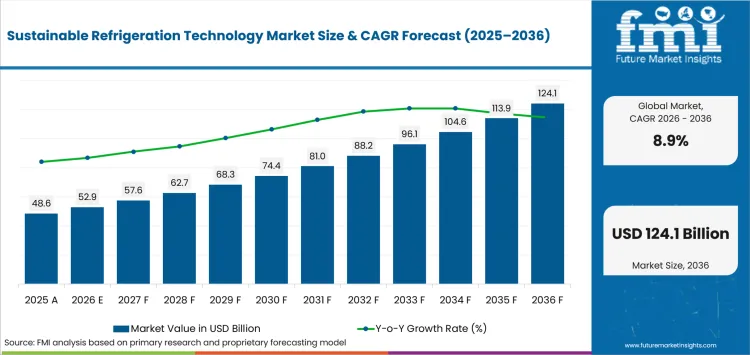
Key Takeaways of Sustainable Refrigeration Technology Market
- HFC restrictions are advancing replacement schedules for lower-GWP refrigeration equipment with verified energy performance and service support.
- CO2 refrigeration technology is projected to account for 56.0% share in 2026 due to its fit across transcritical and cascade architectures.
- Commercial applications are estimated to represent 59.0% share in 2026 as food retailers replace equipment exposed to refrigerant restrictions.
- Equipment is forecast to hold 72.0% share in 2026 because refrigerant conversion requires compatible compressors and control hardware.
- Pressure, flammability and toxicity requirements can delay projects that lack qualified engineering and reliable local service coverage.
- Daikin Industries, Carrier Global, Trane Technologies, Danfoss, Johnson Controls, BITZER, GEA Group and Panasonic Holdings comprise the key players.
Analyst Perspective
"System selection should start with actual site temperatures and refrigerant charge plus available maintenance skills. Strong proposals connect compliant equipment with measured energy performance, safe commissioning and service coverage that protects uptime."
- Nikhil Kaitwade, Principal Consultant, Future Market Insights
How is the Sustainable Refrigeration Technology Market segmented?
The sustainable refrigeration technology market is segmented by type of technology, type of equipment, application, end user, component and region.
The market is segmented by type of technology, type of equipment, application, end user, component and region. Technology covers CO2, ammonia, propane and other routes, while equipment includes chillers, display cabinets, condensing units and cascades. Applications include commercial, industrial and other uses, while end users cover food and beverage, cold chain, healthcare and hospitality and components include equipment and services.
What makes CO2 refrigeration technology central to the type of technology category?
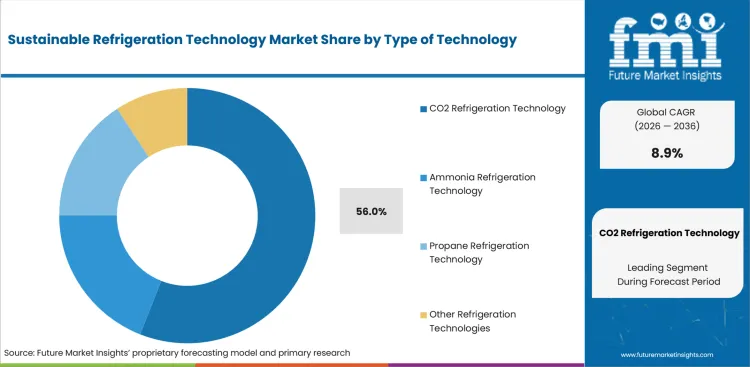
CO2 systems support transcritical retail refrigeration and subcritical cascade duties across mixed-temperature sites that need several temperature levels. Engineers compare pressure design with ambient performance and local refrigeration coolers, while approval also depends on service teams that can manage high operating pressure.
- Based on type of technology, CO2 refrigeration technology is projected to account for 56.0% in 2026 due to broad system compatibility and regulatory alignment.
- Commercial sites adopt CO2 systems where pressure-rated components and trained technicians support safe operation, with transcritical platforms serving retail duties and cascade designs handling lower-temperature loads.
How do engineering teams evaluate chillers within the type of equipment category?
Chillers centralize capacity across facilities with several cooling zones or stable process loads, while air-cooled and water-cooled industrial chillers match heat rejection with ambient conditions and maintenance access.
- By type of equipment, chillers are estimated to hold 27.0% in 2026 owing to one platform serving process and commercial loads with optional heat recovery.
- The United States EPA applies a 700 GWP limit to comfort-cooling chillers from January 2025. Specified process chillers follow from January 2026, linking refrigerant selection with equipment class and commissioning date.
Why do commercial applications shape the application category?
Supermarkets and hospitality sites carry continuous refrigeration loads that allow little tolerance for service disruption. Store planners compare refrigerated display cases with central systems during phased refurbishments that preserve trading continuity and existing floor layouts.
- In 2026, commercial applications are expected to lead the application category with 59.0% share as food retailers replace equipment exposed to refrigerant restrictions.
- The EPA applies a 150 GWP limit to stand-alone retail food equipment from January 2025, requiring compliant cabinets with coordinated installation and service plans.
What role does equipment play within the component category?
Refrigerant conversion changes pressure ratings and compressor selection plus heat-exchanger design, so project teams must coordinate sensors and controls with industrial condensers during major retrofits.
- The component category is forecast to be led by equipment at 72.0% share in 2026 due to compressors, condensers and evaporators carrying most initial value.
- GEA introduced OptiPartner Blu-Red Energy in October 2025 for real-time control across compressors and cooling plants that documents energy savings under changing loads.
What are the drivers, restraints and opportunities in the Sustainable Refrigeration Technology Market?
HFC restrictions accelerate lower-GWP replacement. Natural-refrigerant safety requirements raise engineering and training costs. Integrated controls and heat recovery improve lifecycle economics.
- Driver: HFC schedules change refrigerant availability and equipment specifications during commercial and industrial replacement planning.
- Restraint: Natural refrigerants require site-specific safety controls and technicians qualified for installation and maintenance work.
- Opportunity: Integrated controls and heat recovery lower operating costs and support recurring commissioning plus maintenance revenue.
Regulatory Limits Accelerate Refrigerant Replacement
Compliance dates affect equipment availability for cold-chain automation and refrigeration projects, so operators compare asset life with permitted refrigerants to prevent restricted configurations at commissioning.
Safety Requirements Raise Project Complexity
Natural refrigerants change each site's safety case because CO2 needs pressure-rated components, propane requires ignition controls and ammonia requires toxicity safeguards. Projects slow when local codes or maintenance teams cannot support ventilation, detection and technical insulation requirements.
Integrated Controls Improve Lifecycle Economics
Heat recovery connects refrigeration with site energy planning and commercial heat pumps, while connected controls verify savings and reveal control drift. Equipment manufacturers gain recurring service work by pairing hardware with commissioning and planned retrofits across the installed base.
Which country CAGRs are profiled in the Sustainable Refrigeration Technology Market?
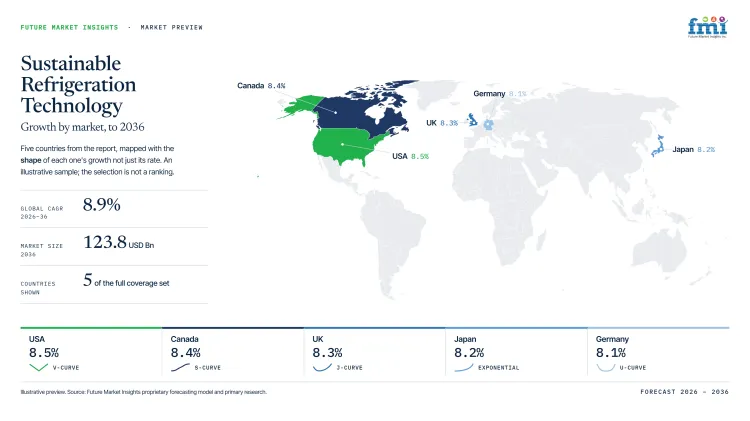
| Country | CAGR |
|---|---|
| South Korea | 9.4% |
| Australia | 8.6% |
| United States | 8.5% |
| United Kingdom | 8.3% |
| Germany | 8.1% |
How do country-level CAGRs compare in the Sustainable Refrigeration Technology Market?
The forecasts span 1.3 percentage points between South Korea and Germany across the assessment period. The range measures forecast pace rather than current size, with policy timing and service access explaining the spacing.
- South Korea advances under lifecycle refrigerant programs that connect equipment conversion with recovery and reclamation requirements.
- Australia follows with a quota schedule that gives equipment owners a defined replacement horizon across long asset lives.
- The United States remains close as compliance dates vary across chillers and retail refrigeration systems during replacement planning.
- The United Kingdom combines HFC reduction targets with leak controls and technician certification across the equipment lifecycle.
- Germany reflects established natural-refrigerant equipment routes alongside detailed project qualification and local service support requirements.
Comparable CAGRs can produce different entry conditions because regulations and service networks vary across every standard FMI region covered by the full report.
Country-wise Analysis
- South Korean agencies link refrigerant recovery with lower-GWP equipment conversion across commercial sites and service networks. South Korea's outlook is anticipated to advance at 9.4% CAGR over the assessment period, reinforced by the June 2026 program for faster recovery equipment and mixed-refrigerant reclamation. The program clarifies redesign and service-record needs, although smaller operators must align testing and handling procedures before routine reclaimed-refrigerant use.
- Australian equipment owners plan replacements against a declining bulk-gas import quota across commercial and industrial assets. Sustainable refrigeration technology sales are forecast to expand at 8.6% CAGR by 2036, supported by a phase-down that provides long-term planning certainty. The schedule supports earlier specifications, although pre-charged equipment sits outside the quota and maintenance coverage can delay remote projects.
- United States projects face separate GWP limits across chillers and retail equipment plus field-assembled systems. The sector is projected to record 8.5% CAGR during the assessment period, shaped by EPA deadlines that vary across equipment classes and installation dates. The rules support product planning, although state codes and technician availability can shift commissioning windows.
- United Kingdom operators manage refrigerant selection alongside leak controls and technician certification across the equipment lifecycle. Adoption is estimated to expand at 8.3% CAGR through 2036, influenced by the official 79% HFC reduction target for 2030. The target supports earlier capital planning, although equipment owners must reconcile product restrictions with available refrigerants and maintenance capacity.
- German commercial refrigeration already uses natural refrigerants across plug-in equipment and expanding condensing-unit plus chiller ranges. Germany is estimated to post 8.1% CAGR over the forecast period, shaped by equipment routes documented in November 2024 guidance. Existing availability reduces uncertainty, although engineering teams must verify pressure safety and efficiency with nearby service capacity.
Who are the notable companies in the Sustainable Refrigeration Technology Market?
Daikin Industries, Ltd., Carrier Global Corporation, Trane Technologies plc, Danfoss A/S, Johnson Controls International plc, BITZER SE, GEA Group AG and Panasonic Holdings Corporation are the notable companies serving this market.
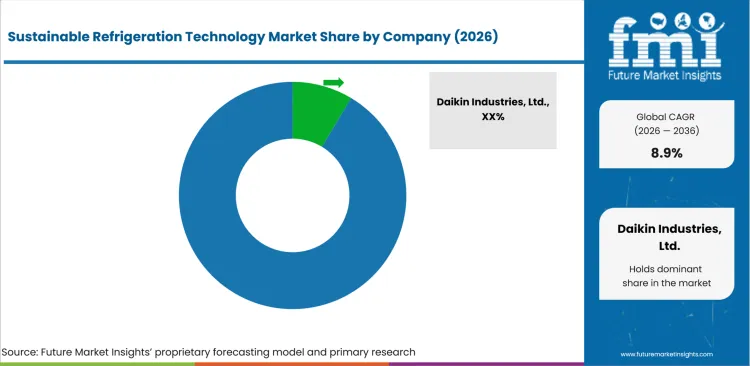
The competitive field combines integrated HVAC-R groups with industrial refrigeration specialists and component manufacturers, while operators compare refrigerant coverage with control compatibility and service reach for food refrigeration equipment.
- Daikin Industries provides commercial system platforms, while Johnson Controls and GEA serve both commercial and industrial natural-refrigerant applications Johnson Controls through its SABROE, FRICK, and YORK brands for ammonia and CO2 refrigeration.
- Carrier and Trane Technologies serve transport or chiller applications, while Panasonic adds European condensing-unit coverage.
- Danfoss and BITZER supply compressor and control packages for CO2 and ammonia systems across commercial applications, including a 4.22 MW BITZER food-processing installation documented in August 2024.
Competitive Benchmarking: Sustainable Refrigeration Technology Market
| Company | Natural-Refrigerant Coverage | Equipment and Controls Breadth | Commercial and Industrial Coverage | Geographic Reach |
|---|---|---|---|---|
| Daikin Industries, Ltd. | Medium | High | High | Global |
| Carrier Global Corporation | Medium | High | High | Global |
| Trane Technologies plc | Medium | High | High | Global |
| Danfoss A/S | High | High | High | Global |
| Johnson Controls International plc | High | High | High | Global |
| BITZER SE | High | Medium | High | Global |
| GEA Group AG | High | High | High | Global |
| Panasonic Holdings Corporation | High | Medium | High | Global |
Key Developments in the Sustainable Refrigeration Technology Market
- In February 2026, Danfoss introduced the Optyma iCO2 condensing unit for transcritical CO2 refrigeration, integrating a Danfoss BOCK® reciprocating semi-hermetic inverter compressor with Danfoss drives, controllers, valves, and a microchannel heat exchanger.
- In October 2025, Carrier Transicold secured a 1,000-unit OptimaLINE order from Great White Fleet with EverFRESH controlled-atmosphere technology for perishable ocean cargo.
- In June 2025, Panasonic announced 70 iCORE and iCOOL condensing-unit models for European retail, hospitality and cold-room applications from October 2025.
Key Players in the Sustainable Refrigeration Technology Market
Integrated Refrigeration and Cold-Chain Platforms
- Daikin Industries, Ltd.
- Carrier Global Corporation
- Trane Technologies plc
- Johnson Controls International plc
- Panasonic Holdings Corporation
Component, Controls and Automation Specialists
- Danfoss A/S
- BITZER SE
Industrial Natural-Refrigerant System Providers
- GEA Group AG
Sustainable Refrigeration Technology Market - Report Scope
| Coverage field | Report scope |
|---|---|
| Market breakdown | By type of technology, type of equipment, application, end user, component and region. |
| Quantitative Units | Revenue in USD billion and CAGR in %. |
| Market Definition | Refrigeration equipment, controls and services using lower-GWP refrigerants across commercial and industrial cooling applications. |
| Regions Covered | North America, Latin America, Western Europe, Eastern Europe, East Asia, South Asia and Pacific and Middle East and Africa. |
| Countries Covered | South Korea, Australia, United States, United Kingdom, Germany and 20+ countries. |
| Key Companies Profiled | Daikin Industries, Carrier Global, Trane Technologies, Danfoss, Johnson Controls, BITZER, GEA Group and Panasonic Holdings. |
| Forecast Period | 2026 to 2036. |
| Approach | Primary and secondary research with market triangulation. |
Sustainable Refrigeration Technology Market - Research Methodology
| Method | Approach |
|---|---|
| Primary Research | FMI analysts gathered input from manufacturers, service providers, technology developers, distributors, end users, procurement teams, and subject-matter experts. Interviews examined purchasing decisions, product or service evaluation, adoption barriers, approval requirements, pricing considerations, and expectations for technical or commercial support. Respondents were also asked what evidence is required before a trial, pilot, or initial order develops into regular purchasing. |
| Desk Research | Desk research covered government statistics, regulatory publications, trade data, industry associations, technical literature, standards, company filings, product information, and official corporate announcements. Sources were reviewed for relevance, publication date, geographic coverage, and consistency with the defined market scope. Claims relating to performance, applications, approvals, capacity, investment, and commercial activity were retained only when supported by credible public evidence. |
| Market Sizing and Forecasting | The market model combined the baseline value with historical performance, segment structure, pricing and volume indicators, adoption levels, company participation, and country-level demand conditions. Forecast assumptions considered economic activity, investment trends, regulatory developments, technology adoption, purchasing cycles, supply availability, and barriers to wider market use. Segment and regional estimates were reconciled before the final market total was calculated. |
| Data Validation | Estimates were checked against multiple independent indicators, including public data, company activity, trade patterns, industry developments, and findings from primary interviews. Validation also tested whether products, services, applications, and company revenues fell within the defined market boundaries. Adjacent categories, unsupported claims, overlapping revenues, and activities without direct market relevance were excluded to reduce double counting and maintain consistency across segments and countries. |
Sustainable Refrigeration Technology Market by Segments
Sustainable Refrigeration Technology Market segmented by Type of Technology:
- CO2 Refrigeration Technology
- Transcritical CO2 Systems
- Subcritical CO2 Cascade Systems
- Ammonia Refrigeration Technology
- Industrial Ammonia Systems
- Ammonia-CO2 Cascade Systems
- Propane Refrigeration Technology
- Propane-Based Commercial Systems
- Propane Heat Pump Systems
- Other Refrigeration Technologies
- Magnetic Refrigeration
- Solar-Assisted Refrigeration
Sustainable Refrigeration Technology Market segmented by Type of Equipment:
- Chillers
- Air-Cooled Chillers
- Water-Cooled Chillers
- Display Cabinets
- Plug-In Display Cabinets
- Remote Display Cabinets
- Condensing Units
- Air-Cooled Condensing Units
- Water-Cooled Condensing Units
- Cascades
- CO2 Cascade Systems
- Ammonia-CO2 Cascade Systems
Sustainable Refrigeration Technology Market segmented by Application:
- Commercial Applications
- Supermarkets & Hypermarkets
- Foodservice & Hospitality
- Industrial Applications
- Food Processing
- Cold Storage & Warehousing
- Other Applications
- Healthcare & Pharmaceuticals
- Transport Refrigeration
Sustainable Refrigeration Technology Market segmented by End User:
- Food & Beverage
- Food Retail
- Food Processing
- Cold Chain & Logistics
- Cold Storage Facilities
- Refrigerated Transport
- Healthcare & Pharmaceuticals
- Hospitals & Clinics
- Pharmaceutical Storage
- Hospitality & Foodservice
- Hotels & Resorts
- Restaurants & Catering
Sustainable Refrigeration Technology Market segmented by Component:
- Equipment
- Compressors
- Condensers & Evaporators
- Services
- Installation & Commissioning
- Maintenance & Retrofit Services
Sustainable Refrigeration Technology Market by Region
- North America
- United States
- Canada
- Mexico
- Latin America
- Brazil
- Chile
- Rest of Latin America
- Western Europe
- Germany
- United Kingdom
- Italy
- Spain
- France
- Nordics
- Benelux
- Rest of Western Europe
- Eastern Europe
- Russia
- Poland
- Hungary
- Balkan and Baltic States
- Rest of Eastern Europe
- East Asia
- China
- Japan
- South Korea
- South Asia and Pacific
- India
- ASEAN
- Australia and New Zealand
- Rest of South Asia and Pacific
- Middle East and Africa
- Kingdom of Saudi Arabia
- Other GCC Countries
- Türkiye
- South Africa
- Other African Union Countries
- Rest of Middle East and Africa
Research Sources and Bibliography
- European Parliament and Council of the European Union. (2024, February 20). Regulation (EU) 2024/573 on fluorinated greenhouse gases.
- Australian Government Department of Climate Change, Energy, the Environment and Water. (2026, June 4). Hydrofluorocarbon (HFC) phase-down.
- German Environment Agency. (2024, November 28). Commercial Refrigeration.
- United States Environmental Protection Agency. (2026, July 8). Technology Transitions HFC Restrictions by Sector.
- GEA Group. (2025, October 23). Energy optimization for heating and cooling systems.
- Ministry of Climate, Energy and Environment, Republic of Korea. (2026, June 21). Next-generation refrigerant and reclaimed-refrigerant technology development program.
- Environment Agency and Department for Environment, Food & Rural Affairs. (2024, February 7). Fluorinated gases (F gases).
- BITZER. (2024, August). Natural refrigerants for food processing facility.
- Danfoss. (2026, February 9). Danfoss Optyma iCO2 condensing unit provides effective CO2 transcritical refrigeration in a range of climates.
- Carrier Global Corporation. (2025, October 23). Carrier Transicold secures 1,000-unit order from Great White Fleet for OptimaLINE with EverFRESH.
- Panasonic Corporation. (2025, June 26). Panasonic boosts expansion of condensing unit business in Europe.
This bibliography is provided for reader reference and is not exhaustive. The full report contains the complete reference list and detailed citations
This Report Answers
- How large is the sustainable refrigeration technology market in 2026 and 2036?
- Which refrigerant rules are changing replacement schedules?
- Why does CO2 refrigeration technology hold the leading share?
- How do chillers influence equipment selection?
- Which safety requirements limit natural-refrigerant adoption?
- How do country growth conditions differ?
- Which companies serve systems, components and cold-chain applications?
- Which developments are changing commercial availability?
Frequently Asked Questions
How big is the sustainable refrigeration technology market in 2026?
The sustainable refrigeration technology market is estimated at USD 52.9 billion in 2026 and is projected to reach USD 124.1 billion by 2036. Growth is driven by refrigerant regulations, equipment replacement cycles, and demand for energy-efficient cooling systems.
What is the CAGR of the sustainable refrigeration technology market from 2026 to 2036?
The sustainable refrigeration technology market is projected to grow at a CAGR of 8.9% between 2026 and 2036. Expansion is supported by the adoption of low-GWP refrigerants and increasing investments in energy-efficient refrigeration infrastructure.
Which technology segment is projected to account for 56.0% of the sustainable refrigeration technology market?
CO₂ refrigeration technology is projected to account for 56.0% of the market in 2026. Its leading position reflects growing adoption in commercial and industrial refrigeration applications due to its low environmental impact and regulatory compliance.
How much value is the sustainable refrigeration technology market projected to add between 2026 and 2036?
The sustainable refrigeration technology market is expected to add USD 70.87 billion in value between 2026 and 2036. This growth is supported by rising investments in advanced refrigeration equipment, controls, and servicing solutions.
Which companies are active in the sustainable refrigeration technology market?
Key companies operating in the market include Daikin Industries, Carrier Global, Trane Technologies, Danfoss, Johnson Controls, BITZER, GEA Group, and Panasonic Holdings. These companies provide refrigeration equipment, controls, and cold-chain solutions across major global markets.
Preview the report firsthand - request a free sample
Get SampleGet the brochure for pricing and purchase details.
Get PDFTable of Content
- Key Takeaways
- Market Size and CAGR
- Top Growth Driver
- Fastest Growing Segment
- Leading Region
- Key Companies
- Emerging Opportunities
- Executive Summary
- Global Market Outlook
- Demand-side Trends
- Supply-side Trends
- Technology Roadmap Analysis
- Analysis and Recommendations
- Analyst Perspective (What is happening? Why now? What should investors know?)
- Key Questions Answered
- How large is the market?
- What is the CAGR?
- What are key trends?
- Which region dominates?
- Who are the leaders?
- Market Overview
- Market Coverage / Taxonomy
- Market Definition / Scope / Limitations
- Research Methodology
- Chapter Orientation
- Analytical Lens and Working Hypotheses
- Market Structure, Signals, and Trend Drivers
- Benchmarking and Cross-market Comparability
- Market Sizing, Forecasting, and Opportunity Mapping
- Research Design and Evidence Framework
- Desk Research Programme (Secondary Evidence)
- Expert Input and Fieldwork (Primary Evidence)
- Tooling, Models, and Reference Databases
- Data Engineering and Model Build
- Quality Assurance and Audit Trail
- Market Background
- Market Dynamics (Drivers, Restraints, Opportunity, Trends)
- Scenario Forecast (Optimistic, Likely, Conservative)
- Impact Analysis
- AI Impact
- Sustainability Impact
- Regulatory Impact
- Technology Impact
- Consumer / Buyer Analysis
- Purchase Drivers
- Adoption Barriers
- Buyer Journey
- Opportunity Map Analysis
- Product Life Cycle Analysis
- Supply Chain Analysis
- Investment Feasibility Matrix
- Value Chain Analysis
- PESTLE and Porter's Analysis
- Regulatory Landscape
- Regional Parent Market Outlook
- Production and Consumption Statistics
- Import and Export Statistics
- Global Market Analysis and Forecast, 2021 to 2036
- Historical Market Size Value (USD Billion) Analysis, 2021 to 2025
- Current and Future Market Size Value (USD Billion) Projections, 2026 to 2036
- Y-o-Y Growth Trend Analysis
- Absolute $ Opportunity Analysis
- Global Market Pricing Analysis, 2021 to 2036
- Global Market Analysis and Forecast, By Type of Technology, 2021 to 2036
- Introduction / Key Findings
- Historical Market Size Value (USD Billion) Analysis By Type of Technology, 2021 to 2025
- Current and Future Market Size Value (USD Billion) Analysis and Forecast By Type of Technology, 2026 to 2036
- CO2 Refrigeration Technology
- Transcritical CO2 Systems
- Subcritical CO2 Cascade Systems
- Ammonia Refrigeration Technology
- Industrial Ammonia Systems
- Ammonia-CO2 Cascade Systems
- Propane Refrigeration Technology
- Propane-Based Commercial Systems
- Propane Heat Pump Systems
- Other Refrigeration Technologies
- Magnetic Refrigeration
- Solar-Assisted Refrigeration
- CO2 Refrigeration Technology
- Y-o-Y Growth Trend Analysis By Type of Technology, 2021 to 2025
- Absolute $ Opportunity Analysis By Type of Technology, 2026 to 2036
- Global Market Analysis and Forecast, By Type of Equipment, 2021 to 2036
- Introduction / Key Findings
- Historical Market Size Value (USD Billion) Analysis By Type of Equipment, 2021 to 2025
- Current and Future Market Size Value (USD Billion) Analysis and Forecast By Type of Equipment, 2026 to 2036
- Chillers
- Air-Cooled Chillers
- Water-Cooled Chillers
- Display Cabinets
- Plugin Display Cabinets
- Remote Display Cabinets
- Condensing Units
- Air-Cooled Condensing Units
- Water-Cooled Condensing Units
- Cascades
- CO2 Cascade Systems
- Ammonia-CO2 Cascade Systems
- Chillers
- Y-o-Y Growth Trend Analysis By Type of Equipment, 2021 to 2025
- Absolute $ Opportunity Analysis By Type of Equipment, 2026 to 2036
- Global Market Analysis and Forecast, By Application, 2021 to 2036
- Introduction / Key Findings
- Historical Market Size Value (USD Billion) Analysis By Application, 2021 to 2025
- Current and Future Market Size Value (USD Billion) Analysis and Forecast By Application, 2026 to 2036
- Commercial Applications
- Supermarkets & Hypermarkets
- Foodservice & Hospitality
- Industrial Applications
- Food Processing
- Cold Storage & Warehousing
- Other Applications
- Healthcare & Pharmaceuticals
- Transport Refrigeration
- Commercial Applications
- Y-o-Y Growth Trend Analysis By Application, 2021 to 2025
- Absolute $ Opportunity Analysis By Application, 2026 to 2036
- Global Market Analysis and Forecast, By End User, 2021 to 2036
- Introduction / Key Findings
- Historical Market Size Value (USD Billion) Analysis By End User, 2021 to 2025
- Current and Future Market Size Value (USD Billion) Analysis and Forecast By End User, 2026 to 2036
- Food & Beverage
- Food Retail
- Food Processing
- Cold Chain & Logistics
- Cold Storage Facilities
- Refrigerated Transport
- Healthcare & Pharmaceuticals
- Hospitals & Clinics
- Pharmaceutical Storage
- Hospitality & Foodservice
- Hotels & Resorts
- Restaurants & Catering
- Food & Beverage
- Y-o-Y Growth Trend Analysis By End User, 2021 to 2025
- Absolute $ Opportunity Analysis By End User, 2026 to 2036
- Global Market Analysis and Forecast, By Component, 2021 to 2036
- Introduction / Key Findings
- Historical Market Size Value (USD Billion) Analysis By Component, 2021 to 2025
- Current and Future Market Size Value (USD Billion) Analysis and Forecast By Component, 2026 to 2036
- Equipment
- Compressors
- Condensers & Evaporators
- Services
- Installation & Commissioning
- Maintenance & Retrofit Services
- Equipment
- Y-o-Y Growth Trend Analysis By Component, 2021 to 2025
- Absolute $ Opportunity Analysis By Component, 2026 to 2036
- Global Market Analysis and Forecast, By Region, 2021 to 2036
- Introduction
- Historical Market Size Value (USD Billion) Analysis By Region, 2021 to 2025
- Current Market Size Value (USD Billion) Analysis and Forecast By Region, 2026 to 2036
- North America
- Latin America
- Western Europe
- Eastern Europe
- East Asia
- South Asia and Pacific
- Middle East & Africa
- Market Attractiveness Analysis By Region
- North America Market Analysis and Forecast, By Country, 2021 to 2036
- Historical Market Size Value (USD Billion) Trend Analysis By Market Taxonomy, 2021 to 2025
- Market Size Value (USD Billion) Forecast By Market Taxonomy, 2026 to 2036
- By Country
- USA
- Canada
- By Type of Technology
- By Type of Equipment
- By Application
- By End User
- By Component
- By Country
- Market Attractiveness Analysis
- By Country
- By Type of Technology
- By Type of Equipment
- By Application
- By End User
- By Component
- Key Takeaways
- Latin America Market Analysis and Forecast, By Country
- Historical Market Size Value (USD Billion) Trend Analysis By Market Taxonomy, 2021 to 2025
- Market Size Value (USD Billion) Forecast By Market Taxonomy, 2026 to 2036
- By Country
- Brazil
- Mexico
- Chile
- Rest of Latin America
- By Type of Technology
- By Type of Equipment
- By Application
- By End User
- By Component
- By Country
- Market Attractiveness Analysis
- By Country
- By Type of Technology
- By Type of Equipment
- By Application
- By End User
- By Component
- Key Takeaways
- Western Europe Market Analysis and Forecast, By Country
- Historical Market Size Value (USD Billion) Trend Analysis By Market Taxonomy, 2021 to 2025
- Market Size Value (USD Billion) Forecast By Market Taxonomy, 2026 to 2036
- By Country
- Germany
- UK
- Italy
- Spain
- France
- Nordic
- BENELUX
- Rest of Western Europe
- By Type of Technology
- By Type of Equipment
- By Application
- By End User
- By Component
- By Country
- Market Attractiveness Analysis
- By Country
- By Type of Technology
- By Type of Equipment
- By Application
- By End User
- By Component
- Key Takeaways
- Eastern Europe Market Analysis and Forecast, By Country
- Historical Market Size Value (USD Billion) Trend Analysis By Market Taxonomy, 2021 to 2025
- Market Size Value (USD Billion) Forecast By Market Taxonomy, 2026 to 2036
- By Country
- Russia
- Poland
- Hungary
- Balkan & Baltic
- Rest of Eastern Europe
- By Type of Technology
- By Type of Equipment
- By Application
- By End User
- By Component
- By Country
- Market Attractiveness Analysis
- By Country
- By Type of Technology
- By Type of Equipment
- By Application
- By End User
- By Component
- Key Takeaways
- East Asia Market Analysis and Forecast, By Country
- Historical Market Size Value (USD Billion) Trend Analysis By Market Taxonomy, 2021 to 2025
- Market Size Value (USD Billion) Forecast By Market Taxonomy, 2026 to 2036
- By Country
- China
- Japan
- South Korea
- By Type of Technology
- By Type of Equipment
- By Application
- By End User
- By Component
- By Country
- Market Attractiveness Analysis
- By Country
- By Type of Technology
- By Type of Equipment
- By Application
- By End User
- By Component
- Key Takeaways
- South Asia and Pacific Market Analysis and Forecast, By Country
- Historical Market Size Value (USD Billion) Trend Analysis By Market Taxonomy, 2021 to 2025
- Market Size Value (USD Billion) Forecast By Market Taxonomy, 2026 to 2036
- By Country
- India
- ASEAN
- Australia & New Zealand
- Rest of South Asia and Pacific
- By Type of Technology
- By Type of Equipment
- By Application
- By End User
- By Component
- By Country
- Market Attractiveness Analysis
- By Country
- By Type of Technology
- By Type of Equipment
- By Application
- By End User
- By Component
- Key Takeaways
- Middle East & Africa Market Analysis and Forecast, By Country
- Historical Market Size Value (USD Billion) Trend Analysis By Market Taxonomy, 2021 to 2025
- Market Size Value (USD Billion) Forecast By Market Taxonomy, 2026 to 2036
- By Country
- Kingdom of Saudi Arabia
- Other GCC Countries
- Türkiye
- South Africa
- Other African Union
- Rest of Middle East & Africa
- By Type of Technology
- By Type of Equipment
- By Application
- By End User
- By Component
- By Country
- Market Attractiveness Analysis
- By Country
- By Type of Technology
- By Type of Equipment
- By Application
- By End User
- By Component
- Key Takeaways
- Key Countries Market Analysis
- USA
- Pricing Analysis
- Market Share Analysis, 2025
- By Type of Technology
- By Type of Equipment
- By Application
- By End User
- By Component
- Canada
- Pricing Analysis
- Market Share Analysis, 2025
- By Type of Technology
- By Type of Equipment
- By Application
- By End User
- By Component
- Mexico
- Pricing Analysis
- Market Share Analysis, 2025
- By Type of Technology
- By Type of Equipment
- By Application
- By End User
- By Component
- Brazil
- Pricing Analysis
- Market Share Analysis, 2025
- By Type of Technology
- By Type of Equipment
- By Application
- By End User
- By Component
- Chile
- Pricing Analysis
- Market Share Analysis, 2025
- By Type of Technology
- By Type of Equipment
- By Application
- By End User
- By Component
- Germany
- Pricing Analysis
- Market Share Analysis, 2025
- By Type of Technology
- By Type of Equipment
- By Application
- By End User
- By Component
- UK
- Pricing Analysis
- Market Share Analysis, 2025
- By Type of Technology
- By Type of Equipment
- By Application
- By End User
- By Component
- Italy
- Pricing Analysis
- Market Share Analysis, 2025
- By Type of Technology
- By Type of Equipment
- By Application
- By End User
- By Component
- Spain
- Pricing Analysis
- Market Share Analysis, 2025
- By Type of Technology
- By Type of Equipment
- By Application
- By End User
- By Component
- France
- Pricing Analysis
- Market Share Analysis, 2025
- By Type of Technology
- By Type of Equipment
- By Application
- By End User
- By Component
- India
- Pricing Analysis
- Market Share Analysis, 2025
- By Type of Technology
- By Type of Equipment
- By Application
- By End User
- By Component
- ASEAN
- Pricing Analysis
- Market Share Analysis, 2025
- By Type of Technology
- By Type of Equipment
- By Application
- By End User
- By Component
- Australia & New Zealand
- Pricing Analysis
- Market Share Analysis, 2025
- By Type of Technology
- By Type of Equipment
- By Application
- By End User
- By Component
- China
- Pricing Analysis
- Market Share Analysis, 2025
- By Type of Technology
- By Type of Equipment
- By Application
- By End User
- By Component
- Japan
- Pricing Analysis
- Market Share Analysis, 2025
- By Type of Technology
- By Type of Equipment
- By Application
- By End User
- By Component
- South Korea
- Pricing Analysis
- Market Share Analysis, 2025
- By Type of Technology
- By Type of Equipment
- By Application
- By End User
- By Component
- Russia
- Pricing Analysis
- Market Share Analysis, 2025
- By Type of Technology
- By Type of Equipment
- By Application
- By End User
- By Component
- Poland
- Pricing Analysis
- Market Share Analysis, 2025
- By Type of Technology
- By Type of Equipment
- By Application
- By End User
- By Component
- Hungary
- Pricing Analysis
- Market Share Analysis, 2025
- By Type of Technology
- By Type of Equipment
- By Application
- By End User
- By Component
- Kingdom of Saudi Arabia
- Pricing Analysis
- Market Share Analysis, 2025
- By Type of Technology
- By Type of Equipment
- By Application
- By End User
- By Component
- Türkiye
- Pricing Analysis
- Market Share Analysis, 2025
- By Type of Technology
- By Type of Equipment
- By Application
- By End User
- By Component
- South Africa
- Pricing Analysis
- Market Share Analysis, 2025
- By Type of Technology
- By Type of Equipment
- By Application
- By End User
- By Component
- USA
- Market Structure Analysis
- Competition Dashboard
- Competition Benchmarking
- Market Share Analysis of Top Players
- By Regional
- By Type of Technology
- By Type of Equipment
- By Application
- By End User
- By Component
- Emerging Startups
- Innovation Benchmarking
- Competition Analysis
- Competition Deep Dive
- Daikin Industries, Ltd.
- Overview
- Product Portfolio
- Profitability by Market Segments
- Sales Footprint
- Strategy Overview
- Marketing Strategy
- Product Strategy
- Channel Strategy
- Carrier Global Corporation
- Trane Technologies plc
- Danfoss A/S
- Johnson Controls International plc
- Emerson Electric Co.
- BITZER SE
- GEA Group AG
- Mayekawa MFG. Co., Ltd.
- Panasonic Holdings Corporation
- Others
- Daikin Industries, Ltd.
- Case Studies
- Success Stories
- Recent Developments
- Competition Deep Dive
- Assumptions & Acronyms Used


