

- Market Size (2026)
- USD 1.7 Bn
- Forecast (2036)
- USD 6.9 Bn
- CAGR (2026 to 2036)
- 15.0%
How big is Cold-Chain & Frozen Warehouse Automation Market in 2026?
USD 1.7 billion in 2026 and USD 6.9 billion by 2036 at a 15.0% CAGR.
Sales in cold-chain & frozen warehouse automation market are forecast to rise from USD 1.7 billion in 2026 to USD 6.9 billion by 2036, driven by the rising cost of cold storage and the need to use each cooled cubic foot more productively. The USA Department of Agriculture's National Agricultural Statistics Service (USDA NASS) reported in February 2026 that refrigerated warehouses provided 3.99 billion cubic feet of gross capacity on October 1 2025. That scale creates a broad modernization base for high-bay storage, automated pallet transfer and control software that protects stock rotation.
National investment patterns differ because cold-storage networks have different building ages and food-distribution roles across regions. China’s projects often add high-capacity hubs near food production and urban demand, whereas USA projects frequently modernize existing refrigerated sites or build contract facilities for named food producers. The Office of the Governor of Maryland announced in May 2025 that NewCold was investing more than USD 275 million in a temperature-controlled automated warehouse in Hagerstown. That commitment shows why warehouse robotics must be assessed with building design and customer volume rather than as a stand-alone equipment purchase. Project teams must coordinate pallet profiles with freezer doors and software interfaces before finalizing maintenance access.
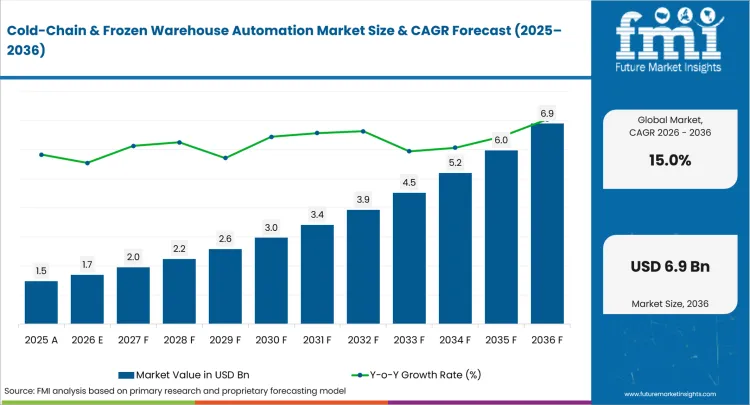
Key Takeaways of Cold-Chain & Frozen Warehouse Automation Market
- Demand for cold-chain and frozen warehouse automation is driven by cold-storage economics connecting building density with labor exposure and inventory control, as high-bay storage delays costly building expansion at busy food distribution sites.
- By component, hardware is expected to lead with 64.0% share in 2026, as cold-rated racks and cranes carry much of the initial installed value.
- Frozen food DCs are the dominant application segment, projected to hold 42.0% share in 2026, driven by steady inbound loads and outbound waves tied to promotions or seasonal consumption.
- Deep-freeze rated ASRS is estimated to lead the system type category with 38.0% share in 2026, forming the fixed core of many frozen facilities through full-pallet storage.
- Automated pallet transfer reduces routine travel through sub-zero aisles, letting trained staff focus on inspections, damaged loads, and operating exceptions, while control software supports lot- and expiry-based rotation.
- The United States is expected to lead growth at 16.0% CAGR through 2036, while European projects require early refrigeration-controls alignment, Japan rewards compact designs, and India favors phased projects amid uneven infrastructure.
- Competition centers on Daifuku, Swisslog, Dematic, Cimcorp, System Logistics, AutoStore, SSI SCHAEFER, and Mecalux, with vendors differentiating through integrated project delivery, food handling specialization, compact grid storage, and deep-freeze shuttle systems.
Analyst Perspective
"Cold-chain warehouse automation delivers lasting value when operational continuity is maintained under demanding frozen-storage conditions rather than when systems simply achieve higher handling speeds. Operators are placing greater emphasis on fault recovery, uninterrupted inventory access, and phased implementation strategies that protect outbound fulfillment during facility upgrades. The competitive landscape will increasingly favor automation providers that design for maintainability, simplify servicing in low-temperature environments, and help customers balance storage density with long-term operational resilience."
- Nikhil Kaitwade, Principal Analyst at Future Market Insights
How is the Cold-Chain & Frozen Warehouse Automation Market segmented?
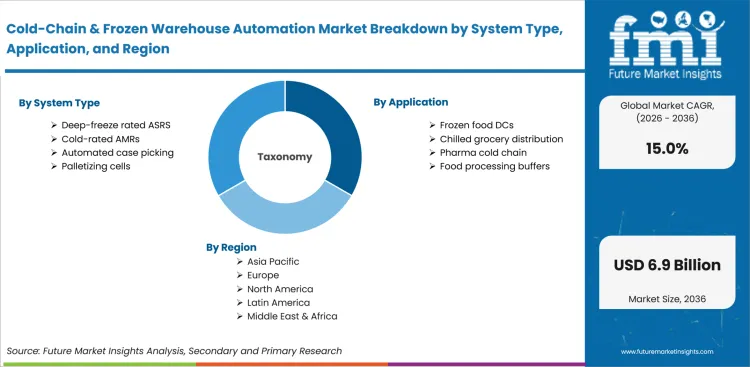
The Cold-Chain & Frozen Warehouse Automation Market is segmented by system type, application, component, end-use industry, sales channel and region.
The cold-chain & frozen warehouse automation market is segmented by system type, application, component, end-use industry, sales channel and region. System Type distinguishes high-bay pallet storage from mobile transport and automated case handling inside controlled-temperature facilities. Application analysis separates frozen food distribution from chilled grocery and pharmaceutical storage with different rotation needs. Component analysis shows how project value is divided between machinery and software or lifecycle services. End-use Industry identifies the operating setting that creates repeated handling work, whereas Sales Channel shows who carries responsibility for delivery. Regional analysis links each project to refrigerated capacity and local investment conditions.
What makes deep-freeze rated ASRS central to the System Type category?
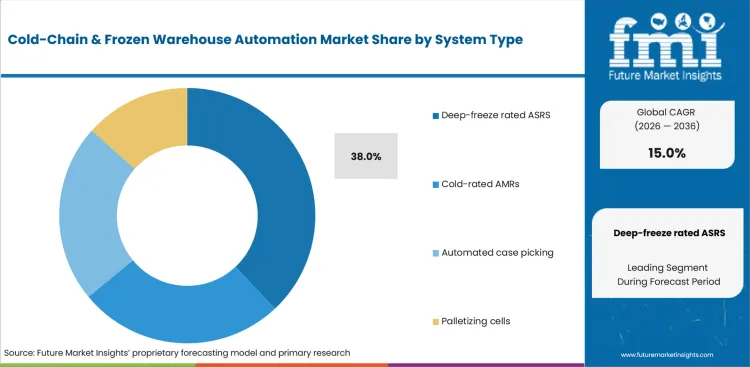
Deep-freeze rated ASRS suits facilities that hold full pallets through long storage cycles inside tall aisles. USDA NASS reported in February 2026 that 275 USA refrigerated warehouses had at least 5 million cubic feet of gross capacity during 2025. Large buildings can gain more usable positions by reducing travel aisles and using multi-depth storage. Cold-chain monitoring software then links each pallet position with temperature history and expiry rules across routine storage and urgent lot reviews.
- Deep-freeze rated ASRS is projected to hold 38.0% of System Type revenue in 2026. Its dominance comes from repeated full-pallet movement at frozen food sites that need dense storage and controlled retrieval. The system also reduces employee journeys through long freezer aisles while preserving accurate lot access during outbound peaks.
- Large refrigerated warehouses evaluate crane speed together with low-temperature lubrication and condensation control across the full operating range. Repair access carries equal commercial weight because maintenance teams need to reach critical equipment without exposing inventory or stopping several aisles.
How does the Frozen food DC application shape demand?
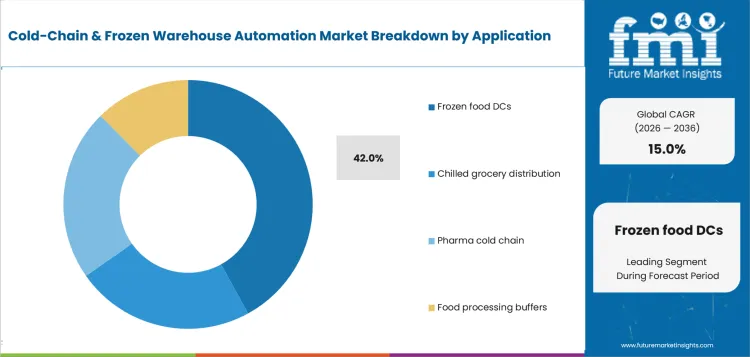
Frozen food DCs combine long holding periods with release peaks linked to promotions and seasonal demand. USDA NASS stated in February 2026 that freezer space represented 79% of usable USA refrigerated capacity during 2025. That mix favors systems that release full pallets in planned waves and preserve clear lot rotation. Autonomous mobile robots can support transfer routes near receiving or staging without fixing every movement to a conveyor.
- Based on application, frozen food DCs are estimated to account for 42.0% share in 2026. Uniform pallets and cartons support repeatable handling from receipt through storage across long holding periods. This operating pattern gives distribution managers more reason to automate location control across thousands of frozen stock positions without relying on manual checks during busy release periods.
- Distribution centers need buffers between high-bay retrieval and truck loading because outbound work rarely runs at the same pace as the storage system. Flexible transport serves those buffers and helps supervisors redirect loads during unexpected dock delays in real time. This flexibility protects loading schedules despite changing truck arrival patterns and preserves the fixed freezer rack layout.
How are Hardware, Food & beverage and Direct positioned in their categories?
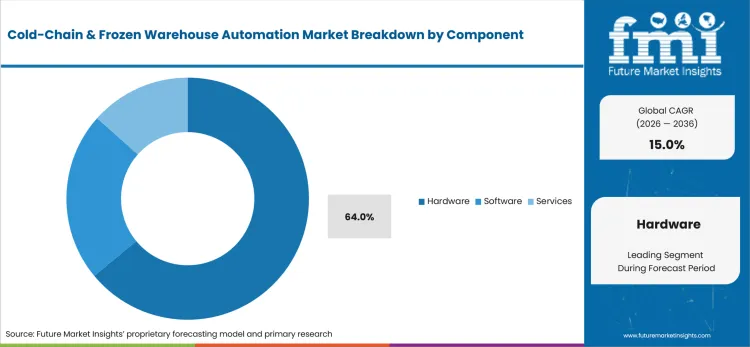
Hardware carries much of the initial project value because the storage frame and cold-rated machines must operate as one physical system. NewCold reported in June 2025 that its Corby 3 expansion added more than 33,000 automated cold-storage pallet positions and raised the company’s United Kingdom network above 185,000 positions. The expansion shows how a high-volume food network can align the building, storage equipment and control layer under one delivery plan.
- In 2026, hardware is expected to represent 64.0% of component revenue, reflecting the significant investment required for cold-rated automation systems and the intensive pallet and case throughput characteristic of large-scale refrigerated and frozen warehouse operations.
- Integrators remain useful for retrofits that connect palletizing robots or specialist transport equipment with an operating freezer. This approach can preserve outbound work through a staged controls change at an active refrigerated distribution center.
What are the drivers, restraints and opportunities in the Cold-Chain & Frozen Warehouse Automation Market?
Dense storage and worker protection support investment. Integration risk and refrigeration rules can delay projects. Flexible transport and lifecycle service create phased expansion options.
- Driver: High-bay automation can add pallet positions inside a fixed refrigerated volume and reduce routine freezer travel. The economic case becomes clearer at food hubs with steady annual throughput and limited room for a wider building.
- Restraint: Refrigeration and automation share structural space with electrical capacity and maintenance routes inside the same controlled-temperature building. A late design change can affect several systems and create shutdown risk during commissioning at a site that must continue dispatching frozen orders.
- Opportunity: Cold-rated mobile transport and remote service can extend automation in stages beyond the central storage rack. This approach suits operating warehouses that need measurable gains without replacing each connected process during one capital project.
Large projects make the storage-density case measurable by tying substantial pallet capacity to a defined automated design. NewCold announced in February 2026 that its fully automated frozen facility in McDonough, Georgia would provide 125,000 pallet positions and automated layer picking. The project converts demand for dense storage into a defined operating design rather than a broad construction plan. Similar investments favor automation partners that can link high-bay retrieval with outbound preparation and support the facility through commissioning.
Integration risk rises because the warehouse layout and refrigeration system cannot be planned independently inside a frozen facility. European Commission guidance updated in April 2025 states that self-contained industrial refrigeration equipment with a global warming potential of 150 or more has been prohibited since January 1 2025, subject to stated derogations. The selected refrigerant can change equipment clearances and service routes, so project teams need an early specification that prevents later redesign of controls and maintenance access.
Phased automation creates an opening for mobile transport, software upgrades and service contracts at warehouses that cannot support a complete rebuild. Cold-rated robots can connect receiving and inspection areas with staging lanes around a fixed storage core. Retail warehouse management systems can coordinate release rules and record equipment exceptions across those processes. The commercial opportunity belongs to firms that can add one useful workflow at a time and prove that each stage improves access, rotation or dispatch reliability.
Which country CAGRs are profiled in the Cold-Chain & Frozen Warehouse Automation Market?
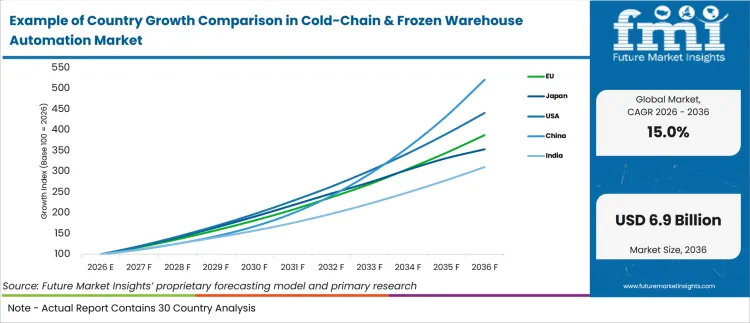
| Country | CAGR |
|---|---|
| United States | 16.0% |
| European Union | 14.5% |
| Japan | 13.5% |
Source: FMI's proprietary forecasting model and primary research.
How do country-level CAGRs compare in the Cold-Chain & Frozen Warehouse Automation Market?
The comparison covers a 2.5 percentage point range across the cold-chain & frozen warehouse automation market. The United States records the highest CAGR at 16.0%, followed by the European Union at 14.5% and Japan at 13.5%. The relatively narrow spread indicates that investment in warehouse automation for temperature-controlled logistics is progressing across all three markets, although the pace differs.
- The United States leads with a CAGR of 16.0%. Cold-storage operators are expanding warehouse automation to improve inventory movement, order fulfillment and material handling in temperature-controlled facilities while reducing manual operations in frozen environments.
- The European Union follows at 14.5%, 1.5 percentage points below the United States. Investment is directed toward automated storage, robotic handling and warehouse management technologies for cold-chain operations. Deployment differs among member states because logistics infrastructure, food distribution networks and capital investment priorities are not uniform.
- Japan records a CAGR of 13.5%, 1.0 percentage point behind the European Union. Warehouse operators continue adopting automation to improve space utilization, maintain efficient product flow and support reliable handling of refrigerated and frozen goods across distribution facilities.
Comparable CAGRs do not indicate identical market conditions. Differences in cold-chain infrastructure, warehouse modernization strategies, operating costs and automation investment influence deployment patterns and long-term commercial opportunities. The full report provides country-level CAGR analysis across North America, Latin America, Europe, East Asia, South Asia, Oceania and the Middle East and Africa.
Country-wise Analysis
Country growth depends on the balance between new construction and retrofit work across each refrigerated logistics network. The United States combines public cold stores with dedicated facilities, whereas European Union projects give refrigeration choices greater influence over automation design. Japan places more value on compact equipment that fits established sites, which changes how project teams compare pallet density with service access during modernization.
- The United States has a mature refrigerated warehouse base in which public facilities often serve several food companies from one site. From 2026 to 2036, the USA sector is anticipated to advance at a 16.0% CAGR, reflecting modernization needs and dedicated automated projects. USDA NASS reported in February 2026 that public warehouses represented 62% of USA gross refrigerated capacity during 2025. Multi-client operations need strong inventory separation and reliable fault recovery because one control failure can affect several customer accounts. Project reviews should test software interfaces and spare-parts response instead of comparing nominal crane speed in isolation. Reliable recovery can create a stronger commercial advantage than a small throughput difference across a shared cold-storage network.
- European Union projects must coordinate dense storage with refrigeration requirements and energy targets from the first design stage. The European Union is estimated to record a 14.5% CAGR during the forecast period, shaped by high land costs and investment in lower-energy facilities. Engineering firms need to prove that controls and service access remain practical under the selected refrigerant system. Energy performance can influence supplier selection alongside storage capacity and planned throughput for the completed facility.
- Japan rewards compact automation that can modernize established refrigerated buildings without requiring a broad greenfield site. Automation adoption in Japan is forecast to rise at a 13.5% CAGR from 2026 to 2036, supported by labor constraints and dense food distribution. Japan's Ministry of Land, Infrastructure, Transport and Tourism reported in March 2025 that 1,264 refrigerated warehouse businesses managed 35.898 million cubic meters during fiscal 2023. The number of businesses makes standard service coverage and retrofit planning commercially important across the installed base. Local operators need equipment that fits around existing docks and refrigeration rooms without weakening maintenance access during a fault. Modular layouts with dependable domestic support can reduce disruption across modernization projects that cannot suspend daily food dispatch.
-
Who are the notable companies in the Cold-Chain & Frozen Warehouse Automation Market?
Daifuku, Swisslog, Dematic, Cimcorp, System Logistics, AutoStore, SSI SCHAEFER and Mecalux are notable companies in the Cold-Chain & Frozen Warehouse Automation Market.
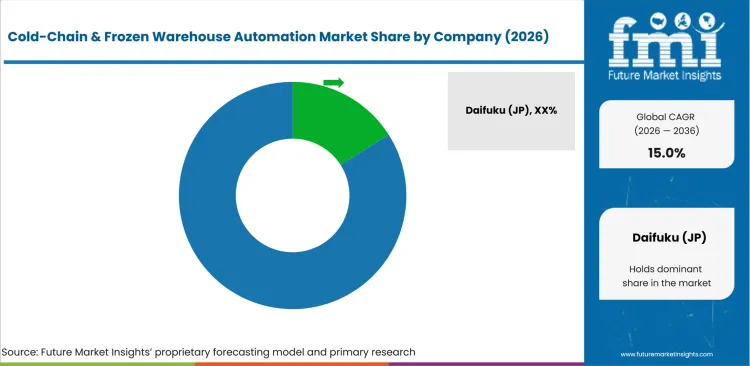
Competition spans integrated warehouse projects and specialist systems for pallet storage or crate handling across refrigerated facilities. Order-picking tools and control software add separate choices that depend on each facility’s load profile. Daifuku and Swisslog cover several parts of the refrigerated workflow, whereas Cimcorp and System Logistics apply narrower food-handling expertise. AutoStore extends compact grid storage into frozen operations, whereas SSI SCHAEFER provides deep-freeze shuttle options for pallet channels. Mecalux connects automated pallet storage with warehouse software across chilled and frozen facilities at operating sites. The choice between broad storage and handling equipment portfolios and specialist designs depends on the load profile. Reliable inventory management software becomes commercially important once several machines share location and release decisions.
- Integrated project delivery: Daifuku and Swisslog connect high-bay pallet storage with transfer equipment and warehouse controls. Their commercial role becomes especially relevant at large freezer sites that need one engineering plan for equipment interfaces and commissioning. That coordinated plan must support later service and fault recovery across the complete frozen storage flow.
- Food-workflow specialization: Cimcorp applies robotic handling to dairy and fresh-food crates, whereas System Logistics supplies frozen pallet storage and mixed-pallet preparation. Dematic adds guided picking and automated transfer tools, which gives project teams different routes for matching equipment to the refrigerated workflow.
- Dense-storage alternatives: AutoStore extends grid storage into frozen operations, whereas SSI SCHAEFER offers deep-freeze pallet shuttles for dense channels. Mecalux supplies automated pallet warehouses with control software, giving project teams a third route for matching case access with full-pallet throughput across refrigerated facilities.
Competitive Benchmarking: Cold-Chain & Frozen Warehouse Automation Market
| Company | Pallet AS/RS | Case or crate handling | Warehouse controls | Geographic Reach |
|---|---|---|---|---|
| Daifuku | High | Medium | High | High |
| Swisslog | High | High | High | High |
| Dematic | Medium | High | High | High |
| Cimcorp | Low | High | High | Medium |
| System Logistics | High | High | High | Medium |
| AutoStore | Low | High | High | High |
| SSI SCHAEFER | High | Medium | High | High |
| Mecalux | High | Medium | High | Medium |
Scoring basis: High indicates verified direct capability across the stated dimension, whereas Medium reflects a narrower capability or one supported through partners. Low indicates limited direct evidence within this specific market and does not imply weak performance in unrelated warehouse applications.
Source: Future Market Insights competitive analysis, 2026. Ratings reflect verified portfolio relevance, cold-storage workflow fit and official company evidence.
Key Developments in the Cold-Chain & Frozen Warehouse Automation Market
- In October 2025, Swisslog announced an automated frozen food warehouse for Orto Verde in the Italian city of Senigallia. The design combines 19,700 pallet locations with three Vectura S32 multi-depth stacker cranes that support dense frozen storage. A monorail link and SynQ control software connect production with shipping buffers under one coordinated operating plan. Completion is scheduled for 2027, giving Orto Verde a defined route from production into frozen dispatch.
- In October 2025, AutoStore introduced a Frozen-Only Grid for frozen grocery and healthcare operations within its Fall 2025 product portfolio. The dedicated configuration extends grid-based storage into frozen operations while reducing routine worker exposure inside temperature-controlled space. The launch adds a compact option for facilities that need case or item access instead of full-pallet retrieval and it widens design choices for mixed-temperature fulfillment.
- In November 2025, Dematic announced a voice-directed picking rollout at two cold-storage distribution centers in Melbourne and Adelaide. The implementation applies hands-free instructions to case and piece picking inside refrigerated distribution operations during daily work. Its significance lies in improving an existing manual workflow without rebuilding the complete storage system.
- In January 2026, SSI SCHAEFER announced a partnership with Moffett Automation for free-roaming pallet shuttle systems integrated with WAMAS software. The official announcement states that the compact shuttles can operate under deep-freeze conditions across complex warehouse layouts. The partnership gives refrigerated warehouses another route to multi-depth pallet storage without assigning every channel to one fixed machine.
Key Players in the Cold-Chain & Frozen Warehouse Automation Market
Integrated cold-storage automation providers
- Daifuku
- Swisslog
- Dematic
- Mecalux
Food and temperature-controlled workflow specialists
- Cimcorp
- System Logistics
Dense-storage and pallet-shuttle technology providers
- AutoStore
- SSI SCHAEFER
Cold-Chain & Frozen Warehouse Automation Market - Report Scope
| Coverage field | Report scope |
|---|---|
| Market breakdown | System type, application, component, end-use industry, sales channel and region. |
| Quantitative Units | Revenue in USD Million, CAGR in %. |
| Market Definition | Cold-rated automated storage and retrieval systems linked with transport, picking, control software and lifecycle services inside controlled-temperature warehouses. |
| Regions Covered | North America, Latin America, Europe, East Asia, South Asia, Oceania and Middle East and Africa. |
| Countries Covered | United States, Canada, China, Japan, India, major European countries and more than 20 countries within the regional model. |
| Key Companies Profiled | Daifuku, Swisslog, Dematic, Cimcorp, System Logistics, AutoStore, SSI SCHAEFER and Mecalux. |
| Forecast Period | 2026 to 2036. |
| Approach | Bottom-up market estimation supported by supplier-side revenue analysis, cross-validated using demand-side assessments, primary expert interviews and secondary data triangulation. |
Source: Future Market Insights analysis based on proprietary forecasting models and primary research
Cold-Chain & Frozen Warehouse Automation Market - Research Methodology
| Method | Approach |
|---|---|
| Primary Research | FMI analysts gathered input from manufacturers, service providers, technology developers, distributors, end users, procurement teams, and subject-matter experts. Interviews examined purchasing decisions, product or service evaluation, adoption barriers, approval requirements, pricing considerations, and expectations for technical or commercial support. Respondents were also asked what evidence is required before a trial, pilot, or initial order develops into regular purchasing. |
| Desk Research | Desk research covered government statistics, regulatory publications, trade data, industry associations, technical literature, standards, company filings, product information, and official corporate announcements. Sources were reviewed for relevance, publication date, geographic coverage, and consistency with the defined market scope. Claims relating to performance, applications, approvals, capacity, investment, and commercial activity were retained only when supported by credible public evidence. |
| Market Sizing and Forecasting | The market model combined the baseline value with historical performance, segment structure, pricing and volume indicators, adoption levels, company participation, and country-level demand conditions. Forecast assumptions considered economic activity, investment trends, regulatory developments, technology adoption, purchasing cycles, supply availability, and barriers to wider market use. Segment and regional estimates were reconciled before the final market total was calculated. |
| Data Validation | Estimates were checked against multiple independent indicators, including public data, company activity, trade patterns, industry developments, and findings from primary interviews. Validation also tested whether products, services, applications, and company revenues fell within the defined market boundaries. Adjacent categories, unsupported claims, overlapping revenues, and activities without direct market relevance were excluded to reduce double counting and maintain consistency across segments and countries. |
Cold-Chain & Frozen Warehouse Automation Market by Segments
Cold-Chain & Frozen Warehouse Automation Market segmented by System Type:
- Deep-freeze Rated ASRS
- Cold-rated AMRs
- Automated Case Picking
- Palletizing Cells
Cold-Chain & Frozen Warehouse Automation Market segmented by Application:
- Frozen Food DCs
- Chilled Grocery Distribution
- Pharma Cold Chain
- Food Processing Buffers
Cold-Chain & Frozen Warehouse Automation Market segmented by Component:
- Hardware
- Software
- Services
Cold-Chain & Frozen Warehouse Automation Market segmented by End-use Industry:
- Food & Beverage
- Grocery Retail
- Pharmaceuticals
- Third-party Cold Storage
Cold-Chain & Frozen Warehouse Automation Market segmented by Sales Channel:
- Direct
- System Integrators
- Lease
- Aftermarket
Cold-Chain & Frozen Warehouse Automation Market by Region:
- North America
- United States
- Canada
- Latin America
- Brazil
- Mexico
- Argentina
- Europe
- Germany
- United Kingdom
- France
- Italy
- Spain
- East Asia
- China
- Japan
- South Korea
- South Asia
- India
- Thailand
- Indonesia
- Oceania
- Australia
- New Zealand
- Middle East and Africa
- GCC Countries
- South Africa
- Türkiye
Research Sources and Bibliography
- United States Department of Agriculture, National Agricultural Statistics Service. (2026, February). Capacity of Refrigerated Warehouses: 2025 Summary. United States Department of Agriculture, National Agricultural Statistics Service.
- Office of the Governor of Maryland. (2025, May 29). Governor Moore welcomes NewCold and more than 100 jobs to Maryland. Office of the Governor of Maryland.
- NewCold. (2025, June 17). NewCold launches Corby expansion, increasing automated cold-storage capacity in the United Kingdom. NewCold.
- NewCold. (2026, February 11). NewCold announces expansion in McDonough, Georgia with a new automated frozen facility. NewCold.
- European Commission. (2025, April 9). Refrigeration: Climate-friendly alternatives to fluorinated gases. European Commission.
- European Bank for Reconstruction and Development. (2026, February 6). EBRD finances NewCold automated cold storage in Romania. European Bank for Reconstruction and Development.
- Ministry of Land, Infrastructure, Transport and Tourism, Japan. (2025, March 31). FY2023 Warehouse Business Management Indicators Overview. Ministry of Land, Infrastructure, Transport and Tourism, Japan.
- Press Information Bureau, Government of India. (2025, September 28). Building Resilient Infrastructure for Storage of Food Grains. Press Information Bureau, Government of India.
- Swisslog. (2025, October 8). Swisslog to automate a frozen food warehouse for Orto Verde. Swisslog.
- AutoStore. (2025, October 22). AutoStore introduces its Fall 2025 product portfolio. AutoStore.
- Dematic. (2025, November 25). Cold-storage provider adopts Dematic Voice technology. Dematic.
- SSI SCHAEFER. (2026, May 20). SSI SCHAEFER and Moffett Automation announce a pallet-shuttle partnership. SSI SCHAEFER.
This bibliography is provided for reader reference and uses primary government, standards-body, official trade body and company sources.
This Report Answers
- What market value is estimated for 2026 and 2036?
- What CAGR is projected from 2026 to 2036?
- Which system and application segments shape automated cold-storage demand?
- How do storage density and worker exposure affect investment decisions?
- How do country CAGRs differ across the three profiled markets?
- Which companies compete through integrated systems or specialist food-handling workflows?
- What should project teams resolve during frozen warehouse commissioning?
- How do refrigeration rules affect equipment layout and supplier selection?
- Which operating factors limit return on investment after installation?
Frequently Asked Questions
What is driving growth in the Cold-Chain & Frozen Warehouse Automation Market?
Dense automated storage reduces cooled floor demand and routine freezer travel across high-volume refrigerated facilities. Better location control then supports accurate stock rotation throughout frozen food distribution networks during seasonal release peaks.
Who are the key players in the Cold-Chain & Frozen Warehouse Automation Market?
Daifuku and Swisslog integrate pallet storage with warehouse controls for large refrigerated facilities and multi-zone distribution sites. Dematic, Cimcorp, System Logistics, AutoStore, SSI SCHAEFER and Mecalux cover transfer, picking, grid, or shuttle needs.
What is a notable restraint in the Cold-Chain & Frozen Warehouse Automation Market?
Integration faults can block access to frozen inventory during daily dispatch across several connected aisles. Refrigeration changes may then force costly redesign of equipment clearances or service routes inside the same facility.
Why should executives track the Cold-Chain & Frozen Warehouse Automation Market?
Automation changes warehouse capacity and routine labor exposure inside refrigerated distribution facilities that handle steady pallet flows. This shift can support network growth without requiring a matching increase in cooled floor area across new sites.
What business problem does the Cold-Chain & Frozen Warehouse Automation Market address?
The market addresses repetitive pallet and case movement inside controlled-temperature rooms across food distribution networks. It improves storage density and lot control while supporting faster access to affected inventory during operational reviews.
What should procurement teams evaluate?
Project teams should compare temperature ratings with documented fault-recovery procedures across the proposed equipment package. Service coverage and maintenance access can carry more commercial weight than a small throughput difference during daily operation.
What limits return on investment?
Low utilization can leave costly equipment underused across seasonal demand cycles at refrigerated facilities with uneven throughput. Weak integration planning may add downtime or redesign expense during commissioning and later expansion across the operating site.
What supports long-term commercial confidence?
Stable operation through seasonal peaks builds confidence in each automated workflow across the frozen facility. Documented recovery procedures and local service support then create a safer basis for network expansion across additional sites.
Preview the report firsthand - request a free sample
Get SampleGet the brochure for pricing and purchase details.
Get PDFTable of Content
- Key Takeaways
- Market Size and CAGR
- Top Growth Driver
- Fastest Growing Segment
- Leading Region
- Key Companies
- Emerging Opportunities
- Executive Summary
- Global Market Outlook
- Demand-side Trends
- Supply-side Trends
- Technology Roadmap Analysis
- Analysis and Recommendations
- Analyst Perspective (What is happening? Why now? What should investors know?)
- Key Questions Answered
- How large is the market?
- What is the CAGR?
- What are key trends?
- Which region dominates?
- Who are the leaders?
- Market Overview
- Market Coverage / Taxonomy
- Market Definition / Scope / Limitations
- Research Methodology
- Chapter Orientation
- Analytical Lens and Working Hypotheses
- Market Structure, Signals, and Trend Drivers
- Benchmarking and Cross-market Comparability
- Market Sizing, Forecasting, and Opportunity Mapping
- Research Design and Evidence Framework
- Desk Research Programme (Secondary Evidence)
- Expert Input and Fieldwork (Primary Evidence)
- Tooling, Models, and Reference Databases
- Data Engineering and Model Build
- Quality Assurance and Audit Trail
- Market Background
- Market Dynamics (Drivers, Restraints, Opportunity, Trends)
- Scenario Forecast (Optimistic, Likely, Conservative)
- Impact Analysis
- AI Impact
- Sustainability Impact
- Regulatory Impact
- Technology Impact
- Consumer / Buyer Analysis
- Purchase Drivers
- Adoption Barriers
- Buyer Journey
- Opportunity Map Analysis
- Product Life Cycle Analysis
- Supply Chain Analysis
- Investment Feasibility Matrix
- Value Chain Analysis
- PESTLE and Porter's Analysis
- Regulatory Landscape
- Regional Parent Market Outlook
- Production and Consumption Statistics
- Import and Export Statistics
- Global Market Analysis and Forecast, 2021 to 2036
- Historical Market Size Value (USD Bn) Analysis, 2021 to 2025
- Current and Future Market Size Value (USD Bn) Projections, 2026 to 2036
- Y-o-Y Growth Trend Analysis
- Absolute $ Opportunity Analysis
- Global Market Pricing Analysis, 2021 to 2036
- Global Market Analysis and Forecast, By System Type, 2021 to 2036
- Introduction / Key Findings
- Historical Market Size Value (USD Bn) Analysis By System Type, 2021 to 2025
- Current and Future Market Size Value (USD Bn) Analysis and Forecast By System Type, 2026 to 2036
- Deep-freeze rated ASRS
- Cold-rated AMRs
- Automated case picking
- Palletizing cells
- Deep-freeze rated ASRS
- Y-o-Y Growth Trend Analysis By System Type, 2021 to 2025
- Absolute $ Opportunity Analysis By System Type, 2026 to 2036
- Global Market Analysis and Forecast, By Application, 2021 to 2036
- Introduction / Key Findings
- Historical Market Size Value (USD Bn) Analysis By Application, 2021 to 2025
- Current and Future Market Size Value (USD Bn) Analysis and Forecast By Application, 2026 to 2036
- Frozen food DCs
- Chilled grocery distribution
- Pharma cold chain
- Food processing buffers
- Frozen food DCs
- Y-o-Y Growth Trend Analysis By Application, 2021 to 2025
- Absolute $ Opportunity Analysis By Application, 2026 to 2036
- Global Market Analysis and Forecast, By Component, 2021 to 2036
- Introduction / Key Findings
- Historical Market Size Value (USD Bn) Analysis By Component, 2021 to 2025
- Current and Future Market Size Value (USD Bn) Analysis and Forecast By Component, 2026 to 2036
- Hardware
- Software
- Services
- Hardware
- Y-o-Y Growth Trend Analysis By Component, 2021 to 2025
- Absolute $ Opportunity Analysis By Component, 2026 to 2036
- Global Market Analysis and Forecast, By End-use Industry, 2021 to 2036
- Introduction / Key Findings
- Historical Market Size Value (USD Bn) Analysis By End-use Industry, 2021 to 2025
- Current and Future Market Size Value (USD Bn) Analysis and Forecast By End-use Industry, 2026 to 2036
- Food & beverage
- Grocery retail
- Pharma
- 3PL cold storage
- Food & beverage
- Y-o-Y Growth Trend Analysis By End-use Industry, 2021 to 2025
- Absolute $ Opportunity Analysis By End-use Industry, 2026 to 2036
- Global Market Analysis and Forecast, By Sales Channel, 2021 to 2036
- Introduction / Key Findings
- Historical Market Size Value (USD Bn) Analysis By Sales Channel, 2021 to 2025
- Current and Future Market Size Value (USD Bn) Analysis and Forecast By Sales Channel, 2026 to 2036
- Direct
- System integrators
- Lease
- Aftermarket
- Direct
- Y-o-Y Growth Trend Analysis By Sales Channel, 2021 to 2025
- Absolute $ Opportunity Analysis By Sales Channel, 2026 to 2036
- Global Market Analysis and Forecast, By Region, 2021 to 2036
- Introduction
- Historical Market Size Value (USD Bn) Analysis By Region, 2021 to 2025
- Current Market Size Value (USD Bn) Analysis and Forecast By Region, 2026 to 2036
- North America
- Latin America
- Western Europe
- Eastern Europe
- East Asia
- South Asia and Pacific
- Middle East & Africa
- Market Attractiveness Analysis By Region
- North America Market Analysis and Forecast, By Country, 2021 to 2036
- Historical Market Size Value (USD Bn) Trend Analysis By Market Taxonomy, 2021 to 2025
- Market Size Value (USD Bn) Forecast By Market Taxonomy, 2026 to 2036
- By Country
- USA
- Canada
- By System Type
- By Application
- By Component
- By End-use Industry
- By Sales Channel
- By Country
- Market Attractiveness Analysis
- By Country
- By System Type
- By Application
- By Component
- By End-use Industry
- By Sales Channel
- Key Takeaways
- Latin America Market Analysis and Forecast, By Country
- Historical Market Size Value (USD Bn) Trend Analysis By Market Taxonomy, 2021 to 2025
- Market Size Value (USD Bn) Forecast By Market Taxonomy, 2026 to 2036
- By Country
- Brazil
- Mexico
- Chile
- Rest of Latin America
- By System Type
- By Application
- By Component
- By End-use Industry
- By Sales Channel
- By Country
- Market Attractiveness Analysis
- By Country
- By System Type
- By Application
- By Component
- By End-use Industry
- By Sales Channel
- Key Takeaways
- Western Europe Market Analysis and Forecast, By Country
- Historical Market Size Value (USD Bn) Trend Analysis By Market Taxonomy, 2021 to 2025
- Market Size Value (USD Bn) Forecast By Market Taxonomy, 2026 to 2036
- By Country
- Germany
- UK
- Italy
- Spain
- France
- Nordic
- BENELUX
- Rest of Western Europe
- By System Type
- By Application
- By Component
- By End-use Industry
- By Sales Channel
- By Country
- Market Attractiveness Analysis
- By Country
- By System Type
- By Application
- By Component
- By End-use Industry
- By Sales Channel
- Key Takeaways
- Eastern Europe Market Analysis and Forecast, By Country
- Historical Market Size Value (USD Bn) Trend Analysis By Market Taxonomy, 2021 to 2025
- Market Size Value (USD Bn) Forecast By Market Taxonomy, 2026 to 2036
- By Country
- Russia
- Poland
- Hungary
- Balkan & Baltic
- Rest of Eastern Europe
- By System Type
- By Application
- By Component
- By End-use Industry
- By Sales Channel
- By Country
- Market Attractiveness Analysis
- By Country
- By System Type
- By Application
- By Component
- By End-use Industry
- By Sales Channel
- Key Takeaways
- East Asia Market Analysis and Forecast, By Country
- Historical Market Size Value (USD Bn) Trend Analysis By Market Taxonomy, 2021 to 2025
- Market Size Value (USD Bn) Forecast By Market Taxonomy, 2026 to 2036
- By Country
- China
- Japan
- South Korea
- By System Type
- By Application
- By Component
- By End-use Industry
- By Sales Channel
- By Country
- Market Attractiveness Analysis
- By Country
- By System Type
- By Application
- By Component
- By End-use Industry
- By Sales Channel
- Key Takeaways
- South Asia and Pacific Market Analysis and Forecast, By Country
- Historical Market Size Value (USD Bn) Trend Analysis By Market Taxonomy, 2021 to 2025
- Market Size Value (USD Bn) Forecast By Market Taxonomy, 2026 to 2036
- By Country
- India
- ASEAN
- Australia & New Zealand
- Rest of South Asia and Pacific
- By System Type
- By Application
- By Component
- By End-use Industry
- By Sales Channel
- By Country
- Market Attractiveness Analysis
- By Country
- By System Type
- By Application
- By Component
- By End-use Industry
- By Sales Channel
- Key Takeaways
- Middle East & Africa Market Analysis and Forecast, By Country
- Historical Market Size Value (USD Bn) Trend Analysis By Market Taxonomy, 2021 to 2025
- Market Size Value (USD Bn) Forecast By Market Taxonomy, 2026 to 2036
- By Country
- Kingdom of Saudi Arabia
- Other GCC Countries
- Türkiye
- South Africa
- Other African Union
- Rest of Middle East & Africa
- By System Type
- By Application
- By Component
- By End-use Industry
- By Sales Channel
- By Country
- Market Attractiveness Analysis
- By Country
- By System Type
- By Application
- By Component
- By End-use Industry
- By Sales Channel
- Key Takeaways
- Key Countries Market Analysis
- USA
- Pricing Analysis
- Market Share Analysis, 2025
- By System Type
- By Application
- By Component
- By End-use Industry
- By Sales Channel
- Canada
- Pricing Analysis
- Market Share Analysis, 2025
- By System Type
- By Application
- By Component
- By End-use Industry
- By Sales Channel
- Mexico
- Pricing Analysis
- Market Share Analysis, 2025
- By System Type
- By Application
- By Component
- By End-use Industry
- By Sales Channel
- Brazil
- Pricing Analysis
- Market Share Analysis, 2025
- By System Type
- By Application
- By Component
- By End-use Industry
- By Sales Channel
- Chile
- Pricing Analysis
- Market Share Analysis, 2025
- By System Type
- By Application
- By Component
- By End-use Industry
- By Sales Channel
- Germany
- Pricing Analysis
- Market Share Analysis, 2025
- By System Type
- By Application
- By Component
- By End-use Industry
- By Sales Channel
- UK
- Pricing Analysis
- Market Share Analysis, 2025
- By System Type
- By Application
- By Component
- By End-use Industry
- By Sales Channel
- Italy
- Pricing Analysis
- Market Share Analysis, 2025
- By System Type
- By Application
- By Component
- By End-use Industry
- By Sales Channel
- Spain
- Pricing Analysis
- Market Share Analysis, 2025
- By System Type
- By Application
- By Component
- By End-use Industry
- By Sales Channel
- France
- Pricing Analysis
- Market Share Analysis, 2025
- By System Type
- By Application
- By Component
- By End-use Industry
- By Sales Channel
- India
- Pricing Analysis
- Market Share Analysis, 2025
- By System Type
- By Application
- By Component
- By End-use Industry
- By Sales Channel
- ASEAN
- Pricing Analysis
- Market Share Analysis, 2025
- By System Type
- By Application
- By Component
- By End-use Industry
- By Sales Channel
- Australia & New Zealand
- Pricing Analysis
- Market Share Analysis, 2025
- By System Type
- By Application
- By Component
- By End-use Industry
- By Sales Channel
- China
- Pricing Analysis
- Market Share Analysis, 2025
- By System Type
- By Application
- By Component
- By End-use Industry
- By Sales Channel
- Japan
- Pricing Analysis
- Market Share Analysis, 2025
- By System Type
- By Application
- By Component
- By End-use Industry
- By Sales Channel
- South Korea
- Pricing Analysis
- Market Share Analysis, 2025
- By System Type
- By Application
- By Component
- By End-use Industry
- By Sales Channel
- Russia
- Pricing Analysis
- Market Share Analysis, 2025
- By System Type
- By Application
- By Component
- By End-use Industry
- By Sales Channel
- Poland
- Pricing Analysis
- Market Share Analysis, 2025
- By System Type
- By Application
- By Component
- By End-use Industry
- By Sales Channel
- Hungary
- Pricing Analysis
- Market Share Analysis, 2025
- By System Type
- By Application
- By Component
- By End-use Industry
- By Sales Channel
- Kingdom of Saudi Arabia
- Pricing Analysis
- Market Share Analysis, 2025
- By System Type
- By Application
- By Component
- By End-use Industry
- By Sales Channel
- Türkiye
- Pricing Analysis
- Market Share Analysis, 2025
- By System Type
- By Application
- By Component
- By End-use Industry
- By Sales Channel
- South Africa
- Pricing Analysis
- Market Share Analysis, 2025
- By System Type
- By Application
- By Component
- By End-use Industry
- By Sales Channel
- USA
- Market Structure Analysis
- Competition Dashboard
- Competition Benchmarking
- Market Share Analysis of Top Players
- By Regional
- By System Type
- By Application
- By Component
- By End-use Industry
- By Sales Channel
- Emerging Startups
- Innovation Benchmarking
- Competition Analysis
- Competition Deep Dive
- Daifuku (JP)
- Overview
- Product Portfolio
- Profitability by Market Segments
- Sales Footprint
- Strategy Overview
- Marketing Strategy
- Product Strategy
- Channel Strategy
- Swisslog (CH)
- Cimcorp (FI)
- Vertique (US)
- Daifuku (JP)
- Case Studies
- Success Stories
- Recent Developments
- Competition Deep Dive
- Assumptions & Acronyms Used


