

- Market Size (2026)
- USD 682.3 Mn
- Forecast (2036)
- USD 1620.0 Mn
- CAGR (2026 to 2036)
- 9.0%
How big is Sustainable Cocoa Butter Alternatives Market in 2026?
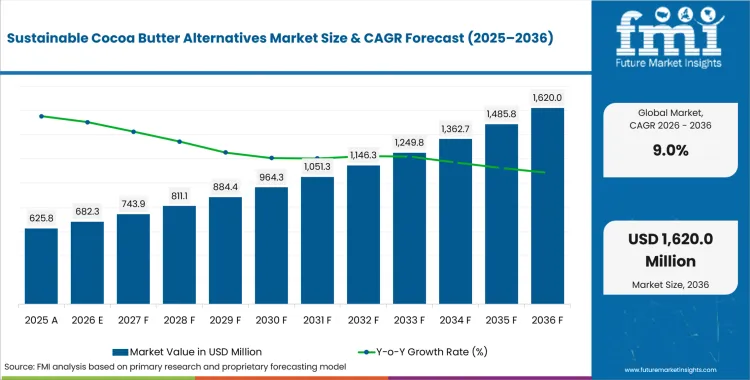
USD 682.3 million in 2026 and USD 1620.0 million by 2036 at a 9.0% CAGR.
Demand for sustainable cocoa butter alternatives is projected to expand at 9.0% CAGR between 2026 and 2036, increasing valuation from USD 682.3 million in 2026 to USD 1620.0 million by 2036. Volatility in global cocoa supply and pricing is prompting manufacturers to explore alternative fats that can reduce dependence on conventional cocoa butter while maintaining product quality. The USDA Economic Research Service reported in February 2025 that global cocoa prices reached USD 10,412 per metric ton during December 2024. The same release recorded a 26% decline in United States cocoa bean imports during 2024 as high prices reduced shipment volumes. Pressure across cocoa butter supply encourages manufacturers to redesign selected recipes instead of extending full cocoa exposure across every established product line. Commercial approval depends on repeatable melt and texture performance with ingredient access that remains dependable across planned production cycles.
Commercial partnerships now connect cocoa-free formulation work with manufacturing and application support across bakery and confectionery programs. Barry Callebaut and Planet A Foods announced a long-term partnership in November 2025 to expand ChoViva across Europe and support later international rollout. The agreement connects cocoa-free ingredient development with established manufacturing channels and customer application support for industrial programs. Comparable specialty fat systems let technical teams adjust crystallization and coating behavior without rebuilding established lines around conventional cocoa butter. Regional adoption remains uneven as national labeling rules control the product descriptions permitted on finished packages. Manufacturers are expected to approve alternatives through trials that confirm sensory performance and dependable scale-up within existing equipment.
Key Takeaways of Sustainable Cocoa Butter Alternatives Market
- Demand is projected to expand at 9.0% CAGR through 2036 as cocoa volatility supports industrial reformulation across bakery and confectionery programs.
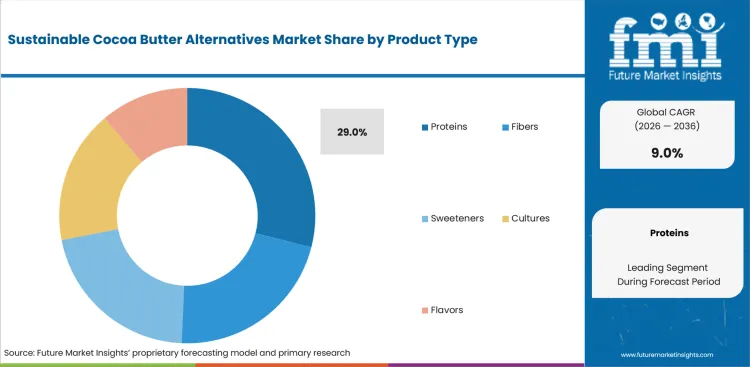
- Proteins are expected to account for 29.0% by product type in 2026 owing to their role in flavor development and recipe structure.
- Plant sources are anticipated to capture 23.0% share in 2026 due to familiar handling and established ingredient distribution routes.
- Bakery applications are forecast to represent 28.0% in 2026 supported by repeat use across fillings and compound coatings.
- Melting behavior and protected chocolate descriptions remain material barriers that require technical validation and accurate package language for each recipe.
- Competition includes specialty-fat platforms from AAK and Bunge alongside broader systems from Cargill and Fuji Oil; Wilmar International and ofi add scale as Barry Callebaut and Planet A Foods commercialize cocoa-free routes.
Analyst Perspective
"Cocoa butter alternatives become commercially useful when they preserve snap and melt behavior across repeated industrial batches. Specialty fats reduce exposure to volatile cocoa costs while cocoa-free systems widen formulation options for fillings and coatings. Product identity rules and flavor balance create the main trade-off across regional launches and established confectionery portfolios. Developers gain a commercial advantage by linking recipe performance with reliable scale-up and dependable ingredient supply across regional production networks."
- Nandini Roy Choudhury, Principal Analyst, Future Market Insights
How is the Sustainable Cocoa Butter Alternatives Market segmented?
The sustainable cocoa butter alternatives industry is segmented by product type, source, application, end user, and region.
Product type separates protein, fiber, sweetener, culture and flavor systems used to recreate texture or flavor. Source distinguishes plant, microbial, dairy-analog, upcycled and mineral routes through their principal formulation inputs and processing requirements. Application tracks bakery, beverages, snacks, infant nutrition and ready meals, and end user separates food manufacturers, beverage manufacturers, foodservice operators, contract manufacturers and retail brands. Region captures differences in ingredient access, labeling rules and technical-service coverage across major food production centers. The combined dimensions show whether a project depends mainly on fat behavior, flavor development, recipe compatibility, commercial scale or local product identity.
Why do proteins anchor product type demand in the sustainable cocoa butter alternatives market?
Protein systems help recreate roasted notes and matrix structure in cocoa-reduced bakery and confectionery recipes. Fuji Oil launched Anoza M in March 2025 as a milk-chocolate-type ingredient made without cocoa-derived materials. The formula combines pea protein with carob and specialty fats for commercial bakery and confectionery applications. Wider fats and oils portfolios help technical teams balance browning and viscosity with expected melt during representative production trials.
- The product type category is forecast to be led by proteins at 29.0% share in 2026 due to their role in flavor development and recipe structure. Protein choice also changes browning and water interaction across baked products during processing and storage. Technical teams therefore test proteins inside complete recipes rather than treating them as separate nutritional additions.
- Food developers use protein systems through roasting and refining steps that already operate across pilot and commercial batches. Controlled flavor development supports repeatable viscosity and finished-product stability across scheduled production runs for several commercial product families. Allergen declarations and persistent off-notes create a separate friction that requires formula changes across several product families.
Why do plant sources remain central to sustainable cocoa butter alternative formulations?
Plant sources fit storage and batching systems already used for oils and seed-derived solids across many food factories. Planet A Foods reported in March 2025 that partners launched ChoViva seasonal products across France and the United Kingdom alongside Germany. The rollout connected plant-based alternatives with established confectionery brands and national retail channels across three European markets. The arrangement demonstrates a practical commercialization route through recognized brands and established retail networks across national channels.
- Plant sources are set to lead the source category with 23.0% share in 2026 due to established ingredient channels and familiar production controls. Manufacturers can test oils and seed-derived materials through familiar storage and batching equipment during normal production runs. The familiar operating fit limits process changes during initial scale-up and customer approval across established product programs.
- Plant formulations gain adoption through familiar ingredient handling rather than one technical advantage across every application. Seed profiles and vegetable fat blends shorten ingredient lead times through established regional distributors serving food manufacturing centers. Interest in fermented ingredients broadens source competition for recipes requiring specialized flavor or texture across several product formats. Oxidation control and flavor masking sometimes weaken cost or label objectives in products with longer shelf-life requirements.
Why does bakery create the clearest application route for sustainable cocoa butter alternatives?
Bakery lines expose fillings and coatings to heat and moisture that can reveal weak melting behavior or flavor retention. Planet A Foods announced in May 2025 that BAKER & BAKER and BÄKO introduced three ChoViva bakery products for German channels. The agreement combined ready-to-bake formats with established wholesale distribution across German bakery production and retail channels. Comparable bakery ingredients require trials that measure depositability and finished texture across defined shelf-life conditions.
- By application, bakery is estimated to hold 28.0% in 2026 owing to repeat use across fillings and compound coatings. Industrial bakeries introduce alternatives through selected lines without reformulating every cocoa-containing item across complete portfolios. Repeat production volumes also justify application support and process validation across several finished product formats during planned annual production cycles.
- Bakery producers favor alternatives that maintain texture during baking and storage across products with different moisture levels. Inclusions and fillings often accept blended formulas more readily than exposed decorations with strict appearance requirements. Commercial approval depends on consistent handling across mixing and depositing equipment at representative line speeds during scheduled production runs.
Why do food manufacturers control end-user demand for sustainable cocoa butter alternatives?
Food manufacturers control recipe specifications and production trials across branded products and contract manufacturing programs. Planet A Foods reported in March 2026 that Nestlé Germany selected ChoViva for a new Choco Crossies line planned for April 2026. The launch linked a cocoa-free ingredient with an established confectionery brand and national retail distribution. Related confectionery ingredients support broader formula comparisons across coatings and fillings that carry different melting and handling requirements.
- Food manufacturers are likely to capture 13.0% share in 2026 attributable to their control over formula approval and repeat production. Technical teams compare sensory results with equipment compatibility and ingredient availability across several production runs. Formulation authority gives food manufacturers the central role in repeat production across branded and contract programs.
- Food manufacturers adopt alternatives through development programs designed to absorb technical testing and package changes across several products. Contract producers transfer validation knowledge across customers but face limits on unauthorized recipe changes during repeated projects. Brand owners need clear specifications and support duties to preserve repeat production across multiple commercial cycles and regional plants.
What are the drivers, restraints, and opportunities in the Sustainable Cocoa Butter Alternatives Market?
Cocoa volatility encourages formula redesign, although melting performance and protected product descriptions slow approvals as new specialty-fat capacity supports practical blended systems.
- Driver: Cocoa price volatility encourages reformulation that reduces conventional input exposure without weakening finished-product performance across established manufacturing programs.
- Restraint: Melting behavior and protected chocolate descriptions create material validation costs across production lines and national package requirements.
- Opportunity: New specialty-fat capacity supports blended recipes that balance ingredient flexibility with familiar sensory performance across commercial product portfolios.
Cocoa price volatility creates a direct commercial driver for reformulation across bakery and confectionery manufacturing. ICCO reported in February 2026 that global cocoa grindings for the 2024/25 cocoa year stood at 4.60 million tonnes, down from 4.81 million tonnes the prior season. The decline reflects commercial pressure across conventional cocoa processing during a period of elevated input costs. Pressure across cocoa derivatives increases the value of formulas that shift selected fat inputs without reducing output quality. Investment becomes defensible through measurable exposure reduction and stable line performance across several product families.
Technical equivalence remains a notable restraint as no alternative system matches every cocoa butter property across all recipes. United Kingdom guidance requires reserved chocolate descriptions to follow defined compositional standards under national cocoa and chocolate rules. Manufacturers must separate compound or chocolate-like products from formulas sold under protected chocolate descriptions across regulated national markets. Different melting curves also alter tempering and coating behavior across existing equipment during standard commercial production schedules. Package redesign and line validation therefore absorb part of the savings expected from ingredient substitution.
Hybrid formulation programs offers a lucrative opportunity between full cocoa dependence and complete replacement across demanding recipes. AAK announced in October 2025 that its Nura joint venture would establish Malaysian production for high-purity specialty palm fractions used in cocoa butter alternatives. The project adds upstream feedstock capacity for scalable cocoa butter equivalent production across international specialty-fat manufacturing programs. The added capacity enables blended systems with defined cost and performance targets across several applications. Commercial gains depend on specifications that preserve sensory consistency across repeat manufacturing cycles and several finished product formats.
Which country CAGRs are profiled in the Sustainable Cocoa Butter Alternatives Market?
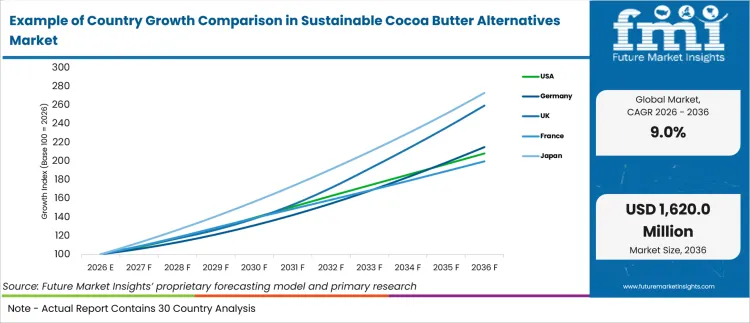
| Country | CAGR |
|---|---|
| India | 12.2% |
| United States | 11.3% |
| United Kingdom | 10.4% |
| Japan | 9.5% |
| France | 8.6% |
| Germany | 7.7% |
How do country-level CAGRs compare in the Sustainable Cocoa Butter Alternatives Market?
The six national forecasts span 4.5 percentage points and form three pairs separated by equal 0.9-point gaps. India and the United States create the upper pair with a 0.9-point separation between their national forecasts. The United Kingdom and Japan form the middle pair through the same measured difference between their national rates. France and Germany complete the comparison with another 0.9-point gap between their national rates. Equal spacing does not create equal entry conditions; manufacturing scale and labeling rules vary across these countries.
- India combines domestic cocoa development with a growing food-processing base across several manufacturing corridors and regional ingredient distribution networks. Its 0.9-point separation from the United States reflects different sourcing conditions rather than one shared commercial route.
- United States manufacturers benefit from large confectionery plants and national ingredient distribution across major production regions. The country remains close to India despite different customer validation and labeling paths across national confectionery manufacturing programs.
- United Kingdom adoption gains support from concentrated grocery channels and visible cocoa-free retail programs across established brands. Its rate remains evenly separated from the United States and Japan within the comparison despite different retail and labeling conditions.
- Japan demonstrates how national retail partnerships introduce cocoa-free formats through established private-label distribution across carefully controlled national assortments. Its position between the United Kingdom and France reflects sensory requirements alongside compact product formats.
- France combines an established confectionery base with large retail groups that coordinate national seasonal programs. The equal gap from Japan and Germany does not remove differences in premium positioning and package language.
- Germany brings substantial chocolate output and specialized bakery channels to alternative formulation programs across established industrial production centers. Its growth path reflects commercial activity across compound coatings and cocoa-reduced bakery products rather than one uniform replacement route.
Comparable national rates produce materially different market entry conditions across the six profiled countries and applications. Technical service distance and labeling treatment affect project timing alongside access to specialty fats or cocoa-free ingredients. The full report provides country-level CAGR analysis across North America, Latin America, Europe, East Asia, South Asia, Oceania and the Middle East and Africa.
Country-wise Analysis
- India's cocoa sector is concentrated across southern states that also support large bakery and confectionery manufacturing corridors. India's sustainable cocoa butter alternatives outlook is anticipated to advance at 12.2% CAGR over the assessment period, supported by domestic ingredient development and branded food investment. The Press Information Bureau reported in April 2026 that India produced 32.91 thousand metric tons of cocoa and exported cocoa products worth USD 295.58 million during 2024/25. The figures describe a conventional cocoa chain that alternative systems must complement through measurable performance and cost advantages. Established edible-oil distributors create an enabler by supplying plant fats to regional bakery and confectionery plants through familiar routes. Domestic cocoa-development programs create friction by requiring alternatives to prove performance or cost value beyond a temporary shortage response. Commercial entry should focus on heat-tolerant compound coatings with technical support near major southern manufacturing centers.
- United States confectionery manufacturers operate large plants with national ingredient distribution and specialized application laboratories. Domestic application facilities provide an enabler through pilot work that connects ingredient testing with commercial equipment. The United States' sustainable cocoa butter alternatives market is estimated to post 11.3% CAGR over the forecast period, aided by established compound coating production and active cocoa-free development. The U.S. Bureau of Labor Statistics recorded a producer price index of 198.533 for cacao-based chocolate confectionery during May 2026. The index uses December 2011 as 100 and describes the pricing environment surrounding conventional chocolate programs. National brand approval creates friction through sensory and supply requirements that must remain consistent across several facilities. Technical reviews should separate texture performance from cost exposure so contracts assign clear responsibility for each operating result.
- United Kingdom manufacturers sell through concentrated grocery channels capable of scaling successful reformulations across national private-label programs. Sustainable cocoa butter alternative demand in the United Kingdom is forecast to rise at 10.4% CAGR over the forecast period, strengthened by visible retail launches and established confectionery production. The Office for National Statistics published the series in June 2026 and placed the 2025 annual producer price index at 156.4. The index uses 2015 as 100 and confirms sustained price pressure across domestic cocoa and confectionery manufacturing. National retailers provide an enabler through coordinated product specifications and launch volumes across large store networks. Reserved descriptions for cocoa and chocolate products create friction for names and label claims applied to alternatives. Commercial programs need early regulatory review and production trials that protect taste without implying conventional chocolate composition.
- Japanese confectionery channels favor compact product formats and careful sensory validation across national retail assortments. Nationwide retail networks provide an enabler for testing limited formats through controlled shelf programs before wider expansion. The Japanese sustainable cocoa butter alternatives sector is projected to record 9.5% CAGR during the assessment period, influenced by premium sensory expectations and targeted private-label innovation. Planet A Foods reported in September 2025 that Aeon listed three ChoViva varieties across stores nationwide following an earlier biscuit trial. The rollout established a commercial route for cocoa-free formulations through a national retailer and its existing distribution network. Exacting taste standards create friction through the careful adjustment required for roasted seed profiles across local flavor expectations. Manufacturers should begin with applications that accept compact formats and controlled shelf presentation across national stores.
- French confectionery production combines industrial manufacturers with strong supermarket channels and substantial seasonal gifting demand. Sustainable cocoa butter alternative sales in France are forecast to expand at 8.6% CAGR by 2036, linked to retail experimentation and cocoa cost pressure. Insee reported in May 2026 that the French producer price index for cocoa and confectionery reached 170.9 during April 2026. The official series describes the pricing environment faced by domestic manufacturers during formulation and product development decisions. Large retail groups provide an enabler through national shelf access and seasonal programs for new formulations. Premium sensory benchmarks create material friction for alternatives that appear to compromise established confectionery expectations across seasonal and everyday products.
- Germany has a large chocolate manufacturing base with specialized bakery channels and broad technical ingredient distribution. Destatis reported in December 2025 that Germany produced nearly 1.07 million metric tons of cocoa-containing chocolate products during 2024. Adoption of sustainable cocoa butter alternatives in Germany is estimated to expand at 7.7% CAGR through 2036, shaped by industrial output and active cocoa-free product development. The same release recorded a 5.8% annual production decline alongside substantial export volumes from domestic plants. Wholesale bakery networks provide an enabler for trials that use commercial equipment and established ingredient routes. High sensory expectations create material friction across product approval and package language for cocoa-reduced formulations in established national brands.
Who are the notable companies in the Sustainable Cocoa Butter Alternatives Market?
AAK, Bunge, Cargill, Fuji Oil, Wilmar International, ofi, Barry Callebaut, and Planet A Foods are the notable companies shaping this market.
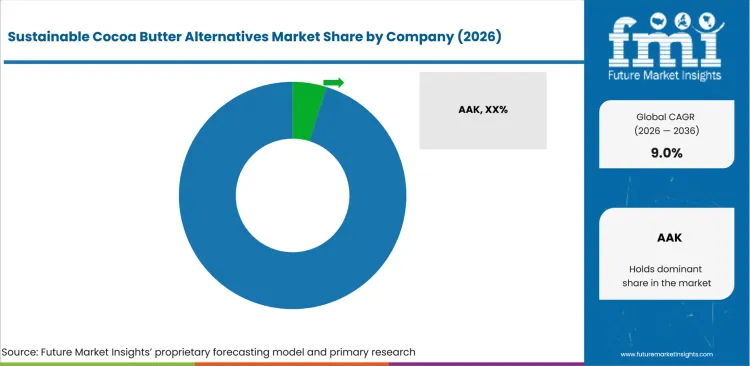
Specialty-fat groups and cocoa-free developers compete through distinct commercial routes rather than one uniform product model. AAK and Bunge offer cocoa butter equivalents, while Cargill adds a North American cocoa-free route through Voyage Foods. Fuji Oil links confectionery fats with recent launches; Wilmar International and ofi supply plant-fat portfolios across several regions. Barry Callebaut contributes manufacturing channels and application infrastructure, while Planet A Foods provides fermented seed technology through established brand partnerships. The larger groups provide manufacturing breadth and ingredient supply, whereas specialist developers contribute focused cocoa-free formulation technology. Competition across plant-based formulations centers on recipe performance, scale-up support and dependable ingredient supply across regional production networks.
- AAK and Bunge compete through broad cocoa butter equivalent portfolios for coatings and fillings across several manufacturing regions. Their commercial position depends on formulation support and dependable specialty-fat supply across repeated customer production and product development programs. Cargill adds a North American cocoa-free route through Voyage Foods and regional distribution partners serving established confectionery manufacturing customers.
- Fuji Oil combines specialty fats with recent cocoa-reduced and cocoa-free products for bakery and confectionery applications. Wilmar International supports compound chocolate programs through a multi-region plant-fat portfolio covering several coating and filling applications. ofi adds Britannia cocoa butter equivalents and related filling fats with customer development facilities supporting commercial application work.
- Barry Callebaut contributes global production channels and application infrastructure for cocoa-free and compound product development. Planet A Foods provides a fermented seed platform with documented launches through food manufacturers and retailers. Their complementary capabilities connect focused cocoa-free technology with established customer channels and scale-up resources across multiple product development programs.
Competitive Benchmarking: Sustainable Cocoa Butter Alternatives Market
| Company | Alternative Fat and Cocoa-free Portfolio | Application and Scale-up Support | Commercial Route and Channel Reach | Geographic Reach |
|---|---|---|---|---|
| AAK | High | High | High | Global |
| Bunge | High | High | High | Global |
| Cargill | High | High | High | Global |
| Fuji Oil | High | High | Medium | Asia, Europe and North America |
| Wilmar International | High | Medium | High | Global |
| ofi | High | High | High | Global |
| Barry Callebaut | Medium | High | High | Global |
| Planet A Foods | Medium | Medium | Medium | Europe and Japan |
Key Developments in the Sustainable Cocoa Butter Alternatives Market
- In March 2026, Cargill added a specialty-fats line at its Port Klang facility in Malaysia. The expansion supports cocoa butter equivalents and low-trans cocoa butter replacers for confectionery and bakery applications. Added capacity creates another industrial supply route across Asia Pacific and EMEA for established bakery and confectionery manufacturers. The project also strengthens regional application support for manufacturers that need alternative-fat performance without rebuilding complete recipes or established production lines.
- In February 2025, Fuji Oil began selling a milk-chocolate-type CP Chocolate product with a high proportion of specialty chocolate fats. The formula supports coatings and baked goods through blends with conventional chocolate across familiar industrial handling and production conditions. Japanese manufacturers gained another commercial route for managing cocoa cost exposure through familiar handling and commercial blending practices. The launch also expanded the CP series beyond sweet and white formats for industrial applications.
- In June 2026, Planet A Foods launched ChoViva No Added Sugar for confectionery and bakery manufacturers. The cocoa-free formula extends the platform into reduced-sugar product development and preserves a smooth melt. The format links ingredient resilience with nutrition-led positioning through one industrial system across established bakery and confectionery applications. The launch also broadens the company’s business-to-business portfolio for commercial fillings and coatings that require controlled texture.
- In February 2026, Barry Callebaut opened a Global Innovation Center in Singapore with a compound coatings center and pilot laboratory. The facility supports coatings and fillings through formulation work with customers across pilot production programs. Its application infrastructure shortens the route from alternative-fat concepts to scalable products through active customer development programs. The center also expands technical support for manufacturers serving Asian and international confectionery channels and regional application teams.
Key Players in the Sustainable Cocoa Butter Alternatives Market
Broad Specialty Fat Platforms
- AAK
- Bunge
- Cargill
Confectionery Fat and Compound Specialists
- Fuji Oil
- Wilmar International
- ofi
Cocoa-free Development and Commercialization
- Barry Callebaut
- Planet A Foods
Sustainable Cocoa Butter Alternatives Market - Report Scope
| Coverage field | Report scope |
|---|---|
| Market breakdown | Product type, source, application, end user, and region. |
| Quantitative Units | Revenue in USD Million, CAGR in %. |
| Market Definition | Commercial demand for fats and cocoa-free formulation systems that replace or reduce cocoa butter across food manufacturing applications. |
| Regions Covered | North America, Latin America, Europe, East Asia, South Asia and Pacific, and Middle East and Africa. |
| Countries Covered | India, United States, United Kingdom, Japan, France, Germany, and 30+ countries. |
| Key Companies Profiled | AAK, Bunge, Cargill, Fuji Oil, Wilmar International, ofi, Barry Callebaut, and Planet A Foods. |
| Forecast Period | 2026 to 2036. |
| Approach | Hybrid bottom-up and top-down market sizing supported by primary interviews and official desk research. |
Sustainable Cocoa Butter Alternatives Market - Research Methodology
| Method | Approach |
|---|---|
| Primary Research | FMI analysts gathered input from manufacturers, service providers, technology developers, distributors, end users, procurement teams, and subject-matter experts. Interviews examined purchasing decisions, product or service evaluation, adoption barriers, approval requirements, pricing considerations, and expectations for technical or commercial support. Respondents were also asked what evidence is required before a trial, pilot, or initial order develops into regular purchasing. |
| Desk Research | Desk research covered government statistics, regulatory publications, trade data, industry associations, technical literature, standards, company filings, product information, and official corporate announcements. Sources were reviewed for relevance, publication date, geographic coverage, and consistency with the defined market scope. Claims relating to performance, applications, approvals, capacity, investment, and commercial activity were retained only when supported by credible public evidence. |
| Market Sizing and Forecasting | The market model combined the baseline value with historical performance, segment structure, pricing and volume indicators, adoption levels, company participation, and country-level demand conditions. Forecast assumptions considered economic activity, investment trends, regulatory developments, technology adoption, purchasing cycles, supply availability, and barriers to wider market use. Segment and regional estimates were reconciled before the final market total was calculated. |
| Data Validation | Estimates were checked against multiple independent indicators, including public data, company activity, trade patterns, industry developments, and findings from primary interviews. Validation also tested whether products, services, applications, and company revenues fell within the defined market boundaries. Adjacent categories, unsupported claims, overlapping revenues, and activities without direct market relevance were excluded to reduce double counting and maintain consistency across segments and countries. |
Sustainable Cocoa Butter Alternatives Market by Segments
Sustainable Cocoa Butter Alternatives Market segmented by Product Type:
- Proteins
- Fibers
- Sweeteners
- Cultures
- Flavors
Sustainable Cocoa Butter Alternatives Market segmented by Source:
- Plant
- Microbial
- Dairy Analog
- Upcycled
- Mineral
Sustainable Cocoa Butter Alternatives Market segmented by Application:
- Bakery
- Beverages
- Snacks
- Infant Nutrition
- Ready Meals
Sustainable Cocoa Butter Alternatives Market segmented by End User:
- Food Manufacturers
- Beverage Manufacturers
- Foodservice Operators
- Contract Manufacturers
- Retail Brands
Sustainable Cocoa Butter Alternatives Market by Region:
- North America
- United States
- Canada
- Mexico
- Latin America
- Brazil
- Chile
- Rest of Latin America
- Western Europe
- Germany
- UK
- Italy
- Spain
- France
- Nordic
- BENELUX
- Rest of Western Europe
- Eastern Europe
- Russia
- Poland
- Hungary
- Balkan and Baltic
- Rest of Eastern Europe
- East Asia
- China
- Japan
- South Korea
- South Asia and Pacific
- India
- ASEAN
- Australia and New Zealand
- Rest of South Asia and Pacific
- Middle East and Africa
- Kingdom of Saudi Arabia
- Other GCC Countries
- Turkiye
- South Africa
- Other African Union
- Rest of Middle East and Africa
Research Sources and Bibliography
- Gerval, A. (2025, February 13). High cocoa prices on smaller global crops lead to decreased U.S. imports in 2023 and 2024.
- Planet A Foods. (2025, November 5). Barry Callebaut and Planet A Foods Partner to Pioneer Sustainable Chocolate Alternatives Without Cocoa.
- Fuji Oil Co., Ltd. (2025, March 12).
- Planet A Foods. (2025, March 25). ChoViva Expands Across Europe with First Seasonal Product Launches For Easter.
- Planet A Foods. (2025, May 5). Zukunftsweisende Partnerschaft: BAKER & BAKER, BÄKO und Planet A Foods revolutionieren den Backwarenmarkt.
- Planet A Foods. (2026, March 5). Global Brands drive innovation together with ChoViva.
- Cargill. (2026, May 12). Cargill and Voyage Foods to bring NextCoa™ cocoa-free confectionery alternatives to North America.
- International Cocoa Organization. (2026, February 27). February 2026 Quarterly Bulletin of Cocoa Statistics.
- Department for Environment, Food & Rural Affairs. (2022, September 20). Food standards: Labelling and composition.
- AAK. (2025, October 24). AAK strengthens supply of specialty palm fractions.
- Press Information Bureau. (2026, April 19). Accelerating India’s High Value Crop Diversification.
- U.S. Bureau of Labor Statistics. (2026, June 11). Producer Price Index by Industry: Chocolate and Confectionery Manufacturing from Cacao: Chocolate/Chocolate-Type Confectionery Products, Made from Cacao Beans.
- Office for National Statistics. (2026, June 17). PPI INDEX OUTPUT DOMESTIC - C1082 Cocoa, chocolate and sugar confectionery 2015=100.
- Planet A Foods. (2025, September 17). Aeon brings ChoViva to Asia: First launch in Japan.
- Institut national de la statistique et des études économiques. (2026, May 28). Indice de prix de production de l’industrie française pour le marché français − CPF 10.82 − Cacao, chocolat et produits de confiserie.
- Federal Statistical Office of Germany. (2025, December 2). 12,8 Kilo Schokolade pro Kopf wurden 2024 produziert.
- Cargill. (2026, March 31). Cargill strengthens global specialty fats portfolio with expansion of Port Klang, Malaysia facility.
- Fuji Oil Co., Ltd. (2025, February 20).
- Planet A Foods. (2026, June 19). Planet A Foods Expands ChoViva Portfolio for the B2B Market.
- Barry Callebaut. (2026, February 10). Barry Callebaut Opens Global Innovation Center in Singapore, Pioneering the Future of Chocolate Through AI and Advanced Innovation.
- Bunge Global SA. (2026, February 19). Form 10-K for the fiscal year ended December 31, 2025.
- Wilmar International Limited. (2026, March 25). Annual Reports and Related Documents.
- Olam Group Limited. (2026, April 10). Olam Group publishes 2025 Annual Report “From Vision to Value” and announces Board and management changes.
This bibliography is provided for reader reference and is not exhaustive. The full report contains the complete reference list and detailed citations
This Report Answers
- How large is the sustainable cocoa butter alternatives market in 2026 and 2036?
- Which cocoa supply pressures support investment in alternative formulation systems?
- Why do proteins account for the largest product type share in 2026?
- How do plant sources support commercial formulation across established food production networks?
- Why does bakery create a scalable application route for fillings and coatings?
- How do national growth rates differ across India and the United States alongside Europe and Japan?
- Which companies combine specialty-fat portfolios with cocoa-free ingredient development?
- What technical and labeling requirements can delay wider commercial adoption?
- How should manufacturers evaluate alternative systems across recipes and production lines?
Frequently Asked Questions
How big is the Sustainable Cocoa Butter Alternatives Market in 2026?
The sustainable cocoa butter alternatives market is valued at USD 682.3 million in 2026 and is forecast to reach USD 1620.0 million by 2036, supported by cocoa price volatility prompting food manufacturers to reformulate bakery and confectionery recipes with alternative fats that reduce conventional cocoa butter dependence without weakening finished-product performance.
What is the CAGR of the Sustainable Cocoa Butter Alternatives Market from 2026 to 2036?
The sustainable cocoa butter alternatives market is projected to grow at a CAGR of 9.0% between 2026 and 2036, supported by sustained cocoa supply pressure, expanding specialty-fat capacity, and growing commercial partnerships connecting cocoa-free ingredient development with industrial bakery and confectionery manufacturing programs globally.
Which product type leads the Sustainable Cocoa Butter Alternatives Market?
Proteins account for 29.0% of the sustainable cocoa butter alternatives market by product type in 2026, driven by their role in recreating roasted notes and recipe structure across cocoa-reduced bakery and confectionery formulations, requiring technical teams to test protein systems inside complete recipes rather than treating them as standalone nutritional additions.
How much will the Sustainable Cocoa Butter Alternatives Market add between 2026 and 2036?
The sustainable cocoa butter alternatives market is set to add USD 937.7 million between 2026 and 2036, growing from USD 682.3 million to USD 1,620.0 million as cocoa price volatility, new specialty-fat capacity investments, and expanding cocoa-free commercialization programs accelerate industrial reformulation across bakery, confectionery, and coating applications worldwide.
Who are the leading companies in the Sustainable Cocoa Butter Alternatives Market?
Leading companies in the sustainable cocoa butter alternatives market include AAK, Bunge, Cargill, Fuji Oil, Wilmar International, ofi, Barry Callebaut, and Planet A Foods, competing across broad specialty-fat platforms, confectionery fat and compound supply, and cocoa-free ingredient development and commercialization with global manufacturing and application reach.
Preview the report firsthand - request a free sample
Get SampleGet the brochure for pricing and purchase details.
Get PDFTable of Content
- Key Takeaways
- Market Size and CAGR
- Top Growth Driver
- Fastest Growing Segment
- Leading Region
- Key Companies
- Emerging Opportunities
- Executive Summary
- Global Market Outlook
- Demand-side Trends
- Supply-side Trends
- Technology Roadmap Analysis
- Analysis and Recommendations
- Analyst Perspective (What is happening? Why now? What should investors know?)
- Key Questions Answered
- How large is the market?
- What is the CAGR?
- What are key trends?
- Which region dominates?
- Who are the leaders?
- Market Overview
- Market Coverage / Taxonomy
- Market Definition / Scope / Limitations
- Research Methodology
- Chapter Orientation
- Analytical Lens and Working Hypotheses
- Market Structure, Signals, and Trend Drivers
- Benchmarking and Cross-market Comparability
- Market Sizing, Forecasting, and Opportunity Mapping
- Research Design and Evidence Framework
- Desk Research Programme (Secondary Evidence)
- Expert Input and Fieldwork (Primary Evidence)
- Tooling, Models, and Reference Databases
- Data Engineering and Model Build
- Quality Assurance and Audit Trail
- Market Background
- Market Dynamics (Drivers, Restraints, Opportunity, Trends)
- Scenario Forecast (Optimistic, Likely, Conservative)
- Impact Analysis
- AI Impact
- Sustainability Impact
- Regulatory Impact
- Technology Impact
- Consumer / Buyer Analysis
- Purchase Drivers
- Adoption Barriers
- Buyer Journey
- Opportunity Map Analysis
- Product Life Cycle Analysis
- Supply Chain Analysis
- Investment Feasibility Matrix
- Value Chain Analysis
- PESTLE and Porter's Analysis
- Regulatory Landscape
- Regional Parent Market Outlook
- Production and Consumption Statistics
- Import and Export Statistics
- Global Market Analysis and Forecast, 2021 to 2036
- Historical Market Size Value (USD Million) Analysis, 2021 to 2025
- Current and Future Market Size Value (USD Million) Projections, 2026 to 2036
- Y-o-Y Growth Trend Analysis
- Absolute $ Opportunity Analysis
- Global Market Pricing Analysis, 2021 to 2036
- Global Market Analysis and Forecast, By Product Type, 2021 to 2036
- Introduction / Key Findings
- Historical Market Size Value (USD Million) Analysis By Product Type, 2021 to 2025
- Current and Future Market Size Value (USD Million) Analysis and Forecast By Product Type, 2026 to 2036
- Proteins
- Fibers
- Sweeteners
- Cultures
- Flavors
- Proteins
- Y-o-Y Growth Trend Analysis By Product Type, 2021 to 2025
- Absolute $ Opportunity Analysis By Product Type, 2026 to 2036
- Global Market Analysis and Forecast, By Source, 2021 to 2036
- Introduction / Key Findings
- Historical Market Size Value (USD Million) Analysis By Source, 2021 to 2025
- Current and Future Market Size Value (USD Million) Analysis and Forecast By Source, 2026 to 2036
- Plant
- Microbial
- Dairy Analog
- Upcycled
- Mineral
- Plant
- Y-o-Y Growth Trend Analysis By Source, 2021 to 2025
- Absolute $ Opportunity Analysis By Source, 2026 to 2036
- Global Market Analysis and Forecast, By Application, 2021 to 2036
- Introduction / Key Findings
- Historical Market Size Value (USD Million) Analysis By Application, 2021 to 2025
- Current and Future Market Size Value (USD Million) Analysis and Forecast By Application, 2026 to 2036
- Bakery
- Beverages
- Snacks
- Infant Nutrition
- Ready Meals
- Bakery
- Y-o-Y Growth Trend Analysis By Application, 2021 to 2025
- Absolute $ Opportunity Analysis By Application, 2026 to 2036
- Global Market Analysis and Forecast, By End User, 2021 to 2036
- Introduction / Key Findings
- Historical Market Size Value (USD Million) Analysis By End User, 2021 to 2025
- Current and Future Market Size Value (USD Million) Analysis and Forecast By End User, 2026 to 2036
- Food Manufacturers
- Ingredient Blenders
- Private Label
- Foodservice
- Nutraceutical brands
- Food Manufacturers
- Y-o-Y Growth Trend Analysis By End User, 2021 to 2025
- Absolute $ Opportunity Analysis By End User, 2026 to 2036
- Global Market Analysis and Forecast, By Region, 2021 to 2036
- Introduction
- Historical Market Size Value (USD Million) Analysis By Region, 2021 to 2025
- Current Market Size Value (USD Million) Analysis and Forecast By Region, 2026 to 2036
- North America
- Latin America
- Western Europe
- Eastern Europe
- East Asia
- South Asia and Pacific
- Middle East & Africa
- Market Attractiveness Analysis By Region
- North America Market Analysis and Forecast, By Country, 2021 to 2036
- Historical Market Size Value (USD Million) Trend Analysis By Market Taxonomy, 2021 to 2025
- Market Size Value (USD Million) Forecast By Market Taxonomy, 2026 to 2036
- By Country
- USA
- Canada
- By Product Type
- By Source
- By Application
- By End User
- By Country
- Market Attractiveness Analysis
- By Country
- By Product Type
- By Source
- By Application
- By End User
- Key Takeaways
- Latin America Market Analysis and Forecast, By Country
- Historical Market Size Value (USD Million) Trend Analysis By Market Taxonomy, 2021 to 2025
- Market Size Value (USD Million) Forecast By Market Taxonomy, 2026 to 2036
- By Country
- Brazil
- Mexico
- Chile
- Rest of Latin America
- By Product Type
- By Source
- By Application
- By End User
- By Country
- Market Attractiveness Analysis
- By Country
- By Product Type
- By Source
- By Application
- By End User
- Key Takeaways
- Western Europe Market Analysis and Forecast, By Country
- Historical Market Size Value (USD Million) Trend Analysis By Market Taxonomy, 2021 to 2025
- Market Size Value (USD Million) Forecast By Market Taxonomy, 2026 to 2036
- By Country
- Germany
- UK
- Italy
- Spain
- France
- Nordic
- BENELUX
- Rest of Western Europe
- By Product Type
- By Source
- By Application
- By End User
- By Country
- Market Attractiveness Analysis
- By Country
- By Product Type
- By Source
- By Application
- By End User
- Key Takeaways
- Eastern Europe Market Analysis and Forecast, By Country
- Historical Market Size Value (USD Million) Trend Analysis By Market Taxonomy, 2021 to 2025
- Market Size Value (USD Million) Forecast By Market Taxonomy, 2026 to 2036
- By Country
- Russia
- Poland
- Hungary
- Balkan & Baltic
- Rest of Eastern Europe
- By Product Type
- By Source
- By Application
- By End User
- By Country
- Market Attractiveness Analysis
- By Country
- By Product Type
- By Source
- By Application
- By End User
- Key Takeaways
- East Asia Market Analysis and Forecast, By Country
- Historical Market Size Value (USD Million) Trend Analysis By Market Taxonomy, 2021 to 2025
- Market Size Value (USD Million) Forecast By Market Taxonomy, 2026 to 2036
- By Country
- China
- Japan
- South Korea
- By Product Type
- By Source
- By Application
- By End User
- By Country
- Market Attractiveness Analysis
- By Country
- By Product Type
- By Source
- By Application
- By End User
- Key Takeaways
- South Asia and Pacific Market Analysis and Forecast, By Country
- Historical Market Size Value (USD Million) Trend Analysis By Market Taxonomy, 2021 to 2025
- Market Size Value (USD Million) Forecast By Market Taxonomy, 2026 to 2036
- By Country
- India
- ASEAN
- Australia & New Zealand
- Rest of South Asia and Pacific
- By Product Type
- By Source
- By Application
- By End User
- By Country
- Market Attractiveness Analysis
- By Country
- By Product Type
- By Source
- By Application
- By End User
- Key Takeaways
- Middle East & Africa Market Analysis and Forecast, By Country
- Historical Market Size Value (USD Million) Trend Analysis By Market Taxonomy, 2021 to 2025
- Market Size Value (USD Million) Forecast By Market Taxonomy, 2026 to 2036
- By Country
- Kingdom of Saudi Arabia
- Other GCC Countries
- Türkiye
- South Africa
- Other African Union
- Rest of Middle East & Africa
- By Product Type
- By Source
- By Application
- By End User
- By Country
- Market Attractiveness Analysis
- By Country
- By Product Type
- By Source
- By Application
- By End User
- Key Takeaways
- Key Countries Market Analysis
- USA
- Pricing Analysis
- Market Share Analysis, 2025
- By Product Type
- By Source
- By Application
- By End User
- Canada
- Pricing Analysis
- Market Share Analysis, 2025
- By Product Type
- By Source
- By Application
- By End User
- Mexico
- Pricing Analysis
- Market Share Analysis, 2025
- By Product Type
- By Source
- By Application
- By End User
- Brazil
- Pricing Analysis
- Market Share Analysis, 2025
- By Product Type
- By Source
- By Application
- By End User
- Chile
- Pricing Analysis
- Market Share Analysis, 2025
- By Product Type
- By Source
- By Application
- By End User
- Germany
- Pricing Analysis
- Market Share Analysis, 2025
- By Product Type
- By Source
- By Application
- By End User
- UK
- Pricing Analysis
- Market Share Analysis, 2025
- By Product Type
- By Source
- By Application
- By End User
- Italy
- Pricing Analysis
- Market Share Analysis, 2025
- By Product Type
- By Source
- By Application
- By End User
- Spain
- Pricing Analysis
- Market Share Analysis, 2025
- By Product Type
- By Source
- By Application
- By End User
- France
- Pricing Analysis
- Market Share Analysis, 2025
- By Product Type
- By Source
- By Application
- By End User
- India
- Pricing Analysis
- Market Share Analysis, 2025
- By Product Type
- By Source
- By Application
- By End User
- ASEAN
- Pricing Analysis
- Market Share Analysis, 2025
- By Product Type
- By Source
- By Application
- By End User
- Australia & New Zealand
- Pricing Analysis
- Market Share Analysis, 2025
- By Product Type
- By Source
- By Application
- By End User
- China
- Pricing Analysis
- Market Share Analysis, 2025
- By Product Type
- By Source
- By Application
- By End User
- Japan
- Pricing Analysis
- Market Share Analysis, 2025
- By Product Type
- By Source
- By Application
- By End User
- South Korea
- Pricing Analysis
- Market Share Analysis, 2025
- By Product Type
- By Source
- By Application
- By End User
- Russia
- Pricing Analysis
- Market Share Analysis, 2025
- By Product Type
- By Source
- By Application
- By End User
- Poland
- Pricing Analysis
- Market Share Analysis, 2025
- By Product Type
- By Source
- By Application
- By End User
- Hungary
- Pricing Analysis
- Market Share Analysis, 2025
- By Product Type
- By Source
- By Application
- By End User
- Kingdom of Saudi Arabia
- Pricing Analysis
- Market Share Analysis, 2025
- By Product Type
- By Source
- By Application
- By End User
- Türkiye
- Pricing Analysis
- Market Share Analysis, 2025
- By Product Type
- By Source
- By Application
- By End User
- South Africa
- Pricing Analysis
- Market Share Analysis, 2025
- By Product Type
- By Source
- By Application
- By End User
- USA
- Market Structure Analysis
- Competition Dashboard
- Competition Benchmarking
- Market Share Analysis of Top Players
- By Regional
- By Product Type
- By Source
- By Application
- By End User
- Emerging Startups
- Innovation Benchmarking
- Competition Analysis
- Competition Deep Dive
- AAK
- Overview
- Product Portfolio
- Profitability by Market Segments
- Sales Footprint
- Strategy Overview
- Marketing Strategy
- Product Strategy
- Channel Strategy
- Bunge
- Cargill
- Fuji Oil
- Wilmar
- IOI Loders Croklaan
- Barry Callebaut
- Olam Food Ingredients
- AAK
- Case Studies
- Success Stories
- Recent Developments
- Competition Deep Dive
- Assumptions & Acronyms Used


