

- Market Size (2026)
- USD 44.7 Bn
- Forecast (2036)
- USD 115.9 Bn
- CAGR (2026 to 2036)
- 10.0%
How big is Sustainable Agriculture Market in 2026?
USD 44.7 billion in 2026 and USD 115.9 billion by 2036 at a 10.0% CAGR.
Sales in sustainable agriculture market are projected to rise from USD 44.7 billion in 2026 to USD 115.9 billion by 2036 at 10.0% CAGR. Improving nutrient-use efficiency remains a central objective of sustainable agriculture as producers seek to maintain yields while reducing environmental impacts. FAO reported 150 teragrams of nitrogen use in January 2025, reinforcing the importance of technologies and practices that optimize fertilizer application. Large fertilizer requirements continue to support investment in precision nutrient-management systems and data-driven farm operations.
Implementation strategies vary across agricultural markets according to local farming systems and regulatory requirements. Defra reported 363,000 hectares under variable-rate application in England during April 2025, demonstrating growing adoption of precision input-management practices. The expansion of site-specific application techniques supports more targeted use of fertilizers and crop inputs. South Korea places greater emphasis on smart-farming platforms that integrate sensors and farm data, while German producers operate within certification-driven frameworks that place additional focus on approved products and documented sustainability practices.
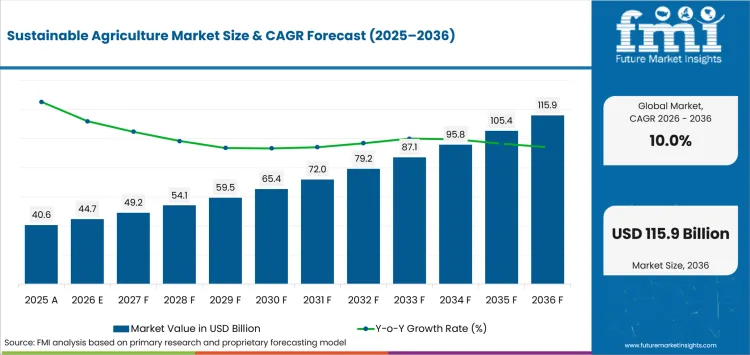
Key Takeaways of Sustainable Agriculture Market
- Commercial farms adopt resource-efficient inputs that fit machinery and protect output across repeated seasonal programs.
- Enhanced-efficiency synthetic inputs are projected at 31.0% in 2026 owing to familiar fertilizer application routines.
- Conventional farms adopting sustainable inputs are estimated at 38.0% because staged changes limit operational disruption.
- Liquid formulations are forecast at 47.0% in 2026 due to familiar handling and application equipment.
- Field variability and national registration delay orders until local trials establish reliable performance and guidance.
- Bayer, Syngenta, Corteva, UPL, FMC, BASF, Sumitomo Chemical and ADAMA combine crop-protection and biological capabilities.
Analyst Perspective
"Recurring orders depend on evidence that lower input losses preserve output with familiar equipment. Farms compare registration coverage and local support across complete rotations."
- Nandini Roy Choudhury, Principal Consultant, Future Market Insights
How is the Sustainable Agriculture Market segmented?
The sustainable agriculture market is segmented by product type, farming system, crop type, form, mode of application and region.
Market taxonomy covers product type, farming system, crop type, form, application mode, and region. Product types include inputs, biological protection and nutrition. Farming systems cover conventional, regenerative, organic, and integrated pest management. Crop types include cereals, oilseeds, horticulture, and industrial crops. Routes include liquids, granules, powders, soil, foliar, seed, and fertigation use.
Why do enhanced-efficiency synthetic inputs lead the product type category?
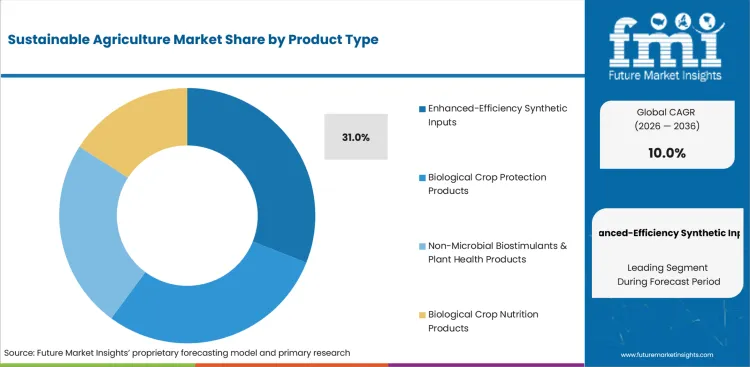
Enhanced-efficiency inputs alter nutrient release or persistence within established fertilizer programs. FAO guidance published in January 2026 states that nitrogen inhibitors require food-safety assessment because residues can enter crops or animal products.
- By product type, enhanced-efficiency synthetic inputs are estimated to hold 31.0% in 2026 owing to compatibility with existing nutrient schedules and field machinery.
- Controlled-release fertilizers and stabilized nitrogen products compete on crop-specific rates plus evidence that lower nutrient losses preserve yield. Biological crop protection broadens integrated programs, although distributors need separate proof of legal access and dependable performance across local conditions and seasonal programs.
Why do conventional farms adopting sustainable inputs lead the farming system category?
Conventional farms can test selected inputs on defined acreage without replacing their complete production system. Precision tools and smart irrigation systems give agronomists measured entry points for nutrient and water decisions.
- In 2026, conventional farms adopting sustainable inputs are expected to lead the farming system category with 38.0% share because staged changes reduce operational disruption.
- Regenerative agriculture practices add cover crops and reduced tillage while retaining much of the existing machinery base. Organic systems require certified inputs, whereas integrated pest management uses monitoring thresholds to determine treatment timing and recurring purchasing decisions across multiple crop cycles.
Why do cereals and grains lead the crop type category?
Cereal farms repeat fertilizer and crop-protection decisions across broad acreage under fixed seasonal windows. Soil testing programs help agronomists adjust rates for field variability before extending a product across complete rotations.
- Based on crop type, cereals and grains are projected to account for 38.0% in 2026 due to repeated input decisions across wheat and maize production.
- Wheat and maize programs require dependable nutrient placement plus weed and disease control under different soil and weather conditions. Companies gain acreage access by producing crop-specific evidence and supporting dealers during application planning across complete seasonal programs.
Why do liquid formulations lead the form category?
Liquid products fit common mixing and spraying routines across commercial farms. Biostimulant formulations must retain storage stability and tank compatibility under field conditions.
- Liquid formulations are set to lead the form category with 47.0% share in 2026 due to familiar handling and established application equipment.
- Liquid biofertilizers can enter existing spray or irrigation programs with limited equipment changes. Controlled environment agriculture also uses liquid dosing through fertigation, while dry formats remain practical for storage. Each route needs separate dissolution and dose evidence before distributors support recurring use across sites with different water quality.
What are the drivers, restraints and opportunities in the Sustainable Agriculture Market?
Recurring input decisions sustain demand, local validation slows expansion and agronomic support improves repeat adoption.
- Driver: Farms purchase nutrient and crop-protection inputs every season, giving proven efficiency products repeated entry opportunities.
- Restraint: Registration and crop-specific performance requirements increase expansion costs across additional territories and crop programs.
- Opportunity: Companies can pair registered products with field monitoring and guidance that reduce uncertainty during commercial trials.
Recurring Decisions Sustain Demand
Fertilizer and crop-protection purchases recur across the same acreage. Products gain repeat orders once field records connect lower losses with stable yield. Growing use of digital farm records allows producers to compare performance across seasons and refine input strategies. Suppliers that consistently demonstrate agronomic value are more likely to secure renewal orders and larger coverage across existing farms.
Local Validation Slows Expansion
New formulations face separate efficacy and labeling requirements. Companies need local trials and distributor training before broader inventory commitments become reasonable. Climatic conditions, crop mixes, and pest pressures can vary significantly between regions, making local performance data an important part of commercialization. Regulatory reviews and field demonstrations often extend the timeline between product launch and large-scale market penetration.
Agronomic Support Converts Trials
Integrated packages combine registered inputs with field guidance. Agriculture analytics platforms can identify application problems and support expansion across more acreage. Technical advisory services help growers adjust timing, dosage, and placement practices to improve outcomes under local conditions. Successful field results often encourage adoption beyond pilot plots and support broader deployment across commercial farming operations.
Which country CAGRs are profiled in the Sustainable Agriculture Market?
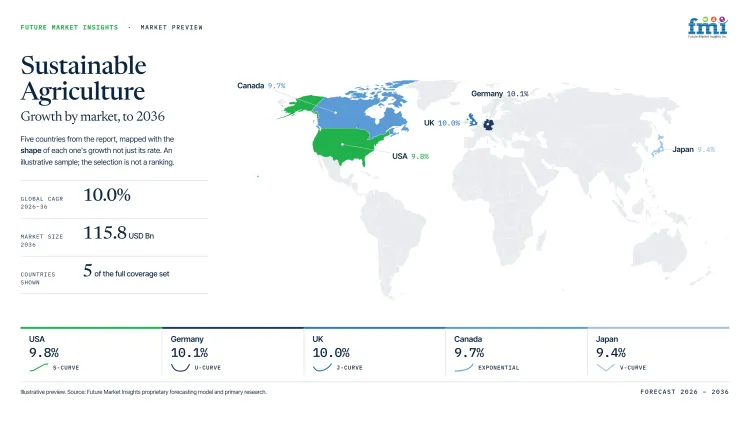
| Country | CAGR |
|---|---|
| South Korea | 11.2% |
| Australia | 10.3% |
| Germany | 10.1% |
| United Kingdom | 10.0% |
| United States | 9.8% |
How do country-level CAGRs compare in the Sustainable Agriculture Market?
The forecasts span 1.4 percentage points between South Korea and the United States. The range describes projected pace rather than current scale.
- South Korea links smart-farm investment with controlled production, although service capacity determines conversion from trials to recurring orders.
- Australia combines climate-adaptation programs with regional agronomy networks, although long service corridors raise maintenance costs.
- Germany pairs organic acreage with advisory channels, while certification and varied soils increase qualification work.
- The United Kingdom converts funded land-management agreements into demand, although changing eligibility complicates multi-season inventory planning.
- The United States offers broad conservation acreage, although registration and state distribution requirements raise expansion costs.
Similar CAGRs lead to different entry conditions and service needs across the five countries. The full report covers North America, Latin America, Europe, East Asia, South Asia and Pacific, and the Middle East and Africa.
Country-wise Analysis
- South Korean greenhouse operators use climate controls and digital dosing across concentrated production zones, yet smaller farms need financing and trained technicians for dependable installation. The South Korean sustainable agriculture sector is projected to record 11.2% CAGR during the assessment period, supported by smart-farm clusters and technology verification. MAFRA reported in February 2025 that its plan targets smart conversion across 35% of 55,000 greenhouse hectares and technology use across 20% of major field-crop areas and regional service networks must maintain equipment and convert operating data into crop-specific input decisions before equipment-led trials become recurring contracts.
- Australian growers operate across long service corridors that increase demonstration and maintenance costs outside established production zones. Sustainable agriculture sales in Australia are forecast to expand at 10.3% CAGR by 2036, aided by climate adaptation and soil-management programs. The agriculture ministry reported in July 2025 that 54 climate-smart projects were operating nationwide and 17 addressed adaptation and regional organizations provide credible extension channels, but input companies still need distribution partners that align trials with planting windows and maintain technical support across distant farming areas and regional delivery also depends on demonstrations aligned with planting windows and equipment service routes.
- German farms combine substantial organic acreage with advisory networks that understand regional crop and certification requirements. Germany’s sustainable agriculture outlook is anticipated to advance at 10.1% CAGR over the assessment period, shaped by demand for inputs that pair environmental performance with dependable output. Destatis reported in December 2025 that organic arable land and permanent grassland covered 1.86 million hectares with 399,300 hectares of cereals and certified acreage supports demand, although companies must provide compliant labels and repeatable field evidence across varied soils before distributors broaden inventory and local evidence must also remain consistent across several Länder and crop rotations.
- English land managers use funded agreements for soil planning and reduced-input actions across established farm businesses. Adoption of sustainable agriculture inputs in the United Kingdom is estimated to expand at 10.0% CAGR through 2036, supported by payments tied to defined practices. Defra reported in November 2025 that 77,000 agri-environment agreements were live during April 2025 and the schemes give companies a visible route into funded actions, but changing eligibility and administrative rules can interrupt multi-season planning for farms and regional distributors and commercial planning must therefore follow each agreement cycle and annual distributor inventory schedule.
- United States growers apply conservation practices across large commodity-crop regions with established dealer and agronomy networks. The United States is estimated to post 9.8% CAGR over the forecast period, influenced by farms adding selected soil and input-efficiency practices. USDA ERS reported in July 2025 that cover crops preceded 8% of corn acres and 11% of soybean acres and national scale provides broad acreage potential, although federal registration plus state distribution requirements raise expansion costs and demand crop-specific support before trials become recurring orders and technical coverage must extend across state channels and seasonal crop programs.
Who are the notable companies in the Sustainable Agriculture Market?
Bayer AG (Crop Science), Syngenta Group, Corteva Agriscience, UPL Limited, FMC Corporation, BASF SE, Sumitomo Chemical Co., Ltd. and ADAMA Ltd.
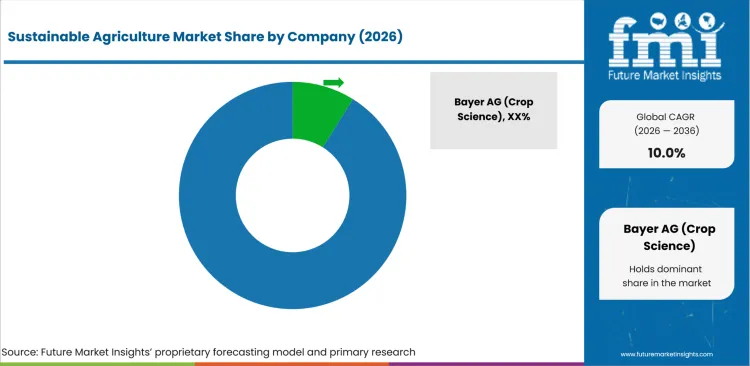
Integrated crop-science groups compete with crop-protection and biological-input companies. Market access depends on registered coverage and field support.
- Bayer, Syngenta, Corteva and BASF combine crop protection with seeds, biological products or digital agronomy.
- UPL, FMC, Sumitomo Chemical and ADAMA compete through formulations, biological portfolios and registration networks.
Competitive Benchmarking: Sustainable Agriculture Market
| Company | Integrated Input Coverage | Biological and Plant Health | Digital or Farm-System Integration | Geographic Reach |
|---|---|---|---|---|
| Bayer AG (Crop Science) | High | High | High | Global |
| Syngenta Group | High | High | High | Global |
| Corteva Agriscience | High | High | High | Global |
| UPL Limited | High | High | Medium | Global |
| FMC Corporation | Medium | High | High | Global |
| BASF SE | High | High | High | Global |
| Sumitomo Chemical Co., Ltd. | Medium | High | Medium | Global |
| ADAMA Ltd. | Medium | Medium | Medium | Global |
Key Developments in the Sustainable Agriculture Market
- In July 2026, Sumitomo Chemical obtained United States registration for Rapidicil and prepared state launches for no-till weed programs.
- In May 2026, BASF commissioned its Ludwigshafen BioHub and began production of biological active ingredients for fungicide and seed-treatment programs.
- In February 2025, Syngenta acquired Novartis research assets and opened a South Carolina facility that expanded biological discovery and production.
Key Players in the Sustainable Agriculture Market
Integrated Crop Science Platforms
- Bayer AG (Crop Science)
- Syngenta Group
- Corteva Agriscience
- BASF SE
Crop Protection and Biological Solutions Providers
- UPL Limited
- FMC Corporation
- Sumitomo Chemical Co., Ltd.
Formulation and Regional Crop Protection Specialist
- ADAMA Ltd.
Sustainable Agriculture Market - Report Scope
| Coverage field | Report scope |
|---|---|
| Market breakdown | By product type, farming system, crop type, form, mode of application and region. |
| Quantitative Units | Revenue in USD billion and CAGR in %. |
| Market Definition | Agricultural inputs and farm systems for efficiency or crop resilience. |
| Regions Covered | North America, Latin America, Europe, East Asia, South Asia and Pacific, and Middle East and Africa. |
| Countries Covered | South Korea, Australia, Germany, United Kingdom, United States and 20+ countries included in the full report. |
| Key Companies Profiled | Bayer AG (Crop Science), Syngenta Group, Corteva Agriscience, UPL Limited, FMC Corporation, BASF SE, Sumitomo Chemical Co., Ltd. and ADAMA Ltd. |
| Forecast Period | 2026 to 2036. |
| Approach | Primary and secondary research with market triangulation. |
Sustainable Agriculture Market - Research Methodology
| Method | Approach |
|---|---|
| Primary Research | FMI analysts gathered input from manufacturers, service providers, technology developers, distributors, end users, procurement teams, and subject-matter experts. Interviews examined purchasing decisions, product or service evaluation, adoption barriers, approval requirements, pricing considerations, and expectations for technical or commercial support. Respondents were also asked what evidence is required before a trial, pilot, or initial order develops into regular purchasing. |
| Desk Research | Desk research covered government statistics, regulatory publications, trade data, industry associations, technical literature, standards, company filings, product information, and official corporate announcements. Sources were reviewed for relevance, publication date, geographic coverage, and consistency with the defined market scope. Claims relating to performance, applications, approvals, capacity, investment, and commercial activity were retained only when supported by credible public evidence. |
| Market Sizing and Forecasting | The market model combined the baseline value with historical performance, segment structure, pricing and volume indicators, adoption levels, company participation, and country-level demand conditions. Forecast assumptions considered economic activity, investment trends, regulatory developments, technology adoption, purchasing cycles, supply availability, and barriers to wider market use. Segment and regional estimates were reconciled before the final market total was calculated. |
| Data Validation | Estimates were checked against multiple independent indicators, including public data, company activity, trade patterns, industry developments, and findings from primary interviews. Validation also tested whether products, services, applications, and company revenues fell within the defined market boundaries. Adjacent categories, unsupported claims, overlapping revenues, and activities without direct market relevance were excluded to reduce double counting and maintain consistency across segments and countries. |
Sustainable Agriculture Market by Segments
Sustainable Agriculture Market segmented by Product Type:
- Enhanced-Efficiency Synthetic Inputs
- Controlled-Release Fertilizers
- Stabilized Nitrogen Fertilizers
- Biological Crop Protection Products
- Biopesticides
- Biofungicides
- Non-Microbial Biostimulants & Plant Health Products
- Plant Biostimulants
- Seaweed Extracts
- Biological Crop Nutrition Products
- Biofertilizers
- Microbial Inoculants
Sustainable Agriculture Market segmented by Farming System:
- Conventional Farms Adopting Sustainable Inputs
- Precision Input Management
- Efficient Irrigation Systems
- Regenerative-Conservation Agriculture Farms
- No-Till Farming
- Cover Cropping
- Organic Agriculture
- Certified Organic Farming
- Organic Input-Based Farming
- Integrated Pest Management-Focused Farms
- Biological Pest Control
- Pest Monitoring Systems
Sustainable Agriculture Market segmented by Crop Type:
- Cereals & Grains
- Wheat
- Corn & Maize
- Oilseeds & Pulses
- Soybeans
- Pulses & Legumes
- Fruits & Vegetables
- Fruits
- Vegetables
- Industrial & Cash Crops
- Cotton
- Sugarcane
Sustainable Agriculture Market segmented by Form:
- Liquid Formulations
- Liquid Biofertilizers
- Liquid Biostimulants
- Dry-Granular Formulations
- Granular Biofertilizers
- Dry Organic Amendments
- Powder-Wettable Powder Formulations
- Powdered Biopesticides
- Wettable Biological Products
- Other Formulations
- Tablets & Pellets
- Specialty Formulations
Sustainable Agriculture Market segmented by Mode of Application:
- Soil-Applied Field Application
- Soil Amendments
- Soil Biological Inputs
- Foliar Application
- Foliar Biostimulants
- Foliar Biological Crop Protection
- Seed-Applied-Planting-Stage Application
- Seed Treatment
- Seed Coating
- Fertigation-Irrigation-Mediated Application
- Fertigation
- Drip Irrigation Application
Sustainable Agriculture Market by Region:
- North America
- United States
- Canada
- Mexico
- Latin America
- Brazil
- Chile
- Rest of Latin America
- Western Europe
- Germany
- United Kingdom
- Italy
- Spain
- France
- Nordics
- Benelux
- Rest of Western Europe
- Eastern Europe
- Russia
- Poland
- Hungary
- Balkan and Baltic States
- Rest of Eastern Europe
- East Asia
- China
- Japan
- South Korea
- South Asia and Pacific
- India
- ASEAN
- Australia and New Zealand
- Rest of South Asia and Pacific
- Middle East and Africa
- Kingdom of Saudi Arabia
- Other GCC Countries
- Türkiye
- South Africa
- Other African Union Countries
- Rest of Middle East and Africa
Research Sources and Bibliography
- FAO. (2025, January 20). Nitrogen use efficiency must be improved to reduce harm to human and environmental health.
- Defra. (2025, November 19). CS, ES and SFI option uptake data April 2025.
- FAO. (2026, January 19). New FAO guidance on assessing food safety risks related to environmental inhibitors.
- MAFRA. (2025, February 27). S. Korea’s First Master Plan for Promotion of the Growth of the Smart-Farming Industry for the Years 2025-2029.
- Australian DAFF. (2025, July 18). Albanese Labor Government delivering $76 million in climate-smart support for farmers.
- Destatis. (2025, December 5). Ökologischer Landbau in Deutschland: Ackerland und Dauergrünland.
- USDA ERS. (2025, July 30). Farmers increase cover crop usage over past decade for some major cash crops.
- Sumitomo Chemical Co., Ltd.. (2026, July 2). Sumitomo Chemical Obtains Registration for New Herbicide Rapidicil™ in the United States.
- BASF SE. (2026, May 11). BASF Agricultural Solutions successfully commissions new fermentation plant for crop protection products in Ludwigshafen.
- Syngenta Group. (2025, February 26). Syngenta strengthens global leadership in agricultural biologicals.
This bibliography is provided for reader reference and is not exhaustive. The full report contains the complete reference list and detailed citations
This Report Answers
- How large is the global Sustainable Agriculture market, and what is its growth outlook through 2036?
- What factors help convert sustainability and efficiency claims into measurable on-farm adoption and purchasing decisions?
- Why do enhanced-efficiency agricultural inputs hold a leading share of the Sustainable Agriculture market?
- How does the staged adoption of sustainable farming technologies and practices progress across agricultural operations?
- Why do cereal and grain crops generate recurring demand for sustainable agriculture products and solutions?
- How do national regulations, farm economics, and agricultural conditions influence market access and adoption across countries?
- Which companies combine biological solutions, precision agriculture technologies, and digital farming tools within their offerings?
- What field-trial results, performance data, and validation evidence support broader commercialization and adoption of sustainable agriculture solutions?
Frequently Asked Questions
How big is the Sustainable Agriculture Market in 2026?
The Sustainable Agriculture Market is valued at USD 44.7 billion in 2026. Commercial farms support this value by adopting inputs and management systems that improve resource efficiency while fitting established equipment, crop schedules and farm economics across repeated production cycles.
What is the Sustainable Agriculture Market CAGR?
The Sustainable Agriculture Market is projected to expand at 10.0% CAGR between 2026 and 2036. Forecast demand depends on verified field performance and workable registration routes that permit recurring purchases across diverse crop systems, established dealer networks and regional distribution channels.
Which product type leads the Sustainable Agriculture Market?
Enhanced-efficiency synthetic inputs are projected to hold 31.0% of the Sustainable Agriculture Market product type category in 2026. Their position reflects compatibility with established fertilizer programs and gradual adoption without replacing complete production systems across broad commercial acreage and dealer networks.
How much will the Sustainable Agriculture Market add between 2026 and 2036?
The Sustainable Agriculture Market is projected to add USD 71.1 billion between 2026 and 2036. The increase reflects wider use of efficient inputs and farm systems that fit existing equipment while meeting regional performance, registration and application requirements across commercial farms.
Which companies are active in the Sustainable Agriculture Market?
Bayer AG, Syngenta Group, Corteva Agriscience, UPL Limited, FMC Corporation, BASF SE, Sumitomo Chemical Co., Ltd. and ADAMA Ltd. cover crop-protection and biological programs across major agricultural regions worldwide.
Preview the report firsthand - request a free sample
Get SampleGet the brochure for pricing and purchase details.
Get PDFTable of Content
- Key Takeaways
- Market Size and CAGR
- Top Growth Driver
- Fastest Growing Segment
- Leading Region
- Key Companies
- Emerging Opportunities
- Executive Summary
- Global Market Outlook
- Demand-side Trends
- Supply-side Trends
- Technology Roadmap Analysis
- Analysis and Recommendations
- Analyst Perspective (What is happening? Why now? What should investors know?)
- Key Questions Answered
- How large is the market?
- What is the CAGR?
- What are key trends?
- Which region dominates?
- Who are the leaders?
- Market Overview
- Market Coverage / Taxonomy
- Market Definition / Scope / Limitations
- Research Methodology
- Chapter Orientation
- Analytical Lens and Working Hypotheses
- Market Structure, Signals, and Trend Drivers
- Benchmarking and Cross-market Comparability
- Market Sizing, Forecasting, and Opportunity Mapping
- Research Design and Evidence Framework
- Desk Research Programme (Secondary Evidence)
- Expert Input and Fieldwork (Primary Evidence)
- Tooling, Models, and Reference Databases
- Data Engineering and Model Build
- Quality Assurance and Audit Trail
- Market Background
- Market Dynamics (Drivers, Restraints, Opportunity, Trends)
- Scenario Forecast (Optimistic, Likely, Conservative)
- Impact Analysis
- AI Impact
- Sustainability Impact
- Regulatory Impact
- Technology Impact
- Consumer / Buyer Analysis
- Purchase Drivers
- Adoption Barriers
- Buyer Journey
- Opportunity Map Analysis
- Product Life Cycle Analysis
- Supply Chain Analysis
- Investment Feasibility Matrix
- Value Chain Analysis
- PESTLE and Porter's Analysis
- Regulatory Landscape
- Regional Parent Market Outlook
- Production and Consumption Statistics
- Import and Export Statistics
- Global Market Analysis and Forecast, 2021 to 2036
- Historical Market Size Value (USD Billion) Analysis, 2021 to 2025
- Current and Future Market Size Value (USD Billion) Projections, 2026 to 2036
- Y-o-Y Growth Trend Analysis
- Absolute $ Opportunity Analysis
- Global Market Pricing Analysis, 2021 to 2036
- Global Market Analysis and Forecast, By Product Type, 2021 to 2036
- Introduction / Key Findings
- Historical Market Size Value (USD Billion) Analysis By Product Type, 2021 to 2025
- Current and Future Market Size Value (USD Billion) Analysis and Forecast By Product Type, 2026 to 2036
- Enhanced-Efficiency Synthetic Inputs
- Controlled-Release Fertilizers
- Stabilized Nitrogen Fertilizers
- Biological Crop Protection Products
- Biopesticides
- Biofungicides
- Non-Microbial Biostimulants & Plant Health Products
- Plant Biostimulants
- Seaweed Extracts
- Biological Crop Nutrition Products
- Biofertilizers
- Microbial Inoculants
- Enhanced-Efficiency Synthetic Inputs
- Y-o-Y Growth Trend Analysis By Product Type, 2021 to 2025
- Absolute $ Opportunity Analysis By Product Type, 2026 to 2036
- Global Market Analysis and Forecast, By Farming System, 2021 to 2036
- Introduction / Key Findings
- Historical Market Size Value (USD Billion) Analysis By Farming System, 2021 to 2025
- Current and Future Market Size Value (USD Billion) Analysis and Forecast By Farming System, 2026 to 2036
- Conventional Farms Adopting Sustainable Inputs
- Precision Input Management
- Efficient Irrigation Systems
- Regenerative-Conservation Agriculture Farms
- No-Till Farming
- Cover Cropping
- Organic Agriculture
- Certified Organic Farming
- Organic Input-Based Farming
- Integrated Pest Management-Focused Farms
- Biological Pest Control
- Pest Monitoring Systems
- Conventional Farms Adopting Sustainable Inputs
- Y-o-Y Growth Trend Analysis By Farming System, 2021 to 2025
- Absolute $ Opportunity Analysis By Farming System, 2026 to 2036
- Global Market Analysis and Forecast, By Crop Type, 2021 to 2036
- Introduction / Key Findings
- Historical Market Size Value (USD Billion) Analysis By Crop Type, 2021 to 2025
- Current and Future Market Size Value (USD Billion) Analysis and Forecast By Crop Type, 2026 to 2036
- Cereals & Grains
- Wheat
- Corn & Maize
- Oilseeds & Pulses
- Soybeans
- Pulses & Legumes
- Fruits & Vegetables
- Fruits
- Vegetables
- Industrial & Cash Crops
- Cotton
- Sugarcane
- Cereals & Grains
- Y-o-Y Growth Trend Analysis By Crop Type, 2021 to 2025
- Absolute $ Opportunity Analysis By Crop Type, 2026 to 2036
- Global Market Analysis and Forecast, By Form, 2021 to 2036
- Introduction / Key Findings
- Historical Market Size Value (USD Billion) Analysis By Form, 2021 to 2025
- Current and Future Market Size Value (USD Billion) Analysis and Forecast By Form, 2026 to 2036
- Liquid Formulations
- Liquid Biofertilizers
- Liquid Biostimulants
- Dry-Granular Formulations
- Granular Biofertilizers
- Dry Organic Amendments
- Powder-Wettable Powder Formulations
- Powdered Biopesticides
- Wettable Biological Products
- Other Formulations
- Tablets & Pellets
- Specialty Formulations
- Liquid Formulations
- Y-o-Y Growth Trend Analysis By Form, 2021 to 2025
- Absolute $ Opportunity Analysis By Form, 2026 to 2036
- Global Market Analysis and Forecast, By Mode of Application, 2021 to 2036
- Introduction / Key Findings
- Historical Market Size Value (USD Billion) Analysis By Mode of Application, 2021 to 2025
- Current and Future Market Size Value (USD Billion) Analysis and Forecast By Mode of Application, 2026 to 2036
- Soil-Applied Field Application
- Soil Amendments
- Soil Biological Inputs
- Foliar Application
- Foliar Biostimulants
- Foliar Biological Crop Protection
- Seed-Applied-Planting-Stage Application
- Seed Treatment
- Seed Coating
- Fertigation-Irrigation-Mediated Application
- Fertigation
- Drip Irrigation Application
- Soil-Applied Field Application
- Y-o-Y Growth Trend Analysis By Mode of Application, 2021 to 2025
- Absolute $ Opportunity Analysis By Mode of Application, 2026 to 2036
- Global Market Analysis and Forecast, By Region, 2021 to 2036
- Introduction
- Historical Market Size Value (USD Billion) Analysis By Region, 2021 to 2025
- Current Market Size Value (USD Billion) Analysis and Forecast By Region, 2026 to 2036
- North America
- Latin America
- Western Europe
- Eastern Europe
- East Asia
- South Asia and Pacific
- Middle East & Africa
- Market Attractiveness Analysis By Region
- North America Market Analysis and Forecast, By Country, 2021 to 2036
- Historical Market Size Value (USD Billion) Trend Analysis By Market Taxonomy, 2021 to 2025
- Market Size Value (USD Billion) Forecast By Market Taxonomy, 2026 to 2036
- By Country
- USA
- Canada
- By Product Type
- By Farming System
- By Crop Type
- By Form
- By Mode of Application
- By Country
- Market Attractiveness Analysis
- By Country
- By Product Type
- By Farming System
- By Crop Type
- By Form
- By Mode of Application
- Key Takeaways
- Latin America Market Analysis and Forecast, By Country
- Historical Market Size Value (USD Billion) Trend Analysis By Market Taxonomy, 2021 to 2025
- Market Size Value (USD Billion) Forecast By Market Taxonomy, 2026 to 2036
- By Country
- Brazil
- Mexico
- Chile
- Rest of Latin America
- By Product Type
- By Farming System
- By Crop Type
- By Form
- By Mode of Application
- By Country
- Market Attractiveness Analysis
- By Country
- By Product Type
- By Farming System
- By Crop Type
- By Form
- By Mode of Application
- Key Takeaways
- Western Europe Market Analysis and Forecast, By Country
- Historical Market Size Value (USD Billion) Trend Analysis By Market Taxonomy, 2021 to 2025
- Market Size Value (USD Billion) Forecast By Market Taxonomy, 2026 to 2036
- By Country
- Germany
- UK
- Italy
- Spain
- France
- Nordic
- BENELUX
- Rest of Western Europe
- By Product Type
- By Farming System
- By Crop Type
- By Form
- By Mode of Application
- By Country
- Market Attractiveness Analysis
- By Country
- By Product Type
- By Farming System
- By Crop Type
- By Form
- By Mode of Application
- Key Takeaways
- Eastern Europe Market Analysis and Forecast, By Country
- Historical Market Size Value (USD Billion) Trend Analysis By Market Taxonomy, 2021 to 2025
- Market Size Value (USD Billion) Forecast By Market Taxonomy, 2026 to 2036
- By Country
- Russia
- Poland
- Hungary
- Balkan & Baltic
- Rest of Eastern Europe
- By Product Type
- By Farming System
- By Crop Type
- By Form
- By Mode of Application
- By Country
- Market Attractiveness Analysis
- By Country
- By Product Type
- By Farming System
- By Crop Type
- By Form
- By Mode of Application
- Key Takeaways
- East Asia Market Analysis and Forecast, By Country
- Historical Market Size Value (USD Billion) Trend Analysis By Market Taxonomy, 2021 to 2025
- Market Size Value (USD Billion) Forecast By Market Taxonomy, 2026 to 2036
- By Country
- China
- Japan
- South Korea
- By Product Type
- By Farming System
- By Crop Type
- By Form
- By Mode of Application
- By Country
- Market Attractiveness Analysis
- By Country
- By Product Type
- By Farming System
- By Crop Type
- By Form
- By Mode of Application
- Key Takeaways
- South Asia and Pacific Market Analysis and Forecast, By Country
- Historical Market Size Value (USD Billion) Trend Analysis By Market Taxonomy, 2021 to 2025
- Market Size Value (USD Billion) Forecast By Market Taxonomy, 2026 to 2036
- By Country
- India
- ASEAN
- Australia & New Zealand
- Rest of South Asia and Pacific
- By Product Type
- By Farming System
- By Crop Type
- By Form
- By Mode of Application
- By Country
- Market Attractiveness Analysis
- By Country
- By Product Type
- By Farming System
- By Crop Type
- By Form
- By Mode of Application
- Key Takeaways
- Middle East & Africa Market Analysis and Forecast, By Country
- Historical Market Size Value (USD Billion) Trend Analysis By Market Taxonomy, 2021 to 2025
- Market Size Value (USD Billion) Forecast By Market Taxonomy, 2026 to 2036
- By Country
- Kingdom of Saudi Arabia
- Other GCC Countries
- Türkiye
- South Africa
- Other African Union
- Rest of Middle East & Africa
- By Product Type
- By Farming System
- By Crop Type
- By Form
- By Mode of Application
- By Country
- Market Attractiveness Analysis
- By Country
- By Product Type
- By Farming System
- By Crop Type
- By Form
- By Mode of Application
- Key Takeaways
- Key Countries Market Analysis
- USA
- Pricing Analysis
- Market Share Analysis, 2025
- By Product Type
- By Farming System
- By Crop Type
- By Form
- By Mode of Application
- Canada
- Pricing Analysis
- Market Share Analysis, 2025
- By Product Type
- By Farming System
- By Crop Type
- By Form
- By Mode of Application
- Mexico
- Pricing Analysis
- Market Share Analysis, 2025
- By Product Type
- By Farming System
- By Crop Type
- By Form
- By Mode of Application
- Brazil
- Pricing Analysis
- Market Share Analysis, 2025
- By Product Type
- By Farming System
- By Crop Type
- By Form
- By Mode of Application
- Chile
- Pricing Analysis
- Market Share Analysis, 2025
- By Product Type
- By Farming System
- By Crop Type
- By Form
- By Mode of Application
- Germany
- Pricing Analysis
- Market Share Analysis, 2025
- By Product Type
- By Farming System
- By Crop Type
- By Form
- By Mode of Application
- UK
- Pricing Analysis
- Market Share Analysis, 2025
- By Product Type
- By Farming System
- By Crop Type
- By Form
- By Mode of Application
- Italy
- Pricing Analysis
- Market Share Analysis, 2025
- By Product Type
- By Farming System
- By Crop Type
- By Form
- By Mode of Application
- Spain
- Pricing Analysis
- Market Share Analysis, 2025
- By Product Type
- By Farming System
- By Crop Type
- By Form
- By Mode of Application
- France
- Pricing Analysis
- Market Share Analysis, 2025
- By Product Type
- By Farming System
- By Crop Type
- By Form
- By Mode of Application
- India
- Pricing Analysis
- Market Share Analysis, 2025
- By Product Type
- By Farming System
- By Crop Type
- By Form
- By Mode of Application
- ASEAN
- Pricing Analysis
- Market Share Analysis, 2025
- By Product Type
- By Farming System
- By Crop Type
- By Form
- By Mode of Application
- Australia & New Zealand
- Pricing Analysis
- Market Share Analysis, 2025
- By Product Type
- By Farming System
- By Crop Type
- By Form
- By Mode of Application
- China
- Pricing Analysis
- Market Share Analysis, 2025
- By Product Type
- By Farming System
- By Crop Type
- By Form
- By Mode of Application
- Japan
- Pricing Analysis
- Market Share Analysis, 2025
- By Product Type
- By Farming System
- By Crop Type
- By Form
- By Mode of Application
- South Korea
- Pricing Analysis
- Market Share Analysis, 2025
- By Product Type
- By Farming System
- By Crop Type
- By Form
- By Mode of Application
- Russia
- Pricing Analysis
- Market Share Analysis, 2025
- By Product Type
- By Farming System
- By Crop Type
- By Form
- By Mode of Application
- Poland
- Pricing Analysis
- Market Share Analysis, 2025
- By Product Type
- By Farming System
- By Crop Type
- By Form
- By Mode of Application
- Hungary
- Pricing Analysis
- Market Share Analysis, 2025
- By Product Type
- By Farming System
- By Crop Type
- By Form
- By Mode of Application
- Kingdom of Saudi Arabia
- Pricing Analysis
- Market Share Analysis, 2025
- By Product Type
- By Farming System
- By Crop Type
- By Form
- By Mode of Application
- Türkiye
- Pricing Analysis
- Market Share Analysis, 2025
- By Product Type
- By Farming System
- By Crop Type
- By Form
- By Mode of Application
- South Africa
- Pricing Analysis
- Market Share Analysis, 2025
- By Product Type
- By Farming System
- By Crop Type
- By Form
- By Mode of Application
- USA
- Market Structure Analysis
- Competition Dashboard
- Competition Benchmarking
- Market Share Analysis of Top Players
- By Regional
- By Product Type
- By Farming System
- By Crop Type
- By Form
- By Mode of Application
- Emerging Startups
- Innovation Benchmarking
- Competition Analysis
- Competition Deep Dive
- Bayer AG (Crop Science)
- Overview
- Product Portfolio
- Profitability by Market Segments
- Sales Footprint
- Strategy Overview
- Marketing Strategy
- Product Strategy
- Channel Strategy
- Syngenta Group
- Corteva Agriscience
- UPL Limited
- FMC Corporation
- BASF SE
- Nufarm Limited
- Sumitomo Chemical Co., Ltd.
- ADAMA Ltd.
- Gowan Company
- Others
- Bayer AG (Crop Science)
- Case Studies
- Success Stories
- Recent Developments
- Competition Deep Dive
- Assumptions & Acronyms Used


