

- Market Size (2026)
- USD 40.3 Bn
- Forecast (2036)
- USD 76.4 Bn
- CAGR (2026 to 2036)
- 6.6%
How big is Sustainable Protein & Meat Packaging Market in 2026?
USD 40.3 billion in 2026 and USD 76.4 billion by 2036 at a 6.6% CAGR.
Demand for sustainable protein & meat packaging are projected to expand at 6.6% CAGR from 2026 to 2036, supported by processor investment in packaging that protects product quality and line output. Industry valuation is projected to rise from USD 40.3 billion in 2026 to USD 76.4 billion by 2036. Protein packaging earns repeat orders through stable seals and puncture resistance across wet products with uneven shapes and chilled distribution requirements. Regulation (EU) 2025/40 was published in January 2025 and introduced lifecycle requirements for packaging placed on the European Union market. The regulation raises the commercial value of designs that pair food protection with documented recyclability across intended national recovery systems.
National adoption differs across the five profiled countries through distinct collection systems and food-contact qualification routes. German facilities operate within mature recovery networks that demand detailed evidence for barrier layers and absorbent components. Chinese plants process larger protein volumes under national material standards that require local qualification for imported structures. United States processors manage federal food-contact controls alongside state packaging rules that complicate common national specifications. Brazilian and Australian facilities gain from export-oriented protein output but face longer service routes across major processing regions. Investment decisions therefore depend on full-line trials that test seal integrity and purge control across actual commercial operating conditions. Defined maintenance responsibility protects material savings from repeated line stoppages and rejected recovery claims during commercial production.
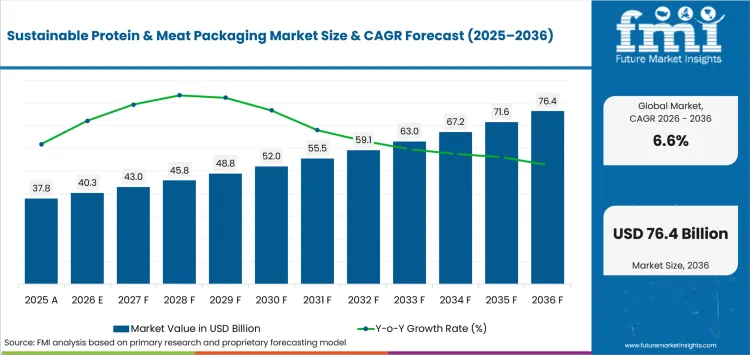
Key Takeaways of Sustainable Protein & Meat Packaging Market
- Protein protection requirements support recurring packaging demand through seal integrity and puncture resistance across chilled distribution and retail handling.
- By format, fiber trays are forecast to represent 45.3% in 2026 and are supported by rigid presentation and processor goals for lower plastic use.
- Recyclable mono is expected to represent 57.8% of material in 2026, reflecting familiar equipment and simpler recovery classification across intended systems.
- Meat is estimated to capture 44.0% of protein in 2026, influenced by strict requirements for bone-puncture protection and purge management.
- Barrier performance and local recovery routes remain the main restraints across protein-packaging conversion decisions in this market. Recyclable claims require dependable sealing and accessible collection infrastructure across every intended national sales region for commercial credibility.
- Sealed Air and Amcor provide integrated material platforms; Faerch and Yangi specialize in rigid circular trays and Mondi adds fiber formats.
Analyst Perspective
"Protein processors should reject material claims that separate recovery goals from shelf-life protection and line reliability. The strongest packages combine purge control and puncture resistance with evidence that sealing performance remains repeatable across commercial runs. Executives should compare fiber trays and mono-material films through plant trials that expose downtime risk and clarify technical support responsibilities."
- Nandini Roy Choudhury, Principal Analyst, Future Market Insights
How is the Sustainable Protein & Meat Packaging Market segmented?
The industry is segmented by format, material, protein, and region.
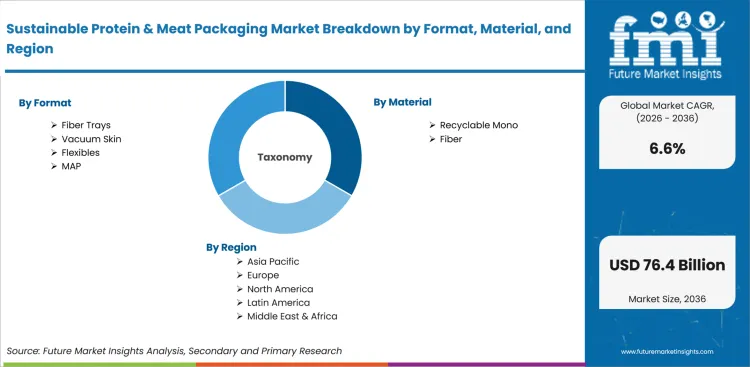
The market is segmented by format, material, protein, and region to reflect distinct operating and purchasing decisions. Format covers fiber trays, vacuum skin, flexibles, and modified-atmosphere packaging according to presentation, barrier performance, and equipment fit. Material divides recyclable mono structures from fiber designs through sealing behavior, food-contact compliance, and available recovery routes. Protein analysis compares meat, poultry, seafood, and alternative proteins through purge levels, bone exposure, product shape, and chilled shelf-life requirements. These analytical categories connect protein packaging formats with different filling and transport conditions across chilled commercial operations. Regional analysis examines the United States, Germany, Brazil, China, and Australia through local food packaging rules, processing scale, service access, and collection infrastructure. The framework separates technical performance from market access so each segment retains a clear commercial boundary.
Why do fiber trays lead the format category?
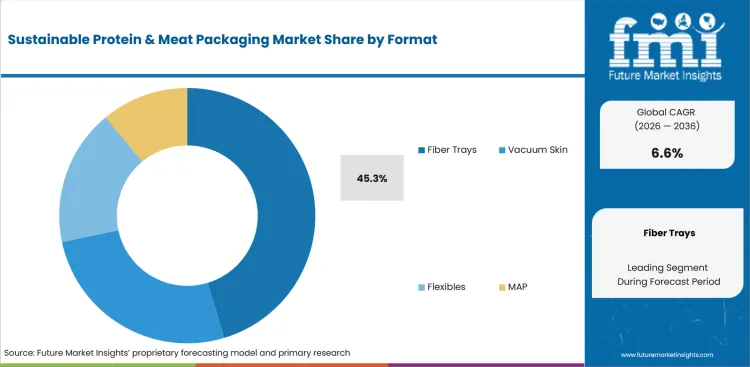
Fiber trays provide rigid presentation and a lower-plastic route for chilled meat and seafood packs. Yangi announced in February 2026 that its Cellera platform enabled production-ready fiber trays for meat and fish. The platform reported four-to-six-second cycles and modified-atmosphere compatibility across sustained industrial output for commercial tray production. The development places formed fiber beside vacuum skin paperboard in practical trials that must test wet-product strength and dependable sealing across commercial protein lines.
- Fiber trays are likely to capture 45.3% share in 2026 attributable to rigid presentation and a practical route toward lower plastic use. Commercial position depends on maintaining tray stiffness through wet-product contact and refrigerated distribution across retail supply chains. Processors favor designs that reduce resin use without transferring leakage risk or slower output into commercial packing operations.
- Protein processors adopt fiber trays through line trials that examine barrier liners and consistent sealing edges across varied cuts. Reliable tray performance reduces leaks and prevents fiber softening throughout refrigerated storage and extended chilled distribution. Adoption weakens at plants lacking nearby technical support or a recovery route that accepts coated fiber structures following food contact. Those limits determine whether a successful trial becomes a repeat specification across several processing plants.
How does recyclable mono shape the material category?
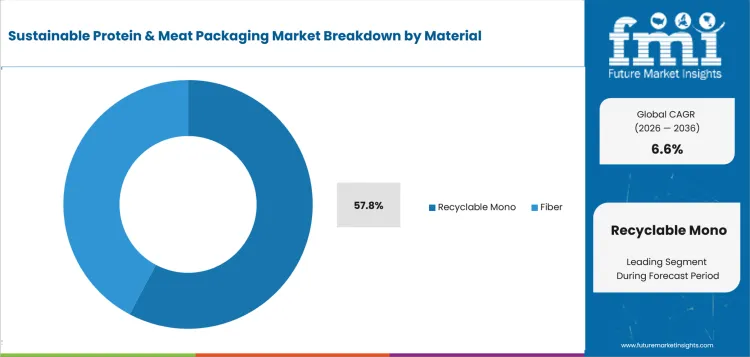
Recyclable mono structures simplify material classification and retain familiar forming and sealing methods across protein lines. Faerch reported in April 2025 that MAPET II fresh-meat trays achieved 98% to 99% recyclability certification. The trays combine recycled PET with an airtight rim adhesive that protects contaminated sealing edges during commercial filling. The development shows that mono-material structures need verified barrier performance and recovery compatibility rather than a simple material claim.
- By material, recyclable mono is estimated to hold 57.8% in 2026 owing to established equipment compatibility and simpler recovery classification. Existing thermoforming assets reduce conversion expense across large protein-processing plants with established commercial production lines. The segment retains its position through designs that preserve oxygen control and seal strength without adding layers that complicate sorting across local recovery systems.
- Food processors favor mono-material packs that protect shelf life without requiring complete line replacement across production sites. Commercial adoption depends on verified puncture resistance and reliable heat-seal windows for varied protein formats. Limited collection capacity remains a material friction and can weaken the commercial value of technically recyclable designs across intended sales regions.
What supports meat within the protein category?
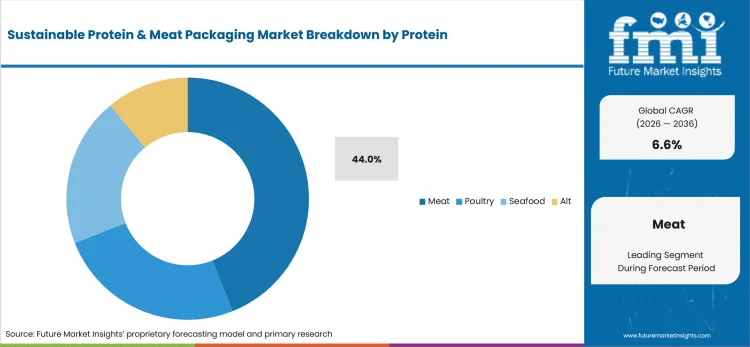
Fresh meat packaging releases purge and presents sharp bone edges that test seals throughout chilled distribution and retail handling. Amcor reported in May 2026 that its paper-based fresh-meat MAP solution reduced plastic use and preserved sealing integrity. Commercial trials supported eight-to-ten days of shelf life in the Chinese market under normal distribution conditions. The development connects fresh food protection with measurable pack integrity across existing filling and retail workflows.
- Meat is projected to hold 44.0% share in 2026 owing to persistent requirements for puncture protection and purge control. Irregular cut geometry creates demanding sealing conditions that exceed those presented by uniform protein formats. The operating pressure favors packaging systems that protect color and shelf life without slowing high-volume filling operations across commercial plants.
- Meat processors require materials that tolerate bone contact and variable surface moisture across every commercial production shift. Technical teams must confirm seal windows and leak rates under actual line speeds rather than controlled sample conditions. Adoption expands through packaging support that identifies failure causes quickly and limits product loss during changeovers or seasonal volume increases.
What are the drivers, restraints, and opportunities in the Sustainable Protein & Meat Packaging Market?
Reliable product protection supports demand; qualification expense restrains conversion; verified recovery data creates a clearer route for alternative materials.
- Driver: Stable sealing and puncture protection reduce product loss across high-volume meat and poultry processing operations.
- Restraint: Food-contact review and full-line validation increase conversion expense across plants with varied protein specifications and equipment.
- Opportunity: Verified recycled content and recovery data give processors a clearer basis for approving alternative trays and films.
Production efficiency creates recurring demand for sustainable packaging systems that protect output during long protein-processing runs. Sealed Air reported in September 2025 that CRYOVAC installed its 4,000th rotary vacuum chamber system at Cargill. The replacement machine succeeded equipment that had operated for forty years across continuous commercial production. The installation shows how durable vacuum systems and accountable service reduce downtime risk across plants that rely on continuous food packaging films performance.
Food-contact changes can slow material conversion across paper and plastic formats used with wet protein products. The FDA determined in January 2025 that 35 PFAS-related food-contact notifications were no longer effective. Fiber developers must qualify new grease and moisture barriers across every intended protein packaging application. Film manufacturers face similar qualification work across high-barrier film structures that require migration review and processor trials for varied protein specifications. These requirements increase conversion expense across plants operating several product and equipment combinations at multiple production sites.
Independent environmental data creates a practical opening for packaging manufacturers that support recovery claims with verified evidence. Faerch announced in February 2025 that CIRPET+ received a third-party tray-to-tray emissions factor within the Sphera database. The verified record gives retailers and processors a consistent basis for comparing recycled-content packaging options. Clear documentation can shorten package approval and reduce reliance on broad environmental claims that do not explain actual material recovery across intended collection systems.
Which country CAGRs are profiled in the Sustainable Protein & Meat Packaging Market?
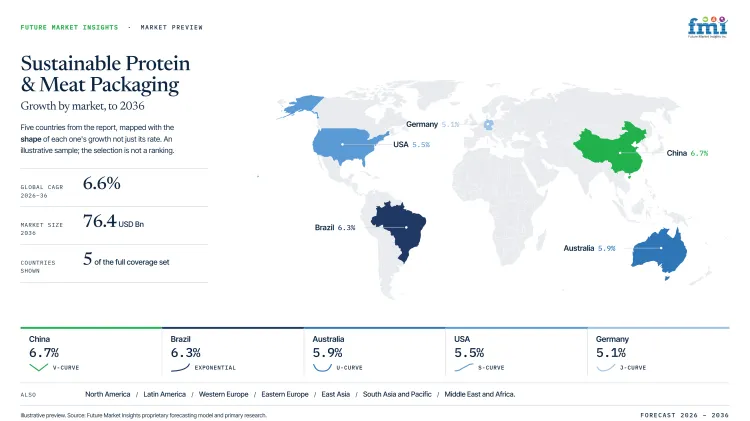
| Country | CAGR |
|---|---|
| USA | 5.5% |
| Germany | 5.1% |
| Brazil | 6.3% |
| China | 6.7% |
| Australia | 5.9% |
How do country-level CAGRs compare in the Sustainable Protein & Meat Packaging Market?
The country forecasts show a gradual progression across the sustainable protein & meat packaging market rather than clearly separated growth tiers. China and Brazil form an upper group with only a limited difference between their projected growth rates, reflecting strong momentum in packaging solutions that support product protection and sustainability objectives. Australia follows closely behind and acts as a bridge between the upper and lower markets. The USA and Germany create a closely aligned lower pair with a gap of just 0.4 percentage points between them. The overall spread of 1.6 percentage points indicates that demand for sustainable protein and meat packaging is advancing across all five countries, with differences linked to packaging innovation, regulatory priorities and adoption of recyclable and resource-efficient materials.
- China shows a notable position within the comparison as food producers and packaging manufacturers continue to invest in recyclable and lower-impact packaging formats for protein products.
- Brazil remains closely aligned with China as growth in meat exports and packaged protein sales encourages wider adoption of sustainable packaging materials and designs.
- Australia reflects steady momentum through increasing emphasis on packaging efficiency, shelf-life preservation and sustainability requirements across meat supply chains.
- The USA benefits from growing demand for recyclable and responsible packaging solutions as retailers and food brands pursue environmental commitments and waste reduction goals.
- Germany maintains a meaningful position within the comparison as circular economy initiatives and packaging sustainability targets continue to influence material selection and product development.
Comparable CAGRs do not create identical market conditions across countries. Differences in recycling infrastructure, packaging regulations, protein production volumes and retailer sustainability requirements can influence adoption pathways and investment priorities. Similar growth forecasts may therefore reflect distinct commercialization strategies and end-user requirements within the sustainable protein and meat packaging market. The full report provides country-level CAGR analysis across North America, Latin America, Europe, East Asia, South Asia, Oceania and the Middle East and Africa.
Country-wise Analysis
- United States processors operate under federal food-contact controls and state packaging rules that complicate common specifications across national distribution. In the United States, sustainable protein and meat packaging demand is predicted to advance at 5.5% CAGR through 2036. Large processing capacity and broad technical service coverage support the authorised market outlook across major protein regions. USDA NASS reported in November 2025 that livestock slaughter data covered approximately 800 federally inspected plants and 1,900 state-inspected facilities. Dense plant networks improve access to sealing equipment maintenance and production trials across major protein regions. Fragmented state recovery requirements create different documentation and collection assumptions across sales territories for the same recyclable structure.
- German meat plants operate within European food-contact controls and established producer-responsibility systems that support documented recovery claims. Germany's sustainable protein and meat packaging outlook is anticipated to advance at 5.1% CAGR over the assessment period, influenced by mature processing capacity and retailer packaging requirements. Detailed recyclability assessment supports credible material claims but increases qualification work for barrier layers and absorbent components. Destatis reported in August 2025 that commercial slaughterhouses produced nearly 3.4 million tonnes of meat during the first half of 2025. High processing throughput creates recurring demand for trays and barrier films across established meat plants. Strict evidence requirements can delay conversion across facilities that process varied cuts or operate older sealing equipment.
- Brazilian processors manage high slaughter volumes across major production states and widely separated customer facilities. Sustainable protein and meat packaging demand in Brazil is forecast to rise at 6.3% CAGR over the forecast period, underpinned by expanding cattle and poultry throughput. IBGE reported in March 2026 that 42.94 million cattle and 6.69 billion chickens were slaughtered during 2025. Large processing batches support steady use of trays and barrier films across export-oriented protein plants. Long service distances remain a material friction for specialized sealing equipment outside established production clusters. Uneven collection infrastructure also weakens the commercial case for recyclable formats across regions without dependable material recovery routes.
- Chinese protein plants serve large domestic volumes through centralized processing and retail networks that support automated tray and film systems. Sustainable protein and meat packaging sales in China are forecast to expand at 6.7% CAGR by 2036, strengthened by concentrated processing throughput and national food-contact requirements. Imported structures require local material qualification across intended protein applications and provincial recovery routes for processors. The National Bureau of Statistics reported in January 2026 that combined pork and beef output with mutton and poultry reached 100.72 million tonnes during 2025. Large production volumes support high equipment utilization across commercial modified-atmosphere packaging lines in major protein plants. Provincial recovery differences create a material implementation friction across distributed processor locations and recovery networks. National technical approval does not guarantee consistent collection outcomes across every regional recovery system in practice.
- Australian meat processors serve domestic retailers and export supply chains across widely separated facilities with demanding chilled-distribution requirements. Adoption of sustainable protein and meat packaging in Australia is estimated to expand at 5.9% CAGR through 2036, aided by export handling requirements and high-throughput beef processing. Remote plants face long service routes that increase downtime exposure for specialized sealing equipment during peak production. The Australian Bureau of Statistics reported in February 2026 that beef production reached 727,921 tonnes during the December 2025 quarter. Export programs reward strong barrier performance and documented pack integrity across extended chilled distribution routes. Maintenance planning remains a material friction across facilities that lack nearby technicians or replacement parts.
Who are the notable companies in the Sustainable Protein & Meat Packaging Market?
Sealed Air, Yangi, Amcor, Mondi, and Faerch are the notable companies profiled in this industry.
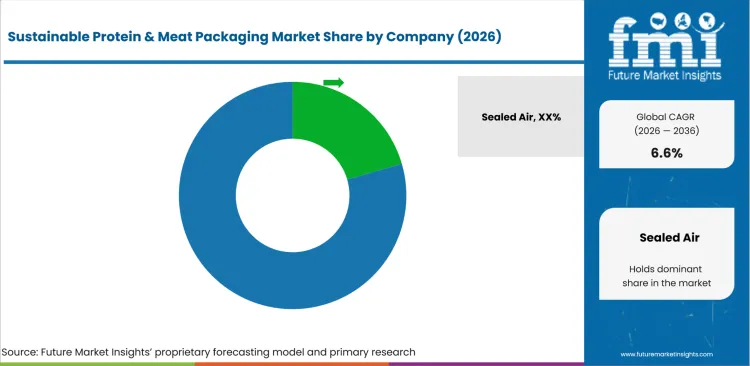
Competition combines integrated film and equipment providers with specialists in recycled PET and dry-formed fiber trays. Sealed Air reported in January 2026 that its CRYOVAC technical service team averaged eleven years of equipment experience. The service base gives large protein processors a route for coordinated materials and machinery support. Amcor develops films and trays through multinational production networks with established technical resources across several regions. Faerch and Yangi focus on rigid circular formats through recycled PET and dry-forming technologies for protein applications. Mondi adds fiber and flexible structures for chilled meat and seafood applications across a broad European production network.
- Sealed Air and Amcor compete through broad material portfolios that support multinational protein processors across films and equipment interfaces. Experienced vacuum-system service teams strengthen Sealed Air across major production regions and customer sites globally. Amcor combines flexible barriers with fiber-tray collaborations that help processors test material changes across established modified-atmosphere and skin-pack lines.
- Faerch and Yangi focus on rigid formats with different material routes across chilled protein applications. Faerch develops tray-to-tray recycled PET structures through documented commercial meat-packaging conversions across established production lines. Yangi advances dry-formed fiber platforms that target high-volume output with modified-atmosphere compatibility and customer-site production evidence.
- Mondi provides flexible and fiber structures for meat and seafood applications through an international production network. Its corrugated and solid-board portfolio broadens protective packaging choices across refrigerated distribution and handling systems. Mondi's recyclable packaging capabilities remain strongest across regions that align barrier requirements with collection and fiber-recovery systems.
Competitive Benchmarking: Sustainable Protein & Meat Packaging Market
| Company | Format Specification Fit | Material Application Support | Validation and Scale Support | Geographic Reach |
|---|---|---|---|---|
| Sealed Air | High | High | High | Global |
| Yangi | High | Medium | Medium | Europe-focused |
| Amcor | High | High | High | Global |
| Mondi | High | High | Medium | Global |
| Faerch | High | High | High | Europe-focused |
Key Developments in the Sustainable Protein & Meat Packaging Market
- In June 2026, Yangi commissioned its first serial Cellera platform at a European packaging manufacturer and demonstrated continuous dry-forming output under industrial conditions. The customer installation produced repeatable quality with high uptime across standard commercial production cycles and operating schedules. The development gave protein-packaging manufacturers reliable evidence that formed-fiber trays can progress from pilot trials into sustained manufacturing for meat and fish applications with accountable operating support.
- In April 2026, Faerch and Norfersk introduced fresh-meat trays containing 70% tray-to-tray recycled PET from used food packaging. The conversion maintained dependable commercial production-line performance across existing lines and created a dedicated food-grade material loop for thermoformed meat trays. The development demonstrated that higher recycled content can enter existing protein-packaging operations without forcing processors to rebuild filling equipment or weaken pack protection.
- In April 2026, Amcor joined Metsä Group and Mondini to develop a formed-fiber tray with compatible barrier films for protein and chilled ready-meal applications. The partners demonstrated the structure on established Mondini equipment for commercial modified-atmosphere and skin-pack formats. The collaboration gave processors a practical route for testing fiber conversion without replacing the complete tray-sealing platform across commercial production lines.
- In November 2025, Mondi expanded its corrugated and solid-board food portfolio with high-strength trays and leakproof boxes for meat and seafood distribution. The launch increased available fiber formats across an expanded European production network following the Schumacher Packaging acquisition. Protein processors gained a broader route for chilled transport packaging that combines moisture resistance with established regional converting and service capacity across customer sites.
Key Players in the Sustainable Protein & Meat Packaging Market
Integrated Food Packaging Providers
- Sealed Air
- Amcor
Circular Tray and Fiber Technology Providers
- Faerch
- Yangi
Flexible and Fiber Packaging Provider
- Mondi
Sustainable Protein & Meat Packaging Market - Report Scope
| Coverage field | Report scope |
|---|---|
| Market breakdown | Format, material, protein, and region. |
| Quantitative Units | Revenue in USD Billion, CAGR in %. |
| Market Definition | Packaging formats and material systems used for meat, poultry, seafood, and alternative proteins across filling, chilled distribution, retail presentation, and recovery workflows. |
| Regions Covered | North America, Latin America, Western Europe, Eastern Europe, East Asia, South Asia and Pacific, Middle East and Africa. |
| Countries Covered | USA, Germany, Brazil, China, Australia, and more than twenty-five additional countries. |
| Key Companies Profiled | Sealed Air, Yangi, Amcor, Mondi, and Faerch |
| Forecast Period | 2026 to 2036. |
| Approach | Hybrid bottom-up and top-down market sizing supported by primary interviews and official desk research. |
Sustainable Protein & Meat Packaging Market - Research Methodology
| Method | Approach |
|---|---|
| Primary Research | FMI analysts gathered input from manufacturers, service providers, technology developers, distributors, end users, procurement teams, and subject-matter experts. Interviews examined purchasing decisions, product or service evaluation, adoption barriers, approval requirements, pricing considerations, and expectations for technical or commercial support. Respondents were also asked what evidence is required before a trial, pilot, or initial order develops into regular purchasing. |
| Desk Research | Desk research covered government statistics, regulatory publications, trade data, industry associations, technical literature, standards, company filings, product information, and official corporate announcements. Sources were reviewed for relevance, publication date, geographic coverage, and consistency with the defined market scope. Claims relating to performance, applications, approvals, capacity, investment, and commercial activity were retained only when supported by credible public evidence. |
| Market Sizing and Forecasting | The market model combined the baseline value with historical performance, segment structure, pricing and volume indicators, adoption levels, company participation, and country-level demand conditions. Forecast assumptions considered economic activity, investment trends, regulatory developments, technology adoption, purchasing cycles, supply availability, and barriers to wider market use. Segment and regional estimates were reconciled before the final market total was calculated. |
| Data Validation | Estimates were checked against multiple independent indicators, including public data, company activity, trade patterns, industry developments, and findings from primary interviews. Validation also tested whether products, services, applications, and company revenues fell within the defined market boundaries. Adjacent categories, unsupported claims, overlapping revenues, and activities without direct market relevance were excluded to reduce double counting and maintain consistency across segments and countries. |
Sustainable Protein & Meat Packaging Market by Segments
Sustainable Protein & Meat Packaging Market segmented by Format:
- Fiber Trays
- Vacuum Skin
- Flexibles
- MAP
Sustainable Protein & Meat Packaging Market segmented by Material:
- Recyclable Mono
- Fiber
Sustainable Protein & Meat Packaging Market segmented by Protein:
- Meat
- Poultry
- Seafood
- Alt
Sustainable Protein & Meat Packaging Market by Region:
- North America
- United States
- Canada
- Latin America
- Brazil
- Mexico
- Argentina
- Chile
- Western Europe
- Germany
- France
- United Kingdom
- Italy
- Spain
- Benelux
- Nordics
- Eastern Europe
- Poland
- Czech Republic
- Romania
- Hungary
- East Asia
- China
- Japan
- South Korea
- South Asia and Pacific
- India
- ASEAN
- Australia and New Zealand
- Middle East and Africa
- GCC Countries
- South Africa
- Türkiye
- Israel
Research Sources and Bibliography
- European Parliament and Council of the European Union. (2025, January 22). Regulation (EU) 2025/40 of the European Parliament and of the Council of 19 December 2024 on packaging and packaging waste, amending Regulation (EU) 2019/1020 and Directive (EU) 2019/904, and repealing Directive 94/62/EC (Text with EEA relevance).
- Yangi. (2026, February 24). Dry forming goes industrial: Cellera enables production-ready fiber trays for the food industry.
- Faerch. (2025, April 23). Faerch achieves independent recyclability certification for MAPET II trays, paving the way for full circularity in packaging.
- Amcor. (2026, May 18). Amcor wins WorldStar Global Packaging Award for recycle-ready fresh meat packaging solution.
- Sealed Air. (2025, September 9). CRYOVAC® brand food packaging installs 4,000th rotary vacuum packaging system.
- USA Food and Drug Administration. (2025, January 3). FDA determines authorization for 35 food contact notifications related to PFAS are no longer effective.
- Faerch. (2025, February 25). Faerch becomes first company to publish third-party-verified tray-to-tray rPET emission factor in Sphera database.
- USA Department of Agriculture, National Agricultural Statistics Service. (2025, November 20). Livestock Slaughter.
- Statistisches Bundesamt (Destatis). (2025, August 7). Fleischproduktion im 1. Halbjahr 2025: mehr Schweinefleisch und weniger Rindfleisch.
- Brazilian Institute of Geography and Statistics. (2026, March 18). In 2025, Brazil registers the highest production of milk, leather and eggs in history; slaughter of cattle, chickens and pigs also hits record.
- National Bureau of Statistics of China. (2026, January 19). National economy pushed forward with innovation-led and high-quality development and expected targets achieved successfully in 2025.
- Australian Bureau of Statistics. (2026, February 20). Livestock Products, Australia.
- Sealed Air. (2026, January 7). CRYOVAC® brand food packaging marks 85 years of innovation, performance and customer service.
- Yangi. (2026, June 22). First serial Yangi Cellera dry forming platform operational at customer production site.
- Faerch. (2026, April 9). Faerch and Norfersk scale 70% tray-to-tray recycled PET meat trays using CIRPET+.
- Amcor. (2026, April 21). Amcor accelerates all-in-one fiber packaging innovation through strategic collaboration with Metsä Group and G. Mondini.
- Mondi. (2025, November 18). Mondi launches extended corrugated and solid board portfolio for the food packaging industry.
This bibliography is provided for reader reference and is not exhaustive. The full report contains the complete reference list and detailed citations
This Report Answers
- How large is the sustainable protein and meat packaging market in 2026 and 2036?
- Which operating conditions support investment in fiber trays and recyclable films?
- Why do fiber trays account for the largest format share in 2026?
- How does recyclable mono influence material selection across protein packaging?
- Why does meat account for the largest protein share in 2026?
- How do country growth rates differ across the USA, Germany, Brazil, China, and Australia?
- Which companies provide integrated films, trays, fiber technologies, or equipment support?
- What limits conversion across food-contact barriers and local recovery systems?
- How should processors evaluate line trials and service support before broad adoption?
Frequently Asked Questions
How big is the Sustainable Protein & Meat Packaging Market in 2026?
The sustainable protein & meat packaging market is valued at USD 40.3 billion in 2026 and is forecast to reach USD 76.4 billion by 2036.
What is the CAGR of the Sustainable Protein & Meat Packaging Market from 2026 to 2036?
The sustainable protein & meat packaging market is projected to grow at a CAGR of 6.6% between 2026 and 2036, supported by processor investment in packaging that delivers stable sealing and puncture resistance across chilled protein distribution and retail handling.
Which format segment leads the Sustainable Protein & Meat Packaging Market?
Fiber trays account for 45.3% of the sustainable protein & meat packaging market by format in 2026, driven by rigid presentation and a practical lower-plastic route for chilled meat and seafood packs across processor goals for reduced resin use without compromising line output.
Which country is growing fastest in the Sustainable Protein & Meat Packaging Market?
China is the fastest-growing country in the sustainable protein & meat packaging market, expanding at a 6.7% CAGR through 2036, ahead of the market average of 6.6%, supported by concentrated protein processing throughput, national food-contact requirements, and high equipment utilization across commercial modified-atmosphere packaging lines.
Who are the leading companies in the Sustainable Protein & Meat Packaging Market?
Leading companies in the sustainable protein & meat packaging market include Sealed Air, Amcor, Faerch, Yangi, and Mondi, spanning integrated vacuum and barrier film platforms, recycled PET circular tray systems, dry-formed fiber technologies, and flexible and fiber structures for chilled protein distribution.
Preview the report firsthand - request a free sample
Get SampleGet the brochure for pricing and purchase details.
Get PDFTable of Content
- Key Takeaways
- Market Size and CAGR
- Top Growth Driver
- Fastest Growing Segment
- Leading Region
- Key Companies
- Emerging Opportunities
- Executive Summary
- Global Market Outlook
- Demand-side Trends
- Supply-side Trends
- Technology Roadmap Analysis
- Analysis and Recommendations
- Analyst Perspective (What is happening? Why now? What should investors know?)
- Key Questions Answered
- How large is the market?
- What is the CAGR?
- What are key trends?
- Which region dominates?
- Who are the leaders?
- Market Overview
- Market Coverage / Taxonomy
- Market Definition / Scope / Limitations
- Research Methodology
- Chapter Orientation
- Analytical Lens and Working Hypotheses
- Market Structure, Signals, and Trend Drivers
- Benchmarking and Cross-market Comparability
- Market Sizing, Forecasting, and Opportunity Mapping
- Research Design and Evidence Framework
- Desk Research Programme (Secondary Evidence)
- Expert Input and Fieldwork (Primary Evidence)
- Tooling, Models, and Reference Databases
- Data Engineering and Model Build
- Quality Assurance and Audit Trail
- Market Background
- Market Dynamics (Drivers, Restraints, Opportunity, Trends)
- Scenario Forecast (Optimistic, Likely, Conservative)
- Impact Analysis
- AI Impact
- Sustainability Impact
- Regulatory Impact
- Technology Impact
- Consumer / Buyer Analysis
- Purchase Drivers
- Adoption Barriers
- Buyer Journey
- Opportunity Map Analysis
- Product Life Cycle Analysis
- Supply Chain Analysis
- Investment Feasibility Matrix
- Value Chain Analysis
- PESTLE and Porter's Analysis
- Regulatory Landscape
- Regional Parent Market Outlook
- Production and Consumption Statistics
- Import and Export Statistics
- Global Market Analysis and Forecast, 2021 to 2036
- Historical Market Size Value (USD Billion) Analysis, 2021 to 2025
- Current and Future Market Size Value (USD Billion) Projections, 2026 to 2036
- Y-o-Y Growth Trend Analysis
- Absolute $ Opportunity Analysis
- Global Market Pricing Analysis, 2021 to 2036
- Global Market Analysis and Forecast, By Format, 2021 to 2036
- Introduction / Key Findings
- Historical Market Size Value (USD Billion) Analysis By Format, 2021 to 2025
- Current and Future Market Size Value (USD Billion) Analysis and Forecast By Format, 2026 to 2036
- Fiber Trays
- Vacuum Skin
- Flexibles
- MAP
- Fiber Trays
- Y-o-Y Growth Trend Analysis By Format, 2021 to 2025
- Absolute $ Opportunity Analysis By Format, 2026 to 2036
- Global Market Analysis and Forecast, By Material, 2021 to 2036
- Introduction / Key Findings
- Historical Market Size Value (USD Billion) Analysis By Material, 2021 to 2025
- Current and Future Market Size Value (USD Billion) Analysis and Forecast By Material, 2026 to 2036
- Recyclable Mono
- Fiber
- Recyclable Mono
- Y-o-Y Growth Trend Analysis By Material, 2021 to 2025
- Absolute $ Opportunity Analysis By Material, 2026 to 2036
- Global Market Analysis and Forecast, By Protein, 2021 to 2036
- Introduction / Key Findings
- Historical Market Size Value (USD Billion) Analysis By Protein, 2021 to 2025
- Current and Future Market Size Value (USD Billion) Analysis and Forecast By Protein, 2026 to 2036
- Meat
- Poultry
- Seafood
- Alt
- Meat
- Y-o-Y Growth Trend Analysis By Protein, 2021 to 2025
- Absolute $ Opportunity Analysis By Protein, 2026 to 2036
- Global Market Analysis and Forecast, By Region, 2021 to 2036
- Introduction
- Historical Market Size Value (USD Billion) Analysis By Region, 2021 to 2025
- Current Market Size Value (USD Billion) Analysis and Forecast By Region, 2026 to 2036
- North America
- Latin America
- Western Europe
- Eastern Europe
- East Asia
- South Asia and Pacific
- Middle East & Africa
- Market Attractiveness Analysis By Region
- North America Market Analysis and Forecast, By Country, 2021 to 2036
- Historical Market Size Value (USD Billion) Trend Analysis By Market Taxonomy, 2021 to 2025
- Market Size Value (USD Billion) Forecast By Market Taxonomy, 2026 to 2036
- By Country
- USA
- Canada
- By Format
- By Material
- By Protein
- By Country
- Market Attractiveness Analysis
- By Country
- By Format
- By Material
- By Protein
- Key Takeaways
- Latin America Market Analysis and Forecast, By Country
- Historical Market Size Value (USD Billion) Trend Analysis By Market Taxonomy, 2021 to 2025
- Market Size Value (USD Billion) Forecast By Market Taxonomy, 2026 to 2036
- By Country
- Brazil
- Mexico
- Chile
- Rest of Latin America
- By Format
- By Material
- By Protein
- By Country
- Market Attractiveness Analysis
- By Country
- By Format
- By Material
- By Protein
- Key Takeaways
- Western Europe Market Analysis and Forecast, By Country
- Historical Market Size Value (USD Billion) Trend Analysis By Market Taxonomy, 2021 to 2025
- Market Size Value (USD Billion) Forecast By Market Taxonomy, 2026 to 2036
- By Country
- Germany
- UK
- Italy
- Spain
- France
- Nordic
- BENELUX
- Rest of Western Europe
- By Format
- By Material
- By Protein
- By Country
- Market Attractiveness Analysis
- By Country
- By Format
- By Material
- By Protein
- Key Takeaways
- Eastern Europe Market Analysis and Forecast, By Country
- Historical Market Size Value (USD Billion) Trend Analysis By Market Taxonomy, 2021 to 2025
- Market Size Value (USD Billion) Forecast By Market Taxonomy, 2026 to 2036
- By Country
- Russia
- Poland
- Hungary
- Balkan & Baltic
- Rest of Eastern Europe
- By Format
- By Material
- By Protein
- By Country
- Market Attractiveness Analysis
- By Country
- By Format
- By Material
- By Protein
- Key Takeaways
- East Asia Market Analysis and Forecast, By Country
- Historical Market Size Value (USD Billion) Trend Analysis By Market Taxonomy, 2021 to 2025
- Market Size Value (USD Billion) Forecast By Market Taxonomy, 2026 to 2036
- By Country
- China
- Japan
- South Korea
- By Format
- By Material
- By Protein
- By Country
- Market Attractiveness Analysis
- By Country
- By Format
- By Material
- By Protein
- Key Takeaways
- South Asia and Pacific Market Analysis and Forecast, By Country
- Historical Market Size Value (USD Billion) Trend Analysis By Market Taxonomy, 2021 to 2025
- Market Size Value (USD Billion) Forecast By Market Taxonomy, 2026 to 2036
- By Country
- India
- ASEAN
- Australia & New Zealand
- Rest of South Asia and Pacific
- By Format
- By Material
- By Protein
- By Country
- Market Attractiveness Analysis
- By Country
- By Format
- By Material
- By Protein
- Key Takeaways
- Middle East & Africa Market Analysis and Forecast, By Country
- Historical Market Size Value (USD Billion) Trend Analysis By Market Taxonomy, 2021 to 2025
- Market Size Value (USD Billion) Forecast By Market Taxonomy, 2026 to 2036
- By Country
- Kingdom of Saudi Arabia
- Other GCC Countries
- Türkiye
- South Africa
- Other African Union
- Rest of Middle East & Africa
- By Format
- By Material
- By Protein
- By Country
- Market Attractiveness Analysis
- By Country
- By Format
- By Material
- By Protein
- Key Takeaways
- Key Countries Market Analysis
- USA
- Pricing Analysis
- Market Share Analysis, 2025
- By Format
- By Material
- By Protein
- Canada
- Pricing Analysis
- Market Share Analysis, 2025
- By Format
- By Material
- By Protein
- Mexico
- Pricing Analysis
- Market Share Analysis, 2025
- By Format
- By Material
- By Protein
- Brazil
- Pricing Analysis
- Market Share Analysis, 2025
- By Format
- By Material
- By Protein
- Chile
- Pricing Analysis
- Market Share Analysis, 2025
- By Format
- By Material
- By Protein
- Germany
- Pricing Analysis
- Market Share Analysis, 2025
- By Format
- By Material
- By Protein
- UK
- Pricing Analysis
- Market Share Analysis, 2025
- By Format
- By Material
- By Protein
- Italy
- Pricing Analysis
- Market Share Analysis, 2025
- By Format
- By Material
- By Protein
- Spain
- Pricing Analysis
- Market Share Analysis, 2025
- By Format
- By Material
- By Protein
- France
- Pricing Analysis
- Market Share Analysis, 2025
- By Format
- By Material
- By Protein
- India
- Pricing Analysis
- Market Share Analysis, 2025
- By Format
- By Material
- By Protein
- ASEAN
- Pricing Analysis
- Market Share Analysis, 2025
- By Format
- By Material
- By Protein
- Australia & New Zealand
- Pricing Analysis
- Market Share Analysis, 2025
- By Format
- By Material
- By Protein
- China
- Pricing Analysis
- Market Share Analysis, 2025
- By Format
- By Material
- By Protein
- Japan
- Pricing Analysis
- Market Share Analysis, 2025
- By Format
- By Material
- By Protein
- South Korea
- Pricing Analysis
- Market Share Analysis, 2025
- By Format
- By Material
- By Protein
- Russia
- Pricing Analysis
- Market Share Analysis, 2025
- By Format
- By Material
- By Protein
- Poland
- Pricing Analysis
- Market Share Analysis, 2025
- By Format
- By Material
- By Protein
- Hungary
- Pricing Analysis
- Market Share Analysis, 2025
- By Format
- By Material
- By Protein
- Kingdom of Saudi Arabia
- Pricing Analysis
- Market Share Analysis, 2025
- By Format
- By Material
- By Protein
- Türkiye
- Pricing Analysis
- Market Share Analysis, 2025
- By Format
- By Material
- By Protein
- South Africa
- Pricing Analysis
- Market Share Analysis, 2025
- By Format
- By Material
- By Protein
- USA
- Market Structure Analysis
- Competition Dashboard
- Competition Benchmarking
- Market Share Analysis of Top Players
- By Regional
- By Format
- By Material
- By Protein
- Emerging Startups
- Innovation Benchmarking
- Competition Analysis
- Competition Deep Dive
- Sealed Air
- Overview
- Product Portfolio
- Profitability by Market Segments
- Sales Footprint
- Strategy Overview
- Marketing Strategy
- Product Strategy
- Channel Strategy
- Yangi
- Amcor
- Mondi
- Faerch
- Huhtamaki
- Sealed Air
- Case Studies
- Success Stories
- Recent Developments
- Competition Deep Dive
- Assumptions & Acronyms Used


