

- Industry Size (2026)
- USD 7.8 Bn
- Forecast (2036)
- USD 19.2 Bn
- CAGR (2026 to 2036)
- 9.4%
Poultry Vaccines Market Forecast and Outlook 2026 to 2036
The poultry vaccines market is likely to be valued at USD 7.8 billion in 2026, reach USD 19.2 billion by 2036, and expand at a CAGR of 9.4%. Expansion is closely tied to the structural role vaccination plays in stabilizing output within high-density broiler, layer, and breeder systems where disease transmission risk is inherently elevated.
Poultry production economics leave limited tolerance for mortality spikes, feed conversion losses, or egg production disruption, making immunization a non-negotiable input rather than a discretionary health measure. Vaccines are selected not only for pathogen coverage but also for their ability to integrate with hatchery workflows, mass administration systems, and regulatory disease control requirements that govern domestic supply and export eligibility.
Adoption trends indicate that growth is driven by system scale and management discipline rather than episodic outbreak response. Vertically integrated producers standardize vaccination schedules across breeding, hatchery, and grow-out stages to maintain flock uniformity and predictable processing volumes. Investment decisions prioritize platforms that deliver consistent immune response under variable field conditions while minimizing handling stress and labor complexity.
As antimicrobial use faces tighter scrutiny, vaccination increasingly substitutes for therapeutic risk management, reinforcing its role in long-term cost control. Market expansion therefore reflects normalization of preventive immunization as a core production control, embedded into routine poultry management and aligned with biosecurity, surveillance, and supply chain assurance expectations.
Quick Stats for Poultry Vaccines Market
- Poultry Vaccines Market Value (2026): USD 7.8 billion
- Poultry Vaccines Market Forecast Value (2036): USD 19.2 billion
- Poultry Vaccines Market Forecast CAGR 2026 to 2036: 9.4%
- Leading Product Category by Utilization: Live attenuated vaccines
- Fastest-Growing Countries: India, China, Brazil, USA, UK
- Top Players in Global Demand: Zoetis, Boehringer Ingelheim, Ceva, Elanco, Phibro
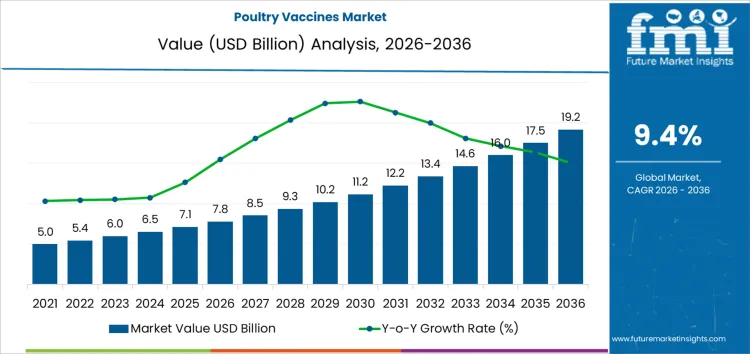
Poultry Vaccines Market Key Takeaways
| Metric | Value |
|---|---|
| Market Value (2026) | USD 7.8 billion |
| Market Forecast Value (2036) | USD 19.2 billion |
| Forecast CAGR 2026 to 2036 | 9.4% |
Why is the Demand for Poultry Vaccines Growing?
Demand for poultry vaccines is rising as poultry producers and integrators seek reliable prevention of infectious diseases that impair flock performance and result in significant production losses. Viral and bacterial pathogens such as Newcastle disease, infectious bronchitis, Marek’s disease, and avian influenza reduce weight gain, egg production, and flock uniformity, reducing profitability in commercial broiler and layer operations. Poultry veterinarians specify vaccines based on regional disease prevalence, flock health history, and risk profiles of integrated or contract facilities. Procurement teams assess antigen coverage, administration format, cold chain requirements, and vaccine efficacy data to support consistent immune response across large populations. Regulatory expectations and food safety standards reinforce vaccine use because disease outbreaks can prompt trade restrictions and costly depopulation measures that disrupt supplier contracts and processing schedules.
Growth in high density and vertically integrated poultry systems reinforces uptake of vaccines that align with biosecurity protocols and herd health planning to maintain predictable performance metrics. Diagnostic surveillance and rapid reporting systems help producers identify emerging strains and adjust immunization schedules to address variant challenges. Specialists in poultry health coordinate vaccination timing with flock cycles to optimize immunocompetence at critical periods such as early grow-out or pre-lay onset, which supports stable throughput and market commitments. Education efforts on vaccine handling and administration technique improve field outcomes and reduce variability in immune protection. These production-specific clinical and operational drivers are contributing to sustained demand growth in the poultry vaccines market.
How Is the Poultry Vaccines Market Segmented by Product Type, Application, and End User?
Demand for poultry vaccines is driven by high stocking densities, disease transmission risk, and economic sensitivity to flock health disruptions. Health management emphasizes preventive immunization to stabilize production yields and reduce mortality events. Adoption reflects biosecurity standards, regulatory programs, and integration with hatchery and farm-level vaccination schedules. Product selection considers immune response durability, administration method, and compatibility with large-scale operations. Segmentation explains how vaccine type, disease focus, and operational ownership influence utilization patterns, procurement concentration, and deployment logistics across poultry health management.
Which Product Type Leads Utilization in Poultry Vaccination Programs?
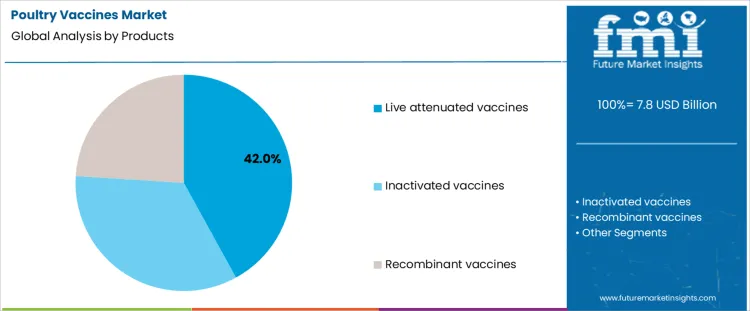
Use concentrates around live attenuated vaccines at 42.0%, reflecting their ability to induce strong and rapid immune responses. These vaccines are well suited for mass administration through spray or drinking water systems. Cost efficiency and established handling practices support routine use across large flocks. Inactivated vaccines at 34.0% provide enhanced safety profiles and are commonly used where maternal antibody transfer is prioritized. Recombinant vaccines at 24.0% address specific pathogen targets with improved differentiation capability. Product segmentation reflects preference for vaccine types balancing immune strength, scalability, and operational practicality.
Key Points
- Live vaccines support rapid immunity in large populations.
- Inactivated options emphasize safety and maternal protection.
- Recombinant vaccines target specific disease control needs.
How Do Disease Targets Shape Application-Level Vaccine Demand?
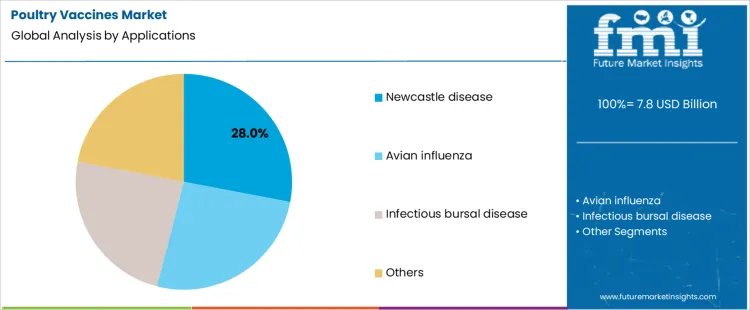
Application demand is distributed across Newcastle disease at 28.0%, avian influenza at 26.0%, and infectious bursal disease at 24.0%. These diseases pose persistent threats due to high transmissibility and production impact. Vaccination schedules are designed around regional risk profiles and regulatory mandates. Other diseases at 22.0% require tailored immunization strategies based on local epidemiology. Application segmentation highlights how disease prevalence, outbreak history, and regulatory focus influence prioritization within poultry vaccination programs.
Key Points
- Newcastle disease remains a core vaccination target.
- Avian influenza control aligns with regulatory oversight.
- Other diseases reflect region-specific risk management.
Which End User Segment Drives Poultry Vaccine Deployment?
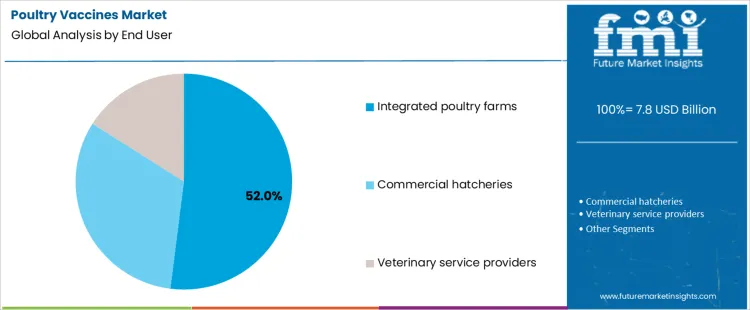
Integrated poultry farms account for 52.0% of vaccine deployment due to centralized control over breeding, rearing, and processing operations. Vertical integration enables standardized vaccination protocols and volume-based procurement. Commercial hatcheries at 32.0% administer early-life vaccines to ensure uniform flock immunity. Veterinary service providers at 16.0% support program design, field implementation, and compliance monitoring. End-user segmentation reflects concentration where operational control, scale, and lifecycle management drive consistent vaccine utilization.
Key Points
- Integrated farms implement standardized vaccination programs.
- Hatcheries ensure early and uniform immunization.
- Veterinary providers support oversight and execution.
What are the Key Dynamics in the Poultry Vaccines Market?
Demand for poultry vaccines reflects disease prevention requirements essential to maintaining flock health, productivity, and food supply continuity. Adoption concentrates in commercial broiler, layer, and breeder operations operating under intensive production conditions. Global scope aligns with biosecurity regulation, disease prevalence, and integrated poultry farming models. Usage centers on live attenuated, inactivated, and recombinant vaccines administered through hatchery, drinking water, spray, or injection routes.
How do disease pressure intensity and production system scale shape adoption?
High stocking density and rapid turnover increase vulnerability to viral and bacterial diseases that spread quickly within flocks. Demand increases where outbreaks directly impact mortality, feed conversion, and egg or meat yield. Vaccination programs are designed around regional disease prevalence, production stage, and bird lifespan. Hatchery-level vaccination supports uniform early protection across large populations. Breeder vaccination protects downstream progeny through maternal antibody transfer. Integration of vaccination schedules with farm biosecurity protocols improves overall disease control effectiveness. Producers prioritize vaccines that balance broad protection with minimal growth or stress impact. Adoption reflects reliance on preventive health management to protect thin-margin, volume-driven poultry operations.
How do cold chain dependence, administration logistics, and regulatory controls influence market scalability?
Vaccine effectiveness depends on strict cold chain maintenance from manufacture to administration. Demand sensitivity rises where infrastructure gaps affect storage and handling reliability. Mass administration methods require precise dilution and timing, increasing operational complexity. Live vaccines pose reversion and interference risks if improperly applied. Regulatory approval varies by disease and geography, affecting availability. Cost considerations influence adoption in low-margin operations, especially for multi-dose programs. Antigen matching challenges emerge with evolving pathogens. Scalability remains constrained by handling discipline requirements, variable farm capabilities, and regulatory oversight across poultry-producing regions.
How Is Demand for Poultry Vaccines Evolving Globally?
Demand for poultry vaccines is expanding globally as intensive production systems prioritize disease prevention, flock uniformity, and supply continuity. Vaccination programs address viral, bacterial, and parasitic threats that directly affect mortality, feed conversion, and trade compliance. Integration of hatchery vaccination, farm-level boosters, and biosecurity protocols sustains consistent uptake. Government surveillance and export standards reinforce preventive investment. Growth rates in India at 11.7%, China at 10.5%, Brazil at 10.2%, USA at 9.1%, and the UK at 8.9% indicate strong expansion driven by production scale, biosecurity economics, and regulatory alignment rather than episodic outbreak-driven demand.
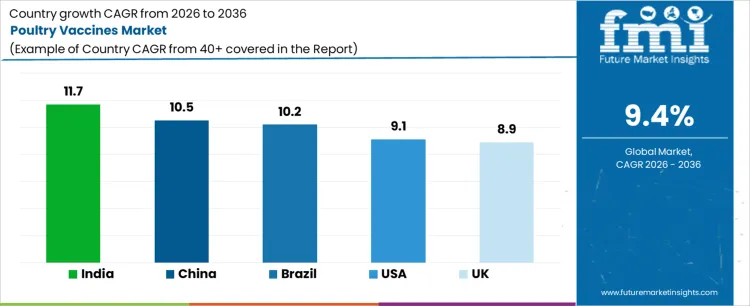
| Country | CAGR (%) |
|---|---|
| India | 11.7% |
| China | 10.5% |
| Brazil | 10.2% |
| USA | 9.1% |
| UK | 8.9% |
What Is Driving Rapid Expansion of Poultry Vaccine Demand in India?
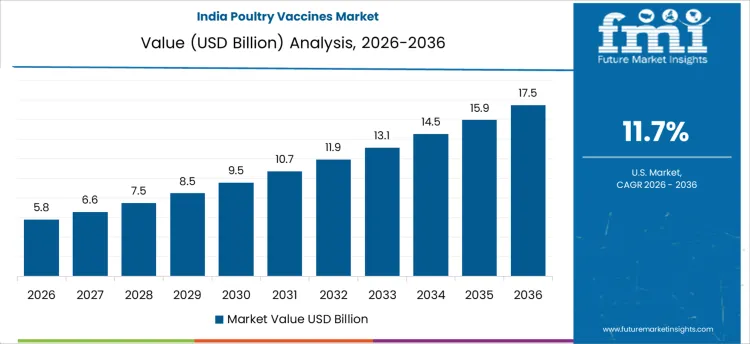
Demand for poultry vaccines in India is growing at a CAGR of 11.7%, shaped by rapid broiler integration and disease risk management. Large integrators implement standardized vaccination schedules to stabilize flock performance. High stocking densities elevate exposure to viral diseases, increasing preventive focus. Government disease surveillance programs support routine immunization. Expansion of commercial hatcheries improves vaccine delivery efficiency. Growth reflects operational risk control and production consistency rather than reactive vaccination following outbreaks.
- Integrated broiler production vaccination protocols
- High stocking density increasing disease exposure
- Government-supported disease surveillance alignment
- Hatchery-based vaccine delivery expansion
Why Is China Sustaining Strong Growth in Poultry Vaccine Utilization?
Poultry vaccine demand in China is expanding at a CAGR of 10.5%, supported by farm consolidation and food safety oversight. Large-scale operations adopt comprehensive vaccination programs to reduce mortality and culling. National disease control policies emphasize preventive immunization. Domestic vaccine manufacturing ensures supply reliability. Monitoring of avian influenza and Newcastle disease reinforces routine use. Growth reflects system-level disease governance and production scale rather than sporadic emergency vaccination.
- Farm consolidation enabling uniform vaccination
- National preventive disease control policies
- Reliable domestic vaccine manufacturing
- Continuous monitoring of priority poultry diseases
How Is Brazil Supporting Expansion of Poultry Vaccine Demand?
Demand for poultry vaccines in Brazil is growing at a CAGR of 10.2%, influenced by export orientation and biosecurity discipline. Export markets require strict compliance with health standards, driving preventive vaccination. Large integrators coordinate hatchery and farm-level immunization. Climatic conditions increase pathogen pressure, reinforcing routine use. Veterinary oversight ensures protocol adherence. Growth reflects trade-driven compliance and operational efficiency rather than increased disease incidence.
- Export compliance requiring preventive vaccination
- Integrated hatchery and farm immunization
- Climate-driven pathogen pressure management
- Veterinary oversight supporting protocol adherence
What Factors Are Driving Poultry Vaccine Growth in United States?
Poultry vaccine demand in the United States is expanding at a CAGR of 9.1%, driven by productivity protection and supply chain resilience. Large producers deploy vaccination to reduce antibiotic reliance. Surveillance-guided immunization targets region-specific risks. Strong veterinary infrastructure supports customized programs. Processor requirements reinforce consistent application. Growth reflects preventive economics and antimicrobial stewardship rather than expansion of flock numbers alone.
- Vaccination reducing antibiotic dependence
- Surveillance-guided targeted immunization
- Robust veterinary program customization
- Processor-driven compliance requirements
Why Is the UK Experiencing Sustained Growth in Poultry Vaccines?
Demand for poultry vaccines in United Kingdom is growing at a CAGR of 8.9%, shaped by welfare standards and antimicrobial reduction strategies. Producers adopt vaccination to maintain flock health under restricted antibiotic use. Assurance schemes emphasize preventive health planning. Biosecurity integration supports consistent vaccine application. Cost sensitivity favors optimized schedules. Growth remains sustained, reflecting governance-led disease prevention and productivity maintenance rather than rapid expansion of poultry capacity.
- Welfare and antimicrobial reduction standards
- Assurance scheme preventive health requirements
- Integrated biosecurity and vaccination planning
- Optimized schedules under cost discipline
What is the competitive landscape of demand for the poultry vaccines market globally?
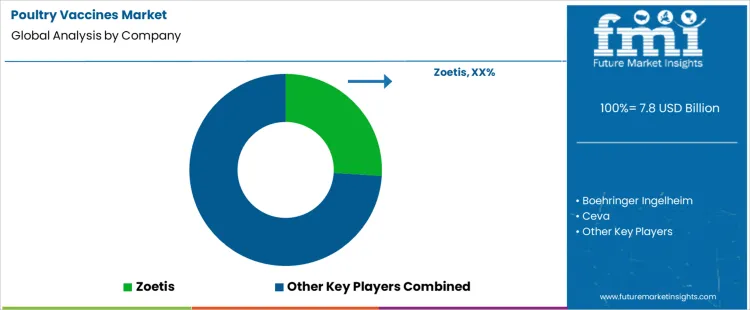
Demand for poultry vaccines is driven by disease pressure in intensive farming systems, productivity protection, and biosecurity regulation enforcement. Poultry integrators and veterinarians evaluate vaccine efficacy by strain, duration of immunity, administration route suitability, and flock coverage consistency. Buyer assessment includes compatibility with hatchery vaccination programs, cold chain robustness, and performance under high-density rearing conditions. Procurement behavior reflects long-term supply agreements, disease risk forecasting, and alignment with antimicrobial reduction strategies. Purchasing decisions emphasize predictable flock health outcomes, scalability across production cycles, and technical support availability. Trend in the poultry vaccines market reflects expanding preventive vaccination protocols and rising adoption in emerging poultry-producing regions.
Zoetis leads competitive positioning through a broad poultry vaccine portfolio supported by global manufacturing scale and deep veterinary engagement. Boehringer Ingelheim competes with advanced vaccine technologies integrated into comprehensive poultry health management programs. Ceva supports demand through strong hatchery-focused solutions and localized disease control expertise. Elanco maintains relevance by offering vaccines aligned with productivity and food safety objectives across commercial poultry systems. Phibro participates through targeted vaccines addressing specific disease challenges in poultry operations. Competitive differentiation centers on strain coverage breadth, administration efficiency, supply reliability, and alignment with integrated poultry health strategies.
Key Players in the Poultry Vaccines Market
- Zoetis
- Boehringer Ingelheim
- Ceva
- Elanco
- Phibro
- Others
Scope of the Report
| Items | Values |
|---|---|
| Quantitative Units | USD billion |
| Products | Live attenuated vaccines; Inactivated vaccines; Recombinant vaccines |
| Applications | Newcastle disease; Avian influenza; Infectious bursal disease; Others |
| End User | Integrated poultry farms; Commercial hatcheries; Veterinary service providers |
| Regions Covered | Asia Pacific, Europe, North America, Latin America, Middle East & Africa |
| Countries Covered | India, China, Brazil, USA, UK, and 40+ countries |
| Key Companies Profiled | Zoetis; Boehringer Ingelheim; Ceva; Elanco; Phibro; Others |
| Additional Attributes | Dollar sales by product type, application, end user, and sales channel; vaccine efficacy and duration of immunity across live, inactivated, and recombinant platforms; cold-chain handling and mass administration methods including spray, drinking water, and in-ovo delivery; biosecurity integration within large-scale poultry operations; procurement dynamics shaped by integrated farm contracts, hatchery vaccination programs, and veterinary service agreements. |
Poultry Vaccines Market by Segment
Products:
- Live attenuated vaccines
- Inactivated vaccines
- Recombinant vaccines
Applications:
- Newcastle disease
- Avian influenza
- Infectious bursal disease
- Others
End User:
- Integrated poultry farms
- Commercial hatcheries
- Veterinary service providers
Region:
- Asia Pacific
- China
- Japan
- South Korea
- India
- Australia & New Zealand
- ASEAN
- Rest of Asia Pacific
- Europe
- Germany
- United Kingdom
- France
- Italy
- Spain
- Nordic
- BENELUX
- Rest of Europe
- North America
- United States
- Canada
- Mexico
- Latin America
- Brazil
- Chile
- Rest of Latin America
- Middle East & Africa
- Kingdom of Saudi Arabia
- Other GCC Countries
- Turkey
- South Africa
- Other African Union
- Rest of Middle East & Africa
Bibliography
- Food and Agriculture Organization of the United Nations. (2025). FAO animal production and health manual: Vaccination, biosecurity, and disease prevention in commercial poultry systems. FAO Animal Health Division.
- World Organisation for Animal Health. (2025). Terrestrial Animal Health Code: Chapter 6.6 – Avian disease prevention and vaccination strategies (2025 revision). WOAH.
- European Food Safety Authority. (2024). Scientific opinion on animal health and welfare aspects of vaccination programs in poultry production. EFSA Journal, 22(4), e07904.
Frequently Asked Questions
How big is the poultry vaccines market in 2026?
The global poultry vaccines market is estimated to be valued at USD 7.8 billion in 2026.
What will be the size of poultry vaccines market in 2036?
The market size for the poultry vaccines market is projected to reach USD 19.2 billion by 2036.
How much will be the poultry vaccines market growth between 2026 and 2036?
The poultry vaccines market is expected to grow at a 9.4% CAGR between 2026 and 2036.
What are the key product types in the poultry vaccines market?
The key product types in poultry vaccines market are live attenuated vaccines, inactivated vaccines and recombinant vaccines.
Which applications segment to contribute significant share in the poultry vaccines market in 2026?
In terms of applications, newcastle disease segment to command 28.0% share in the poultry vaccines market in 2026.
Preview the report firsthand - request a free sample
Get SampleGet the brochure for pricing and purchase details.
Get PDFTable of Content
- Executive Summary
- Global Market Outlook
- Demand-side Trends
- Supply-side Trends
- Technology Roadmap Analysis
- Analysis and Recommendations
- Market Overview
- Market Coverage / Taxonomy
- Market Definition / Scope / Limitations
- Market Background
- Market Dynamics
- Drivers
- Restraints
- Opportunity
- Trends
- Scenario Forecast
- Demand in Optimistic Scenario
- Demand in Likely Scenario
- Demand in Conservative Scenario
- Opportunity Map Analysis
- Product Life Cycle Analysis
- Supply Chain Analysis
- Investment Feasibility Matrix
- Value Chain Analysis
- PESTLE and Porter’s Analysis
- Regulatory Landscape
- Regional Parent Market Outlook
- Production and Consumption Statistics
- Import and Export Statistics
- Market Dynamics
- Global Market Analysis 2021 to 2025 and Forecast, 2026 to 2036
- Historical Market Size Value (USD Million) Analysis, 2021 to 2025
- Current and Future Market Size Value (USD Million) Projections, 2026 to 2036
- Y-o-Y Growth Trend Analysis
- Absolute $ Opportunity Analysis
- Global Market Pricing Analysis 2021 to 2025 and Forecast 2026 to 2036
- Global Market Analysis 2021 to 2025 and Forecast 2026 to 2036, By Products
- Introduction / Key Findings
- Historical Market Size Value (USD Million) Analysis By Products , 2021 to 2025
- Current and Future Market Size Value (USD Million) Analysis and Forecast By Products , 2026 to 2036
- Live attenuated vaccines
- Inactivated vaccines
- Recombinant vaccines
- Live attenuated vaccines
- Y-o-Y Growth Trend Analysis By Products , 2021 to 2025
- Absolute $ Opportunity Analysis By Products , 2026 to 2036
- Global Market Analysis 2021 to 2025 and Forecast 2026 to 2036, By Applications
- Introduction / Key Findings
- Historical Market Size Value (USD Million) Analysis By Applications, 2021 to 2025
- Current and Future Market Size Value (USD Million) Analysis and Forecast By Applications, 2026 to 2036
- Newcastle disease
- Avian influenza
- Infectious bursal disease
- Others
- Newcastle disease
- Y-o-Y Growth Trend Analysis By Applications, 2021 to 2025
- Absolute $ Opportunity Analysis By Applications, 2026 to 2036
- Global Market Analysis 2021 to 2025 and Forecast 2026 to 2036, By End User
- Introduction / Key Findings
- Historical Market Size Value (USD Million) Analysis By End User, 2021 to 2025
- Current and Future Market Size Value (USD Million) Analysis and Forecast By End User, 2026 to 2036
- Integrated poultry farms
- Commercial hatcheries
- Veterinary service providers
- Integrated poultry farms
- Y-o-Y Growth Trend Analysis By End User, 2021 to 2025
- Absolute $ Opportunity Analysis By End User, 2026 to 2036
- Global Market Analysis 2021 to 2025 and Forecast 2026 to 2036, By Region
- Introduction
- Historical Market Size Value (USD Million) Analysis By Region, 2021 to 2025
- Current Market Size Value (USD Million) Analysis and Forecast By Region, 2026 to 2036
- North America
- Latin America
- Western Europe
- Eastern Europe
- East Asia
- South Asia and Pacific
- Middle East & Africa
- Market Attractiveness Analysis By Region
- North America Market Analysis 2021 to 2025 and Forecast 2026 to 2036, By Country
- Historical Market Size Value (USD Million) Trend Analysis By Market Taxonomy, 2021 to 2025
- Market Size Value (USD Million) Forecast By Market Taxonomy, 2026 to 2036
- By Country
- USA
- Canada
- Mexico
- By Products
- By Applications
- By End User
- By Country
- Market Attractiveness Analysis
- By Country
- By Products
- By Applications
- By End User
- Key Takeaways
- Latin America Market Analysis 2021 to 2025 and Forecast 2026 to 2036, By Country
- Historical Market Size Value (USD Million) Trend Analysis By Market Taxonomy, 2021 to 2025
- Market Size Value (USD Million) Forecast By Market Taxonomy, 2026 to 2036
- By Country
- Brazil
- Chile
- Rest of Latin America
- By Products
- By Applications
- By End User
- By Country
- Market Attractiveness Analysis
- By Country
- By Products
- By Applications
- By End User
- Key Takeaways
- Western Europe Market Analysis 2021 to 2025 and Forecast 2026 to 2036, By Country
- Historical Market Size Value (USD Million) Trend Analysis By Market Taxonomy, 2021 to 2025
- Market Size Value (USD Million) Forecast By Market Taxonomy, 2026 to 2036
- By Country
- Germany
- UK
- Italy
- Spain
- France
- Nordic
- BENELUX
- Rest of Western Europe
- By Products
- By Applications
- By End User
- By Country
- Market Attractiveness Analysis
- By Country
- By Products
- By Applications
- By End User
- Key Takeaways
- Eastern Europe Market Analysis 2021 to 2025 and Forecast 2026 to 2036, By Country
- Historical Market Size Value (USD Million) Trend Analysis By Market Taxonomy, 2021 to 2025
- Market Size Value (USD Million) Forecast By Market Taxonomy, 2026 to 2036
- By Country
- Russia
- Poland
- Hungary
- Balkan & Baltic
- Rest of Eastern Europe
- By Products
- By Applications
- By End User
- By Country
- Market Attractiveness Analysis
- By Country
- By Products
- By Applications
- By End User
- Key Takeaways
- East Asia Market Analysis 2021 to 2025 and Forecast 2026 to 2036, By Country
- Historical Market Size Value (USD Million) Trend Analysis By Market Taxonomy, 2021 to 2025
- Market Size Value (USD Million) Forecast By Market Taxonomy, 2026 to 2036
- By Country
- China
- Japan
- South Korea
- By Products
- By Applications
- By End User
- By Country
- Market Attractiveness Analysis
- By Country
- By Products
- By Applications
- By End User
- Key Takeaways
- South Asia and Pacific Market Analysis 2021 to 2025 and Forecast 2026 to 2036, By Country
- Historical Market Size Value (USD Million) Trend Analysis By Market Taxonomy, 2021 to 2025
- Market Size Value (USD Million) Forecast By Market Taxonomy, 2026 to 2036
- By Country
- India
- ASEAN
- Australia & New Zealand
- Rest of South Asia and Pacific
- By Products
- By Applications
- By End User
- By Country
- Market Attractiveness Analysis
- By Country
- By Products
- By Applications
- By End User
- Key Takeaways
- Middle East & Africa Market Analysis 2021 to 2025 and Forecast 2026 to 2036, By Country
- Historical Market Size Value (USD Million) Trend Analysis By Market Taxonomy, 2021 to 2025
- Market Size Value (USD Million) Forecast By Market Taxonomy, 2026 to 2036
- By Country
- Kingdom of Saudi Arabia
- Other GCC Countries
- Turkiye
- South Africa
- Other African Union
- Rest of Middle East & Africa
- By Products
- By Applications
- By End User
- By Country
- Market Attractiveness Analysis
- By Country
- By Products
- By Applications
- By End User
- Key Takeaways
- Key Countries Market Analysis
- USA
- Pricing Analysis
- Market Share Analysis, 2025
- By Products
- By Applications
- By End User
- Canada
- Pricing Analysis
- Market Share Analysis, 2025
- By Products
- By Applications
- By End User
- Mexico
- Pricing Analysis
- Market Share Analysis, 2025
- By Products
- By Applications
- By End User
- Brazil
- Pricing Analysis
- Market Share Analysis, 2025
- By Products
- By Applications
- By End User
- Chile
- Pricing Analysis
- Market Share Analysis, 2025
- By Products
- By Applications
- By End User
- Germany
- Pricing Analysis
- Market Share Analysis, 2025
- By Products
- By Applications
- By End User
- UK
- Pricing Analysis
- Market Share Analysis, 2025
- By Products
- By Applications
- By End User
- Italy
- Pricing Analysis
- Market Share Analysis, 2025
- By Products
- By Applications
- By End User
- Spain
- Pricing Analysis
- Market Share Analysis, 2025
- By Products
- By Applications
- By End User
- France
- Pricing Analysis
- Market Share Analysis, 2025
- By Products
- By Applications
- By End User
- India
- Pricing Analysis
- Market Share Analysis, 2025
- By Products
- By Applications
- By End User
- ASEAN
- Pricing Analysis
- Market Share Analysis, 2025
- By Products
- By Applications
- By End User
- Australia & New Zealand
- Pricing Analysis
- Market Share Analysis, 2025
- By Products
- By Applications
- By End User
- China
- Pricing Analysis
- Market Share Analysis, 2025
- By Products
- By Applications
- By End User
- Japan
- Pricing Analysis
- Market Share Analysis, 2025
- By Products
- By Applications
- By End User
- South Korea
- Pricing Analysis
- Market Share Analysis, 2025
- By Products
- By Applications
- By End User
- Russia
- Pricing Analysis
- Market Share Analysis, 2025
- By Products
- By Applications
- By End User
- Poland
- Pricing Analysis
- Market Share Analysis, 2025
- By Products
- By Applications
- By End User
- Hungary
- Pricing Analysis
- Market Share Analysis, 2025
- By Products
- By Applications
- By End User
- Kingdom of Saudi Arabia
- Pricing Analysis
- Market Share Analysis, 2025
- By Products
- By Applications
- By End User
- Turkiye
- Pricing Analysis
- Market Share Analysis, 2025
- By Products
- By Applications
- By End User
- South Africa
- Pricing Analysis
- Market Share Analysis, 2025
- By Products
- By Applications
- By End User
- USA
- Market Structure Analysis
- Competition Dashboard
- Competition Benchmarking
- Market Share Analysis of Top Players
- By Regional
- By Products
- By Applications
- By End User
- Competition Analysis
- Competition Deep Dive
- Zoetis
- Overview
- Product Portfolio
- Profitability by Market Segments (Product/Age /Sales Channel/Region)
- Sales Footprint
- Strategy Overview
- Marketing Strategy
- Product Strategy
- Channel Strategy
- Boehringer Ingelheim
- Ceva
- Elanco
- Phibro
- Others
- Zoetis
- Competition Deep Dive
- Assumptions & Acronyms Used
- Research Methodology


