- Market Size (2026)
- USD 7.21 Bn
- Forecast (2036)
- USD 11.45 Bn
- CAGR (2026 to 2036)
- 4.7%
How Big Is the Rainwear Market in 2026?
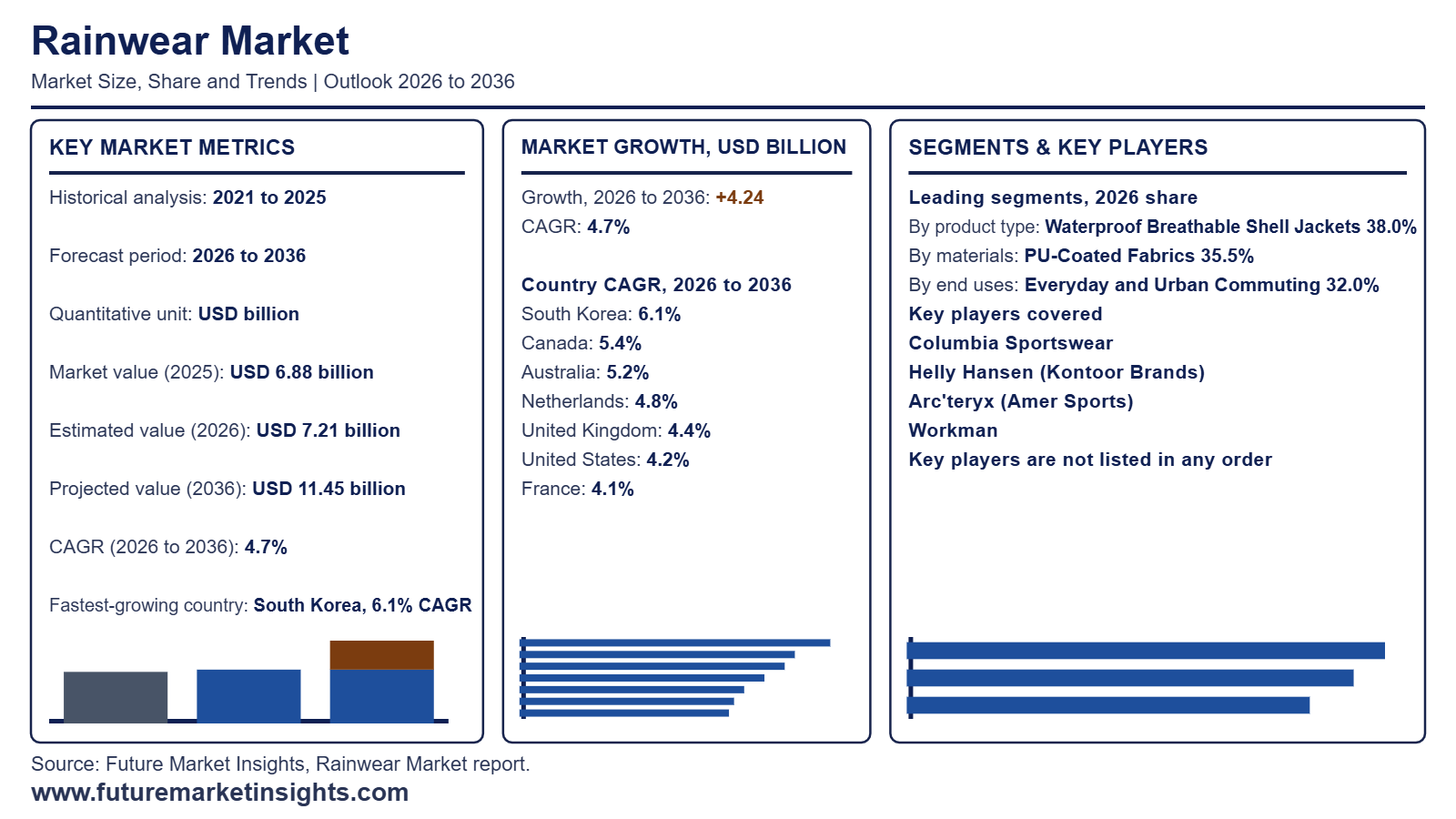
The global rainwear market is valued at USD 7.21 billion in 2026, up from USD 6.88 billion in 2025, and is projected by Future Market Insights (FMI) to reach USD 11.45 billion by 2036, expanding at a 4.7% CAGR from 2026 to 2036 and generating USD 4.24 billion in incremental revenue over the 10-year forecast period.
| Market Metric | Valuation / Share / Forecast Benchmark |
|---|---|
| 2025 Market Size (Historical) | USD 6.88 billion |
| 2026 Market Size (Estimated) | USD 7.21 billion |
| 2036 Market Size (Projected) | USD 11.45 billion |
| Compound Annual Growth Rate (2026 to 2036) | 4.7% CAGR |
| Incremental Dollar Opportunity (2026 to 2036) | USD 4.24 billion |
| Dominant Product Type (2026 to 2036 Share) | Waterproof Breathable Shell Jackets (38.0% in 2026, rising to 40.0% by 2036) |
| Leading & Fastest-Growing Materials | PU-Coated Fabrics (35.5% share in 2026, 3.0% CAGR) │ PFAS-Free Membrane Laminates (12.5% CAGR) |
| Leading & Fastest-Growing End Uses | Everyday and Urban Commuting (32.0% share in 2026) │ Cycling and Motorcycling (5.8% CAGR) |
| Largest Country Markets (2026 Global Share) | United States (22.9%), Japan (11.4%), Germany (7.8%) |
| Fastest-Growing Country Markets (2026 to 2036) | South Korea (6.1% CAGR), Canada (5.4% CAGR), Australia (5.2% CAGR) |
| Leading Tier-1 Companies | Columbia Sportswear, Helly Hansen (Kontoor Brands), Arc'teryx (Amer Sports), Workman |
Source: Future Market Insights analysis of the rainwear market, 2026.
Executive Market Overview
Preference for rainwear is driven by wetter seasons in major consuming countries along with the move to PFAS-free waterproof fabrics. FMI estimates that the United States is the largest market with 22.9% of global sales in 2026, and Japan is next at 11.4%. Waterproof breathable shell jackets make up 38.0% of sales, and everyday and urban commuting is the largest use at 32.0%. The UK recorded 113% of average winter rainfall in December 2025 to February 2026, according to the Met Office (March 2026). Rain gear sold strongly in Japan during autumn. Workman reported a 20.7% rise in same-store sales in September 2026, per Ava (October 2026). Regulation is changing what those buyers can find on shelves. France has banned PFAS in clothing textiles since 1 January 2026, as Intertek (January 2026) reports. As a result, brands are replacing older membranes and coatings across whole ranges.
Commuters and hikers, along with outdoor workers, buy rainwear to stay dry and comfortable through a full day outside. Buyers now compare waterproof ratings and breathability, along with chemical content, before choosing a jacket. Within that comparison, PFAS-free membranes and urban styles are set to deliver much of the value growth. FMI projects PFAS-free membrane laminates to expand at a 12.5% CAGR and shell jackets at 5.3%, both faster than the 4.7% overall market CAGR. By contrast, ePTFE membrane laminates are projected to fall from 19.0% of sales in 2026 to 5.0% by 2036 as regulators restrict fluorinated chemicals. Market sizing covers waterproof shell jackets and urban raincoats, rain suits and rain pants, along with ponchos and rain capes for adults and children. Rain boots and umbrellas are excluded, as are insulated ski wear, wetsuits, protective chemical suits and firefighter turnout gear.
Analyst Perspective
"Rainwear makers are expected to lift revenue ahead of unit volume as PFAS-free shells replace older coated jackets at higher prices. Uneven chemical rules pose the largest commercial risk, since a jacket that is legal in one U.S. state or EU country can be banned in another, forcing relabeling or write-offs."
- Rahul Pandita, Principal Consultant, Future Market Insights (FMI)
Major Market Trends and Insights
PFAS Bans Move from Proposals to Enforcement: National and state rules on fluorinated chemicals in clothing are now in force on both sides of the Atlantic. France bans the manufacture and sale of clothing textiles containing PFAS, along with imports and exports, from 1 January 2026, with exemptions for protective equipment and for clothing with at least 20% post-consumer recycled content, per Intertek (January 2026). Denmark adopted BEK No. 464 on 2 May 2025 to ban the import and sale of clothing and footwear with total fluorine at or above 50 mg per kg from 1 July 2026, according to SGS (September 2025). In the United States, SGS (March 2025) notes that New York and Colorado defer bans on outdoor apparel for severe wet conditions until 1 January 2028.
PFAS-Free Membranes Reach Premium Shells: Technical rainwear brands are converting top ranges to new membranes. All Arc'teryx Gore-Tex products sold in Australia and New Zealand use ePE membranes from 1 March 2026, according to Wild (April 2026). The same report states that the ePE membrane has no intentionally added PFAS and is half the thickness of earlier membranes. Arc'teryx released Gore-Tex Pro ePE outerwear in February 2026, rated for 550 mm of rain per hour against 76 mm for standard ePE shells. FMI expects these changes to lift demand for testing and certification in the textile chemicals market.
Rain Specialists Expand into New Countries and Categories: Fashion-led rain brands are broadening the product range beyond jackets. Rains opened a second Canadian store at Yorkdale in Toronto on 12 June 2026 and now manages Canadian distribution directly, per Retail Insider (July 2026). Two months later, the Danish brand entered footwear with the waterproof dry boot at USD 125 to USD 195, according to WWD (August 2026). Rains aims to reach DKK 1.5 billion (USD 221.0 million) in turnover by 2027, with outerwear and bags each making up about half of current sales.
What Are the Main Drivers, Restraints, and Opportunities?
Wet seasons and fast product replacement under new chemical rules support baseline demand. Tariffs on imported garments and the cost of reformulating coatings weigh on margins. PFAS-free premium shells and faster-growing markets such as South Korea, Canada and Australia offer the strongest growth.
Driver: Wetter Seasons and Year-Round Rain Gear in Japan and Europe
Heavy and persistent rain supports rainwear purchases in Northern Europe and East Asia. The Met Office (March 2026) reports that England had the eighth wettest winter in a series from 1836, with four named storms between December 2025 and February 2026. In Japan, Workman sold JPY 40,849 million (USD 256.9 million) of work supplies and rainwear in the year to March 2026, up 1.3%, according to BigGo Finance (May 2026). The retailer credited seasonal products adapted to climate change for strong sales, and the chain reached 1,094 stores by the end of March 2026.
Restraint: Tariff Costs and Performance Trade-Offs in PFAS-Free Finishes
Rainwear sold in North America is largely imported, so tariffs raise landed costs for large brands. Columbia Sportswear (February 2026) absorbed USD 31.0 million of incremental U.S. tariffs in 2025 gross margin before mitigation. The company expects about 300 basis points of tariff impact on 2026 gross margin. PFAS-free finishes add a second constraint. Wild (April 2026) notes that the new fluorine-free water repellent resists oil contamination less well, so ePE jackets need more frequent washing to keep breathability.
Opportunity: Faster Growth in South Korea, Canada and Australia
Sales of rainwear are expected to rise fastest in markets with long wet seasons and growing outdoor recreation. FMI projects South Korea to expand at a 6.1% CAGR, Canada at 5.4% and Australia at 5.2%, the three fastest rates among the ten core countries. Brands are already investing in these markets. Rains moved from a Canadian distributor to direct distribution and lists Holt Renfrew and Simons, along with Sporting Life, among wholesale partners, according to Retail Insider (July 2026).
How Is the Rainwear Market Segmented?
The global rainwear market is segmented by product type, material, end use, and region, with every jacket, coat, suit, pant and poncho measured as one unit for volume comparison.
| Segmentation Axis | Sub-Segments Covered | 2026 Leading Segment & Share | Main Growth Benchmark (2026 to 2036) |
|---|---|---|---|
| Product Type | Waterproof Breathable Shell Jackets, Urban Raincoats and Parkas, Rain Suits and Rain Pants, Ponchos and Rain Capes | Waterproof Breathable Shell Jackets (38.0% share) | Shell Jackets grow fastest at a 5.3% CAGR |
| Material | PU-Coated Fabrics, PVC and Rubberized Fabrics, ePTFE Membrane Laminates, PFAS-Free Membrane Laminates, Waxed Cotton and Other Fabrics | PU-Coated Fabrics (35.5% share) | PFAS-Free Membrane Laminates grow fastest at a 12.5% CAGR |
| End Use | Everyday and Urban Commuting, Outdoor Recreation and Hiking, Work and Industrial, Children and School, Cycling and Motorcycling | Everyday and Urban Commuting (32.0% share) | Cycling and Motorcycling grows fastest at a 5.8% CAGR |
| Region | Europe, North America, East Asia, South Asia & Pacific, Latin America, Middle East & Africa | Europe (32.2% global share) | South Asia & Pacific grows fastest at a 6.4% CAGR |
Source: Future Market Insights analysis of the rainwear market, 2026.
Why Does the Shell Jacket Segment Lead by Product Type?
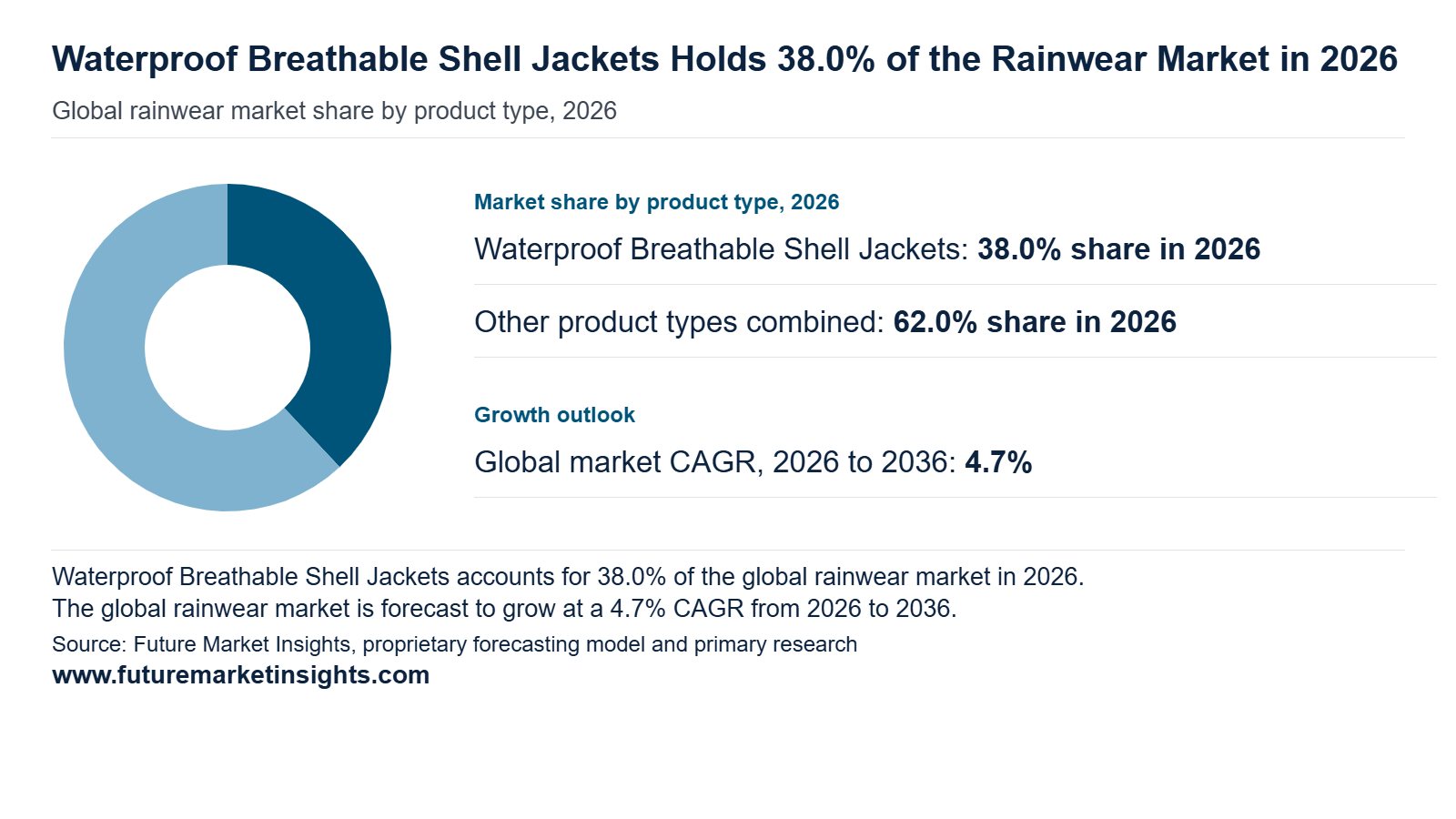
Waterproof breathable shell jackets represent 38.0% of sales of rainwear in 2026, and that share is projected to reach 40.0% by 2036. The segment posts the fastest product growth at a 5.3% CAGR. Shells sell at the highest prices in the category, and PFAS rules are pushing brands to relaunch them with new membranes. Arc'teryx, for example, moved Gore-Tex shells sold in two Pacific markets to ePE in March 2026 (Wild, April 2026). Rain suits and rain pants, the low-cost choice for commuters and site workers, are projected to grow at 3.5% per year.
Why Does the PU-Coated Fabrics Segment Lead by Material?
PU-coated fabrics account for 35.5% of 2026 sales by material, because the coating is cheap and widely used in everyday raincoats and ponchos, along with rain suits. The share is set to fall to 30.0% by 2036. PFAS-free membrane laminates lead growth with a 12.5% CAGR, rising from 24.0% to 49.0% of sales. ePTFE membrane laminates are expected to shrink to 5.0% of sales by 2036, since bluesign stopped registering new articles with PTFE membranes in January 2025, per SGS (March 2025).
Why Does the Everyday and Urban Commuting Segment Lead by End Use?
Everyday and urban commuting accounts for 32.0% of global rainwear sales in 2026. City buyers wear rain jackets on the way to work and school, and fashion-led brands such as Rains design for changing urban weather, per Retail Insider (July 2026). Outdoor recreation and hiking is the second-largest end use at 29.7%. Cycling and motorcycling is set to post the quickest end-use growth, a 5.8% CAGR. Work and industrial rainwear, sold through workwear chains as part of the wider workwear market, holds 20.5% of 2026 sales.
Rainwear Market by Region and Country (2026 to 2036)
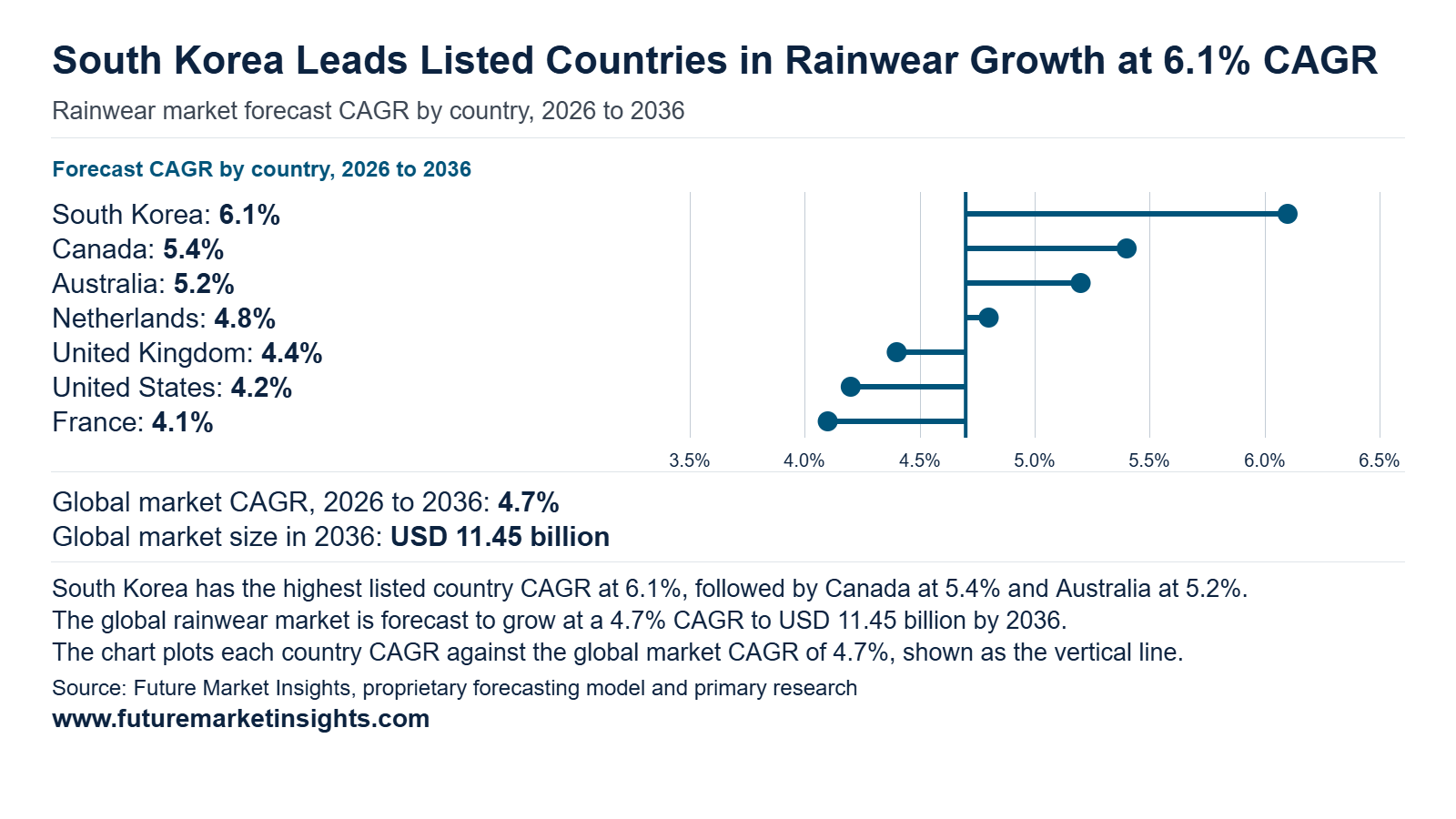
Europe is the largest rainwear region, with 32.2% of global sales in 2026, but the United States is the largest single country at 22.9%. Combined, the ten core countries hold 71.7% of 2026 sales, a share FMI expects to ease to 68.6% by 2036. American buyers contribute USD 0.84 billion, or 19.8% of global growth. South Asia and Pacific posts the fastest regional pace, a 6.4% CAGR, from a small base. East Asia, led by Japan and South Korea, is set to grow from USD 1.90 billion in 2026 to USD 3.08 billion by 2036.
| Country | 2026 Revenue | 2036 Revenue | 10-Year Addition | 2026 to 2036 CAGR | Global Share (2026 → 2036) |
|---|---|---|---|---|---|
| South Korea | USD 0.26 billion | USD 0.47 billion | +USD 0.21 billion | 6.1% | 3.6% → 4.1% |
| Canada | USD 0.30 billion | USD 0.51 billion | +USD 0.21 billion | 5.4% | 4.2% → 4.5% |
| Australia | USD 0.21 billion | USD 0.35 billion | +USD 0.14 billion | 5.2% | 2.9% → 3.1% |
| Netherlands | USD 0.15 billion | USD 0.24 billion | +USD 0.09 billion | 4.8% | 2.1% → 2.1% |
| United Kingdom | USD 0.52 billion | USD 0.80 billion | +USD 0.28 billion | 4.4% | 7.2% → 7.0% |
| United States | USD 1.65 billion | USD 2.49 billion | +USD 0.84 billion | 4.2% | 22.9% → 21.7% |
| France | USD 0.41 billion | USD 0.61 billion | +USD 0.20 billion | 4.1% | 5.7% → 5.3% |
| Germany | USD 0.56 billion | USD 0.82 billion | +USD 0.26 billion | 3.9% | 7.8% → 7.2% |
| Italy | USD 0.29 billion | USD 0.41 billion | +USD 0.12 billion | 3.5% | 4.0% → 3.6% |
| Japan | USD 0.82 billion | USD 1.15 billion | +USD 0.33 billion | 3.4% | 11.4% → 10.0% |
Source: Future Market Insights analysis of the rainwear market, 2026.
United States
The United States is the largest national rainwear market, with sales projected to grow from USD 1.65 billion in 2026 to USD 2.49 billion by 2036, a 4.2% CAGR. The national share of global sales eases from 22.9% to 21.7%. Domestic demand was soft in 2025, as Columbia Sportswear (February 2026) reported a 4% fall in U.S. net sales. State PFAS laws are the main product issue, with severe-weather outdoor clothing facing bans in New York and Colorado from 1 January 2028, per SGS (March 2025).
Japan
Japan is the second-largest rainwear market, with sales expected to rise from USD 0.82 billion in 2026 to USD 1.15 billion by 2036 at a 3.4% CAGR, the slowest pace in the country table. Japan's long rainy season and typhoons keep rain suits in steady use by commuters and students, along with site workers. Low-cost private-label rain gear sold through work clothing chains such as Workman sets the price level for much of the market.
Germany
Germany is projected to expand from USD 0.56 billion in 2026 to USD 0.82 billion by 2036, a 3.9% CAGR that adds USD 0.26 billion. German buyers wear rainwear for cycling and walking, along with hiking. Outdoor specialists hold a large share of sales. FMI expects PFAS-free shells to reach a majority of new technical ranges in this market before the end of the forecast period.
United Kingdom
Sales of rainwear in the United Kingdom are projected to increase at a 4.4% CAGR, from USD 0.52 billion in 2026 to USD 0.80 billion by 2036. Wet weather supports demand, as the Met Office (March 2026) reports that southern England had the fourth wettest winter on record in 2026. British buyers favor lightweight rain jackets for walking and commuting, sold through outdoor chains and online retailers.
France
Sales of rainwear in France are forecast to grow from USD 0.41 billion in 2026 to USD 0.61 billion by 2036, a 4.1% CAGR. France has barred the sale of new clothing textiles containing PFAS since 1 January 2026, per Intertek (January 2026). Products made before that date may be sold for a maximum of twelve months, according to the same bulletin.
Canada
Canada is projected to grow at a 5.4% CAGR, the second-fastest pace among core countries, with sales rising 1.70-fold from USD 0.30 billion in 2026 to USD 0.51 billion by 2036. Coastal British Columbia has one of the wettest climates in North America, and Rains opened the first Canadian store in Vancouver before the Toronto opening, per Retail Insider (July 2026). Columbia Sportswear (February 2026) grew Canadian net sales by 1% to USD 230.2 million in 2025.
South Korea
South Korea grows faster than any other core rainwear market, at a 6.1% CAGR, as sales rise from USD 0.26 billion in 2026 to USD 0.47 billion by 2036. The national share increases from 3.6% to 4.1%. Summer monsoon rain and a large hiking population support purchases of both rain suits and technical shells. FMI expects Korean outdoor brands and global labels to add PFAS-free ranges as PFAS rules in European export markets tighten.
Italy
Italy's rainwear market is set to grow at a 3.5% CAGR, from USD 0.29 billion in 2026 to USD 0.41 billion by 2036, with the national share easing from 4.0% to 3.6%. Fashion raincoats and trench coats sell through department stores and brand boutiques. Wholesale demand for Scandinavian rain brands is present at stores such as La Rinascente, which WWD (August 2026) lists among Rains accounts.
Australia
Australia is forecast to expand at a 5.2% CAGR, the third-fastest among core countries, from USD 0.21 billion in 2026 to USD 0.35 billion by 2036. Hiking and alpine sports drive demand for technical shells. Australian buyers were among the first to receive PFAS-free ePE ranges from Arc'teryx, as Wild (April 2026) reports.
Netherlands
The Netherlands is projected to add USD 0.09 billion, with sales growing from USD 0.15 billion in 2026 to USD 0.24 billion by 2036 (4.8% CAGR). Daily bicycle commuting creates steady demand for light rain jackets and ponchos. Dutch rain brands and cycling specialists sell lightweight rain suits designed to pack into a bicycle bag.
Competitive Environment and Notable Companies
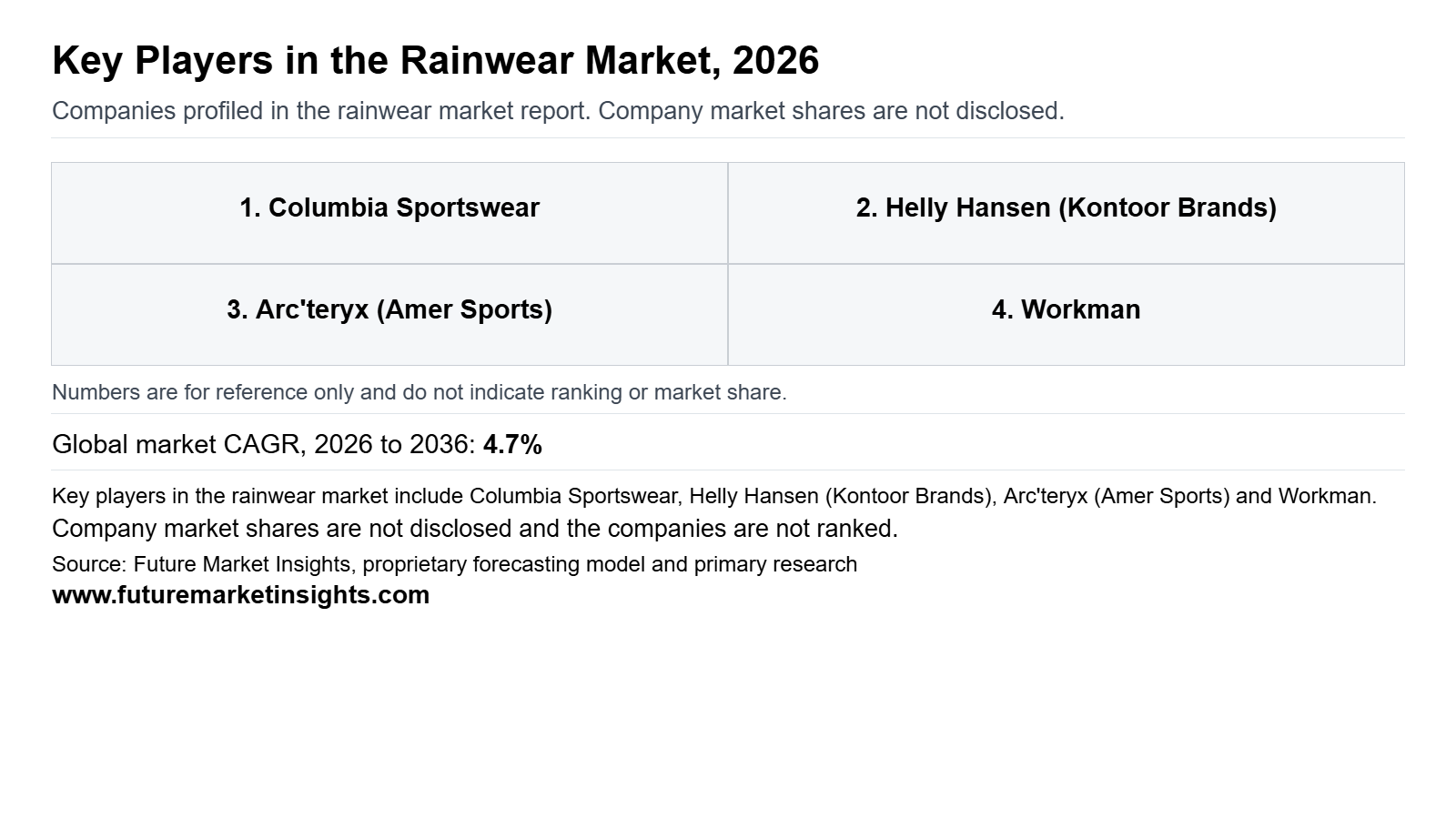
Major rainwear brands include Columbia Sportswear and Helly Hansen, now owned by Kontoor Brands, along with Arc'teryx and Workman. Membrane maker W. L. Gore & Associates supplies Gore-Tex laminates to many premium brands, and Rains competes in urban fashion rainwear. Competition splits by use and price. Technical brands sell high-priced shells through outdoor specialists and own stores, and workwear chains sell low-cost rain suits in large volumes. PFAS rules are raising the cost of entry, since every brand selling in France, Denmark or several U.S. states needs to prove compliance.
How Are Companies Positioned in the Rainwear Market?
Columbia Sportswear (February 2026) reported 2025 net sales of USD 3.40 billion, up 1%, with growth of 13% in Europe, the Middle East and Africa. Kontoor Brands completed the Helly Hansen acquisition in the second quarter of 2025, and Helly Hansen delivered double-digit pro forma sales growth in the first half of 2026, per Kontoor Brands (August 2026). Arc'teryx sells Gore-Tex Pro ePE shells for extreme conditions, per Wild (April 2026). Workman leads low-cost rain gear in Japan through 1,094 stores.
What Matters When a Buyer Selects a Rainwear Brand?
Buyers compare waterproof and breathability ratings, along with weight and price. Chemical content now matters as well, since France and Denmark set legal limits on PFAS in clothing. Durability claims are becoming more specific, as Gore-Tex Pro ePE shells are tested at 550 mm per hour and 20,000 Martindale abrasion cycles, per Wild (April 2026). Work buyers add visibility and freedom of movement to the checklist.
Which Capabilities Distinguish Product Offers?
Rainwear ranges are separated mainly by membrane technology and design, along with channel reach. Membrane access is the main technical divide, and Wild (April 2026) names Arc'teryx and Patagonia among the early investors in the ePE membrane. Rains, by contrast, competes on minimal design and a full look that now includes boots (WWD, August 2026). Helly Hansen combines sport ranges with a workwear division that grew 5% to USD 44 million in the third quarter of 2026, per Just Style (November 2026).
How Does Geographic Reach Affect Competition?
Large outdoor groups sell in many countries, and Columbia brands are sold in 115 countries (Columbia Sportswear, February 2026). Regulation differs by market, so international brands need several compliance plans at once. Japanese chains such as Workman serve mainly the domestic market. FMI expects retailers to give more shelf space to PFAS-free ranges already certified for France and Denmark as other countries adopt similar rules.
| Verified Company Evidence (2026) | Commercial Effect | Buyer Action |
|---|---|---|
| 1 March 2026: All Arc'teryx Gore-Tex products sold in Australia and New Zealand moved to PFAS-free ePE membranes, after the February 2026 release of Gore-Tex Pro ePE shells (Wild, April 2026). | Removes PFAS membranes from a full premium range in two markets. | Check membrane and water-repellent chemistry on every technical shell. |
| 12 June 2026: Rains opened a second Canadian store at Yorkdale in Toronto and now manages Canadian distribution directly (Retail Insider, July 2026). | Adds owned retail and direct wholesale control in a fast-growing market. | Review direct wholesale terms with brands leaving distributors. |
| 5 August 2026: Rains launched the waterproof dry boot at USD 125 to USD 195 as a new footwear pillar (WWD, August 2026). | Extends rain brands from jackets into a full wet-weather outfit. | Plan coordinated rain jacket and boot displays for autumn. |
| September 2026: Workman same-store sales rose 20.7% year on year, helped by rainwear and recovery wear (Ava, October 2026). | Shows how wet autumn weather lifts sales of low-cost rain gear in Japan. | Hold extra rain suit stock into the autumn typhoon season. |
| Third quarter 2026: Sales at Helly Hansen rose 3% to USD 191 million, with workwear up 5% to USD 44 million (Just Style, November 2026). | Confirms steady demand for professional rain and work gear. | Use workwear ranges to supply site and marine buyers. |
Source: Verified corporate disclosures and Future Market Insights analysis, 2026.
| Company | Core Positioning | Verified Activity & Source Attribution |
|---|---|---|
| Columbia Sportswear | Outdoor rain jackets and shells across price tiers | Reported 2025 net sales of USD 3.40 billion, up 1%, and USD 31.0 million of incremental U.S. tariffs (Columbia Sportswear, February 2026). |
| Helly Hansen (Kontoor Brands) | Sailing, ski and professional rain and workwear | Acquisition by Kontoor Brands completed in the second quarter of 2025 (Kontoor Brands, August 2026). Sales of USD 191 million in the third quarter of 2026 (Just Style, November 2026). |
| Arc'teryx (Amer Sports) | Premium Gore-Tex shells | Moved all Gore-Tex products in Australia and New Zealand to ePE membranes from 1 March 2026 (Wild, April 2026). |
| W. L. Gore & Associates | Waterproof membrane supplier (Gore-Tex) | Supplies the PFAS-free ePE membrane used in Arc'teryx shells (Wild, April 2026). |
| Workman | Low-cost rain suits and work rain gear in Japan | Sold JPY 40,849 million (USD 256.9 million) of work supplies and rainwear in the year to March 2026 (BigGo Finance, May 2026). |
| Rains | Urban fashion rainwear and bags | Opened a second Canadian store in June 2026 (Retail Insider, July 2026) and launched boots in August 2026 (WWD, August 2026). |
| Patagonia | Outdoor shells with PFAS-free membranes | Named as an early investor in the ePE membrane (Wild, April 2026). |
Source: Verified corporate disclosures and Future Market Insights analysis, 2026.
Rainwear Market Report Scope and Research Methodology
Rainwear values combine the number of rain garments sold in each country with the average price buyers pay in stores, online or under contract. Weather records and chemical regulations, along with company results, provide checks on these values. The United States and Japan, along with Western Europe, supply the most detailed company and retailer data and receive the most weight. Jackets, coats, suits, pants and ponchos enter the volume series as one garment apiece. Values are booked in the country of sale, and the national and segment series reconcile to the global figure each year. Company material confirms launches and positioning only. This report gives no estimate of any single company's sales.
| Coverage Field | Report Scope |
|---|---|
| Market definition | Garments designed to keep the wearer dry in rain, sold to adults and children for daily, outdoor and work use. |
| Product types | Waterproof breathable shell jackets, urban raincoats and parkas, rain suits and rain pants, ponchos and rain capes. |
| Materials | PU-coated fabrics, PVC and rubberized fabrics, ePTFE membrane laminates, PFAS-free membrane laminates, waxed cotton and other fabrics. |
| Treatments included | Durable water repellent finishes, taped seams and laminated membranes. |
| Size ranges | Adult, plus-size, children's and toddler sizes. |
| Distribution channels | Outdoor and sporting goods stores, workwear chains, department stores, brand stores and online retail. |
| End users | Everyday and urban commuters, outdoor recreation users, workers, children and school users, cyclists and motorcyclists. |
| Exclusions | Rain boots and umbrellas, insulated ski wear, wetsuits, protective chemical suits and firefighter turnout gear. |
| Quantitative units | USD billion for value, million units for volume. |
| Volume basis | Garments sold, with each suit measured as one unit. |
| Value basis | Sales to buyers in each country, measured in the country of purchase. |
| Regions covered | Europe, North America, East Asia, South Asia and Pacific, Latin America, Middle East and Africa. |
| National coverage | United States, Japan, Germany, United Kingdom, France, Canada, South Korea, Netherlands, Italy and Australia. |
| Companies covered | Columbia Sportswear, Helly Hansen (Kontoor Brands), Arc'teryx (Amer Sports), W. L. Gore & Associates, Workman, Rains and Patagonia. |
Source: Future Market Insights analysis of the rainwear market, 2026.
Research Sources and Bibliography
- Ava. (2026, October 1). Workman September same-store sales rise 20.7% year on year, rain-related products strong.
- BigGo Finance. (2026, May 11). Workman FY March 2026 financial results presentation materials.
- Columbia Sportswear. (2026, February 3). Columbia Sportswear Company reports fourth quarter and full year 2025 financial results.
- Intertek. (2026, January 6). France, update on prohibition of clothing textile products and footwear containing PFAS.
- Just Style. (2026, November 6). Kontoor plans USD 400 million buyback as Q3 earnings rise.
- Kontoor Brands. (2026, August 12). Kontoor Brands reports 2026 second quarter results and raises full year outlook. https://kontoorbrands.com/_assets/_d7f835982c8b74891429648903c64e24/kontoorbrands/news/2026-08-12_Kontoor_Brands_Reports_2026_Second_Quarter_241.pdf
- Met Office. (2026, March 2). Seasonal assessment, winter 2026. https://www.metoffice.gov.uk/binaries/content/assets/metofficegovuk/pdf/research/seasonal-assessment---winter26.pdf
- Retail Insider. (2026, July 20). Rains opens Yorkdale store as Canada becomes key growth market. https://retail-insider.com/retail-insider/2026/07/rains-opens-yorkdale-store-as-canada-becomes-key-growth-market/
- SGS. (2025, March 25). Phasing out PFAS in the textile industry. https://www.sgs.com/en/news/2025/03/cc-2025-q1-phasing-out-pfas-in-the-textile-industry
- SGS. (2025, September 29). Denmark introduces national ban on PFAS in clothing and footwear. https://www.sgs.com/en-us/news/2025/09/safeguards-14825-denmark-introduces-national-ban-on-pfas-in-clothing-and-footwear
- Wild. (2026, April 1). Arc'teryx moves to PFAS-free Gore-Tex ePE membranes. https://wild.com.au/gear/launches/arcteryx-gore-tex-epe-membrane-explained/
- WWD. (2026, August 5). Rains enters footwear, building new growth pillar with boot range. https://wwd.com/footwear-news/shoe-industry-news/rains-footwear-launch-dry-boot-new-growth-pillar-1239092516/
Table of Content
- Key Takeaways
- Market Size and CAGR
- Top Growth Driver
- Fastest Growing Segment
- Leading Region
- Key Companies
- Emerging Opportunities
- Executive Summary
- Global Market Outlook
- Demand-side Trends
- Supply-side Trends
- Technology Roadmap Analysis
- Analysis and Recommendations
- Analyst Perspective (What is happening? Why now? What should investors know?)
Read More...
- Key Questions Answered
- How large is the market?
- What is the CAGR?
- What are key trends?
- Which region dominates?
- Who are the leaders?
- Market Overview
- Market Coverage / Taxonomy
- Market Definition / Scope / Limitations
- Research Methodology
- Chapter Orientation
- Analytical Lens and Working Hypotheses
- Market Structure, Signals, and Trend Drivers
- Benchmarking and Cross-market Comparability
- Market Sizing, Forecasting, and Opportunity Mapping
- Research Design and Evidence Framework
- Desk Research Program (Secondary Evidence)
- Expert Input and Fieldwork (Primary Evidence)
- Tooling, Models, and Reference Databases
- Data Engineering and Model Build
- Quality Assurance and Audit Trail
- Market Background
- Market Dynamics (Drivers, Restraints, Opportunity, Trends)
- Scenario Forecast (Optimistic, Likely, Conservative)
- Impact Analysis
- AI Impact
- Sustainability Impact
- Regulatory Impact
- Technology Impact
- Consumer / Buyer Analysis
- Purchase Drivers
- Adoption Barriers
- Buyer Journey
- Opportunity Map Analysis
- Product Life Cycle Analysis
- Supply Chain Analysis
- Investment Feasibility Matrix
- Value Chain Analysis
- PESTLE and Porter's Analysis
- Regulatory Landscape
- Regional Parent Market Outlook
- Production and Consumption Statistics
- Import and Export Statistics
- Global Market Analysis and Forecast, 2021 to 2036
- Historical Market Size Value (USD Billion) Analysis, 2021 to 2025
- Current and Future Market Size Value (USD Billion) Projections, 2026 to 2036
- Y-o-Y Growth Trend Analysis
- Absolute $ Opportunity Analysis
- Global Market Pricing Analysis, 2021 to 2036
- Global Market Analysis and Forecast, By Product Type, 2021 to 2036
- Introduction / Key Findings
- Historical Market Size Value (USD Billion) Analysis By Product Type, 2021 to 2025
- Current and Future Market Size Value (USD Billion) Analysis and Forecast By Product Type, 2026 to 2036
- Waterproof Breathable Shell Jackets
- Urban Raincoats and Parkas
- Rain Suits and Rain Pants
- Ponchos and Rain Capes
- Y-o-Y Growth Trend Analysis By Product Type, 2021 to 2025
- Absolute $ Opportunity Analysis By Product Type, 2026 to 2036
- Global Market Analysis and Forecast, By Material, 2021 to 2036
- Introduction / Key Findings
- Historical Market Size Value (USD Billion) Analysis By Material, 2021 to 2025
- Current and Future Market Size Value (USD Billion) Analysis and Forecast By Material, 2026 to 2036
- PU-Coated Fabrics
- PVC and Rubberized Fabrics
- ePTFE Membrane Laminates
- PFAS-Free Membrane Laminates
- Waxed Cotton and Other Fabrics
- Y-o-Y Growth Trend Analysis By Material, 2021 to 2025
- Absolute $ Opportunity Analysis By Material, 2026 to 2036
- Global Market Analysis and Forecast, By End Use, 2021 to 2036
- Introduction / Key Findings
- Historical Market Size Value (USD Billion) Analysis By End Use, 2021 to 2025
- Current and Future Market Size Value (USD Billion) Analysis and Forecast By End Use, 2026 to 2036
- Everyday and Urban Commuting
- Outdoor Recreation and Hiking
- Work and Industrial
- Children and School
- Cycling and Motorcycling
- Y-o-Y Growth Trend Analysis By End Use, 2021 to 2025
- Absolute $ Opportunity Analysis By End Use, 2026 to 2036
- Global Market Analysis and Forecast, By Region, 2021 to 2036
- Introduction
- Historical Market Size Value (USD Billion) Analysis By Region, 2021 to 2025
- Current Market Size Value (USD Billion) Analysis and Forecast By Region, 2026 to 2036
- North America
- Europe
- East Asia
- South Asia and Pacific
- Latin America
- Middle East and Africa
- Market Attractiveness Analysis By Region
- North America Market Analysis and Forecast, By Country, 2021 to 2036
- Historical Market Size Value (USD Billion) Trend Analysis By Market Taxonomy, 2021 to 2025
- Market Size Value (USD Billion) Forecast By Market Taxonomy, 2026 to 2036
- By Country
- United States
- Canada
- By Product Type
- By Material
- By End Use
- By Country
- Market Attractiveness Analysis
- By Country
- By Product Type
- By Material
- By End Use
- Key Takeaways
- Europe Market Analysis and Forecast, By Country, 2021 to 2036
- Historical Market Size Value (USD Billion) Trend Analysis By Market Taxonomy, 2021 to 2025
- Market Size Value (USD Billion) Forecast By Market Taxonomy, 2026 to 2036
- By Country
- Germany
- United Kingdom
- France
- Italy
- Netherlands
- Rest of Europe
- By Product Type
- By Material
- By End Use
- By Country
- Market Attractiveness Analysis
- By Country
- By Product Type
- By Material
- By End Use
- Key Takeaways
- East Asia Market Analysis and Forecast, By Country, 2021 to 2036
- Historical Market Size Value (USD Billion) Trend Analysis By Market Taxonomy, 2021 to 2025
- Market Size Value (USD Billion) Forecast By Market Taxonomy, 2026 to 2036
- By Country
- Japan
- South Korea
- Rest of East Asia
- By Product Type
- By Material
- By End Use
- By Country
- Market Attractiveness Analysis
- By Country
- By Product Type
- By Material
- By End Use
- Key Takeaways
- South Asia and Pacific Market Analysis and Forecast, By Country, 2021 to 2036
- Historical Market Size Value (USD Billion) Trend Analysis By Market Taxonomy, 2021 to 2025
- Market Size Value (USD Billion) Forecast By Market Taxonomy, 2026 to 2036
- By Country
- Australia
- Rest of South Asia and Pacific
- By Product Type
- By Material
- By End Use
- By Country
- Market Attractiveness Analysis
- By Country
- By Product Type
- By Material
- By End Use
- Key Takeaways
- Key Countries Market Analysis
- United States
- Pricing Analysis
- Market Share Analysis, 2025
- By Product Type
- By Material
- By End Use
- Japan
- Pricing Analysis
- Market Share Analysis, 2025
- By Product Type
- By Material
- By End Use
- Germany
- Pricing Analysis
- Market Share Analysis, 2025
- By Product Type
- By Material
- By End Use
- United Kingdom
- Pricing Analysis
- Market Share Analysis, 2025
- By Product Type
- By Material
- By End Use
- France
- Pricing Analysis
- Market Share Analysis, 2025
- By Product Type
- By Material
- By End Use
- Canada
- Pricing Analysis
- Market Share Analysis, 2025
- By Product Type
- By Material
- By End Use
- South Korea
- Pricing Analysis
- Market Share Analysis, 2025
- By Product Type
- By Material
- By End Use
- Netherlands
- Pricing Analysis
- Market Share Analysis, 2025
- By Product Type
- By Material
- By End Use
- Italy
- Pricing Analysis
- Market Share Analysis, 2025
- By Product Type
- By Material
- By End Use
- Australia
- Pricing Analysis
- Market Share Analysis, 2025
- By Product Type
- By Material
- By End Use
- United States
- Market Structure Analysis
- Competition Dashboard
- Competition Benchmarking
- Market Share Analysis of Top Players
- By Regional
- By Product Type
- By Material
- By End Use
- Emerging Startups
- Innovation Benchmarking
- Competition Analysis
- Competition Deep Dive
- Columbia Sportswear
- Overview
- Product Portfolio
- Profitability by Market Segments
- Sales Footprint
- Strategy Overview
- Marketing Strategy
- Product Strategy
- Channel Strategy
- Helly Hansen (Kontoor Brands)
- Arc'teryx (Amer Sports)
- W. L. Gore & Associates
- Workman
- Rains
- Patagonia
- Columbia Sportswear
- Competition Deep Dive
- Case Studies
- Success Stories
- Recent Developments
- Assumptions & Acronyms Used
List of Tables
- Table 1: Global Market Value (USD Billion) Forecast by Region, 2021 to 2036
- Table 2: Global Market Value (USD Billion) Forecast by Product Type, 2021 to 2036
- Table 3: Global Market Value (USD Billion) Forecast by Material, 2021 to 2036
- Table 4: Global Market Value (USD Billion) Forecast by End Use, 2021 to 2036
- Table 5: Global Market Volume (Million Units) Forecast by Region, 2021 to 2036
- Table 6: North America Market Value (USD Billion) Forecast by Country, 2021 to 2036
- Table 7: North America Market Value (USD Billion) Forecast by Product Type, 2021 to 2036
- Table 8: North America Market Value (USD Billion) Forecast by Material, 2021 to 2036
- Table 9: North America Market Value (USD Billion) Forecast by End Use, 2021 to 2036
- Table 10: Europe Market Value (USD Billion) Forecast by Country, 2021 to 2036
- Table 11: Europe Market Value (USD Billion) Forecast by Product Type, 2021 to 2036
- Table 12: Europe Market Value (USD Billion) Forecast by Material, 2021 to 2036
- Table 13: Europe Market Value (USD Billion) Forecast by End Use, 2021 to 2036
- Table 14: East Asia Market Value (USD Billion) Forecast by Country, 2021 to 2036
- Table 15: East Asia Market Value (USD Billion) Forecast by Product Type, 2021 to 2036
- Table 16: East Asia Market Value (USD Billion) Forecast by Material, 2021 to 2036
- Table 17: East Asia Market Value (USD Billion) Forecast by End Use, 2021 to 2036
- Table 18: South Asia and Pacific Market Value (USD Billion) Forecast by Country, 2021 to 2036
- Table 19: South Asia and Pacific Market Value (USD Billion) Forecast by Product Type, 2021 to 2036
- Table 20: South Asia and Pacific Market Value (USD Billion) Forecast by Material, 2021 to 2036
- Table 21: South Asia and Pacific Market Value (USD Billion) Forecast by End Use, 2021 to 2036
List of Figures
- Figure 1: Global Market Pricing Analysis
- Figure 2: Global Market Value (USD Billion) Forecast 2021-2036
- Figure 3: Global Market Value Share and BPS Analysis by Product Type, 2026 and 2036
- Figure 4: Global Market Y-o-Y Growth Comparison by Product Type, 2026-2036
- Figure 5: Global Market Attractiveness Analysis by Product Type
- Figure 6: Global Market Value Share and BPS Analysis by Material, 2026 and 2036
- Figure 7: Global Market Y-o-Y Growth Comparison by Material, 2026-2036
- Figure 8: Global Market Attractiveness Analysis by Material
- Figure 9: Global Market Value Share and BPS Analysis by End Use, 2026 and 2036
- Figure 10: Global Market Y-o-Y Growth Comparison by End Use, 2026-2036
- Figure 11: Global Market Attractiveness Analysis by End Use
- Figure 12: Global Market Value (USD Billion) Share and BPS Analysis by Region, 2026 and 2036
- Figure 13: Global Market Y-o-Y Growth Comparison by Region, 2026-2036
- Figure 14: Global Market Attractiveness Analysis by Region
- Figure 15: North America Market Incremental Dollar Opportunity, 2026-2036
- Figure 16: Europe Market Incremental Dollar Opportunity, 2026-2036
- Figure 17: East Asia Market Incremental Dollar Opportunity, 2026-2036
- Figure 18: South Asia and Pacific Market Incremental Dollar Opportunity, 2026-2036
- Figure 19: North America Market Value Share and BPS Analysis by Country, 2026 and 2036
- Figure 20: North America Market Value Share and BPS Analysis by Product Type, 2026 and 2036
- Figure 21: North America Market Y-o-Y Growth Comparison by Product Type, 2026-2036
- Figure 22: North America Market Attractiveness Analysis by Product Type
- Figure 23: North America Market Value Share and BPS Analysis by Material, 2026 and 2036
- Figure 24: North America Market Y-o-Y Growth Comparison by Material, 2026-2036
- Figure 25: North America Market Attractiveness Analysis by Material
- Figure 26: North America Market Value Share and BPS Analysis by End Use, 2026 and 2036
- Figure 27: North America Market Y-o-Y Growth Comparison by End Use, 2026-2036
- Figure 28: North America Market Attractiveness Analysis by End Use
- Figure 29: Europe Market Value Share and BPS Analysis by Country, 2026 and 2036
- Figure 30: Europe Market Value Share and BPS Analysis by Product Type, 2026 and 2036
- Figure 31: Europe Market Y-o-Y Growth Comparison by Product Type, 2026-2036
- Figure 32: Europe Market Attractiveness Analysis by Product Type
- Figure 33: Europe Market Value Share and BPS Analysis by Material, 2026 and 2036
- Figure 34: Europe Market Y-o-Y Growth Comparison by Material, 2026-2036
- Figure 35: Europe Market Attractiveness Analysis by Material
- Figure 36: Europe Market Value Share and BPS Analysis by End Use, 2026 and 2036
- Figure 37: Europe Market Y-o-Y Growth Comparison by End Use, 2026-2036
- Figure 38: Europe Market Attractiveness Analysis by End Use
- Figure 39: East Asia Market Value Share and BPS Analysis by Country, 2026 and 2036
- Figure 40: East Asia Market Value Share and BPS Analysis by Product Type, 2026 and 2036
- Figure 41: East Asia Market Y-o-Y Growth Comparison by Product Type, 2026-2036
- Figure 42: East Asia Market Attractiveness Analysis by Product Type
- Figure 43: East Asia Market Value Share and BPS Analysis by Material, 2026 and 2036
- Figure 44: East Asia Market Y-o-Y Growth Comparison by Material, 2026-2036
- Figure 45: East Asia Market Attractiveness Analysis by Material
- Figure 46: East Asia Market Value Share and BPS Analysis by End Use, 2026 and 2036
- Figure 47: East Asia Market Y-o-Y Growth Comparison by End Use, 2026-2036
- Figure 48: East Asia Market Attractiveness Analysis by End Use
- Figure 49: South Asia and Pacific Market Value Share and BPS Analysis by Country, 2026 and 2036
- Figure 50: South Asia and Pacific Market Value Share and BPS Analysis by Product Type, 2026 and 2036
- Figure 51: South Asia and Pacific Market Y-o-Y Growth Comparison by Product Type, 2026-2036
- Figure 52: South Asia and Pacific Market Attractiveness Analysis by Product Type
- Figure 53: South Asia and Pacific Market Value Share and BPS Analysis by Material, 2026 and 2036
- Figure 54: South Asia and Pacific Market Y-o-Y Growth Comparison by Material, 2026-2036
- Figure 55: South Asia and Pacific Market Attractiveness Analysis by Material
- Figure 56: South Asia and Pacific Market Value Share and BPS Analysis by End Use, 2026 and 2036
- Figure 57: South Asia and Pacific Market Y-o-Y Growth Comparison by End Use, 2026-2036
- Figure 58: South Asia and Pacific Market Attractiveness Analysis by End Use
- Figure 59: Global Market - Tier Structure Analysis
- Figure 60: Global Market - Company Share Analysis
Frequently Asked Questions
How big is the rainwear market in 2026?
Global sales of rainwear reach USD 7.21 billion in 2026, according to Future Market Insights, up from USD 6.88 billion in 2025.
How fast is the rainwear market expected to grow through 2036?
FMI expects the rainwear market to reach USD 11.45 billion by 2036, a 4.7% CAGR from 2026 to 2036 that adds USD 4.24 billion.
Which product type leads the rainwear market?
Waterproof breathable shell jackets account for the largest share of the rainwear market by product type, 38.0% of 2026 sales, and are forecast to grow fastest among product types, at a 5.3% CAGR through 2036.
Which material leads the rainwear market?
PU-coated fabrics hold 35.5% of 2026 rainwear sales, growing at a 3.0% CAGR, as PFAS-free membrane laminates grow fastest at 12.5% per year.
Which end use leads the rainwear market?
Everyday and urban commuting represents 32.0% of 2026 rainwear sales, and cycling and motorcycling use grows fastest, at 5.8% per year from 2026 to 2036.
Which country is the largest rainwear market?
The United States is the largest rainwear market at 22.9% of 2026 global sales (USD 1.65 billion), followed by Japan at 11.4% (USD 0.82 billion) and Germany at 7.8% (USD 0.56 billion).
Which countries are expected to grow fastest in the rainwear market?
South Korea leads rainwear market growth with a 6.1% CAGR from 2026 to 2036, ahead of Canada at 5.4% and Australia at 5.2%.
What drives demand for rainwear?
Commuters and outdoor users in wet climates account for most rainwear demand, along with buyers replacing older jackets as PFAS bans take effect. Wet winters in Europe and rainy autumns in Japan add repeat purchases of rain jackets and rain suits.
Preview the report firsthand - request a free sample
Get SampleGet the brochure for pricing and purchase details.
Get PDF