

- Industry Size (2026)
- USD 1026.0 Mn
- Forecast (2036)
- USD 1624.1 Mn
- CAGR (2026 to 2036)
- 4.7%
Refuse Truck Hydraulic Cylinders Market Forecast and Outlook 2026 to 2036
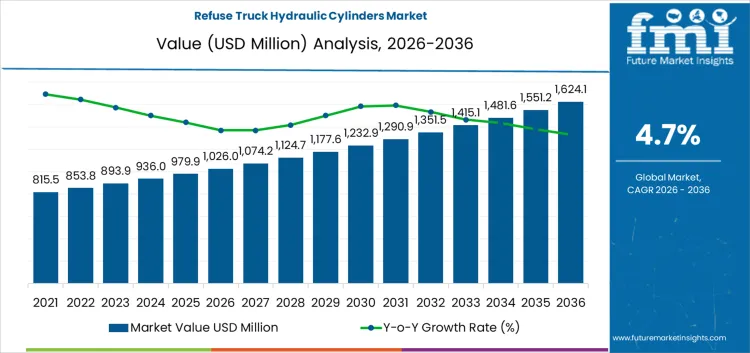
The refuse truck hydraulic cylinders market is valued at USD 1,026.0 million in 2026 and is expected to reach USD 1,624.1 million by 2036, registering a CAGR of 4.7%. Value generation is anchored in mechanical intensity rather than fleet volume expansion. Hydraulic cylinders operate under high-pressure compaction loads, misaligned forces, and contamination exposure that accelerate seal degradation and rod wear. Municipal refuse vehicles impose repeated short-cycle operation, making cylinder durability a primary determinant of vehicle availability. OEM demand aligns with standardized cylinder geometries, while aftermarket demand is driven by rebuild thresholds, leakage tolerance limits, and safety inspection outcomes rather than discretionary upgrades.
Consumption behavior reflects operational stress profiles specific to refuse handling rather than generalized commercial vehicle trends. Replacement timing is dictated by pressure loss, seal failure, or stroke inconsistency observed during compaction cycles. Electrified refuse trucks retain hydraulic actuation for high-force functions, maintaining cylinder relevance despite drivetrain change. Design evolution remains incremental due to chassis packaging constraints and established hydraulic layouts. Procurement decisions emphasize rebuildability, seal kit availability, and interchangeability across loader configurations. Supply continuity depends on machining capacity, coating processes, and seal material availability, constraining rapid volume shifts. Demand progression remains service-driven, shaped by municipal maintenance discipline and equipment uptime thresholds rather than expansion in waste collection coverage.
Quick Stats for Refuse Truck Hydraulic Cylinders Market
- Refuse Truck Hydraulic Cylinders Market Value (2026): USD 1,026.0 million
- Refuse Truck Hydraulic Cylinders Market Forecast Value (2036): USD 1,624.1 million
- Refuse Truck Hydraulic Cylinders Market Forecast CAGR 2026 to 2036: 4.7%
- Leading Cylinder Type by Demand Share: Telescopic Cylinders
- Fastest-Growing Countries: China, Brazil, USA, Germany, South Korea
- Top Players in Global Demand: Parker Hannifin, Eaton, HYDAC, Bosch Rexroth, Wipro Pari, Bucher Hydraulics, Delta Motion, Enerpac, CNH Industrial, Danfoss
Refuse Truck Hydraulic Cylinders Market Key Takeaways
| Metric | Value |
|---|---|
| Market Value (2026) | USD 1,026.0 million |
| Market Forecast Value (2036) | USD 1,624.1 million |
| Forecast CAGR 2026 to 2036 | 4.7% |
Why is the Demand for Refuse Truck Hydraulic Cylinders Growing?
Demand for refuse truck hydraulic cylinders is rising as waste collection fleets require robust actuation systems that handle heavy loads and repetitive duty cycles. Waste management authorities and fleet operators specify cylinders that deliver reliable force for hopper lift, packer ram, and tailgate functions because operational uptime directly affects collection schedules. Procurement teams assess material strength, sealing performance, and corrosion resistance to ensure component durability under exposure to moisture, debris, and variable temperatures. Engineering planners emphasize dimensional accuracy and compatibility with hydraulic networks to support integration with vehicle power units and control valves.
Safety and regulatory guidelines for refuse equipment influence selection of cylinders that meet performance criteria for controlled motion, pressure tolerance, and serviceability in municipal and commercial applications. Growth in urban waste volumes and fleet renewal initiatives reinforces uptake of high quality hydraulic cylinders that support predictable wear rates and reduce maintenance interruptions. Service facilities prioritize components with standardized mounting interfaces and replacement part availability to minimize downtime during scheduled overhauls. Technicians coordinate with manufacturers to verify testing protocols and performance records that align with fleet reliability targets. These technical and operational priorities support sustained adoption of advanced hydraulic actuation solutions across refuse collection fleets and equipment networks.
How Are the Segments Classified in the Refuse Truck Hydraulic Cylinders Market?
Demand for hydraulic cylinders in refuse trucks is shaped by waste collection intensity, automation of compaction functions, and durability requirements under harsh operating conditions. Daily operation involves repetitive lifting, compacting, and ejection cycles requiring consistent hydraulic performance. Component selection prioritizes load handling capacity, seal integrity, and resistance to contamination. Municipal fleet expansion and mechanized waste handling practices influence equipment specification. Segment classification reflects differentiation by cylinder design, functional application, and vehicle deployment environment. Structure highlights how motion requirement, operational duty cycle, and fleet ownership model influence specification standards, replacement frequency, and deployment scale across refuse collection operations.
Which Cylinder Type Represents the Largest Share of Demand?
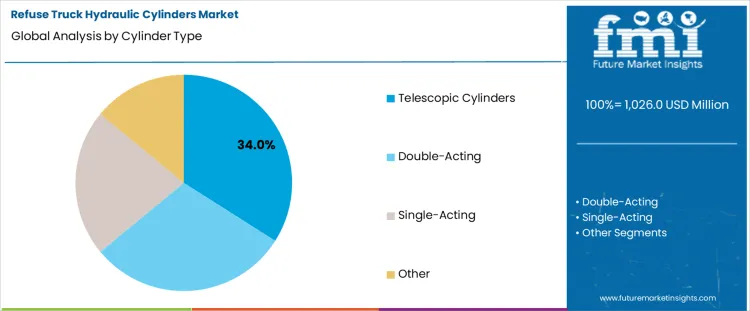
Telescopic cylinders hold 34.0%, representing the largest share among cylinder types due to space-efficient stroke capability. These cylinders enable long extension lengths within compact mounting envelopes common in refuse truck designs. Application suitability aligns with compaction and ejection mechanisms requiring variable stroke control. Structural design supports heavy axial loads encountered during waste compression. Double-acting cylinders provide controlled motion in both directions with balanced force output. Single-acting cylinders address simpler lifting tasks with gravity return. Cylinder type segmentation reflects preference for adaptable designs supporting complex motion profiles within constrained vehicle architectures.
Key Points:
- Telescopic cylinders support long stroke within limited space.
- Variable extension suits compaction and ejection functions.
- Other cylinder types address directional control or simpler motions.
Which Application Accounts for the Highest Share of Demand?

Compactor mechanisms hold 44.0%, representing the largest share among applications due to central role in waste volume reduction. Hydraulic cylinders drive compression plates handling dense and uneven material loads. Frequent cycling during collection routes increases performance and durability requirements. System reliability directly affects collection efficiency and route completion. Arm or lift systems manage bin handling with controlled vertical and rotational movement. Tailgate or ejection systems support unloading operations with lower cycle frequency. Application segmentation reflects concentration of hydraulic force demand within compaction processes fundamental to refuse truck functionality.
Key Points:
- Compaction requires high-force, repetitive hydraulic operation.
- Performance reliability affects route efficiency.
- Other applications support lifting and unloading tasks.
Which Vehicle Class Drives the Largest Share of Demand?
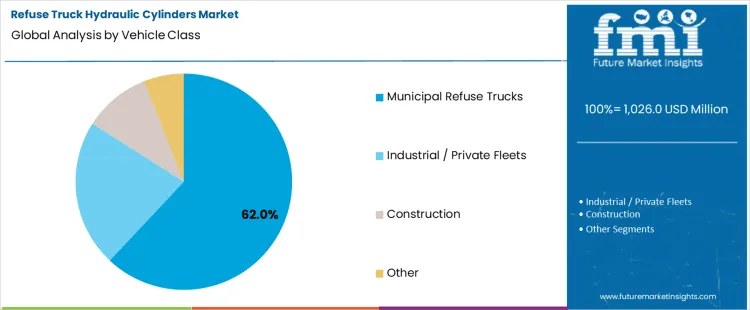
Municipal refuse trucks hold 62.0%, representing the largest share among vehicle classes due to scale of public waste collection services. City-operated fleets perform daily collection across residential and commercial zones. High utilization rates accelerate wear on hydraulic components. Maintenance programs emphasize proven cylinder designs with predictable service intervals. Industrial or private fleets operate under contract-based schedules with varied duty intensity. Construction applications use similar cylinders with different load profiles. Vehicle class segmentation reflects dominance of municipal operations where continuous service demand drives consistent hydraulic cylinder consumption.
Key Points:
- Municipal fleets operate under continuous daily duty cycles.
- High utilization increases replacement and service demand.
- Other fleets apply cylinders under varied operational intensity.
What are the Key Dynamics in the Refuse Truck Hydraulic Cylinders Market?
Demand for refuse truck hydraulic cylinders reflects operational requirements for reliable lifting, compaction, and ejection functions within municipal waste collection fleets. Adoption spans rear loader, side loader, and front loader refuse vehicles operated by public agencies and private contractors. Global scope aligns with urban sanitation service continuity and equipment uptime expectations. Usage centers on double-acting cylinders engineered for high cycle frequency, contamination exposure, and load variability.
How do waste collection duty cycles and vehicle design requirements shape adoption?
Refuse collection involves repetitive lifting and compaction cycles under variable load conditions. Demand increases as automated and semi-automated refuse trucks require precise hydraulic actuation for arms, packer plates, and tailgates. Cylinder performance directly affects cycle speed, compaction force consistency, and operator safety. Fleet operators prioritize seals, rod coatings, and bore designs that withstand abrasive debris, moisture ingress, and temperature variation. Integration with hydraulic power units and electronic controls supports synchronized operation across vehicle functions. Adoption strengthens where municipalities mandate standardized vehicle configurations to simplify maintenance. Reliability under stop-and-go urban routes reinforces preference for heavy-duty cylinder specifications.
How do maintenance intensity and procurement constraints influence market scalability?
Hydraulic cylinders face accelerated wear due to contamination, shock loads, and misalignment during operation. Demand sensitivity rises where maintenance budgets constrain preventive replacement schedules. Seal failure and rod damage increase downtime risk, affecting fleet availability. Procurement often occurs through long vehicle replacement cycles, limiting short-term volume growth. Compatibility requirements with existing truck models restrict interchangeability. Price pressure emerges from competitive tendering by municipal buyers. Skilled service availability affects repair versus replacement decisions. Supply chain dependence on machined components and seals influences lead times, constraining rapid scaling across large fleet renewal programs.
How Is Demand for Refuse Truck Hydraulic Cylinders Evolving Globally?
Demand for refuse truck hydraulic cylinders is expanding globally due to urban waste collection intensity, fleet renewal, and durability requirements under high-duty cycles. Consumption aligns with compaction frequency, lifting loads, and maintenance-driven replacement across municipal fleets. Electrification and automation of refuse vehicles influence cylinder specifications, sealing performance, and corrosion resistance. Retrofit activity contributes where legacy fleets undergo modernization. Growth rates in China at 5.9%, Brazil at 5.7%, USA at 4.5%, Germany at 4.4%, and South Korea at 4.3% indicate steady expansion driven by operating intensity, service reliability expectations, and lifecycle replacement rather than rapid fleet growth.

| Country | CAGR (%) |
|---|---|
| China | 5.9% |
| Brazil | 5.7% |
| USA | 4.5% |
| Germany | 4.4% |
| South Korea | 4.3% |
What Is Driving Refuse Truck Hydraulic Cylinder Demand Growth in China?
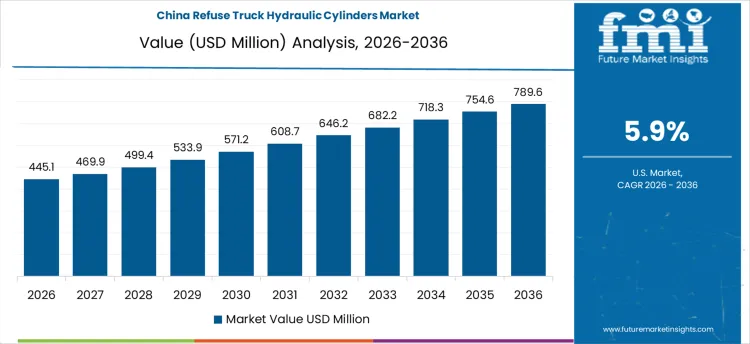
Urban sanitation scale is driving refuse truck hydraulic cylinder demand in China, expanding at a CAGR of 5.9%. High collection frequency in dense cities increases wear on compaction and lifting cylinders. Municipal standards emphasize reliable force output and leak prevention under continuous duty cycles. Expansion of electric refuse trucks requires cylinders compatible with optimized hydraulic systems. Retrofit programs replace aging components to reduce downtime. Strong domestic manufacturing supports standardized specifications across new builds and maintenance contracts, reinforcing maintenance-led growth across large municipal fleets.
- High-frequency urban waste collection operations
- Continuous-duty compaction and lifting requirements
- Electrification influencing hydraulic system design
- Large-scale municipal retrofit programs
Why Is Brazil Experiencing Steady Expansion in Refuse Truck Hydraulic Cylinder Demand?
Operating conditions are shaping refuse truck hydraulic cylinder demand in Brazil, growing at a CAGR of 5.7%. High ambient temperatures and humidity affect seal integrity and fluid performance. Urban collection routes with uneven road surfaces increase mechanical stress on cylinders. Municipal fleet renewal programs prioritize durability to reduce service interruptions. Compaction-intensive waste streams raise pressure cycle counts. Demand growth reflects operating environment stress and maintenance replacement needs rather than expansion of collection coverage.
- Climate impact on seals and hydraulic fluids
- Road conditions increasing mechanical stress
- Municipal focus on durable fleet components
- High compaction pressure cycle frequency
How Is the USA Sustaining Demand for Refuse Truck Hydraulic Cylinders?
Maintenance economics sustain refuse truck hydraulic cylinder demand in the USA, expanding at a CAGR of 4.5%. High utilization across daily collection routes accelerates wear on lift and ejector cylinders. Fleet operators emphasize preventive replacement to avoid service delays. Adoption of automated side-loader trucks increases reliance on precise hydraulic actuation. Regulatory safety expectations influence cylinder performance standards. Growth remains measured, aligned with replacement cycles within established municipal and private waste fleets.
- High daily utilization across collection routes
- Preventive maintenance to minimize downtime
- Automation increasing hydraulic precision needs
- Safety standards shaping component specifications
What Factors Are Supporting Refuse Truck Hydraulic Cylinder Demand in Germany?
Structured fleet management supports refuse truck hydraulic cylinder demand in Germany, growing at a CAGR of 4.4%. Preventive maintenance practices extend component life while ensuring predictable replacement intervals. Emphasis on leak prevention and environmental compliance influences cylinder design. Automation and low-noise collection systems require smooth hydraulic performance. Electrification of municipal fleets increases demand for efficient, low-loss hydraulic components. Growth reflects disciplined replacement within mature waste collection systems rather than fleet expansion.
- Preventive maintenance with predictable replacement cycles
- Environmental compliance influencing leak prevention
- Automation requiring smooth hydraulic actuation
- Electrification of municipal refuse fleets
Why Is South Korea Showing Controlled Growth in Refuse Truck Hydraulic Cylinder Demand?
Operational efficiency defines refuse truck hydraulic cylinder demand in South Korea, expanding at a CAGR of 4.3%. Compact urban geography limits route length while maintaining high collection frequency. Advanced maintenance discipline reduces premature component failure. Automation in waste collection increases reliance on consistent hydraulic performance. Municipal procurement favors standardized components with long service intervals. Growth remains controlled, reflecting efficient fleet utilization and scheduled replacement rather than increased vehicle deployment.
- High-frequency collection within compact urban routes
- Strong maintenance discipline reducing failures
- Automation increasing performance consistency needs
- Standardized municipal procurement practices
What is the competitive landscape of demand for the refuse truck hydraulic cylinders market globally?

Demand for refuse truck hydraulic cylinders is driven by municipal solid waste fleet expansion, replacement cycles, and requirements for durable, high-force actuation in compactors, lift arms, and tailgate systems. Buyers evaluate cylinder force capacity, sealing performance, corrosion resistance, stroke precision, and compatibility with truck electrical and hydraulic architectures. Procurement teams prioritize suppliers with proven heavy-duty product portfolios, global service networks, quality certifications, and ability to meet demanding duty-cycle requirements. Trend in the global market reflects increased urbanization, investment in automated collection systems, and emphasis on durability and uptime in waste collection operations.
Parker Hannifin holds leading positioning through a broad range of heavy-duty hydraulic cylinders and custom actuation solutions widely adopted in refuse and municipal vehicle applications. Eaton supports demand with industrial-grade hydraulic cylinders and related system components designed for high load and frequent cycling. Bosch Rexroth contributes robust hydraulic actuator platforms with strong durability credentials used in refuse truck compaction and lifting systems. HYDAC participates with hydraulic cylinders and support systems integrated into fluid power solutions for refuse and construction vehicle OEMs. Bucher Hydraulics supplies heavy-duty cylinders and components tailored to waste-handling equipment with technical support networks. Competitive differentiation depends on load capacity, sealing technology, corrosion protection, field serviceability, and ability to support long warranty and maintenance intervals.
Key Players in the Refuse Truck Hydraulic Cylinders Market
- Parker Hannifin
- Eaton
- HYDAC
- Bosch Rexroth
- Wipro Pari
- Bucher Hydraulics
- Delta Motion
- Enerpac
- CNH Industrial
- Danfoss
Scope of the Report
| Items | Values |
|---|---|
| Quantitative Units | USD million |
| Cylinder Type | Telescopic Cylinders; Double-Acting; Single-Acting; Other |
| Application | Compactor Mechanisms; Arm or Lift Systems; Tailgate or Ejection; Other |
| Vehicle Class | Municipal Refuse Trucks; Industrial or Private Fleets; Construction; Other |
| Sales Channel | OEM Line-Fit; Aftermarket or Service; Dealer or OES; Other |
| Regions Covered | Asia Pacific, Europe, North America, Latin America, Middle East & Africa |
| Countries Covered | China, Brazil, USA, Germany, South Korea, and 40+ countries |
| Key Companies Profiled | Parker Hannifin; Eaton; HYDAC; Bosch Rexroth; Wipro Pari; Bucher Hydraulics; Delta Motion; Enerpac; CNH Industrial; Danfoss |
| Additional Attributes | Dollar sales by cylinder type and application; adoption trends for telescopic cylinders in high-compaction refuse operations; stroke length, load capacity, and cycle-life performance metrics; sealing durability, contamination tolerance, and corrosion resistance considerations; compatibility with automated side-loaders and rear-loaders; maintenance intervals, rebuildability, and total cost of ownership factors; compliance with municipal fleet safety standards and OEM durability specifications influencing hydraulic cylinder selection. |
Refuse Truck Hydraulic Cylinders Market by Segment
By Cylinder Type:
- Telescopic Cylinders
- Double-Acting
- Single-Acting
- Other
By Application:
- Compactor Mechanisms
- Arm or Lift Systems
- Tailgate or Ejection
- Other
By Vehicle Class:
- Municipal Refuse Trucks
- Industrial or Private Fleets
- Construction
- Other
By Sales Channel:
- OEM Line-Fit
- Aftermarket or Service
- Dealer or OES
- Other
By Region:
- Asia Pacific
- China
- Japan
- South Korea
- India
- Australia & New Zealand
- ASEAN
- Rest of Asia Pacific
- Europe
- Germany
- United Kingdom
- France
- Italy
- Spain
- Nordic
- BENELUX
- Rest of Europe
- North America
- United States
- Canada
- Mexico
- Latin America
- Brazil
- Chile
- Rest of Latin America
- Middle East & Africa
- Kingdom of Saudi Arabia
- Other GCC Countries
- Turkey
- South Africa
- Other African Union
- Rest of Middle East & Africa
Bibliography
- International Organization of Motor Vehicle Manufacturers (OICA). (2024). Municipal vehicle production trends and implications for refuse truck hydraulic system demand. OICA Statistical Publications.
- Society of Automotive Engineers International. (2023). Hydraulic cylinder design, sealing performance, and duty-cycle durability in refuse and municipal vehicles. SAE Technical Papers.
- International Solid Waste Association (ISWA). (2024). Urban waste collection operations, fleet renewal trends, and equipment reliability requirements. ISWA Technical Reports.
- OECD International Transport Forum. (2024). Urban service vehicle utilization, maintenance intensity, and lifecycle replacement dynamics. ITF Transport Outlook.
Frequently Asked Questions
How big is the refuse truck hydraulic cylinders market in 2026?
The global refuse truck hydraulic cylinders market is estimated to be valued at USD 1,026.0 million in 2026.
What will be the size of refuse truck hydraulic cylinders market in 2036?
The market size for the refuse truck hydraulic cylinders market is projected to reach USD 1,624.1 million by 2036.
How much will be the refuse truck hydraulic cylinders market growth between 2026 and 2036?
The refuse truck hydraulic cylinders market is expected to grow at a 4.7% CAGR between 2026 and 2036.
What are the key product types in the refuse truck hydraulic cylinders market?
The key product types in refuse truck hydraulic cylinders market are telescopic cylinders, double-acting, single-acting and other.
Which application segment to contribute significant share in the refuse truck hydraulic cylinders market in 2026?
In terms of application, compactor mechanisms segment to command 44.0% share in the refuse truck hydraulic cylinders market in 2026.
Preview the report firsthand - request a free sample
Get SampleGet the brochure for pricing and purchase details.
Get PDFTable of Content
- Executive Summary
- Global Market Outlook
- Demand-side Trends
- Supply-side Trends
- Technology Roadmap Analysis
- Analysis and Recommendations
- Market Overview
- Market Coverage / Taxonomy
- Market Definition / Scope / Limitations
- Market Background
- Market Dynamics
- Drivers
- Restraints
- Opportunity
- Trends
- Scenario Forecast
- Demand in Optimistic Scenario
- Demand in Likely Scenario
- Demand in Conservative Scenario
- Opportunity Map Analysis
- Product Life Cycle Analysis
- Supply Chain Analysis
- Investment Feasibility Matrix
- Value Chain Analysis
- PESTLE and Porter’s Analysis
- Regulatory Landscape
- Regional Parent Market Outlook
- Production and Consumption Statistics
- Import and Export Statistics
- Market Dynamics
- Global Market Analysis 2021 to 2025 and Forecast, 2026 to 2036
- Historical Market Size Value (USD Million) Analysis, 2021 to 2025
- Current and Future Market Size Value (USD Million) Projections, 2026 to 2036
- Y-o-Y Growth Trend Analysis
- Absolute $ Opportunity Analysis
- Global Market Pricing Analysis 2021 to 2025 and Forecast 2026 to 2036
- Global Market Analysis 2021 to 2025 and Forecast 2026 to 2036, By Cylinder Type
- Introduction / Key Findings
- Historical Market Size Value (USD Million) Analysis By Cylinder Type , 2021 to 2025
- Current and Future Market Size Value (USD Million) Analysis and Forecast By Cylinder Type , 2026 to 2036
- Telescopic Cylinders
- Double-Acting
- Single-Acting
- Other
- Telescopic Cylinders
- Y-o-Y Growth Trend Analysis By Cylinder Type , 2021 to 2025
- Absolute $ Opportunity Analysis By Cylinder Type , 2026 to 2036
- Global Market Analysis 2021 to 2025 and Forecast 2026 to 2036, By Application
- Introduction / Key Findings
- Historical Market Size Value (USD Million) Analysis By Application, 2021 to 2025
- Current and Future Market Size Value (USD Million) Analysis and Forecast By Application, 2026 to 2036
- Compactor Mechanisms
- Arm or Lift Systems
- Tailgate or Ejection
- Other
- Compactor Mechanisms
- Y-o-Y Growth Trend Analysis By Application, 2021 to 2025
- Absolute $ Opportunity Analysis By Application, 2026 to 2036
- Global Market Analysis 2021 to 2025 and Forecast 2026 to 2036, By Vehicle Class
- Introduction / Key Findings
- Historical Market Size Value (USD Million) Analysis By Vehicle Class, 2021 to 2025
- Current and Future Market Size Value (USD Million) Analysis and Forecast By Vehicle Class, 2026 to 2036
- Municipal Refuse Trucks
- Industrial / Private Fleets
- Construction
- Other
- Municipal Refuse Trucks
- Y-o-Y Growth Trend Analysis By Vehicle Class, 2021 to 2025
- Absolute $ Opportunity Analysis By Vehicle Class, 2026 to 2036
- Global Market Analysis 2021 to 2025 and Forecast 2026 to 2036, By Sales Channel
- Introduction / Key Findings
- Historical Market Size Value (USD Million) Analysis By Sales Channel, 2021 to 2025
- Current and Future Market Size Value (USD Million) Analysis and Forecast By Sales Channel, 2026 to 2036
- OEM Line-Fit
- Aftermarket or Service
- Dealer or OES
- Other
- OEM Line-Fit
- Y-o-Y Growth Trend Analysis By Sales Channel, 2021 to 2025
- Absolute $ Opportunity Analysis By Sales Channel, 2026 to 2036
- Global Market Analysis 2021 to 2025 and Forecast 2026 to 2036, By Region
- Introduction
- Historical Market Size Value (USD Million) Analysis By Region, 2021 to 2025
- Current Market Size Value (USD Million) Analysis and Forecast By Region, 2026 to 2036
- North America
- Latin America
- Western Europe
- Eastern Europe
- East Asia
- South Asia and Pacific
- Middle East & Africa
- Market Attractiveness Analysis By Region
- North America Market Analysis 2021 to 2025 and Forecast 2026 to 2036, By Country
- Historical Market Size Value (USD Million) Trend Analysis By Market Taxonomy, 2021 to 2025
- Market Size Value (USD Million) Forecast By Market Taxonomy, 2026 to 2036
- By Country
- USA
- Canada
- Mexico
- By Cylinder Type
- By Application
- By Vehicle Class
- By Sales Channel
- By Country
- Market Attractiveness Analysis
- By Country
- By Cylinder Type
- By Application
- By Vehicle Class
- By Sales Channel
- Key Takeaways
- Latin America Market Analysis 2021 to 2025 and Forecast 2026 to 2036, By Country
- Historical Market Size Value (USD Million) Trend Analysis By Market Taxonomy, 2021 to 2025
- Market Size Value (USD Million) Forecast By Market Taxonomy, 2026 to 2036
- By Country
- Brazil
- Chile
- Rest of Latin America
- By Cylinder Type
- By Application
- By Vehicle Class
- By Sales Channel
- By Country
- Market Attractiveness Analysis
- By Country
- By Cylinder Type
- By Application
- By Vehicle Class
- By Sales Channel
- Key Takeaways
- Western Europe Market Analysis 2021 to 2025 and Forecast 2026 to 2036, By Country
- Historical Market Size Value (USD Million) Trend Analysis By Market Taxonomy, 2021 to 2025
- Market Size Value (USD Million) Forecast By Market Taxonomy, 2026 to 2036
- By Country
- Germany
- UK
- Italy
- Spain
- France
- Nordic
- BENELUX
- Rest of Western Europe
- By Cylinder Type
- By Application
- By Vehicle Class
- By Sales Channel
- By Country
- Market Attractiveness Analysis
- By Country
- By Cylinder Type
- By Application
- By Vehicle Class
- By Sales Channel
- Key Takeaways
- Eastern Europe Market Analysis 2021 to 2025 and Forecast 2026 to 2036, By Country
- Historical Market Size Value (USD Million) Trend Analysis By Market Taxonomy, 2021 to 2025
- Market Size Value (USD Million) Forecast By Market Taxonomy, 2026 to 2036
- By Country
- Russia
- Poland
- Hungary
- Balkan & Baltic
- Rest of Eastern Europe
- By Cylinder Type
- By Application
- By Vehicle Class
- By Sales Channel
- By Country
- Market Attractiveness Analysis
- By Country
- By Cylinder Type
- By Application
- By Vehicle Class
- By Sales Channel
- Key Takeaways
- East Asia Market Analysis 2021 to 2025 and Forecast 2026 to 2036, By Country
- Historical Market Size Value (USD Million) Trend Analysis By Market Taxonomy, 2021 to 2025
- Market Size Value (USD Million) Forecast By Market Taxonomy, 2026 to 2036
- By Country
- China
- Japan
- South Korea
- By Cylinder Type
- By Application
- By Vehicle Class
- By Sales Channel
- By Country
- Market Attractiveness Analysis
- By Country
- By Cylinder Type
- By Application
- By Vehicle Class
- By Sales Channel
- Key Takeaways
- South Asia and Pacific Market Analysis 2021 to 2025 and Forecast 2026 to 2036, By Country
- Historical Market Size Value (USD Million) Trend Analysis By Market Taxonomy, 2021 to 2025
- Market Size Value (USD Million) Forecast By Market Taxonomy, 2026 to 2036
- By Country
- India
- ASEAN
- Australia & New Zealand
- Rest of South Asia and Pacific
- By Cylinder Type
- By Application
- By Vehicle Class
- By Sales Channel
- By Country
- Market Attractiveness Analysis
- By Country
- By Cylinder Type
- By Application
- By Vehicle Class
- By Sales Channel
- Key Takeaways
- Middle East & Africa Market Analysis 2021 to 2025 and Forecast 2026 to 2036, By Country
- Historical Market Size Value (USD Million) Trend Analysis By Market Taxonomy, 2021 to 2025
- Market Size Value (USD Million) Forecast By Market Taxonomy, 2026 to 2036
- By Country
- Kingdom of Saudi Arabia
- Other GCC Countries
- Turkiye
- South Africa
- Other African Union
- Rest of Middle East & Africa
- By Cylinder Type
- By Application
- By Vehicle Class
- By Sales Channel
- By Country
- Market Attractiveness Analysis
- By Country
- By Cylinder Type
- By Application
- By Vehicle Class
- By Sales Channel
- Key Takeaways
- Key Countries Market Analysis
- USA
- Pricing Analysis
- Market Share Analysis, 2025
- By Cylinder Type
- By Application
- By Vehicle Class
- By Sales Channel
- Canada
- Pricing Analysis
- Market Share Analysis, 2025
- By Cylinder Type
- By Application
- By Vehicle Class
- By Sales Channel
- Mexico
- Pricing Analysis
- Market Share Analysis, 2025
- By Cylinder Type
- By Application
- By Vehicle Class
- By Sales Channel
- Brazil
- Pricing Analysis
- Market Share Analysis, 2025
- By Cylinder Type
- By Application
- By Vehicle Class
- By Sales Channel
- Chile
- Pricing Analysis
- Market Share Analysis, 2025
- By Cylinder Type
- By Application
- By Vehicle Class
- By Sales Channel
- Germany
- Pricing Analysis
- Market Share Analysis, 2025
- By Cylinder Type
- By Application
- By Vehicle Class
- By Sales Channel
- UK
- Pricing Analysis
- Market Share Analysis, 2025
- By Cylinder Type
- By Application
- By Vehicle Class
- By Sales Channel
- Italy
- Pricing Analysis
- Market Share Analysis, 2025
- By Cylinder Type
- By Application
- By Vehicle Class
- By Sales Channel
- Spain
- Pricing Analysis
- Market Share Analysis, 2025
- By Cylinder Type
- By Application
- By Vehicle Class
- By Sales Channel
- France
- Pricing Analysis
- Market Share Analysis, 2025
- By Cylinder Type
- By Application
- By Vehicle Class
- By Sales Channel
- India
- Pricing Analysis
- Market Share Analysis, 2025
- By Cylinder Type
- By Application
- By Vehicle Class
- By Sales Channel
- ASEAN
- Pricing Analysis
- Market Share Analysis, 2025
- By Cylinder Type
- By Application
- By Vehicle Class
- By Sales Channel
- Australia & New Zealand
- Pricing Analysis
- Market Share Analysis, 2025
- By Cylinder Type
- By Application
- By Vehicle Class
- By Sales Channel
- China
- Pricing Analysis
- Market Share Analysis, 2025
- By Cylinder Type
- By Application
- By Vehicle Class
- By Sales Channel
- Japan
- Pricing Analysis
- Market Share Analysis, 2025
- By Cylinder Type
- By Application
- By Vehicle Class
- By Sales Channel
- South Korea
- Pricing Analysis
- Market Share Analysis, 2025
- By Cylinder Type
- By Application
- By Vehicle Class
- By Sales Channel
- Russia
- Pricing Analysis
- Market Share Analysis, 2025
- By Cylinder Type
- By Application
- By Vehicle Class
- By Sales Channel
- Poland
- Pricing Analysis
- Market Share Analysis, 2025
- By Cylinder Type
- By Application
- By Vehicle Class
- By Sales Channel
- Hungary
- Pricing Analysis
- Market Share Analysis, 2025
- By Cylinder Type
- By Application
- By Vehicle Class
- By Sales Channel
- Kingdom of Saudi Arabia
- Pricing Analysis
- Market Share Analysis, 2025
- By Cylinder Type
- By Application
- By Vehicle Class
- By Sales Channel
- Turkiye
- Pricing Analysis
- Market Share Analysis, 2025
- By Cylinder Type
- By Application
- By Vehicle Class
- By Sales Channel
- South Africa
- Pricing Analysis
- Market Share Analysis, 2025
- By Cylinder Type
- By Application
- By Vehicle Class
- By Sales Channel
- USA
- Market Structure Analysis
- Competition Dashboard
- Competition Benchmarking
- Market Share Analysis of Top Players
- By Regional
- By Cylinder Type
- By Application
- By Vehicle Class
- By Sales Channel
- Competition Analysis
- Competition Deep Dive
- Parker Hannifin
- Overview
- Product Portfolio
- Profitability by Market Segments (Product/Age /Sales Channel/Region)
- Sales Footprint
- Strategy Overview
- Marketing Strategy
- Product Strategy
- Channel Strategy
- Eaton
- HYDAC
- Bosch Rexroth
- Wipro Pari
- Bucher Hydraulics
- Delta Motion
- Enerpac
- CNH Industrial (hydraulics)
- Danfoss
- Parker Hannifin
- Competition Deep Dive
- Assumptions & Acronyms Used
- Research Methodology


