

- Market Size (2026)
- USD 4.1 Bn
- Forecast (2036)
- USD 6.6 Bn
- CAGR (2026 to 2036)
- 4.8%
How big is Rubber Kneader Machine Market in 2026?
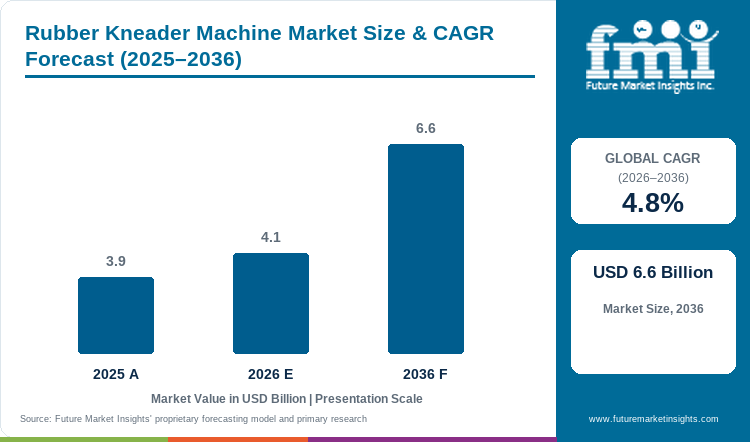
USD 4.1 Billion in 2026 and USD 6.6 Billion by 2036 at a 4.8% CAGR.
Sales of rubber kneader machines are estimated to grow at 4.8% from USD 4.1 Billion in 2026 to USD 6.6 Billion by 2036. The Rubber Kneader Machine Market was valued at USD 3.9 Billion in 2025. Spending on these machines depends heavily on what is happening inside the mixing room. Tire and industrial rubber producers usually replace or add a kneader when batch times become too long, filler dispersion becomes inconsistent, or temperature is harder to control. USTMA projected 330.3 million U.S. tire shipments for 2026. JATMA reported 123.28 million tires produced in Japan in 2025 and about 0.93 million tons of rubber used for tire production. Even in mature manufacturing markets, those volumes keep mixer uptime and repeatable recipes commercially important.
Engineers first match chamber volume and rotor design to the compound, then review drive load, cooling, controls, feeding, and discharge. Brownfield projects are harder because a replacement machine has to work with existing foundations, utilities, and surrounding equipment. Suppliers are therefore more likely to win when they can show a clear operating benefit and manage installation without creating excessive production downtime.
Key Takeaways
- The market moves from USD 4.1 Billion in 2026 to USD 6.6 Billion by 2036 at a 4.8% CAGR. The 2025 base is USD 3.9 Billion.
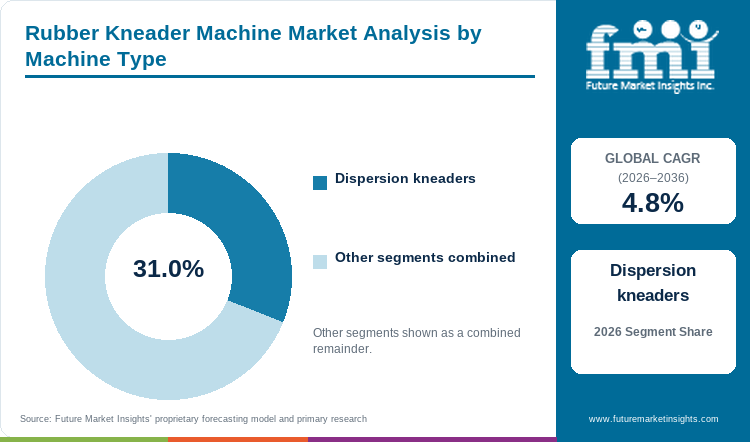
- Dispersion kneaders hold 31.0% of Machine Type demand in 2026 because closed-chamber batch processing supports controlled shear and filler incorporation across tire and technical-rubber compounds.
- The 50-150 L capacity band accounts for 36.0% in 2026. It gives processors production-scale batches while retaining more scheduling flexibility than very large chambers.
- Tire manufacturing holds 42.0% of End Use demand because high rubber throughput and multiple compound families place mixing consistency near the front of the production sequence.
- PLC-controlled equipment holds 39.0% of Automation demand, while Machinery OEMs account for 44.0% of Sales Channel demand because recipe control and line integration are part of the equipment purchase.
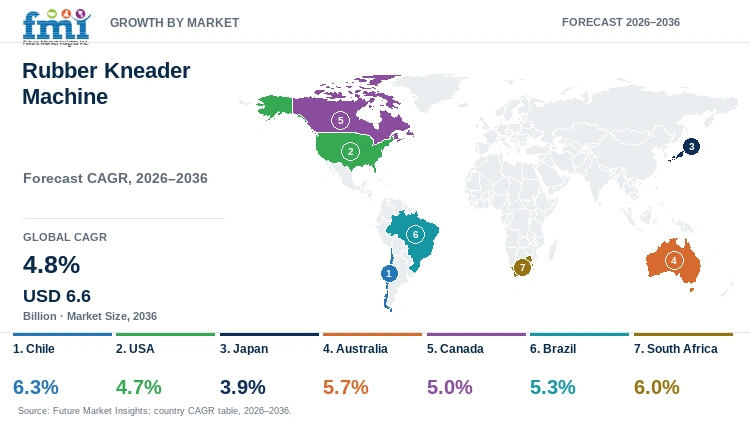
- Country growth ranges from 6.3% CAGR in Chile to 3.9% in Japan from 2026 to 2036. Project timing, installed-base age, and local service economics shape how quickly that growth converts into orders.
Analyst Perspective
“Rubber kneader projects are decided at the point where a compound problem becomes expensive enough to justify production interruption. Chamber size alone will not carry the business case. Buyers will look for lower batch variation, controllable thermal load, and a commissioning plan that protects recipe qualification. Retrofit capability matters because many plants can improve controls before they replace the mechanical core. Suppliers that can price both paths give the plant a clearer capital choice.”
- Nikhil Kaitwade, Principal Consultant, Future Market Insights
How is the Rubber Kneader Machine Market segmented?
Machine Type, Capacity, End Use, Automation, Sales Channel, and Region
The market is segmented by Machine Type, Capacity, End Use, Automation, Sales Channel, and Region. Machine Type includes Dispersion kneaders, Pressure kneaders, Banbury-type mixers, Tangential rotor kneaders, and Intermeshing rotor kneaders. Capacity covers 50-150 L, Below 50 L, 150-300 L, and Above 300 L. End Use includes Tire manufacturing, Rubber goods, Automotive rubber parts, Footwear soles, and Industrial compounds. Automation covers PLC-controlled, Manual controls, Recipe management, and Line integrated systems. Sales Channel includes Machinery OEMs, Direct factory projects, Distributor network, and Aftermarket/service. Regional coverage spans North America, Latin America, Western Europe, Eastern Europe, East Asia, South Asia & Pacific, and Middle East & Africa.
Why do Dispersion kneaders lead demand within the Machine Type category?
Dispersion kneaders perform the main batch-mixing task of bringing polymers, fillers, oils, and chemicals together under controlled shear. Their closed chamber gives operators tighter control over temperature, pressure, rotor action, and discharge timing. That matters when a compound contains high filler loads or when small changes in mixing conditions can affect downstream processing. Banbury-type and other rotor designs remain useful for recipes that need a different energy profile, but dispersion kneaders cover a broad range of rubber compounds and production duties.
- Dispersion kneaders hold a 31.0% share in 2026 because their closed-chamber batch process supports controlled filler incorporation across broad rubber-compounding duties.
- Buzuluk documents internal mixers for rubber, chemicals, and fillers with tangential and interlocking rotor architectures, showing the range of batch-mixing configurations available to processors.
Why does 50-150 L lead demand within the Capacity category?
The 50-150 L range sits between laboratory equipment and very large production mixers. It gives processors enough volume for commercial batches without making every run too large to manage efficiently. That is useful for plants that switch between compounds or serve several product lines. Mid-range machines can also reduce the scale of drive, cooling, foundation, and material-handling requirements compared with larger units. This makes the capacity band a practical choice where output matters, but production flexibility still has value.
- The 50-150 L segment holds a 36.0% share in 2026 because it balances production-scale batches with manageable changeovers and plant integration.
- Buzuluk lists 100 L tangential mixers and interlocking models at 90 L and 140 L, placing commercial configurations directly around the leading capacity band.
Why does Tire manufacturing lead demand within the End Use category?
Tire plants rely on several rubber compounds before material reaches component preparation and curing. Carbon black, silica, oils, polymers, and curatives all need to stay within controlled mixing conditions because problems at this stage can lead to rework or unstable downstream processing. JATMA reported 123.28 million tires produced in Japan in 2025 and about 0.93 million tons of rubber consumed for tire production. At that scale, mixer performance matters whether the plant is expanding capacity or simply maintaining existing output. Related tire-line automation also makes consistent, traceable batch execution more valuable.
- Tire manufacturing holds a 42.0% share in 2026 because tire plants run high material volumes through many differentiated compounds before downstream forming and curing.
- Kobe Steel stated in June 2025 that its Indian machinery base manufactures rubber mixers and extruders for tire and rubber customers, linking the plant expansion to rising equipment demand in India.
Why do PLC-controlled systems lead demand within the Automation category?
PLC control gives operators a repeatable sequence for each batch instead of relying mainly on manual timing. Feeding, rotor movement, temperature conditions, mixing time, and discharge can all follow programmed recipes. This becomes more useful when the mixer is connected to weighing equipment or downstream material handling. More advanced recipe-management and MES systems add another layer of control, but PLCs remain the main automation step for plants that want better repeatability without rebuilding the entire mixing room.
- PLC-controlled systems hold a 39.0% share in 2026 because programmed sequences improve repeatability and provide the control layer for broader mixing-room automation.
- HF GROUP documents ADVISE as a modular mixing-room automation system that connects material receiving, weighing, mixer control, process monitoring, batch tracking, and ERP interfaces.
Why do Machinery OEMs lead demand within the Sales Channel category?
A production-scale kneader is usually purchased as part of a wider process system rather than as a standalone machine. Chamber size must suit the compound, while the drive and cooling system must handle the intended operating cycle. Feeders, discharge equipment, and rubber extrusion equipment may also need to work directly with the mixer. Machinery OEMs can manage more of these interfaces and stay involved through installation and commissioning. Distributors remain useful for smaller machines, while aftermarket specialists support repair and life extension.
- Machinery OEMs hold a 44.0% share in 2026 because buyers value engineering ownership and service continuity around an upstream production asset.
- Qingdao Evertech reported an updated CE certification audit for its rubber machinery in January 2024 and describes direct design and manufacturing for export markets.
What are the drivers, restraints and opportunities in the Rubber Kneader Machine Market?
Mixing-room modernization supports demand, brownfield integration slows replacement, and retrofit-friendly controls create an upgrade route.
- Driver: Rubber and tire producers need repeatable dispersion and usable throughput as recipes change and mixing rooms add more automated material handling.
- Restraint: Long equipment lives make replacement dependent on shutdown economics, integration work, and recipe requalification before a plant approves new capital.
- Opportunity: Modular controls and mechanical retrofits can improve an installed mixer when the plant cannot justify a complete greenfield mixing line.
Demand starts with how the compound behaves inside the mixer. Plants need to keep shear and temperature inside a workable range without sacrificing throughput. New synthetic rubber compounds or higher filler loadings can increase power demand and change heat buildup during mixing. Older controls can also become a weak point when weighing and material handling are increasingly automated. Kobe Steel announced about 3 billion yen of investment in June 2025 to expand its Indian machinery plant, which manufactures tire and rubber machinery including mixers. For buyers, a new kneader makes financial sense when it removes a visible production constraint or reduces batch variation that is creating losses elsewhere in the plant.
Brownfield replacement is more complicated. A mixer may continue operating for years after rotor work, drive repair, or component upgrades. Replacing the complete machine can require changes to foundations, utilities, feed systems, dust handling, control cabinets, and discharge equipment. Pelmar Engineering’s July 2025 machinery relocation project for Yokohama OHT shows how much work can surround a heavy rubber-processing asset. A plant may therefore keep an older machine running when the cost and disruption of replacement outweigh the expected operating gain.
This leaves a clear opening for staged modernization. HF GROUP provides retrofit packages for controls and mechanical components, while ADVISE links mixer control with recipe management and process monitoring. Plants can improve repeatability and visibility without immediately replacing the chamber and drive. The value is easiest to justify when the upgrade solves a measurable production problem and can be installed within an acceptable shutdown window.
Which country CAGRs are profiled in the Rubber Kneader Machine Market?
| Country | CAGR |
|---|---|
| Chile | 6.3% |
| USA | 4.7% |
| Japan | 3.9% |
| Australia | 5.7% |
| Canada | 5.0% |
| Brazil | 5.3% |
| South Africa | 6.0% |
How do country-level CAGRs compare in the Rubber Kneader Machine Market?
Growth across the profiled countries ranges from 6.3% CAGR in Chile to 3.9% in Japan between 2026 and 2036. Chile, South Africa, and Australia form the faster-growth group at 5.7% to 6.3%, supported by industrial, resource, and automotive-related investment. Brazil and Canada sit in the middle at 5.3% and 5.0%. The USA grows at 4.7%, while Japan reflects a slower renewal cycle in a mature manufacturing base. These rates show how quickly demand is expected to expand, not the size of each country’s installed machinery base.
- Chile at 6.3% is 0.3 percentage points above South Africa at 6.0%. Chilean demand is tied more closely to mining-linked technical rubber, while South Africa has a policy-driven tire and automotive investment angle.
- Australia at 5.7% sits 0.4 percentage points above Brazil at 5.3%. Australia has a dispersed resource-project geography, while Brazil has a more concentrated path through domestic tire manufacturing investment.
- Canada at 5.0% is close to the USA at 4.7%, but Canadian projects can hinge on a small number of plant modernization programs while the USA has a broader installed tire and rubber-processing base.
- Japan at 3.9% remains a renewal market where process efficiency and brownfield fit can matter more than nameplate capacity expansion.
Country-wise Analysis
- Chile: Demand for Rubber Kneader Machines is forecast to expand at 6.3% CAGR from 2026 to 2036. Chile’s Ministry of Mining reported a 2025-2034 mining investment portfolio of US$104.549 billion in December 2025. Mining activity supports demand for conveyor components, hoses, seals, and other industrial rubber products. The equipment opportunity is therefore project-linked rather than driven by a large domestic tire base. Suppliers need machine configurations and service plans that can support varied technical compounds and remote industrial users.
- USA: Demand for Rubber Kneader Machines is forecast to expand at 4.7% CAGR from 2026 to 2036. USTMA projected 330.3 million U.S. tire shipments for 2026 versus 336.3 million in 2025. That near-term decline raises the approval bar for capacity-led projects and gives more weight to cycle control, energy use, and uptime. Suppliers must show why a new kneader produces a better plant-level return than extending the life of an installed mixer.
- Japan: Demand for Rubber Kneader Machines is forecast to expand at 3.9% CAGR from 2026 to 2036. JATMA reported 123.28 million tires produced in 2025 and about 0.93 million tons of rubber used in tire production. The tire industry accounted for about 80% of domestic rubber consumption. This keeps mixing assets central to the manufacturing base, but purchase timing is governed by renewal and efficiency in a mature installed stock.
- Australia: Demand for Rubber Kneader Machines is forecast to expand at 5.7% CAGR from 2026 to 2036. The Department of Industry reported 432 major resource and energy projects under development at the end of October 2025, up from 407 a year earlier. That project pipeline supports technical-rubber demand for wear components and material-handling systems. A dispersed customer geography makes remote service capability and spares planning part of the equipment proposition.
- Canada: Demand for Rubber Kneader Machines is forecast to expand at 5.0% CAGR from 2026 to 2036. Product transitions can change compound recipes and upstream mixing requirements even when the kneader is not the headline asset. Suppliers need to connect mixer upgrades to defined shutdown windows and product-change programs.
- Brazil: Demand for Rubber Kneader Machines is forecast to expand at 5.3% CAGR from 2026 to 2036. Brazil’s local tire manufacturing scale supports upstream mixing demand. Project conversion depends on lifecycle economics and the availability of commissioning support inside Brazil.
- South Africa: Demand for Rubber Kneader Machines is forecast to expand at 6.0% CAGR from 2026 to 2036. The government’s South Africa-China Trade and Investment Package 2025-2029 identifies tyres and automotive among investment priorities and includes skills for service and aftercare maintenance. That direction can support machinery projects, but a smaller pool of large mixing sites makes local parts access and technical training important to supplier economics.
Who are the notable companies in the Rubber Kneader Machine Market?
HF Mixing Group; Farrel Pomini; Kobelco Stewart Bolling; Comerio Ercole; Mitsubishi Heavy Industries; Dalian Rubber & Plastics; Qingdao Evertech; Buzuluk; Pelmar Engineering; Wuxi Double Elephant
Suppliers compete on how much of the mixing-room job they can handle beyond the mixer itself. HF Mixing Group and Kobelco Stewart Bolling combine mixer hardware with controls and lifecycle support. Mitsubishi Heavy Industries and Dalian Rubber & Plastics serve production-scale tire and rubber mixing requirements. Comerio Ercole and Buzuluk focus more directly on rubber-processing machinery and plant engineering. Qingdao Evertech and Wuxi Double Elephant supply pressurized kneaders and internal mixers for domestic and export customers. Farrel Pomini stands apart through continuous compounding, while Pelmar Engineering focuses on acquisition, rebuild, relocation, and installation of machinery.
- Integrated Tire Mixing Platforms: HF Mixing Group, Kobelco Stewart Bolling, Mitsubishi Heavy Industries, and Dalian Rubber & Plastics compete on batch-mixer architecture plus line engineering and service.
- Specialist Rubber Machinery Builders: Comerio Ercole, Buzuluk, Qingdao Evertech, and Wuxi Double Elephant address buyers that need configured rubber-processing machinery across varied plant scales.
- Compounding and Lifecycle Project Specialists: Farrel Pomini brings continuous mixing technology, while Pelmar Engineering supports acquisition, rebuild, relocation, and installation projects.
Competitive Benchmarking: Rubber Kneader Machine Market
| Company | Batch Mixing Architecture | Controls & Line Integration | Lifecycle Project Support | Geographic Reach |
|---|---|---|---|---|
| HF Mixing Group | High | High | High | Europe, North America, India, China |
| Farrel Pomini | Low | Medium | High | North America, Europe, global support |
| Kobelco Stewart Bolling | High | High | High | USA, Japan, India, Germany, China |
| Comerio Ercole | High | Medium | High | Europe with broad export reach |
| Mitsubishi Heavy Industries | High | Unscored | Medium | Japan with international tire and rubber customers |
| Dalian Rubber & Plastics | High | Medium | Medium | China with overseas sales |
| Qingdao Evertech | Medium | Medium | Medium | China with export markets |
| Buzuluk | High | Medium | High | Europe with sales to more than 40 countries |
| Pelmar Engineering | Medium | High | High | Europe and global tire and rubber project locations |
| Wuxi Double Elephant | Medium | Unscored | Medium | China with export focus |
Scoring basis: Batch Mixing Architecture measures documented breadth in batch or internal-mixer chamber and rotor configurations. Controls & Line Integration measures mixer control, recipe capability, and connection to upstream or downstream equipment. Lifecycle Project Support covers rebuilds, spare parts, relocation, commissioning, or retrofit work. High indicates broad documented capability against the criterion. Medium indicates narrower but relevant coverage. Low indicates a documented limitation relative to the criterion. Unscored is retained as a table state.
Key Developments in the Rubber Kneader Machine Market
- In January 2026, Farrel Pomini acquired majority ownership of WF RECYCLE-TECH. The recycling system uses the Farrel Continuous Mixer to process end-of-life tires into outputs that include recovered carbon black and oil. The move extends continuous-mixing technology into tire-material recovery and creates a link between recycling output and future compound formulation.
- In June 2025, Kobe Steel announced about 3 billion yen of investment to expand Kobelco Industrial Machinery India. The site manufactures tire and rubber machinery including rubber mixers and extruders, and the expansion is scheduled for completion in fiscal 2027. The project adds production capacity closer to Indian tire and rubber customers.
- In June 2025, Comerio Ercole added a next-generation mixer to its technical laboratory as part of an expanded R&D setup. The lab supports testing and validation of new materials and process concepts before full-scale production investment, strengthening the company’s process-development role around rubber mixing.
Key Players in the Rubber Kneader Machine Market
Integrated Tire Mixing Platforms
- HF Mixing Group
- Kobelco Stewart Bolling
- Mitsubishi Heavy Industries
- Dalian Rubber & Plastics
Specialist Rubber Machinery Builders
- Comerio Ercole
- Buzuluk
- Qingdao Evertech
- Wuxi Double Elephant
Compounding and Lifecycle Project Specialists
- Farrel Pomini
- Pelmar Engineering
Rubber Kneader Machine Market - Report Scope
| Coverage field | Report scope |
|---|---|
| Market breakdown | Machine Type, Capacity, End Use, Automation, Sales Channel, and Region |
| Quantitative Units | USD Billion |
| Market Definition | Revenue from rubber kneader machines sold within the defined machine type, capacity, end-use, automation, and sales-channel universe. Downstream finished-product revenue and adjacent or substitute machinery revenue are excluded. |
| Regions Covered | North America; Latin America; Western Europe; Eastern Europe; East Asia; South Asia & Pacific; Middle East & Africa |
| Countries Covered | Chile, USA, Japan, Australia, Canada, Brazil, South Africa, and more than twenty-five additional countries in the full report |
| Key Companies Profiled | HF Mixing Group; Farrel Pomini; Kobelco Stewart Bolling; Comerio Ercole; Mitsubishi Heavy Industries; Dalian Rubber & Plastics; Qingdao Evertech; Buzuluk; Pelmar Engineering; Wuxi Double Elephant |
| Forecast Period | 2026 to 2036 |
| Approach | Hybrid bottom-up and top-down market sizing that reconciles equipment activity, channel economics, installed-base replacement cycles, and end-use capital investment. |
Rubber Kneader Machine Market - Research Methodology
| Method | Approach |
|---|---|
| Primary Research | Structured discussions with rubber-machinery manufacturers and system integrators, along with tire and rubber processors, procurement teams, process engineers, maintenance teams, and subject-matter specialists. The work tests purchase criteria, replacement timing, automation needs, and service expectations. |
| Desk Research | Government investment releases, tire-industry statistics, company filings, product documentation, technical material, and relevant standards are reviewed for facts that directly affect rubber kneader demand and specification. |
| Market Sizing and Forecasting | The sizing framework considers machine configurations, capacity bands, channel economics, end-use activity, installed-base replacement cycles, modernization projects, and automation adoption. Forecast assumptions reflect capital timing and service intensity together with country-specific operating conditions. |
| Data Validation | Findings are cross-checked across supplier evidence, end-use indicators, country investment signals, and equipment scope. Revenue from downstream finished products and substitute machinery is kept outside the market definition. |
Rubber Kneader Machine Market by Segments
Rubber Kneader Machine Market segmented by Machine Type:
- Dispersion kneaders
- Pressure kneaders
- Banbury-type mixers
- Tangential rotor kneaders
- Intermeshing rotor kneaders
Rubber Kneader Machine Market segmented by Capacity:
- 50-150 L
- Below 50 L
- 150-300 L
- Above 300 L
Rubber Kneader Machine Market segmented by End Use:
- Tire manufacturing
- Rubber goods
- Automotive rubber parts
- Footwear soles
- Industrial compounds
Rubber Kneader Machine Market segmented by Automation:
- PLC-controlled
- Manual controls
- Recipe management
- Line integrated
Rubber Kneader Machine Market segmented by Sales Channel:
- Machinery OEMs
- Direct factory projects
- Distributor network
- Aftermarket/service
Rubber Kneader Machine Market by Region
- North America
- United States
- Canada
- Latin America
- Brazil
- Mexico
- Argentina
- Chile
- Western Europe
- Germany
- France
- United Kingdom
- Italy
- Spain
- Benelux
- Nordics
- Eastern Europe
- Poland
- Czech Republic
- Romania
- Hungary
- East Asia
- China
- Japan
- South Korea
- South Asia & Pacific
- India
- ASEAN
- Australia and New Zealand
- Middle East & Africa
- GCC Countries
- South Africa
- Türkiye
- Israel
Research Sources and Bibliography
- U.S. Tire Manufacturers Association. (2026, August 6). USTMA July 2026 Forecast Predicts Lower 2026 Tire Shipments for U.S. Tire Market.
- Japan Automobile Tyre Manufacturers Association. (2026). Tyre Industry of Japan: History of the Japanese Tyre Industry.
- Kobe Steel, Ltd. (2025, June 27). Kobe Steel to Invest in Plant Expansion at Kobelco Industrial Machinery India.
- HF GROUP. Mixing Room Automation ADVISE: Controls & Automation.
- HF GROUP. Retrofit and Upgrades: Mechanical and Automation Modernisation.
- Buzuluk a.s. Internal Mixers: Tangential and Interlocking Rotor Configurations.
- Qingdao Evertech Industry Co., Ltd. (2024, January 11). Successfully Passed the CE Certification Audit.
- Chilean Copper Commission (Cochilco). (2025, December 11). Mining Investment Project Portfolio 2025-2034.
- Australian Department of Industry, Science and Resources. (2025). Resources and Energy Major Projects 2025.
- Government of South Africa. (2025, August 7). South Africa-China Trade and Investment Package 2025-2029.
- Pelmar Engineering International Group. (2025, July 18). AG Tires Production Machinery: Dismantling and Relocation of Yokohama OHT Tire Machinery.
- FARREL POMINI. (2026, January 28). FARREL POMINI Acquires Majority Ownership of WF RECYCLE-TECH.
- Comerio Ercole S.p.A. (2025, June 27). 140 Years of Comerio Ercole Between Innovation, Tradition and Sustainability.
This Report Answers
- What is the Rubber Kneader Machine Market size in 2026 and what value is forecast for 2036?
- Which mixing-room constraints convert rubber-processing demand into kneader equipment spending?
- Why do Dispersion kneaders hold the leading position within Machine Type?
- How does the 50-150 L capacity band affect batch size and scheduling flexibility?
- Why does Tire manufacturing hold the leading position within End Use?
- How do growth rates differ across Chile, USA, Japan, Australia, Canada, Brazil, and South Africa?
- How do suppliers differ across batch mixing architecture, controls, and lifecycle project support?
- What should plant engineering and procurement teams evaluate before replacing or upgrading a rubber kneader machine?
Frequently Asked Questions
What is driving growth in the Rubber Kneader Machine Market?
Growth comes from tire and technical-rubber plants that need better control over dispersion and more consistent batch execution. As mixing rooms modernize, older equipment becomes harder to justify when it limits recipe control or creates avoidable downtime. Replacement usually moves forward only when the operating benefit is large enough to cover integration work and planned production interruption.
Who are the key players in the Rubber Kneader Machine Market?
Key companies include HF Mixing Group, Farrel Pomini, Kobelco Stewart Bolling, Comerio Ercole, Mitsubishi Heavy Industries, Dalian Rubber & Plastics, Qingdao Evertech, Buzuluk, Pelmar Engineering, and Wuxi Double Elephant. They compete from different positions, ranging from batch mixing and continuous compounding to line integration, rebuilds, and lifecycle projects.
What notable restraint affects the Rubber Kneader Machine Market?
Long equipment life is the main barrier to faster replacement. Plants can often rebuild mechanical parts or upgrade controls rather than buy a new kneader. A complete replacement also brings foundation work, integration, recipe requalification, commissioning risk, and production downtime, so the financial case has to be stronger than the option of extending the existing machine’s life.
Why should executives track the Rubber Kneader Machine Market?
The market shows where tire and rubber processors are putting capital into one of the earliest stages of compound production. A kneader affects batch consistency before material reaches downstream forming and curing. Buying patterns also reveal whether plants are favoring full replacement, automation upgrades, or longer use of existing machinery.
What should plant engineering and procurement teams evaluate in the Rubber Kneader Machine Market?
Teams should first match chamber volume and rotor architecture to the compound and expected batch duty. They then need to review drive load, cooling, controls, feeder interfaces, discharge fit, service coverage, spare-parts access, and the shutdown time required for installation. A technically stronger machine can still be a poor investment if it creates too much disruption around the existing line.
What supports long-term commercial confidence in the Rubber Kneader Machine Market?
Tire and technical-rubber production create an ongoing need for mixing assets, while control and retrofit programs give plants another way to spend between full machine replacements. This creates more than one revenue path for suppliers. The pace of spending still depends on plant-level capital cycles and whether a project can show a clear operating benefit.
Preview the report firsthand - request a free sample
Get SampleGet the brochure for pricing and purchase details.
Get PDFTable of Content
- How big is Rubber Kneader Machine Market in 2026?
- Key Takeaways
- Analyst Perspective
- How is the Rubber Kneader Machine Market segmented?
- Why do Dispersion kneaders lead demand within the Machine Type category?
- Why does 50-150 L lead demand within the Capacity category?
- Why does Tire manufacturing lead demand within the End Use category?
- Why do PLC-controlled systems lead demand within the Automation category?
- Why do Machinery OEMs lead demand within the Sales Channel category?
- What are the drivers, restraints and opportunities in the Rubber Kneader Machine Market?
- Which country CAGRs are profiled in the Rubber Kneader Machine Market?
- How do country-level CAGRs compare in the Rubber Kneader Machine Market?
- Country-wise Analysis
- Who are the notable companies in the Rubber Kneader Machine Market?
- Competitive Benchmarking: Rubber Kneader Machine Market
- Key Developments in the Rubber Kneader Machine Market
- Key Players in the Rubber Kneader Machine Market
- Integrated Tire Mixing Platforms
- Specialist Rubber Machinery Builders
- Compounding and Lifecycle Project Specialists
- Rubber Kneader Machine Market - Report Scope
- Rubber Kneader Machine Market - Research Methodology
- Rubber Kneader Machine Market by Segments
- Rubber Kneader Machine Market segmented by Machine Type:
- Rubber Kneader Machine Market segmented by Capacity:
- Rubber Kneader Machine Market segmented by End Use:
- Rubber Kneader Machine Market segmented by Automation:
- Rubber Kneader Machine Market segmented by Sales Channel:
- Rubber Kneader Machine Market by Region
- Research Sources and Bibliography
- This Report Answers
- Frequently Asked Questions
- Competitive Landscape


