

- Market Size (2026)
- USD 460.6 Mn
- Forecast (2036)
- USD 2103.1 Mn
- CAGR (2026 to 2036)
- 16.4%
How big is the RWGS catalysts market in 2026?
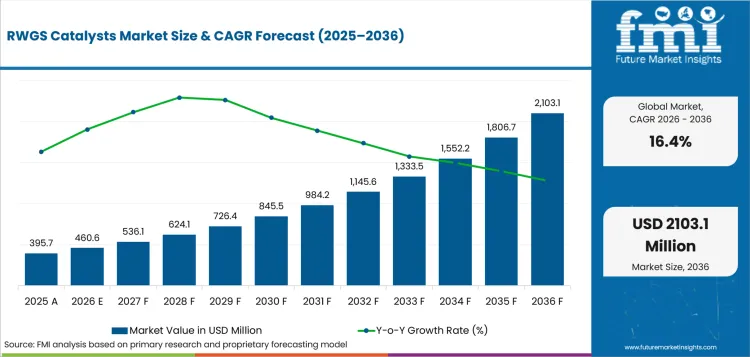
USD 460.6 million in 2026 and USD 2,103.1 million by 2036 at a 16.4% CAGR.
The RWGS catalysts industry value is forecast to grow from USD 395.7 million in 2025 to USD 2,103.1 million by 2036 at 16.4% CAGR as e-fuel developers, hydrogen project owners, and carbon recycling buyers move from pathway studies toward integrated syngas production packages. Catalyst + Reactor Package sales are expected to represent 61.0% share in 2026 because buyers prefer accountable scale-up support. Fixed-bed reactors are projected to hold 57.0% share in 2026, led by known catalyst-loading behavior and familiar process engineering.
RWGS Catalysts Market Overview: Size and Forecast
- 2025 Market Size: USD 395.7 million
- 2026 Market Size: USD 460.6 million
- 2036 Market Size: USD 2,103.1 million
- Forecast CAGR: 16.4% from 2026 to 2036
- Leading Sales Model: Catalyst + Reactor Package
- Catalyst + Reactor Package Share in 2026: 61.0%
- Leading Reactor Type: Fixed-bed
- Fixed-bed Share in 2026: 57.0%
- Fastest-growing Country: China
- China CAGR by 2036: 18.5%
Summary of the RWGS Catalysts Market
- Demand and Growth Drivers
- E-fuels developers are specifying RWGS catalysts to adjust CO₂ and hydrogen into syngas streams suitable for methanol and Fischer-Tropsch routes.
- Carbon recycling projects are creating demand for catalyst systems that can prove stable conversion under high-temperature reactor duty.
- Process licensors are influencing catalyst selection by bundling RWGS chemistry with reactor control, heat management, and downstream synthesis guarantees.
- Product and Segment View
- Catalyst + Reactor Package sales are projected to hold 61.0% share in 2026, supported by buyer preference for a single accountable supplier during first commercial scale-up.
- Fixed-bed reactors are anticipated to represent 57.0% share in 2026, led by engineering teams relying on familiar catalyst beds and established heat-management practices.
- PtX Developers are forecast to account for 44.0% share in 2026, reflected by e-SAF, e-methanol, and synthetic fuel projects requiring controlled syngas ratios.
- Geography and Competitive Outlook
- China is projected to record 18.5% CAGR by 2036, backed by hydrogen scale and industrial CO₂ utilization readiness.
- India is expected to expand at 17.8% CAGR by 2036, supported by green hydrogen policy and refinery-led demand channels.
- Topsoe and Axens compete through direct RWGS and e-fuels process positions.
- Clariant, Johnson Matthey, BASF, Honeywell UOP, and Sinopec Catalyst strengthen competition through adjacent syngas, methanol, and process catalyst capability.
- Analyst Opinion
- Nikhil Kaitwade, Principal Consultant at Future Market Insights for the chemicals domain, observes, “RWGS catalysts are moving from research selection into process-risk selection. Buyers are no longer evaluating only catalyst composition. They are comparing catalyst life, methane control, heat transfer, syngas quality, and reactor accountability. Suppliers that prove catalyst and reactor performance together should gain stronger positions in e-fuel and carbon recycling projects.”
The RWGS catalysts market is expected to advance steadily through 2036, driven by power-to-liquid fuel projects, industrial carbon recycling, and integrated catalyst-reactor procurement. Market expansion is supported by higher interest in converting captured CO₂ and low-carbon hydrogen into carbon monoxide-rich syngas for downstream fuel and chemical synthesis.
RWGS catalyst demand is being shaped by aviation-fuel policy, hydrogen availability, and process licensing evidence. The IEA reported that global hydrogen demand reached almost 100 million tonnes in 2024, while low-emissions hydrogen production remained below 1% of global production. ReFuelEU Aviation requires aviation fuel suppliers to include 6% SAF by 2030, giving power-to-liquid projects a stronger long-term offtake signal. Topsoe and Sasol’s German e-SAF demonstration agreement targets 2,500 tons of e-fuels per year from Q4 2027, showing how RWGS-linked process packages are moving closer to qualification in fuel projects.
Which factors support expansion in the RWGS catalysts market?
Integrated syngas packages and low-carbon fuel policies support market value across early commercial projects.
- Market value is supported by catalyst loading, reactor integration, qualification testing, and replacement cycles because RWGS projects need performance proof before scale-up.
- Supplier pricing reflects catalyst chemistry, heat-control proof, downstream syngas quality, and project-stage risk because each factor affects e-fuel project economics.
- Revenue improves as PtX developers shift from laboratory trials to licensed fuel production packages that require catalyst reliability, process support, and repeat supply.
- Buyer confidence rises when catalyst suppliers provide operating evidence under CO₂-rich and variable hydrogen feed conditions.
Why is the RWGS catalysts market growing?
RWGS catalyst demand is rising as fuel and chemical producers need controlled routes to convert CO₂ and hydrogen into synthesis gas.
The market is growing as synthetic aviation fuel rules create a measurable pull for power-to-liquid pathways. The United States SAF Grand Challenge targets 3 billion gallons per year of domestic SAF production by 2030, creating a clear signal for synthetic fuel chains that can use renewable hydrogen and captured carbon. RWGS catalysts become relevant where CO₂ must first be converted into CO-rich syngas before downstream fuel synthesis. This makes catalyst selectivity and reactor control important to project economics. Suppliers that can show stable conversion and low methane formation will be better placed as e-fuel projects move from feasibility to procurement.
How is the RWGS catalysts market segmented?
The RWGS catalysts industry is segmented by catalyst chemistry, application, reactor type, end use, and sales model.
- Ni-based catalysts are projected to secure 42.0% share in 2026, led by cost-efficient high-temperature activity and broader suitability for early commercial CO₂ conversion systems.
- E-fuels Syngas Conditioning is expected to capture 39.0% share in 2026, supported by e-SAF and e-methanol developers requiring controlled H₂-to-CO ratios.
- Fixed-bed reactors are anticipated to account for 57.0% share in 2026, shaped by familiar scale-up rules and bankable reactor engineering.
- PtX Developers are forecast to represent 44.0% share in 2026, guided by power-to-liquid projects that specify catalyst performance with fuel synthesis design.
- Catalyst + Reactor Package sales are projected to hold 61.0% share in 2026, reflected in buyers seeking one supplier for catalyst performance and reactor integration.
Why do Ni-based catalysts dominate the RWGS catalysts market?
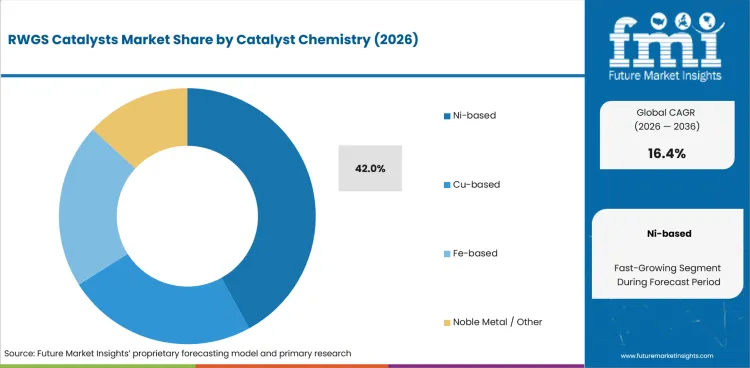
- Ni-based catalysts are expected to account for 42.0% share in 2026, influenced by their practical balance of cost, activity, and availability for high-temperature RWGS use.
- Noble metal systems remain relevant for selective and demanding trials, although cost limits broad first-load use across early commercial projects.
Which application leads the RWGS catalysts market?
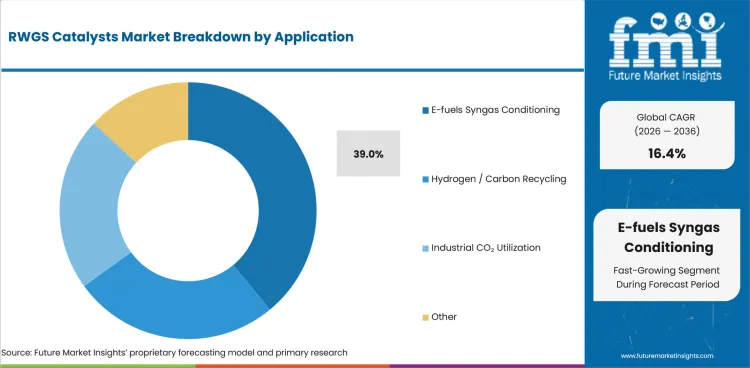
- E-fuels Syngas Conditioning is projected to hold 39.0% share in 2026, supported by demand for syngas streams that can feed e-methanol and Fischer-Tropsch fuel routes.
- Hydrogen and carbon recycling applications are gaining attention as industrial users evaluate CO₂ reuse rather than treating captured carbon only as a disposal stream.
Which reactor type leads the RWGS catalysts market?
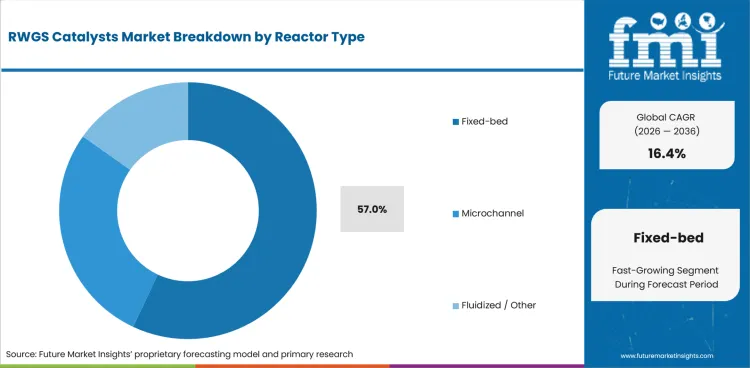
- Fixed-bed reactors are anticipated to represent 57.0% share in 2026, led by their established catalyst-loading behavior and clearer operating references.
- Microchannel reactors can support compact pilots and heat-sensitive testing, but they need stronger commercial references before broader adoption.
Which end use leads the RWGS catalysts market?
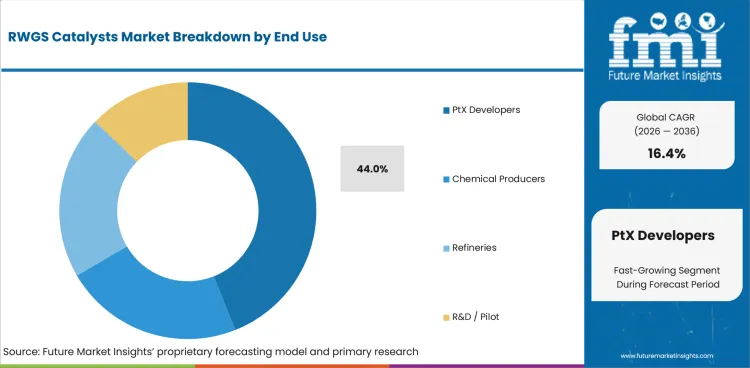
- PtX Developers are forecast to account for 44.0% share in 2026, led by e-fuel projects connecting low-carbon hydrogen with captured carbon.
- Chemical producers are expected to test RWGS as a carbon recycling pathway when syngas quality supports downstream methanol or intermediate production.
Which sales model leads the RWGS catalysts market?
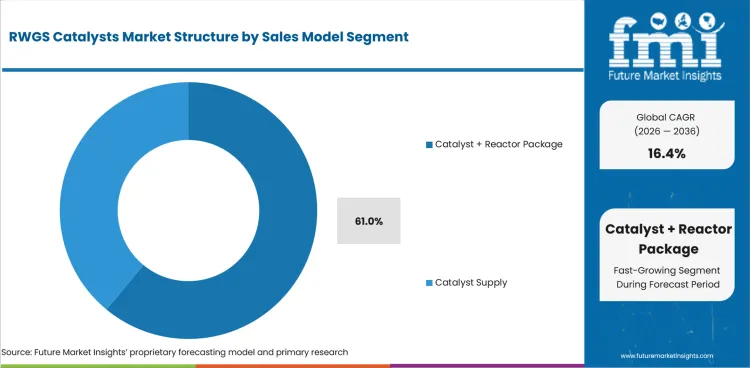
- Catalyst + Reactor Package sales are projected to secure 61.0% share in 2026, shaped by buyer preference for integrated accountability across catalyst and reactor performance.
- Standalone catalyst supply remains important for research buyers and replacement cycles, but first commercial plants are expected to favor bundled guarantees.
What are the driver, restraints, and opportunities in the RWGS catalysts market?
RWGS catalysts benefit from e-fuel mandates and carbon recycling, while hydrogen cost and heat-control risk limit faster adoption.
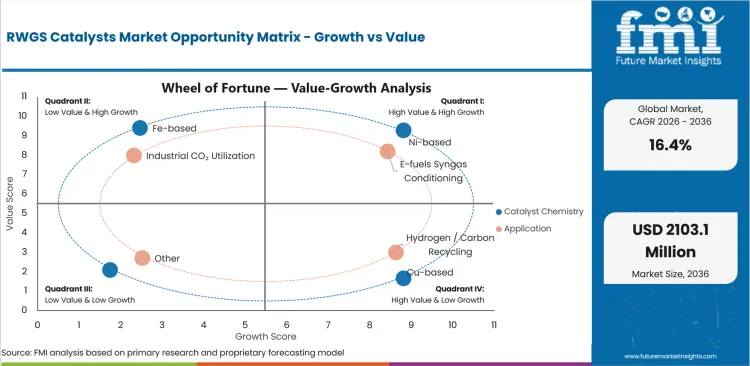
- E-fuel mandates increase RWGS catalyst demand because power-to-liquid routes need carbon monoxide-rich syngas before methanol, Fischer-Tropsch, or derivative synthesis.
- Hydrogen cost exposure delays catalyst qualification when project economics remain uncertain, making developers cautious about committing to commercial reactor packages.
- Integrated licensing creates room for suppliers that can bundle catalyst performance with reactor control, helping buyers reduce process risk during project development.
E-fuel Syngas Pull
The strongest demand driver comes from e-fuel projects that need syngas from captured CO₂ and hydrogen. The UK SAF mandate set the 2025 main obligation at 2% of total fossil jet fuel supplied, equal to about 230,000 tonnes of SAF, creating a measurable demand base for fuel pathways that need certified low-carbon inputs. The mandate also introduces a separate power-to-liquid obligation from 2028 at 0.2% of total jet fuel demand, which directly supports e-fuels made from renewable electricity and non-biogenic carbon. RWGS catalysts are upstream of similar e-fuel chains when CO₂ must first become CO-rich syngas. This keeps catalyst performance close to fuel yield and project finance risk. Suppliers that show reliable conversion under project-scale duty should win before broad capacity is built.
Hydrogen Cost Exposure
Hydrogen price remains the central restraint for RWGS catalyst demand. RWGS uses hydrogen to reduce CO₂ into carbon monoxide, so catalyst value is judged partly by how much useful syngas is produced per unit of hydrogen. IEA analysis shows low-emissions hydrogen use increased by nearly 10% in 2024, but it still represented less than 1% of total hydrogen demand. That gap makes catalyst buyers more selective. They will prefer systems that protect hydrogen efficiency and can operate across variable plant loads.
Reactor Heat Control
RWGS is not only a catalyst chemistry problem. Reactor heat control affects selectivity, lifetime, and downstream conditioning cost. The USA Department of Energy announced up to USD 2.2 billion in award commitments for two Regional Clean Hydrogen Hubs in November 2024, strengthening the infrastructure base that can support linked hydrogen and CO₂ conversion projects. Catalyst companies that partner with process licensors and engineering firms can convert pilot demand into packaged commercial opportunities.
Which countries are growing fastest in the RWGS catalysts market?
China 18.5% CAGR, India 17.8% CAGR, Germany 17.4% CAGR, United States 16.8% CAGR, South Korea 16.7% CAGR, United Kingdom 16.1% CAGR, France 15.8% CAGR, and Japan 15.2% CAGR through 2036.
.webp "Top Country Growth Comparison Rwgs Catalysts Market Cagr (2026 2036)")
| Country | CAGR |
|---|---|
| China | 18.5% |
| India | 17.8% |
| Germany | 17.4% |
| United States | 16.8% |
| South Korea | 16.7% |
| United Kingdom | 16.1% |
| France | 15.8% |
| Japan | 15.2% |
Source: Future Market Insights, 2026.
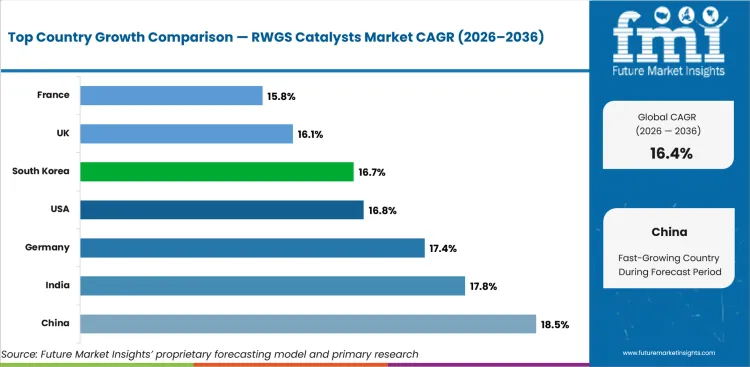
How do country-level CAGRs compare in the RWGS catalysts market?
China leads selected-country expansion while Japan records the most cautious profile among the covered markets.
- China is forecast to record 18.5% CAGR by 2036 as hydrogen scale and industrial CO₂ utilization deepen.
- India is expected to advance at 17.8% CAGR through 2036 as green hydrogen policy supports future carbon recycling.
- Germany is projected to expand at 17.4% CAGR by 2036 with e-SAF demonstration work and hydrogen import planning.
- United States is estimated to rise at 16.8% CAGR through 2036 through hydrogen hubs and refinery-linked project channels.
- South Korea is forecast to grow at 16.7% CAGR by 2036 as refinery and petrochemical clusters assess clean hydrogen pathways.
- United Kingdom is projected to increase at 16.1% CAGR through 2036 as SAF policy supports power-to-liquid demand.
- France is expected to register 15.8% CAGR by 2036 through RWGS licensing capability and hydrogen strategy updates.
- Japan is forecast to expand at 15.2% CAGR through 2036 as hydrogen import planning and industrial decarbonization shape selective demand.
What is the RWGS catalysts market outlook in China?
An 18.5% CAGR through 2036 reflects hydrogen scale, industrial decarbonization, and domestic catalyst qualification.
Country Market Snapshot Table
| Parameter | Value |
|---|---|
| Market Size in 2025 (Value) | USD 91.1 million |
| Market Size in 2026 (Value) | USD 108.0 million |
| Market Forecast in 2036 (Value) | USD 589.7 million |
| CAGR (2026 to 2036) | 18.5% |
| Years Considered | 2021 to 2036 |
| Base Year | 2025 |
| Forecast Period | 2026 to 2036 |
| Units Considered | Value (USD million) |
| Leading Sub-Region | Coastal chemical and industrial park corridors |
China RWGS Catalysts Market Outlook
China RWGS catalyst demand is shaped by hydrogen scale, green methanol activity, and state-led industrial decarbonization. Domestic buyers are expected to evaluate catalyst systems through industrial parks, state-owned energy groups, and local process engineering partners.
The market will likely favor suppliers that can combine cost control with technical service. Global suppliers may gain opportunities in premium projects, while domestic catalyst firms can compete strongly in localized qualification programs.
Key Growth Drivers
- Hydrogen scale gives RWGS projects a broad feedstock base. Official reporting stated that hydrogen production and consumption exceeded 36 million tonnes in 2024, maintaining the country’s top global position.
- Green hydrogen capacity strengthens future CO₂ conversion trials. China reported annual green hydrogen energy production capacity of more than 150,000 tonnes by the end of 2024.
- Industrial parks can combine renewable power, hydrogen, captured carbon, and methanol users in one procurement environment for RWGS catalyst qualification.
- Domestic catalyst suppliers can shorten service response times for state-owned refinery and chemical buyers reviewing CO₂-to-syngas packages.
Key Restraints
- Local price pressure can limit premium catalyst margins as buyers compare imported catalysts against domestic process-catalyst alternatives.
- Renewable hydrogen remains a small part of the broader hydrogen base, so early RWGS projects must still prove feedstock reliability.
- New energy storage reached about 95 million kilowatts by the first half of 2025, but rapid infrastructure expansion can create integration complexity for variable renewable-linked hydrogen projects.
What makes China unique
China is unique due to its large hydrogen base, fast industrial localization, and strong state-owned buyer influence in process catalyst decisions.
Key Companies
- Sinopec Catalyst
- China Energy Engineering Corporation
- China Huaneng Group
- BASF
- Clariant
- Topsoe
- Axens
Sales & Marketing Channels
- Direct supply to state-owned energy groups
- Industrial park procurement
- Local technical service partnerships
- Engineering contractor channels
- Process licensing routes
- Pilot plant supply programs
Country Segment Breakdown Table
| Segment | Sub-Segments |
|---|---|
| By Catalyst Chemistry | Ni-based, Cu-based, Fe-based, Noble Metal / Other |
| By Application | E-fuels Syngas Conditioning, Hydrogen / Carbon Recycling, Industrial CO₂ Utilization, Other |
| By Reactor Type | Fixed-bed, Microchannel, Fluidized / Other |
| By End Use | PtX Developers, Chemical Producers, Refineries, R&D / Pilot |
| By Sales Model | Catalyst Supply, Catalyst + Reactor Package |
| Key Sub-Regions Covered, Industrial Corridors | Jiangsu, Shandong, Inner Mongolia, Guangdong, Shanghai, Zhejiang |
Frequently Asked Questions
How fast is China RWGS catalysts market growing?
China demand is projected to expand at 18.5% CAGR from 2026 to 2036, guided by hydrogen scale and industrial CO₂ utilization.
Who leads China RWGS catalysts market?
Sinopec Catalyst, BASF, Clariant, Topsoe, and Axens compete through domestic catalyst supply, global process positions, and engineering partnerships.
What is driving adoption in China RWGS catalysts market?
Hydrogen output, green methanol interest, and state-led industrial parks are moving buyers toward RWGS catalyst qualification.
What is driving RWGS catalysts market growth in India?
A 17.8% CAGR through 2036 is supported by green hydrogen targets and refinery-linked carbon recycling interest.
Country Market Snapshot Table
| Parameter | Value |
|---|---|
| Market Size in 2025 (Value) | USD 29.7 million |
| Market Size in 2026 (Value) | USD 35.0 million |
| Market Forecast in 2036 (Value) | USD 180.1 million |
| CAGR (2026 to 2036) | 17.8% |
| Years Considered | 2021 to 2036 |
| Base Year | 2025 |
| Forecast Period | 2026 to 2036 |
| Units Considered | Value (USD million) |
| Leading Sub-Region | Gujarat and western refinery corridors |
India RWGS Catalysts Market Outlook
India RWGS catalyst demand is influenced by green hydrogen policy, refinery decarbonization, and future synthetic fuel planning. Early orders are expected to move through public sector refiners, engineering contractors, and pilot projects.
Buyer behavior will remain cost-sensitive. Suppliers need to prove catalyst life, hydrogen efficiency, and local service support before broader commercial adoption develops.
Key Growth Drivers
- Green hydrogen policy creates a future feedstock platform. India’s National Green Hydrogen Mission is expected to be supported by about 125 GW of new renewable energy capacity by 2030.
- Investment visibility supports domestic hydrogen scale-up. The mission expects investments exceeding ₹8 lakh crore and more than 6 lakh jobs by 2030.
- Public sector refiners and fertilizer producers already understand hydrogen and process catalyst procurement, giving RWGS suppliers a practical qualification route.
- Port-linked methanol and fuel projects can create future demand for CO₂-to-syngas systems when hydrogen costs become competitive.
Key Restraints
- Hydrogen cost and renewable power access can delay commercial RWGS buying until projects secure bankable energy inputs.
- Catalyst imports may face long approval cycles when public sector buyers require performance, service, and replacement assurances.
- The mission expects to avoid nearly 50 MMT of greenhouse gas emissions every year by 2030, but that scale requires coordinated hydrogen supply, renewable power, and end-use demand development.
What makes India unique
India is unique due to public sector refinery influence, cost-sensitive procurement, and a green hydrogen program linked to domestic industrial decarbonization.
Key Companies
- Indian Oil Corporation
- Bharat Petroleum Corporation
- Hindustan Petroleum Corporation
- Reliance Industries
- Larsen & Toubro
- Topsoe
- Johnson Matthey
Sales & Marketing Channels
- Direct sales to refiners
- Engineering contractor partnerships
- Government-backed pilot supply
- Technology licensing routes
- Local distributor support
- Industrial consortium procurement
Country Segment Breakdown Table
| Segment | Sub-Segments |
|---|---|
| By Catalyst Chemistry | Ni-based, Cu-based, Fe-based, Noble Metal / Other |
| By Application | E-fuels Syngas Conditioning, Hydrogen / Carbon Recycling, Industrial CO₂ Utilization, Other |
| By Reactor Type | Fixed-bed, Microchannel, Fluidized / Other |
| By End Use | PtX Developers, Chemical Producers, Refineries, R&D / Pilot |
| By Sales Model | Catalyst Supply, Catalyst + Reactor Package |
| Key Sub-Regions Covered, Refinery and Hydrogen Corridors | Gujarat, Maharashtra, Tamil Nadu, Karnataka, Andhra Pradesh, Rajasthan |
Frequently Asked Questions
How fast is India RWGS catalysts market growing?
India demand is expected to increase at 17.8% CAGR from 2026 to 2036, supported by green hydrogen and refinery decarbonization.
Who leads India RWGS catalysts market?
Indian Oil, BPCL, HPCL, Reliance Industries, L&T, Topsoe, and Johnson Matthey are relevant through refining, engineering, and catalyst channels.
What is driving adoption in India RWGS catalysts market?
Green hydrogen policy and refinery-led pilot projects are supporting early RWGS catalyst evaluation.
How is the RWGS catalysts market performing in Germany?
A 17.4% CAGR through 2036 reflects e-SAF demonstration, electrolyzer planning, and hydrogen import strategy.
Country Market Snapshot Table
| Parameter | Value |
|---|---|
| Market Size in 2025 (Value) | USD 44.3 million |
| Market Size in 2026 (Value) | USD 52.0 million |
| Market Forecast in 2036 (Value) | USD 258.6 million |
| CAGR (2026 to 2036) | 17.4% |
| Years Considered | 2021 to 2036 |
| Base Year | 2025 |
| Forecast Period | 2026 to 2036 |
| Units Considered | Value (USD million) |
| Leading Sub-Region | Leuna and Rhine-Ruhr industrial corridors |
Germany RWGS Catalysts Market Outlook
Germany demand is supported by PtX projects, industrial engineering depth, and e-SAF demonstration activity. Buyers are expected to prioritize technology proof, operating reliability, and integration with hydrogen sourcing plans.
Integrated RWGS packages can gain stronger buyer confidence in Germany because project owners often require bankable references before commercial procurement. This favors licensors and catalyst suppliers with credible demonstration data.
Key Growth Drivers
- Germany gives hydrogen suppliers a strong domestic planning frame. The national strategy targets at least 10 GW of electrolyzer capacity by 2030.
- E-SAF demonstration strengthens RWGS relevance. Topsoe and Sasol were selected in December 2024 to deliver e-fuels technology for a German Aerospace Center e-SAF demonstration plant that is expected to produce 2,500 tons per year of e-fuels from Q4 2027.
- German research centers can validate catalyst-reactor systems under rigorous operating conditions before wider industrial adoption.
- Chemical clusters create strong demand for syngas quality, catalyst durability, and reactor heat-control documentation.
Key Restraints
- Imported hydrogen dependence can affect project timing when domestic hydrogen output is not enough for all industrial users.
- Conservative qualification standards can lengthen approval cycles for catalyst suppliers without German or European references.
- Germany expects hydrogen and derivative demand of 95 TWh to 130 TWh by 2030, with 50% to 70% expected to be imported, increasing exposure to supply-chain coordination.
What makes Germany unique
Germany is unique due to e-SAF demonstration activity, industrial engineering depth, and strict qualification standards for integrated RWGS systems.
Key Companies
- Topsoe
- Sasol
- Clariant
- BASF
- Axens
- Siemens Energy
- Thyssenkrupp Uhde
Sales & Marketing Channels
- Direct sales to PtX consortia
- Research center partnerships
- Engineering contractor qualification
- Industrial cluster procurement
- Process licensing agreements
- Demonstration plant supply routes
Country Segment Breakdown Table
| Segment | Sub-Segments |
|---|---|
| By Catalyst Chemistry | Ni-based, Cu-based, Fe-based, Noble Metal / Other |
| By Application | E-fuels Syngas Conditioning, Hydrogen / Carbon Recycling, Industrial CO₂ Utilization, Other |
| By Reactor Type | Fixed-bed, Microchannel, Fluidized / Other |
| By End Use | PtX Developers, Chemical Producers, Refineries, R&D / Pilot |
| By Sales Model | Catalyst Supply, Catalyst + Reactor Package |
| Key Sub-Regions Covered, Chemical and PtX Clusters | Leuna, Ruhr, Hamburg, Bavaria, Saxony-Anhalt, Lower Saxony |
Frequently Asked Questions
How fast is Germany RWGS catalysts market growing?
Germany demand is forecast to expand at 17.4% CAGR from 2026 to 2036, supported by e-SAF demonstration and hydrogen planning.
Who leads Germany RWGS catalysts market?
Topsoe, Sasol, Clariant, BASF, Axens, and Thyssenkrupp Uhde compete through catalyst, process, and engineering channels.
What is driving adoption in Germany RWGS catalysts market?
E-SAF demonstration, electrolyzer targets, and chemical cluster validation are supporting RWGS catalyst adoption.
What is the RWGS catalysts market outlook in the United States?
A 16.8% CAGR through 2036 is supported by hydrogen hubs, refinery scale, and SAF production targets.
Country Market Snapshot Table
| Parameter | Value |
|---|---|
| Market Size in 2025 (Value) | USD 66.8 million |
| Market Size in 2026 (Value) | USD 78.0 million |
| Market Forecast in 2036 (Value) | USD 368.6 million |
| CAGR (2026 to 2036) | 16.8% |
| Years Considered | 2021 to 2036 |
| Base Year | 2025 |
| Forecast Period | 2026 to 2036 |
| Units Considered | Value (USD million) |
| Leading Sub-Region | Gulf Coast refinery and hydrogen corridors |
United States RWGS Catalysts Market Outlook
United States demand is shaped by refinery expertise, hydrogen hub funding, and e-fuel project interest. Buyers are expected to prefer catalyst systems supported by licensors, engineering contractors, and technical service teams.
The market will remain disciplined because first commercial RWGS projects must prove both fuel offtake and hydrogen economics. Suppliers with catalyst life data and reactor integration support are expected to gain stronger shortlists.
Key Growth Drivers
- Hydrogen hub funding improves future feedstock access. The USA Department of Energy announced up to USD 2.2 billion in commitments for two Regional Clean Hydrogen Hubs in November 2024.
- Refinery scale gives RWGS suppliers an experienced customer base. USA operable atmospheric distillation capacity totaled 18.4 million barrels per calendar day on January 1, 2025.
- SAF and e-fuel interest raises the value of CO₂-to-CO routes that can feed methanol or Fischer-Tropsch production.
- Process licensors and engineering contractors shape catalyst shortlists by linking catalyst performance with plant guarantees.
Key Restraints
- First commercial plants face financing pressure when hydrogen supply, carbon sourcing, and fuel offtake are not aligned.
- Catalyst qualification may slow where buyers require long-duration data under variable renewable hydrogen input.
- Federal agencies noted that announced SAF capacity must fully come online to exceed the domestic 3 billion gallon per year 2030 target, which keeps project execution risk visible.
What makes United States unique
The United States is unique due to its large refinery base, hydrogen hub funding, and strong process-licensor influence in fuel technology procurement.
Key Companies
- Johnson Matthey
- Honeywell UOP
- BASF
- Topsoe
- Clariant
- Chevron
- Lummus Technology
Sales & Marketing Channels
- Direct enterprise sales
- Refinery technology teams
- Engineering contractor partnerships
- Process licensor channels
- National laboratory collaborations
- Pilot plant supply routes
Country Segment Breakdown Table
| Segment | Sub-Segments |
|---|---|
| By Catalyst Chemistry | Ni-based, Cu-based, Fe-based, Noble Metal / Other |
| By Application | E-fuels Syngas Conditioning, Hydrogen / Carbon Recycling, Industrial CO₂ Utilization, Other |
| By Reactor Type | Fixed-bed, Microchannel, Fluidized / Other |
| By End Use | PtX Developers, Chemical Producers, Refineries, R&D / Pilot |
| By Sales Model | Catalyst Supply, Catalyst + Reactor Package |
| Key Sub-Regions Covered, Refinery and Hydrogen Areas | Gulf Coast, California, Midwest, Appalachia, Pacific Northwest, Rocky Mountain Corridor |
Frequently Asked Questions
How fast is United States RWGS catalysts market growing?
United States demand is expected to rise at 16.8% CAGR from 2026 to 2036, backed by hydrogen hubs and refinery project channels.
Who leads United States RWGS catalysts market?
Johnson Matthey, Honeywell UOP, BASF, Topsoe, and Clariant compete through syngas catalysts and e-fuel technology channels.
What is driving adoption in United States RWGS catalysts market?
Hydrogen hub funding, refinery experience, and SAF production targets are supporting RWGS catalyst qualification.
What is the RWGS catalysts market forecast for South Korea?
A 16.7% CAGR through 2036 reflects refinery, petrochemical, and clean hydrogen power demand channels.
Country Market Snapshot Table
| Parameter | Value |
|---|---|
| Market Size in 2025 (Value) | USD 23.1 million |
| Market Size in 2026 (Value) | USD 27.0 million |
| Market Forecast in 2036 (Value) | USD 126.5 million |
| CAGR (2026 to 2036) | 16.7% |
| Years Considered | 2021 to 2036 |
| Base Year | 2025 |
| Forecast Period | 2026 to 2036 |
| Units Considered | Value (USD million) |
| Leading Sub-Region | Ulsan and southern petrochemical corridors |
South Korea RWGS Catalysts Market Outlook
South Korea demand is guided by refinery clusters, petrochemical production, and clean hydrogen planning. RWGS catalyst adoption is expected to move through large industrial groups and consortium-led project structures.
Suppliers will need local engineering partners because buyers usually demand proven integration and after-sales support. Direct RWGS evidence is still emerging, making adjacent syngas and clean fuel references important.
Key Growth Drivers
- Clean hydrogen power demand can support linked hydrogen infrastructure. Korea’s power plan targets a hydrogen-to-ammonia ratio of 2.1% in power generation, equal to 13 TWh, by 2030.
- Hydrogen roadmap targets support long-term infrastructure depth. The roadmap outlines 6.2 million fuel cell electric vehicles and at least 1,200 refilling stations by 2040.
- Refinery and petrochemical clusters can test CO₂-to-syngas pathways when carbon recycling aligns with export fuel demand.
- Consortium-based procurement can accelerate adoption after one proven reference is accepted by major industrial buyers.
Key Restraints
- Direct public RWGS project visibility remains limited, slowing supplier validation for first commercial catalyst loads.
- Large buyers may defer procurement until licensors show complete reactor, catalyst, and downstream conversion evidence.
- The power-sector plan would require about 800,000 tonnes of clean hydrogen in the power sector alone by 2030, creating supply coordination pressure before RWGS demand can broaden.
What makes South Korea unique
South Korea is unique because concentrated industrial groups can speed adoption after qualification, but they can delay buying until proof is complete.
Key Companies
- SK Innovation
- Hyundai Engineering
- Hanwha Solutions
- Lotte Chemical
- GS Caltex
- Johnson Matthey
- Honeywell UOP
Sales & Marketing Channels
- Direct sales to refinery groups
- Petrochemical consortium channels
- Local engineering contractor partnerships
- Pilot plant supply
- Technology licensing
- Marine fuel project channels
Country Segment Breakdown Table
| Segment | Sub-Segments |
|---|---|
| By Catalyst Chemistry | Ni-based, Cu-based, Fe-based, Noble Metal / Other |
| By Application | E-fuels Syngas Conditioning, Hydrogen / Carbon Recycling, Industrial CO₂ Utilization, Other |
| By Reactor Type | Fixed-bed, Microchannel, Fluidized / Other |
| By End Use | PtX Developers, Chemical Producers, Refineries, R&D / Pilot |
| By Sales Model | Catalyst Supply, Catalyst + Reactor Package |
| Key Sub-Regions Covered, Refinery and Petrochemical Zones | Ulsan, Yeosu, Incheon, Busan, Daesan, Pohang |
Frequently Asked Questions
How fast is South Korea RWGS catalysts market growing?
South Korea demand is projected to grow at 16.7% CAGR from 2026 to 2036, driven by refinery and clean hydrogen pathways.
Who leads South Korea RWGS catalysts market?
SK Innovation, Hyundai Engineering, Hanwha Solutions, Lotte Chemical, GS Caltex, and global licensors are relevant to buyer shortlists.
What is driving adoption in South Korea RWGS catalysts market?
Petrochemical clusters, hydrogen power planning, and consortium-led clean fuel projects are supporting RWGS catalyst evaluation.
What is the RWGS catalysts market outlook in the United Kingdom?
A 16.1% CAGR through 2036 is supported by SAF rules, hydrogen allocation rounds, and aviation-fuel bankability.
Country Market Snapshot Table
| Parameter | Value |
|---|---|
| Market Size in 2025 (Value) | USD 16.4 million |
| Market Size in 2026 (Value) | USD 19.0 million |
| Market Forecast in 2036 (Value) | USD 84.5 million |
| CAGR (2026 to 2036) | 16.1% |
| Years Considered | 2021 to 2036 |
| Base Year | 2025 |
| Forecast Period | 2026 to 2036 |
| Units Considered | Value (USD million) |
| Leading Sub-Region | Teesside and Humber industrial clusters |
United Kingdom RWGS Catalysts Market Outlook
United Kingdom demand is policy-led through sustainable aviation fuel obligations and hydrogen allocation programs. RWGS catalyst buyers are likely to include aviation fuel developers, process licensors, and industrial cluster participants.
The market is smaller than the United States or China, but policy clarity can support early project formation. Catalyst suppliers must address revenue certainty, hydrogen availability, and bankable performance.
Key Growth Drivers
- SAF policy creates a direct power-to-liquid demand signal. The UK mandate starts at 2% of fossil jet fuel supplied in 2025 and rises to 10% in 2030.
- Hydrogen project support creates a feedstock base. The July 2025 hydrogen update stated that two CCUS-enabled hydrogen projects in negotiation could provide up to 1 GW of low-carbon hydrogen production capacity.
- Industrial clusters can connect hydrogen, carbon capture, and synthetic fuel projects through shared infrastructure.
- UK project finance channels can support RWGS catalysts once offtake contracts and revenue mechanisms are clearer.
Key Restraints
- SAF project economics depend on revenue stability before commercial plants can commit to catalyst and reactor packages.
- Local demand may remain project-specific if developers import licensed RWGS packages from global technology suppliers.
- The SAF revenue certainty mechanism can include penalties of up to the lesser of £100,000 or 10% of annual turnover for serious non-compliance, adding compliance pressure for fuel suppliers.
What makes United Kingdom unique
The United Kingdom is unique because RWGS demand is closely tied to aviation-fuel policy and industrial cluster financing.
Key Companies
- Johnson Matthey
- Honeywell UOP
- Velocys
- bp
- Shell UK
- Topsoe
- Axens
Sales & Marketing Channels
- Direct sales to SAF developers
- Industrial cluster consortium routes
- Process licensor partnerships
- Aviation fuel supplier channels
- University and pilot plant supply
- Government-backed project programs
Country Segment Breakdown Table
| Segment | Sub-Segments |
|---|---|
| By Catalyst Chemistry | Ni-based, Cu-based, Fe-based, Noble Metal / Other |
| By Application | E-fuels Syngas Conditioning, Hydrogen / Carbon Recycling, Industrial CO₂ Utilization, Other |
| By Reactor Type | Fixed-bed, Microchannel, Fluidized / Other |
| By End Use | PtX Developers, Chemical Producers, Refineries, R&D / Pilot |
| By Sales Model | Catalyst Supply, Catalyst + Reactor Package |
| Key Sub-Regions Covered, Industrial and Aviation Fuel Areas | Teesside, Humber, Scotland, North West England, London aviation corridor, South Wales |
Frequently Asked Questions
How fast is United Kingdom RWGS catalysts market growing?
United Kingdom demand is forecast to expand at 16.1% CAGR from 2026 to 2036, guided by SAF policy and hydrogen projects.
Who leads United Kingdom RWGS catalysts market?
Johnson Matthey, Honeywell UOP, Velocys, bp, Shell UK, Topsoe, and Axens are relevant through catalyst, fuel, and licensing channels.
What is driving adoption in United Kingdom RWGS catalysts market?
SAF mandates, hydrogen allocation rounds, and industrial cluster programs are supporting RWGS catalyst qualification.
What is the RWGS catalysts market outlook in France?
A 15.8% CAGR through 2036 reflects RWGS licensing evidence and low-carbon hydrogen strategy updates.
Country Market Snapshot Table
| Parameter | Value |
|---|---|
| Market Size in 2025 (Value) | USD 24.2 million |
| Market Size in 2026 (Value) | USD 28.0 million |
| Market Forecast in 2036 (Value) | USD 121.4 million |
| CAGR (2026 to 2036) | 15.8% |
| Years Considered | 2021 to 2036 |
| Base Year | 2025 |
| Forecast Period | 2026 to 2036 |
| Units Considered | Value (USD million) |
| Leading Sub-Region | Northern industrial and refinery corridors |
France RWGS Catalysts Market Outlook
France demand is influenced by process licensing strength, Axens and IFPEN technology evidence, and hydrogen strategy updates. The country’s role is especially important on the licensor side of RWGS commercialization.
Domestic catalyst volume may build slowly, but France can influence global RWGS adoption through technology packages. Buyers in aviation fuel and chemicals are expected to evaluate RWGS through integrated licensing routes.
Key Growth Drivers
- Hydrogen policy funding gives domestic production a clearer base for industrial use. France’s updated strategy is being implemented through to 2030 with a budget of €9 billion.
- Pipeline planning supports future industrial hubs. France aims to develop 500 km of low-carbon hydrogen transport infrastructure by 2030 within hydrogen hubs.
- Axens and IFPEN give France direct technical relevance in RWGS licensing through Carboverseo™.
- Aviation and maritime synthetic fuel demand can support bundled CO₂-to-fuel project evaluation.
Key Restraints
- Domestic hydrogen project timing can slow near-term catalyst orders when industrial demand pooling is incomplete.
- France may focus support on domestic hydrogen capacity before import routes become economically proven.
- The first support wave launched in December 2024 covers 200 MW of electrolysis capacity, showing that commercial hydrogen support is moving in phased tranches rather than immediate full-scale deployment.
What makes France unique
France is unique because its strongest RWGS position sits in process licensing and technology commercialization rather than broad domestic catalyst volume.
Key Companies
- Axens
- IFP Energies nouvelles
- TotalEnergies
- Air Liquide
- Technip Energies
- SMS group / Paul Wurth
- Johnson Matthey
Sales & Marketing Channels
- Process licensing agreements
- Joint development with engineering firms
- Direct sales to e-fuel developers
- Pilot plant catalyst supply
- Consortium bids for aviation fuel projects
- Industrial hydrogen hub channels
Country Segment Breakdown Table
| Segment | Sub-Segments |
|---|---|
| By Catalyst Chemistry | Ni-based, Cu-based, Fe-based, Noble Metal / Other |
| By Application | E-fuels Syngas Conditioning, Hydrogen / Carbon Recycling, Industrial CO₂ Utilization, Other |
| By Reactor Type | Fixed-bed, Microchannel, Fluidized / Other |
| By End Use | PtX Developers, Chemical Producers, Refineries, R&D / Pilot |
| By Sales Model | Catalyst Supply, Catalyst + Reactor Package |
| Key Sub-Regions Covered, Industrial and Licensing Corridors | Normandy, Grand Est, Provence-Alpes-Côte d’Azur, Hauts-de-France, Île-de-France, Auvergne-Rhône-Alpes |
Frequently Asked Questions
How fast is France RWGS catalysts market growing?
France demand is expected to expand at 15.8% CAGR from 2026 to 2036, supported by RWGS licensing and hydrogen strategy updates.
Who leads France RWGS catalysts market?
Axens, IFPEN, TotalEnergies, Air Liquide, Technip Energies, and SMS group are relevant through licensing, hydrogen, and fuel pathways.
What is driving adoption in France RWGS catalysts market?
Carboverseo™ licensing, hydrogen strategy funding, and synthetic fuel planning are supporting RWGS catalyst relevance.
What is the RWGS catalysts market forecast for Japan?
A 15.2% CAGR through 2036 reflects hydrogen import planning, refinery capability, and selective carbon recycling trials.
Country Market Snapshot Table
| Parameter | Value |
|---|---|
| Market Size in 2025 (Value) | USD 20.8 million |
| Market Size in 2026 (Value) | USD 24.0 million |
| Market Forecast in 2036 (Value) | USD 98.8 million |
| CAGR (2026 to 2036) | 15.2% |
| Years Considered | 2021 to 2036 |
| Base Year | 2025 |
| Forecast Period | 2026 to 2036 |
| Units Considered | Value (USD million) |
| Leading Sub-Region | Tokyo Bay and Pacific industrial belt |
Japan RWGS Catalysts Market Outlook
Japan RWGS catalyst demand is expected to build from hydrogen supply planning, refinery decarbonization, and carbon recycling interest. Buyers are likely to prefer proven technology packages with safety documentation and local engineering support.
Adoption may remain selective because low-carbon hydrogen supply is still developing. Catalyst efficiency and reactor reliability will carry high weight in procurement decisions.
Key Growth Drivers
- Long-term hydrogen planning supports future carbon conversion studies. Japan’s strategic energy planning continues to aim for 12 million tons per year of hydrogen and ammonia by 2040.
- Public and private investment supports low-carbon fuel infrastructure. Japan’s GX framework identifies 150 trillion yen in public-private investment over a decade.
- Refinery and chemical users understand syngas handling, which can support cautious RWGS catalyst testing.
- Trading houses and engineering companies can package RWGS systems into broader hydrogen, ammonia, or synthetic fuel projects.
Key Restraints
- Imported hydrogen dependence can expose RWGS economics to supply-chain and delivered-energy costs.
- Buyers may delay catalyst qualification until process licensors provide longer operating evidence under Japanese safety expectations.
- Japan plans about 3 trillion yen in price-gap support for low-carbon hydrogen supply chains, showing that cost bridging remains necessary before broader demand develops.
What makes Japan unique
Japan is unique because RWGS catalyst adoption depends heavily on reliability proof, local engineering trust, and imported hydrogen economics.
Key Companies
- ENEOS
- Mitsubishi Heavy Industries
- JGC Holdings
- IHI Corporation
- Toyota Tsusho
- Topsoe
- Johnson Matthey
Sales & Marketing Channels
- Engineering company partnerships
- Direct sales to refinery groups
- Trading house project channels
- Pilot plant supply
- Technology licensing with local support
- Industrial consortium procurement
Country Segment Breakdown Table
| Segment | Sub-Segments |
|---|---|
| By Catalyst Chemistry | Ni-based, Cu-based, Fe-based, Noble Metal / Other |
| By Application | E-fuels Syngas Conditioning, Hydrogen / Carbon Recycling, Industrial CO₂ Utilization, Other |
| By Reactor Type | Fixed-bed, Microchannel, Fluidized / Other |
| By End Use | PtX Developers, Chemical Producers, Refineries, R&D / Pilot |
| By Sales Model | Catalyst Supply, Catalyst + Reactor Package |
| Key Sub-Regions Covered, Industrial and Fuel Corridors | Tokyo Bay, Osaka, Nagoya, Yokohama, Chiba, Fukuoka |
Frequently Asked Questions
How fast is Japan RWGS catalysts market growing?
Japan demand is forecast to rise at 15.2% CAGR from 2026 to 2036, shaped by hydrogen supply planning and industrial pilots.
Who leads Japan RWGS catalysts market?
ENEOS, Mitsubishi Heavy Industries, JGC Holdings, IHI, Toyota Tsusho, Topsoe, and Johnson Matthey are relevant through fuel and engineering channels.
What is driving adoption in Japan RWGS catalysts market?
Hydrogen supply planning, refinery experience, and carbon recycling trials are supporting selective RWGS catalyst adoption.
Who are the leading companies in the RWGS catalysts market?
Topsoe, Axens, Clariant, Johnson Matthey, BASF, Honeywell UOP, Sinopec Catalyst, IFPEN, and SMS group.
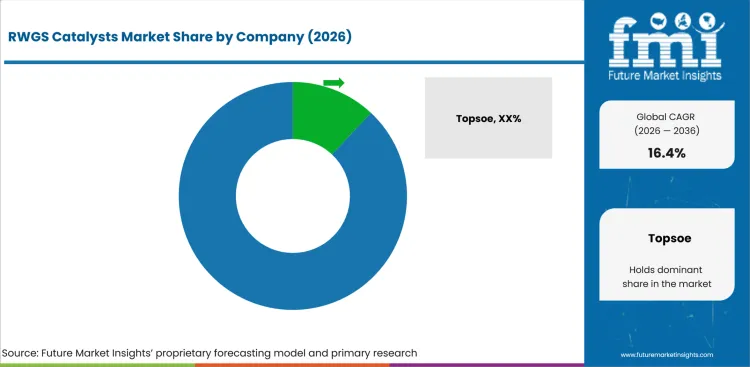
- Integrated process licensors hold an advantage because RWGS catalyst selection is linked to reactor design, heat control, and downstream fuel synthesis.
- Syngas catalyst suppliers gain relevance when buyers compare RWGS systems against methanol, carbon monoxide, and industrial gas conversion pathways.
- Regional catalyst makers gain opportunities in China and India when localization, service speed, and cost discipline become procurement requirements.
- Engineering-linked suppliers gain stronger buyer confidence by offering performance documentation across catalyst life, methane control, and syngas quality.
Technology companies in the market compete by combining catalyst chemistry with validated process design. Topsoe and Axens hold direct RWGS relevance because both connect CO₂-to-syngas conversion with e-fuels deployment. Clariant, BASF, and Johnson Matthey compete through adjacent syngas, methanol, and carbon oxide catalyst portfolios. Honeywell UOP strengthens its position through downstream fuel upgrading and methanol-to-jet technology.
Manufacturing and licensing depth have become competitive separators as RWGS demand moves beyond small research volumes. Buyers want catalyst suppliers that can support qualification, reactor operation, replacement planning, and process guarantees. Sinopec Catalyst can gain traction in China through domestic supply and service proximity. Global licensors can retain premium positions when project owners need bankable operating references.
Smaller and regional catalyst developers can win pilot orders by offering fast customization and strong technical support. Their challenge is proving commercial scale-up under high-temperature CO₂-rich operating conditions. Companies that rely only on catalyst composition will face tougher competition from suppliers that can prove full-package performance. Buyers are expected to favor vendors that connect catalyst behavior with plant economics.
How do top RWGS catalysts companies compare?
Topsoe and Axens score strongest on direct RWGS process proof while Clariant, BASF, and Johnson Matthey gain strength through syngas and carbon conversion portfolios.
| Company | Relevance to Market Title | RWGS Process Proof | Syngas Catalyst Portfolio | Reactor / Licensing Depth | Channel Reach | Geographic Footprint |
|---|---|---|---|---|---|---|
| Topsoe | Very High | Very Strong | Very Strong | Very Strong | Very Strong | Global |
| Axens | Very High | Very Strong | Strong | Very Strong | Very Strong | Global |
| IFP Energies nouvelles | Very High | Very Strong | Strong | Strong | Moderate | Europe and Global Partnerships |
| SMS group / Paul Wurth | High | Strong | Moderate | Strong | Strong | Global |
| Clariant | High | Moderate | Very Strong | Moderate | Very Strong | Global |
| Johnson Matthey | High | Moderate | Very Strong | Strong | Very Strong | Global |
| BASF | High | Moderate | Very Strong | Moderate | Very Strong | Global |
| Honeywell UOP | Moderate to High | Low to Moderate | Strong | Very Strong | Very Strong | Global |
| Sinopec Catalyst | Moderate to High | Moderate | Strong | Moderate | Strong | China and Asia |
| Sasol | Moderate to High | Moderate | Strong | Strong | Strong | Global |
Source: Future Market Insights competitive analysis, 2026.
Who are the key players in the RWGS catalysts market?
Topsoe, Axens, IFPEN, SMS group, Clariant, Johnson Matthey, BASF, Honeywell UOP, Sinopec Catalyst, and Sasol are listed among other suppliers.
Key global companies leading the RWGS catalysts market include:
- Topsoe
- Axens
- IFP Energies nouvelles
- SMS group / Paul Wurth
- Clariant
- Johnson Matthey
- BASF
- Honeywell UOP
- Sinopec Catalyst
- Sasol
Key Developments in RWGS Catalysts Market
- In June 2025, Axens, IFPEN, and SMS group launched Carboverseo™ after homologation, positioning the RWGS process as a route to convert CO₂ into CO for e-fuels.
- In November 2024, Clariant upgraded its syngas catalyst portfolio with ReforMax™ LDP Plus, ShiftMax™ 217 Plus, and AmoMax™ 10 Plus, supporting broader syngas plant efficiency and emissions reduction.
- In November 2024, Honeywell UOP and Johnson Matthey announced collaboration on lower-carbon fuels technology, linking methanol-based fuel pathways with process and catalyst expertise.
Key Players in the RWGS Catalysts Market
RWGS Technology Licensors
- Topsoe
- Axens
- IFP Energies nouvelles
- SMS group / Paul Wurth
Syngas and CO₂ Conversion Catalyst Suppliers
- Clariant
- Johnson Matthey
- BASF
- Sinopec Catalyst
Integrated Process and Fuel Technology Players
- Honeywell UOP
- Sasol
- Technip Energies
- Lummus Technology
RWGS Catalysts Market - Report Scope
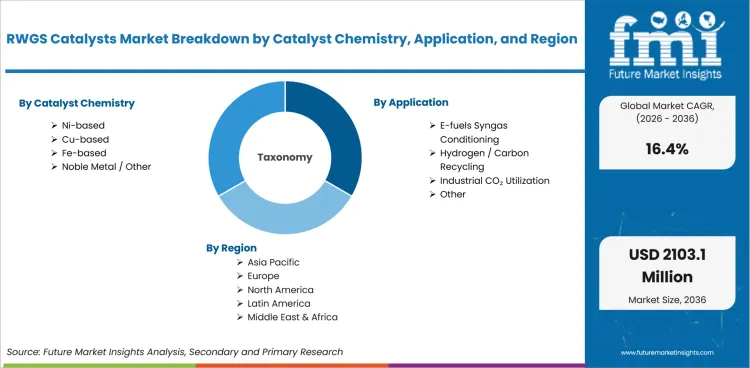
| Parameter | Details |
|---|---|
| Forecast period | 2026 to 2036 |
| Historical period | 2021 to 2025 |
| Quantitative unit | Revenue in USD million |
| By catalyst chemistry | Ni-based, Cu-based, Fe-based, Noble Metal / Other |
| By application | E-fuels Syngas Conditioning, Hydrogen / Carbon Recycling, Industrial CO₂ Utilization, Other |
| By reactor type | Fixed-bed, Microchannel, Fluidized / Other |
| By end use | PtX Developers, Chemical Producers, Refineries, R&D / Pilot |
| By sales model | Catalyst Supply, Catalyst + Reactor Package |
| Regions covered | North America, Western Europe, East Asia, South Asia and Pacific |
| Countries covered | United States, United Kingdom, Germany, France, Japan, China, South Korea, India |
| Key companies profiled | Topsoe, Axens, Clariant, Johnson Matthey, BASF, Honeywell UOP, Sinopec Catalyst, IFPEN, SMS group |
| Approach | Bottom-up project-boundary approach using catalyst loading, reactor mix, project stage, country readiness, replacement timing, and process licensing evidence |
Source: Future Market Insights, 2026.
RWGS Catalysts Market - Scope & Definition
| Attribute | Detail |
|---|---|
| Market Definition | Catalysts used in reverse water-gas shift reactors that convert CO₂ and hydrogen into carbon monoxide and water for syngas-related applications. |
| Functions Covered | CO₂ conversion, carbon monoxide generation, syngas ratio adjustment, reactor-linked conversion support, and carbon recycling enablement. |
| Applications Covered | E-fuels syngas conditioning, hydrogen and carbon recycling, industrial CO₂ utilization, and pilot-scale RWGS conversion. |
| End-Use Industries | Power-to-X fuels, chemicals, refining, industrial gases, pilot plants, and carbon utilization projects. |
| Grades Covered | Ni-based, Cu-based, Fe-based, and noble metal / other catalyst systems for RWGS duty. |
| Inclusions | RWGS catalyst chemistries, reactor-linked catalyst loads, catalyst supply contracts, catalyst plus reactor packages, PtX developers, chemical producers, refineries, and R&D users. |
| Exclusions | Conventional refinery shift catalysts, methanol synthesis catalysts sold without RWGS duty, carbon capture solvents, electrolyzers, Fischer-Tropsch catalysts, and standalone CO₂ capture systems. |
RWGS Catalysts Market - Research Methodology
| Method | Description |
|---|---|
| Primary Research | FMI analyst interviews with catalyst suppliers, PtX developers, process licensors, refinery engineers, chemical producers, and industrial CO₂ utilization project teams. |
| Desk Research | Review of official hydrogen policy documents, government SAF rules, company technology pages, public process catalyst information, and country-level project activity. |
| Market Sizing & Forecasting | Bottom-up model using project-stage RWGS demand, catalyst loading assumptions, reactor type mix, sales model mix, country readiness, and expected catalyst replacement cycles. |
| Data Validation | Cross-verification using process catalyst portfolios, e-fuel technology announcements, hydrogen policy signals, and direct RWGS evidence where available. |
RWGS Catalysts Market Breakdown by Catalyst Chemistry, Application, Reactor Type, End Use, Sales Model, and Region
RWGS Catalysts Market Segmented by Catalyst Chemistry
- Ni-based
- Cu-based
- Fe-based
- Noble Metal / Other
RWGS Catalysts Market Segmented by Application
- E-fuels Syngas Conditioning
- Hydrogen / Carbon Recycling
- Industrial CO₂ Utilization
- Other
RWGS Catalysts Market Segmented by Reactor Type
- Fixed-bed
- Microchannel
- Fluidized / Other
RWGS Catalysts Market Segmented by End Use
- PtX Developers
- Chemical Producers
- Refineries
- R&D / Pilot
RWGS Catalysts Market Segmented by Sales Model
- Catalyst Supply
- Catalyst + Reactor Package
RWGS Catalysts Market by Region
- North America
- Western Europe
- East Asia
- South Asia and Pacific
Research Sources and Bibliography
- Axens. (2025, June 26). Axens, IFPEN, and SMS group launch Carboverseo™: Essential technology for e-fuels deployment.
- Clariant. (2024, November 12). Clariant upgrades its syngas catalyst portfolio to improve customers’ sustainability and profitability.
- Department for Energy Security and Net Zero. (2025, July). Hydrogen update to the market: July 2025.
- European Commission. (2025). ReFuelEU Aviation.
- European Hydrogen Observatory. (2025, June 23). France: National strategies.
- Federal Ministry for Economic Affairs and Climate Action. (2024). National Hydrogen Strategy Update.
- Government of France. (2025, September 30). National Hydrogen Strategy.
- Honeywell UOP and Johnson Matthey. (2024, November 11). Honeywell UOP and Johnson Matthey join forces to cut costs and boost deployment of sustainable fuels.
- IEA. (2025, September 12). Global Hydrogen Review 2025: Demand.
- IEA. (2026, April 2). National strategy for low-carbon hydrogen 2025.
- Invest Korea. (2024, May 9). Korea setting its eyes on creating a clean hydrogen ecosystem.
- Ministry of Economy, Trade and Industry. (2025). Strategic Energy Plan.
- Press Information Bureau, Government of India. (2025, November 12). Unlocking India’s green hydrogen production potential.
- The State Council of the People’s Republic of China. (2025, December 5). China sees rapid green and low-carbon energy transition.
- Topsoe. (2024, December 3). Topsoe and Sasol selected to deliver innovative e-fuels technology for an e-SAF demonstration plant in Germany.
- Topsoe. (2025, October 16). Cooperation agreement for innovative e-fuels demonstration research plant in Germany.
- UK Department for Transport. (2024, December 19). The SAF mandate: An essential guide.
- UK Department for Transport. (2025, October 16). Sustainable Aviation Fuel Revenue Certainty Mechanism: Levy design consultation.
- USA Department of Energy. (2024, November 20). Biden-Harris Administration announces awards for up to USD 2.2 billion to two Regional Clean Hydrogen Hubs.
- USA Department of Energy. (2025, January 13). Federal agencies publish SAF Grand Challenge progress report.
- USA Energy Information Administration. (2025, June 30). USA refining capacity largely unchanged as of January 2025.
This bibliography is provided for reader reference and is not exhaustive. The full report contains the complete reference list and detailed citations.
This Report Answers
- Market size estimates for 2026 and forecasts through 2036 for the RWGS catalysts market.
- Insights across selected regional and country-level markets.
- Analysis of demand drivers, catalyst adoption patterns, reactor preferences, and purchasing behavior.
- Evaluation of key end users and sales models, including catalyst supply and integrated package dynamics.
- Assessment of hydrogen policy, SAF obligations, and carbon recycling impacts on market development.
- Identification of opportunities across catalyst chemistries, applications, reactor types, and sales models.
- Evaluation of supply chain dynamics, product innovation trends, and process licensor influence.
- Country-level growth analysis covering the United States, United Kingdom, Germany, France, Japan, China, South Korea, and India.
- Assessment of the competitive landscape, including leading RWGS catalyst suppliers and technology licensors.
- Analysis of project qualification, market penetration trends, and emerging commercial opportunities.
- Regional outlooks across North America, Western Europe, East Asia, and South Asia and Pacific.
- Delivery of market data, forecasts, and supporting analysis in PDF and Excel formats.
Frequently Asked Questions
What is the growth prospect for RWGS catalysts?
Demand for RWGS catalysts is expected to rise at a considerable pace as e-fuel and carbon recycling projects move toward integrated syngas production.
Which companies are expected to shape the RWGS catalysts market?
Topsoe, Axens, Clariant, Johnson Matthey, BASF, Honeywell UOP, Sinopec Catalyst, IFPEN, and SMS group are expected to shape market competition through catalyst portfolios, process licensing, and reactor-linked solutions.
Why are process licensors investing in RWGS catalysts?
Process licensors are investing in RWGS catalysts to connect CO₂ conversion with e-fuels, methanol, and carbon recycling pathways that need controlled syngas output.
Why are integrated catalyst-reactor packages important in the RWGS catalysts market?
Integrated catalyst-reactor packages reduce buyer risk by linking catalyst behavior with heat control, reactor operation, and downstream syngas quality.
Which catalyst chemistry is gaining attention in RWGS catalysts?
Ni-based catalysts are gaining attention as buyers seek cost-efficient high-temperature activity for early commercial RWGS systems.
How do regulations influence RWGS catalyst demand?
SAF mandates, hydrogen policy, and industrial decarbonization rules influence demand by making CO₂-to-fuel and carbon recycling routes more commercially relevant.
Why is hydrogen availability important for RWGS catalysts?
Hydrogen availability is important because RWGS conversion depends on hydrogen as a reactant, and feedstock cost affects project economics.
What role do reactor types play in RWGS catalyst adoption?
Reactor types influence catalyst loading, heat transfer, methane control, and operating reliability during CO₂-to-syngas conversion.
How do PtX developers support RWGS catalyst demand?
PtX developers support RWGS catalyst demand by specifying catalysts that can turn captured CO₂ and low-carbon hydrogen into fuel-ready syngas.
Preview the report firsthand - request a free sample
Get SampleGet the brochure for pricing and purchase details.
Get PDFTable of Content
- Key Takeaways
- Market Size and CAGR
- Top Growth Driver
- Fastest Growing Segment
- Leading Region
- Key Companies
- Emerging Opportunities
- Executive Summary
- Global Market Outlook
- Demand-side Trends
- Supply-side Trends
- Technology Roadmap Analysis
- Analysis and Recommendations
- Analyst Perspective (What is happening? Why now? What should investors know?)
- Key Questions Answered
- How large is the market?
- What is the CAGR?
- What are key trends?
- Which region dominates?
- Who are the leaders?
- Market Overview
- Market Coverage / Taxonomy
- Market Definition / Scope / Limitations
- Research Methodology
- Chapter Orientation
- Analytical Lens and Working Hypotheses
- Market Structure, Signals, and Trend Drivers
- Benchmarking and Cross-market Comparability
- Market Sizing, Forecasting, and Opportunity Mapping
- Research Design and Evidence Framework
- Desk Research Programme (Secondary Evidence)
- Expert Input and Fieldwork (Primary Evidence)
- Tooling, Models, and Reference Databases
- Data Engineering and Model Build
- Quality Assurance and Audit Trail
- Market Background
- Market Dynamics (Drivers, Restraints, Opportunity, Trends)
- Scenario Forecast (Optimistic, Likely, Conservative)
- Impact Analysis
- AI Impact
- Sustainability Impact
- Regulatory Impact
- Technology Impact
- Consumer / Buyer Analysis
- Purchase Drivers
- Adoption Barriers
- Buyer Journey
- Opportunity Map Analysis
- Product Life Cycle Analysis
- Supply Chain Analysis
- Investment Feasibility Matrix
- Value Chain Analysis
- PESTLE and Porter's Analysis
- Regulatory Landscape
- Regional Parent Market Outlook
- Production and Consumption Statistics
- Import and Export Statistics
- Global Market Analysis and Forecast, 2021 to 2036
- Historical Market Size Value (USD Million) & Volume (Unit) Analysis, 2021 to 2025
- Current and Future Market Size Value (USD Million) & Volume (Unit) Projections, 2026 to 2036
- Y-o-Y Growth Trend Analysis
- Absolute $ Opportunity Analysis
- Global Market Pricing Analysis, 2021 to 2036
- Global Market Analysis and Forecast, By Catalyst Chemistry, 2021 to 2036
- Introduction / Key Findings
- Historical Market Size Value (USD Million) & Volume (Unit) Analysis By Catalyst Chemistry, 2021 to 2025
- Current and Future Market Size Value (USD Million) & Volume (Unit) Analysis and Forecast By Catalyst Chemistry, 2026 to 2036
- Ni-based
- Cu-based
- Fe-based
- Noble Metal / Other
- Ni-based
- Y-o-Y Growth Trend Analysis By Catalyst Chemistry, 2021 to 2025
- Absolute $ Opportunity Analysis By Catalyst Chemistry, 2026 to 2036
- Global Market Analysis and Forecast, By Application, 2021 to 2036
- Introduction / Key Findings
- Historical Market Size Value (USD Million) & Volume (Unit) Analysis By Application, 2021 to 2025
- Current and Future Market Size Value (USD Million) & Volume (Unit) Analysis and Forecast By Application, 2026 to 2036
- E-fuels Syngas Conditioning
- Hydrogen / Carbon Recycling
- Industrial CO2 Utilization
- Other
- RWGS Catalysts Mar
- E-fuels Syngas Conditioning
- Y-o-Y Growth Trend Analysis By Application, 2021 to 2025
- Absolute $ Opportunity Analysis By Application, 2026 to 2036
- Global Market Analysis and Forecast, By Reactor Type, 2021 to 2036
- Introduction / Key Findings
- Historical Market Size Value (USD Million) & Volume (Unit) Analysis By Reactor Type, 2021 to 2025
- Current and Future Market Size Value (USD Million) & Volume (Unit) Analysis and Forecast By Reactor Type, 2026 to 2036
- Fixed-bed
- Microchannel
- Fluidized / Other
- Fixed-bed
- Y-o-Y Growth Trend Analysis By Reactor Type, 2021 to 2025
- Absolute $ Opportunity Analysis By Reactor Type, 2026 to 2036
- Global Market Analysis and Forecast, By End Use, 2021 to 2036
- Introduction / Key Findings
- Historical Market Size Value (USD Million) & Volume (Unit) Analysis By End Use, 2021 to 2025
- Current and Future Market Size Value (USD Million) & Volume (Unit) Analysis and Forecast By End Use, 2026 to 2036
- PtX Developers
- Chemical Producers
- Refineries
- R&D / Pilot
- PtX Developers
- Y-o-Y Growth Trend Analysis By End Use, 2021 to 2025
- Absolute $ Opportunity Analysis By End Use, 2026 to 2036
- Global Market Analysis and Forecast, By Sales Model, 2021 to 2036
- Introduction / Key Findings
- Historical Market Size Value (USD Million) & Volume (Unit) Analysis By Sales Model, 2021 to 2025
- Current and Future Market Size Value (USD Million) & Volume (Unit) Analysis and Forecast By Sales Model, 2026 to 2036
- Catalyst + Reactor Package
- Catalyst Supply
- Catalyst + Reactor Package
- Y-o-Y Growth Trend Analysis By Sales Model, 2021 to 2025
- Absolute $ Opportunity Analysis By Sales Model, 2026 to 2036
- Global Market Analysis and Forecast, By Region, 2021 to 2036
- Introduction
- Historical Market Size Value (USD Million) & Volume (Unit) Analysis By Region, 2021 to 2025
- Current Market Size Value (USD Million) & Volume (Unit) Analysis and Forecast By Region, 2026 to 2036
- North America
- Latin America
- Western Europe
- Eastern Europe
- East Asia
- South Asia and Pacific
- Middle East & Africa
- Market Attractiveness Analysis By Region
- North America Market Analysis and Forecast, By Country, 2021 to 2036
- Historical Market Size Value (USD Million) & Volume (Unit) Trend Analysis By Market Taxonomy, 2021 to 2025
- Market Size Value (USD Million) & Volume (Unit) Forecast By Market Taxonomy, 2026 to 2036
- By Country
- USA
- Canada
- Mexico
- By Catalyst Chemistry
- By Application
- By Reactor Type
- By End Use
- By Sales Model
- By Country
- Market Attractiveness Analysis
- By Country
- By Catalyst Chemistry
- By Application
- By Reactor Type
- By End Use
- By Sales Model
- Key Takeaways
- Latin America Market Analysis and Forecast, By Country
- Historical Market Size Value (USD Million) & Volume (Unit) Trend Analysis By Market Taxonomy, 2021 to 2025
- Market Size Value (USD Million) & Volume (Unit) Forecast By Market Taxonomy, 2026 to 2036
- By Country
- Brazil
- Chile
- Rest of Latin America
- By Catalyst Chemistry
- By Application
- By Reactor Type
- By End Use
- By Sales Model
- By Country
- Market Attractiveness Analysis
- By Country
- By Catalyst Chemistry
- By Application
- By Reactor Type
- By End Use
- By Sales Model
- Key Takeaways
- Western Europe Market Analysis and Forecast, By Country
- Historical Market Size Value (USD Million) & Volume (Unit) Trend Analysis By Market Taxonomy, 2021 to 2025
- Market Size Value (USD Million) & Volume (Unit) Forecast By Market Taxonomy, 2026 to 2036
- By Country
- Germany
- UK
- Italy
- Spain
- France
- Nordic
- BENELUX
- Rest of Western Europe
- By Catalyst Chemistry
- By Application
- By Reactor Type
- By End Use
- By Sales Model
- By Country
- Market Attractiveness Analysis
- By Country
- By Catalyst Chemistry
- By Application
- By Reactor Type
- By End Use
- By Sales Model
- Key Takeaways
- Eastern Europe Market Analysis and Forecast, By Country
- Historical Market Size Value (USD Million) & Volume (Unit) Trend Analysis By Market Taxonomy, 2021 to 2025
- Market Size Value (USD Million) & Volume (Unit) Forecast By Market Taxonomy, 2026 to 2036
- By Country
- Russia
- Poland
- Hungary
- Balkan & Baltic
- Rest of Eastern Europe
- By Catalyst Chemistry
- By Application
- By Reactor Type
- By End Use
- By Sales Model
- By Country
- Market Attractiveness Analysis
- By Country
- By Catalyst Chemistry
- By Application
- By Reactor Type
- By End Use
- By Sales Model
- Key Takeaways
- East Asia Market Analysis and Forecast, By Country
- Historical Market Size Value (USD Million) & Volume (Unit) Trend Analysis By Market Taxonomy, 2021 to 2025
- Market Size Value (USD Million) & Volume (Unit) Forecast By Market Taxonomy, 2026 to 2036
- By Country
- China
- Japan
- South Korea
- By Catalyst Chemistry
- By Application
- By Reactor Type
- By End Use
- By Sales Model
- By Country
- Market Attractiveness Analysis
- By Country
- By Catalyst Chemistry
- By Application
- By Reactor Type
- By End Use
- By Sales Model
- Key Takeaways
- South Asia and Pacific Market Analysis and Forecast, By Country
- Historical Market Size Value (USD Million) & Volume (Unit) Trend Analysis By Market Taxonomy, 2021 to 2025
- Market Size Value (USD Million) & Volume (Unit) Forecast By Market Taxonomy, 2026 to 2036
- By Country
- India
- ASEAN
- Australia & New Zealand
- Rest of South Asia and Pacific
- By Catalyst Chemistry
- By Application
- By Reactor Type
- By End Use
- By Sales Model
- By Country
- Market Attractiveness Analysis
- By Country
- By Catalyst Chemistry
- By Application
- By Reactor Type
- By End Use
- By Sales Model
- Key Takeaways
- Middle East & Africa Market Analysis and Forecast, By Country
- Historical Market Size Value (USD Million) & Volume (Unit) Trend Analysis By Market Taxonomy, 2021 to 2025
- Market Size Value (USD Million) & Volume (Unit) Forecast By Market Taxonomy, 2026 to 2036
- By Country
- Kingdom of Saudi Arabia
- Other GCC Countries
- Türkiye
- South Africa
- Other African Union
- Rest of Middle East & Africa
- By Catalyst Chemistry
- By Application
- By Reactor Type
- By End Use
- By Sales Model
- By Country
- Market Attractiveness Analysis
- By Country
- By Catalyst Chemistry
- By Application
- By Reactor Type
- By End Use
- By Sales Model
- Key Takeaways
- Key Countries Market Analysis
- USA
- Pricing Analysis
- Market Share Analysis, 2025
- By Catalyst Chemistry
- By Application
- By Reactor Type
- By End Use
- By Sales Model
- Canada
- Pricing Analysis
- Market Share Analysis, 2025
- By Catalyst Chemistry
- By Application
- By Reactor Type
- By End Use
- By Sales Model
- Mexico
- Pricing Analysis
- Market Share Analysis, 2025
- By Catalyst Chemistry
- By Application
- By Reactor Type
- By End Use
- By Sales Model
- Brazil
- Pricing Analysis
- Market Share Analysis, 2025
- By Catalyst Chemistry
- By Application
- By Reactor Type
- By End Use
- By Sales Model
- Chile
- Pricing Analysis
- Market Share Analysis, 2025
- By Catalyst Chemistry
- By Application
- By Reactor Type
- By End Use
- By Sales Model
- Germany
- Pricing Analysis
- Market Share Analysis, 2025
- By Catalyst Chemistry
- By Application
- By Reactor Type
- By End Use
- By Sales Model
- UK
- Pricing Analysis
- Market Share Analysis, 2025
- By Catalyst Chemistry
- By Application
- By Reactor Type
- By End Use
- By Sales Model
- Italy
- Pricing Analysis
- Market Share Analysis, 2025
- By Catalyst Chemistry
- By Application
- By Reactor Type
- By End Use
- By Sales Model
- Spain
- Pricing Analysis
- Market Share Analysis, 2025
- By Catalyst Chemistry
- By Application
- By Reactor Type
- By End Use
- By Sales Model
- France
- Pricing Analysis
- Market Share Analysis, 2025
- By Catalyst Chemistry
- By Application
- By Reactor Type
- By End Use
- By Sales Model
- India
- Pricing Analysis
- Market Share Analysis, 2025
- By Catalyst Chemistry
- By Application
- By Reactor Type
- By End Use
- By Sales Model
- ASEAN
- Pricing Analysis
- Market Share Analysis, 2025
- By Catalyst Chemistry
- By Application
- By Reactor Type
- By End Use
- By Sales Model
- Australia & New Zealand
- Pricing Analysis
- Market Share Analysis, 2025
- By Catalyst Chemistry
- By Application
- By Reactor Type
- By End Use
- By Sales Model
- China
- Pricing Analysis
- Market Share Analysis, 2025
- By Catalyst Chemistry
- By Application
- By Reactor Type
- By End Use
- By Sales Model
- Japan
- Pricing Analysis
- Market Share Analysis, 2025
- By Catalyst Chemistry
- By Application
- By Reactor Type
- By End Use
- By Sales Model
- South Korea
- Pricing Analysis
- Market Share Analysis, 2025
- By Catalyst Chemistry
- By Application
- By Reactor Type
- By End Use
- By Sales Model
- Russia
- Pricing Analysis
- Market Share Analysis, 2025
- By Catalyst Chemistry
- By Application
- By Reactor Type
- By End Use
- By Sales Model
- Poland
- Pricing Analysis
- Market Share Analysis, 2025
- By Catalyst Chemistry
- By Application
- By Reactor Type
- By End Use
- By Sales Model
- Hungary
- Pricing Analysis
- Market Share Analysis, 2025
- By Catalyst Chemistry
- By Application
- By Reactor Type
- By End Use
- By Sales Model
- Kingdom of Saudi Arabia
- Pricing Analysis
- Market Share Analysis, 2025
- By Catalyst Chemistry
- By Application
- By Reactor Type
- By End Use
- By Sales Model
- Türkiye
- Pricing Analysis
- Market Share Analysis, 2025
- By Catalyst Chemistry
- By Application
- By Reactor Type
- By End Use
- By Sales Model
- South Africa
- Pricing Analysis
- Market Share Analysis, 2025
- By Catalyst Chemistry
- By Application
- By Reactor Type
- By End Use
- By Sales Model
- USA
- Market Structure Analysis
- Competition Dashboard
- Competition Benchmarking
- Market Share Analysis of Top Players
- By Regional
- By Catalyst Chemistry
- By Application
- By Reactor Type
- By End Use
- By Sales Model
- Emerging Startups
- Innovation Benchmarking
- Competition Analysis
- Competition Deep Dive
- Topsoe
- Overview
- Product Portfolio
- Profitability by Market Segments (Product/Region/Sales Channel)
- Sales Footprint
- Strategy Overview
- Marketing Strategy
- Product Strategy
- Channel Strategy
- Axens
- IFP Energies nouvelles
- SMS group / Paul Wurth
- Clariant
- Johnson Matthey
- BASF
- Honeywell UOP
- Sinopec Catalyst
- Sasol
- Topsoe
- Case Studies
- Success Stories
- Recent Developments
- Competition Deep Dive
- Assumptions & Acronyms Used


