

- Market Size (2026)
- USD 1180.6 Mn
- Forecast (2036)
- USD 5723.6 Mn
- CAGR (2026 to 2036)
- 17.1%
How big is the e-fuel catalysts market in 2026?
USD 1,180.6 million in 2026 and USD 5,723.6 million by 2036 at a 17.1% CAGR.
The e-fuel catalysts market is predicted to grow from USD 1,008.2 million in 2025 to USD 5,723.6 million by 2036 at 17.1% CAGR. Catalyst + Process Package sales are expected to represent 58.0% share in 2026. SAF is forecast to hold 52.0% share in 2026 due to binding aviation fuel rules and limited electrification options for long-haul aircraft.
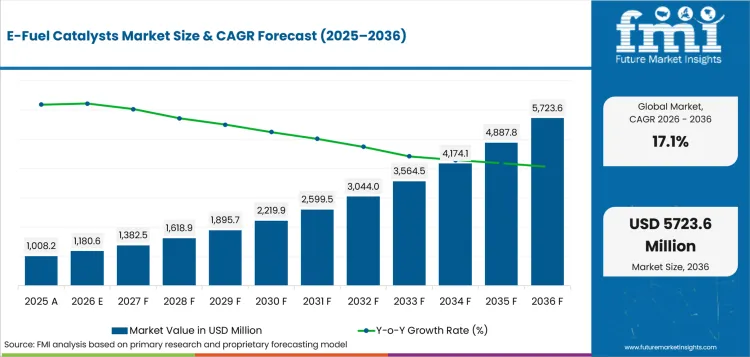
E-Fuel Catalysts Market Overview: Size and Forecast
- 2025 Market Size: USD 1,008.2 million
- 2026 Market Size: USD 1,180.6 million
- 2036 Market Size: USD 5,723.6 million
- Forecast CAGR: 17.1% from 2026 to 2036
- Leading Project Stage: Pilot / Demo Projects
- Pilot / Demo Projects Share in 2026: 64.0%
- Leading Sales Model: Catalyst + Process Package
- Catalyst + Process Package Share in 2026: 58.0%
- Leading Country by CAGR: China
- China CAGR: 18.9% by 2036
Summary of the E-Fuel Catalysts Market
- Demand and Growth Drivers
- Growing commercial-scale e‑fuel projects in Europe, the USA, and Asia are driving sustained demand for high‑performance catalysts that improve CO₂ conversion efficiency and operational uptime.
- Fuel producers and refiners are actively adopting advanced catalysts to reduce production costs per liter, accelerate reactor throughput, and meet aviation and maritime fuel quality standards.
- Rising sales of e‑fuels to airlines, shipping companies, and industrial offtakers are increasing procurement of durable and regenerable catalysts for long‑cycle operations.
- Long‑term offtake agreements and pilot‑to‑commercial transitions are strengthening catalyst replacement demand, aftermarket sales, and recurring revenues across the e‑fuel value chain.
- Product and Segment View
- Fischer-Tropsch Catalysts are projected to account for 46.0% share in 2026 as e-SAF and e-diesel buyers need proven hydrocarbon synthesis.
- Cu / Zn-based catalysts are expected to represent 38.0% share in 2026 as methanol synthesis supports fuel and chemical flexibility.
- SAF buyers are anticipated to hold 52.0% end-use share in 2026 due to mandate pressure and long-haul aviation demand.
- Geography and Competitive Outlook
- China is forecast to lead country pace at 18.9% CAGR through 2036 due to clean energy scale and catalyst manufacturing depth.
- Germany is expected to follow at 18.5% CAGR through 2036 as Leuna strengthens the country’s e-SAF test position.
- Topsoe, Johnson Matthey, Shell Catalysts & Technologies, and Axens compete around licensed synthesis pathways.
- Clariant, BASF, Sasol, and INERATEC hold relevance in methanol and Fischer-Tropsch catalyst routes.
- Analyst Opinion
- Nikhil Kaitwade, Principal Consultant at Future Market Insights for the chemicals domain, says, “E-fuel catalysts are becoming a qualification market before they become a volume market. Buyers are choosing a pathway that must handle renewable hydrogen swings, carbon dioxide quality, and strict fuel certification. Suppliers with catalyst depth and process guarantees should win faster than firms selling standalone materials.”
The e-fuel catalysts market is projected to expand through 2036 as fuel suppliers move from policy planning into process selection. Demand is concentrated in aviation and marine applications that require drop-in liquid fuels.
Policy demand is moving faster than plant qualification cycles in this market. The European Commission states that ReFuelEU requires 2.0% SAF in EU airports from 2025. The same framework requires synthetic aviation fuels to reach 1.2% from 2030 and 35.0% from 2050. The UK SAF mandate starts at 2.0% of jet fuel demand in 2025 and rises to 10.0% in 2030. These rules move catalyst buying from routine replacement planning into pathway qualification. Catalyst suppliers that serve sustainable aviation fuel demand need to prove syngas control and finished-fuel quality before developers lock technology packages.
Which factors support expansion in the e-fuel catalysts market?
Finished catalyst packages and licensed process systems support market value across policy-backed fuel projects.
- Market value is supported by catalyst packages that include reactor guidance and fuel-quality guarantees.
- Supplier pricing reflects catalyst life and process support before commodity metals determine final quotation.
- Revenue improves as SAF developers qualify e-fuel routes for bankable offtake and financing discussions.
- Project trust rises when suppliers provide operating references and documented feed-flexibility evidence.
Why is the e-fuel catalysts market growing?
Aviation policy is the strongest near-term demand signal for e-fuel catalysts.
ReFuelEU and the UK mandate give fuel suppliers defined SAF obligations through 2030. Catalyst suppliers benefit when project developers need certified molecules rather than laboratory claims. Shell states that its XTL Process integrates Fischer-Tropsch synthesis with other steps for e-SAF and bio-SAF production. That shows why integrated process offers are becoming more important than standalone catalyst sales. The demand is also influenced by green hydrogen supply because hydrogen cost determines whether e-fuel plants can progress from engineering studies to catalyst orders.
Project developers are using e-methanol as a bridge between carbon recycling and liquid fuel markets. Johnson Matthey stated in May 2024 that HIF Global selected its eMERALD technology for a Paysandu facility with expected capacity of 700,000 tonnes per year of e-methanol. Methanol can serve marine fuel markets or become a feedstock for e-gasoline and SAF routes. Catalyst suppliers that prove stability under variable renewable hydrogen supply should gain stronger positions with developers. Process licensors are also connected to the refinery catalysts market because existing hydroprocessing and synthesis experience helps buyers evaluate fuel upgrading risk.
How is the e-fuel catalysts market segmented?
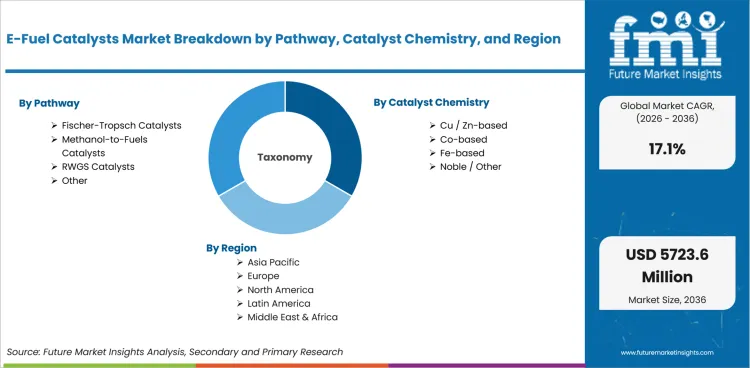
The e-fuel catalysts industry is segmented by pathway, catalyst chemistry, end use, project stage, and sales model.
- Fischer-Tropsch Catalysts are projected to secure 46.0% share in 2026 led by e-SAF and e-diesel routes.
- Cu / Zn-based catalysts are expected to hold 38.0% share in 2026 through methanol synthesis use.
- SAF is forecast to capture 52.0% share in 2026 because aviation has the strongest mandate pull.
- Pilot / Demo projects are anticipated to represent 64.0% share in 2026 as scale-up proof remains the main buying hurdle.
- Catalyst + Process Package sales are estimated to account for 58.0% share in 2026 as developers prefer one licensed route.
Why do Fischer-Tropsch Catalysts dominate the e-fuel catalysts market?
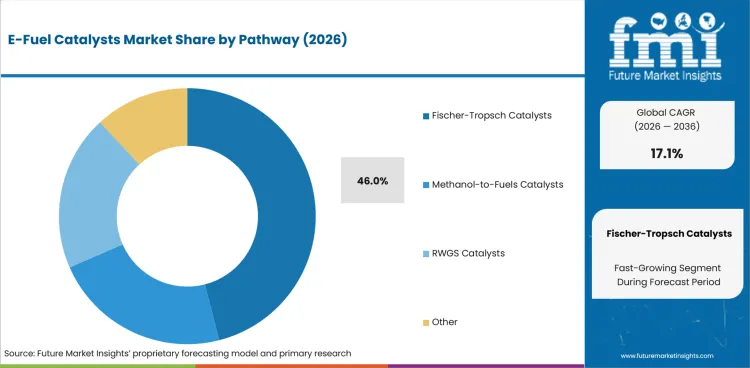
- Fischer-Tropsch Catalysts are projected to account for 46.0% share in 2026 as producers use syngas-to-liquids routes for e-SAF and e-diesel output.
- Buyers compare cobalt and iron systems by chain growth and heat removal performance before approving a fuel slate.
Which catalyst chemistry leads the e-fuel catalysts market?
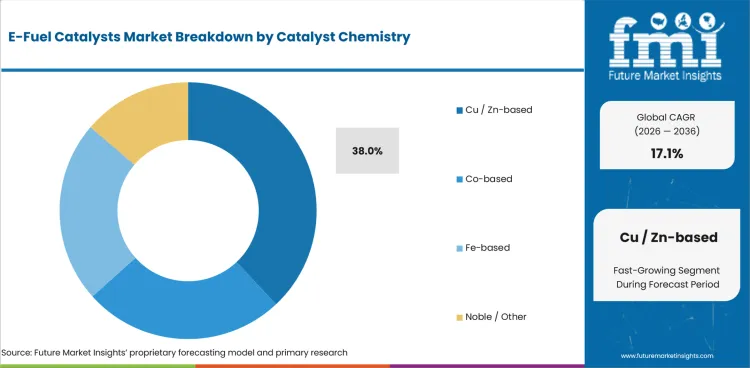
- Cu / Zn-based catalysts are expected to represent 38.0% share in 2026 as e-methanol plants use them to convert carbon oxides and hydrogen.
- Methanol synthesis buyers test activity under variable hydrogen feed because renewable power swings can affect catalyst life.
Which end use leads the e-fuel catalysts market?
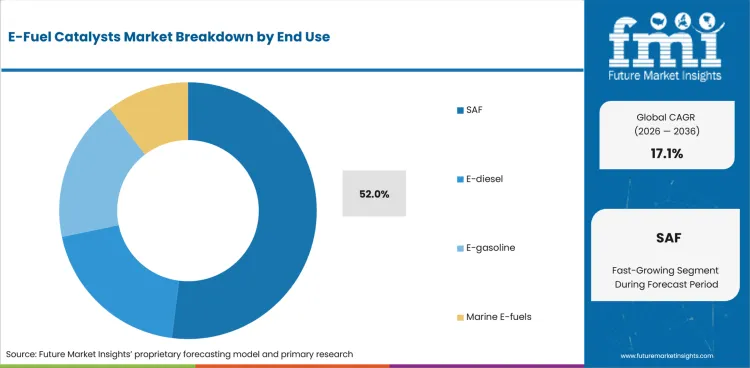
- SAF is anticipated to hold 52.0% share in 2026 as aviation faces binding fuel rules and few direct electrification options.
- Fuel producers need catalysts that support ASTM-compatible fuel quality before aviation buyers accept route risk.
Which project stage leads the e-fuel catalysts market?
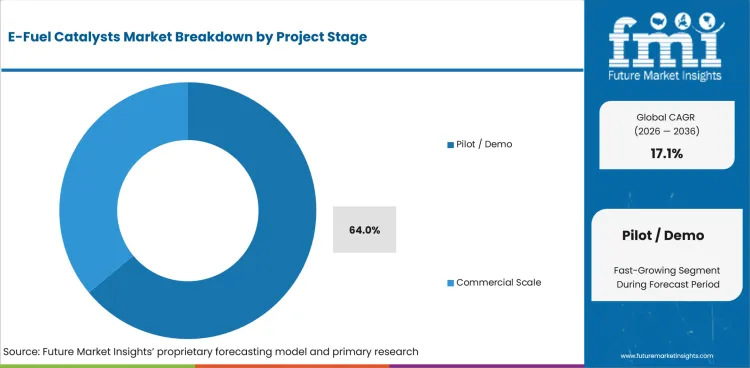
- Pilot / Demo projects are projected to represent 64.0% share in 2026 as most buyers are validating yield before commercial financing.
- Demonstration buyers value operating hours and feed flexibility over unit price when catalyst failure can delay permits.
Which sales model leads the e-fuel catalysts market?
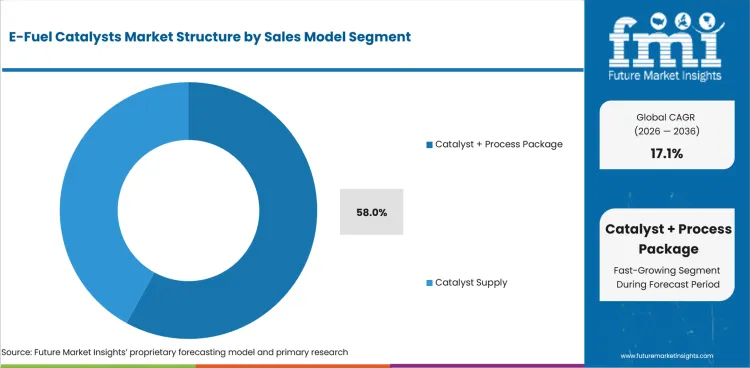
- Catalyst + Process Package sales are estimated to account for 58.0% share in 2026 as developers seek bundled performance guarantees.
- Package-based buying favors licensors with reactor design depth and downstream upgrading support for finished fuel quality.
What are the drivers, restraints, and opportunities in the e-fuel catalysts market?
SAF mandates and e-methanol projects support demand while hydrogen cost and qualification risk slow faster ordering.
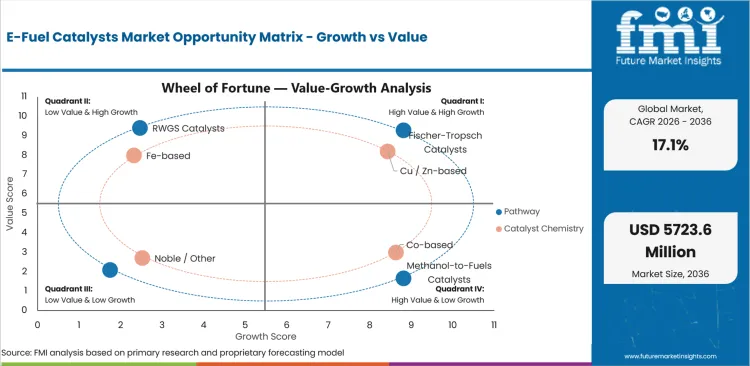
- Driver: SAF blending rules are expected to lift catalyst demand as synthetic fuel targets need stable syngas and fuel synthesis routes.
- Restraint: Hydrogen price volatility is expected to restrain plant timing because power cost shapes every e-fuel molecule.
- Opportunity: Modular e-fuel plants are expected to open a channel for smaller suppliers that can prove compact reactors.
E-Fuel Catalysts Market Demand Outlook
E-fuel catalyst demand is moving toward aviation-led projects because buyers need route certification, fuel traceability and carbon accounting before large orders. ReFuelEU Aviation requires a 2% SAF share at EU airports from 2025 and a 1.2% synthetic aviation fuel share from 2030. The UK SAF Mandate also starts at 2% of total UK jet fuel demand in 2025 and rises to 10% in 2030. These mandates matter because e-SAF developers need catalyst systems that can support licensed process routes and bankable offtake discussions. Shell’s XTL Process gives a current supplier signal because it integrates CO2 capture, reverse water-gas shift and Fischer-Tropsch synthesis for e-SAF and bio-SAF production. Catalyst selection is therefore shifting from material specification toward full process qualification.
Project Qualification and Purchase Behavior Analysis
Fuel suppliers and project developers compare e-fuel catalysts through pathway efficiency, catalyst life and proof from operating or licensed plants. Topsoe’s August 2025 e-SAF pathway review identifies three frontrunner routes. These are Fischer-Tropsch with combustion RWGS, Fischer-Tropsch with electrified RWGS and Methanol-to-Jet. That matters because buyers must choose a conversion route before they approve catalyst packages. Johnson Matthey’s FT CANS reference with DG Fuels also shows how project evidence supports supplier confidence because the announced Louisiana plant is planned around a 13,000 barrel-per-day SAF facility. Buyers are therefore evaluating fuel pathway evidence before unit catalyst price.
Voice of Customer and Decision-driver Analysis
The buying decision is increasingly shaped by carbon source quality, process integration and offtake credibility. Topsoe reported in May 2026 that Fischer-Tropsch and Methanol-to-Jet are the main e-SAF pathways under comparison. It also noted that its G2L eFuels approach combines Fischer-Tropsch synthesis with eREACT and extensive by-product recycling. This matters because project teams need a route that can protect kerosene yield and simplify offtake. CO2 supply remains part of the catalyst decision because e-SAF relies on hydrogen and captured carbon moving through RWGS and downstream synthesis. Suppliers with reactor support, carbon-accounting evidence and project-scale references should hold stronger positions during licensing review.
Which countries are growing fastest in the e-fuel catalysts market?
China 18.9% CAGR, Germany 18.5% CAGR, United States 17.8% CAGR, South Korea 17.4% CAGR, France 16.9% CAGR, Japan 16.6% CAGR, United Kingdom 16.4% CAGR, and India 15.8% CAGR through 2036.
.webp "Top Country Growth Comparison E Fuel Catalysts Market Cagr (2026 2036)")
| Country | CAGR |
|---|---|
| China | 18.9% |
| Germany | 18.5% |
| United States | 17.8% |
| South Korea | 17.4% |
| France | 16.9% |
| Japan | 16.6% |
| United Kingdom | 16.4% |
| India | 15.8% |
Source: Future Market Insights, 2026.
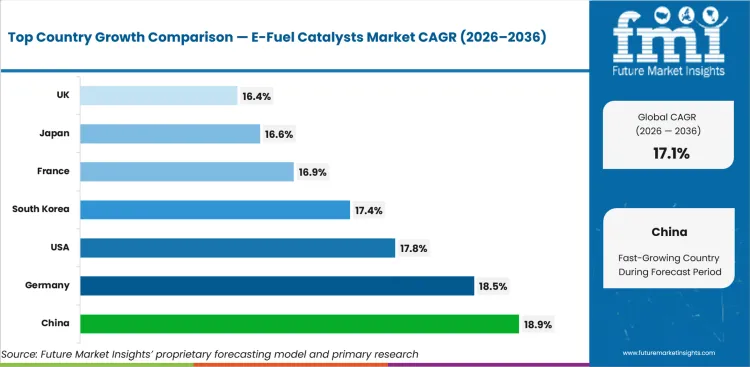
How do country-level CAGRs compare in the e-fuel catalysts market?
China leads country growth while India records the most cautious expansion outlook among profiled markets.
- China is projected to record 18.9% CAGR through 2036 due to clean energy scale and catalyst manufacturing depth.
- Germany is projected to record 18.5% CAGR through 2036 as Leuna demonstration work and public research funding.
- United States is projected to record 17.8% CAGR through 2036 with SAF policy and large fuel project finance.
- South Korea is projected to record 17.4% CAGR through 2036 because refining export strength and planned SAF blending.
- France is projected to record 16.9% CAGR through 2036 through Axens technology depth and EU aviation demand.
- Japan is projected to record 16.6% CAGR through 2036 supported by fuel import coordination and SAF targets.
- United Kingdom is projected to record 16.4% CAGR through 2036 as mandate compliance and local technology strength.
- India is projected to record 15.8% CAGR through 2036 reflecting green hydrogen policy and refinery conversion interest.
How fast is the e-fuel catalysts market growing in China?
A 18.9% CAGR through 2036 reflects clean power scale and domestic catalyst manufacturing depth.
Country Market Snapshot Table
| Parameter | Value |
|---|---|
| Market Size in 2025 (Value) | USD 151.4 million |
| Market Size in 2026 (Value) | USD 180.0 million |
| Market Forecast in 2036 (Value) | USD 1016.5 million |
| CAGR (2026 to 2036) | 18.9% |
| Years Considered | 2021 to 2036 |
| Base Year | 2025 |
| Forecast Period | 2026 to 2036 |
| Units Considered | Value (USD million) |
| Leading Sub-Region | Yangtze River Delta and coastal chemical clusters |
China E-Fuel Catalysts Market Outlook
China e-fuel catalyst demand is shaped by renewable power scale and domestic chemical engineering depth. State-backed project developers can connect methanol synthesis, hydrogen supply, and refinery integration faster than most markets.
Imported licensors remain relevant where process guarantees are needed for aviation-grade fuels. Local suppliers are expected to compete strongly on cost, plant access, and catalyst service coverage.
Key Growth Drivers
- Renewable power additions support future green hydrogen availability. China’s State Council reported 373.0 million kilowatts of new renewable capacity in 2024.
- Solar capacity strengthens power access for hydrogen-linked methanol projects. China’s State Council reported about 890.0 million kilowatts of solar generation capacity in 2024.
- State-owned energy groups are expected to shorten procurement cycles by linking project approvals with catalyst supply programs.
- Domestic chemical EPC depth supports methanol synthesis packages and route-specific catalyst testing near industrial clusters.
Key Restraints
- Grid integration remains a timing risk for e-fuel plants. China’s State Council reported 430.0 gigawatts of new wind and solar capacity in 2025.
- Lower-cost domestic catalyst suppliers can pressure imported process packages before licensors prove lifecycle value.
- Foreign suppliers may face slower approvals when state-backed developers prioritize local plant-service access.
What makes China unique
China is unique because it combines clean power scale, chemical plant construction speed, and local catalyst manufacturing depth.
Key Companies
- Shanghai Electric Group Co. Ltd.
- Sinopec Catalyst Co. Ltd.
- China Energy Engineering Group
- China Huaneng Group
- Dalian Institute of Chemical Physics
- Wison Engineering Ltd.
Sales & Marketing Channels
- State-owned energy groups
- Chemical plant EPC packages
- Technology alliance channels
- Refinery and methanol project developers
- Provincial clean energy programs
- Direct catalyst supply contracts
Country Segment Breakdown Table
| Segment | Sub-Segments |
|---|---|
| By Pathway | Fischer-Tropsch Catalysts, Methanol-to-Fuels Catalysts, RWGS Catalysts, Other |
| By Catalyst Chemistry | Co-based, Fe-based, Cu / Zn-based, Noble / Other |
| By End Use | SAF, E-diesel, E-gasoline, Marine E-fuels |
| By Project Stage | Pilot / Demo, Commercial Scale |
| By Sales Model | Catalyst Supply, Catalyst + Process Package |
| Key Sub-Regions Covered, Industrial and Fuel Corridors | Shanghai, Jiangsu, Zhejiang, Guangdong, Shandong, Inner Mongolia |
Frequently Asked Questions
How fast is China e-fuel catalysts market growing?
Sales in China are projected to grow at 18.9% CAGR from 2026 to 2036 due to country-specific fuel policy and project activity.
Who leads China e-fuel catalysts market?
Shanghai Electric Group Co. Ltd., Sinopec Catalyst Co. Ltd., China Energy Engineering Group, China Huaneng Group compete through local project access, technology licensing, or fuel-production capabilities.
What is driving adoption in China e-fuel catalysts market?
Renewable power additions support future green hydrogen availability.
How fast is the e-fuel catalysts market growing in Germany?
A 18.5% CAGR through 2036 reflects Leuna demonstration activity and power-to-liquid validation.
Country Market Snapshot Table
| Parameter | Value |
|---|---|
| Market Size in 2025 (Value) | USD 122.4 million |
| Market Size in 2026 (Value) | USD 145.0 million |
| Market Forecast in 2036 (Value) | USD 791.7 million |
| CAGR (2026 to 2036) | 18.5% |
| Years Considered | 2021 to 2036 |
| Base Year | 2025 |
| Forecast Period | 2026 to 2036 |
| Units Considered | Value (USD million) |
| Leading Sub-Region | Leuna and Rhine-Ruhr chemical corridors |
Germany E-Fuel Catalysts Market Outlook
Germany is one of the most evidence-backed markets for e-fuel catalyst validation. The Leuna Chemical Complex gives technology developers a physical platform for integrated power-to-liquid fuel production.
German buyers care about operating data, reactor performance, and integration with downstream fuel testing. Suppliers should position around demonstration proof rather than low-cost catalyst supply.
Key Growth Drivers
- Leuna gives catalyst suppliers a visible test location for e-SAF technology. DLR stated the platform will be able to produce up to 2,500.0 tonnes of fuel per year.
- Public funding lowers early technology risk. Germany’s BMDV action plan lists EUR 30.0 million in initial 2024 funding for PtL fuel production.
- German industrial clusters support engineering, utilities, and chemical plant services for power-to-liquid demonstration activity.
- Local modular suppliers can use domestic operating references to support catalyst and reactor sales in wider European projects.
Key Restraints
- Commercial catalyst orders may remain delayed until research operation begins. DLR states the TPP research operation is scheduled to start in 2028.
- Strict engineering qualification can lengthen supplier approval and plant design timelines before catalyst replacement demand appears.
- Premium imported catalysts may face cost pressure from local process integration and modular reactor suppliers.
What makes Germany unique
Germany is unique because Leuna provides a public demonstration platform for e-SAF catalyst and process qualification.
Key Companies
- INERATEC GmbH
- BASF SE
- Clariant Deutschland GmbH
- Sunfire GmbH
- Linde Engineering
- Uhde GmbH
Sales & Marketing Channels
- Public research platforms
- Industrial cluster partnerships
- EPC contractor channels
- Direct technology licensing
- Demonstration plant catalyst supply
- University and institute-linked validation routes
Country Segment Breakdown Table
| Segment | Sub-Segments |
|---|---|
| By Pathway | Fischer-Tropsch Catalysts, Methanol-to-Fuels Catalysts, RWGS Catalysts, Other |
| By Catalyst Chemistry | Co-based, Fe-based, Cu / Zn-based, Noble / Other |
| By End Use | SAF, E-diesel, E-gasoline, Marine E-fuels |
| By Project Stage | Pilot / Demo, Commercial Scale |
| By Sales Model | Catalyst Supply, Catalyst + Process Package |
| Key Sub-Regions Covered, Industrial and Fuel Corridors | Leuna, North Rhine-Westphalia, Hamburg, Bavaria, Lower Saxony, Berlin-Brandenburg |
Frequently Asked Questions
How fast is Germany e-fuel catalysts market growing?
Sales in Germany are projected to grow at 18.5% CAGR from 2026 to 2036 due to country-specific fuel policy and project activity.
Who leads Germany e-fuel catalysts market?
INERATEC GmbH, BASF SE, Clariant Deutschland GmbH, Sunfire GmbH compete through local project access, technology licensing, or fuel-production capabilities.
What is driving adoption in Germany e-fuel catalysts market?
Leuna gives catalyst suppliers a visible test location for e-SAF technology.
How fast is the e-fuel catalysts market growing in the United States?
A 17.8% CAGR through 2036 reflects federal SAF goals and Gulf Coast project development.
Country Market Snapshot Table
| Parameter | Value |
|---|---|
| Market Size in 2025 (Value) | USD 195.2 million |
| Market Size in 2026 (Value) | USD 230.0 million |
| Market Forecast in 2036 (Value) | USD 1183.5 million |
| CAGR (2026 to 2036) | 17.8% |
| Years Considered | 2021 to 2036 |
| Base Year | 2025 |
| Forecast Period | 2026 to 2036 |
| Units Considered | Value (USD million) |
| Leading Sub-Region | Gulf Coast and California clean-fuel corridors |
United States E-Fuel Catalysts Market Outlook
United States e-fuel catalyst demand is shaped by federal SAF policy and large project finance capacity. Developers use licensor-backed packages to reduce fuel certification and engineering risk before final investment decisions.
Gulf Coast infrastructure gives catalyst suppliers access to refining skills and fuel logistics. Local demand is strong but project timing depends on electricity sourcing and carbon accounting rules.
Key Growth Drivers
- SAF offtake interest supports Fischer-Tropsch and methanol-to-jet route selection. The USA Department of Energy targets 3.0 billion gallons of SAF production by 2030.
- Public funding supports early SAF infrastructure. The Federal Aviation Administration announced USD 244.5 million for SAF production and supply-chain projects in August 2024.
- Gulf Coast refining clusters are expected to make catalyst qualification easier by linking synthesis projects with fuel logistics and storage expertise.
- Federal clean fuel credits are expected to improve developer economics when catalysts are bundled with qualified low-carbon fuel pathways.
Key Restraints
- Project economics can depend on credit eligibility. The USA Treasury stated in April 2024 that SAF producers can receive up to USD 1.75 per gallon.
- Local permitting and grid access can delay electrolyzer and synthesis plant schedules before catalyst purchase orders are released.
- Developers may delay open catalyst tenders because licensor-backed packages are often selected before standalone materials are compared.
What makes United States unique
United States is unique due to large aviation fuel demand and strong project finance capacity across Gulf Coast fuel corridors.
Key Companies
- Johnson Matthey Inc.
- Honeywell UOP LLC
- Shell Catalysts & Technologies
- Topsoe Inc.
- Sasol Chemicals North America LLC
- LanzaJet Inc.
- Gevo Inc.
Sales & Marketing Channels
- Direct licensing to project developers
- EPC-backed technology packages
- Airline and fuel offtake partnerships
- Refinery integration channels
- Government-backed project finance routes
- Technical service agreements
Country Segment Breakdown Table
| Segment | Sub-Segments |
|---|---|
| By Pathway | Fischer-Tropsch Catalysts, Methanol-to-Fuels Catalysts, RWGS Catalysts, Other |
| By Catalyst Chemistry | Co-based, Fe-based, Cu / Zn-based, Noble / Other |
| By End Use | SAF, E-diesel, E-gasoline, Marine E-fuels |
| By Project Stage | Pilot / Demo, Commercial Scale |
| By Sales Model | Catalyst Supply, Catalyst + Process Package |
| Key Sub-Regions Covered, Industrial and Fuel Corridors | Texas, Louisiana, California, Midwest, Pacific Northwest, Rocky Mountain states |
Frequently Asked Questions
How fast is United States e-fuel catalysts market growing?
Sales in United States are projected to grow at 17.8% CAGR from 2026 to 2036 due to country-specific fuel policy and project activity.
Who leads United States e-fuel catalysts market?
Johnson Matthey Inc., Honeywell UOP LLC, Shell Catalysts & Technologies, Topsoe Inc. compete through local project access, technology licensing, or fuel-production capabilities.
What is driving adoption in United States e-fuel catalysts market?
SAF offtake interest supports Fischer-Tropsch and methanol-to-jet route selection.
What is the e-fuel catalysts market outlook in South Korea?
A 17.4% CAGR through 2036 is supported by refining export scale and planned SAF blending.
Country Market Snapshot Table
| Parameter | Value |
|---|---|
| Market Size in 2025 (Value) | USD 76.7 million |
| Market Size in 2026 (Value) | USD 90.0 million |
| Market Forecast in 2036 (Value) | USD 447.6 million |
| CAGR (2026 to 2036) | 17.4% |
| Years Considered | 2021 to 2036 |
| Base Year | 2025 |
| Forecast Period | 2026 to 2036 |
| Units Considered | Value (USD million) |
| Leading Sub-Region | Ulsan and Incheon refining corridors |
South Korea E-Fuel Catalysts Market Outlook
South Korea’s e-fuel catalyst demand is tied to refinery exports and SAF policy preparation. Local refiners have strong fuel logistics and hydrogen-handling experience.
Catalyst suppliers should position around Korean refiners and engineering firms. Demand is expected to favor packages that lower certification risk and improve synthesis yields.
Key Growth Drivers
- SAF policy creates a defined fuel pathway. MOLIT reported weekly fueling with a 1.0% SAF blend in 2024 on selected international routes.
- Planned blending raises future fuel demand. MOLIT stated mandatory SAF blending starts at 1.0% in 2027 for international flights departing Korea.
- Refinery export strength gives local suppliers a practical route to evaluate e-fuels for international aviation customers.
- Engineering contractors can support packaged reactor and catalyst delivery across Asian clean fuel projects.
Key Restraints
- Higher blending targets may increase feedstock pressure before e-fuel supply is ready. MOLIT stated the SAF mandate could rise to 5.0% by 2030.
- Feedstock competition can delay commercial e-fuel output until low-cost hydrogen and carbon dioxide sourcing improve.
- Domestic buyers may prioritize bio-SAF blending before e-fuel catalyst volumes become meaningful.
What makes South Korea unique
South Korea is unique because refining export scale gives e-fuel catalyst suppliers access to aviation fuel logistics.
Key Companies
- SK Innovation Co. Ltd.
- S-Oil Corporation
- HD Hyundai Oilbank Co. Ltd.
- GS Caltex Corporation
- Samsung E&A Co. Ltd.
- Korea Institute of Energy Research
Sales & Marketing Channels
- Refinery-led pilot projects
- Engineering contractor packages
- Airline and airport partnerships
- Government SAF programs
- Hydrogen project developers
- Fuel export networks
Country Segment Breakdown Table
| Segment | Sub-Segments |
|---|---|
| By Pathway | Fischer-Tropsch Catalysts, Methanol-to-Fuels Catalysts, RWGS Catalysts, Other |
| By Catalyst Chemistry | Co-based, Fe-based, Cu / Zn-based, Noble / Other |
| By End Use | SAF, E-diesel, E-gasoline, Marine E-fuels |
| By Project Stage | Pilot / Demo, Commercial Scale |
| By Sales Model | Catalyst Supply, Catalyst + Process Package |
Market Taxonomy and Sub-Regions Covered
Key Sub-Regions Covered, Industrial and Fuel Corridors
Ulsan, Incheon, Busan, Gyeonggi, South Jeolla, Seoul
Frequently Asked Questions
How fast is South Korea e-fuel catalysts market growing?
Sales in South Korea are projected to grow at 17.4% CAGR from 2026 to 2036 due to country-specific fuel policy and project activity.
Who leads South Korea e-fuel catalysts market?
SK Innovation Co. Ltd., S-Oil Corporation, HD Hyundai Oilbank Co. Ltd., GS Caltex Corporation compete through local project access, technology licensing, or fuel-production capabilities.
What is driving adoption in South Korea e-fuel catalysts market?
SAF policy creates a defined fuel pathway.
What is driving e-fuel catalysts growth in France?
A 16.9% CAGR through 2036 is supported by EU aviation rules and domestic process technology depth.
Country Market Snapshot Table
| Parameter | Value |
|---|---|
| Market Size in 2025 (Value) | USD 94.1 million |
| Market Size in 2026 (Value) | USD 110.0 million |
| Market Forecast in 2036 (Value) | USD 524.2 million |
| CAGR (2026 to 2036) | 16.9% |
| Years Considered | 2021 to 2036 |
| Base Year | 2025 |
| Forecast Period | 2026 to 2036 |
| Units Considered | Value (USD million) |
| Leading Sub-Region | Normandy and Paris-Saclay technology corridors |
France E-Fuel Catalysts Market Outlook
France has a strong technology provider role rather than only a domestic demand role. Axens and IFP Energies nouvelles strengthen the country’s position in RWGS and integrated fuel synthesis.
Catalyst sales are expected to follow process selection rather than open tender buying. France remains attractive where aviation fuel suppliers need a licensed route from carbon dioxide to synthetic fuel.
Key Growth Drivers
- EU rules create a clear pull for French aviation fuel suppliers. The European Commission states ReFuelEU requires 2.0% SAF in EU airports from 2025.
- Decarbonized hydrogen policy supports future synthetic fuel routes. France’s hydrogen strategy estimates transport hydrogen needs at 55.0 kt per year by 2030.
- Axens and IFPEN provide local technology depth in RWGS and fuel synthesis through Carboverseo and related process packages.
- Refinery and aviation links are expected to support early SAF qualification projects across French fuel-supply corridors.
Key Restraints
- Hydrogen competition can pressure e-fuel economics. France’s hydrogen strategy estimates refinery hydrogen needs at 150.0 kt per year by 2030.
- Local projects must compete with lower-cost renewable power locations outside France when developers select production sites.
- Fuel suppliers may prioritize imported compliant fuels before domestic e-fuel catalyst volumes reach commercial scale.
What makes France unique
France is unique because Axens links domestic catalyst expertise with an integrated RWGS and fuel synthesis route.
Key Companies
- Axens SA
- IFP Energies nouvelles
- Air Liquide Engineering & Construction
- Technip Energies NV
- TotalEnergies OneTech
- Sunfire France SAS
Sales & Marketing Channels
- Process licensing
- Refinery integration channels
- Airline and fuel-supplier partnerships
- Hydrogen project developers
- Industrial research programs
- EPC and technology alliances
Country Segment Breakdown Table
| Segment | Sub-Segments |
|---|---|
| By Pathway | Fischer-Tropsch Catalysts, Methanol-to-Fuels Catalysts, RWGS Catalysts, Other |
| By Catalyst Chemistry | Co-based, Fe-based, Cu / Zn-based, Noble / Other |
| By End Use | SAF, E-diesel, E-gasoline, Marine E-fuels |
| By Project Stage | Pilot / Demo, Commercial Scale |
| By Sales Model | Catalyst Supply, Catalyst + Process Package |
Market Taxonomy and Sub-Regions Covered
Key Sub-Regions Covered, Industrial and Fuel Corridors
Normandy, Paris-Saclay, Auvergne-Rhone-Alpes, Nouvelle-Aquitaine, Occitanie, Provence-Alpes-Cote d Azur
Frequently Asked Questions
How fast is France e-fuel catalysts market growing?
Sales in France are projected to grow at 16.9% CAGR from 2026 to 2036 due to country-specific fuel policy and project activity.
Who leads France e-fuel catalysts market?
Axens SA, IFP Energies nouvelles, Air Liquide Engineering & Construction, Technip Energies NV compete through local project access, technology licensing, or fuel-production capabilities.
What is driving adoption in France e-fuel catalysts market?
EU rules create a clear pull for French aviation fuel suppliers.
What is the e-fuel catalysts market forecast for Japan?
A 16.6% CAGR through 2036 reflects SAF targets and trading-house-led offtake coordination.
Country Market Snapshot Table
| Parameter | Value |
|---|---|
| Market Size in 2025 (Value) | USD 90.1 million |
| Market Size in 2026 (Value) | USD 105.0 million |
| Market Forecast in 2036 (Value) | USD 487.7 million |
| CAGR (2026 to 2036) | 16.6% |
| Years Considered | 2021 to 2036 |
| Base Year | 2025 |
| Forecast Period | 2026 to 2036 |
| Units Considered | Value (USD million) |
| Leading Sub-Region | Tokyo-Osaka energy and trading corridors |
Japan E-Fuel Catalysts Market Outlook
Japan’s e-fuel catalyst demand is shaped by energy security and fuel import strategy. Domestic buyers are expected to source from global projects while qualifying technology partners for future local use.
Reliability and operating history will carry more weight than lowest upfront price. Catalyst suppliers should work with energy firms, automakers, ship operators, and trading houses.
Key Growth Drivers
- SAF policy gives fuel buyers a defined compliance direction. METI’s climate transition finance guidance states Japan set a 10.0% SAF target for FY2030.
- National decarbonization goals support synthetic fuel route screening. METI states Japan targets a 46.0% greenhouse gas reduction in FY2030 from FY2013.
- Trading houses can connect overseas e-fuel projects with domestic offtake and technology qualification programs.
- Automotive and marine users are expected to create demand outside aviation through e-gasoline and e-methanol pathways.
Key Restraints
- Domestic e-fuel commercialization is still early. METI’s energy agency says e-fuel is under research toward commercialization in the early 2030s.
- Domestic renewable hydrogen cost can push production overseas before Japanese buyers commit to local e-fuel plants.
- Long qualification cycles may delay large catalyst orders until fuel certification and cost gaps narrow.
What makes Japan unique
Japan is unique because trading houses can link domestic fuel users with overseas e-fuel production sites.
Key Companies
- ENEOS Corporation
- Cosmo Energy Holdings Co. Ltd.
- Idemitsu Kosan Co. Ltd.
- Mitsubishi Corporation
- IHI Corporation
- Japan Petroleum Exploration Co. Ltd.
Sales & Marketing Channels
- Trading-house offtake programs
- Refinery technology partnerships
- Airline fuel procurement
- Automotive fuel trials
- Marine fuel alliances
- Overseas project investment routes
Country Segment Breakdown Table
| Segment | Sub-Segments |
|---|---|
| By Pathway | Fischer-Tropsch Catalysts, Methanol-to-Fuels Catalysts, RWGS Catalysts, Other |
| By Catalyst Chemistry | Co-based, Fe-based, Cu / Zn-based, Noble / Other |
| By End Use | SAF, E-diesel, E-gasoline, Marine E-fuels |
| By Project Stage | Pilot / Demo, Commercial Scale |
| By Sales Model | Catalyst Supply, Catalyst + Process Package |
Market Taxonomy and Sub-Regions Covered
Key Sub-Regions Covered, Industrial and Fuel Corridors
Tokyo, Osaka, Chiba, Aichi, Fukuoka, Hokkaido
Frequently Asked Questions
How fast is Japan e-fuel catalysts market growing?
Sales in Japan are projected to grow at 16.6% CAGR from 2026 to 2036 due to country-specific fuel policy and project activity.
Who leads Japan e-fuel catalysts market?
ENEOS Corporation, Cosmo Energy Holdings Co. Ltd., Idemitsu Kosan Co. Ltd., Mitsubishi Corporation compete through local project access, technology licensing, or fuel-production capabilities.
What is driving adoption in Japan e-fuel catalysts market?
SAF policy gives fuel buyers a defined compliance direction.
What is the e-fuel catalysts market outlook in the United Kingdom?
A 16.4% CAGR through 2036 is supported by SAF mandate compliance and local catalyst technology depth.
Country Market Snapshot Table
| Parameter | Value |
|---|---|
| Market Size in 2025 (Value) | USD 107.4 million |
| Market Size in 2026 (Value) | USD 125.0 million |
| Market Forecast in 2036 (Value) | USD 570.7 million |
| CAGR (2026 to 2036) | 16.4% |
| Years Considered | 2021 to 2036 |
| Base Year | 2025 |
| Forecast Period | 2026 to 2036 |
| Units Considered | Value (USD million) |
| Leading Sub-Region | Humber and London aviation-fuel corridors |
United Kingdom E-Fuel Catalysts Market Outlook
United Kingdom e-fuel catalyst demand is policy-led by aviation fuel blending rules and domestic clean fuel planning. The mandate creates a defined buyer group among fuel suppliers serving UK airports.
Johnson Matthey gives the country local relevance through methanol synthesis and SAF pathway work. Catalyst opportunities are expected to remain tied to licensing and project development before large domestic replacement volumes appear.
Key Growth Drivers
- The UK SAF mandate gives fuel suppliers a fixed compliance path. GOV.UK states the mandate starts at 2.0% of total jet fuel demand in 2025.
- Mandate escalation supports medium-term e-fuel planning. GOV.UK states the requirement increases to 10.0% of total UK jet fuel demand in 2030.
- UK process technology firms provide credible local selling points for methanol synthesis and e-SAF catalyst packages.
- Airport-linked fuel suppliers are expected to need traceable low-carbon molecules for long-term compliance planning.
Key Restraints
- Limited domestic project economics can raise entry pressure. GOV.UK states suppliers over 15.9 terajoules of relevant aviation turbine fuel must register.
- Higher project costs may push some catalyst demand into imported fuel supply chains before local e-SAF reaches scale.
- Buyers may delay plant commitments when certificate revenue and power costs do not support domestic production economics.
What makes United Kingdom unique
United Kingdom is unique due to a clear SAF mandate and a domestic technology champion in Johnson Matthey.
Key Companies
- Johnson Matthey PLC
- Velocys PLC
- Carbon Clean Solutions Ltd.
- Zero Petroleum Ltd.
- Ceres Power Holdings PLC
- ITM Power PLC
Sales & Marketing Channels
- Fuel supplier compliance programs
- Direct licensor sales
- Airport fuel procurement networks
- Refinery and terminal partnerships
- Airline-backed offtake discussions
- EPC feasibility studies
Country Segment Breakdown Table
| Segment | Sub-Segments |
|---|---|
| By Pathway | Fischer-Tropsch Catalysts, Methanol-to-Fuels Catalysts, RWGS Catalysts, Other |
| By Catalyst Chemistry | Co-based, Fe-based, Cu / Zn-based, Noble / Other |
| By End Use | SAF, E-diesel, E-gasoline, Marine E-fuels |
| By Project Stage | Pilot / Demo, Commercial Scale |
| By Sales Model | Catalyst Supply, Catalyst + Process Package |
Market Taxonomy and Sub-Regions Covered
Key Sub-Regions Covered, Industrial and Fuel Corridors
Humber, Teesside, London, Scotland, South Wales, Manchester
Frequently Asked Questions
How fast is United Kingdom e-fuel catalysts market growing?
Sales in United Kingdom are projected to grow at 16.4% CAGR from 2026 to 2036 due to country-specific fuel policy and project activity.
Who leads United Kingdom e-fuel catalysts market?
Johnson Matthey PLC, Velocys PLC, Carbon Clean Solutions Ltd., Zero Petroleum Ltd. compete through local project access, technology licensing, or fuel-production capabilities.
What is driving adoption in United Kingdom e-fuel catalysts market?
The UK SAF mandate gives fuel suppliers a fixed compliance path.
How fast is the e-fuel catalysts market growing in India?
A 15.8% CAGR through 2036 reflects green hydrogen policy and long-term refinery conversion interest.
Country Market Snapshot Table
| Parameter | Value |
|---|---|
| Market Size in 2025 (Value) | USD 60.4 million |
| Market Size in 2026 (Value) | USD 70.0 million |
| Market Forecast in 2036 (Value) | USD 303.5 million |
| CAGR (2026 to 2036) | 15.8% |
| Years Considered | 2021 to 2036 |
| Base Year | 2025 |
| Forecast Period | 2026 to 2036 |
| Units Considered | Value (USD million) |
| Leading Sub-Region | Gujarat and coastal refinery corridors |
India E-Fuel Catalysts Market Outlook
India is earlier in e-fuel catalyst demand than China or Germany. The country’s scale advantage comes from green hydrogen policy and refinery-linked demand potential.
Catalyst suppliers should target public-sector refiners and EPC partners first. Commercial orders are expected to remain selective until hydrogen costs and aviation fuel policy become clearer.
Key Growth Drivers
- Green hydrogen policy supports future feedstock availability. India’s Press Information Bureau stated green hydrogen capacity is likely to reach 5.0 million metric tonnes per annum by 2030.
- Commissioned hydrogen capacity remains small but visible. India’s Press Information Bureau reported around 8,000.0 tonnes per annum of green hydrogen capacity by February 2026.
- Public-sector refineries are expected to become early buyer channels for catalyst testing and e-fuel route screening.
- Coastal ports and refinery clusters can support future marine e-fuel and aviation fuel demonstration projects.
Key Restraints
- Staged public funding can slow conversion from policy to purchase orders. India’s Press Information Bureau reported INR 203.75 crore in FY2025-26 utilization by March 2026.
- Commercial SAF and e-fuel mandates are less defined than in Europe and the United Kingdom.
- Project developers may delay catalyst purchases until renewable power access and carbon sourcing become bankable.
What makes India unique
India is unique because its green hydrogen mission can create a future feedstock base for refinery-linked e-fuel projects.
Key Companies
- Indian Oil Corporation Ltd.
- Bharat Petroleum Corporation Ltd.
- Hindustan Petroleum Corporation Ltd.
- Reliance Industries Ltd.
- Larsen & Toubro Ltd.
- Thermax Ltd.
Sales & Marketing Channels
- Public-sector refinery pilots
- EPC-led feasibility studies
- Hydrogen mission projects
- Aviation fuel supplier engagement
- Port-linked marine fuel programs
- Direct catalyst trials
Country Segment Breakdown Table
| Segment | Sub-Segments |
|---|---|
| By Pathway | Fischer-Tropsch Catalysts, Methanol-to-Fuels Catalysts, RWGS Catalysts, Other |
| By Catalyst Chemistry | Co-based, Fe-based, Cu / Zn-based, Noble / Other |
| By End Use | SAF, E-diesel, E-gasoline, Marine E-fuels |
| By Project Stage | Pilot / Demo, Commercial Scale |
| By Sales Model | Catalyst Supply, Catalyst + Process Package |
Market Taxonomy and Sub-Regions Covered
Key Sub-Regions Covered, Industrial and Fuel Corridors
Gujarat, Maharashtra, Tamil Nadu, Karnataka, Odisha, Andhra Pradesh
Frequently Asked Questions
How fast is India e-fuel catalysts market growing?
Sales in India are projected to grow at 15.8% CAGR from 2026 to 2036 due to country-specific fuel policy and project activity.
Who leads India e-fuel catalysts market?
Indian Oil Corporation Ltd., Bharat Petroleum Corporation Ltd., Hindustan Petroleum Corporation Ltd., Reliance Industries Ltd. compete through local project access, technology licensing, or fuel-production capabilities.
What is driving adoption in India e-fuel catalysts market?
Green hydrogen policy supports future feedstock availability.
Competitive Landscape and Strategic Positioning
Who are the leading companies in the e-fuel catalysts market?
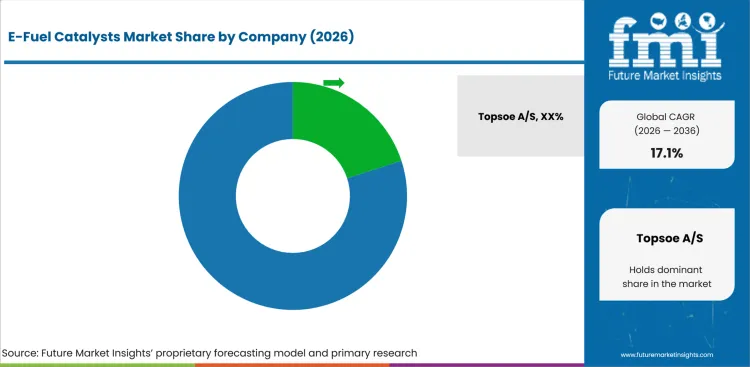
Topsoe A/S, Johnson Matthey PLC, Shell Catalysts & Technologies, Axens SA, Sasol Limited, Clariant AG, BASF SE, INERATEC GmbH, Honeywell UOP LLC, and Shanghai Electric Group Co. Ltd. are key companies in the e-fuel catalysts market.
- Process licensors compete through integrated technology packages that link catalyst chemistry with reactor design and fuel-quality outcomes.
- Catalyst suppliers compete through catalyst life, selectivity, operating stability, and support for Fischer-Tropsch, methanol, and synthesis routes.
- Modular technology suppliers compete where smaller project developers need compact plant integration and quicker deployment support.
- Project ecosystem partners influence catalyst selection by shaping technology routes, feed strategy, and downstream upgrading requirements.
Competition is led by process licensors and catalyst suppliers that can tie catalyst chemistry to finished-fuel performance. Topsoe, Johnson Matthey, Shell Catalysts & Technologies, and Axens compete through licensed pathways, while Sasol, BASF, Clariant, and INERATEC add depth in Fischer-Tropsch chemistry, methanol routes, and modular plant integration.
Suppliers are best positioned when they combine catalyst performance with reactor design, feed management, and downstream upgrading support. Standalone catalyst sellers are expected to face slower adoption unless they can prove operating hours and fuel-quality performance. Specialist suppliers can use links with the specialty catalysts market to explain why catalyst life and selectivity matter in e-fuel project economics.
How do top e-fuel catalysts companies compare?
Topsoe and Johnson Matthey score strongest on process package depth and catalyst relevance, while Shell Catalysts & Technologies, Axens, Sasol, and Honeywell UOP compete through licensed pathways and project execution support.
| Company | Market Relevance | Process Package | Catalyst Depth | Project Proof | Reach | Positioning |
|---|---|---|---|---|---|---|
| Topsoe A/S | Very High | Very Strong | Very Strong | Very Strong | Global | Integrated e-fuel technology leader |
| Johnson Matthey PLC | Very High | Very Strong | Very Strong | Strong | Global | Methanol and catalyst technology leader |
| Shell Catalysts & Technologies | High | Very Strong | Strong | Strong | Global | Licensed process and catalyst supplier |
| Axens SA | High | Very Strong | Strong | Strong | Europe and global | Refining and e-fuel process licensor |
| Sasol Limited | High | Strong | Very Strong | Strong | Global | Fischer-Tropsch catalyst specialist |
| Clariant AG | Moderate to High | Moderate | Strong | Moderate | Global | Specialty catalyst supplier |
| BASF SE | Moderate to High | Moderate | Strong | Moderate | Global | Chemical catalyst supplier |
| INERATEC GmbH | High | Strong | Moderate | Strong | Europe | Modular e-fuel technology supplier |
| Honeywell UOP LLC | High | Very Strong | Moderate | Strong | Global | Process technology licensor |
| Shanghai Electric Group Co. Ltd. | Moderate to High | Strong | Moderate | Moderate | China | Project and equipment ecosystem partner |
Source: Future Market Insights competitive analysis, 2026.
Key Developments in E-Fuel Catalysts Market
- In May 2024, Johnson Matthey said HIF Global selected its eMERALD methanol technology for the Paysandu eFuels facility in Uruguay. The selection supports Johnson Matthey’s position in methanol-route e-fuel production.
- In December 2024, Topsoe and Sasol were selected to deliver G2L e-fuels technology for DLR’s Leuna e-SAF demonstration plant in Germany. The project strengthens both companies’ relevance in synthetic aviation fuel pathways.
- In July 2025, Sasol Chemicals signed a letter of intent to supply INERATEC with a next-generation catalyst for e-SAF production. The agreement links Sasol’s catalyst chemistry with INERATEC’s modular e-fuel platform.
Who are the key players in the e-fuel catalysts market?
Key companies participating in the e-fuel catalysts market include:
Integrated Technology Leaders
- Topsoe A/S
- Johnson Matthey PLC
- Shell Catalysts & Technologies
- Axens SA
- Honeywell UOP LLC
Specialist Catalyst and Chemistry Suppliers
- Sasol Limited
- Clariant AG
- BASF SE
- Sinopec Catalyst Co. Ltd.
- Dalian Institute of Chemical Physics
Project and Modular Ecosystem Partners
- INERATEC GmbH
- HIF Global LLC
- Shanghai Electric Group Co. Ltd.
- Samsung E&A Co. Ltd.
- LanzaJet Inc.
E-Fuel Catalysts Market - Report Scope
| Parameter | Details |
|---|---|
| Forecast period | 2026 to 2036 |
| Historical period | 2021 to 2025 |
| Quantitative unit | Revenue in USD million |
| By pathway | Fischer-Tropsch catalysts, methanol-to-fuels catalysts, RWGS catalysts, other |
| By catalyst chemistry | Co-based, Fe-based, Cu / Zn-based, noble / other |
| By end use | SAF, e-diesel, e-gasoline, marine e-fuels |
| By project stage | Pilot / Demo, commercial scale |
| By sales model | Catalyst supply, catalyst + process package |
| Regions covered | North America, Latin America, Europe, East Asia, South Asia and Pacific, Middle East and Africa |
| Countries covered | China, Germany, United States, South Korea, France, Japan, United Kingdom, India |
| Key companies profiled | Topsoe, Johnson Matthey, Shell Catalysts & Technologies, Axens, Sasol, Clariant, BASF, INERATEC |
| Approach | Bottom-up catalyst-boundary approach using project pipelines, pathway mix, catalyst loading, replacement cycles, and country-level fuel policy signals |
E-Fuel Catalysts Market - Scope & Definition
| Attribute | Detail |
|---|---|
| Market Definition | Catalysts used to convert renewable hydrogen and captured carbon into synthetic liquid or gaseous fuels including e-SAF, e-diesel, e-gasoline, and marine e-fuels |
| Functions Covered | Syngas conversion, methanol synthesis, reverse water-gas shift conversion, hydrocarbon synthesis, catalyst regeneration support |
| Applications Covered | Fischer-Tropsch synthesis, methanol-to-fuels conversion, RWGS conversion, SAF production, e-diesel production, marine e-fuel production |
| End-Use Industries | Aviation fuels, marine fuels, refining, chemicals, transport fuels, renewable fuel project developers |
| Grades Covered | Co-based, Fe-based, Cu / Zn-based, noble and other catalyst chemistries |
| Inclusions | All catalysts and catalyst-linked process packages used directly in e-fuel synthesis routes from carbon oxides and renewable hydrogen |
| Exclusions | Biofuel-only hydrotreating catalysts, conventional refinery catalysts used only for fossil fuels, electrolyzers, carbon capture equipment, storage terminals, and engines using e-fuels |
E-Fuel Catalysts Market - Research Methodology
| Method | Description |
|---|---|
| Primary Research | FMI analyst interviews with catalyst suppliers, process licensors, project developers, SAF producers, refinery integration teams, and fuel offtake buyers across key markets |
| Desk Research | Review of government fuel rules, aviation and shipping policies, company technology releases, official project announcements, and institutional energy investment data |
| Market Sizing & Forecasting | Bottom-up project-boundary approach using catalyst loading estimates, replacement cycles, route mix, project-stage conversion rates, and country fuel policy signals |
| Data Validation | Cross-verification using SAF mandate timelines, hydrogen capacity signals, e-methanol project evidence, verified company portfolios, and buyer interviews |
E-Fuel Catalysts Market Breakdown by Pathway, Catalyst Chemistry, End Use, Project Stage, Sales Model, and Region
E-Fuel Catalysts Market Segmented by Pathway
- Fischer-Tropsch Catalysts
- Methanol-to-Fuels Catalysts
- RWGS Catalysts
- Other
E-Fuel Catalysts Market Segmented by Catalyst Chemistry
- Co-based
- Fe-based
- Cu / Zn-based
- Noble / Other
E-Fuel Catalysts Market Segmented by End Use
- SAF
- E-diesel
- E-gasoline
- Marine E-fuels
E-Fuel Catalysts Market Segmented by Project Stage
- Pilot / Demo
- Commercial Scale
E-Fuel Catalysts Market Segmented by Sales Model
- Catalyst Supply
- Catalyst + Process Package
E-Fuel Catalysts Market by Region
- North America
- United States
- Canada
- Latin America
- Brazil
- Mexico
- Rest of Latin America
- Europe
- United Kingdom
- Germany
- France
- Italy
- Spain
- Nordics
- Rest of Europe
- East Asia
- China
- Japan
- South Korea
- South Asia and Pacific
- India
- ASEAN
- Australia and New Zealand
- Rest of South Asia and Pacific
- Middle East and Africa
- Kingdom of Saudi Arabia
- Other GCC Countries
- Turkiye
- South Africa
- Rest of Middle East and Africa
Research Sources and Bibliography
- 1. European Commission. (2026). ReFuelEU aviation. Mobility and Transport.
- 2. European Commission. (2025, December 4). EU launches Early Movers Coalition to accelerate sustainable aviation fuel uptake.
- 3. United Kingdom Department for Transport. (2026, February). Sustainable Aviation Fuel (SAF) Mandate. GOV.UK.
- 4. United Kingdom Department for Transport. (2025, August 14). Sustainable Aviation Fuel (SAF) Mandate statistics. GOV.UK.
- 5. USA Department of Energy. (2025, January 13). Federal agencies publish SAF Grand Challenge progress report highlighting progress toward domestic SAF production goals.
- 6. USA Federal Aviation Administration. (2024, August 16). Biden-Harris Administration announces nearly USD 300 million in awards for sustainable aviation fuels.
- 7. USA Department of the Treasury. (2024, April 30). Treasury and IRS release guidance to drive American innovation and cut aviation sector emissions.
- 8. State Council of the People’s Republic of China. (2025, January 28). Renewable energy accounts for 56 pct of China’s total installed power capacity.
- 9. State Council of the People’s Republic of China. (2025, January 21). China’s installed power generation capacity up 14.6 pct in 2024.
- 10. State Council of the People’s Republic of China. (2026, January 30). Renewables account for over 60 pct of China’s power capacity in 2025.
- 11. German Aerospace Center. (2024, October 1). Construction begins on Technology Platform for Power-to-Liquid Fuels.
- 12. German Federal Ministry for Digital and Transport. (2025, January). ICAO State Action Plan on the Reduction of CO2 Emissions.
- 13. German Aerospace Center. (2026). Technology Platform Power-to-Liquid Fuels.
- 14. Topsoe. (2024, December 3). Topsoe and Sasol selected to deliver e-fuels technology for an e-SAF demonstration plant in Germany.
- 15. Johnson Matthey. (2024, May 16). HIF Global selects Johnson Matthey’s methanol technology for the largest e-methanol plant in South America.
- 16. Sasol Chemicals. (2025, July 21). Sasol commits to next-generation catalyst supply for e-SAF pioneer INERATEC.
- 17. Axens. (2025, June). Axens, IFPEN, and SMS group launch Carboverseo.
- 18. French Ministry for the Economy, Finance and Industrial and Digital Sovereignty. (2025, September 30). France’s national strategy for decarbonized hydrogen.
- 19. French Ministry for the Economy, Finance and Industrial and Digital Sovereignty. (2025, June 18). Signature of the sustainable aviation fuels section of the strategic sector contract.
- 20. Ministry of Economy, Trade and Industry Japan. (2026, January 19). Government of Japan Climate Transition Bond Framework second-party opinion addendum.
- 21. Ministry of Economy, Trade and Industry Japan. (2026). Basic Guidelines on Climate Transition Finance.
- 22. Agency for Natural Resources and Energy Japan. (2024, June 24). Subsidies upgraded for the purchase of clean energy vehicles.
- 23. Cosmo Energy Holdings. (2025, March 7). SAFFAIRE SKY ENERGY holds ceremony to mark completion of Japan’s first large-scale SAF production facility.
- 24. Ministry of Land, Infrastructure and Transport Korea. (2024, September 10). South Korea’s SAF expansion strategy.
- 25. Ministry of Land, Infrastructure and Transport Korea. (2025, September 22). SAF blending becomes mandatory for international flights departing Korea in 2027.
- 26. Press Information Bureau India. (2026, March 25). India commissions 8,000 TPA green hydrogen capacity till February 2026.
- 27. Press Information Bureau India. (2026, March 30). Exchange of green ammonia agreements under National Green Hydrogen Mission.
- 28. Press Information Bureau India. (2026, March 31). Decarbonizing India’s fertilizer sector and strengthening energy security through green hydrogen.
- 29. Shell Catalysts & Technologies. (2026, June). The Shell XTL Process for synthetic aviation fuel and bio-SAF.
The bibliography is provided for reader reference and uses primary government, official company, regulator, and institutional sources.
This Report Answers
- Market size estimates for 2026 and forecasts through 2036 for the e-fuel catalysts market.
- Insights across regional and country-level markets relevant to synthetic fuel project development.
- Analysis of demand drivers, catalyst qualification patterns, route selection, and purchase behavior.
- Evaluation of key pathway segments and catalyst chemistries including Fischer-Tropsch and Cu / Zn-based systems.
- Assessment of SAF mandate impacts, hydrogen cost exposure, and power-to-liquid project timing.
- Identification of growth opportunities across e-SAF, e-methanol, e-diesel, and marine e-fuel applications.
- Evaluation of supply-chain dynamics, process-package competition, and licensor positioning.
- Country-level growth analysis covering China, Germany, United States, South Korea, France, Japan, United Kingdom, and India.
- Assessment of the competitive landscape including process licensors and catalyst suppliers.
- Analysis of customer preference for integrated catalyst and process packages.
- Regional outlooks across North America, Europe, East Asia, and South Asia and Pacific.
- Delivery of market data, forecasts, and supporting analysis in PDF and Excel formats.
Frequently Asked Questions
What is the global market demand for E-Fuel Catalysts Market in 2026?
In 2026, the global E-Fuel Catalysts Market is expected to be worth USD 1,180.6 million as pilot projects scale.
What will be the E-Fuel Catalysts Market value by 2036?
The E-Fuel Catalysts Market is forecast to reach USD 5,723.6 million by 2036 as SAF and e-methanol projects mature.
How fast is the E-Fuel Catalysts Market expected to grow?
The E-Fuel Catalysts Market is projected to expand at a 17.1% CAGR during the 2026 to 2036 forecast period.
Which pathway is expected to lead the E-Fuel Catalysts Market in 2026?
Fischer-Tropsch Catalysts are projected to account for 46.0% share in 2026 due to strong e-SAF and e-diesel use.
Which end-use segment is expected to lead demand in 2026?
SAF is expected to hold 52.0% share in 2026 because aviation mandates create the strongest early buyer pull.
Which country is projected to grow fastest in the E-Fuel Catalysts Market?
China is projected to record 18.9% CAGR through 2036 as clean energy scale and catalyst manufacturing support projects.
Which companies are expected to shape the E-Fuel Catalysts Market?
Topsoe, Johnson Matthey, Shell Catalysts & Technologies, Axens, and Sasol are expected to shape process-package competition.
Why are project developers buying catalyst and process packages together?
Project developers prefer bundled catalyst and process packages because fuel certification and reactor performance must be proved together.
How do regulations influence e-fuel catalyst demand?
Regulations influence demand by setting SAF and synthetic aviation fuel requirements that create defined offtake pathways.
Preview the report firsthand - request a free sample
Get SampleGet the brochure for pricing and purchase details.
Get PDFTable of Content
- Executive Summary
- Global Market Outlook
- Demand-side Trends
- Supply-side Trends
- Technology Roadmap Analysis
- Analysis and Recommendations
- Market Overview
- Market Coverage / Taxonomy
- Market Definition / Scope / Limitations
- Research Methodology
- Research Design
- Primary Research
- Desk Research
- Market Sizing and Forecasting
- Data Validation
- Global Market Analysis 2021 to 2025 and Forecast, 2026 to 2036
- Historical Market Size Value (USD Million) Analysis, 2021 to 2025
- Current and Future Market Size Value (USD Million) Projections, 2026 to 2036
- Y-o-Y Growth Trend Analysis
- Absolute $ Opportunity Analysis
- Global Market Pricing Analysis 2021 to 2025 and Forecast 2026 to 2036
- Global Market Analysis 2021 to 2025 and Forecast 2026 to 2036, By Pathway
- Introduction / Key Findings
- Historical Market Size Value (USD Million) Analysis By Pathway, 2021 to 2025
- Current and Future Market Size Value (USD Million) Analysis By Pathway, 2026 to 2036
- Global Market Analysis 2021 to 2025 and Forecast 2026 to 2036, By Catalyst Chemistry
- Introduction / Key Findings
- Historical Market Size Value (USD Million) Analysis By Catalyst Chemistry, 2021 to 2025
- Current and Future Market Size Value (USD Million) Analysis By Catalyst Chemistry, 2026 to 2036
- Global Market Analysis 2021 to 2025 and Forecast 2026 to 2036, By End Use
- Introduction / Key Findings
- Historical Market Size Value (USD Million) Analysis By End Use, 2021 to 2025
- Current and Future Market Size Value (USD Million) Analysis By End Use, 2026 to 2036
- Global Market Analysis 2021 to 2025 and Forecast 2026 to 2036, By Project Stage
- Introduction / Key Findings
- Historical Market Size Value (USD Million) Analysis By Project Stage, 2021 to 2025
- Current and Future Market Size Value (USD Million) Analysis By Project Stage, 2026 to 2036
- Global Market Analysis 2021 to 2025 and Forecast 2026 to 2036, By Sales Model
- Introduction / Key Findings
- Historical Market Size Value (USD Million) Analysis By Sales Model, 2021 to 2025
- Current and Future Market Size Value (USD Million) Analysis By Sales Model, 2026 to 2036
- Global Market Analysis 2021 to 2025 and Forecast 2026 to 2036, By Region
- Introduction / Key Findings
- Historical Market Size Value (USD Million) Analysis By Region, 2021 to 2025
- Current and Future Market Size Value (USD Million) Analysis By Region, 2026 to 2036
- North America Market Analysis 2021 to 2025 and Forecast 2026 to 2036
- Pricing Analysis
- Market Share Analysis, 2025
- By Country
- By Pathway
- By Catalyst Chemistry
- By End Use
- By Project Stage
- By Sales Model
- Country-level Analysis
- United States
- Canada
- Latin America Market Analysis 2021 to 2025 and Forecast 2026 to 2036
- Pricing Analysis
- Market Share Analysis, 2025
- By Country
- By Pathway
- By Catalyst Chemistry
- By End Use
- By Project Stage
- By Sales Model
- Country-level Analysis
- Brazil
- Mexico
- Rest of Latin America
- Western Europe Market Analysis 2021 to 2025 and Forecast 2026 to 2036
- Pricing Analysis
- Market Share Analysis, 2025
- By Country
- By Pathway
- By Catalyst Chemistry
- By End Use
- By Project Stage
- By Sales Model
- Country-level Analysis
- Germany
- France
- United Kingdom
- Italy
- Spain
- BENELUX
- Nordics
- Rest of Western Europe
- Eastern Europe Market Analysis 2021 to 2025 and Forecast 2026 to 2036
- Pricing Analysis
- Market Share Analysis, 2025
- By Country
- By Pathway
- By Catalyst Chemistry
- By End Use
- By Project Stage
- By Sales Model
- Country-level Analysis
- Russia
- Poland
- Rest of Eastern Europe
- East Asia Market Analysis 2021 to 2025 and Forecast 2026 to 2036
- Pricing Analysis
- Market Share Analysis, 2025
- By Country
- By Pathway
- By Catalyst Chemistry
- By End Use
- By Project Stage
- By Sales Model
- Country-level Analysis
- China
- Japan
- South Korea
- South Asia and Pacific Market Analysis 2021 to 2025 and Forecast 2026 to 2036
- Pricing Analysis
- Market Share Analysis, 2025
- By Country
- By Pathway
- By Catalyst Chemistry
- By End Use
- By Project Stage
- By Sales Model
- Country-level Analysis
- India
- ASEAN
- Australia & New Zealand
- Rest of South Asia and Pacific
- Middle East & Africa Market Analysis 2021 to 2025 and Forecast 2026 to 2036
- Pricing Analysis
- Market Share Analysis, 2025
- By Country
- By Pathway
- By Catalyst Chemistry
- By End Use
- By Project Stage
- By Sales Model
- Country-level Analysis
- GCC Countries
- South Africa
- Turkey
- Rest of Middle East & Africa
- Market Structure Analysis
- Competition Dashboard
- Competition Benchmarking
- Market Share Analysis of Top Players
- By Region
- By Pathway
- By Catalyst Chemistry
- By End Use
- By Project Stage
- By Sales Model
- Emerging Startups
- Innovation Benchmarking
- Competition Analysis
- Competition Deep Dive
- Company Profiles
- Case Studies
- Success Stories
- Recent Developments
- Assumptions & Acronyms Used
- List of Tables: E-Fuel Catalysts Market
- List of Figures: E-Fuel Catalysts Market


