

- Market Size (2026)
- USD 340.7 Mn
- Forecast (2036)
- USD 1402.5 Mn
- CAGR (2026 to 2036)
- 15.2%
How big is the ETJ catalysts market in 2026?
USD 340.7 million in 2026 and USD 1,402.5 million by 2036 at a 15.2% CAGR.
The ETJ catalysts market is estimated to increase from a valuation of USD 295.7 million in 2025 to USD 1,402.5 million by 2036 as ethanol-to-jet SAF projects move from validation into licensed plant design. Oligomerization catalysts are forecast to represent 43.0% share in 2026 because chain-length control decides jet-range yield. Ethanol-to-jet feedstock is expected to secure 72.0% share in 2026 because early commercial proof is centered on alcohol-to-jet routes.
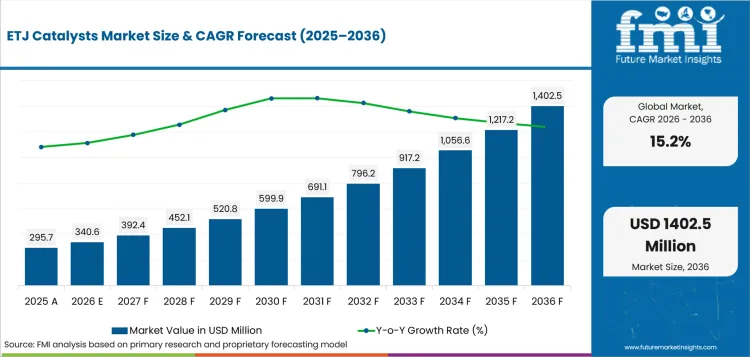
ETJ Catalysts Market Overview: Size and Forecast
- 2025 Market Size: USD 295.7 million
- 2026 Market Size: USD 340.7 million
- 2036 Market Size: USD 1,402.5 million
- Forecast CAGR: 15.2% from 2026 to 2036
- Leading Feedstock Route: Ethanol-to-Jet
- Ethanol-to-Jet Share in 2026: 72.0%
- Leading End Use: SAF Producers
- SAF Producers Share in 2026: 63.0%
- Leading Sales Mix: New SAF Plants
- New SAF Plants Share in 2026: 71.0%
- Leading Country by CAGR: India
- India CAGR: 17.4% by 2036
Summary of the ETJ Catalysts Market
- Demand and Growth Drivers
- Rising commercial production of Sustainable Aviation Fuel (SAF) is increasing demand for ethanol-to-jet catalysts, as producers scale capacity to meet airline decarbonization targets and regulatory blending requirements.
- Growing adoption of ethanol-based SAF pathways in regions with abundant bioethanol supply is driving catalyst consumption across new and expanding ETJ facilities.
- Increasing investments in SAF projects and technology commercialization are accelerating catalyst sales, with developers seeking higher conversion efficiency and improved process economics.
- Long-term offtake agreements between airlines and SAF producers are supporting higher ETJ fuel output, creating sustained demand for advanced catalysts used in ethanol conversion processes.
- Product and Segment View
- Oligomerization Catalysts are projected to lead the Catalyst Type segment with 43.0% share as they shape jet-range output.
- Ethanol-to-Jet is expected to lead the Feedstock segment with 72.0% share because ethanol is the most developed ETJ input.
- Oligomerization is anticipated to lead the Process Step segment with 39.0% share owing to its effect on carbon-chain distribution.
- SAF Producers are forecast to lead the End Use segment with 63.0% share as they buy catalysts with process guarantees.
- New SAF Plants are expected to lead the Sales Mix segment with 71.0% share as new capacity needs first-fill loading.
- Geography and Competitive Outlook
- India is projected to grow fastest at 17.4% CAGR as blending targets and domestic ethanol supply support ETJ planning.
- The United States is expected to remain the clearest early scale market with operating ethanol-to-jet proof.
- Axens and Topsoe compete on process-step depth across dehydration and oligomerization with hydrogenation packages.
- LanzaJet and Praj Industries influence catalyst demand through ETJ technology scale-up and project validation.
- Specialist catalyst suppliers can win where they prove selectivity and life-cycle support with feedstock flexibility.
- Analyst Opinion
- Nikhil Kaitwade, Principal Consultant at FMI, says, “I see ETJ catalysts as a process reliability market before I see it as a volume market. Buyers are choosing the risk profile of a licensed SAF unit that must meet fuel specifications and offtake terms. Oligomerization is the pressure point because it controls the carbon-chain distribution that decides saleable jet yield.”
The ETJ catalysts market is projected to expand through 2036 as ethanol-based SAF projects convert policy targets into catalyst qualification work. Demand is shaped by new SAF plants and SAF producers. Oligomerization catalysts and ethanol-to-jet feedstock also influence process-step warranties.
Commercial proof is shifting catalyst buying from small research orders toward first-fill supply and start-up service. The USA Department of Energy reported in February 2024 that LanzaJet Freedom Pines is the first commercial ethanol alcohol-to-jet SAF plant. The facility is designed for 9 million gallons of SAF and 1 million gallons of renewable diesel in its first year. Project developers are expected to demand stronger yield evidence before locking catalyst suppliers into process packages. Axens stated in January 2026 that Praj demonstrated an ethanol-to-jet pathway using dehydration and oligomerization before hydrogenation. That gives catalyst suppliers a clearer route to compete on selectivity and start-up support.
Which factors support expansion in the ETJ catalysts market?
Finished catalyst packages and process-service revenue support market value across licensed ETJ projects.
- Market value is supported by catalyst revenue before process licensors add start-up and performance service income.
- Supplier pricing reflects selectivity evidence and catalyst life before ethanol logistics affect final buying decisions.
- Revenue improves when alcohol-to-jet developers move from pilots into bankable engineering packages.
- Buyer confidence rises when catalyst vendors document jet-range distribution and hydrogen use under realistic feedstocks.
Why is the ETJ Catalysts Market Growing?
SAF mandates are turning ETJ catalysts into compliance-linked process inputs. Developers of sustainable aviation fuel projects need catalysts that can move alcohol streams toward ASTM-compliant jet-range hydrocarbons. The USA Department of Energy reported in January 2025 that announced domestic SAF projects represented over 3 billion gallons of annual capacity by 2030 and over USD 44 billion in investment.
Catalyst buyers are expected to compare ETJ packages against adjacent refinery catalyst systems and dedicated catalysts for bio-jet fuel when they evaluate life-cycle cost. Topsoe and Axens both describe oligomerization and hydrogenation as central steps in alcohol-to-jet conversion. That makes catalyst performance a yield and financing issue rather than a routine consumable purchase.
Feedstock strategy is another driver because ethanol-rich countries can connect alcohol supply with fuel mandates. The market is therefore linked to the ethanol biofuel supply base as well as broader chemical catalyst technology choices. ETJ suppliers that document impurity tolerance should gain access to projects using sugarcane and corn. Residue alcohol and mixed alcohol routes can create additional opportunities.
How is the ETJ catalysts market segmented?
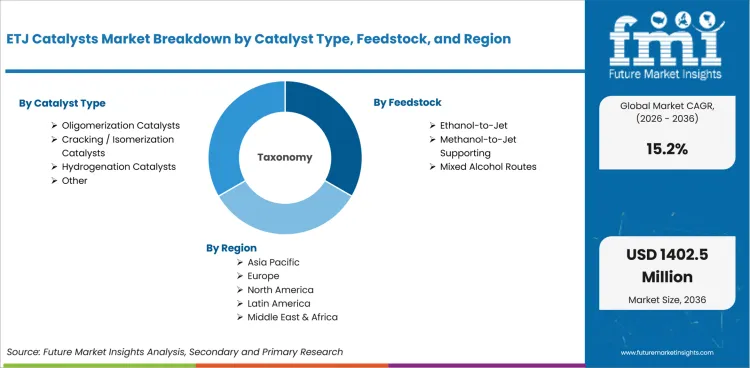
The ETJ catalysts industry is segmented by catalyst type and feedstock. It is also segmented by process step and end use. Sales mix and region are also covered.
- Oligomerization Catalysts are projected to account for 43.0% share in 2026 as jet-range chain building drives value capture.
- Ethanol-to-Jet is expected to lead with 72.0% share in 2026 due to commercial plant proof and ethanol availability.
- Oligomerization is anticipated to hold 39.0% share by process step in 2026 because it controls carbon-chain distribution.
- SAF Producers are forecast to represent 63.0% share in 2026 with direct buying tied to process licenses.
- New SAF Plants are anticipated to hold 71.0% share in 2026 as project construction needs first-fill catalysts.
Why do oligomerization catalysts lead the ETJ catalysts market?
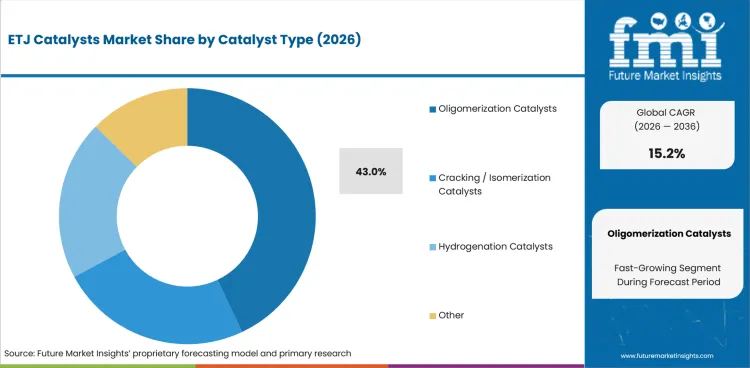
- Oligomerization Catalysts are projected to account for 43.0% share in 2026 because this step builds the jet-range carbon chains.
- Cracking and isomerization catalysts gain use where producers need tighter specification control after chain building.
Which feedstock leads the ETJ catalysts market?
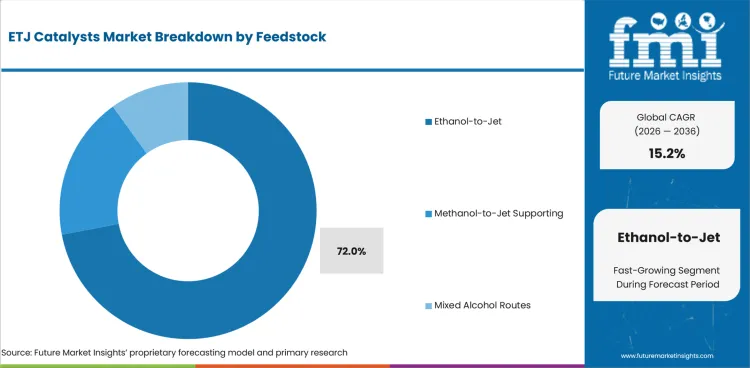
- Ethanol-to-Jet is expected to hold 72.0% share in 2026 as commercial proof and ethanol logistics support the route.
- Mixed alcohol routes are expected to gain attention where waste gas or residue-derived alcohol streams are available.
Which process step leads the ETJ catalysts market?
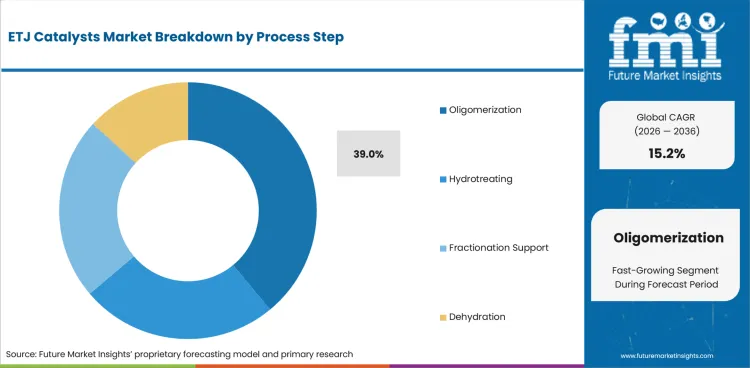
- Oligomerization is forecast to secure 39.0% share in 2026 due to its direct effect on jet-range yield.
- Hydrotreating demand increases when producers need fuel stability and final specification control.
Which end use leads the ETJ catalysts market?
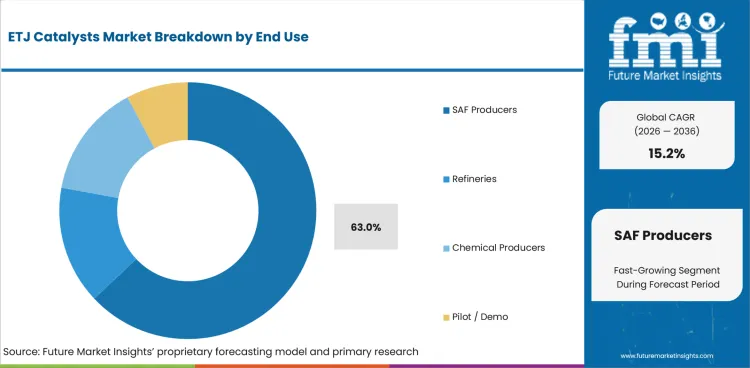
- SAF Producers are projected to account for 63.0% share in 2026 because they buy catalysts with process guarantees.
- Refineries gain importance where alcohol-to-jet units are integrated into existing fuel infrastructure.
Which sales mix leads the ETJ catalysts market?
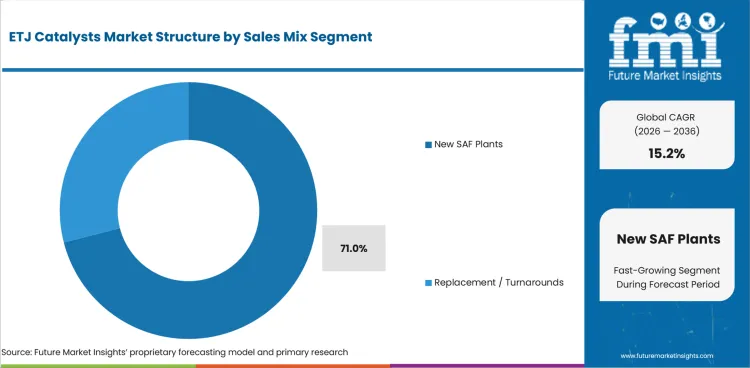
- New SAF Plants are expected to represent 71.0% share in 2026 as greenfield and bolt-on units need first-fill catalyst packages.
- Replacement and turnaround demand is expected to expand after early plants complete stable operating cycles.
What are the drivers and restraints in the ETJ catalysts market?
SAF rules and ethanol logistics support growth while yield risk and hydrogen access restrain wider project conversion.
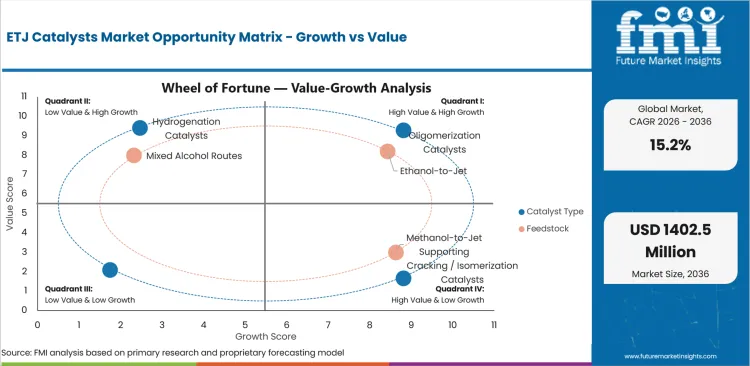
- Driver: SAF mandates are expected to raise ETJ catalyst demand when airlines and fuel suppliers need certified lower-carbon jet fuel volumes.
- Driver: Ethanol-rich regions create ETJ openings because alcohol logistics can reduce feedstock uncertainty for new SAF plants.
- Restraint: Catalyst selectivity is a constraint because poor jet-range distribution can reduce saleable output.
- Restraint: Hydrogen supply creates a cost barrier where upgrading steps need reliable low-carbon hydrogen access.
- Opportunity: Mixed alcohol processing opens demand for catalyst firms with feedstock-tolerant dehydration and oligomerization systems.
ETJ Catalysts Market Demand Outlook
Demand outlook is moving toward licensed alcohol-to-jet projects that can prove yield before plant financing closes. The market is connected to aviation drop-in biomass renewable fuels because airlines need fuels that work in existing aircraft and airport fuel systems. The European Commission stated in February 2025 that industry was on track to meet the first 2.0% ReFuelEU Aviation target for 2025.
Hydrogen availability is expected to shape catalyst selection because upgrading steps need predictable supply and cost. That links ETJ catalysts with hydrogen electrolyzer investment and broader low-carbon hydrogen planning. Suppliers with lower hydrogen-use claims still need pilot data before buyers treat those claims as bankable.
Consumer Segmentation and Purchase Behavior Analysis
The direct buyer base is concentrated among SAF producers and refineries. Chemical producers and pilot project owners create additional demand. SAF producers are expected to lead with 63.0% share in 2026 because they make the final catalyst selection for licensed ETJ units. Refineries can add demand where existing hydroprocessing assets reduce integration risk.
Voice of Customer and Decision-driver Analysis
Buyer decisions are shaped by jet-range yield and catalyst life. Ethanol impurity tolerance and hydrogen use also guide supplier selection. Developers assessing aviation fuel additives and catalyst packages still need fuel specification proof before accepting supplier claims. Performance warranties are expected to carry more weight than material price alone.aviation fuel additives
Longer-term project economics are expected to connect ETJ catalysts with carbon accounting and fuel-credit systems. This creates an indirect link with carbon capture storage where producers evaluate the wider cost of low-carbon aviation fuel pathways. Catalyst vendors that can quantify output quality and emissions-relevant process efficiency should be better placed in engineering reviews.
Which countries are growing fastest in the ETJ catalysts market?
India leads at 17.4% CAGR through 2036. United States follows at 16.9% CAGR. South Korea records 16.8% CAGR. China records 16.6% CAGR. Japan records 16.4% CAGR. United Kingdom records 16.1% CAGR. France records 14.8% CAGR. Germany records 14.7% CAGR.
.webp "Top Country Growth Comparison Etj Catalysts Market Cagr (2026 2036)")
| Country | CAGR |
|---|---|
| India | 17.4% |
| United States | 16.9% |
| South Korea | 16.8% |
| China | 16.6% |
| Japan | 16.4% |
| United Kingdom | 16.1% |
| France | 14.8% |
| Germany | 14.7% |
| Source | Future Market Insights, 2026. |
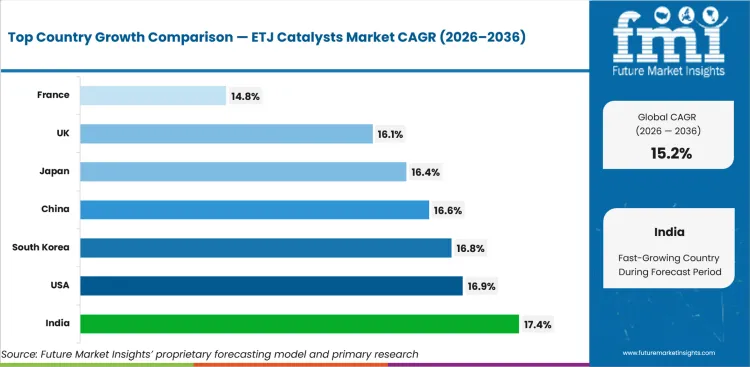
How do country-level CAGRs compare in the ETJ catalysts market?
India leads selected-country growth while Germany records the most measured expansion outlook among profiled markets.
- India is forecast to record 17.4% by 2036 as ethanol blending targets and domestic SAF certification work support ETJ project design.
- United States is forecast to record 16.9% by 2036 as commercial ATJ proof and loan-backed SAF project visibility reduce scale-up risk.
- South Korea is forecast to record 16.8% by 2036 as mandatory SAF blending for international departures creates a clear compliance timetable.
- China is forecast to record 16.6% by 2036 as pilot flights and large airport throughput create a larger testing base for local SAF supply.
- Japan is forecast to record 16.4% by 2036 as domestic SAF subsidy work and 2030 airline replacement goals support catalyst qualification.
- United Kingdom is forecast to record 16.1% by 2036 as mandate schedules and Project Speedbird planning support local alcohol-to-jet demand.
- France is forecast to record 14.8% by 2036 as EU mandate coverage and active airport traffic keep SAF supply planning visible.
- Germany is forecast to record 14.7% by 2036 as EU rules create demand but tax and traffic recovery gaps slow project timing.
How fast is the ETJ catalysts market growing in India?
A 17.4% CAGR through 2036 reflects ethanol policy and SAF certification. Expanding aviation fuel demand also supports the outlook.
Country Market Snapshot Table
| Parameter | Value |
|---|---|
| Market Size in 2025 (Value) | USD 26.0 million |
| Market Size in 2026 (Value) | USD 30.5 million |
| Market Forecast in 2036 (Value) | USD 151.7 million |
| CAGR (2026 to 2036) | 17.4% |
| Years Considered | 2021 to 2036 |
| Base Year | 2025 |
| Forecast Period | 2026 to 2036 |
| Units Considered | Value (USD million) |
| Leading Sub-Region | Panipat and sugarcane ethanol corridors |
India ETJ Catalysts Market Outlook
India ETJ catalyst demand is supported by ethanol policy and SAF certification work. Fast aviation expansion strengthens the demand case. Catalyst suppliers can benefit where alcohol-to-jet routes connect sugarcane ethanol and residue-based feedstocks.
Buyers are expected to seek catalyst packages that can handle variable feedstocks and support domestic certification. Local partnerships should matter because project developers need process support during scale-up.
Key Growth Drivers
- Blending targets create a direct SAF catalyst signal. The Press Information Bureau stated in September 2025 that India targets 1.0% SAF blending by 2027.
- Airport expansion strengthens the long-term fuel demand base. The Press Information Bureau stated in October 2025 that India had 163 airports in 2025.
- Domestic certification work is expected to help catalyst vendors align process data with SAF approval requirements.
- Praj and Axens validation should support ETJ catalyst qualification through integrated alcohol-to-jet process evidence.
Key Restraints
- Feedstock collection remains a practical constraint. The Press Information Bureau stated in September 2025 that India had nearly 230.0 million metric tonnes of surplus agricultural residue.
- Project developers need reliable ethanol quality before catalyst life and selectivity can be guaranteed.
- High capital cost can delay ETJ units where airlines are not ready to sign long-term SAF offtake contracts.
What makes India unique
India is distinct because ethanol policy and domestic certification create a broad SAF project base. Fast aviation capacity expansion adds a second demand channel.
Key Companies
- Praj Industries
- Indian Oil Corporation
- Bharat Petroleum Corporation
- Hindustan Petroleum Corporation
- Reliance Industries
- Godavari Biorefineries
- Triveni Engineering
Sales & Marketing Channels
- SAF producers
- Oil marketing companies
- Ethanol suppliers
- Airport fuel buyers
- Process licensors
- Engineering contractors
Country Segment Breakdown Table
| Segment | Sub-Segments |
|---|---|
| By Catalyst Type | Oligomerization Catalysts, Cracking / Isomerization Catalysts, Hydrogenation Catalysts, Other |
| By Feedstock | Ethanol-to-Jet, Methanol-to-Jet Supporting, Mixed Alcohol Routes |
| By Process Step | Dehydration, Oligomerization, Hydrotreating, Fractionation Support |
| By End Use | SAF Producers, Refineries, Chemical Producers, Pilot / Demo |
| By Sales Mix | New SAF Plants, Replacement / Turnarounds |
| Key Sub-Regions Covered, Industrial and Airport Clusters | Panipat, Maharashtra, Uttar Pradesh, Karnataka, Gujarat, Delhi-NCR |
How fast is the ETJ catalysts market growing in United States?
A 16.9% CAGR through 2036 reflects commercial alcohol-to-jet proof and ethanol logistics across early SAF corridors.
Country Market Snapshot Table
| Parameter | Value |
|---|---|
| Market Size in 2025 (Value) | USD 78.7 million |
| Market Size in 2026 (Value) | USD 92.0 million |
| Market Forecast in 2036 (Value) | USD 438.5 million |
| CAGR (2026 to 2036) | 16.9% |
| Years Considered | 2021 to 2036 |
| Base Year | 2025 |
| Forecast Period | 2026 to 2036 |
| Units Considered | Value (USD million) |
| Leading Sub-Region | Gulf Coast and Midwest SAF corridors |
United States ETJ Catalysts Market Outlook
United States ETJ catalyst demand is influenced by operating alcohol-to-jet proof and a large ethanol supply base. Early plant data gives buyers a better basis for first-fill catalyst selection and performance guarantees.
Project developers are expected to prioritize catalysts that support jet-range yield under commercial feedstock conditions. Suppliers with pilot records and start-up teams should gain more access to EPC-led qualification rounds.
Key Growth Drivers
- Freedom Pines gives United States buyers operating ETJ proof. The USA Department of Energy reported in February 2024 that the Georgia plant is designed for 9.0 million gallons of SAF in its first year.
- Refinery integration supports upgrading catalyst demand. The USA Energy Information Administration stated in March 2025 that three main transportation fuels made up more than 85.0% of refinery output.
- Corn ethanol logistics are expected to support dehydration catalyst trials because alcohol supply chains already serve large domestic fuel markets.
- Project pipeline visibility supports first-fill catalyst planning as domestic SAF developers move into engineering reviews.
Key Restraints
- Scale-up remains exposed to fuel-use volatility. The USA Energy Information Administration reported in August 2025 that USA jet fuel consumption growth had slowed in 2025.
- Hydrogen cost can delay catalyst package selection where low-carbon supply is not available near SAF sites.
- Project financing can slow order conversion when offtake contracts do not cover start-up and catalyst replacement risk.
What makes United States unique
The United States is distinct because commercial alcohol-to-jet proof and ethanol supply are located near aviation fuel demand centers.
Key Companies
- LanzaJet
- Gevo
- Honeywell UOP
- Albemarle Corporation
- W. R. Grace & Co.
- Johnson Matthey Inc.
- Cargill Bioindustrial
Sales & Marketing Channels
- Process licensors
- SAF plant EPCs
- Refinery procurement teams
- Catalyst distributors
- Ethanol producer partnerships
- Technology demonstration programs
Country Segment Breakdown Table
| Segment | Sub-Segments |
|---|---|
| By Catalyst Type | Oligomerization Catalysts, Cracking / Isomerization Catalysts, Hydrogenation Catalysts, Other |
| By Feedstock | Ethanol-to-Jet, Methanol-to-Jet Supporting, Mixed Alcohol Routes |
| By Process Step | Dehydration, Oligomerization, Hydrotreating, Fractionation Support |
| By End Use | SAF Producers, Refineries, Chemical Producers, Pilot / Demo |
| By Sales Mix | New SAF Plants, Replacement / Turnarounds |
| Key Sub-Regions Covered, Industrial and Airport Clusters | Gulf Coast, Georgia, Midwest ethanol corridor, California, Pacific Northwest, Illinois |
How fast is the ETJ catalysts market growing in South Korea?
A 16.8% CAGR through 2036 reflects mandatory SAF blending for international departures and refinery integration.
Country Market Snapshot Table
| Parameter | Value |
|---|---|
| Market Size in 2025 (Value) | USD 24.0 million |
| Market Size in 2026 (Value) | USD 28.0 million |
| Market Forecast in 2036 (Value) | USD 132.3 million |
| CAGR (2026 to 2036) | 16.8% |
| Years Considered | 2021 to 2036 |
| Base Year | 2025 |
| Forecast Period | 2026 to 2036 |
| Units Considered | Value (USD million) |
| Leading Sub-Region | Ulsan and Incheon aviation fuel corridors |
South Korea ETJ Catalysts Market Outlook
South Korea ETJ catalyst demand is shaped by mandatory SAF blending for international departures and a strong refining export base. Early catalyst orders are expected to follow refinery-led compliance projects.
Suppliers should gain where they can support refinery integration and process data for alcohol-to-jet routes. Local buyers are expected to compare ETJ against HEFA and imported SAF options.
Key Growth Drivers
- The mandate gives suppliers a clear start date. MOLIT stated in September 2025 that SAF blending becomes mandatory for international flights departing Korea in 2027.
- Blend planning supports near-term qualification. MOTIE and MOLIT stated in September 2024 that Korea was considering a 1.0% SAF blend for international departures from 2027 onward.
- Large refinery operators are expected to support catalyst demand where SAF compliance can be integrated with existing fuel exports.
- Airport-linked fuel suppliers should favor catalyst packages that provide stable output quality and documented lifecycle assumptions.
Key Restraints
- Early blending rates may limit first-fill volumes. Korea’s 2027 obligation starts from a 1.0% planning level under the September 2024 roadmap.
- Imported ethanol or alcohol intermediates can add feedstock price risk before domestic routes scale.
- Refiners may delay ETJ catalyst selection when HEFA options offer faster near-term compliance.
What makes South Korea unique
South Korea is distinct because a clear 2027 mandate meets refinery scale and international aviation fuel export expertise.
Key Companies
- SK Innovation
- S-Oil
- Hyundai Oilbank
- GS Caltex
- Lotte Chemical
- Korea National Oil Corporation
- Korean Air SAF partners
Sales & Marketing Channels
- Refinery procurement groups
- Airline fuel buyers
- Airport fuel operators
- Government pilot programs
- Process licensors
- Catalyst distributors
Country Segment Breakdown Table
| Segment | Sub-Segments |
|---|---|
| By Catalyst Type | Oligomerization Catalysts, Cracking / Isomerization Catalysts, Hydrogenation Catalysts, Other |
| By Feedstock | Ethanol-to-Jet, Methanol-to-Jet Supporting, Mixed Alcohol Routes |
| By Process Step | Dehydration, Oligomerization, Hydrotreating, Fractionation Support |
| By End Use | SAF Producers, Refineries, Chemical Producers, Pilot / Demo |
| By Sales Mix | New SAF Plants, Replacement / Turnarounds |
| Key Sub-Regions Covered, Industrial and Airport Clusters | Ulsan, Incheon, Seoul Capital Area, Busan, Daesan, Yeosu |
How fast is the ETJ catalysts market growing in China?
A 16.6% CAGR through 2036 reflects pilot flights and large airport throughput supporting future SAF trials.
Country Market Snapshot Table
| Parameter | Value |
|---|---|
| Market Size in 2025 (Value) | USD 33.9 million |
| Market Size in 2026 (Value) | USD 39.5 million |
| Market Forecast in 2036 (Value) | USD 183.5 million |
| CAGR (2026 to 2036) | 16.6% |
| Years Considered | 2021 to 2036 |
| Base Year | 2025 |
| Forecast Period | 2026 to 2036 |
| Units Considered | Value (USD million) |
| Leading Sub-Region | Yangtze River Delta and major airport corridors |
China ETJ Catalysts Market Outlook
China ETJ catalyst demand is supported by large airport throughput and policy-backed SAF pilots. Local catalyst qualification can scale faster once demonstration flights convert into procurement frameworks.
Buyers are expected to assess ETJ catalysts through feedstock flexibility and domestic manufacturing readiness. Suppliers with local technical service teams should have an advantage in pilot-to-plant conversion.
Key Growth Drivers
- SAF pilot activity is moving into airline operations. CAAC reported in September 2024 that 12 flights were refueled with SAF across four participating airports.
- Airport scale gives catalyst suppliers a large future fuel base. CAAC reported in March 2026 that Chinese airports handled 1,529.0 million passengers in 2025.
- Domestic ethanol and chemical processing capacity are expected to support local trials for dehydration and oligomerization catalyst packages.
- National airline participation should help catalyst vendors validate fuel performance across multiple operating environments.
Key Restraints
- Project timing remains tied to airport and airline approval cycles. CAAC reported in March 2026 that international passenger throughput grew 18.7% in 2025.
- Feedstock sustainability documentation can slow approval where residue and alcohol streams have variable origin records.
- Local qualification requirements may limit imported catalyst packages that lack domestic testing data.
What makes China unique
China is distinct because SAF pilots can be paired with very large airport throughput and domestic catalyst manufacturing capacity.
Key Companies
- Sinopec
- PetroChina
- China National Aviation Fuel
- Wanhua Chemical
- Shaanxi Yanchang Petroleum
- Zhejiang Satellite Chemical
- Cathay Pacific China SAF partners
Sales & Marketing Channels
- State fuel suppliers
- Airport fuel operators
- Refinery project teams
- Chemical producers
- Airline pilot programs
- Local catalyst distributors
Country Segment Breakdown Table
| Segment | Sub-Segments |
|---|---|
| By Catalyst Type | Oligomerization Catalysts, Cracking / Isomerization Catalysts, Hydrogenation Catalysts, Other |
| By Feedstock | Ethanol-to-Jet, Methanol-to-Jet Supporting, Mixed Alcohol Routes |
| By Process Step | Dehydration, Oligomerization, Hydrotreating, Fractionation Support |
| By End Use | SAF Producers, Refineries, Chemical Producers, Pilot / Demo |
| By Sales Mix | New SAF Plants, Replacement / Turnarounds |
| Key Sub-Regions Covered, Industrial and Airport Clusters | Shanghai, Beijing-Tianjin-Hebei, Guangdong, Chengdu-Chongqing, Zhengzhou, Ningbo |
How fast is the ETJ catalysts market growing in Japan?
A 16.4% CAGR through 2036 reflects domestic SAF targets and refinery-linked ATJ project development.
Country Market Snapshot Table
| Parameter | Value |
|---|---|
| Market Size in 2025 (Value) | USD 26.6 million |
| Market Size in 2026 (Value) | USD 31.0 million |
| Market Forecast in 2036 (Value) | USD 141.5 million |
| CAGR (2026 to 2036) | 16.4% |
| Years Considered | 2021 to 2036 |
| Base Year | 2025 |
| Forecast Period | 2026 to 2036 |
| Units Considered | Value (USD million) |
| Leading Sub-Region | Tokyo Bay and Setouchi industrial corridors |
Japan ETJ Catalysts Market Outlook
Japan ETJ catalyst demand is supported by domestic SAF targets and named ATJ project development. Buyers are expected to favor catalysts that can handle imported and domestic ethanol routes.
Commercial selection is expected to depend on fuel certification and refinery-linked integration. Suppliers with local partners and clear process data should gain early traction.
Key Growth Drivers
- National SAF policy supports catalyst qualification. Japan aviation authorities stated in 2024 that the country aims to replace 10.0% of fuel used by Japanese airlines with SAF by 2030.
- Airline planning is moving into formal approval work. ICAO materials reported in 2025 that major Japanese airline plans were certified by March 2025.
- Refinery-linked projects are expected to support demand for oligomerization and hydrogenation catalysts that can fit existing fuel operations.
- Imported ethanol flexibility should help suppliers that can document catalyst tolerance across alcohol feedstock grades.
Key Restraints
- Feedstock constraints remain visible. METI noted in February 2025 that global SAF supply was only 0.1% of aviation fuel supplies in 2022.
- Domestic projects need long qualification cycles before airlines can rely on local SAF volumes.
- Competing HEFA and synthetic pathways can split investment before ATJ units reach steady operation.
What makes Japan unique
Japan is distinct because domestic SAF goals and refinery-linked ATJ planning give catalyst vendors a defined qualification route.
Key Companies
- Cosmo Oil
- ENEOS
- Idemitsu Kosan
- Mitsui & Co.
- Nippon Shokubai
- Chiyoda Corporation
- JGC Holdings
Sales & Marketing Channels
- Refinery procurement teams
- Trading houses
- Airline offtake groups
- EPC contractors
- Technology licensors
- Government demonstration programs
Country Segment Breakdown Table
| Segment | Sub-Segments |
|---|---|
| By Catalyst Type | Oligomerization Catalysts, Cracking / Isomerization Catalysts, Hydrogenation Catalysts, Other |
| By Feedstock | Ethanol-to-Jet, Methanol-to-Jet Supporting, Mixed Alcohol Routes |
| By Process Step | Dehydration, Oligomerization, Hydrotreating, Fractionation Support |
| By End Use | SAF Producers, Refineries, Chemical Producers, Pilot / Demo |
| By Sales Mix | New SAF Plants, Replacement / Turnarounds |
| Key Sub-Regions Covered, Industrial and Airport Clusters | Tokyo Bay, Osaka-Kobe, Sakaide, Nagoya, Kyushu, Hokkaido |
How fast is the ETJ catalysts market growing in United Kingdom?
A 16.1% CAGR through 2036 reflects mandate-backed procurement and Project Speedbird activity around Teesside.
Country Market Snapshot Table
| Parameter | Value |
|---|---|
| Market Size in 2025 (Value) | USD 36.2 million |
| Market Size in 2026 (Value) | USD 42.0 million |
| Market Forecast in 2036 (Value) | USD 186.9 million |
| CAGR (2026 to 2036) | 16.1% |
| Years Considered | 2021 to 2036 |
| Base Year | 2025 |
| Forecast Period | 2026 to 2036 |
| Units Considered | Value (USD million) |
| Leading Sub-Region | Teesside and Heathrow-linked supply corridors |
United Kingdom ETJ Catalysts Market Outlook
United Kingdom ETJ catalyst demand is shaped by a clear SAF mandate and project work around Teesside. Local developers need catalysts that can support alcohol-to-jet conversion under domestic fuel obligations.
Buyers are expected to favor technology packages with bankable yield data and mandate-aligned documentation. Catalyst suppliers should gain where they connect process guarantees with UK offtake planning.
Key Growth Drivers
- The SAF mandate creates a direct project signal for catalyst suppliers. The Department for Transport stated in April 2024 that the 2025 obligation is set at 2.0% of jet fuel supplied.
- Long-term mandate visibility supports bankable catalyst qualification. The Department for Transport stated in December 2024 that the UK SAF obligation reaches 22.0% in 2040.
- Policy-backed procurement is expected to support first-fill catalyst orders where fuel suppliers need compliant volumes under mandate accounting.
- Airport-linked offtake planning should support catalyst vendors that can document ASTM-compliant output and start-up service readiness.
Key Restraints
- Traffic recovery can pressure fuel-cost acceptance. The UK Civil Aviation Authority reported in February 2026 that UK aviation reached 302.0 million passenger journeys in 2025.
- High buyout prices can delay marginal projects if producers view compliance payments as less risky than new production.
- PtL carve-outs may draw policy attention away from ethanol-to-jet projects where synthetic aviation fuel supply is prioritized.
What makes United Kingdom unique
The United Kingdom is distinct because a binding mandate and a named alcohol-to-jet project create a visible route for catalyst qualification.
Key Companies
- LanzaJet UK
- British Airways
- Nova Pangaea Technologies
- Coryton Advanced Fuels
- Johnson Matthey
- Velocys
- BP
Sales & Marketing Channels
- Fuel suppliers
- Airline offtake groups
- Process licensors
- Teesside project partners
- Refinery procurement teams
- Government-backed demonstration programs
Country Segment Breakdown Table
| Segment | Sub-Segments |
|---|---|
| By Catalyst Type | Oligomerization Catalysts, Cracking / Isomerization Catalysts, Hydrogenation Catalysts, Other |
| By Feedstock | Ethanol-to-Jet, Methanol-to-Jet Supporting, Mixed Alcohol Routes |
| By Process Step | Dehydration, Oligomerization, Hydrotreating, Fractionation Support |
| By End Use | SAF Producers, Refineries, Chemical Producers, Pilot / Demo |
| By Sales Mix | New SAF Plants, Replacement / Turnarounds |
| Key Sub-Regions Covered, Industrial and Airport Clusters | Teesside, Heathrow corridor, London, Manchester, Midlands, Scotland |
How fast is the ETJ catalysts market growing in France?
A 14.8% CAGR through 2036 reflects airport coverage under EU rules and refinery-linked fuel supply planning.
Country Market Snapshot Table
| Parameter | Value |
|---|---|
| Market Size in 2025 (Value) | USD 29.6 million |
| Market Size in 2026 (Value) | USD 34.0 million |
| Market Forecast in 2036 (Value) | USD 135.2 million |
| CAGR (2026 to 2036) | 14.8% |
| Years Considered | 2021 to 2036 |
| Base Year | 2025 |
| Forecast Period | 2026 to 2036 |
| Units Considered | Value (USD million) |
| Leading Sub-Region | Paris airport and southern refining corridors |
France ETJ Catalysts Market Outlook
France ETJ catalyst demand is shaped by EU SAF obligations and strong aviation traffic recovery. Local buyers need catalysts that fit refinery operations and airline fuel accounting.
Project timing is expected to depend on offtake clarity and the cost gap between SAF and fossil jet fuel. Suppliers with European compliance evidence should gain stronger consideration.
Key Growth Drivers
- Aviation activity supports SAF project planning. DSNA reported in July 2025 that it controlled 3.4 million flights in 2024.
- French compliance coverage is widening. DGAC reported in June 2025 that ReFuelEU applied to 17 airports in France during 2024.
- Refinery-linked supply chains are expected to support catalyst qualification where alcohol-to-jet projects can share fuel logistics.
- French airline decarbonization targets should support vendors that can show fuel stability and jet-range yield.
Key Restraints
- Ticket-tax pressure can affect fuel-cost acceptance. French authorities stated in November 2025 that the TSBA increase was expected to generate more than EUR 3.0 billion in annual state revenue.
- International aviation emissions growth keeps SAF under scrutiny and raises pressure for verifiable lifecycle claims.
- ETJ projects must compete with HEFA and synthetic fuel options for airline offtake budgets.
What makes France unique
France is distinct because airport coverage and traffic recovery create SAF demand while tax pressure keeps project economics under review.
Key Companies
- TotalEnergies
- Axens
- Air Liquide
- Safran
- Air France-KLM SAF partners
- IFP Energies nouvelles
- Suez biofuel partners
Sales & Marketing Channels
- Airport fuel suppliers
- Refinery project teams
- Airline offtake groups
- Process licensors
- EPC contractors
- EU compliance buyers
Country Segment Breakdown Table
| Segment | Sub-Segments |
|---|---|
| By Catalyst Type | Oligomerization Catalysts, Cracking / Isomerization Catalysts, Hydrogenation Catalysts, Other |
| By Feedstock | Ethanol-to-Jet, Methanol-to-Jet Supporting, Mixed Alcohol Routes |
| By Process Step | Dehydration, Oligomerization, Hydrotreating, Fractionation Support |
| By End Use | SAF Producers, Refineries, Chemical Producers, Pilot / Demo |
| By Sales Mix | New SAF Plants, Replacement / Turnarounds |
| Key Sub-Regions Covered, Industrial and Airport Clusters | Paris, Normandy, Marseille-Fos, Lyon, Toulouse, Bordeaux |
How fast is the ETJ catalysts market growing in Germany?
A 14.7% CAGR through 2036 reflects EU SAF compliance needs with cautious refinery investment timing.
Country Market Snapshot Table
| Parameter | Value |
|---|---|
| Market Size in 2025 (Value) | USD 31.4 million |
| Market Size in 2026 (Value) | USD 36.0 million |
| Market Forecast in 2036 (Value) | USD 141.9 million |
| CAGR (2026 to 2036) | 14.7% |
| Years Considered | 2021 to 2036 |
| Base Year | 2025 |
| Forecast Period | 2026 to 2036 |
| Units Considered | Value (USD million) |
| Leading Sub-Region | Frankfurt and Rhine-Ruhr refining corridors |
Germany ETJ Catalysts Market Outlook
Germany ETJ catalyst demand is supported by ReFuelEU obligations and a strong refining base. Adoption is slower because fuel-tax pressure and traffic recovery gaps can affect investment timing.
Catalyst suppliers are expected to win through refinery-compatible packages and European mandate documentation. Buyers are still expected to test whether ETJ projects can compete with other SAF routes.
Key Growth Drivers
- ReFuelEU gives German fuel suppliers a mandate-backed demand floor. The European Commission reported in October 2025 that the 2030 EU SAF blending target is 6.0%.
- Aviation recovery keeps SAF demand visible. Destatis stated in October 2025 that 105.3 million people flew from Germany in 2024.
- Refinery and chemical infrastructure is expected to support catalyst trials that combine oligomerization and hydrotreating know-how.
- German engineering contractors should favor catalyst vendors with validated process data and start-up service commitments.
Key Restraints
- Aviation taxes can narrow project economics. Destatis reported in April 2026 that EUR 2.1 billion of aviation tax was payable in 2025.
- Traffic volumes remain below the 2019 benchmark, limiting the pace at which airlines accept higher SAF cost.
- Competing PtL and HEFA pathways can delay ETJ catalyst decisions when fuel suppliers diversify compliance options.
What makes Germany unique
Germany is distinct because refinery depth and EU mandate exposure are balanced by higher tax pressure and cautious fuel-cost planning.
Key Companies
- BASF
- Clariant
- Evonik Industries
- Topsoe Germany
- Linde Engineering
- Deutsche Aircraft SAF partners
- Sunfire
Sales & Marketing Channels
- Refinery procurement groups
- Chemical producers
- Airport fuel suppliers
- EPC contractors
- EU compliance buyers
- Technology licensors
Country Segment Breakdown Table
| Segment | Sub-Segments |
|---|---|
| By Catalyst Type | Oligomerization Catalysts, Cracking / Isomerization Catalysts, Hydrogenation Catalysts, Other |
| By Feedstock | Ethanol-to-Jet, Methanol-to-Jet Supporting, Mixed Alcohol Routes |
| By Process Step | Dehydration, Oligomerization, Hydrotreating, Fractionation Support |
| By End Use | SAF Producers, Refineries, Chemical Producers, Pilot / Demo |
| By Sales Mix | New SAF Plants, Replacement / Turnarounds |
| Key Sub-Regions Covered, Industrial and Airport Clusters | Frankfurt, Hamburg, North Rhine-Westphalia, Bavaria, Berlin, Saxony |
Who are the leading companies in the ETJ catalysts market?
Axens and Topsoe lead through process licensing depth. LanzaJet and Praj Industries shape adoption through SAF project references. Johnson Matthey and Honeywell UOP support competition through catalyst know-how.
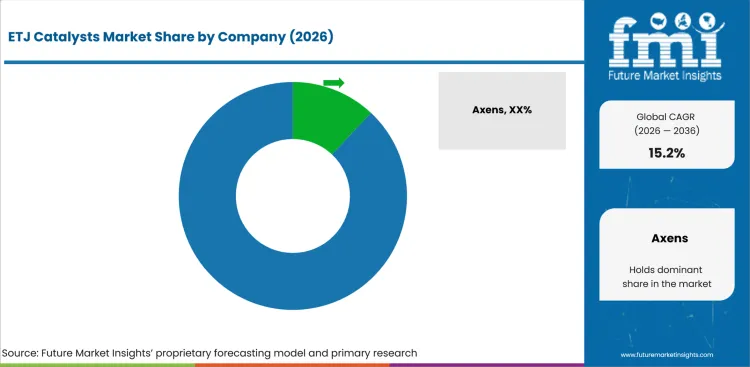
- Process licensors hold an advantage where catalyst supply is connected with plant guarantees and start-up service.
- Catalyst specialists gain consideration when they prove jet-range selectivity and hydrogen-use advantages.
- SAF technology developers influence catalyst selection through process packages and engineering partnerships.
- Refinery-linked suppliers can win where existing fuel infrastructure reduces integration risk.
The ETJ catalysts market is supplier-concentrated around process licensors and catalyst specialists. SAF technology developers and refinery chemistry firms create additional competition. Competition is based on jet-range selectivity and catalyst lifetime. Hydrogen use and feedstock tolerance also influence supplier selection.
Axens and Topsoe are best positioned where technology packages connect catalyst supply with process licensing. LanzaJet and Praj Industries remain strong where plant commissioning evidence shapes demand. Specialist catalyst firms can gain share by proving oligomerization selectivity and replacement planning for early commercial units.
Who are the key players in the ETJ catalysts market?
Axens and Topsoe are listed with LanzaJet and Praj Industries. Johnson Matthey and Honeywell UOP are also included among other suppliers.
Key global companies leading the ETJ catalysts market include:
- Axens
- Topsoe
- LanzaJet
- Praj Industries
- Johnson Matthey
- W. R. Grace & Co.
- BASF
- Clariant
- Albemarle Corporation
- Honeywell UOP
- Shell Catalysts & Technologies
- Sasol Catalysts
How do top ETJ catalysts companies compare?
Axens and Topsoe score strongest on process-step depth while LanzaJet and Praj shape technology adoption through ATJ project references.
| Company | Country Base | Primary Role | ETJ Relevance | Strength | Risk | Strategic Position |
|---|---|---|---|---|---|---|
| Axens | France | Process licensor and catalyst supplier | Jetanol route covers dehydration, oligomerization, and hydrogenation | Strong pathway integration | Project timing risk | Well placed in licensed alcohol-to-jet packages |
| Topsoe | Denmark | Process technology and catalyst supplier | ATJet disclosure emphasizes oligomerization and hydrogenation | Strong catalyst depth | Needs project wins | Competitive in refinery-linked SAF projects |
| LanzaJet | United States | ATJ technology developer | Freedom Pines and project partnerships create route proof | Commercial reference | Capacity ramp risk | Influences catalyst buying through technology scale-up |
| Praj Industries | India | Engineering and biofuel technology firm | Integrated ETJ validation supports India demand | Local ethanol knowledge | Scale-up complexity | Strong in India and residue-linked projects |
| Johnson Matthey | United Kingdom | Catalyst and process technology supplier | Hydrogenation and refinery catalyst experience supports ETJ adjacency | High technical credibility | Direct ETJ disclosure limited | Useful partner for upgrading catalysts |
| BASF | Germany | Chemical catalyst supplier | Zeolite and process catalyst capability supports adjacent roles | Broad catalyst portfolio | Specific ETJ proof limited | Can compete in selected catalyst materials |
| Clariant | Switzerland | Specialty catalyst supplier | Process catalyst know-how supports dehydration and upgrading adjacency | Feedstock chemistry strength | Needs ETJ references | Positioned for custom catalyst supply |
| Honeywell UOP | United States | Refining and fuel technology provider | Fuel processing experience supports SAF plant integration | Refinery channel access | ETJ exposure less direct | Strong in integrated fuel units |
Key Developments in ETJ Catalysts Market
- In January 2026, Axens stated that Praj demonstrated an integrated ethanol-to-jet pathway using Axens Jetanol technology. The disclosure covered dehydration and oligomerization before hydrogenation steps for ASTM-aligned SAF production.
- In November 2025, LanzaJet selected Fluor to provide front-end engineering and design for Project Speedbird in Teesside. The project is planned for about 90,000 tonnes of SAF and renewable diesel per year.
- In September 2025, India designated COTECNA Inspection India as the first certification body for sustainable aviation fuel. The same announcement identified IOC Panipat as India’s first certified SAF producer.
Key Players in the ETJ Catalysts Market
Process Licensors and SAF Technology Developers
- Axens
- Topsoe
- LanzaJet
- Praj Industries
- Honeywell UOP
Catalyst and Refining Chemistry Suppliers
- Johnson Matthey
- W. R. Grace & Co.
- BASF
- Clariant
- Albemarle Corporation
Regional SAF Project and Engineering Companies
- Indian Oil Corporation
- Cosmo Oil
- TotalEnergies
- SK Innovation
- Sinopec
ETJ Catalysts Market - Report Scope
| Parameter | Details |
|---|---|
| Forecast period | 2026 to 2036 |
| Historical period | 2021 to 2025 |
| Quantitative unit | Revenue in USD million |
| By catalyst type | Oligomerization catalysts, cracking / isomerization catalysts, hydrogenation catalysts, other |
| By feedstock | Ethanol-to-jet, methanol-to-jet supporting, mixed alcohol routes |
| By process step | Dehydration, oligomerization, hydrotreating, fractionation support |
| By end use | SAF producers, refineries, chemical producers, pilot / demo |
| By sales mix | New SAF plants, replacement / turnarounds |
| Regions covered | North America, Latin America, Europe, East Asia, South Asia and Pacific, Middle East and Africa |
| Countries covered | India, United States, South Korea, China, Japan, United Kingdom, France, Germany |
| Key companies profiled | Axens, Topsoe, LanzaJet, Praj Industries, Johnson Matthey, Honeywell UOP, BASF, Clariant |
| Approach | Bottom-up catalyst-boundary approach using ETJ project counts, first-fill catalyst needs, replacement cycles, process-step weighting, and country-level SAF policy timing |
| Source | Future Market Insights, 2026. |
ETJ Catalysts Market - Scope & Definition
| Attribute | Detail |
|---|---|
| Market Definition | Process catalysts used to convert ethanol and related alcohol streams into jet-range hydrocarbons for sustainable aviation fuel production. |
| Functions Covered | Alcohol dehydration, olefin oligomerization, hydrocarbon upgrading, hydrogenation, isomerization, product stabilization, and fractionation support. |
| Applications Covered | Ethanol-to-jet SAF units, mixed alcohol-to-jet pathways, refinery-integrated SAF projects, pilot units, and commercial SAF production systems. |
| End-Use Industries | Sustainable aviation fuel producers, refineries, chemical producers, aviation fuel suppliers, and process demonstration operators. |
| Grades Covered | Oligomerization catalysts, cracking / isomerization catalysts, hydrogenation catalysts, and other ETJ support catalysts. |
| Inclusions | All commercial and pre-commercial ETJ catalyst revenue across first-fill, replacement, turnaround, and process-linked support packages. |
| Exclusions | HEFA-only catalysts, Fischer-Tropsch-only catalysts, generic refinery catalysts without ETJ use, fuel additives, and laboratory chemicals. |
ETJ Catalysts Market - Research Methodology
| Method | Description |
|---|---|
| Primary Research | FMI analyst interviews with catalyst suppliers, SAF producers, process licensors, ethanol suppliers, refinery planners, EPC contractors, and aviation fuel buyers across key markets. |
| Desk Research | Review of SAF mandates, aviation fuel rules, government energy publications, company process disclosures, patents, and technical pathway references for alcohol-to-jet production. |
| Market Sizing & Forecasting | Bottom-up catalyst-boundary approach using ETJ project counts, first-fill catalyst needs, replacement schedules, process-step weighting, and country-level mandate timing. |
| Data Validation | Cross-verification using catalyst role, feedstock readiness, SAF mandate timing, company technology disclosures, project evidence, and parent sustainable aviation fuel activity. |
ETJ Catalysts Market Breakdown by Catalyst Type and Feedstock. Process Step, End Use and Sales Mix
ETJ Catalysts Market Segmented by Catalyst Type
- Oligomerization Catalysts
- Cracking / Isomerization Catalysts
- Hydrogenation Catalysts
- Other
ETJ Catalysts Market Segmented by Feedstock
- Ethanol-to-Jet
- Methanol-to-Jet Supporting
- Mixed Alcohol Routes
ETJ Catalysts Market Segmented by Process Step
- Dehydration
- Oligomerization
- Hydrotreating
- Fractionation Support
ETJ Catalysts Market Segmented by End Use
- SAF Producers
- Refineries
- Chemical Producers
- Pilot / Demo
ETJ Catalysts Market Segmented by Sales Mix
- New SAF Plants
- Replacement / Turnarounds
ETJ Catalysts Market by Region
- North America
- Latin America
- Europe
- East Asia
- South Asia and Pacific
- Middle East and Africa
Research Sources and Bibliography
- Axens. (2026, January 30). Praj demonstrates integrated ethanol-to-jet pathway using Axens Jetanol technology. Axens.
- Civil Aviation Administration of China. (2024, September 27). China launches pilot project of sustainable aviation fuel application. CAAC.
- Civil Aviation Administration of China. (2026, March 4). Chinese airports handled 1.529 billion passengers in 2025. CAAC.
- Department for Transport. (2024, April 26). Creating the UK SAF mandate: Government response. Government of the United Kingdom.
- Department for Transport. (2024, December 19). The SAF Mandate: An essential guide. Government of the United Kingdom.
- Direction Générale de l’Aviation Civile. (2025, June 28). Environmental report 2024. French Ministry for Ecological Transition.
- Direction des Services de la Navigation Aérienne. (2025, July 4). DSNA annual report 2024. French Ministry for Ecological Transition.
- European Commission. (2025, October 22). New report shows progress in sustainable aviation fuel uptake across the EU. European Commission.
- Federal Statistical Office of Germany. (2025, October 30). EU-wide air traffic is recovering. Destatis.
- Federal Statistical Office of Germany. (2026, April 1). 2.1 billion euros of aviation tax declared in 2025 for roughly 84 million air passengers. Destatis.
- French Ministry for Ecological Transition. (2025, November). French tax on air tickets. DGAC.
- International Civil Aviation Organization. (2025, August 1). Initiatives to ensure the effectiveness of CORSIA to achieve LTAG. ICAO.
- LanzaJet. (2025, January 22). LanzaJet selects Teesside’s Wilton International as home for next production facility. LanzaJet.
- LanzaJet. (2025, February 24). LanzaJet, Mitsui & Co., and Cosmo Oil secure funding for large-scale domestic SAF production in Japan. LanzaJet.
- LanzaJet. (2025, November 3). LanzaJet announces selection of Fluor for FEED for Project Speedbird. LanzaJet.
- Ministry of Economy, Trade and Industry. (2025, February). Sustainable aviation fuel: Decarbonizing the skies. Agency for Natural Resources and Energy.
- Ministry of Land, Infrastructure, Transport and Tourism Japan. (2024, August). Promotion and implementation of SAF in Japan. ICAO Asia-Pacific seminar.
- Ministry of Land, Infrastructure and Transport Korea. (2025, September 23). SAF blending becomes mandatory for international flights departing Korea in 2027. MOLIT.
- Ministry of Trade, Industry and Energy Korea and Ministry of Land, Infrastructure and Transport Korea. (2024, September 10). South Korea SAF expansion strategy. MOTIE and MOLIT.
- Press Information Bureau. (2025, September 3). Sustainable Aviation Fuel is a practical and immediate solution to decarbonize the aviation sector. Government of India.
- Press Information Bureau. (2025, October 23). India’s aviation: Soaring towards inclusive growth. Government of India.
- USA Department of Energy. (2024, February 29). World’s first ethanol-to-jet fuel plant paves the way for commercial production of SAF. USA Department of Energy.
- USA Department of Energy. (2025, January 13). Sustainable Aviation Fuel Grand Challenge releases 2021-2024 progress report. USA Department of Energy.
- USA Energy Information Administration. (2025, March 24). Jet fuel made up a record share of USA refinery output in 2024. USA Energy Information Administration.
- USA Energy Information Administration. (2025, August 26). USA jet fuel consumption growth slows after air travel recovers from pandemic slowdown. USA Energy Information Administration.
- UK Civil Aviation Authority. (2026, February 24). UK aviation officially breaks records with over 300m passenger journeys in 2025. Civil Aviation Authority.
This bibliography is provided for reader reference and is not exhaustive. The full report contains the complete reference list and detailed citations.
This Report Answers
- Market size estimates for 2026 and forecasts through 2036 for the ETJ catalysts market.
- Insights across regional and country-level markets linked to ethanol-to-jet SAF development.
- Analysis of demand drivers and process risks. Catalyst selection patterns and project qualification factors are also covered.
- Evaluation of key catalyst types and process steps including oligomerization. Dehydration and hydrogenation are also assessed.
- Assessment of SAF mandates and blending requirements. Government policy signals affecting catalyst demand are also reviewed.
- Identification of growth opportunities across feedstock routes and SAF producer projects. Refinery integration and replacement cycles are also assessed.
- Evaluation of supply chain dynamics and technology licensing trends. Catalyst support models are also assessed.
- Country-level growth analysis covering all selected markets. The analysis includes India, the United States and South Korea. China, Japan and European markets are also covered.
- Assessment of the competitive landscape including process licensors and catalyst suppliers. SAF technology developers and regional project companies are also reviewed.
- Analysis of project financing and feedstock availability. Hydrogen access and yield assurance are also reviewed as buying criteria.
- Regional outlooks across North America and Europe. East Asia and South Asia are also covered.
- Delivery of market data and forecasts. Supporting analysis is provided in PDF and Excel formats.
Frequently Asked Questions
How large is the ETJ catalysts market expected to be in 2026?
The market is expected to reach USD 340.7 million in 2026, supported by first-fill catalyst demand for alcohol-to-jet SAF projects.
What is the long-term outlook for the ETJ catalysts market?
The market is projected to reach USD 1,402.5 million by 2036 as SAF mandates convert licensed ETJ projects into catalyst orders.
How fast is the ETJ catalysts market anticipated to grow?
The market is forecast to expand at 15.2% CAGR from 2026 to 2036 due to mandate-backed SAF project development.
Which catalyst type is expected to lead the market?
Oligomerization Catalysts are projected to lead with 43.0% share in 2026 because jet-range carbon-chain control decides yield.
Which feedstock is expected to lead the market?
Ethanol-to-Jet is expected to lead with 72.0% share in 2026 because commercial proof is strongest in alcohol-to-jet routes.
Which country is expected to grow fastest?
India is projected to grow fastest at 17.4% CAGR by 2036 because ethanol policy and SAF certification work support domestic projects.
Who are the leading companies in the ETJ catalysts market?
Axens and Topsoe are among the main companies shaping ETJ catalyst demand. LanzaJet, Praj Industries and Honeywell UOP also influence competition.
Preview the report firsthand - request a free sample
Get SampleGet the brochure for pricing and purchase details.
Get PDFTable of Content
- Executive Summary
- Global Market Outlook
- Demand-side Trends
- Supply-side Trends
- Technology Roadmap Analysis
- Analysis and Recommendations
- Market Overview
- Market Coverage / Taxonomy
- Market Definition / Scope / Limitations
- Research Methodology
- Research Design
- Primary Research
- Desk Research
- Market Sizing and Forecasting
- Data Validation
- Global Market Analysis 2021 to 2025 and Forecast, 2026 to 2036
- Historical Market Size Value (USD Million) Analysis, 2021 to 2025
- Current and Future Market Size Value (USD Million) Projections, 2026 to 2036
- Y-o-Y Growth Trend Analysis
- Absolute $ Opportunity Analysis
- Global Market Pricing Analysis 2021 to 2025 and Forecast 2026 to 2036
- Global Market Analysis 2021 to 2025 and Forecast 2026 to 2036, By Catalyst Type
- Introduction / Key Findings
- Historical Market Size Value (USD Million) Analysis By Catalyst Type, 2021 to 2025
- Current and Future Market Size Value (USD Million) Analysis By Catalyst Type, 2026 to 2036
- Global Market Analysis 2021 to 2025 and Forecast 2026 to 2036, By Feedstock
- Introduction / Key Findings
- Historical Market Size Value (USD Million) Analysis By Feedstock, 2021 to 2025
- Current and Future Market Size Value (USD Million) Analysis By Feedstock, 2026 to 2036
- Global Market Analysis 2021 to 2025 and Forecast 2026 to 2036, By Process Step
- Introduction / Key Findings
- Historical Market Size Value (USD Million) Analysis By Process Step, 2021 to 2025
- Current and Future Market Size Value (USD Million) Analysis By Process Step, 2026 to 2036
- Global Market Analysis 2021 to 2025 and Forecast 2026 to 2036, By End Use
- Introduction / Key Findings
- Historical Market Size Value (USD Million) Analysis By End Use, 2021 to 2025
- Current and Future Market Size Value (USD Million) Analysis By End Use, 2026 to 2036
- Global Market Analysis 2021 to 2025 and Forecast 2026 to 2036, By Sales Mix
- Introduction / Key Findings
- Historical Market Size Value (USD Million) Analysis By Sales Mix, 2021 to 2025
- Current and Future Market Size Value (USD Million) Analysis By Sales Mix, 2026 to 2036
- Global Market Analysis 2021 to 2025 and Forecast 2026 to 2036, By Region
- Introduction / Key Findings
- Historical Market Size Value (USD Million) Analysis By Region, 2021 to 2025
- Current and Future Market Size Value (USD Million) Analysis By Region, 2026 to 2036
- North America Market Analysis 2021 to 2025 and Forecast 2026 to 2036
- Pricing Analysis
- Market Share Analysis, 2025
- By Country
- By Catalyst Type
- By Feedstock
- By Process Step
- By End Use
- By Sales Mix
- Country-level Analysis
- United States
- Canada
- Latin America Market Analysis 2021 to 2025 and Forecast 2026 to 2036
- Pricing Analysis
- Market Share Analysis, 2025
- By Country
- By Catalyst Type
- By Feedstock
- By Process Step
- By End Use
- By Sales Mix
- Country-level Analysis
- Brazil
- Mexico
- Rest of Latin America
- Western Europe Market Analysis 2021 to 2025 and Forecast 2026 to 2036
- Pricing Analysis
- Market Share Analysis, 2025
- By Country
- By Catalyst Type
- By Feedstock
- By Process Step
- By End Use
- By Sales Mix
- Country-level Analysis
- Germany
- France
- United Kingdom
- Italy
- Spain
- BENELUX
- Nordics
- Rest of Western Europe
- Eastern Europe Market Analysis 2021 to 2025 and Forecast 2026 to 2036
- Pricing Analysis
- Market Share Analysis, 2025
- By Country
- By Catalyst Type
- By Feedstock
- By Process Step
- By End Use
- By Sales Mix
- Country-level Analysis
- Russia
- Poland
- Rest of Eastern Europe
- East Asia Market Analysis 2021 to 2025 and Forecast 2026 to 2036
- Pricing Analysis
- Market Share Analysis, 2025
- By Country
- By Catalyst Type
- By Feedstock
- By Process Step
- By End Use
- By Sales Mix
- Country-level Analysis
- China
- Japan
- South Korea
- South Asia and Pacific Market Analysis 2021 to 2025 and Forecast 2026 to 2036
- Pricing Analysis
- Market Share Analysis, 2025
- By Country
- By Catalyst Type
- By Feedstock
- By Process Step
- By End Use
- By Sales Mix
- Country-level Analysis
- India
- ASEAN
- Australia & New Zealand
- Rest of South Asia and Pacific
- Middle East & Africa Market Analysis 2021 to 2025 and Forecast 2026 to 2036
- Pricing Analysis
- Market Share Analysis, 2025
- By Country
- By Catalyst Type
- By Feedstock
- By Process Step
- By End Use
- By Sales Mix
- Country-level Analysis
- GCC Countries
- South Africa
- Turkey
- Rest of Middle East & Africa
- Market Structure Analysis
- Competition Dashboard
- Competition Benchmarking
- Market Share Analysis of Top Players
- By Region
- By Catalyst Type
- By Feedstock
- By Process Step
- By End Use
- By Sales Mix
- Emerging Startups
- Innovation Benchmarking
- Competition Analysis
- Competition Deep Dive
- Company Profiles
- Case Studies
- Success Stories
- Recent Developments
- Assumptions & Acronyms Used
- List of Tables: ETJ Catalysts Market
- List of Figures: ETJ Catalysts Market


