

- Market Size (2026)
- USD 520.6 Mn
- Forecast (2036)
- USD 1560.1 Mn
- CAGR (2026 to 2036)
- 11.6%
How big is the SCM activators market in 2026?
USD 520.6 million in 2026 and USD 1,560.1 million by 2036 at an 11.6% CAGR.
The SCM activators industry value is forecast to grow from USD 466.5 million in 2025 to USD 1,560.1 million by 2036 at 11.6% CAGR as cement producers shift from simple clinker substitution toward controlled strength recovery in lower-clinker binder systems. Powder activators are forecast to represent 64.0% share in 2026 because cement mills prefer dry dosing, bulk storage, and easier blending control. Direct to Cement / Concrete Producers is expected to secure 58.5% share in 2026, led by plant trials, dosage validation, and technical service requirements.
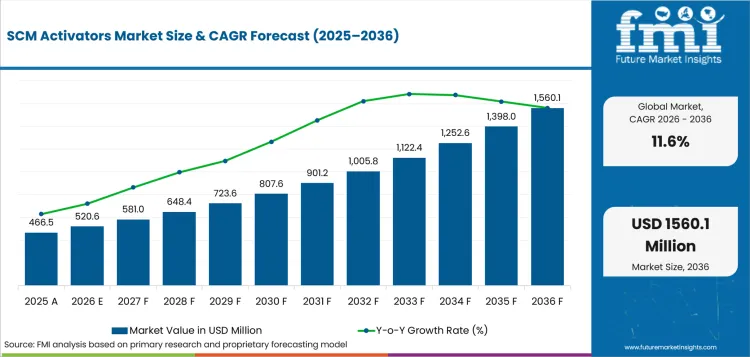
SCM Activators Market Overview: Size and Forecast
- 2025 Market Size: USD 466.5 million
- 2026 Market Size: USD 520.6 million
- 2036 Market Size: USD 1,560.1 million
- Forecast CAGR: 11.6% from 2026 to 2036
- Leading Form: Powder
- Powder Share in 2026: 64.0%
- Leading Sales Channel: Direct to Cement / Concrete Producers
- Direct to Cement / Concrete Producers Share in 2026: 58.5%
- Fastest-growing Country: China
- China CAGR by 2036: 12.9%
Summary of the SCM Activators Market
- Demand and Growth Drivers
- Cement producers are using activators to protect early strength when slag, fly ash, calcined clay, or natural pozzolans replace clinker.
- Ready-mix suppliers are testing activator packages when low-carbon concrete specifications require stable slump and predictable set behavior.
- Precast manufacturers are adopting performance additives when lower-clinker binder systems must maintain mold turnover and early handling strength.
- Product and Segment View
- Powder is expected to represent 64.0% share in 2026, supported by dry mill dosing, bulk handling, and cement-blending convenience.
- Direct to Cement / Concrete Producers is projected to hold 58.5% share in 2026, influenced by technical selling and formulation trials.
- Ready-Mix Concrete is anticipated to secure 48.0% share in 2026, led by plant-level mix redesign and specification-driven dosing.
- Geography and Competitive Outlook
- China is forecast to record 12.9% CAGR by 2036, supported by cement production scale and industrial carbon policy pressure.
- India is projected to expand at 12.7% CAGR by 2036, backed by blended cement familiarity and infrastructure concrete demand.
- Saint-Gobain Construction Chemicals and Sika compete through multi-country admixture portfolios and plant technical support.
- Mapei, Ecocem, Cemex, Master Builders Solutions, and Heidelberg Materials influence activator adoption through low-clinker formulation depth.
- Analyst Opinion
- Nikhil Kaitwade, Associate Vice President at FMI, observes, “SCM activators are moving from a lab-led additive category into a plant economics tool. Buyers are not only asking whether an activator improves strength. They are asking whether it lets a cement mill cut clinker without slowing dispatches or creating concrete complaint risk. The strongest demand pathways are low-clinker cement blending, ready-mix mix redesign, and precast early-strength control. Suppliers with mineral analysis, sulfate balance support, and field dosage teams will gain a clear advantage.”
The SCM activators market is expected to witness strong expansion through 2036, driven by lower-clinker binder adoption and the need for predictable cement and concrete performance. Market expansion is further supported by cement producers seeking activator systems that improve early strength recovery without slowing plant operations.
Demand visibility is improving as cement and concrete buyers connect SCM activation with lower-clinker specifications and production reliability. The USA Geological Survey estimated 82 million tons of USA portland and blended cement production in 2025, while 70% to 75% of USA cement sales went to ready-mixed concrete producers. IEA states that reducing the clinker-to-cement ratio through supplementary cementitious materials is a core cement emissions-reduction measure. Ecocem announced in January 2025 that its Dunkirk ACT line would initially provide 300,000 tonnes of annual ACT capacity from 2026, creating a commercial proof point for activation and rheology control in low-carbon cement systems.
Which factors support expansion in the SCM activators market?
Finished activator revenue is supported by low-clinker cement trials, ready-mix performance requirements, and technical service-led selling.
- Market value is supported by activator sales before downstream concrete production adds incremental formulation service revenue.
- Supplier pricing reflects alkali balance, sulfate control, dosage safety, and field testing before repeat orders develop.
- Revenue improves as cement producers use activators to reduce clinker dependence without weakening dispatch reliability.
- Retail-style distributor channels matter less than direct plant access because buyer approval usually needs laboratory and batch trials.
Why is the SCM activators market growing?
Cement producers need activators because lower-clinker binders can lose early strength, setting control, and mix consistency without chemical reaction support.
SCM activator demand is rising as cement producers try to reduce clinker use while keeping concrete performance within accepted strength and workability limits. NITI Aayog’s January 2026 cement decarbonisation roadmap states that India’s cement sector contributes roughly 7% of national greenhouse gas emissions, with about 55% from limestone calcination, 33% from on-site fuel combustion, and 12% from electricity use. This strengthens the business case for clinker substitution, but it also raises the need for activators that can help SCM-rich binders meet conventional performance requirements.
How is the SCM activators market segmented?
The SCM activators industry is segmented by activator type, SCM type, application, form, and sales channel.
- Alkali Activators are projected to account for 46.0% share in 2026, led by slag-rich and fly-ash-rich binders that require stronger reaction support at early ages.
- Slag is expected to represent 39.0% share in 2026, supported by established cementitious response and widespread use in blended cement systems.
- Ready-Mix Concrete is anticipated to secure 48.0% share in 2026, guided by project specifications that require lower-carbon mixes with stable placement behavior.
- Powder is estimated to hold 64.0% share in 2026, reflected in dry blending convenience and stronger fit with mill-fed cement production systems.
- Direct to Cement / Concrete Producers is forecast to account for 58.5% share in 2026, shaped by plant trials, mineral testing, and dosage recommendations.
Why do alkali activators dominate the SCM activators market?
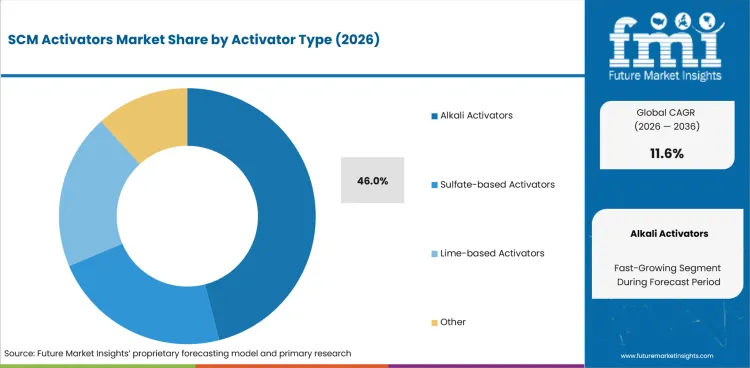
- Alkali Activators are projected to account for 46.0% share in 2026, influenced by their ability to improve reaction potential in slag-rich and fly-ash-rich binder systems.
- Sulfate-based activators gain demand when cement producers need setting balance, strength timing, and compatibility with gypsum-controlled formulations.
Which SCM type leads the SCM activators market?
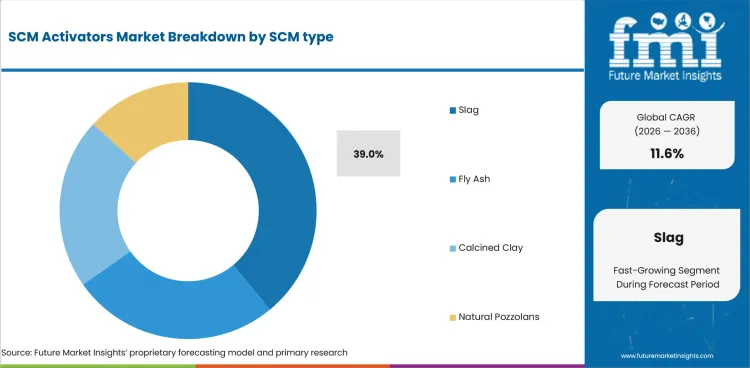
- Slag is expected to represent 39.0% share in 2026, supported by its proven cementitious behavior and reliable response after chemical activation.
- Calcined clay is gaining attention as clay availability gives producers a broader low-clinker route beyond fly ash and blast-furnace slag.
Which application leads the SCM activators market?
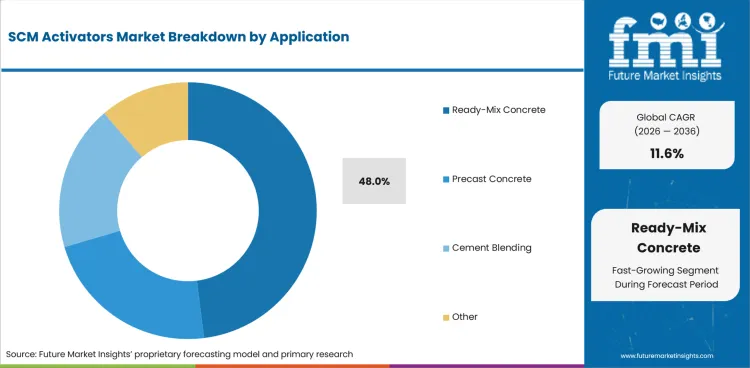
- Ready-Mix Concrete is anticipated to account for 48.0% share in 2026, shaped by plant-level trials that test slump, pumpability, setting time, and compressive strength.
- Precast concrete gains value when activators help lower-clinker mixes reach handling strength without delaying demolding schedules.
Which form leads the SCM activators market?
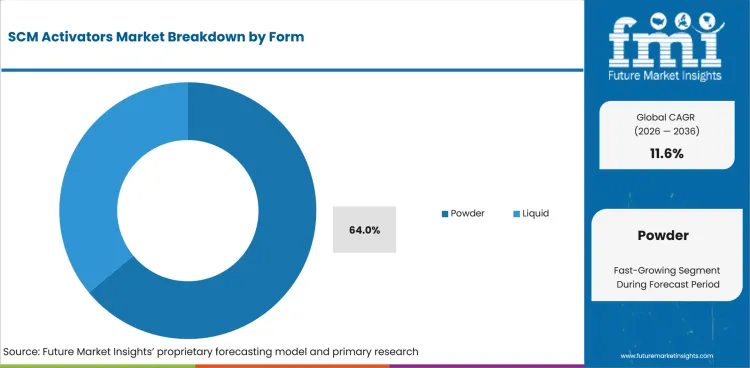
- Powder is estimated to hold 64.0% share in 2026, led by dry storage, mill dosing convenience, and stronger compatibility with cement blending workflows.
- Liquid activators gain acceptance in ready-mix plants because metered admixture systems allow faster adjustment during batch-level formulation changes.
Which sales channel leads the SCM activators market?
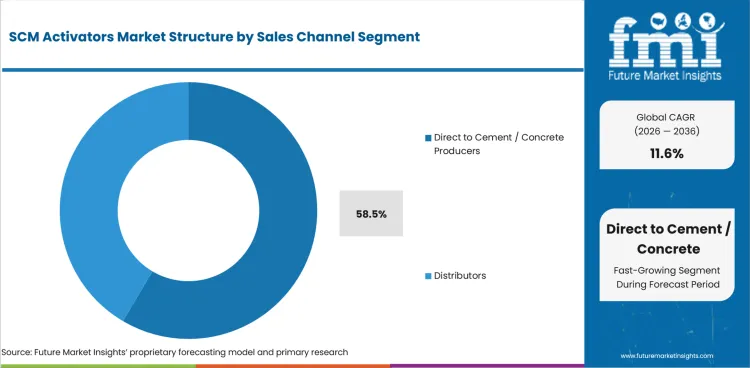
- Direct to Cement / Concrete Producers is projected to represent 58.5% share in 2026, driven by technical support, laboratory testing, and plant validation needs.
- Distributors remain relevant in smaller concrete markets where local producers need access to specialist additive products without direct global supplier contracts.
What are the drivers, restraints, and opportunities in the SCM activators market?
Clinker reduction and low-carbon concrete specifications support demand while SCM variability extends customer approval cycles.
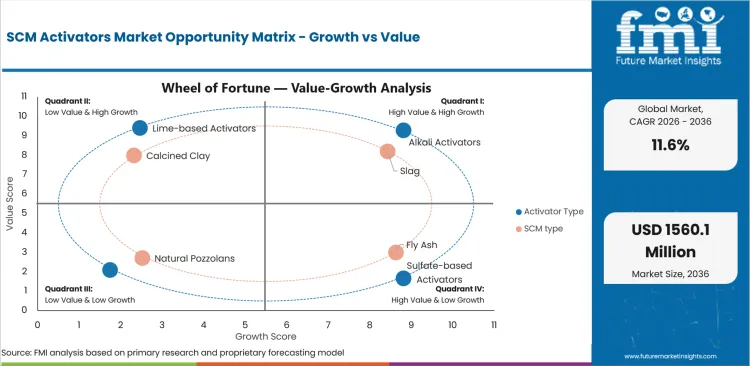
- Cement producers use activators to recover performance after slag, fly ash, calcined clay, or natural pozzolan substitution, protecting saleable strength while reducing clinker dependence.
- Variable SCM chemistry makes activator selection slower than standard grinding aid approval because each material source can change dosage, setting, and strength behavior.
- Calcined clay and natural pozzolan systems create formulation-service opportunities for suppliers that can connect laboratory testing with field support at cement plants.
Clinker Factor Pressure
Clinker reduction is the strongest structural driver for SCM activators because cement producers must cut clinker content while retaining strength and workability. VDZ reported in October 2024 that German cement manufacturers had reduced clinker content from 83% in 1990 to 69% today, while alternative fuels account for around 74% of fuel use. Activators support this direction by improving reaction speed in blended formulations and reducing the risk that lower-clinker cement fails performance checks.
SCM Variability Barrier
SCM variability remains the main restraint because fly ash carbon content, slag glass content, and calcined clay reactivity differ between sources. The Mineral Products Association reported in 2025 that UK slag production has fallen steadily from 5 million tonnes in 2008 to just under 1.4 million tonnes in 2023, making the UK increasingly reliant on imports from Europe, China, Japan, and India. This supply variation can make activator trials longer and raise the cost of formulation support.
Calcined Clay and Pozzolan Opportunity
Calcined clay and natural pozzolans give activator suppliers a route beyond conventional slag and fly ash because clay sources are more geographically diverse. The IEA’s cement pathway shows the global clinker-to-cement ratio at 0.71 in 2022 and a milestone target of 0.65 by 2030, indicating that wider SCM use remains necessary for emissions reduction. Suppliers that combine alkali balance, water reducer compatibility, and local mineral testing can convert newer SCM blends into repeat commercial demand.
Which countries are growing fastest in the SCM activators market?
China 12.9% CAGR, India 12.7% CAGR, United States 10.9% CAGR, France 10.8% CAGR, Germany 10.7% CAGR, South Korea 10.5% CAGR, United Kingdom 10.4% CAGR, and Japan 9.8% CAGR through 2036.
.webp "Top Country Growth Comparison Scm Activators Market Cagr (2026 2036)")
| Country | CAGR |
|---|---|
| United States | 10.9% |
| United Kingdom | 10.4% |
| Germany | 10.7% |
| France | 10.8% |
| Japan | 9.8% |
| China | 12.9% |
| South Korea | 10.5% |
| India | 12.7% |
Source: Future Market Insights, 2026.
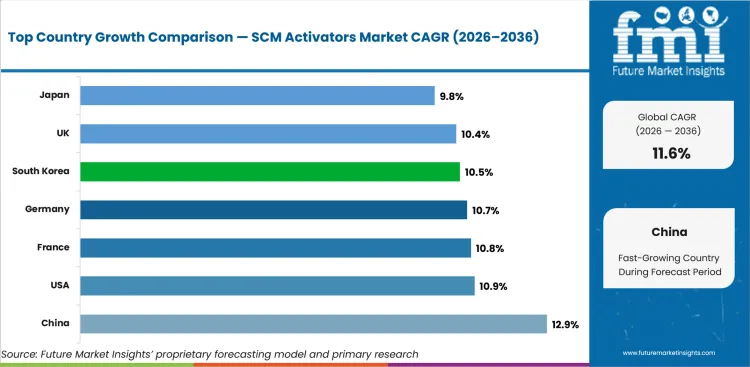
How do country-level CAGRs compare in the SCM activators market?
China leads country growth while Japan records the most cautious expansion outlook among profiled markets.
- China is forecast to record 12.9% CAGR by 2036 as cement scale and carbon-market pressure support activation trials.
- India is projected to advance at 12.7% CAGR through 2036 as blended cement familiarity supports lower-clinker formulation work.
- The United States is expected to expand at 10.9% CAGR from 2026 to 2036 due to ready-mix demand and infrastructure concrete trials.
- France is estimated to rise at 10.8% CAGR by 2036 with low-carbon cement production projects strengthening commercial proof.
- Germany is projected to post 10.7% CAGR by 2036 as technical standards and clinker reduction work support activator use.
- South Korea is expected to grow at 10.5% CAGR through 2036 due to compact cement production and export-linked low-carbon pressure.
- The United Kingdom is estimated to expand at 10.4% CAGR by 2036 with ready-mix and precast specifications shaping demand.
- Japan is forecast to grow at 9.8% CAGR through 2036 as quality-control requirements slow but strengthen approved adoption.
What is the SCM activators market outlook in the United States?
A 10.9% CAGR through 2036 reflects infrastructure concrete demand and ready-mix trials for lower-clinker binder systems.
Country Market Snapshot Table
| Parameter | Value |
|---|---|
| Market Size in 2025 (Value) | USD 70.3 million |
| Market Size in 2026 (Value) | USD 78.0 million |
| Market Forecast in 2036 (Value) | USD 219.5 million |
| CAGR (2026 to 2036) | 10.9% |
| Years Considered | 2021 to 2036 |
| Base Year | 2025 |
| Forecast Period | 2026 to 2036 |
| Units Considered | Value (USD million) |
| Leading Sub-Region | South Atlantic and Gulf Coast cement corridors |
United States SCM Activators Market Outlook
United States demand is shaped by performance risk in large infrastructure concrete. Buyers evaluate SCM activators through compressive strength recovery, set time, and compatibility with existing admixture packages.
Cement producers and concrete plants remain cautious when fly ash quality changes across basins. Suppliers with national technical service teams and local dosage validation should gain stronger recurring accounts.
Key Growth Drivers
- Federal and state infrastructure concrete projects create recurring trial opportunities for lower-clinker binder systems, with FHWA stating that the Infrastructure Investment and Jobs Act provides about USD 350 billion for federal highway programs over fiscal years 2022 to 2026.
- Ready-mix usage supports direct plant trials because USGS estimated that 70% to 75% of USA cement sales in 2025 went to ready-mixed concrete producers.
- Regional fly ash variability increases demand for activators that stabilize strength and setting behavior across different SCM sources.
- Large concrete producers usually require batch-level testing before approving recurring supply contracts for activated binder systems.
Key Restraints
- Import reliance can complicate cement supply planning because USGS estimated USA hydraulic cement imports at 23 million tons in 2025.
- Cement producers may delay activator adoption when standard blended cement already meets local strength requirements.
- Regional SCM access can change quickly as coal ash availability and slag import corridors shift across supply basins.
What makes the United States unique
The United States is unique because buyers combine high infrastructure volume with decentralized ready-mix decision-making across many regional plants.
Key Companies
- Sika Corporation
- Mapei Corporation
- Master Builders Solutions
- Saint-Gobain Construction Chemicals
- Cemex USA
- GCP Applied Technologies
- Euclid Chemical
Sales & Marketing Channels
- Direct technical sales to cement plants
- Ready-mix plant trials
- Distributor supply for regional concrete producers
- Infrastructure specification consultants
- National account sales to large concrete groups
- Precast producer approvals
Country Segment Breakdown Table
| Segment | Sub-Segments |
|---|---|
| By Activator Type | Alkali Activators, Sulfate-based Activators, Lime-based Activators, Other |
| By SCM Type | Slag, Fly Ash, Calcined Clay, Natural Pozzolans |
| By Application | Ready-Mix Concrete, Precast Concrete, Cement Blending, Other |
| By Form | Powder, Liquid |
| By Sales Channel | Direct to Cement / Concrete Producers, Distributors |
| Key Sub-Regions Covered, Cement Corridors | Texas, California, Florida, Missouri, Southeast, Midwest |
Frequently Asked Questions
How fast is United States SCM activators market growing?
Demand in the United States is projected to expand at 10.9% CAGR from 2026 to 2036, supported by infrastructure concrete trials.
Who leads United States SCM activators market?
Sika, Mapei, Master Builders Solutions, Saint-Gobain Construction Chemicals, and Cemex compete through cement additives and concrete admixture portfolios.
What is driving adoption in United States SCM activators market?
Ready-mix demand, infrastructure specifications, and SCM variability are moving producers toward trial-backed activator systems.
What is driving SCM activators growth in the United Kingdom?
A 10.4% CAGR through 2036 is supported by ready-mix concrete demand, domestic cement pressure, and lower-carbon project specifications.
Country Market Snapshot Table
| Parameter | Value |
|---|---|
| Market Size in 2025 (Value) | USD 19.9 million |
| Market Size in 2026 (Value) | USD 22.0 million |
| Market Forecast in 2036 (Value) | USD 59.2 million |
| CAGR (2026 to 2036) | 10.4% |
| Years Considered | 2021 to 2036 |
| Base Year | 2025 |
| Forecast Period | 2026 to 2036 |
| Units Considered | Value (USD million) |
| Leading Sub-Region | London and South East ready-mix corridors |
United Kingdom SCM Activators Market Outlook
United Kingdom demand is shaped by specification pressure from contractors and public project clients. Cement and concrete suppliers need lower-carbon products that pass conventional strength and durability expectations.
SCM activators gain attention when producers attempt to raise replacement levels without slowing construction programs. Suppliers with application support in ready-mix and precast should hold a stronger route to repeat sales.
Key Growth Drivers
- Ready-mix channels create a practical route for activator trials because MPA reported that 58% of UK domestic cement sales in 2024 went into ready-mixed concrete.
- Precast and mortar applications support early-strength demand because MPA reported that another 24% of UK domestic cement sales in 2024 went into precast concrete and mortar production.
- Contractors increasingly ask suppliers to document embodied-carbon reduction for building and infrastructure projects.
- Precast producers need reliable early strength when lower-clinker binder systems affect cycle times.
Key Restraints
- Domestic production pressure can limit trial appetite because MPA reported UK cement sales from domestic production reached only 7.1 million tonnes in 2024, the lowest level since 1950.
- Conservative specification habits can slow approval for new activator chemistries.
- Limited domestic SCM sources can raise dependence on imported slag or alternative materials.
What makes the United Kingdom unique
The United Kingdom is unique because buyer pull comes from embodied-carbon project specifications rather than cement production scale.
Key Companies
- Sika Limited
- Saint-Gobain Construction Chemicals UK
- Mapei UK Limited
- Ecocem UK
- Master Builders Solutions UK
- Breedon Group
- Cemex UK
Sales & Marketing Channels
- Direct technical sales to cement producers
- Ready-mix specification trials
- Precast manufacturer approvals
- Construction chemical distributors
- Contractor sustainability specifications
- Public infrastructure material approvals
Country Segment Breakdown Table
| Segment | Sub-Segments |
|---|---|
| By Activator Type | Alkali Activators, Sulfate-based Activators, Lime-based Activators, Other |
| By SCM Type | Slag, Fly Ash, Calcined Clay, Natural Pozzolans |
| By Application | Ready-Mix Concrete, Precast Concrete, Cement Blending, Other |
| By Form | Powder, Liquid |
| By Sales Channel | Direct to Cement / Concrete Producers, Distributors |
| Key Sub-Regions Covered, Ready-Mix Corridors | London, South East, West Midlands, North West, Scotland, Yorkshire |
Frequently Asked Questions
How fast is United Kingdom SCM activators market growing?
Demand in the United Kingdom is expected to increase at 10.4% CAGR from 2026 to 2036 through ready-mix and precast trials.
Who leads United Kingdom SCM activators market?
Sika, Saint-Gobain Construction Chemicals, Mapei, Ecocem, and Master Builders Solutions compete through cement and concrete chemistry support.
What is driving adoption in United Kingdom SCM activators market?
Ready-mix demand, embodied-carbon specifications, and domestic cement production pressure are moving suppliers toward activated binder systems.
What is the SCM activators market outlook in Germany?
A 10.7% CAGR through 2036 reflects strong technical standards, clinker reduction experience, and cement plant validation culture.
Country Market Snapshot Table
| Parameter | Value |
|---|---|
| Market Size in 2025 (Value) | USD 27.1 million |
| Market Size in 2026 (Value) | USD 30.0 million |
| Market Forecast in 2036 (Value) | USD 82.9 million |
| CAGR (2026 to 2036) | 10.7% |
| Years Considered | 2021 to 2036 |
| Base Year | 2025 |
| Forecast Period | 2026 to 2036 |
| Units Considered | Value (USD million) |
| Leading Sub-Region | North Rhine-Westphalia and southern cement clusters |
Germany SCM Activators Market Outlook
Germany’s market is shaped by measured technical evaluation rather than rapid switching. Buyers focus on compressive strength, setting behavior, and long-term durability before approving activators.
Cement producers already have experience lowering clinker content, so they judge activators against a high technical bar. Supplier success will depend on local technical references and plant-level service.
Key Growth Drivers
- German clinker reduction experience creates a ready technical audience for advanced activators because VDZ reported clinker content fell from 83% in 1990 to 69% today.
- Construction cost exposure keeps ready-mix trials relevant because Destatis listed EUR 7.50 billion in estimated building costs for new residential and non-residential buildings permitted in March 2026.
- Ready-mix suppliers need reliable low-carbon concrete for infrastructure and building projects.
- Standards-focused cement producers create demand for suppliers that can provide mineral testing and documentation.
Key Restraints
- Long approval cycles make customer conversion slower because German buyers often require extensive durability and standards evidence before changing cement chemistry.
- Residential permitting volatility can slow project-linked activator trials because Destatis recorded 17,605 new-building dwelling permits in March 2026, below 19,031 in February 2026.
- EU emissions trading pressure can raise compliance costs and reduce near-term flexibility for premium additive trials.
What makes Germany unique
Germany is unique because technical proof and standards compliance carry more weight than short-term additive price savings.
Key Companies
- Sika Deutschland GmbH
- Saint-Gobain Construction Chemicals
- Mapei GmbH
- Master Builders Solutions Deutschland
- Heidelberg Materials
- Dyckerhoff GmbH
- MC-Bauchemie
Sales & Marketing Channels
- Cement plant technical trials
- Ready-mix quality teams
- Precast plant approvals
- Standards-focused specification networks
- Direct sales to integrated cement groups
- Research-linked formulation programs
Country Segment Breakdown Table
| Segment | Sub-Segments |
|---|---|
| By Activator Type | Alkali Activators, Sulfate-based Activators, Lime-based Activators, Other |
| By SCM Type | Slag, Fly Ash, Calcined Clay, Natural Pozzolans |
| By Application | Ready-Mix Concrete, Precast Concrete, Cement Blending, Other |
| By Form | Powder, Liquid |
| By Sales Channel | Direct to Cement / Concrete Producers, Distributors |
| Key Sub-Regions Covered, Cement Clusters | North Rhine-Westphalia, Bavaria, Baden-Württemberg, Lower Saxony, Saxony, Hesse |
Frequently Asked Questions
How fast is Germany SCM activators market growing?
Demand in Germany is forecast to expand at 10.7% CAGR from 2026 to 2036 through clinker reduction and standards-led trials.
Who leads Germany SCM activators market?
Sika, Saint-Gobain Construction Chemicals, Mapei, Master Builders Solutions, Heidelberg Materials, and MC-Bauchemie are relevant suppliers.
What is driving adoption in Germany SCM activators market?
Technical proof, clinker reduction experience, and low-carbon cement standards are moving German producers toward activated SCM systems.
What is driving SCM activators growth in France?
A 10.8% CAGR through 2036 is supported by low-carbon cement projects, construction chemistry depth, and public works specifications.
Country Market Snapshot Table
| Parameter | Value |
|---|---|
| Market Size in 2025 (Value) | USD 24.4 million |
| Market Size in 2026 (Value) | USD 27.0 million |
| Market Forecast in 2036 (Value) | USD 75.3 million |
| CAGR (2026 to 2036) | 10.8% |
| Years Considered | 2021 to 2036 |
| Base Year | 2025 |
| Forecast Period | 2026 to 2036 |
| Units Considered | Value (USD million) |
| Leading Sub-Region | Northern France and Paris construction corridor |
France SCM Activators Market Outlook
France combines regulation, construction chemical depth, and low-carbon cement production activity. Buyers are more willing to test activated binders when project-level carbon reporting gives a clear business reason.
Cement producers and ready-mix suppliers need performance proof before replacing clinker at higher levels. Local technical presence will shape account wins.
Key Growth Drivers
- Commercial low-carbon production gives activator chemistry visibility because Ecocem announced its Dunkirk ACT line would initially provide 300,000 tonnes of annual capacity from 2026.
- Site expansion strengthens demand signals because Ecocem stated in April 2026 that Dunkirk would add 300,000 tonnes of ACT cement capacity on top of 700,000 tonnes of existing low-carbon products.
- French construction chemical suppliers can combine admixtures and activators for ready-mix clients.
- Public project material approvals can encourage trial-backed low-clinker cement and activated binder systems.
Key Restraints
- Housing-permit weakness can delay project-linked cement additive trials because SDES reported 378,806 housing units authorized from December 2024 to November 2025, 9.5% below the prior five-year average.
- Project-level approval requirements can slow the shift from pilot use to recurring supply.
- Imported SCM availability can expose suppliers to quality variation and logistics costs across slag and fly ash streams.
What makes France unique
France is unique because commercial low-carbon cement projects and construction chemical suppliers create early proof points for activator demand.
Key Companies
- Ecocem France
- Saint-Gobain Construction Chemicals
- CHRYSO
- Sika France
- Mapei France
- Heidelberg Materials France
- Cemex France
Sales & Marketing Channels
- Cement plant validation trials
- Ready-mix producer specifications
- Public project material approvals
- Construction chemical distributor networks
- Contractor-led low-carbon material selection
- Direct sales to integrated cement groups
Country Segment Breakdown Table
| Segment | Sub-Segments |
|---|---|
| By Activator Type | Alkali Activators, Sulfate-based Activators, Lime-based Activators, Other |
| By SCM Type | Slag, Fly Ash, Calcined Clay, Natural Pozzolans |
| By Application | Ready-Mix Concrete, Precast Concrete, Cement Blending, Other |
| By Form | Powder, Liquid |
| By Sales Channel | Direct to Cement / Concrete Producers, Distributors |
| Key Sub-Regions Covered, Low-Carbon Cement Areas | Dunkirk, Paris Basin, Lyon, Marseille, Hauts-de-France, Normandy |
Frequently Asked Questions
How fast is France SCM activators market growing?
Demand in France is expected to rise at 10.8% CAGR from 2026 to 2036 through low-carbon cement projects.
Who leads France SCM activators market?
Ecocem, Saint-Gobain Construction Chemicals, CHRYSO, Sika, Mapei, Heidelberg Materials, and Cemex are relevant companies.
What is driving adoption in France SCM activators market?
ACT production, public project specifications, and admixture supplier depth are moving French buyers toward activated low-clinker binders.
What is the SCM activators market forecast for Japan?
A 9.8% CAGR through 2036 reflects cement quality discipline, controlled plant trials, and gradual low-carbon binder adoption.
Country Market Snapshot Table
| Parameter | Value |
|---|---|
| Market Size in 2025 (Value) | USD 16.4 million |
| Market Size in 2026 (Value) | USD 18.0 million |
| Market Forecast in 2036 (Value) | USD 45.8 million |
| CAGR (2026 to 2036) | 9.8% |
| Years Considered | 2021 to 2036 |
| Base Year | 2025 |
| Forecast Period | 2026 to 2036 |
| Units Considered | Value (USD million) |
| Leading Sub-Region | Kanto and Kyushu cement corridors |
Japan SCM Activators Market Outlook
Japan’s SCM activator demand is slower but technically disciplined. Cement companies prioritize long-term durability and tight process control before changing binder chemistry.
Activators must prove stable performance in controlled trials, especially when slag or calcined clay affects setting behavior. Suppliers without local technical support will face longer sales cycles.
Key Growth Drivers
- Concentrated cement production makes plant-level validation commercially efficient because the Japan Cement Association reported 26 plants owned by 15 companies as of July 2025.
- Capacity concentration supports technical testing because Japan’s cement sector had 47 million tons of clinker production capacity as of July 2025.
- Precast producers value controlled early strength for high-quality structural components.
- Carbon reduction goals encourage gradual testing of lower-clinker cement blends and limestone-blended cement routes.
Key Restraints
- Slow approval culture limits fast switching from conventional cement additives.
- Limited public evidence on activator-specific supplier activity raises market visibility challenges.
- Regional concentration can slow broad supplier access because Japan Cement Association data shows 5 cement plants in Kyushu, 3 in Yamaguchi, and 6 in the Kanto district.
What makes Japan unique
Japan is unique because high quality control can support premium activator pricing after performance proof is accepted.
Key Companies
- Taiheiyo Cement Corporation
- Sumitomo Osaka Cement Co. Ltd.
- Ube Mitsubishi Cement Corporation
- Denka Company Limited
- Sika Japan
- Mapei Japan
- Master Builders Solutions Japan
Sales & Marketing Channels
- Cement company laboratory trials
- Direct technical sales to cement plants
- Precast producer approvals
- Specialist chemical distributors
- University and standards-linked technical networks
- Ready-mix quality departments
Country Segment Breakdown Table
| Segment | Sub-Segments |
|---|---|
| By Activator Type | Alkali Activators, Sulfate-based Activators, Lime-based Activators, Other |
| By SCM Type | Slag, Fly Ash, Calcined Clay, Natural Pozzolans |
| By Application | Ready-Mix Concrete, Precast Concrete, Cement Blending, Other |
| By Form | Powder, Liquid |
| By Sales Channel | Direct to Cement / Concrete Producers, Distributors |
| Key Sub-Regions Covered, Cement Production Areas | Kanto, Kyushu, Yamaguchi, Kansai, Chubu, Hokkaido |
Frequently Asked Questions
How fast is Japan SCM activators market growing?
Demand in Japan is projected to rise at 9.8% CAGR from 2026 to 2036 through controlled cement and precast trials.
Who leads Japan SCM activators market?
Taiheiyo Cement, Sumitomo Osaka Cement, Ube Mitsubishi Cement, Denka, Sika Japan, and Mapei Japan are relevant companies.
What is driving adoption in Japan SCM activators market?
Quality-controlled cement production, clinker capacity concentration, and gradual low-carbon binder testing support activator adoption.
What makes China the fastest-growing SCM activators market?
A 12.9% CAGR through 2036 reflects cement output scale, clinker-factor pressure, and large cement-group adoption potential.
Country Market Snapshot Table
| Parameter | Value |
|---|---|
| Market Size in 2025 (Value) | USD 111.6 million |
| Market Size in 2026 (Value) | USD 126.0 million |
| Market Forecast in 2036 (Value) | USD 423.9 million |
| CAGR (2026 to 2036) | 12.9% |
| Years Considered | 2021 to 2036 |
| Base Year | 2025 |
| Forecast Period | 2026 to 2036 |
| Units Considered | Value (USD million) |
| Leading Sub-Region | Eastern and southern cement production corridors |
China SCM Activators Market Outlook
China is the largest potential market because small formulation changes can affect very large cement volumes. Buyers need activators that work across variable SCM streams and plant conditions.
The market is not only about low-carbon concrete. It is about making reduced-clinker cement viable inside large cement production systems.
Key Growth Drivers
- Cement scale creates a large activation pool because China produced 147.75 million tons of cement in October 2025, according to the National Bureau of Statistics.
- IEA reported China’s clinker-to-cement ratio increased from 0.57 in 2015 to 0.65 in 2022, showing why clinker-efficiency programs need stronger SCM performance.
- Large cement groups can scale approved activator systems across multiple plants after validation.
- Fly ash and slag streams create broad demand for performance-enhancing chemistries across regional binder systems.
Key Restraints
- Real estate weakness can reduce cement additive trial urgency because the National Bureau of Statistics reported real estate development investment at RMB 7,859.1 billion from January to November 2025, down 15.9% year on year.
- Regional SCM quality differences raise the cost of formulation support.
- Monthly cement output weakness can restrict new additive spending when producers prioritize utilization and price defense.
What makes China unique
China is unique because activator adoption can scale rapidly once a major cement group validates a formulation.
Key Companies
- Sika China
- Mapei China
- Saint-Gobain Construction Chemicals China
- China National Building Material Group
- Anhui Conch Cement
- Huaxin Cement
- Tangshan Jidong Cement
Sales & Marketing Channels
- Direct supply to cement groups
- Regional chemical distributor networks
- Cement plant trial programs
- Ready-mix producer trials in major cities
- Low-carbon construction specification channels
- Technical service partnerships
Country Segment Breakdown Table
| Segment | Sub-Segments |
|---|---|
| By Activator Type | Alkali Activators, Sulfate-based Activators, Lime-based Activators, Other |
| By SCM Type | Slag, Fly Ash, Calcined Clay, Natural Pozzolans |
| By Application | Ready-Mix Concrete, Precast Concrete, Cement Blending, Other |
| By Form | Powder, Liquid |
| By Sales Channel | Direct to Cement / Concrete Producers, Distributors |
| Key Sub-Regions Covered, Cement Corridors | East China, South China, North China, Central China, Sichuan-Chongqing, Guangdong |
Frequently Asked Questions
How fast is China SCM activators market growing?
Demand in China is forecast to grow at 12.9% CAGR from 2026 to 2036 through cement scale and clinker reduction pressure.
Who leads China SCM activators market?
Sika China, Mapei China, Saint-Gobain Construction Chemicals, CNBM, Anhui Conch, Huaxin, and Jidong are relevant companies.
What is driving adoption in China SCM activators market?
Large cement output, carbon policy pressure, and SCM-rich blended cement trials are driving activator adoption.
How is the SCM activators market performing in South Korea?
A 10.5% CAGR through 2036 reflects compact cement production, export pressure, and controlled technical approvals.
Country Market Snapshot Table
| Parameter | Value |
|---|---|
| Market Size in 2025 (Value) | USD 14.5 million |
| Market Size in 2026 (Value) | USD 16.0 million |
| Market Forecast in 2036 (Value) | USD 43.4 million |
| CAGR (2026 to 2036) | 10.5% |
| Years Considered | 2021 to 2036 |
| Base Year | 2025 |
| Forecast Period | 2026 to 2036 |
| Units Considered | Value (USD million) |
| Leading Sub-Region | Gangwon and coastal cement corridors |
South Korea SCM Activators Market Outlook
South Korea’s activator demand is shaped by concentrated cement production and tight technical control. Buyers are likely to test products through cement laboratory work before field use.
Export pressure can support low-carbon cement trials, but domestic construction weakness can slow spending on new additives. Distributor access alone will not win major accounts.
Key Growth Drivers
- Concentrated producer structure can accelerate adoption after technical approval because the Korea Cement Association reported 44.186 million tonnes of cement production in its 2025 industry material.
- A compact producer base supports coordinated validation because the World Cement Association states KCA represents 9 member companies, 11 kiln plants, and 23 grinding stations.
- Export markets may reward lower-carbon cement products over time.
- Precast factories need predictable early strength in controlled production cycles.
Key Restraints
- Weak domestic demand can delay new activator trials because OECD projected Korea’s GDP growth at 1.0% in 2025 before improving to 2.2% in 2026.
- Public evidence on activator-specific supplier activity is limited for South Korea.
- Domestic shipment pressure can push producers to prioritize cost control over additive experimentation.
What makes South Korea unique
South Korea is unique because a compact producer structure can turn a validated formulation into a wider national buying pattern.
Key Companies
- Sampyo Cement
- Ssangyong C&E
- Hanil Cement
- Sungshin Cement
- Asia Cement Korea
- Sika Korea
- Saint-Gobain Construction Chemicals Korea
Sales & Marketing Channels
- Cement producer technical departments
- Specialist chemical distributors
- Precast factory trials
- Export-oriented cement product programs
- Direct sales to integrated cement companies
- Ready-mix producer validation
Country Segment Breakdown Table
| Segment | Sub-Segments |
|---|---|
| By Activator Type | Alkali Activators, Sulfate-based Activators, Lime-based Activators, Other |
| By SCM Type | Slag, Fly Ash, Calcined Clay, Natural Pozzolans |
| By Application | Ready-Mix Concrete, Precast Concrete, Cement Blending, Other |
| By Form | Powder, Liquid |
| By Sales Channel | Direct to Cement / Concrete Producers, Distributors |
| Key Sub-Regions Covered, Cement Corridors | Gangwon, Chungcheong, Gyeonggi, Seoul Capital Area, Busan-Ulsan, Jeolla |
Frequently Asked Questions
How fast is South Korea SCM activators market growing?
Demand in South Korea is expected to expand at 10.5% CAGR from 2026 to 2036 through technical approvals and export-linked pressure.
Who leads South Korea SCM activators market?
Sampyo Cement, Ssangyong C&E, Hanil Cement, Sungshin Cement, Asia Cement Korea, and Sika Korea are relevant companies.
What is driving adoption in South Korea SCM activators market?
Compact cement production, controlled plant testing, and low-carbon product needs are supporting activator adoption.
What is the SCM activators market forecast for India?
A 12.7% CAGR through 2036 reflects large cement volume, blended cement familiarity, and infrastructure-led concrete demand.
Country Market Snapshot Table
| Parameter | Value |
|---|---|
| Market Size in 2025 (Value) | USD 58.6 million |
| Market Size in 2026 (Value) | USD 66.0 million |
| Market Forecast in 2036 (Value) | USD 218.2 million |
| CAGR (2026 to 2036) | 12.7% |
| Years Considered | 2021 to 2036 |
| Base Year | 2025 |
| Forecast Period | 2026 to 2036 |
| Units Considered | Value (USD million) |
| Leading Sub-Region | Western and southern cement clusters |
India SCM Activators Market Outlook
India is a high-upside market because blended cement already has strong commercial acceptance. Activators can help producers raise SCM content while protecting early strength and dispatch reliability.
Buyers remain price sensitive, so products must show clinker savings or lower rejection risk. Formulators with slag and fly ash expertise should win earlier.
Key Growth Drivers
- Cement volume expansion strengthens the activator base because IBEF stated India’s cement production is expected to reach about 490 million tonnes in FY26, up from 453 million tonnes in FY25.
- Highway and infrastructure spending supports concrete demand because PRS stated the road transport and highways ministry received Rs 3,09,875 crore for 2026-27, an 8% increase over revised estimates.
- Blended cement familiarity reduces customer education barriers for activated SCM systems.
- Local construction chemical networks help suppliers support trials across several regional markets.
Key Restraints
- Decarbonisation compliance can raise approval pressure because PIB stated the cement sector must cut carbon intensity from 0.63 tCO₂e per tonne to about 0.09 to 0.13 tCO₂e per tonne by 2070.
- Price sensitivity limits premium activator use unless clinker savings are visible.
- Regional SCM sourcing differences can force suppliers to customize dosage across cement clusters.
What makes India unique
India is unique because large cement volume and blended cement familiarity create strong activator scale potential.
Key Companies
- Sika India
- Saint-Gobain Construction Chemicals India
- Fosroc India
- Mapei India
- Master Builders Solutions India
- UltraTech Cement
- Dalmia Cement
Sales & Marketing Channels
- Direct cement plant sales
- Ready-mix producer trials
- Construction chemical distributors
- Precast plant approvals
- Infrastructure contractor specifications
- Regional technical service teams
Country Segment Breakdown Table
| Segment | Sub-Segments |
|---|---|
| By Activator Type | Alkali Activators, Sulfate-based Activators, Lime-based Activators, Other |
| By SCM Type | Slag, Fly Ash, Calcined Clay, Natural Pozzolans |
| By Application | Ready-Mix Concrete, Precast Concrete, Cement Blending, Other |
| By Form | Powder, Liquid |
| By Sales Channel | Direct to Cement / Concrete Producers, Distributors |
| Key Sub-Regions Covered, Cement Clusters | West India, South India, North India, East India, Central India, NCR |
Frequently Asked Questions
How fast is India SCM activators market growing?
Demand in India is forecast to expand at 12.7% CAGR from 2026 to 2036 through blended cement and infrastructure concrete.
Who leads India SCM activators market?
Sika India, Saint-Gobain Construction Chemicals, Fosroc India, Mapei India, Master Builders Solutions, and UltraTech are relevant companies.
What is driving adoption in India SCM activators market?
Blended cement familiarity, cement decarbonisation, and infrastructure concrete demand are driving activator adoption.
Who are the leading companies in the SCM activators market?
Sika, Saint-Gobain Construction Chemicals, Mapei, Ecocem and Cemex.
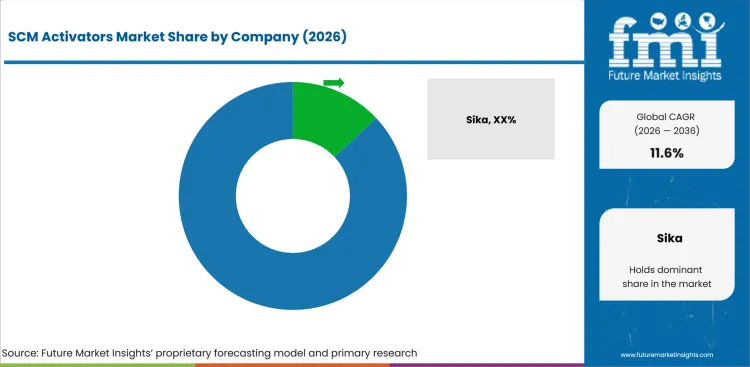
- Global construction chemical suppliers hold an advantage through cement additive portfolios and field-service teams.
- Binder technology developers gain relevance by proving activated low-clinker cement systems at commercial sites.
- Integrated cement producers influence demand by setting specifications for blended cement and ready-mix products.
- Technical service capacity supports repeat orders when activators must be adjusted across slag, fly ash, calcined clay, and natural pozzolan blends.
Construction chemical groups in the market compete by combining cement additives with ready-mix admixture support. Sika, Saint-Gobain Construction Chemicals, Mapei, and Master Builders Solutions are positioned around dosage validation, water-reducer compatibility, and plant trials. Their advantage is strongest where buyers want one supplier to support cement mills and concrete plants together. Cement producers assess reaction control and strength recovery before approving recurring supply.
Binder technology developers are building stronger visibility as lower-clinker cement moves into commercial production. Ecocem’s ACT work and Cemex’s low-clinker formulation activity show how activation is becoming part of broader decarbonisation programs. These companies may not always sell activators as standalone products, but their binder systems influence supplier demand for chemical additions. Customers compare them on verified performance, carbon documentation, and repeatable field results.
Smaller regional additive suppliers can win through local mineral knowledge and fast technical service. China and India create scale opportunities where cement plants need customized dosage across different SCM sources. Germany, Japan, and South Korea create harder approval paths because technical validation and standards evidence carry more weight. Suppliers that can prove performance without creating setting, durability, or workability risk should gain more durable customer approvals.
How do top SCM activators companies compare?
Sika and Saint-Gobain score strongest on formulation depth while Ecocem leads commercial low-clinker binder relevance.
| Company | Relevance to Market Title | SCM Reactivity Support | Low-Clinker Formulation Depth | Field Trial Coverage | Channel Reach | Geographic Footprint |
|---|---|---|---|---|---|---|
| Sika | Very High | Very Strong | Very Strong | Very Strong | Very Strong | Global |
| Saint-Gobain Construction Chemicals | Very High | Very Strong | Very Strong | Very Strong | Very Strong | Global |
| Mapei | Very High | Very Strong | Very Strong | Strong | Strong | Global |
| Ecocem | Very High | Very Strong | Very Strong | Moderate | Moderate | Europe and selected export markets |
| Cemex | High | Moderate | Very Strong | Strong | Strong | Americas and Europe |
| Master Builders Solutions | High | Strong | Moderate | Strong | Strong | Global |
| Heidelberg Materials | Moderate to High | Moderate | Strong | Moderate | Strong | Global |
| Fosroc brand within Saint-Gobain | High | Moderate | Moderate | Strong | Strong | Asia and Middle East |
| CHRYSO brand within Saint-Gobain | High | Very Strong | Very Strong | Strong | Strong | Global |
Source: Future Market Insights competitive analysis, 2026.
Who are the key players in the SCM activators market?
Sika, Saint-Gobain Construction Chemicals and Mapei are listed with Ecocem and Cemex among other suppliers.
Key global companies leading the SCM activators market include:
- Sika
- Saint-Gobain Construction Chemicals
- Mapei
- Ecocem
- Cemex
- Master Builders Solutions
- Heidelberg Materials
- Fosroc brand within Saint-Gobain
- CHRYSO brand within Saint-Gobain
Key Developments in SCM Activators Market
- In January 2025, Ecocem announced its first commercial ACT production unit at Dunkirk, with initial annual production capacity of 300,000 tonnes from 2026.
- In October 2025, Saint-Gobain completed the acquisition of Fosroc, strengthening its construction chemicals presence across Asia and emerging markets.
- In February 2026, Mapei highlighted low-clinker cement and advanced grinding additives as part of cement formula changes aimed at lowering clinker content while maintaining performance.
Key Players in the SCM Activators Market
Global Construction Chemical Groups
- Sika
- Saint-Gobain Construction Chemicals
- Mapei
- Master Builders Solutions
Binder Technology Developers
- Ecocem
- Cemex
Integrated Cement and Low-Carbon Binder Companies
- Heidelberg Materials
- Cemex
- UltraTech Cement
- Dalmia Cement
Regional and Brand-Level Additive Platforms
- Fosroc brand within Saint-Gobain
- CHRYSO brand within Saint-Gobain
- MC-Bauchemie
- Euclid Chemical
SCM Activators Market - Report Scope
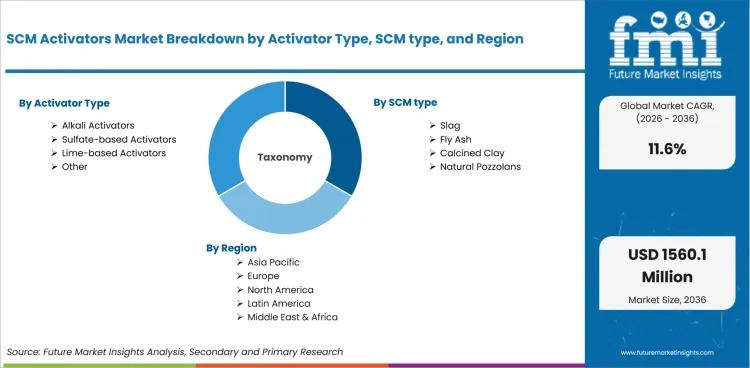
| Parameter | Details |
|---|---|
| Forecast period | 2026 to 2036 |
| Historical period | 2021 to 2025 |
| Quantitative unit | Revenue in USD million |
| By activator type | Alkali activators, sulfate-based activators, lime-based activators, other |
| By SCM type | Slag, fly ash, calcined clay, natural pozzolans |
| By application | Ready-mix concrete, precast concrete, cement blending, other |
| By form | Powder, liquid |
| By sales channel | Direct to cement / concrete producers, distributors |
| Regions covered | North America, Latin America, Europe, East Asia, South Asia and Pacific, Middle East and Africa |
| Countries covered | United States, United Kingdom, Germany, France, Japan, China, South Korea, India |
| Key companies profiled | Sika, Saint-Gobain Construction Chemicals, Mapei, Ecocem, Cemex, Master Builders Solutions, Heidelberg Materials |
| Approach | Hybrid bottom-up and top-down methodology using cement production exposure, SCM use, dosage ranges, application mix, and country adoption velocity |
Source: Future Market Insights, 2026.
SCM Activators Market - Scope & Definition
| Attribute | Detail |
|---|---|
| Market Definition | Chemical additives used to raise the reactivity of supplementary cementitious materials in cement and concrete systems |
| Functions Covered | SCM activation, early-strength recovery, setting balance, reaction control, lower-clinker binder support |
| Applications Covered | Ready-mix concrete, precast concrete, cement blending, and other cementitious formulation uses |
| End-Use Industries | Cement manufacturing, concrete production, precast manufacturing, infrastructure construction, building materials |
| Grades Covered | Alkali activators, sulfate-based activators, lime-based activators, and other activation systems |
| Inclusions | Activator products used with slag, fly ash, calcined clay, natural pozzolans, powder products, liquid products, direct sales, distributor sales, and demand across selected countries |
| Exclusions | Ordinary Portland cement, clinker, bulk slag, fly ash, calcined clay, aggregates, standard concrete admixtures without SCM activation use, and finished ready-mix concrete |
SCM Activators Market - Research Methodology
| Method | Description |
|---|---|
| Primary Research | FMI analyst interviews with cement producers, ready-mix suppliers, precast manufacturers, construction chemical distributors, and technical service teams across selected markets |
| Desk Research | Review of cement decarbonisation data, mineral commodity data, company product information, cement standards, government releases, and credible industry publications |
| Market Sizing & Forecasting | Hybrid bottom-up and top-down model using cement production exposure, low-clinker cement penetration, activator dosage ranges, country adoption differences, and application mix |
| Data Validation | Cross-verification using cement additives portfolios, blended cement trends, country production signals, policy pressure, and local supplier reach |
SCM Activators Market Breakdown by Activator Type, SCM Type, Application, Form, Sales Channel, and Region
SCM Activators Market Segmented by Activator Type
- Alkali Activators
- Sulfate-based Activators
- Lime-based Activators
- Other
SCM Activators Market Segmented by SCM Type
- Slag
- Fly Ash
- Calcined Clay
- Natural Pozzolans
SCM Activators Market Segmented by Application
- Ready-Mix Concrete
- Precast Concrete
- Cement Blending
- Other
SCM Activators Market Segmented by Form
- Powder
- Liquid
SCM Activators Market Segmented by Sales Channel
- Direct to Cement / Concrete Producers
- Distributors
SCM Activators Market by Region
- North America
- Latin America
- Europe
- East Asia
- South Asia and Pacific
- Middle East and Africa
Research Sources and Bibliography
- British Cement Association and Mineral Products Association. (2025). Profile of the UK mineral products industry 2025. Mineral Products Association.
- CHRYSO. (2024, November 6). EnviroAdd: Next generation activators for low-carbon cement. CHRYSO.
- Destatis. (2026). Construction and housing: Building permits in building construction. Federal Statistical Office of Germany.
- Ecocem. (2025, January 28). Ecocem announces the first commercial low-carbon cement production unit for ACT technology at its Dunkirk manufacturing facility. Ecocem.
- Ecocem. (2026, April 15). Commissioner Hoekstra visits Ecocem’s Dunkirk facility to highlight decisive role in Europe’s industrial decarbonisation. Ecocem.
- Federal Highway Administration. (2026). Funding: Infrastructure Investment and Jobs Act. USA Department of Transportation.
- France Ministry of Ecological Transition. (2025, December 31). Construction de logements: Résultats à fin novembre 2025. Service des données et études statistiques.
- India Brand Equity Foundation. (2026). Indian cement industry analysis. IBEF.
- International Energy Agency. (2026). Cement. IEA.
- Japan Cement Association. (2025, July). The cement industry in Japan. Japan Cement Association.
- Korea Cement Association. (2025). 2025 Cement in Korea. Korea Cement Association.
- Mapei. (2026, February 2). Cement formulas are changing: Alternative materials and innovative technologies. Mapei.
- National Bureau of Statistics of China. (2025, November 17). Industrial production operation in October 2025. National Bureau of Statistics of China.
- National Bureau of Statistics of China. (2025, December 16). Investment in real estate development for January-November 2025. National Bureau of Statistics of China.
- NITI Aayog. (2026, January). Roadmap for cement sector decarbonisation. Government of India.
- OECD. (2025, June 3). Korea: OECD Economic Outlook, Volume 2025 Issue 1. OECD.
- PRS Legislative Research. (2026, February 19). Demand for grants 2026-27 analysis: Road transport and highways. PRS Legislative Research.
- Press Information Bureau. (2026, January 21). NITI Aayog releases three reports on green transition in cement, aluminium and MSME sectors. Government of India.
- Saint-Gobain. (2025, October 2). Saint-Gobain completes the acquisition of Fosroc, a leading player in construction chemicals in Asia and emerging markets. Saint-Gobain.
- USA Geological Survey. (2026, February). Cement: Mineral commodity summaries 2026. USA Geological Survey.
- VDZ. (2024, October 1). VDZ’s environmental data 2023 published. German Cement Works Association.
- World Cement Association. (2025). Korea Cement Association member profile. World Cement Association.
This bibliography is provided for reader reference and is not exhaustive. The full report contains the complete reference list and detailed citations.
This Report Answers
- Market size estimates for 2026 and forecasts through 2036 for the SCM activators market.
- Insights across regional and country-level markets for SCM activator demand.
- Analysis of demand drivers, clinker substitution pressure, and low-carbon binder adoption.
- Evaluation of activator type, SCM type, application, form, and sales channel segmentation.
- Assessment of country-level demand conditions across the United States, United Kingdom, Germany, France, Japan, China, South Korea, and India.
- Identification of opportunities across slag, fly ash, calcined clay, and natural pozzolan activation systems.
- Evaluation of supplier positioning across construction chemical groups, binder technology developers, and cement producers.
- Analysis of technical service requirements, plant trial behavior, and formulation support needs.
- Assessment of competitive positioning across global and regional supplier groups.
- Country-level growth analysis covering the fastest-growing and more cautious markets.
- Regional outlooks across North America, Europe, East Asia, and South Asia and Pacific.
- Delivery of market data, forecasts, and supporting analysis in PDF and Excel formats.
Frequently Asked Questions
What is the growth prospect for SCM activators?
Demand for SCM activators is expected to rise at a considerable pace as cement producers adopt lower-clinker binder systems and require stronger performance recovery.
Which companies are expected to shape the SCM activators market?
Sika, Saint-Gobain Construction Chemicals, Mapei, Ecocem, Cemex, Master Builders Solutions, and Heidelberg Materials are expected to shape market competition through formulation support and cement-sector reach.
Why are leading construction chemical companies investing in SCM activators?
Leading construction chemical companies are investing in SCM activators to support lower-clinker cement, ready-mix concrete trials, and early-strength recovery in blended binder systems.
Why are direct sales channels important in the SCM activators market?
Direct sales channels support plant testing, mineral analysis, dosage recommendations, and technical service during customer approvals.
Which activator formats are gaining attention in SCM activators?
Powder activators are gaining attention because cement mills prefer dry storage, mill-fed dosing, and simpler bulk handling.
How do regulations influence SCM activator adoption?
Regulations influence adoption through carbon reporting, low-carbon procurement, cement standards, and project-level embodied-carbon requirements.
Why is SCM variability important for activator selection?
SCM variability is important because fly ash, slag, calcined clay, and natural pozzolans differ by source and can change setting time, strength gain, and workability.
What role do ready-mix plants play in the SCM activators market?
Ready-mix plants support adoption by testing activated binder systems under real batching, pumping, finishing, and strength-performance conditions.
How do calcined clay systems support SCM activator demand?
Calcined clay systems support demand because they create a wider low-clinker route beyond slag and fly ash, while often requiring chemistry support for workability and strength.
Preview the report firsthand - request a free sample
Get SampleGet the brochure for pricing and purchase details.
Get PDFTable of Content
- Key Takeaways
- Market Size and CAGR
- Top Growth Driver
- Fastest Growing Segment
- Leading Region
- Key Companies
- Emerging Opportunities
- Executive Summary
- Global Market Outlook
- Demand-side Trends
- Supply-side Trends
- Technology Roadmap Analysis
- Analysis and Recommendations
- Analyst Perspective (What is happening? Why now? What should investors know?)
- Key Questions Answered
- How large is the market?
- What is the CAGR?
- What are key trends?
- Which region dominates?
- Who are the leaders?
- Market Overview
- Market Coverage / Taxonomy
- Market Definition / Scope / Limitations
- Research Methodology
- Chapter Orientation
- Analytical Lens and Working Hypotheses
- Market Structure, Signals, and Trend Drivers
- Benchmarking and Cross-market Comparability
- Market Sizing, Forecasting, and Opportunity Mapping
- Research Design and Evidence Framework
- Desk Research Programme (Secondary Evidence)
- Expert Input and Fieldwork (Primary Evidence)
- Tooling, Models, and Reference Databases
- Data Engineering and Model Build
- Quality Assurance and Audit Trail
- Market Background
- Market Dynamics (Drivers, Restraints, Opportunity, Trends)
- Scenario Forecast (Optimistic, Likely, Conservative)
- Impact Analysis
- AI Impact
- Sustainability Impact
- Regulatory Impact
- Technology Impact
- Consumer / Buyer Analysis
- Purchase Drivers
- Adoption Barriers
- Buyer Journey
- Opportunity Map Analysis
- Product Life Cycle Analysis
- Supply Chain Analysis
- Investment Feasibility Matrix
- Value Chain Analysis
- PESTLE and Porter's Analysis
- Regulatory Landscape
- Regional Parent Market Outlook
- Production and Consumption Statistics
- Import and Export Statistics
- Global Market Analysis and Forecast, 2021 to 2036
- Historical Market Size Value (USD Million) & Volume (Unit) Analysis, 2021 to 2025
- Current and Future Market Size Value (USD Million) & Volume (Unit) Projections, 2026 to 2036
- Y-o-Y Growth Trend Analysis
- Absolute $ Opportunity Analysis
- Global Market Pricing Analysis, 2021 to 2036
- Global Market Analysis and Forecast, By Activator Type, 2021 to 2036
- Introduction / Key Findings
- Historical Market Size Value (USD Million) & Volume (Unit) Analysis By Activator Type, 2021 to 2025
- Current and Future Market Size Value (USD Million) & Volume (Unit) Analysis and Forecast By Activator Type, 2026 to 2036
- Alkali Activators
- Sulfate-based Activators
- Lime-based Activators
- Other
- Alkali Activators
- Y-o-Y Growth Trend Analysis By Activator Type, 2021 to 2025
- Absolute $ Opportunity Analysis By Activator Type, 2026 to 2036
- Global Market Analysis and Forecast, By SCM Type, 2021 to 2036
- Introduction / Key Findings
- Historical Market Size Value (USD Million) & Volume (Unit) Analysis By SCM Type, 2021 to 2025
- Current and Future Market Size Value (USD Million) & Volume (Unit) Analysis and Forecast By SCM Type, 2026 to 2036
- Slag
- Fly Ash
- Calcined Clay
- Natural Pozzolans
- Slag
- Y-o-Y Growth Trend Analysis By SCM Type, 2021 to 2025
- Absolute $ Opportunity Analysis By SCM Type, 2026 to 2036
- Global Market Analysis and Forecast, By Application, 2021 to 2036
- Introduction / Key Findings
- Historical Market Size Value (USD Million) & Volume (Unit) Analysis By Application, 2021 to 2025
- Current and Future Market Size Value (USD Million) & Volume (Unit) Analysis and Forecast By Application, 2026 to 2036
- Ready-Mix Concrete
- Precast Concrete
- Cement Blending
- Other
- Ready-Mix Concrete
- Y-o-Y Growth Trend Analysis By Application, 2021 to 2025
- Absolute $ Opportunity Analysis By Application, 2026 to 2036
- Global Market Analysis and Forecast, By Form, 2021 to 2036
- Introduction / Key Findings
- Historical Market Size Value (USD Million) & Volume (Unit) Analysis By Form, 2021 to 2025
- Current and Future Market Size Value (USD Million) & Volume (Unit) Analysis and Forecast By Form, 2026 to 2036
- Powder
- Liquid
- Powder
- Y-o-Y Growth Trend Analysis By Form, 2021 to 2025
- Absolute $ Opportunity Analysis By Form, 2026 to 2036
- Global Market Analysis and Forecast, By Sales Channel, 2021 to 2036
- Introduction / Key Findings
- Historical Market Size Value (USD Million) & Volume (Unit) Analysis By Sales Channel, 2021 to 2025
- Current and Future Market Size Value (USD Million) & Volume (Unit) Analysis and Forecast By Sales Channel, 2026 to 2036
- Direct to Cement / Concrete Producers
- Distributors
- Direct to Cement / Concrete Producers
- Y-o-Y Growth Trend Analysis By Sales Channel, 2021 to 2025
- Absolute $ Opportunity Analysis By Sales Channel, 2026 to 2036
- Global Market Analysis and Forecast, By Region, 2021 to 2036
- Introduction
- Historical Market Size Value (USD Million) & Volume (Unit) Analysis By Region, 2021 to 2025
- Current Market Size Value (USD Million) & Volume (Unit) Analysis and Forecast By Region, 2026 to 2036
- North America
- Latin America
- Western Europe
- Eastern Europe
- East Asia
- South Asia and Pacific
- Middle East & Africa
- Market Attractiveness Analysis By Region
- North America Market Analysis and Forecast, By Country, 2021 to 2036
- Historical Market Size Value (USD Million) & Volume (Unit) Trend Analysis By Market Taxonomy, 2021 to 2025
- Market Size Value (USD Million) & Volume (Unit) Forecast By Market Taxonomy, 2026 to 2036
- By Country
- USA
- Canada
- Mexico
- By Activator Type
- By SCM Type
- By Application
- By Form
- By Sales Channel
- By Country
- Market Attractiveness Analysis
- By Country
- By Activator Type
- By SCM Type
- By Application
- By Form
- By Sales Channel
- Key Takeaways
- Latin America Market Analysis and Forecast, By Country
- Historical Market Size Value (USD Million) & Volume (Unit) Trend Analysis By Market Taxonomy, 2021 to 2025
- Market Size Value (USD Million) & Volume (Unit) Forecast By Market Taxonomy, 2026 to 2036
- By Country
- Brazil
- Chile
- Rest of Latin America
- By Activator Type
- By SCM Type
- By Application
- By Form
- By Sales Channel
- By Country
- Market Attractiveness Analysis
- By Country
- By Activator Type
- By SCM Type
- By Application
- By Form
- By Sales Channel
- Key Takeaways
- Western Europe Market Analysis and Forecast, By Country
- Historical Market Size Value (USD Million) & Volume (Unit) Trend Analysis By Market Taxonomy, 2021 to 2025
- Market Size Value (USD Million) & Volume (Unit) Forecast By Market Taxonomy, 2026 to 2036
- By Country
- Germany
- UK
- Italy
- Spain
- France
- Nordic
- BENELUX
- Rest of Western Europe
- By Activator Type
- By SCM Type
- By Application
- By Form
- By Sales Channel
- By Country
- Market Attractiveness Analysis
- By Country
- By Activator Type
- By SCM Type
- By Application
- By Form
- By Sales Channel
- Key Takeaways
- Eastern Europe Market Analysis and Forecast, By Country
- Historical Market Size Value (USD Million) & Volume (Unit) Trend Analysis By Market Taxonomy, 2021 to 2025
- Market Size Value (USD Million) & Volume (Unit) Forecast By Market Taxonomy, 2026 to 2036
- By Country
- Russia
- Poland
- Hungary
- Balkan & Baltic
- Rest of Eastern Europe
- By Activator Type
- By SCM Type
- By Application
- By Form
- By Sales Channel
- By Country
- Market Attractiveness Analysis
- By Country
- By Activator Type
- By SCM Type
- By Application
- By Form
- By Sales Channel
- Key Takeaways
- East Asia Market Analysis and Forecast, By Country
- Historical Market Size Value (USD Million) & Volume (Unit) Trend Analysis By Market Taxonomy, 2021 to 2025
- Market Size Value (USD Million) & Volume (Unit) Forecast By Market Taxonomy, 2026 to 2036
- By Country
- China
- Japan
- South Korea
- By Activator Type
- By SCM Type
- By Application
- By Form
- By Sales Channel
- By Country
- Market Attractiveness Analysis
- By Country
- By Activator Type
- By SCM Type
- By Application
- By Form
- By Sales Channel
- Key Takeaways
- South Asia and Pacific Market Analysis and Forecast, By Country
- Historical Market Size Value (USD Million) & Volume (Unit) Trend Analysis By Market Taxonomy, 2021 to 2025
- Market Size Value (USD Million) & Volume (Unit) Forecast By Market Taxonomy, 2026 to 2036
- By Country
- India
- ASEAN
- Australia & New Zealand
- Rest of South Asia and Pacific
- By Activator Type
- By SCM Type
- By Application
- By Form
- By Sales Channel
- By Country
- Market Attractiveness Analysis
- By Country
- By Activator Type
- By SCM Type
- By Application
- By Form
- By Sales Channel
- Key Takeaways
- Middle East & Africa Market Analysis and Forecast, By Country
- Historical Market Size Value (USD Million) & Volume (Unit) Trend Analysis By Market Taxonomy, 2021 to 2025
- Market Size Value (USD Million) & Volume (Unit) Forecast By Market Taxonomy, 2026 to 2036
- By Country
- Kingdom of Saudi Arabia
- Other GCC Countries
- Türkiye
- South Africa
- Other African Union
- Rest of Middle East & Africa
- By Activator Type
- By SCM Type
- By Application
- By Form
- By Sales Channel
- By Country
- Market Attractiveness Analysis
- By Country
- By Activator Type
- By SCM Type
- By Application
- By Form
- By Sales Channel
- Key Takeaways
- Key Countries Market Analysis
- USA
- Pricing Analysis
- Market Share Analysis, 2025
- By Activator Type
- By SCM Type
- By Application
- By Form
- By Sales Channel
- Canada
- Pricing Analysis
- Market Share Analysis, 2025
- By Activator Type
- By SCM Type
- By Application
- By Form
- By Sales Channel
- Mexico
- Pricing Analysis
- Market Share Analysis, 2025
- By Activator Type
- By SCM Type
- By Application
- By Form
- By Sales Channel
- Brazil
- Pricing Analysis
- Market Share Analysis, 2025
- By Activator Type
- By SCM Type
- By Application
- By Form
- By Sales Channel
- Chile
- Pricing Analysis
- Market Share Analysis, 2025
- By Activator Type
- By SCM Type
- By Application
- By Form
- By Sales Channel
- Germany
- Pricing Analysis
- Market Share Analysis, 2025
- By Activator Type
- By SCM Type
- By Application
- By Form
- By Sales Channel
- UK
- Pricing Analysis
- Market Share Analysis, 2025
- By Activator Type
- By SCM Type
- By Application
- By Form
- By Sales Channel
- Italy
- Pricing Analysis
- Market Share Analysis, 2025
- By Activator Type
- By SCM Type
- By Application
- By Form
- By Sales Channel
- Spain
- Pricing Analysis
- Market Share Analysis, 2025
- By Activator Type
- By SCM Type
- By Application
- By Form
- By Sales Channel
- France
- Pricing Analysis
- Market Share Analysis, 2025
- By Activator Type
- By SCM Type
- By Application
- By Form
- By Sales Channel
- India
- Pricing Analysis
- Market Share Analysis, 2025
- By Activator Type
- By SCM Type
- By Application
- By Form
- By Sales Channel
- ASEAN
- Pricing Analysis
- Market Share Analysis, 2025
- By Activator Type
- By SCM Type
- By Application
- By Form
- By Sales Channel
- Australia & New Zealand
- Pricing Analysis
- Market Share Analysis, 2025
- By Activator Type
- By SCM Type
- By Application
- By Form
- By Sales Channel
- China
- Pricing Analysis
- Market Share Analysis, 2025
- By Activator Type
- By SCM Type
- By Application
- By Form
- By Sales Channel
- Japan
- Pricing Analysis
- Market Share Analysis, 2025
- By Activator Type
- By SCM Type
- By Application
- By Form
- By Sales Channel
- South Korea
- Pricing Analysis
- Market Share Analysis, 2025
- By Activator Type
- By SCM Type
- By Application
- By Form
- By Sales Channel
- Russia
- Pricing Analysis
- Market Share Analysis, 2025
- By Activator Type
- By SCM Type
- By Application
- By Form
- By Sales Channel
- Poland
- Pricing Analysis
- Market Share Analysis, 2025
- By Activator Type
- By SCM Type
- By Application
- By Form
- By Sales Channel
- Hungary
- Pricing Analysis
- Market Share Analysis, 2025
- By Activator Type
- By SCM Type
- By Application
- By Form
- By Sales Channel
- Kingdom of Saudi Arabia
- Pricing Analysis
- Market Share Analysis, 2025
- By Activator Type
- By SCM Type
- By Application
- By Form
- By Sales Channel
- Türkiye
- Pricing Analysis
- Market Share Analysis, 2025
- By Activator Type
- By SCM Type
- By Application
- By Form
- By Sales Channel
- South Africa
- Pricing Analysis
- Market Share Analysis, 2025
- By Activator Type
- By SCM Type
- By Application
- By Form
- By Sales Channel
- USA
- Market Structure Analysis
- Competition Dashboard
- Competition Benchmarking
- Market Share Analysis of Top Players
- By Regional
- By Activator Type
- By SCM Type
- By Application
- By Form
- By Sales Channel
- Emerging Startups
- Innovation Benchmarking
- Competition Analysis
- Competition Deep Dive
- Sika
- Overview
- Product Portfolio
- Profitability by Market Segments (Product/Region/Sales Channel)
- Sales Footprint
- Strategy Overview
- Marketing Strategy
- Product Strategy
- Channel Strategy
- Saint-Gobain Construction Chemicals
- Mapei
- Ecocem
- Cemex
- Master Builders Solutions
- Heidelberg Materials
- CHRYSO
- Fosroc
- Sika
- Case Studies
- Success Stories
- Recent Developments
- Competition Deep Dive
- Assumptions & Acronyms Used


