
- Market Size (2026)
- USD 224.9 Mn
- Forecast (2036)
- USD 361.8 Mn
- CAGR (2026 to 2036)
- 4.9%
How big is Shellac Market in 2026?
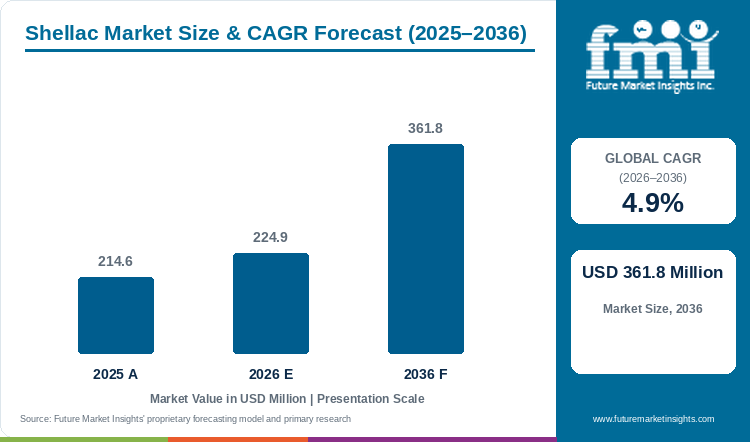
The shellac market evolved from a 2025 valuation of USD 214.6 million to USD 224.9 million in 2026, and is set to achieve USD 361.8 million by 2036, reflecting a 4.9% CAGR.
Manufacturer requirements for natural, high-gloss moisture barriers in chocolate panning and acid-resistant tablet coatings are driving steady adoption across the global shellac market. Commercial shellac industry size totaled USD 214.6 million in 2025 and reaches USD 224.9 million in 2026. Long-term market value is forecast to reach USD 361.8 million by 2036, growing at a 4.9% CAGR from 2026 through 2036. Dewaxed Bleached and Refined Shellac commands 48.6% of 2026 processing grade value because wax-free transparent coatings dissolve cleanly in food-grade ethanol and water-based ammonium solutions without leaving cloudy spots on candies or pills. Food and supplement companies are adopting shellac coatings to protect sensitive ingredients from ambient moisture and stomach acid. An August 2026 investigation in Food Research International showed that coating baker's yeast in a double layer of HPMC and 7.5% tributyl citrate plasticized shellac kept 86.47% of yeast alive across six freeze-thaw dough cycles versus 59.48% in uncoated yeast. This natural protective film gives E904 shellac a strong performance advantage over barley hordein packaging films in commercial food preservation. Similarly, a July 2025 study in the International Journal of Biological Macromolecules proved that 5.0% w/v shellac microgels blended with zein and alginate trapped 95.3% of probiotics and protected them through stomach acid. As documented in FMI research, summer heatwaves across forest host trees in India and Thailand and gradual hardening of aged bleached shellac during warm storage force buyers to rely on cold-chain refiner contracts through 2036.
Key Market Trends & Insights
- By processing grade: Dewaxed Bleached and Refined Shellac holds an estimated 48.6% share in 2026 because transparent, wax-free grades prevent cloudy haze on chocolate dragees and pharmaceutical tablets.
- By physical form: Solid Flakes, Buttons, and Powder represent 61.4% in 2026 since dry resin flakes avoid flammable-liquid ocean freight charges and premature aging in alcohol.
- By functional role: Confectionery and Fresh Citrus Glazing E904 accounts for 39.2% in 2026 as citrus packhouses and chocolate panners demand breathable, high-gloss natural coatings.
- By procurement channel: Direct Industrial Refiner Contracts command 64.8% in 2026 through custom acid-value and wax-content specs with pharmacopoeial purity certificates.
- By active packaging & probiotics: Antimicrobial meat-packaging films and acid-resistant probiotic microgels expand high-margin bio-resin demand beyond traditional wood finishes.
Regional Highlights
- Top national expansion: Thailand leads national growth projections at a 5.8% CAGR through 2036 under domestic rain-tree sticklac refining and tropical fruit export coating.
- Broader country progression: The United States tracks at a 4.8% CAGR ahead of the United Kingdom at 4.7% and Germany at 4.6%, whereas Japan records a 4.5% CAGR.
Market Size & Forecast
Table 1: Market Size and Forecast for the Shellac Market (USD million and CAGR percentage), 2025 to 2036
| Metric | Value |
|---|---|
| 2025 Market Size | USD 214.6 million |
| Estimated Market Size in 2026 | USD 224.9 million |
| Projected Market Size by 2036 | USD 361.8 million |
| CAGR, 2026 to 2036 | 4.9% |
| Added Market Value, 2026 to 2036 | USD 136.9 million |
Pharmaceutical and probiotic supplement makers need a natural tablet coating that stays intact in acidic stomach fluid (pH 1.2 to 3.0) and only dissolves when the pill reaches the neutral environment of the intestine (above pH 6.8). Raw sticklac harvested from forest host trees contains 6% to 8% natural insect wax and red dye that must be removed before industrial coating. Per a September 2025 review in Polymers (Basel), refined E904 shellac consists of natural hydroxy fatty acid esters that form tight, water-resistant edible films. To fine-tune how fast tablets dissolve in the gut, coating engineers blend dewaxed shellac with rye secalin coating resins.
Refined Lac Volume and Active-Coating Sizing
Table 2: Refined Lac Volume and Coating Sizing for the Shellac Market (USD million, thousand metric tons, and USD per kilogram), 2025 to 2036
| Metric | 2025 | 2026 | 2036 |
|---|---|---|---|
| Market size (USD million) | 214.6 | 224.9 | 361.8 |
| Commercial seedlac, flake & bleached shellac volume (thousand metric tons) | 20.2 to 22.4 | 21.0 to 23.3 | 31.2 to 34.8 |
| Food E904 & pharmaceutical USP/EP grade volume (thousand metric tons) | 11.8 to 13.2 | 12.3 to 13.8 | 19.2 to 21.5 |
| Average commercial refined shellac valuation per kilogram (USD) | 9.6 to 10.6 | 9.7 to 10.7 | 10.4 to 11.6 |
Operational note: Lac tonnage figures track B2B seedlac and button lac shipments with dewaxed orange/lemon flake shellac and bleached refined shellac plus aqueous/ethanolic coating solutions.
Supermarket chains and fresh-food packers looking to cut plastic waste and food spoilage are also creating new demand for active shellac packaging coatings. According to an August 2025 study in the Journal of the Science of Food and Agriculture, embedding cinnamon-oil shellac nanoparticles into natural chitosan films doubled chilled beef shelf life from 4 days to 8 days. Produce packhouses and candy plants combine these natural barrier coatings with natural food glazing agents and pan-coated confectionery glazes to protect citrus fruits and chocolate dragees.
Per Capita & Commercial Coating Line Sizing
Table 3: Per Capita and Coating Line Valuation Indicators for the Shellac Market (USD and percentage share), 2025 to 2036
| Metric | 2025 | 2026 | 2036 |
|---|---|---|---|
| World population (billion) | 8.2 | 8.3 | 9.0 |
| Market value per 1,000 people (USD) | 26.2 | 27.1 | 40.2 |
| Annual market value per confectionery, citrus & pharma coating line (USD thousand) | 18.8 to 21.0 | 19.5 to 21.8 | 30.5 to 34.2 |
| Aqueous ammonium & ethanolic liquid solution share (%) | 37.8% to 39.2% | 38.0% to 39.4% | 41.5% to 43.5% |
Table 4: Industrial Coating and Channel Valuation Indicators for the Shellac Market (USD million and line count), 2026
| Metric | Value | Institutional Reference Basis |
|---|---|---|
| Market size, 2026 | USD 224.9 million | 2026 global market valuation baseline |
| Commercial confectionery panning, citrus waxing & tablet coating lines | 11,200 lines | Global E904 dragee panning, citrus packhouse, and enteric tablet lines |
| Market value per coating line | USD 20,080.4 | Annualized shellac resin procurement valuation |
| Direct Industrial Refiner Contracts market value, 2026 | USD 145.7 million | 64.8% procurement channel allocation |
Tighter workplace air-quality rules inside pharmaceutical tablet factories and packaging print shops are pushing buyers away from alcohol-dissolved shellac toward water-based solutions. Refiners dissolve dewaxed shellac in mild aqueous ammonium carbonate with protective edible films and coatings and packhouse microbial spoilage inhibitors so coaters can spray high-gloss films without solvent fumes.
Analyst Perspective
"Confectionery panners and pharmaceutical enteric-coating engineers do not buy shellac as raw forest sticklac, because they require guaranteed ethanol solubility and predictable pH 7.0 dissolution. Refiners that pair seedlac reserves in India and Thailand as well as Yunnan with chlorine-free activated-carbon dewaxing and ready-to-spray aqueous ammonium solutions will hold multi-year industrial contracts through 2036."
- Nandini Roy Choudhury, Principal Consultant, Future Market Insights.
How is the shellac market segmented?
The shellac market is segmented by processing grade and physical form with functional role and procurement channel. In 2026, Dewaxed Bleached and Refined Shellac is projected at 48.6% and Solid Flakes, Buttons, and Powder at 61.4%, while Confectionery and Fresh Citrus Glazing E904 holds 39.2% and Direct Industrial Refiner Contracts command 64.8%.
By processing grade: Dewaxed Bleached and Refined Shellac with Dewaxed Orange and Lemon Flake Shellac and Wax-Containing Seedlac and Button Lac.
By physical form: Solid Flakes, Buttons, and Powder and Aqueous Ammonium and Ethanolic Liquid Solutions.
By functional role: Confectionery and Fresh Citrus Glazing E904 with Pharmaceutical Enteric Tablet and Pellet Coating as well as Wood Luthiery, French Polish, and Sealers plus Cosmetic Hair Lacquer, Mascara, and Flexo Inks.
By procurement channel: Direct Industrial Refiner Contracts and Specialty Gum and Resin Distributors.
Why does Dewaxed Bleached and Refined Shellac lead the processing grade category?
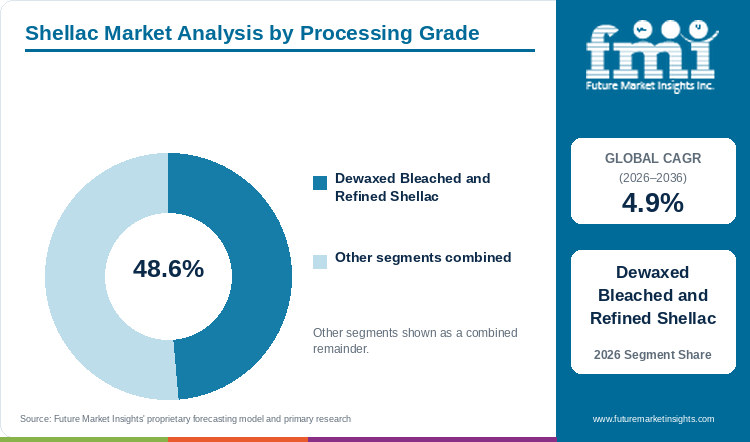
Dewaxed Bleached and Refined Shellac holds an estimated 48.6% of processing grade demand in 2026, anchored by water-clear transparency and pharmacopoeial purity.
Table 5: Processing Grade Share for the Shellac Market (percentage share), 2026
| Processing Grade | Share (2026) |
|---|---|
| Dewaxed Bleached and Refined Shellac | 48.6% |
| Other Segments Combined | 51.4%* |
| Total | 100.0% |
*Note: Unbleached processing grades (Dewaxed Orange and Lemon Flake Shellac and Wax-Containing Seedlac and Button Lac) account for the remaining 51.4% of 2026 shellac demand.
Table 6: Processing Grade Leadership and Market Growth for the Shellac Market (segment share and CAGR percentage), 2026 to 2036
| Metric | Value |
|---|---|
| Global CAGR (2026 to 2036) | 4.9% |
| Leading Segment | Dewaxed Bleached and Refined Shellac (48.6% share in 2026) |
Unrefined orange shellac still contains natural insect wax and amber-red dye that leave a cloudy, yellowish tint on white sugar-coated pills and brightly colored candies. Dewaxed bleached and carbon-refined shellac removes both the insoluble wax and the dark color, giving confectionery panners and fruit packers using fresh-produce ripening modulators a crystal-clear, odorless finish.
- Dewaxed Bleached and Refined Shellac holds 48.6% of processing grade value in 2026 because transparent, wax-free resin commands a 35% to 55% price premium over raw seedlac.
- Per the March 2026 USDA New Delhi Food Processing Ingredients Annual report IN2026-0016, agro-processing exporters in India are expanding refined food-grade resin and specialty ingredient capacity for global food manufacturers.
What sustains Solid Flakes, Buttons, and Powder leadership in physical form?
Solid Flakes, Buttons, and Powder represent 61.4% of the physical form category in 2026, supported by non-flammable ocean transport and longer ester shelf life.
Liquid shellac dissolved in ethanol is classified as a flammable hazardous cargo, which makes international ocean shipping from Asian refineries to Western factories expensive. Liquid alcohol solutions also slowly react with the resin in the drum and lose their ability to dissolve properly on tablets. For this reason, dry shellac flakes and powders shipped from India and Thailand to compounding plants in Europe and the United States as well as Japan remain the preferred trade format.
- Solid Flakes, Buttons, and Powder account for 61.4% of physical form demand in 2026 as industrial coaters dissolve dry flakes on-site or buy refrigerated powder drums.
- According to a January 2026 study in the International Journal of Biological Macromolecules, combining oat protein isolate with shellac nanoparticles at a 2 to 1 ratio forms an elastic emulsion film that boosts curcumin retention by 37.8% and bioaccessibility by 40.6%.
How does Confectionery and Fresh Citrus Glazing E904 lead functional roles?
Confectionery and Fresh Citrus Glazing E904 accounts for 39.2% of functional role value in 2026, driven by chocolate dragee shine and non-synthetic fruit waxing.
Chocolate-covered almonds and sugar-panned candies need a thin final polish that gives a mirror shine and stops chocolate fat from melting onto shoppers' fingers. In fresh produce packhouses, E904 shellac sprays paired with citrus post-harvest sanitizers replace natural peel wax washed off oranges and apples during cleaning, locking in juiciness during supermarket display.
- Confectionery and Fresh Citrus Glazing E904 secures 39.2% of functional role demand in 2026 because plant gums and starches cannot match the high gloss and fast drying speed of shellac.
- A 2026 study in Polymers demonstrated that coaxial electrospun zein and shellac composite films loaded with limonin and resveratrol achieved 89.69% antioxidant activity and extended fresh strawberry shelf life.
Why do Direct Industrial Refiner Contracts lead the procurement channel?
Direct Industrial Refiner Contracts command 64.8% of procurement channel share in 2026, supported by pharmacopoeial auditing and custom solution compounding.
Global chocolate brands and pharmaceutical tablet makers contract directly with primary lac refiners in Germany and the United States as well as India and China plus Japan to guarantee batch purity and stable pricing. Wood finish makers formulating French polish and stain-blocking primers with architectural and luthiery wood coatings and bio-based wood coating resins also rely on direct refiner testing to prevent wax haze.
- Direct Industrial Refiner Contracts command 64.8% of channel value in 2026 because primary refiners blend multiple seedlac harvests to protect buyers from local crop shortages in Jharkhand and Lampang.
- In July 2025, Palsgaard inaugurated a new state-of-the-art application center in Navi Mumbai to support confectionery and bakery coating customers across India and Asia-Pacific.
How do Pharmaceutical Enteric Coatings and Probiotic Microgels expand high-value demand?
Pharmaceutical Enteric Tablet and Pellet Coating represents the highest-margin functional tier through 2036, driven by natural colon-targeted drug and probiotic delivery.
Nutraceutical brands want a clean-label, natural coating to replace synthetic petroleum methacrylic copolymers on probiotic and enzyme capsules. Water-based USP and Ph. Eur. ammonium shellac coatings resist stomach acid and release delicate probiotics and omega-3 oils safely in the lower intestine.
- Water-based ammonium shellac coatings resist acidic gastric fluid below pH 3.0 and dissolve cleanly at neutral intestinal pH above 6.8 to protect probiotic and enzyme tablets.
- In February 2025, Roquette launched a new high-performance pharmaceutical tablet coating platform to help drug and supplement makers achieve reliable moisture barrier and enteric release profiles.
What are the drivers, restraints, and opportunities in the shellac market?
In the shellac market, E904 confectionery and citrus glazing demand and natural enteric probiotic encapsulation drive adoption whereas Kerria lacca host-tree heatwaves and vegan label exclusions restrain volume and thermo-responsive double-layer microcapsules support frozen-dough and pharma growth.
- Driver: High-gloss E904 chocolate dragee panning and export citrus packhouse waxing with natural-origin enteric tablet coatings drive steady B2B demand for dewaxed shellac.
- Restraint: Extreme summer heatwaves across lac host forests in India and Thailand cause Kerria lacca insect mortality, while strict vegan food certifications exclude insect-secreted E904.
- Opportunity: Thermo-responsive shellac/HPMC yeast microcapsules and probiotic gastric-shielding microgels with active antimicrobial food packaging films open high-margin bio-resin applications.
Growth Analysis and Future Potential: Qualitative Demand Catalysts
Food and supplement industry demand for natural, biodegradable coatings that protect sensitive ingredients from moisture and stomach acid is the main catalyst propelling the shellac market. In May 2025, dsm-firmenich opened its state-of-the-art Princeton Baking Innovation Center in New Jersey to accelerate clean-label bakery and confectionery texture reformulation across North America. In parallel, Puratos introduced new chocolate and patisserie glaze innovations at iba 2025 in May 2025 to help commercial bakers and confectioners deliver high-gloss finishes without synthetic additives. These commercial investments build on steady core demand for E904 glazing across chocolate panners and citrus export packhouses.
Risk Assessment of the Shellac Market: Operational and Formulation Friction
Weather-driven swings in forest lac harvests and resin hardening during warm storage with regulatory intake limits represent the primary challenges restraining the shellac market. Because Kerria lacca insects live on forest host trees across Jharkhand and Chhattisgarh as well as Thailand, severe pre-monsoon heatwaves can kill broodlac colonies and cause raw seedlac prices to spike. On the regulatory side, the August 2024 EFSA scientific opinion re-evaluating E904 shellac established a group acceptable daily intake and requested stricter limits on lead and wax impurities in food-grade resins. In addition, confectionery brands seeking strict vegan front-of-pack certification must replace insect-secreted E904 with plant zein or carnauba wax.
Commercial Opportunity Analysis: Formulation Differentiation and Value-Add Formats
Lac refiners are capturing higher margins by engineering biomedical wound-care sponges and eco-friendly superhydrophobic spray coatings paired with chlorine-free enteric solutions. In March 2026, pharmaceutical researchers writing in Biomaterials Advances developed a pH-responsive naringenin-loaded shellac nanoparticle sponge that achieved hemostasis in under 40 seconds and accelerated diabetic wound healing. In parallel, a February 2025 study in Langmuir demonstrated that bioadhesive shellac combined with silica nanoparticles creates a durable superhydrophobic spray coating with a 162.1-degree water contact angle that withstands 50 abrasion cycles and temperatures up to 150 degrees Celsius. Refiners supplying these specialized grades are locking in high-value industrial and medical accounts through 2036.
Shellac Market by Country (2026 to 2036)
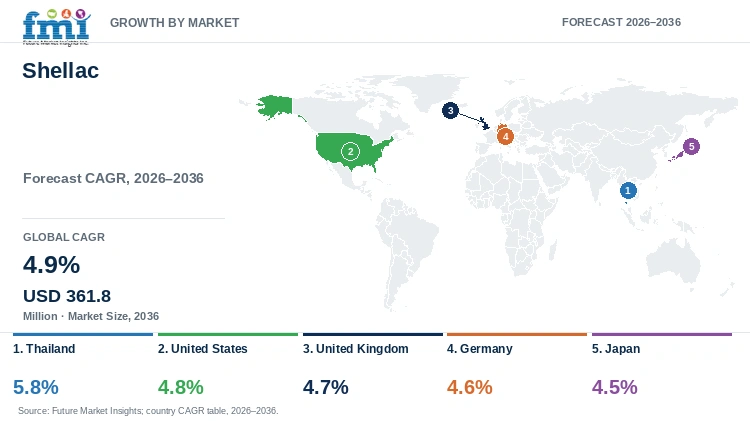
FMI country modeling indicates that Thailand leads shellac market expansion at a 5.8% CAGR from 2026 to 2036, followed by the United States at 4.8% and the United Kingdom at 4.7%. Germany advances at 4.6%, whereas Japan progresses at a 4.5% CAGR.
Table 7: Country CAGR and Primary Growth Levers for the Shellac Market (CAGR percentage), 2026 to 2036
| Country | CAGR (2026 to 2036) | Primary Growth Lever |
|---|---|---|
| Thailand | 5.8% | Northern Lampang and Chiang Mai sticklac refining and tropical citrus and fruit export coating |
| United States | 4.8% | Aqueous E904 confectionery glazes, citrus packhouse waxing, and wood primer sealers |
| United Kingdom | 4.7% | Premium panned chocolate confectionery, luthiery French polishes, and enteric nutraceuticals |
| Germany | 4.6% | European Pharmacopoeia chlorine-free solvent refining and global E904 dragee glaze exports |
| Japan | 4.5% | USP/JP pharmaceutical tablet enteric coating, Kampo pill polishing, and precision electronics inks |
Source: Future Market Insights analysis
Thailand Shellac Market Outlook (2026 to 2036)
Thailand leads national growth at a 5.8% CAGR through 2036 because it is both the world's second-largest raw sticklac producer and a major exporter of waxed tropical fruits. Growers in Lampang and Chiang Mai with Phayao cultivate lac on rain trees (Samanea saman) and supply domestic refineries that upgrade raw sticklac into seedlac and food-grade E904 glazes. Per the April 2026 USDA FAS Oilseeds and Products Annual report on Thailand, domestic agro-industrial processors continue expanding value-added refining for Asian food and industrial markets. In August 2026, pharmaceutical researchers at Silpakorn University and Burapha University in Thailand also validated electrosprayed shellac-salt nanoparticles with 97.63% encapsulation efficiency for intestinal drug delivery.
Key takeaway: In Thailand, northern rain-tree seedlac refining and export fruit packhouse coating expansion drive a leading 5.8% CAGR through 2036.
United States Shellac Market Outlook (2026 to 2036)
The United States shellac market expands at a 4.8% CAGR from 2026 to 2036, anchored by California and Florida citrus packing and panned chocolate candy glazing with stain-blocking wood primers. Specialty refiners in Massachusetts and New Jersey import seedlac from India and Thailand to formulate FDA-approved liquid E904 glazes and USP tablet coatings with knot-sealing primers. In September 2025, Corbion showcased clean-label preservation and coating advances at IBIE in Las Vegas to help U.S. confectionery and bakery brands extend ambient product shelf life. Dietary supplement contract manufacturers across the United States are also adopting water-based shellac enteric coatings for acid-sensitive probiotic and enzyme capsules.
Key takeaway: In the United States, citrus packhouse waxing and confectionery panning with probiotic enteric microencapsulation support a 4.8% CAGR.
United Kingdom Shellac Market Outlook (2026 to 2036)
The United Kingdom shellac market advances at a 4.7% CAGR from 2026 through 2036, supported by strong retail consumption of panned chocolate dragees and enteric-coated health supplements. Confectionery plants in the United Kingdom use ready-to-spray ethanolic and water-based E904 shellac glazes to give chocolate-covered nuts and raisins a glossy, non-sticky finish. In February 2026, Kerry Group reported 3.5% volume expansion across its food and beverage nutrition and functional coating operations. In addition, a July 2025 study in Colloids and Surfaces B demonstrated that cationically functionalized curcumin-shellac nanoparticles deliver potent natural antimicrobial protection for food and biomedical packaging surfaces across commercial retail supply chains.
Key takeaway: In the United Kingdom, panned chocolate dragee glazing and enteric nutraceutical tablet coating underpin a 4.7% annual growth rate.
Germany Shellac Market Outlook (2026 to 2036)
Germany records a 4.6% annual growth rate across the ten-year window to 2036 because its Bremen and Hamburg refineries lead the world in chlorine-free activated-carbon solvent refining. Rather than using harsh chemical bleach that causes shellac to harden in storage, refiners in Germany purify imported seedlac from India and Thailand with activated carbon to produce non-aging European Pharmacopoeia (Ph. Eur.) flakes and liquid E904 glazes. Supermarket tracking in the January 2026 USDA Berlin report GM2026-0003 shows that booming domestic natural food demand across over 2,200 specialty shops is driving orders for clean-label confectionery glazes. Refiners in Germany export these certified E904 glazes across Europe.
Key takeaway: In Germany, Bremen and Hamburg chlorine-free Ph. Eur. shellac refining and controlled-release food and pharma coatings sustain a 4.6% CAGR.
Japan Shellac Market Outlook (2026 to 2036)
Japan advances at a 4.5% CAGR through 2036, distinguished by high-precision Japanese Pharmacopoeia (JP) enteric tablet coating and traditional Kampo herbal pill polishing with eco-friendly packaging inks. Refiners in Gifu and Osaka process imported seedlac into ultra-clean white shellac flakes and water-based dispersions with tight acid-value tolerances so tablets dissolve on schedule in the intestine. Commercial attendance data in the October 2026 USDA Tokyo exhibition report JA2026-0017 highlight over 72,000 buyers across 3,000 stands at the FOODEX show prioritizing shelf-life extension and functional confectionery formats. Pharmaceutical tablet coaters and specialty packaging ink makers across Tokyo and Osaka rely on domestic custom-refined shellac dispersions to prevent film cracking.
Key takeaway: In Japan, Japanese Pharmacopoeia enteric tablet coatings and Kampo herbal pill and confectionery glazes support a 4.5% CAGR through 2036.
Full report country CAGRs cover North America and Latin America with Western and Eastern Europe. Country tables also include East Asia and South Asia and Pacific with the Middle East and Africa.
Who are the notable companies in the shellac market?
Stroever GmbH & Co. KG SSB and Mantrose-Haeuser Co., Inc. with Norevo GmbH, D.M. Shellac Pvt. Ltd., Aadhunik Shellac, Chuxiong DES Shellac Co., Ltd. and Gifu Shellac Manufacturing Co., Ltd. are the notable companies in the shellac market.
Competitive positioning in the shellac industry separates pharmacopoeial solvent refiners and liquid glaze formulators in Europe and North America as well as Japan from primary origin lac processors in India and China.
- Western and East Asian Pharmacopoeial Refiners and Liquid Glaze Innovators: Stroever GmbH & Co. KG SSB and Mantrose-Haeuser Co., Inc. with Norevo GmbH and Gifu Shellac Manufacturing Co., Ltd. engineer chlorine-free dewaxed flakes and aqueous ammonium enteric coatings with E904 confectionery glazes.
- Primary Origin Seedlac and Machine-Made Flake Processors in India: D.M. Shellac Pvt. Ltd. and Aadhunik Shellac operate sticklac washing and hot-filtration lines with solvent dewaxing and bleached shellac plants across Chhattisgarh and West Bengal in India.
- Yunnan Origin Bleached and Dewaxed Shellac Refiners in China: Chuxiong DES Shellac Co., Ltd. processes Yunnan sticklac and imported seedlac into food-grade bleached shellac powders and dewaxed flakes with fruit coating emulsions.
Competitive Benchmarking: Shellac Market
Table 8: Competitive Benchmarking for the Shellac Market (qualitative capability ratings and geographic reach)
| Company | Chlorine-Free Dewaxing & Bleaching | Aqueous E904 & Enteric Solutions | Multi-Origin Seedlac Sourcing | Geographic Reach |
|---|---|---|---|---|
| Stroever GmbH & Co. KG SSB | High | High | High | Germany Bremen refining hub exporting SSB pharmacopoeial and E904 shellac globally |
| Mantrose-Haeuser Co., Inc. | High | High | High | United States and North America confectionery glazes, citrus coatings, and pharma shellac |
| Norevo GmbH | High | High | High | Germany and global Quick Coat confectionery panning glazes and natural resin supply |
| D.M. Shellac Pvt. Ltd. | High | Medium | High | India Chhattisgarh origin sticklac washing, seedlac, and dewaxed/bleached flake export |
| Aadhunik Shellac | High | Medium | High | India origin machine-made dewaxed orange, lemon, and bleached shellac manufacturing |
| Chuxiong DES Shellac Co., Ltd. | High | High | High | China Yunnan origin bleached shellac powder, dewaxed flakes, and fruit coatings |
| Gifu Shellac Manufacturing Co., Ltd. | High | High | Medium | Japan JP pharmacopoeial enteric coating, food glazing, and industrial shellac dispersions |
Scoring basis: Chlorine-Free Dewaxing & Bleaching evaluates activated-carbon solvent decolorization that prevents bound-chlorine ester cross-linking, whereas Aqueous E904 & Enteric Solutions rates ready-to-use ammonium salt and ethanolic glaze formulations. Multi-Origin Seedlac Sourcing measures direct procurement across lac harvests in India and Thailand as well as Yunnan.
Key Developments in the Shellac Market
- Food engineers demonstrated in Food Research International in August 2026 that a double-layered HPMC and 7.5% tributyl citrate plasticized shellac microcapsule raises baker's yeast survival across six freeze-thaw dough cycles to 86.47%.
- Biopolymer researchers at the University of Tennessee reported in the International Journal of Biological Macromolecules in July 2025 that 5.0% w/v shellac-zein-alginate microgels achieve up to 95.3% probiotic entrapment and >5 log CFU/g gastric survival.
- Material scientists published a study in the Journal of the Science of Food and Agriculture in August 2025 showing that cinnamaldehyde-loaded shellac nanoparticles in chitosan films extend chilled beef shelf life from 4 to 8 days.
- Edible coating specialists published a state-of-the-art review in Polymers (Basel) in September 2025 detailing electrohydrodynamic atomization and composite E904 shellac coatings for fresh citrus and confectionery preservation.
Key Players in the Shellac Market
Western and East Asian Pharmacopoeial Refiners and Liquid Glaze Innovators
- Stroever GmbH & Co. KG SSB
- Mantrose-Haeuser Co., Inc.
- Norevo GmbH
- Gifu Shellac Manufacturing Co., Ltd.
Primary Origin Seedlac and Machine-Made Flake Processors in India
- D.M. Shellac Pvt. Ltd.
- Aadhunik Shellac
Yunnan Origin Bleached and Dewaxed Shellac Refiners in China
- Chuxiong DES Shellac Co., Ltd.
Shellac Market - Report Scope
Table 9: Report Scope for the Shellac Market (coverage fields and definitions), 2026 to 2036
| Coverage field | Report scope |
|---|---|
| Market breakdown | Processing Grade and Physical Form with Functional Role and Procurement Channel |
| Quantitative Units | USD Million |
| Market Definition | Commercial B2B supplier valuation of Kerria lacca natural resin grades including wax-containing seedlac and button lac with dewaxed orange/lemon flake shellac, dewaxed bleached/refined shellac and aqueous ammonium or ethanolic liquid solutions across E904 food glazing, pharma enteric coating, wood finishing and ink roles. Excludes synthetic acrylic wood varnishes and plant zein glazes. |
| Regions Covered | North America and Latin America with Western Europe, Eastern Europe, East Asia, South Asia and Pacific and Middle East and Africa |
| Countries Covered | United States and Germany with Japan, Thailand and United Kingdom plus additional national markets |
| Key Companies Covered | Stroever GmbH & Co. KG SSB and Mantrose-Haeuser Co., Inc. with Norevo GmbH, D.M. Shellac Pvt. Ltd., Aadhunik Shellac, Chuxiong DES Shellac Co., Ltd. and Gifu Shellac Manufacturing Co., Ltd. |
| Forecast Period | 2026 to 2036 |
| Approach | Primary and secondary research with top-down food glazing and pharmaceutical excipient baselines reconciled against bottom-up refined seedlac and shellac tonnage. |
Shellac Market - Research Methodology
Table 10: Research Methodology for the Shellac Market (research methods and approaches)
| Method | Approach |
|---|---|
| Primary Research | Structured interviews with lac refiners in India, Thailand, and China and European and U.S. E904 confectionery glaze formulators with citrus packhouse managers and pharma enteric-coating chemists to validate sticklac-to-refined conversion yields. |
| Secondary Research | Analysis of USP, Ph. Eur., and JP shellac monographs and EFSA E904 specifications with PubMed/PMC microencapsulation and edible-coating studies. |
| Market Sizing and Forecasting | Top-down natural food glazing and enteric polymer baselines reconciled against bottom-up commercial seedlac and refined shellac tonnage (21.0K to 23.3K MT in 2026) and grade-weighted values per kilogram from 2026 to 2036. |
| Country Forecasting Model | Econometric national projections weight panned chocolate confectionery production and export citrus waxing volume with pharmaceutical and probiotic enteric tablet manufacturing across five priority countries. |
| Operational Benchmark Traceability | Refined lac volume and coating line indicators in Tables 2, 3, and 4 trace to Food Research International yeast microcapsule trials and International Journal of Biological Macromolecules probiotic microgel assays with Polymers (Basel) E904 film metrics. |
| Data Triangulation and Validation | Valuation estimates isolate B2B seedlac, button lac, dewaxed/bleached flakes, and formulated shellac solutions while strictly excluding synthetic methacrylic polymers, petroleum citrus waxes, and retail nail polish products. |
Shellac Market by Segments
Shellac Market segmented by Processing Grade:
- Dewaxed Bleached and Refined Shellac
- Dewaxed Orange and Lemon Flake Shellac
- Wax-Containing Seedlac and Button Lac
Shellac Market segmented by Physical Form:
- Solid Flakes, Buttons, and Powder
- Aqueous Ammonium and Ethanolic Liquid Solutions
Shellac Market segmented by Functional Role:
- Confectionery and Fresh Citrus Glazing E904
- Pharmaceutical Enteric Tablet and Pellet Coating
- Wood Luthiery, French Polish, and Sealers
- Cosmetic Hair Lacquer, Mascara, and Flexo Inks
Shellac Market segmented by Procurement Channel:
- Direct Industrial Refiner Contracts
- Specialty Gum and Resin Distributors
Shellac Market by Region
- North America
- United States
- Canada
- Latin America
- Brazil
- Mexico
- Argentina
- Chile
- Western Europe
- Germany
- France
- United Kingdom
- Italy
- Spain
- Benelux
- Nordics
- Eastern Europe
- Poland
- Czech Republic
- Romania
- Hungary
- East Asia
- China
- Japan
- South Korea
- South Asia and Pacific
- India
- ASEAN
- Australia and New Zealand
- Middle East and Africa
- GCC Countries
- South Africa
- Türkiye
- Israel
Research Sources and Bibliography
- [1] Xie, Y., Zhu, H., Wang, Z., Chen, X., Fu, H., Wang, Y., Zhang, Z., & Wang, Y. (2026, August 6). Thermo-responsive shellac/HPMC double-layered microcapsules for controlled release and stability enhancement of baker's yeast in frozen dough. Food Research International, 243(Pt 1), 120310 (PubMed PMID 42692704).
- [2] Calumba, K. F., & Zhong, Q. (2025, July 27). Shellac-based microgels for enhanced delivery of Lactobacillus bulgaricus ATCC 11842. International Journal of Biological Macromolecules, 319, 146358 (PubMed PMID 40730302).
- [3] Li, D., Zhou, Z., Liu, S., & Li, Y. (2025, August 28). Fabrication of cinnamaldehyde-shellac nanoparticle-filled chitosan packaging material and application in chilled beef preservation. Journal of the Science of Food and Agriculture, 106(1), 272 to 282 (PubMed PMID 40874378).
- [4] Marino-Cortegoso, S., Lestido-Cardama, A., Sendon, R., Bernaldo de Quiros, A. R., & Barbosa-Pereira, L. (2025, September 12). The State of the Art and Innovations in Active and Edible Coatings and Films for Functional Food Applications. Polymers (Basel), 17(18), 2472 (PMCID PMC12473381).
- [5] USDA Foreign Agricultural Service. (2026, April 15). Thailand: Oilseeds and Products Annual. U.S. Department of Agriculture GAIN Report TH2026-0016.
- [6] Kerry Group. (2026, February 17). Kerry Group Preliminary Statement of Results for the year ended 31 December 2025. Kerry Group plc Media Releases.
- [7] Puratos. (2025, May 7). Puratos brings a trio of transformative innovations to iba 2025. Puratos Group Press Room.
- [8] Corbion. (2025, September 2). Corbion leads clean-label reformulation forward at IBIE 2025. Corbion N.V. Media Releases.
- [9] dsm-firmenich. (2025, May 20). On the rise: dsm-firmenich opens state-of-the-art Princeton Baking Innovation Center in Princeton, NJ. dsm-firmenich AG Press Releases.
- [10] Palsgaard. (2025, July 8). Palsgaard Inaugurates State-of-the-Art Application Centre in Navi Mumbai to Strengthen Regional Customer Support. Palsgaard A/S Newsroom.
- [11] Krongrawa, W., Limmatvapirat, C., Sriamornsak, P., Chinatangkul, N., Chansatidkosol, S., & Limmatvapirat, S. (2026, August 3). Electrosprayed Shellac-Salt Nanoparticles for Improved Intestinal Dissolution and pH-Responsive Drug Release. ACS Omega, 11(32), 47654 to 47666 (PMCID PMC13491924).
- [12] Mao, J., Zhang, C., Wang, J., Gao, T., Fang, L., & Zhao, X. (2026, March 22). Shellac nanoparticle based intelligent drug-delivery composite sponge for hemostasis and healing of diabetic wounds. Biomaterials Advances, 184, 214838 (PubMed PMID 41887025).
- [13] Al-Obaidy, S. S. M., Halbus, A. F., & Paunov, V. N. (2025, July 18). Dual surface functionalised curcumin-shellac nano-delivery system with boosted antimicrobial action. Colloids and Surfaces B: Biointerfaces, 253, 114742 (PMCID PMC12273685).
- [14] Soni, R., Kim, Y. T., Aabloo, A., Bathula, C., Kim, H. S., Ray, S. S., Kwon, Y. N., & Lee, C. Y. (2025, February 11). Scalable and Durable Superhydrophobic Coating Using Shellac-Based Bioadhesive and Hierarchical Silica Nanoparticles. Langmuir, 41(5), 3269 to 3277 (PubMed PMID 39887039).
- [15] Yang, C., Liu, Z., Guan, Z., Zhang, Y., Zheng, K., Hu, H., Chu, R., Qiao, Y., Xia, G., Wang, L., & Wang, J. (2026, January 20). Oat protein isolate-shellac nanoparticle stabilized Pickering emulsions with elastic interfacial layer: From interfacial stabilization mechanism to efficient delivery system. International Journal of Biological Macromolecules, 336, 150325 (PubMed PMID 41571134).
- [16] Wang, Y., Zhang, H., & Liu, X. (2026, January 15). Zein/Shellac Composite Films with Limonin and Resveratrol for Active Fresh Berry Packaging. Polymers (Basel), 18(2), 215 (PMCID PMC12785481).
- [17] EFSA Panel on Food Additives and Flavourings. (2024, August 1). Re-evaluation of shellac (E 904) as a food additive and a new application on the extension of use of shellac (E 904) in foods for special medical purposes. EFSA Journal, 22(8), e8897 (PMCID PMC11292212).
- [18] Roquette Freres. (2025, February 11). Roquette Reshapes the Pharmaceutical Coating Landscape with an Innovative and High-Performance Platform. Roquette Corporate Press Releases.
- [19] USDA Foreign Agricultural Service. (2026, January 29). Germany: Large Retail Chains Support Record Year for German Organic Sales. U.S. Department of Agriculture GAIN Report GM2026-0003.
- [20] USDA Foreign Agricultural Service. (2026, October 20). Japan: FOODEX Japan 2026 Report. U.S. Department of Agriculture GAIN Report JA2026-0017.
- [21] USDA Foreign Agricultural Service. (2026, March 27). India: Food Processing Ingredients Annual. U.S. Department of Agriculture GAIN Report IN2026-0016.
This bibliography is provided for reader reference and is not exhaustive. The full report contains the complete reference list and detailed citations.
This Report Answers
- How large is the shellac market in 2026 and what is forecast for 2036?
- Which E904 confectionery glazing and citrus waxing trends with probiotic enteric demand support shellac growth?
- Why does Dewaxed Bleached and Refined Shellac lead the processing grade category?
- Why do Solid Flakes, Buttons, and Powder lead the physical form category globally?
- How do growth rates differ across Thailand and the United States compared with the United Kingdom and Germany?
- Which leading companies operate chlorine-free Ph. Eur./USP solvent refining versus origin sticklac washing?
- What limits Kerria lacca broodlac harvests or causes ester blocking and vegan exclusion hurdles in the shellac market?
- What should confectionery and pharma buyers evaluate when specifying dewaxed flakes and aqueous E904 solutions?
Table of Content
- Key Takeaways
- Market Size and CAGR
- Top Growth Driver
- Fastest Growing Segment
- Leading Region
- Key Companies
- Emerging Opportunities
- Executive Summary
- Global Market Outlook
- Demand-side Trends
- Supply-side Trends
- Technology Roadmap Analysis
- Analysis and Recommendations
- Analyst Perspective (What is happening? Why now? What should investors know?)
- Key Questions Answered
- How large is the market?
- What is the CAGR?
- What are key trends?
- Which region dominates?
- Who are the leaders?
Read More...
- Market Overview
- Market Coverage / Taxonomy
- Market Definition / Scope / Limitations
- Research Methodology
- Chapter Orientation
- Analytical Lens and Working Hypotheses
- Market Structure, Signals, and Trend Drivers
- Benchmarking and Cross-market Comparability
- Market Sizing, Forecasting, and Opportunity Mapping
- Research Design and Evidence Framework
- Desk Research Programme (Secondary Evidence)
- Expert Input and Fieldwork (Primary Evidence)
- Tooling, Models, and Reference Databases
- Data Engineering and Model Build
- Quality Assurance and Audit Trail
- Market Background
- Market Dynamics (Drivers, Restraints, Opportunity, Trends)
- Scenario Forecast (Optimistic, Likely, Conservative)
- Impact Analysis
- AI Impact
- Sustainability Impact
- Regulatory Impact
- Technology Impact
- Consumer / Buyer Analysis
- Purchase Drivers
- Adoption Barriers
- Buyer Journey
- Opportunity Map Analysis
- Product Life Cycle Analysis
- Supply Chain Analysis
- Investment Feasibility Matrix
- Value Chain Analysis
- PESTLE and Porter's Analysis
- Regulatory Landscape
- Regional Parent Market Outlook
- Production and Consumption Statistics
- Import and Export Statistics
- Global Market Analysis and Forecast, 2021 to 2036
- Historical Market Size Value (USD Million) Analysis, 2021 to 2025
- Current and Future Market Size Value (USD Million) Projections, 2026 to 2036
- Y-o-Y Growth Trend Analysis
- Absolute $ Opportunity Analysis
- Global Market Pricing Analysis, 2021 to 2036
- Global Market Analysis and Forecast, By Processing Grade, 2021 to 2036
- Introduction / Key Findings
- Historical Market Size Value (USD Million) Analysis By Processing Grade, 2021 to 2025
- Current and Future Market Size Value (USD Million) Analysis and Forecast By Processing Grade, 2026 to 2036
- Dewaxed Bleached and Refined Shellac
- Dewaxed Orange and Lemon Flake Shellac
- Wax-Containing Seedlac and Button Lac
- Y-o-Y Growth Trend Analysis By Processing Grade, 2021 to 2025
- Absolute $ Opportunity Analysis By Processing Grade, 2026 to 2036
- Global Market Analysis and Forecast, By Physical Form, 2021 to 2036
- Introduction / Key Findings
- Historical Market Size Value (USD Million) Analysis By Physical Form, 2021 to 2025
- Current and Future Market Size Value (USD Million) Analysis and Forecast By Physical Form, 2026 to 2036
- Solid Flakes, Buttons, and Powder
- Aqueous Ammonium and Ethanolic Liquid Solutions
- Y-o-Y Growth Trend Analysis By Physical Form, 2021 to 2025
- Absolute $ Opportunity Analysis By Physical Form, 2026 to 2036
- Global Market Analysis and Forecast, By Functional Role, 2021 to 2036
- Introduction / Key Findings
- Historical Market Size Value (USD Million) Analysis By Functional Role, 2021 to 2025
- Current and Future Market Size Value (USD Million) Analysis and Forecast By Functional Role, 2026 to 2036
- Confectionery and Fresh Citrus Glazing E904
- Pharmaceutical Enteric Tablet and Pellet Coating
- Wood Luthiery, French Polish, and Sealers
- Cosmetic Hair Lacquer, Mascara, and Flexo Inks
- Y-o-Y Growth Trend Analysis By Functional Role, 2021 to 2025
- Absolute $ Opportunity Analysis By Functional Role, 2026 to 2036
- Global Market Analysis and Forecast, By Procurement Channel, 2021 to 2036
- Introduction / Key Findings
- Historical Market Size Value (USD Million) Analysis By Procurement Channel, 2021 to 2025
- Current and Future Market Size Value (USD Million) Analysis and Forecast By Procurement Channel, 2026 to 2036
- Direct Industrial Refiner Contracts
- Specialty Gum and Resin Distributors
- Y-o-Y Growth Trend Analysis By Procurement Channel, 2021 to 2025
- Absolute $ Opportunity Analysis By Procurement Channel, 2026 to 2036
- Global Market Analysis and Forecast, By Region, 2021 to 2036
- Introduction
- Historical Market Size Value (USD Million) Analysis By Region, 2021 to 2025
- Current Market Size Value (USD Million) Analysis and Forecast By Region, 2026 to 2036
- North America
- Latin America
- Western Europe
- Eastern Europe
- East Asia
- South Asia and Pacific
- Middle East and Africa
- Market Attractiveness Analysis By Region
- North America Market Analysis and Forecast, By Country, 2021 to 2036
- Historical Market Size Value (USD Million) Trend Analysis By Market Taxonomy, 2021 to 2025
- Market Size Value (USD Million) Forecast By Market Taxonomy, 2026 to 2036
- By Country
- United States
- Canada
- By Processing Grade
- By Physical Form
- By Functional Role
- By Procurement Channel
- By Country
- Market Attractiveness Analysis
- By Country
- By Processing Grade
- By Physical Form
- By Functional Role
- By Procurement Channel
- Key Takeaways
- Latin America Market Analysis and Forecast, By Country
- Historical Market Size Value (USD Million) Trend Analysis By Market Taxonomy, 2021 to 2025
- Market Size Value (USD Million) Forecast By Market Taxonomy, 2026 to 2036
- By Country
- Brazil
- Mexico
- Argentina
- Chile
- By Processing Grade
- By Physical Form
- By Functional Role
- By Procurement Channel
- By Country
- Market Attractiveness Analysis
- By Country
- By Processing Grade
- By Physical Form
- By Functional Role
- By Procurement Channel
- Key Takeaways
- Western Europe Market Analysis and Forecast, By Country
- Historical Market Size Value (USD Million) Trend Analysis By Market Taxonomy, 2021 to 2025
- Market Size Value (USD Million) Forecast By Market Taxonomy, 2026 to 2036
- By Country
- Germany
- France
- United Kingdom
- Italy
- Spain
- Benelux
- Nordics
- By Processing Grade
- By Physical Form
- By Functional Role
- By Procurement Channel
- By Country
- Market Attractiveness Analysis
- By Country
- By Processing Grade
- By Physical Form
- By Functional Role
- By Procurement Channel
- Key Takeaways
- Eastern Europe Market Analysis and Forecast, By Country
- Historical Market Size Value (USD Million) Trend Analysis By Market Taxonomy, 2021 to 2025
- Market Size Value (USD Million) Forecast By Market Taxonomy, 2026 to 2036
- By Country
- Poland
- Czech Republic
- Romania
- Hungary
- By Processing Grade
- By Physical Form
- By Functional Role
- By Procurement Channel
- By Country
- Market Attractiveness Analysis
- By Country
- By Processing Grade
- By Physical Form
- By Functional Role
- By Procurement Channel
- Key Takeaways
- East Asia Market Analysis and Forecast, By Country
- Historical Market Size Value (USD Million) Trend Analysis By Market Taxonomy, 2021 to 2025
- Market Size Value (USD Million) Forecast By Market Taxonomy, 2026 to 2036
- By Country
- China
- Japan
- South Korea
- By Processing Grade
- By Physical Form
- By Functional Role
- By Procurement Channel
- By Country
- Market Attractiveness Analysis
- By Country
- By Processing Grade
- By Physical Form
- By Functional Role
- By Procurement Channel
- Key Takeaways
- South Asia and Pacific Market Analysis and Forecast, By Country
- Historical Market Size Value (USD Million) Trend Analysis By Market Taxonomy, 2021 to 2025
- Market Size Value (USD Million) Forecast By Market Taxonomy, 2026 to 2036
- By Country
- India
- ASEAN
- Australia and New Zealand
- By Processing Grade
- By Physical Form
- By Functional Role
- By Procurement Channel
- By Country
- Market Attractiveness Analysis
- By Country
- By Processing Grade
- By Physical Form
- By Functional Role
- By Procurement Channel
- Key Takeaways
- Middle East and Africa Market Analysis and Forecast, By Country
- Historical Market Size Value (USD Million) Trend Analysis By Market Taxonomy, 2021 to 2025
- Market Size Value (USD Million) Forecast By Market Taxonomy, 2026 to 2036
- By Country
- GCC Countries
- South Africa
- Türkiye
- Israel
- By Processing Grade
- By Physical Form
- By Functional Role
- By Procurement Channel
- By Country
- Market Attractiveness Analysis
- By Country
- By Processing Grade
- By Physical Form
- By Functional Role
- By Procurement Channel
- Key Takeaways
- Key Countries Market Analysis
- United States
- Pricing Analysis
- Market Share Analysis, 2025
- By Processing Grade
- By Physical Form
- By Functional Role
- By Procurement Channel
- Canada
- Pricing Analysis
- Market Share Analysis, 2025
- By Processing Grade
- By Physical Form
- By Functional Role
- By Procurement Channel
- Mexico
- Pricing Analysis
- Market Share Analysis, 2025
- By Processing Grade
- By Physical Form
- By Functional Role
- By Procurement Channel
- Brazil
- Pricing Analysis
- Market Share Analysis, 2025
- By Processing Grade
- By Physical Form
- By Functional Role
- By Procurement Channel
- Chile
- Pricing Analysis
- Market Share Analysis, 2025
- By Processing Grade
- By Physical Form
- By Functional Role
- By Procurement Channel
- Germany
- Pricing Analysis
- Market Share Analysis, 2025
- By Processing Grade
- By Physical Form
- By Functional Role
- By Procurement Channel
- United Kingdom
- Pricing Analysis
- Market Share Analysis, 2025
- By Processing Grade
- By Physical Form
- By Functional Role
- By Procurement Channel
- Italy
- Pricing Analysis
- Market Share Analysis, 2025
- By Processing Grade
- By Physical Form
- By Functional Role
- By Procurement Channel
- Spain
- Pricing Analysis
- Market Share Analysis, 2025
- By Processing Grade
- By Physical Form
- By Functional Role
- By Procurement Channel
- France
- Pricing Analysis
- Market Share Analysis, 2025
- By Processing Grade
- By Physical Form
- By Functional Role
- By Procurement Channel
- India
- Pricing Analysis
- Market Share Analysis, 2025
- By Processing Grade
- By Physical Form
- By Functional Role
- By Procurement Channel
- ASEAN
- Pricing Analysis
- Market Share Analysis, 2025
- By Processing Grade
- By Physical Form
- By Functional Role
- By Procurement Channel
- Australia and New Zealand
- Pricing Analysis
- Market Share Analysis, 2025
- By Processing Grade
- By Physical Form
- By Functional Role
- By Procurement Channel
- China
- Pricing Analysis
- Market Share Analysis, 2025
- By Processing Grade
- By Physical Form
- By Functional Role
- By Procurement Channel
- Japan
- Pricing Analysis
- Market Share Analysis, 2025
- By Processing Grade
- By Physical Form
- By Functional Role
- By Procurement Channel
- South Korea
- Pricing Analysis
- Market Share Analysis, 2025
- By Processing Grade
- By Physical Form
- By Functional Role
- By Procurement Channel
- Poland
- Pricing Analysis
- Market Share Analysis, 2025
- By Processing Grade
- By Physical Form
- By Functional Role
- By Procurement Channel
- Hungary
- Pricing Analysis
- Market Share Analysis, 2025
- By Processing Grade
- By Physical Form
- By Functional Role
- By Procurement Channel
- Türkiye
- Pricing Analysis
- Market Share Analysis, 2025
- By Processing Grade
- By Physical Form
- By Functional Role
- By Procurement Channel
- South Africa
- Pricing Analysis
- Market Share Analysis, 2025
- By Processing Grade
- By Physical Form
- By Functional Role
- By Procurement Channel
- Thailand
- Pricing Analysis
- Market Share Analysis, 2025
- By Processing Grade
- By Physical Form
- By Functional Role
- By Procurement Channel
- United States
- Market Structure Analysis
- Competition Dashboard
- Competition Benchmarking
- Market Share Analysis of Top Players
- By Regional
- By Processing Grade
- By Physical Form
- By Functional Role
- By Procurement Channel
- Emerging Startups
- Innovation Benchmarking
- Competition Analysis
- Competition Deep Dive
- Stroever GmbH & Co. KG SSB
- Overview
- Product Portfolio
- Profitability by Market Segments
- Sales Footprint
- Strategy Overview
- Marketing Strategy
- Product Strategy
- Channel Strategy
- Mantrose-Haeuser Co., Inc.
- Norevo GmbH
- D.M. Shellac Pvt. Ltd.
- Aadhunik Shellac
- Chuxiong DES Shellac Co., Ltd.
- Gifu Shellac Manufacturing Co., Ltd.
- Stroever GmbH & Co. KG SSB
- Case Studies
- Success Stories
- Recent Developments
- Competition Deep Dive
- Assumptions & Acronyms Used
List of Tables
- Table 1: Global Market Value (USD Million) Forecast by Region, 2021 to 2036
- Table 2: Global Market Value (USD Million) Forecast by Processing Grade, 2021 to 2036
- Table 3: Global Market Value (USD Million) Forecast by Physical Form, 2021 to 2036
- Table 4: Global Market Value (USD Million) Forecast by Functional Role, 2021 to 2036
- Table 5: Global Market Value (USD Million) Forecast by Procurement Channel, 2021 to 2036
- Table 6: North America Market Value (USD Million) Forecast by Country, 2021 to 2036
- Table 7: North America Market Value (USD Million) Forecast by Processing Grade, 2021 to 2036
- Table 8: North America Market Value (USD Million) Forecast by Physical Form, 2021 to 2036
- Table 9: North America Market Value (USD Million) Forecast by Functional Role, 2021 to 2036
- Table 10: North America Market Value (USD Million) Forecast by Procurement Channel, 2021 to 2036
- Table 11: Latin America Market Value (USD Million) Forecast by Country, 2021 to 2036
- Table 12: Latin America Market Value (USD Million) Forecast by Processing Grade, 2021 to 2036
- Table 13: Latin America Market Value (USD Million) Forecast by Physical Form, 2021 to 2036
- Table 14: Latin America Market Value (USD Million) Forecast by Functional Role, 2021 to 2036
- Table 15: Latin America Market Value (USD Million) Forecast by Procurement Channel, 2021 to 2036
- Table 16: Western Europe Market Value (USD Million) Forecast by Country, 2021 to 2036
- Table 17: Western Europe Market Value (USD Million) Forecast by Processing Grade, 2021 to 2036
- Table 18: Western Europe Market Value (USD Million) Forecast by Physical Form, 2021 to 2036
- Table 19: Western Europe Market Value (USD Million) Forecast by Functional Role, 2021 to 2036
- Table 20: Western Europe Market Value (USD Million) Forecast by Procurement Channel, 2021 to 2036
- Table 21: Eastern Europe Market Value (USD Million) Forecast by Country, 2021 to 2036
- Table 22: Eastern Europe Market Value (USD Million) Forecast by Processing Grade, 2021 to 2036
- Table 23: Eastern Europe Market Value (USD Million) Forecast by Physical Form, 2021 to 2036
- Table 24: Eastern Europe Market Value (USD Million) Forecast by Functional Role, 2021 to 2036
- Table 25: Eastern Europe Market Value (USD Million) Forecast by Procurement Channel, 2021 to 2036
- Table 26: East Asia Market Value (USD Million) Forecast by Country, 2021 to 2036
- Table 27: East Asia Market Value (USD Million) Forecast by Processing Grade, 2021 to 2036
- Table 28: East Asia Market Value (USD Million) Forecast by Physical Form, 2021 to 2036
- Table 29: East Asia Market Value (USD Million) Forecast by Functional Role, 2021 to 2036
- Table 30: East Asia Market Value (USD Million) Forecast by Procurement Channel, 2021 to 2036
- Table 31: South Asia and Pacific Market Value (USD Million) Forecast by Country, 2021 to 2036
- Table 32: South Asia and Pacific Market Value (USD Million) Forecast by Processing Grade, 2021 to 2036
- Table 33: South Asia and Pacific Market Value (USD Million) Forecast by Physical Form, 2021 to 2036
- Table 34: South Asia and Pacific Market Value (USD Million) Forecast by Functional Role, 2021 to 2036
- Table 35: South Asia and Pacific Market Value (USD Million) Forecast by Procurement Channel, 2021 to 2036
- Table 36: Middle East and Africa Market Value (USD Million) Forecast by Country, 2021 to 2036
- Table 37: Middle East and Africa Market Value (USD Million) Forecast by Processing Grade, 2021 to 2036
- Table 38: Middle East and Africa Market Value (USD Million) Forecast by Physical Form, 2021 to 2036
- Table 39: Middle East and Africa Market Value (USD Million) Forecast by Functional Role, 2021 to 2036
- Table 40: Middle East and Africa Market Value (USD Million) Forecast by Procurement Channel, 2021 to 2036
List of Figures
- Figure 1: Global Market Pricing Analysis
- Figure 2: Global Market Value (USD Million) Forecast 2021-2036
- Figure 3: Global Market Value Share and BPS Analysis by Processing Grade, 2026 and 2036
- Figure 4: Global Market Y-o-Y Growth Comparison by Processing Grade, 2026-2036
- Figure 5: Global Market Attractiveness Analysis by Processing Grade
- Figure 6: Global Market Value Share and BPS Analysis by Physical Form, 2026 and 2036
- Figure 7: Global Market Y-o-Y Growth Comparison by Physical Form, 2026-2036
- Figure 8: Global Market Attractiveness Analysis by Physical Form
- Figure 9: Global Market Value Share and BPS Analysis by Functional Role, 2026 and 2036
- Figure 10: Global Market Y-o-Y Growth Comparison by Functional Role, 2026-2036
- Figure 11: Global Market Attractiveness Analysis by Functional Role
- Figure 12: Global Market Value Share and BPS Analysis by Procurement Channel, 2026 and 2036
- Figure 13: Global Market Y-o-Y Growth Comparison by Procurement Channel, 2026-2036
- Figure 14: Global Market Attractiveness Analysis by Procurement Channel
- Figure 15: Global Market Value (USD Million) Share and BPS Analysis by Region, 2026 and 2036
- Figure 16: Global Market Y-o-Y Growth Comparison by Region, 2026-2036
- Figure 17: Global Market Attractiveness Analysis by Region
- Figure 18: North America Market Incremental Dollar Opportunity, 2026-2036
- Figure 19: Latin America Market Incremental Dollar Opportunity, 2026-2036
- Figure 20: Western Europe Market Incremental Dollar Opportunity, 2026-2036
- Figure 21: Eastern Europe Market Incremental Dollar Opportunity, 2026-2036
- Figure 22: East Asia Market Incremental Dollar Opportunity, 2026-2036
- Figure 23: South Asia and Pacific Market Incremental Dollar Opportunity, 2026-2036
- Figure 24: Middle East and Africa Market Incremental Dollar Opportunity, 2026-2036
- Figure 25: North America Market Value Share and BPS Analysis by Country, 2026 and 2036
- Figure 26: North America Market Value Share and BPS Analysis by Processing Grade, 2026 and 2036
- Figure 27: North America Market Y-o-Y Growth Comparison by Processing Grade, 2026-2036
- Figure 28: North America Market Attractiveness Analysis by Processing Grade
- Figure 29: North America Market Value Share and BPS Analysis by Physical Form, 2026 and 2036
- Figure 30: North America Market Y-o-Y Growth Comparison by Physical Form, 2026-2036
- Figure 31: North America Market Attractiveness Analysis by Physical Form
- Figure 32: North America Market Value Share and BPS Analysis by Functional Role, 2026 and 2036
- Figure 33: North America Market Y-o-Y Growth Comparison by Functional Role, 2026-2036
- Figure 34: North America Market Attractiveness Analysis by Functional Role
- Figure 35: North America Market Value Share and BPS Analysis by Procurement Channel, 2026 and 2036
- Figure 36: North America Market Y-o-Y Growth Comparison by Procurement Channel, 2026-2036
- Figure 37: North America Market Attractiveness Analysis by Procurement Channel
- Figure 38: Latin America Market Value Share and BPS Analysis by Country, 2026 and 2036
- Figure 39: Latin America Market Value Share and BPS Analysis by Processing Grade, 2026 and 2036
- Figure 40: Latin America Market Y-o-Y Growth Comparison by Processing Grade, 2026-2036
- Figure 41: Latin America Market Attractiveness Analysis by Processing Grade
- Figure 42: Latin America Market Value Share and BPS Analysis by Physical Form, 2026 and 2036
- Figure 43: Latin America Market Y-o-Y Growth Comparison by Physical Form, 2026-2036
- Figure 44: Latin America Market Attractiveness Analysis by Physical Form
- Figure 45: Latin America Market Value Share and BPS Analysis by Functional Role, 2026 and 2036
- Figure 46: Latin America Market Y-o-Y Growth Comparison by Functional Role, 2026-2036
- Figure 47: Latin America Market Attractiveness Analysis by Functional Role
- Figure 48: Latin America Market Value Share and BPS Analysis by Procurement Channel, 2026 and 2036
- Figure 49: Latin America Market Y-o-Y Growth Comparison by Procurement Channel, 2026-2036
- Figure 50: Latin America Market Attractiveness Analysis by Procurement Channel
- Figure 51: Western Europe Market Value Share and BPS Analysis by Country, 2026 and 2036
- Figure 52: Western Europe Market Value Share and BPS Analysis by Processing Grade, 2026 and 2036
- Figure 53: Western Europe Market Y-o-Y Growth Comparison by Processing Grade, 2026-2036
- Figure 54: Western Europe Market Attractiveness Analysis by Processing Grade
- Figure 55: Western Europe Market Value Share and BPS Analysis by Physical Form, 2026 and 2036
- Figure 56: Western Europe Market Y-o-Y Growth Comparison by Physical Form, 2026-2036
- Figure 57: Western Europe Market Attractiveness Analysis by Physical Form
- Figure 58: Western Europe Market Value Share and BPS Analysis by Functional Role, 2026 and 2036
- Figure 59: Western Europe Market Y-o-Y Growth Comparison by Functional Role, 2026-2036
- Figure 60: Western Europe Market Attractiveness Analysis by Functional Role
- Figure 61: Western Europe Market Value Share and BPS Analysis by Procurement Channel, 2026 and 2036
- Figure 62: Western Europe Market Y-o-Y Growth Comparison by Procurement Channel, 2026-2036
- Figure 63: Western Europe Market Attractiveness Analysis by Procurement Channel
- Figure 64: Eastern Europe Market Value Share and BPS Analysis by Country, 2026 and 2036
- Figure 65: Eastern Europe Market Value Share and BPS Analysis by Processing Grade, 2026 and 2036
- Figure 66: Eastern Europe Market Y-o-Y Growth Comparison by Processing Grade, 2026-2036
- Figure 67: Eastern Europe Market Attractiveness Analysis by Processing Grade
- Figure 68: Eastern Europe Market Value Share and BPS Analysis by Physical Form, 2026 and 2036
- Figure 69: Eastern Europe Market Y-o-Y Growth Comparison by Physical Form, 2026-2036
- Figure 70: Eastern Europe Market Attractiveness Analysis by Physical Form
- Figure 71: Eastern Europe Market Value Share and BPS Analysis by Functional Role, 2026 and 2036
- Figure 72: Eastern Europe Market Y-o-Y Growth Comparison by Functional Role, 2026-2036
- Figure 73: Eastern Europe Market Attractiveness Analysis by Functional Role
- Figure 74: Eastern Europe Market Value Share and BPS Analysis by Procurement Channel, 2026 and 2036
- Figure 75: Eastern Europe Market Y-o-Y Growth Comparison by Procurement Channel, 2026-2036
- Figure 76: Eastern Europe Market Attractiveness Analysis by Procurement Channel
- Figure 77: East Asia Market Value Share and BPS Analysis by Country, 2026 and 2036
- Figure 78: East Asia Market Value Share and BPS Analysis by Processing Grade, 2026 and 2036
- Figure 79: East Asia Market Y-o-Y Growth Comparison by Processing Grade, 2026-2036
- Figure 80: East Asia Market Attractiveness Analysis by Processing Grade
- Figure 81: East Asia Market Value Share and BPS Analysis by Physical Form, 2026 and 2036
- Figure 82: East Asia Market Y-o-Y Growth Comparison by Physical Form, 2026-2036
- Figure 83: East Asia Market Attractiveness Analysis by Physical Form
- Figure 84: East Asia Market Value Share and BPS Analysis by Functional Role, 2026 and 2036
- Figure 85: East Asia Market Y-o-Y Growth Comparison by Functional Role, 2026-2036
- Figure 86: East Asia Market Attractiveness Analysis by Functional Role
- Figure 87: East Asia Market Value Share and BPS Analysis by Procurement Channel, 2026 and 2036
- Figure 88: East Asia Market Y-o-Y Growth Comparison by Procurement Channel, 2026-2036
- Figure 89: East Asia Market Attractiveness Analysis by Procurement Channel
- Figure 90: South Asia and Pacific Market Value Share and BPS Analysis by Country, 2026 and 2036
- Figure 91: South Asia and Pacific Market Value Share and BPS Analysis by Processing Grade, 2026 and 2036
- Figure 92: South Asia and Pacific Market Y-o-Y Growth Comparison by Processing Grade, 2026-2036
- Figure 93: South Asia and Pacific Market Attractiveness Analysis by Processing Grade
- Figure 94: South Asia and Pacific Market Value Share and BPS Analysis by Physical Form, 2026 and 2036
- Figure 95: South Asia and Pacific Market Y-o-Y Growth Comparison by Physical Form, 2026-2036
- Figure 96: South Asia and Pacific Market Attractiveness Analysis by Physical Form
- Figure 97: South Asia and Pacific Market Value Share and BPS Analysis by Functional Role, 2026 and 2036
- Figure 98: South Asia and Pacific Market Y-o-Y Growth Comparison by Functional Role, 2026-2036
- Figure 99: South Asia and Pacific Market Attractiveness Analysis by Functional Role
- Figure 100: South Asia and Pacific Market Value Share and BPS Analysis by Procurement Channel, 2026 and 2036
- Figure 101: South Asia and Pacific Market Y-o-Y Growth Comparison by Procurement Channel, 2026-2036
- Figure 102: South Asia and Pacific Market Attractiveness Analysis by Procurement Channel
- Figure 103: Middle East and Africa Market Value Share and BPS Analysis by Country, 2026 and 2036
- Figure 104: Middle East and Africa Market Value Share and BPS Analysis by Processing Grade, 2026 and 2036
- Figure 105: Middle East and Africa Market Y-o-Y Growth Comparison by Processing Grade, 2026-2036
- Figure 106: Middle East and Africa Market Attractiveness Analysis by Processing Grade
- Figure 107: Middle East and Africa Market Value Share and BPS Analysis by Physical Form, 2026 and 2036
- Figure 108: Middle East and Africa Market Y-o-Y Growth Comparison by Physical Form, 2026-2036
- Figure 109: Middle East and Africa Market Attractiveness Analysis by Physical Form
- Figure 110: Middle East and Africa Market Value Share and BPS Analysis by Functional Role, 2026 and 2036
- Figure 111: Middle East and Africa Market Y-o-Y Growth Comparison by Functional Role, 2026-2036
- Figure 112: Middle East and Africa Market Attractiveness Analysis by Functional Role
- Figure 113: Middle East and Africa Market Value Share and BPS Analysis by Procurement Channel, 2026 and 2036
- Figure 114: Middle East and Africa Market Y-o-Y Growth Comparison by Procurement Channel, 2026-2036
- Figure 115: Middle East and Africa Market Attractiveness Analysis by Procurement Channel
- Figure 116: Global Market - Tier Structure Analysis
- Figure 117: Global Market - Company Share Analysis
Frequently Asked Questions
How big is the shellac market in 2026, and what is forecast for 2036?
FMI estimates that the global shellac market size stood at USD 214.6 million in 2025 and reached USD 224.9 million in 2026. Overall industry valuation is projected to reach USD 361.8 million by 2036 as food panners and pharma coaters expand natural E904 bio-resin procurement.
What is the CAGR for the shellac market from 2026 to 2036?
Global shellac demand is forecast to grow at a 4.9% annual pace between 2026 and 2036, adding USD 136.9 million in new market value.
Which processing grade segment leads the shellac market?
Dewaxed Bleached and Refined Shellac holds 48.6% of processing grade demand in 2026 because transparent, wax-free resin prevents cloudy haze on chocolate dragees and enteric tablets.
Which physical form segment leads the shellac market?
Solid Flakes, Buttons, and Powder hold 61.4% of 2026 physical form volume since dry resin avoids flammable-liquid freight surcharges and alcohol-esterification aging during ocean transit.
Which country has a notable growth outlook during the assessment period?
Thailand tops national shellac growth forecasts at a 5.8% annual rate through 2036 under northern rain-tree sticklac refining and export fruit waxing.
Who are the key players in the market?
Stroever GmbH & Co. KG SSB and Mantrose-Haeuser Co., Inc. with Norevo GmbH and D.M. Shellac Pvt. Ltd. plus Aadhunik Shellac, Chuxiong DES Shellac Co., Ltd. and Gifu Shellac Manufacturing Co., Ltd. are the core refiners profiled.
Preview the report firsthand - request a free sample
Get SampleGet the brochure for pricing and purchase details.
Get PDF
