

- Industry Size (2026)
- USD 43919.2 Mn
- Forecast (2036)
- USD 83219.8 Mn
- CAGR (2026 to 2036)
- 6.60%
Small-molecule Respiratory Drugs Market Forecast and Outlook 2026 to 2036
The small-molecule respiratory drugs market is valued at USD 43,919.2 million in 2026 and is projected to reach USD 83,219.8 million by 2036, expanding at a CAGR of 6.60%. Small-molecule drugs benefit from predictable clinical performance, mature manufacturing processes, and broad physician familiarity, which together support stable prescribing across both chronic maintenance and acute relief settings. Growth quality is shaped less by breakthrough innovation and more by portfolio optimization, lifecycle extensions, and access economics. Reformulations, fixed-dose combinations, and inhaler-drug alignment are being used to protect share and improve adherence in competitive categories. At the same time, pricing pressure from generics and payer scrutiny limits margin expansion in mature markets. Emerging regions provide volume upside due to affordability advantages over biologics, but success depends on supply reliability and reimbursement access. Between 2026 and 2036, value capture will favor companies that balance cost efficiency, portfolio breadth, and sustained prescriber trust rather than those pursuing aggressive product turnover.
Quick Stats for Small-Molecule Respiratory Drugs Market
- Small-Molecule Respiratory Drugs Market Value (2026): USD 43,919.2 Million
- Small-Molecule Respiratory Drugs Market Forecast Value (2036): USD 83,219.8 Million
- Small-Molecule Respiratory Drugs Market Forecast CAGR (2026-2036): 6.60%
- Leading Product Type in Small-Molecule Respiratory Drugs Market: Bronchodilators (38% share)
- Key Growth Regions in Small-Molecule Respiratory Drugs Market: Asia Pacific, Europe, North America, Latin America, Middle East & Africa
- Top Key Players in Small-Molecule Respiratory Drugs Market: AstraZeneca, GSK, Novartis, Boehringer Ingelheim, Teva
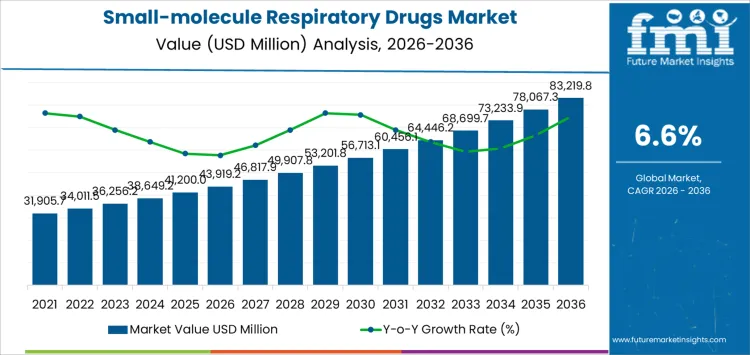
Small-Molecule Respiratory Drugs Market Key Takeaways
| Metric | Value |
|---|---|
| Small-Molecule Respiratory Drugs Market Value (2026) | USD 43,919.2 Million |
| Small-Molecule Respiratory Drugs Market Forecast Value (2036) | USD 83,219.8 Million |
| Small-Molecule Respiratory Drugs Market Forecast CAGR (2026-2036) | 6.60% |
How are Portfolio Optimization and Access Economics Driving the Small-Molecule Respiratory Drugs Market?
The small-molecule respiratory drugs market continues to expand as manufacturers leverage well-understood chemistries to deliver scalable, cost-effective therapies for asthma, COPD, and related airway disorders. These products benefit from established clinical profiles, predictable manufacturing, and broad physician familiarity, supporting sustained demand across chronic maintenance and acute relief indications. For pharmaceutical companies, small molecule inhibitors remain central to respiratory portfolios due to their suitability for high-volume inhalation and oral delivery formats.
Lifecycle management strategies are a key growth lever. Companies are extending product relevance through reformulations, fixed-dose combinations, and device-drug optimization rather than relying solely on new molecular entities. Improved inhaler compatibility, dose consistency, and patient-friendly delivery are enabling differentiation even in competitive classes. Manufacturers that align formulation development with device performance and patient adherence metrics are better positioned to defend share against generics and newer biologic entrants.
Market expansion is also supported by access and manufacturing economics. Small-molecule respiratory drugs are generally more affordable than biologics, making them the preferred option in cost-sensitive healthcare systems and emerging markets. API scalability, robust supply chains, and streamlined regulatory pathways allow companies to expand geographically with lower risk. As respiratory disease prevalence rises globally, particularly in urbanizing regions, competitive advantage increasingly depends on efficient manufacturing, strong payer access, and portfolio breadth positioning small-molecule therapies as a durable growth engine within the global respiratory drugs market.
How is The Small-Molecule Respiratory Drugs Market Structured by Product and Application?
The small-molecule respiratory drugs market is segmented by product and application, reflecting differences in mechanism of action, treatment duration, and disease severity. By product, bronchodilators represent the leading category, as they are foundational therapies for airway obstruction management. Other products include anti-inflammatory agents, leukotriene modifiers, and additional small-molecule therapies used in combination regimens. By application, asthma represents the largest treatment area, while COPD and other respiratory disorders such as chronic bronchitis and allergic airway conditions account for sustained clinical demand across adult and pediatric populations.
Why Do Bronchodilators Lead Product Adoption In The Small-Molecule Respiratory Drugs Market?

Bronchodilators account for 38% share of the small-molecule respiratory drugs market because they deliver rapid relief by relaxing airway smooth muscles and improving airflow. Physicians widely prescribe bronchodilators as first-line therapy for both acute symptom relief and long-term disease control. Their use spans short-acting rescue medications and long-acting maintenance therapies, expanding patient coverage. Compatibility with inhaler and nebulizer delivery systems supports broad clinical adoption. High prescription volumes and repeat usage drive consistent demand. For pharmaceutical manufacturers, bronchodilators offer established clinical acceptance and scalable production. These therapeutic effectiveness and utilization factors explain their leading position.
Why Does Asthma Represent The Largest Application Segment In The Small-Molecule Respiratory Drugs Market?

Asthma holds 25% share of the small-molecule respiratory drugs market because it affects a large global patient population across all age groups. The chronic nature of asthma requires continuous pharmacological management to control inflammation and prevent exacerbations. Small-molecule drugs are central to daily maintenance and acute symptom control strategies. Rising urbanization, environmental exposure, and allergic conditions increase diagnosis rates. Patients often rely on combination therapy, increasing overall drug utilization. For drug developers and suppliers, asthma provides long-term treatment continuity and predictable demand. These epidemiological and treatment dynamics explain why asthma remains the largest application area.
What Are The Key Dynamics Of The Small-Molecule Respiratory Drugs Market?
The small-molecule respiratory drugs market is driven by the persistent global burden of respiratory diseases such as asthma, chronic obstructive pulmonary disease (COPD), bronchitis, and seasonal infections. Small-molecule therapeutics including bronchodilators, corticosteroids, leukotriene modifiers, and combination therapies remain foundational due to their proven efficacy, oral or inhaled delivery, and cost effectiveness. For pharmaceutical manufacturers and suppliers, product potency, pharmacokinetics, safety profile, and ease of formulation strongly influence prescriber and patient adoption. Healthcare access, reimbursement policies, and treatment guidelines from respiratory specialist societies also shape demand patterns across geographies.
How Are Treatment Practices And Drug Development Trends Shaping The Market?
Treatment practices and drug development trends are influencing the small-molecule respiratory drugs market through combination therapies, advanced delivery systems, and optimized dosing regimens. Co-formulations that pair bronchodilators with anti-inflammatory agents in single inhaler products enhance convenience and adherence. Improvements in dry powder inhaler and metered dose inhaler technologies support more efficient drug deposition in the lungs, reducing systemic side effects. For developers, focusing on formulations that minimize dosing frequency and enhance patient quality of life drives credibility with prescribers. Pipeline activity targeting novel small molecules with improved receptor selectivity and reduced adverse effects sustains long-term market evolution.
Why Do Regulatory And Clinical Barriers Restrain Market Growth?
Regulatory and clinical barriers restrain growth in the small-molecule respiratory drugs market because respiratory therapeutics require rigorous clinical validation to demonstrate safety and sustained efficacy. Demonstrating meaningful clinical benefit over established therapies can extend development timelines and increase investment risk for sponsors. Regulatory agencies demand robust long-term safety data, particularly for chronic use in asthma and COPD, which extends time to market. Liability considerations regarding inhalation safety, pediatric use, and real-world performance further temper rapid product introduction. These factors contribute to slower adoption of new entrants and reinforce reliance on established, well-characterized drugs.
What is the Growth Outlook for the Small-Molecule Respiratory Drugs Market?
The small-molecule respiratory drugs market is expanding as chronic respiratory conditions such as asthma, chronic obstructive pulmonary disease, and allergic rhinitis continue to rise globally. These drugs remain central to respiratory care due to their oral and inhaled formulations, established efficacy, and cost accessibility compared with biologic therapies. Growth differs by country based on disease prevalence, air quality, healthcare access, prescribing patterns, and availability of generic formulations. Mature markets focus on therapy optimization, adherence improvement, and line extensions, while faster-growing regions are driven by expanding diagnosis rates, broader access to treatment, and increasing use of maintenance therapies.

| Country | CAGR (%) |
|---|---|
| India | 9.6 |
| China | 9.4 |
| Brazil | 8.8 |
| United States | 7.2 |
| Germany | 5.9 |
How Is The United States Managing A Mature Small-Molecule Respiratory Drugs Market?
The small-molecule respiratory drugs market in the United States is growing at a CAGR of 7.2% during 2026-2036, reflecting steady demand across asthma, chronic obstructive pulmonary disease, and allergic rhinitis therapies. Prescribing is well established, with inhaled bronchodilators, corticosteroids, and oral agents forming the backbone of long-term respiratory care. Physicians emphasize guideline-based treatment, patient adherence, and combination therapy optimization. Generic penetration is high, placing pressure on pricing while sustaining large prescription volumes. Procurement decisions are influenced by formulary placement, reimbursement rules, and payer negotiations. Market value is driven by chronic therapy use, line extensions, and improved delivery formats rather than rapid product launches. The demand for respiratory inhaler devices in USA depends on incremental innovation, adherence-focused programs, and maintaining broad access through retail and specialty pharmacy channels.
Why Is Brazil A Fast-Expanding Market For Small-Molecule Respiratory Drugs?
Brazil’s small-molecule respiratory drugs market is expanding at a CAGR of 8.8% during 2026-2036, supported by rising respiratory disease prevalence and broader access to treatment. Urban pollution, smoking rates, and respiratory infections contribute to sustained demand. Adoption is driven by public healthcare programs and growing private sector participation. Physicians rely heavily on oral and inhaled small-molecule drugs due to affordability and familiarity. Procurement decisions emphasize price competitiveness, availability, and inclusion in public formularies. Distribution is led by hospital pharmacies and retail drugstores. Market value is driven by expanding patient coverage, improving diagnosis rates, and consistent use of maintenance therapies. Brazil represents a growth-oriented market where pricing strategy, local manufacturing presence, and public sector engagement are critical for success.
Why Is China Experiencing Rapid Growth In Small-Molecule Respiratory Drug Use?
China’s small-molecule respiratory drugs market is growing at a CAGR of 9.4% during 2026-2036, driven by high prevalence of respiratory conditions and increasing healthcare access. Urban air quality issues and an aging population contribute to rising demand for asthma and chronic obstructive pulmonary disease treatments. Physicians emphasize early diagnosis and long-term management using established small-molecule therapies. Generic drugs play a central role due to affordability and widespread availability. Procurement decisions favor manufacturers with local production, regulatory compliance, and strong distribution networks. Market value is supported by large patient volumes, hospital-based prescribing, and growing retail pharmacy penetration. China represents a volume-driven market where scale, consistent supply, and alignment with national healthcare policies determine competitiveness.
Why Is India Emerging As A High-Growth Market For Small-Molecule Respiratory Drugs?
India’s small-molecule respiratory drugs market is projected to grow at a CAGR of 9.6% during 2026-2036, driven by rising respiratory disease burden and expanding access to affordable treatment. Asthma and chronic obstructive pulmonary disease prevalence remains high, supported by environmental and lifestyle factors. Physicians rely heavily on small-molecule drugs due to cost efficiency and wide availability. Generics dominate prescribing, enabling broad patient access. Distribution is led by retail pharmacies and hospital supply channels. Procurement cycles are short, encouraging rapid uptake of new formulations. Market value is driven by large patient populations, frequent therapy use, and competitive pricing. India represents a high-growth market where scale, affordability, and distribution reach define market leadership.
How Is Germany Maintaining A Conservative Small-Molecule Respiratory Drugs Market?
Germany’s small-molecule respiratory drugs market is growing at a CAGR of 5.9% during the forecast period, characterized by structured prescribing practices and strong regulatory oversight. Physicians adhere closely to clinical guidelines, favoring established therapies with proven outcomes. Generic usage is widespread, placing pressure on pricing and limiting rapid revenue expansion. Procurement decisions involve reimbursement authorities and insurance providers, resulting in longer adoption cycles. Market value is driven by stable prescription volumes and long-term management of chronic respiratory conditions. Germany represents a mature and regulated market where growth is steady and depends on adherence to treatment protocols and demographic demand rather than aggressive market expansion.
How Are Companies Competing in the Small-Molecule Respiratory Drugs Market?

Competition in the small-molecule respiratory drugs market is anchored in proven clinical efficacy, broad indication coverage, and documented safety profiles that matter to physicians, payers, and care teams. AstraZeneca positions its portfolio with product literature that highlights long-acting bronchodilation, inflammation control, and ease of adherence. Its materials emphasize real-world effectiveness across COPD and asthma patient populations, supported by large-scale clinical evidence and guideline endorsements that reinforce prescribing confidence.
GSK competes through a broad spectrum of small-molecule offerings that span short-acting and long-acting agents. Official therapeutic data emphasize favorable benefit-risk profiles and flexible dosing regimens that support step-wise management of chronic respiratory conditions. Positioning reinforces trusted heritage, extensive safety data, and formulary acceptance in major markets. Novartis differentiates by aligning small-molecule chemistry with targeted mechanism modulation, with technical materials detailing rapid onset of action and compatibility with combination therapies that appeal to complex COPD and asthma cases.
Large respiratory specialists also emphasize lifecycle continuity and global access. Boehringer Ingelheim positions its small-molecule drugs with documentation of sustained bronchodilation and tolerability, supported by robust trial data and real-world adherence evidence. Teva competes by broadening access through cost-effective generic small-molecule respiratory agents, with product leaflets that underscore bioequivalence and predictable pharmacokinetics suited to common respiratory indications.
Others in the market include regional pharmaceutical companies and generic manufacturers that reinforce value through competitive pricing, niche indications, and tailored patient support programs. Across all suppliers, competitive differentiation rests on verified clinical benefit, documented safety, and wide prescriber awareness rather than price alone.
Key Players in Small-molecule Respiratory Drugs Market
- AstraZeneca
- GSK
- Novartis
- Boehringer Ingelheim
- Teva
- Others
Scope of Report
| Attribute | Description |
|---|---|
| Quantitative Unit | USD Million |
| Products | Bronchodilators, Anti-Inflammatory Agents, Leukotriene Modifiers, Other Small-Molecule Respiratory Drugs |
| Applications | Asthma, Chronic Obstructive Pulmonary Disease (COPD), Other Respiratory Disorders |
| Countries Covered | China, Japan, South Korea, India, Australia & New Zealand, ASEAN, Rest of Asia Pacific, Germany, United Kingdom, France, Italy, Spain, Nordic, BENELUX, Rest of Europe, United States, Canada, Mexico, Brazil, Chile, Rest of Latin America, Kingdom of Saudi Arabia, Other GCC Countries, Turkey, South Africa, Other African Union, Rest of Middle East & Africa |
| Regions Covered | Asia Pacific, Europe, North America, Latin America, Middle East & Africa |
| Key Companies Profiled | AstraZeneca plc, GSK plc, Novartis AG, Boehringer Ingelheim International GmbH, Teva Pharmaceutical Industries Ltd., Others |
| Additional Attributes | Dollar sales by product type and application are assessed across outpatient, chronic care, and hospital-based respiratory treatment settings. The report includes country-level demand assessment, growth projections for 2026-2036, analysis of generic penetration and treatment adherence, evaluation of inhaled versus oral therapy usage, competitive benchmarking of manufacturers, and assessment of prescribing trends across asthma and COPD management pathways. |
Small-molecule Respiratory Drugs Market by Key Segments
Products:
- Bronchodilators
- Anti-inflammatory agents
- Leukotriene modifiers
- Others
Applications:
- Asthma
- COPD
- Other respiratory disorders
Region:
- Asia Pacific
- China
- Japan
- South Korea
- India
- Australia & New Zealand
- ASEAN
- Rest of Asia Pacific
- Europe
- Germany
- United Kingdom
- France
- Italy
- Spain
- Nordic
- BENELUX
- Rest of Europe
- North America
- United States
- Canada
- Mexico
- Latin America
- Brazil
- Chile
- Rest of Latin America
- Middle East & Africa
- Kingdom of Saudi Arabia
- Other GCC Countries
- Turkey
- South Africa
- Other African Union
- Rest of Middle East & Africa
Bibliography
- Global Initiative for Asthma. (2024). Global strategy for asthma management and prevention: 2024 update. Global Initiative for Asthma.
- Global Initiative for Chronic Obstructive Lung Disease. (2024). Global strategy for the prevention, diagnosis and management of COPD: 2025 report (version 1.0). GOLD.
- World Health Organization. (2024). Chronic obstructive pulmonary disease (COPD): Fact sheet. World Health Organization.
- Papi, A., Brightling, C., Pedersen, S. E., & Reddel, H. K. (2023). European Respiratory Society short guideline on the use of as-needed ICS–formoterol in mild asthma. European Respiratory Journal.
- European Medicines Agency. (2024). Draft guideline on the pharmaceutical quality of inhalation and nasal medicinal products (Revision 1). European Medicines Agency.
Frequently Asked Questions
How big is the small-molecule respiratory drugs market in 2026?
The global small-molecule respiratory drugs market is estimated to be valued at USD 43,919.2 million in 2026.
What will be the size of small-molecule respiratory drugs market in 2036?
The market size for the small-molecule respiratory drugs market is projected to reach USD 83,219.8 million by 2036.
How much will be the small-molecule respiratory drugs market growth between 2026 and 2036?
The small-molecule respiratory drugs market is expected to grow at a 6.6% CAGR between 2026 and 2036.
What are the key product types in the small-molecule respiratory drugs market?
The key product types in small-molecule respiratory drugs market are bronchodilators, anti-inflammatory agents, leukotriene modifiers and others.
Which applications segment to contribute significant share in the small-molecule respiratory drugs market in 2026?
In terms of applications, asthma segment to command 25.0% share in the small-molecule respiratory drugs market in 2026.
Preview the report firsthand - request a free sample
Get SampleGet the brochure for pricing and purchase details.
Get PDFTable of Content
- Executive Summary
- Global Market Outlook
- Demand-side Trends
- Supply-side Trends
- Technology Roadmap Analysis
- Analysis and Recommendations
- Market Overview
- Market Coverage / Taxonomy
- Market Definition / Scope / Limitations
- Market Background
- Market Dynamics
- Drivers
- Restraints
- Opportunity
- Trends
- Scenario Forecast
- Demand in Optimistic Scenario
- Demand in Likely Scenario
- Demand in Conservative Scenario
- Opportunity Map Analysis
- Product Life Cycle Analysis
- Supply Chain Analysis
- Investment Feasibility Matrix
- Value Chain Analysis
- PESTLE and Porter’s Analysis
- Regulatory Landscape
- Regional Parent Market Outlook
- Production and Consumption Statistics
- Import and Export Statistics
- Market Dynamics
- Global Market Analysis 2021 to 2025 and Forecast, 2026 to 2036
- Historical Market Size Value (USD Million) Analysis, 2021 to 2025
- Current and Future Market Size Value (USD Million) Projections, 2026 to 2036
- Y-o-Y Growth Trend Analysis
- Absolute $ Opportunity Analysis
- Global Market Pricing Analysis 2021 to 2025 and Forecast 2026 to 2036
- Global Market Analysis 2021 to 2025 and Forecast 2026 to 2036, By Products
- Introduction / Key Findings
- Historical Market Size Value (USD Million) Analysis By Products , 2021 to 2025
- Current and Future Market Size Value (USD Million) Analysis and Forecast By Products , 2026 to 2036
- Bronchodilators
- Anti-inflammatory agents
- Leukotriene modifiers
- Others
- Bronchodilators
- Y-o-Y Growth Trend Analysis By Products , 2021 to 2025
- Absolute $ Opportunity Analysis By Products , 2026 to 2036
- Global Market Analysis 2021 to 2025 and Forecast 2026 to 2036, By Applications
- Introduction / Key Findings
- Historical Market Size Value (USD Million) Analysis By Applications, 2021 to 2025
- Current and Future Market Size Value (USD Million) Analysis and Forecast By Applications, 2026 to 2036
- Asthma
- COPD
- Other respiratory disorders
- Asthma
- Y-o-Y Growth Trend Analysis By Applications, 2021 to 2025
- Absolute $ Opportunity Analysis By Applications, 2026 to 2036
- Global Market Analysis 2021 to 2025 and Forecast 2026 to 2036, By Region
- Introduction
- Historical Market Size Value (USD Million) Analysis By Region, 2021 to 2025
- Current Market Size Value (USD Million) Analysis and Forecast By Region, 2026 to 2036
- North America
- Latin America
- Western Europe
- Eastern Europe
- East Asia
- South Asia and Pacific
- Middle East & Africa
- Market Attractiveness Analysis By Region
- North America Market Analysis 2021 to 2025 and Forecast 2026 to 2036, By Country
- Historical Market Size Value (USD Million) Trend Analysis By Market Taxonomy, 2021 to 2025
- Market Size Value (USD Million) Forecast By Market Taxonomy, 2026 to 2036
- By Country
- USA
- Canada
- Mexico
- By Products
- By Applications
- By Country
- Market Attractiveness Analysis
- By Country
- By Products
- By Applications
- Key Takeaways
- Latin America Market Analysis 2021 to 2025 and Forecast 2026 to 2036, By Country
- Historical Market Size Value (USD Million) Trend Analysis By Market Taxonomy, 2021 to 2025
- Market Size Value (USD Million) Forecast By Market Taxonomy, 2026 to 2036
- By Country
- Brazil
- Chile
- Rest of Latin America
- By Products
- By Applications
- By Country
- Market Attractiveness Analysis
- By Country
- By Products
- By Applications
- Key Takeaways
- Western Europe Market Analysis 2021 to 2025 and Forecast 2026 to 2036, By Country
- Historical Market Size Value (USD Million) Trend Analysis By Market Taxonomy, 2021 to 2025
- Market Size Value (USD Million) Forecast By Market Taxonomy, 2026 to 2036
- By Country
- Germany
- UK
- Italy
- Spain
- France
- Nordic
- BENELUX
- Rest of Western Europe
- By Products
- By Applications
- By Country
- Market Attractiveness Analysis
- By Country
- By Products
- By Applications
- Key Takeaways
- Eastern Europe Market Analysis 2021 to 2025 and Forecast 2026 to 2036, By Country
- Historical Market Size Value (USD Million) Trend Analysis By Market Taxonomy, 2021 to 2025
- Market Size Value (USD Million) Forecast By Market Taxonomy, 2026 to 2036
- By Country
- Russia
- Poland
- Hungary
- Balkan & Baltic
- Rest of Eastern Europe
- By Products
- By Applications
- By Country
- Market Attractiveness Analysis
- By Country
- By Products
- By Applications
- Key Takeaways
- East Asia Market Analysis 2021 to 2025 and Forecast 2026 to 2036, By Country
- Historical Market Size Value (USD Million) Trend Analysis By Market Taxonomy, 2021 to 2025
- Market Size Value (USD Million) Forecast By Market Taxonomy, 2026 to 2036
- By Country
- China
- Japan
- South Korea
- By Products
- By Applications
- By Country
- Market Attractiveness Analysis
- By Country
- By Products
- By Applications
- Key Takeaways
- South Asia and Pacific Market Analysis 2021 to 2025 and Forecast 2026 to 2036, By Country
- Historical Market Size Value (USD Million) Trend Analysis By Market Taxonomy, 2021 to 2025
- Market Size Value (USD Million) Forecast By Market Taxonomy, 2026 to 2036
- By Country
- India
- ASEAN
- Australia & New Zealand
- Rest of South Asia and Pacific
- By Products
- By Applications
- By Country
- Market Attractiveness Analysis
- By Country
- By Products
- By Applications
- Key Takeaways
- Middle East & Africa Market Analysis 2021 to 2025 and Forecast 2026 to 2036, By Country
- Historical Market Size Value (USD Million) Trend Analysis By Market Taxonomy, 2021 to 2025
- Market Size Value (USD Million) Forecast By Market Taxonomy, 2026 to 2036
- By Country
- Kingdom of Saudi Arabia
- Other GCC Countries
- Turkiye
- South Africa
- Other African Union
- Rest of Middle East & Africa
- By Products
- By Applications
- By Country
- Market Attractiveness Analysis
- By Country
- By Products
- By Applications
- Key Takeaways
- Key Countries Market Analysis
- USA
- Pricing Analysis
- Market Share Analysis, 2025
- By Products
- By Applications
- Canada
- Pricing Analysis
- Market Share Analysis, 2025
- By Products
- By Applications
- Mexico
- Pricing Analysis
- Market Share Analysis, 2025
- By Products
- By Applications
- Brazil
- Pricing Analysis
- Market Share Analysis, 2025
- By Products
- By Applications
- Chile
- Pricing Analysis
- Market Share Analysis, 2025
- By Products
- By Applications
- Germany
- Pricing Analysis
- Market Share Analysis, 2025
- By Products
- By Applications
- UK
- Pricing Analysis
- Market Share Analysis, 2025
- By Products
- By Applications
- Italy
- Pricing Analysis
- Market Share Analysis, 2025
- By Products
- By Applications
- Spain
- Pricing Analysis
- Market Share Analysis, 2025
- By Products
- By Applications
- France
- Pricing Analysis
- Market Share Analysis, 2025
- By Products
- By Applications
- India
- Pricing Analysis
- Market Share Analysis, 2025
- By Products
- By Applications
- ASEAN
- Pricing Analysis
- Market Share Analysis, 2025
- By Products
- By Applications
- Australia & New Zealand
- Pricing Analysis
- Market Share Analysis, 2025
- By Products
- By Applications
- China
- Pricing Analysis
- Market Share Analysis, 2025
- By Products
- By Applications
- Japan
- Pricing Analysis
- Market Share Analysis, 2025
- By Products
- By Applications
- South Korea
- Pricing Analysis
- Market Share Analysis, 2025
- By Products
- By Applications
- Russia
- Pricing Analysis
- Market Share Analysis, 2025
- By Products
- By Applications
- Poland
- Pricing Analysis
- Market Share Analysis, 2025
- By Products
- By Applications
- Hungary
- Pricing Analysis
- Market Share Analysis, 2025
- By Products
- By Applications
- Kingdom of Saudi Arabia
- Pricing Analysis
- Market Share Analysis, 2025
- By Products
- By Applications
- Turkiye
- Pricing Analysis
- Market Share Analysis, 2025
- By Products
- By Applications
- South Africa
- Pricing Analysis
- Market Share Analysis, 2025
- By Products
- By Applications
- USA
- Market Structure Analysis
- Competition Dashboard
- Competition Benchmarking
- Market Share Analysis of Top Players
- By Regional
- By Products
- By Applications
- Competition Analysis
- Competition Deep Dive
- AstraZeneca
- Overview
- Product Portfolio
- Profitability by Market Segments (Product/Age /Sales Channel/Region)
- Sales Footprint
- Strategy Overview
- Marketing Strategy
- Product Strategy
- Channel Strategy
- GSK
- Novartis
- Boehringer Ingelheim
- Teva
- Others
- AstraZeneca
- Competition Deep Dive
- Assumptions & Acronyms Used
- Research Methodology


