

- Industry Size (2026):
- USD 30316.1 Mn
- Forecast (2036):
- USD 48913.4 Mn
- CAGR (2026 to 2036)
- 4.9%
OTC Heartburn Drugs Market Forecast and Outlook 2026 to 2036
The OTC heartburn drugs market is valued at USD 30,316.1 million in 2026 and is forecast to reach USD 48,913.4 million by 2036, expanding at a CAGR of 4.9%. Occasional heartburn dominates consumption, anchoring volumes in predictable, repeat-purchase behavior rather than episodic clinical intervention. This application concentration creates volume stability, as demand is driven by lifestyle patterns that fluctuate little across economic cycles. End-use dependency on retail pharmacies, supermarkets, and online channels further reinforces consistency, as availability and shelf visibility directly influence purchasing decisions. Chronic GERD and stress-related acidity contribute incremental growth but remain secondary to short-term symptom relief products that turn faster and carry lower usage friction. As a result, growth quality is defined by throughput efficiency, SKU rationalization, and inventory velocity rather than margin expansion. Between 2026 and 2036, suppliers that align portfolios with high-rotation applications and maintain strong channel execution are positioned to capture durable value, while exposure to niche or low-frequency uses offers limited upside.
Quick Stats for OTC Heartburn Drugs Market
- OTC Heartburn Drugs Market Value (2026): USD 30,316.1 Million
- OTC Heartburn Drugs Market Forecast Value (2036): USD 48,913.4 Million
- OTC Heartburn Drugs Market Forecast CAGR (2026-2036): 4.9%
- Leading Product Type in OTC Heartburn Drugs Market: Proton Pump Inhibitors (41% share)
- Key Growth Regions in OTC Heartburn Drugs Market: Asia Pacific, Europe, North America, Latin America, Middle East & Africa
- Top Key Players in OTC Heartburn Drugs Market: Pfizer, Bayer, GSK, Johnson & Johnson, Sanofi
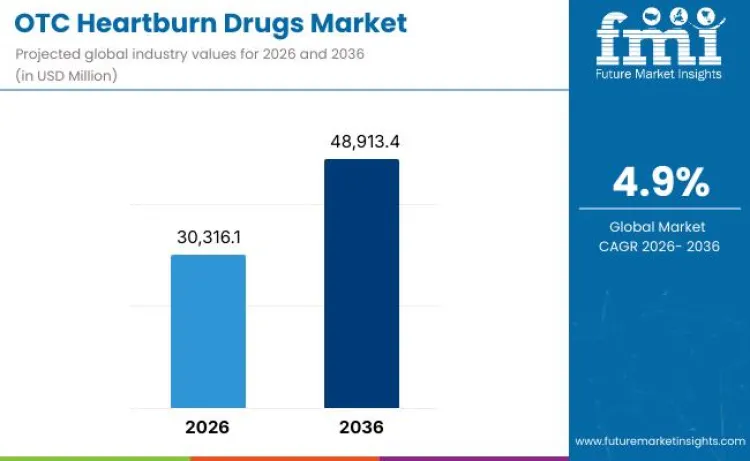
OTC Heartburn Drugs Market Key Takeaways
| Metric | Value |
|---|---|
| OTC Heartburn Drugs Market Value (2026) | USD 30,316.1 Million |
| OTC Heartburn Drugs Market Forecast Value (2036) | USD 48,913.4 Million |
| OTC Heartburn Drugs Market Forecast CAGR (2026-2036) | 4.9% |
How are Self-Medication Trends and Retail Channel Dynamics Shaping the OTC Heartburn Drugs Market?
The OTC heartburn drugs market is expanding as consumers increasingly favor self-medication for recurrent gastrointestinal discomfort. Broader OTC gastrointestinal drugs trends indicate growing consumer reliance on self-care therapies for mild digestive issues. Busy lifestyles, dietary habits, and stress-related digestive issues are driving frequent use of antacids, H2 blockers, and proton pump inhibitors without physician consultation. For manufacturers, this translates into stable, high-volume demand anchored in repeat purchases rather than episodic treatment, making brand trust and product familiarity critical drivers of market share.
Retail and digital channel dynamics are strongly influencing competitive positioning. Pharmacies, mass merchandisers, and e-commerce platforms are prioritizing fast-moving SKUs with clear labeling, recognizable efficacy claims, and competitive pricing. Private-label offerings are gaining traction in mature markets, pushing branded players to differentiate through extended-release formats, combination products, and flavor or dosage innovations. Manufacturers that optimize packaging size, shelf visibility, and promotional cadence are better positioned to capture impulse and repeat purchases.
Portfolio strategy and regulatory familiarity are further supporting market growth. Regulatory familiarity with established molecules has also accelerated Rx-to-OTC switches, enabling wider consumer access while maintaining predictable safety and labeling standards. Many OTC heartburn drugs are well-established molecules with predictable manufacturing processes and regulatory pathways, allowing companies to scale efficiently and manage margins. Expansion in emerging markets, where OTC penetration is rising alongside urbanization and pharmacy access, is creating new volume opportunities. For suppliers and brand owners, long-term success in the OTC heartburn drugs market increasingly depends on channel execution, portfolio optimization, and consumer loyalty rather than breakthrough formulation innovation.
How is the OTC Heartburn Drugs Market Classified?
The OTC heartburn drugs market is segmented by product and application, reflecting differences in symptom frequency, onset of relief, and duration of action. By product, proton pump inhibitors represent the leading category, as they are widely used for sustained acid suppression. Other products include H2 receptor antagonists and antacids, which address faster relief and short-term symptom control. By application, occasional heartburn represents the primary use case, while chronic GERD and stress-related acidity account for continued demand across recurrent and lifestyle-driven conditions.
Why Do Proton Pump Inhibitors Lead Product Adoption in the OTC Heartburn Drugs Market?
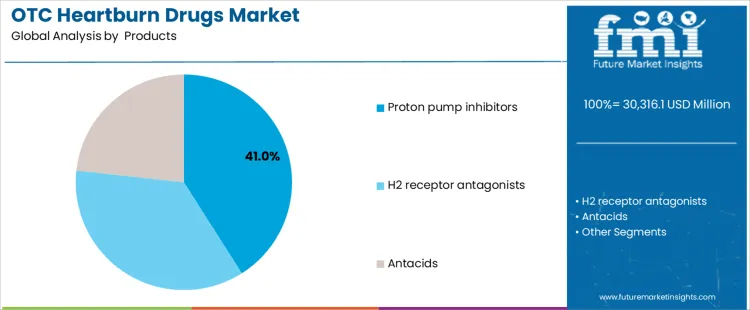
Proton pump inhibitors account for 41% share of the OTC heartburn drugs market because they provide prolonged acid suppression and symptom control over extended periods. Consumers prefer PPIs for frequent or severe heartburn episodes that are not adequately managed by fast-acting antacids. These drugs reduce gastric acid production at the source, offering sustained relief with once-daily dosing. OTC availability has expanded access beyond prescription settings, increasing adoption among self-managing patients. Brand recognition and clear usage guidelines support consumer confidence. For manufacturers, PPIs generate repeat purchases due to multi-day treatment courses. These efficacy and convenience factors explain why proton pump inhibitors remain the dominant product category.
Why Does Occasional Heartburn Dominate Application Demand In The OTC Heartburn Drugs Market?
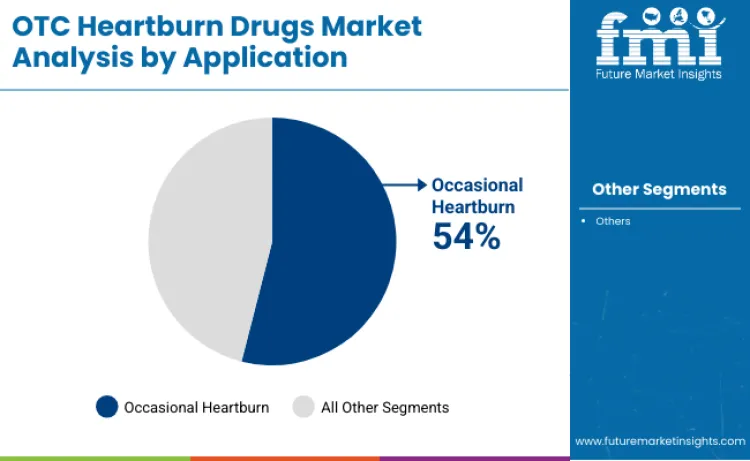
Occasional heartburn accounts for 54% share of the OTC heartburn drugs market because most consumers experience symptoms intermittently rather than as a chronic condition. Lifestyle factors such as diet, stress, and irregular meal patterns contribute to episodic acid discomfort. OTC products offer convenient access for rapid symptom management without medical consultation. Consumer demand for digestive health products continues to rise as lifestyle-related gastrointestinal discomfort becomes more prevalent. Consumers often seek treatment during flare-ups related to specific triggers like spicy food or late meals. Retail pharmacies and online channels support easy availability for occasional use. High incidence and self-treatment behavior drive consistent volume demand. These usage patterns explain why occasional heartburn remains the largest application segment.
What Are The Key Dynamics Of The OTC Heartburn Drugs Market?
The OTC heartburn drugs market is driven by the high prevalence of acid related digestive conditions such as GERD, frequent heartburn, and indigestion across adult and aging populations. Growth patterns in the functional dyspepsia drugs segment highlight broader demand for self-care digestive therapies. Easy availability of antacids, H2 blockers, and proton pump inhibitors enables self-care without prescription dependence. For manufacturers, brand trust, perceived speed of relief, safety labeling clarity, and dosing convenience strongly influence consumer choice. Retail visibility across pharmacies, mass merchants, and online platforms plays a critical role in volume performance. Pricing tiers and promotional intensity further shape competitive positioning and repeat purchase behavior.
How Consumer Usage Patterns And Product Are Formats Shaping The Market?
Consumer usage patterns are shaping the OTC heartburn drugs market through preference for fast acting and easy to consume formats. Chewable tablets, liquids, and rapid dissolve products appeal to users seeking immediate symptom relief, while delayed release capsules attract consumers managing recurring symptoms. Clear usage instructions and transparent labeling are increasingly important as consumers self-evaluate treatment suitability. Combination formulations that address multiple symptoms support broader use cases. Packaging innovation, portability, and shelf ready formats enhance product appeal in retail settings, directly influencing brand switching and loyalty.
Why Do Safety Awareness And Medical Guidance Limit Market Expansion?
Safety awareness and increased medical guidance limit unrestricted growth in the OTC heartburn drugs market. Concerns around prolonged use of acid suppression therapies have led some consumers to limit duration of self-treatment or seek physician consultation. Regulatory agencies require stronger warning statements and usage limits, influencing consumer confidence and purchase frequency. Growing awareness of dietary triggers and lifestyle related causes of heartburn encourages non drug management approaches. These factors reduce long term dependency on OTC medications and shift demand toward intermittent or short duration use.
What is the Country-Level Outlook for the OTC Heartburn Drugs Market?
The OTC heartburn drugs market is expanding as consumers increasingly self-manage acid reflux, indigestion, and related gastrointestinal discomfort without prescription intervention. Products such as antacids, H2 receptor antagonists, and proton pump inhibitors are widely used due to their accessibility, rapid symptom relief, and suitability for short-term and recurring use. Country-level growth varies based on dietary habits, urban lifestyles, healthcare access, and regulatory frameworks for OTC switching, and consumer awareness. The broader gastrointestinal therapeutics landscape contextualizes how acid-relief drugs fit within multi-modal digestive care. Mature markets emphasize brand loyalty, safety labeling, and incremental formulation improvements, while higher-growth regions are driven by expanding retail pharmacy networks, rising gastrointestinal disorder prevalence, and increased consumer willingness to self-treat.
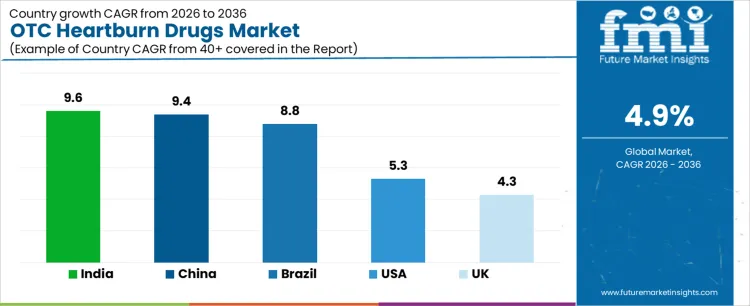
| Country | CAGR (%) |
|---|---|
| India | 9.6 |
| China | 9.4 |
| Brazil | 8.8 |
| United States | 5.3 |
| United Kingdom | 4.3 |
How Is The United States Sustaining A Mature OTC Heartburn Drugs Market?
The OTC heartburn drugs market in the United States is growing at a CAGR of 5.3% during 2026-2036, reflecting steady but moderate expansion in a well-established self-care category. Demand is driven by widespread prevalence of acid reflux, lifestyle-related dietary habits, and strong consumer familiarity with OTC antacids, H2 blockers, and proton pump inhibitors. Consumers prioritize fast symptom relief, trusted brands, and clear dosing instructions. Product differentiation is incremental, focusing on extended relief, chewable formats, and combination therapies. Retail pharmacies, mass merchandisers, and online platforms dominate distribution. Procurement and shelf placement are heavily influenced by brand equity and promotional activity. Market value is driven by repeat purchases and chronic but intermittent usage patterns. The USA represents a mature market where growth depends on brand loyalty, line extensions, and effective consumer education rather than rapid volume expansion.
Why Is Brazil A High-Growth Market For OTC Heartburn Medications?
Brazil’s OTC heartburn drugs market is expanding at a CAGR of 8.8% during 2026-2036, supported by rising self-medication trends and increasing access to retail pharmacies. Urbanization, dietary changes, and growing awareness of digestive health are driving demand for non-prescription heartburn remedies. Consumers prioritize affordability, ease of access, and immediate symptom relief. Antacids and low-dose acid reducers are widely used due to their familiarity and price accessibility. Distribution is dominated by pharmacy chains and independent drugstores, with growing presence in supermarkets. Procurement decisions are shaped by pricing strategies and retail promotions. Market growth is reinforced by expanding middle-income populations and improved retail penetration in secondary cities. Brazil represents a growth-oriented market where competitive advantage depends on pricing flexibility, broad distribution coverage, and strong point-of-sale visibility.
Why Is China Experiencing Rapid Expansion In OTC Heartburn Drug Usage?
China’s OTC heartburn drugs market is growing at a CAGR of 9.4% during 2026-2036, driven by changing dietary patterns, urban lifestyles, and increased acceptance of self-care medications. Demand is supported by growing retail pharmacy networks and rising consumer health awareness. Consumers seek quick relief products that are easy to use and widely available. Antacids and acid reducers are increasingly purchased through both offline pharmacies and online health platforms. Buyers emphasize safety labeling, product efficacy, and brand credibility. Procurement favors manufacturers with strong regulatory compliance and local manufacturing capabilities. Market value is driven by large population size, increasing OTC penetration, and integration of heartburn treatments into everyday self-care routines. China represents a volume-driven market where success depends on wide distribution, competitive pricing, and strong consumer trust.
Why Is India Emerging As A Fast-Growing OTC Heartburn Drugs Market?
India’s OTC heartburn drugs market is projected to grow at a CAGR of 9.6% during 2026-2036, supported by high prevalence of acid-related digestive issues and widespread self-medication practices. Spicy diets, irregular eating patterns, and increasing stress levels contribute to sustained demand. Consumers prioritize low-cost, fast-acting remedies available without prescription. Antacids dominate usage, while awareness of acid reducers is gradually increasing. Distribution is led by retail pharmacies, local chemists, and expanding e-commerce platforms. Procurement cycles are short, enabling rapid product introduction and price-based competition. Market value is driven by high consumption frequency, large population base, and affordability-focused product portfolios. India represents a high-growth market where scale, pricing strategy, and retail reach determine competitive positioning.
How Is The United Kingdom Maintaining A Conservative OTC Heartburn Drugs Market?
The OTC heartburn drugs market in the United Kingdom is growing at a CAGR of 4.3% during the forecast period, characterized by cautious consumer behavior and strong regulatory oversight. Demand is steady, supported by an aging population and dietary habits associated with acid reflux. Consumers emphasize product safety, clear labeling, and guidance from pharmacists. Acid reducers and antacids are widely available through pharmacies and selected retail outlets. Procurement and product switching are influenced by regulatory approvals and pharmacist recommendations. Market growth is incremental, with limited product innovation and stable usage patterns. The UK represents a mature and regulated market where growth is driven by population demographics and consistent demand rather than rapid adoption or aggressive marketing.
How Are Companies Competing in the OTC Heartburn Drugs Market?
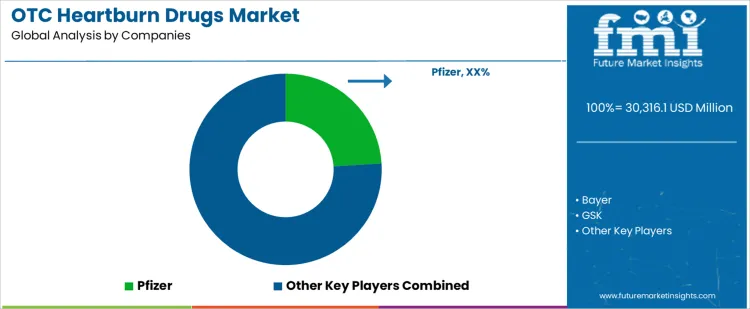
Competition in the OTC heartburn drugs market is driven by brand credibility, speed and duration of symptom relief, and clear positioning across major therapeutic classes including antacids, H2 receptor antagonists, and proton pump inhibitors. Pfizer leverages strong consumer recognition across acid-control products, with portfolio messaging centered on reliable, fast relief and wide retail penetration. Product differentiation is reinforced through familiar dosing formats and long-established trust among pharmacists and consumers managing frequent heartburn.
Bayer and GSK compete by combining acid suppression with broader digestive comfort claims. Their OTC heartburn offerings are positioned around consistent efficacy, multi-symptom relief, and strong shelf visibility. Marketing strategies emphasize safety profiles, predictable onset of action, and suitability for self-care without physician intervention, supporting high consumer confidence and repeat usage.
Portfolio breadth and formulation familiarity shape competition among diversified players. Johnson & Johnson focuses on ease-of-use formats and consumer-friendly dosing schedules, reinforcing accessibility for occasional and recurrent users. Sanofi positions its OTC heartburn products within a broader digestive health lineup, emphasizing proven formulations and everyday symptom management. Others in the market include private-label and regional manufacturers that compete on targeted relief claims and value positioning. Across all players, competitive advantage is built on brand trust, clarity of therapeutic benefit, and strong retail distribution rather than pricing alone.
Key Players in OTC Heartburn Drugs Market
- Pfizer
- Bayer
- GSK
- Johnson & Johnson
- Sanofi
- Others
Scope of Report
| Attribute | Description |
|---|---|
| Quantitative Unit | USD Million |
| Products | Proton Pump Inhibitors, H2 Receptor Antagonists, Antacids |
| Applications | Occasional Heartburn, Chronic GERD, Stress-Related Acidity |
| Countries Covered | China, Japan, South Korea, India, Australia & New Zealand, ASEAN, Rest of Asia Pacific, Germany, United Kingdom, France, Italy, Spain, Nordic, BENELUX, Rest of Europe, United States, Canada, Mexico, Brazil, Chile, Rest of Latin America, Kingdom of Saudi Arabia, Other GCC Countries, Turkey, South Africa, Other African Union, Rest of Middle East & Africa |
| Regions Covered | Asia Pacific, Europe, North America, Latin America, Middle East & Africa |
| Key Companies Profiled | Pfizer Inc., Bayer AG, GSK plc, Johnson & Johnson, Sanofi S.A., Others |
| Additional Attributes | Dollar sales by product type and application are evaluated across retail pharmacies, supermarkets, and online channels. The report includes country-level demand assessment, growth projections for 2026-2036, analysis of self-medication trends and brand loyalty, evaluation of pricing and formulation shifts, competitive benchmarking of manufacturers, and assessment of regulatory and switching trends influencing OTC gastrointestinal drug consumption globally. |
OTC Heartburn Drugs Market by Key Segments
Products:
- Proton pump inhibitors
- H2 receptor antagonists
- Antacids
Applications:
- Occasional heartburn
- Chronic GERD
- Stress-related acidity
Region:
- Asia Pacific
- China
- Japan
- South Korea
- India
- Australia & New Zealand
- ASEAN
- Rest of Asia Pacific
- Europe
- Germany
- United Kingdom
- France
- Italy
- Spain
- Nordic
- BENELUX
- Rest of Europe
- North America
- United States
- Canada
- Mexico
- Latin America
- Brazil
- Chile
- Rest of Latin America
- Middle East & Africa
- Kingdom of Saudi Arabia
- Other GCC Countries
- Turkey
- South Africa
- Other African Union
- Rest of Middle East & Africa
Bibliography
- American Gastroenterological Association. (2025). AGA clinical practice guideline on the management of gastroesophageal reflux disease. Gastroenterology.
- National Institute of Diabetes and Digestive and Kidney Diseases. (2024). Treatment for GERD and heartburn. U.S. Department of Health & Human Services.
- World Health Organization. (2024). Self‑care interventions for common gastrointestinal symptoms: Guidance for health systems. WHO Press.
Frequently Asked Questions
How big is the otc heartburn drugs market in 2026?
The global otc heartburn drugs market is estimated to be valued at USD 30,316.1 million in 2026.
What will be the size of otc heartburn drugs market in 2036?
The market size for the otc heartburn drugs market is projected to reach USD 48,913.4 million by 2036.
How much will be the otc heartburn drugs market growth between 2026 and 2036?
The otc heartburn drugs market is expected to grow at a 4.9% CAGR between 2026 and 2036.
What are the key product types in the otc heartburn drugs market?
The key product types in otc heartburn drugs market are proton pump inhibitors, h2 receptor antagonists and antacids.
Which applications segment to contribute significant share in the otc heartburn drugs market in 2026?
In terms of applications, occasional heartburn segment to command 0.0% share in the otc heartburn drugs market in 2026.
Preview the report firsthand - request a free sample
Get SampleGet the brochure for pricing and purchase details.
Get PDFTable of Content
- Executive Summary
- Global Market Outlook
- Demand-side Trends
- Supply-side Trends
- Technology Roadmap Analysis
- Analysis and Recommendations
- Market Overview
- Market Coverage / Taxonomy
- Market Definition / Scope / Limitations
- Market Background
- Market Dynamics
- Drivers
- Restraints
- Opportunity
- Trends
- Scenario Forecast
- Demand in Optimistic Scenario
- Demand in Likely Scenario
- Demand in Conservative Scenario
- Opportunity Map Analysis
- Product Life Cycle Analysis
- Supply Chain Analysis
- Investment Feasibility Matrix
- Value Chain Analysis
- PESTLE and Porter’s Analysis
- Regulatory Landscape
- Regional Parent Market Outlook
- Production and Consumption Statistics
- Import and Export Statistics
- Market Dynamics
- Global Market Analysis 2021 to 2025 and Forecast, 2026 to 2036
- Historical Market Size Value (USD Million) Analysis, 2021 to 2025
- Current and Future Market Size Value (USD Million) Projections, 2026 to 2036
- Y-o-Y Growth Trend Analysis
- Absolute $ Opportunity Analysis
- Global Market Pricing Analysis 2021 to 2025 and Forecast 2026 to 2036
- Global Market Analysis 2021 to 2025 and Forecast 2026 to 2036, By Products
- Introduction / Key Findings
- Historical Market Size Value (USD Million) Analysis By Products , 2021 to 2025
- Current and Future Market Size Value (USD Million) Analysis and Forecast By Products , 2026 to 2036
- Proton pump inhibitors
- H2 receptor antagonists
- Antacids
- Proton pump inhibitors
- Y-o-Y Growth Trend Analysis By Products , 2021 to 2025
- Absolute $ Opportunity Analysis By Products , 2026 to 2036
- Global Market Analysis 2021 to 2025 and Forecast 2026 to 2036, By Applications
- Introduction / Key Findings
- Historical Market Size Value (USD Million) Analysis By Applications, 2021 to 2025
- Current and Future Market Size Value (USD Million) Analysis and Forecast By Applications, 2026 to 2036
- Occasional heartburn
- Chronic GERD
- Stress-related acidity
- Occasional heartburn
- Y-o-Y Growth Trend Analysis By Applications, 2021 to 2025
- Absolute $ Opportunity Analysis By Applications, 2026 to 2036
- Global Market Analysis 2021 to 2025 and Forecast 2026 to 2036, By Region
- Introduction
- Historical Market Size Value (USD Million) Analysis By Region, 2021 to 2025
- Current Market Size Value (USD Million) Analysis and Forecast By Region, 2026 to 2036
- North America
- Latin America
- Western Europe
- Eastern Europe
- East Asia
- South Asia and Pacific
- Middle East & Africa
- Market Attractiveness Analysis By Region
- North America Market Analysis 2021 to 2025 and Forecast 2026 to 2036, By Country
- Historical Market Size Value (USD Million) Trend Analysis By Market Taxonomy, 2021 to 2025
- Market Size Value (USD Million) Forecast By Market Taxonomy, 2026 to 2036
- By Country
- USA
- Canada
- Mexico
- By Products
- By Applications
- By Country
- Market Attractiveness Analysis
- By Country
- By Products
- By Applications
- Key Takeaways
- Latin America Market Analysis 2021 to 2025 and Forecast 2026 to 2036, By Country
- Historical Market Size Value (USD Million) Trend Analysis By Market Taxonomy, 2021 to 2025
- Market Size Value (USD Million) Forecast By Market Taxonomy, 2026 to 2036
- By Country
- Brazil
- Chile
- Rest of Latin America
- By Products
- By Applications
- By Country
- Market Attractiveness Analysis
- By Country
- By Products
- By Applications
- Key Takeaways
- Western Europe Market Analysis 2021 to 2025 and Forecast 2026 to 2036, By Country
- Historical Market Size Value (USD Million) Trend Analysis By Market Taxonomy, 2021 to 2025
- Market Size Value (USD Million) Forecast By Market Taxonomy, 2026 to 2036
- By Country
- Germany
- UK
- Italy
- Spain
- France
- Nordic
- BENELUX
- Rest of Western Europe
- By Products
- By Applications
- By Country
- Market Attractiveness Analysis
- By Country
- By Products
- By Applications
- Key Takeaways
- Eastern Europe Market Analysis 2021 to 2025 and Forecast 2026 to 2036, By Country
- Historical Market Size Value (USD Million) Trend Analysis By Market Taxonomy, 2021 to 2025
- Market Size Value (USD Million) Forecast By Market Taxonomy, 2026 to 2036
- By Country
- Russia
- Poland
- Hungary
- Balkan & Baltic
- Rest of Eastern Europe
- By Products
- By Applications
- By Country
- Market Attractiveness Analysis
- By Country
- By Products
- By Applications
- Key Takeaways
- East Asia Market Analysis 2021 to 2025 and Forecast 2026 to 2036, By Country
- Historical Market Size Value (USD Million) Trend Analysis By Market Taxonomy, 2021 to 2025
- Market Size Value (USD Million) Forecast By Market Taxonomy, 2026 to 2036
- By Country
- China
- Japan
- South Korea
- By Products
- By Applications
- By Country
- Market Attractiveness Analysis
- By Country
- By Products
- By Applications
- Key Takeaways
- South Asia and Pacific Market Analysis 2021 to 2025 and Forecast 2026 to 2036, By Country
- Historical Market Size Value (USD Million) Trend Analysis By Market Taxonomy, 2021 to 2025
- Market Size Value (USD Million) Forecast By Market Taxonomy, 2026 to 2036
- By Country
- India
- ASEAN
- Australia & New Zealand
- Rest of South Asia and Pacific
- By Products
- By Applications
- By Country
- Market Attractiveness Analysis
- By Country
- By Products
- By Applications
- Key Takeaways
- Middle East & Africa Market Analysis 2021 to 2025 and Forecast 2026 to 2036, By Country
- Historical Market Size Value (USD Million) Trend Analysis By Market Taxonomy, 2021 to 2025
- Market Size Value (USD Million) Forecast By Market Taxonomy, 2026 to 2036
- By Country
- Kingdom of Saudi Arabia
- Other GCC Countries
- Turkiye
- South Africa
- Other African Union
- Rest of Middle East & Africa
- By Products
- By Applications
- By Country
- Market Attractiveness Analysis
- By Country
- By Products
- By Applications
- Key Takeaways
- Key Countries Market Analysis
- USA
- Pricing Analysis
- Market Share Analysis, 2025
- By Products
- By Applications
- Canada
- Pricing Analysis
- Market Share Analysis, 2025
- By Products
- By Applications
- Mexico
- Pricing Analysis
- Market Share Analysis, 2025
- By Products
- By Applications
- Brazil
- Pricing Analysis
- Market Share Analysis, 2025
- By Products
- By Applications
- Chile
- Pricing Analysis
- Market Share Analysis, 2025
- By Products
- By Applications
- Germany
- Pricing Analysis
- Market Share Analysis, 2025
- By Products
- By Applications
- UK
- Pricing Analysis
- Market Share Analysis, 2025
- By Products
- By Applications
- Italy
- Pricing Analysis
- Market Share Analysis, 2025
- By Products
- By Applications
- Spain
- Pricing Analysis
- Market Share Analysis, 2025
- By Products
- By Applications
- France
- Pricing Analysis
- Market Share Analysis, 2025
- By Products
- By Applications
- India
- Pricing Analysis
- Market Share Analysis, 2025
- By Products
- By Applications
- ASEAN
- Pricing Analysis
- Market Share Analysis, 2025
- By Products
- By Applications
- Australia & New Zealand
- Pricing Analysis
- Market Share Analysis, 2025
- By Products
- By Applications
- China
- Pricing Analysis
- Market Share Analysis, 2025
- By Products
- By Applications
- Japan
- Pricing Analysis
- Market Share Analysis, 2025
- By Products
- By Applications
- South Korea
- Pricing Analysis
- Market Share Analysis, 2025
- By Products
- By Applications
- Russia
- Pricing Analysis
- Market Share Analysis, 2025
- By Products
- By Applications
- Poland
- Pricing Analysis
- Market Share Analysis, 2025
- By Products
- By Applications
- Hungary
- Pricing Analysis
- Market Share Analysis, 2025
- By Products
- By Applications
- Kingdom of Saudi Arabia
- Pricing Analysis
- Market Share Analysis, 2025
- By Products
- By Applications
- Turkiye
- Pricing Analysis
- Market Share Analysis, 2025
- By Products
- By Applications
- South Africa
- Pricing Analysis
- Market Share Analysis, 2025
- By Products
- By Applications
- USA
- Market Structure Analysis
- Competition Dashboard
- Competition Benchmarking
- Market Share Analysis of Top Players
- By Regional
- By Products
- By Applications
- Competition Analysis
- Competition Deep Dive
- Pfizer
- Overview
- Product Portfolio
- Profitability by Market Segments (Product/Age /Sales Channel/Region)
- Sales Footprint
- Strategy Overview
- Marketing Strategy
- Product Strategy
- Channel Strategy
- Bayer
- GSK
- Johnson & Johnson
- Sanofi
- Others
- Pfizer
- Competition Deep Dive
- Assumptions & Acronyms Used
- Research Methodology


