

- Industry Size (2026)
- USD 720 Mn
- Forecast (2036)
- USD 1850 Mn
- CAGR (2026 to 2036)
- 9.9%
Smart Returnable Transport Items with Integrated Identification Hardware Market Forecast and Outlook 2026 to 2036
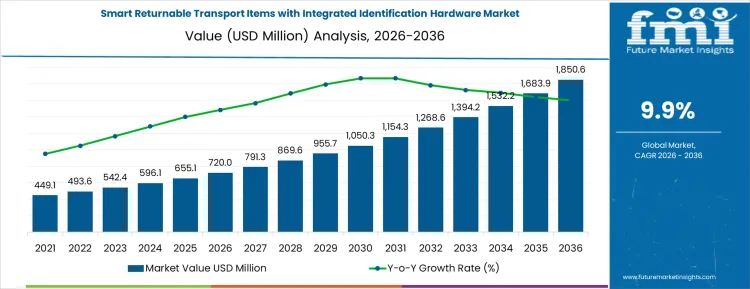
The smart returnable transport items (RTIs) with integrated identification hardware market is expected to grow from USD 720 million in 2026 to USD 1,850.6 million by 2036, reflecting a compound annual growth rate (CAGR) of 9.9%. These smart RTIs, which include containers, pallets, and crates embedded with identification technologies like RFID or NFC, enable efficient tracking, management, and optimization of supply chains. The market is driven by increasing demand for supply chain transparency, cost reduction, and sustainability in industries such as logistics, food & beverage, and automotive. The integration of identification hardware improves inventory management, reduces losses, and enhances the traceability of goods in transit, supporting operational efficiency.
The growth of this market is also fueled by the shift towards a circular economy, where returnable and reusable packaging is favored over single-use items. As industries seek more sustainable and cost-effective packaging solutions, the adoption of smart RTIs with integrated identification hardware is expected to increase. Additionally, advancements in IoT and RFID technologies are further driving the demand for these solutions in real-time tracking and data collection across the global supply chain.
Quick Stats of the Smart Returnable Transport Items with Integrated Identification Hardware Market
- Smart Returnable Transport Items with Integrated Identification Hardware Market Value (2026): USD 720 million
- Smart Returnable Transport Items with Integrated Identification Hardware Market Forecast Value (2036): USD 1,850.6 million
- Smart Returnable Transport Items with Integrated Identification Hardware Market Global Forecast CAGR (2026 to 2035): 9.9%
- Smart Returnable Transport Items with Integrated Identification Hardware Market Leading Segment: Technology (IoT modules, long-range RFID, sensor nodes) 55%
- Key Growth Regions in Smart Returnable Transport Items with Integrated Identification Hardware Market: China
- Top Players in Smart Returnable Transport Items with Integrated Identification Hardware Market: Orbis, Cabka, Qingdao Logistics Equipment Makers, Uflex, Local RTP manufacturers, Toyota Industries (RTI tech), Schoeller Allibert, CHEP, SSI Schäfer
What is the Growth Forecast for the Smart Returnable Transport Items with Integrated Identification Hardware Market through 2036?
The rolling CAGR analysis for the smart returnable transport items market shows steady growth, with acceleration occurring as adoption rises. Starting at USD 720 million in 2026, the market grows to USD 792.5 million in 2027 and USD 873.3 million in 2028, indicating consistent early-stage adoption of smart RTI solutions. As industries begin to realize the benefits of improved tracking and resource optimization, the demand for these systems increases.
Between 2028 and 2030, the market continues to expand, reaching USD 963.3 million in 2029 and USD 1,063.3 million in 2030. The acceleration continues as technological advancements in RFID, NFC, and IoT further streamline supply chain processes. From 2030 to 2035, the growth rate accelerates further, reaching USD 1,174.7 million in 2031, USD 1,300.9 million in 2032, and USD 1,444.2 million in 2033. By 2035, the market is projected to reach USD 1,607.6 million, with the final market value of USD 1,850.6 million expected in 2036. The rolling CAGR analysis highlights that the market's growth is driven by both increased adoption and technological advancements, with strong momentum expected throughout the forecast period.
Smart Returnable Transport Items with Integrated Identification Hardware Market Key Takeaways
| Metric | Value |
|---|---|
| Industry Sales Value (2026) | USD 720 million |
| Industry Forecast Value (2036) | USD 1,850 million |
| Industry Forecast CAGR (2026 to 2036) | 9.9% |
What Is Driving the Demand for Smart Returnable Transport Items with Integrated Identification Hardware in the US and Globally?
The demand for smart returnable transport items (RTIs) with integrated identification hardware is driven by the need to improve efficiency, traceability, and cost control in supply chains. Retailers, manufacturers, and logistics providers increasingly use reusable containers, pallets, crates, and totes to reduce waste, lower packaging costs, and support sustainability commitments. Integrating identification hardware such as RFID tags, NFC chips, or QR codes enables real time tracking of RTIs across transport, storage, and handling points.
This visibility helps organisations monitor location, usage cycles, and condition of assets, reducing loss, misplacement, and overstock of containers. The growing adoption of automation and digital systems in warehouses and logistics operations further supports use of smart RTIs because automated readers and sensors can capture data without manual scanning or human intervention. Pressure to improve asset utilisation and reduce operating costs in complex, high volume supply chains-such as automotive, retail, cold chain, and manufacturing-encourages investment in smarter tracking technologies that integrate seamlessly with warehouse management systems, transportation management platforms, and enterprise resource planning software.
Future demand for smart returnable transport items with integrated identification hardware is expected to grow as companies pursue circular economy goals and seek better supply chain intelligence. Integration of identification hardware with cloud based platforms, analytics, and IoT ecosystems will enable deeper insights into asset performance, predictive maintenance, and optimal routing. Growth of e commerce and omni channel fulfilment increases the number of touchpoints where RTIs are moved, making accurate tracking more valuable.
Regulatory and sustainability pressures to reduce single use packaging and demonstrate responsible resource use will further reinforce adoption of reusable, trackable assets. Advances in low cost, durable identification hardware and sensor technologies will expand use to harsher environments, including cold chains and industrial settings. As companies pursue greater resilience and agility in supply chains, smart RTI solutions that combine visibility, data capture, and reuse economics will continue to gain traction. The pace of adoption will depend on how well providers can demonstrate clear ROI, ease of integration with existing systems, and durability of identification hardware across long usage cycles and diverse handling conditions. Overall, visibility, sustainability, and operational efficiency will drive steady expansion of the market worldwide.
What is the Segment Analysis for the Smart Returnable Transport Items with Integrated Identification Hardware Market?
The smart returnable transport items (RTIs) with integrated identification hardware market is driven by key segments based on material types and technology. Among the material types, HDPE/PP combined with embedded electronics leads the market, comprising 50% of the share, followed by HDPE/composite pallets, recycled HDPE blends, and PP/HDPE. These materials are selected for their durability, recyclability, and ability to integrate advanced identification technologies. In terms of technology, IoT modules, long-range RFID, and sensor nodes dominate the market with 55% of the share, followed by serialized RFID inlays, low-cost RFID systems, and QR + RFID hybrids. These technologies are crucial for enhancing the tracking, management, and efficiency of RTIs across supply chains.
The growing demand for smart, connected solutions that enable real-time tracking and inventory management drives market growth. Industries like logistics, manufacturing, and retail are adopting these technologies to improve operational efficiency and reduce costs. The market is further influenced by environmental concerns, as the use of recyclable materials in RTIs increases, and by the need for more advanced tracking and monitoring solutions. Regional factors, particularly in North America, Europe, and parts of Asia, are accelerating the adoption of smart RTIs with integrated identification hardware.
What is Driving Growth in the HDPE/PP + Embedded Electronics Segment of the Smart RTI Market?
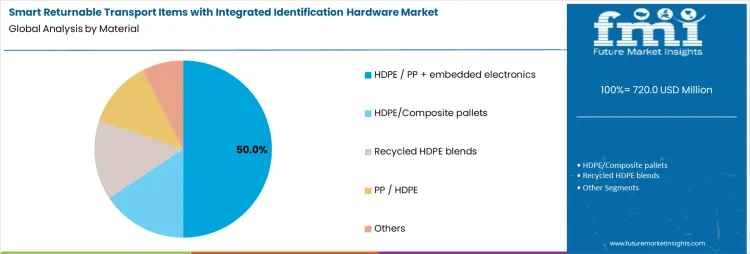
The HDPE/PP combined with embedded electronics segment is the largest material category in the smart returnable transport items (RTIs) with integrated identification hardware market, accounting for 50% of the market share. This material is widely used for its excellent balance of strength, flexibility, and durability, making it ideal for heavy-duty applications like pallets, crates, and containers in logistics and supply chain management. The addition of embedded electronics such as RFID tags or IoT modules enhances the material’s functionality by enabling real-time tracking, monitoring, and data collection.
The growing need for smart, connected solutions in supply chains is driving the demand for HDPE/PP RTIs with embedded electronics. These RTIs help businesses track product movements, optimize inventory management, and reduce the loss of transport items, which can significantly lower costs. Furthermore, the environmental benefits of using HDPE/PP, which is recyclable and reusable, align with the growing focus on sustainability in industries like logistics, retail, and manufacturing. As companies continue to seek efficient and eco-friendly packaging and transport solutions, the demand for HDPE/PP RTIs with embedded electronics is expected to continue growing, solidifying its dominant position in the market.
What is Contributing to the Growth of IoT Modules, Long-Range RFID, and Sensor Nodes in the Smart RTI Market?
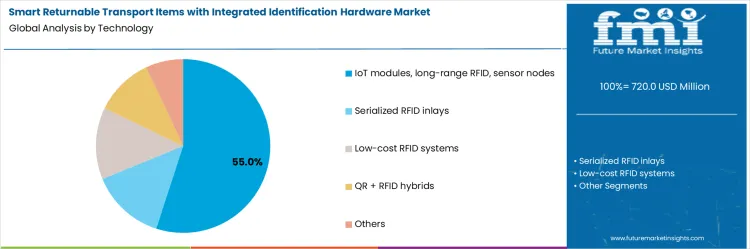
IoT modules, long-range RFID, and sensor nodes are the leading technologies in the smart returnable transport items (RTIs) with integrated identification hardware market, representing 55% of the market share. These technologies are critical for enabling real-time data collection, monitoring, and communication within supply chains. IoT modules and long-range RFID systems allow for the seamless tracking of RTIs across large distances, which is essential for managing inventory, reducing loss, and improving operational efficiency. The integration of sensor nodes further enhances the capabilities of smart RTIs by providing data on the condition of goods, such as temperature, humidity, and vibration levels. This is particularly valuable in industries that handle sensitive or perishable items, such as pharmaceuticals and food.
The ability to gather detailed, real-time information on the movement and status of RTIs enables businesses to optimize supply chain operations, reduce waste, and increase transparency. As industries increasingly adopt digital technologies to improve efficiency and traceability, the demand for IoT, RFID, and sensor-enabled RTIs continues to rise. These advancements, combined with the growing focus on sustainability and cost reduction, position IoT modules, long-range RFID, and sensor nodes as key drivers of market growth in the smart RTI sector.
What are the Key Dynamics of the Global Smart Returnable Transport Items with Integrated Identification Hardware Market?
The global smart returnable transport items with integrated identification hardware market is expanding as supply chain operators adopt reusable containers tagged with sensors and digital IDs to track assets through return cycles. These smart items help improve visibility, reduce loss, and streamline handling across transport, warehousing and manufacturing operations. Growth is driven by rising logistics complexity, focus on sustainability, and adoption of Industry 4.0 technologies. Manufacturers, third party logistics providers and retailers deploy systems that combine physical returnable assets with embedded hardware for scanning, wireless communication and automated data capture.
What are the Key Drivers for the Global Smart Returnable Transport Items with Integrated Identification Hardware Market?
Increasing pressure on supply chain efficiency motivates investment in smart returnable transport items that provide real time visibility and traceability of assets. Embedded identification hardware such as RFID, NFC, BLE and IoT sensors supports automated tracking, reducing manual scanning and errors. Sustainability goals encourage use of reusable packaging and containers to replace single use alternatives, lowering waste and cost over repeated cycles. Growth in e commerce and omni channel fulfillment increases asset movement and complexity, prompting deployment of connected returnable systems. Partnerships between brands, logistics providers and technology vendors help integrate digital tracking into broader supply chain platforms.
What are the Restraints for the Global Smart Returnable Transport Items with Integrated Identification Hardware Market?
One restraint is the upfront cost of equipping returnable transport items with integrated identification hardware and connecting systems. Small and mid sized enterprises may find initial investment in tagged containers, readers and supporting software challenging. Integration with existing enterprise resource planning, warehouse management and transport systems requires technical effort and planning, which can slow adoption. Data management and ensuring interoperability across stakeholders remain barriers where standards differ. Operational change management, including training staff on new workflows, affects implementation timelines. In regions with limited digital infrastructure, real time tracking performance may be inconsistent.
What is the Key Trends in the Global Smart Returnable Transport Items with Integrated Identification Hardware Market?
A key trend is fusion of identification hardware with sensors that capture environmental conditions such as temperature and shock, adding value for sensitive goods transport. Platforms increasingly use cloud computing and analytics to transform captured data into insights that improve asset utilization, predict maintenance and support route optimization. Use of modular, scalable hardware designs that can be retrofitted to existing returnable assets is rising, reducing cost barriers. Collaboration within industry consortia and adoption of open standards improve interoperability among partners. Growing interest in circular supply chains and extended producer responsibility supports expansion of smart returnable ecosystems.
What are the Key Insights from the Smart Returnable Transport Items with Integrated Identification Hardware Market Analysis?
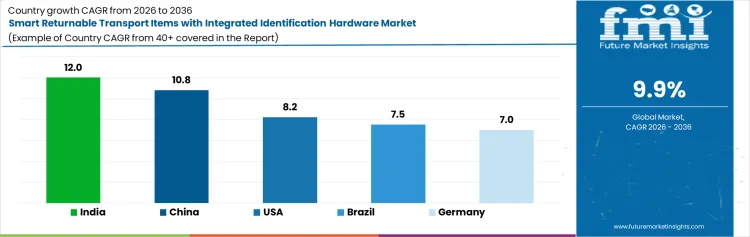
The smart returnable transport items (RTIs) with integrated identification hardware market is projected to grow steadily, driven by increasing demand for efficient logistics and supply chain solutions. These smart RTIs, equipped with technologies such as RFID (Radio Frequency Identification) and IoT sensors, help businesses improve the tracking, management, and reusability of transport items. The rise in e-commerce, along with the increasing need for cost-effective and sustainable packaging solutions, is fueling the adoption of smart RTIs. Countries like India and China are expected to see high growth rates due to rapid industrialization and the growing demand for supply chain optimization. In developed markets like the USA and Germany, the adoption of smart RTIs is driven by regulatory requirements and the need to improve operational efficiency. The market is being shaped by technological advancements, sustainability goals, and evolving consumer demands for better supply chain transparency.
| Country | CAGR (2026 to 2036) |
|---|---|
| USA | 8.2% |
| Germany | 7% |
| China | 10.8% |
| India | 12% |
| Brazil | 7.5% |
What is the Growth Outlook for the Smart Returnable Transport Items with Integrated Identification Hardware Market in the USA?
The market for smart returnable transport items with integrated identification hardware in the United States is projected to grow at a moderate pace, with a projected CAGR of 8.2%. The USA has a highly developed logistics and supply chain sector, where the adoption of smart RTIs is driven by the need for efficiency, cost reduction, and regulatory compliance. As industries such as automotive, food and beverage, and consumer goods increasingly demand more sustainable and efficient packaging solutions, the market for smart RTIs is expected to rise. The adoption of RFID and IoT technologies to track the movement and condition of transport items in real-time is seen as a crucial element in enhancing operational efficiency. As the USA continues to focus on supply chain optimization, the market for smart RTIs is expected to grow steadily.
What is the Market Outlook for the Smart Returnable Transport Items with Integrated Identification Hardware Market in Germany?
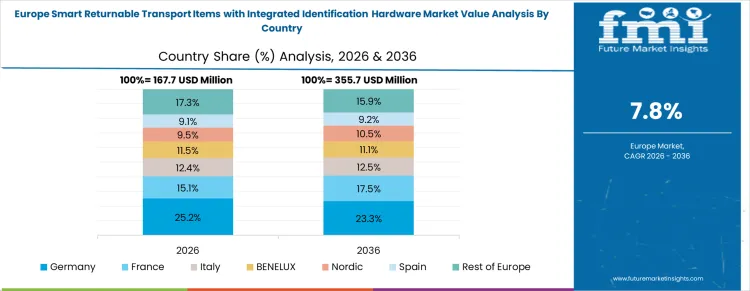
The smart returnable transport items with integrated identification hardware market in Germany is expected to grow at a moderate rate, with a projected CAGR of 7%. Germany’s strong industrial and logistics sectors, combined with its emphasis on sustainability and efficiency, provide a favorable environment for the adoption of smart RTIs. The country’s manufacturing and automotive industries, in particular, are increasingly utilizing smart RTIs to streamline operations, reduce waste, and improve supply chain transparency. Germany’s regulatory framework encourages businesses to implement more sustainable practices, further driving the demand for smart RTIs. Additionally, advancements in RFID and IoT technologies make it easier for businesses in Germany to implement these solutions. The market is expected to experience steady growth as German companies continue to prioritize supply chain optimization.
What is the Growth Forecast for the Smart Returnable Transport Items with Integrated Identification Hardware Market in China?
The market for smart returnable transport items with integrated identification hardware in China is expected to experience the highest growth, with a projected CAGR of 10.8%. China’s rapid industrialization, growing e-commerce sector, and the need for supply chain optimization are major drivers of this market’s expansion. The country’s large manufacturing base and the rise of the logistics industry are contributing to the increasing demand for efficient and traceable transport solutions. As Chinese businesses seek to improve the management of returnable transport items and reduce operational costs, the adoption of smart RTIs with integrated identification hardware is expected to increase. Additionally, China’s commitment to sustainability and regulatory reforms is encouraging companies to adopt more efficient and environmentally friendly supply chain solutions, further supporting market growth.
What is the Market Outlook for the Smart Returnable Transport Items with Integrated Identification Hardware Market in India?
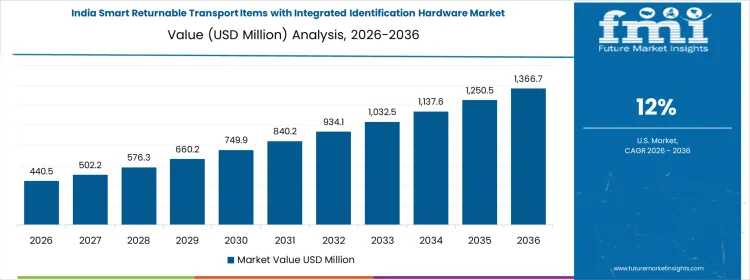
The smart returnable transport items with integrated identification hardware market in India is projected to grow at the highest rate globally, with a CAGR of 12%. India’s expanding manufacturing sector, rapidly growing logistics industry, and increasing demand for efficient and traceable packaging solutions are key drivers of this market. The rise in e-commerce and the push towards digitalization are also contributing to the demand for smart RTIs. India’s logistics sector is becoming increasingly sophisticated, with companies focusing on improving supply chain efficiency and transparency. As the country continues to invest in infrastructure and technology, the adoption of smart RTIs equipped with RFID and IoT technologies is expected to accelerate. The growth of India’s industrial and retail sectors further supports the demand for these advanced transport solutions.
What are the Growth Prospects for the Smart Returnable Transport Items with Integrated Identification Hardware Market in Brazil?
The smart returnable transport items with integrated identification hardware market in Brazil is expected to grow at a moderate pace, with a projected CAGR of 7.5%. While Brazil’s logistics and manufacturing industries are still developing, there is a growing recognition of the need for smarter, more efficient packaging and transport solutions. The country’s expanding industrial base and the increasing demand for supply chain optimization are contributing to the rise in demand for smart RTIs. However, the market growth in Brazil is somewhat constrained by economic challenges and slower adoption of new technologies compared to other regions. Nonetheless, as businesses in Brazil begin to invest more in digital solutions to enhance efficiency, the market for smart RTIs is expected to gradually grow. Increased adoption of IoT and RFID technologies will likely contribute to further growth as Brazilian companies seek to improve logistics and reduce costs.
What is the Competitive Landscape for the Smart Returnable Transport Items with Integrated Identification Hardware Market?
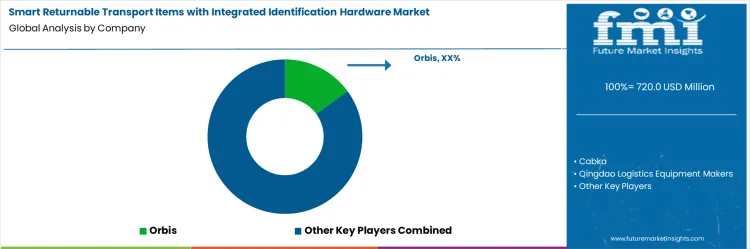
The smart returnable transport items (RTP) with integrated identification hardware market is growing rapidly, driven by the increasing need for efficient logistics and supply chain solutions. Orbis leads the market with its innovative RTP solutions that incorporate integrated identification hardware, offering enhanced tracking, traceability, and supply chain visibility. Their advanced technology enables real-time monitoring of transport items, making them a preferred choice for industries such as automotive, retail, and food. Cabka, Qingdao Logistics Equipment Makers, and Uflex are major competitors, each offering a range of RTP solutions with integrated identification features. Cabka specializes in sustainable, high-quality RTPs, while Qingdao Logistics Equipment Makers and Uflex provide customizable solutions tailored to specific industry needs.
Local RTP manufacturers, Toyota Industries (RTI tech), Schoeller Allibert, CHEP, and SSI Schäfer further contribute to the competitive dynamics. Toyota Industries integrates its RTI tech to enhance RTP functionality, offering robust solutions for material handling. Schoeller Allibert focuses on durable and sustainable RTPs with smart identification, while CHEP and SSI Schäfer offer scalable solutions designed to improve logistics efficiency and reduce operational costs. These companies compete by focusing on product durability, technological integration, and the ability to provide seamless tracking and traceability for returnable transport items. Their strategies emphasize innovation, reliability, and meeting the growing demand for smarter, more efficient logistics solutions.
Key Players of the Smart Returnable Transport Items with Integrated Identification Hardware Market
- Orbis
- Cabka
- Qingdao Logistics Equipment Makers
- Uflex
- Local RTP manufacturers
- Toyota Industries (RTI tech)
- Schoeller Allibert
- CHEP
- SSI Schäfer
Scope of the Report
| Items | Values |
|---|---|
| Quantitative Units (2026) | USD Million |
| End-use / Application | Retail & Distribution Centres, Intra-EU Supply Chains, E-commerce Fulfillment, Retail & Warehousing, Food & Beverage Logistics, Electronics Manufacturing |
| Packaging Format / Type | RFID/NFC-Enabled Totes & Pallets, Smart Crates & Pallets, Trackable Totes, Smart Bins, Others |
| Material | HDPE / PP + Embedded Electronics, HDPE/Composite Pallets, Recycled HDPE Blends, PP / HDPE, Others |
| Technology | IoT Modules, Long-Range RFID, Sensor Nodes, Serialized RFID Inlays, Low-Cost RFID Systems, QR + RFID Hybrids |
| Companies | Orbis, Cabka, Qingdao Logistics Equipment Makers, Uflex, Local RTP Manufacturers, Toyota Industries (RTI Tech), Schoeller Allibert, CHEP, SSI Schäfer |
| Regions Covered | North America, Latin America, Western Europe, Eastern Europe, South Asia and Pacific, East Asia, Middle East & Africa |
| Countries Covered | United States, Canada, Mexico, Brazil, Argentina, Germany, France, United Kingdom, Italy, Spain, Netherlands, China, India, Japan, South Korea, ANZ, GCC Countries, South Africa |
| Additional Attributes | Dollar by sales by end-use/application, packaging format/type, material, technology, and region. Includes market trends in smart returnable transport items, focusing on RFID/NFC-enabled totes, smart crates, trackable totes, and smart bins. Highlights the role of IoT modules, long-range RFID, sensor nodes, and low-cost RFID systems in supply chains. Focus on regulatory compliance, cost-effectiveness, market share, and competitive positioning of key companies in the logistics and warehousing sectors. |
Smart Returnable Transport Items with Integrated Identification Hardware Market Segmentation
By End-use / Application:
- Retail & distribution centres
- Intra-EU supply chains
- E-commerce fulfilment
- Retail & warehousing
- Food & beverage logistics
- Electronics manufacturing
By Packaging Format / Type:
- RFID/NFC-enabled totes & pallets
- Smart crates & pallets
- Trackable totes
- Smart bins
- Others
By Material:
- HDPE / PP + embedded electronics
- HDPE/Composite pallets
- Recycled HDPE blends
- PP / HDPE
- Others
By Technology:
- IoT modules, long-range RFID, sensor nodes
- Serialized RFID inlays
- Low-cost RFID systems
- QR + RFID hybrids
- Others
By Region:
- Asia Pacific
- China
- Japan
- South Korea
- India
- Australia & New Zealand
- ASEAN
- Rest of Asia Pacific
- Europe
- Germany
- United Kingdom
- France
- Italy
- Spain
- Nordic
- BENELUX
- Rest of Europe
- North America
- United States
- Canada
- Mexico
- Latin America
- Brazil
- Chile
- Rest of Latin America
- Middle East & Africa
- Kingdom of Saudi Arabia
- Other GCC Countries
- Turkey
- South Africa
- Other African Union
- Rest of Middle East & Africa
Bibliography
- GS1. (2023). Identification standards and data carrier technologies for reusable logistics assets. GS1 General Specifications and Technical Guidance.
- International Organization for Standardization. (2023). Automatic identification and data capture standards for reusable transport items. ISO Standards Publications.
- Reusable Packaging Association. (2023). Best practices for returnable transport items and tracking hardware integration. RPA Industry Publications.
- VDI Association of German Engineers. (2023). Logistics automation and intelligent load carrier systems in industrial supply chains. VDI Technical Guidelines.
Frequently Asked Questions
How big is the smart returnable transport items with integrated identification hardware market in 2026?
The global smart returnable transport items with integrated identification hardware market is estimated to be valued at USD 720.0 million in 2026.
What will be the size of smart returnable transport items with integrated identification hardware market in 2036?
The market size for the smart returnable transport items with integrated identification hardware market is projected to reach USD 1,850.6 million by 2036.
How much will be the smart returnable transport items with integrated identification hardware market growth between 2026 and 2036?
The smart returnable transport items with integrated identification hardware market is expected to grow at a 9.9% CAGR between 2026 and 2036.
What are the key product types in the smart returnable transport items with integrated identification hardware market?
The key product types in smart returnable transport items with integrated identification hardware market are retail & distribution centres, intra-eu supply chains, e-commerce fulfilment, retail & warehousing, food & beverage logistics and electronics manufacturing.
Which packaging format segment to contribute significant share in the smart returnable transport items with integrated identification hardware market in 2026?
In terms of packaging format, rfid/nfc-enabled totes & pallets segment to command 45.0% share in the smart returnable transport items with integrated identification hardware market in 2026.
Preview the report firsthand - request a free sample
Get SampleGet the brochure for pricing and purchase details.
Get PDFTable of Content
- Executive Summary
- Global Market Outlook
- Demand-side Trends
- Supply-side Trends
- Technology Roadmap Analysis
- Analysis and Recommendations
- Market Overview
- Market Coverage / Taxonomy
- Market Definition / Scope / Limitations
- Market Background
- Market Dynamics
- Drivers
- Restraints
- Opportunity
- Trends
- Scenario Forecast
- Demand in Optimistic Scenario
- Demand in Likely Scenario
- Demand in Conservative Scenario
- Opportunity Map Analysis
- Product Life Cycle Analysis
- Supply Chain Analysis
- Investment Feasibility Matrix
- Value Chain Analysis
- PESTLE and Porter’s Analysis
- Regulatory Landscape
- Regional Parent Market Outlook
- Production and Consumption Statistics
- Import and Export Statistics
- Market Dynamics
- Global Market Analysis 2021 to 2025 and Forecast, 2026 to 2036
- Historical Market Size Value (USD Million) Analysis, 2021 to 2025
- Current and Future Market Size Value (USD Million) Projections, 2026 to 2036
- Y-o-Y Growth Trend Analysis
- Absolute $ Opportunity Analysis
- Global Market Pricing Analysis 2021 to 2025 and Forecast 2026 to 2036
- Global Market Analysis 2021 to 2025 and Forecast 2026 to 2036, By End-use
- Introduction / Key Findings
- Historical Market Size Value (USD Million) Analysis By End-use , 2021 to 2025
- Current and Future Market Size Value (USD Million) Analysis and Forecast By End-use , 2026 to 2036
- Retail & distribution centres
- Intra-EU supply chains
- E-commerce fulfilment
- Retail & warehousing
- Food & beverage logistics
- Electronics manufacturing
- Y-o-Y Growth Trend Analysis By End-use , 2021 to 2025
- Absolute $ Opportunity Analysis By End-use , 2026 to 2036
- Global Market Analysis 2021 to 2025 and Forecast 2026 to 2036, By Packaging Format
- Introduction / Key Findings
- Historical Market Size Value (USD Million) Analysis By Packaging Format, 2021 to 2025
- Current and Future Market Size Value (USD Million) Analysis and Forecast By Packaging Format, 2026 to 2036
- RFID/NFC-enabled totes & pallets
- Smart crates & pallets
- Trackable totes
- Smart bins
- Others
- Y-o-Y Growth Trend Analysis By Packaging Format, 2021 to 2025
- Absolute $ Opportunity Analysis By Packaging Format, 2026 to 2036
- Global Market Analysis 2021 to 2025 and Forecast 2026 to 2036, By Material
- Introduction / Key Findings
- Historical Market Size Value (USD Million) Analysis By Material, 2021 to 2025
- Current and Future Market Size Value (USD Million) Analysis and Forecast By Material, 2026 to 2036
- HDPE / PP + embedded electronics
- HDPE/Composite pallets
- Recycled HDPE blends
- PP / HDPE
- Others
- Y-o-Y Growth Trend Analysis By Material, 2021 to 2025
- Absolute $ Opportunity Analysis By Material, 2026 to 2036
- Global Market Analysis 2021 to 2025 and Forecast 2026 to 2036, By Technology
- Introduction / Key Findings
- Historical Market Size Value (USD Million) Analysis By Technology, 2021 to 2025
- Current and Future Market Size Value (USD Million) Analysis and Forecast By Technology, 2026 to 2036
- IoT modules, long-range RFID, sensor nodes
- Serialized RFID inlays
- Low-cost RFID systems
- QR + RFID hybrids
- Others
- Y-o-Y Growth Trend Analysis By Technology, 2021 to 2025
- Absolute $ Opportunity Analysis By Technology, 2026 to 2036
- Global Market Analysis 2021 to 2025 and Forecast 2026 to 2036, By Region
- Introduction
- Historical Market Size Value (USD Million) Analysis By Region, 2021 to 2025
- Current Market Size Value (USD Million) Analysis and Forecast By Region, 2026 to 2036
- North America
- Latin America
- Western Europe
- Eastern Europe
- East Asia
- South Asia and Pacific
- Middle East & Africa
- Market Attractiveness Analysis By Region
- North America Market Analysis 2021 to 2025 and Forecast 2026 to 2036, By Country
- Historical Market Size Value (USD Million) Trend Analysis By Market Taxonomy, 2021 to 2025
- Market Size Value (USD Million) Forecast By Market Taxonomy, 2026 to 2036
- By Country
- USA
- Canada
- Mexico
- By End-use
- By Packaging Format
- By Material
- By Technology
- By Country
- Market Attractiveness Analysis
- By Country
- By End-use
- By Packaging Format
- By Material
- By Technology
- Key Takeaways
- Latin America Market Analysis 2021 to 2025 and Forecast 2026 to 2036, By Country
- Historical Market Size Value (USD Million) Trend Analysis By Market Taxonomy, 2021 to 2025
- Market Size Value (USD Million) Forecast By Market Taxonomy, 2026 to 2036
- By Country
- Brazil
- Chile
- Rest of Latin America
- By End-use
- By Packaging Format
- By Material
- By Technology
- By Country
- Market Attractiveness Analysis
- By Country
- By End-use
- By Packaging Format
- By Material
- By Technology
- Key Takeaways
- Western Europe Market Analysis 2021 to 2025 and Forecast 2026 to 2036, By Country
- Historical Market Size Value (USD Million) Trend Analysis By Market Taxonomy, 2021 to 2025
- Market Size Value (USD Million) Forecast By Market Taxonomy, 2026 to 2036
- By Country
- Germany
- UK
- Italy
- Spain
- France
- Nordic
- BENELUX
- Rest of Western Europe
- By End-use
- By Packaging Format
- By Material
- By Technology
- By Country
- Market Attractiveness Analysis
- By Country
- By End-use
- By Packaging Format
- By Material
- By Technology
- Key Takeaways
- Eastern Europe Market Analysis 2021 to 2025 and Forecast 2026 to 2036, By Country
- Historical Market Size Value (USD Million) Trend Analysis By Market Taxonomy, 2021 to 2025
- Market Size Value (USD Million) Forecast By Market Taxonomy, 2026 to 2036
- By Country
- Russia
- Poland
- Hungary
- Balkan & Baltic
- Rest of Eastern Europe
- By End-use
- By Packaging Format
- By Material
- By Technology
- By Country
- Market Attractiveness Analysis
- By Country
- By End-use
- By Packaging Format
- By Material
- By Technology
- Key Takeaways
- East Asia Market Analysis 2021 to 2025 and Forecast 2026 to 2036, By Country
- Historical Market Size Value (USD Million) Trend Analysis By Market Taxonomy, 2021 to 2025
- Market Size Value (USD Million) Forecast By Market Taxonomy, 2026 to 2036
- By Country
- China
- Japan
- South Korea
- By End-use
- By Packaging Format
- By Material
- By Technology
- By Country
- Market Attractiveness Analysis
- By Country
- By End-use
- By Packaging Format
- By Material
- By Technology
- Key Takeaways
- South Asia and Pacific Market Analysis 2021 to 2025 and Forecast 2026 to 2036, By Country
- Historical Market Size Value (USD Million) Trend Analysis By Market Taxonomy, 2021 to 2025
- Market Size Value (USD Million) Forecast By Market Taxonomy, 2026 to 2036
- By Country
- India
- ASEAN
- Australia & New Zealand
- Rest of South Asia and Pacific
- By End-use
- By Packaging Format
- By Material
- By Technology
- By Country
- Market Attractiveness Analysis
- By Country
- By End-use
- By Packaging Format
- By Material
- By Technology
- Key Takeaways
- Middle East & Africa Market Analysis 2021 to 2025 and Forecast 2026 to 2036, By Country
- Historical Market Size Value (USD Million) Trend Analysis By Market Taxonomy, 2021 to 2025
- Market Size Value (USD Million) Forecast By Market Taxonomy, 2026 to 2036
- By Country
- Kingdom of Saudi Arabia
- Other GCC Countries
- Turkiye
- South Africa
- Other African Union
- Rest of Middle East & Africa
- By End-use
- By Packaging Format
- By Material
- By Technology
- By Country
- Market Attractiveness Analysis
- By Country
- By End-use
- By Packaging Format
- By Material
- By Technology
- Key Takeaways
- Key Countries Market Analysis
- USA
- Pricing Analysis
- Market Share Analysis, 2025
- By End-use
- By Packaging Format
- By Material
- By Technology
- Canada
- Pricing Analysis
- Market Share Analysis, 2025
- By End-use
- By Packaging Format
- By Material
- By Technology
- Mexico
- Pricing Analysis
- Market Share Analysis, 2025
- By End-use
- By Packaging Format
- By Material
- By Technology
- Brazil
- Pricing Analysis
- Market Share Analysis, 2025
- By End-use
- By Packaging Format
- By Material
- By Technology
- Chile
- Pricing Analysis
- Market Share Analysis, 2025
- By End-use
- By Packaging Format
- By Material
- By Technology
- Germany
- Pricing Analysis
- Market Share Analysis, 2025
- By End-use
- By Packaging Format
- By Material
- By Technology
- UK
- Pricing Analysis
- Market Share Analysis, 2025
- By End-use
- By Packaging Format
- By Material
- By Technology
- Italy
- Pricing Analysis
- Market Share Analysis, 2025
- By End-use
- By Packaging Format
- By Material
- By Technology
- Spain
- Pricing Analysis
- Market Share Analysis, 2025
- By End-use
- By Packaging Format
- By Material
- By Technology
- France
- Pricing Analysis
- Market Share Analysis, 2025
- By End-use
- By Packaging Format
- By Material
- By Technology
- India
- Pricing Analysis
- Market Share Analysis, 2025
- By End-use
- By Packaging Format
- By Material
- By Technology
- ASEAN
- Pricing Analysis
- Market Share Analysis, 2025
- By End-use
- By Packaging Format
- By Material
- By Technology
- Australia & New Zealand
- Pricing Analysis
- Market Share Analysis, 2025
- By End-use
- By Packaging Format
- By Material
- By Technology
- China
- Pricing Analysis
- Market Share Analysis, 2025
- By End-use
- By Packaging Format
- By Material
- By Technology
- Japan
- Pricing Analysis
- Market Share Analysis, 2025
- By End-use
- By Packaging Format
- By Material
- By Technology
- South Korea
- Pricing Analysis
- Market Share Analysis, 2025
- By End-use
- By Packaging Format
- By Material
- By Technology
- Russia
- Pricing Analysis
- Market Share Analysis, 2025
- By End-use
- By Packaging Format
- By Material
- By Technology
- Poland
- Pricing Analysis
- Market Share Analysis, 2025
- By End-use
- By Packaging Format
- By Material
- By Technology
- Hungary
- Pricing Analysis
- Market Share Analysis, 2025
- By End-use
- By Packaging Format
- By Material
- By Technology
- Kingdom of Saudi Arabia
- Pricing Analysis
- Market Share Analysis, 2025
- By End-use
- By Packaging Format
- By Material
- By Technology
- Turkiye
- Pricing Analysis
- Market Share Analysis, 2025
- By End-use
- By Packaging Format
- By Material
- By Technology
- South Africa
- Pricing Analysis
- Market Share Analysis, 2025
- By End-use
- By Packaging Format
- By Material
- By Technology
- USA
- Market Structure Analysis
- Competition Dashboard
- Competition Benchmarking
- Market Share Analysis of Top Players
- By Regional
- By End-use
- By Packaging Format
- By Material
- By Technology
- Competition Analysis
- Competition Deep Dive
- Orbis
- Overview
- Product Portfolio
- Profitability by Market Segments (Product/Age /Sales Channel/Region)
- Sales Footprint
- Strategy Overview
- Marketing Strategy
- Product Strategy
- Channel Strategy
- Cabka
- Qingdao Logistics Equipment Makers
- Uflex
- Local RTP manufacturers
- Toyota Industries (RTI tech)
- Schoeller Allibert
- CHEP
- SSI Schäfer
- Orbis
- Competition Deep Dive
- Assumptions & Acronyms Used
- Research Methodology


