

- Industry Size (2026):
- USD 950.0 Mn
- Forecast (2036)
- USD 1392.8 Mn
- CAGR (2026 to 2036)
- 3.9%
Snow Chains and Traction Devices Market Forecast and Outlook 2026 to 2036
The snow chains and traction devices market is likely to be valued at USD 950.0 million in 2026, and reach USD 1,392.8 million by 2036, at 3.9% CAGR. Value behavior is anchored in regulatory enforcement and weather exposure rather than discretionary vehicle accessory spending. Demand concentrates in regions where seasonal mandates require certified traction equipment for road access. Purchase timing is episodic and compliance driven, with volumes peaking ahead of winter months and declining sharply outside snow periods.
value reflects durability under abrasion, tensile load, and repeated installation rather than feature differentiation. Steel-based solutions retain pricing power due to regulatory acceptance and predictable performance under severe conditions. Consumer and fleet buyers prioritize reliability over innovation, reinforcing conservative replacement cycles aligned with wear and corrosion rather than technology upgrades.
Volume expansion remains structurally constrained by geographic concentration and seasonality. Mild winters and improved road maintenance reduce utilization intensity in several mature regions. Standardization challenges persist due to wheel size variation, clearance limits, and drivetrain compatibility, restricting universal designs.
Installation complexity and ride comfort penalties limit prolonged use, confining demand to short-duration deployment. Alternative solutions such as advanced winter tires moderate penetration in urban settings. Inventory planning, manufacturing utilization, and pricing remain sensitive to annual snowfall variability. Growth follows climate exposure, enforcement rigor, and replacement necessity rather than vehicle parc expansion or lifestyle-driven adoption trends.
Quick Stats for Snow Chains and Traction Devices Market
- Snow Chains and Traction Devices Market Value (2026): USD 950.0 million
- Snow Chains and Traction Devices Market Forecast Value (2036): USD 1,392.8 million
- Snow Chains and Traction Devices Market Forecast CAGR 2026 to 2036: 3.9%
- Leading Product Type by Demand Share: Traditional Snow Chains
- Fastest-Growing Countries: Canada, USA, Germany, France, Japan
- Top Players in Global Demand: Thule Group (König), Pewag, RUD Ketten, Weissenfels, Michelin
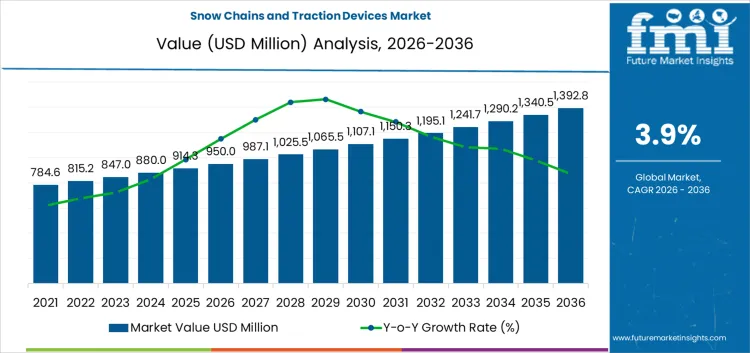
Snow Chains and Traction Devices Market Key Takeaways
| Metric | Value |
|---|---|
| Market Value (2026) | USD 950.0 million |
| Market Forecast Value (2036) | USD 1,392.8 million |
| Forecast CAGR (2026-2036) | 3.9% |
Why is the Demand for Snow Chains and Traction Devices Growing?
Demand for snow chains and traction devices is increasing as vehicle operators and fleet managers seek reliable solutions for safe mobility in regions subject to winter weather and variable road surface conditions. Snow chains, cable traction devices, and hybrid link systems enhance tire grip on ice and packed snow by increasing friction at the tire-road interface, supporting vehicle control and braking performance where studded tires or advanced traction control alone are insufficient. Regulatory frameworks in mountainous and cold-climate transport corridors often require seasonal fitment of approved traction devices to maintain compliance with local safety mandates. Procurement specialists evaluate device compatibility with specific tire sizes, ease of installation, and resistance to abrasion and corrosion so that devices perform reliably across multiple winter seasons and under repeated tension cycles without damaging wheels or vehicle undercarriage. Passenger vehicle owners, commercial transport operators, and emergency service fleets adopt these systems to reduce skid incidents and support predictable travel in adverse conditions.
Growth in winter tourism, intercity freight movement through high altitude passes, and public awareness of seasonal road safety reinforce uptake of snow chains and traction devices that meet diverse use-case requirements. Original equipment manufacturers and aftermarket suppliers offer modular traction solutions that fit light trucks, SUVs, vans, and heavy trucks to cover a broad spectrum of operational demands. Professional drivers and fleet safety coordinators monitor weather forecasts and road advisories to determine appropriate device selection, emphasizing products that balance traction performance with minimized impact on ride quality and driveline stress. Seasonal stocking by retailers and service centers ensures availability in advance of winter peaks, reducing lead times for consumers and commercial buyers. These application-specific performance and safety priorities are contributing to sustained demand growth in the snow chains and traction devices market.
How Are the Segments Classified in the Snow Chains and Traction Devices Market?
Demand for snow chains and traction devices is shaped by winter road safety requirements, regional weather severity, and regulatory mandates for seasonal driving conditions. Drivers seek reliable traction to maintain vehicle control on snow-covered or icy surfaces. Adoption aligns with passenger mobility patterns, mountain travel, and commercial operations in cold climates. Product selection prioritizes grip effectiveness, installation ease, and compatibility with vehicle drivetrains. Segment classification reflects differentiation by traction device design, vehicle application profile, and material composition influencing durability, performance consistency, and user handling characteristics.
Which Product Type Represents the Largest Share of Demand?
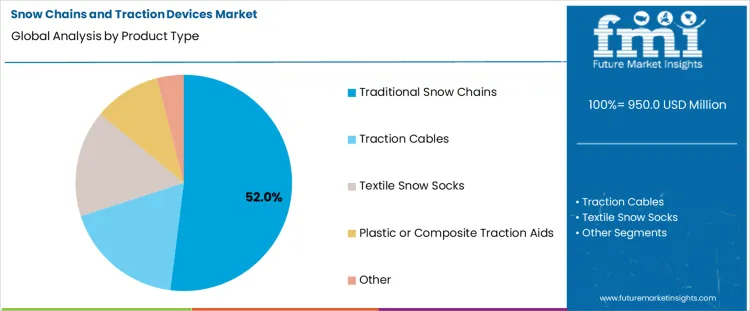
Traditional snow chains hold 52.0%, representing the largest share among product types due to proven traction performance. Steel link designs provide strong grip on packed snow and ice across varied road gradients. Long-standing regulatory acceptance supports use in controlled mountain passes and winter routes. Durability under repeated use reinforces preference among frequent winter drivers. Traction cables offer lighter handling with reduced clearance requirements. Textile snow socks provide temporary assistance for mild conditions. Plastic or composite aids address emergency use with limited durability. Product type segmentation reflects preference for established solutions delivering reliable traction under severe winter conditions.
Key Points
- Steel chain designs deliver strong traction on snow and ice.
- Regulatory acceptance supports use in controlled winter routes.
- Other products address lighter or temporary traction needs.
Which Vehicle Type Accounts for the Highest Share of Demand?
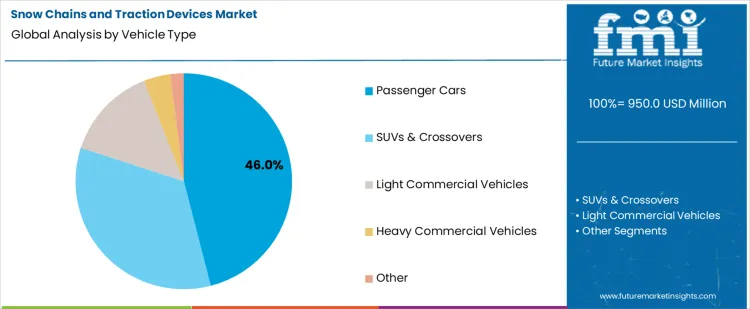
Passenger cars hold 46.0%, representing the largest share among vehicle types due to high ownership volume. Urban and regional drivers encounter winter conditions requiring periodic traction assistance. Standard wheel sizes and drivetrains simplify product compatibility. Seasonal travel increases demand during peak winter months. SUVs and crossovers follow with higher ground clearance and mixed traction needs. Light commercial vehicles apply devices for regional delivery operations. Heavy commercial vehicles contribute limited volume with specialized solutions. Vehicle type segmentation reflects concentration where vehicle population density and seasonal exposure drive consistent traction accessory adoption.
Key Points
- Passenger cars dominate vehicle populations in winter regions.
- Standard fitment supports straightforward product selection.
- Other vehicle types apply traction devices for specific use cases.
Which Material Accounts for the Highest Share of Demand?
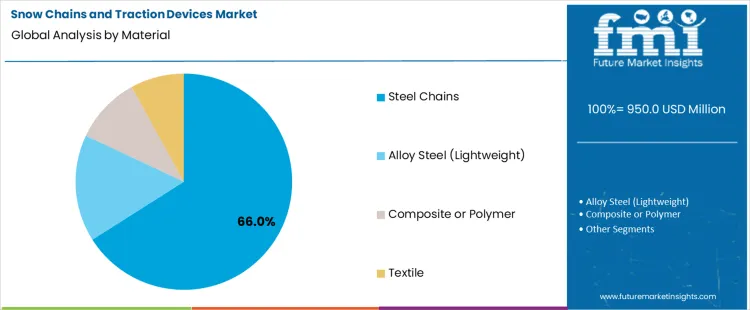
Steel chains hold 66.0%, representing the largest share among materials due to strength and abrasion resistance. Hardened steel withstands friction against ice, asphalt, and debris without rapid wear. Structural rigidity maintains traction geometry under load and braking forces. Longevity supports repeated seasonal use. Lightweight alloy steel reduces handling effort with moderate durability trade-offs. Composite or polymer materials prioritize ease of installation with lower grip performance. Textile materials serve emergency or light-duty conditions. Material segmentation reflects reliance on robust metals where traction reliability and service life remain critical.
Key Points
- Steel offers durability and consistent traction geometry.
- Abrasion resistance supports repeated seasonal usage.
- Other materials prioritize weight reduction or temporary use.
What are the Key Dynamics in the Snow Chains and Traction Devices Market?
Demand for snow chains and traction devices reflects vehicle mobility and safety requirements under snow, ice, and low-friction road conditions. Adoption concentrates in passenger vehicles, commercial trucks, buses, and off-highway equipment operating in cold climate regions and mountainous terrain. Global scope aligns with seasonal weather exposure and regulatory traction mandates. Usage centers on metal chains, composite chains, textile socks, and mechanical traction aids designed for temporary installation.
How do winter road safety requirements and regulatory mandates shape adoption?
Snow and ice significantly reduce tire-road friction, increasing stopping distance and loss of vehicle control risk. Demand increases where road authorities mandate traction devices during winter months or at specific altitude checkpoints. Commercial fleets rely on chains to maintain route continuity and avoid road closures or fines. Mountainous regions require rapid installation systems to minimize downtime during sudden weather changes. Passenger vehicle users adopt textile and low-profile devices for ease of handling and compatibility with limited wheel well clearance. Emergency services and logistics operators prioritize durable chains capable of repeated deployment. Adoption reflects compliance-driven usage combined with operational necessity to maintain mobility under adverse weather.
How do installation constraints, durability limits, and cost sensitivity influence market scalability?
Snow chains and traction devices experience high mechanical stress from road abrasion, impact, and centrifugal forces. Demand sensitivity rises where premature breakage increases replacement frequency. Incorrect installation risks vehicle damage, tire wear, and safety incidents, limiting user confidence. Wheel size variation and clearance constraints reduce universal fit potential. Noise and ride discomfort restrict prolonged use on mixed-condition roads. Seasonal demand concentration affects inventory planning and manufacturing utilization. Regulatory differences across regions complicate standardization. Price competition remains intense in consumer segments, constraining margin-supported innovation and limiting scalable expansion beyond weather-dependent markets.
How Is Demand for Snow Chains and Traction Devices Evolving Globally?
Demand for snow chains and traction devices is expanding globally due to winter safety regulations, climate variability, and vehicle mobility requirements in cold regions. Adoption aligns with passenger vehicles, commercial fleets, and emergency services operating under snow and ice conditions. Regulatory mandates, road safety enforcement, and insurance guidance influence purchasing behavior. Replacement demand arises from wear, corrosion, and vehicle changeovers. Growth rates in Canada at 4.6%, USA at 3.2%, France at 2.6%, Germany at 2.5%, and Japan at 2.1% indicate measured expansion driven by winter severity exposure, compliance-led usage, and lifecycle replacement rather than growth in vehicle ownership.
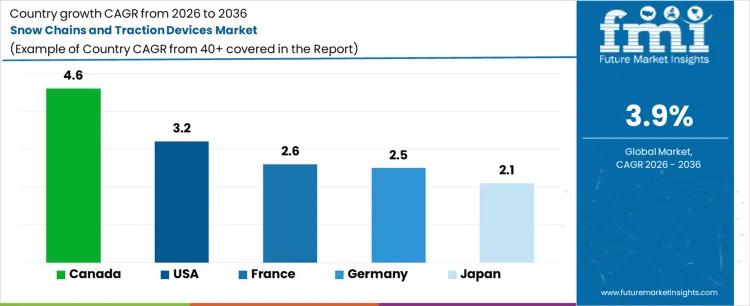
| Country | CAGR (%) |
|---|---|
| Canada | 4.6% |
| USA | 3.2% |
| Germany | 2.5% |
| France | 2.6% |
| Japan | 2.1% |
What Is Driving Expansion of Snow Chain Demand in Canada?
Demand for snow chains and traction devices in Canada is growing at a CAGR of 4.6%, supported by prolonged winter conditions and widespread rural driving. Mountainous regions and interprovincial highways require reliable traction under heavy snowfall. Commercial vehicles, utility fleets, and emergency services maintain compliant traction equipment. Provincial regulations mandate usage during severe conditions. Replacement demand remains consistent due to corrosion and mechanical wear. Growth reflects climate necessity and regulatory enforcement rather than discretionary safety upgrades.
- Prolonged winter driving conditions
- Regulatory mandates across provinces
- Commercial and emergency fleet usage
- Corrosion-driven replacement cycles
Why Is the United States Seeing Moderate Growth in Snow Chain Adoption?
Snow chain and traction device demand in the United States is expanding at a CAGR of 3.2%, driven by regional winter exposure and state-level enforcement. Mountain passes and northern states require chains during storm events. Commercial trucking fleets maintain traction devices for compliance and route access. Consumer adoption concentrates in recreational and rural driving segments. Alternative traction technologies moderate growth pace. Expansion reflects episodic winter demand and compliance needs rather than nationwide adoption.
- State-level chain enforcement in mountain regions
- Commercial trucking compliance requirements
- Recreational and rural vehicle usage
- Competition from alternative traction solutions
How Are Snow Chain Sales Developing in France?
Sales of snow chains and traction devices in France are growing at a CAGR of 2.6%, shaped by alpine travel regulations and winter tourism activity. Mountain departments enforce mandatory traction equipment during snow events. Passenger vehicles traveling to ski regions sustain seasonal demand. Rental fleets maintain compliant accessories for winter operations. Replacement purchases occur before peak travel seasons. Growth reflects regulatory compliance tied to tourism mobility rather than expansion of winter driving across all regions.
- Mandatory traction rules in alpine regions
- Seasonal demand from winter tourism
- Rental fleet compliance requirements
- Pre-season replacement purchasing
What Factors Are Influencing Snow Chain Demand in Germany?
Snow chain and traction device demand in Germany is expanding at a CAGR of 2.5%, influenced by road safety regulations and cross-border alpine travel. Southern regions require traction devices during severe weather. Commercial transport operators maintain chains for compliance on transnational routes. High-quality winter tires reduce reliance on chains in urban areas. Replacement demand supports steady volume. Growth remains measured, reflecting safety regulation adherence and mature winter mobility infrastructure.
- Southern region winter safety requirements
- Cross-border freight transport compliance
- High winter tire penetration
- Stable replacement demand
Why Is Japan Experiencing Limited Growth in Snow Chain Demand?
Demand for snow chains and traction devices in Japan is growing at a CAGR of 2.1%, supported by localized winter conditions and mountainous terrain. Northern regions and alpine roads require traction during snowfall. Compact vehicle usage favors lightweight chain designs. Urban reliance on public transport limits private vehicle usage during storms. Advanced road maintenance moderates demand growth. Expansion remains limited, reflecting geographic concentration and effective infrastructure management rather than broad winter driving adoption.
- Localized snowfall in northern regions
- Mountain road traction requirements
- Preference for lightweight compact designs
- Effective snow removal infrastructure
What is the competitive landscape of demand for the snow chains and traction devices market globally?
Demand for snow chains and traction devices is driven by the increasing need for vehicle safety in winter driving conditions, the rise in outdoor recreational activities, and regulatory requirements in snow-prone regions. Buyers evaluate the performance of traction devices in extreme weather, ease of installation, durability, and compatibility with different tire sizes. Procurement behavior emphasizes reliable, high-quality chains that provide maximum traction and safety under snow and ice conditions. Purchasing decisions prioritize brands with a proven track record for high-performance products that can withstand harsh environments. Trend in the market reflects growing demand for user-friendly, quick-installation products, as well as advancements in materials for improved performance and longevity.
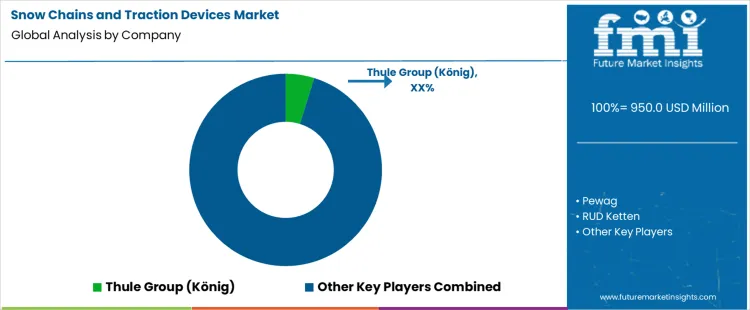
Thule Group (König) leads the competitive landscape with its well-established reputation for producing high-quality, easy-to-use snow chains and traction devices, offering premium solutions for a wide range of vehicles. Pewag competes by offering durable and reliable traction devices, focusing on superior performance in both passenger cars and commercial vehicles. RUD Ketten supports demand with high-strength snow chains designed for heavy-duty applications, ensuring maximum safety and performance. Weissenfels participates by providing a wide variety of snow chains designed for both light and heavy vehicles, with an emphasis on quality and convenience. Michelin offers traction solutions that blend ease of use with reliable performance, especially in the consumer and fleet markets.
Key Players in the Snow Chains and Traction Devices Market
- Thule Group (König)
- Pewag
- RUD Ketten
- Weissenfels
- Michelin
- SCC
- Peerless Chain
- Quality Chain Corp.
- Maggi Group
Scope of the Report
| Items | Values |
|---|---|
| Quantitative Units | USD million |
| Product Type | Traditional Snow Chains; Traction Cables; Textile Snow Socks; Plastic or Composite Traction Aids; Other |
| Vehicle Type | Passenger Cars; SUVs & Crossovers; Light Commercial Vehicles; Heavy Commercial Vehicles; Other |
| Material | Steel Chains; Alloy Steel (Lightweight); Composite or Polymer; Textile |
| Sales Channel | Auto Parts & Winter Retail; Online Retail; OEM or Dealer; Tire Dealers; Other |
| Regions Covered | Asia Pacific, Europe, North America, Latin America, Middle East & Africa |
| Countries Covered | Canada, USA, Germany, France, Japan, and 40+ countries |
| Key Companies Profiled | Thule Group (König); Pewag; RUD Ketten; Weissenfels; Michelin; SCC; Peerless Chain; Quality Chain Corp.; Maggi Group |
| Additional Attributes | Dollar sales by product type, vehicle type, material, and sales channel; traction performance, durability, and ease of installation across traditional snow chains, textile snow socks, and composite aids; material resilience under extreme cold, weight, and stress conditions for steel, alloy, and textile designs; sales dynamics influenced by winter retail, online channels, OEM tire dealer partnerships, and consumer-driven purchases. |
Snow Chains and Traction Devices Market by Segment
Product Type:
- Traditional Snow Chains
- Traction Cables
- Textile Snow Socks
- Plastic or Composite Traction Aids
- Other
Vehicle Type:
- Passenger Cars
- SUVs & Crossovers
- Light Commercial Vehicles
- Heavy Commercial Vehicles
- Other
Material:
- Steel Chains
- Alloy Steel (Lightweight)
- Composite or Polymer
- Textile
Sales Channel:
- Auto Parts & Winter Retail
- Online Retail
- OEM or Dealer
- Tire Dealers
- Other
Region:
- Asia Pacific
- China
- Japan
- South Korea
- India
- Australia & New Zealand
- ASEAN
- Rest of Asia Pacific
- Europe
- Germany
- United Kingdom
- France
- Italy
- Spain
- Nordic
- BENELUX
- Rest of Europe
- North America
- United States
- Canada
- Mexico
- Latin America
- Brazil
- Chile
- Rest of Latin America
- Middle East & Africa
- Kingdom of Saudi Arabia
- Other GCC Countries
- Turkey
- South Africa
- Other African Union
- Rest of Middle East & Africa
Bibliography
- International Organization for Standardization. (2024). Metallic materials for road vehicle components—Corrosion resistance and durability under winter operating conditions (ISO 9227:2024). ISO.
- United Nations Economic Commission for Europe. (2023). UN Regulation No. 117—Uniform provisions concerning the approval of tyres with regard to rolling sound emissions, adhesion on wet surfaces, and snow grip: Amendments influencing traction device usage. United Nations.
- European Commission. (2023). Directive (EU) 2020/40 and related delegated acts—Winter road safety, seasonal equipment obligations, and traction device requirements. Official Journal of the European Union.
Frequently Asked Questions
How big is the snow chains and traction devices market in 2026?
The global snow chains and traction devices market is estimated to be valued at USD 950.0 million in 2026.
What will be the size of snow chains and traction devices market in 2036?
The market size for the snow chains and traction devices market is projected to reach USD 1,392.8 million by 2036.
How much will be the snow chains and traction devices market growth between 2026 and 2036?
The snow chains and traction devices market is expected to grow at a 3.9% CAGR between 2026 and 2036.
What are the key product types in the snow chains and traction devices market?
The key product types in snow chains and traction devices market are traditional snow chains, traction cables, textile snow socks, plastic or composite traction aids and other.
Which vehicle type segment to contribute significant share in the snow chains and traction devices market in 2026?
In terms of vehicle type, passenger cars segment to command 46.0% share in the snow chains and traction devices market in 2026.
Preview the report firsthand - request a free sample
Get SampleGet the brochure for pricing and purchase details.
Get PDFTable of Content
- Executive Summary
- Global Market Outlook
- Demand-side Trends
- Supply-side Trends
- Technology Roadmap Analysis
- Analysis and Recommendations
- Market Overview
- Market Coverage / Taxonomy
- Market Definition / Scope / Limitations
- Market Background
- Market Dynamics
- Drivers
- Restraints
- Opportunity
- Trends
- Scenario Forecast
- Demand in Optimistic Scenario
- Demand in Likely Scenario
- Demand in Conservative Scenario
- Opportunity Map Analysis
- Product Life Cycle Analysis
- Supply Chain Analysis
- Investment Feasibility Matrix
- Value Chain Analysis
- PESTLE and Porter’s Analysis
- Regulatory Landscape
- Regional Parent Market Outlook
- Production and Consumption Statistics
- Import and Export Statistics
- Market Dynamics
- Global Market Analysis 2021 to 2025 and Forecast, 2026 to 2036
- Historical Market Size Value (USD Million) Analysis, 2021 to 2025
- Current and Future Market Size Value (USD Million) Projections, 2026 to 2036
- Y-o-Y Growth Trend Analysis
- Absolute $ Opportunity Analysis
- Global Market Pricing Analysis 2021 to 2025 and Forecast 2026 to 2036
- Global Market Analysis 2021 to 2025 and Forecast 2026 to 2036, By Product Type
- Introduction / Key Findings
- Historical Market Size Value (USD Million) Analysis By Product Type , 2021 to 2025
- Current and Future Market Size Value (USD Million) Analysis and Forecast By Product Type , 2026 to 2036
- Traditional Snow Chains
- Traction Cables
- Textile Snow Socks
- Plastic or Composite Traction Aids
- Other
- Traditional Snow Chains
- Y-o-Y Growth Trend Analysis By Product Type , 2021 to 2025
- Absolute $ Opportunity Analysis By Product Type , 2026 to 2036
- Global Market Analysis 2021 to 2025 and Forecast 2026 to 2036, By Vehicle Type
- Introduction / Key Findings
- Historical Market Size Value (USD Million) Analysis By Vehicle Type, 2021 to 2025
- Current and Future Market Size Value (USD Million) Analysis and Forecast By Vehicle Type, 2026 to 2036
- Passenger Cars
- SUVs & Crossovers
- Light Commercial Vehicles
- Heavy Commercial Vehicles
- Other
- Passenger Cars
- Y-o-Y Growth Trend Analysis By Vehicle Type, 2021 to 2025
- Absolute $ Opportunity Analysis By Vehicle Type, 2026 to 2036
- Global Market Analysis 2021 to 2025 and Forecast 2026 to 2036, By Material
- Introduction / Key Findings
- Historical Market Size Value (USD Million) Analysis By Material, 2021 to 2025
- Current and Future Market Size Value (USD Million) Analysis and Forecast By Material, 2026 to 2036
- Steel Chains
- Alloy Steel (Lightweight)
- Composite or Polymer
- Textile
- Steel Chains
- Y-o-Y Growth Trend Analysis By Material, 2021 to 2025
- Absolute $ Opportunity Analysis By Material, 2026 to 2036
- Global Market Analysis 2021 to 2025 and Forecast 2026 to 2036, By Sales Channel
- Introduction / Key Findings
- Historical Market Size Value (USD Million) Analysis By Sales Channel, 2021 to 2025
- Current and Future Market Size Value (USD Million) Analysis and Forecast By Sales Channel, 2026 to 2036
- Auto Parts & Winter Retail
- Online Retail
- OEM or Dealer
- Tire Dealers
- Other
- Auto Parts & Winter Retail
- Y-o-Y Growth Trend Analysis By Sales Channel, 2021 to 2025
- Absolute $ Opportunity Analysis By Sales Channel, 2026 to 2036
- Global Market Analysis 2021 to 2025 and Forecast 2026 to 2036, By Region
- Introduction
- Historical Market Size Value (USD Million) Analysis By Region, 2021 to 2025
- Current Market Size Value (USD Million) Analysis and Forecast By Region, 2026 to 2036
- North America
- Latin America
- Western Europe
- Eastern Europe
- East Asia
- South Asia and Pacific
- Middle East & Africa
- Market Attractiveness Analysis By Region
- North America Market Analysis 2021 to 2025 and Forecast 2026 to 2036, By Country
- Historical Market Size Value (USD Million) Trend Analysis By Market Taxonomy, 2021 to 2025
- Market Size Value (USD Million) Forecast By Market Taxonomy, 2026 to 2036
- By Country
- USA
- Canada
- Mexico
- By Product Type
- By Vehicle Type
- By Material
- By Sales Channel
- By Country
- Market Attractiveness Analysis
- By Country
- By Product Type
- By Vehicle Type
- By Material
- By Sales Channel
- Key Takeaways
- Latin America Market Analysis 2021 to 2025 and Forecast 2026 to 2036, By Country
- Historical Market Size Value (USD Million) Trend Analysis By Market Taxonomy, 2021 to 2025
- Market Size Value (USD Million) Forecast By Market Taxonomy, 2026 to 2036
- By Country
- Brazil
- Chile
- Rest of Latin America
- By Product Type
- By Vehicle Type
- By Material
- By Sales Channel
- By Country
- Market Attractiveness Analysis
- By Country
- By Product Type
- By Vehicle Type
- By Material
- By Sales Channel
- Key Takeaways
- Western Europe Market Analysis 2021 to 2025 and Forecast 2026 to 2036, By Country
- Historical Market Size Value (USD Million) Trend Analysis By Market Taxonomy, 2021 to 2025
- Market Size Value (USD Million) Forecast By Market Taxonomy, 2026 to 2036
- By Country
- Germany
- UK
- Italy
- Spain
- France
- Nordic
- BENELUX
- Rest of Western Europe
- By Product Type
- By Vehicle Type
- By Material
- By Sales Channel
- By Country
- Market Attractiveness Analysis
- By Country
- By Product Type
- By Vehicle Type
- By Material
- By Sales Channel
- Key Takeaways
- Eastern Europe Market Analysis 2021 to 2025 and Forecast 2026 to 2036, By Country
- Historical Market Size Value (USD Million) Trend Analysis By Market Taxonomy, 2021 to 2025
- Market Size Value (USD Million) Forecast By Market Taxonomy, 2026 to 2036
- By Country
- Russia
- Poland
- Hungary
- Balkan & Baltic
- Rest of Eastern Europe
- By Product Type
- By Vehicle Type
- By Material
- By Sales Channel
- By Country
- Market Attractiveness Analysis
- By Country
- By Product Type
- By Vehicle Type
- By Material
- By Sales Channel
- Key Takeaways
- East Asia Market Analysis 2021 to 2025 and Forecast 2026 to 2036, By Country
- Historical Market Size Value (USD Million) Trend Analysis By Market Taxonomy, 2021 to 2025
- Market Size Value (USD Million) Forecast By Market Taxonomy, 2026 to 2036
- By Country
- China
- Japan
- South Korea
- By Product Type
- By Vehicle Type
- By Material
- By Sales Channel
- By Country
- Market Attractiveness Analysis
- By Country
- By Product Type
- By Vehicle Type
- By Material
- By Sales Channel
- Key Takeaways
- South Asia and Pacific Market Analysis 2021 to 2025 and Forecast 2026 to 2036, By Country
- Historical Market Size Value (USD Million) Trend Analysis By Market Taxonomy, 2021 to 2025
- Market Size Value (USD Million) Forecast By Market Taxonomy, 2026 to 2036
- By Country
- India
- ASEAN
- Australia & New Zealand
- Rest of South Asia and Pacific
- By Product Type
- By Vehicle Type
- By Material
- By Sales Channel
- By Country
- Market Attractiveness Analysis
- By Country
- By Product Type
- By Vehicle Type
- By Material
- By Sales Channel
- Key Takeaways
- Middle East & Africa Market Analysis 2021 to 2025 and Forecast 2026 to 2036, By Country
- Historical Market Size Value (USD Million) Trend Analysis By Market Taxonomy, 2021 to 2025
- Market Size Value (USD Million) Forecast By Market Taxonomy, 2026 to 2036
- By Country
- Kingdom of Saudi Arabia
- Other GCC Countries
- Turkiye
- South Africa
- Other African Union
- Rest of Middle East & Africa
- By Product Type
- By Vehicle Type
- By Material
- By Sales Channel
- By Country
- Market Attractiveness Analysis
- By Country
- By Product Type
- By Vehicle Type
- By Material
- By Sales Channel
- Key Takeaways
- Key Countries Market Analysis
- USA
- Pricing Analysis
- Market Share Analysis, 2025
- By Product Type
- By Vehicle Type
- By Material
- By Sales Channel
- Canada
- Pricing Analysis
- Market Share Analysis, 2025
- By Product Type
- By Vehicle Type
- By Material
- By Sales Channel
- Mexico
- Pricing Analysis
- Market Share Analysis, 2025
- By Product Type
- By Vehicle Type
- By Material
- By Sales Channel
- Brazil
- Pricing Analysis
- Market Share Analysis, 2025
- By Product Type
- By Vehicle Type
- By Material
- By Sales Channel
- Chile
- Pricing Analysis
- Market Share Analysis, 2025
- By Product Type
- By Vehicle Type
- By Material
- By Sales Channel
- Germany
- Pricing Analysis
- Market Share Analysis, 2025
- By Product Type
- By Vehicle Type
- By Material
- By Sales Channel
- UK
- Pricing Analysis
- Market Share Analysis, 2025
- By Product Type
- By Vehicle Type
- By Material
- By Sales Channel
- Italy
- Pricing Analysis
- Market Share Analysis, 2025
- By Product Type
- By Vehicle Type
- By Material
- By Sales Channel
- Spain
- Pricing Analysis
- Market Share Analysis, 2025
- By Product Type
- By Vehicle Type
- By Material
- By Sales Channel
- France
- Pricing Analysis
- Market Share Analysis, 2025
- By Product Type
- By Vehicle Type
- By Material
- By Sales Channel
- India
- Pricing Analysis
- Market Share Analysis, 2025
- By Product Type
- By Vehicle Type
- By Material
- By Sales Channel
- ASEAN
- Pricing Analysis
- Market Share Analysis, 2025
- By Product Type
- By Vehicle Type
- By Material
- By Sales Channel
- Australia & New Zealand
- Pricing Analysis
- Market Share Analysis, 2025
- By Product Type
- By Vehicle Type
- By Material
- By Sales Channel
- China
- Pricing Analysis
- Market Share Analysis, 2025
- By Product Type
- By Vehicle Type
- By Material
- By Sales Channel
- Japan
- Pricing Analysis
- Market Share Analysis, 2025
- By Product Type
- By Vehicle Type
- By Material
- By Sales Channel
- South Korea
- Pricing Analysis
- Market Share Analysis, 2025
- By Product Type
- By Vehicle Type
- By Material
- By Sales Channel
- Russia
- Pricing Analysis
- Market Share Analysis, 2025
- By Product Type
- By Vehicle Type
- By Material
- By Sales Channel
- Poland
- Pricing Analysis
- Market Share Analysis, 2025
- By Product Type
- By Vehicle Type
- By Material
- By Sales Channel
- Hungary
- Pricing Analysis
- Market Share Analysis, 2025
- By Product Type
- By Vehicle Type
- By Material
- By Sales Channel
- Kingdom of Saudi Arabia
- Pricing Analysis
- Market Share Analysis, 2025
- By Product Type
- By Vehicle Type
- By Material
- By Sales Channel
- Turkiye
- Pricing Analysis
- Market Share Analysis, 2025
- By Product Type
- By Vehicle Type
- By Material
- By Sales Channel
- South Africa
- Pricing Analysis
- Market Share Analysis, 2025
- By Product Type
- By Vehicle Type
- By Material
- By Sales Channel
- USA
- Market Structure Analysis
- Competition Dashboard
- Competition Benchmarking
- Market Share Analysis of Top Players
- By Regional
- By Product Type
- By Vehicle Type
- By Material
- By Sales Channel
- Competition Analysis
- Competition Deep Dive
- Thule Group (König)
- Overview
- Product Portfolio
- Profitability by Market Segments (Product/Age /Sales Channel/Region)
- Sales Footprint
- Strategy Overview
- Marketing Strategy
- Product Strategy
- Channel Strategy
- Pewag
- RUD Ketten
- Weissenfels
- Michelin
- SCC
- Peerless Chain
- Quality Chain Corp.
- Maggi Group
- Thule Group (König)
- Competition Deep Dive
- Assumptions & Acronyms Used
- Research Methodology


