

- 2025 (base history)
- USD 650.0 Mn
- 2026 (current)
- USD 720.9 Mn
- 2036 (forecast)
- USD 2028.6 Mn
- CAGR (2026–2036)
- 10.9%
How big is the solid state battery pilot manufacturing equipment market in 2026?
USD 720.9 million in 2026 and USD 2,028.6 million by 2036 at a 10.9% CAGR.
The solid state battery pilot manufacturing equipment industry value is forecast to grow from USD 650.0 million in 2025 to USD 2,028.6 million by 2036 at 10.9% CAGR as battery developers move from laboratory validation toward controlled pilot-line production. Battery electric propulsion is forecast to represent 74.0% share in 2026 because solid-state batteries are being evaluated mainly for electric vehicle range, charging, and safety gains. Passenger car programs are expected to secure 62.0% share in 2026, led by premium EV validation work before wider platform adoption.
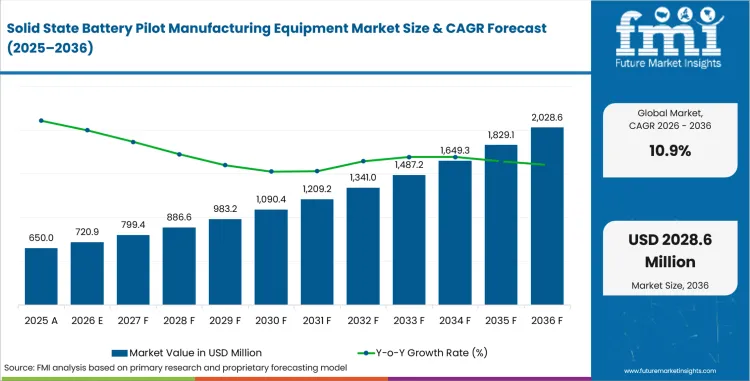
Solid State Battery Pilot Manufacturing Equipment Market Overview: Size and Forecast
- 2025 (base history): USD 650.0 million
- 2026 (current): USD 720.9 million
- 2036 (forecast): USD 2,028.6 million
- CAGR (2026–2036): 10.9%
- Leading Propulsion: Battery Electric
- Battery Electric Share in 2026: 74.0%
- Leading Vehicle Type: Passenger Car
- Passenger Car Share in 2026: 62.0%
- Fastest-growing Country: China
- China CAGR: 12.6% by 2036
Summary of the Solid State Battery Pilot Manufacturing Equipment Market
- Demand and Growth Drivers
- Battery developers are shifting from lab tools toward pilot equipment that proves repeatable coating, pressing, formation, and safety performance.
- OEMs are giving more attention to pilot lines that generate auditable process data before larger battery factory investments.
- Dry electrode processes are increasing demand for controlled mixing, coating, calendering, and inspection equipment.
- Product and Segment View
- Battery electric propulsion is projected to represent 74.0% share in 2026, led by solid-state battery targets around range improvement and faster charging.
- Passenger car programs are expected to hold 62.0% share in 2026, influenced by premium EV programs receiving early validation budgets.
- OEM channels are forecast to secure 47.0% share in 2026, supported by direct equipment procurement tied to vehicle platform gates.
- Geography and Competitive Outlook
- China is projected to record 12.6% CAGR by 2036, backed by EV production scale and domestic battery equipment supply.
- India is expected to expand at 12.2% CAGR by 2036 as battery localization and EV manufacturing support pilot-line demand.
- South Korea is anticipated to grow at 11.8% CAGR by 2036, led by cell-maker pilot programs and dry electrode development.
- Wuxi Lead Intelligent Equipment, Dürr Group, LiCAP Technologies, GROB, Bühler Group, Toray Engineering, and TMAX compete through dry electrode, coating, assembly, testing, and pilot-line integration capabilities.
- Analyst Opinion
- Nikhil Kaitwade, Associate Vice President at FMI, observes, “Solid state battery pilot manufacturing equipment is becoming a qualification market rather than a simple machinery category. Buyers are testing whether battery chemistry can survive repeatable coating, stacking, pressure control, and formation cycles. Suppliers with integrated lines and process data will gain stronger access to OEM and cell-maker qualification programs.”
Pilot-line equipment demand is being shaped by EV production scale, national battery manufacturing support, and OEM demonstration programs. The International Energy Agency reported that global electric car sales exceeded 20 million in 2025, equal to one in four new cars sold worldwide. The U.S. Department of Energy selected 11 projects in December 2024 under its platform technologies program for battery manufacturing. Honda’s November 2024 all-solid-state battery demonstration line in Tochigi covered about 27,400 square meters and required an investment of about 43 billion yen, showing the level of integrated equipment needed before commercial release.
Country-wise CAGR Projections (2026–2036)
China leads growth at 12.6% CAGR through 2036, followed by India at 12.2% and South Korea at 11.8%, as EV battery localization and pilot-line qualification programs accelerate across Asia.
- China: 12.6% CAGR
- India: 12.2% CAGR
- South Korea: 11.8% CAGR
Which factors support expansion in the solid state battery pilot manufacturing equipment market?
Integrated pilot-line revenue, dry electrode process demand, and software-linked qualification data support market value across advanced battery manufacturing programs.
- Market value is supported by pilot-line equipment revenue before commercial solid-state battery plants move toward larger capacity.
- Supplier pricing reflects dry-room compatibility, pressure-control capability, inspection quality, and process software integration.
- Revenue improves as cell developers move from manual sample production toward auditable pilot batches.
- Buyer confidence rises when equipment suppliers can reduce integration risk across coating, stacking, formation, and inspection stages.
Why is the solid state battery pilot manufacturing equipment market growing?
Solid-state battery programs are moving toward pilot equipment that proves manufacturing repeatability before commercial scale-up.
Growth outlook is becoming stronger as electric vehicle production pushes battery developers to validate next-generation cell processes. The International Energy Agency reported nearly 22 million electric cars were produced globally in 2025, with China capturing nearly 75% of production. This scale makes battery manufacturing cost and process yield more important for OEMs and cell suppliers. Solid-state pilot equipment gains value because buyers need controlled dry coating, lamination, pressure handling, and formation data before approving commercial investment.
How is the solid state battery pilot manufacturing equipment market segmented?
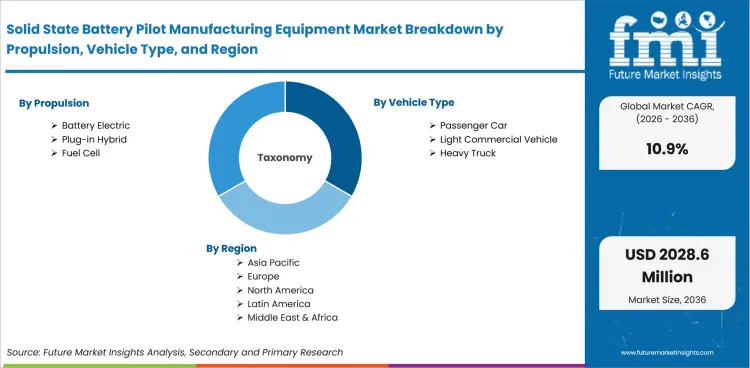
The solid state battery pilot manufacturing equipment industry is segmented by propulsion, vehicle type, sales channel, process stage, and component type.
- Battery electric propulsion is expected to capture 74.0% share in 2026, led by solid-state cell programs that target long-range EVs and faster charging architectures.
- Passenger car programs are projected to account for 62.0% share in 2026 since premium EV platforms absorb early validation budgets before heavier vehicle segments.
- OEM channels are forecast to represent 47.0% share in 2026, guided by direct procurement linked to vehicle platform decisions and internal battery strategy.
- Dry mixing and coating is anticipated to secure 38.5% share in 2026, supported by solvent-free electrode trials and demand for uniform solid electrolyte interfaces.
- Module is projected to hold 34.0% share in 2026, influenced by buyer preference for bundled pilot skids that reduce integration risk.
Which propulsion type leads the solid state battery pilot manufacturing equipment market?
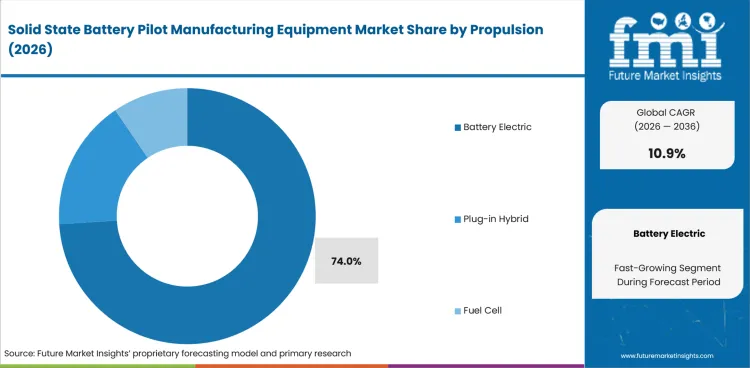
- Battery electric is forecast to account for 74.0% share in 2026, reflected by solid-state battery programs mainly targeting electric vehicles with range, charging, and packaging advantages.
- Plug-in hybrid pilot activity remains smaller because limited pack size and cost targets often favor proven lithium-ion chemistries during the forecast period.
Which vehicle type leads the solid state battery pilot manufacturing equipment market?
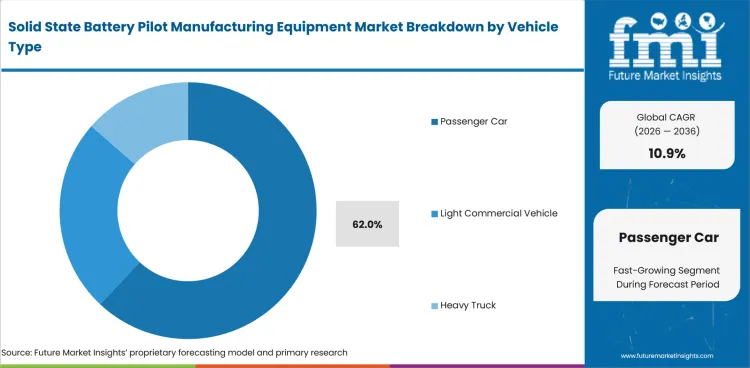
- Passenger car is expected to hold 62.0% share in 2026 through premium EV validation programs that can justify early spending on safety and performance proof.
- Heavy truck and bus programs need larger cell formats, but longer duty-cycle validation slows pilot equipment orders compared with passenger vehicle programs.
Which sales channel leads the solid state battery pilot manufacturing equipment market?
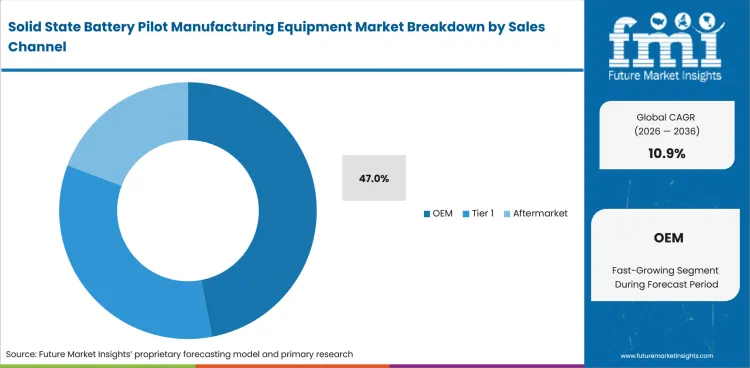
- OEM is anticipated to represent 47.0% share in 2026 as automakers build demonstration lines or sponsor supplier pilots linked to future vehicle platforms.
- Tier 1 channels gain relevance when pack integrators need pressure-managed modules, inspection systems, and test equipment before vehicle integration contracts.
Which process stage leads the solid state battery pilot manufacturing equipment market?
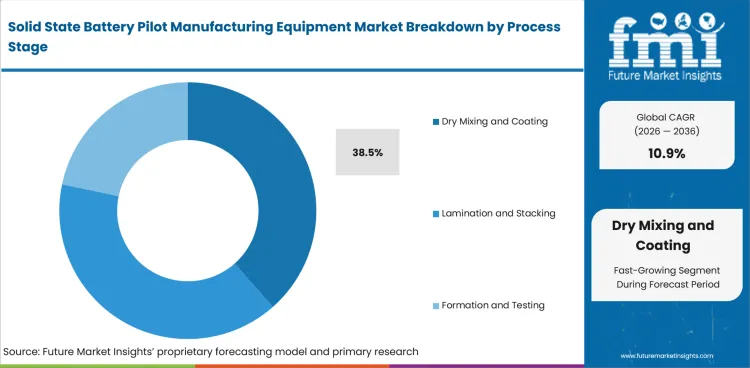
- Dry mixing and coating is projected to secure 38.5% share in 2026, led by solvent-free electrode process trials and the need to reduce oven-linked energy burden.
- Formation and testing equipment gains importance as solid-state cells must prove pressure stability, cycling behavior, and safety performance before OEM sample approval.
Which component type leads the solid state battery pilot manufacturing equipment market?
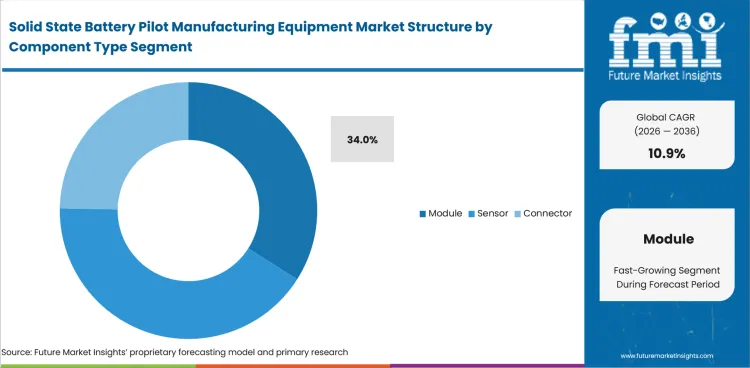
- Module is expected to account for 34.0% share in 2026, influenced by buyer demand for integrated skids that combine coating, lamination, stacking, pressure, and formation functions.
- Software and sensors gain value behind module demand because pilot-line buyers need pressure, temperature, thickness, defect, and batch-history data during qualification.
What are the driver, restraints, and opportunities in the solid state battery pilot manufacturing equipment market?
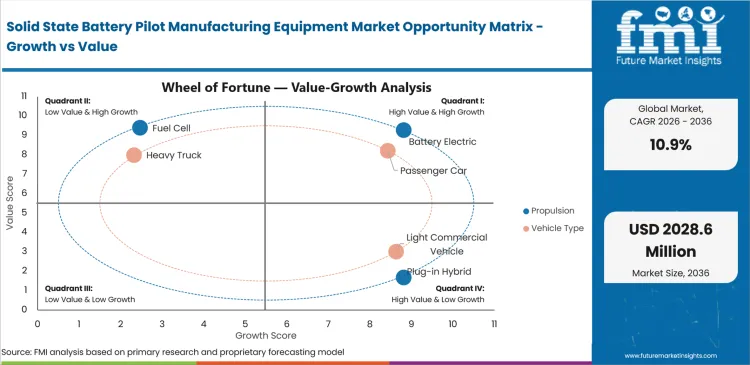
Dry electrode validation and OEM qualification support growth while chemistry-specific process uncertainty limits faster standardization.
- Driver: Battery developers need pilot lines that convert laboratory formulations into repeatable automotive-format samples.
- Restraint: Sulfide, oxide, polymer, and lithium-metal designs require different moisture, pressure, and transfer-control approaches.
- Opportunity: Modular pilot equipment can help buyers adjust cell formats without replacing the entire workflow.
Solid State Battery Pilot Manufacturing Equipment Market Demand Outlook
Demand outlook is moving toward dry electrode and pressure-controlled pilot lines that can prove process economics before commercial scale-up. Dürr stated in February 2025 that the pilot dry coating plant planned with Cellforce and LiCAP can enable energy savings of up to 40% by eliminating drying ovens. This gives equipment buyers a measurable reason to evaluate dry mixing, dry coating, calendering, and inspection systems. Vendors that prove coating quality and powder handling stability should gain stronger early-stage orders.
Solid-State Process Control Restraint
Solid-state battery pilot equipment faces a restraint because manufacturing requirements change sharply across electrolyte chemistries and cell formats. Honda’s demonstration line includes weighing, mixing, coating, roll pressing, cell formation, and module assembly, showing how many process stages must be controlled together. The complexity raises qualification time and makes buyers cautious about single-purpose equipment. Suppliers without proven pressure control and dry-room compatibility may face slower purchase decisions.
Qualification Data and Software Opportunity
The strongest opportunity is linked to software-integrated pilot lines that connect process history with cell performance evidence. Stellantis and Factorial Energy reported in April 2025 that automotive-sized solid-state cells reached 77Ah, 375Wh/kg, and more than 600 cycles. Such results increase buyer expectations around process traceability because pilot equipment must show whether performance can be repeated across batches. Sensor-rich systems and auditable software can therefore secure premium positioning.
Which countries are growing fastest in the solid state battery pilot manufacturing equipment market?
China 12.6% CAGR, India 12.2% CAGR, South Korea 11.8% CAGR, Japan 11.2% CAGR, United States 10.6% CAGR, Germany 10.1% CAGR, France 9.8% CAGR, and United Kingdom 9.4% CAGR through 2036.
.webp "Top Country Growth Comparison Solid State Battery Pilot Manufacturing Equipment Market Cagr (2026 2036)")
| Country | CAGR |
|---|---|
| China | 12.6% |
| India | 12.2% |
| South Korea | 11.8% |
| Japan | 11.2% |
| United States | 10.6% |
| Germany | 10.1% |
| France | 9.8% |
| United Kingdom | 9.4% |
Source: Future Market Insights, 2026.
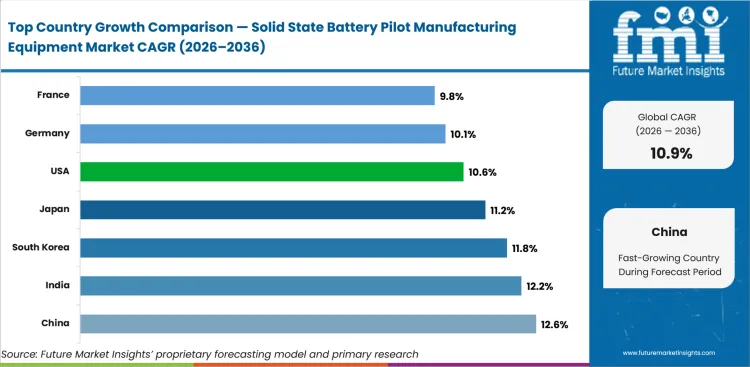
How do country-level CAGRs compare in the solid state battery pilot manufacturing equipment market?
China leads country growth while the United Kingdom records the most cautious expansion outlook among profiled markets.
- China is forecast to record 12.6% CAGR by 2036 as domestic EV production and battery equipment depth support pilot-line investment.
- India is projected to grow at 12.2% CAGR through 2036 as local battery manufacturing programs support flexible pilot-line demand.
- South Korea is expected to rise at 11.8% CAGR by 2036 with major cell makers expanding dry electrode and solid-state battery process work.
- Japan is anticipated to advance at 11.2% CAGR by 2036 as OEM demonstration lines support controlled process learning.
- The United States is forecast to expand at 10.6% CAGR by 2036 through startup activity and grant-backed pilot infrastructure.
- Germany is projected to grow at 10.1% CAGR through 2036 due to machinery engineering depth and dry coating partnerships.
- France is expected to record 9.8% CAGR by 2036 as battery developers and European programs support selective pilot investment.
- The United Kingdom is estimated to expand at 9.4% CAGR by 2036 through engineering centers and imported equipment routes.
How fast is the solid state battery pilot manufacturing equipment market growing in China?
A 12.6% CAGR through 2036 reflects domestic EV production scale and strong battery equipment supply.
Country Market Snapshot Table
| Parameter | Value |
|---|---|
| Market Size in 2025 (Value) | USD 171.6 million |
| Market Size in 2026 (Value) | USD 193.2 million |
| Market Forecast in 2036 (Value) | USD 635.4 million |
| CAGR (2026 to 2036) | 12.6% |
| Years Considered | 2021 to 2036 |
| Base Year | 2025 |
| Forecast Period | 2026 to 2036 |
| Units Considered | Value (USD million) |
| Leading Sub-Region | Yangtze River Delta and Greater Bay Area battery clusters |
China Solid State Battery Pilot Manufacturing Equipment Market Outlook
China demand is shaped by local EV production, battery-maker density, and domestic machinery suppliers. Local buyers can test dry mixing, coating, lamination, stacking, and formation with closer supplier support.
Equipment procurement is expected to move through direct sales, turnkey line projects, and battery-maker qualification programs. Domestic vendors with faster service response should gain better access to pilot and production-transition projects.
Key Growth Drivers
- EV production depth gives equipment suppliers a large base of battery customers. China’s NEV output reached 16.524 million units in 2025.
- Battery equipment buyers benefit from a strong EV sales base. China sold more than 13 million electric cars in 2025 and accounted for six out of ten global electric car sales.
- Domestic machinery companies can shorten pilot-line iteration cycles for coating, stacking, pressure control, and formation workflows.
- Turnkey equipment vendors are gaining preference as buyers seek fewer integration gaps across powder handling and cell assembly stages.
Key Restraints
- Production and service complexity increase as the installed vehicle base expands. China’s NEV fleet reached 43.97 million units by the end of 2025.
- Price competition can reduce margins for suppliers that must support customized pilots and long validation programs.
- Confidentiality around customer projects limits public proof of equipment wins and makes external benchmarking harder for newer suppliers.
What makes China unique
China is unique because it combines EV production scale, battery manufacturing density, and domestic equipment companies that can supply complete pilot-line modules.
Key Companies
- Wuxi Lead Intelligent Equipment
- BYD
- CATL
- Ganfeng Lithium
- EVE Energy
- Shenzhen Kejing Star Technology
- TMAX Battery Equipment
Sales & Marketing Channels
- Direct turnkey sales
- Battery-maker procurement
- OEM-linked pilot projects
- Trade-show leads
- Local distributor networks
- After-sales service teams
Country Segment Breakdown Table
| Segment | Sub-Segments |
|---|---|
| By Propulsion | Battery Electric · Plug-in Hybrid · Fuel Cell · Hybrid · ICE Retrofit |
| By Vehicle Type | Passenger Car · Light Commercial Vehicle · Heavy Truck · Two Wheeler · Bus |
| By Sales Channel | OEM · Tier 1 · Aftermarket · Fleet Retrofit · Charging Network |
| By Process Stage | Dry Mixing and Coating · Lamination and Stacking · Formation and Testing · Inspection · Process Control |
| By Component Type | Sensor · Module · Connector · Software · Thermal System |
| Key Sub-Regions Covered, Battery Manufacturing Clusters | Yangtze River Delta · Greater Bay Area · Beijing-Tianjin-Hebei · Chengdu-Chongqing · Central China · Northeast industrial corridor |
Frequently Asked Questions
How fast is China solid state battery pilot manufacturing equipment market growing?
Sales in China are ready to scale at 12.6% CAGR from 2026 to 2036, guided by domestic battery machinery depth.
Who leads China solid state battery pilot manufacturing equipment market?
Wuxi Lead, TMAX, and local battery equipment integrators compete through dry electrode, stacking, and formation equipment capabilities.
What is driving adoption in China solid state battery pilot manufacturing equipment market?
Large EV output and domestic cell manufacturing are moving suppliers toward integrated solid-state pilot equipment.
What is driving solid state battery pilot manufacturing equipment growth in India?
A 12.2% CAGR through 2036 is supported by EV localization, battery manufacturing policy, and flexible pilot-line demand.
Country Market Snapshot Table
| Parameter | Value |
|---|---|
| Market Size in 2025 (Value) | USD 28.5 million |
| Market Size in 2026 (Value) | USD 32.0 million |
| Market Forecast in 2036 (Value) | USD 101.3 million |
| CAGR (2026 to 2036) | 12.2% |
| Years Considered | 2021 to 2036 |
| Base Year | 2025 |
| Forecast Period | 2026 to 2036 |
| Units Considered | Value (USD million) |
| Leading Sub-Region | Western and southern EV manufacturing corridors |
India Solid State Battery Pilot Manufacturing Equipment Market Outlook
India demand is expected to develop from local EV manufacturing, two wheeler scale, and battery localization goals. Pilot equipment buyers are likely to prefer flexible systems that support lithium-ion improvement and future solid-state trials.
Procurement will remain cost-sensitive because dedicated solid-state pilot capacity is still emerging. Shared pilot facilities, university-industry programs, and imported equipment routes should shape early adoption.
Key Growth Drivers
- EV sales momentum supports pilot-line interest. Indian electric car sales rose 75% year-on-year in 2025 to about 165,000 units.
- Battery localization policy supports process equipment demand. India’s PLI ACC program targets 50 GWh of domestic ACC manufacturing capacity.
- Local EV makers need battery process know-how to reduce import reliance and prepare for future cell chemistries.
- Technical institutes and startups can use shared pilot equipment before committing to factory-scale solid-state investments.
Key Restraints
- Domestic cell capacity is still forming. India had awarded 40 GWh of ACC capacity by February 2026, but installed capacity remained limited.
- Price sensitivity slows purchase of highly specialized equipment when buyers can still use adapted lithium-ion pilot systems.
- Public disclosure of dedicated solid-state pilot lines remains limited, reducing near-term certainty for specialized vendors.
What makes India unique
India is unique because flexible pilot equipment may matter more than premium dedicated solid-state lines during the early localization phase.
Key Companies
- Tata Motors
- Mahindra Electric
- Amara Raja Energy & Mobility
- Exide Industries
- Ola Electric
- Log9 Materials
- Asian equipment import partners
Sales & Marketing Channels
- OEM R&D procurement
- Cell localization projects
- Government-backed labs
- University pilots
- Distributor-led imports
- Technical partnerships with Asian equipment makers
Country Segment Breakdown Table
| Segment | Sub-Segments |
|---|---|
| By Propulsion | Battery Electric · Plug-in Hybrid · Fuel Cell · Hybrid · ICE Retrofit |
| By Vehicle Type | Passenger Car · Light Commercial Vehicle · Heavy Truck · Two Wheeler · Bus |
| By Sales Channel | OEM · Tier 1 · Aftermarket · Fleet Retrofit · Charging Network |
| By Process Stage | Dry Mixing and Coating · Lamination and Stacking · Formation and Testing · Inspection · Process Control |
| By Component Type | Sensor · Module · Connector · Software · Thermal System |
| Key Sub-Regions Covered, EV Localization Areas | Maharashtra · Gujarat · Tamil Nadu · Karnataka · Telangana · National Capital Region |
Frequently Asked Questions
How fast is India solid state battery pilot manufacturing equipment market growing?
Demand in India is ready to rise at 12.2% CAGR from 2026 to 2036 with battery localization.
Who leads India solid state battery pilot manufacturing equipment market?
Local automakers, battery firms, technical institutes, and imported equipment suppliers shape early demand.
What is driving adoption in India solid state battery pilot manufacturing equipment market?
EV localization and battery manufacturing policy are supporting interest in flexible pilot manufacturing lines.
How is the solid state battery pilot manufacturing equipment market performing in South Korea?
An 11.8% CAGR through 2036 reflects cell-maker pilot activity and dry electrode process development.
Country Market Snapshot Table
| Parameter | Value |
|---|---|
| Market Size in 2025 (Value) | USD 84.5 million |
| Market Size in 2026 (Value) | USD 94.5 million |
| Market Forecast in 2036 (Value) | USD 287.5 million |
| CAGR (2026 to 2036) | 11.8% |
| Years Considered | 2021 to 2036 |
| Base Year | 2025 |
| Forecast Period | 2026 to 2036 |
| Units Considered | Value (USD million) |
| Leading Sub-Region | Suwon, Ochang, and major battery manufacturing corridors |
South Korea Solid State Battery Pilot Manufacturing Equipment Market Outlook
South Korea demand is led by major cell-maker engineering teams and controlled pilot programs. Equipment suppliers must meet demanding specifications for dry electrode work, electrolyte handling, inspection, and formation systems.
The country is expected to remain buyer-led because large battery manufacturers often control process details internally. Suppliers with local service teams and proven battery manufacturing experience should gain stronger access.
Key Growth Drivers
- Samsung SDI creates a clear solid-state process signal. Its all-solid battery roadmap targets 900Wh/L energy density, about 40% higher than its mass-produced prismatic battery.
- Local EV manufacturing supports equipment demand. South Korea produced 407,009 EVs in 2025, equal to 11% of total automobile production.
- LG Energy Solution’s Ochang dry electrode pilot-line work supports demand for coating, calendering, inspection, and formation equipment.
- Korean cell makers need advanced process-control systems to serve premium global EV customers with tighter battery qualification requirements.
Key Restraints
- EV market pressure can affect investment timing. South Korea’s EV share was projected to reach 20% of total vehicle sales by the end of 2025.
- Large customers can demand customized equipment that increases engineering time and stretches validation cycles.
- Competitive secrecy limits public supplier detail and makes reference-building harder for smaller equipment makers.
What makes South Korea unique
South Korea is unique because cell makers lead equipment qualification and often keep solid-state process details confidential.
Key Companies
- Samsung SDI
- LG Energy Solution
- SK On
- CIS Co.
- PNT
- Wonik PNE
- Korean battery equipment integrators
Sales & Marketing Channels
- Direct cell-maker procurement
- Engineering-center qualification
- OEM-linked cell programs
- Local service teams
- Trade fairs
- Joint development projects
Country Segment Breakdown Table
| Segment | Sub-Segments |
|---|---|
| By Propulsion | Battery Electric · Plug-in Hybrid · Fuel Cell · Hybrid · ICE Retrofit |
| By Vehicle Type | Passenger Car · Light Commercial Vehicle · Heavy Truck · Two Wheeler · Bus |
| By Sales Channel | OEM · Tier 1 · Aftermarket · Fleet Retrofit · Charging Network |
| By Process Stage | Dry Mixing and Coating · Lamination and Stacking · Formation and Testing · Inspection · Process Control |
| By Component Type | Sensor · Module · Connector · Software · Thermal System |
| Key Sub-Regions Covered, Cell-Maker and Equipment Areas | Suwon · Ochang · Ulsan · Cheongju · Daejeon · Seoul metropolitan engineering corridor |
Frequently Asked Questions
How fast is South Korea solid state battery pilot manufacturing equipment market growing?
South Korea demand is set to rise at 11.8% CAGR from 2026 to 2036 through cell-maker pilot activity.
Who leads South Korea solid state battery pilot manufacturing equipment market?
Samsung SDI, LG Energy Solution, SK On, and Korean battery equipment integrators shape local procurement.
What is driving adoption in South Korea solid state battery pilot manufacturing equipment market?
Solid-state battery samples and dry electrode pilot lines are moving buyers toward advanced equipment validation.
What is the solid state battery pilot manufacturing equipment market forecast for Japan?
An 11.2% CAGR through 2036 reflects OEM-controlled demonstration lines and battery material partnerships.
Country Market Snapshot Table
| Parameter | Value |
|---|---|
| Market Size in 2025 (Value) | USD 78.0 million |
| Market Size in 2026 (Value) | USD 86.7 million |
| Market Forecast in 2036 (Value) | USD 251.0 million |
| CAGR (2026 to 2036) | 11.2% |
| Years Considered | 2021 to 2036 |
| Base Year | 2025 |
| Forecast Period | 2026 to 2036 |
| Units Considered | Value (USD million) |
| Leading Sub-Region | Tochigi, Kanagawa, Aichi, and Chiba battery corridors |
Japan Solid State Battery Pilot Manufacturing Equipment Market Outlook
Japan demand is supported by OEM-controlled pilot lines and material partnerships focused on all-solid-state battery commercialization. Equipment selection is expected to remain closely tied to internal process learning and confidentiality.
Suppliers must fit strict dry-room, pressure, and formation requirements. Pilot-line buyers are likely to prioritize reliability, service continuity, and compatibility with proprietary cell recipes.
Key Growth Drivers
- Honda’s demonstration line gives direct equipment demand evidence. The facility covers about 27,400 square meters and required about 43 billion yen in investment.
- Japan’s battery strategy supports equipment localization. METI referenced a target to secure 150 GWh/year domestic battery manufacturing capacity by 2030.
- Nissan began operating its all-solid-state battery pilot line in January 2025, supporting process demand for dry electrode and cell assembly equipment.
- Toyota and Sumitomo Metal Mining collaboration strengthens local cathode material work for future all-solid-state battery production.
Key Restraints
- EV uptake remains cautious. New EVs accounted for 1.35% of new vehicles sold in Japan in 2024.
- Long qualification cycles can delay repeat orders as OEMs refine solid electrolyte recipes and assembly routines.
- Proprietary workflows reduce open supplier access and make public equipment benchmarking difficult.
What makes Japan unique
Japan is unique because automakers control pilot-line decisions and connect equipment choices directly with long-term battery strategy.
Key Companies
- Honda Motor Co., Ltd.
- Nissan Motor Co., Ltd.
- Toyota Motor Corporation
- Sumitomo Metal Mining
- Idemitsu Kosan
- Toray Engineering
- Chiyoda Corporation
Sales & Marketing Channels
- Direct OEM engineering sales
- Battery material partner channels
- Equipment integrators
- Technical service offices
- University consortia
- Supplier qualification programs
Country Segment Breakdown Table
| Segment | Sub-Segments |
|---|---|
| By Propulsion | Battery Electric · Plug-in Hybrid · Fuel Cell · Hybrid · ICE Retrofit |
| By Vehicle Type | Passenger Car · Light Commercial Vehicle · Heavy Truck · Two Wheeler · Bus |
| By Sales Channel | OEM · Tier 1 · Aftermarket · Fleet Retrofit · Charging Network |
| By Process Stage | Dry Mixing and Coating · Lamination and Stacking · Formation and Testing · Inspection · Process Control |
| By Component Type | Sensor · Module · Connector · Software · Thermal System |
| Key Sub-Regions Covered, OEM and Materials Corridors | Tochigi · Kanagawa · Aichi · Chiba · Osaka · Fukuoka |
Frequently Asked Questions
How fast is Japan solid state battery pilot manufacturing equipment market growing?
Japan demand is projected to grow at 11.2% CAGR from 2026 to 2036 through OEM pilot-line programs.
Who leads Japan solid state battery pilot manufacturing equipment market?
Honda, Nissan, Toyota, Toray Engineering, Idemitsu, and Sumitomo Metal Mining shape local demand.
What is driving adoption in Japan solid state battery pilot manufacturing equipment market?
OEM demonstration lines and solid electrolyte material partnerships are supporting controlled pilot equipment procurement.
What is the solid state battery pilot manufacturing equipment market outlook in the United States?
A 10.6% CAGR through 2036 is supported by battery startups, public funding, and pilot infrastructure.
Country Market Snapshot Table
| Parameter | Value |
|---|---|
| Market Size in 2025 (Value) | USD 117.0 million |
| Market Size in 2026 (Value) | USD 129.4 million |
| Market Forecast in 2036 (Value) | USD 354.5 million |
| CAGR (2026 to 2036) | 10.6% |
| Years Considered | 2021 to 2036 |
| Base Year | 2025 |
| Forecast Period | 2026 to 2036 |
| Units Considered | Value (USD million) |
| Leading Sub-Region | California and Midwest battery innovation corridors |
United States Solid State Battery Pilot Manufacturing Equipment Market Outlook
United States demand is shaped by grant-backed pilot infrastructure, battery startups, and OEM demonstration programs. Buyers often need flexible pilot lines before committing to larger manufacturing designs.
Equipment suppliers gain when they can serve startups, national laboratory-linked projects, university programs, and vehicle validation partners. Procurement is less concentrated than East Asian markets but remains strong for high-value pilot systems.
Key Growth Drivers
- Public battery manufacturing programs reduce early pilot-line capital risk. The U.S. Department of Energy selected 11 battery manufacturing platform projects in December 2024.
- California’s battery pilot manufacturing solicitation supports shared process validation. The workshop specified capacity for 10,000 battery cells per year across pouch and cylindrical formats.
- U.S. battery developers need flexible systems before they commit to fixed factory designs for solid electrolyte and lithium-metal formats.
- Startup and OEM demonstration activity supports demand for formation, testing, and process-control equipment.
Key Restraints
- EV demand volatility can affect near-term pilot timing. U.S. electric car sales were around 1.5 million in 2025, slightly below the prior year.
- Domestic solid-state equipment supply is narrower than East Asian machinery ecosystems, extending procurement lead times.
- Policy changes can shift grant-backed order timing and reduce certainty around capital programs.
What makes the United States unique
The United States is unique because battery startups and public pilot infrastructure create demand before large-scale factory commitments.
Key Companies
- LiCAP Technologies
- Factorial Energy
- QuantumScape
- Solid Power
- AM Batteries
- MTI Corporation
- Stellantis battery development partners
Sales & Marketing Channels
- Direct pilot-line supply
- DOE-funded projects
- California grant channels
- OEM demonstration programs
- University labs
- Battery startup procurement
Country Segment Breakdown Table
| Segment | Sub-Segments |
|---|---|
| By Propulsion | Battery Electric · Plug-in Hybrid · Fuel Cell · Hybrid · ICE Retrofit |
| By Vehicle Type | Passenger Car · Light Commercial Vehicle · Heavy Truck · Two Wheeler · Bus |
| By Sales Channel | OEM · Tier 1 · Aftermarket · Fleet Retrofit · Charging Network |
| By Process Stage | Dry Mixing and Coating · Lamination and Stacking · Formation and Testing · Inspection · Process Control |
| By Component Type | Sensor · Module · Connector · Software · Thermal System |
| Key Sub-Regions Covered, Innovation and Pilot Corridors | California · Michigan · Colorado · Massachusetts · Texas · Pacific Northwes |
Frequently Asked Questions
How fast is United States solid state battery pilot manufacturing equipment market growing?
The United States market is projected to grow at 10.6% CAGR from 2026 to 2036 through startup and grant-backed pilot activity.
Who leads United States solid state battery pilot manufacturing equipment market?
LiCAP, AM Batteries, MTI Corporation, QuantumScape, Factorial, and Solid Power shape technology-side equipment needs.
What is driving adoption in United States solid state battery pilot manufacturing equipment market?
Battery startup activity and public funding are moving buyers toward flexible pilot manufacturing lines.
How is the solid state battery pilot manufacturing equipment market performing in Germany?
A 10.1% CAGR through 2036 reflects machinery engineering depth and automotive dry coating projects.
Country Market Snapshot Table
| Parameter | Value |
|---|---|
| Market Size in 2025 (Value) | USD 61.6 million |
| Market Size in 2026 (Value) | USD 67.8 million |
| Market Forecast in 2036 (Value) | USD 177.2 million |
| CAGR (2026 to 2036) | 10.1% |
| Years Considered | 2021 to 2036 |
| Base Year | 2025 |
| Forecast Period | 2026 to 2036 |
| Units Considered | Value (USD million) |
| Leading Sub-Region | Baden-Württemberg and Bavaria machinery corridors |
Germany Solid State Battery Pilot Manufacturing Equipment Market Outlook
Germany demand is supported by automotive OEM engineering and machinery supplier depth. Equipment suppliers can use lithium-ion coating and automation experience to serve solid-state pilot lines.
Dry electrode projects are a strong local signal because they connect equipment validation with automotive manufacturing requirements. Buyers are expected to favor suppliers with process proof and factory-scale automation experience.
Key Growth Drivers
- BEV demand supports battery process investment. Germany registered 45,535 new BEVs in April 2025, giving BEVs 18.8% monthly market share.
- Dry coating economics support equipment trials. Dürr stated oven removal can enable energy savings of up to 40% in the Cellforce and LiCAP pilot project.
- German machinery firms can adapt coating, automation, and assembly know-how to solid-state pilot lines.
- Porsche-linked Cellforce activity supports local validation of dry electrode production inside an automotive ecosystem.
Key Restraints
- Mixed powertrain demand can slow battery-only investment urgency. In Q1 2026, BEVs captured 19.4% of EU market share while hybrids captured 38.6%.
- High energy and labor costs raise the payback bar for pilot lines and increase pressure on equipment efficiency.
- Slower consumer EV demand can delay cell investment timing and make buyers cautious about sequencing.
What makes Germany unique
Germany is unique because machinery suppliers and automakers can jointly prove pilot-to-production equipment concepts.
Key Companies
- Dürr Group
- GROB
- Cellforce
- LiCAP Technologies
- Manz
- Bosch
- BMW battery research partners
Sales & Marketing Channels
- OEM partnerships
- Direct machinery sales
- Tier 1 integrators
- Demonstration projects
- Battery research institutes
- European procurement frameworks
Country Segment Breakdown Table
| Segment | Sub-Segments |
|---|---|
| By Propulsion | Battery Electric · Plug-in Hybrid · Fuel Cell · Hybrid · ICE Retrofit |
| By Vehicle Type | Passenger Car · Light Commercial Vehicle · Heavy Truck · Two Wheeler · Bus |
| By Sales Channel | OEM · Tier 1 · Aftermarket · Fleet Retrofit · Charging Network |
| By Process Stage | Dry Mixing and Coating · Lamination and Stacking · Formation and Testing · Inspection · Process Control |
| By Component Type | Sensor · Module · Connector · Software · Thermal System |
| Key Sub-Regions Covered, Automotive Machinery Areas | Baden-Württemberg · Bavaria · North Rhine-Westphalia · Saxony · Lower Saxony · Hesse |
Frequently Asked Questions
How fast is Germany solid state battery pilot manufacturing equipment market growing?
Germany demand is projected to grow at 10.1% CAGR from 2026 to 2036 through machinery and OEM-linked projects.
Who leads Germany solid state battery pilot manufacturing equipment market?
Dürr, GROB, Cellforce, Manz, and European battery equipment suppliers support local demand.
What is driving adoption in Germany solid state battery pilot manufacturing equipment market?
Dry coating projects and automotive engineering depth are supporting solid-state pilot equipment procurement.
What is the solid state battery pilot manufacturing equipment market forecast for France?
A 9.8% CAGR through 2036 reflects selective pilot activity and European manufacturing partnerships.
Country Market Snapshot Table
| Parameter | Value |
|---|---|
| Market Size in 2025 (Value) | USD 39.0 million |
| Market Size in 2026 (Value) | USD 42.8 million |
| Market Forecast in 2036 (Value) | USD 109.0 million |
| CAGR (2026 to 2036) | 9.8% |
| Years Considered | 2021 to 2036 |
| Base Year | 2025 |
| Forecast Period | 2026 to 2036 |
| Units Considered | Value (USD million) |
| Leading Sub-Region | Northern France and Paris-linked battery innovation corridor |
France Solid State Battery Pilot Manufacturing Equipment Market Outlook
France demand is tied to EV market development, battery value-chain investment, and partnerships involving solid-state developers. The equipment opportunity is selective but supported by European industrial policy.
Pilot-line access is expected through partnerships, imported equipment, and specialist battery developers. Suppliers with coating, film handling, and process-control capabilities should be better placed.
Key Growth Drivers
- French EV demand supports battery qualification work. France registered 363,130 BEVs in 2025, representing a 10.5% increase compared with the reference year.
- European battery support strengthens local manufacturing equipment demand. The EU Innovation Fund awarded EUR 200 million to the ACC ACCEPT battery manufacturing project in France.
- Blue Solutions gives France a direct solid-state technology reference for manufacturing partnerships.
- European machinery suppliers can support French buyers through coating, assembly, and technical service links.
Key Restraints
- Plug-in hybrid weakness shows uneven electrified demand. France recorded 113,221 PHEV registrations in 2025, down 30.7% compared with the reference year.
- Publicly disclosed solid-state pilot equipment orders are limited, restricting near-term supplier visibility.
- Imported machinery dependence can lengthen qualification and service cycles for domestic battery developers.
What makes France unique
France is unique because it has a visible solid-state battery developer but a less public local equipment base than Germany.
Key Companies
- Blue Solutions
- Putailai
- Verkor
- ACC
- Renault Group battery partners
- Schneider Electric automation partners
- European machinery distributors
Sales & Marketing Channels
- Direct battery-developer sales
- European machinery distributors
- Automotive R&D centers
- Public innovation programs
- Technical integrators
- University-linked pilots
Country Segment Breakdown Table
| Segment | Sub-Segments |
|---|---|
| By Propulsion | Battery Electric · Plug-in Hybrid · Fuel Cell · Hybrid · ICE Retrofit |
| By Vehicle Type | Passenger Car · Light Commercial Vehicle · Heavy Truck · Two Wheeler · Bus |
| By Sales Channel | OEM · Tier 1 · Aftermarket · Fleet Retrofit · Charging Network |
| By Process Stage | Dry Mixing and Coating · Lamination and Stacking · Formation and Testing · Inspection · Process Control |
| By Component Type | Sensor · Module · Connector · Software · Thermal System |
| Key Sub-Regions Covered, Battery and Automotive Areas | Hauts-de-France · Île-de-France · Auvergne-Rhône-Alpes · Grand Est · Normandy · Nouvelle-Aquitaine |
Frequently Asked Questions
How fast is France solid state battery pilot manufacturing equipment market growing?
France demand is forecast to grow at 9.8% CAGR from 2026 to 2036 through selective battery partnerships.
Who leads France solid state battery pilot manufacturing equipment market?
Blue Solutions, Putailai, Verkor, ACC, and European machinery suppliers shape the country opportunity.
What is driving adoption in France solid state battery pilot manufacturing equipment market?
EV demand and solid-state manufacturing partnerships are supporting demand for pilot-line equipment.
How is the solid state battery pilot manufacturing equipment market performing in the United Kingdom?
A 9.4% CAGR through 2036 reflects engineering-center demand and imported equipment dependence.
Country Market Snapshot Table
| Parameter | Value |
|---|---|
| Market Size in 2025 (Value) | USD 34.5 million |
| Market Size in 2026 (Value) | USD 37.8 million |
| Market Forecast in 2036 (Value) | USD 92.6 million |
| CAGR (2026 to 2036) | 9.4% |
| Years Considered | 2021 to 2036 |
| Base Year | 2025 |
| Forecast Period | 2026 to 2036 |
| Units Considered | Value (USD million) |
| Leading Sub-Region | Midlands and Oxford-Cambridge engineering corridor |
United Kingdom Solid State Battery Pilot Manufacturing Equipment Market Outlook
United Kingdom demand is shaped by automotive engineering centers, battery research organizations, and imported pilot-line equipment. The country is more of a qualification and integration market than a large equipment manufacturing base.
Suppliers are expected to win through system integration, testing services, and European equipment partnerships. Demand will depend on policy clarity and the willingness of engineering centers to fund early solid-state validation.
Key Growth Drivers
- ZEV rules keep vehicle manufacturers focused on better battery platforms. The UK mandate starts at 22% for cars and rises to 80% by 2030.
- Pilot infrastructure supports early production trials. UKBIC’s flexible pilot line is a GBP 12 million facility for scalable battery materials development.
- Battery research sites and engineering centers support early pilot trials for materials, modules, and vehicle integration.
- Imported equipment suppliers can serve UK buyers through system integration and technical service routes.
Key Restraints
- Limited local scale can restrict large equipment orders. AESC’s Sunderland battery project is expected to supply 100,000 EV batteries each year.
- Policy flexibility around vehicle mandates can slow capital decisions as buyers wait for final compliance pathways.
- Local cell manufacturing depth is smaller than leading East Asian battery economies, which increases import dependence for specialized pilot equipment.
What makes the United Kingdom unique
The United Kingdom is unique because it functions as a qualification and engineering market rather than a large machinery production center.
Key Companies
- Ilika
- UK Battery Industrialisation Centre partners
- WAE Technologies
- AESC supply-chain partners
- European equipment suppliers
- Automotive engineering integrators
- Battery research organizations
Sales & Marketing Channels
- Direct engineering sales
- European distributor networks
- Research consortium procurement
- OEM technical centers
- Government-backed R&D projects
- Battery testing labs
Country Segment Breakdown Table
| Segment | Sub-Segments |
|---|---|
| By Propulsion | Battery Electric · Plug-in Hybrid · Fuel Cell · Hybrid · ICE Retrofit |
| By Vehicle Type | Passenger Car · Light Commercial Vehicle · Heavy Truck · Two Wheeler · Bus |
| By Sales Channel | OEM · Tier 1 · Aftermarket · Fleet Retrofit · Charging Network |
| By Process Stage | Dry Mixing and Coating · Lamination and Stacking · Formation and Testing · Inspection · Process Control |
| By Component Type | Sensor · Module · Connector · Software · Thermal System |
| Key Sub-Regions Covered, Engineering and Battery Areas | Midlands · Oxford-Cambridge corridor · North East England · South Wales · Scotland central belt · London technical services corridor |
Frequently Asked Questions
How fast is United Kingdom solid state battery pilot manufacturing equipment market growing?
The United Kingdom market is projected to grow at 9.4% CAGR from 2026 to 2036 through engineering-led demand.
Who leads United Kingdom solid state battery pilot manufacturing equipment market?
Ilika, UKBIC-linked suppliers, WAE Technologies, and European equipment integrators support early activity.
What is driving adoption in United Kingdom solid state battery pilot manufacturing equipment market?
Engineering centers and ZEV-linked platform planning are moving buyers toward pilot validation tools.
Who are the leading companies in the solid state battery pilot manufacturing equipment market?
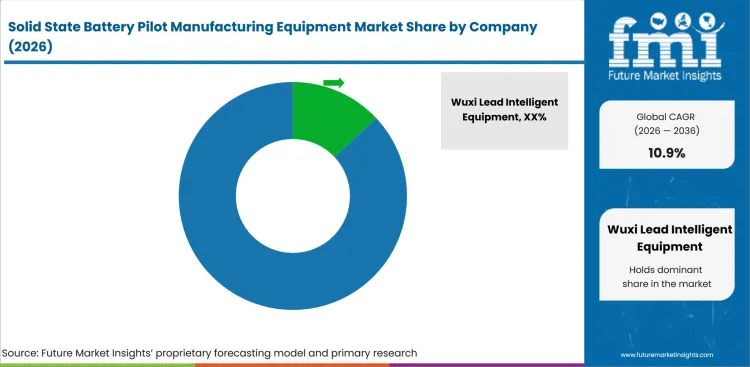
Wuxi Lead Intelligent Equipment, Dürr Group, LiCAP Technologies, GROB, and Bühler Group.
- Integrated equipment suppliers hold an advantage through coating, assembly, inspection, and control-system capability.
- Dry electrode specialists gain supplier relevance when buyers prioritize solvent-free coating and powder handling proof.
- Lab and pilot-line vendors gain access through flexible systems used by startups, universities, and early process developers.
- Software-ready equipment supports qualification through recipe control, defect tracking, and batch-history documentation.
Competition in the market is shaped by the ability to connect process equipment with battery validation needs. Wuxi Lead Intelligent Equipment competes through solid-state equipment coverage across dry mixing, coating, lamination, stacking, and high-pressure formation. Dürr and LiCAP gain relevance through dry coating work connected with Cellforce, which gives buyers a practical process reference. GROB and Bühler compete through automation, mixing, and industrial equipment experience that can be adapted to battery pilot lines.
Pilot-line integration has become a stronger separator than individual machine supply. Buyers want equipment that reduces handoff risk between dry coating, stacking, pressure management, formation, and inspection. Suppliers with local service engineers near customer labs have a stronger position because pilot programs require repeated troubleshooting. Vendors without process data support may struggle to move beyond small laboratory equipment sales.
Smaller and regional suppliers can win when buyers need flexible tools rather than full integrated lines. TMAX, MTI Corporation, and similar vendors serve labs and startups that need configurable pilot systems. However, larger automotive-linked programs are expected to favor suppliers that can prove traceable results across multiple process stages. Companies with dry electrode proof, formation data, and service depth should gain more durable positions.
How do top solid state battery pilot manufacturing equipment companies compare?
Wuxi Lead and Dürr score strongest on integrated process relevance while LiCAP leads dry electrode specialization.
| Company | Relevance to Market Title | Dry Electrode Process Depth | Pilot-Line Integration Scope | Qualification Data Fit | Geographic Footprint |
|---|---|---|---|---|---|
| Wuxi Lead Intelligent Equipment | Very High | Very Strong | Very Strong | Strong | Global |
| Dürr Group | Very High | Very Strong | Strong | Strong | Global |
| LiCAP Technologies | Very High | Very Strong | Moderate | Moderate | United States and Europe |
| GROB | High | Moderate | Strong | Strong | Europe and North America |
| Bühler Group | High | Strong | Moderate | Moderate | Global |
| Toray Engineering | High | Moderate | Moderate | Moderate | Japan and Asia |
| TMAX | Moderate to High | Moderate | Moderate | Moderate | Asia and export markets |
| MTI Corporation | Moderate | Low to Moderate | Moderate | Moderate | North America and global lab channels |
| Manz | Moderate to High | Moderate | Strong | Moderate | Europe and Asia |
| Chiyoda Corporation | Moderate | Moderate | Moderate | Moderate | Japan |
Source: Future Market Insights competitive analysis, 2026.
Who are the key players in the solid state battery pilot manufacturing equipment market?
Wuxi Lead Intelligent Equipment, Dürr Group, LiCAP Technologies, GROB, and Bühler Group are listed with Toray Engineering and TMAX among other suppliers.
Key global companies leading the solid state battery pilot manufacturing equipment market include:
- Wuxi Lead Intelligent Equipment
- Dürr Group
- LiCAP Technologies
- GROB
- Bühler Group
- Toray Engineering
- TMAX
- MTI Corporation
- Manz
- Chiyoda Corporation
Key Developments in Solid State Battery Pilot Manufacturing Equipment Market
- In February 2025, Dürr, Cellforce, and LiCAP planned a pilot dry coating plant at Cellforce in Kirchentellinsfurt to validate solvent-free electrode production.
- In September 2025, LG Energy Solution said it was establishing dry electrode pilot lines at its Ochang Energy Plant, with commercial production targeted for 2028.
- In February 2026, QuantumScape inaugurated its Eagle Line for solid-state battery pilot production, incorporating the Cobra separator production process as a production blueprint.
Key Players in the Solid State Battery Pilot Manufacturing Equipment Market
Integrated Equipment Suppliers
- Wuxi Lead Intelligent Equipment
- Dürr Group
- GROB
- Manz
Dry Electrode and Process Specialists
- LiCAP Technologies
- Bühler Group
- Toray Engineering
- Chiyoda Corporation
Lab and Pilot-Line Suppliers
- TMAX
- MTI Corporation
- Shenzhen Kejing Star Technology
- University-linked equipment integrators
Solid State Battery Pilot Manufacturing Equipment Market - Report Scope
| Parameter | Details |
|---|---|
| Market size by 2036 | USD 2,028.6 million |
| Growth rate | 10.9% CAGR from 2026 to 2036 |
| Forecast period | 2026 to 2036 |
| Base year value (2025) | USD 650.0 million |
| By propulsion | Battery electric, plug-in hybrid, fuel cell, hybrid, ICE retrofit |
| By vehicle type | Passenger car, light commercial vehicle, heavy truck, two wheeler, bus |
| By sales channel | OEM, Tier 1, aftermarket, fleet retrofit, charging network |
| By process stage | Dry mixing and coating, lamination and stacking, formation and testing, inspection, process control |
| By component type | Sensor, module, connector, software, thermal system |
| Regions covered | North America, Europe, East Asia, South Asia, Latin America |
| Countries covered | China, India, South Korea, Japan, United States, Germany, France, United Kingdom |
| Key companies profiled | Wuxi Lead Intelligent Equipment, Dürr Group, LiCAP Technologies, GROB, Bühler Group, Toray Engineering, TMAX, MTI Corporation |
| Approach | Bottom-up pilot-line equipment analysis using equipment scope, system pricing, process adoption, country EV program maturity, and supplier activity |
Source: Future Market Insights, 2026.
Solid State Battery Pilot Manufacturing Equipment Market Breakdown by Propulsion, Vehicle Type, Sales Channel, Process Stage, Component Type, and Region
Solid State Battery Pilot Manufacturing Equipment Market Segmented by Propulsion:
- Battery Electric
- Plug-in Hybrid
- Fuel Cell
- Hybrid
- ICE Retrofit
Solid State Battery Pilot Manufacturing Equipment Market Segmented by Vehicle Type:
- Passenger Car
- Light Commercial Vehicle
- Heavy Truck
- Two Wheeler
- Bus
Solid State Battery Pilot Manufacturing Equipment Market Segmented by Sales Channel:
- OEM
- Tier 1
- Aftermarket
- Fleet Retrofit
- Charging Network
Solid State Battery Pilot Manufacturing Equipment Market Segmented by Process Stage:
- Dry Mixing and Coating
- Lamination and Stacking
- Formation and Testing
- Inspection
- Process Control
Solid State Battery Pilot Manufacturing Equipment Market Segmented by Component Type:
- Sensor
- Module
- Connector
- Software
- Thermal System
Solid State Battery Pilot Manufacturing Equipment Market by Region:
- North America
- Europe
- East Asia
- South Asia
- Latin America
Research Sources and Bibliography
- ACEA. (2026, April 23). New car registrations: +4% in Q1 2026; battery-electric 19.4% market share.
- Blue Solutions. (2025, August 13). Strategic partnership: Moving forward on next-generation solid-state batteries manufacturing between Putailai and Blue Solutions.
- Bühler Group. (2026, February 11). Bühler reaches milestone in battery manufacturing with over 100 continuous mixing lines sold.
- California Energy Commission. (2025, January 28). GFO-24-304: California Battery Pilot Manufacturing Line.
- California Energy Commission. (2025, February 7). GFO-24-304 pre-application workshop presentation.
- Department for Transport. (2025, October 17). Updates to the Vehicle Emissions Trading Schemes Order 2023. GOV.UK.
- Dürr Group. (2025, February 5). Dürr plans pilot line for dry coating of electrodes together with Cellforce and LiCAP.
- European Alternative Fuels Observatory. (2025, May). Germany: BEV registrations surge by 54% in April 2025.
- European Alternative Fuels Observatory. (2026, January 21). France’s EV market in 2025: Renewed momentum and a growing fleet.
- European Commission. (2025, July 3). EU invests EUR 852 million in six innovative electric vehicle battery projects.
- European Commission. (2026, March 27). ACCEPT: Automotive Cells Company European Production Take-off project factsheet.
- GOV.UK. (2025, May 9). Another boost for British car industry as GBP 1 billion secured for new Sunderland gigafactory.
- GOV.UK. (2025, July 13). Backing British industry: Government launches GBP 2.5 billion DRIVE35 programme.
- Honda Motor Co., Ltd. (2024, November 21). Honda unveils demonstration production line for all-solid-state batteries in Japan.
- International Energy Agency. (2026, May). Global EV Outlook 2026: Executive summary.
- International Energy Agency. (2026, May). Global EV Outlook 2026: Manufacturing and trade.
- International Energy Agency. (2026, May). Global EV Outlook 2026: Trends in electric cars.
- LG Energy Solution. (2025, September 22). LG Energy Solution unlocks new value for customers with dry electrode technology.
- Ministry of Economy, Trade and Industry. (2026, January 19). Climate Transition Bond Framework second-party opinion addendum.
- Ministry of Heavy Industries. (2025, December 5). Increasing adoption of electric vehicles in India. Press Information Bureau, Government of India.
- Ministry of Heavy Industries. (2026, February 13). Promotion of domestic battery manufacturing capacity. Press Information Bureau, Government of India.
- National Bureau of Statistics of China. (2026, February 28). Statistical communique of the People’s Republic of China on the 2025 national economic and social development.
- Nissan Motor Co., Ltd. (2024, April 16). Nissan shows in-construction all-solid-state battery pilot line in Japan.
- Nissan Motor Co., Ltd. (2025, August 19). Nissan partners with LiCAP Technologies to develop all-solid-state battery electrode production process technology.
- QuantumScape. (2026, February 4). QuantumScape inaugurates Eagle Line for solid-state battery pilot production.
- Samsung SDI. (2024, March 5). Samsung SDI to present essence of super-gap battery technology at InterBattery 2024.
- State Council of the People’s Republic of China. (2026, January 14). China’s auto output, sales reach new highs in 2025.
- Stellantis. (2025, April 24). Stellantis and Factorial Energy reach key milestone in solid-state battery development.
- Toyota Motor Corporation. (2025, October 8). Sumitomo Metal Mining and Toyota collaborate on mass production of cathode materials for all-solid-state batteries.
- U.S. Department of Energy. (2024, December 19). Funding selections: Platform technologies for transformative battery manufacturing.
- U.S. International Trade Administration. (2025, February 10). Japan electric vehicle market.
- U.S. International Trade Administration. (2025, July 21). South Korea electric vehicles EV market.
- UK Battery Industrialisation Centre. (2025, March 13). 2025 in focus for the Faraday Battery Challenge.
- Wuxi Lead Intelligent Equipment Co., Ltd. (2026, February 4). LEAD’s next-generation dry coating equipment moves solid-state batteries closer to mass production.
This bibliography is provided for reader reference and is not exhaustive. The full report contains the complete reference list and detailed citations.
Solid State Battery Pilot Manufacturing Equipment Market - Scope & Definition
| Attribute | Detail |
|---|---|
| Market Definition | Machinery, modules, sensors, software, and testing systems used to produce prototype and pilot-scale solid-state battery cells before commercial manufacturing. |
| Functions Covered | Dry mixing, dry coating, lamination, stacking, densification, pressure control, cell formation, inspection, safety testing, and process data management. |
| Applications Covered | Pilot lines for automotive solid-state cells, dry electrode process trials, electrolyte film preparation, module assembly validation, and safety testing. |
| End-Use Industries | Battery manufacturing, automotive OEM R&D, EV platform development, battery materials development, and research-backed pilot production. |
| Grades Covered | Lab-scale tools, pilot-line modules, integrated skids, semi-automated pilot systems, and OEM-grade validation equipment. |
| Inclusions | Equipment and software used in solid-state battery pilot production across propulsion, vehicle type, sales channel, process stage, component type, and region. |
| Exclusions | Finished battery cells, EV battery packs, raw active materials, commercial lithium-ion lines without solid-state adaptation, recycling systems, and consumer battery tools. |
Solid State Battery Pilot Manufacturing Equipment Market - Research Methodology
| Method | Description |
|---|---|
| Primary Research | FMI analyst interviews with equipment suppliers, battery process engineers, automotive R&D teams, cell developers, and pilot-line integrators across key markets. |
| Desk Research | Review of government EV data, battery manufacturing funding notices, company pilot-line announcements, equipment disclosures, and technical battery manufacturing references. |
| Market Sizing & Forecasting | Bottom-up assessment using pilot-line equipment counts, average system pricing, process-stage adoption, country EV program maturity, and supplier participation. |
| Data Validation | Cross-verification using EV production trends, pilot-line disclosures, dry electrode equipment references, and country-level battery manufacturing activity. |
This Report Answers
- Market size estimates for 2026 and forecasts through 2036 for the solid state battery pilot manufacturing equipment market.
- Insights across more than 30 regional and country-level markets.
- Analysis of demand drivers, dry electrode process adoption, OEM validation needs, and pilot-line procurement behavior.
- Evaluation of propulsion, vehicle type, sales channel, process stage, and component type segments.
- Assessment of national EV programs, battery localization efforts, and manufacturing policy influence.
- Identification of opportunities across dry mixing, coating, lamination, pressure control, formation, inspection, and process-control software.
- Country-level growth analysis covering China, India, South Korea, Japan, the United States, Germany, France, and the United Kingdom.
- Assessment of the competitive landscape, including integrated equipment suppliers, process specialists, and lab-scale pilot-line vendors.
- Analysis of company developments and pilot-line announcements.
- Delivery of market data, forecasts, and supporting analysis in PDF and Excel formats.
Frequently Asked Questions
What is the solid state battery pilot manufacturing equipment market size in 2026?
The solid state battery pilot manufacturing equipment market size is anticipated to cross USD 720.9 million in 2026.
What is the solid state battery pilot manufacturing equipment market forecast for 2036?
The industry revenue is predicted to reach USD 2,028.6 million by 2036 as dry electrode and solid-state pilot validation expands.
What is the solid state battery pilot manufacturing equipment market CAGR?
The sector is projected to expand at 10.9% CAGR from 2026 to 2036.
What segment leads the solid state battery pilot manufacturing equipment market?
Battery electric propulsion is likely to capture 74.0% share in 2026 due to solid-state battery alignment with EV range and charging goals.
What country grows fastest in the solid state battery pilot manufacturing equipment market?
China is set to record 12.6% CAGR by 2036, driven by EV production scale and domestic battery machinery depth.
Which companies are active in the solid state battery pilot manufacturing equipment market?
Wuxi Lead Intelligent Equipment, Dürr Group, LiCAP Technologies, GROB, Bühler Group, Toray Engineering, TMAX, and MTI Corporation are active across equipment and process segments.
What is included in this market?
The market includes pilot-scale equipment for dry mixing, coating, lamination, stacking, densification, formation, inspection, safety testing, and process control.
How is the forecast developed?
The forecast combines pilot-line equipment scope, average system pricing, country EV program maturity, process adoption, and company activity across buyer groups.
Which equipment is best for a solid-state battery pilot line?
The best setup combines dry mixing, dry coating, lamination, stacking, pressure control, formation, inspection, and safety testing in one traceable workflow.
What are the main disadvantages of solid-state battery pilot equipment?
The main disadvantages are high upfront cost, chemistry-specific configuration, long qualification cycles, and limited public process benchmarks.
Preview the report firsthand - request a free sample
Get SampleGet the brochure for pricing and purchase details.
Get PDFTable of Content
- Executive Summary
- Global Market Outlook
- Demand to side Trends
- Supply to side Trends
- Technology Roadmap Analysis
- Analysis and Recommendations
- Market Overview
- Market Coverage / Taxonomy
- Market Definition / Scope / Limitations
- Research Methodology
- Chapter Orientation
- Analytical Lens and Working Hypotheses
- Market Structure, Signals, and Trend Drivers
- Benchmarking and Cross-market Comparability
- Market Sizing, Forecasting, and Opportunity Mapping
- Research Design and Evidence Framework
- Desk Research Programme (Secondary Evidence)
- Company Annual and Sustainability Reports
- Peer-reviewed Journals and Academic Literature
- Corporate Websites, Product Literature, and Technical Notes
- Earnings Decks and Investor Briefings
- Statutory Filings and Regulatory Disclosures
- Technical White Papers and Standards Notes
- Trade Journals, Industry Magazines, and Analyst Briefs
- Conference Proceedings, Webinars, and Seminar Materials
- Government Statistics Portals and Public Data Releases
- Press Releases and Reputable Media Coverage
- Specialist Newsletters and Curated Briefings
- Sector Databases and Reference Repositories
- FMI Internal Proprietary Databases and Historical Market Datasets
- Subscription Datasets and Paid Sources
- Social Channels, Communities, and Digital Listening Inputs
- Additional Desk Sources
- Expert Input and Fieldwork (Primary Evidence)
- Primary Modes
- Qualitative Interviews and Expert Elicitation
- Quantitative Surveys and Structured Data Capture
- Blended Approach
- Why Primary Evidence is Used
- Field Techniques
- Interviews
- Surveys
- Focus Groups
- Observational and In-context Research
- Social and Community Interactions
- Stakeholder Universe Engaged
- C-suite Leaders
- Board Members
- Presidents and Vice Presidents
- R&D and Innovation Heads
- Technical Specialists
- Domain Subject-matter Experts
- Scientists
- Physicians and Other Healthcare Professionals
- Governance, Ethics, and Data Stewardship
- Research Ethics
- Data Integrity and Handling
- Primary Modes
- Tooling, Models, and Reference Databases
- Desk Research Programme (Secondary Evidence)
- Data Engineering and Model Build
- Data Acquisition and Ingestion
- Cleaning, Normalisation, and Verification
- Synthesis, Triangulation, and Analysis
- Quality Assurance and Audit Trail
- Market Background
- Market Dynamics
- Drivers
- Restraints
- Opportunity
- Trends
- Scenario Forecast
- Demand in Optimistic Scenario
- Demand in Likely Scenario
- Demand in Conservative Scenario
- Opportunity Map Analysis
- Product Life Cycle Analysis
- Supply Chain Analysis
- Investment Feasibility Matrix
- Value Chain Analysis
- PESTLE and Porter’s Analysis
- Regulatory Landscape
- Regional Parent Market Outlook
- Production and Consumption Statistics
- Import and Export Statistics
- Market Dynamics
- Global Market Analysis 2021 to 2025 and Forecast, 2026 to 2036
- Historical Market Size Value (USD Million) Analysis, 2021 to 2025
- Current and Future Market Size Value (USD Million) Projections, 2026 to 2036
- Y to o to Y Growth Trend Analysis
- Absolute $ Opportunity Analysis
- Global Market Pricing Analysis 2021 to 2025 and Forecast 2026 to 2036
- Global Market Analysis 2021 to 2025 and Forecast 2026 to 2036, By Propulsion
- Introduction / Key Findings
- Historical Market Size Value (USD Million) Analysis By Propulsion , 2021 to 2025
- Current and Future Market Size Value (USD Million) Analysis and Forecast By Propulsion , 2026 to 2036
- Battery Electric
- Plug-in Hybrid
- Fuel Cell
- Battery Electric
- Y to o to Y Growth Trend Analysis By Propulsion , 2021 to 2025
- Absolute $ Opportunity Analysis By Propulsion , 2026 to 2036
- Global Market Analysis 2021 to 2025 and Forecast 2026 to 2036, By Vehicle Type
- Introduction / Key Findings
- Historical Market Size Value (USD Million) Analysis By Vehicle Type, 2021 to 2025
- Current and Future Market Size Value (USD Million) Analysis and Forecast By Vehicle Type, 2026 to 2036
- Passenger Car
- Light Commercial Vehicle
- Heavy Truck
- Passenger Car
- Y to o to Y Growth Trend Analysis By Vehicle Type, 2021 to 2025
- Absolute $ Opportunity Analysis By Vehicle Type, 2026 to 2036
- Global Market Analysis 2021 to 2025 and Forecast 2026 to 2036, By Sales Channel
- Introduction / Key Findings
- Historical Market Size Value (USD Million) Analysis By Sales Channel, 2021 to 2025
- Current and Future Market Size Value (USD Million) Analysis and Forecast By Sales Channel, 2026 to 2036
- OEM
- Tier 1
- Aftermarket
- OEM
- Y to o to Y Growth Trend Analysis By Sales Channel, 2021 to 2025
- Absolute $ Opportunity Analysis By Sales Channel, 2026 to 2036
- Global Market Analysis 2021 to 2025 and Forecast 2026 to 2036, By Process Stage
- Introduction / Key Findings
- Historical Market Size Value (USD Million) Analysis By Process Stage, 2021 to 2025
- Current and Future Market Size Value (USD Million) Analysis and Forecast By Process Stage, 2026 to 2036
- Dry Mixing and Coating
- Lamination and Stacking
- Formation and Testing
- Dry Mixing and Coating
- Y to o to Y Growth Trend Analysis By Process Stage, 2021 to 2025
- Absolute $ Opportunity Analysis By Process Stage, 2026 to 2036
- Global Market Analysis 2021 to 2025 and Forecast 2026 to 2036, By Component Type
- Introduction / Key Findings
- Historical Market Size Value (USD Million) Analysis By Component Type, 2021 to 2025
- Current and Future Market Size Value (USD Million) Analysis and Forecast By Component Type, 2026 to 2036
- Module
- Sensor
- Connector
- Module
- Y to o to Y Growth Trend Analysis By Component Type, 2021 to 2025
- Absolute $ Opportunity Analysis By Component Type, 2026 to 2036
- Global Market Analysis 2021 to 2025 and Forecast 2026 to 2036, By Region
- Introduction
- Historical Market Size Value (USD Million) Analysis By Region, 2021 to 2025
- Current Market Size Value (USD Million) Analysis and Forecast By Region, 2026 to 2036
- North America
- Latin America
- Western Europe
- Eastern Europe
- East Asia
- South Asia and Pacific
- Middle East & Africa
- Market Attractiveness Analysis By Region
- North America Market Analysis 2021 to 2025 and Forecast 2026 to 2036, By Country
- Historical Market Size Value (USD Million) Trend Analysis By Market Taxonomy, 2021 to 2025
- Market Size Value (USD Million) Forecast By Market Taxonomy, 2026 to 2036
- By Country
- USA
- Canada
- Mexico
- By Propulsion
- By Vehicle Type
- By Sales Channel
- By Process Stage
- By Component Type
- By Country
- Market Attractiveness Analysis
- By Country
- By Propulsion
- By Vehicle Type
- By Sales Channel
- By Process Stage
- By Component Type
- Key Takeaways
- Latin America Market Analysis 2021 to 2025 and Forecast 2026 to 2036, By Country
- Historical Market Size Value (USD Million) Trend Analysis By Market Taxonomy, 2021 to 2025
- Market Size Value (USD Million) Forecast By Market Taxonomy, 2026 to 2036
- By Country
- Brazil
- Chile
- Rest of Latin America
- By Propulsion
- By Vehicle Type
- By Sales Channel
- By Process Stage
- By Component Type
- By Country
- Market Attractiveness Analysis
- By Country
- By Propulsion
- By Vehicle Type
- By Sales Channel
- By Process Stage
- By Component Type
- Key Takeaways
- Western Europe Market Analysis 2021 to 2025 and Forecast 2026 to 2036, By Country
- Historical Market Size Value (USD Million) Trend Analysis By Market Taxonomy, 2021 to 2025
- Market Size Value (USD Million) Forecast By Market Taxonomy, 2026 to 2036
- By Country
- Germany
- UK
- Italy
- Spain
- France
- Nordic
- BENELUX
- Rest of Western Europe
- By Propulsion
- By Vehicle Type
- By Sales Channel
- By Process Stage
- By Component Type
- By Country
- Market Attractiveness Analysis
- By Country
- By Propulsion
- By Vehicle Type
- By Sales Channel
- By Process Stage
- By Component Type
- Key Takeaways
- Eastern Europe Market Analysis 2021 to 2025 and Forecast 2026 to 2036, By Country
- Historical Market Size Value (USD Million) Trend Analysis By Market Taxonomy, 2021 to 2025
- Market Size Value (USD Million) Forecast By Market Taxonomy, 2026 to 2036
- By Country
- Russia
- Poland
- Hungary
- Balkan & Baltic
- Rest of Eastern Europe
- By Propulsion
- By Vehicle Type
- By Sales Channel
- By Process Stage
- By Component Type
- By Country
- Market Attractiveness Analysis
- By Country
- By Propulsion
- By Vehicle Type
- By Sales Channel
- By Process Stage
- By Component Type
- Key Takeaways
- East Asia Market Analysis 2021 to 2025 and Forecast 2026 to 2036, By Country
- Historical Market Size Value (USD Million) Trend Analysis By Market Taxonomy, 2021 to 2025
- Market Size Value (USD Million) Forecast By Market Taxonomy, 2026 to 2036
- By Country
- China
- Japan
- South Korea
- By Propulsion
- By Vehicle Type
- By Sales Channel
- By Process Stage
- By Component Type
- By Country
- Market Attractiveness Analysis
- By Country
- By Propulsion
- By Vehicle Type
- By Sales Channel
- By Process Stage
- By Component Type
- Key Takeaways
- South Asia and Pacific Market Analysis 2021 to 2025 and Forecast 2026 to 2036, By Country
- Historical Market Size Value (USD Million) Trend Analysis By Market Taxonomy, 2021 to 2025
- Market Size Value (USD Million) Forecast By Market Taxonomy, 2026 to 2036
- By Country
- India
- ASEAN
- Australia & New Zealand
- Rest of South Asia and Pacific
- By Propulsion
- By Vehicle Type
- By Sales Channel
- By Process Stage
- By Component Type
- By Country
- Market Attractiveness Analysis
- By Country
- By Propulsion
- By Vehicle Type
- By Sales Channel
- By Process Stage
- By Component Type
- Key Takeaways
- Middle East & Africa Market Analysis 2021 to 2025 and Forecast 2026 to 2036, By Country
- Historical Market Size Value (USD Million) Trend Analysis By Market Taxonomy, 2021 to 2025
- Market Size Value (USD Million) Forecast By Market Taxonomy, 2026 to 2036
- By Country
- Kingdom of Saudi Arabia
- Other GCC Countries
- Turkiye
- South Africa
- Other African Union
- Rest of Middle East & Africa
- By Propulsion
- By Vehicle Type
- By Sales Channel
- By Process Stage
- By Component Type
- By Country
- Market Attractiveness Analysis
- By Country
- By Propulsion
- By Vehicle Type
- By Sales Channel
- By Process Stage
- By Component Type
- Key Takeaways
- Key Countries Market Analysis
- USA
- Pricing Analysis
- Market Share Analysis, 2025
- By Propulsion
- By Vehicle Type
- By Sales Channel
- By Process Stage
- By Component Type
- Canada
- Pricing Analysis
- Market Share Analysis, 2025
- By Propulsion
- By Vehicle Type
- By Sales Channel
- By Process Stage
- By Component Type
- Mexico
- Pricing Analysis
- Market Share Analysis, 2025
- By Propulsion
- By Vehicle Type
- By Sales Channel
- By Process Stage
- By Component Type
- Brazil
- Pricing Analysis
- Market Share Analysis, 2025
- By Propulsion
- By Vehicle Type
- By Sales Channel
- By Process Stage
- By Component Type
- Chile
- Pricing Analysis
- Market Share Analysis, 2025
- By Propulsion
- By Vehicle Type
- By Sales Channel
- By Process Stage
- By Component Type
- Germany
- Pricing Analysis
- Market Share Analysis, 2025
- By Propulsion
- By Vehicle Type
- By Sales Channel
- By Process Stage
- By Component Type
- UK
- Pricing Analysis
- Market Share Analysis, 2025
- By Propulsion
- By Vehicle Type
- By Sales Channel
- By Process Stage
- By Component Type
- Italy
- Pricing Analysis
- Market Share Analysis, 2025
- By Propulsion
- By Vehicle Type
- By Sales Channel
- By Process Stage
- By Component Type
- Spain
- Pricing Analysis
- Market Share Analysis, 2025
- By Propulsion
- By Vehicle Type
- By Sales Channel
- By Process Stage
- By Component Type
- France
- Pricing Analysis
- Market Share Analysis, 2025
- By Propulsion
- By Vehicle Type
- By Sales Channel
- By Process Stage
- By Component Type
- India
- Pricing Analysis
- Market Share Analysis, 2025
- By Propulsion
- By Vehicle Type
- By Sales Channel
- By Process Stage
- By Component Type
- ASEAN
- Pricing Analysis
- Market Share Analysis, 2025
- By Propulsion
- By Vehicle Type
- By Sales Channel
- By Process Stage
- By Component Type
- Australia & New Zealand
- Pricing Analysis
- Market Share Analysis, 2025
- By Propulsion
- By Vehicle Type
- By Sales Channel
- By Process Stage
- By Component Type
- China
- Pricing Analysis
- Market Share Analysis, 2025
- By Propulsion
- By Vehicle Type
- By Sales Channel
- By Process Stage
- By Component Type
- Japan
- Pricing Analysis
- Market Share Analysis, 2025
- By Propulsion
- By Vehicle Type
- By Sales Channel
- By Process Stage
- By Component Type
- South Korea
- Pricing Analysis
- Market Share Analysis, 2025
- By Propulsion
- By Vehicle Type
- By Sales Channel
- By Process Stage
- By Component Type
- Russia
- Pricing Analysis
- Market Share Analysis, 2025
- By Propulsion
- By Vehicle Type
- By Sales Channel
- By Process Stage
- By Component Type
- Poland
- Pricing Analysis
- Market Share Analysis, 2025
- By Propulsion
- By Vehicle Type
- By Sales Channel
- By Process Stage
- By Component Type
- Hungary
- Pricing Analysis
- Market Share Analysis, 2025
- By Propulsion
- By Vehicle Type
- By Sales Channel
- By Process Stage
- By Component Type
- Kingdom of Saudi Arabia
- Pricing Analysis
- Market Share Analysis, 2025
- By Propulsion
- By Vehicle Type
- By Sales Channel
- By Process Stage
- By Component Type
- Turkiye
- Pricing Analysis
- Market Share Analysis, 2025
- By Propulsion
- By Vehicle Type
- By Sales Channel
- By Process Stage
- By Component Type
- South Africa
- Pricing Analysis
- Market Share Analysis, 2025
- By Propulsion
- By Vehicle Type
- By Sales Channel
- By Process Stage
- By Component Type
- USA
- Market Structure Analysis
- Competition Dashboard
- Competition Benchmarking
- Market Share Analysis of Top Players
- By Regional
- By Propulsion
- By Vehicle Type
- By Sales Channel
- By Process Stage
- By Component Type
- Competition Analysis
- Competition Deep Dive
- Wuxi Lead Intelligent Equipment
- Overview
- Product Portfolio
- Profitability by Market Segments (Product/Age /Sales Channel/Region)
- Sales Footprint
- Strategy Overview
- Marketing Strategy
- Product Strategy
- Channel Strategy
- Dürr Group
- LiCAP Technologies
- GROB
- Bühler Group
- Toray Engineering
- Wuxi Lead Intelligent Equipment
- Competition Deep Dive
- Assumptions & Acronyms Used


