

- Industry Size (2025)
- USD 25.5 Bn
- Forecast (2035)
- USD 40 Bn
- CAGR (2025 to 2035)
- 4.6%
Solvent Degassing System Market Forecast and Outlook (2025-2035)
The global solvent degassing system market is valued at USD 25.5 billion in 2025. It is slated to reach USD 40 billion by 2035, recording an absolute increase of USD 1,448.7 million over the forecast period. This translates into a total growth of 56.8%, with the market forecast to expand at a compound annual growth rate (CAGR) of 4.6% between 2025 and 2035. The overall market size is expected to grow by nearly 1.57X during the same period, supported by increasing demand for high-purity analytical applications, growing adoption of liquid chromatography techniques in pharmaceutical development, and rising emphasis on accurate analytical results and solvent quality optimization across diverse laboratory settings, pharmaceutical manufacturing facilities, and chemical processing applications.
Between 2025 and 2030, the solvent degassing system market is projected to expand from USD 25.5 billion to USD 3,053.7 million, resulting in a value increase of USD 502.8 million, which represents 34.7% of the total forecast growth for the decade. This phase of development will be shaped by increasing pharmaceutical research and development activities requiring precise analytical instrumentation, rising adoption of high-performance liquid chromatography systems, and growing demand for automated degassing solutions in quality control laboratories. Pharmaceutical manufacturers and analytical laboratories are expanding their solvent degassing capabilities to address the growing demand for reliable solvent preparation solutions that ensure measurement accuracy and chromatographic performance consistency.
Quick Stats for Solvent Degassing System Market
- Solvent Degassing System Market Value (2025): USD 25.5 billion
- Solvent Degassing System Market Forecast Value (2035): USD 40 billion
- Solvent Degassing System Market Forecast CAGR: 4.6%
- Leading Degassing Method in Solvent Degassing System Market: Volumetric Method
- Key Growth Regions in Solvent Degassing System Market: East Asia, Europe, and North America
- Key Players in Solvent Degassing System Market: Quality Lab Solutions, Distek, ERWEKA GmbH, RIGGTEK GmbH, Electrolab, Dosatec GmbH
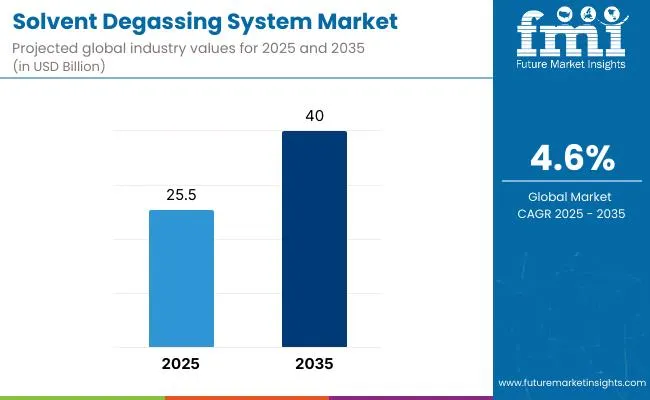
From 2030 to 2035, the market is forecast to grow from USD 3,053.7 million to USD 40 billion, adding another USD 945.9 million, which constitutes 65.3% of the overall ten-year expansion. This period is expected to be characterized by the expansion of biopharmaceutical manufacturing and advanced therapeutic development, the development of inline degassing systems with real-time monitoring capabilities, and the growth of specialized applications for environmental analysis and food safety testing. The growing adoption of automation technologies and laboratory digitalization will drive demand for integrated solvent degassing systems with enhanced functionality and connectivity features.
Between 2020 and 2025, the solvent degassing system market experienced steady growth, driven by increasing pharmaceutical quality standards and growing recognition of solvent degassing as essential process for ensuring chromatographic accuracy and analytical reliability in diverse laboratory and manufacturing applications. The market developed as analytical chemists and quality assurance professionals recognized the potential for degassing technology to eliminate dissolved gases, prevent baseline drift, and support reproducible analytical results while meeting regulatory requirements. Technological advancement in vacuum degassing and membrane separation began emphasizing the critical importance of maintaining consistent solvent quality and system performance in challenging analytical environments.
Solvent Degassing System Market Key Takeaways
| Metric | Value |
|---|---|
| Estimated Value in (2025E) | USD 25.5 billion |
| Forecast Value in (2035F) | USD 40 billion |
| Forecast CAGR (2025 to 2035) | 4.6% |
Why is the Solvent Degassing System Market Growing?
Market expansion is being supported by the increasing global pharmaceutical production driven by aging populations and rising healthcare needs, alongside the corresponding need for advanced analytical instrumentation that can ensure solvent purity, eliminate dissolved gas interference, and maintain chromatographic performance across various high-performance liquid chromatography applications, quality control testing procedures, and research laboratory operations. Modern pharmaceutical laboratories and analytical testing facilities are increasingly focused on implementing solvent degassing solutions that can improve peak resolution, enhance detector sensitivity, and provide consistent analytical results in demanding measurement conditions.
The growing emphasis on regulatory compliance and analytical method validation is driving demand for solvent degassing systems that can support reproducible chromatographic separations, enable reliable quality assurance testing, and ensure comprehensive analytical data integrity. Laboratory managers' preference for degassing technologies that combine operational efficiency with measurement reliability and system integration capabilities is creating opportunities for innovative solvent degassing implementations. The rising influence of biopharmaceutical development and environmental monitoring programs is also contributing to increased adoption of solvent degassing systems that can provide superior analytical performance without compromising throughput or operational flexibility.
How Is the Solvent Degassing System Market Segmented by Method, Application, and Region?
The market is segmented by degassing method, application, and region. By degassing method, the market is divided into volumetric method, gravimetric method, and others. Based on application, the market is categorized into pharmaceutical, food processing, chemical processing, and others. Regionally, the market is divided into East Asia, Europe, North America, South Asia, Latin America, Middle East & Africa, and Eastern Europe.
By Degassing Method, the Volumetric Method Segment Leads the Market
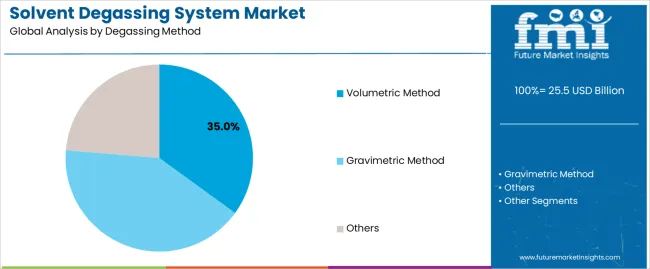
The volumetric method segment is projected to maintain its leading position with 35% market share in the solvent degassing system market in 2025, reaffirming its role as the preferred degassing approach for high-performance liquid chromatography applications and analytical laboratory operations. Analytical chemists and laboratory technicians increasingly utilize volumetric degassing methods for their continuous operation capabilities, proven effectiveness in removing dissolved gases, and ability to maintain consistent solvent quality while supporting multiple chromatography systems simultaneously. Volumetric degassing technology's proven effectiveness and application versatility directly address the industry requirements for reliable chromatographic performance and comprehensive solvent preparation across diverse analytical methods and instrument configurations.
This degassing method segment forms the foundation of modern analytical laboratory infrastructure, as it represents the technology with the greatest contribution to baseline stability and established reliability record across multiple chromatographic applications and solvent systems. Pharmaceutical industry investments in quality control capabilities continue to strengthen adoption among analytical laboratories and quality assurance departments. With regulatory requirements demanding robust analytical methods and reproducible results, volumetric degassing systems align with both operational efficiency objectives and analytical performance requirements, making them the central component of comprehensive chromatography support strategies.
By Application, the Pharmaceutical Segment Dominates Market Demand
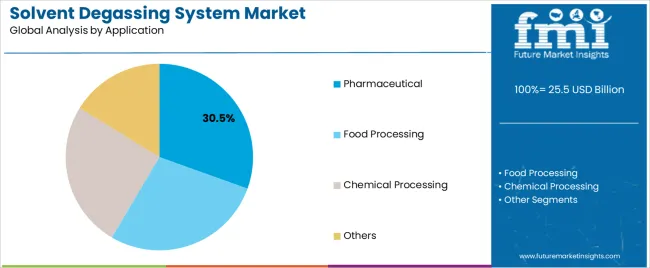
The pharmaceutical application segment is projected to represent the 30.5% market share of solvent degassing system demand in 2025, underscoring its critical role as the primary driver for system adoption across pharmaceutical quality control laboratories, drug development facilities, and contract analytical testing organizations. Pharmaceutical professionals prefer solvent degassing systems for analytical applications due to their essential contribution to chromatographic accuracy, regulatory compliance support, and ability to ensure reproducible analytical results while supporting drug quality assessment and stability testing protocols. Positioned as essential equipment for modern pharmaceutical analysis, solvent degassing systems offer both analytical advantages and regulatory compliance support.
The segment is supported by continuous innovation in analytical methodologies and the growing availability of automated degassing systems that enable high-throughput testing with enhanced reliability and reduced operator intervention. Additionally, pharmaceutical companies are investing in comprehensive chromatography infrastructure programs to support increasingly stringent quality standards and regulatory agency expectations for analytical method validation and data integrity. As pharmaceutical development accelerates and quality requirements intensify, the pharmaceutical application will continue to dominate the market while supporting advanced chromatography utilization and analytical optimization strategies.
What Are the Primary Drivers, Restraints, and Emerging Trends in the Solvent Degassing System Market?
The solvent degassing system market is advancing steadily due to increasing pharmaceutical manufacturing activity driven by global healthcare demand and growing adoption of high-performance liquid chromatography techniques that require effective solvent preparation and gas removal capabilities across diverse analytical testing, quality control, and research laboratory applications. However, the market faces challenges, including high initial equipment costs and budget constraints in academic laboratories, competition from manual degassing methods and lower-cost alternatives, and maintenance requirements related to membrane replacement and system performance verification. Innovation in automation integration and real-time monitoring continues to influence product development and market expansion patterns.
Expansion of Biopharmaceutical Development and Advanced Therapeutics
The growing biopharmaceutical industry is driving demand for sophisticated analytical testing capabilities that address complex molecule characterization including protein analysis, peptide mapping, and biologic drug quality assessment. Biopharmaceutical analysis requires advanced solvent degassing systems that deliver ultra-pure mobile phases for sensitive detection methods while supporting gradient elution and complex chromatographic separations. Analytical laboratories are increasingly recognizing the critical importance of effective solvent degassing for achieving reliable results in biologics analysis and regulatory submission packages, creating opportunities for high-specification degassing systems specifically designed for biopharmaceutical applications and advanced analytical requirements.
Integration of Automation and Laboratory Information Management Systems
Modern solvent degassing system manufacturers are incorporating automation capabilities and digital connectivity features to enhance operational efficiency, enable remote monitoring, and support comprehensive laboratory workflow integration through automated solvent preparation, real-time gas level monitoring, and seamless data management platforms. Leading companies are developing systems with intelligent sensors, predictive maintenance algorithms, and laboratory information management system connectivity that allow laboratory managers to optimize solvent usage and monitor system performance remotely. These technologies improve operational reliability while enabling new laboratory management approaches, including predictive maintenance programs, automated quality documentation, and data-driven resource optimization. Advanced technology integration also allows manufacturers to differentiate product offerings and address laboratory efficiency requirements beyond traditional degassing functionality.
Development of Inline Degassing Technologies for Continuous Operations
The expansion of continuous pharmaceutical manufacturing and increasing emphasis on process analytical technology is driving development of inline solvent degassing systems with real-time monitoring and automated control capabilities. These advanced applications require compact system designs and integrated sensors that enable continuous solvent quality assurance without manual intervention, creating specialized market segments with differentiated value propositions. Manufacturers are investing in miniaturized degassing technologies and advanced control systems to serve continuous manufacturing facilities and process development laboratories while supporting innovation in real-time analytical methods and quality-by-design approaches.
How Are Leading Countries Driving Growth in the Solvent Degassing System Market?
| Country | CAGR (2025-2035) |
|---|---|
| China | 6.2% |
| India | 5.8% |
| Germany | 5.3% |
| Brazil | 4.8% |
| USA | 4.4% |
| UK | 3.9% |
| Japan | 3.5% |
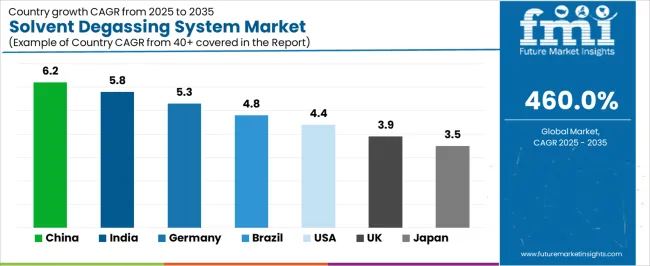
The solvent degassing system market is experiencing solid growth globally, with China leading at 6.2% CAGR through 2035, driven by expanding pharmaceutical manufacturing capacity, growing contract research organization sector, and increasing investment in laboratory infrastructure. India follows at 5.8%, supported by pharmaceutical industry growth, expanding generic drug production, and rising analytical testing requirements. Germany shows growth at 5.3%, emphasizing pharmaceutical research excellence, advanced analytical capabilities, and strong chemical industry infrastructure. Brazil demonstrates 4.8% growth, supported by pharmaceutical sector expansion, growing quality control requirements, and increasing regulatory enforcement. The United States records 4.4%, focusing on biopharmaceutical development, food safety testing, and environmental monitoring applications. The United Kingdom exhibits 3.9% growth, emphasizing pharmaceutical research, contract testing services, and academic research infrastructure. Japan shows 3.5% growth, supported by established pharmaceutical industry and precision instrumentation market maturity.
The report covers an in-depth analysis of 40+ countries top-performing countries are highlighted below.
How Is Pharmaceutical Manufacturing Expansion Accelerating Market Growth in China?
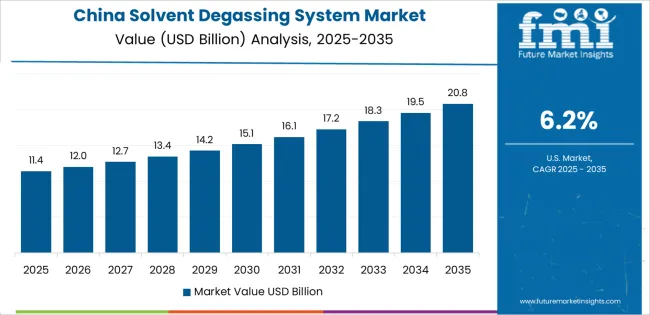
Revenue from solvent degassing systems in China is projected to exhibit exceptional growth with a CAGR of 6.2% through 2035, driven by expanding pharmaceutical manufacturing capacity and rapidly growing contract research organization sector supported by government pharmaceutical innovation initiatives and quality standard enhancement programs. The country's massive pharmaceutical production scale and increasing investment in analytical laboratory infrastructure are creating substantial demand for solvent degassing solutions. Major analytical instrument manufacturers and international companies are establishing comprehensive sales and service capabilities to serve both domestic markets and regional opportunities.
- Government support for pharmaceutical quality improvement and generic drug consistency evaluation is driving demand for advanced analytical equipment throughout major pharmaceutical clusters and quality control laboratories across pharmaceutical manufacturing facilities, contract testing organizations, and research institutions.
- Strong growth in contract research services and an expanding network of analytical testing laboratories are supporting the rapid adoption of automated solvent degassing technologies among service providers seeking enhanced analytical capabilities and improved operational efficiency.
Why Are Quality Standards Enhancing Analytical Adoption in India?
Revenue from solvent degassing systems in India is expanding at a CAGR of 5.8%, supported by the country's rapidly growing pharmaceutical manufacturing sector, expanding generic drug production, and increasing regulatory emphasis on analytical method validation and quality control procedures. The country's pharmaceutical export focus and improving laboratory infrastructure are driving sophisticated solvent degassing capabilities throughout manufacturing and testing facilities. Leading analytical instrument suppliers are establishing distribution networks and technical support programs to address growing demand.
- Expanding pharmaceutical manufacturing capacity and increasing regulatory scrutiny are creating opportunities for solvent degassing system adoption across pharmaceutical plants, contract manufacturing facilities, and independent testing laboratories in major pharmaceutical hubs.
- Growing contract research organization sector and increasing foreign direct investment in pharmaceutical services are driving investment in advanced analytical instrumentation among service providers seeking international quality standards and regulatory compliance capabilities.
How Does Research Leadership Strengthen Market Competitiveness in Germany?
Revenue from solvent degassing systems in Germany is expanding at a CAGR of 5.3%, supported by the country's world-class pharmaceutical research infrastructure, advanced chemical industry, and strong emphasis on analytical precision and measurement accuracy. The nation's pharmaceutical innovation leadership and quality standards are driving sophisticated solvent degassing capabilities throughout research and industrial sectors. Leading instrument manufacturers are investing extensively in product development and application support for German market requirements.
- Advanced pharmaceutical research programs and comprehensive quality control frameworks are creating demand for high-specification solvent degassing systems among pharmaceutical companies seeking superior analytical performance and regulatory compliance assurance.
- Strong chemical industry and analytical instrumentation manufacturing expertise are supporting the development of innovative degassing technologies with enhanced capabilities and improved integration features across research institutions and industrial laboratories.
Why Is Pharmaceutical Modernization Supporting Market Expansion in Brazil?
Revenue from solvent degassing systems in Brazil is expanding at a CAGR of 4.8%, supported by the country's growing pharmaceutical sector, increasing domestic drug production, and strengthening regulatory framework through ANVISA quality standards enforcement. Brazil's pharmaceutical industry modernization and laboratory infrastructure development are driving demand for analytical equipment. Analytical instrument distributors are investing in market development to serve both multinational pharmaceutical companies and domestic manufacturers.
- Growing pharmaceutical manufacturing activity and increasing regulatory enforcement are creating demand for quality analytical equipment among pharmaceutical companies seeking compliance with good manufacturing practice requirements and product quality specifications.
- Expanding contract testing services and increasing investment in laboratory capabilities are driving adoption of automated solvent degassing systems in analytical service laboratories serving pharmaceutical and chemical industries.
How Do Biopharmaceutical Innovations Reinforce Market Leadership in the United States?
Revenue from solvent degassing systems in the United States is expanding at a CAGR of 4.4%, supported by the country's leading biopharmaceutical industry, extensive analytical research infrastructure, and growing emphasis on advanced analytical characterization for complex therapeutics. The nation's pharmaceutical innovation leadership and analytical technology development are driving demand for sophisticated solvent degassing solutions. Manufacturers are investing in product innovation and application development to support evolving analytical requirements and emerging therapeutic modalities.
- Extensive biopharmaceutical development activities and advanced therapeutic characterization requirements are creating demand for high-performance solvent degassing systems among pharmaceutical companies seeking superior analytical capabilities for protein and peptide analysis.
- Strong food safety testing and environmental monitoring programs are driving adoption of chromatography systems with integrated degassing capabilities in government laboratories, contract testing facilities, and academic research institutions.
How Are Research Collaborations Advancing Market Adoption in the United Kingdom?
Revenue from solvent degassing systems in the United Kingdom is expanding at a CAGR of 3.9%, supported by the country's pharmaceutical research excellence, established contract testing industry, and academic research infrastructure. The UK's pharmaceutical sector focus and analytical science expertise are driving structured adoption of advanced laboratory instrumentation. Analytical equipment suppliers are establishing partnerships with pharmaceutical companies and research organizations to support method development and quality assurance programs.
- Pharmaceutical research activities and contract development and manufacturing organization services are creating opportunities for solvent degassing systems throughout pharmaceutical development laboratories, quality control facilities, and contract testing organizations across England, Scotland, and Wales.
- Growing emphasis on analytical method development and quality-by-design approaches are supporting investment in advanced chromatography infrastructure among pharmaceutical companies seeking robust analytical methods and regulatory submission support.
How Does Analytical Precision Drive Market Stability in Japan?
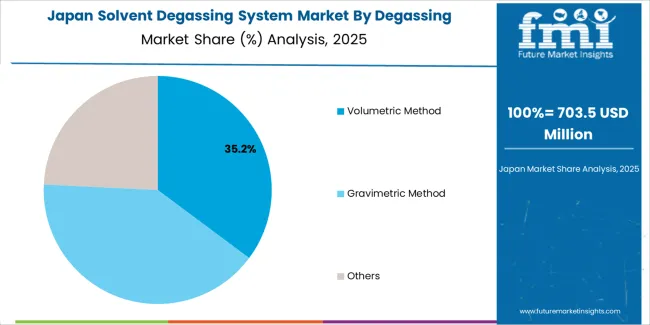
Revenue from solvent degassing systems in Japan is expanding at a CAGR of 3.5%, supported by the country's established pharmaceutical industry, precision instrumentation expertise, and comprehensive quality assurance traditions. Japan's analytical excellence and quality standards are driving demand for reliable and precise solvent degassing products. Leading analytical instrument manufacturers are investing in product refinement for Japanese regulatory requirements and laboratory practices.
- Established pharmaceutical industry and stringent quality requirements are creating sustained demand for high-quality solvent degassing systems throughout pharmaceutical manufacturing facilities, quality control laboratories, and research institutions addressing precision analytical requirements.
- Strong analytical instrumentation market and comprehensive equipment validation practices are driving adoption of certified degassing systems among pharmaceutical companies seeking reliable analytical performance and regulatory compliance documentation.
How Are Research Networks Shaping Market Development Across Europe?
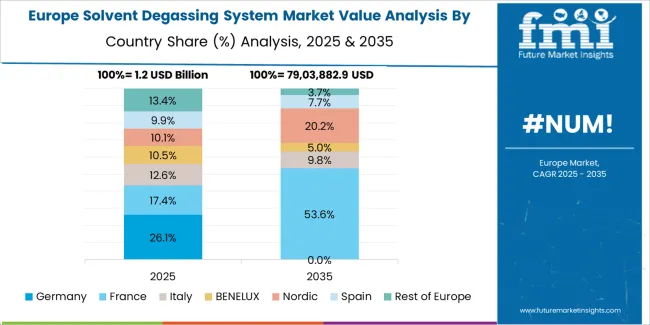
The solvent degassing system market in Europe is projected to grow from USD 765.3 million in 2025 to USD 1,198.7 million by 2035, registering a CAGR of 4.6% over the forecast period. Germany is expected to maintain leadership with a 28.9% market share in 2025, moderating to 28.6% by 2035, supported by advanced pharmaceutical research infrastructure, precision analytical instrumentation excellence, and strong chemical industry analytical requirements.
France follows with 18.6% in 2025, projected at 18.8% by 2035, driven by pharmaceutical industry presence, contract research organization development, and academic research capabilities. The United Kingdom holds 16.3% in 2025, reaching 16.0% by 2035 on the back of pharmaceutical research activities and contract testing services. Italy commands 13.7% in 2025, rising slightly to 13.9% by 2035, while Spain accounts for 9.2% in 2025, reaching 9.4% by 2035 aided by pharmaceutical manufacturing growth and laboratory modernization. Switzerland maintains 5.8% in 2025, up to 5.9% by 2035 due to pharmaceutical industry concentration and analytical excellence. The Rest of Europe region, including Nordics, Central & Eastern Europe, and other markets, is anticipated to hold 7.5% in 2025 and 7.4% by 2035, reflecting steady development in pharmaceutical quality infrastructure and analytical laboratory expansion.
How Competitive Is the Global Solvent Degassing System Market and What Shapes Its Leadership Structure?
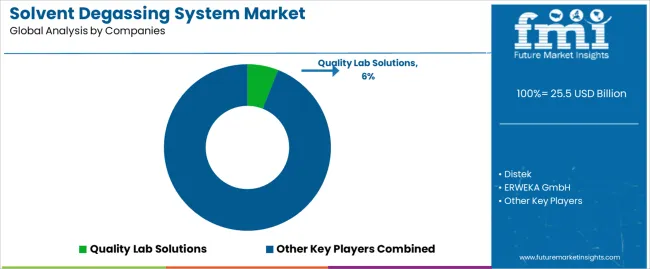
The solvent degassing system market is characterized by competition among established analytical instrument manufacturers, specialized laboratory equipment companies, and chromatography system suppliers. Companies are investing in automation technology development, system integration capabilities, product reliability enhancement, and technical support services to deliver efficient, reliable, and user-friendly solvent degassing solutions. Innovation in inline degassing methods, real-time monitoring technologies, and laboratory connectivity features is central to strengthening market position and competitive advantage.
Quality Lab Solutions leads the market with comprehensive analytical laboratory equipment offerings, providing solvent degassing systems with focus on reliability, ease of use, and integration capabilities across pharmaceutical and chemical testing applications. Distek delivers innovative dissolution testing and laboratory automation solutions with emphasis on pharmaceutical quality control. ERWEKA GmbH offers specialized pharmaceutical testing equipment with comprehensive degassing system integration.
RIGGTEK GmbH focuses on analytical instrumentation development with emphasis on chromatography support systems. Electrolab specializes in pharmaceutical testing equipment for emerging markets with focus on cost-effective solutions. Dosatec GmbH provides precision dosing and degassing technologies for laboratory applications.
Teledyne Technologies offers advanced analytical instrumentation across multiple scientific disciplines. SOTAX specializes in pharmaceutical dissolution testing with integrated solvent preparation systems. Caleva focuses on pharmaceutical processing equipment and laboratory solutions. Zauba provides laboratory equipment distribution services.
Pharma Alliance Group offers comprehensive pharmaceutical testing solutions. Pharma Test specializes in dissolution testing and quality control equipment. Shenzhen Wahyong Analytical Instruments focuses on chromatography systems for Chinese markets. Zhejiang Tailin Bioengineering provides laboratory equipment for pharmaceutical applications. Ningbo Scientz Biotechnology offers analytical instrumentation for life sciences research. Tianjin Rised Technology specializes in laboratory equipment manufacturing for domestic and regional markets.
Key Players in the Solvent Degassing System Market
- Quality Lab Solutions
- Distek
- ERWEKA GmbH
- RIGGTEK GmbH
- Electrolab
- Dosatec GmbH
- Teledyne Technologies
- SOTAX
- Caleva
- Zauba
- Pharma Alliance Group
- Pharma Test
- Shenzhen Wahyong Analytical Instruments
- Zhejiang Tailin Bioengineering
- Ningbo Scientz Biotechnology
- Tianjin Rised Technology
What Defines the Analytical Scope and Methodological Framework of the Solvent Degassing System Market Report?
| Items | Values |
|---|---|
| Quantitative Units (2025) | USD 25.5 billion |
| Degassing Method | Volumetric Method, Gravimetric Method, Others |
| Application | Pharmaceutical, Food Processing, Chemical Processing, Others |
| Regions Covered | East Asia, Europe, North America, South Asia, Latin America, Middle East & Africa, Eastern Europe |
| Countries Covered | China, India, Germany, Brazil, United States, United Kingdom, Japan, and 40+ countries |
| Key Companies Profiled | Quality Lab Solutions, Distek, ERWEKA GmbH, RIGGTEK GmbH, Electrolab, Dosatec GmbH |
| Additional Attributes | Dollar sales by degassing method and application category, regional demand trends, competitive landscape, technological advancements in vacuum degassing, automation integration, inline monitoring development, and chromatographic performance optimization |
Solvent Degassing System Market by Segments
Degassing Method:
- Volumetric Method
- Gravimetric Method
- Others
Application:
- Pharmaceutical
- Food Processing
- Chemical Processing
- Others
Region:
- East Asia
- China
- Japan
- South Korea
- Taiwan
- Rest of East Asia
- Europe
- Germany
- United Kingdom
- France
- Italy
- Spain
- Netherlands
- Nordic
- BENELUX
- Rest of Europe
- North America
- United States
- Canada
- Mexico
- South Asia
- India
- Pakistan
- Bangladesh
- Rest of South Asia
- Latin America
- Brazil
- Argentina
- Chile
- Rest of Latin America
- Middle East & Africa
- Kingdom of Saudi Arabia
- Other GCC Countries
- Turkey
- South Africa
- Other African Union
- Rest of Middle East & Africa
- Eastern Europe
- Russia
- Poland
- Czech Republic
- Rest of Eastern Europe
Frequently Asked Questions
How big is the solvent degassing system market in 2025?
The global solvent degassing system market is estimated to be valued at USD 25.5 billion in 2025.
What will be the size of solvent degassing system market in 2035?
The market size for the solvent degassing system market is projected to reach USD 773,428,997.2 billion by 2035.
How much will be the solvent degassing system market growth between 2025 and 2035?
The solvent degassing system market is expected to grow at a 460.0% CAGR between 2025 and 2035.
What are the key product types in the solvent degassing system market?
The key product types in solvent degassing system market are volumetric method, gravimetric method and others.
Which application segment to contribute significant share in the solvent degassing system market in 2025?
In terms of application, pharmaceutical segment to command 30.5% share in the solvent degassing system market in 2025.
Preview the report firsthand - request a free sample
Get SampleGet the brochure for pricing and purchase details.
Get PDFTable of Content
- Executive Summary
- Global Market Outlook
- Demand-side Trends
- Supply-side Trends
- Technology Roadmap Analysis
- Analysis and Recommendations
- Market Overview
- Market Coverage / Taxonomy
- Market Definition / Scope / Limitations
- Market Background
- Market Dynamics
- Drivers
- Restraints
- Opportunity
- Trends
- Scenario Forecast
- Demand in Optimistic Scenario
- Demand in Likely Scenario
- Demand in Conservative Scenario
- Opportunity Map Analysis
- Product Life Cycle Analysis
- Supply Chain Analysis
- Investment Feasibility Matrix
- Value Chain Analysis
- PESTLE and Porter’s Analysis
- Regulatory Landscape
- Regional Parent Market Outlook
- Production and Consumption Statistics
- Import and Export Statistics
- Market Dynamics
- Global Market Analysis 2020 to 2024 and Forecast, 2025 to 2035
- Historical Market Size Value (USD Million) Analysis, 2020 to 2024
- Current and Future Market Size Value (USD Million) Projections, 2025 to 2035
- Y-o-Y Growth Trend Analysis
- Absolute $ Opportunity Analysis
- Global Market Pricing Analysis 2020 to 2024 and Forecast 2025 to 2035
- Global Market Analysis 2020 to 2024 and Forecast 2025 to 2035, By Degassing Method
- Introduction / Key Findings
- Historical Market Size Value (USD Million) Analysis By Degassing Method , 2020 to 2024
- Current and Future Market Size Value (USD Million) Analysis and Forecast By Degassing Method , 2025 to 2035
- Volumetric Method
- Gravimetric Method
- Others
- Y-o-Y Growth Trend Analysis By Degassing Method , 2020 to 2024
- Absolute $ Opportunity Analysis By Degassing Method , 2025 to 2035
- Global Market Analysis 2020 to 2024 and Forecast 2025 to 2035, By Application
- Introduction / Key Findings
- Historical Market Size Value (USD Million) Analysis By Application, 2020 to 2024
- Current and Future Market Size Value (USD Million) Analysis and Forecast By Application, 2025 to 2035
- Pharmaceutical
- Food Processing
- Chemical Processing
- Others
- Y-o-Y Growth Trend Analysis By Application, 2020 to 2024
- Absolute $ Opportunity Analysis By Application, 2025 to 2035
- Global Market Analysis 2020 to 2024 and Forecast 2025 to 2035, By Region
- Introduction
- Historical Market Size Value (USD Million) Analysis By Region, 2020 to 2024
- Current Market Size Value (USD Million) Analysis and Forecast By Region, 2025 to 2035
- North America
- Latin America
- Western Europe
- Eastern Europe
- East Asia
- South Asia and Pacific
- Middle East & Africa
- Market Attractiveness Analysis By Region
- North America Market Analysis 2020 to 2024 and Forecast 2025 to 2035, By Country
- Historical Market Size Value (USD Million) Trend Analysis By Market Taxonomy, 2020 to 2024
- Market Size Value (USD Million) Forecast By Market Taxonomy, 2025 to 2035
- By Country
- USA
- Canada
- Mexico
- By Degassing Method
- By Application
- By Country
- Market Attractiveness Analysis
- By Country
- By Degassing Method
- By Application
- Key Takeaways
- Latin America Market Analysis 2020 to 2024 and Forecast 2025 to 2035, By Country
- Historical Market Size Value (USD Million) Trend Analysis By Market Taxonomy, 2020 to 2024
- Market Size Value (USD Million) Forecast By Market Taxonomy, 2025 to 2035
- By Country
- Brazil
- Chile
- Rest of Latin America
- By Degassing Method
- By Application
- By Country
- Market Attractiveness Analysis
- By Country
- By Degassing Method
- By Application
- Key Takeaways
- Western Europe Market Analysis 2020 to 2024 and Forecast 2025 to 2035, By Country
- Historical Market Size Value (USD Million) Trend Analysis By Market Taxonomy, 2020 to 2024
- Market Size Value (USD Million) Forecast By Market Taxonomy, 2025 to 2035
- By Country
- Germany
- UK
- Italy
- Spain
- France
- Nordic
- BENELUX
- Rest of Western Europe
- By Degassing Method
- By Application
- By Country
- Market Attractiveness Analysis
- By Country
- By Degassing Method
- By Application
- Key Takeaways
- Eastern Europe Market Analysis 2020 to 2024 and Forecast 2025 to 2035, By Country
- Historical Market Size Value (USD Million) Trend Analysis By Market Taxonomy, 2020 to 2024
- Market Size Value (USD Million) Forecast By Market Taxonomy, 2025 to 2035
- By Country
- Russia
- Poland
- Hungary
- Balkan & Baltic
- Rest of Eastern Europe
- By Degassing Method
- By Application
- By Country
- Market Attractiveness Analysis
- By Country
- By Degassing Method
- By Application
- Key Takeaways
- East Asia Market Analysis 2020 to 2024 and Forecast 2025 to 2035, By Country
- Historical Market Size Value (USD Million) Trend Analysis By Market Taxonomy, 2020 to 2024
- Market Size Value (USD Million) Forecast By Market Taxonomy, 2025 to 2035
- By Country
- China
- Japan
- South Korea
- By Degassing Method
- By Application
- By Country
- Market Attractiveness Analysis
- By Country
- By Degassing Method
- By Application
- Key Takeaways
- South Asia and Pacific Market Analysis 2020 to 2024 and Forecast 2025 to 2035, By Country
- Historical Market Size Value (USD Million) Trend Analysis By Market Taxonomy, 2020 to 2024
- Market Size Value (USD Million) Forecast By Market Taxonomy, 2025 to 2035
- By Country
- India
- ASEAN
- Australia & New Zealand
- Rest of South Asia and Pacific
- By Degassing Method
- By Application
- By Country
- Market Attractiveness Analysis
- By Country
- By Degassing Method
- By Application
- Key Takeaways
- Middle East & Africa Market Analysis 2020 to 2024 and Forecast 2025 to 2035, By Country
- Historical Market Size Value (USD Million) Trend Analysis By Market Taxonomy, 2020 to 2024
- Market Size Value (USD Million) Forecast By Market Taxonomy, 2025 to 2035
- By Country
- Kingdom of Saudi Arabia
- Other GCC Countries
- Turkiye
- South Africa
- Other African Union
- Rest of Middle East & Africa
- By Degassing Method
- By Application
- By Country
- Market Attractiveness Analysis
- By Country
- By Degassing Method
- By Application
- Key Takeaways
- Key Countries Market Analysis
- USA
- Pricing Analysis
- Market Share Analysis, 2024
- By Degassing Method
- By Application
- Canada
- Pricing Analysis
- Market Share Analysis, 2024
- By Degassing Method
- By Application
- Mexico
- Pricing Analysis
- Market Share Analysis, 2024
- By Degassing Method
- By Application
- Brazil
- Pricing Analysis
- Market Share Analysis, 2024
- By Degassing Method
- By Application
- Chile
- Pricing Analysis
- Market Share Analysis, 2024
- By Degassing Method
- By Application
- Germany
- Pricing Analysis
- Market Share Analysis, 2024
- By Degassing Method
- By Application
- UK
- Pricing Analysis
- Market Share Analysis, 2024
- By Degassing Method
- By Application
- Italy
- Pricing Analysis
- Market Share Analysis, 2024
- By Degassing Method
- By Application
- Spain
- Pricing Analysis
- Market Share Analysis, 2024
- By Degassing Method
- By Application
- France
- Pricing Analysis
- Market Share Analysis, 2024
- By Degassing Method
- By Application
- India
- Pricing Analysis
- Market Share Analysis, 2024
- By Degassing Method
- By Application
- ASEAN
- Pricing Analysis
- Market Share Analysis, 2024
- By Degassing Method
- By Application
- Australia & New Zealand
- Pricing Analysis
- Market Share Analysis, 2024
- By Degassing Method
- By Application
- China
- Pricing Analysis
- Market Share Analysis, 2024
- By Degassing Method
- By Application
- Japan
- Pricing Analysis
- Market Share Analysis, 2024
- By Degassing Method
- By Application
- South Korea
- Pricing Analysis
- Market Share Analysis, 2024
- By Degassing Method
- By Application
- Russia
- Pricing Analysis
- Market Share Analysis, 2024
- By Degassing Method
- By Application
- Poland
- Pricing Analysis
- Market Share Analysis, 2024
- By Degassing Method
- By Application
- Hungary
- Pricing Analysis
- Market Share Analysis, 2024
- By Degassing Method
- By Application
- Kingdom of Saudi Arabia
- Pricing Analysis
- Market Share Analysis, 2024
- By Degassing Method
- By Application
- Turkiye
- Pricing Analysis
- Market Share Analysis, 2024
- By Degassing Method
- By Application
- South Africa
- Pricing Analysis
- Market Share Analysis, 2024
- By Degassing Method
- By Application
- USA
- Market Structure Analysis
- Competition Dashboard
- Competition Benchmarking
- Market Share Analysis of Top Players
- By Regional
- By Degassing Method
- By Application
- Competition Analysis
- Competition Deep Dive
- Quality Lab Solutions
- Overview
- Product Portfolio
- Profitability by Market Segments (Product/Age /Sales Channel/Region)
- Sales Footprint
- Strategy Overview
- Marketing Strategy
- Product Strategy
- Channel Strategy
- Distek
- ERWEKA GmbH
- RIGGTEK GmbH
- Electrolab
- Dosatec GmbH
- Teledyne Technologies
- SOTAX
- Caleva
- Zauba
- Pharma Alliance Group
- Pharma Test
- Shenzhen Wahyong Analytical Instruments
- Zhejiang Tailin Bioengineering
- Ningbo Scientz Biotechnology
- Tianjin Rised Technology
- Quality Lab Solutions
- Competition Deep Dive
- Assumptions & Acronyms Used
- Research Methodology


