

- Industry Size (2026)
- USD 35.2 Mn
- Forecast (2036)
- USD 55.5 Mn
- CAGR (2026 to 2036)
- 4.7%
Demand for Activated Alumina in South Korea Forecast and Outlook 2026 to 2036
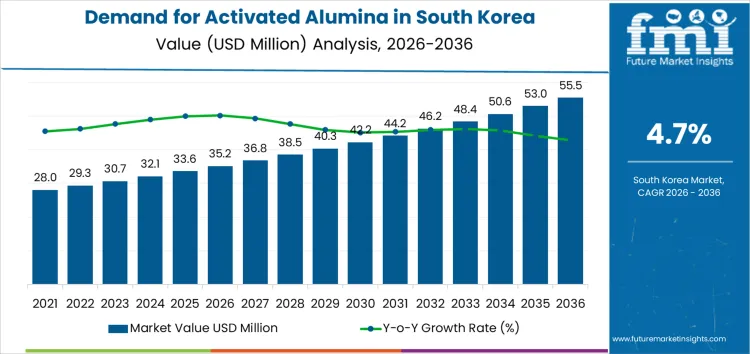
The demand for activated alumina in South Korea is projected to reach USD 35.2 million in 2026 and grow to USD 55.5 million by 2036, with a CAGR of 4.7%. Capital intensity will be a significant factor in shaping market dynamics, as investments in manufacturing capabilities, particularly for high-purity alumina, require substantial up-front costs. Given the specialized nature of the product and its applications in water treatment, oil refining, and other industries, return timelines will likely stretch beyond the typical short-term horizon, requiring investors to adopt a longer-term view.
selectivity will be crucial, with opportunities favoring companies that focus on innovation, process efficiency, and sustainable production methods. Strategic investments in R&D, along with a focus on expanding production capacity in line with rising demand, will enhance competitive positioning. Investors who prioritize companies with scalable, low-risk expansion models and strong market relationships will be better positioned to capture the sector’s growth.
Quick Stats for the Demand for Activated Alumina in South Korea
- Activated Alumina in South Korea Value (2026): USD 35.2 million
- Activated Alumina in South Korea Forecast Value (2036): USD 55.5 million
- Activated Alumina in South Korea Forecast CAGR (2026 to 2036): 4.7%
- Activated Alumina in South Korea Leading Segment: Particle Size 0.5-2 mm (35%)
- Key Growth Regions of Activated Alumina in South Korea: Jeju (leading CAGR ~5.6%)
- Top Players of Activated Alumina in South Korea: BASF SE, Honeywell International Inc., Axens S.A., Sumitomo Chemical Co., Ltd., Porocel Industries LLC (Evonik)
What is the Growth Forecast for the Demand for Activated Alumina in South Korea through 2036?
The demand for activated alumina in South Korea is projected to see consistent growth through 2036, reaching USD 55.5 million by the end of the forecast period. The market’s growth curve exhibits a gradual and steady increase, starting at USD 35.2 million in 2026 and expanding at a 4.7% CAGR. The steady rise is attributed to the increasing application of activated alumina in water and air treatment processes, along with its growing use in catalyst support within the chemical and petrochemical industries. South Korea’s focus on improving environmental quality and sustainability is expected to further fuel demand, as activated alumina plays a vital role in reducing harmful emissions and purifying water sources.
By 2036, the market for activated alumina in South Korea will reach USD 55.5 million, reflecting continued market maturity and application diversification. As the demand for environmentally friendly and efficient materials rises, the activated alumina market will continue to expand in alignment with growing industrial requirements and stringent environmental standards. This gradual yet steady market trajectory will ensure that activated alumina remains an essential material for a wide range of industrial and environmental applications in South Korea.
Key Takeaways for Demand for Activated Alumina in South Korea
| Metric | Value |
|---|---|
| Industry Sales Value (2026) | USD 35.2 million |
| Industry Forecast Value (2036) | USD 55.5 million |
| Industry Forecast CAGR (2026 to 2036) | 4.7% |
Why is the Demand for Activated Alumina Growing in South Korea?
Demand for activated alumina in South Korea stems from its wide use in applications that require high efficiency adsorption and filtration performance. Industries such as water treatment, petrochemicals, and air purification rely on activated alumina for removing moisture, fluoride, arsenic, and other contaminants. South Korea’s industrial infrastructure includes large chemical and refining sectors where desiccant performance is critical for maintaining process stability and product quality. Water utilities and private treatment facilities use activated alumina to meet tightening standards for potable water quality, particularly in removing fluoride and arsenic to comply with public health guidelines. Manufacturers of compressed gases and refrigeration systems also deploy activated alumina to dry gas streams, ensuring reliability in systems where moisture can compromise performance. These application demands align with broader industrial priorities in South Korea, where quality control and operational resilience are core concerns for producers and service providers.
Looking forward, factors that support continued growth in demand for activated alumina across South Korea include regulatory emphasis on environmental protection and industrial efficiency. Water treatment standards are becoming more stringent, encouraging utilities and industrial facilities to adopt advanced filtration media that can deliver consistent removal of contaminants. Growth in petrochemical and specialty chemical production drives demand for adsorption materials that protect catalysts and extend equipment life by removing moisture and impurities. Air quality control systems in manufacturing plants and commercial buildings increasingly incorporate activated alumina as part of multi stage filtration solutions to address humidity and pollutant removal. In addition, the expansion of renewable energy technologies, such as hydrogen production and fuel cells, creates new opportunities for adsorbents that support high purity gas streams. As these technology areas advance, the role of activated alumina in ensuring performance and compliance will continue to influence procurement decisions in South Korea’s industrial and environmental sectors.
What is the Demand for Activated Alumina in South Korea?
The demand for activated alumina in South Korea is driven by two key factors: particle size and end-use application. The 0.5-2 mm particle size dominates the market, while water treatment is the leading end-use sector. The particle size segment of 0.5-2 mm represents 35% of the market share, and water treatment accounts for 35% of the demand. These two segments are critical in shaping the activated alumina market in South Korea, where industries ranging from water treatment to petrochemicals rely on this material for various applications, making it an essential component for industrial processes.
How Does the 0.5-2 mm Particle Size Impact the Activated Alumina Market?
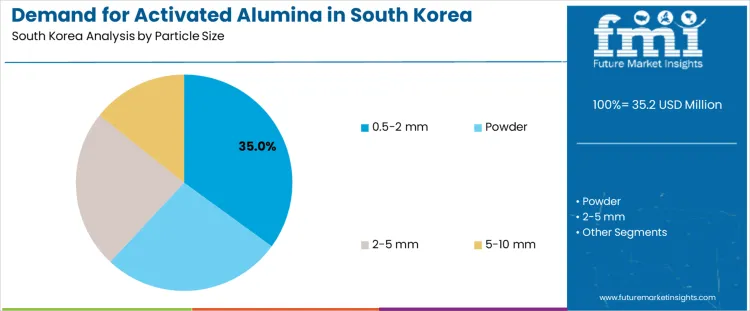
The 0.5-2 mm particle size is the leading segment for activated alumina in South Korea, representing 35% of the market. This size range is particularly favored for water treatment applications, where it is used for the adsorption of fluoride, arsenic, and other contaminants from water. The high surface area and porous structure of activated alumina make it ideal for removing impurities, improving water quality, and ensuring compliance with environmental standards.
As water treatment becomes an increasingly critical issue in South Korea due to population growth, urbanization, and industrialization, the demand for activated alumina in this particle size is expected to remain strong. Additionally, the ability of activated alumina to efficiently adsorb contaminants, combined with its cost-effectiveness, reinforces its popularity in water treatment systems. The growing awareness of water pollution and the need for clean, safe drinking water in South Korea further drives the demand for activated alumina in this particle size. As industrial processes in South Korea continue to expand, the role of activated alumina in water purification will become even more integral.
How Does Water Treatment Drive the End-Use Market for Activated Alumina?
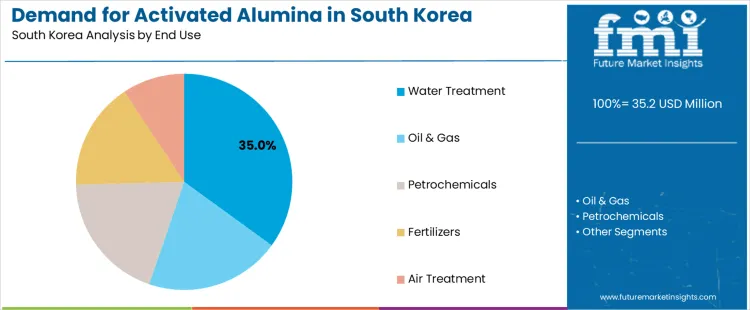
Water treatment is the leading end-use application for activated alumina in South Korea, representing 35% of the overall demand. Activated alumina is widely used in water filtration systems due to its ability to remove heavy metals, fluoride, and other contaminants effectively. With South Korea facing growing challenges related to water pollution, the need for efficient water treatment solutions has surged. Municipal water treatment plants, as well as industrial water treatment facilities, rely on activated alumina to ensure that water meets safety and quality standards.
Furthermore, the rise in environmental awareness among consumers and the government’s commitment to improving water quality further boost the demand for activated alumina in water treatment. As South Korea continues to prioritize environmental sustainability and public health, the role of activated alumina in water purification will remain essential. The material’s effectiveness, combined with its eco-friendly nature, positions it as a preferred choice for water treatment in both residential and industrial applications. As water treatment technologies advance, the demand for activated alumina in South Korea is expected to continue to grow steadily.
What Is the Current Demand for Activated Alumina in South Korea?
The demand for activated alumina in South Korea reflects its use across water treatment, air purification, petrochemical refining, and desiccant systems. Industrial sectors continue to rely on activated alumina for moisture adsorption and purification functions, maintaining steady procurement from local and international suppliers. Demand patterns are tied to infrastructure growth, environmental control standards, and activity in the chemical processing industry. Recent years have seen increases in utility applications, particularly as facilities upgrade filtration and drying systems. Demand remains linked to broader industrial output and regulatory requirements for quality and safety.
What Factors Are Driving Demand for Activated Alumina in South Korea?
Several drivers underlie demand for activated alumina in South Korea. Expansion of water purification infrastructure supports uptake, as municipal and industrial facilities invest in media capable of removing fluoride, arsenic, and other contaminants. Growth in the petrochemical and refining sectors stimulates demand for desiccants that protect catalysts and process streams from moisture. Air separation and gas drying applications in manufacturing also contribute to requirements for high performance alumina media. Environmental regulations focused on emissions and effluent quality push firms to adopt more advanced filtration and adsorption materials. Finally, diversification of end use industries, including electronics and pharmaceuticals, sustains demand for reliable adsorption media.
What Are the Constraints on Demand for Activated Alumina in South Korea?
Several factors constrain the expansion of activated alumina demand in South Korea. Cost considerations remain significant, as high grade adsorption media often command premium pricing relative to basic alternatives, affecting procurement choices for cost sensitive users. Competition from substitute materials, such as molecular sieves and silica gel, limits uptake where specific performance attributes are less critical. Volatility in raw material inputs and energy costs can translate into price fluctuations for finished alumina products, creating budgeting challenges for procurement planners. Variations in industrial activity levels, especially in sectors tied to global commodity cycles, also influence demand and procurement timelines.
What Trends Are Emerging in South Korea’s Activated Alumina Market?
Emerging trends in South Korea’s activated alumina market point to shifts in technology application and supply chain behavior. Adoption of specialized formulations with tailored pore size distributions is increasing, as users seek media optimized for precise separations or longer service life. There is heightened interest in regenerated and reusable alumina products to manage lifecycle costs and align with environmental goals. Integration of advanced monitoring systems in water and air treatment facilities supports more predictive maintenance and scheduled media replacement, influencing purchasing patterns. Finally, collaborations between local industry and overseas suppliers are shaping product availability, with an eye on quality consistency and logistical reliability.
What is the Regional Outlook for the Demand for Activated Alumina in South Korea?
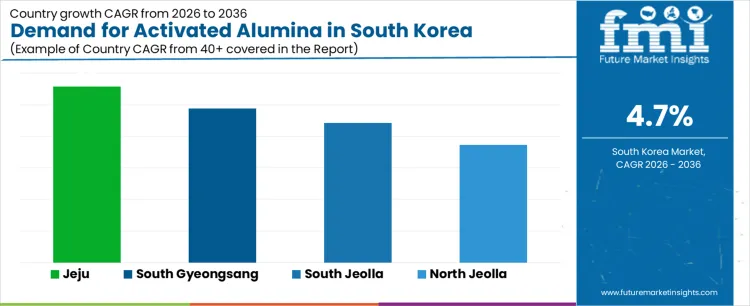
The demand for activated alumina in South Korea varies across its regions, influenced by local industrial activities, environmental regulations, and economic development. South Gyeongsang, North Jeolla, South Jeolla, and Jeju all demonstrate strong demand, driven by industries such as water treatment, petrochemicals, and air purification. Jeju is projected to experience the highest growth, reflecting increasing industrial and environmental needs in the region. South Gyeongsang and South Jeolla also show steady growth, while North Jeolla is expected to see moderate demand. The rising demand for environmentally sustainable solutions further boosts the adoption of activated alumina, which is widely used in applications requiring high adsorption capacity and low reactivity.
| Province | CAGR (2026 to 2036) |
|---|---|
| South Gyeongsang | 4.9% |
| North Jeolla | 3.7% |
| South Jeolla | 4.4% |
| Jeju | 5.6% |
What drives the demand for Activated Alumina in South Gyeongsang? South Gyeongsang is projected to experience a CAGR of 4.9% in activated alumina demand from 2026 to 2036. The region's industrial base, particularly in petrochemicals, water treatment, and manufacturing, is a major factor driving this demand. Activated alumina is crucial in the removal of impurities from liquids and gases, making it highly sought after in South Gyeongsang's industries, which require high-performance adsorbents. The region's strong role in environmental protection and pollution control further boosts demand for activated alumina, as it is commonly used in water and air purification processes. The increasing focus on sustainable and efficient industrial practices, combined with South Gyeongsang's significant manufacturing output, ensures that demand for activated alumina will continue to grow in the coming years.
What influences the growth of Activated Alumina demand in North Jeolla?
North Jeolla is expected to see a steady CAGR of 3.7% in activated alumina demand from 2026 to 2036. The region’s industrial activities, particularly in the automotive, petrochemical, and environmental sectors, contribute to the rising demand for activated alumina. As industries in North Jeolla expand their operations to meet stricter environmental regulations, the need for efficient water and air treatment solutions becomes more prominent. Activated alumina is favored for its ability to adsorb moisture, organic compounds, and other contaminants, making it indispensable in both industrial processes and environmental protection. Furthermore, North Jeolla’s efforts to boost sustainable manufacturing and implement cleaner technologies are driving increased adoption of activated alumina, particularly in air and water purification applications.
What drives the demand for Activated Alumina in South Jeolla?
South Jeolla’s demand for activated alumina is expected to grow at a CAGR of 4.4% from 2026 to 2036. The region’s increasing focus on industrial growth, particularly in petrochemicals and water treatment, plays a critical role in driving this demand. Activated alumina is widely used in removing impurities from air and water, making it an essential part of South Jeolla’s growing industrial sector. As the region continues to expand its manufacturing base and adhere to stricter environmental standards, the need for efficient adsorbent materials like activated alumina will rise. Additionally, the region’s commitment to sustainable technologies and water treatment solutions, driven by increasing awareness of environmental challenges, supports the growth of activated alumina demand.
Why is Jeju’s demand for Activated Alumina the highest?
Jeju is projected to experience the highest growth in activated alumina demand, with a CAGR of 5.6% from 2026 to 2036. The region’s role in tourism and its increasing adoption of green technologies are key factors driving this demand. Jeju’s commitment to environmental sustainability, particularly in water and air quality management, has led to a growing need for activated alumina in both industrial and commercial applications. Activated alumina is widely used in the region’s air purification systems and water treatment plants, supporting Jeju’s green initiatives. The region’s strong focus on reducing environmental impact and enhancing the quality of life for both residents and visitors has made activated alumina an essential part of its industrial and environmental strategies. As Jeju continues to develop its infrastructure to meet sustainability goals, the demand for activated alumina is expected to increase significantly.
How are Competitors Differentiating in the Activated Alumina Market in South Korea?
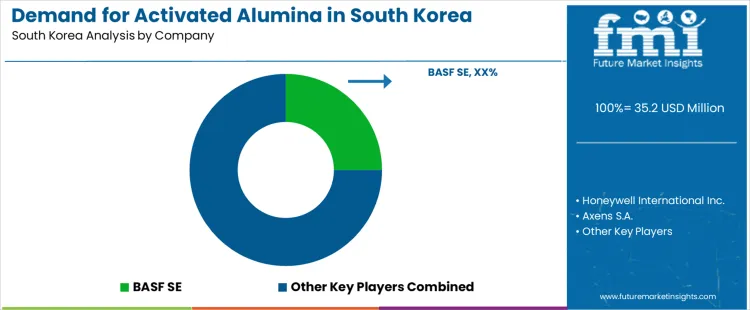
The demand for activated alumina in South Korea is driven by industrial applications such as water treatment, air purification, and refining processes. BASF SE, as the leading player, stands out with its high-quality activated alumina products designed for moisture removal and catalytic applications. The company’s focus on innovation, offering customized solutions for diverse applications, has helped solidify its market leadership. Honeywell International Inc. competes with its advanced adsorbent solutions, providing activated alumina that supports a variety of industrial processes with an emphasis on efficiency and cost-effectiveness. Their products are particularly favored in the refining and petrochemical industries due to their superior moisture and impurity removal properties.
Companies like Axens S.A. and Sumitomo Chemical Co., Ltd. differentiate through specialization in chemical processes and refining applications. Axens S.A. provides activated alumina solutions tailored to the needs of refineries and chemical plants, while Sumitomo Chemical Co., Ltd. focuses on providing high-performance adsorbents designed to meet stringent industrial standards. Porocel Industries LLC (Evonik) also competes by offering highly efficient activated alumina products that focus on enhancing the performance of air and water purification systems. These companies use product brochures to showcase the superior adsorption capacities, durability, and versatility of their activated alumina products, highlighting their ability to meet the rigorous demands of South Korea’s industrial sectors.
Key Players of the Demand for Activated Alumina in South Korea
- BASF SE
- Honeywell International Inc.
- Axens S.A.
- Sumitomo Chemical Co., Ltd.
- Porocel Industries LLC (Evonik)
Scope of the Report
| Items | Values |
|---|---|
| Quantitative Units (2026) | USD Million |
| Particle Size | 0.5-2 mm, Powder, 2-5 mm, 5-10 mm |
| End Use | Water Treatment, Oil & Gas, Petrochemicals, Fertilizers, Air Treatment |
| Companies | BASF SE, Honeywell International Inc., Axens S.A., Sumitomo Chemical Co., Ltd., Porocel Industries LLC (Evonik) |
| Region Covered | South Korea |
| Provinces Covered | South Gyeongsang, North Jeolla, South Jeolla, Jeju |
| Additional Attributes | Dollar sales by particle size and end-use. The demand for activated alumina is driven by its critical role in water treatment and air purification systems. It is also gaining traction in oil & gas and petrochemical applications, supporting efficient filtration and adsorption. |
Demand for Activated Alumina in South Korea
Particle Size:
- 0.5-2 mm
- Powder
- 2-5 mm
- 5-10 mm
End Use:
- Water Treatment
- Oil & Gas
- Petrochemicals
- Fertilizers
- Air Treatment
Provinces:
- South Gyeongsang
- North Jeolla
- South Jeolla
- Jeju
Bibliography
- BASF SE. (2023). High-quality activated alumina for moisture removal and catalytic applications.
- Honeywell International Inc.. (2023). Advanced adsorbent solutions for industrial processes using activated alumina.
- Axens S.A.. (2023). Activated alumina solutions tailored for refining and chemical processes.
- Sumitomo Chemical Co., Ltd.. (2023). High-performance activated alumina for stringent industrial standards.
- Porocel Industries LLC (Evonik). (2023). Efficient activated alumina products for air and water purification systems.
Frequently Asked Questions
How big is the demand for activated alumina in south korea in 2026?
The demand for activated alumina in south korea is estimated to be valued at USD 35.2 million in 2026.
What will be the size of activated alumina in south korea in 2036?
The market size for the activated alumina in south korea is projected to reach USD 55.5 million by 2036.
How much will be the demand for activated alumina in south korea growth between 2026 and 2036?
The demand for activated alumina in south korea is expected to grow at a 4.7% CAGR between 2026 and 2036.
What are the key product types in the activated alumina in south korea?
The key product types in activated alumina in south korea are 0.5-2 mm, powder, 2-5 mm and 5-10 mm.
Which end use segment is expected to contribute significant share in the activated alumina in south korea in 2026?
In terms of end use, water treatment segment is expected to command 35.0% share in the activated alumina in south korea in 2026.
Preview the report firsthand - request a free sample
Get SampleGet the brochure for pricing and purchase details.
Get PDFTable of Content
- Executive Summary
- South Korea Market Outlook
- Demand-side Trends
- Supply-side Trends
- Technology Roadmap Analysis
- Analysis and Recommendations
- Market Overview
- Market Coverage / Taxonomy
- Market Definition / Scope / Limitations
- Market Background
- Market Dynamics
- Drivers
- Restraints
- Opportunity
- Trends
- Scenario Forecast
- Demand in Optimistic Scenario
- Demand in Likely Scenario
- Demand in Conservative Scenario
- Opportunity Map Analysis
- Product Life Cycle Analysis
- Supply Chain Analysis
- Investment Feasibility Matrix
- Value Chain Analysis
- PESTLE and Porter’s Analysis
- Regulatory Landscape
- Regional Parent Market Outlook
- Production and Consumption Statistics
- Import and Export Statistics
- Market Dynamics
- South Korea Market Analysis 2021 to 2025 and Forecast, 2026 to 2036
- Historical Market Size Value (USD Million) Analysis, 2021 to 2025
- Current and Future Market Size Value (USD Million) Projections, 2026 to 2036
- Y-o-Y Growth Trend Analysis
- Absolute $ Opportunity Analysis
- South Korea Market Pricing Analysis 2021 to 2025 and Forecast 2026 to 2036
- South Korea Market Analysis 2021 to 2025 and Forecast 2026 to 2036, By Particle Size
- Introduction / Key Findings
- Historical Market Size Value (USD Million) Analysis By Particle Size , 2021 to 2025
- Current and Future Market Size Value (USD Million) Analysis and Forecast By Particle Size , 2026 to 2036
- 0.5-2 mm
- Powder
- 2-5 mm
- 5-10 mm
- 0.5-2 mm
- Y-o-Y Growth Trend Analysis By Particle Size , 2021 to 2025
- Absolute $ Opportunity Analysis By Particle Size , 2026 to 2036
- South Korea Market Analysis 2021 to 2025 and Forecast 2026 to 2036, By End Use
- Introduction / Key Findings
- Historical Market Size Value (USD Million) Analysis By End Use, 2021 to 2025
- Current and Future Market Size Value (USD Million) Analysis and Forecast By End Use, 2026 to 2036
- Water Treatment
- Oil & Gas
- Petrochemicals
- Fertilizers
- Air Treatment
- Water Treatment
- Y-o-Y Growth Trend Analysis By End Use, 2021 to 2025
- Absolute $ Opportunity Analysis By End Use, 2026 to 2036
- Market Structure Analysis
- Competition Dashboard
- Competition Benchmarking
- Market Share Analysis of Top Players
- By Regional
- By Particle Size
- By End Use
- Competition Analysis
- Competition Deep Dive
- BASF SE
- Overview
- Product Portfolio
- Profitability by Market Segments (Product/Age /Sales Channel/Region)
- Sales Footprint
- Strategy Overview
- Marketing Strategy
- Product Strategy
- Channel Strategy
- Honeywell International Inc.
- Axens S.A.
- Sumitomo Chemical Co., Ltd.
- Porocel Industries LLC (Evonik)
- BASF SE
- Competition Deep Dive
- Assumptions & Acronyms Used
- Research Methodology


