

- Industry Size (2026)
- USD 75 Mn
- Forecast (2036)
- USD 133 Mn
- CAGR (2026 to 2036)
- 5.9%
Demand for Automotive Roof Rails in South Korea Forecast and Outlook 2026 to 2036
The demand for automotive roof rails in South Korea is projected to reach USD 133 million by 2036, growing at a CAGR of 5.9% from USD 75 million in 2026. The market's growth quality is closely tied to application concentration, particularly in the automotive sector, where roof rails are integral to vehicle design and functionality. End-use dependency on key automotive manufacturers creates a reliance on a limited number of buyers, which could lead to fluctuations in demand as production schedules shift. Volume stability in this market is influenced by broader automotive production cycles, with roof rail demand often mirroring vehicle output trends. The degree of dependency on major automotive OEMs further impacts supply chain dynamics, as any disruptions or changes in consumer preferences could have a significant effect on demand. As the industry adapts to evolving vehicle designs and regulatory requirements, market performance will be shaped by the stability of these key applications and end-users.
Quick Stats for the Demand for Automotive Roof Rails in South Korea
- Automotive Roof Rails in South Korea Value (2026): USD 75 million
- Automotive Roof Rails in South Korea Forecast Value (2036): USD 133 million
- Automotive Roof Rails in South Korea Global Forecast CAGR (2026 to 2036): 5.9%
- Automotive Roof Rails in South Korea Leading Segment: Passenger Vehicle (70%)
- Key Growth Regions of Automotive Roof Rails in South Korea: Jeju (leading CAGR ~7.1%)
- Top Players of Automotive Roof Rails in South Korea: VDL Hapro B.V., Thule Group, BOSAL, Magna International, Rhino-Rack
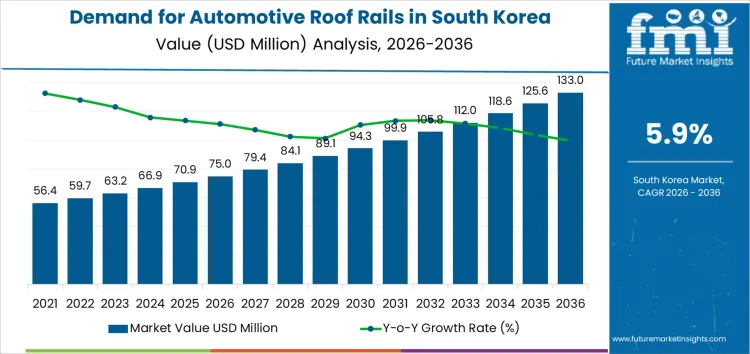
What is the Growth Forecast for the Automotive Roof Rail Market in South Korea through 2036?
The automotive roof rail segment in South Korea is expected to expand steadily through the forecast period, supported by stable vehicle production and increasing consumer preference for functional exterior accessories. Roof rails are gaining wider adoption as more buyers choose SUVs, crossovers, and lifestyle-oriented vehicles that emphasize utility, outdoor travel, and cargo flexibility. Automakers are also integrating roof rails as standard or premium-fit features to enhance styling and improve the overall perceived value of vehicles.
Growth will be further supported by rising demand for higher-quality and lightweight rail systems, especially as manufacturers focus on improved aerodynamics, noise reduction, and durability. Increased use of roof-mounted accessories such as carriers, bicycle racks, and rooftop storage solutions also strengthens aftermarket demand. In addition, premium vehicle segments increasingly prefer sleek and integrated designs, encouraging innovation in materials and mounting systems. Overall, the outlook remains positive, with demand driven by vehicle mix shifts toward SUVs, growing accessory penetration, and ongoing upgrades in design and performance standards across South Korea’s automotive industry.
Key Takeaways for Demand for Automotive Roof Rails in South Korea
| Metric | Value |
|---|---|
| Industry Sales Value (2026) | USD 75 million |
| Industry Forecast Value (2036) | USD 133 million |
| Industry Forecast CAGR (2026 to 2036) | 5.9% |
Why is the Demand for Automotive Roof Rails Growing in South Korea?
Demand for automotive roof rails in South Korea has increased in line with rising popularity of sport utility vehicles (SUVs) and crossovers, which are typically equipped with roof rails as standard or optional features. Historically, the South Korean automotive market was focused on compact cars and sedans, with limited accessory demand. As consumer preferences shifted toward vehicles that offered more utility for travel and cargo transport, roof rails became an essential feature. The growing interest in outdoor activities, such as cycling and camping, further fueled the demand for accessories that allow the transportation of equipment like bicycles, kayaks, and luggage. As a result, automotive manufacturers have expanded the availability of roof rails, offering them both as original equipment on new models and as aftermarket installations. This shift has been further supported by the increase in overall vehicle ownership, as more vehicles on the road naturally lead to greater demand for functional automotive accessories.
Looking forward, the demand for automotive roof rails in South Korea is expected to continue its upward trajectory. The expanding share of SUVs and crossovers in new vehicle sales, particularly in the domestic market, will contribute to ongoing growth. The increasing popularity of electric vehicles, especially those designed with versatile cargo options, will also play a role in boosting demand. The rise of e-commerce and direct-to-consumer sales channels will provide easier access to roof rails, making it more convenient for consumers to install them on their vehicles. As automotive customization and functionality continue to be prioritized, the demand for roof rails will remain a significant part of the vehicle accessory market in South Korea.
What Are the Key Segments in Demand for Automotive Roof Rails in South Korea?
Demand for automotive roof rails in South Korea is influenced by material types and vehicle types. Aluminum alloy dominates the material segment, accounting for 66.3%, followed by composite plastic and other materials. In terms of vehicle types, passenger vehicles lead the demand with a share of 70%, while commercial vehicles also contribute to the market. The growing automotive industry and the increasing need for vehicle customization drive the demand for roof rails in both passenger and commercial vehicles.
What Is the Demand Pattern for Automotive Roof Rails in South Korea by Material?
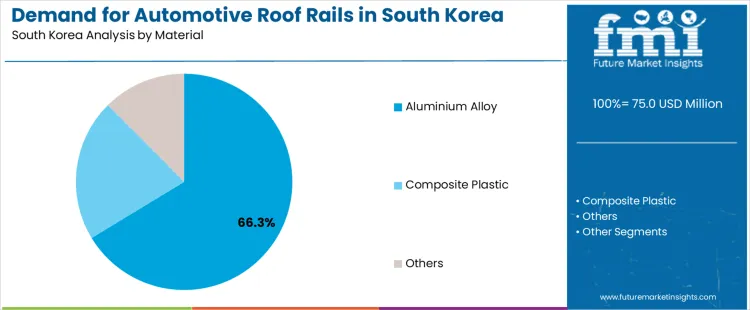
The demand for automotive roof rails in South Korea by material is primarily driven by aluminum alloy, which holds a significant share of 66.3%. Aluminum alloy is favored for its combination of strength, light weight, and corrosion resistance, making it ideal for automotive applications where durability and fuel efficiency are important. The lightweight nature of aluminum alloy helps reduce the overall weight of vehicles, thereby contributing to improved fuel efficiency and performance. Additionally, aluminum is resistant to rust and corrosion, making it a long-lasting material for automotive roof rails exposed to weather conditions. Composite plastic materials follow, though they represent a smaller share compared to aluminum.
Composite plastic is used in automotive roof rails for its cost-effectiveness, ease of manufacturing, and potential for custom designs. Composite materials offer benefits in terms of flexibility and weight reduction but are less durable than aluminum alloys, which limits their application in high-demand automotive markets. The “others” category includes materials such as stainless steel and advanced polymer composites, which are occasionally used in niche applications or for specific vehicle designs. As the automotive industry continues to focus on lightweight and efficient components, the demand for aluminum alloy in roof rails is expected to remain dominant, with other materials catering to more specialized needs.
What Is the Demand Pattern for Automotive Roof Rails in South Korea by Vehicle Type?
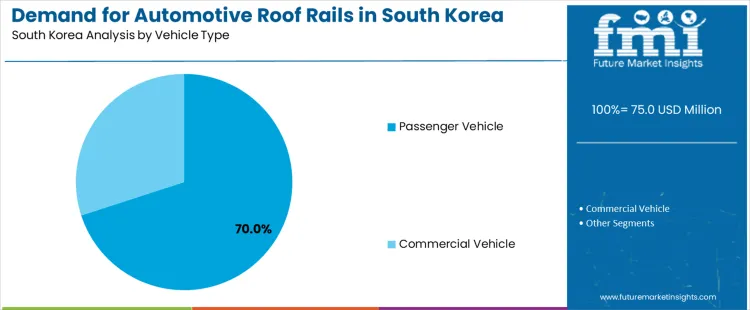
In South Korea, the demand for automotive roof rails is predominantly driven by passenger vehicles, which account for 70% of the market. This segment reflects the growing consumer demand for vehicle customization and enhanced functionality in passenger cars, particularly for outdoor activities and transportation of cargo. Roof rails are considered a desirable feature in SUVs, crossovers, and other vehicles designed for leisure and family use, where additional storage capacity is needed. The ability to carry bulky items like bicycles, kayaks, and luggage using roof rails is a key factor influencing their popularity in the passenger vehicle segment. Commercial vehicles also contribute to the demand for automotive roof rails, though to a lesser extent.
These vehicles, often used for transport and logistics, benefit from roof rails as they provide additional cargo space and can help carry goods that require secure, accessible loading. The demand for roof rails in commercial vehicles is often determined by the vehicle's intended use, with roof rails being more common in light commercial vehicles and vans. As the automotive market in South Korea continues to grow, the demand for roof rails is expected to increase, with passenger vehicles driving the bulk of this growth due to their popularity in urban and suburban markets.
What are the Key Dynamics in the Demand for Automotive Roof Rails in South Korea?
Demand for automotive roof rails in South Korea is tied to passenger vehicle production, consumer preferences for utility features, and aftermarket sales activities. Automotive roof rails form part of exterior automotive accessories that provide cargo support and utility function for sport utility vehicles, crossovers, and station wagons. South Korea’s automotive industry maintains significant production volumes for domestic market consumption and export. Consumer interest in outdoor lifestyle and cargo carrying capacity influences accessory adoption. The interplay between original equipment manufacturers and replacement parts suppliers shapes the dynamics in this component segment.
What are the Drivers of Demand for Automotive Roof Rails in South Korea?
Domestic vehicle production supporting SUVs and multi-purpose vehicles increases the integration of automotive roof rails at manufacturing stages. Consumers seeking additional cargo capacity for travel and utility use favor vehicles equipped with roof rails from the factory or through aftermarket installation. South Korea’s river of exports to regions that value utility features supports roof rail adoption. Growth in automotive aftermarket channels, including parts distributors and online platforms, broadens access to roof rail products. Regulatory focus on vehicle safety and standards ensures that accessory components meet prescribed criteria, reinforcing installation confidence among buyers.
What are the Restraints on Demand for Automotive Roof Rails in South Korea?
High ownership costs associated with premium vehicles can limit elective purchases of utility accessories. Some vehicle segments favored in South Korea, including compact sedans, have lower baseline demand for roof rails due to design priorities and consumer use patterns. Price sensitivity among certain buyer groups may reduce uptake of add-on accessories, particularly when roof rail kits carry additional installation charges. Supply chain variability affecting component availability can constrain timely delivery of roof rail products. Competitive pressures in the automotive parts sector influence margins for suppliers and can impact investment in roof rail product lines.
What Key Trends Affect Demand for Automotive Roof Rails in South Korea?
A trend toward increased SUV and crossover sales in the passenger vehicle mix supports greater incorporation of automotive roof rails. Aftermarket customization continues to attract vehicle owners who seek utility or aesthetic enhancements. Retail channels that provide bundling of roof rail systems with crossbars and cargo accessories expand consumer options. Manufacturers and suppliers are offering modular roof rail designs that align with vehicle aerodynamics and weight reduction objectives. Environmental considerations and fuel efficiency concerns nudge engineers to refine roof rail materials and mounting methods to minimize drag. Digital commerce for parts ordering and installation booking contributes to distribution efficiency in this accessory segment.
What is the Regional Analysis of Demand for Automotive Roof Rails in South Korea?
The demand for automotive roof rails in South Korea varies by region, driven by local automotive manufacturing activities, infrastructure development, and consumer trends. South Gyeongsang, with a CAGR of 6.2%, shows robust demand, supported by its strong presence in the automotive manufacturing sector. North Jeolla, with a growth rate of 4.7%, experiences more moderate demand, influenced by the regional industrial focus and consumer preferences. South Jeolla, with a projected CAGR of 5.6%, sees steady demand growth due to its expanding automotive and industrial sectors. Jeju, with the highest demand growth rate of 7.1%, reflects the region's increasing adoption of automotive roof rails in line with consumer demand for vehicle customization. Regional trends indicate that as the automotive industry grows, so does the demand for automotive roof rails, particularly in areas with a strong focus on manufacturing and transportation.
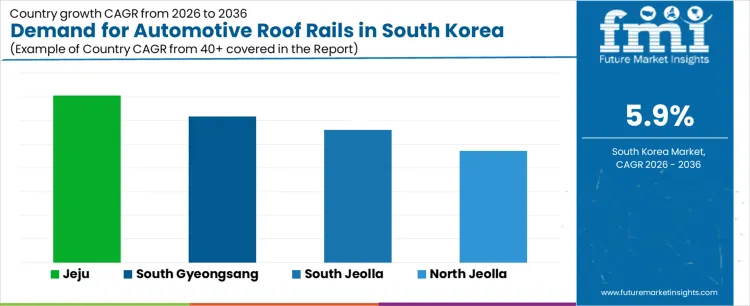
| Region | CAGR (2026 to 2036) |
|---|---|
| South Gyeongsang | 6.2% |
| North Jeolla | 4.7% |
| South Jeolla | 5.6% |
| Jeju | 7.1% |
What is the Demand for Automotive Roof Rails in South Gyeongsang?
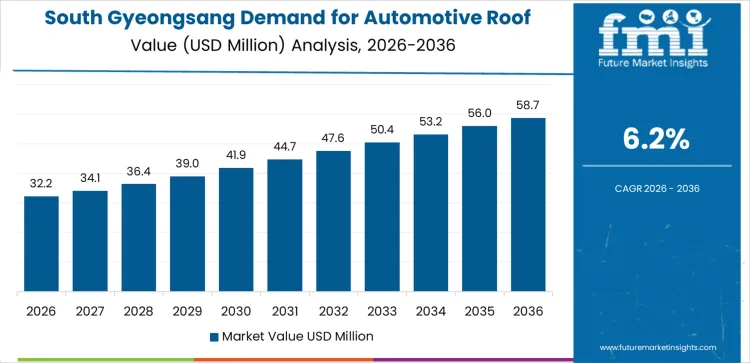
South Gyeongsang is expected to experience strong demand growth for automotive roof rails, with a CAGR of 6.2% from 2026 to 2036. The region is home to major automotive manufacturers and suppliers, making it a central hub for vehicle production. As the automotive industry continues to thrive, the demand for vehicle accessories like roof rails is expected to increase, driven by consumer preference for functionality and customization. With South Gyeongsang’s expanding automotive manufacturing capabilities and its growing consumer base, demand for automotive roof rails is projected to remain strong, contributing to the region's overall automotive sector growth.
What Drives Demand for Automotive Roof Rails in North Jeolla?
North Jeolla’s demand for automotive roof rails is projected to grow at a moderate pace, with a CAGR of 4.7%. The region has a significant automotive manufacturing base, but it is not as concentrated as in South Gyeongsang. While the automotive industry in North Jeolla is expanding, particularly with the rise of electric vehicle production, the demand for accessories like roof rails is growing more slowly. The region’s automotive sector is diversifying, which will contribute to a gradual increase in demand for automotive roof rails as more consumers opt for vehicles with these accessories. As North Jeolla's industrial landscape continues to evolve, its demand for automotive roof rails will likely increase steadily.
How is Demand for Automotive Roof Rails in South Jeolla Expected to Develop?
South Jeolla, with a projected CAGR of 5.6%, is experiencing steady demand growth for automotive roof rails. The region's growing automotive industry, particularly in the manufacturing of vehicle components, is driving this demand. As more vehicles are produced in South Jeolla, the need for vehicle accessories like roof rails increases. The region's expanding industrial capacity, along with consumer demand for functional vehicle features, supports the continued growth of automotive roof rail demand. South Jeolla’s strong industrial base in manufacturing and automotive components ensures a positive outlook for this market, with demand expected to rise in tandem with the region's automotive industry expansion.
What is the Demand for Automotive Roof Rails in Jeju?
Jeju is expected to experience the highest demand growth for automotive roof rails, with a CAGR of 7.1%. The region's growing automotive sector, influenced by increasing tourism and vehicle customization trends, is a significant driver of demand. As more consumers seek vehicles with additional storage and customization options, the need for automotive roof rails is expected to rise. Jeju’s emphasis on lifestyle and tourism-oriented vehicle features, combined with its expanding automotive market, positions the region for continued demand growth in automotive roof rails. As tourism increases, the demand for vehicles equipped with roof rails for enhanced cargo capacity is expected to continue growing in the region.
What is the Competitive Landscape for Automotive Roof Rails in South Korea?
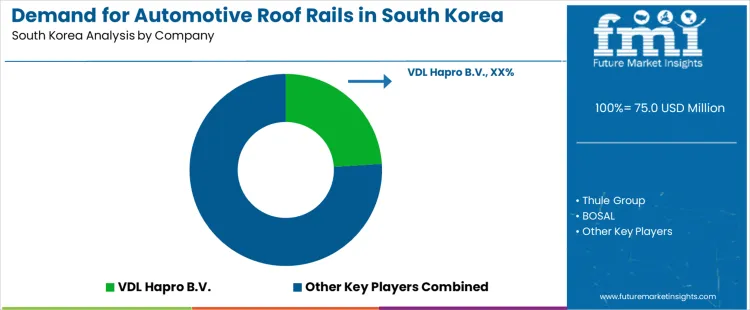
Demand for automotive roof rails in South Korea reflects trends in vehicle customization, utility features, and aftermarket enhancements. Adoption is concentrated in sport utility vehicles, crossovers, and light commercial vehicles where additional load-carrying capacity is valued. Consumer preference for outdoor activity accessories has supported sales of roof rail systems that provide base structures for cargo boxes, bike carriers, and luggage baskets. Production volumes of passenger vehicles with factory-installed roof rails have increased in response to model lineup expansions by domestic and foreign original equipment manufacturers. South Korea’s automotive sector continues to invest in variants that emphasize functional accessories, with roof rails integrated as standard or optional equipment on mid-range and premium models. Demand from the aftermarket segment has persisted, driven by individual owners and fleet operators seeking retrofit solutions that meet safety and performance criteria. Regulatory requirements for automotive accessories have maintained emphasis on load ratings, impact resistance, and corrosion protection, shaping procurement specifications for roof rail suppliers.
Key companies compete on product quality, system compatibility, and customer-facing literature that details technical specifications. VDL Hapro B.V. is recognized as a leading provider, with product brochures that specify material composition, load capacity, and fitment data for multiple vehicle models. Thule Group materials present modular roof rail solutions with emphasis on ease of installation and accessory integration, including details on attachment interfaces and tested weight limits. BOSAL documentation outlines roof rail systems engineered to meet durability standards, with specification sheets on corrosion resistance and wind noise performance. Magna International brochures describe roof rail assemblies designed for original equipment fitment, highlighting design tolerances and structural integrity metrics. Rhino-Rack literature focuses on robust roof rail platforms suited to aftermarket applications, including data on cross-bar compatibility and load distribution. These brochures typically include dimensional drawings, material grades, and certification information that inform purchasing decisions by automotive OEMs, tier suppliers, and aftermarket distributors in South Korea.
Key Players of the Demand for Automotive Roof Rails in South Korea
- VDL Hapro B.V.
- Thule Group
- BOSAL
- Magna International
- Rhino-Rack
Scope of the Report
| Items | Values |
|---|---|
| Quantitative Units (2026) | USD Million |
| Type | Roof Mount, Gutter, Raised Rails, Others |
| Material | Aluminium Alloy, Composite Plastic, Others |
| Vehicle Type | Passenger Vehicle, Commercial Vehicle |
| Sales Channel | OEM, Aftermarket |
| Companies | VDL Hapro B.V., Thule Group, BOSAL, Magna International, Rhino-Rack |
| Region Covered | South Korea |
| Provinces Covered | South Gyeongsang, North Jeolla, South Jeolla, Jeju |
| Additional Attributes | Dollar sales by type, material, vehicle type, and sales channel. Demand is driven by increased vehicle customization, growth in SUV and crossover sales, and rising adoption of lightweight aluminium and composite roof rail systems across OEM and aftermarket channels. |
Key Segments of Demand for Automotive Roof Rails in South Korea
Type
- Roof Mount
- Gutter
- Raised Rails
- Other
Material
- Aluminum Alloy
- Composite Plastic
- Other
Vehicle Type
- Passenger Vehicle
- Commercial Vehicle
- Other
Sales Channel
- OEM
- Aftermarket
- Other
Provinces
- South Gyeongsang
- North Jeolla
- South Jeolla
- Jeju
Bibliography
- Korea Automobile Manufacturers Association. (2024). Automotive accessory component production and export statistics in South Korea. KAMA.
- Ministry of Land, Infrastructure and Transport. (2025). Vehicle safety component standards and design guidelines. Government of the Republic of Korea.
- International Organization for Standardization. (2024). Road vehicles — Roof load carrier systems — Requirements and test methods (ISO 11154:2024). ISO.
Frequently Asked Questions
How big is the demand for automotive roof rails in south korea in 2026?
The demand for automotive roof rails in south korea is estimated to be valued at USD 75.0 million in 2026.
What will be the size of automotive roof rails in south korea in 2036?
The market size for the automotive roof rails in south korea is projected to reach USD 133.0 million by 2036.
How much will be the demand for automotive roof rails in south korea growth between 2026 and 2036?
The demand for automotive roof rails in south korea is expected to grow at a 5.9% CAGR between 2026 and 2036.
What are the key product types in the automotive roof rails in south korea?
The key product types in automotive roof rails in south korea are roof mount, gutter, raised rails and others.
Which material segment is expected to contribute significant share in the automotive roof rails in south korea in 2026?
In terms of material, aluminium alloy segment is expected to command 66.3% share in the automotive roof rails in south korea in 2026.
Preview the report firsthand - request a free sample
Get SampleGet the brochure for pricing and purchase details.
Get PDFTable of Content
- Executive Summary
- South Korea Market Outlook
- Demand-side Trends
- Supply-side Trends
- Technology Roadmap Analysis
- Analysis and Recommendations
- Market Overview
- Market Coverage / Taxonomy
- Market Definition / Scope / Limitations
- Market Background
- Market Dynamics
- Drivers
- Restraints
- Opportunity
- Trends
- Scenario Forecast
- Demand in Optimistic Scenario
- Demand in Likely Scenario
- Demand in Conservative Scenario
- Opportunity Map Analysis
- Product Life Cycle Analysis
- Supply Chain Analysis
- Investment Feasibility Matrix
- Value Chain Analysis
- PESTLE and Porter’s Analysis
- Regulatory Landscape
- Regional Parent Market Outlook
- Production and Consumption Statistics
- Import and Export Statistics
- Market Dynamics
- South Korea Market Analysis 2021 to 2025 and Forecast, 2026 to 2036
- Historical Market Size Value (USD Million) Analysis, 2021 to 2025
- Current and Future Market Size Value (USD Million) Projections, 2026 to 2036
- Y-o-Y Growth Trend Analysis
- Absolute $ Opportunity Analysis
- South Korea Market Pricing Analysis 2021 to 2025 and Forecast 2026 to 2036
- South Korea Market Analysis 2021 to 2025 and Forecast 2026 to 2036, By Type
- Introduction / Key Findings
- Historical Market Size Value (USD Million) Analysis By Type, 2021 to 2025
- Current and Future Market Size Value (USD Million) Analysis and Forecast By Type, 2026 to 2036
- Roof Mount
- Gutter
- Raised Rails
- Others
- Roof Mount
- Y-o-Y Growth Trend Analysis By Type, 2021 to 2025
- Absolute $ Opportunity Analysis By Type, 2026 to 2036
- South Korea Market Analysis 2021 to 2025 and Forecast 2026 to 2036, By Material
- Introduction / Key Findings
- Historical Market Size Value (USD Million) Analysis By Material, 2021 to 2025
- Current and Future Market Size Value (USD Million) Analysis and Forecast By Material, 2026 to 2036
- Aluminium Alloy
- Composite Plastic
- Others
- Aluminium Alloy
- Y-o-Y Growth Trend Analysis By Material, 2021 to 2025
- Absolute $ Opportunity Analysis By Material, 2026 to 2036
- South Korea Market Analysis 2021 to 2025 and Forecast 2026 to 2036, By Vehicle Type
- Introduction / Key Findings
- Historical Market Size Value (USD Million) Analysis By Vehicle Type, 2021 to 2025
- Current and Future Market Size Value (USD Million) Analysis and Forecast By Vehicle Type, 2026 to 2036
- Passenger Vehicle
- Commercial Vehicle
- Passenger Vehicle
- Y-o-Y Growth Trend Analysis By Vehicle Type, 2021 to 2025
- Absolute $ Opportunity Analysis By Vehicle Type, 2026 to 2036
- South Korea Market Analysis 2021 to 2025 and Forecast 2026 to 2036, By Sales Channel
- Introduction / Key Findings
- Historical Market Size Value (USD Million) Analysis By Sales Channel, 2021 to 2025
- Current and Future Market Size Value (USD Million) Analysis and Forecast By Sales Channel, 2026 to 2036
- OEM
- Aftermarket
- OEM
- Y-o-Y Growth Trend Analysis By Sales Channel, 2021 to 2025
- Absolute $ Opportunity Analysis By Sales Channel, 2026 to 2036
- Market Structure Analysis
- Competition Dashboard
- Competition Benchmarking
- Market Share Analysis of Top Players
- By Regional
- By Type
- By Material
- By Vehicle Type
- By Sales Channel
- Competition Analysis
- Competition Deep Dive
- VDL Hapro B.V.
- Overview
- Product Portfolio
- Profitability by Market Segments (Product/Age /Sales Channel/Region)
- Sales Footprint
- Strategy Overview
- Marketing Strategy
- Product Strategy
- Channel Strategy
- Thule Group
- BOSAL
- Magna International
- Rhino-Rack
- VDL Hapro B.V.
- Competition Deep Dive
- Assumptions & Acronyms Used
- Research Methodology


