

- Industry Size (2026)
- USD 58.5 Mn
- Forecast (2036)
- USD 92.3 Mn
- CAGR (2026 to 2036)
- 4.7%
Demand for Collapsible Rigid Containers in South Korea Forecast and Outlook 2026 to 2036
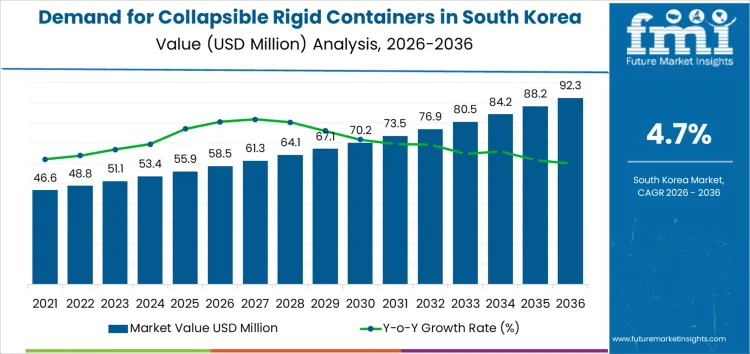
The demand for collapsible rigid containers in South Korea is projected to reach USD 92.3 million by 2036, growing at a CAGR of 4.7% from USD 58.5 million in 2026. The cost structure within this market is influenced by key factors such as raw material costs, manufacturing efficiencies, and supply chain dynamics. Pricing control is largely in the hands of leading manufacturers, whose ability to scale operations and secure long-term contracts allows them to maintain stable margins.
Margin concentration is high, with a few large players capturing the majority of the industry value, primarily through cost leadership and vertical integration. As competition intensifies, companies that innovate in material sourcing and optimize production processes are likely to hold the upper hand in value capture. The industry's evolution will be shaped not only by sales volume but by the strategic management of operational costs and pricing leverage.
Quick Stats for the Demand for Collapsible Rigid Containers in South Korea
- Collapsible Rigid Containers in South Korea Value (2026): USD 58.5 million
- Collapsible Rigid Containers in South Korea Forecast Value (2036): USD 92.3 million
- Collapsible Rigid Containers in South Korea Global Forecast CAGR (2026 to 2036): 4.7%
- Collapsible Rigid Containers in South Korea Leading Segment: Plastic (56%)
- Key Growth Regions of Collapsible Rigid Containers in South Korea: Jeju (leading CAGR ~5.6%)
- Top Players of Collapsible Rigid Containers in South Korea: Brambles Limited, Supreme Industries Limited, Schoeller Allibert Services B.V., DS Smith plc, SSI Schäfer AG
What is the Growth Forecast for the Collapsible Rigid Container Market in South Korea through 2036?
The collapsible rigid container market in South Korea is expected to experience steady growth over the forecast period. The industry is projected to start at USD 58.5 million in 2026 and increase to USD 61.3 million in 2027. By 2028, the industry value is expected to reach USD 64.1 million, followed by USD 67.1 million in 2029. The value will continue to rise, reaching USD 70.2 million in 2030 and USD 73.5 million in 2031.
Further growth will see the industry value rise to USD 76.9 million in 2032 and USD 80.5 million in 2033. By 2034, the industry is expected to grow to USD 84.2 million, and in 2035, the value is projected to reach USD 88.2 million. The industry will continue its upward trajectory, reaching USD 92.3 million in 2036. This growth highlights the increasing adoption of collapsible rigid containers across industries in South Korea, driven by the demand for efficient and sustainable packaging solutions.
Key Takeaways of Collapsible Rigid Containers in South Korea
| Metric | Value |
|---|---|
| Industry Sales Value (2026) | USD 58.5 million |
| Industry Forecast Value (2036) | USD 92.3 million |
| Industry Forecast CAGR (2026 to 2036) | 4.7% |
Why is the Demand for Collapsible Rigid Containers Growing in South Korea?
The demand for collapsible rigid containers in South Korea has been increasing due to several key factors, primarily driven by the need for space-efficient, durable, and cost-effective packaging solutions. Historically, these containers gained popularity in industries like manufacturing and logistics, where they provided the advantage of durability combined with the ability to collapse and save space during return transport or storage. The rise of urbanization and limited storage space in distribution centers and warehouses further fueled the adoption of collapsible containers. South Korea's strict regulations on waste management and recycling encouraged businesses to shift to reusable packaging solutions, reducing the need for single-use alternatives and aligning with sustainability goals.
Looking ahead, the demand for collapsible rigid containers in South Korea is expected to continue growing, driven by the expansion of the e-commerce sector and the increasing need for efficient logistics solutions. Companies in industries such as food and beverage, pharmaceuticals, and chemicals are adopting these containers to meet hygiene standards and ensure product safety during transportation. The benefits of reduced reverse logistics costs and minimal storage space requirements are especially valuable as supply chains grow more complex. Innovations in container materials and design are improving their performance and cost-effectiveness, making them a more attractive option for businesses seeking to optimize both packaging and logistics operations.
What are the key segments collapsible rigid containers sector in South Korea by material type and product type?
Demand for collapsible rigid containers in South Korea is segmented by material type and product type. Material type covers plastic, metal, and others, with plastic holding the largest share at 56 %. Product type comprises crates, foldable intermediate bulk containers (IBCs), pallets boxes, and jerry cans, with crates leading at 45.1 %. Regional demand is shaped by industrial and logistics needs.
What is the demand pattern for collapsible rigid containers in South Korea by material type?
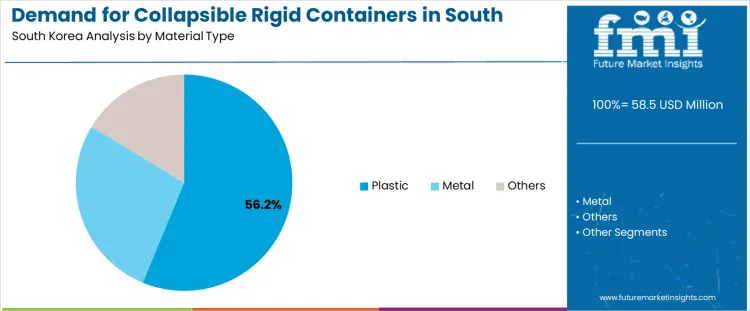
Demand for collapsible rigid containers in South Korea by material type is concentrated in plastic products, which account for 56 % of the material segment. This dominance reflects a preference for lighter weight and cost efficient solutions in logistics and storage operations. Plastic containers see extensive use across manufacturing, retail, and distribution sectors where frequent handling and rapid turnaround are priorities. The physical properties of plastic, including resistance to corrosion and ease of cleaning, support applications where hygiene and durability are important. Metal containers are used where load strength and resistance to extreme conditions are required, though they hold a smaller portion of the material segment.
Use of metal persists in heavy industry and sectors with rigorous handling standards. Others, including composite materials and engineered polymers, cater to niche requirements where specific performance attributes are sought. Demand trends show that operators favor material solutions that balance lifecycle cost and operational efficiency. Cost considerations affect procurement decisions where cost per use and repair rates influence total expenditure. Sustainability practices within supply chains have led some buyers to assess recyclability and end of life handling. Material selection aligns with downstream use cases, handling frequency, and compatibility with existing logistics systems. In South Korea’s market, plastic’s share underscores its role in meeting broad utility requirements while supporting cost and performance expectations.
What is the demand pattern for collapsible rigid containers in South Korea by product type?
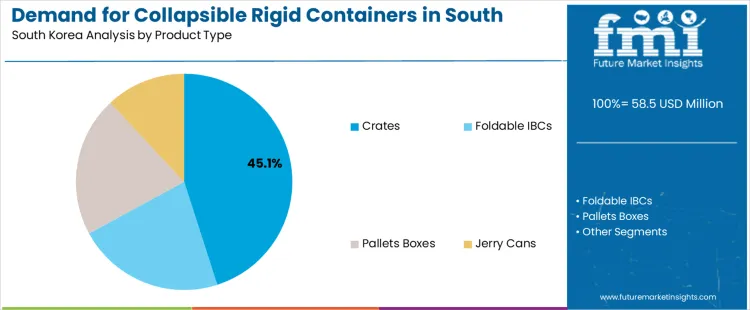
Demand for collapsible rigid containers in South Korea by product type is led by crates, which command 45.1 % of this segment. Crates serve a wide range of industries and distribution systems where modular storage and transport elements streamline operations. Their design facilitates stacking, space utilization, and ease of access to contents, making them suitable for warehousing, retail distribution, and intra facility movement. Foldable intermediate bulk containers (IBCs) follow crates in relevance where bulk handling and fluid or granule storage require larger capacity units. IBCs are used in chemical processing, food ingredient handling, and industrial supply chains, though their share is below that of crates.
Pallets boxes contribute to integrated palletized logistics where containers interface with forklift and automated systems. Their selection reflects preferences for consolidated unit loads and compatibility with mechanized handling. Jerry cans are chosen for specific liquid transport needs, particularly in sectors that require smaller volume, portable solutions. Demand patterns show that buyers weigh criteria including ease of handling, return logistics costs, and compatibility with existing transport systems. The leading position of crates indicates that segment priorities emphasize operational flexibility and space efficiency. Product selection correlates with use case requirements, container life, and total cost impacts. In South Korea’s context, crates continue to meet diverse operational demands across sectors with high turnover and dynamic storage needs.
What are the Key Dynamics for Collapsible Rigid Containers in South Korea?
Demand for collapsible rigid containers in South Korea is linked to logistics efficiency, warehouse space optimization, and supply chain cost control. These containers support industrial packaging, automotive parts transport, and electronics component handling. The South Korean manufacturing sector’s emphasis on lean operations and cost reduction drives interest in reusable packaging solutions. Growth in e-commerce and distribution networks also contributes to demand, as retailers and logistics providers seek durable, space-saving material handling options. Industrial packaging, freight transport, and returnable transit packaging are common use cases for these containers in the industry.
What are the Drivers Propelling the Demand for Collapsible Rigid Containers in South Korea?
Demand drivers include rapid expansion of domestic logistics networks and the need for efficient warehouse utilization. Collapsible rigid containers help reduce storage space when empty, supporting just-in-time delivery and inventory management. South Korea’s export-oriented manufacturing base, especially in automotive and electronics, requires dependable packaging solutions that lower freight damage risk. Sustainability and corporate cost management practices also influence container adoption. Companies pursue reusable packaging to reduce waste and operational expenditures. Growth in e-commerce and omnichannel fulfillment further increases the need for robust, returnable transport packaging suited to frequent handling and movement.
What are the Restraints on Demand for Collapsible Rigid Containers in South Korea?
Restraints include high initial investment in reusable packaging compared with single-use alternatives. Some small and medium enterprises may find upfront costs difficult to justify in tight margin environments. Logistics providers with limited warehouse space may also face challenges in managing return flows for collapsible containers. Market adoption is uneven across sectors, with traditional packaging still prevalent in smaller distribution channels. Regulatory complexity related to packaging standards and recycling protocols influences procurement decisions and can slow deployment. Price sensitivity in competitive supply chains may reduce willingness to shift from conventional packaging even when lifecycle cost benefits exist.
What Key Trends Affect Demand for Collapsible Rigid Containers in South Korea?
A notable trend is the integration of collapsible rigid containers into automated material handling systems and smart warehouse operations. Companies are adopting RFID and barcode tracking to improve container visibility and turnover rates. Sustainable supply chain practices are gaining emphasis, pushing procurement toward reusable and recyclable packaging solutions. Demand is increasing in automotive parts logistics as manufacturers optimize tier-1 and tier-2 supplier flows. Retailers and third-party logistics firms are also standardizing packaging formats to streamline reverse logistics and reduce damage during transit. Collaboration between manufacturers and logistics partners on returnable packaging programs is emerging as a method to share cost benefits and improve asset utilization.
What is the Regional Analysis of Collapsible Rigid Containers Sector in South Korea?
The demand for collapsible rigid containers in South Korea varies significantly across its regions. Factors such as industrial activities, logistics infrastructure, and regional economic strengths influence the demand. The demand for these containers is notably high in regions with strong manufacturing and logistics sectors, such as South Gyeongsang and Jeju. South Gyeongsang, home to major industrial centers, shows a growth rate of 4.9%, reflecting its strong manufacturing capabilities. On the other hand, regions like North Jeolla, with a slightly lower demand of 3.7%, indicate a less industrially concentrated environment. In contrast, South Jeolla and Jeju show relatively higher growth, with demand growth rates of 4.4% and 5.6%, respectively. These regions have seen increased investment in infrastructure and logistics, contributing to the higher demand for collapsible rigid containers.
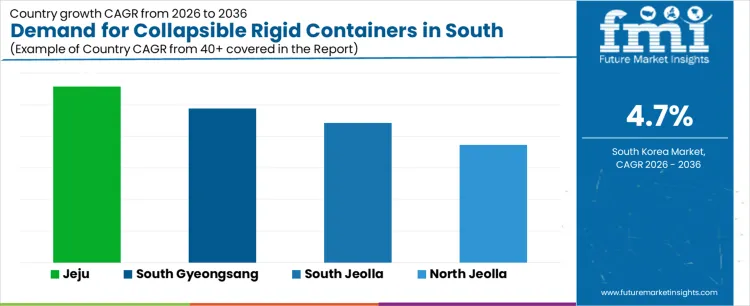
| Province | CAGR (2026 to 2036) |
|---|---|
| South Gyeongsang | 4.9% |
| North Jeolla | 3.7% |
| South Jeolla | 4.4% |
| Jeju | 5.6% |
What is the Demand Outlook for Collapsible Rigid Containers in South Gyeongsang?
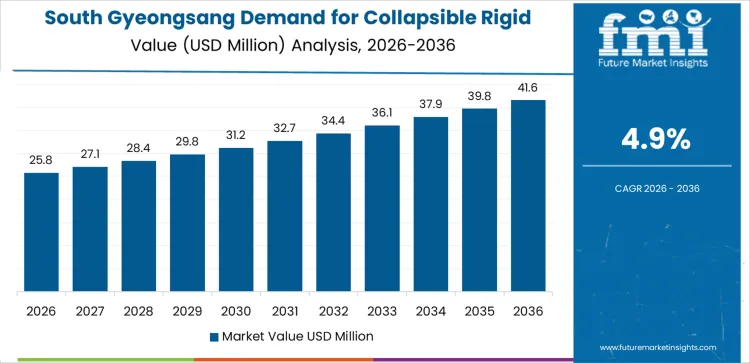
South Gyeongsang, a major industrial and manufacturing hub, has a substantial demand for collapsible rigid containers, with a CAGR of 4.9% from 2026 to 2036. The region is home to a variety of industries, including electronics, petrochemicals, and automotive manufacturing, which drive the demand for efficient and reusable packaging solutions. As these industries grow, the need for reliable, space-saving packaging solutions, like collapsible rigid containers, continues to increase. The region’s strong logistics infrastructure and industrial activities contribute significantly to its demand, supporting a positive growth outlook.
What is Driving the Demand for Collapsible Rigid Containers in North Jeolla?
North Jeolla, with a CAGR of 3.7%, demonstrates a relatively slower pace of demand growth for collapsible rigid containers. The region’s economy is less industrially concentrated than other regions like South Gyeongsang or Jeju, which results in more moderate growth. The demand in North Jeolla is primarily driven by agriculture and smaller-scale manufacturing. While the region has a growing logistics and distribution sector, it lacks the same level of industrial development seen in more central regions. Despite this, as the local economy diversifies, demand for collapsible rigid containers is expected to increase modestly, particularly in the packaging and agricultural sectors.
What is Propelling the Demand for Collapsible Rigid Containers in South Jeolla?
South Jeolla shows a solid demand growth for collapsible rigid containers, with a CAGR of 4.4% from 2026 to 2036. The region benefits from its industrial base, which includes chemicals, shipbuilding, and manufacturing. South Jeolla has seen steady investments in infrastructure, which has enhanced its logistics and distribution capabilities. As a result, industries that require durable and efficient packaging solutions, such as collapsible rigid containers, are experiencing growth. The demand is expected to continue rising, particularly in the sectors of manufacturing and logistics, as these industries expand and integrate more sustainable packaging practices.
What is the Demand for Collapsible Rigid Containers in Jeju?
Jeju, with the highest CAGR of 5.6%, stands out for its increasing demand for collapsible rigid containers. The region’s strong focus on tourism, agriculture, and local manufacturing has contributed to this trend. Jeju’s ongoing development in infrastructure, particularly in logistics and transportation, has bolstered the demand for efficient packaging solutions. The tourism industry, in particular, drives demand for packaging that supports the transportation of goods. Additionally, the growing agricultural sector in Jeju is fostering a need for durable and reusable packaging options. The combination of these factors is expected to result in robust demand growth for collapsible rigid containers in the region.
What is the Competitive Landscape for Collapsible Rigid Containers in South Korea?
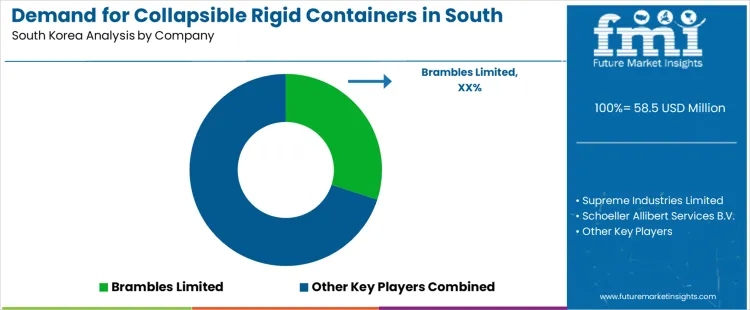
The demand for collapsible rigid containers in South Korea is steadily growing, driven by the country's expanding logistics and supply chain industries. These containers are valued for their ability to optimize storage space and reduce transportation costs, which is crucial in industries such as food and beverage, automotive, and pharmaceuticals. Their reusable nature supports sustainability efforts, while their durability ensures they can withstand the rigors of repeated use. The rising need for cost-effective packaging solutions, combined with the growing focus on environmental concerns, is expected to increase their adoption. South Korean companies are adopting these containers to streamline their operations, reduce waste, and improve the efficiency of reverse logistics.
Key players in the industry, such as Brambles Limited, Supreme Industries Limited, Schoeller Allibert Services B.V., DS Smith plc, and SSI Schäfer AG, are strengthening their positions by expanding product offerings and targeting specific industry requirements. These companies emphasize the technical specifications of their collapsible rigid containers, highlighting features like load capacity, ease of storage, and cost savings. Marketing strategies involve promoting product brochures that focus on material durability, foldability, and compatibility with automated systems. As demand rises, these companies are expected to continue innovating their product lines to cater to a wider range of industries, particularly those requiring secure, efficient, and reusable packaging solutions.
Key Players of the Demand for Collapsible Rigid Containers in South Korea
- Brambles Limited
- Supreme Industries Limited
- Schoeller Allibert Services B.V.
- DS Smith plc
- SSI Schäfer AG
Scope of the Report
| Items | Values |
|---|---|
| Quantitative Units (2026) | USD Million |
| Material Type | Plastic, Metal, Others |
| Product Type | Crates, Foldable IBCs, Pallets Boxes, Jerry Cans |
| Sales Channel | Direct, Indirect |
| End Use | Automobile, Pharmaceutical, Chemical, Agriculture, Food & Beverage, Shipping & Logistics, Other Manufacturing |
| Companies | Brambles Limited, Supreme Industries Limited, Schoeller Allibert Services B.V., DS Smith plc, SSI Schäfer AG |
| Region Covered | South Korea |
| Provinces Covered | South Gyeongsang, North Jeolla, South Jeolla, Jeju |
| Additional Attributes | Dollar sales by material type, product type, sales channel, and end use. Demand is driven by the need for durable, space-efficient storage and transport solutions across automotive, pharmaceuticals, chemicals, and logistics sectors. Plastic-based collapsible containers dominate due to lightweight construction and reusability. |
Key Segments of Demand for Collapsible Rigid Containers in South Korea
Material Type
- Plastic
- Metal
- Others
Product Type
- Crates
- Foldable IBCs
- Pallet Boxes
- Jerry Cans
- Other
Sales Channel
- Direct
- Indirect
- Other
End Use
- Automobile
- Pharmaceutical
- Chemical
- Agriculture
- Food & Beverage
- Shipping & Logistics
- Other Manufacturing
Provinces
- South Gyeongsang
- North Jeolla
- South Jeolla
- Jeju
Bibliography
- Brambles Limited. (2024). Reusable and collapsible rigid containers for industrial supply chains – product portfolio and specifications. Brambles Limited.
- Supreme Industries Limited. (2024). Industrial material handling solutions: Collapsible containers and pallet systems. Supreme Industries Limited.
- Schoeller Allibert. (2024). Foldable large containers and returnable packaging solutions. Schoeller Allibert Services B.V.
- DS Smith. (2024). Reusable and circular packaging solutions for industrial logistics. DS Smith plc.
- SSI Schaefer. (2024). Large load carriers and collapsible container systems. SSI Schäfer AG.
Frequently Asked Questions
How big is the demand for collapsible rigid containers in south korea in 2026?
The demand for collapsible rigid containers in south korea is estimated to be valued at USD 58.5 million in 2026.
What will be the size of collapsible rigid containers in south korea in 2036?
The market size for the collapsible rigid containers in south korea is projected to reach USD 92.3 million by 2036.
How much will be the demand for collapsible rigid containers in south korea growth between 2026 and 2036?
The demand for collapsible rigid containers in south korea is expected to grow at a 4.7% CAGR between 2026 and 2036.
What are the key product types in the collapsible rigid containers in south korea?
The key product types in collapsible rigid containers in south korea are plastic, metal and others.
Which product type segment is expected to contribute significant share in the collapsible rigid containers in south korea in 2026?
In terms of product type, crates segment is expected to command 45.1% share in the collapsible rigid containers in south korea in 2026.
Preview the report firsthand - request a free sample
Get SampleGet the brochure for pricing and purchase details.
Get PDFTable of Content
- Executive Summary
- South Korea Market Outlook
- Demand-side Trends
- Supply-side Trends
- Technology Roadmap Analysis
- Analysis and Recommendations
- Market Overview
- Market Coverage / Taxonomy
- Market Definition / Scope / Limitations
- Market Background
- Market Dynamics
- Drivers
- Restraints
- Opportunity
- Trends
- Scenario Forecast
- Demand in Optimistic Scenario
- Demand in Likely Scenario
- Demand in Conservative Scenario
- Opportunity Map Analysis
- Product Life Cycle Analysis
- Supply Chain Analysis
- Investment Feasibility Matrix
- Value Chain Analysis
- PESTLE and Porter’s Analysis
- Regulatory Landscape
- Regional Parent Market Outlook
- Production and Consumption Statistics
- Import and Export Statistics
- Market Dynamics
- South Korea Market Analysis 2021 to 2025 and Forecast, 2026 to 2036
- Historical Market Size Value (USD Million) Analysis, 2021 to 2025
- Current and Future Market Size Value (USD Million) Projections, 2026 to 2036
- Y-o-Y Growth Trend Analysis
- Absolute $ Opportunity Analysis
- South Korea Market Pricing Analysis 2021 to 2025 and Forecast 2026 to 2036
- South Korea Market Analysis 2021 to 2025 and Forecast 2026 to 2036, By Material Type
- Introduction / Key Findings
- Historical Market Size Value (USD Million) Analysis By Material Type, 2021 to 2025
- Current and Future Market Size Value (USD Million) Analysis and Forecast By Material Type, 2026 to 2036
- Plastic
- Metal
- Others
- Plastic
- Y-o-Y Growth Trend Analysis By Material Type, 2021 to 2025
- Absolute $ Opportunity Analysis By Material Type, 2026 to 2036
- South Korea Market Analysis 2021 to 2025 and Forecast 2026 to 2036, By Product Type
- Introduction / Key Findings
- Historical Market Size Value (USD Million) Analysis By Product Type, 2021 to 2025
- Current and Future Market Size Value (USD Million) Analysis and Forecast By Product Type, 2026 to 2036
- Crates
- Foldable IBCs
- Pallets Boxes
- Jerry Cans
- Crates
- Y-o-Y Growth Trend Analysis By Product Type, 2021 to 2025
- Absolute $ Opportunity Analysis By Product Type, 2026 to 2036
- South Korea Market Analysis 2021 to 2025 and Forecast 2026 to 2036, By Sales Channel
- Introduction / Key Findings
- Historical Market Size Value (USD Million) Analysis By Sales Channel, 2021 to 2025
- Current and Future Market Size Value (USD Million) Analysis and Forecast By Sales Channel, 2026 to 2036
- Direct
- Indirect
- Direct
- Y-o-Y Growth Trend Analysis By Sales Channel, 2021 to 2025
- Absolute $ Opportunity Analysis By Sales Channel, 2026 to 2036
- South Korea Market Analysis 2021 to 2025 and Forecast 2026 to 2036, By End Use
- Introduction / Key Findings
- Historical Market Size Value (USD Million) Analysis By End Use, 2021 to 2025
- Current and Future Market Size Value (USD Million) Analysis and Forecast By End Use, 2026 to 2036
- Automobile
- Pharmaceutical
- Chemical
- Agriculture
- Food & Beverage
- Shipping & Logistics
- Other Manufacturing
- Automobile
- Y-o-Y Growth Trend Analysis By End Use, 2021 to 2025
- Absolute $ Opportunity Analysis By End Use, 2026 to 2036
- Market Structure Analysis
- Competition Dashboard
- Competition Benchmarking
- Market Share Analysis of Top Players
- By Regional
- By Material Type
- By Product Type
- By Sales Channel
- By End Use
- Competition Analysis
- Competition Deep Dive
- Brambles Limited
- Overview
- Product Portfolio
- Profitability by Market Segments (Product/Age /Sales Channel/Region)
- Sales Footprint
- Strategy Overview
- Marketing Strategy
- Product Strategy
- Channel Strategy
- Supreme Industries Limited
- Schoeller Allibert Services B.V.
- DS Smith plc
- SSI Schäfer AG
- Brambles Limited
- Competition Deep Dive
- Assumptions & Acronyms Used
- Research Methodology


