

- Industry Size (2026)
- USD 233.4 Mn
- Forecast (2036)
- USD 385.9 Mn
- CAGR (2026 to 2036)
- 5.2%
Demand for Collapsible Rigid Containers in United Kingdom Forecast and Outlook 2026 to 2036
The collapsible rigid containers market in the United Kingdom is forecast to grow from USD 233.4 million in 2026 to USD 385.9 million by 2036, at a CAGR of 5.2%. Cost structures will be a key factor influencing profitability in this market, as fluctuations in raw material prices, such as plastics and metals, can significantly affect production costs. Manufacturers with efficient supply chains and economies of scale will have the ability to maintain competitive pricing and stronger margins. Pricing control will be essential as suppliers face increasing pressure from large buyers, who are likely to demand cost reductions without compromising quality. Companies that can adapt to shifting cost dynamics, while delivering superior product features and maintaining flexibility, will be best positioned to capture value. Margin concentration will become more pronounced, with larger players gaining more control over pricing and product innovation, allowing them to secure long-term contracts and outpace smaller competitors in profitability.
Quick Stats for the Demand for Collapsible Rigid Containers in United Kingdom
- Collapsible Rigid Containers in United Kingdom Value (2026): USD 233.4 million
- Collapsible Rigid Containers in United Kingdom Forecast Value (2036): USD 385.9 million
- Collapsible Rigid Containers in United Kingdom Forecast CAGR (2026 to 2036): 5.2%
- Collapsible Rigid Containers in United Kingdom Leading Segment: Plastic (53.4% share)
- Key Growth Regions of Collapsible Rigid Containers in United Kingdom: England
- Top Players of Collapsible Rigid Containers in United Kingdom: Brambles Limited, Supreme Industries Limited, Schoeller Allibert Services B.V., DS Smith plc, SSI Schäfer AG
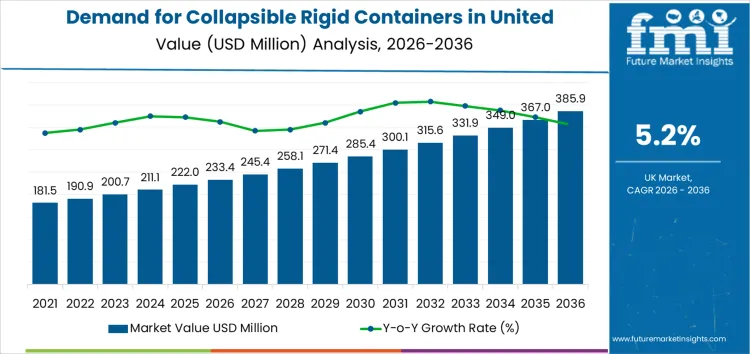
What is the Growth Forecast for Collapsible Rigid Containers in United Kingdom through 2036?
The collapsible rigid containers segment in the United Kingdom is expected to expand steadily through the forecast period, supported by rising demand for reusable, space-efficient packaging across logistics, manufacturing, and food distribution networks. These containers are increasingly preferred because they improve handling efficiency, reduce return transport costs, and support organized storage in supply chains where turnaround speed and asset utilization matter. Growth is also supported by the shift toward reusable transit packaging and stronger sustainability goals across industrial operations.
Long-term value accumulation is expected to remain consistent, driven by gradual adoption rather than sharp inflection points. As more companies build container fleets and integrate collapsible formats into routine operations, replacement demand and fleet expansion become stronger contributors to ongoing growth. The outlook remains stable with limited volatility, reflecting the utility nature of the product and its alignment with cost-saving logistics models. Over time, wider penetration across distribution centers, manufacturing hubs, and retail-linked supply chains will continue to support predictable demand, keeping the segment on a steady upward trajectory.
Key Takeaways for Demand for Collapsible Rigid Containers in United Kingdom
| Metric | Value |
|---|---|
| Industry Sales Value (2026) | USD 233.4 million |
| Industry Forecast Value (2036) | USD 385.9 million |
| Industry Forecast CAGR (2026 to 2036) | 5.2% |
Why is Demand for Collapsible Rigid Containers in United Kingdom Growing?
Demand for collapsible rigid containers in the United Kingdom has strengthened as industrial and logistics operations prioritised flexibility in storage and transport. Historically, rigid containers served static roles in long haul freight and warehousing where reuse and durability were primary criteria. In the UK, manufacturers of automotive parts, electronics, and consumer goods began shifting toward collapsible designs that combine the strength of traditional rigid solutions with space saving benefits when empty. This shift reflected broader supply chain adjustments in response to fluctuating freight costs and constrained warehouse capacity.
Operators found that containers which fold flat between cycles reduced return haul volume and lowered storage footprint, contributing to lower logistics costs. Returnable packaging programmes incorporating collapsible units also improved control over container assets, reducing dependency on one way packaging and easing inventory pressures. Adoption was supported by procurement teams seeking robust returnable solutions that withstand repeated handling without compromising product protection.
Looking ahead, demand for collapsible rigid containers in the United Kingdom is expected to grow as end users and suppliers focus on efficiency and total cost of ownership. Manufacturers with multi tier supplier networks will value containers that streamline flows between production sites and distribution centres while minimising wasted space. Growing integration of reusable packaging into circular supply chain strategies will reinforce purchases of containers that collapse for cost effective repositioning. Tier 1 suppliers supplying automotive and industrial sectors may standardise on collapsible designs to harmonise packaging across diverse product lines. Warehouse operators could specify these containers to improve aisle clearance and reduce congestion during peak activity. Purchasing teams evaluating packaging investments will weigh longevity, handling characteristics, and lifecycle costs, supporting continued uptick in demand for collapsible rigid solutions within UK logistics and manufacturing ecosystems.
What Are the Key Segments in the Demand for Collapsible Rigid Containers in the United Kingdom?
Demand for collapsible rigid containers in the United Kingdom is driven by material type and product type. Plastic leads the material type segment with 53.4%, while crates dominate the product type segment with 42.8%. Other material types, such as metal and others, including pallet boxes and jerry cans, also contribute to the market. These segments reflect the growing need for efficient, space-saving packaging solutions across industries such as logistics, food & beverage, and manufacturing.
What Is the Material Type Segment of Demand for Collapsible Rigid Containers in the United Kingdom?
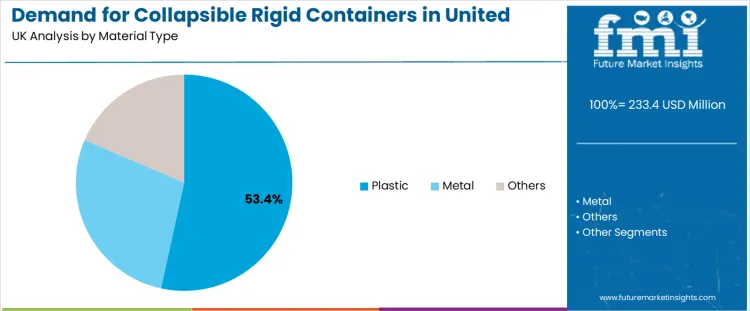
The material type segment for collapsible rigid containers in the United Kingdom is led by plastic, which accounts for 53.4% of the market share. Plastic containers are favored for their versatility, lightweight properties, and resistance to wear and tear. They are commonly used in the logistics, food & beverage, and retail industries, where durability and ease of transport are essential. Plastic containers can be easily folded for efficient storage, making them a popular choice for businesses looking to optimize space when containers are not in use. Their resistance to corrosion and ability to withstand a range of temperatures also contribute to their popularity.
Metal containers follow as a smaller segment, representing a more durable option for heavy-duty applications. Metal containers, such as foldable IBCs (Intermediate Bulk Containers), are commonly used for transporting and storing liquids and bulk materials, especially in industries like chemicals, pharmaceuticals, and agriculture. While heavier than plastic, metal containers are valued for their strength and long-lasting performance in demanding environments. Other materials, including composite containers or specialized options, cater to niche applications. These include pallet boxes and jerry cans, which are used for bulk storage and liquid transportation, respectively. The plastic segment remains dominant due to its broad applicability and cost-effective properties, while metal and other materials serve specialized, high-durability needs.
What Is the Product Type Segment of Demand for Collapsible Rigid Containers in the United Kingdom?
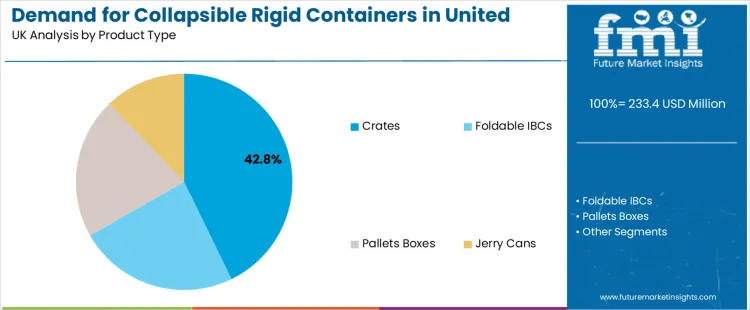
The product type segment for collapsible rigid containers in the United Kingdom is primarily led by crates, which account for 42.8% of the market share. Crates are widely used across various industries, especially in food & beverage, retail, and logistics, where they serve as ideal solutions for organizing, transporting, and storing goods. Crates offer versatility, ease of handling, and efficient space utilization, especially in supply chain and warehousing operations. Their ability to collapse for compact storage makes them a popular choice for companies looking to reduce storage costs when containers are not in use. Foldable IBCs (Intermediate Bulk Containers), typically made of metal or plastic, follow as a significant product type, particularly in industries that require larger volume containers for transporting bulk goods like liquids and powders.
These containers are essential in sectors such as chemicals, pharmaceuticals, and agriculture, where safe, sturdy packaging is required. Pallet boxes, another key product type, are used for storing and moving large quantities of goods, often in industrial or bulk transport settings. Jerry cans, used primarily for liquids, represent a smaller segment but are highly valued for their portability and secure sealing, making them ideal for industries requiring the transport of fluids in smaller, manageable units. The demand for each product type reflects specific industry needs, with crates dominating the market due to their widespread use in everyday logistics and handling operations.
What are the Key Dynamics in the Demand for Collapsible Rigid Containers in the United Kingdom?
Demand for collapsible rigid containers in the United Kingdom is linked to sectors that require returnable, reusable packaging for storage, transport, and material handling. These containers are employed in automotive parts distribution, retail logistics, electronics, food processing, and industrial supply chains. Procurement reflects supply chain optimisation strategies aimed at reducing packaging waste, lowering transport costs, and improving warehouse space utilisation. Demand is shaped by manufacturing output, seasonal peaks in production and retail activity, and shifts toward circular economy practices that prioritise durable packaging over single-use alternatives.
What are the Key Drivers for Collapsible Rigid Container Demand in the United Kingdom?
Several factors drive demand for collapsible rigid containers in the United Kingdom. Corporate focus on supply chain cost efficiency supports uptake because collapsible containers reduce freight volume and rental costs when empty. Growth in manufacturing, particularly automotive and electronics, increases need for robust returnable packaging that protects components and supports just-in-time delivery. Warehousing and distribution operations prioritise stackable, space-efficient containers to optimise floor space and reduce storage expenses. Environmental commitments by large retailers and industrial operators encourage substitution of disposable packaging with reusable rigid systems to meet sustainability objectives and reduce packaging waste.
What are the Restraints on Collapsible Rigid Container Demand in the United Kingdom?
Despite advantages, demand for collapsible rigid containers in the United Kingdom encounters restraints. Higher upfront cost relative to single-use packaging can deter smaller enterprises with limited capital budgets. Adoption requires commitment to returnable packaging programmes and reverse logistics systems, which may increase operational complexity. Availability of standardized container sizes that fit existing pallet and racking systems influences compatibility and may limit uptake where custom sizes are required. Competition from alternative reusable solutions, such as foldable bulk bins and pallet boxes made from different materials, also affects procurement choices. Variable industrial activity can delay investment in reusable packaging infrastructure.
What are the Key Trends in Collapsible Rigid Container Demand in the United Kingdom?
Key trends influencing demand for collapsible rigid containers in the United Kingdom include integration of tracking technologies like barcodes and RFID to improve visibility in returnable asset loops and reduce loss. Corporations are prioritising modular container systems that adapt to varied product sizes and transport modes, supporting flexibility across supply chains. Emphasis on sustainability and circular packaging strategies encourages replacement of single-use cartons and crates with reusable rigid options. Logistics service providers and manufacturers are collaborating to standardise reusable container pools, lowering total cost of ownership. Demand is also shaped by automation in warehouses, where containers compatible with conveyors and robotics are preferred to support efficient material flow.
What is the Country-Wise Demand for Collapsible Rigid Containers in the United Kingdom?
The country-wise demand for collapsible rigid containers in the United Kingdom shows varying growth across its regions. England leads the market, supported by its large retail, logistics, and manufacturing sectors, where collapsible rigid containers are widely used for efficient storage and transportation. Scotland, Wales, and Northern Ireland follow with steady demand, driven by similar industries in their respective regions. The increasing emphasis on space-saving, cost-effective packaging solutions and the growing adoption of sustainable practices in the logistics and manufacturing sectors are driving the demand for collapsible rigid containers. While England remains the dominant market, growth in other regions is expected to continue, fueled by expanding industries and the need for more efficient packaging solutions.
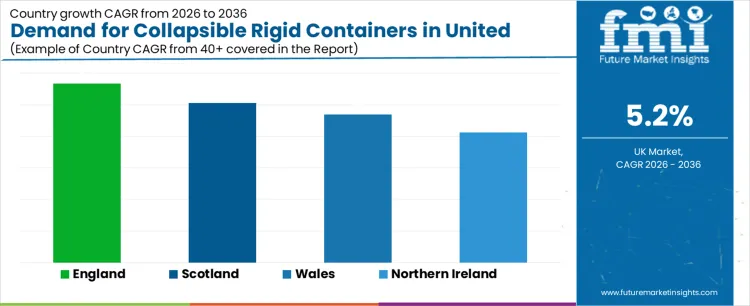
| Country | CAGR (2026 to 2036) |
|---|---|
| England | 5.7% |
| Scotland | 5.1% |
| Wales | 4.7% |
| Northern Ireland | 4.1% |
What is Driving the Demand for Collapsible Rigid Containers in England?
The demand for collapsible rigid containers in England is projected to grow at a CAGR of 5.7% from 2026 to 2036. England’s large retail, logistics, and manufacturing industries are the main drivers of this demand. Collapsible rigid containers are increasingly being used in supply chains due to their space-saving properties, which reduce storage and transportation costs. The UK’s push towards sustainability in packaging is another significant factor driving demand. Collapsible rigid containers, being reusable and durable, help businesses minimize waste and lower packaging costs. The growing focus on supply chain efficiency, combined with increased regulations surrounding packaging waste, ensures steady growth in the demand for these containers in England. As logistics operations and e-commerce continue to expand, the need for efficient, sustainable packaging solutions will maintain the strong demand for collapsible rigid containers.
How is the Demand for Collapsible Rigid Containers Performing in Scotland?
In Scotland, the demand for collapsible rigid containers is expected to grow at a CAGR of 5.1% from 2026 to 2036. The demand is driven by the growing logistics, retail, and manufacturing sectors, where businesses are increasingly seeking cost-effective and space-efficient packaging solutions. Collapsible rigid containers are particularly popular in industries that require efficient product storage and transport, such as food and beverage, automotive, and electronics. Additionally, as sustainability becomes a key focus for Scottish businesses, the demand for reusable and durable packaging solutions like collapsible rigid containers is rising. The growing adoption of e-commerce in Scotland is also contributing to the demand for these containers, as online retailers require flexible and efficient packaging options for their operations. Overall, the increased focus on sustainability and operational efficiency is expected to support continued demand for collapsible rigid containers in Scotland.
What Are the Growth Drivers for Collapsible Rigid Containers in Wales?
The demand for collapsible rigid containers in Wales is projected to grow at a CAGR of 4.7% through 2036. The food and beverage, retail, and manufacturing sectors in Wales are the primary drivers of this demand, as collapsible containers offer businesses a space-saving and cost-effective solution for storage and transportation. As Welsh businesses continue to prioritize sustainability, the demand for collapsible rigid containers, which can be reused and recycled, is expected to rise. Additionally, the growing need for efficient supply chain management in Wales is driving the adoption of these containers, particularly in industries that require high-volume product transport and storage. The increasing focus on reducing packaging waste, combined with the growth of the logistics and e-commerce sectors, is expected to support continued market growth in Wales.
What is the Outlook for Collapsible Rigid Containers Demand in Northern Ireland?
Northern Ireland’s demand for collapsible rigid containers is expected to grow at a CAGR of 4.1% from 2026 to 2036. While Northern Ireland represents the smallest market in the United Kingdom, the demand for these containers is steadily increasing due to the growing focus on cost-effective and sustainable packaging solutions in the region’s logistics and manufacturing sectors. Collapsible rigid containers are being increasingly adopted by businesses looking to optimize storage and reduce transportation costs. As Northern Ireland’s industries focus on sustainability and improved supply chain efficiency, the use of collapsible rigid containers is expected to grow. The increasing demand for flexible, reusable packaging options in industries such as food, retail, and automotive is contributing to this steady growth. Though the market is smaller compared to other regions, the ongoing trend toward efficient packaging solutions in Northern Ireland suggests a positive growth outlook.
What is the Competitive Landscape for Demand for Collapsible Rigid Containers in the United Kingdom?
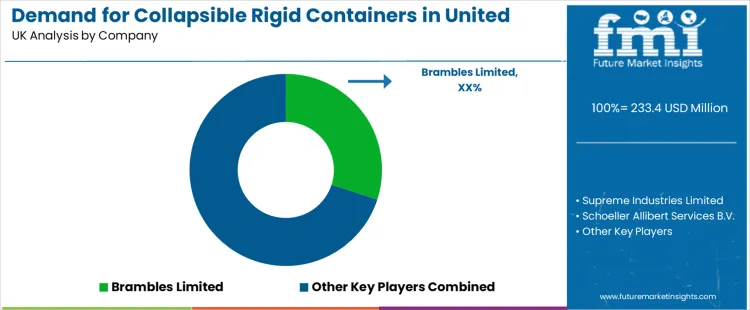
Demand for collapsible rigid containers in the United Kingdom is influenced by logistics optimization, storage efficiency goals, and sustainability requirements within supply chains. Procurement teams in manufacturing, retail, and logistics sectors specify containers based on documented load capacities, foldability features, and material durability. Brochures from Brambles Limited, positioned as a leading supplier, detail grade options, stack load ratings, and documented use cases in closed loop pallet systems that are referenced by buyers when aligning selection with warehouse footprint constraints. Supreme Industries Limited competes with documented container specifications that list polymer grades, hinge designs, and documented lifecycle performance values that are used to map container choice to transport cycles. Buyers evaluate these documented attributes to ensure containers meet handling protocols and automated systems compatibility.
Schoeller Allibert Services B.V. supplies collapsible rigid container solutions with technical literature highlighting wall strength values, ergonomic handling features, and recommended application sectors. Specification sheets from Schoeller Allibert are consulted by procurement professionals in the United Kingdom when aligning container properties with payload types and cross docking operations. DS Smith plc participates with rigid container systems supported by documentation that presents documented weight limits, recycling notes, and fold flat performance metrics. SSI Schäfer AG offers container solutions documented with assembly parameters, load stability data, and integration options with storage systems. Buyers compare documented performance values and documented supply terms to ensure that selected containers satisfy operational and regulatory criteria. Lead times and documented distribution capabilities appear in supplier brochures and are used during tender evaluations and planning cycles.
Procurement decisions in the United Kingdom reflect scheduled production demands and logistics planning horizons. Technical teams review documented handling instructions and documented compliance notes to align container choice with industry standards. Competitive activity is grounded in documented product attributes and documented supply commitments provided by each company. Documentation serves as the basis for specification alignment, contract negotiations, and storage system integration, anchoring selection in measurable technical data and documented reliability indicators rather than subjective assessments.
Key Players of the Demand for Collapsible Rigid Containers in United Kingdom
- Brambles Limited
- Supreme Industries Limited
- Schoeller Allibert Services B.V.
- DS Smith plc
- SSI Schäfer AG
Scope of the Report
| Items | Values |
|---|---|
| Quantitative Units (2026) | USD Million |
| Material Type | Plastic, Metal, Others |
| Product Type | Crates, Foldable IBCs, Pallets Boxes, Jerry Cans |
| Sales Channel | Direct, Indirect |
| End Use | Automobile, Pharmaceutical, Chemical, Agriculture, Food & Beverage, Shipping & Logistics, Other Manufacturing |
| Companies | Brambles Limited, Supreme Industries Limited, Schoeller Allibert Services B.V., DS Smith plc, SSI Schäfer AG |
| Regions Covered | United Kingdom |
| Countries Covered | England, Scotland, Wales, Northern Ireland |
| Additional Attributes | Dollar by sales by material type, product type, sales channel, end use, and region. Includes market trends towards cost-effectiveness, sustainability, and the role of collapsible rigid containers in various industries. |
Key Segments of Demand for Collapsible Rigid Containers in United Kingdom
Material Type
- Plastic
- Metal
- Others
Product Type
- Crates
- Foldable IBCs
- Pallets Boxes
- Jerry Cans
Sales Channel
- Direct
- Indirect
End Use
- Automobile
- Pharmaceutical
- Chemical
- Agriculture
- Food & Beverage
- Shipping & Logistics
- Other Manufacturing
Countries
- England
- Scotland
- Wales
- Northern Ireland
Bibliography
- Department for Environment, Food & Rural Affairs. (2025). Producer Responsibility Obligations (Packaging and Packaging Waste) Regulations 2024. UK Government.
- Department for Environment, Food & Rural Affairs & Environment Agency. (2025). Extended producer responsibility for packaging: Guidance on obligations and reporting. UK Government.
- Department for Environment, Food & Rural Affairs & Environment Agency. (2025). Packaging data: What to collect for extended producer responsibility. UK Government.
Frequently Asked Questions
How big is the demand for collapsible rigid containers in United Kingdom in 2026?
The demand for collapsible rigid containers in United Kingdom is estimated to be valued at USD 233.4 million in 2026.
What will be the size of collapsible rigid containers in United Kingdom in 2036?
The market size for the collapsible rigid containers in United Kingdom is projected to reach USD 385.9 million by 2036.
How much will be the demand for collapsible rigid containers in United Kingdom growth between 2026 and 2036?
The demand for collapsible rigid containers in United Kingdom is expected to grow at a 5.2% CAGR between 2026 and 2036.
What are the key product types in the collapsible rigid containers in United Kingdom?
The key product types in collapsible rigid containers in United Kingdom are plastic, metal and others.
Which product type segment is expected to contribute significant share in the collapsible rigid containers in United Kingdom in 2026?
In terms of product type, crates segment is expected to command 42.8% share in the collapsible rigid containers in United Kingdom in 2026.
Preview the report firsthand - request a free sample
Get SampleGet the brochure for pricing and purchase details.
Get PDFTable of Content
- Executive Summary
- UK Market Outlook
- Demand-side Trends
- Supply-side Trends
- Technology Roadmap Analysis
- Analysis and Recommendations
- Market Overview
- Market Coverage / Taxonomy
- Market Definition / Scope / Limitations
- Market Background
- Market Dynamics
- Drivers
- Restraints
- Opportunity
- Trends
- Scenario Forecast
- Demand in Optimistic Scenario
- Demand in Likely Scenario
- Demand in Conservative Scenario
- Opportunity Map Analysis
- Product Life Cycle Analysis
- Supply Chain Analysis
- Investment Feasibility Matrix
- Value Chain Analysis
- PESTLE and Porter’s Analysis
- Regulatory Landscape
- Regional Parent Market Outlook
- Production and Consumption Statistics
- Import and Export Statistics
- Market Dynamics
- UK Market Analysis 2021 to 2025 and Forecast, 2026 to 2036
- Historical Market Size Value (USD Million) Analysis, 2021 to 2025
- Current and Future Market Size Value (USD Million) Projections, 2026 to 2036
- Y-o-Y Growth Trend Analysis
- Absolute $ Opportunity Analysis
- UK Market Pricing Analysis 2021 to 2025 and Forecast 2026 to 2036
- UK Market Analysis 2021 to 2025 and Forecast 2026 to 2036, By Material Type
- Introduction / Key Findings
- Historical Market Size Value (USD Million) Analysis By Material Type , 2021 to 2025
- Current and Future Market Size Value (USD Million) Analysis and Forecast By Material Type , 2026 to 2036
- Plastic
- Metal
- Others
- Plastic
- Y-o-Y Growth Trend Analysis By Material Type , 2021 to 2025
- Absolute $ Opportunity Analysis By Material Type , 2026 to 2036
- UK Market Analysis 2021 to 2025 and Forecast 2026 to 2036, By Product Type
- Introduction / Key Findings
- Historical Market Size Value (USD Million) Analysis By Product Type, 2021 to 2025
- Current and Future Market Size Value (USD Million) Analysis and Forecast By Product Type, 2026 to 2036
- Crates
- Foldable IBCs
- Pallets Boxes
- Jerry Cans
- Crates
- Y-o-Y Growth Trend Analysis By Product Type, 2021 to 2025
- Absolute $ Opportunity Analysis By Product Type, 2026 to 2036
- UK Market Analysis 2021 to 2025 and Forecast 2026 to 2036, By Sales Channel
- Introduction / Key Findings
- Historical Market Size Value (USD Million) Analysis By Sales Channel, 2021 to 2025
- Current and Future Market Size Value (USD Million) Analysis and Forecast By Sales Channel, 2026 to 2036
- Direct
- Indirect
- Direct
- Y-o-Y Growth Trend Analysis By Sales Channel, 2021 to 2025
- Absolute $ Opportunity Analysis By Sales Channel, 2026 to 2036
- UK Market Analysis 2021 to 2025 and Forecast 2026 to 2036, By End Use
- Introduction / Key Findings
- Historical Market Size Value (USD Million) Analysis By End Use, 2021 to 2025
- Current and Future Market Size Value (USD Million) Analysis and Forecast By End Use, 2026 to 2036
- Automobile
- Pharmaceutical
- Chemical
- Agriculture
- Food & Beverage
- Shipping & Logistics
- Other Manufacturing
- Automobile
- Y-o-Y Growth Trend Analysis By End Use, 2021 to 2025
- Absolute $ Opportunity Analysis By End Use, 2026 to 2036
- Market Structure Analysis
- Competition Dashboard
- Competition Benchmarking
- Market Share Analysis of Top Players
- By Regional
- By Material Type
- By Product Type
- By Sales Channel
- By End Use
- Competition Analysis
- Competition Deep Dive
- Brambles Limited
- Overview
- Product Portfolio
- Profitability by Market Segments (Product/Age /Sales Channel/Region)
- Sales Footprint
- Strategy Overview
- Marketing Strategy
- Product Strategy
- Channel Strategy
- Supreme Industries Limited
- Schoeller Allibert Services B.V.
- DS Smith plc
- SSI Schäfer AG
- Brambles Limited
- Competition Deep Dive
- Assumptions & Acronyms Used
- Research Methodology


