

- Industry Size (2026)
- USD 93.4 Mn
- Forecast (2036)
- USD 221.6 Mn
- CAGR (2026 to 2036)
- 9%
Demand for Online Clothing Rental in South Korea Forecast and Outlook 2026 to 2036
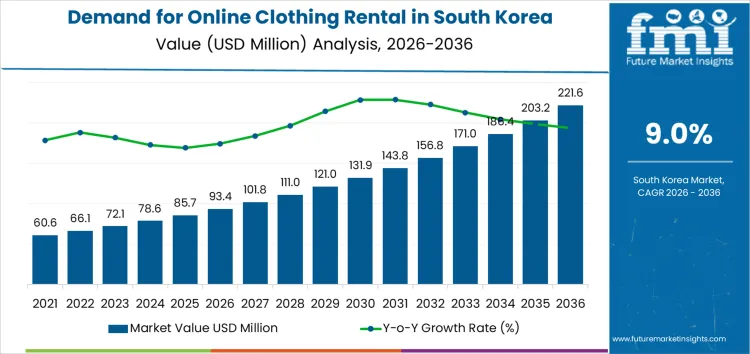
The demand for online clothing rental in South Korea is projected to grow from USD 93.4 million to USD 221.6 million by 2036 at a CAGR of 9%. This space is emerging as a key player within the broader fashion and e-commerce industries, offering a sustainable and cost-effective alternative to traditional clothing consumption. Its role is increasingly influential, especially as consumers seek flexibility in fashion without the long-term commitment of ownership. The competitive weight of the online clothing rental market is rising, with established brands leveraging technological advancements and extensive product ranges to differentiate themselves. At the same time, new entrants continue to disrupt the industry, emphasizing convenience and personalization. The industry’s growth trajectory indicates a shift in consumer behavior, where rental models are gaining ground over purchasing, positioning this sector as a significant force in shaping the future of fashion retail and contributing to broader sustainability trends.
Quick Stats for the Demand for Online Clothing Rental in South Korea
- Online Clothing Rental in South Korea Value (2026): USD 93.4 million
- Online Clothing Rental in South Korea Forecast Value (2036): USD 221.6 million
- Online Clothing Rental in South Korea Forecast CAGR (2026 to 2036): 9%
- Online Clothing Rental in South Korea Leading Segment: Business-to-Business (B2B) (94.1%)
- Key Growth Regions of Online Clothing Rental in South Korea: Jeju (leading CAGR ~10.8%)
- Top Players of Online Clothing Rental in South Korea: Rent the Runway, H&M (H&M Rental), MyWardrobeHQ, Le Tote, GlamCorner
What is the Growth Forecast for the Online Clothing Rental Market in South Korea through 2036?
The online clothing rental market in South Korea is projected to grow rapidly from 2026 to 2036. Starting at USD 93.4 million in 2026, the industry is expected to increase to USD 101.8 million in 2027. By 2028, the industry value will reach USD 111.0 million, followed by USD 121.0 million in 2029. The industry will continue to expand, reaching USD 131.9 million in 2030 and USD 143.8 million in 2031.
In the subsequent years, demand for online clothing rental services will increase further, with the industry projected to reach USD 156.8 million in 2032 and USD 171.0 million in 2033. By 2034, the industry value will reach USD 186.4 million, growing to USD 203.2 million in 2035. By 2036, the industry is expected to reach USD 221.6 million. The rolling compound annual growth rate (CAGR) analysis reveals strong growth driven by the increasing demand for sustainable fashion and the convenience of online rental services. The industry's expansion reflects the growing shift in consumer behavior and the rise of the sharing economy in South Korea.
Key Takeaways for Demand for Online Clothing Rental in South Korea
| Metric | Value |
|---|---|
| Industry Sales Value (2026) | USD 93.4 million |
| Industry Forecast Value (2036) | USD 221.6 million |
| Industry Forecast CAGR (2026 to 2036) | 9% |
Why is the Demand for Online Clothing Rental Growing in South Korea?
Demand for online clothing rental services in South Korea is rising as consumer behavior shifts toward flexible fashion access and cost-efficient wardrobe options. Urban consumers, particularly younger demographics, are increasingly open to using rental platforms rather than owning multiple seasonal or occasion-specific garments. This change reflects pressure on household spending, heightened awareness of fashion variety, and preference for digital purchase journeys. Rental platforms reduce the need for large upfront purchases, allowing consumers to access designer labels and trending styles through subscription or pay-per-use models. South Korea’s high smartphone penetration and established e-commerce infrastructure support seamless online discovery, ordering, and return logistics. From a supply perspective, fashion brands and rental operators have developed partnerships that integrate inventory across digital platforms and physical collection points, improving product availability. Retailers using data analytics to forecast demand by style, size, and season improve inventory turns and reduce idle stock. This analytical insight assists both rental platforms and fashion manufacturers in aligning stock with consumer preferences, enhancing overall utilization rates in clothing portfolios.
Looking ahead, online clothing rental in South Korea presents strategic opportunities for manufacturers, suppliers, and platform operators as market adoption broadens. Companies that offer durable garments designed for multiple wear cycles can differentiate through quality while reducing lifecycle costs. Suppliers of laundry, logistics, and garment-tracking technologies benefit from rising volumes as platforms seek scalable solutions for cleaning, inspection, and reverse logistics. Machine-readable tags and real-time inventory systems improve turnaround efficiency and reduce losses. Integrating personalization features, such as AI-driven style recommendations and size fit prediction, can increase repeat usage and customer lifetime value. Collaboration between fashion brands and rental services to co-develop exclusive collections optimized for rental use may open new revenue streams. Operational partnerships that enhance delivery speed and garment care quality will influence consumer retention. As consumer acceptance of shared fashion grows, companies aligned with operational excellence and digital innovation are positioned to capture expanding demand in South Korea’s online clothing rental market.
What Are the Key Segments in Demand for Online Clothing Rental in South Korea?
The demand for online clothing rental in South Korea is driven by both product type and end-user segments. The key product types include ethnic wear, knitwear, trousers & jeans, jumpsuits, coats & jackets, and performance wear, with ethnic wear leading the industry at 31%. In terms of end users, the business-to-business (B2B) segment dominates, accounting for 94.1% of the industry, followed by business-to-consumer (B2C) rentals. The growing interest in sustainable fashion and the need for affordable, high-quality clothing are key drivers behind this demand.
How Does Product Type Influence Demand for Online Clothing Rental in South Korea?
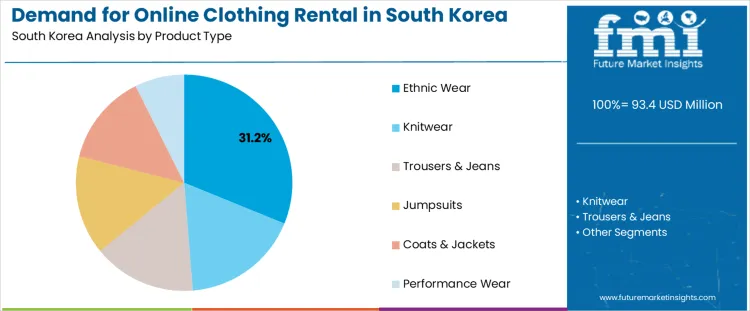
Product type plays a significant role in shaping the demand for online clothing rental in South Korea. Ethnic wear, which accounts for 31% of the industry, remains the leading category due to its seasonal and event-specific nature. Renting ethnic wear allows consumers to access high-quality garments for weddings, festivals, and cultural events without the need for long-term ownership, which can be expensive and space-consuming. This is particularly appealing in South Korea, where cultural attire is worn occasionally but requires high investment. Knitwear is another popular category in online clothing rental, with growing demand due to its comfort and versatility. As fashion trends move toward more casual and flexible dressing styles, knitwear has become a staple in both everyday wear and more formal occasions. Items like trousers & jeans, jumpsuits, and coats & jackets also contribute to the industry, as they are sought after for a variety of events, from casual outings to business meetings. Performance wear, though a smaller segment, is gaining traction as more consumers engage in sports or fitness activities and require specialized attire on a temporary basis. As the fashion rental model continues to grow in South Korea, these product types will likely evolve, catering to a broader range of consumer needs for both everyday wear and special occasions.
What Is the Demand for Online Clothing Rental in South Korea by End-User Segment?
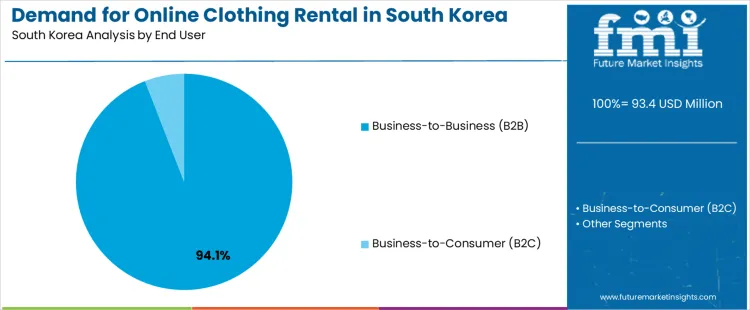
The demand for online clothing rental in South Korea is heavily dominated by the business-to-business (B2B) segment, which accounts for a staggering 94.1% of the industry. In this segment, clothing rental services are primarily used by businesses, such as fashion retailers, event planners, and production companies, that require large quantities of clothing for short-term use. These businesses benefit from the flexibility and cost savings offered by rental services, as they can access high-quality clothing for events, photo shoots, or seasonal collections without the need for large upfront investments. B2B clients value the convenience of renting garments for their employees, models, or clients, especially for high-demand periods or specific events. On the other hand, the business-to-consumer (B2C) segment remains a smaller portion of the industry but is growing steadily. Consumers in South Korea are increasingly adopting the rental model, especially for high-cost or infrequently worn items such as ethnic wear, special event attire, or seasonal clothing. The B2C market benefits from increased awareness of the environmental benefits of renting over owning, as well as the desire for variety and cost-efficiency in fashion. This shift is supported by South Korea’s tech-savvy population and the growth of e-commerce platforms that allow easy browsing, renting, and returning of garments. As demand for sustainable fashion grows, the B2C segment is expected to expand, while the B2B market will continue to be a key driver in the evolution of the online clothing rental industry.
What are the Key Dynamics in the Demand for Online Clothing Rental in South Korea?
Demand for online clothing rental in South Korea is shaped by changing consumer lifestyles, digital commerce adoption, and evolving attitudes toward ownership and sustainability. Younger consumers and urban professionals increasingly prefer flexible wardrobe access without long-term purchase commitments, particularly for special occasion wear and premium fashion. Mobile app usage and high broadband penetration support seamless browsing, fitting guidance, and logistics coordination. Platforms that integrate size recommendation tools and curated style selections attract repeat engagement. Supply partnerships between rental platforms and fashion brands influence inventory variety and availability. Payment ecosystem sophistication, including subscription models and secure digital wallets, also affects purchase frequency and customer retention.
What are the Drivers of Demand for Online Clothing Rental in South Korea?
A key driver is widespread internet and smartphone adoption that enables convenient browsing, reservation, and return processes. Urban consumers with limited closet space see value in accessing a curated rotation of apparel without ownership obligations. Rising interest in experiences over possessions, amplified by social media fashion culture, motivates users to rotate outfits for events and everyday wear. Sustainability considerations, including reduced waste and circular consumption narratives, support rental platform positioning, especially among environmentally conscious cohorts. Brands exploring omnichannel strategies engage with rental providers to extend reach and data insights on consumer preferences. Efficient logistics networks and reverse-logistics solutions further encourage platform scalability and timely delivery.
What are the Restraints on Demand for Online Clothing Rental in South Korea?
Restraints include cultural preferences that still favor ownership, particularly for everyday basics and high-value fashion investments. Concerns about hygiene, fit accuracy, and condition of rented garments can dissuade certain buyer segments, requiring platforms to invest in transparent cleaning standards and return policies. Pricing sensitivity remains a challenge, especially where subscription fees or per-rental charges approach the cost of mid-range retail purchases. Inventory management complexity, including size range diversity and seasonal demand fluctuations, increases operational costs for suppliers and platforms. Competition from peer-to-peer rental models and second-hand marketplaces can also fragment demand and erode platform loyalty.
What Key Trends Affect Demand for Online Clothing Rental in South Korea?
A significant trend is the rise of data-driven personalization tools that match users with styles and sizes based on purchase history and body metrics, improving conversion rates. Collaboration between rental platforms and fashion designers is generating exclusive capsule collections that create differentiation. Subscription tiering with defined benefits, such as priority delivery and complimentary stylist support, is attracting loyal subscribers. Eco-labeling and transparent sustainability metrics are being incorporated into marketing narratives to appeal to eco-aware consumers. Logistics innovations, including scheduled pickup services and automated locker returns, streamline the customer experience and lower friction points that previously limited repeat rentals. Retailers with physical footprints are also integrating rental services in stores, allowing customers to try garments before committing to rental orders online.
What is the Regional Demand Outlook for Online Clothing Rental in South Korea?
The demand for online clothing rental services in South Korea is rising across various regions, driven by shifting consumer preferences toward convenience, sustainability, and fashion. South Gyeongsang, with a projected CAGR of 9.5%, is showing strong demand, supported by its growing interest in fashion and e-commerce. North Jeolla, with a growth rate of 7.2%, demonstrates moderate demand, reflecting increasing consumer awareness of sustainable fashion and the popularity of rental services among younger demographics. South Jeolla, with a CAGR of 8.6%, is also seeing steady demand growth as more consumers seek flexible, affordable fashion solutions. Jeju, with the highest growth rate of 10.8%, stands out for its rapidly expanding demand, driven by tourism, the local population’s interest in eco-friendly solutions, and the increasing accessibility of online rental platforms. The regional trends indicate that as e-commerce and sustainability trends continue to grow, online clothing rental services are poised for further expansion.
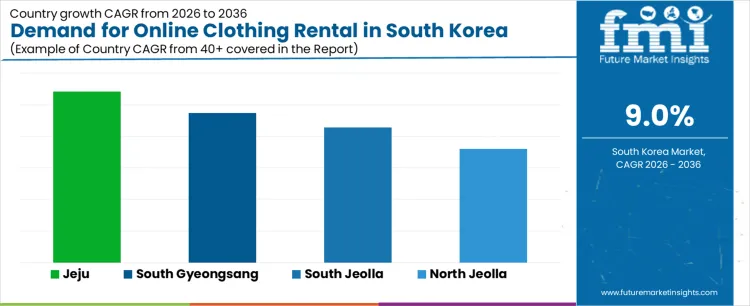
| Region | CAGR (2026 to 2036) |
|---|---|
| South Gyeongsang | 9.5% |
| North Jeolla | 7.2% |
| South Jeolla | 8.6% |
| Jeju | 10.8% |
How Can Online Clothing Rental Companies Leverage the industry in South Gyeongsang?
South Gyeongsang, with a projected CAGR of 9.5%, presents a strong opportunity for online clothing rental companies. The region’s growing interest in fashion and digital services, coupled with the demand for convenient and sustainable solutions, creates a favorable environment for the rental market. Companies can capitalize on this by offering a diverse range of stylish, high-quality clothing options that appeal to fashion-forward consumers. Establishing strategic partnerships with local influencers and collaborating with popular fashion brands could help increase visibility and drive demand. Additionally, focusing on flexible rental plans and ensuring smooth user experiences can strengthen customer loyalty. As the e-commerce landscape in South Gyeongsang expands, online clothing rental services will likely see significant growth.
What Drives Demand for Online Clothing Rental in North Jeolla?
North Jeolla, with a moderate CAGR of 7.2%, is seeing an increase in demand for online clothing rental services, driven by the region’s growing awareness of sustainability and affordability. The younger population, especially students and working professionals, is increasingly seeking cost-effective and eco-friendly alternatives to fast fashion. Manufacturers and service providers in North Jeolla should target this demographic by offering a wide range of casual, professional, and event-based clothing that meets their needs. Since North Jeolla's fashion rental market is still emerging, companies that focus on customer education about the benefits of clothing rental, such as sustainability and cost savings, can successfully capture this growing market.
What is the industry Outlook for Online Clothing Rental in South Jeolla?
South Jeolla, with a projected CAGR of 8.6%, offers steady growth opportunities for online clothing rental services. As the region’s population becomes more health-conscious and eco-aware, demand for sustainable fashion solutions, such as clothing rental, is on the rise. Online platforms that offer convenient, flexible rental options are well-positioned to appeal to South Jeolla’s increasingly fashion-conscious consumers. To tap into this demand, businesses can focus on providing high-quality clothing that caters to both casual wear and special occasions. Collaborations with local retailers and offering region-specific promotions or discounts can further enhance customer acquisition. South Jeolla’s steady growth trajectory positions it as a promising market for online clothing rental services in the coming years.
Why is Jeju Leading the Demand for Online Clothing Rental?
Jeju, with the highest CAGR of 10.8%, is seeing an impressive surge in the demand for online clothing rental services. This growth is driven by Jeju’s thriving tourism sector, where both residents and visitors seek sustainable, stylish, and affordable clothing options. As more tourists visit the region, there is an increasing need for temporary wardrobe solutions for both leisure and business activities. Jeju’s younger, eco-conscious demographic, combined with the region's focus on sustainability, makes it an ideal market for clothing rental services. By offering a variety of clothing suited for different occasions, businesses can attract both local consumers and tourists. Jeju’s growth in online clothing rental presents significant opportunities for suppliers to tap into a market that values convenience, affordability, and environmental responsibility.
What is the Competitive Landscape for Online Clothing Rental Demand in South Korea?
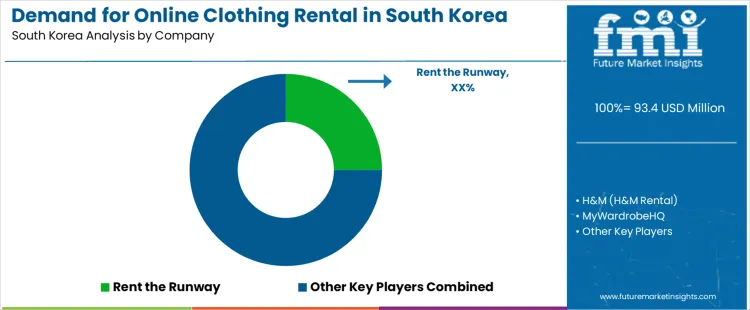
Demand for online clothing rental services in South Korea is growing as consumer behaviour shifts toward access-oriented fashion consumption. Urban populations with high digital adoption rates and frequent participation in social and professional events drive interest in rental offerings that provide variety without long-term ownership. Retailers and platform operators focus on system usability, delivery logistics, and inventory diversity to attract and retain subscribers. Corporate partnerships with event organisers, influencers, and professional networks have influenced demand patterns, particularly for formal wear and seasonal collections. Procurement decisions by rental platforms and service aggregators prioritise supplier relationships that ensure high-quality inventory, reliable turnaround times, and scalable storage and logistics support. Metrics such as customer retention, fulfillment accuracy, and return condition rates are monitored to optimise operations and inform future buying strategies for rental stock. The South Korean market also reflects demand for sustainably minded offerings that reduce textile waste and align with consumer preferences for flexible wardrobe solutions.
Competition among key suppliers in South Korea’s online clothing rental segment is defined by brand positioning, catalogue depth, and service infrastructure. Rent the Runway is recognised as a leading global operator, with platform materials detailing subscription tiers, garment care protocols, and categorised inventory aimed at segmenting customer needs. H&M (H&M Rental) documentation highlights curated collections and integration with existing retail channels, supported by specifications on item turnover rates, rental durations, and condition assurance practices. MyWardrobeHQ materials present luxury and designer inventory with emphasis on authentication processes and quality checks that inform partner onboarding discussions with South Korean affiliates. Le Tote literature outlines flexible rental packages and styling services that include detailed size guides and garment handling guidelines for platform users and sourcing partners. GlamCorner product information focuses on formal wear and special event collections, with technical data on fabric care standards, return logistics, and cleaning protocols that support consistent service delivery. Brochure content from these companies typically includes service level descriptions, inventory metrics, and customer support frameworks that help South Korean marketplace operators, logistics partners, and fashion curators evaluate supplier offerings based on operational fit and consumer appeal.
Key Players of the Demand for Online Clothing Rental in South Korea
- Rent the Runway
- H&M (H&M Rental)
- MyWardrobeHQ
- Le Tote
- GlamCorner
Scope of the Report
| Items | Values |
|---|---|
| Quantitative Units (2026) | USD Million |
| Product Type | Ethnic Wear, Knitwear, Trousers & Jeans, Jumpsuits, Coats & Jackets, Performance Wear |
| End User | Business-to-Business (B2B), Business-to-Consumer (B2C) |
| Companies | Rent the Runway, H&M (H&M Rental), MyWardrobeHQ, Le Tote, GlamCorner |
| Region Covered | South Korea |
| Provinces Covered | South Gyeongsang, North Jeolla, South Jeolla, Jeju |
| Additional Attributes | Dollar sales by product type and end user. Growth is driven by sustainability-focused consumers, demand for premium apparel at lower cost, and digital rental platforms expanding B2B and B2C offerings across fashion categories. |
Key Segments of Demand for Online Clothing Rental in South Korea
Product Type
- Ethnic Wear
- Knitwear
- Trousers & Jeans
- Jumpsuits
- Coats & Jackets
- Performance Wear
- Other
End User
- Business-to-Business (B2B)
- Business-to-Consumer (B2C)
Provinces
- South Gyeongsang
- North Jeolla
- South Jeolla
- Jeju
Bibliography
- Korea Statistical Information Service. (2024). Clothing, apparel services, and consumer behavior statistics. KOSIS.
- OECD. (2024). Sustainable consumption and circular fashion business models. OECD Publishing.
- European Environment Agency. (2024). Textile reuse, rental models, and sustainability impacts. EEA.
Frequently Asked Questions
How big is the demand for online clothing rental in south korea in 2026?
The demand for online clothing rental in south korea is estimated to be valued at USD 93.4 million in 2026.
What will be the size of online clothing rental in south korea in 2036?
The market size for the online clothing rental in south korea is projected to reach USD 221.6 million by 2036.
How much will be the demand for online clothing rental in south korea growth between 2026 and 2036?
The demand for online clothing rental in south korea is expected to grow at a 9.0% CAGR between 2026 and 2036.
What are the key product types in the online clothing rental in south korea?
The key product types in online clothing rental in south korea are ethnic wear, knitwear, trousers & jeans, jumpsuits, coats & jackets and performance wear.
Which end user segment is expected to contribute significant share in the online clothing rental in south korea in 2026?
In terms of end user, business-to-business (b2b) segment is expected to command 94.1% share in the online clothing rental in south korea in 2026.
Preview the report firsthand - request a free sample
Get SampleGet the brochure for pricing and purchase details.
Get PDFTable of Content
- Executive Summary
- South Korea Market Outlook
- Demand-side Trends
- Supply-side Trends
- Technology Roadmap Analysis
- Analysis and Recommendations
- Market Overview
- Market Coverage / Taxonomy
- Market Definition / Scope / Limitations
- Market Background
- Market Dynamics
- Drivers
- Restraints
- Opportunity
- Trends
- Scenario Forecast
- Demand in Optimistic Scenario
- Demand in Likely Scenario
- Demand in Conservative Scenario
- Opportunity Map Analysis
- Product Life Cycle Analysis
- Supply Chain Analysis
- Investment Feasibility Matrix
- Value Chain Analysis
- PESTLE and Porter’s Analysis
- Regulatory Landscape
- Regional Parent Market Outlook
- Production and Consumption Statistics
- Import and Export Statistics
- Market Dynamics
- South Korea Market Analysis 2021 to 2025 and Forecast, 2026 to 2036
- Historical Market Size Value (USD Million) Analysis, 2021 to 2025
- Current and Future Market Size Value (USD Million) Projections, 2026 to 2036
- Y-o-Y Growth Trend Analysis
- Absolute $ Opportunity Analysis
- South Korea Market Pricing Analysis 2021 to 2025 and Forecast 2026 to 2036
- South Korea Market Analysis 2021 to 2025 and Forecast 2026 to 2036, By Product Type
- Introduction / Key Findings
- Historical Market Size Value (USD Million) Analysis By Product Type, 2021 to 2025
- Current and Future Market Size Value (USD Million) Analysis and Forecast By Product Type, 2026 to 2036
- Ethnic Wear
- Knitwear
- Trousers & Jeans
- Jumpsuits
- Coats & Jackets
- Performance Wear
- Ethnic Wear
- Y-o-Y Growth Trend Analysis By Product Type, 2021 to 2025
- Absolute $ Opportunity Analysis By Product Type, 2026 to 2036
- South Korea Market Analysis 2021 to 2025 and Forecast 2026 to 2036, By End User
- Introduction / Key Findings
- Historical Market Size Value (USD Million) Analysis By End User, 2021 to 2025
- Current and Future Market Size Value (USD Million) Analysis and Forecast By End User, 2026 to 2036
- Business-to-Business (B2B)
- Business-to-Consumer (B2C)
- Business-to-Business (B2B)
- Y-o-Y Growth Trend Analysis By End User, 2021 to 2025
- Absolute $ Opportunity Analysis By End User, 2026 to 2036
- Market Structure Analysis
- Competition Dashboard
- Competition Benchmarking
- Market Share Analysis of Top Players
- By Regional
- By Product Type
- By End User
- Competition Analysis
- Competition Deep Dive
- Rent the Runway
- Overview
- Product Portfolio
- Profitability by Market Segments (Product/Age /Sales Channel/Region)
- Sales Footprint
- Strategy Overview
- Marketing Strategy
- Product Strategy
- Channel Strategy
- H&M (H&M Rental)
- MyWardrobeHQ
- Le Tote
- GlamCorner
- Rent the Runway
- Competition Deep Dive
- Assumptions & Acronyms Used
- Research Methodology


