

- Industry Size (2025)
- USD 70.5 Bn
- Forecast (2035)
- USD 117.1 Bn
- CAGR (2025 to 2035)
- 5.2%
Stack And Nest Containers Market Size and Share Forecast Outlook 2025 to 2035
The Stack And Nest Containers Market is estimated to be valued at USD 70.5 billion in 2025 and is projected to reach USD 117.1 billion by 2035, registering a compound annual growth rate (CAGR) of 5.2% over the forecast period.
Quick Stats for Stack And Nest Containers Market
- Stack And Nest Containers Market Value (2025): USD 70.5 billion
- Stack And Nest Containers Market Forecast Value (2035): USD 117.1 billion
- Stack And Nest Containers Market Forecast CAGR: 5.2%
- Leading Segment in Stack And Nest Containers Market in 2025: Metal (28.7%)
- Key Growth Regions in Stack And Nest Containers Market: North America, Asia-Pacific, Europe
- Top Key Players in Stack And Nest Containers Market: Polymer Logistics, Monoflo International, Schoeller Allibert Services, Mailbox, Stamford Products, Georg UTZ Holding, Greif, Loadhog, Exporta Global
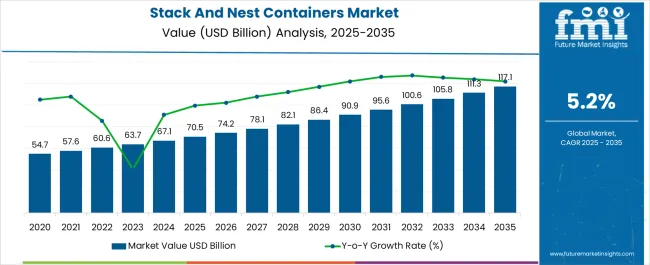
Stack And Nest Containers Market Key Takeaways
| Metric | Value |
|---|---|
| Stack And Nest Containers Market Estimated Value in (2025 E) | USD 70.5 billion |
| Stack And Nest Containers Market Forecast Value in (2035 F) | USD 117.1 billion |
| Forecast CAGR (2025 to 2035) | 5.2% |
Why is the Stack And Nest Containers Market Growing?
The Stack And Nest Containers market is experiencing steady growth, driven by increasing demand for efficient storage, transportation, and handling solutions across diverse industries. The adoption of stack and nest containers is being supported by their ability to optimize space utilization, reduce handling time, and lower operational costs. Industries are increasingly prioritizing materials that offer durability, hygiene, and compliance with regulatory standards, particularly in sectors such as pharmaceuticals, food processing, and chemicals.
Innovations in container design and manufacturing processes are enabling enhanced load-bearing capacity, resistance to environmental conditions, and improved ergonomics for material handling. The growing emphasis on sustainable and reusable packaging solutions is further accelerating market adoption, as organizations seek to minimize waste and operational inefficiencies.
Rising investment in automated warehouse systems, logistics optimization, and supply chain management is creating additional opportunities for container deployment As industries continue to focus on operational efficiency, regulatory compliance, and safety, the Stack And Nest Containers market is expected to maintain steady growth, with technologically advanced and versatile container solutions driving market expansion over the coming decade.
Segmental Analysis
The stack and nest containers market is segmented by material type, capacity (litres), end use industry, and geographic regions. By material type, stack and nest containers market is divided into Metal and Plastic. In terms of capacity (litres), stack and nest containers market is classified into <25, 25 – 50, 50 – 100, 100 – 150, and >150. Based on end use industry, stack and nest containers market is segmented into Pharmaceutical Industry, Food & Beverage Industry, Chemical & Petrochemical Industry, Consumer Goods Industry, Industrial Packaging Industry, Shipping And Logistic Industry, Retail Industry, Automotive Industry, Aerospace Industry, Metalworking Industry, and Electrical & Electronics Industry. Regionally, the stack and nest containers industry is classified into North America, Latin America, Western Europe, Eastern Europe, Balkan & Baltic Countries, Russia & Belarus, Central Asia, East Asia, South Asia & Pacific, and the Middle East & Africa.
Insights into the Metal Material Type Segment
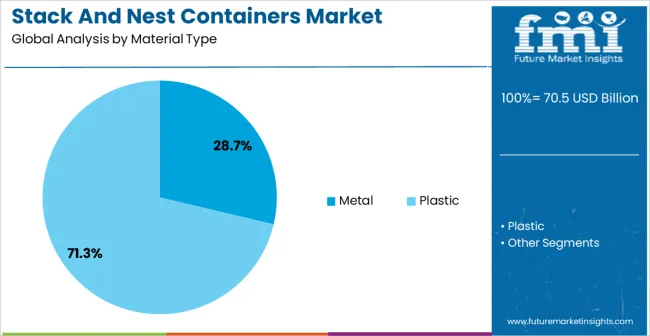
The metal segment is projected to hold 28.7% of the market revenue in 2025, positioning it as the leading material type. This dominance is being driven by the superior strength, durability, and load-bearing capabilities of metal containers, which make them ideal for transporting and storing heavy or sensitive goods. Metal containers provide long-term reliability and resistance to environmental degradation, ensuring product integrity during storage and shipment.
They are particularly preferred in industries that require high safety and compliance standards, including pharmaceuticals, chemicals, and industrial manufacturing. The ability to withstand repeated use without deformation or performance loss enhances cost efficiency over time.
Additionally, metal containers are compatible with automated stacking and nesting systems, which improves operational efficiency in warehouses and logistics centers As organizations continue to prioritize durability, safety, and sustainability, the metal segment is expected to maintain its leading position, supported by ongoing improvements in corrosion resistance, manufacturing processes, and ergonomic design features that meet evolving industrial requirements.
Insights into the <25 Litres Capacity Segment
.webp "Stack And Nest Containers Market Analysis By Capacity (litres)")
The less than 25 litres capacity segment is anticipated to account for 32.4% of the market revenue in 2025, establishing it as the leading capacity category. Its growth is being driven by the need for compact, easy-to-handle containers suitable for small-volume storage, transportation, and distribution. These containers are particularly advantageous in environments where space optimization and frequent handling are critical, including pharmaceutical laboratories, small-scale manufacturing, and retail operations.
Smaller capacity containers offer operational flexibility, enabling safe and efficient storage of diverse products without risking contamination or damage. Their compatibility with stacking and nesting configurations enhances warehouse utilization and reduces logistical costs.
Additionally, materials and designs that support repeated use, hygiene compliance, and durability make them attractive for regulated industries As demand for operational efficiency, compliance, and cost-effective storage solutions rises, the less than 25 litres capacity segment is expected to maintain its leadership, supported by innovations in container design, material performance, and adaptability to modern supply chain and warehouse automation requirements.
Insights into the Pharmaceutical Industry End-Use Segment
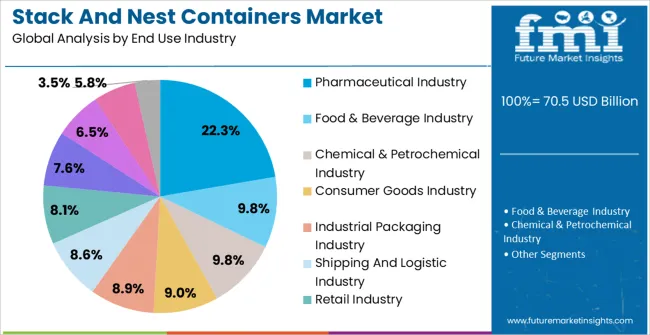
The pharmaceutical industry segment is projected to hold 22.3% of the market revenue in 2025, making it the leading end-use industry. Growth in this segment is being driven by stringent regulatory standards, which require containers that maintain product integrity, prevent contamination, and support controlled storage conditions. Stack and nest containers are increasingly used in pharmaceutical operations for efficient handling of raw materials, intermediates, and finished products.
Their durability, hygiene compliance, and compatibility with automated storage and retrieval systems enhance operational efficiency and reduce the risk of human error. Additionally, the ability to integrate containers with temperature-controlled storage, traceability systems, and transport processes further strengthens adoption.
The rising demand for efficient supply chain management, safe handling of sensitive materials, and optimization of storage space is driving the use of these containers in pharmaceutical operations As regulatory compliance and operational efficiency continue to be prioritized, the pharmaceutical industry segment is expected to remain the primary driver of market growth, supported by innovations in container design and material performance.
Market Overview
Stack And Nest Containers Market Outlook
The stack and nest containers are witnessing an unprecedented surge in demand in recent years due to the opening of cross-border trading that has created lucrative growth opportunities for manufacturers from all industries to expand their geographical reach.
While analyzing the stack and nest containers market, it is anticipated that the manufacturers are relying on shipping companies and improved infrastructure and technology for packaging, shipping, and protecting goods in bulk quantities.
The competitive market landscape depicts a fragmented market. It is projected that the key players are making continuous efforts to curate a diversified product portfolio with constant innovations and to produce new and unique stack and nest containers.
The vendors operating in the global stack and nest containers market cater to an extremely niche market. This factor contracts the market share of the companies and prompts them to resort to subsidiary means of revenue generation.
Despite this, the growth index of the leading vendors in the global stack and nest market is improving. This owes to the ballooning demand for stack and nest containers, especially in the retail and metal working industry. Additionally, some major players are following a staggered approach in targeting multiple domains and strengthening their foothold in the global stack and nest containers market.
To overcome the drawbacks of packaging, the manufacturers are rigorously developing these containers and indulging in organic growth strategies like mergers and acquisitions, collaborations with other prominent players, and more. They are making advances to increase their material handling capabilities in bulk quantity.
Stacking and nesting shipping containers have significantly improved shipping companies' goods handling capability and productivity. Therefore, it is anticipated that the stack and nest containers market is likely to witness substantial growth at a steady pace during the estimated time period of study.
Analysis of Stack And Nest Containers Market By Key Countries
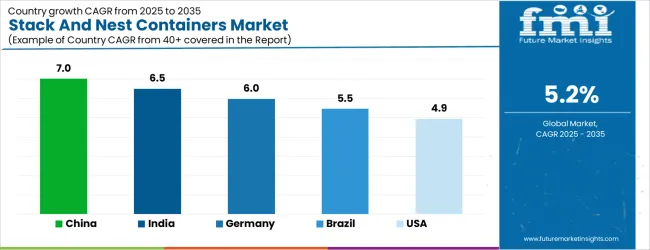
| Country | CAGR |
|---|---|
| China | 7.0% |
| India | 6.5% |
| Germany | 6.0% |
| Brazil | 5.5% |
| USA | 4.9% |
| UK | 4.4% |
| Japan | 3.9% |
Country-wise Analysis
The Stack And Nest Containers Market is expected to register a CAGR of 5.2% during the forecast period, exhibiting varied country level momentum. China leads with the highest CAGR of 7.0%, followed by India at 6.5%. Developed markets such as Germany, France, and the UK continue to expand steadily, while the USA is likely to grow at consistent rates. Japan posts the lowest CAGR at 3.9%, yet still underscores a broadly positive trajectory for the global Stack And Nest Containers Market. In 2024, Germany held a dominant revenue in the Western Europe market and is expected to grow with a CAGR of 6.0%. The USA Stack And Nest Containers Market is estimated to be valued at USD 25.9 billion in 2025 and is anticipated to reach a valuation of USD 25.9 billion by 2035. Sales are projected to rise at a CAGR of 0.0% over the forecast period between 2025 and 2035. While Japan and South Korea markets are estimated to be valued at USD 3.3 billion and USD 1.8 billion respectively in 2025.
Key Players in the Stack And Nest Containers Market
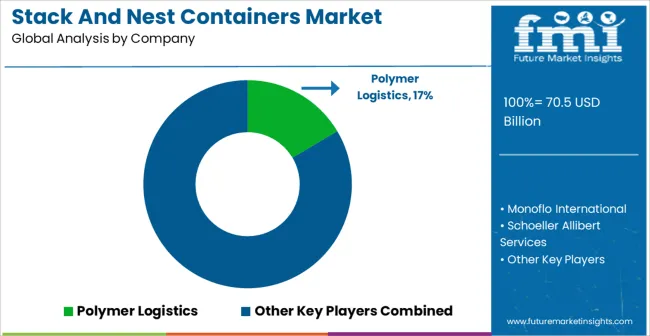
- Polymer Logistics
- Monoflo International
- Schoeller Allibert Services
- Mailbox
- Stamford Products
- Georg UTZ Holding
- Greif
- Loadhog
- Exporta Global
Scope of the Report
| Item | Value |
|---|---|
| Quantitative Units | USD 70.5 Billion |
| Material Type | Metal and Plastic |
| Capacity (Litres) | <25, 25 – 50, 50 – 100, 100 – 150, and >150 |
| End Use Industry | Pharmaceutical Industry, Food & Beverage Industry, Chemical & Petrochemical Industry, Consumer Goods Industry, Industrial Packaging Industry, Shipping And Logistic Industry, Retail Industry, Automotive Industry, Aerospace Industry, Metalworking Industry, and Electrical & Electronics Industry |
| Regions Covered | North America, Europe, Asia-Pacific, Latin America, Middle East & Africa |
| Country Covered | United States, Canada, Germany, France, United Kingdom, China, Japan, India, Brazil, South Africa |
| Key Companies Profiled | Polymer Logistics, Monoflo International, Schoeller Allibert Services, Mailbox, Stamford Products, Georg UTZ Holding, Greif, Loadhog, and Exporta Global |
Stack And Nest Containers Market by Segments
Material Type:
- Metal
- Plastic
Capacity (Litres):
- <25
- 25 – 50
- 50 – 100
- 100 – 150
- >150
End Use Industry:
- Pharmaceutical Industry
- Food & Beverage Industry
- Chemical & Petrochemical Industry
- Consumer Goods Industry
- Industrial Packaging Industry
- Shipping And Logistic Industry
- Retail Industry
- Automotive Industry
- Aerospace Industry
- Metalworking Industry
- Electrical & Electronics Industry
Region:
- North America
- USA
- Canada
- Mexico
- Latin America
- Brazil
- Chile
- Rest of Latin America
- Western Europe
- Germany
- UK
- Italy
- Spain
- France
- Nordic
- BENELUX
- Rest of Western Europe
- Eastern Europe
- Russia
- Poland
- Hungary
- Balkan & Baltic
- Rest of Eastern Europe
- East Asia
- China
- Japan
- South Korea
- South Asia and Pacific
- India
- ASEAN
- Australia & New Zealand
- Rest of South Asia and Pacific
- Middle East & Africa
- Kingdom of Saudi Arabia
- Other GCC Countries
- Turkiye
- South Africa
- Other African Union
- Rest of Middle East & Africa
Frequently Asked Questions
How big is the stack and nest containers market in 2025?
The global stack and nest containers market is estimated to be valued at USD 70.5 billion in 2025.
What will be the size of stack and nest containers market in 2035?
The market size for the stack and nest containers market is projected to reach USD 117.1 billion by 2035.
How much will be the stack and nest containers market growth between 2025 and 2035?
The stack and nest containers market is expected to grow at a 5.2% CAGR between 2025 and 2035.
What are the key product types in the stack and nest containers market?
The key product types in stack and nest containers market are metal, _steel, plastic, _hdpe and _others.
Which capacity (litres) segment to contribute significant share in the stack and nest containers market in 2025?
In terms of capacity (litres), <25 segment to command 32.4% share in the stack and nest containers market in 2025.
Preview the report firsthand - request a free sample
Get SampleGet the brochure for pricing and purchase details.
Get PDFTable of Content
- Executive Summary
- Global Market Outlook
- Demand-side Trends
- Supply-side Trends
- Technology Roadmap Analysis
- Analysis and Recommendations
- Market Overview
- Market Coverage / Taxonomy
- Market Definition / Scope / Limitations
- Market Background
- Market Dynamics
- Drivers
- Restraints
- Opportunity
- Trends
- Scenario Forecast
- Demand in Optimistic Scenario
- Demand in Likely Scenario
- Demand in Conservative Scenario
- Opportunity Map Analysis
- Product Life Cycle Analysis
- Supply Chain Analysis
- Investment Feasibility Matrix
- Value Chain Analysis
- PESTLE and Porter’s Analysis
- Regulatory Landscape
- Regional Parent Market Outlook
- Production and Consumption Statistics
- Import and Export Statistics
- Market Dynamics
- Global Market Analysis 2020 to 2024 and Forecast, 2025 to 2035
- Historical Market Size Value (USD Million) Analysis, 2020 to 2024
- Current and Future Market Size Value (USD Million) Projections, 2025 to 2035
- Y-o-Y Growth Trend Analysis
- Absolute $ Opportunity Analysis
- Global Market Pricing Analysis 2020 to 2024 and Forecast 2025 to 2035
- Global Market Analysis 2020 to 2024 and Forecast 2025 to 2035, By Material Type
- Introduction / Key Findings
- Historical Market Size Value (USD Million) Analysis By Material Type , 2020 to 2024
- Current and Future Market Size Value (USD Million) Analysis and Forecast By Material Type , 2025 to 2035
- Metal
- Steel
- Plastic
- HDPE
- Others
- Metal
- Y-o-Y Growth Trend Analysis By Material Type , 2020 to 2024
- Absolute $ Opportunity Analysis By Material Type , 2025 to 2035
- Global Market Analysis 2020 to 2024 and Forecast 2025 to 2035, By Capacity (Litres)
- Introduction / Key Findings
- Historical Market Size Value (USD Million) Analysis By Capacity (Litres), 2020 to 2024
- Current and Future Market Size Value (USD Million) Analysis and Forecast By Capacity (Litres), 2025 to 2035
- <25
- 25 – 50
- 50 – 100
- 100 – 150
- >150
- Y-o-Y Growth Trend Analysis By Capacity (Litres), 2020 to 2024
- Absolute $ Opportunity Analysis By Capacity (Litres), 2025 to 2035
- Global Market Analysis 2020 to 2024 and Forecast 2025 to 2035, By End Use Industry
- Introduction / Key Findings
- Historical Market Size Value (USD Million) Analysis By End Use Industry, 2020 to 2024
- Current and Future Market Size Value (USD Million) Analysis and Forecast By End Use Industry, 2025 to 2035
- Pharmaceutical Industry
- Food & Beverage Industry
- Chemical & Petrochemical Industry
- Consumer Goods Industry
- Industrial Packaging Industry
- Shipping And Logistic Industry
- Retail Industry
- Automotive Industry
- Aerospace Industry
- Metalworking Industry
- Electrical & Electronics Industry
- Y-o-Y Growth Trend Analysis By End Use Industry, 2020 to 2024
- Absolute $ Opportunity Analysis By End Use Industry, 2025 to 2035
- Global Market Analysis 2020 to 2024 and Forecast 2025 to 2035, By Region
- Introduction
- Historical Market Size Value (USD Million) Analysis By Region, 2020 to 2024
- Current Market Size Value (USD Million) Analysis and Forecast By Region, 2025 to 2035
- North America
- Latin America
- Western Europe
- Eastern Europe
- East Asia
- South Asia and Pacific
- Middle East & Africa
- Market Attractiveness Analysis By Region
- North America Market Analysis 2020 to 2024 and Forecast 2025 to 2035, By Country
- Historical Market Size Value (USD Million) Trend Analysis By Market Taxonomy, 2020 to 2024
- Market Size Value (USD Million) Forecast By Market Taxonomy, 2025 to 2035
- By Country
- USA
- Canada
- Mexico
- By Material Type
- By Capacity (Litres)
- By End Use Industry
- By Country
- Market Attractiveness Analysis
- By Country
- By Material Type
- By Capacity (Litres)
- By End Use Industry
- Key Takeaways
- Latin America Market Analysis 2020 to 2024 and Forecast 2025 to 2035, By Country
- Historical Market Size Value (USD Million) Trend Analysis By Market Taxonomy, 2020 to 2024
- Market Size Value (USD Million) Forecast By Market Taxonomy, 2025 to 2035
- By Country
- Brazil
- Chile
- Rest of Latin America
- By Material Type
- By Capacity (Litres)
- By End Use Industry
- By Country
- Market Attractiveness Analysis
- By Country
- By Material Type
- By Capacity (Litres)
- By End Use Industry
- Key Takeaways
- Western Europe Market Analysis 2020 to 2024 and Forecast 2025 to 2035, By Country
- Historical Market Size Value (USD Million) Trend Analysis By Market Taxonomy, 2020 to 2024
- Market Size Value (USD Million) Forecast By Market Taxonomy, 2025 to 2035
- By Country
- Germany
- UK
- Italy
- Spain
- France
- Nordic
- BENELUX
- Rest of Western Europe
- By Material Type
- By Capacity (Litres)
- By End Use Industry
- By Country
- Market Attractiveness Analysis
- By Country
- By Material Type
- By Capacity (Litres)
- By End Use Industry
- Key Takeaways
- Eastern Europe Market Analysis 2020 to 2024 and Forecast 2025 to 2035, By Country
- Historical Market Size Value (USD Million) Trend Analysis By Market Taxonomy, 2020 to 2024
- Market Size Value (USD Million) Forecast By Market Taxonomy, 2025 to 2035
- By Country
- Russia
- Poland
- Hungary
- Balkan & Baltic
- Rest of Eastern Europe
- By Material Type
- By Capacity (Litres)
- By End Use Industry
- By Country
- Market Attractiveness Analysis
- By Country
- By Material Type
- By Capacity (Litres)
- By End Use Industry
- Key Takeaways
- East Asia Market Analysis 2020 to 2024 and Forecast 2025 to 2035, By Country
- Historical Market Size Value (USD Million) Trend Analysis By Market Taxonomy, 2020 to 2024
- Market Size Value (USD Million) Forecast By Market Taxonomy, 2025 to 2035
- By Country
- China
- Japan
- South Korea
- By Material Type
- By Capacity (Litres)
- By End Use Industry
- By Country
- Market Attractiveness Analysis
- By Country
- By Material Type
- By Capacity (Litres)
- By End Use Industry
- Key Takeaways
- South Asia and Pacific Market Analysis 2020 to 2024 and Forecast 2025 to 2035, By Country
- Historical Market Size Value (USD Million) Trend Analysis By Market Taxonomy, 2020 to 2024
- Market Size Value (USD Million) Forecast By Market Taxonomy, 2025 to 2035
- By Country
- India
- ASEAN
- Australia & New Zealand
- Rest of South Asia and Pacific
- By Material Type
- By Capacity (Litres)
- By End Use Industry
- By Country
- Market Attractiveness Analysis
- By Country
- By Material Type
- By Capacity (Litres)
- By End Use Industry
- Key Takeaways
- Middle East & Africa Market Analysis 2020 to 2024 and Forecast 2025 to 2035, By Country
- Historical Market Size Value (USD Million) Trend Analysis By Market Taxonomy, 2020 to 2024
- Market Size Value (USD Million) Forecast By Market Taxonomy, 2025 to 2035
- By Country
- Kingdom of Saudi Arabia
- Other GCC Countries
- Turkiye
- South Africa
- Other African Union
- Rest of Middle East & Africa
- By Material Type
- By Capacity (Litres)
- By End Use Industry
- By Country
- Market Attractiveness Analysis
- By Country
- By Material Type
- By Capacity (Litres)
- By End Use Industry
- Key Takeaways
- Key Countries Market Analysis
- USA
- Pricing Analysis
- Market Share Analysis, 2024
- By Material Type
- By Capacity (Litres)
- By End Use Industry
- Canada
- Pricing Analysis
- Market Share Analysis, 2024
- By Material Type
- By Capacity (Litres)
- By End Use Industry
- Mexico
- Pricing Analysis
- Market Share Analysis, 2024
- By Material Type
- By Capacity (Litres)
- By End Use Industry
- Brazil
- Pricing Analysis
- Market Share Analysis, 2024
- By Material Type
- By Capacity (Litres)
- By End Use Industry
- Chile
- Pricing Analysis
- Market Share Analysis, 2024
- By Material Type
- By Capacity (Litres)
- By End Use Industry
- Germany
- Pricing Analysis
- Market Share Analysis, 2024
- By Material Type
- By Capacity (Litres)
- By End Use Industry
- UK
- Pricing Analysis
- Market Share Analysis, 2024
- By Material Type
- By Capacity (Litres)
- By End Use Industry
- Italy
- Pricing Analysis
- Market Share Analysis, 2024
- By Material Type
- By Capacity (Litres)
- By End Use Industry
- Spain
- Pricing Analysis
- Market Share Analysis, 2024
- By Material Type
- By Capacity (Litres)
- By End Use Industry
- France
- Pricing Analysis
- Market Share Analysis, 2024
- By Material Type
- By Capacity (Litres)
- By End Use Industry
- India
- Pricing Analysis
- Market Share Analysis, 2024
- By Material Type
- By Capacity (Litres)
- By End Use Industry
- ASEAN
- Pricing Analysis
- Market Share Analysis, 2024
- By Material Type
- By Capacity (Litres)
- By End Use Industry
- Australia & New Zealand
- Pricing Analysis
- Market Share Analysis, 2024
- By Material Type
- By Capacity (Litres)
- By End Use Industry
- China
- Pricing Analysis
- Market Share Analysis, 2024
- By Material Type
- By Capacity (Litres)
- By End Use Industry
- Japan
- Pricing Analysis
- Market Share Analysis, 2024
- By Material Type
- By Capacity (Litres)
- By End Use Industry
- South Korea
- Pricing Analysis
- Market Share Analysis, 2024
- By Material Type
- By Capacity (Litres)
- By End Use Industry
- Russia
- Pricing Analysis
- Market Share Analysis, 2024
- By Material Type
- By Capacity (Litres)
- By End Use Industry
- Poland
- Pricing Analysis
- Market Share Analysis, 2024
- By Material Type
- By Capacity (Litres)
- By End Use Industry
- Hungary
- Pricing Analysis
- Market Share Analysis, 2024
- By Material Type
- By Capacity (Litres)
- By End Use Industry
- Kingdom of Saudi Arabia
- Pricing Analysis
- Market Share Analysis, 2024
- By Material Type
- By Capacity (Litres)
- By End Use Industry
- Turkiye
- Pricing Analysis
- Market Share Analysis, 2024
- By Material Type
- By Capacity (Litres)
- By End Use Industry
- South Africa
- Pricing Analysis
- Market Share Analysis, 2024
- By Material Type
- By Capacity (Litres)
- By End Use Industry
- USA
- Market Structure Analysis
- Competition Dashboard
- Competition Benchmarking
- Market Share Analysis of Top Players
- By Regional
- By Material Type
- By Capacity (Litres)
- By End Use Industry
- Competition Analysis
- Competition Deep Dive
- Polymer Logistics
- Overview
- Product Portfolio
- Profitability by Market Segments (Product/Age /Sales Channel/Region)
- Sales Footprint
- Strategy Overview
- Marketing Strategy
- Product Strategy
- Channel Strategy
- Monoflo International
- Schoeller Allibert Services
- Mailbox
- Stamford Products
- Georg UTZ Holding
- Greif
- Loadhog
- Exporta Global
- Polymer Logistics
- Competition Deep Dive
- Assumptions & Acronyms Used
- Research Methodology


