

- Market Size (2026)
- USD 735.6 Mn
- Forecast (2036)
- USD 2032.9 Mn
- CAGR (2026 to 2036)
- 10.7%
How big is stretchable electrode neurotechnology market size?
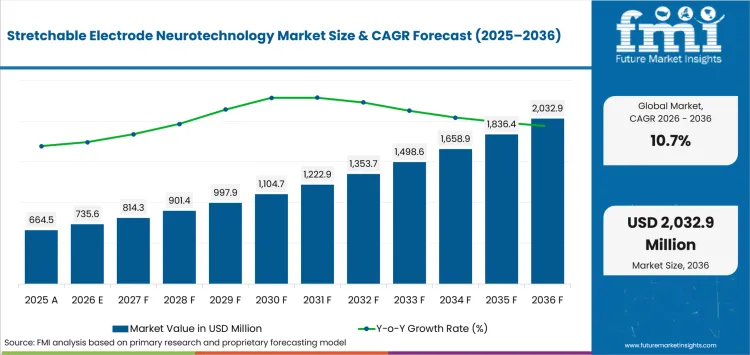
USD 735.6 million in 2026 and USD 2032.9 million by 2036 at a 10.7% CAGR.
Demand for stretchable electrode neurotechnology is projected to expand at 10.7% CAGR between 2026 and 2036, increasing valuation from USD 735.6 million in 2026 to USD 2032.9 million by 2036. Medical progress in neurotechnology relies on flexible electrode arrays being able to maintain clear signals even as brain tissue naturally moves and stretches. Ongoing clinical trials are expanding to evaluate how well these implanted interfaces perform across multiple patients. In January 2026, Neuralink reported having 21 participants enrolled worldwide. Evaluating devices across an extensive patient group provides doctors with valuable evidence regarding how consistently such implants can be placed and how reliably they function over repeated therapy sessions.
International research programs focus on distinct priorities when evaluating new brain-computer interfaces. United Kingdom and United States research teams prioritize human clinical evidence and documented device reliability. Development programs in Germany and South Korea emphasize precise manufacturing controls and bidirectional performance. Long-term safety records also play a crucial role in building clinical trust. In August 2025, Blackrock Neurotech reported 24 combined implant-years without any serious microstimulation-related adverse events. Tracking patients over such longer observation periods helps medical teams confirm for implanted electrodes remaining stable and safe throughout repeated recording and stimulation sessions.
Key Takeaways of Stretchable Electrode Neurotechnology Market
- Demand for stretchable electrode neurotechnology is shaped by the need for compliant neural interfaces that maintain electrical contact across curved or moving tissue, with material durability, signal stability, and biocompatibility influencing clinical and research use.
- By technology, soft robotics integrated systems hold 62.0% share in 2026, while hospitals account for 49.8% share in 2026 among end users, reflecting active electrode conformity and the specialist surgical and neurological follow-up capabilities available within hospitals.
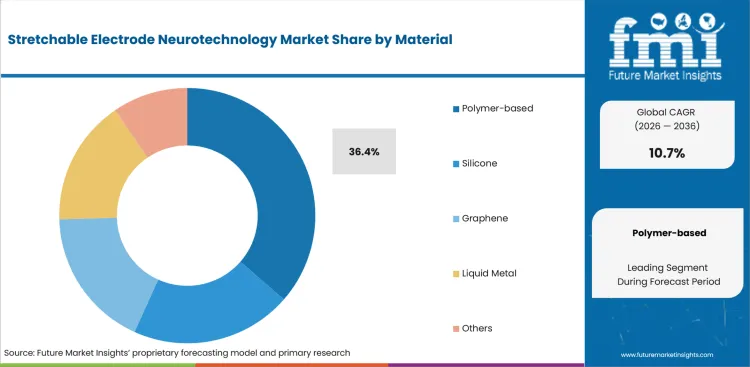
- Brain-computer interfaces represent 38.7% share in 2026, while polymer-based electrodes account for 36.4% share in 2026 within material selection, reflecting communication and motor-control applications alongside the flexibility and fabrication compatibility of polymer substrates.
- The United Kingdom records the highest country CAGR at 12.9%, followed by the United States at 11.7% and Japan at 11.3%, reflecting differences in human study access, regulatory pathways, specialist engineering capacity, and neurotechnology research programs.
- Competition centers on WISE SpA, Precision Neuroscience Corporation, Neuralink Corp., Blackrock Neurotech, Paradromics Inc., and CorTec GmbH, with competitive positioning spanning thin cortical arrays, high-channel neural recording, speech restoration, and closed-loop neuromodulation platforms.
- Mechanical fatigue, electrical stability under repeated strain, surgical handling, biocompatibility controls, and long-term clinical evidence remain key considerations for broader stretchable electrode adoption.
Analyst Perspective
"The stretchable electrode neurotechnology market is moving toward clinical validation as developers address the mechanical mismatch between rigid implants and dynamic neural tissue. Commercial adoption will depend on maintaining electrical performance through repeated deformation while demonstrating safe surgical handling and long-term durability. Companies that combine material innovation with clinical evidence and structured follow-up support will be better positioned to expand adoption."
- Anurag Sharma, Principal Consultant for Healthcare at Future Market Insights
Source: Future Market Insights analysis, 2026.
How is Stretchable Electrode Neurotechnology Market segmented?
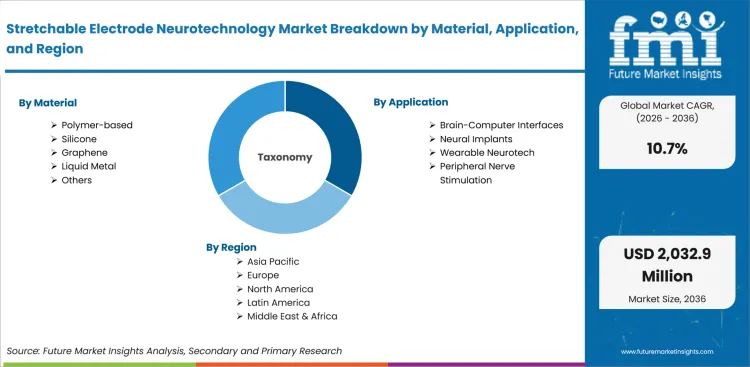
The stretchable electrode neurotechnology industry is segmented by material, application, end user, technology, and region.
The stretchable electrode neurotechnology market is segmented by material, application, end user, technology, and region. Material coverage includes polymer-based and silicone electrodes followed by graphene, liquid metal, and other designs. Application coverage addresses brain-computer interfaces and neural implants with wearable neurotechnology and peripheral nerve stimulation. End-user coverage spans hospitals and research institutes with neurotechnology companies conducting clinical development. Technology coverage includes soft robotics integrated systems and flexible printed electronics. Regional coverage includes North America and Europe together with East Asia and South Asia and Pacific. Latin America and Middle East and Africa complete geographic analysis across developing neurotechnology programs.
Why do polymer-based electrodes shape material selection?
ACS Nano researchers reported in January 2024 a printing resolution of 30 μm for deformable liquid-metal neural interfaces, influencing material review for compact electrode structures requiring precise conductor placement. This fabrication capability directs developer attention toward compliant polymer substrates preserving close tissue contact during bending and anatomical movement. Silicone and liquid-metal electrodes address separate requirements involving insulation conductivity and resistance to repeated deformation.
- In 2026, polymer-based electrodes are set to represent 36.4% share in 2026 due to adaptable stiffness and established compatibility with microfabrication processes. Development teams assess trace adhesion and conductivity retention across repeated bending before selecting materials for neural interfaces.
- Silicone electrodes provide soft insulation around conductive elements exposed to body fluids and continuous anatomical movement. Graphene and liquid-metal designs offer alternative electrical properties for devices requiring thin contact layers or extensive strain tolerance.
How do brain-computer interfaces shape application demand?
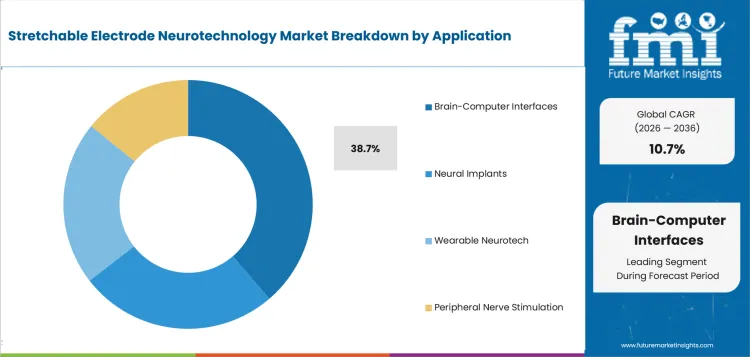
Brain-computer interfaces translate recorded neural activity into commands for communication devices and external control systems. Neural implants extend electrode use into targeted recording and wearable neurotechnology enables non-invasive neurological assessment. Blackrock Neurotech reported in January 2025 a decoding rate of 76 targets per minute with 100% accuracy, reinforcing clinical interest in stable high-density electrode arrays.
- Based on application, brain-computer interfaces are anticipated to secure 38.7% share in 2026 owing to continued work on communication restoration and motor assistance. Clinical teams examine signal clarity and decoding consistency across repeated participant sessions before broader program use.
- Neural implants and peripheral nerve stimulation address therapeutic needs involving defined anatomical targets and controlled electrical delivery. Wearable neurotechnology uses flexible external contacts to improve comfort and limit movement-related interference during neurological assessment.
Why do hospitals lead end-user demand?
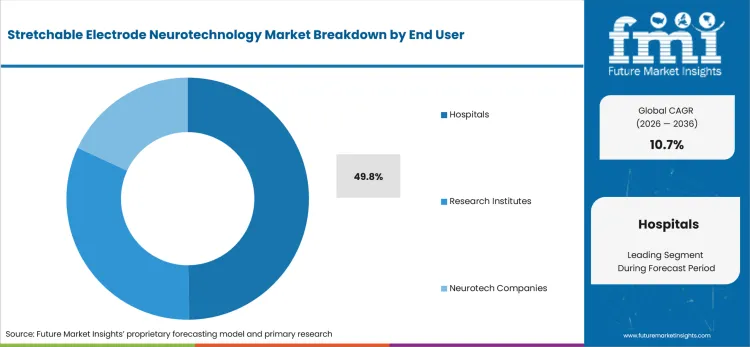
University of Manchester reported in September 2024 a planned first-in-human graphene interface study involving 8 to 10 patients, illustrating hospital participation in early clinical translation. Such institutions combine neurosurgical expertise and diagnostic imaging within coordinated programs involving implantation and neurological follow-up. Research institutes and neurotechnology companies extend development by refining electrode materials and preparing controlled products for clinical evaluation.
- Hospitals are projected to hold 49.8% share of end-user in 2026, guided by their role in implantation and multidisciplinary patient monitoring. Clinical teams evaluate surgical handling and recording quality across defined protocols involving neurological assessment and rehabilitation.
- Research institutes examine conductivity and mechanical fatigue before new electrode designs enter human evaluation. Neurotechnology companies convert validated findings into products with documented specifications and repeatable manufacturing procedures.
How does soft robotics integrated technology shape product design?
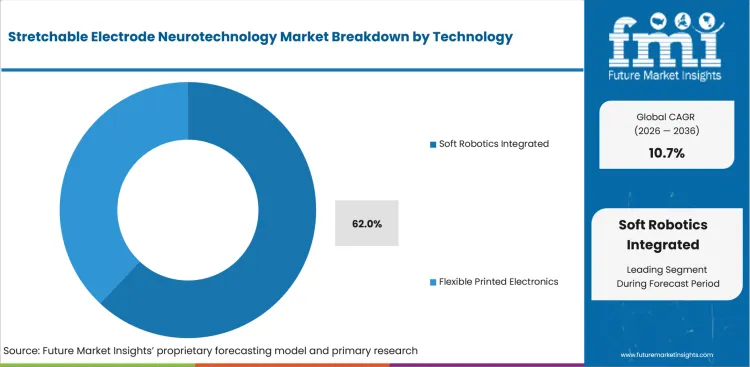
Soft robotics integrated systems use controlled movement to position compliant electrodes against curved or delicate neural structures. Flexible printed electronics apply thin conductive patterns across wearable and implanted substrates requiring close anatomical contact. Nature Materials researchers reported in April 2024 an actuated nerve cuff containing 28 microelectrodes, demonstrating active conformity without rigid fixation.
- By technology, soft robotics integrated technology is forecast to account for 62.0% share in 2026 since active positioning improves electrode contact across irregular anatomy. Design teams examine actuation accuracy and tissue pressure before combining these systems with recording or stimulation functions.
- Flexible printed electronics create thin electrode layouts that bend with wearable devices or implanted substrates. Repeatable printing methods allow developers to tailor contact geometry for defined sensing and stimulation requirements.
What are drivers, restraints, and opportunities in Stretchable Electrode Neurotechnology Market?
Human brain-computer interface studies and compliant material research support electrode evaluation in clinical programs. Limited participant cohorts and demanding durability validation is likely to delay routine adoption in hospital planning.
- Driver: Clinical programs need electrodes maintaining stable tissue contact during physiological movement and repeated neural recording. Human feasibility studies provide direct evidence concerning surgical handling and longitudinal signal stability throughout implanted participants.
- Restraint: Long-term implants require documented fatigue resistance and encapsulation integrity during extended clinical use. Small participant cohorts prolong uncertainty concerning population-level performance and uncommon device-related complications.
- Opportunity: Bidirectional systems combine neural recording and stimulation across rehabilitation or assistive control programs. Modular implantable neurostimulator electrodes support application-specific configurations in neurological procedures and anatomical targets.
Neuralink launched its GB-PRIME study at 2 sites in July 2025, expanding human evaluation of robotically implanted electrode threads. Added clinical locations strengthen investigator training and provide evidence concerning implantation consistency between separate hospital teams. Expanded participation is projected to support demand for compliant interfaces suited to repeatable surgical placement.
Clinical durability remains difficult to prove among limited early-stage cohorts receiving experimental implanted electrode systems. ClinicalTrials.gov listed estimated enrollment of 5 participants for a flexible subdural electrode pilot in April 2026, showing narrow evidence bases during initial human assessment. Small cohorts extend evidence timelines and increase caution during hospital review of long-duration interface reliability.
Bidirectional procedures offer an opportunity for combined neural sensing and targeted therapeutic stimulation. CorTec GmbH reported 32 recording channels and 32 stimulation channels for Brain Interchange in February 2025, advancing closed-loop application development within rehabilitation programs. Configurable channels permit application-specific recording and stimulation patterns within one implanted platform.
How are country CAGRs aligned in Stretchable Electrode Neurotechnology Market?
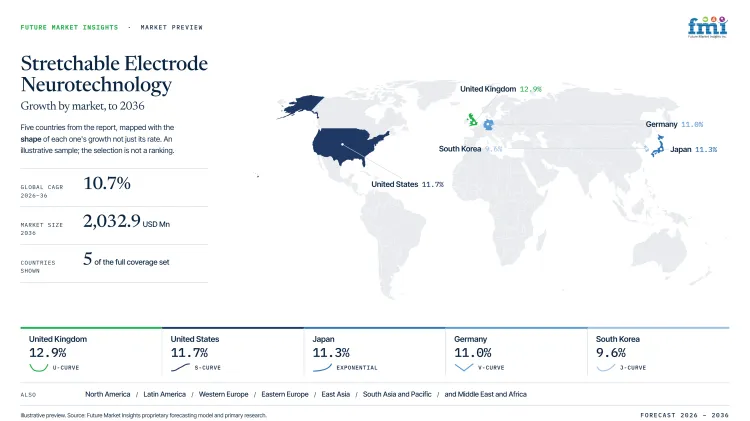
| Country or Market | CAGR |
|---|---|
| United Kingdom | 12.9% |
| United States | 11.7% |
| Japan | 11.3% |
| Germany | 11.0% |
| South Korea | 9.6% |
Source: Future Market Insights country analysis, 2026.
How do country-level CAGRs compare in Stretchable Electrode Neurotechnology Market?
Country comparison reflects a gradual step-down in growth among the profiled markets. The United Kingdom and United States occupy upper end of the range, followed closely by Japan and Germany. South Korea records a lower rate compared to the other disclosed markets. The 3.3-point spread indicates for all five markets sharing a positive outlook. Their positions reflect different levels of market momentum. Country rates describe the profiled set and do not establish a universal ranking.
- The United Kingdom leads comparison and establishes Europe as the prominent development base among the markets shown.
- The United States follows United Kingdom and maintains a limited gap from the leading position.
- Japan and Germany form the next rate band, indicating similar market momentum in both countries.
- South Korea records the slowest expansion among the listed markets, yet its forecast stays positive within the wider market context.
- The pattern resembles a gradual downward slope instead of a sharp separation between faster and slower markets.
Markets with broadly similar CAGRs are likely to present different entry conditions due to clinical infrastructure and neurotechnology readiness. The full report provides country-level analysis for North America, Latin America, Europe, East Asia, South Asia and Pacific, and the Middle East and Africa.
Country-wise Analysis
- Stretchable electrode neurotechnology sales in the United Kingdom are forecast to rise at 12.9% CAGR between 2026 and 2036, reflecting active human interface studies. Specialist hospitals provide controlled environments for implantation and longitudinal assessment. University College London Hospitals reported 7 GB-PRIME participants in January 2026, broadening local clinical experience with implanted interfaces.
- Paradromics Inc. reported 3 Connexus clinical sites in July 2025 across California along with Massachusetts, and Michigan. Multi-site participation improves protocol comparison among separate neurosurgical teams. V, influenced by regulated studies and established specialist centers.
- Precision microfabrication expertise contributes to electrode research in Japan across university engineering laboratories. Industry in Japan is projected to expand at 11.3% CAGR during the forecast period, associated with flexible substrates and low-injury interfaces. Toyohashi University of Technology reported neural recording beyond 1 year using a 5 μm microneedle electrode in November 2025, indicating durable performance with reduced tissue intrusion.
- CorTec GmbH reported thought-controlled computer operation by 1 implanted participant in an FDA-authorized study in April 2026. Developers in Germany combine wireless recording with controlled stimulation for rehabilitation research conducted at authorized clinical sites. Sector in Germany is set to grow at 11.0% CAGR during the study period, aided by implant engineering and structured clinical translation.
- Specialized materials laboratories in South Korea refine deformable conductors for neural sensing devices. Korea Advanced Institute of Science and Technology reported a resistance change of 1.4 at 1,200% strain in April 2024, demonstrating electrical stability during extreme deformation. The market in South Korea is likely to increase at 9.6% CAGR during the assessment period, aided by electronics manufacturing and conductive composite research.
Who are notable companies in Stretchable Electrode Neurotechnology Market?
WISE SpA, Precision Neuroscience Corporation, Neuralink Corp., Blackrock Neurotech, Paradromics Inc., CorTec GmbH, and INBRAIN Neuroelectronics SL are the prominent companies influencing this market.
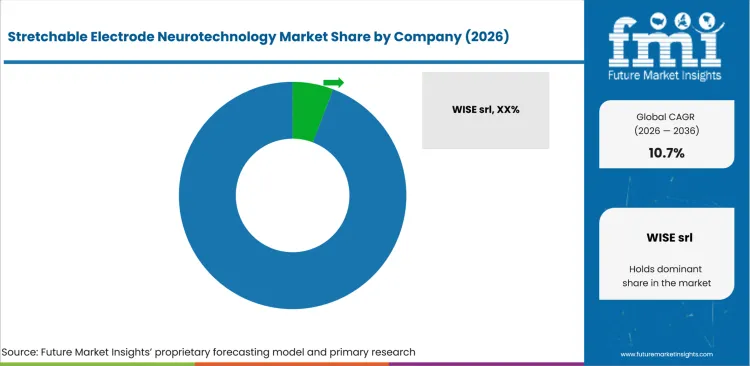
Competition is anticipated to center on mechanical compliance and electrical stability during clinically useful periods. Hospital teams are likely to compare human evidence and manufacturing controls prior to clinical adoption. WISE SpA and Precision Neuroscience Corporation address cortical surface recording led by compliant arrays. Neuralink Corp. and Blackrock Neurotech focus on implanted recording for assistive control. Paradromics Inc. and CorTec GmbH develop implanted platforms for communication or rehabilitation programs. INBRAIN Neuroelectronics SL advances graphene-based interfaces for precision neurology studies.
- WISE SpA and Precision Neuroscience Corporation receive hospital review through conformable cortical surface arrays. Surgical teams compare placement behavior with recording resolution during temporary monitoring procedures conducted under defined neurological protocols.
- Neuralink Corp. and Blackrock Neurotech compete on implanted channel capacity and assistive-control performance. Clinical investigators examine signal consistency across repeated sessions alongside participant-specific decoding under controlled study protocols at specialist centers.
- Paradromics Inc. and CorTec GmbH advance high-data-rate and bidirectional implanted platforms. Human study progress informs hospital assessment of communication restoration and post-stroke rehabilitation within governed clinical programs.
- INBRAIN Neuroelectronics SL attracts specialist assessment through graphene neural interfaces. Clinical teams examine sensing quality alongside stimulation control during precision neurology studies requiring safety monitoring and documented follow-up.
Competitive Benchmarking: Stretchable Electrode Neurotechnology Market
| Company | Portfolio Depth | Clinical Match | Service Support | Service Reach |
|---|---|---|---|---|
| WISE SpA | High | High | Medium | Europe and United States |
| Precision Neuroscience Corporation | High | High | High | United States |
| Neuralink Corp. | High | High | High | United States and United Kingdom |
| Blackrock Neurotech | High | High | High | United States and selected research sites |
| Paradromics Inc. | Medium | High | Medium | United States |
| CorTec GmbH | High | High | High | Europe and United States |
| INBRAIN Neuroelectronics SL | Medium | High | Medium | Europe and selected clinical sites |
Source: Future Market Insights competitive analysis, 2026.
Key Developments in Stretchable Electrode Neurotechnology Market
- In March 2025, a substantially equivalent decision was made from the United States Food and Drug Administration for Precision Neuroscience Corporation’s Layer 7-T cortical electrode. FDA clearance supported temporary recording and stimulation on the brain surface for periods below 30 days during neurological procedures.
- In July 2025, CorTec GmbH brought first human implantation of Brain Interchange during an FDA-authorized stroke study. Implantation advanced a bidirectional interface into therapeutic human assessment within a controlled rehabilitation program.
- In February 2026, researchers reported a kirigami-inspired stretchable microelectrode array that recorded activity from more than 700 cortical neurons in a macaque brain. Reconfigurable spiral threads accommodated brain movement and advanced large-area, long-duration neural recording.
Key Players in Stretchable Electrode Neurotechnology Market
Commercial and regulated cortical electrode companies
- WISE SpA
- Precision Neuroscience Corporation
Implantable brain-computer interface developers
- Neuralink Corp.
- Blackrock Neurotech
- Paradromics Inc.
Bidirectional and graphene interface developers
- CorTec GmbH
- INBRAIN Neuroelectronics SL
Stretchable Electrode Neurotechnology Market Report Scope
| Coverage field | Report scope |
|---|---|
| Market breakdown | Stretchable Electrode Neurotechnology Market breakdown by material, application, end user, technology, and region |
| Market Definition | Stretchable electrode neurotechnology includes compliant conductive interfaces designed for neural recording or stimulation during tissue movement and anatomical deformation. |
| Regions Covered | North America, Latin America, Western Europe, Eastern Europe, East Asia, South Asia and Pacific, and Middle East and Africa |
| Countries Covered | United Kingdom, United States, Japan, Germany, South Korea, China, India, France, Canada, and additional profiled countries |
| Key Companies Profiled | WISE SpA and Precision Neuroscience Corporation with Neuralink Corp. and Blackrock Neurotech and Paradromics Inc. and CorTec GmbH and INBRAIN Neuroelectronics SL |
| Forecast Period | 2026 to 2036 |
| Approach | Hybrid bottom-up and top-down methodology using segment shares and country CAGRs with clinical evidence and company participation and regulatory activity |
Source: Future Market Insights scope analysis, 2026.
Stretchable Electrode Neurotechnology Market - Research Methodology
| Method | Approach |
|---|---|
| Primary Research | FMI analysts gathered input from manufacturers, service providers, technology developers, distributors, end users, procurement teams, and subject-matter experts. Interviews examined purchasing decisions, product or service evaluation, adoption barriers, approval requirements, pricing considerations, and expectations for technical or commercial support. Respondents were also asked what evidence is required before a trial, pilot, or initial order develops into regular purchasing. |
| Desk Research | Desk research covered government statistics, regulatory publications, trade data, industry associations, technical literature, standards, company filings, product information, and official corporate announcements. Sources were reviewed for relevance, publication date, geographic coverage, and consistency with the defined market scope. Claims relating to performance, applications, approvals, capacity, investment, and commercial activity were retained only when supported by credible public evidence. |
| Market Sizing and Forecasting | The market model combined the baseline value with historical performance, segment structure, pricing and volume indicators, adoption levels, company participation, and country-level demand conditions. Forecast assumptions considered economic activity, investment trends, regulatory developments, technology adoption, purchasing cycles, supply availability, and barriers to wider market use. Segment and regional estimates were reconciled before the final market total was calculated. |
| Data Validation | Estimates were checked against multiple independent indicators, including public data, company activity, trade patterns, industry developments, and findings from primary interviews. Validation also tested whether products, services, applications, and company revenues fell within the defined market boundaries. Adjacent categories, unsupported claims, overlapping revenues, and activities without direct market relevance were excluded to reduce double counting and maintain consistency across segments and countries. |
Source: Future Market Insights methodology analysis, 2026.
Stretchable Electrode Neurotechnology Market by Segments
Stretchable Electrode Neurotechnology Market segmented by Material:
- Polymer-based
- Silicone
- Graphene
- Liquid Metal
- Others
Stretchable Electrode Neurotechnology Market segmented by Application:
- Brain-Computer Interfaces
- Neural Implants
- Wearable Neurotechnology
- Peripheral Nerve Stimulation
Stretchable Electrode Neurotechnology Market segmented by End User:
- Hospitals
- Research Institutes
- Neurotechnology Companies
Stretchable Electrode Neurotechnology Market segmented by Technology:
- Soft Robotics Integrated
- Flexible Printed Electronics
Stretchable Electrode Neurotechnology Market segmented by Region:
- North America
- United States
- Canada
- Latin America
- Brazil
- Mexico
- Argentina
- Chile
- Western Europe
- Germany
- France
- United Kingdom
- Italy
- Spain
- Benelux
- Nordics
- Eastern Europe
- Poland
- Czech Republic
- Romania
- Hungary
- East Asia
- China
- Japan
- South Korea
- South Asia and Pacific
- India
- ASEAN
- Australia and New Zealand
- Middle East and Africa
- GCC Countries
- South Africa
- Türkiye
- Israel
Research Sources and Bibliography
- Neuralink Corp. (2026, January 28). Two years of Telepathy.
- Blackrock Neurotech. (2025, August 13). Intracortical microstimulation in humans: A decade of safety and efficacy.
- Dong, R., Wang, L., Li, Z., Jiao, J., Wu, Y., Feng, Z., Wang, X., Chen, M., Cui, C., Lu, Y., and Jiang, X. (2024, January 2). Stretchable, self-rolled, microfluidic electronics enable conformable neural interfaces of brain and vagus neuromodulation. ACS Nano, 18(2), 1702-1713.
- Blackrock Neurotech. (2025, January 23). A high-performance brain-computer interface for finger decoding and quadcopter game control in an individual with paralysis.
- University of Manchester. (2024, September 26). INBRAIN Neuroelectronics announces world’s first human graphene-based brain computer interface procedure.
- Dong, C., Carnicer-Lombarte, A., Bonafè, F., Huang, B., Middya, S., Jin, A., Tao, X., Han, S., Bance, M., Barone, D. G., Fraboni, B., and Malliaras, G. G. (2024, April 26). Electrochemically actuated microelectrodes for minimally invasive peripheral nerve interfaces. Nature Materials, 23, 969-976.
- Neuralink Corp. (2025, July 31). GB-PRIME study launch.
- ClinicalTrials.gov. (2026, April 21). MINDZ--Minimally invasive approach pilot study.
- CorTec GmbH. (2025, February 7). Our Brain Interchange BCI system reaches clinical readiness.
- University College London Hospitals Biomedical Research Centre. (2026, January 29). Seven patients now participating in Neuralink trial.
- Paradromics Inc. (2025, July 17). Paradromics adds third site for the Connexus brain-computer interface clinical study at the University of Michigan.
- Toyohashi University of Technology. (2025, November 26). Year-long neural recording using the world’s smallest microneedle electrode technology.
- CorTec GmbH. (2026, April 29). CorTec’s Brain Interchange BCI system enables stroke patient to control computer with his mind.
- Korea Advanced Institute of Science and Technology. (2024, April 18). Self-mixed biphasic liquid metal composite with ultra-high stretchability and strain-insensitivity for neuromorphic circuits.
- United States Food and Drug Administration. (2025, March 30). 510(k) premarket notification: Layer 7-T, K242618.
- CorTec GmbH. (2025, July 29). CorTec announces neurotech milestone: First human implantation of a brain-computer interface made in Germany.
- Fang, R., Tian, H., Du, Y., Zhao, Y., Yang, Y., Guan, S., Li, S., Liu, M., Xu, K., & Fang, Y. (2026, February 5). Flexible kirigami microelectrode arrays for neuronal activity recordings in non-human primate brains. Nature Electronics, 9, 266-278.
This bibliography is provided for reader reference and is not exhaustive. The full report contains the complete reference list and detailed citations.
This Report Answers
- What segments influence demand across material and application with end user and technology?
- How do clinical teams evaluate stretchable electrodes prior to human implantation across neurological programs?
- How do country CAGRs differ across profiled markets with distinct clinical access and engineering capacity?
- What companies compete through electrode conformity and clinical evidence and dependable technical support?
- How are forecasts validated through hybrid bottom-up and top-down analysis using independent market indicators?
- What evidence do hospital committees examine prior to adopting compliant cortical interfaces across neurosurgical programs?
- How do material fatigue and signal stability influence electrode selection during clinical qualification?
- What limits return on investment for developers preparing stretchable neural interfaces for regulated use?
- How do clinical study records and regulatory decisions influence hospital assessment across specialist services?
- What company capabilities improve long-term confidence and continuing interface utilization across clinical programs?
Frequently Asked Questions
How big is the Stretchable Electrode Neurotechnology Market in 2026?
The stretchable electrode neurotechnology market is valued at USD 735.6 million in 2026 and is forecast to reach USD 2,032.9 million by 2036, reflecting growing clinical demand for compliant neural interfaces that maintain stable electrical contact across moving and curved tissue.
What is the CAGR of the Stretchable Electrode Neurotechnology Market from 2026 to 2036?
The stretchable electrode neurotechnology market is projected to grow at a CAGR of 10.7% between 2026 and 2036, supported by expanding human clinical trials evaluating implanted electrode performance across communication restoration and motor-assistance programs.
Which technology leads the Stretchable Electrode Neurotechnology Market?
Soft robotics integrated systems account for 62.0% of the stretchable electrode neurotechnology market by technology in 2026, driven by their ability to actively position compliant electrodes against irregular anatomical surfaces without rigid mechanical fixation.
Which country is growing fastest in the Stretchable Electrode Neurotechnology Market?
The stretchable electrode neurotechnology market in the United Kingdom is projected to expand at a CAGR of 12.9% through 2036, ahead of the United States at 11.7%, Japan at 11.3%, Germany at 11.0%, and South Korea at 9.6%, reflecting active human interface studies and specialist hospital participation in implantation programs.
Who are the leading companies in the Stretchable Electrode Neurotechnology Market?
Leading companies in the stretchable electrode neurotechnology market include WISE SpA, Precision Neuroscience Corporation, Neuralink Corp., Blackrock Neurotech, Paradromics Inc., CorTec GmbH, and INBRAIN Neuroelectronics SL, competing across cortical surface arrays, implanted recording platforms, and bidirectional neurostimulation systems.
Preview the report firsthand - request a free sample
Get SampleGet the brochure for pricing and purchase details.
Get PDFTable of Content
- Key Takeaways
- Market Size and CAGR
- Top Growth Driver
- Fastest Growing Segment
- Leading Region
- Key Companies
- Emerging Opportunities
- Executive Summary
- Global Market Outlook
- Demand-side Trends
- Supply-side Trends
- Technology Roadmap Analysis
- Analysis and Recommendations
- Analyst Perspective (What is happening? Why now? What should investors know?)
- Key Questions Answered
- How large is the market?
- What is the CAGR?
- What are key trends?
- Which region dominates?
- Who are the leaders?
- Market Overview
- Market Coverage / Taxonomy
- Market Definition / Scope / Limitations
- Research Methodology
- Chapter Orientation
- Analytical Lens and Working Hypotheses
- Market Structure, Signals, and Trend Drivers
- Benchmarking and Cross-market Comparability
- Market Sizing, Forecasting, and Opportunity Mapping
- Research Design and Evidence Framework
- Desk Research Programme (Secondary Evidence)
- Expert Input and Fieldwork (Primary Evidence)
- Tooling, Models, and Reference Databases
- Data Engineering and Model Build
- Quality Assurance and Audit Trail
- Market Background
- Market Dynamics (Drivers, Restraints, Opportunity, Trends)
- Scenario Forecast (Optimistic, Likely, Conservative)
- Impact Analysis
- AI Impact
- Sustainability Impact
- Regulatory Impact
- Technology Impact
- Consumer / Buyer Analysis
- Purchase Drivers
- Adoption Barriers
- Buyer Journey
- Opportunity Map Analysis
- Product Life Cycle Analysis
- Supply Chain Analysis
- Investment Feasibility Matrix
- Value Chain Analysis
- PESTLE and Porter's Analysis
- Regulatory Landscape
- Regional Parent Market Outlook
- Production and Consumption Statistics
- Import and Export Statistics
- Global Market Analysis and Forecast, 2021 to 2036
- Historical Market Size Value (USD Million) Analysis, 2021 to 2025
- Current and Future Market Size Value (USD Million) Projections, 2026 to 2036
- Y-o-Y Growth Trend Analysis
- Absolute $ Opportunity Analysis
- Global Market Pricing Analysis, 2021 to 2036
- Global Market Analysis and Forecast, By Material, 2021 to 2036
- Introduction / Key Findings
- Historical Market Size Value (USD Million) Analysis By Material, 2021 to 2025
- Current and Future Market Size Value (USD Million) Analysis and Forecast By Material, 2026 to 2036
- Polymer-based
- Silicone
- Graphene
- Liquid Metal
- Others
- Polymer-based
- Y-o-Y Growth Trend Analysis By Material, 2021 to 2025
- Absolute $ Opportunity Analysis By Material, 2026 to 2036
- Global Market Analysis and Forecast, By Application, 2021 to 2036
- Introduction / Key Findings
- Historical Market Size Value (USD Million) Analysis By Application, 2021 to 2025
- Current and Future Market Size Value (USD Million) Analysis and Forecast By Application, 2026 to 2036
- Brain-Computer Interfaces
- Neural Implants
- Wearable Neurotech
- Peripheral Nerve Stimulation
- Brain-Computer Interfaces
- Y-o-Y Growth Trend Analysis By Application, 2021 to 2025
- Absolute $ Opportunity Analysis By Application, 2026 to 2036
- Global Market Analysis and Forecast, By End User, 2021 to 2036
- Introduction / Key Findings
- Historical Market Size Value (USD Million) Analysis By End User, 2021 to 2025
- Current and Future Market Size Value (USD Million) Analysis and Forecast By End User, 2026 to 2036
- Hospitals
- Research Institutes
- Neurotech Companies
- Hospitals
- Y-o-Y Growth Trend Analysis By End User, 2021 to 2025
- Absolute $ Opportunity Analysis By End User, 2026 to 2036
- Global Market Analysis and Forecast, By Technology, 2021 to 2036
- Introduction / Key Findings
- Historical Market Size Value (USD Million) Analysis By Technology, 2021 to 2025
- Current and Future Market Size Value (USD Million) Analysis and Forecast By Technology, 2026 to 2036
- Soft Robotics Integrated
- Flexible Printed Electronics
- Soft Robotics Integrated
- Y-o-Y Growth Trend Analysis By Technology, 2021 to 2025
- Absolute $ Opportunity Analysis By Technology, 2026 to 2036
- Global Market Analysis and Forecast, By Region, 2021 to 2036
- Introduction
- Historical Market Size Value (USD Million) Analysis By Region, 2021 to 2025
- Current Market Size Value (USD Million) Analysis and Forecast By Region, 2026 to 2036
- North America
- Latin America
- Western Europe
- Eastern Europe
- East Asia
- South Asia and Pacific
- Middle East & Africa
- Market Attractiveness Analysis By Region
- North America Market Analysis and Forecast, By Country, 2021 to 2036
- Historical Market Size Value (USD Million) Trend Analysis By Market Taxonomy, 2021 to 2025
- Market Size Value (USD Million) Forecast By Market Taxonomy, 2026 to 2036
- By Country
- USA
- Canada
- By Material
- By Application
- By End User
- By Technology
- By Country
- Market Attractiveness Analysis
- By Country
- By Material
- By Application
- By End User
- By Technology
- Key Takeaways
- Latin America Market Analysis and Forecast, By Country
- Historical Market Size Value (USD Million) Trend Analysis By Market Taxonomy, 2021 to 2025
- Market Size Value (USD Million) Forecast By Market Taxonomy, 2026 to 2036
- By Country
- Brazil
- Mexico
- Chile
- Rest of Latin America
- By Material
- By Application
- By End User
- By Technology
- By Country
- Market Attractiveness Analysis
- By Country
- By Material
- By Application
- By End User
- By Technology
- Key Takeaways
- Western Europe Market Analysis and Forecast, By Country
- Historical Market Size Value (USD Million) Trend Analysis By Market Taxonomy, 2021 to 2025
- Market Size Value (USD Million) Forecast By Market Taxonomy, 2026 to 2036
- By Country
- Germany
- UK
- Italy
- Spain
- France
- Nordic
- BENELUX
- Rest of Western Europe
- By Material
- By Application
- By End User
- By Technology
- By Country
- Market Attractiveness Analysis
- By Country
- By Material
- By Application
- By End User
- By Technology
- Key Takeaways
- Eastern Europe Market Analysis and Forecast, By Country
- Historical Market Size Value (USD Million) Trend Analysis By Market Taxonomy, 2021 to 2025
- Market Size Value (USD Million) Forecast By Market Taxonomy, 2026 to 2036
- By Country
- Russia
- Poland
- Hungary
- Balkan & Baltic
- Rest of Eastern Europe
- By Material
- By Application
- By End User
- By Technology
- By Country
- Market Attractiveness Analysis
- By Country
- By Material
- By Application
- By End User
- By Technology
- Key Takeaways
- East Asia Market Analysis and Forecast, By Country
- Historical Market Size Value (USD Million) Trend Analysis By Market Taxonomy, 2021 to 2025
- Market Size Value (USD Million) Forecast By Market Taxonomy, 2026 to 2036
- By Country
- China
- Japan
- South Korea
- By Material
- By Application
- By End User
- By Technology
- By Country
- Market Attractiveness Analysis
- By Country
- By Material
- By Application
- By End User
- By Technology
- Key Takeaways
- South Asia and Pacific Market Analysis and Forecast, By Country
- Historical Market Size Value (USD Million) Trend Analysis By Market Taxonomy, 2021 to 2025
- Market Size Value (USD Million) Forecast By Market Taxonomy, 2026 to 2036
- By Country
- India
- ASEAN
- Australia & New Zealand
- Rest of South Asia and Pacific
- By Material
- By Application
- By End User
- By Technology
- By Country
- Market Attractiveness Analysis
- By Country
- By Material
- By Application
- By End User
- By Technology
- Key Takeaways
- Middle East & Africa Market Analysis and Forecast, By Country
- Historical Market Size Value (USD Million) Trend Analysis By Market Taxonomy, 2021 to 2025
- Market Size Value (USD Million) Forecast By Market Taxonomy, 2026 to 2036
- By Country
- Kingdom of Saudi Arabia
- Other GCC Countries
- Türkiye
- South Africa
- Other African Union
- Rest of Middle East & Africa
- By Material
- By Application
- By End User
- By Technology
- By Country
- Market Attractiveness Analysis
- By Country
- By Material
- By Application
- By End User
- By Technology
- Key Takeaways
- Key Countries Market Analysis
- USA
- Pricing Analysis
- Market Share Analysis, 2025
- By Material
- By Application
- By End User
- By Technology
- Canada
- Pricing Analysis
- Market Share Analysis, 2025
- By Material
- By Application
- By End User
- By Technology
- Mexico
- Pricing Analysis
- Market Share Analysis, 2025
- By Material
- By Application
- By End User
- By Technology
- Brazil
- Pricing Analysis
- Market Share Analysis, 2025
- By Material
- By Application
- By End User
- By Technology
- Chile
- Pricing Analysis
- Market Share Analysis, 2025
- By Material
- By Application
- By End User
- By Technology
- Germany
- Pricing Analysis
- Market Share Analysis, 2025
- By Material
- By Application
- By End User
- By Technology
- UK
- Pricing Analysis
- Market Share Analysis, 2025
- By Material
- By Application
- By End User
- By Technology
- Italy
- Pricing Analysis
- Market Share Analysis, 2025
- By Material
- By Application
- By End User
- By Technology
- Spain
- Pricing Analysis
- Market Share Analysis, 2025
- By Material
- By Application
- By End User
- By Technology
- France
- Pricing Analysis
- Market Share Analysis, 2025
- By Material
- By Application
- By End User
- By Technology
- India
- Pricing Analysis
- Market Share Analysis, 2025
- By Material
- By Application
- By End User
- By Technology
- ASEAN
- Pricing Analysis
- Market Share Analysis, 2025
- By Material
- By Application
- By End User
- By Technology
- Australia & New Zealand
- Pricing Analysis
- Market Share Analysis, 2025
- By Material
- By Application
- By End User
- By Technology
- China
- Pricing Analysis
- Market Share Analysis, 2025
- By Material
- By Application
- By End User
- By Technology
- Japan
- Pricing Analysis
- Market Share Analysis, 2025
- By Material
- By Application
- By End User
- By Technology
- South Korea
- Pricing Analysis
- Market Share Analysis, 2025
- By Material
- By Application
- By End User
- By Technology
- Russia
- Pricing Analysis
- Market Share Analysis, 2025
- By Material
- By Application
- By End User
- By Technology
- Poland
- Pricing Analysis
- Market Share Analysis, 2025
- By Material
- By Application
- By End User
- By Technology
- Hungary
- Pricing Analysis
- Market Share Analysis, 2025
- By Material
- By Application
- By End User
- By Technology
- Kingdom of Saudi Arabia
- Pricing Analysis
- Market Share Analysis, 2025
- By Material
- By Application
- By End User
- By Technology
- Türkiye
- Pricing Analysis
- Market Share Analysis, 2025
- By Material
- By Application
- By End User
- By Technology
- South Africa
- Pricing Analysis
- Market Share Analysis, 2025
- By Material
- By Application
- By End User
- By Technology
- USA
- Market Structure Analysis
- Competition Dashboard
- Competition Benchmarking
- Market Share Analysis of Top Players
- By Regional
- By Material
- By Application
- By End User
- By Technology
- Emerging Startups
- Innovation Benchmarking
- Competition Analysis
- Competition Deep Dive
- WISE srl
- Overview
- Product Portfolio
- Profitability by Market Segments
- Sales Footprint
- Strategy Overview
- Marketing Strategy
- Product Strategy
- Channel Strategy
- Neuralink
- Blackrock Neurotech
- Paradromics
- Precision Neuro
- Abbott
- Medtronic
- WISE srl
- Case Studies
- Success Stories
- Recent Developments
- Competition Deep Dive
- Assumptions & Acronyms Used


