

- Market Size (2026)
- USD 981.8 Mn
- Forecast (2036)
- USD 2282.0 Mn
- CAGR (2026 to 2036)
- 8.8%
How big is Advanced Implantable Electrode Neurotechnology Market size?
USD 981.8 million in 2026 and USD 2,282.0 million by 2036 at an 8.8% CAGR.
The advanced implantable electrode neurotechnology sector is projected to expand at 8.8% CAGR between 2026 and 2036, increasing valuation from USD 981.8 million in 2026 to USD 2282.0 million by 2036. Continued neuromodulation development directly expands clinical demand across chronic pain and restorative neural interfaces. This growing neurological disease burden urgently reinforces the long-range need for precise stimulation interfaces and specialist follow-up. A BMJ modelling study published in March 2025 projected 25.2 million people living with Parkinson’s disease by 2050. Leading clinicians to rely on such specialized electrode technologies to deliver effective long-term therapy as patient numbers rise.
International healthcare networks apply distinct regional priorities on evaluating new neurotechnology devices. South Korea and United States hospital networks favor rapid clinical translation and specialist education. Healthcare providers in Germany and Japan stress reimbursement evidence and material durability. Extensive real-world usage data directly builds clinical confidence in carefully governed implant research. Blackrock Neurotech reported in August 2025 more than 168 million intracortical microstimulation pulses across combined human experience. Such an extensive operational record helps physicians trust and expand the use of advanced neural interfaces.
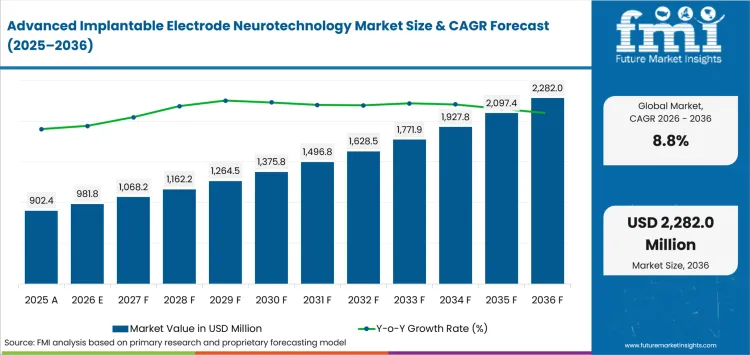
Key Takeaways of Advanced Implantable Electrode Neurotechnology Market
- Demand for advanced implantable electrode neurotechnology is driven by continued neuromodulation development and growing neurological disease burden, with the market projected to expand from USD 981.8 million in 2026 to USD 2,282.0 million by 2036 at an 8.8% CAGR.
- By end user, hospitals hold the leading share at 43.5% in 2026, led by multidisciplinary implant procedures and follow-up resources.
- Spinal cord stimulation is the dominant application segment, holding 31.4% share in 2026, helped by chronic-pain procedures and programmable therapy options.
- Polyimide leads the material category at 39.0% share in 2026, backed by flexible construction and established microfabrication use.
- Stretchable electrodes hold 30.5% technology share in 2026, driven by soft construction and closer mechanical alignment with neural tissue during long implantation periods.
- South Korea, the USA, Germany, the UK, and Japan record CAGRs of 9.8%, 9.4%, 7.8%, 7.6%, and 6.7% respectively through 2036, reflecting a gradual step-down tied to clinical research depth and implementation readiness rather than a sharp regional divide.
- Competition centers on Medtronic, Boston Scientific, Abbott, WISE S.p.A., Blackrock Neurotech, and NeuroPace, with vendors differentiating through established deep brain and spinal cord stimulation portfolios, stretchable electrode engineering, and intracortical/responsive neurotechnology development.
Analyst Perspective
"Commercial adoption will depend on clinical evidence and long-term device reliability rather than material innovation alone. Healthcare providers are prioritizing implantable electrode technologies that combine durable performance with consistent therapeutic outcomes and well-established surgical pathways. Companies that strengthen clinical validation, manufacturing quality, and physician confidence will be better positioned to expand adoption across advanced neurotechnology applications."
-Anurag Sharma, Principal Consultant for Healthcare at Future Market Insights
Source: Future Market Insights analysis, 2026.
How is Advanced Implantable Electrode Neurotechnology Market segmented?
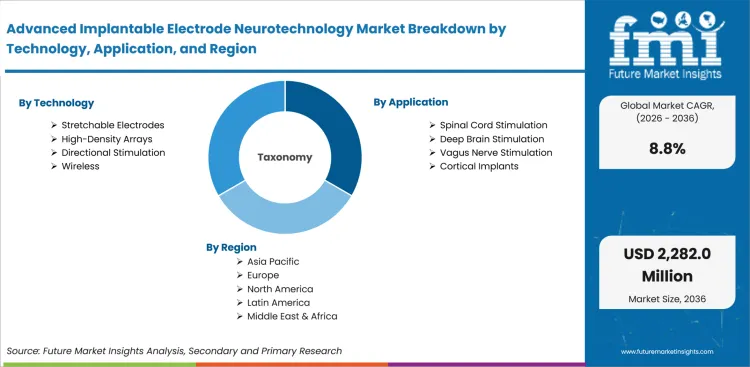
The advanced implantable electrode neurotechnology market is segmented by technology, application, end user, material, and region.
The advanced implantable electrode neurotechnology industry is segmented by technology, application, end user, material, and region. Technology coverage includes stretchable electrodes, high-density arrays, directional stimulation, and wireless designs. Application coverage addresses spinal cord stimulation, deep brain stimulation, vagus nerve stimulation, and cortical implants. End-user coverage spans hospitals, pain clinics, and neurology centers. Material coverage includes polyimide, silicone, graphene-based structures, and liquid crystal polymer. Regional coverage encompasses North America, Latin America, Western Europe, Eastern Europe, East Asia, South Asia and Pacific, and Middle East and Africa.
How do stretchable electrodes shape technology selection?
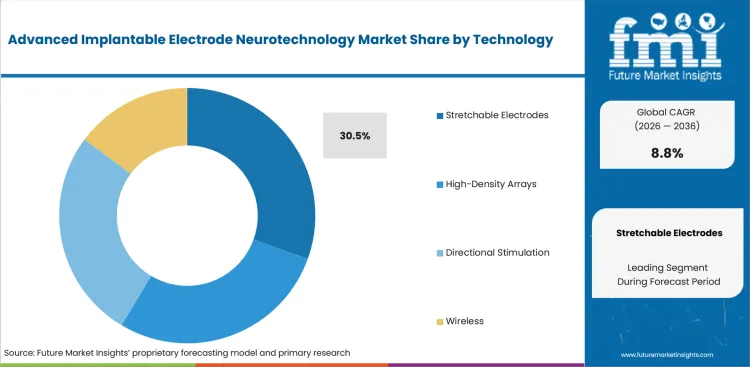
Dong and colleagues reported in January 2024 stating stretchable microfluidic neural interfaces tolerating more than 600% strain, influencing electrode conformity during tissue movement and peripheral nerve modulation. Mechanical adaptability directs product assessment toward low tissue stress and dependable recording during long implantation periods.
- Stretchable electrodes are likely to represent 30.5% share in 2026, driven by soft construction and closer mechanical alignment with neural tissue. Clinical teams assess conductor stability and encapsulation integrity across repeated deformation during implantable neurostimulator electrode development.
- High-density arrays and wireless architectures address distinct needs involving spatial selectivity and reduced lead burden. Engineering review examines channel consistency and power management through complete sensing or stimulation sessions.
How does spinal cord stimulation shape application demand?
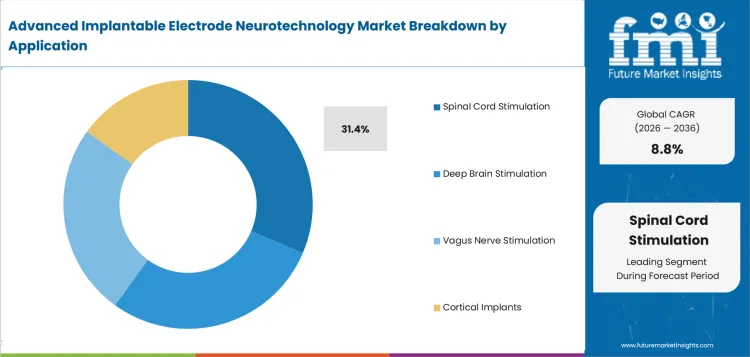
Documented pain relief supports careful comparison of programming modes and follow-up resources across spinal cord stimulators. North and colleagues reported in October 2025 a responder rate of 89.5% in patients receiving spinal cord stimulation with conventional medical management, strengthening clinical review for refractory pain pathways.
- In 2026, spinal cord stimulation is anticipated to secure 31.4% share as it reflects established chronic-pain use and programmable therapy delivery. Pain specialists compare waveform flexibility and electrode positioning through patient-specific trial and implant stages.
- Deep brain stimulation and cortical implants serve movement disorders and restorative neurotechnology research. Case selection rests on target anatomy and durable monitoring responsibility.
Why do hospitals lead end-user demand?
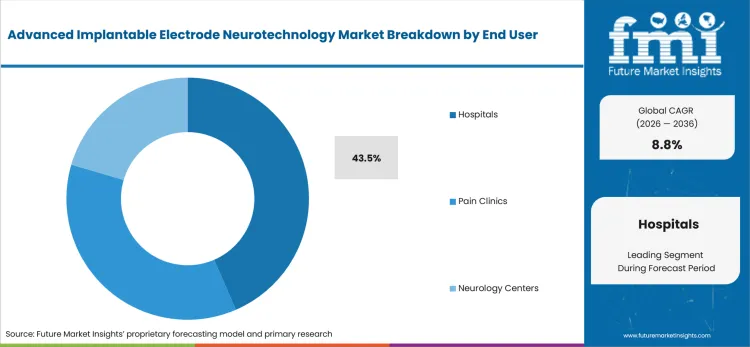
American Hospital Association data published in February 2026 counted 6,100 United States hospitals, illustrating substantial infrastructure for complex procedures and multidisciplinary follow-up. Hospital-based adoption benefits from sterile implantation services and adverse-event management.
- Hospitals are forecast to secure 43.5% share of end-user in 2026, backed by operating-room capacity and coordinated neurology services. Institutional committees assess clinical evidence and service response across deep brain stimulator and chronic-pain programs.
- Pain clinics and neurology centers provide focused evaluation and longitudinal symptom review for selected patients. Referral coordination with implanting hospitals influences continuity across diagnosis and adjustment.
Why does polyimide lead material selection?
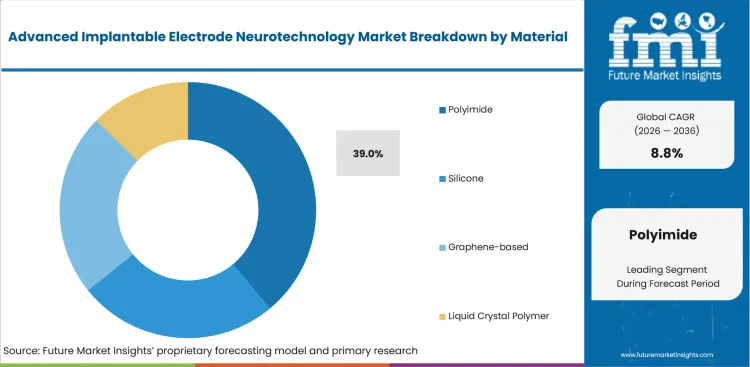
Thin construction supports electrode flexibility and reduced geometric mismatch across delicate neural structures. Wang and colleagues reported in November 2024 an ultraflexible polyimide neural electrode measuring 5 µm in thickness, demonstrating material suitability for long navigational paths and minimally invasive implantation research.
- By material, polyimide is projected to account for 39.0% share in 2026, influenced by microfabrication compatibility and dependable mechanical strength. Developers compare insulation integrity and conductor adhesion across polyimide film and tape specifications used in implant construction.
- Graphene based material and liquid crystal polymer offer alternative combinations of elasticity and barrier performance. Material screening considers chronic biocompatibility and manufacturing repeatability across intended implant locations.
What are the drivers, restraints, and opportunities in Advanced Implantable Electrode Neurotechnology Market?
Advanced implantable electrode neurotechnology advances through growing neurological care needs and improved electrode engineering. Adoption slows amid reimbursement uncertainty and demanding post-implant support.
- Driver: Demand rises as neurology services seek precise stimulation and recording across chronic neurological care pathways. Multidisciplinary implant programs strengthen demand by connecting electrode performance with structured patient monitoring and specialist-led programming.
- Restraint: Adoption faces limits from invasive procedures and long-term service obligations. Limited reimbursement clarity discourages hospitals from expanding implant programs requiring extensive training and postoperative coordination.
- Opportunity: Product development gains scope through adaptive sensing and minimally invasive delivery. Softer electrode materials support closer tissue conformity and create development prospects across long-duration neurological applications.
Neurological disease burden provides a sustained demand base for neurostimulation therapies. World Health Organization reporting issued in March 2024 stated more than 3 billion people live with neurological conditions, supporting investment in therapies aimed at pain and functional impairment. Device suppliers gain commercial credibility through condition-specific outcomes and responsible patient monitoring.
Hospital review examines antimicrobial protocols and technical support prior to program expansion. Implant procedures require disciplined infection control and hardware management across every care stage. Walsh and colleagues reported in April 2024 an overall deep brain stimulation infection rate of 2.56% per procedure, demonstrating direct clinical consequences from electrode placement and pulse-generator management.
High-density cortical arrays create scope for richer neural decoding and targeted stimulation across restorative applications. Hettick and colleagues reported in October 2025 a minimally invasive 1,024-channel cortical microelectrode array, illustrating scalable recording capacity through compact implantation approaches. Research progress supports brain computer interface implant programs requiring dense signals and controlled surgical access.
How are country CAGRs aligned in Advanced Implantable Electrode Neurotechnology Market?
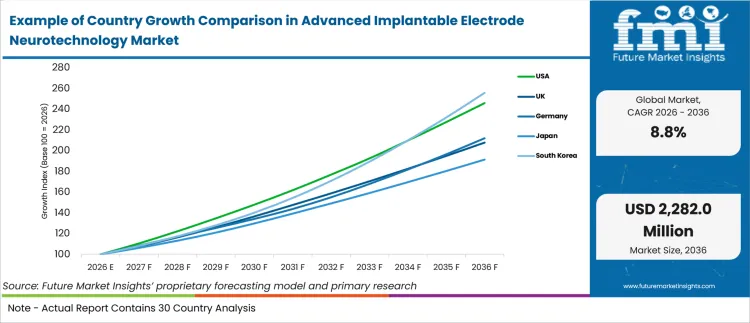
| Country or Market | CAGR |
|---|---|
| South Korea | 9.8% |
| USA | 9.4% |
| Germany | 7.8% |
| UK | 7.6% |
| Japan | 6.7% |
Source: Future Market Insights country analysis, 2026.
How do country-level CAGRs compare in Advanced Implantable Electrode Neurotechnology Market?
Country comparison shows a gradual step-down across the five markets covered. South Korea occupies the leading position, followed by the United States. Germany and the United Kingdom form a closely grouped middle tier. Japan completes the comparison. Market ordering reflects different levels of clinical research depth and implementation readiness. A 3.1 percentage-point spread across the profiled countries reflects positive expansion prospects showing adoption speeds differing through clinical infrastructure and technology evaluation practices.
- South Korea leads the comparison and establishes East Asia as an important clinical technology cluster among the markets shown.
- USA follows South Korea and maintains a narrow gap supported by established neuromodulation services and trial activity.
- Germany and UK form the next development band, reflecting structured hospital review and regulated care pathways.
- Japan records the lowest rate among the listed markets, with specialist concentration supporting continued adoption.
- Market progression resembles a gradual downward slope instead of a sharp separation between national adoption profiles.
Markets with similar CAGRs may present different entry conditions led by implanting-center capacity and long-term service requirements. Full report coverage provides country-level analysis across North America, Latin America, Western Europe, Eastern Europe, East Asia, South Asia and Pacific, and Middle East and Africa.
Country-wise Analysis
- Adoption in South Korea is set to scale at 9.8% CAGR from 2026 to 2036, led by concentrated tertiary hospitals and rapid clinical technology assessment. Active older populations increase demand for neurological support and long-term functional care. OECD reporting dated November 2025 found 57% of people aged 65 to 69 employed during 2024, reinforcing interest in therapies preserving independence and participation.
- Established brain implants programs offer clinical infrastructure for stimulation and device follow-up. United States Census Bureau reporting issued in June 2025 recorded 61.2 million residents aged 65 years or older during 2024, expanding neurological care requirements across regional health systems. Sales in the United States are projected to grow at 9.4% CAGR during forecast period due to coverage depth and specialist scale.
- Industry in Germany is anticipated to progress at 7.8% CAGR between 2026 and 2036, influenced by regulated care pathways and engineering base support. University hospitals provide structured settings for evidence generation and specialist training. German Federal Statistical Office reporting dated December 2025 stated 1 in 5 residents had reached age 67 or older during 2024, increasing attention toward durable neurological therapies.
- Sector in the United Kingdom is expected to expand at 7.6% CAGR through 2036, backed by public-health assessment and specialist service capacity. Neurological disability records influence pathway planning for stimulation and implant follow-up. Department for Work and Pensions statistics published in March 2025 showed neurological disease represented 13% of Personal Independence Payment claims, indicating substantial functional-support needs.
- Provider assessment emphasizes patient safety and compact implant engineering across ageing-care pathways. Statistics Bureau of Japan reporting released in April 2025 recorded residents aged 65 years or older at 29.3% of national population during 2024, promoting demand for neurological intervention capacity. The market in Japan is likely to increase at 6.7% CAGR by 2036, driven by disciplined clinical review and advanced imaging access.
Who are notable companies in Advanced Implantable Electrode Neurotechnology Market?
WISE S.p.A., Medtronic, Boston Scientific, Abbott, Blackrock Neurotech, and NeuroPace are the prominent companies shaping this market.
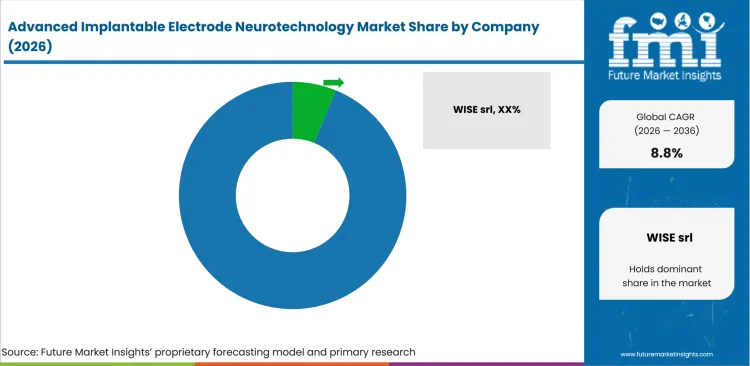
Competition in advanced implantable electrode neurotechnology is anticipated to focus on clinical evidence and electrode durability and dependable programming support. Hospital teams are likely to compare companies driven by stimulation precision and signal stability prior to platform selection. WISE S.p.A. is expected to receive attention due to stretchable electrode engineering. Medtronic and Boston Scientific are projected to retain review through established neuromodulation programs. Abbott is estimated to support evaluation led by implantable stimulation options and clinician resources. Blackrock Neurotech and NeuroPace are anticipated to influence cortical recording and responsive therapy assessment.
- Medtronic and Boston Scientific gain review attention based on established deep brain and spinal cord stimulation portfolios. Clinical teams assess programming breadth, lead design, and long-term technical support across complete care pathways.
- Abbott competes due to implantable stimulation systems serving movement-disorder and chronic-pain programs. Hospital committees compare therapy evidence, patient-management tools, and regional clinician education.
- WISE S.p.A. supports specialist evaluation depending on thin conformable electrodes designed for neural tissue contact. Commercial progress reflects clinical validation, manufacturing consistency, and dependable procedural guidance.
- Blackrock Neurotech and NeuroPace receive specialist interest across intracortical research and responsive epilepsy therapy. Clinical programs examine recording quality, chronic signal stability, and physician interpretation support.
Competitive Benchmarking: Advanced Implantable Electrode Neurotechnology Market
| Company | Portfolio Depth | Clinical Match | Service Support | Service Reach |
|---|---|---|---|---|
| WISE S.p.A. | Medium | High | Medium | Europe and selected clinical research sites |
| Medtronic | High | High | High | Global clinical markets |
| Boston Scientific | High | High | High | North America, Europe, and selected global markets |
| Abbott | High | High | High | United States and international markets |
| Blackrock Neurotech | Medium | Medium | Medium | United States and selected research sites |
| NeuroPace | Medium | High | High | United States |
Source: Future Market Insights competitive analysis, 2026.
Key Developments in Advanced Implantable Electrode Neurotechnology Market
- In February 2025, United States Food and Drug Administration approved Medtronic’s optional adaptive deep brain stimulation feature for Activa along with Percept, and SenSight systems. Signal-linked programming expands individualized stimulation assessment for Parkinson’s disease care.
- In December 2025, United States Food and Drug Administration approved revised MRI conditions for Boston Scientific WaveWriter Alpha spinal cord stimulation systems used with specified compatible leads. Updated labeling supports imaging continuity for selected implanted patients and strengthens MRI-safe neurostimulation systems planning.
- In May 2026, United States Food and Drug Administration approved NeuroPace ECoG Assistant as an optional RNS System feature prioritizing recordings of clinical interest. Automated prioritization supports clinician review across responsive stimulation follow-up.
Key Players in Advanced Implantable Electrode Neurotechnology Market
Established neuromodulation companies
- Medtronic
- Boston Scientific
- Abbott
Stretchable electrode developer
- WISE S.p.A.
Cortical and responsive neurotechnology developers
- Blackrock Neurotech
- NeuroPace
Advanced Implantable Electrode Neurotechnology Market Report Scope
| Coverage field | Report scope |
|---|---|
| Market breakdown | Advanced implantable electrode neurotechnology breakdown by technology, application, end user, material, and region |
| Quantitative Units | Revenue in USD Million, CAGR in %. |
| Market Definition | Advanced implantable electrode neurotechnology includes implantable electrodes and supporting systems used for electrical stimulation, neural recording, responsive therapy, or brain-interface research across defined neurological pathways. |
| Regions Covered | North America, Latin America, Western Europe, Eastern Europe, East Asia, South Asia and Pacific, and Middle East and Africa. |
| Countries Covered | USA, UK, Germany, Japan, and South Korea, among others. |
| Key Companies Profiled | WISE S.p.A., Medtronic, Boston Scientific, Abbott, Blackrock Neurotech, and NeuroPace |
| Forecast Period | 2026 to 2036 |
| Approach | Hybrid bottom-up and top-down methodology using segment shares and country CAGRs with clinical evidence and company participation and specialist capacity and service coverage |
Source: Future Market Insights report scope analysis, 2026.
Advanced Implantable Electrode Neurotechnology Market - Research Methodology
| Method | Approach |
|---|---|
| Primary Research | FMI analysts gathered input from manufacturers, service providers, technology developers, distributors, end users, procurement teams, and subject-matter experts. Interviews examined purchasing decisions, product or service evaluation, adoption barriers, approval requirements, pricing considerations, and expectations for technical or commercial support. Respondents were also asked what evidence is required before a trial, pilot, or initial order develops into regular purchasing. |
| Desk Research | Desk research covered government statistics, regulatory publications, trade data, industry associations, technical literature, standards, company filings, product information, and official corporate announcements. Sources were reviewed for relevance, publication date, geographic coverage, and consistency with the defined market scope. Claims relating to performance, applications, approvals, capacity, investment, and commercial activity were retained only when supported by credible public evidence. |
| Market Sizing and Forecasting | The market model combined the baseline value with historical performance, segment structure, pricing and volume indicators, adoption levels, company participation, and country-level demand conditions. Forecast assumptions considered economic activity, investment trends, regulatory developments, technology adoption, purchasing cycles, supply availability, and barriers to wider market use. Segment and regional estimates were reconciled before the final market total was calculated. |
| Data Validation | Estimates were checked against multiple independent indicators, including public data, company activity, trade patterns, industry developments, and findings from primary interviews. Validation also tested whether products, services, applications, and company revenues fell within the defined market boundaries. Adjacent categories, unsupported claims, overlapping revenues, and activities without direct market relevance were excluded to reduce double counting and maintain consistency across segments and countries. |
Source: Future Market Insights research methodology, 2026.
Advanced Implantable Electrode Neurotechnology Market by Segments
Advanced Implantable Electrode Neurotechnology Market segmented by Technology:
- Stretchable Electrodes
- High-Density Arrays
- Directional Stimulation
- Wireless
Advanced Implantable Electrode Neurotechnology Market segmented by Application:
- Spinal Cord Stimulation
- Deep Brain Stimulation
- Vagus Nerve Stimulation
- Cortical Implants
Advanced Implantable Electrode Neurotechnology Market segmented by End User:
- Hospitals
- Pain Clinics
- Neurology Centers
Advanced Implantable Electrode Neurotechnology Market segmented by Material:
- Polyimide
- Silicone
- Graphene-based
- Liquid Crystal Polymer
Advanced Implantable Electrode Neurotechnology Market segmented by Region:
- North America
- United States
- Canada
- Latin America
- Brazil
- Mexico
- Argentina
- Chile
- Western Europe
- Germany
- France
- United Kingdom
- Italy
- Spain
- Benelux
- Nordics
- Eastern Europe
- Poland
- Czech Republic
- Romania
- Hungary
- East Asia
- China
- Japan
- South Korea
- South Asia and Pacific
- India
- ASEAN
- Australia and New Zealand
- Middle East and Africa
- GCC Countries
- South Africa
- Türkiye
- Israel
Research Sources and Bibliography
- American Hospital Association. (2026, February 5). Fast facts on USA hospitals, 2026.
- Blackrock Neurotech. (2025, August 13). Intracortical microstimulation in humans: A decade of safety and efficacy.
- Department for Work and Pensions. (2025, March 18). Personal Independence Payment official statistics to January 2025.
- Dong, R., Wang, L., Li, Z., Jiao, J., Wu, Y., Feng, Z., Wang, X., Chen, M., Cui, C., Lu, Y., & Jiang, X. (2024, January 2). Stretchable, self-rolled, microfluidic electronics enable conformable neural interfaces of brain and vagus neuromodulation. ACS Nano, 18(2), 1702-1713.
- German Federal Statistical Office. (2025, December 11). By 2035, one quarter of Germany’s population will be aged 67 or over.
- Hettick, M., Ho, E., Poole, A. J., Monge, M., Papageorgiou, D., Takahashi, K., LaMarca, M., Trietsch, D., Reed, K., Murphy, M., Rider, S., et al. (2025, October 2). Minimally invasive implantation of scalable high-density cortical microelectrode arrays for multimodal neural decoding and stimulation. Nature Biomedical Engineering.
- North, J., Calodney, A., Trainor, D., McCormick, Z. L., Paez, J., Loudermilk, E., Christopher, A., Noles, J., Phillips, G., Jolly, S., Yang, M. I., Guirguis, M., Kloster, D., Pak, D. J., Peacock, J., Engle, M., Shah, B., Wilson, D., Anitescu, M., Atallah, J., et al. (2025, October 5). Spinal cord stimulation plus conventional medical management versus conventional medical management alone for severe, non-surgical, refractory back pain: A randomized clinical trial followed by crossover. Regional Anesthesia & Pain Medicine. Advance online publication.
- Organisation for Economic Co-operation and Development. (2025, November 27). Pensions at a glance 2025: Korea.
- Statistics Bureau of Japan. (2025, April 14). Current population estimates as of October 1, 2024.
- Su, D., Cui, Y., He, C., Yin, P., Bai, R., Zhu, J., Lam, J. S. T., Zhang, J., Yan, R., Zheng, X., Wu, J., Zhao, D., Wang, A., Zhou, M., & Feng, T. (2025, March 5). Projections for prevalence of Parkinson’s disease and its driving factors in 195 countries and territories to 2050: Modelling study of Global Burden of Disease Study 2021. BMJ, 388, e080952.
- United States Census Bureau. (2025, June 26). Older adults outnumber children in 11 states and nearly half of USA counties.
- United States Food and Drug Administration. (2025, February 20). Premarket approval: Activa, Percept, and SenSight deep brain stimulation therapy system (P960009/S478).
- United States Food and Drug Administration. (2025, December 18). Premarket approval: WaveWriter Alpha spinal cord stimulation system (P030017/S374).
- United States Food and Drug Administration. (2026, May 28). Premarket approval: NeuroPace RNS system (P100026/S101).
- Walsh, G., Shah-Zamora, D., Laxton, A., Tatter, S., & Siddiqui, M. (2024, April 9). Infection rates in rechargeable cell implantable pulse generators compared to primary cell implantable pulse generators in patients undergoing deep brain stimulation surgery. Neurology, 102(7 Suppl. 1), 2366.
- Wang, X., Wu, S., Yang, H., Bao, Y., Li, Z., Gan, C., Deng, Y., Cao, J., Li, X., Wang, Y., Ren, C., Yang, Z., & Zhao, Z. (2024, November 1). Intravascular delivery of an ultraflexible neural electrode array for recordings of cortical spiking activity. Nature Communications, 15, 9442.
- World Health Organization. (2024, March 14). Over 1 in 3 people affected by neurological conditions, the leading cause of illness and disability worldwide.
This bibliography is provided for reader reference and is not exhaustive. The full report contains the complete reference list and detailed citations.
This Report Answers
- What segments influence demand across technology and application with end user and material?
- How do neurology teams evaluate advanced implantable electrode neurotechnology prior to routine clinical use across hospital services?
- How do country CAGRs differ across profiled markets with distinct specialist capacity and payment access?
- What companies compete through portfolio depth and clinical evidence and dependable regional service support across care networks?
- How are forecasts validated through hybrid bottom-up and top-down analysis using independent market indicators and company evidence?
- What evidence do hospital committees examine prior to multi-site implant program expansion across neurological services?
- How do signal stability and stimulation precision influence electrode selection across neuromodulation programs and hospital networks?
- What limits return on investment for hospitals adding advanced implantable electrode neurotechnology across specialist services?
- How do education records and specialist guidance influence hospital approval across multidisciplinary clinical teams and participating departments?
- What company capabilities improve long-term clinical confidence and continuing platform utilization across neurology networks and specialty services?
Frequently Asked Questions
How big is the Advanced Implantable Electrode Neurotechnology Market in 2026?
The advanced implantable electrode neurotechnology market is valued at USD 981.8 million in 2026 and is forecast to reach USD 2282.0 million by 2036. Growth reflects neuromodulation development directly expanding clinical demand across chronic pain and restorative neural interfaces worldwide.
What is the CAGR of the Advanced Implantable Electrode Neurotechnology Market from 2026 to 2036?
The advanced implantable electrode neurotechnology market grows at a CAGR of 8.8% between 2026 and 2036, supported by neurology services seeking precise stimulation and recording across chronic neurological care pathways requiring structured patient monitoring.
Which end user leads the Advanced Implantable Electrode Neurotechnology Market?
Hospitals account for 43.5% of the advanced implantable electrode neurotechnology market by end user in 2026, backed by operating-room capacity and coordinated neurology services that support deep brain stimulator and chronic-pain implant programs.
How much will the Advanced Implantable Electrode Neurotechnology Market add between 2026 and 2036?
The advanced implantable electrode neurotechnology market is set to add USD 1300.2 million between 2026 and 2036, growing from USD 981.8 million to USD 2282.0 million as precision stimulation and recording electrodes extend across a widening base of hospital neurology programs.
Who are the leading companies in the Advanced Implantable Electrode Neurotechnology Market?
Five companies lead the advanced implantable electrode neurotechnology market, including WISE S.p.A., Medtronic, Boston Scientific, Abbott, and Blackrock Neurotech, competing through implant durability, post-procedure service, and dependable programming support.
Preview the report firsthand - request a free sample
Get SampleGet the brochure for pricing and purchase details.
Get PDFTable of Content
- Key Takeaways
- Market Size and CAGR
- Top Growth Driver
- Fastest Growing Segment
- Leading Region
- Key Companies
- Emerging Opportunities
- Executive Summary
- Global Market Outlook
- Demand-side Trends
- Supply-side Trends
- Technology Roadmap Analysis
- Analysis and Recommendations
- Analyst Perspective (What is happening? Why now? What should investors know?)
- Key Questions Answered
- How large is the market?
- What is the CAGR?
- What are key trends?
- Which region dominates?
- Who are the leaders?
- Market Overview
- Market Coverage / Taxonomy
- Market Definition / Scope / Limitations
- Research Methodology
- Chapter Orientation
- Analytical Lens and Working Hypotheses
- Market Structure, Signals, and Trend Drivers
- Benchmarking and Cross-market Comparability
- Market Sizing, Forecasting, and Opportunity Mapping
- Research Design and Evidence Framework
- Desk Research Programme (Secondary Evidence)
- Expert Input and Fieldwork (Primary Evidence)
- Tooling, Models, and Reference Databases
- Data Engineering and Model Build
- Quality Assurance and Audit Trail
- Market Background
- Market Dynamics (Drivers, Restraints, Opportunity, Trends)
- Scenario Forecast (Optimistic, Likely, Conservative)
- Impact Analysis
- AI Impact
- Sustainability Impact
- Regulatory Impact
- Technology Impact
- Consumer / Buyer Analysis
- Purchase Drivers
- Adoption Barriers
- Buyer Journey
- Opportunity Map Analysis
- Product Life Cycle Analysis
- Supply Chain Analysis
- Investment Feasibility Matrix
- Value Chain Analysis
- PESTLE and Porter's Analysis
- Regulatory Landscape
- Regional Parent Market Outlook
- Production and Consumption Statistics
- Import and Export Statistics
- Global Market Analysis and Forecast, 2021 to 2036
- Historical Market Size Value (USD Million) Analysis, 2021 to 2025
- Current and Future Market Size Value (USD Million) Projections, 2026 to 2036
- Y-o-Y Growth Trend Analysis
- Absolute $ Opportunity Analysis
- Global Market Pricing Analysis, 2021 to 2036
- Global Market Analysis and Forecast, By Technology, 2021 to 2036
- Introduction / Key Findings
- Historical Market Size Value (USD Million) Analysis By Technology, 2021 to 2025
- Current and Future Market Size Value (USD Million) Analysis and Forecast By Technology, 2026 to 2036
- Stretchable Electrodes
- High-Density Arrays
- Directional Stimulation
- Wireless
- Stretchable Electrodes
- Y-o-Y Growth Trend Analysis By Technology, 2021 to 2025
- Absolute $ Opportunity Analysis By Technology, 2026 to 2036
- Global Market Analysis and Forecast, By Application, 2021 to 2036
- Introduction / Key Findings
- Historical Market Size Value (USD Million) Analysis By Application, 2021 to 2025
- Current and Future Market Size Value (USD Million) Analysis and Forecast By Application, 2026 to 2036
- Spinal Cord Stimulation
- Deep Brain Stimulation
- Vagus Nerve Stimulation
- Cortical Implants
- Spinal Cord Stimulation
- Y-o-Y Growth Trend Analysis By Application, 2021 to 2025
- Absolute $ Opportunity Analysis By Application, 2026 to 2036
- Global Market Analysis and Forecast, By End User, 2021 to 2036
- Introduction / Key Findings
- Historical Market Size Value (USD Million) Analysis By End User, 2021 to 2025
- Current and Future Market Size Value (USD Million) Analysis and Forecast By End User, 2026 to 2036
- Hospitals
- Pain Clinics
- Neurology Centers
- Hospitals
- Y-o-Y Growth Trend Analysis By End User, 2021 to 2025
- Absolute $ Opportunity Analysis By End User, 2026 to 2036
- Global Market Analysis and Forecast, By Material, 2021 to 2036
- Introduction / Key Findings
- Historical Market Size Value (USD Million) Analysis By Material, 2021 to 2025
- Current and Future Market Size Value (USD Million) Analysis and Forecast By Material, 2026 to 2036
- Polyimide
- Silicone
- Graphene-based
- Liquid Crystal Polymer
- Polyimide
- Y-o-Y Growth Trend Analysis By Material, 2021 to 2025
- Absolute $ Opportunity Analysis By Material, 2026 to 2036
- Global Market Analysis and Forecast, By Region, 2021 to 2036
- Introduction
- Historical Market Size Value (USD Million) Analysis By Region, 2021 to 2025
- Current Market Size Value (USD Million) Analysis and Forecast By Region, 2026 to 2036
- North America
- Latin America
- Western Europe
- Eastern Europe
- East Asia
- South Asia and Pacific
- Middle East & Africa
- Market Attractiveness Analysis By Region
- North America Market Analysis and Forecast, By Country, 2021 to 2036
- Historical Market Size Value (USD Million) Trend Analysis By Market Taxonomy, 2021 to 2025
- Market Size Value (USD Million) Forecast By Market Taxonomy, 2026 to 2036
- By Country
- USA
- Canada
- By Technology
- By Application
- By End User
- By Material
- By Country
- Market Attractiveness Analysis
- By Country
- By Technology
- By Application
- By End User
- By Material
- Key Takeaways
- Latin America Market Analysis and Forecast, By Country
- Historical Market Size Value (USD Million) Trend Analysis By Market Taxonomy, 2021 to 2025
- Market Size Value (USD Million) Forecast By Market Taxonomy, 2026 to 2036
- By Country
- Brazil
- Mexico
- Chile
- Rest of Latin America
- By Technology
- By Application
- By End User
- By Material
- By Country
- Market Attractiveness Analysis
- By Country
- By Technology
- By Application
- By End User
- By Material
- Key Takeaways
- Western Europe Market Analysis and Forecast, By Country
- Historical Market Size Value (USD Million) Trend Analysis By Market Taxonomy, 2021 to 2025
- Market Size Value (USD Million) Forecast By Market Taxonomy, 2026 to 2036
- By Country
- Germany
- UK
- Italy
- Spain
- France
- Nordic
- BENELUX
- Rest of Western Europe
- By Technology
- By Application
- By End User
- By Material
- By Country
- Market Attractiveness Analysis
- By Country
- By Technology
- By Application
- By End User
- By Material
- Key Takeaways
- Eastern Europe Market Analysis and Forecast, By Country
- Historical Market Size Value (USD Million) Trend Analysis By Market Taxonomy, 2021 to 2025
- Market Size Value (USD Million) Forecast By Market Taxonomy, 2026 to 2036
- By Country
- Russia
- Poland
- Hungary
- Balkan & Baltic
- Rest of Eastern Europe
- By Technology
- By Application
- By End User
- By Material
- By Country
- Market Attractiveness Analysis
- By Country
- By Technology
- By Application
- By End User
- By Material
- Key Takeaways
- East Asia Market Analysis and Forecast, By Country
- Historical Market Size Value (USD Million) Trend Analysis By Market Taxonomy, 2021 to 2025
- Market Size Value (USD Million) Forecast By Market Taxonomy, 2026 to 2036
- By Country
- China
- Japan
- South Korea
- By Technology
- By Application
- By End User
- By Material
- By Country
- Market Attractiveness Analysis
- By Country
- By Technology
- By Application
- By End User
- By Material
- Key Takeaways
- South Asia and Pacific Market Analysis and Forecast, By Country
- Historical Market Size Value (USD Million) Trend Analysis By Market Taxonomy, 2021 to 2025
- Market Size Value (USD Million) Forecast By Market Taxonomy, 2026 to 2036
- By Country
- India
- ASEAN
- Australia & New Zealand
- Rest of South Asia and Pacific
- By Technology
- By Application
- By End User
- By Material
- By Country
- Market Attractiveness Analysis
- By Country
- By Technology
- By Application
- By End User
- By Material
- Key Takeaways
- Middle East & Africa Market Analysis and Forecast, By Country
- Historical Market Size Value (USD Million) Trend Analysis By Market Taxonomy, 2021 to 2025
- Market Size Value (USD Million) Forecast By Market Taxonomy, 2026 to 2036
- By Country
- Kingdom of Saudi Arabia
- Other GCC Countries
- Türkiye
- South Africa
- Other African Union
- Rest of Middle East & Africa
- By Technology
- By Application
- By End User
- By Material
- By Country
- Market Attractiveness Analysis
- By Country
- By Technology
- By Application
- By End User
- By Material
- Key Takeaways
- Key Countries Market Analysis
- USA
- Pricing Analysis
- Market Share Analysis, 2025
- By Technology
- By Application
- By End User
- By Material
- Canada
- Pricing Analysis
- Market Share Analysis, 2025
- By Technology
- By Application
- By End User
- By Material
- Mexico
- Pricing Analysis
- Market Share Analysis, 2025
- By Technology
- By Application
- By End User
- By Material
- Brazil
- Pricing Analysis
- Market Share Analysis, 2025
- By Technology
- By Application
- By End User
- By Material
- Chile
- Pricing Analysis
- Market Share Analysis, 2025
- By Technology
- By Application
- By End User
- By Material
- Germany
- Pricing Analysis
- Market Share Analysis, 2025
- By Technology
- By Application
- By End User
- By Material
- UK
- Pricing Analysis
- Market Share Analysis, 2025
- By Technology
- By Application
- By End User
- By Material
- Italy
- Pricing Analysis
- Market Share Analysis, 2025
- By Technology
- By Application
- By End User
- By Material
- Spain
- Pricing Analysis
- Market Share Analysis, 2025
- By Technology
- By Application
- By End User
- By Material
- France
- Pricing Analysis
- Market Share Analysis, 2025
- By Technology
- By Application
- By End User
- By Material
- India
- Pricing Analysis
- Market Share Analysis, 2025
- By Technology
- By Application
- By End User
- By Material
- ASEAN
- Pricing Analysis
- Market Share Analysis, 2025
- By Technology
- By Application
- By End User
- By Material
- Australia & New Zealand
- Pricing Analysis
- Market Share Analysis, 2025
- By Technology
- By Application
- By End User
- By Material
- China
- Pricing Analysis
- Market Share Analysis, 2025
- By Technology
- By Application
- By End User
- By Material
- Japan
- Pricing Analysis
- Market Share Analysis, 2025
- By Technology
- By Application
- By End User
- By Material
- South Korea
- Pricing Analysis
- Market Share Analysis, 2025
- By Technology
- By Application
- By End User
- By Material
- Russia
- Pricing Analysis
- Market Share Analysis, 2025
- By Technology
- By Application
- By End User
- By Material
- Poland
- Pricing Analysis
- Market Share Analysis, 2025
- By Technology
- By Application
- By End User
- By Material
- Hungary
- Pricing Analysis
- Market Share Analysis, 2025
- By Technology
- By Application
- By End User
- By Material
- Kingdom of Saudi Arabia
- Pricing Analysis
- Market Share Analysis, 2025
- By Technology
- By Application
- By End User
- By Material
- Türkiye
- Pricing Analysis
- Market Share Analysis, 2025
- By Technology
- By Application
- By End User
- By Material
- South Africa
- Pricing Analysis
- Market Share Analysis, 2025
- By Technology
- By Application
- By End User
- By Material
- USA
- Market Structure Analysis
- Competition Dashboard
- Competition Benchmarking
- Market Share Analysis of Top Players
- By Regional
- By Technology
- By Application
- By End User
- By Material
- Emerging Startups
- Innovation Benchmarking
- Competition Analysis
- Competition Deep Dive
- WISE srl
- Overview
- Product Portfolio
- Profitability by Market Segments
- Sales Footprint
- Strategy Overview
- Marketing Strategy
- Product Strategy
- Channel Strategy
- Medtronic
- Boston Scientific
- Abbott
- Blackrock Neurotech
- NeuroPace
- WISE srl
- Case Studies
- Success Stories
- Recent Developments
- Competition Deep Dive
- Assumptions & Acronyms Used


