

- Market Size (2026)
- USD 1118.9 Mn
- Forecast (2036)
- USD 2822.3 Mn
- CAGR (2026 to 2036)
- 9.7%
How big is Advanced Endoscopic Technologies Market in 2026?
USD 1,118.9 million in 2026 and USD 2,822.3 million by 2036 at a 9.7% CAGR.
Demand for advanced endoscopic technologies is anticipated to expand at 9.7% CAGR between 2026 and 2036, increasing valuation from USD 1,118.9 million in 2026 to USD 2,822.3 million by 2036. Hospital groups purchase scopes and processors through capital plans that also cover reprocessing and service support. The Centers for Disease Control and Prevention reported in August 2025 that 53.4% of United States adults aged 45 to 75 had used colonoscopy within ten years. The national procedure base creates recurring room-capacity and platform-availability requirements without determining purchase timing by itself. Current flexible endoscopes support diagnostic access across gastrointestinal and pulmonary pathways through reusable and single-use configurations. Connected endoscopy video systems add image enhancement and documentation functions that influence processor replacement decisions. Hospital committees therefore compare clinical image quality with scope compatibility and repair turnaround during every platform evaluation.
United States providers use mixed hospital and ambulatory purchasing routes that reward measurable procedure capacity. British providers face public waiting-list pressure and assess systems through service impact across scheduled diagnostic programs. Japanese institutions emphasize durable performance and disciplined maintenance during longer replacement cycles across experienced clinical teams. South Korean screening networks create dense workloads that support rapid evaluation of imaging and interpretation tools. Each route changes the preferred balance between reusable systems and disposable endoscopes across different clinical settings. Specialized capsule endoscopy systems extend visualization into anatomy that conventional scopes may not examine directly. Local reimbursement and maintenance coverage therefore determine whether clinical interest becomes a repeatable purchasing program across each provider network.
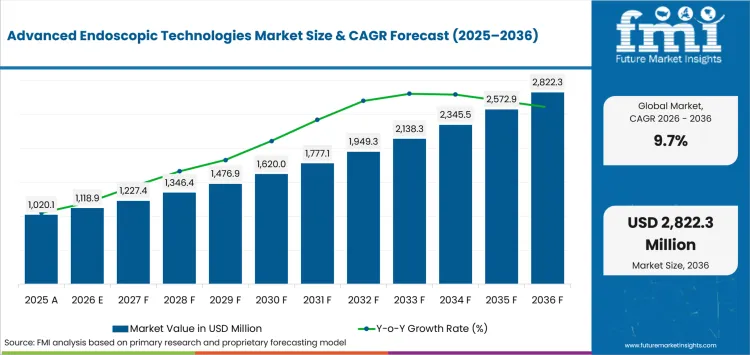
| Metric | Value |
|---|---|
| 2025 Market Size | USD 1,020.1 million |
| 2026 Market Size | USD 1,118.9 million |
| 2036 Market Size | USD 2,8223 million |
| Forecast CAGR (2026-2036) | 9.7% |
| Product Type Focus | Endoscopes (40.6% share in 2026) |
| Application Focus | Gastroenterology (25.6% share in 2026) |
| End User Focus | Hospitals (33.4% share in 2026) |
Summary of the Advanced Endoscopic Technologies Market
| Market Signal | Commercial Impact |
|---|---|
| Demand and Growth Drivers | Hospitals often invest in advanced endoscopy when clinical workloads require dependable visualization and consistent procedure capacity across several departments.
|
| Product and Segment View | The product architecture combines scopes with processors and software that support diagnostic review or minimally invasive treatment.
|
| Geography and Growth Outlook | National adoption differs through screening routes and provider financing alongside local service access and equipment regulation.
|
| Competitive Landscape | Competition separates complete visualization platforms from therapeutic specialists and robotic systems that address narrower clinical procedures.
|
| Analyst Perspective | Clinical value depends on whether improved visualization produces dependable decisions without increasing procedure complexity or equipment downtime.
|
Source: FMI’s proprietary forecasting model and primary research
How is the advanced endoscopic technologies market segmented?
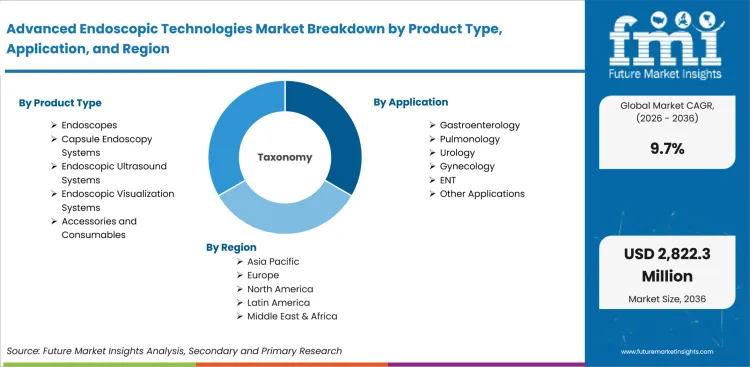
The advanced endoscopic technologies industry is segmented by product type, application, end user, technology, and region.
The segmentation framework separates physical equipment from clinical purpose and purchasing setting inside the defined revenue boundary. Product type distinguishes endoscopes from visualization systems and ultrasound platforms alongside accessories and capsule solutions. Application analysis follows gastroenterology and pulmonology together with urology and surgery across distinct clinical procedure pathways. End user categories distinguish hospitals from ambulatory centers and specialty clinics with different capital approval routes. Technology analysis separates high-definition imaging from narrow-band and ultrasound methods alongside robotic or capsule-based systems. Regional analysis evaluates regulation and clinical infrastructure together with service access across national healthcare systems.
What makes Endoscopes central to the Product Type category?
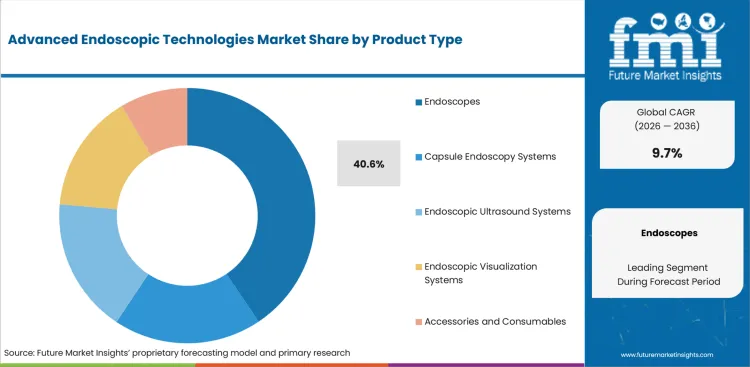
Endoscopes provide the physical route for visualization and instrument access across diagnostic or therapeutic procedures. Scope design determines reach and working-channel capacity alongside maneuverability and image transmission during each examination. Reusable platforms support repeated clinical use but require validated cleaning and dependable repair services throughout scheduled operating periods. Single-use models avoid reprocessing between cases yet create recurring unit costs and disposal requirements for every completed procedure. Investment in endoscope reprocessing devices therefore influences operating economics and daily availability across reusable equipment inventories.
- By product type, endoscopes are estimated to hold 40.6% share in 2026 owing to their direct role during visual examination and instrument delivery. The position reflects recurring purchases and replacements across reusable and single-use configurations rather than processor spending alone.
- Hospital endoscopy units favor scopes that fit existing processors and accessory inventories without disrupting scheduled procedures. PENTAX Medical announced in December 2024 that two i20c video endoscope models and one reusable wheel extender received United States FDA clearance. The clearance gives gastrointestinal departments another compatible replacement route with defined ergonomic support for recurring examinations.
Why does Gastroenterology shape demand within the Application category?
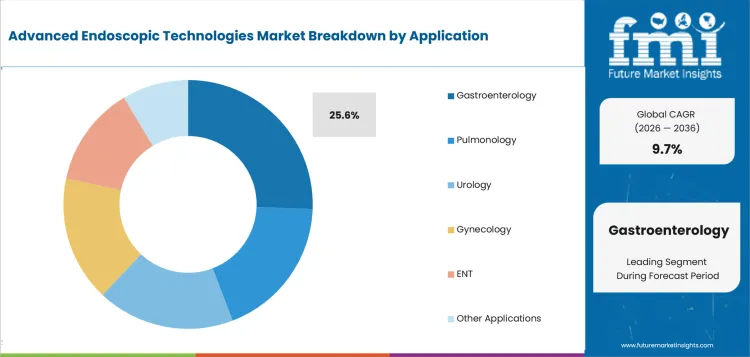
Gastroenterology combines screening volume with interventions that require stable visualization and accessory control throughout each procedure. Colonoscopy and upper gastrointestinal examinations use processors across diagnostic and treatment pathways during recurring daily schedules. FUJIFILM Healthcare Americas Corporation reported in March 2024 that CAD EYE received United States clearance for real-time colonic lesion detection. The clearance connects imaging equipment with software support during routine colonoscopy review across compatible United States facilities. Complex procedures also require compatible scopes and ultrasound accessories for tissue sampling and therapeutic planning.
- Gastroenterology is projected to represent 25.6% of application revenue in 2026 supported by its broad procedure range and recurring replacement needs. The position also reflects processor demand across diagnostic imaging and therapeutic accessory use inside the same clinical department throughout scheduled procedures.
- Gastrointestinal units adopt advanced platforms when physicians can use enhanced imaging without extending routine procedure time. Specialized ERCP devices add treatment pathways that differ from standard visual diagnosis and require compatible imaging support. Platform selection must preserve accessory compatibility and documented image capture through every procedural step inside the gastroenterology department.
How do Hospitals influence purchasing within the End User category?
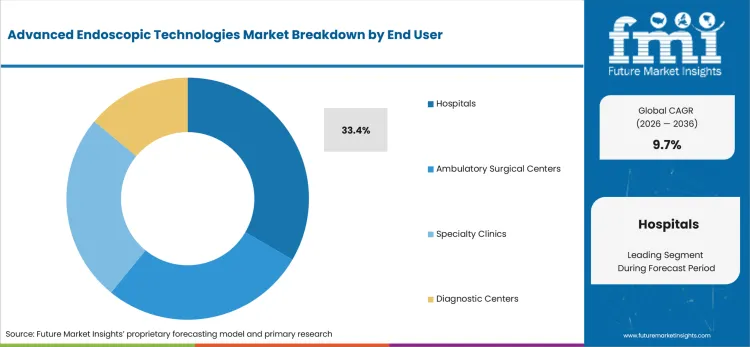
Hospitals operate several endoscopy rooms and often share visualization platforms across clinical specialties inside one healthcare facility. Capital committees consider processor utilization and scope inventories alongside maintenance contracts and staff training across several clinical departments. Emergency coverage also matters as equipment availability extends beyond scheduled outpatient lists and supports urgent inpatient procedures. Large institutions can spread platform cost across gastroenterology and surgery together with pulmonology and urology. Purchasing decisions therefore require a complete view of service exposure and cross-department compatibility across the entire healthcare facility.
- Based on end user, hospitals are expected to account for 33.4% share in 2026 underpinned by concentrated procedure capacity and multi-department purchasing. Their position reflects investment in complete systems that combine processors and scopes with accessories and ongoing technical support across several clinical departments.
- Hospital adoption improves through shared platforms that reduce separate maintenance routes across several clinical departments and procedure rooms. FUJIFILM Healthcare Americas Corporation announced in June 2026 that its new United States endoscopy warehouse supports a service-center expansion to approximately 1.5 times the former size. Similar planning across gastroenterology and ENT endoscopy requires documented service response for each installed platform.
What supports High-definition Endoscopy within the Technology category?
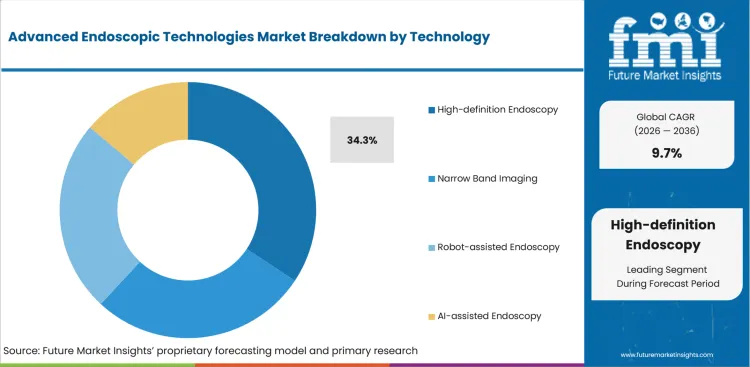
High-definition endoscopy increases image detail during lesion inspection and therapeutic navigation across several clinical specialties. Resolution creates clinical value through monitors and processors that preserve the complete image chain during every examination. Phased upgrades require compatibility across scope generations and installed processors throughout the complete equipment replacement period. Departments also need interpretation protocols that separate meaningful clinical findings from additional visual complexity during routine procedures. The technology therefore competes through measurable system performance rather than resolution labels presented without clinical workflow evidence.
- High-definition endoscopy is projected to hold 34.3% share in 2026 attributable to broad compatibility with routine procedures. Olympus announced in May 2025 that its EZ1500 endoscopes received United States clearance for extended-depth-of-field imaging within the EVIS X1 system. The clearance adds a current route for sharper focus across changing examination distances during gastrointestinal procedures.
- Clinical teams adopt high-definition systems through trials that compare lesion visibility and navigation across representative procedures. Compatible AI capsule reading platforms can extend image interpretation beyond conventional rooms through separate review workflows. Purchasing committees should evaluate image detail and interpretation workload as different operating outcomes during representative clinical trials.
What are the drivers, restraints, and opportunities in the advanced endoscopic technologies market?
Screening and therapeutic workloads support investment in advanced imaging, while reprocessing burden constrains usable capacity and connected software creates a verified expansion route.
- Driver: Organized screening and therapeutic procedures create recurring demand for dependable visualization across scheduled clinical programs.
- Restraint: Reusable scope reprocessing requires trained labor and validated steps that can restrict daily equipment availability.
- Opportunity: Cleared imaging software can add decision support to installed endoscopy platforms without replacing every physical component.
Screening eligibility creates recurring examinations that require dependable scopes and processors across organized clinical programs. Equipment spending follows room utilization and replacement planning across facilities that maintain organized screening capacity. The Centers for Disease Control and Prevention reported in August 2025 that 61.4% of United States adults aged 45 to 75 were current with colorectal cancer screening during 2022. The remaining gap supports outreach that can raise workloads across facilities with prepared endoscopy capacity. Investment in endoscopic closure systems also extends equipment use from diagnosis into minimally invasive treatment.
Reusable equipment creates a material operating constraint through cleaning requirements and potential repair downtime across scheduled departments. The USA Food and Drug Administration stated that reprocessing is labor-intensive and time-consuming for healthcare facilities across the United States. Each device requires a specific regimen that includes initial decontamination and thorough cleaning followed by disinfection or sterilization. Hospitals therefore need trained technicians and enough scope inventory to protect procedure capacity during every reprocessing cycle. Adoption slows if a platform upgrade raises cleaning complexity without improving daily availability or service response.
Connected software creates an opening for hospitals that need additional interpretation support without replacing every compatible scope. Olympus reported in September 2024 that its United States subsidiary Odin Medical received FDA clearance for the cloud-based CADDIE polyp-detection system. The clearance establishes a commercial pathway for remotely updated decision support during colonoscopy procedures across compatible hospital systems. Related endoscopic ultrasound needles create a separate opportunity through image-guided tissue acquisition and minimally invasive intervention workflows. Technology providers must prove processor compatibility and secure workflow integration before hospitals expand software across procedure rooms.
Which country CAGRs are profiled in the advanced endoscopic technologies market?
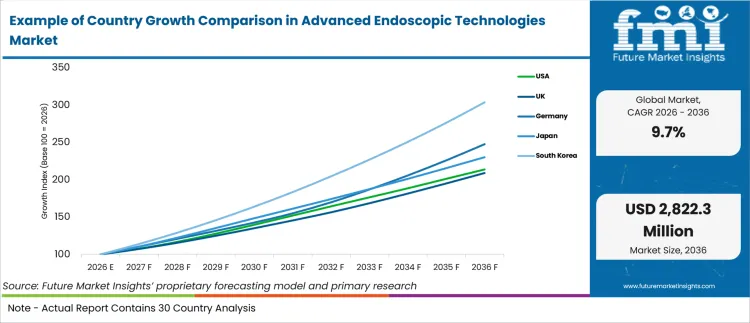
| Country | CAGR |
|---|---|
| USA | 7.9% |
| UK | 7.7% |
| Germany | 9.5% |
| Japan | 8.7% |
| South Korea | 11.8% |
How do country-level CAGRs compare in the advanced endoscopic technologies market?
The country comparison forms three visible growth bands across the assessment period. South Korea sits apart from the middle group with a forecast rate that reflects rapid clinical technology evaluation and dense screening activity. Germany and Japan form the central band with less than one percentage point separating their forecast rates. The USA and UK create a closely grouped lower band with two-tenths of one percentage point between their values. The complete spread between South Korea and the UK equals 4.1 percentage points across the country comparison.
- The 4.1-point separation describes forecast momentum inside this market and does not establish current national market size.
- South Korea and Germany show a 2.3 percentage-point separation that can affect the timing of distributor investment and specialist training. Japan follows Germany by eight-tenths of one percentage point and remains close enough for service economics to influence comparative entry decisions.
- The USA trails Japan by eight-tenths of one percentage point despite its broad provider base and mixed purchasing routes.
- The UK remains near the USA as public procurement and capacity programs create a different path from private capital replacement.
Similar rates therefore require separate commercial plans rather than one standardized regional launch sequence for every provider system. The country figures show relative development speeds but do not replace direct analysis of regulation and service access. Companies should compare product approval and maintenance coverage together with training routes and facility purchasing structures. A higher CAGR can coexist with a smaller installed base or narrower current sales channel. The full report provides country-level CAGR analysis across North America, Latin America, Europe, East Asia, South Asia, Oceania and the Middle East and Africa.
Country-wise Analysis
- United States healthcare systems combine hospital capital plans with ambulatory purchasing across several endoscopy specialties. Demand for advanced endoscopic technologies in the USA is forecast to rise at 7.9% CAGR by 2036 supported by broad procedure settings and established distribution channels. Olympus announced in September 2025 that its global MacroLux distribution agreement includes the United States for single-use cystoscopes and ureteroscopes. The agreement gives urology departments another commercial route for visualization without adding reusable-scope inventory across every procedure room. Budget pressure and service-contract complexity remain material frictions across multi-site systems with different purchasing priorities. Manufacturers need defined training and repair responsibilities prior to expanding placements beyond initial departments and ambulatory facilities.
- United Kingdom providers operate through publicly funded diagnostic programs that connect equipment investment with waiting-list reduction. Adoption of advanced endoscopic technologies in the UK is estimated to expand at 7.7% CAGR through 2036 supported by national capacity programs. NHS England reported in October 2025 that imaging and endoscopy investments produced 275,000 additional endoscopies during 2024 and 2025. The added activity creates a direct capacity enabler for systems that improve room availability and reporting continuity. Central budget limits and local service performance remain practical frictions across provider trusts with different diagnostic capacity needs. Suppliers need measurable throughput benefits and dependable maintenance routes during public procurement reviews across local provider trusts.
- Germany combines statutory screening access with ambulatory specialists and hospital endoscopy services across regulated purchasing channels. The German advanced endoscopic technologies sector is projected to record 9.5% CAGR during the assessment period supported by broader colorectal screening eligibility. Germany’s Federal Ministry of Health reported in February 2026 that women and men aged 50 can use the same colonoscopy options under rules effective from April 2025. The organized pathway enables predictable examination demand across qualified facilities that participate in statutory colorectal screening programs. Formal evidence review and service documentation can lengthen equipment qualification across hospital and ambulatory provider settings. Market entry requires German-language training and a documented repair route that protects scheduled screening capacity across qualified facilities.
- Japanese endoscopy departments operate with experienced clinical teams and long equipment cycles across hospital networks. Demand for advanced endoscopic technologies in Japan is forecast to rise at 8.7% CAGR over the forecast period, supported by established specialist workflows. Olympus announced in October 2025 that domestic sales of its EVIS X1 CV-1500 processor with combined NBI and TXI observation would begin on November 4. The release gives Japanese providers a current upgrade route for enhanced lesion visualization within a familiar platform architecture. Conservative replacement planning and strict workflow validation can delay broader adoption across hospital departments during staged replacement programs. Manufacturers need local training and maintenance plans that preserve clinical continuity throughout staged processor and scope upgrades.
- South Korean hospitals operate through dense referral networks with strong digital infrastructure and concentrated specialist services. Sales of advanced endoscopic technologies in South Korea are forecast to expand at 11.8% CAGR by 2036 supported by rapid evaluation at tertiary centers. The National Cancer Center Korea reported in May 2025 that it introduced the country’s first ION robotic-assisted bronchoscopy system and planned clinical use from June. The installation provides direct local evidence for advanced navigation during difficult peripheral lung biopsy procedures. Specialist training and service access can remain concentrated outside major urban centers across regional healthcare facilities. Companies need support plans that extend maintenance coverage beyond tertiary hospitals without weakening clinical response times.
Who are the notable companies in the advanced endoscopic technologies market?
Olympus Corporation, FUJIFILM Healthcare Americas Corporation, KARL STORZ, Stryker Corporation, Boston Scientific Corporation, Medtronic plc, PENTAX Medical, and Johnson & Johnson MedTech are the notable companies profiled in this market.
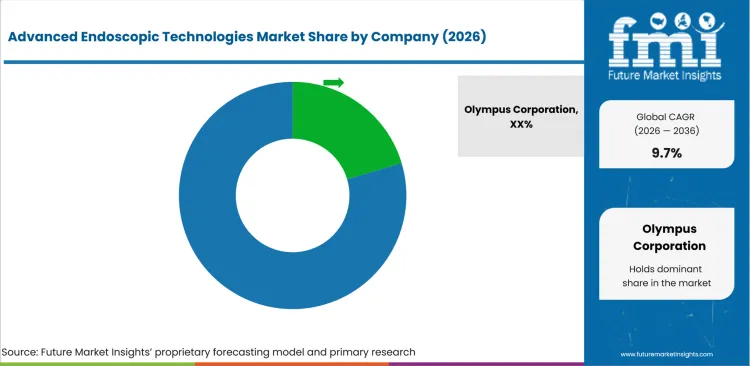
Competition spans complete gastrointestinal imaging platforms and surgical visualization systems alongside therapeutic devices and robotic bronchoscopy. Olympus and Fujifilm connect scopes with processors and imaging software across gastrointestinal workflows. PENTAX Medical provides flexible scopes and processor compatibility that support phased equipment replacement across gastrointestinal procedure rooms. KARL STORZ and Stryker address surgical visualization with operating-room integration across several clinical specialties and procedure settings. Boston Scientific and Medtronic concentrate more heavily on therapeutic endoscopy and digitally assisted procedures across gastrointestinal care pathways. Johnson & Johnson MedTech participates through robotic bronchoscopy with continuous visualization and navigation support for peripheral lung access. Selection therefore depends on verified procedure fit and accountable service ownership rather than corporate scale or reputation.
- Olympus and Fujifilm provide broad gastrointestinal imaging systems that connect scopes with processors and software support. PENTAX Medical offers compatible scope and processor routes that can reduce disruption during phased replacement programs.
- KARL STORZ and Stryker combine surgical visualization with room integration across several procedural specialties and hospital operating environments. Boston Scientific adds therapeutic devices that support minimally invasive intervention through compatible endoscopic working channels during gastrointestinal procedures.
- Medtronic supports gastrointestinal procedures through therapeutic tools and AI-assisted colonoscopy software across diagnostic and treatment workflows. Johnson & Johnson MedTech addresses peripheral lung access through robotic bronchoscopy and AI-assisted navigation technology during biopsy procedures.
Competitive Benchmarking: Advanced Endoscopic Technologies Market
| Company | Flexible Endoscopy Platform | Advanced Imaging | Therapeutic or Robotic Integration | Geographic Reach |
|---|---|---|---|---|
| Olympus Corporation | High | High | High | United States, Europe, and Asia-Pacific |
| FUJIFILM Healthcare Americas Corporation | High | High | Medium | United States |
| KARL STORZ | Medium | High | High | United States |
| Stryker Corporation | Medium | High | High | United States |
| Boston Scientific Corporation | Medium | Medium | High | United States |
| Medtronic plc | Medium | High | High | United States and Europe |
| PENTAX Medical | High | High | Medium | United States |
| Johnson & Johnson MedTech | Medium | High | High | United States |
Flexible Endoscopy Platform receives High for a current scope and processor system and Medium for a procedure-specific visualization route. Advanced Imaging receives High for current HD or 4K imaging with enhancement or AI and Medium for narrower imaging support. Therapeutic or Robotic Integration receives High for broad therapy or robotic integration and Medium for limited therapy support without broad integration. Geographic Reach uses descriptive labels based on official availability information for each verified product portfolio. Low denotes an officially documented limitation within the defined market and unavailable public information is not scored.
Key Developments in the Advanced Endoscopic Technologies Market
- In May 2026, Olympus Corporation introduced the Canon Aplio i800 EUS premium ultrasound system for United States gastroenterology and pulmonary customers through an exclusive distribution arrangement. The launch gives Olympus customers a current ultrasound route for detailed assessment during gastrointestinal and pulmonary procedures.
- In May 2026, FUJIFILM Healthcare Americas Corporation launched the EB-710US balloon-less endobronchial ultrasound bronchoscope in the United States with 180-degree upward angulation and a 5.9-millimeter insertion tube. The design reduces balloon preparation and supports access during pulmonary ultrasound procedures across complex airway examination workflows.
- In February 2026, Medtronic plc received CE Mark approval for ColonPRO as the fourth-generation software for AI-assisted colonoscopy in Europe. The software adds real-time polyp sizing and procedural highlights that can support endoscopist review and surveillance decisions.
- In March 2025, Johnson & Johnson MedTech received United States 510(k) clearance for MONARCH QUEST with AI navigation and a verified OEC Open interface for the GE HealthCare OEC 3D mobile CBCT imaging system. The clearance expands navigation support during robotic bronchoscopy for peripheral lung access and targeted biopsy procedures.
Key Players in the Advanced Endoscopic Technologies Market
Flexible Endoscopy and Imaging Platform Providers
- Olympus Corporation
- FUJIFILM Healthcare Americas Corporation
- PENTAX Medical
Surgical Visualization and Procedure Device Providers
- KARL STORZ
- Stryker Corporation
- Boston Scientific Corporation
Digital and Robotic Endoscopy Providers
- Medtronic plc
- Johnson & Johnson MedTech
Advanced Endoscopic Technologies Market - Report Scope
| Coverage field | Report scope |
|---|---|
| Market breakdown | Product Type, Application, End User, Technology, and Region |
| Quantitative Units | USD Million |
| Market Definition | Advanced endoscopic technologies include scopes, visualization systems, ultrasound platforms, capsule systems, accessories, and digital imaging technologies used directly during minimally invasive diagnosis or treatment. |
| Regions Covered | North America, Latin America, Western Europe, Eastern Europe, East Asia, South Asia and Pacific, Middle East and Africa |
| Countries Covered | USA, UK, Germany, Japan, South Korea, and more than twenty-five additional countries in the full report |
| Key Companies Profiled | Olympus Corporation, FUJIFILM Healthcare Americas Corporation, KARL STORZ, Stryker Corporation, Boston Scientific Corporation, Medtronic plc, PENTAX Medical, and Johnson & Johnson MedTech |
| Forecast Period | 2026 to 2036 |
| Approach | Hybrid bottom-up and top-down sizing that reconciles product revenues, procedure exposure, replacement cycles, and country adoption conditions. |
Advanced Endoscopic Technologies Market - Research Methodology
| Method | Approach |
|---|---|
| Primary Research | FMI analysts gathered input from manufacturers, service providers, technology developers, distributors, end users, procurement teams, and subject-matter experts. Interviews examined purchasing decisions, product or service evaluation, adoption barriers, approval requirements, pricing considerations, and expectations for technical or commercial support. Respondents were also asked what evidence is required before a trial, pilot, or initial order develops into regular purchasing. |
| Desk Research | Desk research covered government statistics, regulatory publications, trade data, industry associations, technical literature, standards, company filings, product information, and official corporate announcements. Sources were reviewed for relevance, publication date, geographic coverage, and consistency with the defined market scope. Claims relating to performance, applications, approvals, capacity, investment, and commercial activity were retained only when supported by credible public evidence. |
| Market Sizing and Forecasting | The market model combined the baseline value with historical performance, segment structure, pricing and volume indicators, adoption levels, company participation, and country-level demand conditions. Forecast assumptions considered economic activity, investment trends, regulatory developments, technology adoption, purchasing cycles, supply availability, and barriers to wider market use. Segment and regional estimates were reconciled before the final market total was calculated. |
| Data Validation | Estimates were checked against multiple independent indicators, including public data, company activity, trade patterns, industry developments, and findings from primary interviews. Validation also tested whether products, services, applications, and company revenues fell within the defined market boundaries. Adjacent categories, unsupported claims, overlapping revenues, and activities without direct market relevance were excluded to reduce double counting and maintain consistency across segments and countries. |
Advanced Endoscopic Technologies Market by Segments
Advanced Endoscopic Technologies Market segmented by Product Type:
- Endoscopes
- Visualization Systems
- Endoscopic Ultrasound Systems
- Capsule Endoscopy Systems
- Endotherapy Devices and Accessories
Advanced Endoscopic Technologies Market segmented by Application:
- Gastroenterology
- Pulmonology
- Urology
- Gynecology
- General Surgery
- ENT and Other Applications
Advanced Endoscopic Technologies Market segmented by End User:
- Hospitals
- Ambulatory Surgical Centers
- Specialty Clinics
- Diagnostic Centers
- Other Healthcare Facilities
Advanced Endoscopic Technologies Market segmented by Technology:
- High-definition Endoscopy
- Narrow-band Imaging
- Endoscopic Ultrasound
- Capsule Endoscopy
- Robot-assisted Endoscopy
Advanced Endoscopic Technologies Market by Region:
- North America
- United States
- Canada
- Latin America
- Brazil
- Mexico
- Argentina
- Chile
- Western Europe
- Germany
- France
- United Kingdom
- Italy
- Spain
- Benelux
- Nordics
- Eastern Europe
- Poland
- Czech Republic
- Romania
- Hungary
- East Asia
- China
- Japan
- South Korea
- South Asia and Pacific
- India
- ASEAN
- Australia and New Zealand
- Middle East and Africa
- GCC Countries
- South Africa
- Türkiye
- Israel
Research Sources and Bibliography
- Sabatino, S. A., Thompson, T. D., Croswell, J. M., Villarroel, M. A., Rodriguez, J. L., Adam, E. E., & Richardson, L. C. (2025, August 14). Use of Cancer Screening Tests, United States, 2023.
- King, S. C., King, J., Thomas, C. C., & Richardson, L. C. (2025, August 7). Baseline Estimates of Colorectal Cancer Screening Among Adults Aged 45 to 75 Years, Behavioral Risk Factor Surveillance System, 2022.
- USA Food and Drug Administration (2018, January 12). How are Reusable Medical Devices Reprocessed?
- Olympus Corporation (2024, September 6). First Cloud-Based AI Endoscopy System for Colonoscopy Receives FDA Clearance.
- PENTAX Medical (2024, December 10). PENTAX Medical obtained US FDA 510(k) clearance for new models of the PENTAX Medical i20c Video Endoscope Series.
- FUJIFILM Healthcare Americas Corporation (2024, March 20). Fujifilm Receives 510(k) Clearance for CAD EYE®, New AI-Powered Endoscopic Imaging Technology for Colonic Polyp Detection.
- FUJIFILM Healthcare Americas Corporation (2026, June 17). Fujifilm Opens New Endoscopy Warehouse Facility in Fairfield, NJ, Expanding Service Operations and Supporting Continued Business Growth.
- Olympus Corporation (2025, May 28). Olympus Announces FDA Clearance of Its Most Advanced Imaging Endoscopes.
- Olympus Corporation (2025, September 4). Olympus Announces Distribution Partnership with MacroLux Medical for Single-Use Urology Products.
- NHS England (2025, October 31). Performance Report.
- Federal Ministry of Health (2026, February 13). Weil früher besser ist - die wichtigsten Fragen zur Darmkrebs-Vorsorge.
- Olympus Corporation (2025, October 29). [Olympus Adds an Observation Mode to the EVIS X1 Endoscopy System to Support Improved Lesion Visibility].
- National Cancer Center Korea (2025, May 19).[National Cancer Center Introduces Korea’s First Advanced Robotic Bronchoscopy System for Lung Cancer Diagnosis].
- Olympus Corporation (2026, May 4). Olympus and Canon Introduce the Aplio i800 EUS Premium Ultrasound System in the USA
- FUJIFILM Healthcare Americas Corporation (2026, May 18). Fujifilm Launches the EB-710US, a Novel Next-Generation, Balloon-less Endobronchial Ultrasound (EBUS) Bronchoscope for Pulmonary Care.
- Medtronic plc (2026, February 23). Medtronic Announces CE Mark for the Next Generation GI Genius™ Module and ColonPRO™ Software.
- Johnson & Johnson MedTech (2025, March 12). Johnson & Johnson MedTech Announces Clearance of MONARCH™ QUEST for Enhanced Robotic-Assisted Bronchoscopy.
This bibliography is provided for reader reference and is not exhaustive. The full report contains the complete reference list and detailed citations.
This Report Answers
- How large is the advanced endoscopic technologies market in 2026 and 2036?
- Which clinical workloads support investment in advanced endoscopy equipment and software?
- Why do endoscopes hold the projected product type position during 2026?
- How does gastroenterology influence platform and accessory demand across healthcare facilities?
- Why do hospitals account for the projected end user position during 2026?
- How do country growth rates differ across the USA, UK, Germany, Japan, and South Korea?
- Which companies provide imaging platforms, therapeutic devices, or robotic endoscopy systems?
- What limits adoption across reusable scopes and connected imaging platforms?
- How should healthcare executives compare imaging performance with service and workflow requirements?
Frequently Asked Questions
What is driving growth in the Advanced Endoscopic Technologies Market?
Cancer screening and complex minimally invasive procedures create recurring demand for dependable visualization and documented clinical decisions. Hospitals invest through capital plans that combine image improvement with procedure capacity and manageable service requirements.
Who are the key players in the Advanced Endoscopic Technologies Market?
Olympus and Fujifilm provide broad gastrointestinal imaging platforms alongside PENTAX Medical and other visualization specialists. Boston Scientific and Medtronic strengthen competition through therapeutic products and digitally assisted gastrointestinal procedure support.
What notable restraint affects the Advanced Endoscopic Technologies Market?
Reusable scope reprocessing requires validated cleaning and adequate technician capacity during every completed procedure cycle. Repair delays and incompatible equipment can also reduce usable capacity across tightly scheduled clinical departments.
Why should executives track the Advanced Endoscopic Technologies Market?
Platform decisions influence capital spending and service exposure across several clinical departments over multiple operating years. Executives need evidence that improved imaging creates measurable value without adding unsustainable training or maintenance requirements.
What business problem does the Advanced Endoscopic Technologies Market address?
Advanced endoscopic technologies address the need for direct internal visualization during diagnosis and minimally invasive treatment. Advanced systems improve image capture and support navigation through anatomy that open procedures would otherwise expose directly.
What should clinical and purchasing decision-makers evaluate in the Advanced Endoscopic Technologies Market?
Clinical and purchasing teams should compare image quality with scope compatibility across representative procedures and staff experience. Contracts should define repair obligations and software updates alongside training responsibilities and expected equipment availability throughout the service term.
What limits return on investment in the Advanced Endoscopic Technologies Market?
Low processor utilization and long repair intervals can weaken returns across expensive multi-department platform investments. Additional reprocessing labor or unsupported software integrations can also reduce usable procedure capacity during regular operations.
What supports long-term commercial confidence in the Advanced Endoscopic Technologies Market?
Documented performance across routine workloads supports confidence during replacement and expansion decisions across several clinical departments. Reliable service coverage and clear operating ownership give providers a practical basis for wider platform standardization.
Preview the report firsthand - request a free sample
Get SampleGet the brochure for pricing and purchase details.
Get PDFTable of Content
- Key Takeaways
- Market Size and CAGR
- Top Growth Driver
- Fastest Growing Segment
- Leading Region
- Key Companies
- Emerging Opportunities
- Executive Summary
- Global Market Outlook
- Demand-side Trends
- Supply-side Trends
- Technology Roadmap Analysis
- Analysis and Recommendations
- Analyst Perspective (What is happening? Why now? What should investors know?)
- Key Questions Answered
- How large is the market?
- What is the CAGR?
- What are key trends?
- Which region dominates?
- Who are the leaders?
- Market Overview
- Market Coverage / Taxonomy
- Market Definition / Scope / Limitations
- Research Methodology
- Chapter Orientation
- Analytical Lens and Working Hypotheses
- Market Structure, Signals, and Trend Drivers
- Benchmarking and Cross-market Comparability
- Market Sizing, Forecasting, and Opportunity Mapping
- Research Design and Evidence Framework
- Desk Research Programme (Secondary Evidence)
- Expert Input and Fieldwork (Primary Evidence)
- Tooling, Models, and Reference Databases
- Data Engineering and Model Build
- Quality Assurance and Audit Trail
- Market Background
- Market Dynamics (Drivers, Restraints, Opportunity, Trends)
- Scenario Forecast (Optimistic, Likely, Conservative)
- Impact Analysis
- AI Impact
- Sustainability Impact
- Regulatory Impact
- Technology Impact
- Consumer / Buyer Analysis
- Purchase Drivers
- Adoption Barriers
- Buyer Journey
- Opportunity Map Analysis
- Product Life Cycle Analysis
- Supply Chain Analysis
- Investment Feasibility Matrix
- Value Chain Analysis
- PESTLE and Porter's Analysis
- Regulatory Landscape
- Regional Parent Market Outlook
- Production and Consumption Statistics
- Import and Export Statistics
- Global Market Analysis and Forecast, 2021 to 2036
- Historical Market Size Value (USD Million) Analysis, 2021 to 2025
- Current and Future Market Size Value (USD Million) Projections, 2026 to 2036
- Y-o-Y Growth Trend Analysis
- Absolute $ Opportunity Analysis
- Global Market Pricing Analysis, 2021 to 2036
- Global Market Analysis and Forecast, By Product Type, 2021 to 2036
- Introduction / Key Findings
- Historical Market Size Value (USD Million) Analysis By Product Type, 2021 to 2025
- Current and Future Market Size Value (USD Million) Analysis and Forecast By Product Type, 2026 to 2036
- Endoscopes
- Capsule Endoscopy Systems
- Endoscopic Ultrasound Systems
- Endoscopic Visualization Systems
- Accessories and Consumables
- Endoscopes
- Y-o-Y Growth Trend Analysis By Product Type, 2021 to 2025
- Absolute $ Opportunity Analysis By Product Type, 2026 to 2036
- Global Market Analysis and Forecast, By Application, 2021 to 2036
- Introduction / Key Findings
- Historical Market Size Value (USD Million) Analysis By Application, 2021 to 2025
- Current and Future Market Size Value (USD Million) Analysis and Forecast By Application, 2026 to 2036
- Gastroenterology
- Pulmonology
- Urology
- Gynecology
- ENT
- Other Applications
- Gastroenterology
- Y-o-Y Growth Trend Analysis By Application, 2021 to 2025
- Absolute $ Opportunity Analysis By Application, 2026 to 2036
- Global Market Analysis and Forecast, By End User, 2021 to 2036
- Introduction / Key Findings
- Historical Market Size Value (USD Million) Analysis By End User, 2021 to 2025
- Current and Future Market Size Value (USD Million) Analysis and Forecast By End User, 2026 to 2036
- Hospitals
- Ambulatory Surgical Centers
- Specialty Clinics
- Diagnostic Centers
- Hospitals
- Y-o-Y Growth Trend Analysis By End User, 2021 to 2025
- Absolute $ Opportunity Analysis By End User, 2026 to 2036
- Global Market Analysis and Forecast, By Technology, 2021 to 2036
- Introduction / Key Findings
- Historical Market Size Value (USD Million) Analysis By Technology, 2021 to 2025
- Current and Future Market Size Value (USD Million) Analysis and Forecast By Technology, 2026 to 2036
- High-definition Endoscopy
- Narrow Band Imaging
- Robot-assisted Endoscopy
- AI-assisted Endoscopy
- High-definition Endoscopy
- Y-o-Y Growth Trend Analysis By Technology, 2021 to 2025
- Absolute $ Opportunity Analysis By Technology, 2026 to 2036
- Global Market Analysis and Forecast, By Region, 2021 to 2036
- Introduction
- Historical Market Size Value (USD Million) Analysis By Region, 2021 to 2025
- Current Market Size Value (USD Million) Analysis and Forecast By Region, 2026 to 2036
- North America
- Latin America
- Western Europe
- Eastern Europe
- East Asia
- South Asia and Pacific
- Middle East & Africa
- Market Attractiveness Analysis By Region
- North America Market Analysis and Forecast, By Country, 2021 to 2036
- Historical Market Size Value (USD Million) Trend Analysis By Market Taxonomy, 2021 to 2025
- Market Size Value (USD Million) Forecast By Market Taxonomy, 2026 to 2036
- By Country
- USA
- Canada
- By Product Type
- By Application
- By End User
- By Technology
- By Country
- Market Attractiveness Analysis
- By Country
- By Product Type
- By Application
- By End User
- By Technology
- Key Takeaways
- Latin America Market Analysis and Forecast, By Country
- Historical Market Size Value (USD Million) Trend Analysis By Market Taxonomy, 2021 to 2025
- Market Size Value (USD Million) Forecast By Market Taxonomy, 2026 to 2036
- By Country
- Brazil
- Mexico
- Chile
- Rest of Latin America
- By Product Type
- By Application
- By End User
- By Technology
- By Country
- Market Attractiveness Analysis
- By Country
- By Product Type
- By Application
- By End User
- By Technology
- Key Takeaways
- Western Europe Market Analysis and Forecast, By Country
- Historical Market Size Value (USD Million) Trend Analysis By Market Taxonomy, 2021 to 2025
- Market Size Value (USD Million) Forecast By Market Taxonomy, 2026 to 2036
- By Country
- Germany
- UK
- Italy
- Spain
- France
- Nordic
- BENELUX
- Rest of Western Europe
- By Product Type
- By Application
- By End User
- By Technology
- By Country
- Market Attractiveness Analysis
- By Country
- By Product Type
- By Application
- By End User
- By Technology
- Key Takeaways
- Eastern Europe Market Analysis and Forecast, By Country
- Historical Market Size Value (USD Million) Trend Analysis By Market Taxonomy, 2021 to 2025
- Market Size Value (USD Million) Forecast By Market Taxonomy, 2026 to 2036
- By Country
- Russia
- Poland
- Hungary
- Balkan & Baltic
- Rest of Eastern Europe
- By Product Type
- By Application
- By End User
- By Technology
- By Country
- Market Attractiveness Analysis
- By Country
- By Product Type
- By Application
- By End User
- By Technology
- Key Takeaways
- East Asia Market Analysis and Forecast, By Country
- Historical Market Size Value (USD Million) Trend Analysis By Market Taxonomy, 2021 to 2025
- Market Size Value (USD Million) Forecast By Market Taxonomy, 2026 to 2036
- By Country
- China
- Japan
- South Korea
- By Product Type
- By Application
- By End User
- By Technology
- By Country
- Market Attractiveness Analysis
- By Country
- By Product Type
- By Application
- By End User
- By Technology
- Key Takeaways
- South Asia and Pacific Market Analysis and Forecast, By Country
- Historical Market Size Value (USD Million) Trend Analysis By Market Taxonomy, 2021 to 2025
- Market Size Value (USD Million) Forecast By Market Taxonomy, 2026 to 2036
- By Country
- India
- ASEAN
- Australia & New Zealand
- Rest of South Asia and Pacific
- By Product Type
- By Application
- By End User
- By Technology
- By Country
- Market Attractiveness Analysis
- By Country
- By Product Type
- By Application
- By End User
- By Technology
- Key Takeaways
- Middle East & Africa Market Analysis and Forecast, By Country
- Historical Market Size Value (USD Million) Trend Analysis By Market Taxonomy, 2021 to 2025
- Market Size Value (USD Million) Forecast By Market Taxonomy, 2026 to 2036
- By Country
- Kingdom of Saudi Arabia
- Other GCC Countries
- Türkiye
- South Africa
- Other African Union
- Rest of Middle East & Africa
- By Product Type
- By Application
- By End User
- By Technology
- By Country
- Market Attractiveness Analysis
- By Country
- By Product Type
- By Application
- By End User
- By Technology
- Key Takeaways
- Key Countries Market Analysis
- USA
- Pricing Analysis
- Market Share Analysis, 2025
- By Product Type
- By Application
- By End User
- By Technology
- Canada
- Pricing Analysis
- Market Share Analysis, 2025
- By Product Type
- By Application
- By End User
- By Technology
- Mexico
- Pricing Analysis
- Market Share Analysis, 2025
- By Product Type
- By Application
- By End User
- By Technology
- Brazil
- Pricing Analysis
- Market Share Analysis, 2025
- By Product Type
- By Application
- By End User
- By Technology
- Chile
- Pricing Analysis
- Market Share Analysis, 2025
- By Product Type
- By Application
- By End User
- By Technology
- Germany
- Pricing Analysis
- Market Share Analysis, 2025
- By Product Type
- By Application
- By End User
- By Technology
- UK
- Pricing Analysis
- Market Share Analysis, 2025
- By Product Type
- By Application
- By End User
- By Technology
- Italy
- Pricing Analysis
- Market Share Analysis, 2025
- By Product Type
- By Application
- By End User
- By Technology
- Spain
- Pricing Analysis
- Market Share Analysis, 2025
- By Product Type
- By Application
- By End User
- By Technology
- France
- Pricing Analysis
- Market Share Analysis, 2025
- By Product Type
- By Application
- By End User
- By Technology
- India
- Pricing Analysis
- Market Share Analysis, 2025
- By Product Type
- By Application
- By End User
- By Technology
- ASEAN
- Pricing Analysis
- Market Share Analysis, 2025
- By Product Type
- By Application
- By End User
- By Technology
- Australia & New Zealand
- Pricing Analysis
- Market Share Analysis, 2025
- By Product Type
- By Application
- By End User
- By Technology
- China
- Pricing Analysis
- Market Share Analysis, 2025
- By Product Type
- By Application
- By End User
- By Technology
- Japan
- Pricing Analysis
- Market Share Analysis, 2025
- By Product Type
- By Application
- By End User
- By Technology
- South Korea
- Pricing Analysis
- Market Share Analysis, 2025
- By Product Type
- By Application
- By End User
- By Technology
- Russia
- Pricing Analysis
- Market Share Analysis, 2025
- By Product Type
- By Application
- By End User
- By Technology
- Poland
- Pricing Analysis
- Market Share Analysis, 2025
- By Product Type
- By Application
- By End User
- By Technology
- Hungary
- Pricing Analysis
- Market Share Analysis, 2025
- By Product Type
- By Application
- By End User
- By Technology
- Kingdom of Saudi Arabia
- Pricing Analysis
- Market Share Analysis, 2025
- By Product Type
- By Application
- By End User
- By Technology
- Türkiye
- Pricing Analysis
- Market Share Analysis, 2025
- By Product Type
- By Application
- By End User
- By Technology
- South Africa
- Pricing Analysis
- Market Share Analysis, 2025
- By Product Type
- By Application
- By End User
- By Technology
- USA
- Market Structure Analysis
- Competition Dashboard
- Competition Benchmarking
- Market Share Analysis of Top Players
- By Regional
- By Product Type
- By Application
- By End User
- By Technology
- Emerging Startups
- Innovation Benchmarking
- Competition Analysis
- Competition Deep Dive
- Olympus Corporation
- Overview
- Product Portfolio
- Profitability by Market Segments
- Sales Footprint
- Strategy Overview
- Marketing Strategy
- Product Strategy
- Channel Strategy
- Fujifilm Holdings Corporation
- Karl Storz
- Stryker Corporation
- Boston Scientific Corporation
- Medtronic plc
- HOYA Corporation
- Johnson & Johnson MedTech
- Conmed Corporation
- Ambu A/S
- Olympus Corporation
- Case Studies
- Success Stories
- Recent Developments
- Competition Deep Dive
- Assumptions & Acronyms Used


