

- Market Size (2026)
- USD 787.5 Mn
- Forecast (2036)
- USD 1549.2 Mn
- CAGR (2026 to 2036)
- 7.0%
How big is Advanced Humidification Incubator Market in 2026?
USD 787.5 million in 2026 and USD 1,549.2 million by 2036 at a 7.0% CAGR.
Demand for advanced humidification incubators is forecast to expand at a 7.0% CAGR during the forecast period, increasing valuation from USD 787.5 million in 2026 to USD 1,549.2 million by 2036. Laboratories invest in carbon dioxide incubators to limit evaporation and atmospheric drift during prolonged culture work with sensitive biological materials. The National Center for Science and Engineering Statistics reported in February 2026 that health sciences and biological or biomedical sciences represented half of United States university research expenditure during fiscal 2024. The measured research base creates recurring chamber workloads across cell expansion and testing without proving an incubator purchase by itself. Automated cell culture systems further increase the value of rapid recovery and traceable environmental records across repeated access events. Laboratory directors therefore compare humidity stability and contamination controls under representative workloads before approving equipment for routine research or regulated testing.
National adoption routes differ through service access and the operating intensity of fertility or cell-therapy laboratories. United States research campuses often prioritize qualification coverage across shared facilities, whereas British fertility clinics focus on dependable recovery during tightly scheduled procedures. German laboratories can draw on domestic chamber engineering but face added documentation for clinical configurations governed as medical devices. Japanese institutions value compact systems and local-language maintenance across carefully managed research environments and hospital laboratories. South Korean regenerative medicine institutions also require trained personnel and defined equipment standards before clinical work begins. Purchasing decisions extend to cell culture media and monitoring interfaces that must remain compatible with established laboratory procedures. Manufacturers gain commercial access through local distributors that can install qualified chambers and restore service without prolonged experimental disruption.
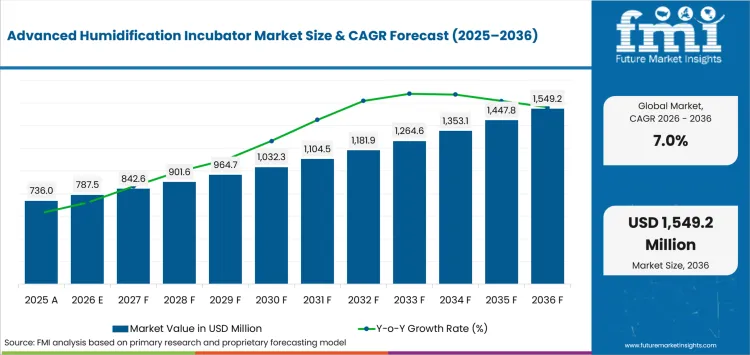
| Metric | Value |
|---|---|
| 2025 Market Size | USD 736.0 million |
| 2026 Market Size | USD 787.5 million |
| 2036 Market Size | USD 1,549.2 million |
| Forecast CAGR (2026-2036) | 7.0% |
| Product Type Focus | CO2 Humidified Incubators (42.1% share in 2026) |
| Application Focus | Cell Culture (36.0% share in 2026) |
| End User Focus | Biopharmaceutical Companies (31.0% share in 2026) |
Summary of the Advanced Humidification Incubator Market
| Market Signal | Commercial Impact |
|---|---|
| Demand and Growth Drivers | Controlled humidity creates measurable spending because laboratories must protect sensitive cultures during long experiments and frequent chamber access.
|
| Product and Segment View | Incubator architecture combines temperature and gas control with humidity management across one enclosed environment for sensitive culture work.
|
| Geography and Growth Outlook | Country positions differ through fertility activity and regenerative medicine capacity alongside local maintenance and qualification responsibilities.
|
| Competitive Landscape | Competition centers on humidity recovery and contamination control beside usable monitoring features and dependable lifecycle service coverage.
|
| Analyst Perspective | Laboratory directors must balance rapid environmental recovery against cleaning effort and qualification cost throughout the chamber lifecycle.
|
Source: FMI’s proprietary forecasting model and primary research
How is the advanced humidification incubator market segmented?
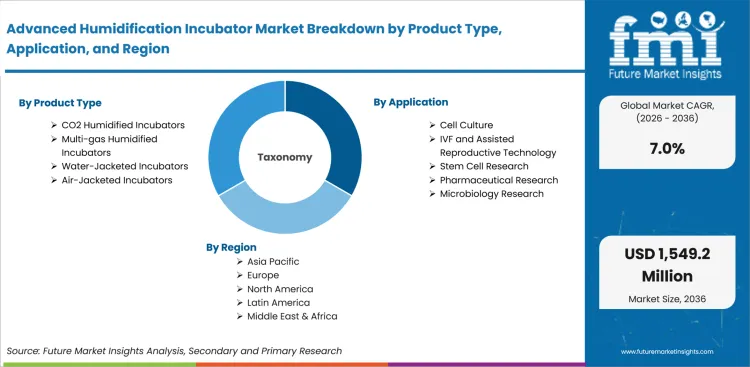
The advanced humidification incubator market is segmented by product type, application, end user, capacity, and region.
The segmentation framework separates chamber design from laboratory use and purchasing responsibility across the defined market. Product type distinguishes carbon dioxide and multi-gas systems alongside water-jacketed and air-jacketed chamber designs used across laboratories. Application analysis covers cell culture and assisted reproduction together with stem cell and pharmaceutical research. End-user categories identify biopharmaceutical companies and research institutes alongside fertility clinics and contract research organizations. Capacity analysis separates compact systems below 100 liters from medium and larger chambers used for broader workloads. Regional classification applies the approved geography without changing the defined product scope or the associated revenue boundary.
What supports demand for CO2 Humidified Incubators within the Product Type category?
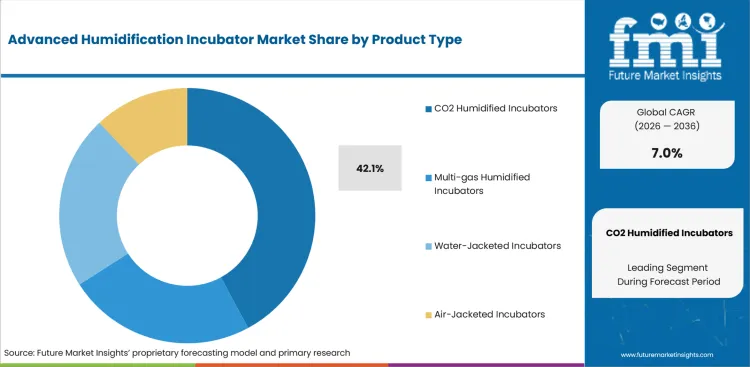
Mammalian cell culture requires stable carbon dioxide and water vapor across experiments that continue through several handling cycles. Door openings disturb chamber conditions and can accelerate media evaporation during feeding or microscopic inspection. NuAire explained in January 2025 that active systems use humidity sensors and steam injection to restore relative humidity within minutes following door openings. Laboratories therefore compare recovery speed and cleanability under representative access patterns before accepting CO2 humidified incubators for sensitive 3D cell culture workflows.
- Within product type, CO2 humidified incubators are projected to account for 42.1% share in 2026, attributable to broad compatibility with mammalian cell workflows. Familiar atmospheric controls also reduce retraining and qualification effort during replacement projects across research facilities and biopharmaceutical laboratories.
- Cell biology teams select CO2 systems to stabilize pH and limit evaporation during repeated culture handling across extended experiments. Adoption depends on validated decontamination and dependable local service because continuous projects cannot tolerate lengthy chamber downtime or uncertain recovery performance.
How does Cell Culture shape demand within the Application category?
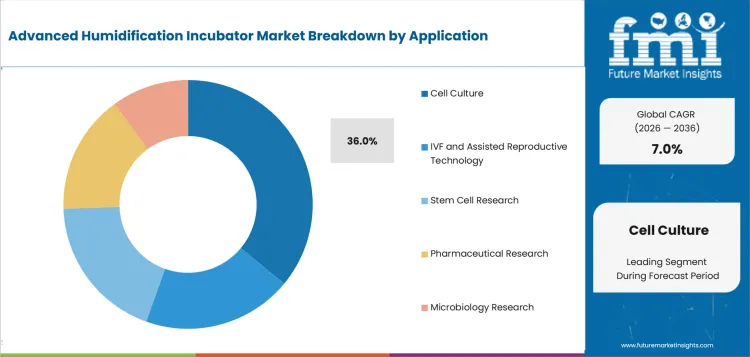
Cell culture programs need repeatable temperature and atmospheric conditions across experiments that continue for several days. Routine feeding and inspection expose cultures to temperature loss and contamination during every chamber access event. Chamber surfaces and water reservoirs therefore become part of the operating decision rather than minor accessories. Laboratory managers test environmental recovery and cleaning procedures with representative cell lines before approving a system for shared research use.
- In 2026, cell culture is expected to represent 36.0% of the application category, supported by recurring use in research and process-development programs. Standard chamber formats also support repeat purchasing across shared laboratories that coordinate several project teams and assay schedules.
- Research institutes adopt advanced humidification incubators to standardize culture conditions across shared laboratories and rotating project teams. BINDER reported in May 2024 that contamination can make weeks or months of cell-culture work worthless. Laboratories therefore prioritize decontamination controls and simple cleaning procedures that reduce operating variation across frequent users.
Why do Biopharmaceutical Companies prioritize advanced humidification incubators?
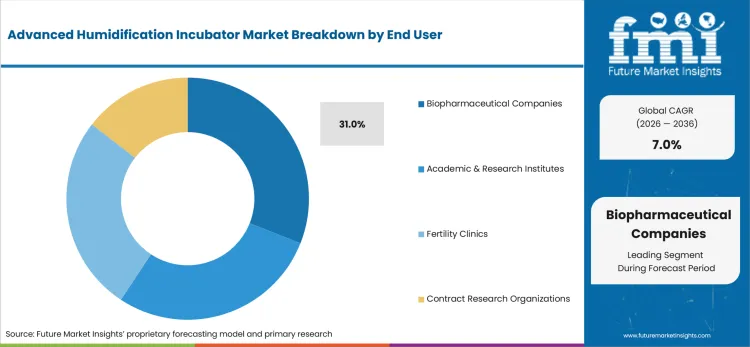
Biopharmaceutical process teams use controlled incubators during cell-line development and analytical testing across regulated workflows. Equipment records must support deviation review and formal qualification without interrupting scheduled culture work across regulated laboratory programs. Biopharmaceutical contract manufacturing programs also increase pressure for transferable procedures across multiple facilities and operating teams. Manufacturers therefore evaluate alarm histories and service documentation beside chamber recovery and documented decontamination performance during qualification. A consistent platform can simplify training but creates greater dependence on responsive regional service coverage.
- Biopharmaceutical companies are forecast to represent 31.0% of the end-user category in 2026, driven by intensive culture workloads and traceability requirements. PHC Corporation reported in February 2025 that variable primary T-cell growth rates and quality require improved expansion processes for cell and gene therapies.
- Process-development groups favor incubators that preserve qualification records and predictable maintenance across related laboratories and production-support teams. Standardized controls reduce retraining during equipment transfers but purchasing approval depends on usable data exports and dependable service response during regulated operations across multiple sites.
What makes Below 100 L systems central to the Capacity category?
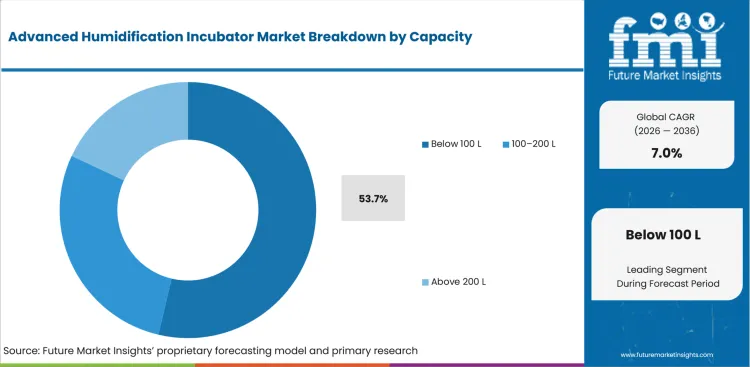
Compact incubators serve laboratories with limited bench space and focused culture volumes across specialized research or clinical procedures. PHCbi product documentation accessed in July 2026 lists a 50-liter stackable Cell-IQ chamber for space-constrained installations. Fertility clinics using in vitro fertilization can assign smaller chambers to defined procedures or patient groups. Capacity planning becomes more complex as several compact units create separate monitoring and qualification records.
- By capacity, below 100 L systems are estimated to hold 53.7% share in 2026, owing to lower space requirements and practical workflow separation. Stackable configurations also preserve expansion options inside laboratory rooms that cannot accommodate larger floor-standing chambers without renovation.
- Fertility clinics and small research groups use compact chambers to isolate workloads and preserve operating flexibility during continuing culture schedules. Adoption depends on stacking safety and local maintenance access alongside enough usable shelf area for daily volumes and emergency capacity during peak workloads.
What are the drivers, restraints, and opportunities in the advanced humidification incubator market?
Expanding cell-based work supports demand, maintenance and qualification burdens restrain adoption, and connected humidity control creates an equipment opportunity.
- Driver: Cell-based therapy and research programs create recurring demand for controlled culture and analytical environments.
- Restraint: Water management and formal qualification can interrupt laboratory work without trained staff or dependable service.
- Opportunity: Connected humidity control can document chamber recovery and support more disciplined environmental review across laboratory fleets.
Cell-based therapy development creates recurring demand for controlled culture and analytical environments across research and quality workflows. The FDA listed seven RMAT approvals dated from February 2024 through April 2025 in its September 2025 data set. The approvals establish continued commercial activity across advanced cellular products without proving incubator purchases directly. Laboratory managers respond by adding qualified chamber capacity where expanding cell handling and testing schedules exceed existing equipment availability. Incubator manufacturers therefore compete through dependable environmental recovery and records that support formal validation across regulated laboratory operations.
Maintenance requirements constrain adoption because humidity reservoirs and chamber surfaces can introduce contamination risks without disciplined operating procedures. NuAire explained in September 2024 that preventive maintenance covers chamber cleaning and water-pan care alongside HEPA filtration and decontamination cycles. Laboratories without trained staff can lose productive culture time during formal qualification or unplanned service interruptions. Equipment providers must supply clear procedures and credible response times before regulated teams standardize one platform across several locations.
Connected humidity control creates a verified opening for laboratories that need environmental records across frequent access events. Active regulation can limit evaporation and document recovery without relying entirely on manual water-pan checks. PHC Corporation of North America launched a stackable high-heat CO2 incubator in March 2025 with an optional 180°C sterilization cycle. The design permits one chamber to undergo decontamination as neighboring units continue operating at set point. Manufacturers can capture this opening through usable data exports that connect chamber conditions with bioprocessing analytics and existing deviation-review procedures.
Which country CAGRs are profiled in the advanced humidification incubator market?
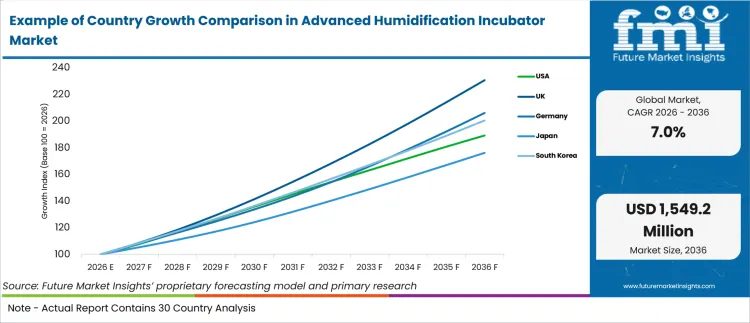
| Country | CAGR |
|---|---|
| USA | 6.6% |
| UK | 8.7% |
| Germany | 7.5% |
| Japan | 5.8% |
| South Korea | 7.2% |
How do country-level CAGRs compare in the advanced humidification incubator market?
The country growth outlook spans 2.9 percentage points between the UK and Japan through 2036. Germany and South Korea form a compressed pair separated by just 0.3 percentage point across the forecast comparison. The USA sits 0.6 percentage point below South Korea and 0.8 point above Japan. The UK remains 1.2 points above Germany and sits outside the central forecast cluster over the assessment period. The measured gaps describe forecast momentum rather than current installed-base size or an independent national ranking across the profiled countries.
- The UK is above the cluster as sustained fertility activity combines with replacement needs and varied financing across licensed clinics that follow different equipment purchasing structures.
- Germany occupies the upper-middle position through domestic engineering access and regulated clinical demand that requires detailed registration records plus qualified local service.
- South Korea remains close to Germany as designated regenerative medicine institutions combine facility standards with formal personnel training and structured approval requirements.
- The USA holds a central position because its broad research base is balanced by mature equipment fleets and demanding site-specific qualification procedures.
- Japan is below the cluster as deliberate validation and compact laboratory planning can extend replacement cycles for advanced environmental-control chamber systems.
Similar CAGRs can create materially different entry conditions through distributor coverage and local responsibility for equipment qualification procedures. Financing structures and maintenance routes also change the economics of an identical incubator platform across national laboratory systems. The full report provides country-level CAGR analysis across North America, Latin America, Europe, East Asia, South Asia, Oceania and the Middle East and Africa.
Country-wise Analysis
- United States fertility laboratories operate within a large national network that processes substantial treatment volumes across independent clinics. Demand for advanced humidification incubators in the USA is forecast to rise at 6.6% CAGR through 2036. The American Society for Reproductive Medicine reported in March 2026 that 364 SART clinics completed 449,772 IVF cycles during 2024. Repeated embryo-culture work supports specialized chamber utilization and structured replacement planning across active clinics with continuing treatment schedules. Service availability remains uneven across dispersed locations and qualification requirements differ materially among independent laboratory groups and hospital systems. Distributors must confirm local response times and validation support before clinics standardize equipment for upstream bioprocessing and reproductive workflows.
- Licensed fertility clinics form a defined operating network across the United Kingdom with recurring controlled-incubation requirements. The UK advanced humidification incubator market is projected to grow at 8.7% CAGR during the forecast period. HFEA reported in June 2026 that around 53,000 patients received IVF at licensed clinics during 2024. The same official release placed NHS-funded IVF cycles at 28% compared with 35% during 2019. Patient volume supports chamber utilization but declining public funding raises financing pressure for independent clinics. Equipment providers need service plans and payment structures that match private purchasing exposure without weakening maintenance coverage.
- Germany combines domestic incubator engineering with an established network of fertility centers and life-science laboratories. The German advanced humidification incubator market is estimated to post 7.5% CAGR through 2036. The Deutsches IVF-Register stated in November 2025 that its 2024 yearbook included data from 139 member centers and more than 2.6 million cumulative treatments. BfArM also states that mandatory use of four EUDAMED modules began on May 28, 2026 for affected devices. Local manufacturing and service capability support adoption but regulated clinical configurations require complete registration and qualification records. Manufacturers need precise product classification and dependable local service coverage before regulated clinical or research installations can proceed.
- Japanese research and clinical laboratories can source incubators through domestic manufacturers and established local service organizations. Adoption of advanced humidification incubators in Japan is estimated to expand at 5.8% CAGR by 2036. Sumitomo Pharma confirmed in March 2026 that Japan granted conditional and time-limited approval for the allogeneic iPS-cell product AMCHEPRY. The action supports continuing cell and gene therapy manufacturing and testing workloads without proving direct incubator purchases. Qualification discipline and limited renovation flexibility can extend equipment installation schedules across existing laboratories with restricted operating space. Entrants need compact configurations and credible local maintenance routes that support controlled culture programs throughout the product life cycle.
- South Korea requires designated institutions to maintain defined facilities and trained personnel for advanced regenerative medicine. Demand for advanced humidification incubators in South Korea is predicted to advance at 7.2% CAGR over the assessment period. The Ministry of Health and Welfare reported in April 2025 that 125 institutions held designation and essential personnel required at least eight hours of basic training. Designated institutional capacity supports controlled culture work across approved clinical research and treatment programs requiring defined laboratory facilities. Facility standards and training obligations increase implementation effort for smaller hospitals with limited laboratory staff. Local distributors must combine equipment installation with formal qualification support and structured operator training for clinical laboratory personnel.
Who are the notable companies in the advanced humidification incubator market?
Thermo Fisher Scientific; Eppendorf; PHCbi; BINDER GmbH; Memmert; Esco Lifesciences; NuAire; and Haier Biomedical are notable companies shaping this market.
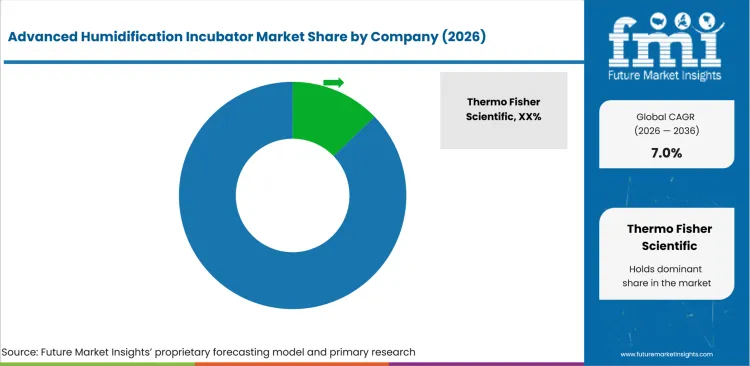
The competitive field combines global laboratory-equipment groups with specialized chamber manufacturers that use different humidity-control architectures. Thermo Fisher Scientific and Eppendorf currently list CO2 incubators with sterilization functions and connected monitoring options. PHCbi and Memmert add active humidity or integrated digital control across current chamber platforms serving research and regulated laboratories. BINDER GmbH and Esco Lifesciences emphasize contamination safeguards plus qualification support while NuAire offers active and passive humidity designs. Haier Biomedical supplies dry-heat sterilization and data-logging functions across current CO2 incubators offered through international sales channels. Selection also depends on interfaces with laboratory automation and the availability of trained service providers across each installation geography.
- Thermo Fisher Scientific and PHCbi combine broad incubator platforms with humidity recovery and international service structures across research institutions. Selection depends on qualification support and replacement-part access across multiple sites using common operating and maintenance procedures.
- Eppendorf and BINDER GmbH compete through chamber engineering and contamination-control functions for research and regulated laboratory settings. Their commercial fit depends on monitoring depth and complete service documentation required by each regulated or shared laboratory installation.
- Memmert and Esco Lifesciences emphasize connected controls while NuAire and Haier Biomedical use different humidity architectures and decontamination methods. Laboratories must compare those systems under representative access patterns rather than treating every carbon dioxide incubator as equivalent.
Competitive Benchmarking: Advanced Humidification Incubator Market
| Company | Humidity Control | Contamination Control | Monitoring and Validation | Geographic Reach |
|---|---|---|---|---|
| Thermo Fisher Scientific | HighHigh | High | Global | |
| Eppendorf | Medium | High | High | Global |
| PHCbi | High | High | High | Global |
| BINDER GmbH | Medium | High | Medium | Global |
| Memmert | High | High | High | Global |
| Esco Lifesciences | Medium | High | Medium | Global |
| NuAire | High | High | High | Global |
| Haier Biomedical | Medium | High | High | Global |
Scoring basis: Humidity Control receives High for active sensor-based regulation with documented recovery performance and Medium for a documented passive or hybrid humidity system. Low requires a current product whose humidity function remains limited to basic manual water-pan control without documented recovery performance. Contamination Control receives High for a validated sterilization cycle plus integrated safeguards and Medium for one documented automated decontamination method. Low requires documented cleanable chamber construction without an automated sterilization or decontamination cycle across the current product platform. Monitoring and Validation receives High for usable data export plus alarm functions and documented qualification support across normal laboratory operations. Medium requires local logging or limited connectivity and Low requires documented basic alarms without usable export.
Key Developments in the Advanced Humidification Incubator Market
- In September 2024, Eppendorf introduced the CellXpert CS220 with carbon dioxide control and an integrated 180°C sterilization routine for mammalian suspension culture. The combined chamber supports suspension-cell process development without transferring vessels between separate incubation and shaking systems. Laboratories must validate atmospheric recovery and shaking performance together under representative vessel loads before routine process use.
- In March 2026, Memmert introduced its next-generation ICO carbon dioxide incubator and connected the platform with the myChamber digital ecosystem. The release added integrated security and networking functions for cell-culture laboratories managing qualification and routine chamber operation. Purchasers gain a common operating interface but must confirm that digital features fit existing data-governance and validation procedures.
- In June 2026, PHCbi introduced the Cell-IQ series with active hybrid humidity control that maintains an 80% to 90% range. The company reported approximately twice the humidity-recovery speed of previous models and a three-hour hydrogen peroxide decontamination option. Active regulation improves environmental stability during frequent access but adds sensors and control components that require documented maintenance and qualification procedures.
- In June 2026, BINDER GmbH opened a Bangalore office that provides direct sales and local application or service support across India. The company identified pharmaceutical and biotechnology laboratories among the initial customer groups for incubation and qualification support. Local technical access can reduce implementation risk for customers requiring commissioning and lifecycle service rather than remote equipment delivery.
Key Players in the Advanced Humidification Incubator Market
Global Incubator Platform Providers
- Thermo Fisher Scientific
- Eppendorf
- PHCbi
Specialized Chamber Manufacturers
- BINDER GmbH
- Memmert
- Esco Lifesciences
Laboratory Incubator Specialists
- NuAire
- Haier Biomedical
Advanced Humidification Incubator Market - Report Scope
| Coverage field | Report scope |
|---|---|
| Market breakdown | Product type, application, end user, capacity, and region. |
| Quantitative Units | USD million |
| Market Definition | Advanced laboratory incubators that regulate humidity with temperature and carbon dioxide or multi-gas conditions for controlled cell and reproductive workflows. |
| Regions Covered | North America, Latin America, Western Europe, Eastern Europe, East Asia, South Asia and Pacific, and Middle East and Africa. |
| Countries Covered | USA, UK, Germany, Japan, and South Korea. |
| Key Companies Profiled | Thermo Fisher Scientific, Eppendorf, PHCbi, BINDER GmbH, Memmert, Esco Lifesciences, NuAire, and Haier Biomedical. |
| Forecast Period | 2026 to 2036. |
| Approach | Hybrid bottom-up and top-down market sizing supported by primary interviews and authoritative desk research across the defined product and revenue boundary. |
Advanced Humidification Incubator Market - Research Methodology
| Method | Approach |
|---|---|
| Primary Research | FMI analysts gathered input from manufacturers, service providers, technology developers, distributors, end users, procurement teams, and subject-matter experts. Interviews examined purchasing decisions, product or service evaluation, adoption barriers, approval requirements, pricing considerations, and expectations for technical or commercial support. Respondents were also asked what evidence is required before a trial, pilot, or initial order develops into regular purchasing. |
| Desk Research | Desk research covered government statistics, regulatory publications, trade data, industry associations, technical literature, standards, company filings, product information, and official corporate announcements. Sources were reviewed for relevance, publication date, geographic coverage, and consistency with the defined market scope. Claims relating to performance, applications, approvals, capacity, investment, and commercial activity were retained only when supported by credible public evidence. |
| Market Sizing and Forecasting | The market model combined the baseline value with historical performance, segment structure, pricing and volume indicators, adoption levels, company participation, and country-level demand conditions. Forecast assumptions considered economic activity, investment trends, regulatory developments, technology adoption, purchasing cycles, supply availability, and barriers to wider market use. Segment and regional estimates were reconciled before the final market total was calculated. |
| Data Validation | Estimates were checked against multiple independent indicators, including public data, company activity, trade patterns, industry developments, and findings from primary interviews. Validation also tested whether products, services, applications, and company revenues fell within the defined market boundaries. Adjacent categories, unsupported claims, overlapping revenues, and activities without direct market relevance were excluded to reduce double counting and maintain consistency across segments and countries. |
Advanced Humidification Incubator Market by Segments
Advanced Humidification Incubator Market segmented by Product Type:
- CO2 Humidified Incubators
- Multi-gas Humidified Incubators
- Water-Jacketed Incubators
- Air-Jacketed Incubators
Advanced Humidification Incubator Market segmented by Application:
- Cell Culture
- IVF and Assisted Reproductive Technology
- Stem Cell Research
- Pharmaceutical Research
- Microbiology Research
Advanced Humidification Incubator Market segmented by End User:
- Biopharmaceutical Companies
- Academic & Research Institutes
- Fertility Clinics
- Contract Research Organizations
Advanced Humidification Incubator Market segmented by Capacity:
- Below 100 L
- 100-200 L
- Above 200 L
Advanced Humidification Incubator Market by Region:
- North America
- United States
- Canada
- Latin America
- Brazil
- Mexico
- Argentina
- Chile
- Western Europe
- Germany
- France
- United Kingdom
- Italy
- Spain
- Benelux
- Nordics
- Eastern Europe
- Poland
- Czech Republic
- Romania
- Hungary
- East Asia
- China
- Japan
- South Korea
- South Asia and Pacific
- India
- ASEAN
- Australia and New Zealand
- Middle East and Africa
- GCC Countries
- South Africa
- Türkiye
- Israel
Research Sources and Bibliography
- National Center for Science and Engineering Statistics. (2026, February 10). Universities report 8.1% growth in R&D expenditures in FY 2024, reaching over $117 billion.
- NuAire. (2025, January 20). Active vs. passive humidity control in CO₂ incubators.
- BINDER GmbH. (2024, May 17). How CO2 incubators help to avoid contamination.
- PHC Corporation. (2025, February 10). PHC and CCRM collaborate to develop primary T-cell expansion culture processes to enhance efficiency and improve cell quality.
- PHC Corporation of North America. (n.d.). Cell-IQ stackable CO2 incubator | MCO-50AICL-PA | PHCbi.
- USA Food and Drug Administration. (2025, November 4). CBER regenerative medicine advanced therapy (RMAT) approvals.
- NuAire. (2024, September 26). CO2 incubator use and maintenance.
- PHC Corporation of North America. (2025, March 4). PHC launches next-generation CO2 incubator combining advanced antimicrobial technology with eco-conscious design.
- American Society for Reproductive Medicine. (2026, March 24). For the first time, more than 100,000 babies born through IVF in the USA in a single year.
- Human Fertilisation and Embryology Authority. (2026, June 16). Fertility treatment 2024: Trends and figures.
- Deutsches IVF-Register. (2025, November 29). Jahrbuch 2024 des Deutschen IVF-Registers.
- Federal Institute for Drugs and Medical Devices. (n.d.). Notification of medical devices and in vitro diagnostics.
- Sumitomo Pharma Co., Ltd. (2026, March 6). Announcement on the approval for manufacturing and marketing authorization of the allogeneic iPS cell-derived dopaminergic neural progenitor cell product “AMCHEPRY” in Japan.
- Ministry of Health and Welfare. (2025, April 28). 2025년도 첨단재생의료실시기관 신규 지정 공모 [2025 call for new advanced regenerative medicine institutions].
- Thermo Fisher Scientific. (n.d.). Forma Steri-Cycle i160 CO2 incubator, 165 L, copper, 230 V.
- Thermo Fisher Scientific. (n.d.). CO₂ incubator services.
- Eppendorf SE. (n.d.). CellXpert C170i cell culture incubator.
- PHC Corporation of North America. (2026, June 18). PHC launches Cell-IQ CO2 incubators with active humidity control, creating critical stability for research samples.
- Memmert GmbH + Co. KG. (n.d.). New CO2 incubator ICO - Next Generation.
- Eppendorf SE. (2024, September 9). First CO2 incubator shaker on the market with integrated 180 °C sterilization routine.
- Memmert GmbH + Co. KG. (2026, March 10). Discover the NextGen of Memmert devices and solutions.
- BINDER GmbH. (2026, June 15). BINDER strengthens local presence in India.
This bibliography is provided for reader reference and is not exhaustive. The full report contains the complete reference list and detailed citations.
This Report Answers
- How large is the advanced humidification incubator market in 2026 and 2036?
- Which laboratory pressures support investment in advanced humidity control?
- Why do CO2 humidified incubators account for the main product type share in 2026?
- How does cell culture influence chamber selection and operating procedures?
- Why do below 100 L systems account for a substantial capacity share?
- How do country growth rates differ across the USA, UK, Germany, Japan, and South Korea?
- Which companies provide humidity control and contamination safeguards across laboratory incubators?
- What limits adoption across laboratories with different maintenance and service capabilities?
- How can connected monitoring improve operational control across incubator fleets?
Frequently Asked Questions
What is driving growth in the Advanced Humidification Incubator Market?
Cell-based research and fertility procedures increase the need for controlled humidity across sensitive culture workflows and extended experiments. Advanced incubators support repeatable atmospheric conditions during frequent access and protect valuable cultures from evaporation-related variation.
Who are the key players in the Advanced Humidification Incubator Market?
Thermo Fisher Scientific and PHCbi provide broad incubator platforms with environmental controls and international service coverage. Eppendorf and BINDER compete alongside Memmert and specialist manufacturers through differentiated humidity and contamination-control designs.
What notable restraint affects the Advanced Humidification Incubator Market?
Maintenance and qualification demands can slow equipment adoption across laboratories without trained staff or dependable local service support. Water management and decontamination procedures also reduce productive laboratory time when operating responsibilities remain poorly defined.
Why should executives track the Advanced Humidification Incubator Market?
Incubator reliability affects research schedules and the financial value of cultures used across sensitive development programs. Equipment choices also shape service exposure and formal qualification costs across multi-site laboratory operations and shared facilities.
What business problem does the Advanced Humidification Incubator Market address?
Advanced humidification incubators reduce environmental variation during cell growth and reproductive laboratory procedures across extended culture periods. Stable humidity and carbon dioxide conditions protect sensitive cultures from evaporation and repeated door-opening disturbances during routine handling.
What should laboratory and biopharmaceutical teams evaluate in the Advanced Humidification Incubator Market?
Laboratory teams should compare humidity recovery and decontamination performance under representative access patterns across normal operating schedules. They should also verify usable data exports and dependable local maintenance support before approving a chamber platform.
What limits return on investment in the Advanced Humidification Incubator Market?
Low chamber utilization and frequent qualification interruptions reduce financial returns from advanced environmental-control and monitoring features. Weak local service coverage can extend downtime across laboratories relying on shared equipment for continuing culture programs.
What supports long-term commercial confidence in the Advanced Humidification Incubator Market?
Documented environmental recovery and reliable contamination control support commercial confidence during multi-site equipment standardization decisions. Manufacturers strengthen long-term value through accessible service and complete records that remain usable across regulated workflows.
Preview the report firsthand - request a free sample
Get SampleGet the brochure for pricing and purchase details.
Get PDFTable of Content
- Key Takeaways
- Market Size and CAGR
- Top Growth Driver
- Fastest Growing Segment
- Leading Region
- Key Companies
- Emerging Opportunities
- Executive Summary
- Global Market Outlook
- Demand-side Trends
- Supply-side Trends
- Technology Roadmap Analysis
- Analysis and Recommendations
- Analyst Perspective (What is happening? Why now? What should investors know?)
- Key Questions Answered
- How large is the market?
- What is the CAGR?
- What are key trends?
- Which region dominates?
- Who are the leaders?
- Market Overview
- Market Coverage / Taxonomy
- Market Definition / Scope / Limitations
- Research Methodology
- Chapter Orientation
- Analytical Lens and Working Hypotheses
- Market Structure, Signals, and Trend Drivers
- Benchmarking and Cross-market Comparability
- Market Sizing, Forecasting, and Opportunity Mapping
- Research Design and Evidence Framework
- Desk Research Programme (Secondary Evidence)
- Expert Input and Fieldwork (Primary Evidence)
- Tooling, Models, and Reference Databases
- Data Engineering and Model Build
- Quality Assurance and Audit Trail
- Market Background
- Market Dynamics (Drivers, Restraints, Opportunity, Trends)
- Scenario Forecast (Optimistic, Likely, Conservative)
- Impact Analysis
- AI Impact
- Sustainability Impact
- Regulatory Impact
- Technology Impact
- Consumer / Buyer Analysis
- Purchase Drivers
- Adoption Barriers
- Buyer Journey
- Opportunity Map Analysis
- Product Life Cycle Analysis
- Supply Chain Analysis
- Investment Feasibility Matrix
- Value Chain Analysis
- PESTLE and Porter's Analysis
- Regulatory Landscape
- Regional Parent Market Outlook
- Production and Consumption Statistics
- Import and Export Statistics
- Global Market Analysis and Forecast, 2021 to 2036
- Historical Market Size Value (USD Million) Analysis, 2021 to 2025
- Current and Future Market Size Value (USD Million) Projections, 2026 to 2036
- Y-o-Y Growth Trend Analysis
- Absolute $ Opportunity Analysis
- Global Market Pricing Analysis, 2021 to 2036
- Global Market Analysis and Forecast, By Product Type, 2021 to 2036
- Introduction / Key Findings
- Historical Market Size Value (USD Million) Analysis By Product Type, 2021 to 2025
- Current and Future Market Size Value (USD Million) Analysis and Forecast By Product Type, 2026 to 2036
- CO2 Humidified Incubators
- Multi-gas Humidified Incubators
- Water-Jacketed Incubators
- Air-Jacketed Incubators
- CO2 Humidified Incubators
- Y-o-Y Growth Trend Analysis By Product Type, 2021 to 2025
- Absolute $ Opportunity Analysis By Product Type, 2026 to 2036
- Global Market Analysis and Forecast, By Application, 2021 to 2036
- Introduction / Key Findings
- Historical Market Size Value (USD Million) Analysis By Application, 2021 to 2025
- Current and Future Market Size Value (USD Million) Analysis and Forecast By Application, 2026 to 2036
- Cell Culture
- IVF and Assisted Reproductive Technology
- Stem Cell Research
- Pharmaceutical Research
- Microbiology Research
- Cell Culture
- Y-o-Y Growth Trend Analysis By Application, 2021 to 2025
- Absolute $ Opportunity Analysis By Application, 2026 to 2036
- Global Market Analysis and Forecast, By End User, 2021 to 2036
- Introduction / Key Findings
- Historical Market Size Value (USD Million) Analysis By End User, 2021 to 2025
- Current and Future Market Size Value (USD Million) Analysis and Forecast By End User, 2026 to 2036
- Biopharmaceutical Companies
- Academic & Research Institutes
- Fertility Clinics
- Contract Research Organizations
- Biopharmaceutical Companies
- Y-o-Y Growth Trend Analysis By End User, 2021 to 2025
- Absolute $ Opportunity Analysis By End User, 2026 to 2036
- Global Market Analysis and Forecast, By Capacity, 2021 to 2036
- Introduction / Key Findings
- Historical Market Size Value (USD Million) Analysis By Capacity, 2021 to 2025
- Current and Future Market Size Value (USD Million) Analysis and Forecast By Capacity, 2026 to 2036
- Below 100 L
- 100-200 L
- Above 200 L
- Below 100 L
- Y-o-Y Growth Trend Analysis By Capacity, 2021 to 2025
- Absolute $ Opportunity Analysis By Capacity, 2026 to 2036
- Global Market Analysis and Forecast, By Region, 2021 to 2036
- Introduction
- Historical Market Size Value (USD Million) Analysis By Region, 2021 to 2025
- Current Market Size Value (USD Million) Analysis and Forecast By Region, 2026 to 2036
- North America
- Latin America
- Western Europe
- Eastern Europe
- East Asia
- South Asia and Pacific
- Middle East & Africa
- Market Attractiveness Analysis By Region
- North America Market Analysis and Forecast, By Country, 2021 to 2036
- Historical Market Size Value (USD Million) Trend Analysis By Market Taxonomy, 2021 to 2025
- Market Size Value (USD Million) Forecast By Market Taxonomy, 2026 to 2036
- By Country
- USA
- Canada
- By Product Type
- By Application
- By End User
- By Capacity
- By Country
- Market Attractiveness Analysis
- By Country
- By Product Type
- By Application
- By End User
- By Capacity
- Key Takeaways
- Latin America Market Analysis and Forecast, By Country
- Historical Market Size Value (USD Million) Trend Analysis By Market Taxonomy, 2021 to 2025
- Market Size Value (USD Million) Forecast By Market Taxonomy, 2026 to 2036
- By Country
- Brazil
- Mexico
- Chile
- Rest of Latin America
- By Product Type
- By Application
- By End User
- By Capacity
- By Country
- Market Attractiveness Analysis
- By Country
- By Product Type
- By Application
- By End User
- By Capacity
- Key Takeaways
- Western Europe Market Analysis and Forecast, By Country
- Historical Market Size Value (USD Million) Trend Analysis By Market Taxonomy, 2021 to 2025
- Market Size Value (USD Million) Forecast By Market Taxonomy, 2026 to 2036
- By Country
- Germany
- UK
- Italy
- Spain
- France
- Nordic
- BENELUX
- Rest of Western Europe
- By Product Type
- By Application
- By End User
- By Capacity
- By Country
- Market Attractiveness Analysis
- By Country
- By Product Type
- By Application
- By End User
- By Capacity
- Key Takeaways
- Eastern Europe Market Analysis and Forecast, By Country
- Historical Market Size Value (USD Million) Trend Analysis By Market Taxonomy, 2021 to 2025
- Market Size Value (USD Million) Forecast By Market Taxonomy, 2026 to 2036
- By Country
- Russia
- Poland
- Hungary
- Balkan & Baltic
- Rest of Eastern Europe
- By Product Type
- By Application
- By End User
- By Capacity
- By Country
- Market Attractiveness Analysis
- By Country
- By Product Type
- By Application
- By End User
- By Capacity
- Key Takeaways
- East Asia Market Analysis and Forecast, By Country
- Historical Market Size Value (USD Million) Trend Analysis By Market Taxonomy, 2021 to 2025
- Market Size Value (USD Million) Forecast By Market Taxonomy, 2026 to 2036
- By Country
- China
- Japan
- South Korea
- By Product Type
- By Application
- By End User
- By Capacity
- By Country
- Market Attractiveness Analysis
- By Country
- By Product Type
- By Application
- By End User
- By Capacity
- Key Takeaways
- South Asia and Pacific Market Analysis and Forecast, By Country
- Historical Market Size Value (USD Million) Trend Analysis By Market Taxonomy, 2021 to 2025
- Market Size Value (USD Million) Forecast By Market Taxonomy, 2026 to 2036
- By Country
- India
- ASEAN
- Australia & New Zealand
- Rest of South Asia and Pacific
- By Product Type
- By Application
- By End User
- By Capacity
- By Country
- Market Attractiveness Analysis
- By Country
- By Product Type
- By Application
- By End User
- By Capacity
- Key Takeaways
- Middle East & Africa Market Analysis and Forecast, By Country
- Historical Market Size Value (USD Million) Trend Analysis By Market Taxonomy, 2021 to 2025
- Market Size Value (USD Million) Forecast By Market Taxonomy, 2026 to 2036
- By Country
- Kingdom of Saudi Arabia
- Other GCC Countries
- Türkiye
- South Africa
- Other African Union
- Rest of Middle East & Africa
- By Product Type
- By Application
- By End User
- By Capacity
- By Country
- Market Attractiveness Analysis
- By Country
- By Product Type
- By Application
- By End User
- By Capacity
- Key Takeaways
- Key Countries Market Analysis
- USA
- Pricing Analysis
- Market Share Analysis, 2025
- By Product Type
- By Application
- By End User
- By Capacity
- Canada
- Pricing Analysis
- Market Share Analysis, 2025
- By Product Type
- By Application
- By End User
- By Capacity
- Mexico
- Pricing Analysis
- Market Share Analysis, 2025
- By Product Type
- By Application
- By End User
- By Capacity
- Brazil
- Pricing Analysis
- Market Share Analysis, 2025
- By Product Type
- By Application
- By End User
- By Capacity
- Chile
- Pricing Analysis
- Market Share Analysis, 2025
- By Product Type
- By Application
- By End User
- By Capacity
- Germany
- Pricing Analysis
- Market Share Analysis, 2025
- By Product Type
- By Application
- By End User
- By Capacity
- UK
- Pricing Analysis
- Market Share Analysis, 2025
- By Product Type
- By Application
- By End User
- By Capacity
- Italy
- Pricing Analysis
- Market Share Analysis, 2025
- By Product Type
- By Application
- By End User
- By Capacity
- Spain
- Pricing Analysis
- Market Share Analysis, 2025
- By Product Type
- By Application
- By End User
- By Capacity
- France
- Pricing Analysis
- Market Share Analysis, 2025
- By Product Type
- By Application
- By End User
- By Capacity
- India
- Pricing Analysis
- Market Share Analysis, 2025
- By Product Type
- By Application
- By End User
- By Capacity
- ASEAN
- Pricing Analysis
- Market Share Analysis, 2025
- By Product Type
- By Application
- By End User
- By Capacity
- Australia & New Zealand
- Pricing Analysis
- Market Share Analysis, 2025
- By Product Type
- By Application
- By End User
- By Capacity
- China
- Pricing Analysis
- Market Share Analysis, 2025
- By Product Type
- By Application
- By End User
- By Capacity
- Japan
- Pricing Analysis
- Market Share Analysis, 2025
- By Product Type
- By Application
- By End User
- By Capacity
- South Korea
- Pricing Analysis
- Market Share Analysis, 2025
- By Product Type
- By Application
- By End User
- By Capacity
- Russia
- Pricing Analysis
- Market Share Analysis, 2025
- By Product Type
- By Application
- By End User
- By Capacity
- Poland
- Pricing Analysis
- Market Share Analysis, 2025
- By Product Type
- By Application
- By End User
- By Capacity
- Hungary
- Pricing Analysis
- Market Share Analysis, 2025
- By Product Type
- By Application
- By End User
- By Capacity
- Kingdom of Saudi Arabia
- Pricing Analysis
- Market Share Analysis, 2025
- By Product Type
- By Application
- By End User
- By Capacity
- Türkiye
- Pricing Analysis
- Market Share Analysis, 2025
- By Product Type
- By Application
- By End User
- By Capacity
- South Africa
- Pricing Analysis
- Market Share Analysis, 2025
- By Product Type
- By Application
- By End User
- By Capacity
- USA
- Market Structure Analysis
- Competition Dashboard
- Competition Benchmarking
- Market Share Analysis of Top Players
- By Regional
- By Product Type
- By Application
- By End User
- By Capacity
- Emerging Startups
- Innovation Benchmarking
- Competition Analysis
- Competition Deep Dive
- Thermo Fisher Scientific
- Overview
- Product Portfolio
- Profitability by Market Segments
- Sales Footprint
- Strategy Overview
- Marketing Strategy
- Product Strategy
- Channel Strategy
- Eppendorf
- PHC Holdings
- BINDER GmbH
- Memmert
- Esco Lifesciences
- NuAire
- Heal Force
- LabTech
- Yamato Scientific
- Thermo Fisher Scientific
- Case Studies
- Success Stories
- Recent Developments
- Competition Deep Dive
- Assumptions & Acronyms Used


