

- Industry Size (2026)
- USD 504 Mn
- Forecast (2036)
- USD 1249 Mn
- CAGR (2026 to 2036)
- 9.5%
Surfactant-Enhanced Aquifer Remediation Fluids Market Forecast and Outlook 2026 to 2036
The surfactant-enhanced aquifer remediation fluids market is projected to increase from USD 504 million in 2026 to USD 1,249 million by 2036, with a compound annual growth rate (CAGR) of 9.5%. As industries face growing environmental pressures and stricter regulatory frameworks, the demand for advanced aquifer remediation technologies is intensifying. Surfactant-enhanced solutions, known for their ability to improve contaminant removal efficiency, are gaining traction across sectors like oil and gas, mining, and municipal water treatment. With aquifer contamination posing long-term ecological risks, businesses are prioritizing cost-effective, scalable solutions that address both environmental and economic concerns. The commercial relevance of these remediation fluids will continue to expand as companies seek technologies that reduce operational costs and minimize environmental liability. Decision-makers in impacted industries will be increasingly influenced by sustainability imperatives, making surfactant-enhanced fluids a strategic investment for achieving both regulatory compliance and long-term environmental stewardship.
Quick Stats of the Surfactant-Enhanced Aquifer Remediation Fluids Market
- Surfactant-Enhanced Aquifer Remediation Fluids Market Value (2026): USD 504 million
- Surfactant-Enhanced Aquifer Remediation Fluids Market Forecast Value (2036): USD 1,249 million
- Surfactant-Enhanced Aquifer Remediation Fluids Market Global Forecast CAGR (2026-2036): 9.5%
- Surfactant-Enhanced Aquifer Remediation Fluids Market Leading Segment: Surfactant Type (Non-Ionic Surfactants) 34%
- Key Growth Regions in Surfactant-Enhanced Aquifer Remediation Fluids Market: USA
- Top Players in Surfactant-Enhanced Aquifer Remediation Fluids Market: Regenesis, Ecolab (Nalco Water), Carus Corporation, Veolia Water Technologies, EOS Remediation
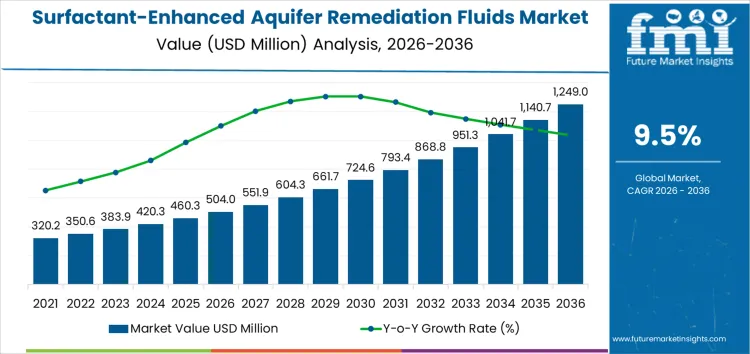
What is the Growth Forecast for the Surfactant-Enhanced Aquifer Remediation Fluids Market through 2036?
The compound annual growth rate (CAGR) analysis for the surfactant-enhanced aquifer remediation fluids market shows steady, consistent growth over the forecast period. Starting with a market value of USD 504 million in 2026, the market will grow incrementally each year. In the first five years (2026-2031), the market will grow from USD 504 million to approximately USD 802.1 million, reflecting a steady rise driven by increasing adoption of advanced remediation technologies. The CAGR during this period is consistent, maintaining an average of 9.5%.
In the later years (2031-2036), the market will continue to expand at a similar pace, reaching USD 1,249 million by 2036. The CAGR remains stable over the entire period, as demand for these solutions increases with more regulations, greater environmental awareness, and advancements in remediation technology. The market will experience predictable growth, making the CAGR of 9.5% an indicator of the increasing adoption of surfactant-enhanced aquifer remediation fluids in both developed and developing markets.
Surfactant-Enhanced Aquifer Remediation Fluids Market Key Takeaways
| Metric | Value |
|---|---|
| Industry Sales Value (2026) | USD 504 million |
| Industry Forecast Value (2036) | USD 1,249 million |
| Industry Forecast CAGR (2026-2036) | 9.5% |
What Is Driving the Demand for the Surfactant-enhanced Aquifer Remediation Fluids Market Globally?
The global demand for surfactant enhanced aquifer remediation (SEAR) fluids is being driven by the need to address persistent contamination in groundwater and soil at industrial, manufacturing, military, and waste disposal sites. Traditional pump and treat and passive remediation approaches often struggle to remove non aqueous phase liquids (NAPLs), heavy hydrocarbons, chlorinated solvents, and other hydrophobic contaminants because these pollutants resist dissolution and remain trapped in pore spaces. Surfactant enhanced remediation fluids use surface active agents to lower interfacial tension, mobilise contaminants, and increase solubility, enabling more effective extraction or in situ destruction. Environmental regulators and responsible parties globally are increasingly focused on achieving measurable reductions in contaminant mass and risk, rather than relying solely on long term containment. Stricter groundwater protection standards in regions across Europe, North America, and Asia Pacific, combined with rising public concern about drinking water quality, have reinforced adoption of technologies that improve recovery efficiency. In addition, remediation consultants and site owners recognise that advanced fluids can reduce remediation timelines and lifecycle costs by enhancing contaminant removal where simpler methods are insufficient.
Future demand for surfactant enhanced aquifer remediation fluids is expected to grow as innovation in formulation science and site characterisation tools improves performance and predictability. Advances in biodegradable, low toxicity surfactants and co solvent systems will make SEAR fluids more acceptable in sensitive environments and compatible with regulatory requirements that emphasise ecological safety. Integration of SEAR with enhanced bioremediation and thermal or chemical oxidation strategies will expand its utility across a wider range of contaminants and geological conditions. As digital subsurface imaging, real time monitoring, and reactive transport modelling become more accessible, practitioners will be better able to design and optimise SEAR applications for specific sites, improving cost effectiveness and reducing uncertainty. Growth in brownfield redevelopment and urban infill projects will maintain pressure to remediate legacy contamination with efficient methods that limit excavation and disturbance. Regulatory frameworks that emphasise risk based corrective action and performance outcomes will further support adoption of surfactant enabled approaches. As stakeholders balance environmental protection, liability management, and redevelopment goals, demand for advanced remediation fluids that offer enhanced contaminant mass removal is expected to expand steadily worldwide.
What are the Leading Segments in the Global Surfactant-Enhanced Aquifer Remediation Fluids Market?
The global surfactant-enhanced aquifer remediation fluids market is segmented by surfactant type and contaminant type. Among surfactant types, non-ionic surfactants lead the market, capturing 34% of the share, followed by anionic surfactants, bio-based & green surfactants, amphoteric & cationic surfactants, and other specialty remediation surfactants. Non-ionic surfactants are favored for their stability and effectiveness in enhancing the removal of contaminants from aquifers. On the contaminant type side, chlorinated solvents (TCE, PCE, VC) dominate the market, holding 32% of the share, followed by petroleum hydrocarbons (BTEX, TPH), PFAS & emerging contaminants, PAHs, PCBs & other recalcitrant organics, and mixed organic & inorganic pollutants. Chlorinated solvents are one of the most common and challenging contaminants in aquifer remediation, making them a key focus for surfactant-enhanced remediation techniques.
What Drives the Growth of Non-Ionic Surfactants in the Surfactant-Enhanced Aquifer Remediation Fluids Market?
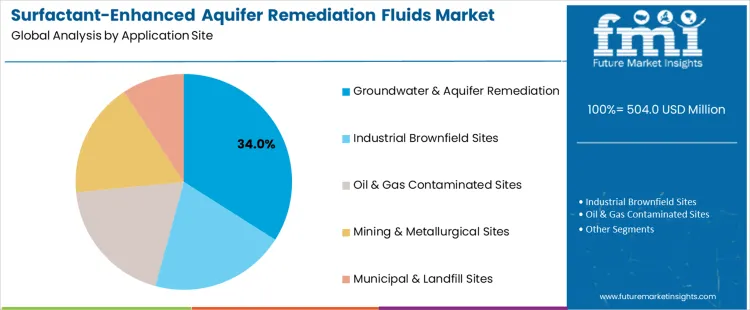
Non-ionic surfactants are the leading surfactant type in the surfactant-enhanced aquifer remediation fluids market, holding 34% of the share. These surfactants are highly valued for their ability to reduce surface tension and improve the solubility of hydrophobic contaminants in groundwater, enhancing their removal during the remediation process. Non-ionic surfactants are preferred in aquifer remediation due to their environmental compatibility and stability across a wide range of pH and temperature conditions. Their low toxicity and non-ionic nature make them less likely to cause additional contamination, ensuring safer and more efficient remediation operations.
Furthermore, non-ionic surfactants are effective in mobilizing a broad spectrum of contaminants, such as chlorinated solvents, which are often difficult to remove using traditional methods. The rising contamination of aquifers with such solvents has spurred the demand for non-ionic surfactants in remediation projects. As environmental regulations continue to tighten and the need for effective, sustainable solutions grows, non-ionic surfactants are expected to maintain their dominant position in the market. Their effectiveness, coupled with their environmental benefits, positions them as a critical tool for improving the efficiency of aquifer remediation.
What is Driving the Demand for Chlorinated Solvents (TCE, PCE, VC) in the Surfactant-Enhanced Aquifer Remediation Fluids Market?
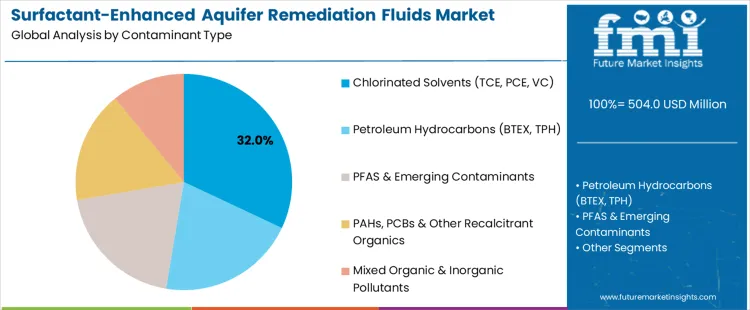
Chlorinated solvents, such as TCE (trichloroethylene), PCE (perchloroethylene), and VC (vinyl chloride), are the leading contaminant type in the surfactant-enhanced aquifer remediation fluids market, holding 32% of the share. These solvents are common contaminants in groundwater, often resulting from industrial activities such as degreasing, dry cleaning, and chemical manufacturing. Chlorinated solvents are particularly challenging to remediate because of their hydrophobic nature and the difficulty in mobilizing them from aquifer systems without specialized treatment methods.
Surfactant-enhanced aquifer remediation fluids, particularly those using non-ionic or anionic surfactants, are effective at breaking down the solvent-water interface and improving the solubility and mobility of these solvents, making their removal more efficient. As regulatory pressure on the cleanup of contaminated water sources increases, the demand for advanced remediation techniques targeting chlorinated solvents has risen. Additionally, the growing awareness of the long-term health and environmental risks posed by these contaminants has led to a greater emphasis on effective groundwater treatment. As the need for comprehensive and efficient remediation solutions for chlorinated solvents continues to grow, surfactant-enhanced remediation fluids will play an essential role in improving the speed and success of cleanup operations. This sustained demand positions chlorinated solvents as a dominant contaminant type in the market.
What are the Key Dynamics in the Global Surfactant-enhanced Aquifer Remediation Fluids Market?
The global surfactant enhanced aquifer remediation (SEAR) fluids market is expanding as environmental remediation programs adopt surfactant based technologies to mobilize and remove hydrophobic and recalcitrant contaminants from groundwater and soil. SEAR fluids reduce interfacial tension and enhance solubilization of hydrocarbons, chlorinated solvents and dense non aqueous phase liquids (DNAPLs), improving recovery efficiency. Growth is supported by heightened regulatory enforcement, increased brownfield redevelopment, and demand for on site, cost effective remediation. Adoption spans industrial sites, military bases and municipal cleanup projects where accelerated contaminant removal supports risk reduction and sustainable land reuse.
What are the Key Drivers for the Surfactant Enhanced Aquifer Remediation Fluids Market?
One major driver is rising regulatory pressure to address legacy contamination and meet stringent groundwater quality standards. Environmental authorities and responsible parties are seeking technologies that enhance recovery of difficult to treat contaminants while minimizing long term liability and risk. Surfactant enhanced systems can increase mass removal rates compared with conventional pump and treat, making them attractive for complex sites. Advances in surfactant chemistry and delivery methods improve performance and lower operational costs. Growth in urban redevelopment, industrial redevelopment and climate resilient infrastructure planning further increases demand for effective groundwater remediation solutions.
What are the Restraints for the Surfactant Enhanced Aquifer Remediation Fluids Market?
One restraint is technical complexity, as effective SEAR implementation requires detailed site characterization and optimization of surfactant type, concentration and injection strategy based on subsurface conditions. Variability in soil composition, contaminant distribution and groundwater flow can affect surfactant transport and recovery efficiency, necessitating extensive pilot scale testing that increases project planning time and cost. Some stakeholders may perceive surfactant enhanced remediation as more expensive upfront than traditional containment methods. Regulatory uncertainty around long term impacts of surfactants in the subsurface and requirements for monitoring and closure criteria can also influence adoption timing and technology selection.
What are the Key Trends in the Surfactant Enhanced Aquifer Remediation Fluids Market?
A key trend is development of tailored, environmentally benign surfactant formulations that balance high solubilization performance with low toxicity and biodegradability to support sustainable cleanup. Innovation includes engineered surfactants and co solvent systems designed for specific contaminant suites and soil types. Integration of SEAR with other remediation strategies, such as chemical oxidation, bioremediation and thermal methods, is gaining traction to achieve more complete site restoration. Advances in real time monitoring, data analytics and modeling improve design precision and demonstrate performance to regulators. Collaboration among technology developers, remediation firms and public agencies is accelerating validation and adoption of optimized surfactant enhancement approaches.
What is the Country-Wise Analysis of the Surfactant-Enhanced Aquifer Remediation Fluids Market?
The surfactant-enhanced aquifer remediation fluids market is expected to grow steadily, driven by increasing demand for efficient and sustainable solutions for groundwater contamination. These fluids, which use surfactants to enhance the removal of contaminants from aquifers, play a crucial role in cleaning up polluted groundwater, particularly in industrial sites. High-growth markets like the United States, China, and India are experiencing strong demand due to rapid industrialization, urbanization, and growing concerns about environmental pollution and water safety. Developed markets such as Germany and Canada are also seeing steady growth, supported by stricter environmental regulations, technological advancements, and a growing focus on sustainable water management practices.
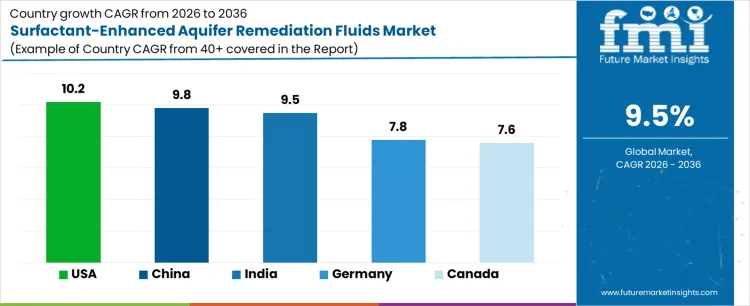
| Country | CAGR (%) |
|---|---|
| USA | 10.2 |
| China | 9.8 |
| India | 9.5 |
| Germany | 7.8 |
| Canada | 7.6 |
What is the Growth Outlook on the Surfactant-Enhanced Aquifer Remediation Fluids Market in the United States?
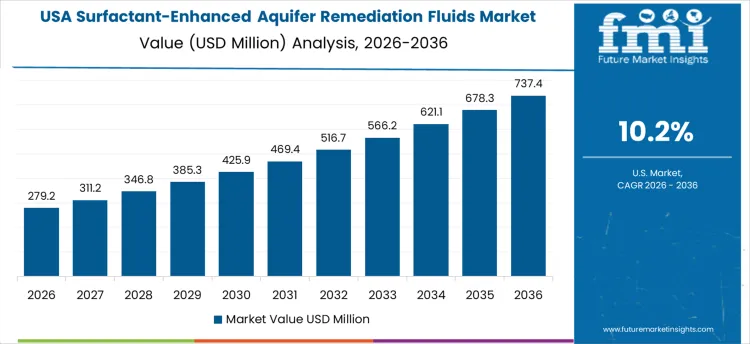
The surfactant-enhanced aquifer remediation fluids market in the United States is expected to grow at the highest rate, with a projected CAGR of 10.2%. The U.S. faces significant challenges related to groundwater contamination, particularly in regions with high industrial activity. With increasing regulatory pressure on industries to clean up polluted aquifers and prevent further contamination, the demand for surfactant-enhanced aquifer remediation fluids is rising. The U.S. Environmental Protection Agency (EPA) and other regulatory bodies continue to promote advanced and sustainable groundwater remediation technologies. As the demand for efficient and environmentally responsible water treatment solutions grows, the U.S. market for surfactant-enhanced aquifer remediation fluids is set to experience strong growth, especially in sectors like manufacturing, agriculture, and municipal water management.
What is the Market Outlook on the Surfactant-Enhanced Aquifer Remediation Fluids Market in China?
The surfactant-enhanced aquifer remediation fluids market in China is projected to grow steadily, with a projected CAGR of 9.8%. As China continues its rapid industrialization and urbanization, groundwater contamination has become a growing environmental concern. The need for effective, cost-efficient groundwater remediation solutions is driving the demand for surfactant-enhanced fluids. China’s government has introduced stricter regulations on environmental pollution, encouraging industries to adopt cleaner and more effective water treatment technologies. The growing focus on sustainable environmental practices and improving water quality, along with increasing investments in environmental infrastructure, is expected to support continued growth in the market. China’s large-scale industrial operations, particularly in sectors such as mining, manufacturing, and agriculture, will continue to drive the demand for advanced groundwater remediation solutions.
What is the Growth Forecast for the Surfactant-Enhanced Aquifer Remediation Fluids Market in India?
The surfactant-enhanced aquifer remediation fluids market in India is expected to grow steadily, with a projected CAGR of 9.5%. India’s rapidly growing industrial base, combined with challenges related to water contamination and pollution, is driving the demand for effective groundwater remediation solutions. As the country continues to face issues such as industrial discharge, agricultural runoff, and rapid urbanization, the need for efficient methods to restore polluted aquifers is increasing. The Indian government’s emphasis on improving water quality and managing water resources more sustainably is expected to further support market growth. As the industrial and agricultural sectors expand, and as water scarcity and contamination become more pressing, India’s market for surfactant-enhanced aquifer remediation fluids is poised for steady growth.
What is the Market Outlook on the Surfactant-Enhanced Aquifer Remediation Fluids Market in Germany?
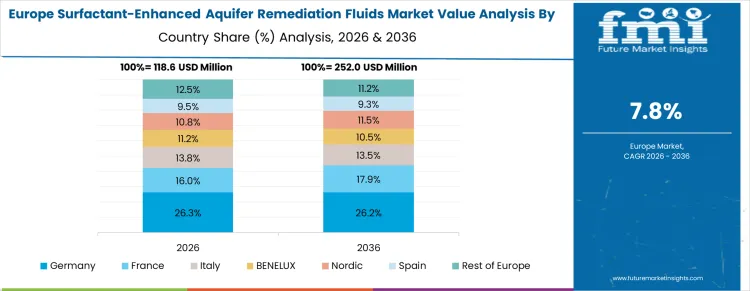
The surfactant-enhanced aquifer remediation fluids market in Germany is projected to grow steadily, with a projected CAGR of 7.8%. Germany’s commitment to environmental sustainability and its stringent environmental regulations are key drivers of the market’s growth. The country’s focus on protecting water resources and improving groundwater quality is driving the adoption of advanced and eco-friendly water remediation technologies. Additionally, Germany’s industrial sectors, particularly manufacturing and chemical industries, are under increasing pressure to reduce their environmental footprint, which is encouraging the use of surfactant-enhanced aquifer remediation fluids. With an increasing number of groundwater contamination incidents and growing awareness of water protection, Germany’s market for these fluids is expected to expand steadily as industries continue to prioritize environmental responsibility.
What are the Growth Prospects for the Surfactant-Enhanced Aquifer Remediation Fluids Market in Canada?
The surfactant-enhanced aquifer remediation fluids market in Canada is expected to grow steadily, with a projected CAGR of 7.6%. Canada’s strong focus on environmental protection, coupled with its significant agricultural and industrial sectors, is driving the demand for advanced groundwater remediation technologies. The country faces challenges related to industrial pollution, agricultural runoff, and the need to manage natural resources sustainably. With increasing government regulations surrounding groundwater quality and contamination, there is a growing need for effective, sustainable solutions. Additionally, as Canadian industries seek to comply with stricter environmental standards, the market for surfactant-enhanced aquifer remediation fluids is expected to see continued growth. The adoption of green technologies and sustainable water management practices in Canada’s municipalities, agriculture, and industrial sectors will further support market expansion.
What is the Competitive Landscape for the Surfactant-Enhanced Aquifer Remediation Fluids Market?
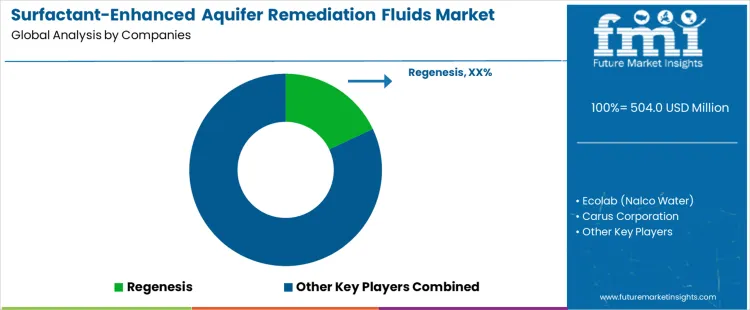
The surfactant-enhanced aquifer remediation fluids market is expanding rapidly as industries look for effective, sustainable solutions for groundwater contamination cleanup. Regenesis leads the market with its innovative surfactant-enhanced aquifer remediation fluids, offering advanced solutions that improve the ability to remove contaminants from aquifers. Their focus on high-performance, eco-friendly products has positioned them as a dominant player in this space. Ecolab (Nalco Water), Carus Corporation, and Veolia Water Technologies are significant competitors, each providing specialized remediation fluids designed to address groundwater contamination. Ecolab (Nalco Water) offers advanced chemical solutions that enhance the efficacy of aquifer remediation, while Carus Corporation provides high-quality surfactants for aquifer treatment. Veolia Water Technologies focuses on providing innovative, sustainable technologies for water remediation, including surfactant-enhanced fluids.
EOS Remediation further contributes to the competitive landscape by offering eco-friendly and effective solutions designed for groundwater cleanup. EOS Remediation emphasizes sustainability in its products while ensuring the high performance needed for aquifer remediation. These companies compete by focusing on product innovation, environmental responsibility, and the ability to provide highly effective solutions for groundwater cleanup. The market is expected to continue growing as demand for sustainable, efficient aquifer remediation solutions rises in response to increasing concerns about water contamination and the need for more effective cleanup technologies.
Key Players of the Surfactant-Enhanced Aquifer Remediation Fluids Market
- Regenesis
- Ecolab (Nalco Water)
- Carus Corporation
- Veolia Water Technologies
- EOS Remediation
Scope of the Report
| Items | Values |
|---|---|
| Quantitative Units (2026) | USD Million |
| Surfactant Type | Non-Ionic Surfactants, Anionic Surfactants, Bio-Based & Green Surfactants, Amphoteric & Cationic Surfactants, Other Specialty Remediation Surfactants |
| Contaminant Type | Chlorinated Solvents (TCE, PCE, VC), Petroleum Hydrocarbons (BTEX, TPH), PFAS & Emerging Contaminants, PAHs, PCBs & Other Recalcitrant Organics, Mixed Organic & Inorganic Pollutants |
| Application Site | Groundwater & Aquifer Remediation, Industrial Brownfield Sites, Oil & Gas Contaminated Sites, Mining & Metallurgical Sites, Municipal & Landfill Sites |
| Companies | Regenesis, Ecolab (Nalco Water), Carus Corporation, Veolia Water Technologies, EOS Remediation |
| Regions Covered | North America, Latin America, Western Europe, Eastern Europe, South Asia and Pacific, East Asia, Middle East & Africa |
| Countries Covered | United States, Canada, Mexico, Brazil, Argentina, Germany, France, United Kingdom, Italy, Spain, Netherlands, China, India, Japan, South Korea, ANZ, GCC Countries, South Africa |
| Additional Attributes | Dollar by sales by surfactant type, contaminant type, application site, and region. Includes market trends in surfactant-enhanced aquifer remediation fluids, performance in groundwater, brownfield, oil & gas, and mining site remediation, cost-effectiveness, sustainability practices, regulatory compliance, market share and competitive positioning of key companies, and the role of surfactants in improving contaminant removal, enhancing remediation efficiency, and supporting the cleanup of complex polluted sites across various industries. |
Surfactant-Enhanced Aquifer Remediation Fluids Market Segmentation
Surfactant Type:
- Non-Ionic Surfactants
- Anionic Surfactants
- Bio-Based & Green Surfactants
- Amphoteric & Cationic Surfactants
- Other Specialty Remediation Surfactants
Contaminant Type:
- Chlorinated Solvents (TCE, PCE, VC)
- Petroleum Hydrocarbons (BTEX, TPH)
- PFAS & Emerging Contaminants
- PAHs, PCBs & Other Recalcitrant Organics
- Mixed Organic & Inorganic Pollutants
Application Site:
- Groundwater & Aquifer Remediation
- Industrial Brownfield Sites
- Oil & Gas Contaminated Sites
- Mining & Metallurgical Sites
- Municipal & Landfill Sites
Region:
- Asia Pacific
- China
- Japan
- South Korea
- India
- Australia & New Zealand
- ASEAN
- Rest of Asia Pacific
- Europe
- Germany
- United Kingdom
- France
- Italy
- Spain
- Nordic
- BENELUX
- Rest of Europe
- North America
- United States
- Canada
- Mexico
- Latin America
- Brazil
- Chile
- Rest of Latin America
- Middle East & Africa
- Kingdom of Saudi Arabia
- Other GCC Countries
- Turkey
- South Africa
- Other African Union
- Rest of Middle East & Africa
Frequently Asked Questions
How big is the surfactant-enhanced aquifer remediation fluids market in 2026?
The global surfactant-enhanced aquifer remediation fluids market is estimated to be valued at USD 504.0 million in 2026.
What will be the size of surfactant-enhanced aquifer remediation fluids market in 2036?
The market size for the surfactant-enhanced aquifer remediation fluids market is projected to reach USD 1,249.0 million by 2036.
How much will be the surfactant-enhanced aquifer remediation fluids market growth between 2026 and 2036?
The surfactant-enhanced aquifer remediation fluids market is expected to grow at a 9.5% CAGR between 2026 and 2036.
What are the key product types in the surfactant-enhanced aquifer remediation fluids market?
The key product types in surfactant-enhanced aquifer remediation fluids market are non-ionic surfactants, anionic surfactants, bio-based & green surfactants, amphoteric & cationic surfactants and other specialty remediation surfactants.
Which contaminant type segment to contribute significant share in the surfactant-enhanced aquifer remediation fluids market in 2026?
In terms of contaminant type, chlorinated solvents (TCE, PCE, VC) segment to command 32.0% share in the surfactant-enhanced aquifer remediation fluids market in 2026.
Preview the report firsthand - request a free sample
Get SampleGet the brochure for pricing and purchase details.
Get PDFTable of Content
- Executive Summary
- Global Market Outlook
- Demand-side Trends
- Supply-side Trends
- Technology Roadmap Analysis
- Analysis and Recommendations
- Market Overview
- Market Coverage / Taxonomy
- Market Definition / Scope / Limitations
- Market Background
- Market Dynamics
- Drivers
- Restraints
- Opportunity
- Trends
- Scenario Forecast
- Demand in Optimistic Scenario
- Demand in Likely Scenario
- Demand in Conservative Scenario
- Opportunity Map Analysis
- Product Life Cycle Analysis
- Supply Chain Analysis
- Investment Feasibility Matrix
- Value Chain Analysis
- PESTLE and Porter’s Analysis
- Regulatory Landscape
- Regional Parent Market Outlook
- Production and Consumption Statistics
- Import and Export Statistics
- Market Dynamics
- Global Market Analysis 2021 to 2025 and Forecast, 2026 to 2036
- Historical Market Size Value (USD Million) Analysis, 2021 to 2025
- Current and Future Market Size Value (USD Million) Projections, 2026 to 2036
- Y-o-Y Growth Trend Analysis
- Absolute $ Opportunity Analysis
- Global Market Pricing Analysis 2021 to 2025 and Forecast 2026 to 2036
- Global Market Analysis 2021 to 2025 and Forecast 2026 to 2036, By Surfactant Type
- Introduction / Key Findings
- Historical Market Size Value (USD Million) Analysis By Surfactant Type , 2021 to 2025
- Current and Future Market Size Value (USD Million) Analysis and Forecast By Surfactant Type , 2026 to 2036
- Non-Ionic Surfactants
- Anionic Surfactants
- Bio-Based & Green Surfactants
- Amphoteric & Cationic Surfactants
- Other Specialty Remediation Surfactants
- Non-Ionic Surfactants
- Y-o-Y Growth Trend Analysis By Surfactant Type , 2021 to 2025
- Absolute $ Opportunity Analysis By Surfactant Type , 2026 to 2036
- Global Market Analysis 2021 to 2025 and Forecast 2026 to 2036, By Contaminant Type
- Introduction / Key Findings
- Historical Market Size Value (USD Million) Analysis By Contaminant Type, 2021 to 2025
- Current and Future Market Size Value (USD Million) Analysis and Forecast By Contaminant Type, 2026 to 2036
- Chlorinated Solvents (TCE, PCE, VC)
- Petroleum Hydrocarbons (BTEX, TPH)
- PFAS & Emerging Contaminants
- PAHs, PCBs & Other Recalcitrant Organics
- Mixed Organic & Inorganic Pollutants
- Chlorinated Solvents (TCE, PCE, VC)
- Y-o-Y Growth Trend Analysis By Contaminant Type, 2021 to 2025
- Absolute $ Opportunity Analysis By Contaminant Type, 2026 to 2036
- Global Market Analysis 2021 to 2025 and Forecast 2026 to 2036, By Application Site
- Introduction / Key Findings
- Historical Market Size Value (USD Million) Analysis By Application Site, 2021 to 2025
- Current and Future Market Size Value (USD Million) Analysis and Forecast By Application Site, 2026 to 2036
- Groundwater & Aquifer Remediation
- Industrial Brownfield Sites
- Oil & Gas Contaminated Sites
- Mining & Metallurgical Sites
- Municipal & Landfill Sites
- Groundwater & Aquifer Remediation
- Y-o-Y Growth Trend Analysis By Application Site, 2021 to 2025
- Absolute $ Opportunity Analysis By Application Site, 2026 to 2036
- Global Market Analysis 2021 to 2025 and Forecast 2026 to 2036, By Region
- Introduction
- Historical Market Size Value (USD Million) Analysis By Region, 2021 to 2025
- Current Market Size Value (USD Million) Analysis and Forecast By Region, 2026 to 2036
- North America
- Latin America
- Western Europe
- Eastern Europe
- East Asia
- South Asia and Pacific
- Middle East & Africa
- Market Attractiveness Analysis By Region
- North America Market Analysis 2021 to 2025 and Forecast 2026 to 2036, By Country
- Historical Market Size Value (USD Million) Trend Analysis By Market Taxonomy, 2021 to 2025
- Market Size Value (USD Million) Forecast By Market Taxonomy, 2026 to 2036
- By Country
- USA
- Canada
- Mexico
- By Surfactant Type
- By Contaminant Type
- By Application Site
- By Country
- Market Attractiveness Analysis
- By Country
- By Surfactant Type
- By Contaminant Type
- By Application Site
- Key Takeaways
- Latin America Market Analysis 2021 to 2025 and Forecast 2026 to 2036, By Country
- Historical Market Size Value (USD Million) Trend Analysis By Market Taxonomy, 2021 to 2025
- Market Size Value (USD Million) Forecast By Market Taxonomy, 2026 to 2036
- By Country
- Brazil
- Chile
- Rest of Latin America
- By Surfactant Type
- By Contaminant Type
- By Application Site
- By Country
- Market Attractiveness Analysis
- By Country
- By Surfactant Type
- By Contaminant Type
- By Application Site
- Key Takeaways
- Western Europe Market Analysis 2021 to 2025 and Forecast 2026 to 2036, By Country
- Historical Market Size Value (USD Million) Trend Analysis By Market Taxonomy, 2021 to 2025
- Market Size Value (USD Million) Forecast By Market Taxonomy, 2026 to 2036
- By Country
- Germany
- UK
- Italy
- Spain
- France
- Nordic
- BENELUX
- Rest of Western Europe
- By Surfactant Type
- By Contaminant Type
- By Application Site
- By Country
- Market Attractiveness Analysis
- By Country
- By Surfactant Type
- By Contaminant Type
- By Application Site
- Key Takeaways
- Eastern Europe Market Analysis 2021 to 2025 and Forecast 2026 to 2036, By Country
- Historical Market Size Value (USD Million) Trend Analysis By Market Taxonomy, 2021 to 2025
- Market Size Value (USD Million) Forecast By Market Taxonomy, 2026 to 2036
- By Country
- Russia
- Poland
- Hungary
- Balkan & Baltic
- Rest of Eastern Europe
- By Surfactant Type
- By Contaminant Type
- By Application Site
- By Country
- Market Attractiveness Analysis
- By Country
- By Surfactant Type
- By Contaminant Type
- By Application Site
- Key Takeaways
- East Asia Market Analysis 2021 to 2025 and Forecast 2026 to 2036, By Country
- Historical Market Size Value (USD Million) Trend Analysis By Market Taxonomy, 2021 to 2025
- Market Size Value (USD Million) Forecast By Market Taxonomy, 2026 to 2036
- By Country
- China
- Japan
- South Korea
- By Surfactant Type
- By Contaminant Type
- By Application Site
- By Country
- Market Attractiveness Analysis
- By Country
- By Surfactant Type
- By Contaminant Type
- By Application Site
- Key Takeaways
- South Asia and Pacific Market Analysis 2021 to 2025 and Forecast 2026 to 2036, By Country
- Historical Market Size Value (USD Million) Trend Analysis By Market Taxonomy, 2021 to 2025
- Market Size Value (USD Million) Forecast By Market Taxonomy, 2026 to 2036
- By Country
- India
- ASEAN
- Australia & New Zealand
- Rest of South Asia and Pacific
- By Surfactant Type
- By Contaminant Type
- By Application Site
- By Country
- Market Attractiveness Analysis
- By Country
- By Surfactant Type
- By Contaminant Type
- By Application Site
- Key Takeaways
- Middle East & Africa Market Analysis 2021 to 2025 and Forecast 2026 to 2036, By Country
- Historical Market Size Value (USD Million) Trend Analysis By Market Taxonomy, 2021 to 2025
- Market Size Value (USD Million) Forecast By Market Taxonomy, 2026 to 2036
- By Country
- Kingdom of Saudi Arabia
- Other GCC Countries
- Turkiye
- South Africa
- Other African Union
- Rest of Middle East & Africa
- By Surfactant Type
- By Contaminant Type
- By Application Site
- By Country
- Market Attractiveness Analysis
- By Country
- By Surfactant Type
- By Contaminant Type
- By Application Site
- Key Takeaways
- Key Countries Market Analysis
- USA
- Pricing Analysis
- Market Share Analysis, 2025
- By Surfactant Type
- By Contaminant Type
- By Application Site
- Canada
- Pricing Analysis
- Market Share Analysis, 2025
- By Surfactant Type
- By Contaminant Type
- By Application Site
- Mexico
- Pricing Analysis
- Market Share Analysis, 2025
- By Surfactant Type
- By Contaminant Type
- By Application Site
- Brazil
- Pricing Analysis
- Market Share Analysis, 2025
- By Surfactant Type
- By Contaminant Type
- By Application Site
- Chile
- Pricing Analysis
- Market Share Analysis, 2025
- By Surfactant Type
- By Contaminant Type
- By Application Site
- Germany
- Pricing Analysis
- Market Share Analysis, 2025
- By Surfactant Type
- By Contaminant Type
- By Application Site
- UK
- Pricing Analysis
- Market Share Analysis, 2025
- By Surfactant Type
- By Contaminant Type
- By Application Site
- Italy
- Pricing Analysis
- Market Share Analysis, 2025
- By Surfactant Type
- By Contaminant Type
- By Application Site
- Spain
- Pricing Analysis
- Market Share Analysis, 2025
- By Surfactant Type
- By Contaminant Type
- By Application Site
- France
- Pricing Analysis
- Market Share Analysis, 2025
- By Surfactant Type
- By Contaminant Type
- By Application Site
- India
- Pricing Analysis
- Market Share Analysis, 2025
- By Surfactant Type
- By Contaminant Type
- By Application Site
- ASEAN
- Pricing Analysis
- Market Share Analysis, 2025
- By Surfactant Type
- By Contaminant Type
- By Application Site
- Australia & New Zealand
- Pricing Analysis
- Market Share Analysis, 2025
- By Surfactant Type
- By Contaminant Type
- By Application Site
- China
- Pricing Analysis
- Market Share Analysis, 2025
- By Surfactant Type
- By Contaminant Type
- By Application Site
- Japan
- Pricing Analysis
- Market Share Analysis, 2025
- By Surfactant Type
- By Contaminant Type
- By Application Site
- South Korea
- Pricing Analysis
- Market Share Analysis, 2025
- By Surfactant Type
- By Contaminant Type
- By Application Site
- Russia
- Pricing Analysis
- Market Share Analysis, 2025
- By Surfactant Type
- By Contaminant Type
- By Application Site
- Poland
- Pricing Analysis
- Market Share Analysis, 2025
- By Surfactant Type
- By Contaminant Type
- By Application Site
- Hungary
- Pricing Analysis
- Market Share Analysis, 2025
- By Surfactant Type
- By Contaminant Type
- By Application Site
- Kingdom of Saudi Arabia
- Pricing Analysis
- Market Share Analysis, 2025
- By Surfactant Type
- By Contaminant Type
- By Application Site
- Turkiye
- Pricing Analysis
- Market Share Analysis, 2025
- By Surfactant Type
- By Contaminant Type
- By Application Site
- South Africa
- Pricing Analysis
- Market Share Analysis, 2025
- By Surfactant Type
- By Contaminant Type
- By Application Site
- USA
- Market Structure Analysis
- Competition Dashboard
- Competition Benchmarking
- Market Share Analysis of Top Players
- By Regional
- By Surfactant Type
- By Contaminant Type
- By Application Site
- Competition Analysis
- Competition Deep Dive
- Regenesis
- Overview
- Product Portfolio
- Profitability by Market Segments (Product/Age /Sales Channel/Region)
- Sales Footprint
- Strategy Overview
- Marketing Strategy
- Product Strategy
- Channel Strategy
- Ecolab (Nalco Water)
- Carus Corporation
- Veolia Water Technologies
- EOS Remediation
- Regenesis
- Competition Deep Dive
- Assumptions & Acronyms Used
- Research Methodology


