

- Market Size (2026)
- USD 294.0 Mn
- Forecast (2036)
- USD 434.9 Mn
- CAGR (2026 to 2036)
- 4.0%
How big is Tert-Dodecyl Mercaptan Market in 2026?
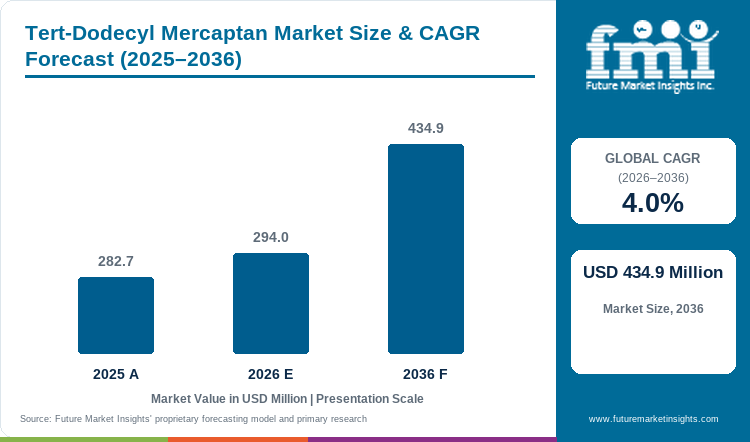
The tert-dodecyl mercaptan market is valued at USD 294.0 million in 2026 and is projected to reach USD 434.9 million by 2036, expanding at a CAGR of 4.0% over the 2026-2036 period.
The tert-dodecyl mercaptan market is valued at USD 294.0 million in 2026 and is projected to reach USD 434.9 million by 2036, expanding at a CAGR of 4.0% over the 2026-2036 period. The market was valued at USD 282.7 million in 2025. The estimate covers commercial tert-dodecyl mercaptan sold as a chain-transfer agent and synthesis intermediate. Other mercaptans, refinery sulfur streams and merchant products without TDM specification are excluded.
TDM sits within the specialty chemicals market, but its demand is narrower and is tied mainly to molecular-weight control in emulsion polymers. Revenue follows polymer output, dosage and contract price rather than rubber tonnage alone.
Key Takeaways
- The market is valued at USD 294.0 million in 2026 and is projected to add USD 140.9 million in value by 2036.
- Polymerization grade is projected to account for 71.0% of Grade demand in 2026 because elastomer and latex recipes depend on repeatable chain transfer.
- 98.0% and above is projected to account for 64.0% of Purity demand in 2026 because tighter polymer recipe control supports demand for higher-purity material.
- Styrene-butadiene rubber and latex is projected to account for 44.0% of Application demand in 2026 because these emulsion systems use mercaptan chain transfer at commercial scale.
- Odor, sulfur handling and dependence on a limited qualified supply base can interrupt polymer recipes even when end-market demand remains stable.
- Key players in this market include Arkema and Chevron Phillips Chemical. Sanshin Chemical Industry and LANXESS are also included. Bruno Bock and Daicel form another pair. Merck KGaA and Tokyo Chemical Industry complete the group.
Analyst Perspective
“TDM is a low-dose input with a high process consequence. The commercial premium depends on consistent chain transfer, secure logistics and the absence of unplanned polymer-batch variation.”
- Nikhil Kaitwade, Principal Consultant, Future Market Insights
How is the tert-dodecyl mercaptan market segmented?
The tert-dodecyl mercaptan market is segmented six ways: by grade, purity, application, end-use industry, supply form, and region. Polymerization grade leads the grade category with 71.0% of 2026 revenue.
The tert-dodecyl mercaptan market is segmented six ways: by grade, purity, application, end-use industry, supply form, and region. Polymerization grade leads the grade category with 71.0% of 2026 revenue.
Grade and purity define formulation consistency. Application separates synthetic rubber, latex, ABS and other synthesis. End-use industry identifies the purchasing plant, while supply form reflects storage scale and closed-transfer practice.
Why does polymerization grade lead TDM demand?
TDM has a narrow job inside the reactor: it controls polymer molecular weight during free-radical polymerization. That makes consistency more important than broad chemical versatility. Arkema identifies TDM as a chain-transfer agent for butadiene- and styrene-based polymers, including SB latex, SB rubber and ABS. Its safety summary also lists e-SBR, NBR and polystyrene among established uses. Research on emulsion polymerization shows that changing chain-transfer conditions affects molecular-weight distribution and polymer properties.
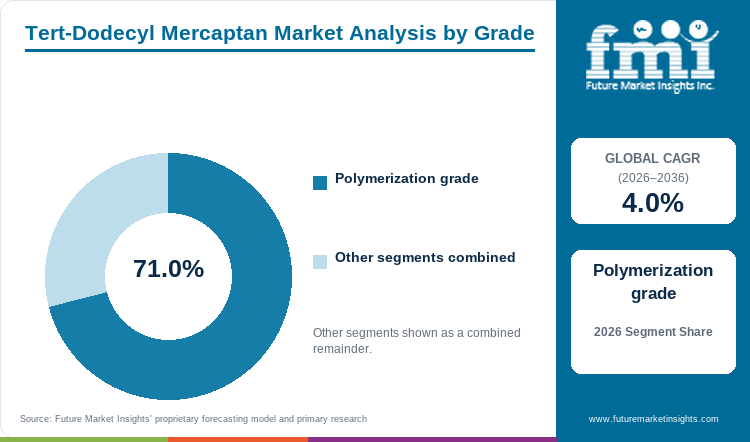
- Polymerization grade is estimated to account for 71.0% of demand in 2026. The share reflects TDM's concentration in polymer processes where dosing consistency directly affects the resulting polymer rather than serving as a general-purpose sulfur chemical.
Why does 98.0% and above lead purity demand?
Purity matters because TDM is dosed for a specific chain-transfer effect. A higher-assay material gives polymer producers a tighter basis for setting addition rates and controlling batch-to-batch variation. Commercial specifications show that 98.0% assay is already used as a defined product threshold for tert-dodecyl mercaptan. At the same time, nominal assay does not capture every variable that can influence polymerization behavior, so qualification can extend beyond a single purity number.
- The 98.0% and above segment is estimated to hold 64.0% of demand in 2026 as polymer producers favor material that can be incorporated into controlled recipes with less uncertainty around active content.
Why do styrene-butadiene rubber and latex lead application demand?
Styrene-butadiene systems are one of TDM's most established industrial uses. Arkema specifically lists SB latex and SB rubber, while its technical safety documentation extends the application set to e-SBR and other synthetic rubbers. In these processes, the mercaptan acts during polymer formation rather than after the rubber has been produced, giving it a direct role in controlling molecular weight and downstream processing behavior.
- Styrene-butadiene rubber and latex are estimated to account for 44.0% of application demand in 2026. Their lead reflects the commercial scale of emulsion polymerization routes in which mercaptan chain-transfer chemistry is already established.
How do rubber and elastomer producers shape the end-use category?
TDM demand is tied more closely to synthetic-rubber polymerization plants than to tire or molded-rubber factories themselves. The material enters upstream during the production of polymers such as SBR and NBR, where chain length has to be controlled before the polymer reaches downstream compounders. Arkema's application documentation places TDM directly in synthetic-rubber production, which explains why polymer operating rates matter more than finished-rubber unit sales alone.
- Rubber and elastomer producers are estimated to account for 57.0% of end-use demand in 2026. Consumption follows polymerization activity because TDM is introduced while the rubber polymer is being made.
Why does bulk liquid lead the supply-form category?
TDM is a liquid under normal industrial conditions, with Arkema reporting a density of 858 kg/m³ at 20°C and a flash point of 97°C. Its safety documentation describes industrial handling requirements, while ECHA records chemical transfer and closed-process use among relevant workplace activities for registered substances in this class. For large polymer plants, this physical form lends itself to tank storage and metered transfer rather than repeated handling of small packages.
- Bulk liquid is estimated to represent 76.0% of supply-form demand in 2026. High-volume polymer plants can feed the material through controlled transfer systems, while storage and odor management remain part of plant-level handling requirements.
What are the drivers, restraints and opportunities in the Tert-Dodecyl Mercaptan Market?
In the tert-dodecyl mercaptan market, the key driver is TDM use in emulsion polymerization to control molecular weight and processing behavior, the key restraint is strong odor, regulated handling and recipe requalification that limit supplier substitution, and the key opportunity is documented isomer consistency and regional inventory that can reduce polymer-batch and logistics risk.
- Driver: Emulsion polymerization plants use TDM to control molecular weight and processing behavior.
- Restraint: Strong odor, regulated handling and recipe requalification limit supplier substitution.
- Opportunity: Documented isomer consistency and regional inventory can reduce polymer-batch and logistics risk.
Growth in the synthetic rubber market keeps TDM closely tied to styrene-butadiene polymer production. Arkema identifies TDM as a chain-transfer agent for SB latex, SB rubber and other butadiene- and styrene-based polymers. Consumption therefore moves with polymerization activity and plant utilization, while dosage is governed by the molecular-weight profile required in the finished polymer.
Supplier interchangeability is more limited than the product's commodity-like appearance suggests. TDM has a strong characteristic odor and is handled as an industrial chemical requiring controlled storage and transfer. More importantly, polymer performance is influenced by the polymerization recipe, molecular weight and melt-flow response, so a source change may need qualification before it is introduced into an established production process.
Within the fine chemicals market, analytical consistency can carry more weight than headline assay alone. Polymer producers are effectively buying a repeatable chain-transfer response, which makes technical documentation and batch consistency relevant to supplier approval. Availability also matters because TDM is fed directly into production rather than purchased as an incidental process chemical.
Which country CAGRs are profiled in the Tert-Dodecyl Mercaptan Market?
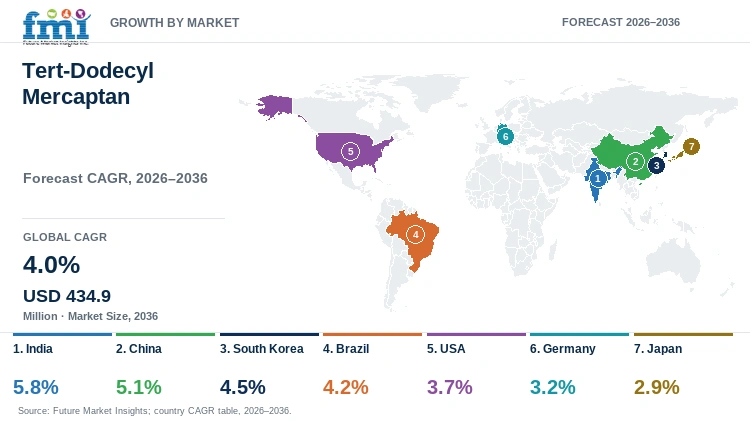
| Country | CAGR |
|---|---|
| India | 5.8% |
| China | 5.1% |
| South Korea | 4.5% |
| Brazil | 4.2% |
| USA | 3.7% |
| Germany | 3.2% |
| Japan | 2.9% |
How do country-level CAGRs compare in the Tert-Dodecyl Mercaptan Market?
Country differences in TDM demand largely reflect where synthetic rubber, ABS and latex are polymerized. India and China have a broader expansion opportunity as polymer capacity develops, while South Korea's position is linked more closely to export-oriented production. In the USA, Germany and Japan, supplier qualification and consistency have greater influence on purchasing decisions.
- India: New polymer and tire investments increase the amount of synthetic-rubber capacity requiring chain-transfer agents. Supply planning remains relevant where TDM is sourced internationally.
- China: A broad polymer manufacturing base creates recurring requirements for TDM across rubber, latex and styrenic polymer production. Local and imported grades compete for approved positions in established recipes.
- South Korea: ABS and synthetic-rubber production creates demand for tightly controlled material. For large export-oriented plants, consistency between deliveries can matter more than access to additional suppliers.
- Brazil: Tire and latex production provides the downstream base for TDM consumption. Import dependence makes freight, currency movements and local inventory more visible in purchasing decisions.
- USA: TDM demand comes from an established synthetic-rubber and polymer manufacturing base. Once a grade has been qualified, reliability and documentation can carry considerable weight in subsequent sourcing decisions.
- Germany: Specialty rubber production keeps TDM relevant in controlled polymer recipes. Chemical handling requirements also increase the importance of contained transfer and documented operating procedures.
- Japan: Established polymer producers create a comparatively specification-led market. Repeatable product behavior and low batch variation remain important where manufacturing recipes have already been optimized.
Across the key countries in this market, these rates measure revenue within the defined product boundary and do not represent growth of the wider parent industry.
Country-wise Analysis
- India, at 5.8% CAGR through 2036, shows the strongest expansion among the countries assessed. Additional tire and polymer investment increases the potential consumption base for chain-transfer agents, although imported material keeps lead times and inventory planning relevant.
- China is projected at 5.1% CAGR through 2036. The opportunity is tied to the scale of domestic polymer production. Competition between locally produced and imported TDM is likely to turn on batch consistency and technical acceptance within existing polymer recipes.
- South Korea follows at 4.5% CAGR through 2036. Its ABS and synthetic-rubber plants create a specification-sensitive market in which repeatable material characteristics and dependable bulk supply influence supplier selection.
- At 4.2% CAGR, Brazil develops from a smaller TDM consumption base. Tire and latex production provide the underlying demand, while freight exposure and exchange-rate movements give regional stocking a larger role in sourcing.
- The USA records a 3.7% CAGR through 2036. With a mature polymer manufacturing base, incremental demand is less dependent on new capacity. Qualified suppliers instead compete around delivery reliability and regulatory documentation as well as compatibility with closed-transfer operations.
- Germany's 3.2% CAGR reflects a market where specialty applications carry more weight than rapid capacity addition. Worker-exposure controls and chemical-handling requirements favor suppliers able to support contained delivery and documented handling practices.
- Japan, at 2.9% CAGR through 2036, remains primarily qualification-led. Established polymer producers have limited incentive to change an accepted TDM grade unless another source can reproduce the required chain-transfer performance with minimal batch variation.
Who are the notable companies in the Tert-Dodecyl Mercaptan Market?
Arkema and Chevron Phillips Chemical are notable companies profiled in this market. Sanshin Chemical Industry and LANXESS are also profiled. Bruno Bock and Daicel are included alongside Merck KGaA and Tokyo Chemical Industry.
Direct competition is concentrated among thiochemical producers able to supply polymerization-scale volumes. Rubber-additive and catalog suppliers are mapped as adjacent participants and remain Low where current public evidence does not confirm merchant TDM at industrial scale.
- Direct TDM and Mercaptan Producers: Arkema and Chevron Phillips Chemical. Sanshin Chemical Industry and Bruno Bock are also included.
- Polymer and Rubber Chemistry Platforms: LANXESS and Daicel.
- Research and Specialty Distribution: Merck KGaA and Tokyo Chemical Industry.
Competitive Benchmarking: Tert-Dodecyl Mercaptan Market
| Company | Direct TDM Evidence | Polymer Support | Supply Reach | Geographic Reach |
|---|---|---|---|---|
| Arkema | High | High | High | Global |
| Chevron Phillips Chemical | High | High | High | Global |
| Sanshin Chemical Industry | Medium | High | Medium | Asia, export |
| LANXESS | Low | High | High | Global |
| Bruno Bock | Medium | High | Medium | Europe, global |
| Daicel | Low | Medium | High | Asia, global |
| Merck KGaA | Low | Medium | Medium | Global |
| Tokyo Chemical Industry | Low | Medium | Medium | Global |
High direct evidence requires a named TDM or relevant commercial mercaptan position. Medium reflects thiochemical capability with narrower public detail. Low identifies adjacent polymer or catalog activity.
Key Developments in the Tert-Dodecyl Mercaptan Market
- In March 2026, Arkema continued to publish TDM as a chain-transfer agent for butadiene and styrene polymers, confirming its current commercial application scope.
- In 2025, European Chemicals Agency registration information continued to list tert-dodecyl mercaptan under industrial chemical controls, sustaining documentation requirements for suppliers and users.
- In 2024, global synthetic-rubber producers continued capacity and efficiency programs in Asia, reinforcing the role of qualified chain-transfer agents in established polymer recipes.
Key Players in the Tert-Dodecyl Mercaptan Market
Direct TDM and Mercaptan Producers
- Arkema
- Chevron Phillips Chemical
- Sanshin Chemical Industry
- Bruno Bock
Polymer and Rubber Chemistry Platforms
- LANXESS
- Daicel
Research and Specialty Distribution
- Merck KGaA
- Tokyo Chemical Industry
Tert-Dodecyl Mercaptan Market - Report Scope
| Coverage field | Report scope |
|---|---|
| Market Size | USD 294.0 million in 2026 and USD 434.9 million by 2036 at 4.0% CAGR. |
| Market Definition | Commercial tert-dodecyl mercaptan used as a chain-transfer agent or specialty synthesis intermediate, including bulk and packaged supply. |
| Segmentation | Grade, purity, application, end-use industry, supply form and region. |
| Regional Coverage | North America, Latin America, Western Europe, Eastern Europe, East Asia, South Asia and Pacific, and Middle East and Africa. |
| Countries Covered | India, China, South Korea, Brazil, USA, Germany, Japan and more than 20 countries included in the full report. |
| Key Companies Profiled | Arkema, Chevron Phillips Chemical, Sanshin Chemical Industry, LANXESS, Bruno Bock, Daicel, Merck KGaA, Tokyo Chemical Industry. |
| Forecast Period | 2026 to 2036. |
| Approach | Bottom-up model using relevant polymer output, recipe dosage, merchant share, average selling price and regional plant utilization. |
Tert-Dodecyl Mercaptan Market - Research Methodology
| Method | Approach |
|---|---|
| Primary Research | FMI analysts gathered input from manufacturers and system integrators as well as distributors and plant engineers. Procurement teams and application specialists also contributed. Interviews tested purchasing criteria and replacement cycles along with qualification work and technical-service requirements. |
| Desk Research | Desk research covered government statistics and standards as well as industry associations and technical literature. Patents and official product information were also reviewed alongside corporate announcements. Evidence was screened for scope and date as well as direct relevance. |
| Market Sizing and Forecasting | The bottom-up model uses relevant polymer output and recipe dosage along with merchant share and average selling price. Regional plant utilization is also included. |
| Data Validation | Estimates were checked against parent-market activity and installed-base indicators as well as product specifications and supplier participation. Adjacent products without the defined function were excluded. |
Tert-Dodecyl Mercaptan Market by Segments
Tert-Dodecyl Mercaptan Market segmented by Grade:
- Polymerization grade
- Synthesis grade
- Technical grade
Tert-Dodecyl Mercaptan Market segmented by Purity:
- 98.0% and above
- 95.0% to below 98.0%
- Below 95.0%
Tert-Dodecyl Mercaptan Market segmented by Application:
- Styrene-butadiene rubber and latex
- ABS resins
- Acrylic polymers
- Other chemical synthesis
Tert-Dodecyl Mercaptan Market segmented by End-use Industry:
- Rubber and elastomer producers
- Resin manufacturers
- Adhesive and latex formulators
- Chemical intermediates
Tert-Dodecyl Mercaptan Market segmented by Supply Form:
- Bulk liquid
- Drums
- Intermediate bulk containers
- Custom blends
Tert-Dodecyl Mercaptan Market by Region:
- North America
- United States
- Canada
- Latin America
- Brazil
- Mexico
- Argentina
- Chile
- Western Europe
- Germany
- France
- United Kingdom
- Italy
- Spain
- Benelux
- Nordics
- Eastern Europe
- Poland
- Czech Republic
- Romania
- Hungary
- East Asia
- China
- Japan
- South Korea
- South Asia and Pacific
- India
- ASEAN
- Australia and New Zealand
- Middle East and Africa
- GCC Countries
- South Africa
- Türkiye
- Israel
Research Sources and Bibliography
- Arkema. (n.d.; accessed September 23, 2026). Tert-Dodecyl Mercaptan product information.
- European Chemicals Agency. (n.d.; accessed September 23, 2026). Tert-dodecyl mercaptan substance information.
- United States Environmental Protection Agency. (2024). Chemical Data Reporting resources.
- Organisation for Economic Co-operation and Development. (2023). Emission scenario documents for polymer chemicals.
- International Institute of Synthetic Rubber Producers. (2025). Industry and sustainability resources.
- PubChem. (n.d.; accessed September 23, 2026). Tert-dodecanethiol compound summary.
- Future Market Insights. (2026). Specialty Chemicals Market.
- Future Market Insights. (2026). Synthetic Rubber Market.
This bibliography is provided for reader reference and is not exhaustive. The full report contains the complete reference list and detailed citations.
This Report Answers
- How large is the tert-dodecyl mercaptan market in 2026 and 2036?
- Which product specification leads demand in 2026?
- What operating condition converts technical need into a purchase?
- Which constraint can delay qualification or replacement?
- How do country growth rates compare across the profiled markets?
- Which companies provide direct or adjacent market capability?
Frequently Asked Questions
How big is the tert-dodecyl mercaptan market in 2026?
The tert-dodecyl mercaptan market is valued at USD 294.0 million in 2026 and is projected to reach USD 434.9 million by 2036, expanding at a CAGR of 4.0% over the 2026–2036 period. The estimate covers revenue within the stated market definition and excludes adjacent equipment or chemicals sold without the required function.
What is the CAGR of the tert-dodecyl mercaptan market from 2026 to 2036?
The market is projected to grow at a 4.0% CAGR between 2026 and 2036. Expansion depends on end-market output and the rate at which plants adopt higher-specification products.
Which grade leads the tert-dodecyl mercaptan market?
Polymerization grade is expected to hold a 71.0% share in 2026 because elastomer and latex recipes depend on repeatable chain transfer. Recipe qualification and batch consistency protect polymerization-grade demand.
Which countries are projected to record higher growth?
India is projected to grow at a 5.8% CAGR through 2036. China is projected at 5.1% and South Korea at 4.5% over the same period. The comparison reflects local production investment and the timing of replacement or qualification cycles.
Which companies are active in the tert-dodecyl mercaptan market?
The profiled group includes Arkema and Chevron Phillips Chemical. Sanshin Chemical Industry and LANXESS are also included. Bruno Bock and Daicel form another pair. Merck KGaA and Tokyo Chemical Industry complete the group. Capability differs by product range and application evidence.
Preview the report firsthand - request a free sample
Get SampleGet the brochure for pricing and purchase details.
Get PDFTable of Content
- Key Takeaways
- Market Size and CAGR
- Top Growth Driver
- Fastest Growing Segment
- Leading Region
- Key Companies
- Emerging Opportunities
- Executive Summary
- Global Market Outlook
- Demand-side Trends
- Supply-side Trends
- Technology Roadmap Analysis
- Analysis and Recommendations
- Analyst Perspective (What is happening? Why now? What should investors know?)
- Key Questions Answered
- How large is the market?
- What is the CAGR?
- What are key trends?
- Which region dominates?
- Who are the leaders?
- Market Overview
- Market Coverage / Taxonomy
- Market Definition / Scope / Limitations
- Research Methodology
- Chapter Orientation
- Analytical Lens and Working Hypotheses
- Market Structure, Signals, and Trend Drivers
- Benchmarking and Cross-market Comparability
- Market Sizing, Forecasting, and Opportunity Mapping
- Research Design and Evidence Framework
- Desk Research Programme (Secondary Evidence)
- Expert Input and Fieldwork (Primary Evidence)
- Tooling, Models, and Reference Databases
- Data Engineering and Model Build
- Quality Assurance and Audit Trail
- Market Background
- Market Dynamics (Drivers, Restraints, Opportunity, Trends)
- Scenario Forecast (Optimistic, Likely, Conservative)
- Impact Analysis
- AI Impact
- Sustainability Impact
- Regulatory Impact
- Technology Impact
- Consumer / Buyer Analysis
- Purchase Drivers
- Adoption Barriers
- Buyer Journey
- Opportunity Map Analysis
- Product Life Cycle Analysis
- Supply Chain Analysis
- Investment Feasibility Matrix
- Value Chain Analysis
- PESTLE and Porter's Analysis
- Regulatory Landscape
- Regional Parent Market Outlook
- Production and Consumption Statistics
- Import and Export Statistics
- Global Market Analysis and Forecast, 2021 to 2036
- Historical Market Size Value (USD Million) Analysis, 2021 to 2025
- Current and Future Market Size Value (USD Million) Projections, 2026 to 2036
- Y-o-Y Growth Trend Analysis
- Absolute $ Opportunity Analysis
- Global Market Pricing Analysis, 2021 to 2036
- Global Market Analysis and Forecast, By Grade, 2021 to 2036
- Introduction / Key Findings
- Historical Market Size Value (USD Million) Analysis By Grade, 2021 to 2025
- Current and Future Market Size Value (USD Million) Analysis and Forecast By Grade, 2026 to 2036
- Polymerization grade
- Synthesis grade
- Technical grade
- Y-o-Y Growth Trend Analysis By Grade, 2021 to 2025
- Absolute $ Opportunity Analysis By Grade, 2026 to 2036
- Global Market Analysis and Forecast, By Purity, 2021 to 2036
- Introduction / Key Findings
- Historical Market Size Value (USD Million) Analysis By Purity, 2021 to 2025
- Current and Future Market Size Value (USD Million) Analysis and Forecast By Purity, 2026 to 2036
- 98.0% and above
- 95.0% to below 98.0%
- Below 95.0%
- Y-o-Y Growth Trend Analysis By Purity, 2021 to 2025
- Absolute $ Opportunity Analysis By Purity, 2026 to 2036
- Global Market Analysis and Forecast, By Application, 2021 to 2036
- Introduction / Key Findings
- Historical Market Size Value (USD Million) Analysis By Application, 2021 to 2025
- Current and Future Market Size Value (USD Million) Analysis and Forecast By Application, 2026 to 2036
- Styrene-butadiene rubber and latex
- ABS resins
- Acrylic polymers
- Other chemical synthesis
- Y-o-Y Growth Trend Analysis By Application, 2021 to 2025
- Absolute $ Opportunity Analysis By Application, 2026 to 2036
- Global Market Analysis and Forecast, By End-use Industry, 2021 to 2036
- Introduction / Key Findings
- Historical Market Size Value (USD Million) Analysis By End-use Industry, 2021 to 2025
- Current and Future Market Size Value (USD Million) Analysis and Forecast By End-use Industry, 2026 to 2036
- Rubber and elastomer producers
- Resin manufacturers
- Adhesive and latex formulators
- Chemical intermediates
- Y-o-Y Growth Trend Analysis By End-use Industry, 2021 to 2025
- Absolute $ Opportunity Analysis By End-use Industry, 2026 to 2036
- Global Market Analysis and Forecast, By Supply Form, 2021 to 2036
- Introduction / Key Findings
- Historical Market Size Value (USD Million) Analysis By Supply Form, 2021 to 2025
- Current and Future Market Size Value (USD Million) Analysis and Forecast By Supply Form, 2026 to 2036
- Bulk liquid
- Drums
- Intermediate bulk containers
- Custom blends
- Y-o-Y Growth Trend Analysis By Supply Form, 2021 to 2025
- Absolute $ Opportunity Analysis By Supply Form, 2026 to 2036
- Global Market Analysis and Forecast, By Region, 2021 to 2036
- Introduction
- Historical Market Size Value (USD Million) Analysis By Region, 2021 to 2025
- Current Market Size Value (USD Million) Analysis and Forecast By Region, 2026 to 2036
- North America
- Latin America
- Western Europe
- Eastern Europe
- East Asia
- South Asia and Pacific
- Middle East and Africa
- Market Attractiveness Analysis By Region
- North America Market Analysis and Forecast, By Country, 2021 to 2036
- Historical Market Size Value (USD Million) Trend Analysis By Market Taxonomy, 2021 to 2025
- Market Size Value (USD Million) Forecast By Market Taxonomy, 2026 to 2036
- By Country
- United States
- Canada
- By Grade
- By Purity
- By Application
- By End-use Industry
- By Supply Form
- By Country
- Market Attractiveness Analysis
- By Country
- By Grade
- By Purity
- By Application
- By End-use Industry
- By Supply Form
- Key Takeaways
- Latin America Market Analysis and Forecast, By Country
- Historical Market Size Value (USD Million) Trend Analysis By Market Taxonomy, 2021 to 2025
- Market Size Value (USD Million) Forecast By Market Taxonomy, 2026 to 2036
- By Country
- Brazil
- Mexico
- Argentina
- Chile
- By Grade
- By Purity
- By Application
- By End-use Industry
- By Supply Form
- By Country
- Market Attractiveness Analysis
- By Country
- By Grade
- By Purity
- By Application
- By End-use Industry
- By Supply Form
- Key Takeaways
- Western Europe Market Analysis and Forecast, By Country
- Historical Market Size Value (USD Million) Trend Analysis By Market Taxonomy, 2021 to 2025
- Market Size Value (USD Million) Forecast By Market Taxonomy, 2026 to 2036
- By Country
- Germany
- France
- United Kingdom
- Italy
- Spain
- Benelux
- Nordics
- By Grade
- By Purity
- By Application
- By End-use Industry
- By Supply Form
- By Country
- Market Attractiveness Analysis
- By Country
- By Grade
- By Purity
- By Application
- By End-use Industry
- By Supply Form
- Key Takeaways
- Eastern Europe Market Analysis and Forecast, By Country
- Historical Market Size Value (USD Million) Trend Analysis By Market Taxonomy, 2021 to 2025
- Market Size Value (USD Million) Forecast By Market Taxonomy, 2026 to 2036
- By Country
- Poland
- Czech Republic
- Romania
- Hungary
- By Grade
- By Purity
- By Application
- By End-use Industry
- By Supply Form
- By Country
- Market Attractiveness Analysis
- By Country
- By Grade
- By Purity
- By Application
- By End-use Industry
- By Supply Form
- Key Takeaways
- East Asia Market Analysis and Forecast, By Country
- Historical Market Size Value (USD Million) Trend Analysis By Market Taxonomy, 2021 to 2025
- Market Size Value (USD Million) Forecast By Market Taxonomy, 2026 to 2036
- By Country
- China
- Japan
- South Korea
- By Grade
- By Purity
- By Application
- By End-use Industry
- By Supply Form
- By Country
- Market Attractiveness Analysis
- By Country
- By Grade
- By Purity
- By Application
- By End-use Industry
- By Supply Form
- Key Takeaways
- South Asia and Pacific Market Analysis and Forecast, By Country
- Historical Market Size Value (USD Million) Trend Analysis By Market Taxonomy, 2021 to 2025
- Market Size Value (USD Million) Forecast By Market Taxonomy, 2026 to 2036
- By Country
- India
- ASEAN
- Australia and New Zealand
- By Grade
- By Purity
- By Application
- By End-use Industry
- By Supply Form
- By Country
- Market Attractiveness Analysis
- By Country
- By Grade
- By Purity
- By Application
- By End-use Industry
- By Supply Form
- Key Takeaways
- Middle East and Africa Market Analysis and Forecast, By Country
- Historical Market Size Value (USD Million) Trend Analysis By Market Taxonomy, 2021 to 2025
- Market Size Value (USD Million) Forecast By Market Taxonomy, 2026 to 2036
- By Country
- GCC Countries
- South Africa
- Türkiye
- Israel
- By Grade
- By Purity
- By Application
- By End-use Industry
- By Supply Form
- By Country
- Market Attractiveness Analysis
- By Country
- By Grade
- By Purity
- By Application
- By End-use Industry
- By Supply Form
- Key Takeaways
- Key Countries Market Analysis
- United States
- Pricing Analysis
- Market Share Analysis, 2025
- By Grade
- By Purity
- By Application
- By End-use Industry
- By Supply Form
- Canada
- Pricing Analysis
- Market Share Analysis, 2025
- By Grade
- By Purity
- By Application
- By End-use Industry
- By Supply Form
- Mexico
- Pricing Analysis
- Market Share Analysis, 2025
- By Grade
- By Purity
- By Application
- By End-use Industry
- By Supply Form
- Brazil
- Pricing Analysis
- Market Share Analysis, 2025
- By Grade
- By Purity
- By Application
- By End-use Industry
- By Supply Form
- Chile
- Pricing Analysis
- Market Share Analysis, 2025
- By Grade
- By Purity
- By Application
- By End-use Industry
- By Supply Form
- Germany
- Pricing Analysis
- Market Share Analysis, 2025
- By Grade
- By Purity
- By Application
- By End-use Industry
- By Supply Form
- United Kingdom
- Pricing Analysis
- Market Share Analysis, 2025
- By Grade
- By Purity
- By Application
- By End-use Industry
- By Supply Form
- Italy
- Pricing Analysis
- Market Share Analysis, 2025
- By Grade
- By Purity
- By Application
- By End-use Industry
- By Supply Form
- Spain
- Pricing Analysis
- Market Share Analysis, 2025
- By Grade
- By Purity
- By Application
- By End-use Industry
- By Supply Form
- France
- Pricing Analysis
- Market Share Analysis, 2025
- By Grade
- By Purity
- By Application
- By End-use Industry
- By Supply Form
- India
- Pricing Analysis
- Market Share Analysis, 2025
- By Grade
- By Purity
- By Application
- By End-use Industry
- By Supply Form
- ASEAN
- Pricing Analysis
- Market Share Analysis, 2025
- By Grade
- By Purity
- By Application
- By End-use Industry
- By Supply Form
- Australia and New Zealand
- Pricing Analysis
- Market Share Analysis, 2025
- By Grade
- By Purity
- By Application
- By End-use Industry
- By Supply Form
- China
- Pricing Analysis
- Market Share Analysis, 2025
- By Grade
- By Purity
- By Application
- By End-use Industry
- By Supply Form
- Japan
- Pricing Analysis
- Market Share Analysis, 2025
- By Grade
- By Purity
- By Application
- By End-use Industry
- By Supply Form
- South Korea
- Pricing Analysis
- Market Share Analysis, 2025
- By Grade
- By Purity
- By Application
- By End-use Industry
- By Supply Form
- Poland
- Pricing Analysis
- Market Share Analysis, 2025
- By Grade
- By Purity
- By Application
- By End-use Industry
- By Supply Form
- Hungary
- Pricing Analysis
- Market Share Analysis, 2025
- By Grade
- By Purity
- By Application
- By End-use Industry
- By Supply Form
- Türkiye
- Pricing Analysis
- Market Share Analysis, 2025
- By Grade
- By Purity
- By Application
- By End-use Industry
- By Supply Form
- South Africa
- Pricing Analysis
- Market Share Analysis, 2025
- By Grade
- By Purity
- By Application
- By End-use Industry
- By Supply Form
- United States
- Market Structure Analysis
- Competition Dashboard
- Competition Benchmarking
- Market Share Analysis of Top Players
- By Regional
- By Grade
- By Purity
- By Application
- By End-use Industry
- By Supply Form
- Emerging Startups
- Innovation Benchmarking
- Competition Analysis
- Competition Deep Dive
- Arkema
- Overview
- Product Portfolio
- Profitability by Market Segments
- Sales Footprint
- Strategy Overview
- Marketing Strategy
- Product Strategy
- Channel Strategy
- Chevron Phillips Chemical
- Sanshin Chemical Industry
- LANXESS
- Bruno Bock
- Daicel
- Merck KGaA
- Tokyo Chemical Industry
- Arkema
- Case Studies
- Success Stories
- Recent Developments
- Competition Deep Dive
- Assumptions & Acronyms Used


