

- Industry Size (2026)
- USD 2950.0 Mn
- Forecast (2036)
- USD 6368.8 Mn
- CAGR (2026 to 2036)
- 8.00%
Ultrapure Fittings Market Forecast and Outlook 2026 to 2036
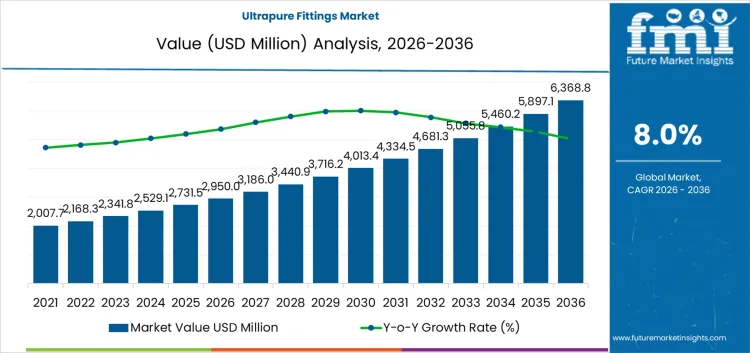
The ultrapure fittings market is valued at USD 2,950.0 million in 2026, projected to reach USD 6368.8 million by 2036, expanding at a CAGR of 8.0% over the forecast period. Procurement behavior in this market is governed by contamination risk, yield sensitivity, and long qualification cycles rather than short-term cost considerations. Buyers are typically highly risk-averse, as fitting failure or trace contamination can trigger costly downtime, yield loss, or regulatory non-compliance in semiconductor and life-science facilities. Preference is therefore given to suppliers with proven cleanroom manufacturing credentials, validated material traceability, and long-standing approvals within fab or plant standards. Vendor lock-in is reinforced once fittings are specified during facility design and integrated into certified process tool architectures. Switching costs remain high due to requalification requirements, documentation burden, and compatibility constraints with existing automation and monitoring systems. As a result, procurement outcomes favor incumbents with deep application knowledge, global service capability, and consistent purity assurance, while new entrants face extended evaluation timelines and limited access to high-criticality installations.
Quick Stats for Ultrapure Fittings Market
- Ultrapure Fittings Market Value (2026): USD 2,950.0 Million
- Ultrapure Fittings Market Forecast Value (2036): USD 6368.8 Million
- Ultrapure Fittings Market Forecast CAGR 2026 to 2036: 8.00%
- Leading Material Type in Ultrapure Fittings Market: PFA & PTFE Fittings
- Leading End Use in Ultrapure Fittings Market: Semiconductor Fabs
- Key Growth Regions in Ultrapure Fittings Market: Asia Pacific, North America, Europe
- Top Key Players in Ultrapure Fittings Market: Swagelok, Parker Hannifin, Entegris, Fujikin, CKD Corporation, SMC Corporation, KITZ SCT, Ham-Let (Let-Lok), Hy-Lok, ASCO (Emerson)
Ultrapure Fittings Market Key Takeaways
| Metric | Value |
|---|---|
| Industry Value (2026) | USD 2,950.0 Million |
| Forecast Value (2036) | USD 6,368.8 Million |
| Forecast CAGR 2026 to 2036 | 8.00% |
How Is the Global Ultrapure Fittings Market Advancing?
The global ultrapure fittings market is advancing steadily, driven by rising demand for contamination-free fluid handling systems in high-precision industries. Ultrapure fittings are critical components in sectors such as semiconductor manufacturing, pharmaceuticals, biotechnology, and specialty chemicals, where even trace contaminants can compromise product quality and process reliability.
A key driver supporting market growth is the continued expansion of semiconductor fabrication and advanced manufacturing facilities. Ultrapure fittings are extensively used in chemical delivery systems, water purification lines, and gas handling applications to maintain strict purity standards. Increasing complexity of semiconductor nodes and higher cleanliness requirements are prompting manufacturers to invest in high-performance fittings with superior surface finish and material integrity.
Technological advancements are further strengthening market adoption. Improvements in material selection, such as high-purity polymers and advanced stainless steel alloys, are enhancing chemical resistance and durability. Precision machining and improved joining technologies are also reducing leak risks and particle generation. As industries continue to tighten process control and purity requirements, the ultrapure fittings market is expected to experience consistent growth over the forecast period
What Is the Segment-Wise Overview of the Ultrapure Fittings Market?
The ultrapure fittings market is driven by stringent contamination control requirements and expanding high-purity manufacturing capacity. PFA and PTFE fittings lead with a 44% share, reflecting their superior chemical inertness, low extractables, and suitability for aggressive chemistries and ultrapure water handling. These materials are widely adopted where purity and reliability are critical. On the end-use side, semiconductor fabs account for 56% of demand, as advanced wafer processing requires defect-free fluid delivery systems to protect yield and performance. Together, these segments highlight a market centered on ultra-high purity standards, fluoropolymer material preference, and strong demand from semiconductor manufacturing expansion.
Why Do PFA and PTFE Fittings Lead the Ultrapure Fittings Market?
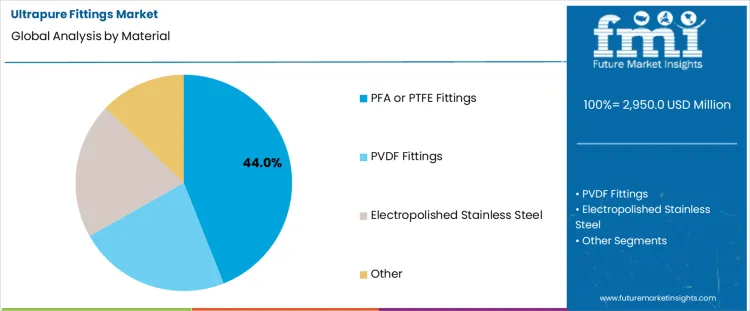
PFA and PTFE fittings account for 44% of the ultrapure fittings market due to their exceptional chemical resistance, ultra-low extractables, and suitability for high-purity fluid handling. These fluoropolymer materials are inert and non-reactive, making them ideal for applications involving aggressive chemicals, ultrapure water, and sensitive process media. PFA and PTFE fittings prevent contamination, leaching, and particle generation, which are critical concerns in high-purity manufacturing environments. Their ability to withstand high temperatures and repeated cleaning cycles further supports long-term use. Manufacturers prefer these fittings for critical fluid lines where purity standards are uncompromising. As industries increasingly tighten contamination control requirements, PFA and PTFE fittings continue to dominate material selection in ultrapure fluid systems.
Why Do Semiconductor Fabs Dominate End-Use Demand in the Ultrapure Fittings Market?
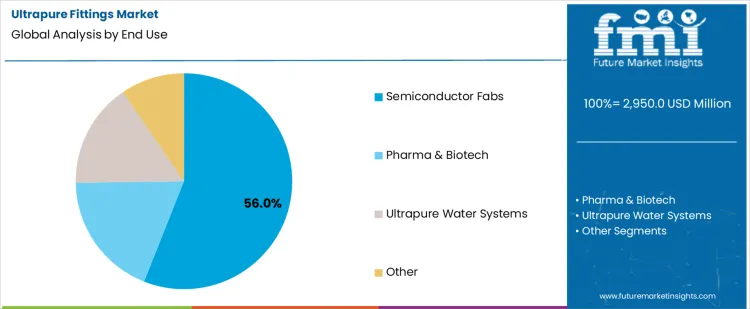
Semiconductor fabrication facilities represent 56% of end-use demand, making them the largest application segment in the ultrapure fittings market. Semiconductor manufacturing requires extremely high-purity chemicals and water to prevent defects during wafer processing. Even trace contamination can impact yield and device performance, driving strict material and component standards. Ultrapure fittings are essential for chemical delivery systems, ultrapure water lines, and waste handling processes within fabs. Continuous capacity expansion, node migration, and construction of advanced fabs increase demand for reliable, contamination-free fluid handling components. Semiconductor fabs prioritize fittings that ensure long-term purity, leak-free operation, and compatibility with automated process systems. As chip manufacturing complexity rises, semiconductor fabs remain the primary drivers of ultrapure fittings demand.
What Are the Key Dynamics for the Ultrapure Fittings Market?
Ultrapure fittings are precision-manufactured connectors, ferrules, and adaptors designed to maintain extremely low particulate and ionic contamination levels in high-purity process lines. Key market dynamics include stringent quality standards for critical processes, rising adoption of automated and high-throughput production lines, and growth of end-use industries with zero-tolerance impurity requirements. Material innovations such as high-grade stainless steel, fluoropolymers, and advanced surface finishes enhance corrosion resistance, purity retention, and durability. As customers emphasize yield optimization and defect reduction, ultrapure fittings become integral to ensuring consistent flow, sealing integrity, and long-term system reliability in high-precision manufacturing environments.
Why Is the Ultrapure Fittings Market Growing?
The ultrapure fittings market is growing as sectors requiring contamination-controlled environments notably semiconductor fabs and biotech cleanrooms expand globally due to rising digital demand and healthcare innovation. Semiconductor manufacturing increasingly relies on advanced node fabrication and 300 mm/450 mm wafer processing, where ultrapure fluid delivery systems must prevent even trace impurities that can damage microstructures. In pharmaceutical and biologics production, clean fluid transfer is critical for meeting regulatory requirements and batch quality standards. Escalating investments in clean technologies, coupled with stringent regulatory oversight for process purity and product safety, drive adoption of high-performance fittings.
How Are the Key Drivers Shaping the Ultrapure Fittings Market?
Key drivers shaping the ultrapure fittings market include the intensifying need for precision fluid handling in critical manufacturing environments and ongoing innovation in fitting design to support higher flow rates and tighter sealing tolerances. Demand for integrated systems with real-time monitoring and predictive maintenance capabilities encourages fittings that interface seamlessly with sensors and automation. Advancements in material science such as ultra-clean surface finishes and contamination-resistant coatings improve performance in corrosive or high-temperature environments, enabling broader application. Growth in high-value sectors such as microelectronics, biopharmaceuticals, and advanced chemicals promotes adoption of ultrapure fittings to maintain process integrity and throughput.
What Is the Growth Outlook for the Ultrapure Fittings Market by Country?
| Country | CAGR (%) |
|---|---|
| India | 9.2% |
| Vietnam | 8.8% |
| Singapore | 8.4% |
| China | 7.9% |
| Malaysia | 7.6% |
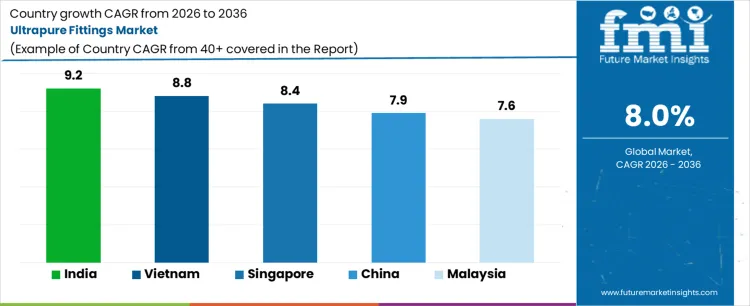
The ultrapure fittings market is expanding steadily as high-purity manufacturing gains momentum across Asia. India leads with a 9.2% CAGR, driven by growth in semiconductors, pharmaceuticals, and cleanroom infrastructure. Vietnam (8.8%) and Singapore (8.4%) follow, supported by electronics manufacturing expansion and advanced fabrication facilities. China grows at 7.9%, driven by large-scale investment in domestic high-tech manufacturing, while Malaysia (7.6%) benefits from electronics and pharmaceutical capacity upgrades. As contamination control becomes critical in advanced manufacturing, demand for ultrapure fittings is expected to rise across all these regions.
What Is Driving the Growth of the Ultrapure Fittings Market in India?
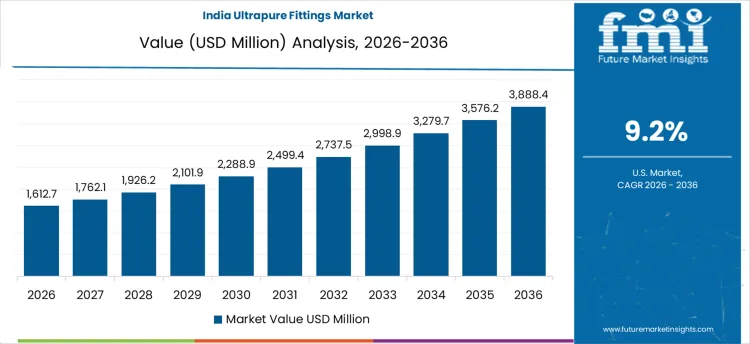
The ultrapure fittings market in India is growing at a CAGR of 9.2%, driven by rapid expansion of semiconductor manufacturing, pharmaceuticals, biotechnology, and specialty chemicals. Increasing investment in domestic semiconductor fabs, API manufacturing plants, and biologics facilities is creating strong demand for contamination-free fluid handling systems. Ultrapure fittings are critical in maintaining process integrity in applications involving high-purity water, chemicals, and gases. Government-backed initiatives to strengthen electronics manufacturing and pharmaceutical self-reliance are accelerating construction of cleanroom facilities, supporting market growth. In addition, rising adoption of advanced process equipment in laboratories and pilot plants is increasing demand for precision-engineered fittings. Local manufacturers and international suppliers are expanding their presence to serve growing demand. As India continues to scale high-purity manufacturing across multiple industries, demand for ultrapure fittings is expected to grow steadily.
How Is the Ultrapure Fittings Market Expanding in Vietnam?
The ultrapure fittings market in Vietnam is expanding at a CAGR of 8.8%, supported by growing investment in electronics manufacturing and industrial processing facilities. Vietnam’s emergence as a key destination for semiconductor assembly, electronics components, and precision manufacturing is driving demand for ultrapure fluid handling infrastructure. Multinational companies setting up cleanroom-based production lines require high-quality fittings to prevent contamination and ensure process consistency. Expansion of pharmaceutical manufacturing and research laboratories is further supporting market growth. Government incentives to attract high-tech manufacturing and foreign direct investment are strengthening demand for clean utility systems. Rising quality standards and export requirements are pushing manufacturers to adopt high-purity components. As Vietnam continues to integrate into global high-tech supply chains, demand for ultrapure fittings is expected to increase consistently.
What Is Supporting Growth of the Ultrapure Fittings Market in Singapore?
The ultrapure fittings market in Singapore is growing at a CAGR of 8.4%, driven by the country’s strong position as a regional hub for semiconductor fabrication, biotechnology, and advanced research. Singapore hosts numerous wafer fabs, pharmaceutical plants, and R&D centers that rely on ultrapure water and chemical delivery systems. Stringent quality and contamination-control requirements make ultrapure fittings essential components in these facilities. Continuous upgrades of fabrication lines and expansion of biologics manufacturing are supporting replacement and expansion demand. Singapore’s focus on advanced manufacturing, process optimization, and high-value production supports adoption of premium, precision-engineered fittings. Strong presence of global suppliers and system integrators further strengthens the market. As Singapore maintains its leadership in high-purity manufacturing, demand for ultrapure fittings is expected to remain strong.
How Is the Ultrapure Fittings Market Developing in China?
The ultrapure fittings market in China is expanding at a CAGR of 7.9%, supported by large-scale investment in semiconductor fabs, display manufacturing, and pharmaceutical production. China’s focus on strengthening domestic high-tech manufacturing capabilities is driving demand for cleanroom infrastructure and ultrapure fluid delivery systems. Ultrapure fittings are essential for maintaining yield and process reliability in advanced manufacturing environments. Expansion of biopharmaceutical facilities and specialty chemical plants is also contributing to market growth. Domestic manufacturers are increasingly developing high-purity components to reduce reliance on imports, while international suppliers continue to serve high-end applications. Tightening quality standards and process control requirements are supporting adoption. As China continues to scale advanced manufacturing capacity, demand for ultrapure fittings is expected to grow steadily.
How Is the Ultrapure Fittings Market Expanding in Malaysia?
The ultrapure fittings market in Malaysia is growing at a CAGR of 7.6%, driven by expansion of semiconductor back-end manufacturing, electronics assembly, and pharmaceutical processing. Malaysia’s established role in electronics manufacturing is encouraging upgrades of production facilities to higher cleanliness standards. Increasing investment in wafer fabrication support facilities and clean utilities is supporting demand for ultrapure fittings. Growth of pharmaceutical manufacturing and contract manufacturing organizations is further strengthening market adoption. Government initiatives promoting high-value manufacturing and industrial automation are indirectly supporting cleanroom infrastructure development. In addition, rising export quality requirements are encouraging manufacturers to adopt contamination-free fluid handling solutions. As Malaysia continues to move up the electronics and life sciences value chain, demand for ultrapure fittings is expected to rise gradually.
How Are Companies Competing in the Ultrapure Fittings Market?
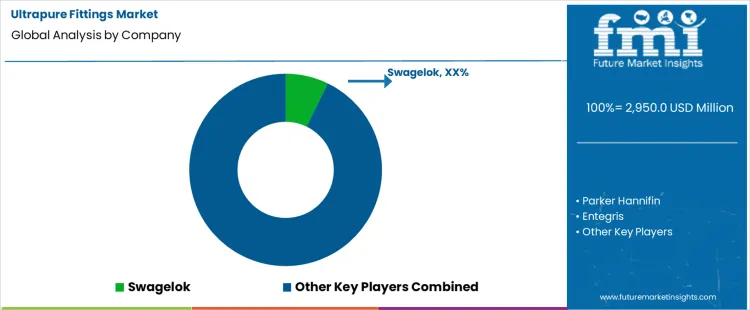
Competition in the ultrapure fittings market is driven by contamination control, material purity, leak integrity, and reliability in high-purity fluid and gas delivery systems. These fittings are critical in semiconductor fabrication, pharmaceuticals, biotechnology, and specialty chemical processing, where even trace contaminants can compromise yields and product quality. Companies compete on surface finish quality, metal purity, cleanroom manufacturing, and repeatable sealing performance under high-vacuum and high-pressure conditions. Differentiation increasingly centers on particle generation control, chemical compatibility, and the ability to support increasingly complex and miniaturized process environments.
Swagelok, Parker Hannifin, Entegris, Fujikin, CKD Corporation, and KITZ SCT lead competition through advanced materials engineering, clean manufacturing standards, and strong relationships with semiconductor and life sciences customers. Swagelok differentiates with precision-engineered fittings, global service infrastructure, and consistent leak-tight performance. Entegris competes through deep specialization in semiconductor fluid handling, emphasizing ultra-low contamination designs and system-level integration. Fujikin and KITZ SCT focus on high-purity valves and fittings optimized for semiconductor gas lines, while Parker and CKD leverage broad industrial automation expertise to deliver high-reliability, contamination-controlled components.
SMC Corporation, Ham-Let (Let-Lok), Hy-Lok, ASCO (Emerson), and regional suppliers compete through portfolio breadth, regional manufacturing strength, and cost-performance balance. SMC and ASCO integrate ultrapure fittings into automation and flow-control ecosystems. Ham-Let and Hy-Lok differentiate with competitive pricing and expanding high-purity product lines for semiconductor fabs and laboratories. Across the market, competitive advantage is defined by purity assurance, sealing reliability, cleanroom readiness, and the ability to meet increasingly stringent contamination and performance requirements in advanced manufacturing environments.
Key Players in Ultrapure Fittings Market
- Swagelok
- Parker Hannifin
- Entegris
- CKD Corporation
- SMC Corporation
- Fujikin
- KITZ SCT
- Ham-Let (Let-Lok)
- Hy-Lok
- ASCO (Emerson)
Scope of Report
| Attributes | Description |
|---|---|
| Quantitative Unit (2026) | USD Million |
| Material | PFA or PTFE Fittings, PVDF Fittings, Electropolished Stainless Steel, Other |
| End Use | Semiconductor Fabs, Pharma & Biotech, Ultrapure Water Systems, Other |
| Regions Covered | Asia Pacific, Europe, North America, Latin America, Middle East & Africa |
| Countries Covered | China, Japan, South Korea, India, Australia & New Zealand, ASEAN, Rest of Asia Pacific, Germany, United Kingdom, France, Italy, Spain, Nordic, BENELUX, Rest of Europe, United States, Canada, Mexico, Brazil, Chile, Rest of Latin America, Kingdom of Saudi Arabia, Other GCC Countries, Turkey, South Africa, Other African Union, Rest of Middle East & Africa |
| Key Companies Profiled | Swagelok, Parker Hannifin, Entegris, CKD Corporation, SMC Corporation, Fujikin, KITZ SCT, Ham-Let (Let-Lok), Hy-Lok, ASCO (Emerson) |
| Additional Attributes | Dollar sales by material and end use; regional market size and forecast analysis; growth outlook across major regions; adoption trends for contamination-controlled fluid handling components; assessment of purity sp |
Ultrapure Fittings Market by Key Segments
Material:
- PFA or PTFE Fittings
- PVDF Fittings
- Electropolished Stainless Steel
- Other
End Use:
- Semiconductor Fabs
- Pharma & Biotech
- Ultrapure Water Systems
- Other
Region:
- Asia Pacific
- China
- Japan
- South Korea
- India
- Australia & New Zealand
- ASEAN
- Rest of Asia Pacific
- Europe
- Germany
- United Kingdom
- France
- Italy
- Spain
- Nordic
- BENELUX
- Rest of Europe
- North America
- United States
- Canada
- Mexico
- Latin America
- Brazil
- Chile
- Rest of Latin America
- Middle East & Africa
- Kingdom of Saudi Arabia
- Other GCC Countries
- Turkey
- South Africa
- Other African Union
- Rest of Middle East & Africa
Bibliography
- SEMI. (2024). SEMI F57: Specification for polymer materials used in ultrapure fluid distribution systems. SEMI.
- Entegris, Inc. (2024). Ultrahigh purity fluid handling solutions for semiconductor and life sciences manufacturing. Entegris, Inc.
- Swagelok Company. (2024). High-purity fittings and tubing systems for critical fluid applications. Swagelok Company.
- Parker Hannifin Corporation. (2023). Instrumentation fittings for high-purity and contamination-controlled processes. Parker Hannifin Corporation.
- Fujikin Incorporated. (2024). High-purity valves and fittings for semiconductor gas and chemical delivery. Fujikin Incorporated.
Frequently Asked Questions
How big is the ultrapure fittings market in 2026?
The global ultrapure fittings market is estimated to be valued at USD 2,950.0 million in 2026.
What will be the size of ultrapure fittings market in 2036?
The market size for the ultrapure fittings market is projected to reach USD 6,368.8 million by 2036.
How much will be the ultrapure fittings market growth between 2026 and 2036?
The ultrapure fittings market is expected to grow at a 8.0% CAGR between 2026 and 2036.
What are the key product types in the ultrapure fittings market?
The key product types in ultrapure fittings market are pfa or ptfe fittings, pvdf fittings, electropolished stainless steel and other.
Which end use segment to contribute significant share in the ultrapure fittings market in 2026?
In terms of end use, semiconductor fabs segment to command 56.0% share in the ultrapure fittings market in 2026.
Preview the report firsthand - request a free sample
Get SampleGet the brochure for pricing and purchase details.
Get PDFTable of Content
- Executive Summary
- Global Market Outlook
- Demand-side Trends
- Supply-side Trends
- Technology Roadmap Analysis
- Analysis and Recommendations
- Market Overview
- Market Coverage / Taxonomy
- Market Definition / Scope / Limitations
- Market Background
- Market Dynamics
- Drivers
- Restraints
- Opportunity
- Trends
- Scenario Forecast
- Demand in Optimistic Scenario
- Demand in Likely Scenario
- Demand in Conservative Scenario
- Opportunity Map Analysis
- Product Life Cycle Analysis
- Supply Chain Analysis
- Investment Feasibility Matrix
- Value Chain Analysis
- PESTLE and Porter’s Analysis
- Regulatory Landscape
- Regional Parent Market Outlook
- Production and Consumption Statistics
- Import and Export Statistics
- Market Dynamics
- Global Market Analysis 2021 to 2025 and Forecast, 2026 to 2036
- Historical Market Size Value (USD Million) Analysis, 2021 to 2025
- Current and Future Market Size Value (USD Million) Projections, 2026 to 2036
- Y-o-Y Growth Trend Analysis
- Absolute $ Opportunity Analysis
- Global Market Pricing Analysis 2021 to 2025 and Forecast 2026 to 2036
- Global Market Analysis 2021 to 2025 and Forecast 2026 to 2036, By Material
- Introduction / Key Findings
- Historical Market Size Value (USD Million) Analysis By Material , 2021 to 2025
- Current and Future Market Size Value (USD Million) Analysis and Forecast By Material , 2026 to 2036
- PFA or PTFE Fittings
- PVDF Fittings
- Electropolished Stainless Steel
- Other
- PFA or PTFE Fittings
- Y-o-Y Growth Trend Analysis By Material , 2021 to 2025
- Absolute $ Opportunity Analysis By Material , 2026 to 2036
- Global Market Analysis 2021 to 2025 and Forecast 2026 to 2036, By End Use
- Introduction / Key Findings
- Historical Market Size Value (USD Million) Analysis By End Use, 2021 to 2025
- Current and Future Market Size Value (USD Million) Analysis and Forecast By End Use, 2026 to 2036
- Semiconductor Fabs
- Pharma & Biotech
- Ultrapure Water Systems
- Other
- Semiconductor Fabs
- Y-o-Y Growth Trend Analysis By End Use, 2021 to 2025
- Absolute $ Opportunity Analysis By End Use, 2026 to 2036
- Global Market Analysis 2021 to 2025 and Forecast 2026 to 2036, By Region
- Introduction
- Historical Market Size Value (USD Million) Analysis By Region, 2021 to 2025
- Current Market Size Value (USD Million) Analysis and Forecast By Region, 2026 to 2036
- North America
- Latin America
- Western Europe
- Eastern Europe
- East Asia
- South Asia and Pacific
- Middle East & Africa
- Market Attractiveness Analysis By Region
- North America Market Analysis 2021 to 2025 and Forecast 2026 to 2036, By Country
- Historical Market Size Value (USD Million) Trend Analysis By Market Taxonomy, 2021 to 2025
- Market Size Value (USD Million) Forecast By Market Taxonomy, 2026 to 2036
- By Country
- USA
- Canada
- Mexico
- By Material
- By End Use
- By Country
- Market Attractiveness Analysis
- By Country
- By Material
- By End Use
- Key Takeaways
- Latin America Market Analysis 2021 to 2025 and Forecast 2026 to 2036, By Country
- Historical Market Size Value (USD Million) Trend Analysis By Market Taxonomy, 2021 to 2025
- Market Size Value (USD Million) Forecast By Market Taxonomy, 2026 to 2036
- By Country
- Brazil
- Chile
- Rest of Latin America
- By Material
- By End Use
- By Country
- Market Attractiveness Analysis
- By Country
- By Material
- By End Use
- Key Takeaways
- Western Europe Market Analysis 2021 to 2025 and Forecast 2026 to 2036, By Country
- Historical Market Size Value (USD Million) Trend Analysis By Market Taxonomy, 2021 to 2025
- Market Size Value (USD Million) Forecast By Market Taxonomy, 2026 to 2036
- By Country
- Germany
- UK
- Italy
- Spain
- France
- Nordic
- BENELUX
- Rest of Western Europe
- By Material
- By End Use
- By Country
- Market Attractiveness Analysis
- By Country
- By Material
- By End Use
- Key Takeaways
- Eastern Europe Market Analysis 2021 to 2025 and Forecast 2026 to 2036, By Country
- Historical Market Size Value (USD Million) Trend Analysis By Market Taxonomy, 2021 to 2025
- Market Size Value (USD Million) Forecast By Market Taxonomy, 2026 to 2036
- By Country
- Russia
- Poland
- Hungary
- Balkan & Baltic
- Rest of Eastern Europe
- By Material
- By End Use
- By Country
- Market Attractiveness Analysis
- By Country
- By Material
- By End Use
- Key Takeaways
- East Asia Market Analysis 2021 to 2025 and Forecast 2026 to 2036, By Country
- Historical Market Size Value (USD Million) Trend Analysis By Market Taxonomy, 2021 to 2025
- Market Size Value (USD Million) Forecast By Market Taxonomy, 2026 to 2036
- By Country
- China
- Japan
- South Korea
- By Material
- By End Use
- By Country
- Market Attractiveness Analysis
- By Country
- By Material
- By End Use
- Key Takeaways
- South Asia and Pacific Market Analysis 2021 to 2025 and Forecast 2026 to 2036, By Country
- Historical Market Size Value (USD Million) Trend Analysis By Market Taxonomy, 2021 to 2025
- Market Size Value (USD Million) Forecast By Market Taxonomy, 2026 to 2036
- By Country
- India
- ASEAN
- Australia & New Zealand
- Rest of South Asia and Pacific
- By Material
- By End Use
- By Country
- Market Attractiveness Analysis
- By Country
- By Material
- By End Use
- Key Takeaways
- Middle East & Africa Market Analysis 2021 to 2025 and Forecast 2026 to 2036, By Country
- Historical Market Size Value (USD Million) Trend Analysis By Market Taxonomy, 2021 to 2025
- Market Size Value (USD Million) Forecast By Market Taxonomy, 2026 to 2036
- By Country
- Kingdom of Saudi Arabia
- Other GCC Countries
- Turkiye
- South Africa
- Other African Union
- Rest of Middle East & Africa
- By Material
- By End Use
- By Country
- Market Attractiveness Analysis
- By Country
- By Material
- By End Use
- Key Takeaways
- Key Countries Market Analysis
- USA
- Pricing Analysis
- Market Share Analysis, 2025
- By Material
- By End Use
- Canada
- Pricing Analysis
- Market Share Analysis, 2025
- By Material
- By End Use
- Mexico
- Pricing Analysis
- Market Share Analysis, 2025
- By Material
- By End Use
- Brazil
- Pricing Analysis
- Market Share Analysis, 2025
- By Material
- By End Use
- Chile
- Pricing Analysis
- Market Share Analysis, 2025
- By Material
- By End Use
- Germany
- Pricing Analysis
- Market Share Analysis, 2025
- By Material
- By End Use
- UK
- Pricing Analysis
- Market Share Analysis, 2025
- By Material
- By End Use
- Italy
- Pricing Analysis
- Market Share Analysis, 2025
- By Material
- By End Use
- Spain
- Pricing Analysis
- Market Share Analysis, 2025
- By Material
- By End Use
- France
- Pricing Analysis
- Market Share Analysis, 2025
- By Material
- By End Use
- India
- Pricing Analysis
- Market Share Analysis, 2025
- By Material
- By End Use
- ASEAN
- Pricing Analysis
- Market Share Analysis, 2025
- By Material
- By End Use
- Australia & New Zealand
- Pricing Analysis
- Market Share Analysis, 2025
- By Material
- By End Use
- China
- Pricing Analysis
- Market Share Analysis, 2025
- By Material
- By End Use
- Japan
- Pricing Analysis
- Market Share Analysis, 2025
- By Material
- By End Use
- South Korea
- Pricing Analysis
- Market Share Analysis, 2025
- By Material
- By End Use
- Russia
- Pricing Analysis
- Market Share Analysis, 2025
- By Material
- By End Use
- Poland
- Pricing Analysis
- Market Share Analysis, 2025
- By Material
- By End Use
- Hungary
- Pricing Analysis
- Market Share Analysis, 2025
- By Material
- By End Use
- Kingdom of Saudi Arabia
- Pricing Analysis
- Market Share Analysis, 2025
- By Material
- By End Use
- Turkiye
- Pricing Analysis
- Market Share Analysis, 2025
- By Material
- By End Use
- South Africa
- Pricing Analysis
- Market Share Analysis, 2025
- By Material
- By End Use
- USA
- Market Structure Analysis
- Competition Dashboard
- Competition Benchmarking
- Market Share Analysis of Top Players
- By Regional
- By Material
- By End Use
- Competition Analysis
- Competition Deep Dive
- Swagelok
- Overview
- Product Portfolio
- Profitability by Market Segments (Product/Age /Sales Channel/Region)
- Sales Footprint
- Strategy Overview
- Marketing Strategy
- Product Strategy
- Channel Strategy
- Parker Hannifin
- Entegris
- CKD Corporation
- SMC Corporation
- Fujikin
- KITZ SCT
- Ham-Let (Let-Lok)
- Hy-Lok
- ASCO (Emerson)
- Swagelok
- Competition Deep Dive
- Assumptions & Acronyms Used
- Research Methodology


