

- Industry Size (2026)
- USD 113.3 Mn
- Forecast (2036)
- USD 187.3 Mn
- CAGR (2026 to 2036)
- 5.2%
Demand for Activated Alumina in United Kingdom Forecast Outlook 2026 to 2036
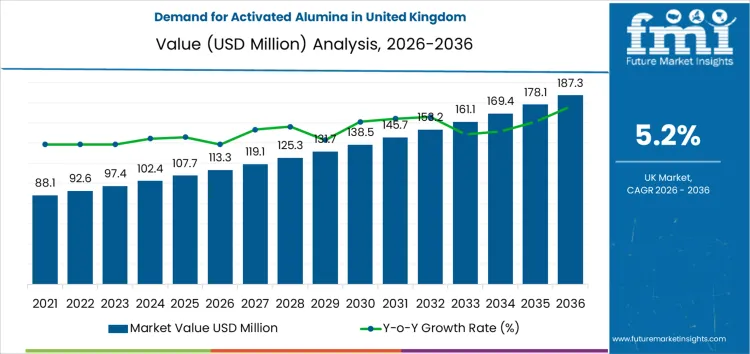
The activated alumina market in the United Kingdom is projected to grow from USD 113.3 million in 2026 to USD 187.3 million by 2036, at a CAGR of 5.2%. Capital intensity will be a significant factor shaping expansion, as investments in production infrastructure and R&D are necessary to meet rising demand in industries like water treatment and petrochemical refining.
Return timelines will influence the speed of investment decisions, with longer payback periods prompting more cautious allocation of capital. As the market matures, investment selectivity will likely increase, with investors focusing on companies with strong cost control, high production efficiency, and the ability to innovate. This selectivity will drive consolidation in the market, as companies with access to capital look to acquire smaller players or expand existing operations to gain a competitive edge. The pace of growth will hinge on how well companies balance long-term capital commitments with short-term profitability.
Quick Stats for the Demand for Activated Alumina in United Kingdom:
- Activated Alumina in United Kingdom Value (2026): USD 113.3 million
- Activated Alumina in United Kingdom Forecast Value (2036): USD 187.3 million
- Activated Alumina in United Kingdom Forecast CAGR (2026 to 2036): 5.2%
- Activated Alumina in United Kingdom Leading Segment: Water Treatment (35% share)
- Key Growth Regions of Activated Alumina in United Kingdom: England
- Top Players of Activated Alumina in United Kingdom: BASF SE, Honeywell International Inc., Axens S.A., Sumitomo Chemical Co., Ltd., Porocel Industries LLC (Evonik)
What is the Growth Forecast for Activated Alumina in United Kingdom through 2036?
The demand for activated alumina in the United Kingdom is expected to grow steadily from 2026 to 2036. The market value is anticipated to increase from USD 113.3 million in 2026 to USD 187.3 million by 2036, reflecting a compound annual growth rate (CAGR) of 5.2%. This growth is driven by the expanding applications of activated alumina in sectors such as water treatment, air purification, and industrial processes. The increasing focus on environmental sustainability, coupled with the demand for efficient purification solutions, is expected to boost the adoption of activated alumina in the UK.
As water purification needs intensify and industries pursue eco-friendlier solutions, the demand for activated alumina is likely to remain strong. Continued advancements in purification technologies and industrial applications will further contribute to market growth.
Key Takeaways for Demand for Activated Alumina in United Kingdom
| Metric | Value |
|---|---|
| Industry Sales Value (2026) | USD 113.3 million |
| Industry Forecast Value (2036) | USD 187.3 million |
| Industry Forecast CAGR (2026 to 2036) | 5.2% |
Why is Demand for Activated Alumina in United Kingdom Growing?
Demand for activated alumina in the United Kingdom has expanded from historical levels as industries increasingly adopt it for purification, separation, and adsorption applications. Historically, activated alumina was used mainly in water treatment and moisture removal processes due to its high surface area and strong adsorption capacity. Over time, its role expanded into catalyst support in chemical processing and gas purification systems as the UK industrial base diversified. Water treatment infrastructure projects and environmental regulations aimed at improving water quality have driven consistent uptake of activated alumina for removing contaminants such as fluoride and arsenic. In addition, petrochemical, pharmaceutical, and wastewater treatment sectors in the UK began integrating activated alumina into drying and purification processes, reflecting broader industrial demand. These trends built a foundation of steady consumption of activated alumina as a versatile material that met both environmental and process requirements.
Looking ahead, demand for activated alumina in the United Kingdom is expected to continue growing through the mid 2030s as application areas widen and regulatory emphasis on purity and emissions persists. Forecasts suggest the UK market may grow around the low single digit to mid single digit annual rates in the coming decade, supported by expanding water treatment projects and ongoing adoption in gas purification and catalytic operations. Industrial expansion in petrochemicals and specialty chemicals will further support demand for high performance adsorbents and catalyst materials. Renewable energy developments, particularly in hydrogen production and low emission refining, could stimulate additional use of activated alumina in catalyst and gas drying roles. Moreover, increasing focus on sustainable production and clean water initiatives will maintain activated alumina as a key material for environmental management applications in the UK.
What Are the Key Segments in the Demand for Activated Alumina in the United Kingdom?
Demand for activated alumina in the United Kingdom is driven by particle size and end-use applications. The 0.5-2 mm particle size dominates with a 30% share, while water treatment leads the end-use segment with 35%. Other industries, such as oil & gas, petrochemicals, and fertilizers, also contribute significantly. The demand across these segments is influenced by regulatory standards, environmental concerns, and the need for efficient purification technologies, particularly in urban and industrial regions.
What Is the Particle Size Segment of Demand for Activated Alumina in the United Kingdom?
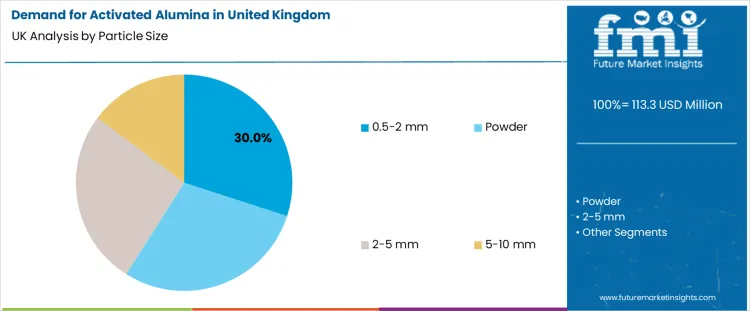
The particle size segment for activated alumina in the United Kingdom is led by the 0.5-2 mm range, which accounts for 30% of the market share. This particle size is particularly suitable for water treatment applications, where high surface area and adsorption capacity are crucial for the effective removal of impurities like fluoride, arsenic, and other contaminants. Activated alumina's ability to adsorb water vapor also makes it ideal for desiccant applications. In the United Kingdom, industries involved in water purification, both municipal and industrial, rely heavily on this particle size for filtration and treatment processes. The powder form of activated alumina follows, primarily used in applications that require fine particle dispersion or where specific adsorption characteristics are needed.
The 2-5 mm and 5-10 mm particle sizes are used in industries like oil & gas, petrochemicals, and fertilizers, where larger particles provide greater mechanical strength and resistance to abrasion. These particle sizes are well-suited for catalytic processes, moisture removal in natural gas production, and refining processes. The preference for the 0.5-2 mm particle size in water treatment applications highlights the need for materials that can operate efficiently in aqueous environments while maintaining high removal capacity and reusability over time.
What Is the End-Use Segment of Demand for Activated Alumina in the United Kingdom?
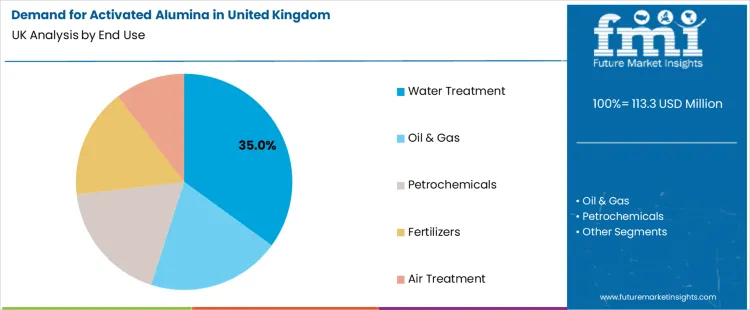
The end-use segment for activated alumina in the United Kingdom is primarily driven by water treatment, which accounts for 35% of the market. Activated alumina is widely used in water treatment facilities to remove hazardous substances such as fluoride, arsenic, and sulfur compounds from drinking water and wastewater. The growing emphasis on improving water quality and meeting regulatory standards in the UK has led to increased adoption of activated alumina for these purposes.
The oil & gas sector follows closely, where activated alumina is used to remove water and sulfur from natural gas and other hydrocarbons. In petrochemical applications, activated alumina is used as a catalyst support and for the desulfurization of fuels, ensuring that the end products meet the required environmental standards. Fertilizer production is another key end-use application, where activated alumina serves as a drying agent and is used in the synthesis of certain chemical compounds. Air treatment is also gaining traction, particularly for industrial applications that require the removal of moisture from air streams, ensuring process stability and reducing corrosion risks. The diverse range of applications in different sectors underscores the versatility and growing demand for activated alumina in the United Kingdom, driven by both industrial needs and environmental regulations.
What are the Key Dynamics in the Demand for Activated Alumina in the United Kingdom?
Demand for activated alumina in the United Kingdom is tied to its use as a desiccant, adsorbent, and catalyst support across industrial sectors. Growth in water treatment, petrochemical refining, air separation, and gas drying applications sustains consistent market activity. Industrial focus on contaminant removal and purification processes supports the uptake of high‑grade activated alumina media. Regulatory emphasis on environmental and quality control standards also influences demand. Market movement reflects broader trends in filtration technology and surface chemistry applications, with manufacturers and end‑users maintaining inventories to support process reliability and product quality.
What are the Key Drivers for Activated Alumina Demand in the United Kingdom?
Several factors drive demand for activated alumina in the United Kingdom. The need for effective moisture removal in compressed air systems, natural gas drying, and air separation processes underpins demand in industrial and energy sectors. Water treatment facilities require activated alumina to remove fluoride, arsenic, and other contaminants, reinforcing its role in public and private infrastructure projects. Petrochemical and refinery operations use activated alumina in catalyst support and reactive media, especially where high surface area and thermal stability are essential. Ongoing investment in manufacturing and processing facilities that utilise adsorption and filtration technology also supports steady demand for activated alumina products.
What are the Restraints on Activated Alumina Demand in the United Kingdom?
Despite stable demand, the activated alumina market in the United Kingdom encounters restraints. The availability and cost of raw materials affect production economics, influencing pricing and supply chain stability. Competition from alternative adsorbents, including silica gel and molecular sieves, can limit market expansion where specific performance characteristics are better suited. Capital expenditure requirements for installing and maintaining adsorption and filtration systems may deter smaller operators. Regulatory compliance with waste handling and disposal standards for spent adsorbent materials adds operational complexity. Variability in industrial output, tied to broader economic cycles, can also dampen short‑term demand for activated alumina.
What are the Key Trends in Activated Alumina Demand in the United Kingdom?
Key trends in the United Kingdom’s activated alumina demand include a shift toward customised and high‑performance grades designed for specific applications, such as ultra‑low moisture removal and precision gas drying. End‑users increasingly prioritise adsorbent longevity and regeneration capability to reduce life‑cycle costs and minimise waste. Integration of advanced monitoring and sensor technology in adsorption systems supports predictive maintenance and optimised media replacement schedules. Sustainability considerations are prompting research into recyclable and low‑impact production methods for activated alumina. In water treatment, stricter contaminant limits and investment in infrastructure upgrades sustain interest in high‑efficiency adsorbent solutions.
What is the Country-Wise Demand for Activated Alumina in the United Kingdom?
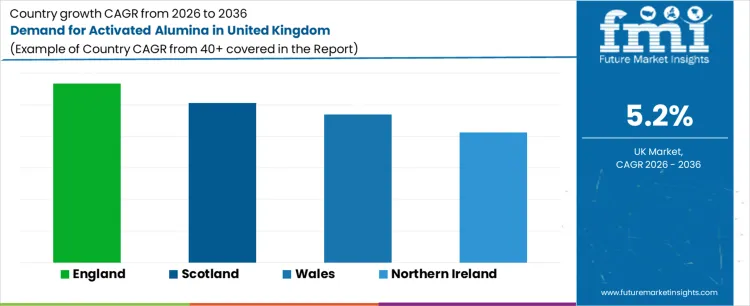
The country-wise demand for activated alumina in the United Kingdom shows noticeable regional variation. England leads the market, driven by its large industrial base, particularly in water treatment, air purification, and chemical manufacturing. Scotland, Wales, and Northern Ireland follow, with steady demand growth primarily in industrial applications. The increasing focus on water and air purification, along with the need for more efficient chemical processes, is boosting demand for activated alumina across all regions. England continues to dominate the market, while other regions see slower, but steady, growth as industrial sectors in these areas increasingly adopt activated alumina for its highly efficient adsorption properties.
| Country | CAGR (2026 to 2036) |
|---|---|
| England | 5.7% |
| Scotland | 5.1% |
| Wales | 4.7% |
| Northern Ireland | 4.1% |
What is Driving the Demand for Activated Alumina in England?
The demand for activated alumina in England is projected to grow at a CAGR of 5.7% from 2026 to 2036. England’s industrial landscape, which includes large-scale chemical manufacturing, water treatment, and air purification industries, is the primary driver for this market. Activated alumina is widely used in water treatment for fluoride removal and in air purification systems due to its high adsorption capacity. As environmental regulations on water and air quality continue to tighten, the demand for effective filtration materials like activated alumina is expected to grow. England’s increasing focus on sustainability and environmental responsibility also supports the use of activated alumina, as it is a highly efficient and environmentally friendly material. The country's substantial manufacturing sector, coupled with its commitment to improving environmental quality, positions activated alumina as a key component in various industrial applications, particularly in water purification and gas desulfurization processes.
What is Fueling the Demand for Activated Alumina in Scotland?
In Scotland, the demand for activated alumina is projected to grow at a CAGR of 5.1% from 2026 to 2036. Scotland’s industrial sectors, including water treatment and chemical manufacturing, are the main contributors to the demand for activated alumina. The growing need for water and air purification technologies is driving the adoption of activated alumina in these sectors. As water treatment companies in Scotland seek to meet stricter regulations for fluoride and arsenic removal, the need for efficient filtration materials has risen. Additionally, the rising focus on air quality and reducing emissions in industrial processes is increasing the demand for activated alumina in desulfurization applications. The region's continued investment in improving environmental standards and sustainability practices will further drive demand in the coming years, although it remains slightly behind England in terms of market size.
What Are the Growth Drivers for Activated Alumina in Wales?
The demand for activated alumina in Wales is expected to grow at a CAGR of 4.7% through 2036. The growth of industrial applications in the region, particularly in water treatment and chemical processes, is driving demand for activated alumina. As Welsh industries adopt more sustainable practices, the need for efficient filtration solutions has grown, particularly for water purification and air quality control. Wales' focus on improving environmental standards, especially in terms of water quality, is increasing the adoption of activated alumina for fluoride and arsenic removal. Additionally, the growing chemical manufacturing sector in Wales requires activated alumina for drying gases and other chemical processes. While the overall market size remains smaller compared to England and Scotland, the rising industrial demand and environmental regulations are expected to maintain steady growth for activated alumina in Wales.
What is the Outlook for Activated Alumina Demand in Northern Ireland?
Northern Ireland's demand for activated alumina is projected to grow at a CAGR of 4.1% from 2026 to 2036. Although Northern Ireland represents the smallest market for activated alumina in the United Kingdom, demand is steadily increasing as the region’s industrial sectors, particularly water treatment and chemical manufacturing, continue to expand. The region’s focus on improving water purification systems, especially for fluoride removal, is a significant factor driving this demand. Additionally, as Northern Ireland’s industrial processes evolve to meet stricter environmental standards, activated alumina is increasingly being used in air purification and gas desulfurization applications. The market for activated alumina in Northern Ireland remains smaller than in other parts of the UK, but steady growth is expected as the region’s industries prioritize more efficient and environmentally friendly filtration solutions.
What is the Competitive Landscape for Demand for Activated Alumina in the United Kingdom?
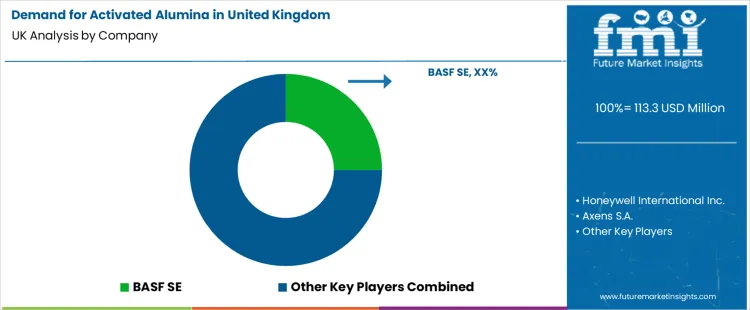
Demand for activated alumina in the United Kingdom is shaped by requirements across water treatment, petrochemical processing, industrial gas drying, and chemical purification applications. Activated alumina is valued for its high surface area and adsorption properties, used as a desiccant and adsorbent in filtration and moisture removal systems. Its adoption in water purification and industrial desiccation supports sustained demand from municipal utilities and manufacturing sectors. Broader trends in Europe show that activated alumina is widely used for water treatment and oil and gas processing, underpinning steady growth in regional demand. The market exhibits participation from global chemical producers and specialist adsorbent suppliers, reflecting a consolidated supplier landscape with a few dominant brands. European analysis of the activated alumina market identifies major players including BASF SE, Honeywell International Inc., Axens S.A., Sumitomo Chemical Co., Ltd., and Evonik Industries as active across industrial segments. These suppliers are referenced in market reports as key contributors to regional supply.
BASF SE is positioned as a leading supplier in the United Kingdom, leveraging its wide range of activated alumina grades for water treatment, dehydration, and purification processes. Its brochures detail porosity specifications, bead sizes, and regeneration protocols, supporting selection by technical procurement teams. Honeywell International Inc. offers comparable adsorbent and desiccant products, with technical literature that lists moisture adsorption capacities and certified performance under specified conditions. Axens S.A. focuses on catalyst support and industrial adsorption solutions, with product sheets that outline performance benchmarks for refining and chemical processing applications. Sumitomo Chemical Co., Ltd. supplies activated alumina with specifications covering mesh sizes and application suitability, while Porocel Industries LLC (part of Evonik) provides grades tailored for advanced filtration tasks. Brochures from these companies emphasise granular properties, handling guidelines, and recommended operating conditions. Demand decisions in the UK are informed by documented performance metrics and compliance notes provided in supplier literature, with selection criteria centred on adsorption efficiency, lifecycle performance, and compatibility with existing treatment infrastructure.
Key Players of the Demand for Activated Alumina in United Kingdom
- BASF SE
- Honeywell International Inc.
- Axens S.A.
- Sumitomo Chemical Co., Ltd.
- Porocel Industries LLC (Evonik)
Scope of the Report
| Items | Values |
|---|---|
| Quantitative Units (2026) | USD Million |
| Particle Size | Powder, 0.5-2 mm, 2-5 mm, 5-10 mm |
| End Use | Oil & Gas, Water Treatment, Petrochemicals, Fertilizers, Air Treatment |
| Companies | BASF SE, Honeywell International Inc., Axens S.A., Sumitomo Chemical Co., Ltd., Porocel Industries LLC (Evonik) |
| Regions Covered | United Kingdom |
| Countries Covered | England, Scotland, Wales, Northern Ireland |
| Additional Attributes | Dollar by sales by particle size, end use, and region. Includes market trends towards efficiency, cost-effectiveness, and the role of activated alumina in various industrial applications. |
Demand for Activated Alumina in United Kingdom
Particle Size:
- Powder
- 0.5-2 mm
- 2-5 mm
- 5-10 mm
End Use:
- Oil & Gas
- Water Treatment
- Petrochemicals
- Fertilizers
- Air Treatment
Countries:
- England
- Scotland
- Wales
- Northern Ireland
Bibliography
- Department for Environment, Food & Rural Affairs (United Kingdom). (2024). Water quality statistics for England and Wales, 2024. Government of the United Kingdom.
- Office for National Statistics. (2025). UK manufacturing output by chemical and allied products, 2024. Office for National Statistics.
- Environment Agency (United Kingdom). (2024). Regulatory position statement: Treatment agents and filtration media in potable water systems. Environment Agency.
Frequently Asked Questions
How big is the demand for activated alumina in United Kingdom in 2026?
The demand for activated alumina in United Kingdom is estimated to be valued at USD 113.3 million in 2026.
What will be the size of activated alumina in United Kingdom in 2036?
The market size for the activated alumina in United Kingdom is projected to reach USD 187.3 million by 2036.
How much will be the demand for activated alumina in United Kingdom growth between 2026 and 2036?
The demand for activated alumina in United Kingdom is expected to grow at a 5.2% CAGR between 2026 and 2036.
What are the key product types in the activated alumina in United Kingdom?
The key product types in activated alumina in United Kingdom are 0.5-2 mm, powder, 2-5 mm and 5-10 mm.
Which end use segment is expected to contribute significant share in the activated alumina in United Kingdom in 2026?
In terms of end use, water treatment segment is expected to command 35.0% share in the activated alumina in United Kingdom in 2026.
Preview the report firsthand - request a free sample
Get SampleGet the brochure for pricing and purchase details.
Get PDFTable of Content
- Executive Summary
- UK Market Outlook
- Demand-side Trends
- Supply-side Trends
- Technology Roadmap Analysis
- Analysis and Recommendations
- Market Overview
- Market Coverage / Taxonomy
- Market Definition / Scope / Limitations
- Market Background
- Market Dynamics
- Drivers
- Restraints
- Opportunity
- Trends
- Scenario Forecast
- Demand in Optimistic Scenario
- Demand in Likely Scenario
- Demand in Conservative Scenario
- Opportunity Map Analysis
- Product Life Cycle Analysis
- Supply Chain Analysis
- Investment Feasibility Matrix
- Value Chain Analysis
- PESTLE and Porter’s Analysis
- Regulatory Landscape
- Regional Parent Market Outlook
- Production and Consumption Statistics
- Import and Export Statistics
- Market Dynamics
- UK Market Analysis 2021 to 2025 and Forecast, 2026 to 2036
- Historical Market Size Value (USD Million) Analysis, 2021 to 2025
- Current and Future Market Size Value (USD Million) Projections, 2026 to 2036
- Y-o-Y Growth Trend Analysis
- Absolute $ Opportunity Analysis
- UK Market Pricing Analysis 2021 to 2025 and Forecast 2026 to 2036
- UK Market Analysis 2021 to 2025 and Forecast 2026 to 2036, By Particle Size
- Introduction / Key Findings
- Historical Market Size Value (USD Million) Analysis By Particle Size , 2021 to 2025
- Current and Future Market Size Value (USD Million) Analysis and Forecast By Particle Size , 2026 to 2036
- 0.5-2 mm
- Powder
- 2-5 mm
- 5-10 mm
- 0.5-2 mm
- Y-o-Y Growth Trend Analysis By Particle Size , 2021 to 2025
- Absolute $ Opportunity Analysis By Particle Size , 2026 to 2036
- UK Market Analysis 2021 to 2025 and Forecast 2026 to 2036, By End Use
- Introduction / Key Findings
- Historical Market Size Value (USD Million) Analysis By End Use, 2021 to 2025
- Current and Future Market Size Value (USD Million) Analysis and Forecast By End Use, 2026 to 2036
- Water Treatment
- Oil & Gas
- Petrochemicals
- Fertilizers
- Air Treatment
- Water Treatment
- Y-o-Y Growth Trend Analysis By End Use, 2021 to 2025
- Absolute $ Opportunity Analysis By End Use, 2026 to 2036
- Market Structure Analysis
- Competition Dashboard
- Competition Benchmarking
- Market Share Analysis of Top Players
- By Regional
- By Particle Size
- By End Use
- Competition Analysis
- Competition Deep Dive
- BASF SE
- Overview
- Product Portfolio
- Profitability by Market Segments (Product/Age /Sales Channel/Region)
- Sales Footprint
- Strategy Overview
- Marketing Strategy
- Product Strategy
- Channel Strategy
- Honeywell International Inc.
- Axens S.A.
- Sumitomo Chemical Co., Ltd.
- Porocel Industries LLC (Evonik)
- BASF SE
- Competition Deep Dive
- Assumptions & Acronyms Used
- Research Methodology


