

- Industry Size (2026)
- USD 271.1 Mn
- Forecast (2036)
- USD 422.0 Mn
- CAGR (2026 to 2036)
- 4.5%
Demand for Thickness Planers in United Kingdom Forecast and Outlook 2026 to 2036
The demand for thickness planers in the United Kingdom is expected to experience steady growth over the forecast period, driven by the increasing demand for precision woodworking tools in industries such as construction, furniture manufacturing, and woodworking. Thickness planers are essential for achieving uniform thickness and smooth finishes in wood products, making them a critical tool in the production of high-quality wood-based items. The growing interest in DIY woodworking, combined with the expansion of commercial and residential construction projects, will continue to support the demand for these machines.
Rising emphasis on output consistency and reduced rework in woodworking workshops is supporting adoption of thickness planers with tighter feed control and improved surface accuracy. The shift towards automated systems in the woodworking industry will likely contribute to the growth in demand for technologically advanced thickness planers in the UK.
Quick Stats for the Demand for Thickness Planers in United Kingdom
- Thickness Planers in United Kingdom Value (2026): USD 271.1 million
- Thickness Planers in United Kingdom Forecast Value (2036): USD 422.0 million
- Thickness Planers in United Kingdom Forecast CAGR (2026 to 2036): 4.5%
- Thickness Planers in United Kingdom Leading Segment: Electric Thickness Planers (65% share)
- Key Growth Regions of Thickness Planers in United Kingdom: England
- Top Players of Thickness Planers in United Kingdom: DeWalt (Stanley Black & Decker, Inc.), Makita Corporation, Bosch Power Tools (Robert Bosch GmbH), JET Tools (JPW Industries, Inc.), Grizzly Industrial, Inc.
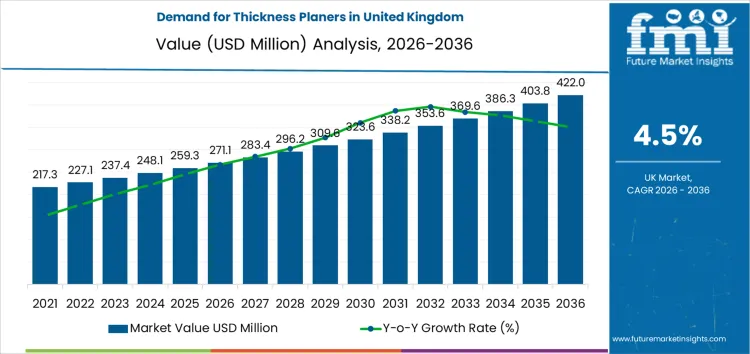
What is the Growth Forecast for Thickness Planers in United Kingdom through 2036?
Demand for thickness planers in the United Kingdom is expected to grow steadily through the forecast period, supported by rising activity across woodworking, furniture production, and interior renovation projects. As both professional workshops and small-scale manufacturers focus on improving output quality and consistency, thickness planers remain essential for achieving uniform board sizing and smooth finishes. Replacement demand will also contribute as users upgrade older equipment to improve productivity and reduce downtime.
Over the long term, adoption is expected to strengthen as woodworking shifts toward higher precision and more process automation. Manufacturers are introducing models with improved feed control, better dust management, enhanced safety features, and stronger durability, making these machines more attractive for daily industrial use. The growth of customized furniture, modular construction components, and premium wood-based products will further support demand. Overall demand remains supported by modernization of woodworking workshops and continued replacement of legacy planing equipment, with thickness planers continuing to be a key machine category as UK woodworking operations modernize and scale efficiently.
Key Takeaways for Demand for Thickness Planers in United Kingdom
| Metric | Value |
|---|---|
| Industry Sales Value (2026) | USD 271.1 million |
| Industry Forecast Value (2036) | USD 422 million |
| Industry Forecast CAGR (2026 to 2036) | 4.5% |
Why is Demand for Thickness Planers in United Kingdom Growing?
Demand for thickness planers in the United Kingdom has risen from earlier levels as woodworking and manufacturing activities adapted to changing production requirements. Historically, thickness planers were standard equipment in carpentry workshops where they served basic roles in leveling and sizing timber for furniture and joinery. Over the past decade, British woodworking shops and small manufacturers expanded use of planers to meet quality and precision standards expected in bespoke furniture, cabinet making, and interior fittings.
Craftspeople and small scale producers valued thickness planers for their ability to deliver consistent thickness and smooth surfaces across batches of boards. Growth in vocational training and apprenticeship programmes in woodworking contributed to wider adoption of planers in educational and professional settings. Demand patterns also reflected broader interest in do it yourself projects and custom carpentry among consumers who sought quality materials and tools. Distribution channels stocking woodworking machinery responded by offering a range of thickness planer models suited to both amateur and professional use. Steady output from timber processing and furniture industries maintained baseline need for reliable planing equipment.
Looking ahead, demand for thickness planers in the United Kingdom is expected to continue rising as production practices and end user requirements evolve. Small and medium woodworking enterprises will seek equipment that supports precision and repeatability in high value applications. Innovations in planer design that improve dust management, feed reliability, and safety features may attract wider use among operators focused on productivity and compliance with workplace standards.
Growth in sectors such as bespoke furniture, interior joinery, and specialist millwork will underpin ongoing need for thickness planers capable of handling diverse wood species and panel materials. Repair and refurbishment businesses using planers to restore reclaimed timber may also sustain demand. Broader trends in construction and interior design that favor custom wood elements could reinforce long term uptake of planers across the UK woodworking landscape.
What Are the Key Segments in the Demand for Thickness Planers in the United Kingdom?
Demand for thickness planers in the United Kingdom is driven by product type and power source. Heavy duty planers lead the product type segment with 45%, while electric thickness planers dominate the power source segment at 65%. Other product types, such as handheld, bench-top, and pneumatic thickness planers, also contribute to the market. These segments reflect the diverse needs in woodworking, construction, and manufacturing industries, where planers are essential for achieving precision in material thickness and finish.
What Is the Product Type Segment of Demand for Thickness Planers in the United Kingdom?
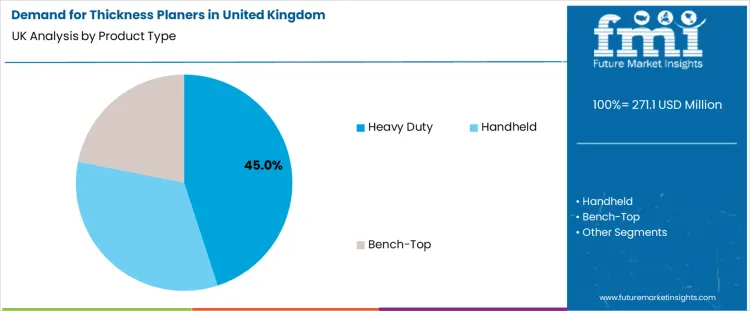
The product type segment for thickness planers in the United Kingdom is led by heavy duty thickness planers, which account for 45% of the market share. Heavy duty planers are widely used in industrial settings where high-volume, precision planing is required. These machines are designed for processing large and thick materials, making them ideal for woodworking shops, furniture manufacturers, and construction industries that work with heavy-duty timber or other dense materials. Their robust build and ability to handle high workloads without compromising accuracy make them essential for tasks such as surfacing, smoothing, and thicknessing large pieces of wood. Handheld thickness planers follow as another important segment, particularly for lighter, more portable applications. Handheld planers are popular among DIY enthusiasts, carpenters, and contractors who need flexibility and mobility on job sites.
These machines are typically used for smaller-scale tasks, such as smoothing edges, trimming wood, or removing small amounts of material. Bench-top thickness planers, though smaller in market share, are also used in smaller woodworking shops or for home use. They provide a compact solution for planing wood, offering precision in a more accessible, space-saving format. Heavy duty planers lead the segment due to their higher productivity and suitability for commercial applications, while handheld and bench-top models serve more specific needs in smaller or less demanding environments.
What Is the Power Source Segment of Demand for Thickness Planers in the United Kingdom?
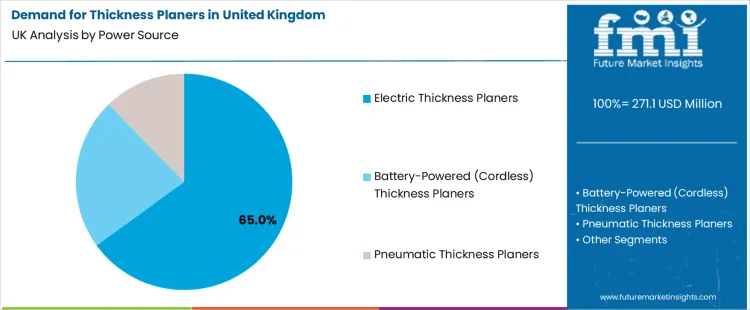
The power source segment for thickness planers in the United Kingdom is predominantly led by electric thickness planers, which account for 65% of the market share. Electric planers are the most common type used in both professional and domestic settings due to their consistent power output, ease of use, and availability in a range of sizes suitable for various applications. Electric thickness planers are used for both light-duty and heavy-duty tasks, providing the necessary power for effective material removal and achieving precise finishes in wood or other soft materials. The electric-powered segment benefits from the wide availability of tools with adjustable settings, including planing depth, making them versatile for a variety of projects, from furniture making to carpentry.
Battery-powered (cordless) thickness planers follow as a smaller segment but are growing in demand due to their portability and ease of use without the need for a power outlet. Cordless planers are especially favored by professionals and DIY users who need to move freely on job sites or work in areas where electrical outlets are not available. Pneumatic thickness planers, while representing a niche segment, are used in industrial environments where high-power and consistent performance are needed in specific, high-volume production settings. The increasing demand for electric and battery-powered planers reflects the shift towards more flexible, portable, and efficient tools, while pneumatic planers continue to serve specialized industrial needs.
What are the Key Dynamics in the Demand for Thickness Planers in the United Kingdom?
Demand for thickness planers in the United Kingdom is connected to woodworking and manufacturing activity across furniture, joinery, carpentry, and bespoke timber production. These machines are used to produce flat, uniform boards by shaving wood surfaces to precise thickness. Procurement levels reflect capital expenditure cycles in small and medium sized woodworking shops, larger furniture manufacturers, and carpentry contractors. Demand also aligns with replacement cycles of existing equipment and adoption of automated machining solutions that improve throughput and precision. Seasonal activity in construction, renovation, and craft production further shapes short term demand patterns.
What are the Key Drivers for Thickness Planer Demand in the United Kingdom?
Several factors drive demand for thickness planers in the United Kingdom. Growth in furniture manufacturing and bespoke carpentry supports the need for precision machinery to deliver consistent surface quality. Woodworking shops replacing outdated equipment with higher capacity or more accurate planers sustain market activity. Investment in small batch and custom production, where dimensional accuracy is essential, favours acquisition of reliable planing solutions. Technical advancements such as digital readouts, automated feed controls, and dust management systems increase productivity and appeal to buyers focused on operational efficiency. Training and skill development in woodworking trades also contribute to demand for advanced planing equipment.
What are the Restraints on Thickness Planer Demand in the United Kingdom?
Despite ongoing use, the thickness planer market in the United Kingdom faces several restraints. Capital cost of CNC equipped or high performance planers can limit acquisition by smaller workshops with constrained budgets. Price sensitivity in the woodworking sector may favour lower cost, imported tabletop or portable models over larger industrial units. Supply chain challenges affecting lead times for specialised machinery can delay procurement decisions. Competition from multifunctional machining centres that combine planning with other operations may reduce standalone planer purchases in facilities seeking to consolidate equipment. Variability in construction and manufacturing activity can temper near term demand fluctuations.
What are the Key Trends in Thickness Planer Demand in the United Kingdom?
Key trends influencing thickness planer demand in the United Kingdom include increased preference for digital features that enhance precision and ease of use, such as electronic thickness control and automated feed adjustment. Integration with dust extraction systems and compliance with workplace air quality standards are shaping equipment specifications. A shift toward hybrid workflows where planers are paired with CNC routers and edge banders supports flexible production in small and medium enterprises. Manufacturers are offering modular and scalable planer designs that can be adapted for diverse workshop footprints. Continued interest in woodworking as a craft and trade, supported by vocational training and maker communities, sustains interest in both entry level and advanced planing equipment.
What is the Country-Wise Demand for Thickness Planers in the United Kingdom?
The country-wise demand for thickness planers in the United Kingdom shows noticeable regional variation, with England leading the market. The demand in England is driven by its strong woodworking, construction, and manufacturing sectors, where thickness planers are essential for ensuring uniformity in material thickness. Scotland, Wales, and Northern Ireland follow with steady demand, supported by their growing woodworking industries and increasing construction activity. As industries continue to focus on precision and efficiency in production processes, the demand for thickness planers is expected to rise across all regions. While England remains the dominant market, steady growth is anticipated in the other regions, driven by industrial trends and advancements in manufacturing technologies.
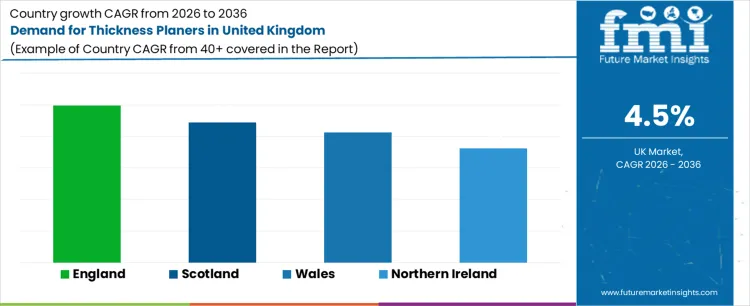
| Country | CAGR (2026 to 2036) |
|---|---|
| England | 5.0% |
| Scotland | 4.4% |
| Wales | 4.1% |
| Northern Ireland | 3.6% |
What is Driving the Demand for Thickness Planers in England?
England shows the strongest regional momentum, with thickness planer demand expanding at a 5.0% CAGR between 2026 and 2036. England’s large woodworking, construction, and manufacturing industries are the key drivers of this demand. Thickness planers are essential tools in these industries, ensuring that wood-based materials are uniformly processed for precise construction and manufacturing. As the construction sector in England continues to expand, particularly with an increasing focus on residential and commercial building projects, the demand for thickness planers is expected to rise. Additionally, as England's manufacturing industry embraces automation and advanced production technologies, the need for high-precision tools like thickness planers will continue to grow. The focus on efficiency and improved productivity in both traditional and modern industries will keep the demand for these machines strong across England.
How is the Demand for Thickness Planers Performing in Scotland?
Thickness planer uptake in Scotland is forecast to increase steadily, recording a 4.4% CAGR over the forecast period. Scotland’s growing woodworking and construction sectors are driving the adoption of thickness planers, as these industries require precise equipment to process materials for a variety of applications. The rise in residential and infrastructure construction projects in Scotland, along with the increasing demand for high-quality woodworking products, is contributing to this demand. Furthermore, as the woodworking industry in Scotland continues to modernize and adopt more advanced machinery, the need for thickness planers is expected to grow. The trend towards more sustainable building materials and practices, along with Scotland's focus on improving the efficiency of its manufacturing sector, will continue to drive steady growth in the market for thickness planers.
What Are the Growth Drivers for Thickness Planers in Wales?
Growth in Wales remains moderate, as thickness planer demand advances at a 4.1% CAGR through 2036. The primary growth drivers are the construction and woodworking sectors, where the need for precision equipment to process materials efficiently is increasing. As the Welsh construction industry grows, particularly in residential and commercial projects, the demand for tools like thickness planers that ensure smooth, uniform materials will rise. Additionally, the adoption of advanced manufacturing techniques and a growing focus on sustainability in the construction industry are fueling the demand for high-quality woodworking equipment. The rising demand for custom-designed and well-finished wood products in Wales is also contributing to the steady growth of the thickness planer market. As Welsh industries continue to modernize and demand for quality materials increases, the adoption of thickness planers is expected to rise.
What is the Outlook for Thickness Planers Demand in Northern Ireland?
Compared with other UK regions, Northern Ireland exhibits slower growth, with thickness planer demand rising at a 3.6% CAGR from 2026 to 2036. Although Northern Ireland represents the smallest market in the United Kingdom, steady demand is driven by the growing demand for precision tools in the woodworking and manufacturing sectors. As the construction industry in Northern Ireland expands, particularly in residential and commercial projects, the need for thickness planers to ensure material precision is increasing. Additionally, the demand for high-quality woodworking products in the region is helping to drive the adoption of these machines. As industries in Northern Ireland continue to improve efficiency and invest in advanced machinery, the need for thickness planers will continue to grow, albeit at a slower rate compared to England and Scotland. Nonetheless, the steady growth in the demand for construction and manufacturing tools in the region will support the market for thickness planers in Northern Ireland.
What is the Competitive Landscape for Demand for Thickness Planers in the United Kingdom?

Demand for thickness planers in the United Kingdom is driven by woodworking, furniture manufacturing, joinery workshops, and specialist carpentry projects where surface finish and dimensional accuracy are required. Procurement teams reference product brochures to compare documented cutting widths, motor power ratings, feed speeds, and dust extraction capabilities. DeWalt (Stanley Black & Decker, Inc.) is positioned as a leading supplier, with brochures that list standard features, accessory compatibility, and operating specifications used by buyers to align tool selection with workshop requirements. Technical sheets from DeWalt detail cutterhead designs, speed control options, and recommended duty cycles that inform specification decisions.
Makita Corporation competes with planer models described in documentation that outlines torque ratings, cutter geometry, and ergonomic features. Buyers in the United Kingdom examine these materials when matching equipment performance with intended use cases. Bosch Power Tools (Robert Bosch GmbH) supplies planers supported by brochures that present documented power consumption, plate flatness tolerances, and safety features, and these data points are referenced by workshop managers during procurement. JET Tools (JPW Industries, Inc.) offers industrial and benchtop planers with brochures listing table size options, build quality notes, and documented performance parameters. Grizzly Industrial, Inc. contributes with planer systems accompanied by technical literature that provides recorded feed rates, cutter specifications, and maintenance guidelines.
Selection decisions in the United Kingdom are made with reference to documented performance values and documented supply terms from these key suppliers. Demand patterns reflect scheduled production runs in woodworking shops and periodic capital equipment upgrades where consistency and reliability are critical. Buyers compare documented motor ratings, cutterhead specifications, and documented dust management performance to ensure compatibility with existing workshop setups. Lead times, documented distribution reach, and authorised service support are outlined in supplier materials and are used by procurement and planning teams during tender evaluations.
Safety certifications and documented compliance with regional standards appear in technical guides, influencing selection criteria. Competitive activity is grounded in documented product attributes and documented supply commitments captured in official brochures and specification sheets. Decisions are anchored in measurable technical data, handling instructions, and documented performance metrics rather than subjective assessments, satisfying formal procurement protocols in both industrial and small business environments.
Key Players of the Demand for Thickness Planers in United Kingdom
- DeWalt (Stanley Black & Decker, Inc.)
- Makita Corporation
- Bosch Power Tools (Robert Bosch GmbH)
- JET Tools (JPW Industries, Inc.)
- Grizzly Industrial, Inc.
Scope of the Report
| Items | Values |
|---|---|
| Quantitative Units (2026) | USD Million |
| Product Type | Handheld, Bench-Top, Heavy Duty |
| Power Source | Electric Thickness Planers, Battery-Powered (Cordless) Thickness Planers, Pneumatic Thickness Planers |
| End-Use Industry | Furniture Manufacturing, Construction & Carpentry, DIY & Hobbyists, Industrial & Commercial Workshops |
| Companies | DeWalt (Stanley Black & Decker, Inc.), Makita Corporation, Bosch Power Tools (Robert Bosch GmbH), JET Tools (JPW Industries, Inc.), Grizzly Industrial, Inc. |
| Regions Covered | United Kingdom |
| Countries Covered | England, Scotland, Wales, Northern Ireland |
| Additional Attributes | Dollar by sales by product type, power source, end-use industry, and region. Includes market trends towards automation, precision, and the role of thickness planers in various industries. |
Demand for Thickness Planers in United Kingdom
Product Type
- Handheld
- Bench-Top
- Heavy Duty
Power Source
- Electric Thickness Planers
- Battery-Powered (Cordless) Thickness Planers
- Pneumatic Thickness Planers
End-Use Industry
- Furniture Manufacturing
- Construction & Carpentry
- DIY & Hobbyists
- Industrial & Commercial Workshops
Countries
- England
- Scotland
- Wales
- Northern Ireland
Bibliography
- Office for National Statistics. (2024). Manufacturing output and capital equipment investment trends. Office for National Statistics.
- Department for Business and Trade. (2025). UK industrial strategy and advanced manufacturing equipment adoption. Government of the United Kingdom.
- Health and Safety Executive. (2024). Guidance on woodworking machinery safety: Obligations for employers. Health and Safety Executive.
Frequently Asked Questions
How big is the demand for thickness planers in United Kingdom in 2026?
The demand for thickness planers in United Kingdom is estimated to be valued at USD 271.1 million in 2026.
What will be the size of thickness planers in United Kingdom in 2036?
The market size for the thickness planers in United Kingdom is projected to reach USD 422.0 million by 2036.
How much will be the demand for thickness planers in United Kingdom growth between 2026 and 2036?
The demand for thickness planers in United Kingdom is expected to grow at a 4.5% CAGR between 2026 and 2036.
What are the key product types in the thickness planers in United Kingdom?
The key product types in thickness planers in United Kingdom are heavy duty, handheld and bench-top.
Which power source segment is expected to contribute significant share in the thickness planers in United Kingdom in 2026?
In terms of power source, electric thickness planers segment is expected to command 65.0% share in the thickness planers in United Kingdom in 2026.
Preview the report firsthand - request a free sample
Get SampleGet the brochure for pricing and purchase details.
Get PDFTable of Content
- Executive Summary
- UK Market Outlook
- Demand-side Trends
- Supply-side Trends
- Technology Roadmap Analysis
- Analysis and Recommendations
- Market Overview
- Market Coverage / Taxonomy
- Market Definition / Scope / Limitations
- Market Background
- Market Dynamics
- Drivers
- Restraints
- Opportunity
- Trends
- Scenario Forecast
- Demand in Optimistic Scenario
- Demand in Likely Scenario
- Demand in Conservative Scenario
- Opportunity Map Analysis
- Product Life Cycle Analysis
- Supply Chain Analysis
- Investment Feasibility Matrix
- Value Chain Analysis
- PESTLE and Porter’s Analysis
- Regulatory Landscape
- Regional Parent Market Outlook
- Production and Consumption Statistics
- Import and Export Statistics
- Market Dynamics
- UK Market Analysis 2021 to 2025 and Forecast, 2026 to 2036
- Historical Market Size Value (USD Million) Analysis, 2021 to 2025
- Current and Future Market Size Value (USD Million) Projections, 2026 to 2036
- Y-o-Y Growth Trend Analysis
- Absolute $ Opportunity Analysis
- UK Market Pricing Analysis 2021 to 2025 and Forecast 2026 to 2036
- UK Market Analysis 2021 to 2025 and Forecast 2026 to 2036, By Product Type
- Introduction / Key Findings
- Historical Market Size Value (USD Million) Analysis By Product Type , 2021 to 2025
- Current and Future Market Size Value (USD Million) Analysis and Forecast By Product Type , 2026 to 2036
- Heavy Duty
- Handheld
- Bench-Top
- Heavy Duty
- Y-o-Y Growth Trend Analysis By Product Type , 2021 to 2025
- Absolute $ Opportunity Analysis By Product Type , 2026 to 2036
- UK Market Analysis 2021 to 2025 and Forecast 2026 to 2036, By Power Source
- Introduction / Key Findings
- Historical Market Size Value (USD Million) Analysis By Power Source, 2021 to 2025
- Current and Future Market Size Value (USD Million) Analysis and Forecast By Power Source, 2026 to 2036
- Electric Thickness Planers
- Battery-Powered (Cordless) Thickness Planers
- Pneumatic Thickness Planers
- Electric Thickness Planers
- Y-o-Y Growth Trend Analysis By Power Source, 2021 to 2025
- Absolute $ Opportunity Analysis By Power Source, 2026 to 2036
- UK Market Analysis 2021 to 2025 and Forecast 2026 to 2036, By End-Use Industry
- Introduction / Key Findings
- Historical Market Size Value (USD Million) Analysis By End-Use Industry, 2021 to 2025
- Current and Future Market Size Value (USD Million) Analysis and Forecast By End-Use Industry, 2026 to 2036
- Furniture Manufacturing
- Construction & Carpentry
- DIY & Hobbyists
- Industrial & Commercial Workshops
- Furniture Manufacturing
- Y-o-Y Growth Trend Analysis By End-Use Industry, 2021 to 2025
- Absolute $ Opportunity Analysis By End-Use Industry, 2026 to 2036
- Market Structure Analysis
- Competition Dashboard
- Competition Benchmarking
- Market Share Analysis of Top Players
- By Regional
- By Product Type
- By Power Source
- By End-Use Industry
- Competition Analysis
- Competition Deep Dive
- DeWalt (Stanley Black & Decker, Inc.)
- Overview
- Product Portfolio
- Profitability by Market Segments (Product/Age /Sales Channel/Region)
- Sales Footprint
- Strategy Overview
- Marketing Strategy
- Product Strategy
- Channel Strategy
- Makita Corporation
- Bosch Power Tools (Robert Bosch GmbH)
- JET Tools (JPW Industries, Inc.)
- Grizzly Industrial, Inc.
- DeWalt (Stanley Black & Decker, Inc.)
- Competition Deep Dive
- Assumptions & Acronyms Used
- Research Methodology


