

- Industry Size (2026)
- USD 72.4 Mn
- Forecast (2036)
- USD 108 Mn
- CAGR (2026 to 2036)
- 4.1%
Demand for Thickness Planers in South Korea Forecast and Outlook 2026 to 2036
The demand for thickness planers in South Korea is expected to grow steadily, driven by the increasing need for precision woodworking tools in both industrial and DIY sectors. Thickness planers are vital in the woodworking and furniture industries for ensuring consistent material thickness, essential for high-quality product finishes. As South Korea’s construction and manufacturing sectors expand, particularly in the production of furniture and wood-based panels, the demand for precision planing equipment is projected to rise. The market will also benefit from growing interest in woodworking as a hobby, further contributing to the demand for smaller, more affordable planers in the consumer segment.
Starting at USD 72.4 million in 2026, the market for thickness planers in South Korea is expected to reach USD 108 million by 2036, growing at a 4.1% CAGR. This growth is driven by steady demand from the woodworking industry and the continued adoption of more advanced and efficient planing technology. As industries strive for higher productivity and quality, the need for reliable thickness planers will remain essential throughout the forecast period.
Quick Stats for the Demand for Thickness Planers in South Korea
- Thickness Planers in South Korea Value (2026): USD 72.4 million
- Thickness Planers in South Korea Forecast Value (2036): USD 108 million
- Thickness Planers in South Korea Forecast CAGR (2026 to 2036): 4.1%
- Thickness Planers in South Korea Leading Segment: Electric Thickness Planers (60%)
- Key Growth Regions of Thickness Planers in South Korea: Jeju (leading CAGR ~4.9%)
- Top Players of Thickness Planers in South Korea: DeWalt (Stanley Black & Decker, Inc.), Makita Corporation, Bosch Power Tools (Robert Bosch GmbH), JET Tools (JPW Industries, Inc.), Grizzly Industrial, Inc.
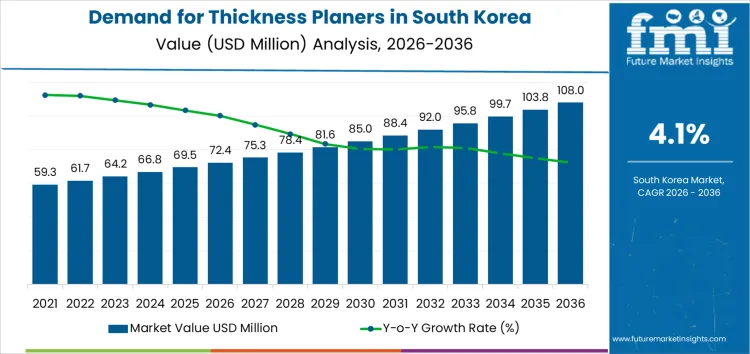
What is the Growth Forecast for the Demand for Thickness Planers in South Korea through 2036?
The long-term value accumulation curve for thickness planers in South Korea indicates a consistent growth pattern, with gradual accumulation over the forecast period. From an initial value of USD 72.4 million in 2026, the market is projected to reach USD 108 million by 2036, reflecting a steady, sustained growth trajectory. The early years (2026-2030) show moderate increases driven by demand from the industrial sector, particularly in furniture and construction. As the industry adopts more efficient and precise machinery, thickness planers will see steady adoption across both large-scale manufacturers and smaller workshops.
As the market matures, the value accumulation curve becomes more stable, with incremental growth in the latter half of the forecast period. By 2036, the market will have accumulated substantial value, reaching USD 108 million. This long-term growth is driven by the continuing evolution of technology in the woodworking industry, improved production capabilities, and increasing interest in home-based woodworking and DIY projects. The steady nature of the curve reflects consistent demand for high-quality, reliable planing equipment across various sectors, making thickness planers a crucial part of South Korea’s industrial and consumer tool markets.
Key Takeaways for Demand for Thickness Planers in South Korea
| Metric | Value |
|---|---|
| Industry Sales Value (2026) | USD 72.4 million |
| Industry Forecast Value (2036) | USD 108 million |
| Industry Forecast CAGR (2026 to 2036) | 4.1% |
Why is the Demand for Thickness Planers Growing in South Korea?
Demand for thickness planers in South Korea reflects the structural needs of the woodworking and furniture manufacturing sectors, where precision and surface quality are fundamental. Cabinet makers, joineries, and custom furniture shops specify thickness planers to achieve uniform board thickness and smooth surfaces before final finishing. Industrial workshops appreciate these machines for their ability to reduce manual sanding and trimming work, thereby improving throughput and dimensional consistency. Procurement teams evaluate planers based on cutting width, motor power, table stability, and ease of adjustment because these attributes influence cut quality and cycle times. South Korea’s construction and interior fit out industries also contribute to planer demand, since interior millwork, door frames, and engineered timber components require accurate thickness control. Small and medium enterprises in regional industrial clusters invest in planers that integrate with existing joinery lines, balancing capital cost with the need to maintain competitive product standards.
Looking ahead, several factors are expected to sustain and expand demand for thickness planers across South Korea’s woodworking and manufacturing landscape. The trend toward premium, custom furniture and high end interior woodwork supports ongoing purchases of machines that deliver fine surface quality and reproducibility. Expansion of urban housing and commercial fit outs drives volume in cabinetry and finish carpentry, where planers play a role in meeting dimensional tolerances and appearance criteria. Technological improvements in cutter head design and dust collection systems enhance planer performance and shop safety, making them more attractive to both established shops and new market entrants. In addition, training institutions and vocational programs that prepare technicians for woodworking careers include thickness planers in curriculum and shop layouts, familiarizing future operators with their operation and maintenance. Taken together, these dynamics contribute to persistent interest in thickness planers among South Korean manufacturers and craft professionals who prioritize precision and productivity in wood processing.
What Shapes the Demand for Thickness Planers in South Korea?
The demand for thickness planers in South Korea is influenced by two primary factors: product type and power source. Handheld thickness planers hold the largest share at 45%, while electric thickness planers lead the power source segment with a 60% share. These two segments drive the market, reflecting the versatility and preference for electric power tools in both professional woodworking and DIY applications. As industries and consumers seek efficient, reliable, and precise tools for wood planning, these categories remain central to the demand dynamics in South Korea.
Why Do Handheld Thickness Planers Lead the Product Type Segment?
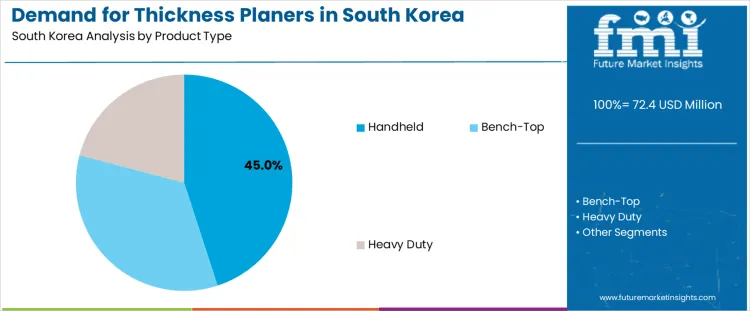
Handheld thickness planers dominate the market in South Korea, accounting for 45% of the demand, due to their portability, ease of use, and ability to handle a wide range of planning tasks. These compact and lightweight planers are favored by both professionals and hobbyists for their convenience, particularly when working on smaller, more intricate projects where maneuverability is essential. Handheld planers offer the flexibility to be used in various settings, from workshops to home DIY spaces, and are suitable for tasks like smoothing surfaces, removing surface defects, and reducing wood thickness. Their accessibility and relatively lower price point compared to heavier-duty alternatives make them the go-to choice for woodworkers needing a versatile tool for routine planning jobs. As the DIY culture grows and the woodworking sector continues to expand in South Korea, the demand for handheld thickness planers is expected to remain strong, driven by their practicality and widespread applicability in both professional and non-professional environments.
Why Do Electric Thickness Planers Lead the Power Source Segment?
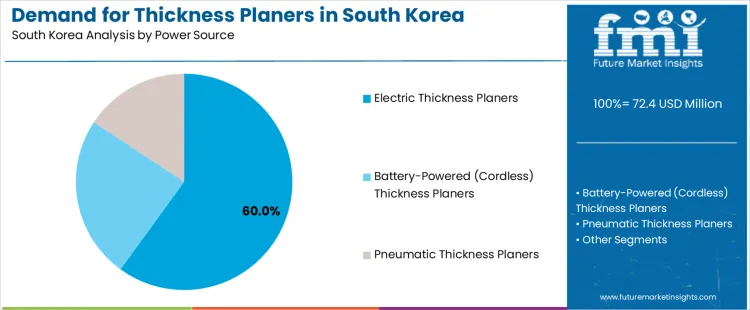
Electric thickness planers lead the power source segment in South Korea with a 60% market share, primarily due to their power, efficiency, and ease of use. Electric planers provide consistent performance, enabling users to achieve precise thickness adjustments and smooth surfaces without the physical exertion required by manual tools. These planers are widely used in both industrial and domestic settings, where high power output and reliability are essential for handling larger workloads or frequent use. Electric models are particularly favored in commercial workshops, where time efficiency and productivity are critical. The widespread adoption of electric thickness planers is also supported by their compatibility with advanced features such as variable speed settings, dust collection systems, and adjustable depth controls, making them a preferred choice for professionals. As South Korea’s woodworking and construction industries continue to expand, the demand for electric thickness planers is expected to grow, driven by the need for high-quality, efficient tools that deliver superior results in less time.
What Is the Current Demand for Thickness Planers in South Korea?
Demand for thickness planers in South Korea is connected to activity in woodworking, furniture, joinery, and construction sectors where precision surfacing of timber and panel products is required. Woodworking shops and manufacturers procure thickness planers to prepare boards with consistent thickness and smooth surfaces before assembly or finishing. Demand reflects investment cycles in woodworking machinery as firms upgrade capabilities or expand production. Uptake patterns are also influenced by output levels in residential and commercial construction where interior woodwork, cabinetry, and custom joinery require dimensionally accurate materials.
What Factors Are Driving Demand for Thickness Planers in South Korea?
Several forces support demand for thickness planers in South Korea. Growth in the furniture manufacturing industry encourages procurement of machines that enhance productivity and dimensional control, especially for medium to high volume production. Expansion of specialized wood product sectors, such as bespoke cabinetry and interior components, underpins need for equipment that can deliver smooth, uniform boards quickly. Construction activity, including renovation and fit out projects, also contributes to incremental demand as contractors and subcontractors require planers for on site material preparation. Technology adoption in workshops, including CNC integration and improved dust management systems, makes modern planers more attractive to firms aiming to improve workflow and safety.
What Are the Constraints on Demand for Thickness Planers in South Korea?
Despite sustained use, certain constraints influence demand for thickness planers in South Korea. Price sensitivity in small and medium sized woodworking shops can limit investment in advanced or high capacity planers, causing some firms to rely on manual smoothing or lower cost alternatives. Competition from imported second hand machinery and used equipment markets offers lower cost entry points that can dampen new unit sales. Fluctuations in raw material prices for timber and panel products influence production planning, which in turn affects machinery procurement timing. Environmental and workplace safety regulations require appropriate dust extraction and containment, adding to total system costs and potentially delaying purchase decisions for standalone planers.
What Trends Are Emerging in South Korea’s Thickness Planer Market?
Emerging trends in South Korea’s thickness planer market include adoption of digitally assisted controls and automated thickness settings that improve accuracy and reduce setup times. There is increasing interest in compact and modular planers suited to smaller workshops and space constrained facilities, reflecting growth in small batch and custom woodworking enterprises. Integration with dust control and shop ventilation systems is shaping specifications as firms prioritise compliance and operator health. Demand for planers with energy efficient drives and low operating noise is growing among buyers focused on sustainability and improved working environments. Collaboration between local distributors and overseas manufacturers is influencing product availability and after sales support, helping workshops adopt more advanced and reliable equipment.
What is the Regional Outlook for the Demand for Thickness Planers in South Korea?
The demand for thickness planers in South Korea is driven by the growth in the woodworking, construction, and manufacturing industries. These machines are essential in the production of precise wood products, particularly in furniture, flooring, and construction applications. Jeju leads in demand growth, driven by its growing tourism infrastructure and rising demand for wood-based products. South Gyeongsang and South Jeolla show steady demand, supported by their strong manufacturing bases and increasing use of wood in both industrial and residential construction. North Jeolla, while showing moderate growth, benefits from its regional manufacturing sector, which increasingly requires efficient, high-quality machinery for woodworking. As South Korea continues to emphasize precision in manufacturing and the use of sustainable materials, demand for thickness planers is expected to grow across all regions.
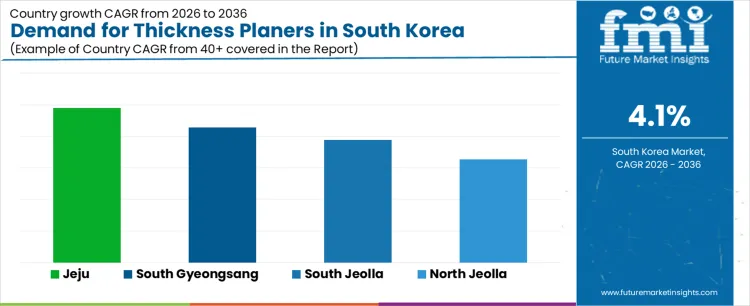
| Province | CAGR (2026-2036) |
|---|---|
| South Gyeongsang | 4.3% |
| North Jeolla | 3.3% |
| South Jeolla | 3.9% |
| Jeju | 4.9% |
What drives the demand for Thickness Planers in South Gyeongsang?
South Gyeongsang is projected to experience a CAGR of 4.3% in the demand for thickness planers from 2026 to 2036. The region’s strong manufacturing and construction sectors play a central role in driving this demand. As industries in South Gyeongsang expand, particularly in the production of furniture, flooring, and construction materials, the need for precision woodworking equipment increases. Thickness planers, essential for achieving smooth, uniform wood surfaces, are widely used in these industries. South Gyeongsang’s growing focus on high-quality manufacturing and sustainable construction practices, which prioritize wood as a material, further accelerates the demand for such machines. The region’s strong logistics and industrial infrastructure ensure that the demand for woodworking machinery, including thickness planers, continues to grow steadily.
What influences the growth of Thickness Planer demand in North Jeolla?
North Jeolla is expected to see a moderate CAGR of 3.3% in the demand for thickness planers from 2026 to 2036. The region’s industrial sector, particularly in manufacturing and agriculture, supports this steady demand. North Jeolla is home to a number of wood processing and furniture manufacturing facilities that require precision equipment like thickness planers to maintain high production standards. Additionally, the rise in construction activities, particularly in residential and commercial buildings, drives the need for planed wood for flooring, paneling, and finishing. As the region focuses on modernizing its industrial base and improving efficiency in production lines, the demand for advanced machinery, including thickness planers, is expected to grow steadily. While growth remains moderate, the region’s focus on improving wood product quality and production efficiency supports continued demand.
What drives the demand for Thickness Planers in South Jeolla?
South Jeolla is projected to grow at a CAGR of 3.9% in the demand for thickness planers from 2026 to 2036. The region’s strong presence in agriculture and food processing, coupled with its expanding construction and furniture manufacturing sectors, contributes to this demand. Thickness planers are used extensively in woodworking for precise surface finishing, making them essential in the production of high-quality wood products such as furniture, flooring, and panels. South Jeolla’s growing focus on sustainable building materials and eco-friendly production methods further boosts the adoption of thickness planers, particularly as the demand for high-quality wood products increases. Additionally, the region’s increasing investments in manufacturing infrastructure and woodworking technology ensure that demand for these machines remains steady as industries modernize and improve production capabilities.
Why is Jeju projected to have the highest demand growth for Thickness Planers?
Jeju is projected to experience the highest demand growth for thickness planers, with a CAGR of 4.9% from 2026 to 2036. The island’s expanding tourism sector and associated infrastructure projects are major drivers of this growth. As the region continues to develop its hospitality, retail, and residential infrastructure, there is an increasing demand for wood-based products such as furniture, flooring, and decorative panels. The use of thickness planers in woodworking and construction applications is essential for achieving the high-quality finishes required in these products. Additionally, Jeju’s emphasis on sustainable construction practices and eco-friendly materials supports the growing use of wood and wood-based products. As the region’s construction and manufacturing sectors expand and prioritize quality, the demand for thickness planers is set to grow at the fastest rate in South Korea.
How are Competitors Differentiating in the Thickness Planer Market in South Korea?
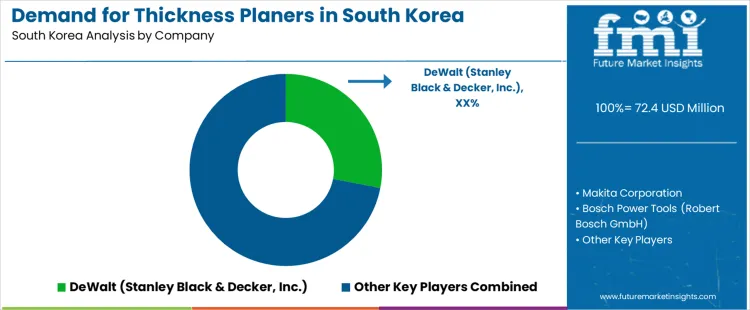
The demand for thickness planers in South Korea is driven by the country’s growing woodworking industry, where precision and efficiency are key in both industrial and home improvement projects. DeWalt (Stanley Black & Decker, Inc.), the leading player, stands out by offering high-performance thickness planers known for their durability, powerful motors, and user-friendly features. Their focus on reliability and versatility has made them a preferred choice among professionals in South Korea. Makita Corporation competes by providing portable and high-quality planers designed for ease of use and smooth finishes, catering to both professionals and DIY enthusiasts. Their products are highly regarded for their precision and lightweight design.
Bosch Power Tools (Robert Bosch GmbH) differentiates by offering innovative and advanced features in their thickness planers, such as electronic controls, dust extraction systems, and adjustable planing depths, making them ideal for users seeking high-quality finishes in woodworking. JET Tools (JPW Industries, Inc.) focuses on providing robust and reliable industrial-grade planers, with a special emphasis on heavy-duty use and precision for woodworking shops. Their products are tailored to the demands of South Korean professionals looking for consistent performance in larger operations. Grizzly Industrial, Inc. offers competitively priced thickness planers, targeting both professional and hobbyist woodworkers who require efficient machinery without breaking the bank. These companies utilize product brochures to highlight key features such as motor strength, ease of adjustment, and dust collection capabilities, helping South Korean customers make informed decisions based on their specific woodworking needs.
Key Players of the Demand for Thickness Planers in South Korea
- DeWalt (Stanley Black & Decker, Inc.)
- Makita Corporation
- Bosch Power Tools (Robert Bosch GmbH)
- JET Tools (JPW Industries, Inc.)
- Grizzly Industrial, Inc.
Scope of the Report
| Items | Values |
|---|---|
| Quantitative Units (2026) | USD Million |
| Product Type | Handheld, Bench-Top, Heavy Duty |
| Power Source | Electric Thickness Planers, Battery-Powered (Cordless) Thickness Planers, Pneumatic Thickness Planers |
| End-Use Industry | Furniture Manufacturing, Construction & Carpentry, DIY & Hobbyists, Industrial & Commercial Workshops |
| Companies | DeWalt (Stanley Black & Decker, Inc.), Makita Corporation, Bosch Power Tools (Robert Bosch GmbH), JET Tools (JPW Industries, Inc.), Grizzly Industrial, Inc. |
| Region Covered | South Korea |
| Provinces Covered | South Gyeongsang, North Jeolla, South Jeolla, Jeju |
| Additional Attributes | Dollar sales by product type, power source, and end-use industry. Demand is driven by the increasing need for precision in woodworking, particularly in furniture manufacturing and construction. Heavy-duty and electric thickness planers dominate the market, with cordless and pneumatic models gaining traction in both DIY and industrial settings. |
Demand for Thickness Planers in South Korea
Product Type:
- Handheld
- Bench-Top
- Heavy Duty
Power Source:
- Electric Thickness Planers
- Battery-Powered (Cordless) Thickness Planers
- Pneumatic Thickness Planers
End-Use Industry:
- Furniture Manufacturing
- Construction & Carpentry
- DIY & Hobbyists
- Industrial & Commercial Workshops
Provinces:
- South Gyeongsang
- North Jeolla
- South Jeolla
- Jeju
Bibliography
- Korea Institute of Industrial Technology. (2024). Woodworking machinery innovation trends and industrial equipment development in South Korea. Korea Institute of Industrial Technology.
- Ministry of Trade, Industry and Energy (Republic of Korea). (2024). Machinery industry report: Power tools, woodworking, and automation equipment in South Korea. Government of South Korea.
- Korea Wood Industry Association. (2024). Trends in woodworking machinery and furniture manufacturing equipment demand. Korea Wood Industry Association.
Frequently Asked Questions
How big is the demand for thickness planers in south korea in 2026?
The demand for thickness planers in south korea is estimated to be valued at USD 72.4 million in 2026.
What will be the size of thickness planers in south korea in 2036?
The market size for the thickness planers in south korea is projected to reach USD 108.0 million by 2036.
How much will be the demand for thickness planers in south korea growth between 2026 and 2036?
The demand for thickness planers in south korea is expected to grow at a 4.1% CAGR between 2026 and 2036.
What are the key product types in the thickness planers in south korea?
The key product types in thickness planers in south korea are handheld, bench-top and heavy duty.
Which power source segment is expected to contribute significant share in the thickness planers in south korea in 2026?
In terms of power source, electric thickness planers segment is expected to command 60.0% share in the thickness planers in south korea in 2026.
Preview the report firsthand - request a free sample
Get SampleGet the brochure for pricing and purchase details.
Get PDFTable of Content
- Executive Summary
- South Korea Market Outlook
- Demand-side Trends
- Supply-side Trends
- Technology Roadmap Analysis
- Analysis and Recommendations
- Market Overview
- Market Coverage / Taxonomy
- Market Definition / Scope / Limitations
- Market Background
- Market Dynamics
- Drivers
- Restraints
- Opportunity
- Trends
- Scenario Forecast
- Demand in Optimistic Scenario
- Demand in Likely Scenario
- Demand in Conservative Scenario
- Opportunity Map Analysis
- Product Life Cycle Analysis
- Supply Chain Analysis
- Investment Feasibility Matrix
- Value Chain Analysis
- PESTLE and Porter’s Analysis
- Regulatory Landscape
- Regional Parent Market Outlook
- Production and Consumption Statistics
- Import and Export Statistics
- Market Dynamics
- South Korea Market Analysis 2021 to 2025 and Forecast, 2026 to 2036
- Historical Market Size Value (USD Million) Analysis, 2021 to 2025
- Current and Future Market Size Value (USD Million) Projections, 2026 to 2036
- Y-o-Y Growth Trend Analysis
- Absolute $ Opportunity Analysis
- South Korea Market Pricing Analysis 2021 to 2025 and Forecast 2026 to 2036
- South Korea Market Analysis 2021 to 2025 and Forecast 2026 to 2036, By Product Type
- Introduction / Key Findings
- Historical Market Size Value (USD Million) Analysis By Product Type , 2021 to 2025
- Current and Future Market Size Value (USD Million) Analysis and Forecast By Product Type , 2026 to 2036
- Handheld
- Bench-Top
- Heavy Duty
- Handheld
- Y-o-Y Growth Trend Analysis By Product Type , 2021 to 2025
- Absolute $ Opportunity Analysis By Product Type , 2026 to 2036
- South Korea Market Analysis 2021 to 2025 and Forecast 2026 to 2036, By Power Source
- Introduction / Key Findings
- Historical Market Size Value (USD Million) Analysis By Power Source, 2021 to 2025
- Current and Future Market Size Value (USD Million) Analysis and Forecast By Power Source, 2026 to 2036
- Electric Thickness Planers
- Battery-Powered (Cordless) Thickness Planers
- Pneumatic Thickness Planers
- Electric Thickness Planers
- Y-o-Y Growth Trend Analysis By Power Source, 2021 to 2025
- Absolute $ Opportunity Analysis By Power Source, 2026 to 2036
- South Korea Market Analysis 2021 to 2025 and Forecast 2026 to 2036, By End-Use Industry
- Introduction / Key Findings
- Historical Market Size Value (USD Million) Analysis By End-Use Industry, 2021 to 2025
- Current and Future Market Size Value (USD Million) Analysis and Forecast By End-Use Industry, 2026 to 2036
- Furniture Manufacturing
- Construction & Carpentry
- DIY & Hobbyists
- Industrial & Commercial Workshops
- Furniture Manufacturing
- Y-o-Y Growth Trend Analysis By End-Use Industry, 2021 to 2025
- Absolute $ Opportunity Analysis By End-Use Industry, 2026 to 2036
- Market Structure Analysis
- Competition Dashboard
- Competition Benchmarking
- Market Share Analysis of Top Players
- By Regional
- By Product Type
- By Power Source
- By End-Use Industry
- Competition Analysis
- Competition Deep Dive
- DeWalt (Stanley Black & Decker, Inc.)
- Overview
- Product Portfolio
- Profitability by Market Segments (Product/Age /Sales Channel/Region)
- Sales Footprint
- Strategy Overview
- Marketing Strategy
- Product Strategy
- Channel Strategy
- Makita Corporation
- Bosch Power Tools (Robert Bosch GmbH)
- JET Tools (JPW Industries, Inc.)
- Grizzly Industrial, Inc.
- DeWalt (Stanley Black & Decker, Inc.)
- Competition Deep Dive
- Assumptions & Acronyms Used
- Research Methodology


