

- Industry Size (2026)
- USD 46.6 Mn
- Forecast (2036)
- USD 71.1 Mn
- CAGR (2026 to 2036)
- 4.3%
Demand for Trash Rack Cleaning Machine in United Kingdom Forecast and Outlook 2026 to 2036
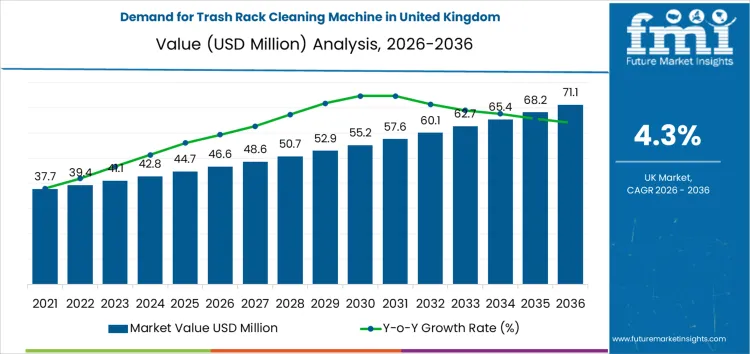
The trash rack cleaning machine market in the United Kingdom is projected to grow from USD 46.6 million in 2026 to USD 71.1 million by 2036, at a CAGR of 4.3%. Demand quality in this sector is marked by a consistent need for reliable, high-performance equipment in industries such as water treatment and power generation. Stability in demand is largely driven by regulatory requirements and the necessity for regular maintenance in critical infrastructure. Repeat usage is common, as buyers typically invest in long-term solutions to ensure operational efficiency, leading to predictable purchasing cycles. Buyer commitment is strong in sectors where the cost of system downtime is high, encouraging investment in durable, well-maintained machinery. The market growth will depend on maintaining service quality and providing tailored solutions to specific industry needs, as companies prioritize long-term relationships over one-off purchases. This dynamic will shape the overall trajectory of demand.
Quick Stats for the Demand for Trash Rack Cleaning Machine in United Kingdom:
- Trash Rack Cleaning Machine in United Kingdom Value (2026): USD 46.6 million
- Trash Rack Cleaning Machine in United Kingdom Forecast Value (2036): USD 71.1 million
- Trash Rack Cleaning Machine in United Kingdom Global Forecast CAGR (2026 to 2036): 4.3%
- Trash Rack Cleaning Machine in United Kingdom Leading Segment: Hydraulic Lifting (70% share)
- Key Growth Regions of Trash Rack Cleaning Machine in United Kingdom: England
- Top Players of Trash Rack Cleaning Machine in United Kingdom: Muhr GmbH, Bosch Rexroth AG, Evoqua Water Technologies LLC, Jash Engineering Ltd.
What is the Growth Forecast for Trash Rack Cleaning Machine in United Kingdom through 2036?
The demand for trash rack cleaning machines in the United Kingdom is expected to rise from USD 46.6 million in 2026 to USD 71.1 million by 2036, reflecting a compound annual growth rate (CAGR) of 4.3%. Between 2026 and 2031, the market will experience gradual growth, increasing from USD 46.6 million to USD 57.6 million. From 2031 to 2036, growth will continue, reaching USD 71.1 million by the end of the forecast period.
The growth momentum analysis indicates that the market will maintain a steady upward trajectory, with gradual increases in demand driven by ongoing infrastructure development and the modernization of water management systems. The growth will be fueled by the need for improved facility maintenance, reduced downtime, and compliance with environmental standards. However, the pace of growth will remain steady without significant acceleration, reflecting the stable demand for trash rack cleaning machines in the UK.
Key Takeaways for Demand for Trash Rack Cleaning Machine in United Kingdom
| Metric | Value |
|---|---|
| Industry Sales Value (2026) | USD 46.6 million |
| Industry Forecast Value (2036) | USD 71.1 million |
| Industry Forecast CAGR (2026 to 2036) | 4.3% |
Why is Demand for Trash Rack Cleaning Machine in United Kingdom Growing?
Demand for trash rack cleaning machine in the United Kingdom has increased as municipal and industrial water management systems placed stronger emphasis on infrastructure performance and operational efficiency. Historically, manual cleaning of debris from intake screens at water treatment plants, hydroelectric facilities, and stormwater channels required substantial labor and time, which constrained throughput and raised safety concerns. Operators began adopting mechanized solutions that automate removal of leaves, plastic, sediment, and other solids from intake structures.
This shift reflected broader investments in water infrastructure upgrades across the UK, driven by regulatory expectations for consistent water flow and flood risk mitigation. Facilities with high debris loads found that mechanized trash rack cleaning improved reliability by reducing stoppages and minimizing unscheduled maintenance. Urban expansion and greater surface runoff increased debris entering water intake systems, which reinforced the case for equipment that could maintain clear racks without frequent manual intervention.
Looking ahead, demand for trash rack cleaning machine in the United Kingdom is expected to continue rising in tandem with infrastructure modernization and resilience planning. Water utilities and hydropower operators will seek technology that supports predictable system performance and lower long term operational costs. Asset owners planning capital expenditure cycles are evaluating mechanical cleaning equipment as part of broader strategies to improve uptime and extend service life of intake structures. Increasing frequency of extreme weather events has heightened awareness of blockage risk at water intakes, which strengthens interest in reliable trash rack cleaning solutions. Innovation in remote monitoring and integration with plant control systems may further encourage adoption among facility operators focused on process optimization. Ongoing regulatory focus on water quality and flow assurance will sustain interest in equipment capable of maintaining clear trash racks across diverse water infrastructure assets.
What Are the Key Segments in the Demand for Trash Rack Cleaning Machines in the United Kingdom?
Demand for trash rack cleaning machines in the United Kingdom is driven by type and application. Hydraulic lifting machines dominate the type segment with 70% of the market share, while hydro power plants lead the application segment with 65%. Other applications, such as plumbing stations, also contribute to the market. These trends reflect the growing need for efficient waste management and debris removal in industrial and energy-producing sectors.
What Is the Type Segment of Demand for Trash Rack Cleaning Machines in the United Kingdom?
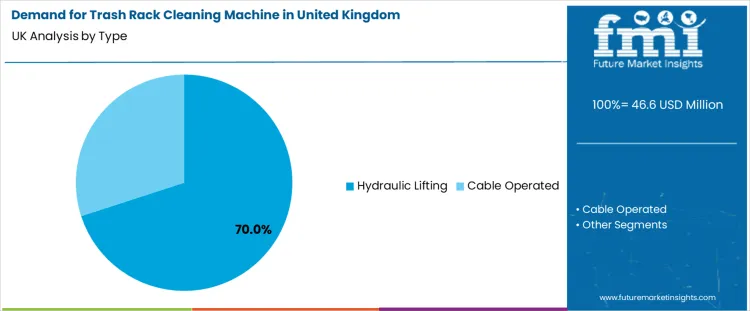
The type segment for trash rack cleaning machines in the United Kingdom is predominantly led by hydraulic lifting machines, which account for 70% of the market share. Hydraulic lifting machines are highly valued for their efficiency and effectiveness in removing debris from trash racks, especially in applications that require robust lifting mechanisms. These machines are commonly used in environments where large volumes of waste or debris are present, such as hydro power plants and water treatment facilities. The hydraulic system provides a powerful lifting mechanism that allows for reliable debris removal, even in challenging conditions.
This type of machine is preferred for its ability to handle heavy, large debris with ease, ensuring minimal downtime and maintaining operational efficiency. Cable-operated machines, while representing a smaller share of the market, are also used in specific applications. These machines rely on cable systems to lift and remove debris, making them suitable for situations where hydraulic lifting is not necessary or cost-effective. Cable-operated trash rack cleaning machines are typically used in smaller-scale operations or in environments where the machine's simpler mechanics can handle the debris load. However, the dominant preference for hydraulic lifting machines reflects the industry’s need for high-powered and durable cleaning systems, particularly in larger, more demanding applications.
What Is the Application Segment of Demand for Trash Rack Cleaning Machines in the United Kingdom?
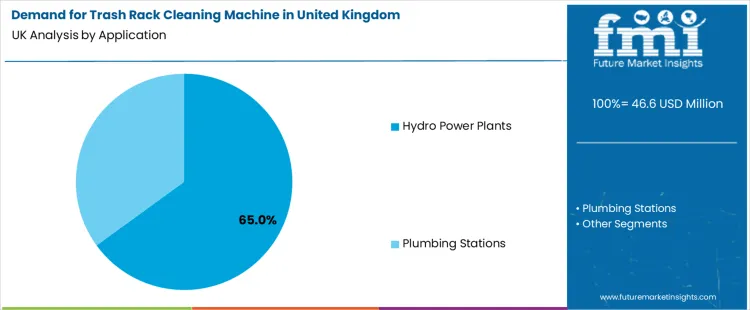
The application segment for trash rack cleaning machines in the United Kingdom is primarily led by hydro power plants, which account for 65% of the market share. Hydro power plants require effective trash rack cleaning systems to maintain the flow of water and ensure the optimal functioning of turbines and other critical equipment. The debris that accumulates on trash racks can obstruct water flow and damage machinery, making regular cleaning essential. Hydraulic lifting machines, with their strong and efficient lifting capabilities, are particularly well-suited for cleaning the large-scale debris often found in these environments. The importance of trash rack cleaning in hydro power plants is driven by the need to ensure continuous energy production and avoid operational interruptions.
Plumbing stations follow as another key application, though their demand for trash rack cleaning machines is more specialized. These stations, which manage wastewater and stormwater, require cleaning systems to prevent clogging and maintain the efficiency of water management systems. While plumbing stations do not generate the same scale of debris as hydro power plants, the need for reliable cleaning systems remains crucial. The overall demand for trash rack cleaning machines reflects the critical role they play in maintaining the functionality and efficiency of water-based infrastructure, particularly in energy production and water treatment industries.
What are the Key Dynamics in the Demand for Trash Rack Cleaning Machines in the United Kingdom?
Demand for trash rack cleaning machines in the United Kingdom is tied to municipal and industrial water infrastructure maintenance. These machines are used to remove debris from intake screens in rivers, canals, reservoirs, and wastewater treatment plants. Requirements for efficient water conveyance and protection of pumping equipment underpin adoption. Asset owners in utilities and industrial sectors schedule routine cleaning to prevent blockages that cause operational disruptions. Demand is also shaped by government standards for water quality and infrastructure resilience, along with capital investment cycles for public works and flood management projects.
What are the Key Drivers for Trash Rack Cleaning Machine Demand in the United Kingdom?
Several factors drive demand for trash rack cleaning machines in the United Kingdom. Increasing focus on preventive maintenance and asset reliability in water and wastewater utilities encourages investment in mechanized cleaning solutions. Growth in infrastructure spending on flood risk mitigation and river management programs supports procurement of equipment that maintains clear intake screens and reduces manual labor. Regulatory emphasis on environmental protection and water resource management reinforces the need for dependable trash removal systems to guard against debris accumulation. Operators seek automated and remote controlled machines to improve worker safety and reduce downtime associated with manual cleaning operations.
What are the Restraints on Trash Rack Cleaning Machine Demand in the United Kingdom?
Despite ongoing interest, several restraints affect demand for trash rack cleaning machines in the United Kingdom. High capital expenditure for acquiring mechanized cleaning systems can deter smaller utilities and private operators with constrained budgets. Competition from manual cleaning methods and lower cost alternatives limits adoption where short term cost savings are prioritized over long term efficiency. Variability in infrastructure investment cycles means spending can be deferred during periods of budgetary pressure. Operational complexity and the need for specialized training to operate and maintain advanced cleaning equipment also represent barriers for some organizations.
What are the Key Trends in Trash Rack Cleaning Machine Demand in the United Kingdom?
Key trends influencing the demand for trash rack cleaning machines in the United Kingdom include the shift toward automation and remote operation, enabling cleaning without exposing personnel to hazardous conditions. Integration of sensor technology and real time monitoring supports predictive maintenance and optimizes cleaning schedules based on debris load. Manufacturers are offering modular and scalable designs that fit varied channel widths and flow conditions, increasing usability across sites. Sustainability considerations also shape specifications, with energy efficient drives and reduced hydraulic consumption becoming important in procurement decisions. Partnerships between equipment providers and municipal authorities aim to tailor solutions for specific waterway conditions and regulatory compliance.
What is the Country-Wise Demand for Trash Rack Cleaning Machines in the United Kingdom?
The country-wise demand for trash rack cleaning machines in the United Kingdom varies across its regions, with England leading the market. The need for efficient and effective cleaning solutions for water intakes in power plants, water treatment facilities, and industrial applications is driving demand in England. Scotland, Wales, and Northern Ireland follow, with steady growth driven by similar needs in the water and wastewater management sectors. As environmental regulations increase and industries focus on optimizing plant operations, the demand for trash rack cleaning machines is expected to rise across all regions. While England remains the dominant market, other regions also show promising growth, particularly in industrial and water management sectors.
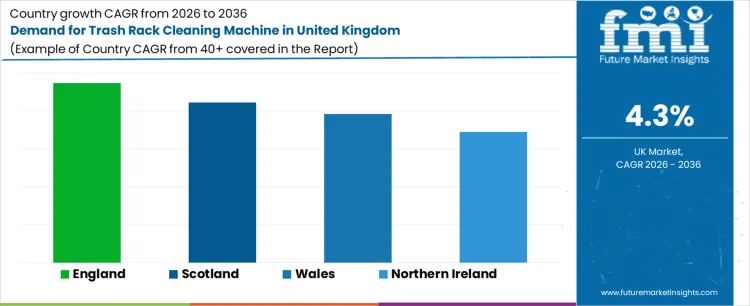
| Country | CAGR (2026 to 2036) |
|---|---|
| England | 4.7% |
| Scotland | 4.2% |
| Wales | 3.9% |
| Northern Ireland | 3.5% |
What is Driving the Demand for Trash Rack Cleaning Machines in England?
The demand for trash rack cleaning machines in England is projected to grow at a CAGR of 4.7% from 2026 to 2036. England’s large industrial base, including power plants, water treatment facilities, and various manufacturing operations, is the key driver of demand. Trash rack cleaning machines are essential for maintaining the flow of water in industrial applications, where debris can clog intake systems and disrupt operations. As the UK continues to emphasize sustainability and compliance with environmental regulations, the need for reliable and efficient trash rack cleaning solutions is increasing. The growing focus on improving operational efficiency and minimizing downtime in industrial plants is further driving the demand for these machines. With the expansion of water treatment infrastructure and increasing regulatory requirements, the demand for trash rack cleaning machines in England is expected to remain strong throughout the forecast period.
How is the Demand for Trash Rack Cleaning Machines Performing in Scotland?
In Scotland, the demand for trash rack cleaning machines is expected to grow at a CAGR of 4.2% from 2026 to 2036. Scotland’s demand is driven primarily by its water treatment facilities and industrial operations that require consistent maintenance of water intake systems. As environmental regulations continue to evolve, Scottish industries are increasingly adopting advanced cleaning technologies to ensure that their operations meet the required standards. Power plants, water treatment facilities, and industrial plants in Scotland rely on trash rack cleaning machines to prevent clogging and optimize water flow. Additionally, the growing focus on sustainability and operational efficiency in Scotland’s industrial sector is expected to further fuel the demand for these machines, making them a critical investment for businesses focused on minimizing environmental impact and ensuring operational continuity.
What Are the Growth Drivers for Trash Rack Cleaning Machines in Wales?
The demand for trash rack cleaning machines in Wales is projected to grow at a CAGR of 3.9% through 2036. The need for efficient water intake maintenance in power plants and water treatment facilities is driving demand in the region. As Wales continues to improve its water management infrastructure, the demand for trash rack cleaning solutions will rise. These machines play a crucial role in maintaining the smooth flow of water in industrial operations by preventing the accumulation of debris, which can lead to system failures and costly downtimes. The increasing focus on compliance with environmental standards and the need to enhance operational efficiency in both public and private sectors will continue to drive the adoption of trash rack cleaning machines in Wales. This growing demand is expected to maintain steady growth in the coming years, driven by both industrial expansion and regulatory pressures.
What is the Outlook for Trash Rack Cleaning Machine Demand in Northern Ireland?
Northern Ireland’s demand for trash rack cleaning machines is projected to grow at a CAGR of 3.5% from 2026 to 2036. Although Northern Ireland represents the smallest market in the UK, demand for trash rack cleaning machines is gradually increasing, primarily driven by the water and wastewater treatment sectors. As the region continues to improve its industrial and environmental infrastructure, the need for efficient water intake maintenance solutions is rising. The adoption of trash rack cleaning machines is driven by the growing importance of operational efficiency and compliance with environmental regulations. Northern Ireland’s power plants and industrial facilities are investing in advanced cleaning solutions to ensure smooth operations and prevent blockages in water intake systems. The steady growth in demand for these machines is expected to continue as the region focuses on sustainability and improving industrial processes.
What is the Competitive Landscape for Demand for Trash Rack Cleaning Machines in the United Kingdom?
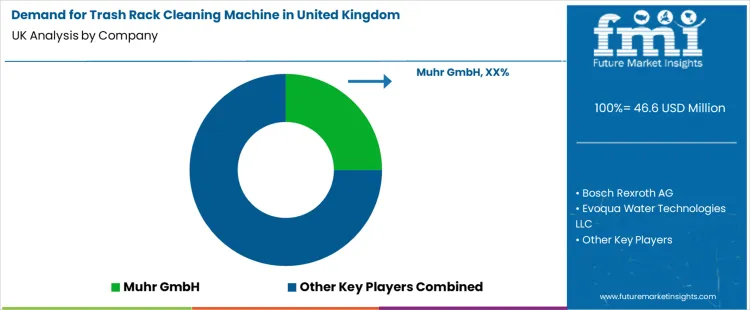
Demand for trash rack cleaning machines in the United Kingdom is shaped by infrastructure maintenance needs in hydropower facilities, water intake systems, wastewater treatment plants, and industrial pumping stations. Automated and hydraulic cleaning systems are increasingly specified to remove debris and maintain uninterrupted flow through intake racks, reducing reliance on manual labor and enhancing operational uptime. Technical documentation and product brochures provided by manufacturers are used by procurement teams and engineering planners to review machine performance, hydraulic capacity, and suitability for site conditions.
Buyers seek documented values for cleaning width range, rake reach, drive type, and automation levels, aligning selection with site constraints and debris profiles. Broader industry reporting indicates that key suppliers such as Muhr GmbH, Bosch Rexroth AG, Evoqua Water Technologies LLC, and Jash Engineering Ltd. serve the competitive landscape in water intake and screening markets, with systems tailored for varying channel widths and operational demands. Operators prioritize documented reliability, ease of maintenance, and compatibility with existing rack geometries when comparing offerings.
Muhr GmbH is positioned as a leading supplier of trash rack cleaning machines used in the United Kingdom and internationally, with its brochures detailing series such as HYDRONIC and CATRONIC that cover hydraulic cleaning operations and tailored configurations. Documentation from Muhr outlines component features, adaptability to new installations or retrofits, and control system options. Bosch Rexroth AG, known for drive and control technologies, contributes components and system expertise that support integrated cleaning machines, with product literature used to configure hydraulic and control solutions.
Evoqua Water Technologies LLC offers intake cleaning solutions with grab rake systems documented for use in municipal and industrial water environments. Jash Engineering Ltd. provides cleaning systems and screening solutions that are referenced in buyer evaluations for mechanical and semi automated configurations. Brochures from these companies act as reference materials in tendering and specification phases, helping engineers align machine capabilities with operational requirements.
Key Players of the Demand for Trash Rack Cleaning Machine in United Kingdom
- Muhr GmbH
- Bosch Rexroth AG
- Evoqua Water Technologies LLC
- Jash Engineering Ltd.
Scope of the Report
| Items | Values |
|---|---|
| Quantitative Units (2026) | USD Million |
| Type | Hydraulic Lifting, Cable Operated |
| Application | Hydro Power Plants, Plumbing Stations |
| Companies | Muhr GmbH, Bosch Rexroth AG, Evoqua Water Technologies LLC, Jash Engineering Ltd. |
| Regions Covered | United Kingdom |
| Countries Covered | England, Scotland, Wales, Northern Ireland |
| Additional Attributes | Dollar by sales by type, application, and region. Includes market trends towards efficiency, automation, and the role of trash rack cleaning machines in improving operations in water treatment and energy generation. |
Demand for Trash Rack Cleaning Machine in United Kingdom
Type
- Hydraulic Lifting
- Cable Operated
Application
- Hydro Power Plants
- Plumbing Stations
Countries
- England
- Scotland
- Wales
- Northern Ireland
Bibliographies
- Muhr GmbH. (2023). Trash Rack Cleaning Machines: Hydraulic Cleaning Solutions for Water Intake Systems.
- UK Government, Department for Environment, Food & Rural Affairs. (2024). Flood and Coastal Erosion Risk Management: National Report 2023-2024.
- United Nations Educational, Scientific and Cultural Organization (UNESCO). (2023). United Nations World Water Development Report 2023.
Frequently Asked Questions
How big is the demand for trash rack cleaning machine in United Kingdom in 2026?
The demand for trash rack cleaning machine in United Kingdom is estimated to be valued at USD 46.6 million in 2026.
What will be the size of trash rack cleaning machine in United Kingdom in 2036?
The market size for the trash rack cleaning machine in United Kingdom is projected to reach USD 71.1 million by 2036.
How much will be the demand for trash rack cleaning machine in United Kingdom growth between 2026 and 2036?
The demand for trash rack cleaning machine in United Kingdom is expected to grow at a 4.3% CAGR between 2026 and 2036.
What are the key product types in the trash rack cleaning machine in United Kingdom?
The key product types in trash rack cleaning machine in United Kingdom are hydraulic lifting and cable operated.
Which application segment is expected to contribute significant share in the trash rack cleaning machine in United Kingdom in 2026?
In terms of application, hydro power plants segment is expected to command 65.0% share in the trash rack cleaning machine in United Kingdom in 2026.
Preview the report firsthand - request a free sample
Get SampleGet the brochure for pricing and purchase details.
Get PDFTable of Content
- Executive Summary
- UK Market Outlook
- Demand-side Trends
- Supply-side Trends
- Technology Roadmap Analysis
- Analysis and Recommendations
- Market Overview
- Market Coverage / Taxonomy
- Market Definition / Scope / Limitations
- Market Background
- Market Dynamics
- Drivers
- Restraints
- Opportunity
- Trends
- Scenario Forecast
- Demand in Optimistic Scenario
- Demand in Likely Scenario
- Demand in Conservative Scenario
- Opportunity Map Analysis
- Product Life Cycle Analysis
- Supply Chain Analysis
- Investment Feasibility Matrix
- Value Chain Analysis
- PESTLE and Porter’s Analysis
- Regulatory Landscape
- Regional Parent Market Outlook
- Production and Consumption Statistics
- Import and Export Statistics
- Market Dynamics
- UK Market Analysis 2021 to 2025 and Forecast, 2026 to 2036
- Historical Market Size Value (USD Million) Analysis, 2021 to 2025
- Current and Future Market Size Value (USD Million) Projections, 2026 to 2036
- Y-o-Y Growth Trend Analysis
- Absolute $ Opportunity Analysis
- UK Market Pricing Analysis 2021 to 2025 and Forecast 2026 to 2036
- UK Market Analysis 2021 to 2025 and Forecast 2026 to 2036, By Type
- Introduction / Key Findings
- Historical Market Size Value (USD Million) Analysis By Type , 2021 to 2025
- Current and Future Market Size Value (USD Million) Analysis and Forecast By Type , 2026 to 2036
- Hydraulic Lifting
- Cable Operated
- Hydraulic Lifting
- Y-o-Y Growth Trend Analysis By Type , 2021 to 2025
- Absolute $ Opportunity Analysis By Type , 2026 to 2036
- UK Market Analysis 2021 to 2025 and Forecast 2026 to 2036, By Application
- Introduction / Key Findings
- Historical Market Size Value (USD Million) Analysis By Application, 2021 to 2025
- Current and Future Market Size Value (USD Million) Analysis and Forecast By Application, 2026 to 2036
- Hydro Power Plants
- Plumbing Stations
- Hydro Power Plants
- Y-o-Y Growth Trend Analysis By Application, 2021 to 2025
- Absolute $ Opportunity Analysis By Application, 2026 to 2036
- Market Structure Analysis
- Competition Dashboard
- Competition Benchmarking
- Market Share Analysis of Top Players
- By Regional
- By Type
- By Application
- Competition Analysis
- Competition Deep Dive
- Muhr GmbH
- Overview
- Product Portfolio
- Profitability by Market Segments (Product/Age /Sales Channel/Region)
- Sales Footprint
- Strategy Overview
- Marketing Strategy
- Product Strategy
- Channel Strategy
- Bosch Rexroth AG
- Evoqua Water Technologies LLC
- Jash Engineering Ltd.
- Muhr GmbH
- Competition Deep Dive
- Assumptions & Acronyms Used
- Research Methodology


