

- Market Size (2026)
- USD 1.7 Bn
- Forecast (2036)
- USD 5.5 Bn
- CAGR (2026 to 2036)
- 12.5%
How big is the Rail Track Inspection and Maintenance Robotics Market in 2026?
USD 1.7 billion in 2026 and USD 5.5 billion by 2036 at a 12.5% CAGR.
Demand for rail track inspection and maintenance robotics is projected to expand at 12.5% CAGR between 2026 and 2036, increasing valuation from USD 1.7 billion in 2026 to USD 5.5 billion by 2036. Modern railway networks require advanced technology to maintain track safety. In July 2025, the Office of Rail and Road reported 29 high-potential train accident incidents during 2024 to 2025. This concerning report directed investment attention toward continuous inspection coverage. To mitigate such risks, rail operators implement revenue-service monitoring. It reduces possession pressure through frequent observation during scheduled train movements. Resulting in safety regulators and infrastructure managers favoring repeatable defect records produced by automated geometry systems.
Global railway inspection strategies vary significantly by region and network size. United States and European Union rail operators prioritize certification records and interoperable inspection data. China and Russia infrastructure teams emphasize corridor coverage and locally supported equipment. Focus on wide coverage is necessary due to the significant infrastructure growth. In February 2025, China’s State Council reported operating railway mileage of 162,000 kilometers in 2024. Such vast mileage expands recurring inspection workloads across long-distance routes. Rail teams are therefore required to tailor their equipment choices to manage heavy regional workloads.
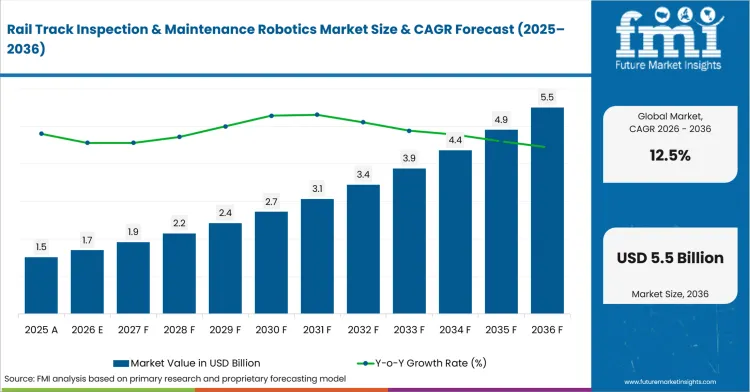
| Metric | Value |
|---|---|
| 2025 Market Size | USD 1.5 billion |
| 2026 Market Size | USD 1.7 billion |
| 2036 Market Size | USD 5.5 billion |
| Forecast CAGR (2026-2036) | 12.5% |
| Component Focus | Machines & Hardware |
| Machines & Hardware Share (2026) | 58.0% |
| End-use Focus | National Infrastructure Managers |
| National Infrastructure Managers Share (2026) | 48.0% |
| Sales Channel Focus | Direct |
| Direct Share (2026) | 46.0% |
Summary of Rail Track Inspection and Maintenance Robotics Market
| Market Signal | Commercial Impact |
|---|---|
| Demand and Growth Drivers | Automated defect detection expands safety coverage under stricter inspection rules and restricted track access. Revenue-service sensing improves inspection cadence without additional line closures.
|
| Product and Segment View | Segment direction is led by machines & hardware followed by national infrastructure managers and direct sales. Specification review is estimated to center on durability and technical support.
|
| Geography and Growth Outlook | Country movement differs through network scale and automated inspection policy. Commercial progress reflects local testing access and technical support.
|
| Competitive View | Competition centers on measurement accuracy and field support. Commercial progress favors companies providing integrated hardware and dependable calibration services.
|
| Analyst Perspective | Automated inspection functions as a planning instrument for routes resisting frequent manual access. Measured trials and operator training improve confidence during system selection.
|
Source: Future Market Insights analysis, 2026.
How is rail track inspection and maintenance robotics market segmented?
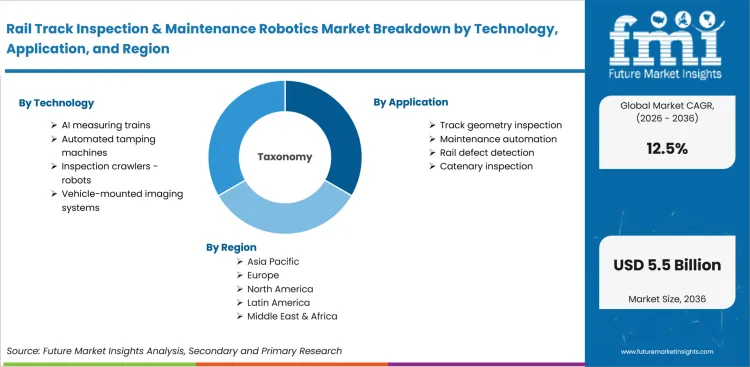
The rail track inspection and maintenance robotics industry is segmented by technology, application, component, end-use, sales channel and region.
The rail track inspection and maintenance robotics market is segmented by technology, application, component, end-use, sales channel and region. Technology coverage includes AI measuring trains beside automated tamping machines, inspection crawlers - robots and vehicle-mounted imaging systems. Application coverage includes track geometry inspection, maintenance automation, rail defect detection and catenary inspection for passenger or freight networks. Component coverage includes machines & hardware, software & analytics and services supporting integrated vehicle programs and field service workflows.
End-use coverage includes national infrastructure managers, regional networks, freight networks and metros under public or private operations. Sales channel coverage includes direct sales, service contracts, lease arrangements and aftermarket support for installed equipment fleets. Regional coverage includes North America and Latin America. Coverage continues through Western Europe, Eastern Europe, East Asia, South Asia and Pacific, Middle East and Africa.
Why do AI measuring trains shape technology selection?
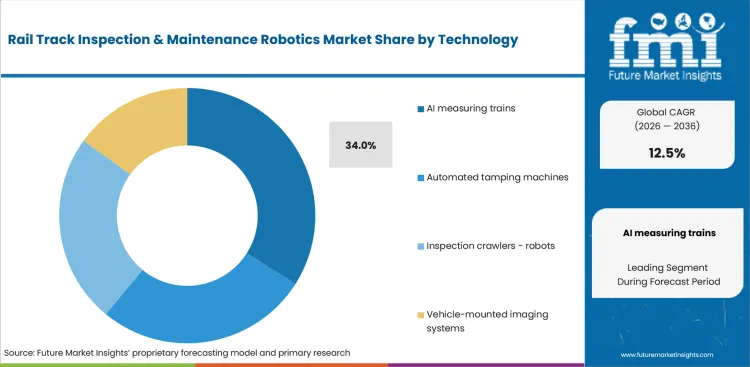
AI measuring trains combine continuous sensing with automated exception recognition during recurring route surveys and scheduled passenger movements. ENSCO reported in November 2024 equipping Vale EFVM locomotive No. 1256 with an autonomous track geometry measurement system, demonstrating uninterrupted geometry records from revenue-service equipment. Sensor arrays and machine vision reduce reviewer workload led by prioritized defect imagery and repeatable location records.
- AI measuring trains are estimated to garner 34.0% share of technology in 2026, backed by continuous corridor measurement and automated exception recognition. Rail teams assess repeatability and route coverage during complete operating cycles prior to fleet expansion.
- Automated tamping machines execute geometry correction during scheduled possessions and planned maintenance programs. Inspection crawlers-robots and vehicle-mounted imaging systems examine constrained spaces or complete visual screening assignments on active infrastructure.
How does track geometry inspection shape application demand?
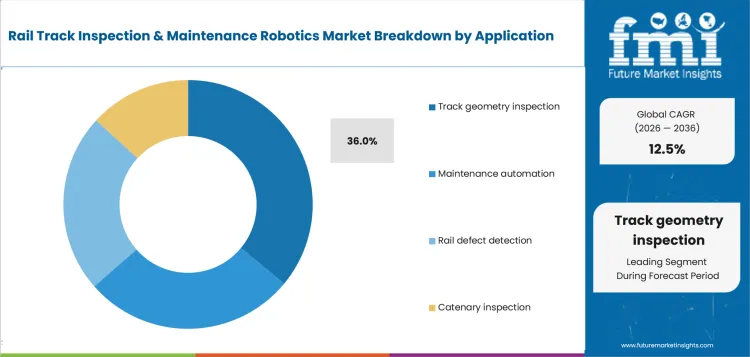
Network Rail described a 13-mile high-speed test track in May 2025, providing controlled validation space for geometry calibration and on-track machinery testing. Automated records guide maintenance planning through consistent comparisons between successive inspection cycles and route sections. Track geometry inspection informs alignment decisions driven by curvature and surface measurements collected on operating routes.
- in 2026, track geometry inspection is projected to command 36.0% share due to recurring safety checks and tamping preparation. Maintenance planners compare gauge and alignment exceptions between route sections prior to assigning corrective work.
- Maintenance automation directs programmed repair activity toward identified track structures and rail surfaces. Rail defect detection examines material condition, and catenary inspection records overhead-line assets for maintenance response planning.
Why do machines & hardware account for component leadership?
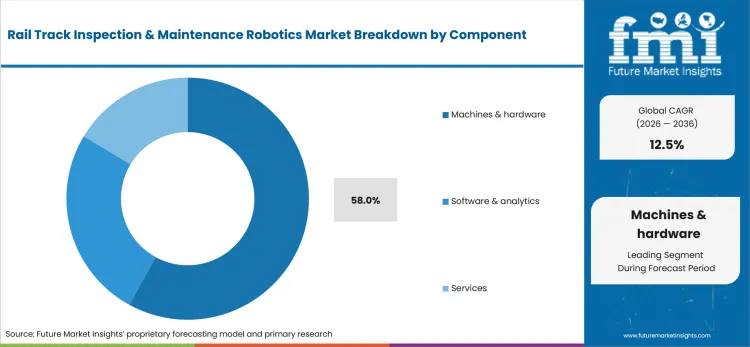
Machines & hardware include tamping equipment and onboard computing units designed for rugged rail service. Plasser & Theurer reported TampingControl operating on over 30 tamping machines in July 2026, highlighting measured cycle adjustments due to sensor-based control. Certified vehicle integration and vibration-resistant sensing keep equipment design central to field deployment.
- By component, machines & hardware are anticipated to secure 58.0% share in 2026 as it reflects equipment-intensive rail deployment and complex vehicle integration. Engineering teams compare sensor durability and mounting stability during vibration-intensive operating cycles.
- Software & analytics organize defect records from repeated surveys and maintenance planning workflows. Services cover technical training and equipment availability for operating regions with distinct rail standards.
Why do national infrastructure managers lead end-use demand?
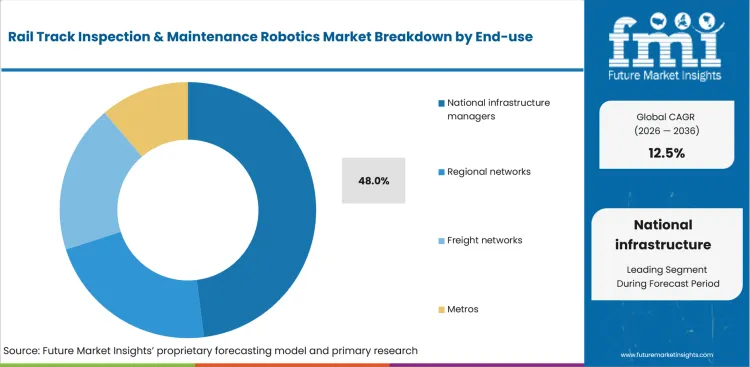
Network Rail reported in March 2025 owning more than 1,000 wagons, illustrating fleet control for centralized monitoring programs and maintenance logistics. Central governance creates shared defect thresholds and common maintenance records for regional operating teams. National infrastructure managers coordinate standards and inspection schedules on public rail networks under common asset policies.
- National infrastructure managers are expected to represent 48.0% share in 2026, influenced by coordinated network programs and common safety standards. Central teams compare route evidence through shared inspection thresholds and regional contractor groups.
- Regional networks focus on localized passenger routes, and freight networks examine heavy-haul corridors under distinct axle-load conditions. Metros prioritize frequent monitoring during restricted maintenance windows and repeated service cycles.
How do direct sales retain sales channel strength?
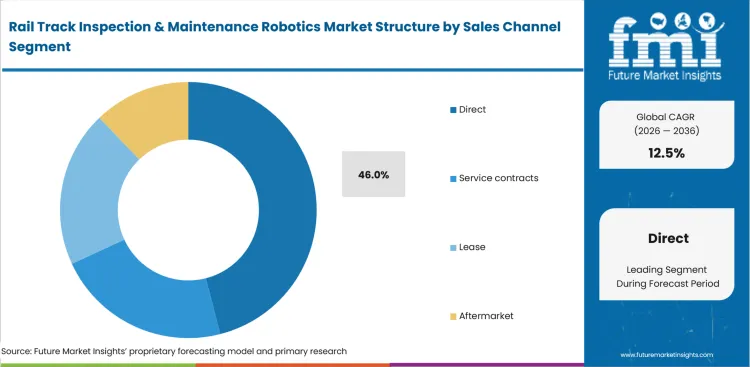
Goldschmidt announced an 8-year automated track inspection project for Poland in August 2025, combining inspection vehicles with software and maintenance support. Direct engagement covers validation planning and local service preparation during multi-year infrastructure programs. Direct sales support customized integration and long-term training for complex measurement fleets requiring company-led acceptance testing.
- Based on sales channel, direct sales are forecast to account for 46.0% share in 2026 owing to tailored delivery and route-specific acceptance work. Infrastructure teams assess integration records and operator training prior to commissioning complex measurement fleets.
- Service contracts provide recurring monitoring and expert review for installed systems under multi-year operating programs. Lease and aftermarket arrangements cover temporary equipment access or continuing support for existing fleets.
What are drivers, restraints, and opportunities in rail track inspection and maintenance robotics market?
Regulatory acceptance supports automated inspection records and revenue-service monitoring on active passenger or freight corridors. Certification complexity may delay deployment across mixed rail environments with distinct route standards and local acceptance procedures.
- Driver: Safety authorities accept automated defect records supporting frequent inspections without recurring walking exposure. Infrastructure managers value repeatable evidence for maintenance decisions on extensive operating routes and scheduled repair programs.
- Restraint: Certification programs extend deployment schedules through calibration checks and route-specific acceptance requirements. Mixed track classes require validated thresholds and specialist review under distinct operating conditions.
- Opportunity: Revenue-service sensing creates recurring analytics and support contracts for installed monitoring fleets. Passenger trains provide regular observation without dedicated inspection journeys during scheduled services.
Regulatory acceptance is projected to increase confidence in automated inspection evidence across freight and passenger corridors. United States Department of Transportation announced a 5-year waiver in December 2025, reflecting expanded automated track inspection testing and structured evaluation across participating railroads. Waiver-based field evidence is expected to improve acceptance protocols and railway telematics integration across participating operators.
Rail Accident Investigation Branch documented a train travelling at 104 mph near a track worker in April 2025, demonstrating exposure risks surrounding manual access during active operations. Route trials for inspection robots require validated clearance and communications procedures under local operating conditions. Certification and safe track access are anticipated to restrain deployment speed across complex infrastructure settings.
Revenue-service sensing is forecast to expand opportunities for recurring monitoring and predictive maintenance on operating corridors. Network Rail reported in November 2025 equipping Hotshot with 2 underbody cameras, producing continuous electrical asset observation during scheduled passenger operations. Service partners help convert repeated imagery into alert review and maintenance-planning agreements for operators.
How are country CAGRs aligned in rail track inspection and maintenance robotics market?
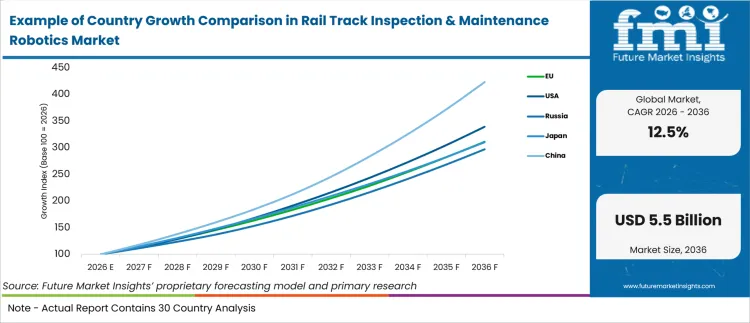
| Country or Market | CAGR |
|---|---|
| China | 15.5% |
| United States | 13.0% |
| European Union | 12.0% |
| Japan | 12.0% |
| Russia | 11.5% |
Source: Future Market Insights analysis, 2026.
How do country-level CAGRs compare in rail track inspection and maintenance robotics market?
The country comparison shows a gradual step-down in growth across the markets covered. China sits at the upper end of the range, while the United States forms the second tier. European Union and Japan follow with identical growth forecasts. Russia remains at the lower end of the comparison. The four-point spread shows that these markets share a positive growth outlook, although their relative positions indicate different levels of market momentum. European Union figure represents a regional average, so individual member countries may record higher or lower growth.
- China leads the comparison and establishes the strongest growth position among the markets shown.
- The United States follows, although its forecast remains below China by a visible margin.
- The European Union and Japan form the next growth band with identical forecast CAGRs.
- Russia records the slowest growth among the listed markets, yet its forecast remains positive within the wider market context.
- The pattern resembles a gradual downward slope rather than a sharp separation between high-growth and low-growth markets.
Markets with broadly similar CAGRs can still present different entry conditions due to network scale and railway safety requirements. The full report provides country-level analysis across North America, Latin America, Europe, East Asia, South Asia, Oceania and the Middle East and Africa.
Country-wise Analysis
- Rail track inspection and maintenance robotics sales in China are forecast to register 15.5% CAGR from 2026 and 2036 as extensive corridors increase automated inspection requirements. Local technical support strengthens equipment availability on heavily scheduled passenger routes and high-speed rail operations. China’s State Council reported more than 10,000 components requiring checks on a standard high-speed train in February 2025, reflecting automated review for complex assets.
- Federal Railroad Administration proposed automated inspection requirements in October 2024 for specified mainline traffic exceeding 10 million gross tons, creating formal geometry measurement conditions on covered routes. Freight networks value repeatable defect evidence throughout operating corridors serving heavy-haul and passenger services under regulated conditions. Industry in the United States is projected to expand at 13.0% CAGR during the study period, driven by regulatory testing influencing automated inspection programs.
- Cross-border operators require interoperable records supporting common safety and climate adaptation decisions on connected national networks. Sector in the European Union is expected to scale at 12.0% CAGR between 2026 and 2036, due to harmonized assessment practices encouraging shared monitoring methods. European Union Agency for Railways reported 70% of infrastructure managers perceiving rising extreme-weather impacts in March 2026, increasing condition-monitoring needs on exposed routes.
- The market in Japan is anticipated to rise at 12.0% CAGR during the assessment period, led by advanced rail engineering promoting specialized monitoring systems. High-density passenger operations favor compact onboard sensing with precise exception alerts on heavily scheduled urban corridors. Railway Technical Research Institute reported foreign-object detection reaching around 40 meters in March 2026, improving overhead-line response capability.
- Russian Railways reported in 2025 inspecting 12,501 kilometers of track bed and drainage structures during 2024, supporting unmanned coverage throughout remote infrastructure and varied terrain. Domestic service availability influences equipment selection under varied climate zones and long-distance corridors. Demand in Russia is estimated to post 11.5% CAGR by 2036, guided by extensive routes encouraging remote inspection technologies.
Who are notable companies in rail track inspection and maintenance robotics market?
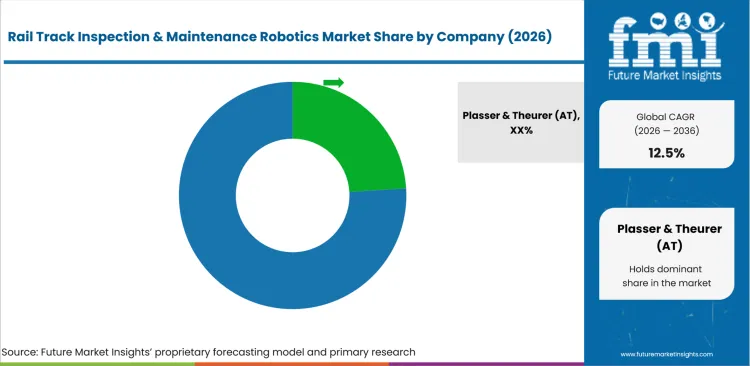
Plasser & Theurer supports integrated track maintenance machines and measurement systems throughout international infrastructure programs. MERMEC Group and ENSCO, Inc. provide diagnostic vehicles or geometry platforms for national rail operators. Loram Maintenance of Way, Inc. and Harsco Rail supply maintenance equipment or field services for heavy-duty routes. Goldschmidt Group and ROBEL Bahnbaumaschinen GmbH combine rail expertise with inspection or maintenance equipment. SPENO International SA specializes in rail grinding and condition measurement. Rail Vision Ltd. and Pavemetrics as part of Eddyfi Technologies, extend vision-based inspection options.
Competition involving railway maintenance machinery and inspection platforms is anticipated to center on measurement accuracy and service ownership. Rail teams compare companies based on portfolio depth and calibration support across inspection or maintenance programs. Sensor interoperability is expected to influence repeat orders as mixed fleets require consistent exception records. Established machinery groups compete driven by vehicle integration and long-term service capacity for national infrastructure programs. Vision specialists address compact installation and automated screening through revenue-service platforms operating under restricted access windows.
- Plasser & Theurer and MERMEC Group are estimated to compete depending on integrated measurement vehicles and maintenance platforms. Infrastructure managers are likely to assess system accuracy and continuing service coverage throughout multi-year programs.
- ENSCO, Inc. and Loram Maintenance of Way, Inc. are projected to emphasize track geometry systems and field support. Freight operators are expected to examine route coverage and calibration access throughout heavy-haul networks and recurring geometry programs.
- Goldschmidt Group and ROBEL Bahnbaumaschinen GmbH are anticipated to combine inspection equipment with rail maintenance expertise. Regional operators are forecast to evaluate equipment versatility and training support under varied track conditions.
- Rail Vision Ltd. and Pavemetrics are expected to advance industrial machine vision for automated defect screening. Rail teams are anticipated to compare image accuracy and exception review tools at operating speeds.
Competitive Benchmarking: Rail Track Inspection and Maintenance Robotics Market
| Company | Portfolio Depth | Rail Match | Service Support | Service Reach |
|---|---|---|---|---|
| Plasser & Theurer | High | High | High | Austria and global |
| MERMEC Group | High | High | High | Italy and global |
| ENSCO, Inc. | High | High | High | United States and global |
| Loram Maintenance of Way, Inc. | High | High | High | United States and global |
| Harsco Rail | High | High | High | United States and global |
| Goldschmidt Group | High | High | High | Germany and global |
| ROBEL Bahnbaumaschinen GmbH | High | High | High | Germany and global |
| SPENO International SA | High | High | High | Switzerland and global |
| Rail Vision Ltd. | Medium | High | Medium | Israel and global |
| Pavemetrics | Medium | High | Medium | Canada and global |
Source: Future Market Insights competitive analysis, 2026.
Key Developments in Rail Track Inspection and Maintenance Robotics Market
- In November 2025, Plasser & Theurer announced an order for 18 UnimatExpress 2X-4x4 Dynamic tamping machines from DB Bahnbau Group. Integrated geometry measurement and assisted tamping are expected to expand automated maintenance capacity across German rail infrastructure.
- In December 2025, ENSCO and Korea Railroad Research Institute signed a cooperation agreement covering railway safety and advanced testing. Access to a 52-square-mile test facility is anticipated to support validation of heavy-haul and high-speed inspection systems.
- In May 2026, Siemens Mobility signed an agreement to acquire key MERMEC businesses covering railway diagnostics and measurement technologies. Integration of around 1,700 employees is projected to expand diagnostic vehicle and analytics support following expected closing.
Key Players in Rail Track Inspection and Maintenance Robotics Market
Global system providers
- Plasser & Theurer
- MERMEC Group
- ENSCO, Inc.
- Siemens Mobility
Rail maintenance specialists
- Loram Maintenance of Way, Inc.
- Harsco Rail
- Goldschmidt Group
- ROBEL Bahnbaumaschinen GmbH
- SPENO International SA
Vision and sensing providers
- Rail Vision Ltd.
- Pavemetrics
Rail Track Inspection and Maintenance Robotics Market Report Scope
| Coverage field | Report scope |
|---|---|
| Market breakdown | Rail track inspection and maintenance robotics breakdown by technology, application, component, end-use, sales channel and region |
| Quantitative Units | USD billion in 2026 to USD billion by 2036 at a CAGR |
| Market Definition | Rail track inspection and maintenance robotics include automated systems measuring or maintaining track geometry, rail condition, catenary assets and related infrastructure. Adjacent robotics applications without direct rail inspection or maintenance use are excluded. |
| Regions Covered | North America and Latin America beside Western Europe, Eastern Europe, East Asia, South Asia and Pacific, Middle East and Africa |
| Countries Covered | United States, China, European Union, Japan, Russia, Canada, Brazil, Mexico, Germany, France, United Kingdom, Italy, Spain, Poland, India, ASEAN, Australia, New Zealand, GCC countries, South Africa and Türkiye |
| Key Companies Profiled | Plasser & Theurer, MERMEC Group, ENSCO, Inc., Loram Maintenance of Way, Inc., Harsco Rail, Goldschmidt Group, ROBEL Bahnbaumaschinen GmbH, SPENO International SA, Rail Vision Ltd. and Pavemetrics |
| Forecast Period | 2026 to 2036 |
| Approach | Hybrid bottom-up and top-down methodology using segment shares, country CAGR, route coverage, company portfolios, field evidence and service reach |
Source: Future Market Insights analysis, 2026.
Rail Track Inspection and Maintenance Robotics Market - Research Methodology
| Method | Approach |
|---|---|
| Primary Research | FMI analysts gathered input from manufacturers, service providers, technology developers, distributors, end users, procurement teams, and subject-matter experts. Interviews examined purchasing decisions, product or service evaluation, adoption barriers, approval requirements, pricing considerations, and expectations for technical or commercial support. Respondents were also asked what evidence is required before a trial, pilot, or initial order develops into regular purchasing. |
| Desk Research | Desk research covered government statistics, regulatory publications, trade data, industry associations, technical literature, standards, company filings, product information, and official corporate announcements. Sources were reviewed for relevance, publication date, geographic coverage, and consistency with the defined market scope. Claims relating to performance, applications, approvals, capacity, investment, and commercial activity were retained only when supported by credible public evidence. |
| Market Sizing and Forecasting | The market model combined the baseline value with historical performance, segment structure, pricing and volume indicators, adoption levels, company participation, and country-level demand conditions. Forecast assumptions considered economic activity, investment trends, regulatory developments, technology adoption, purchasing cycles, supply availability, and barriers to wider market use. Segment and regional estimates were reconciled before the final market total was calculated. |
| Data Validation | Estimates were checked against multiple independent indicators, including public data, company activity, trade patterns, industry developments, and findings from primary interviews. Validation also tested whether products, services, applications, and company revenues fell within the defined market boundaries. Adjacent categories, unsupported claims, overlapping revenues, and activities without direct market relevance were excluded to reduce double counting and maintain consistency across segments and countries. |
Source: Future Market Insights analysis, 2026.
Rail Track Inspection and Maintenance Robotics Market by Segments
Rail Track Inspection and Maintenance Robotics Market segmented by Technology:
- AI measuring trains
- Automated tamping machines
- Inspection crawlers - robots
- Vehicle-mounted imaging systems
Rail Track Inspection and Maintenance Robotics Market segmented by Application:
- Track geometry inspection
- Maintenance automation
- Rail defect detection
- Catenary inspection
Rail Track Inspection and Maintenance Robotics Market segmented by Component:
- Machines & hardware
- Software & analytics
- Services
Rail Track Inspection and Maintenance Robotics Market segmented by End-use:
- National infrastructure managers
- Regional networks
- Freight networks
- Metros
Rail Track Inspection and Maintenance Robotics Market segmented by Sales Channel:
- Direct
- Service contracts
- Lease
- Aftermarket
Rail Track Inspection and Maintenance Robotics Market segmented by Region:
- North America
- United States
- Canada
- Latin America
- Brazil
- Mexico
- Rest of Latin America
- Western Europe
- Germany
- France
- United Kingdom
- Italy
- Spain
- Rest of Western Europe
- Eastern Europe
- Russia
- Poland
- Romania
- Czech Republic
- Rest of Eastern Europe
- East Asia
- China
- Japan
- South Korea
- South Asia and Pacific
- India
- ASEAN
- Australia and New Zealand
- Rest of South Asia and Pacific
- Middle East and Africa
- GCC countries
- South Africa
- Türkiye
- Rest of Middle East and Africa
Research Sources and Bibliography
- ENSCO, Inc. (2024, November 22). ENSCO Rail completes ATGMS installation for Vale EFVM.
- ENSCO, Inc. (2025, December 3). ENSCO and Korea Railroad Research Institute sign memorandum of understanding to advance global railway research and innovation.
- European Union Agency for Railways. (2026, March 30). Rail resilience to climate change.
- Federal Railroad Administration. (2024, October 23). FRA proposes revised regulations to enhance track safety by pairing automated track inspection technology and human inspections.
- Goldschmidt Group. (2025, August 19). GRAW wins major contract for automated track inspection in Poland.
- Network Rail. (2025, March 20). Five things you didn’t know about our fleet.
- Network Rail. (2025, May 12). Innovating and developing at Network Rail.
- Network Rail. (2025, November 17). Hotshot: The train helping us spot faults before they happen.
- Office of Rail and Road. (2025, July 17). Annual report of health and safety on Britain’s railways 2024 to 2025: Track and train: Network Rail and train operators.
- Plasser & Theurer. (2025, November 26). Large-scale order for Plasser & Theurer: DB Bahnbau Group invests in 18 new universal tamping machines.
- Plasser & Theurer. (2026, July 6). We believe in railways: Plasser & Theurer at InnoTrans 2026.
- Rail Accident Investigation Branch. (2025, April 17). Report 06/2025: Track worker near miss at Chiltern Green.
- Railway Technical Research Institute. (2026, March 19). RTRI develops real-time detection and automatic response system for abnormalities in pantographs and overhead contact lines.
- Russian Railways. (2025). Innovation-driven development and digital transformation. In Sustainability report 2024.
- Siemens Mobility. (2026, May 14). Siemens acquires key businesses of MERMEC to strengthen its global rail technology portfolio.
- State Council of China. (2025, February 1). High-tech inspections bolster high-speed rail safety amid Spring Festival rush.
- State Council of China. (2025, February 13). Nation’s rail network continued to break records in 2024.
- United States Department of Transportation. (2025, December 5). Transportation secretary announces new temporary waiver program to better evaluate automated track inspection technology.
This bibliography is provided for reader reference and is not exhaustive. The full report contains the complete reference list and detailed citations.
This Report Answers
- What segments shape demand across technology, application, component, end-use and sales channel?
- How do infrastructure managers evaluate automated inspection systems prior to replacing manual route inspections?
- How do country CAGRs differ across profiled rail infrastructure programs?
- What companies compete through measurement accuracy and continuing service support?
- How are forecasts validated using a hybrid bottom-up and top-down approach?
- What factors do account teams address prior to wider fleet deployment?
- How do detection accuracy and calibration quality affect equipment selection?
- What limits return on investment for teams adding automated inspection systems?
- How do route trials and training guidance influence account approval?
- What company capabilities improve long-term account confidence?
Frequently Asked Questions
What supports demand in rail track inspection and maintenance robotics market?
Demand is likely to receive support from infrastructure managers needing repeatable defect records across extensive operating routes. Accounts are expected to favor companies combining measurement accuracy with dependable calibration and training support.
Who are key players in rail track inspection and maintenance robotics market?
Key companies are anticipated to include Plasser & Theurer and MERMEC Group among active system providers. ENSCO, Inc. and other specialists are likely to compete through inspection accuracy and continuing service support.
What restraint affects rail track inspection and maintenance robotics market?
A major restraint is deployment risk created by route-specific certification and mixed infrastructure conditions across operating networks. Accounts may delay expansion if systems lack validated thresholds or dependable calibration support for local track classes.
Why do executives track rail track inspection and maintenance robotics market?
Executives are expected to track automated rail inspection as safety evidence affects maintenance planning and capital allocation. Route coverage and service availability influence company reviews across national infrastructure programs.
What business problem does rail track inspection and maintenance robotics market address?
Rail track inspection and maintenance robotics addresses inspection gaps created by extensive routes and restricted access periods. Infrastructure managers need systems supporting repeatable records and timely maintenance decisions across active passenger or freight corridors.
What do account teams evaluate prior to selecting companies?
Account teams are likely to evaluate detection accuracy and route coverage prior to company approval. Local technical support and acceptance documentation are expected to guide final company review throughout route acceptance programs.
What limits return on investment for purchasing teams?
Return on investment weakens if route acceptance or data integration stays incomplete during deployment programs. Low utilization and delayed maintenance decisions reduce expected operating benefits throughout installed inspection fleets.
How do companies build long-term account confidence?
Companies build account confidence through consistent measurement quality and evidence specific to active railway operations. Calibration records and responsive troubleshooting are expected to influence repeat-order confidence across multi-year infrastructure programs.
Preview the report firsthand - request a free sample
Get SampleGet the brochure for pricing and purchase details.
Get PDFTable of Content
- Key Takeaways
- Market Size and CAGR
- Top Growth Driver
- Fastest Growing Segment
- Leading Region
- Key Companies
- Emerging Opportunities
- Executive Summary
- Global Market Outlook
- Demand-side Trends
- Supply-side Trends
- Technology Roadmap Analysis
- Analysis and Recommendations
- Analyst Perspective (What is happening? Why now? What should investors know?)
- Key Questions Answered
- How large is the market?
- What is the CAGR?
- What are key trends?
- Which region dominates?
- Who are the leaders?
- Market Overview
- Market Coverage / Taxonomy
- Market Definition / Scope / Limitations
- Research Methodology
- Chapter Orientation
- Analytical Lens and Working Hypotheses
- Market Structure, Signals, and Trend Drivers
- Benchmarking and Cross-market Comparability
- Market Sizing, Forecasting, and Opportunity Mapping
- Research Design and Evidence Framework
- Desk Research Programme (Secondary Evidence)
- Expert Input and Fieldwork (Primary Evidence)
- Tooling, Models, and Reference Databases
- Data Engineering and Model Build
- Quality Assurance and Audit Trail
- Market Background
- Market Dynamics (Drivers, Restraints, Opportunity, Trends)
- Scenario Forecast (Optimistic, Likely, Conservative)
- Impact Analysis
- AI Impact
- Sustainability Impact
- Regulatory Impact
- Technology Impact
- Consumer / Buyer Analysis
- Purchase Drivers
- Adoption Barriers
- Buyer Journey
- Opportunity Map Analysis
- Product Life Cycle Analysis
- Supply Chain Analysis
- Investment Feasibility Matrix
- Value Chain Analysis
- PESTLE and Porter's Analysis
- Regulatory Landscape
- Regional Parent Market Outlook
- Production and Consumption Statistics
- Import and Export Statistics
- Global Market Analysis and Forecast, 2021 to 2036
- Historical Market Size Value (USD Bn) Analysis, 2021 to 2025
- Current and Future Market Size Value (USD Bn) Projections, 2026 to 2036
- Y-o-Y Growth Trend Analysis
- Absolute $ Opportunity Analysis
- Global Market Pricing Analysis, 2021 to 2036
- Global Market Analysis and Forecast, By Technology, 2021 to 2036
- Introduction / Key Findings
- Historical Market Size Value (USD Bn) Analysis By Technology, 2021 to 2025
- Current and Future Market Size Value (USD Bn) Analysis and Forecast By Technology, 2026 to 2036
- AI measuring trains
- Automated tamping machines
- Inspection crawlers - robots
- Vehicle-mounted imaging systems
- AI measuring trains
- Y-o-Y Growth Trend Analysis By Technology, 2021 to 2025
- Absolute $ Opportunity Analysis By Technology, 2026 to 2036
- Global Market Analysis and Forecast, By Application, 2021 to 2036
- Introduction / Key Findings
- Historical Market Size Value (USD Bn) Analysis By Application, 2021 to 2025
- Current and Future Market Size Value (USD Bn) Analysis and Forecast By Application, 2026 to 2036
- Track geometry inspection
- Maintenance automation
- Rail defect detection
- Catenary inspection
- Track geometry inspection
- Y-o-Y Growth Trend Analysis By Application, 2021 to 2025
- Absolute $ Opportunity Analysis By Application, 2026 to 2036
- Global Market Analysis and Forecast, By Component, 2021 to 2036
- Introduction / Key Findings
- Historical Market Size Value (USD Bn) Analysis By Component, 2021 to 2025
- Current and Future Market Size Value (USD Bn) Analysis and Forecast By Component, 2026 to 2036
- Machines & hardware
- Software & analytics
- Services
- Machines & hardware
- Y-o-Y Growth Trend Analysis By Component, 2021 to 2025
- Absolute $ Opportunity Analysis By Component, 2026 to 2036
- Global Market Analysis and Forecast, By End-use, 2021 to 2036
- Introduction / Key Findings
- Historical Market Size Value (USD Bn) Analysis By End-use, 2021 to 2025
- Current and Future Market Size Value (USD Bn) Analysis and Forecast By End-use, 2026 to 2036
- National infrastructure managers
- Regional networks
- Freight networks
- Metros
- National infrastructure managers
- Y-o-Y Growth Trend Analysis By End-use, 2021 to 2025
- Absolute $ Opportunity Analysis By End-use, 2026 to 2036
- Global Market Analysis and Forecast, By Sales Channel, 2021 to 2036
- Introduction / Key Findings
- Historical Market Size Value (USD Bn) Analysis By Sales Channel, 2021 to 2025
- Current and Future Market Size Value (USD Bn) Analysis and Forecast By Sales Channel, 2026 to 2036
- Direct
- Service contracts
- Lease
- Aftermarket
- Direct
- Y-o-Y Growth Trend Analysis By Sales Channel, 2021 to 2025
- Absolute $ Opportunity Analysis By Sales Channel, 2026 to 2036
- Global Market Analysis and Forecast, By Region, 2021 to 2036
- Introduction
- Historical Market Size Value (USD Bn) Analysis By Region, 2021 to 2025
- Current Market Size Value (USD Bn) Analysis and Forecast By Region, 2026 to 2036
- North America
- Latin America
- Western Europe
- Eastern Europe
- East Asia
- South Asia and Pacific
- Middle East & Africa
- Market Attractiveness Analysis By Region
- North America Market Analysis and Forecast, By Country, 2021 to 2036
- Historical Market Size Value (USD Bn) Trend Analysis By Market Taxonomy, 2021 to 2025
- Market Size Value (USD Bn) Forecast By Market Taxonomy, 2026 to 2036
- By Country
- USA
- Canada
- By Technology
- By Application
- By Component
- By End-use
- By Sales Channel
- By Country
- Market Attractiveness Analysis
- By Country
- By Technology
- By Application
- By Component
- By End-use
- By Sales Channel
- Key Takeaways
- Latin America Market Analysis and Forecast, By Country
- Historical Market Size Value (USD Bn) Trend Analysis By Market Taxonomy, 2021 to 2025
- Market Size Value (USD Bn) Forecast By Market Taxonomy, 2026 to 2036
- By Country
- Brazil
- Mexico
- Chile
- Rest of Latin America
- By Technology
- By Application
- By Component
- By End-use
- By Sales Channel
- By Country
- Market Attractiveness Analysis
- By Country
- By Technology
- By Application
- By Component
- By End-use
- By Sales Channel
- Key Takeaways
- Western Europe Market Analysis and Forecast, By Country
- Historical Market Size Value (USD Bn) Trend Analysis By Market Taxonomy, 2021 to 2025
- Market Size Value (USD Bn) Forecast By Market Taxonomy, 2026 to 2036
- By Country
- Germany
- UK
- Italy
- Spain
- France
- Nordic
- BENELUX
- Rest of Western Europe
- By Technology
- By Application
- By Component
- By End-use
- By Sales Channel
- By Country
- Market Attractiveness Analysis
- By Country
- By Technology
- By Application
- By Component
- By End-use
- By Sales Channel
- Key Takeaways
- Eastern Europe Market Analysis and Forecast, By Country
- Historical Market Size Value (USD Bn) Trend Analysis By Market Taxonomy, 2021 to 2025
- Market Size Value (USD Bn) Forecast By Market Taxonomy, 2026 to 2036
- By Country
- Russia
- Poland
- Hungary
- Balkan & Baltic
- Rest of Eastern Europe
- By Technology
- By Application
- By Component
- By End-use
- By Sales Channel
- By Country
- Market Attractiveness Analysis
- By Country
- By Technology
- By Application
- By Component
- By End-use
- By Sales Channel
- Key Takeaways
- East Asia Market Analysis and Forecast, By Country
- Historical Market Size Value (USD Bn) Trend Analysis By Market Taxonomy, 2021 to 2025
- Market Size Value (USD Bn) Forecast By Market Taxonomy, 2026 to 2036
- By Country
- China
- Japan
- South Korea
- By Technology
- By Application
- By Component
- By End-use
- By Sales Channel
- By Country
- Market Attractiveness Analysis
- By Country
- By Technology
- By Application
- By Component
- By End-use
- By Sales Channel
- Key Takeaways
- South Asia and Pacific Market Analysis and Forecast, By Country
- Historical Market Size Value (USD Bn) Trend Analysis By Market Taxonomy, 2021 to 2025
- Market Size Value (USD Bn) Forecast By Market Taxonomy, 2026 to 2036
- By Country
- India
- ASEAN
- Australia & New Zealand
- Rest of South Asia and Pacific
- By Technology
- By Application
- By Component
- By End-use
- By Sales Channel
- By Country
- Market Attractiveness Analysis
- By Country
- By Technology
- By Application
- By Component
- By End-use
- By Sales Channel
- Key Takeaways
- Middle East & Africa Market Analysis and Forecast, By Country
- Historical Market Size Value (USD Bn) Trend Analysis By Market Taxonomy, 2021 to 2025
- Market Size Value (USD Bn) Forecast By Market Taxonomy, 2026 to 2036
- By Country
- Kingdom of Saudi Arabia
- Other GCC Countries
- Türkiye
- South Africa
- Other African Union
- Rest of Middle East & Africa
- By Technology
- By Application
- By Component
- By End-use
- By Sales Channel
- By Country
- Market Attractiveness Analysis
- By Country
- By Technology
- By Application
- By Component
- By End-use
- By Sales Channel
- Key Takeaways
- Key Countries Market Analysis
- USA
- Pricing Analysis
- Market Share Analysis, 2025
- By Technology
- By Application
- By Component
- By End-use
- By Sales Channel
- Canada
- Pricing Analysis
- Market Share Analysis, 2025
- By Technology
- By Application
- By Component
- By End-use
- By Sales Channel
- Mexico
- Pricing Analysis
- Market Share Analysis, 2025
- By Technology
- By Application
- By Component
- By End-use
- By Sales Channel
- Brazil
- Pricing Analysis
- Market Share Analysis, 2025
- By Technology
- By Application
- By Component
- By End-use
- By Sales Channel
- Chile
- Pricing Analysis
- Market Share Analysis, 2025
- By Technology
- By Application
- By Component
- By End-use
- By Sales Channel
- Germany
- Pricing Analysis
- Market Share Analysis, 2025
- By Technology
- By Application
- By Component
- By End-use
- By Sales Channel
- UK
- Pricing Analysis
- Market Share Analysis, 2025
- By Technology
- By Application
- By Component
- By End-use
- By Sales Channel
- Italy
- Pricing Analysis
- Market Share Analysis, 2025
- By Technology
- By Application
- By Component
- By End-use
- By Sales Channel
- Spain
- Pricing Analysis
- Market Share Analysis, 2025
- By Technology
- By Application
- By Component
- By End-use
- By Sales Channel
- France
- Pricing Analysis
- Market Share Analysis, 2025
- By Technology
- By Application
- By Component
- By End-use
- By Sales Channel
- India
- Pricing Analysis
- Market Share Analysis, 2025
- By Technology
- By Application
- By Component
- By End-use
- By Sales Channel
- ASEAN
- Pricing Analysis
- Market Share Analysis, 2025
- By Technology
- By Application
- By Component
- By End-use
- By Sales Channel
- Australia & New Zealand
- Pricing Analysis
- Market Share Analysis, 2025
- By Technology
- By Application
- By Component
- By End-use
- By Sales Channel
- China
- Pricing Analysis
- Market Share Analysis, 2025
- By Technology
- By Application
- By Component
- By End-use
- By Sales Channel
- Japan
- Pricing Analysis
- Market Share Analysis, 2025
- By Technology
- By Application
- By Component
- By End-use
- By Sales Channel
- South Korea
- Pricing Analysis
- Market Share Analysis, 2025
- By Technology
- By Application
- By Component
- By End-use
- By Sales Channel
- Russia
- Pricing Analysis
- Market Share Analysis, 2025
- By Technology
- By Application
- By Component
- By End-use
- By Sales Channel
- Poland
- Pricing Analysis
- Market Share Analysis, 2025
- By Technology
- By Application
- By Component
- By End-use
- By Sales Channel
- Hungary
- Pricing Analysis
- Market Share Analysis, 2025
- By Technology
- By Application
- By Component
- By End-use
- By Sales Channel
- Kingdom of Saudi Arabia
- Pricing Analysis
- Market Share Analysis, 2025
- By Technology
- By Application
- By Component
- By End-use
- By Sales Channel
- Türkiye
- Pricing Analysis
- Market Share Analysis, 2025
- By Technology
- By Application
- By Component
- By End-use
- By Sales Channel
- South Africa
- Pricing Analysis
- Market Share Analysis, 2025
- By Technology
- By Application
- By Component
- By End-use
- By Sales Channel
- USA
- Market Structure Analysis
- Competition Dashboard
- Competition Benchmarking
- Market Share Analysis of Top Players
- By Regional
- By Technology
- By Application
- By Component
- By End-use
- By Sales Channel
- Emerging Startups
- Innovation Benchmarking
- Competition Analysis
- Competition Deep Dive
- Plasser & Theurer (AT)
- Overview
- Product Portfolio
- Profitability by Market Segments
- Sales Footprint
- Strategy Overview
- Marketing Strategy
- Product Strategy
- Channel Strategy
- MERMEC (IT)
- ENSCO (US)
- Loram (US)
- Plasser & Theurer (AT)
- Case Studies
- Success Stories
- Recent Developments
- Competition Deep Dive
- Assumptions & Acronyms Used


