

- Industry Size (2026)
- USD 84.7 Mn
- Forecast (2036)
- USD 134.7 Mn
- CAGR (2026 to 2036)
- 4.8%
Demand for Annatto Food Colors in USA 2026 to 2036
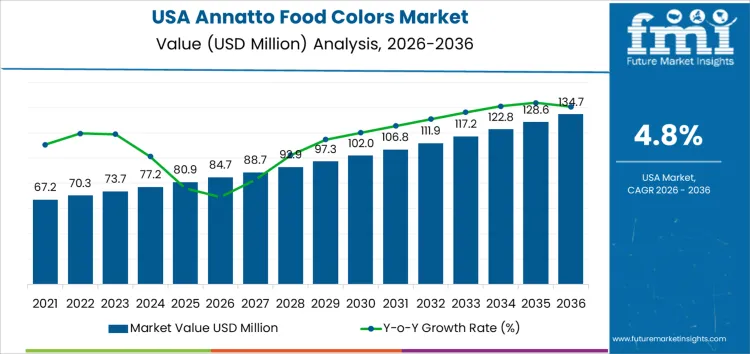
Demand for annatto food colors in USA is valued at USD 84.7 million in 2026 and is forecasted to reach USD 134.7 million by 2036, reflecting a CAGR of 4.8%. Demand grows as food manufacturers increase use of plant-derived colorants to meet clean-label expectations and regulatory acceptance. Expansion of processed foods, snacks, dairy alternatives, and prepared meals supports steady adoption.
Quick Stats for Demand for Annatto Food Colors in USA
- USA Annatto Food Colors Sales Value (2026): USD 84.7 million
- USA Annatto Food Colors Forecast Value (2036): USD 134.7 million
- USA Annatto Food Colors Forecast CAGR (2026 to 2036): 4.8%
- Leading Nature Segment in USA: Conventional Annatto
- Key Growth Regions in USA: West USA, South USA, Northeast USA, Midwest USA
- Top Players in USA: Sensient Food Colors, DDW The Colour House, Chr. Hansen, Naturex (Givaudan), Kalsec
Conventional annatto leads nature-segment usage because it delivers consistent yellow-to-orange shades, good heat stability, and cost-effective performance in large-scale food processing. Manufacturers apply annatto in cheese, bakery products, sauces, and snacks where color uniformity and formulation compatibility are critical. Established extraction and standardization practices support reliable supply and predictable coloring outcomes.
West USA, South USA, Northeast USA, and Midwest USA represent key growth regions supported by large food processing clusters and packaged food consumption. Sensient Food Colors, DDW The Colour House, Chr. Hansen, Naturex (Givaudan), and Kalsec anchor competitive activity through application expertise, standardized color systems, and portfolios aligned with U.S. food safety, labeling, and formulation requirements.
USA Annatto Food Colors Key Takeaways
| Metric | Value |
|---|---|
| USA Annatto Food Colors Sales Value (2026) | USD 84.7 million |
| USA Annatto Food Colors Forecast Value (2036) | USD 134.7 million |
| USA Annatto Food Colors Forecast CAGR (2026 to 2036) | 4.8% |
Why is the Demand for Annatto Food Colors in USA Growing?
Demand for annatto food colors in the United States grows due to increasing preference for naturally derived ingredients across packaged food and beverage categories. Food manufacturers replace synthetic dyes with plant based colorants to align with clean label expectations and simplified ingredient statements. Annatto delivers yellow to orange shades suited for dairy products, cheese alternatives, snacks, bakery items, sauces, and ready meals consumed at scale. Regulatory acceptance and long standing use history support continued application across industrial food processing.
Growth in processed and convenience foods increases reliance on colorants that maintain stability during heat treatment, freezing, and extended shelf storage. Consumers associate natural colors with transparency and perceived quality, influencing purchasing behavior. Expansion of plant based and organic product lines strengthens demand for botanical pigments compatible with non-synthetic positioning. Annatto performs effectively in fat based and emulsified systems common in American food formulations. Supply availability from established agricultural sources supports consistent procurement for large manufacturers. Product development teams value annatto for predictable color performance and formulation flexibility across multiple food matrices.
How Are the Segments Classified in the Demand for Annatto Food Colors in USA?
Demand for annatto food colors in USA is shaped by clean-label positioning, regulatory acceptance of natural colorants, and visual consistency requirements in processed foods. Manufacturers evaluate color stability, heat tolerance, dispersion behavior, and scalability within industrial production lines. Adoption patterns reflect sustained usage across dairy, bakery, and beverage categories, supported by consumer preference for naturally derived ingredients and standardized product appearance.
Which Nature Category Accounts for the Highest Demand for Annatto Food Colors in USA?
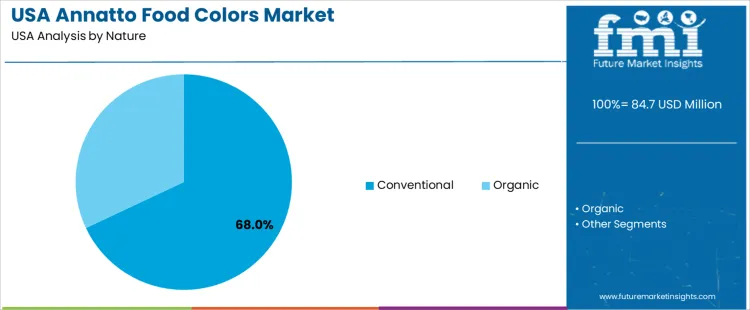
Conventional annatto holds 68.0%, accounting for the highest share in USA demand. Conventional variants provide consistent pigment strength, reliable supply availability, and cost efficiency for large-scale food manufacturing. These attributes support widespread application in mass-market dairy, bakery, and prepared food products. Organic annatto holds 32.0%, serving formulations aligned with organic certification and premium positioning. Nature-based distribution reflects stronger dependence on conventional annatto due to formulation predictability, processing stability, and alignment with mainstream USA food production volumes.
Key Points
- Conventional annatto dominates due to consistency and scalability.
- Cost efficiency supports high-volume food manufacturing.
- Organic variants serve certified and premium product lines.
Which Application Segment Generates the Largest Demand for Annatto Food Colors in USA?
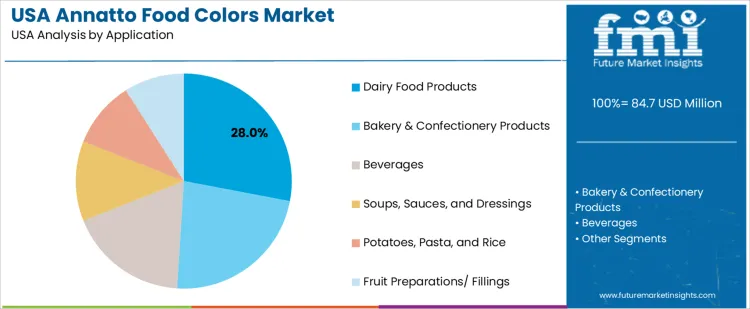
Dairy food products hold 28.0%, generating the largest application demand in USA. Annatto is widely used to standardize color in cheese, butter, and dairy spreads. Bakery and confectionery products hold 23.0%, using annatto to enhance visual appeal of baked goods and fillings. Beverages account for 18.0%, applying annatto in flavored drinks and specialty formulations. Soups, sauces, and dressings hold 12.0%, while potatoes, pasta, rice, and fruit preparations together account for 19.0%. Application distribution reflects strong reliance on dairy color standardization across USA processing facilities.
Key Points
- Dairy products lead due to standardized color expectations.
- Bakery and confectionery rely on consistent visual quality.
- Beverages and prepared foods support diversified usage.
Which Form Is Most Preferred for Annatto Food Colors in USA?
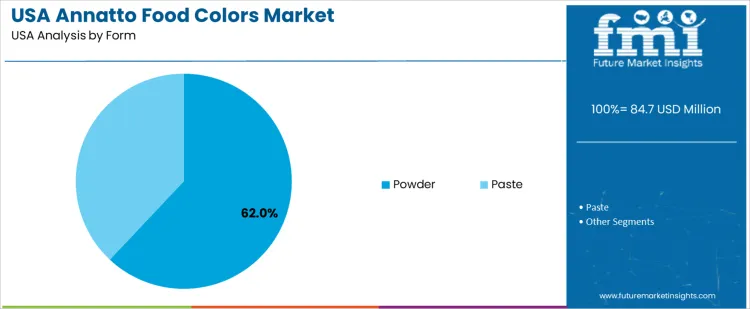
Powder form holds 62.0%, making it the most preferred form in USA demand. Powdered annatto offers longer shelf stability, easier storage, and precise dosing in automated manufacturing systems. These characteristics support widespread use in dry mixes, dairy formulations, and bakery premixes. Paste form holds 38.0%, favored for applications requiring rapid dispersion in liquid or semi-liquid matrices. Form-based distribution reflects preference for powders due to operational efficiency and compatibility with large-scale USA food processing workflows.
Key Points
- Powder form leads due to stability and dosing accuracy.
- Dry formats align with automated processing lines.
- Paste form supports liquid-based formulations.
What are the Key Dynamics in the Annatto Food Colors Industry?
Demand rises as food and beverage manufacturers in USA seek natural colorants to replace synthetic dyes and align with clean-label trends. Annatto food colors provide yellow to orange hues used in dairy, snacks, bakery, sauces, and confectionery products. Adoption aligns with regulatory acceptance by FDA, growing consumer preference for plant-derived ingredients, and food safety standards. Usage concentrates in packaged foods where visual appeal supports purchase decisions across retail and foodservice channels.
How do clean-label priorities and product appearance requirements drive demand in USA?
US consumers increasingly associate natural ingredients with health and quality, prompting formulators to seek plant-based alternatives to synthetic colorants. Annatto delivers stable orange to yellow tones without artificial labeling, fitting clean-label positioning. Food processors apply annatto in cheeses, butter substitutes, flavored chips, baked goods, sauces, and dressings where color consistency affects sensory appeal and shelf presence. Retail brands emphasize ingredient transparency on packaging to meet shopper expectations. Regulatory frameworks permit controlled use of annatto within defined limits, supporting widespread application. Demand remains strong where visual identity and natural claims contribute to competitive product differentiation.
How do supply chain variability, formulation challenges, and cost considerations influence demand stability in USA?
Annatto supply depends on imported seeds and extract processing, exposing formulators to price fluctuation and logistical variability. Color intensity varies by extract grade, requiring careful formulation to achieve consistent visual results. Some applications challenge annatto stability under extremes of pH, heat, or light exposure, limiting use in specific processing conditions. Cost differentials relative to synthetic alternatives affect adoption in price-sensitive categories. Labeling and allergen disclosure requirements add compliance workload for manufacturers. Competition from alternative natural colorants influences specification choices in some segments. Demand remains stable in natural-focused products while growth depends on supply reliability and formulation optimization within USA food manufacturing sectors.
How Is Demand for Annatto Food Colors in the USA Evolving by Region?
Demand for annatto food colors in the USA is increasing due to clean-label reformulation, preference for plant-derived ingredients, and replacement of synthetic additives. West USA leads with a 5.5% CAGR, supported by natural food brands and reformulation-focused processors. South USA follows at 4.9%, driven by packaged food production, sauces, and snack manufacturing. Northeast USA records a 4.4% CAGR, shaped by regulatory scrutiny, premium food positioning, and ingredient transparency requirements. Midwest USA posts 3.8%, reflecting large-scale food processing and cost-managed ingredient substitution. Regional differences reflect formulation strategies, processing scale, and pace of natural color adoption across food categories in the USA.
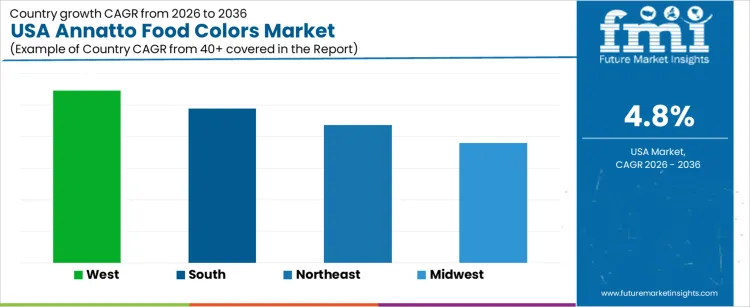
| Region | CAGR (2026 to 2036) |
|---|---|
| West USA | 5.5% |
| South USA | 4.9% |
| Northeast USA | 4.4% |
| Midwest USA | 3.8% |
How is West USA driving demand for Annatto Food Colors in the USA?
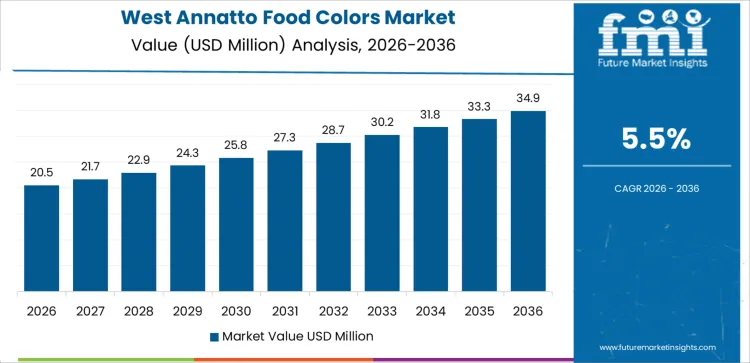
West USA drives demand through concentration of natural food manufacturers, organic brands, and clean-label product development. Region’s CAGR of 5.5% reflects extensive use of annatto food colors in dairy alternatives, snacks, dressings, and plant-based foods. Producers prioritize annatto for stability, visual consistency, and compatibility with oil-based formulations. Product innovation cycles encourage frequent reformulation to remove artificial colors. Companies emphasize traceable sourcing and compliance with labeling expectations. Demand favors standardized liquid and oil-dispersible formats suited for automated processing. Growth remains innovation-led, aligned with consumer preference for recognizable ingredients and transparent formulations.
- Natural and organic food brand concentration
- Plant-based and dairy alternative applications
- Clean-label driven reformulation activity
- Preference for standardized liquid color formats
How is South USA driving demand for Annatto Food Colors in the USA?
South USA demand is shaped by large-scale packaged food manufacturing, snack production, and condiment processing. Region’s CAGR of 4.9% reflects adoption of annatto food colors in sauces, seasonings, bakery fillings, and processed foods. Manufacturers focus on cost efficiency, supply reliability, and consistent color output across high-volume lines. Annatto supports replacement of synthetic colors without altering taste profiles. Regional processors emphasize heat stability and batch uniformity. Demand growth aligns with steady packaged food consumption and incremental ingredient substitution rather than premium product launches.
- High-volume packaged food manufacturing
- Sauces and snack product applications
- Cost-controlled ingredient substitution
- Emphasis on batch consistency
How is Northeast USA driving demand for Annatto Food Colors in the USA?
Northeast USA demand reflects premium food positioning, regulatory awareness, and ingredient transparency priorities. Region’s CAGR of 4.4% is supported by use of annatto food colors in specialty foods, dairy products, and prepared meals. Producers emphasize compliance with labeling standards and consumer trust. Reformulation projects replace artificial dyes while maintaining product appearance. Demand favors suppliers offering documentation, traceability, and consistent specifications. Growth remains regulation-aligned and quality-focused, linked to premium and private-label food segments.
- Premium and specialty food production
- Regulatory and labeling compliance focus
- Artificial color replacement initiatives
- Traceability and documentation requirements
How is Midwest USA driving demand for Annatto Food Colors in the USA?
Midwest USA demand is anchored in large food processing facilities and private-label manufacturing. Region’s CAGR of 3.8% reflects measured adoption of annatto food colors for cost-effective replacement of synthetic additives. Producers prioritize supply stability, pricing predictability, and compatibility with existing formulations. Annatto is used selectively in dairy, bakery, and ready-meal products. Demand growth remains steady and process-driven, aligned with long production runs and conservative formulation changes rather than frequent innovation cycles.
- Large-scale food processing operations
- Private-label product manufacturing
- Cost and supply stability priorities
- Conservative formulation change patterns
What is the competitive landscape of demand for annatto food colors in the USA?
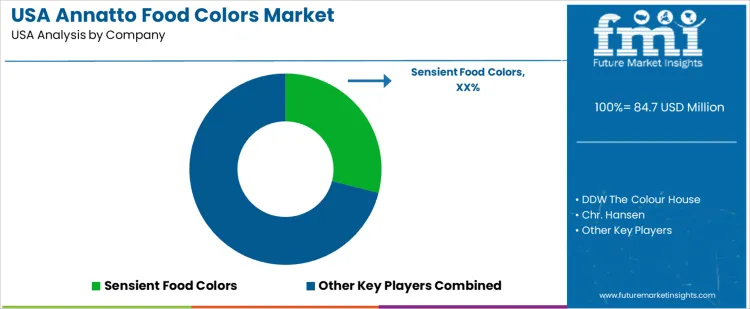
Demand for annatto food colors in the USA is driven by use in confectionery, bakery products, beverages, dairy and dairy-alternative items, and savory snacks seeking natural colorants. Buyers evaluate color intensity, hue stability under thermal processing, solubility, regulatory compliance with FDA food additive standards, and presence of legally permitted impurity levels. Procurement teams prioritize suppliers with food-grade certification, clear documentation of source traceability, and distribution networks capable of serving national food manufacturers. Trend in the USA market reflects rising interest in clean-label ingredients, gradual shift from synthetic dyes to plant-derived colors, and formulation innovation to meet sensory and stability requirements.
Sensient Food Colors holds a leading position through extensive U.S. operations supplying annatto extracts and customized natural color systems tailored to food manufacturers’ processing and labeling needs. DDW The Colour House participates with natural pigment solutions including annatto, supported by technical formulation assistance for specific product categories. Chr. Hansen USA contributes natural color portfolios incorporating annatto extracts used by beverage, dairy, and bakery producers. Naturex (Givaudan) supports demand with integrated flavor and color ingredient solutions including annatto fractions for clean-label applications. Kalsec USA maintains visibility with natural color and spice extract offerings that include annatto used in savory and snack formulations. Competitive positioning in the USA reflects regulatory compliance, pigment consistency, formulation expertise, and reliable distribution across key food processing segments.
Key Players in USA Annatto Food Colors Demand
- Sensient Food Colors
- DDW The Colour House
- Chr. Hansen
- Naturex (Givaudan)
- Kalsec
Scope of the Report
| Items | Details |
|---|---|
| Quantitative Units | USD million |
| Nature | Conventional; Organic |
| Application | Dairy Food Products; Bakery & Confectionery Products; Beverages; Soups, Sauces, and Dressings; Potatoes, Pasta, and Rice; Fruit Preparations / Fillings |
| Form | Powder; Paste |
| Type | Water-soluble Annatto; Oil-soluble Annatto; Emulsified and Solvent-extracted Annatto |
| Regions Covered | West USA; South USA; Northeast USA; Midwest USA |
| Key Companies Profiled | Sensient Food Colors; DDW The Colour House; Chr. Hansen; Naturex (Givaudan); Kalsec |
| Additional Attributes | Demand is supported by clean-label coloring requirements in dairy and bakery products. Water-soluble variants dominate beverage and sauce applications, while oil-soluble formats serve cheese and fat-rich foods. Regulatory compliance, natural color replacement, and shelf-stability performance influence procurement decisions. |
USA Annatto Food Colors Demand by Segments
Nature:
- Conventional
- Organic
Application:
- Dairy Food Products
- Bakery & Confectionery Products
- Beverages
- Soups, Sauces, and Dressings
- Potatoes, Pasta, and Rice
- Fruit Preparations/ Fillings
Form:
- Powder
- Paste
Type:
- Water-soluble Annatto
- Oil-soluble Annatto
- Emulsified and Solvent-extracted Annatto
Region:
- West USA
- South USA
- Northeast USA
- Midwest USA
Frequently Asked Questions
How big is the demand for annatto food colors in USA in 2026?
The demand for annatto food colors in USA is estimated to be valued at USD 84.7 million in 2026.
What will be the size of annatto food colors in USA in 2036?
The market size for the annatto food colors in USA is projected to reach USD 134.7 million by 2036.
How much will be the demand for annatto food colors in USA growth between 2026 and 2036?
The demand for annatto food colors in USA is expected to grow at a 4.8% CAGR between 2026 and 2036.
What are the key product types in the annatto food colors in USA?
The key product types in annatto food colors in USA are conventional and organic.
Which application segment is expected to contribute significant share in the annatto food colors in USA in 2026?
In terms of application, dairy food products segment is expected to command 28.0% share in the annatto food colors in USA in 2026.
Preview the report firsthand - request a free sample
Get SampleGet the brochure for pricing and purchase details.
Get PDFTable of Content
- Executive Summary
- USA Market Outlook
- Demand-side Trends
- Supply-side Trends
- Technology Roadmap Analysis
- Analysis and Recommendations
- Market Overview
- Market Coverage / Taxonomy
- Market Definition / Scope / Limitations
- Market Background
- Market Dynamics
- Drivers
- Restraints
- Opportunity
- Trends
- Scenario Forecast
- Demand in Optimistic Scenario
- Demand in Likely Scenario
- Demand in Conservative Scenario
- Opportunity Map Analysis
- Product Life Cycle Analysis
- Supply Chain Analysis
- Investment Feasibility Matrix
- Value Chain Analysis
- PESTLE and Porter’s Analysis
- Regulatory Landscape
- Regional Parent Market Outlook
- Production and Consumption Statistics
- Import and Export Statistics
- Market Dynamics
- USA Market Analysis 2021 to 2025 and Forecast, 2026 to 2036
- Historical Market Size Value (USD Million) Analysis, 2021 to 2025
- Current and Future Market Size Value (USD Million) Projections, 2026 to 2036
- Y-o-Y Growth Trend Analysis
- Absolute $ Opportunity Analysis
- USA Market Pricing Analysis 2021 to 2025 and Forecast 2026 to 2036
- USA Market Analysis 2021 to 2025 and Forecast 2026 to 2036, By Nature
- Introduction / Key Findings
- Historical Market Size Value (USD Million) Analysis By Nature , 2021 to 2025
- Current and Future Market Size Value (USD Million) Analysis and Forecast By Nature , 2026 to 2036
- Conventional
- Organic
- Conventional
- Y-o-Y Growth Trend Analysis By Nature , 2021 to 2025
- Absolute $ Opportunity Analysis By Nature , 2026 to 2036
- USA Market Analysis 2021 to 2025 and Forecast 2026 to 2036, By Application
- Introduction / Key Findings
- Historical Market Size Value (USD Million) Analysis By Application, 2021 to 2025
- Current and Future Market Size Value (USD Million) Analysis and Forecast By Application, 2026 to 2036
- Dairy Food Products
- Bakery & Confectionery Products
- Beverages
- Soups, Sauces, and Dressings
- Potatoes, Pasta, and Rice
- Fruit Preparations/ Fillings
- Dairy Food Products
- Y-o-Y Growth Trend Analysis By Application, 2021 to 2025
- Absolute $ Opportunity Analysis By Application, 2026 to 2036
- USA Market Analysis 2021 to 2025 and Forecast 2026 to 2036, By Form
- Introduction / Key Findings
- Historical Market Size Value (USD Million) Analysis By Form, 2021 to 2025
- Current and Future Market Size Value (USD Million) Analysis and Forecast By Form, 2026 to 2036
- Powder
- Paste
- Powder
- Y-o-Y Growth Trend Analysis By Form, 2021 to 2025
- Absolute $ Opportunity Analysis By Form, 2026 to 2036
- USA Market Analysis 2021 to 2025 and Forecast 2026 to 2036, By Type
- Introduction / Key Findings
- Historical Market Size Value (USD Million) Analysis By Type, 2021 to 2025
- Current and Future Market Size Value (USD Million) Analysis and Forecast By Type, 2026 to 2036
- Water-soluble Annatto
- Oil-soluble Annatto
- Emulsified and Solvent-extracted Annatto
- Water-soluble Annatto
- Y-o-Y Growth Trend Analysis By Type, 2021 to 2025
- Absolute $ Opportunity Analysis By Type, 2026 to 2036
- Market Structure Analysis
- Competition Dashboard
- Competition Benchmarking
- Market Share Analysis of Top Players
- By Regional
- By Nature
- By Application
- By Form
- By Type
- Competition Analysis
- Competition Deep Dive
- Sensient Food Colors
- Overview
- Product Portfolio
- Profitability by Market Segments (Product/Age /Sales Channel/Region)
- Sales Footprint
- Strategy Overview
- Marketing Strategy
- Product Strategy
- Channel Strategy
- DDW The Colour House
- Chr. Hansen
- Naturex (Givaudan)
- Kalsec
- Sensient Food Colors
- Competition Deep Dive
- Assumptions & Acronyms Used
- Research Methodology


