

- Industry Size (2025)
- USD 334.5 Mn
- Forecast (2035)
- USD 587.6 Mn
- CAGR (2025 to 2035)
- 5.8%
Demand for Essential Thrombocythemia in USA Forecast and Outlook 2025 to 2035
The demand for essential thrombocythemia (ET) treatments in the USA is projected to grow from USD 334.5 million in 2025 to USD 587.6 million in 2035, with a CAGR of 5.80%. Over the first few years from 2025 to 2028, the industry experiences steady growth, with demand rising from USD 334.5 million to USD 353.9 million. This early phase is primarily driven by the increasing awareness of ET as a chronic condition, leading to more accurate diagnoses and an expanding patient population. The rising prevalence of ET, combined with advancements in medical research and improved treatment options, contributes significantly to the industry's growth. During this period, healthcare professionals are becoming more adept at identifying the disease earlier, thus driving the demand for targeted therapies and monitoring solutions.
Quick Stats of the Demand for Essential Thrombocythemia in USA
- Demand for Essential Thrombocythemia in USA Value (2025): USD 334.5 million
- Demand for Essential Thrombocythemia in USA Forecast Value (2035): USD 587.6 million
- Demand for Essential Thrombocythemia in USA Forecast CAGR (2025-2035): 5.8%
- Demand for Essential Thrombocythemia in USA Leading Treatment Drug Type: Aspirin
- Demand for Essential Thrombocythemia in USA Key Growth Regions: West USA, South USA, Northeast USA, Midwest USA
- Demand for Essential Thrombocythemia in USA Top Players: Novartis AG, Bristol Myers Squibb, Incyte Corporation, Pfizer Inc., Merck & Co., Inc.
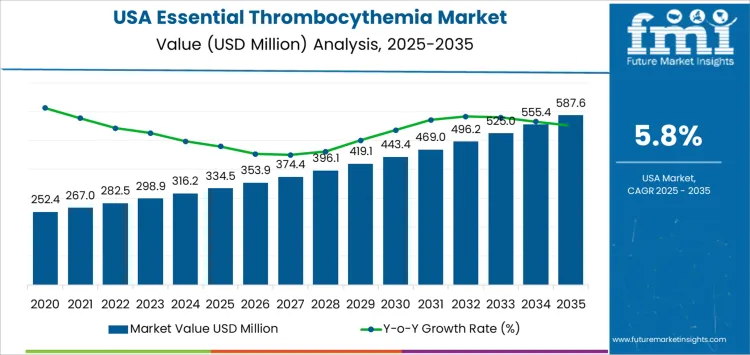
The industry is expected to see a more pronounced rise in demand, from USD 396.1 million in 2029 to USD 587.6 million by 2035. The primary growth drivers during this period include breakthroughs in treatment options, including the development of new pharmaceutical therapies and more effective diagnostic tools. With advances in targeted therapies and personalized medicine, patients are likely to experience improved outcomes, further driving industry growth. The growing aging population, which is more susceptible to conditions like ET, will contribute to the rising demand for treatment options. Regulatory support and healthcare policy reforms aimed at improving access to healthcare services and reducing treatment costs are also expected to contribute significantly to growth. Furthermore, increasing healthcare awareness among the general public, along with growing advocacy and patient support organizations, will help drive awareness and earlier intervention, further accelerating the growth in demand for ET treatments.
Demand for Essential Thrombocythemia in USA Key Takeaways
| Metric | Value |
|---|---|
| Demand for Essential Thrombocythemia in USA Value (2025) | USD 334.5 million |
| Demand for Essential Thrombocythemia in USA Forecast Value (2035) | USD 587.6 million |
| Demand for Essential Thrombocythemia in USA Forecast CAGR (2025-2035) | 5.8% |
Why is the Demand for Essential Thrombocythemia in USA Growing?
The demand for treatments for essential thrombocythemia (ET) in the USA is growing due to an increased awareness of the disease and advancements in its diagnosis and treatment options. Essential thrombocythemia is a rare blood disorder characterized by an overproduction of platelets, which can lead to blood clots and other complications. The growing recognition of the disease among healthcare professionals and the availability of improved treatment options, including targeted therapies and newer medications, are driving demand for ET treatments. As more patients are diagnosed and treated for ET, the demand for specialized medical care and therapies is expected to rise.
Key drivers for growth include advancements in the understanding of essential thrombocythemia, along with the development of new drugs that specifically target the underlying causes of the disease. These therapies, including JAK inhibitors and other targeted treatments, are improving patient outcomes by controlling platelet counts and reducing the risk of thrombotic events. The aging population, which is more susceptible to blood disorders, is contributing to an increased prevalence of ET, further boosting demand for effective treatments. As the focus on precision medicine grows, treatments tailored to individual genetic profiles are expected to enhance the management of the disease.
Despite the positive growth drivers, challenges such as the high cost of advanced treatments, the need for specialized healthcare providers, and the limited awareness of the disease among the general population may impact broader adoption. The continued improvement in diagnosis, treatment options, and patient outcomes is expected to drive steady growth in the demand for essential thrombocythemia treatments in the USA through 2035.
What is the Segment-Wise Analysis of Demand for Essential Thrombocythemia Treatment in USA?
Demand for essential thrombocythemia treatment in the USA is segmented by treatment drug type, end-user, and region. By treatment drug type, aspirin leads with 30% of the demand, followed by hydroxyurea, anagrelide, and interferon. In terms of end-users, hospitals account for 50% of the demand, with specialty clinics and research organizations making up the remaining share. Regionally, demand is distributed across the West, South, Northeast, and Midwest.
How Does Aspirin Lead the Demand for Essential Thrombocythemia Treatment in USA?
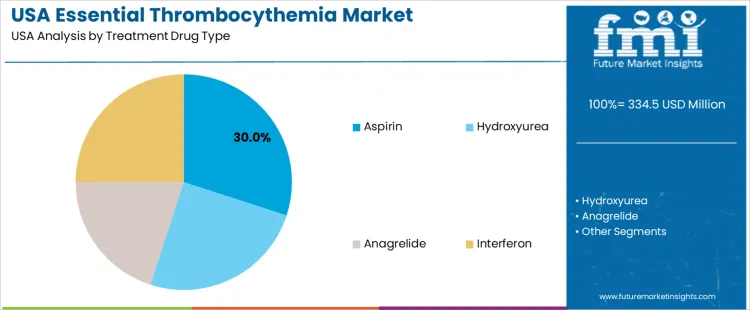
Aspirin accounts for 30% of the demand for essential thrombocythemia treatment in the USA, primarily due to its effectiveness in managing platelet counts and reducing the risk of blood clots. As an antiplatelet agent, aspirin is commonly prescribed as a first-line treatment for patients with essential thrombocythemia to reduce the likelihood of thrombotic events. Its proven efficacy, availability, and cost-effectiveness make it a go-to treatment, especially for early-stage patients. Aspirin is also used in combination with other therapies to manage symptoms and further prevent complications, such as strokes and heart attacks. Its ability to be used for long-term management of the condition, alongside other drugs, helps patients maintain a stable health condition. As the demand for affordable and reliable treatments grows, aspirin remains a dominant treatment choice in essential thrombocythemia, ensuring its continued leadership in the industry.
How Do Hospitals Lead the Demand for Essential Thrombocythemia Treatment in USA?
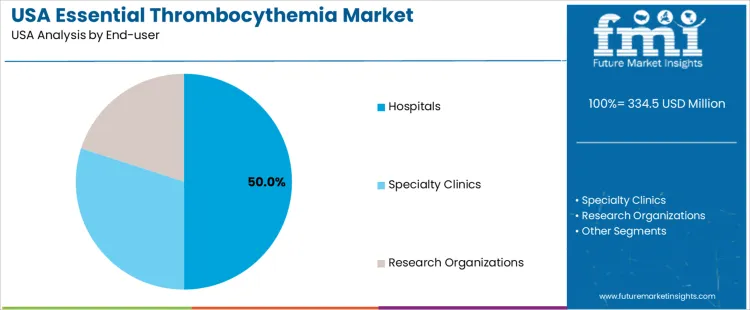
Hospitals account for 50% of the demand for essential thrombocythemia treatment in the USA, as they are the primary healthcare providers for patients requiring specialized and immediate care. Hospitals offer comprehensive treatment regimens that may include medications like aspirin, hydroxyurea, anagrelide, and interferon, tailored to the severity of the condition. Equipped with advanced diagnostic tools and expert medical staff, hospitals are essential for managing the complexities of this rare blood disorder. They serve as the first point of contact for diagnosing and initiating treatment, which further boosts their demand for these medications. As hospitals continue to handle complex cases and expand their treatment capabilities, the need for effective and timely treatment remains high. This central role in managing essential thrombocythemia ensures that hospitals will continue to drive the demand for these life-saving medications, supporting the overall growth in the industry.
What are the Key Trends, Drivers and Restraints in Demand for Essential Thrombocythemia in USA?
ET is typically diagnosed through blood tests and genetic analysis, identifying mutations like JAK2, CALR, and MPL. While ET remains rare, its growing recognition has led to earlier and more frequent diagnoses. The disorder is more common in older adults, particularly in women, contributing to the rising number of diagnosed cases. As the general population ages, the likelihood of individuals developing ET increases. Despite these trends, challenges such as high diagnostic costs and the complexity of treatment still exist. ET's primary risks include thrombosis, bleeding, and progression to more severe blood disorders, which makes early detection and management critical. The complexity of managing ET, including appropriate risk stratification and therapy, remains a challenge to widespread and effective care.
Why is Recognition and Management of Essential Thrombocythemia Growing in USA?
Recognition and management of Essential Thrombocythemia (ET) in the USA are growing due to advances in diagnostic technologies and increased awareness among healthcare professionals. More routine blood tests and genetic screenings have made it easier to detect ET, particularly in asymptomatic patients. As the prevalence of ET rises, particularly among aging populations, there is growing attention on appropriate disease management and prevention of complications such as thrombosis. Better understanding of the disease, including risk factors and treatment options, has led to more targeted therapies such as low-dose aspirin and cytoreductive treatments. Healthcare providers are now more capable of identifying patients early in the disease course, enabling proactive treatment and improved patient outcomes. The increasing emphasis on early disease detection and personalized care plans in healthcare systems has contributed to the growing number of diagnosed cases, leading to more widespread management of the disorder in the USA.
How are Medical and Diagnostic Innovations Affecting ET Management and Awareness in USA?
Medical and diagnostic innovations are playing a pivotal role in the management of Essential Thrombocythemia (ET) in the USA. The development of more precise genetic tests for mutations such as JAK2, CALR, and MPL has enabled earlier and more accurate diagnosis of ET. This has led to better identification of cases that may have previously gone undiagnosed. Advanced diagnostic technologies, such as next-generation sequencing and improved bone marrow biopsy techniques, provide detailed insights into the disease’s progression and risk factors, allowing for tailored treatment strategies. Innovations in the formulation of therapies, including targeted drugs and better management of platelet levels, have improved the quality of life for ET patients. These advancements have also led to improved risk stratification for thrombotic events, enabling more effective long-term management. As these technologies evolve, they contribute to enhanced awareness of ET, driving earlier intervention and better patient outcomes in the USA.
What are the Key Challenges and Risks That Affect Understanding and Management of ET in USA?
One of the main obstacles is the rarity of the disease, which can lead to under-diagnosis, particularly in cases with mild or no symptoms. The complexity of diagnosing ET, including the need for advanced genetic testing and bone marrow analysis, may also delay treatment in some patients. The variability in clinical presentation makes it difficult for healthcare providers to apply standardized treatment protocols universally. The cost of genetic testing, regular monitoring, and treatments such as cytoreductive therapy can create financial barriers for patients, especially in underinsured populations. Another risk is the potential for mismanagement of patients due to the rarity of the disease and insufficient awareness in the medical community. As patients live longer with ET, the possibility of disease progression to more severe conditions, such as myelofibrosis or leukemia, remains a significant challenge.
What is the Regional Demand Outlook for Essential Thrombocythemia in USA?
| Region | CAGR (%) |
|---|---|
| West USA | 6.7% |
| South USA | 6.0% |
| Northeast USA | 5.3% |
| Midwest USA | 4.6% |
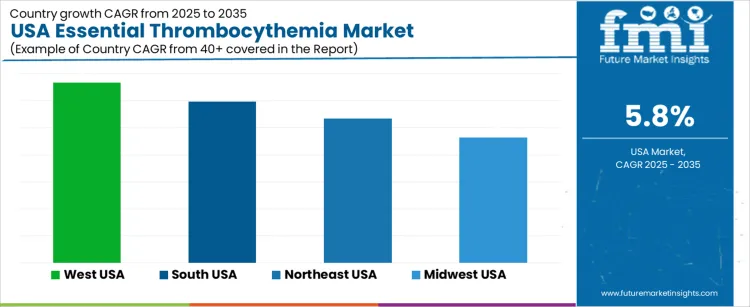
Demand for essential thrombocythemia treatments in the USA is growing steadily, with West USA leading at a 6.7% CAGR, driven by the region’s advanced healthcare infrastructure and increasing patient awareness. South USA follows with a 6.0% CAGR, supported by the rising prevalence of the condition and improved access to medical care in states like Texas and Florida. Northeast USA experiences a 5.3% CAGR, driven by a strong healthcare system and a growing aging population. Midwest USA shows a 4.6% CAGR, with steady growth fueled by advances in medical research and increased focus on rare blood disorders. As healthcare access improves and awareness rises, demand for essential thrombocythemia treatments will continue to increase across all regions.
How is Demand for Essential Thrombocythemia Growing in West USA?
West USA leads the demand for essential thrombocythemia (ET) treatments, growing at a 6.7% CAGR. The region’s robust healthcare infrastructure and strong research initiatives in medical centers are key drivers behind this growth. States like California, Washington, and Oregon have advanced medical facilities where patients are increasingly diagnosed and treated for rare blood disorders like ET. The growing awareness and better diagnostic tools have contributed to early detection, leading to more patients seeking treatment. The region’s focus on personalized medicine and innovative therapies further boosts the adoption of treatments for ET. The West is also home to a large number of biotech and pharmaceutical companies that are developing new drugs and therapies for blood disorders, enhancing access to advanced treatment options. With the increasing aging population and advancements in healthcare, demand for essential thrombocythemia treatments will continue to rise, supported by ongoing research and patient care improvements in the West.
Why is Demand for Essential Thrombocythemia Rising in South USA?
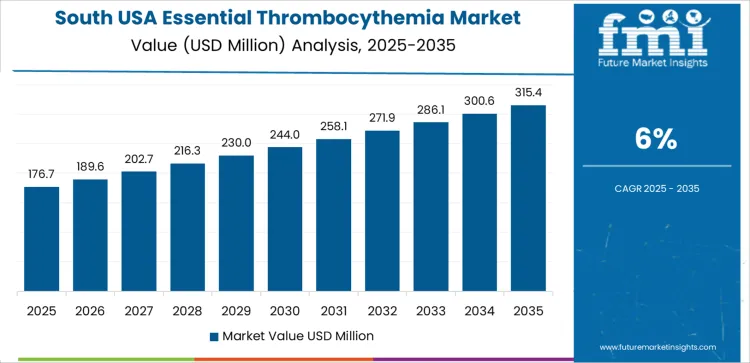
South USA is experiencing strong demand for essential thrombocythemia (ET) treatments, with a 6.0% CAGR. The region’s increasing population, coupled with an expanding healthcare infrastructure, is contributing to the growing need for treatments for blood disorders. States like Texas, Florida, and Georgia are seeing higher diagnosis rates as healthcare access improves and medical professionals gain more expertise in managing ET. The rise in awareness of rare conditions, along with better detection methods, is leading more patients to seek treatment. The South’s large healthcare networks are expanding the availability of specialized care for patients with ET. The growing focus on improving treatment for chronic conditions like ET is supported by both state and local government initiatives to enhance healthcare access. As more individuals are diagnosed and treated for ET in the South, the demand for treatments is expected to continue growing steadily, particularly in areas with a high concentration of healthcare facilities and specialists in blood disorders.
How is Demand for Essential Thrombocythemia Expanding in Northeast USA?
Northeast USA is seeing steady demand for essential thrombocythemia (ET) treatments, with a 5.3% CAGR. The region's strong healthcare system and large, aging population contribute to the increasing demand for ET diagnosis and treatment. Cities like New York, Boston, and Philadelphia are home to leading medical institutions where advancements in diagnostics and therapies for rare blood disorders are being made. The Northeast has a high prevalence of healthcare facilities and specialists who can diagnose and treat blood disorders like ET. With an increasing number of people being diagnosed at earlier stages, there is a greater demand for effective treatments. Furthermore, the region’s focus on medical research and clinical trials has led to the development of new and improved therapies for ET. As the population ages and awareness increases, the need for treatments for blood disorders will continue to grow, supported by a well-established healthcare infrastructure and ongoing research into better treatment options in the Northeast.
Why is Demand for Essential Thrombocythemia Growing in Midwest USA?
Midwest USA is experiencing moderate demand for essential thrombocythemia (ET) treatments, with a 4.6% CAGR. The region’s strong medical community, particularly in states like Illinois, Michigan, and Ohio, is driving the increased diagnosis and treatment of rare blood disorders like ET. As the healthcare system continues to improve, more patients are being diagnosed and treated, increasing the demand for specialized care. The Midwest’s significant investment in medical research, particularly in hematology and oncology, has led to advancements in treatment options and patient care. With healthcare access expanding in urban and rural areas, more individuals are receiving the necessary care to manage chronic conditions like ET. The growing number of specialized healthcare centers in the region is contributing to the rise in diagnoses and treatments. As awareness of ET continues to grow and more patients seek medical care for blood disorders, demand for effective treatments will remain steady in the Midwest, supporting growth in the region.
What is the Competitive Landscape of Essential Thrombocythemia Demand in USA?
Demand for treatments for essential thrombocythemia (ET) in the USA is growing as the need for effective therapies increases among patients suffering from this rare blood disorder. ET, characterized by an overproduction of platelets, can lead to complications such as blood clots, strokes, and hemorrhages. As the understanding of the disease evolves, patients and healthcare providers are seeking more advanced treatments that offer better outcomes and reduced side effects, driving the demand for targeted therapies in the industry. The company’s strategy focuses on providing innovative, targeted therapies that manage the symptoms of ET while improving patients' quality of life. Novartis continues to dominate the competitive landscape by investing in research and development to enhance the effectiveness of its treatments for blood disorders and strengthen its industry presence in the USA.
Other major players in the industry include Bristol Myers Squibb, Incyte Corporation, Pfizer Inc., and Merck & Co., Inc. These companies also offer effective treatments for ET, with a focus on advancing clinical trials and developing novel therapies. Bristol Myers Squibb and Incyte Corporation are key players, with Incyte’s Jakafi being one of the leading options for ET treatment. Pfizer and Merck are exploring new therapies and expanding their portfolios, focusing on improving patient outcomes with fewer adverse effects. As competition intensifies, innovation in treatment approaches, patient adherence, and personalized therapies will play a crucial role in shaping the future of the essential thrombocythemia treatment industry in the USA.
Key Players in USA Essential Thrombocythemia Demand
- Novartis AG
- Bristol Myers Squibb
- Incyte Corporation
- Pfizer Inc.
- Merck & Co., Inc.
Scope of Report
| Items | Values |
|---|---|
| Quantitative Units (2025) | USD million |
| Treatment Drug Type | Aspirin, Hydroxyurea, Anagrelide, Interferon |
| End-user | Hospitals, Specialty Clinics, Research Organizations |
| Regions Covered | West USA, South USA, Northeast USA, Midwest USA |
| Countries Covered | USA |
| Key Companies Profiled | Novartis AG, Bristol Myers Squibb, Incyte Corporation, Pfizer Inc., Merck & Co., Inc. |
| Additional Attributes | Dollar sales by treatment drug type and end-user; regional CAGR and growth outlook; preference for hydroxyurea and anagrelide in treatment plans; rising demand for research in thrombocythemia treatment. |
USA Essential Thrombocythemia Demand by Key Segments
Treatment Drug Type
- Aspirin
- Hydroxyurea
- Anagrelide
- Interferon
End-user
- Hospitals
- Specialty Clinics
- Research Organizations
Region
- West USA
- South USA
- Northeast USA
- Midwest USA
Frequently Asked Questions
How big is the demand for essential thrombocythemia in USA in 2025?
The demand for essential thrombocythemia in USA is estimated to be valued at USD 334.5 million in 2025.
What will be the size of essential thrombocythemia in USA in 2035?
The market size for the essential thrombocythemia in USA is projected to reach USD 587.6 million by 2035.
How much will be the demand for essential thrombocythemia in USA growth between 2025 and 2035?
The demand for essential thrombocythemia in USA is expected to grow at a 5.8% CAGR between 2025 and 2035.
What are the key product types in the essential thrombocythemia in USA?
The key product types in essential thrombocythemia in USA are aspirin, hydroxyurea, anagrelide and interferon.
Which end-user segment is expected to contribute significant share in the essential thrombocythemia in USA in 2025?
In terms of end-user, hospitals segment is expected to command 50.0% share in the essential thrombocythemia in USA in 2025.
Preview the report firsthand - request a free sample
Get SampleGet the brochure for pricing and purchase details.
Get PDFTable of Content
- Executive Summary
- USA Market Outlook
- Demand-side Trends
- Supply-side Trends
- Technology Roadmap Analysis
- Analysis and Recommendations
- Market Overview
- Market Coverage / Taxonomy
- Market Definition / Scope / Limitations
- Market Background
- Market Dynamics
- Drivers
- Restraints
- Opportunity
- Trends
- Scenario Forecast
- Demand in Optimistic Scenario
- Demand in Likely Scenario
- Demand in Conservative Scenario
- Opportunity Map Analysis
- Product Life Cycle Analysis
- Supply Chain Analysis
- Investment Feasibility Matrix
- Value Chain Analysis
- PESTLE and Porter’s Analysis
- Regulatory Landscape
- Regional Parent Market Outlook
- Production and Consumption Statistics
- Import and Export Statistics
- Market Dynamics
- USA Market Analysis 2020 to 2024 and Forecast, 2025 to 2035
- Historical Market Size Value (USD Million) Analysis, 2020 to 2024
- Current and Future Market Size Value (USD Million) Projections, 2025 to 2035
- Y-o-Y Growth Trend Analysis
- Absolute $ Opportunity Analysis
- USA Market Pricing Analysis 2020 to 2024 and Forecast 2025 to 2035
- USA Market Analysis 2020 to 2024 and Forecast 2025 to 2035, By Treatment Drug Type
- Introduction / Key Findings
- Historical Market Size Value (USD Million) Analysis By Treatment Drug Type , 2020 to 2024
- Current and Future Market Size Value (USD Million) Analysis and Forecast By Treatment Drug Type , 2025 to 2035
- Aspirin
- Hydroxyurea
- Anagrelide
- Interferon
- Y-o-Y Growth Trend Analysis By Treatment Drug Type , 2020 to 2024
- Absolute $ Opportunity Analysis By Treatment Drug Type , 2025 to 2035
- USA Market Analysis 2020 to 2024 and Forecast 2025 to 2035, By End-user
- Introduction / Key Findings
- Historical Market Size Value (USD Million) Analysis By End-user, 2020 to 2024
- Current and Future Market Size Value (USD Million) Analysis and Forecast By End-user, 2025 to 2035
- Hospitals
- Specialty Clinics
- Research Organizations
- Y-o-Y Growth Trend Analysis By End-user, 2020 to 2024
- Absolute $ Opportunity Analysis By End-user, 2025 to 2035
- Market Structure Analysis
- Competition Dashboard
- Competition Benchmarking
- Market Share Analysis of Top Players
- By Regional
- By Treatment Drug Type
- By End-user
- Competition Analysis
- Competition Deep Dive
- Novartis AG
- Overview
- Product Portfolio
- Profitability by Market Segments (Product/Age /Sales Channel/Region)
- Sales Footprint
- Strategy Overview
- Marketing Strategy
- Product Strategy
- Channel Strategy
- Bristol Myers Squibb
- Incyte Corporation
- Pfizer Inc.
- Merck & Co., Inc.
- Novartis AG
- Competition Deep Dive
- Assumptions & Acronyms Used
- Research Methodology


