

- Industry Size (2025)
- USD 167.0 Mn
- Forecast (2035)
- USD 260.8 Mn
- CAGR (2025 to 2035)
- 4.6%
Demand for Syringeless Injector in USA Forecast and Outlook 2025 to 2035
The demand for syringeless injectors in the USA is projected to grow from USD 167.0 million in 2025 to USD 260.8 million by 2035, reflecting a compound annual growth rate (CAGR) of 4.6%. Syringeless injectors, which offer a needle-free injection solution, are gaining traction due to their potential to improve patient compliance, reduce needle-related injuries, and offer a more comfortable alternative to traditional syringes.
The growing demand for self-administration of medication, especially in chronic disease management (e.g., diabetes, rheumatoid arthritis), and the increasing focus on reducing healthcare-associated needle injuries are expected to drive steady market growth over the forecast period.
Quick Stats of the Demand for Syringeless Injector in USA
- Demand for Syringeless Injector in USA Value (2025): USD 167.0 million
- Demand for Syringeless Injector in USA Forecast Value (2035): USD 260.8 million
- Demand for Syringeless Injector in USA Forecast CAGR (2025-2035): 4.6%
- Demand for Syringeless Injector in USA Key Product Type: 63% Injectors
- Demand for Syringeless Injector in USA Key Growth Regions: West USA, South USA, Northeast USA, Midwest USA
- Demand for Syringeless Injector in USA Key Players: GE Healthcare, Bayer AG, Guerbet, Bracco Diagnostics Inc.
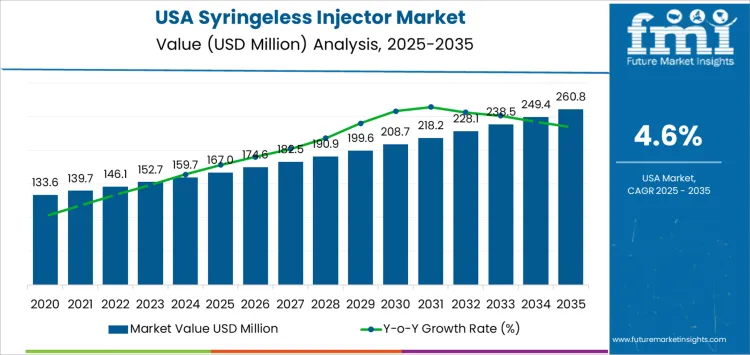
What is the Growth Forecast for the Syringeless Injector Industry in USA through 2035?
The market will experience gradual growth, starting at USD 167.0 million in 2025 and increasing to USD 174.6 million in 2026, USD 182.5 million in 2027, and USD 190.9 million in 2028. By 2029, demand for syringeless injectors will reach USD 199.6 million, continuing its upward trajectory through the 2030s. By 2035, the market for syringeless injectors is expected to reach USD 260.8 million, driven by innovations in drug delivery systems, expanding applications in vaccine delivery, and increasing adoption in homecare settings.
The compound absolute growth analysis for syringeless injectors shows steady growth in market value, with a total absolute increase of USD 93.8 million over the forecast period (2025-2035). The market’s growth is relatively smooth, with an incremental annual increase in value, starting at USD 167.0 million in 2025 and reaching USD 260.8 million by 2035.
The market’s total absolute growth from 2025 to 2035 indicates that syringeless injectors will see steady adoption, particularly as advancements in drug delivery systems continue and the need for needle-free administration grows. The absolute growth analysis reveals that most of the value accumulation will be driven by consistent volume increases, particularly in homecare applications and chronic disease management, rather than by dramatic price changes. This gradual accumulation reflects a broader trend toward self-administered therapies and growing healthcare needs related to non-invasive injection methods.
The total market expansion is driven by the increased focus on patient safety, ease of use, and advancements in delivery technologies that make syringeless injectors more accessible for both patients and healthcare providers. This steady increase in demand over the forecast period reflects the rising acceptance of syringeless injectors as a viable alternative to traditional syringes.
USA Syringeless Injector Industry Key Takeaways
| Metric | Value |
|---|---|
| Industry Sales Value (2025) | USD 167 million |
| Industry Forecast Value (2035) | USD 260.8 million |
| Industry Forecast CAGR (2025-2035) | 4.6% |
Why is the Demand for Syringeless Injectors in USA Growing?
Demand for syringeless injectors in the USA is rising as the broader market for needle-free and needle-less injection systems expands. Needle-free injectors, which include syringeless injectors, offer pain-reduced drug or vaccine delivery by using pressure-driven fluid streams instead of traditional needles and syringes. These systems appeal to patients and providers who wish to avoid needle-stick injuries, reduce anxiety related to injections, and improve hygiene. As chronic diseases, vaccination programmes, and need for regular injections increase, more patients and medical professionals show interest in alternatives to conventional syringe-based delivery. The general acceptance of needle-free delivery solutions supports growing demand for syringeless injectors in home care, clinics, and hospitals.
At the same time technological improvements and evolving healthcare trends support adoption of syringeless injectors. Advances in injector design, materials and reliability make needle-free delivery safer, more accurate, and compatible with a wider range of drugs including biologics and vaccines. Increasing emphasis on patient comfort, compliance in chronic therapies, and the convenience of self-administration encourage use of syringeless injectors. Trends such as home-based care, remote medical services, and demand for minimally invasive treatments strengthen the case for needle-free technology. As these factors converge, demand for syringeless injectors in the USA is likely to grow steadily over the coming years.
What Is the Current State of the Demand for Syringeless Injectors in the USA in Terms of Product Type and Technology?
The demand for syringeless injectors in the USA is primarily driven by product type and technology. The leading product type is injectors, which account for 63% of the market share, while pressure-based systems dominate the technology segment, capturing 40.4% of the demand. Syringeless injectors are increasingly used in the healthcare industry for administering medication without the need for traditional needles, offering advantages in patient comfort and safety. As the demand for non-invasive, easy-to-use, and precise drug delivery systems continues to grow, syringeless injectors are becoming more popular in both clinical and at-home settings.
How Are Injectors Leading the Demand for Syringeless Injectors in the USA?
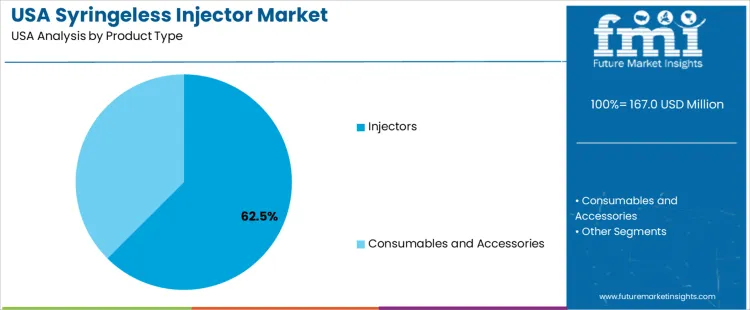
Injectors lead the demand for syringeless injectors in the USA, holding 63% of the market share. Syringeless injectors, typically comprising a pressure chamber and a nozzle, allow for the delivery of medications through the skin via a high-velocity jet of fluid. These injectors are used for a range of therapeutic applications, including vaccinations, hormone treatments, and biologic drug delivery. The main advantage of syringeless injectors is their ability to administer medication without the discomfort and potential risks associated with needles, such as needlestick injuries.
The demand for syringeless injectors is driven by several factors, including the rising preference for needle-free alternatives, the increasing adoption of biologics and vaccines, and the growing emphasis on patient comfort and safety. As healthcare providers seek solutions that reduce the fear and pain associated with injections, syringeless injectors are gaining traction. Additionally, these injectors are seen as beneficial in reducing the risk of needle contamination and improving patient adherence to treatment regimens. With the ongoing advancements in medical technology and the push for more patient-friendly drug delivery methods, injectors will continue to be the dominant product type in the syringeless injector market.
How Are Pressure-Based Systems Leading the Technology Demand for Syringeless Injectors in the USA?
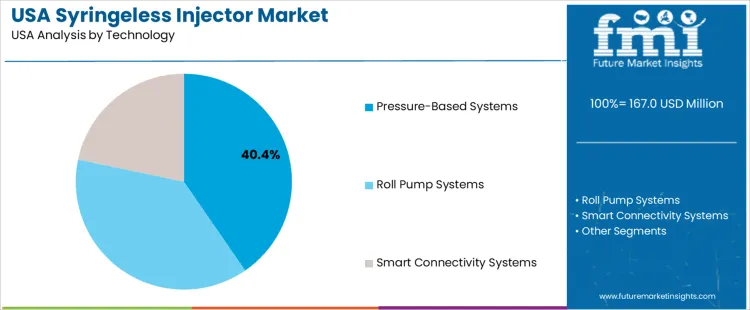
Pressure-based systems lead the technology demand for syringeless injectors in the USA, accounting for 40.4% of the market share. Pressure-based syringeless injectors use high-pressure systems to force the medication through the skin, providing a quick and efficient delivery method. These systems are widely used for administering vaccines, insulin, and other injectable medications. Pressure-based systems offer the advantage of being reliable and easy to use, making them popular among both healthcare providers and patients in need of regular injections.
The demand for pressure-based systems is driven by their proven effectiveness and ability to deliver precise doses of medication without the need for needles. Pressure-based injectors are also valued for their versatility, as they can be used in a wide variety of therapeutic areas, from chronic disease management to acute treatments. As the healthcare industry continues to prioritize patient safety and comfort, pressure-based syringeless injectors are expected to remain a leading choice, with a growing emphasis on reducing the risks and challenges associated with traditional needle-based injections.
What is the Demand Dynamics for Syringeless Injectors in the USA?
Demand for syringeless injectors in the USA is increasing as diagnostic imaging and medical services expand. These injectors are used in CT, MRI, and other imaging procedures to deliver contrast media safely and efficiently. As the number of imaging procedures grows, hospitals, clinics, and outpatient centers are investing in syringeless injectors to improve workflow, reduce waste, and enhance patient safety. The market for syringeless injectors in the USA is expected to grow steadily over the coming years.
What are the Drivers of Demand for Syringeless Injectors in the USA?
Demand for syringeless injectors is driven by several factors. First, the increasing volume of diagnostic imaging procedures such as CT and MRI scans for chronic disease screening and routine health checks is driving the need for reliable injector devices. Second, healthcare providers prefer syringeless injectors because they reduce preparation time, minimize waste, lower contamination risk, and improve efficiency in imaging workflows. Third, rising regulatory and institutional focus on patient safety and infection control encourages the use of advanced injectors over traditional methods. Finally, the growth of high-throughput imaging centers boosts the demand for syringeless injectors due to their consistency, reliability, and suitability for repeated use.
What are the Restraints on Demand for Syringeless Injectors in the USA?
There are some factors that limit the adoption of syringeless injectors. One is the high cost of acquiring and maintaining advanced injector systems, which may be a barrier for smaller clinics or imaging centers with limited budgets. Another restraint is that some facilities may not perform enough contrast-based scans to justify the investment in such equipment. Additionally, some facilities may continue to use traditional syringe-based injectors or manual methods when patient volumes are low. Technical training requirements and compatibility issues with existing imaging systems may also limit the widespread use of syringeless injectors in certain settings.
What are the Key Trends Influencing Demand for Syringeless Injectors in the USA?
Key trends include the shift toward automated diagnostic imaging workflows that favor syringeless injectors for efficiency and patient safety. The rise of smart-connectivity injector models that support a range of contrast media types and protocols is also increasing demand. Furthermore, the consolidation of imaging services in large hospital systems and diagnostic labs, which are more likely to invest in advanced injector technology, is contributing to market growth. Finally, the focus on reducing medical waste and minimizing contamination risk is encouraging more healthcare providers to adopt syringeless systems.
What is the Regional Demand Outlook for Syringeless Injectors in the USA?
The demand for syringeless injectors in the USA is forecast to rise across all major regions. The highest growth is expected in the West at a CAGR of 5.2%. The South follows with 4.7%, the Northeast at 4.2%, and the Midwest at 3.6%. These differences reflect variations in adoption of advanced imaging technologies, the density of healthcare facilities, and regional investment in diagnostic infrastructure. Overall growth is driven by increasing use of contrast-enhanced imaging procedures, demand for efficient medical workflows, and growing emphasis on patient safety and resource optimization.
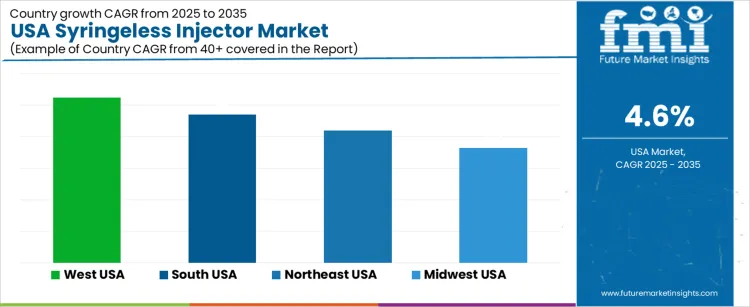
| Region | CAGR (%) |
|---|---|
| West USA | 5.2 |
| South USA | 4.7 |
| Northeast USA | 4.2 |
| Midwest USA | 3.6 |
What supports growth of syringeless injectors in the West USA?
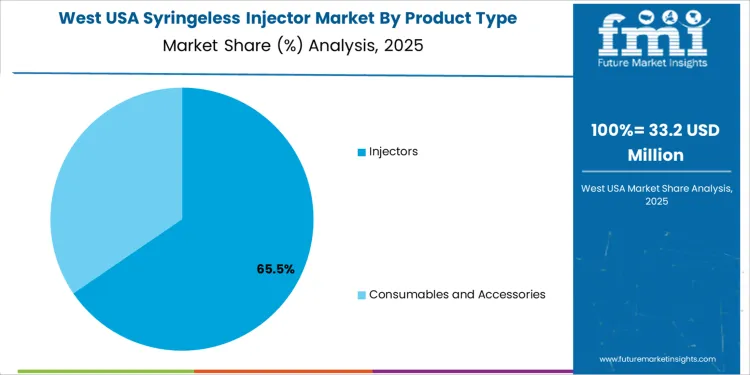
In the West USA, the projected 5.2% annual growth for syringeless injectors reflects strong demand from radiology and diagnostic imaging facilities upgrading to modern injector systems. The region hosts numerous hospitals, imaging centers, and advanced-care clinics that conduct frequent contrast-enhanced imaging procedures such as CT and MRI scans. Syringeless injectors provide precise and efficient delivery of contrast media, reducing contrast waste and minimizing risk of dosing or contamination errors compared with conventional syringe-based systems.
Studies have shown that syringeless injectors reduce contrast media wastage dramatically and improve workflow efficiency in high-volume imaging practices. As facilities in the West scale up diagnostic capacity and adopt newer imaging technologies, the demand for syringeless injectors rises accordingly. This supports a steady adoption rate across urban and suburban centers where imaging demand and medical infrastructure are concentrated.
Why is demand increasing for syringeless injectors in the South USA?
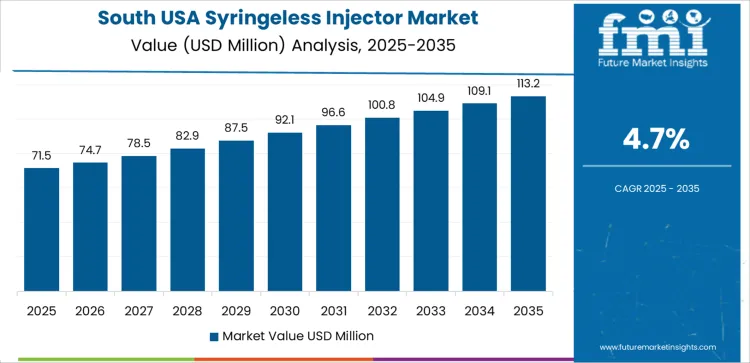
In the South USA, a projected CAGR of 4.7% for syringeless injectors arises from expanding healthcare infrastructure and rising demand for diagnostic imaging. Several hospitals, outpatient imaging centers, and multispecialty clinics in southern states are upgrading equipment to support growing patient loads. As chronic diseases, cardiovascular disorders, and other conditions requiring imaging become more prevalent, the need for efficient, safe, and cost-effective contrast injection systems increases. Syringeless injectors help streamline workflow, reduce consumables waste, and enhance patient throughput - advantages that appeal strongly in settings with high patient volume and cost-sensitivity. The gradual modernization of diagnostic services and increased focus on imaging efficiency contribute to rising adoption in the South region.
What drives adoption of syringeless injectors in the Northeast USA?
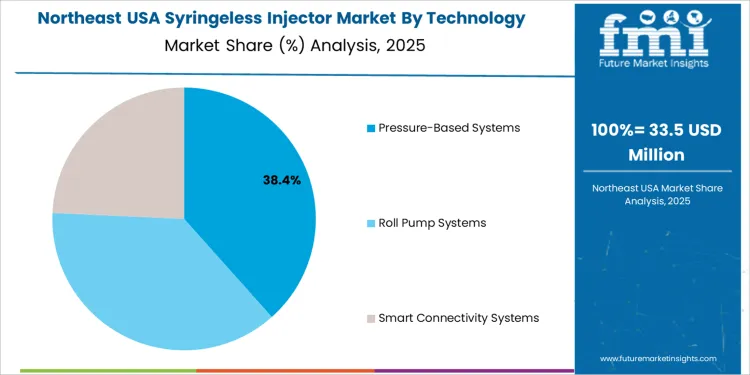
In the Northeast USA, the projected 4.2% CAGR for syringeless injectors reflects a stable yet growing market driven by hospitals, academic medical centers, and diagnostic imaging facilities upgrading from legacy injection systems. The region’s high concentration of healthcare institutions performing contrast-enhanced imaging - including computed tomography, magnetic resonance imaging, and hybrid imaging modalities - supports demand. Syringeless injectors are valued for their ability to reduce contrast media waste, minimize preparation time, and improve safety for both patients and technologists. As imaging protocols evolve and the number of imaging procedures increases, syringeless systems provide a scalable, efficient solution. This fosters a gradual but consistent rise in demand across the Northeast.
How is the demand for syringeless injectors evolving in the Midwest USA?
In the Midwest USA, the projected 3.6% CAGR indicates slower but steady growth in adoption of syringeless injectors. The region includes a mix of urban, suburban, and rural areas with varied access to advanced imaging infrastructure. Some hospitals and diagnostic centers in the Midwest are only now upgrading from older syringe-based injectors. As healthcare providers modernize and aim to improve efficiency and cost-effectiveness, syringeless injectors become more appealing. The advantages of reduced contrast waste, enhanced workflow, and improved safety are likely to encourage gradual adoption. As diagnostic imaging demand grows and facilities seek to optimize resource use, syringeless injectors will see increasing uptake even in less densely populated or lower-volume settings.
What is the Competitive Landscape for the Syringeless Injector Market in the USA?
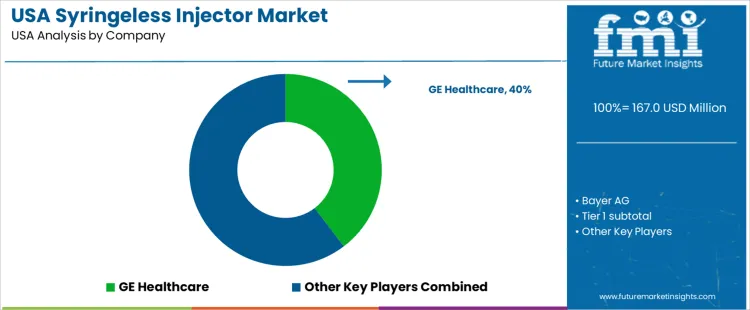
Demand for syringeless injectors in the USA is rising amid broader growth in injectable-drug delivery and diagnostic imaging markets. The market benefits from increasing use of imaging procedures, greater demand for biologics and injectable therapies, and growing emphasis on workflow efficiency in hospitals and clinics. Syringeless systems, particularly in contrast-media injection for radiology, have gained favour because they reduce waste, improve ease of use, and shorten procedure times.
Evidence suggests syringeless injectors are more efficient and cost-effective than traditional dual-syringe injectors. These factors support a steady expansion of demand for syringeless injectors across radiology and therapeutic drug-delivery settings.
In the USA market several firms compete for share. The leading supplier is GE Healthcare with about 39.6% share. Other notable competitors include Bayer AG, Guerbet, Bracco Diagnostics Inc. and other firms (grouped under "Tier 1 subtotal"). Competition among these providers centres on device reliability, ease of operation, safety, contrast-media waste reduction, and total cost per procedure.
Some firms emphasise advanced syringeless injectors offering disposable or bag-based contrast media delivery systems suitable for high-volume imaging centres. Others focus on compatibility with existing imaging infrastructure and maintenance efficiency. As demand grows for outpatient care, imaging diagnostics, and convenient injectable drug delivery, manufacturers continuously refine syringeless injector designs to meet healthcare providers’ needs for efficiency, safety, and cost control.
Key Players of the Syringeless Injector Industry in USA
- GE Healthcare
- Bayer AG
- Tier 1 subtotal
- Guerbet
- Bracco Diagnostics Inc.
Scope of the Report
| Items | Details |
|---|---|
| Quantitative Units | USD Million |
| Regions Covered | USA |
| Product Type | Injectors, Consumables and Accessories |
| Technology | Pressure-Based Systems, Roll Pump Systems, Smart Connectivity Systems |
| Application | Computed Tomography (CT), Magnetic Resonance Imaging (MRI) |
| End-User | Hospitals, Ambulatory Surgical Centers, Diagnostic Imaging Centers, Academic & Research Institutes |
| Key Companies Profiled | GE Healthcare, Bayer AG, Guerbet, Bracco Diagnostics Inc. |
| Additional Attributes | Dollar sales by product type, technology, and application indicate strong demand for pressure-based systems in hospitals and diagnostic imaging centers, particularly for CT and MRI procedures. Smart connectivity systems are gaining popularity for enhanced efficiency and integration with digital imaging equipment. GE Healthcare and Bayer AG lead the market with a wide range of syringeless injectors and consumables. The market is expected to grow as demand for advanced diagnostic imaging and more efficient, user-friendly injection systems increases. |
Key Segments in the Demand for Syringeless Injector in USA
Product Type
- Injectors
- Consumables and Accessories
Technology
- Pressure-Based Systems
- Roll Pump Systems
- Smart Connectivity Systems
Application
- Computed Tomography (CT)
- Magnetic Resonance Imaging (MRI)
End User
- Hospitals
- Ambulatory Surgical Centers
- Diagnostic Imaging Centers
- Academic & Research Institutes
Region
- Northeast USA
- West USA
- Midwest USA
- South USA
Frequently Asked Questions
How big is the demand for syringeless injector in USA in 2025?
The demand for syringeless injector in USA is estimated to be valued at USD 167.0 million in 2025.
What will be the size of syringeless injector in USA in 2035?
The market size for the syringeless injector in USA is projected to reach USD 260.8 million by 2035.
How much will be the demand for syringeless injector in USA growth between 2025 and 2035?
The demand for syringeless injector in USA is expected to grow at a 4.6% CAGR between 2025 and 2035.
What are the key product types in the syringeless injector in USA?
The key product types in syringeless injector in USA are injectors and consumables and accessories.
Which technology segment is expected to contribute significant share in the syringeless injector in USA in 2025?
In terms of technology, pressure-based systems segment is expected to command 40.4% share in the syringeless injector in USA in 2025.
Preview the report firsthand - request a free sample
Get SampleGet the brochure for pricing and purchase details.
Get PDFTable of Content
- Executive Summary
- USA Market Outlook
- Demand-side Trends
- Supply-side Trends
- Technology Roadmap Analysis
- Analysis and Recommendations
- Market Overview
- Market Coverage / Taxonomy
- Market Definition / Scope / Limitations
- Market Background
- Market Dynamics
- Drivers
- Restraints
- Opportunity
- Trends
- Scenario Forecast
- Demand in Optimistic Scenario
- Demand in Likely Scenario
- Demand in Conservative Scenario
- Opportunity Map Analysis
- Product Life Cycle Analysis
- Supply Chain Analysis
- Investment Feasibility Matrix
- Value Chain Analysis
- PESTLE and Porter’s Analysis
- Regulatory Landscape
- Regional Parent Market Outlook
- Production and Consumption Statistics
- Import and Export Statistics
- Market Dynamics
- USA Market Analysis 2020 to 2024 and Forecast, 2025 to 2035
- Historical Market Size Value (USD Million) Analysis, 2020 to 2024
- Current and Future Market Size Value (USD Million) Projections, 2025 to 2035
- Y-o-Y Growth Trend Analysis
- Absolute $ Opportunity Analysis
- USA Market Pricing Analysis 2020 to 2024 and Forecast 2025 to 2035
- USA Market Analysis 2020 to 2024 and Forecast 2025 to 2035, By Product Type
- Introduction / Key Findings
- Historical Market Size Value (USD Million) Analysis By Product Type , 2020 to 2024
- Current and Future Market Size Value (USD Million) Analysis and Forecast By Product Type , 2025 to 2035
- Injectors
- Consumables and Accessories
- Y-o-Y Growth Trend Analysis By Product Type , 2020 to 2024
- Absolute $ Opportunity Analysis By Product Type , 2025 to 2035
- USA Market Analysis 2020 to 2024 and Forecast 2025 to 2035, By Technology
- Introduction / Key Findings
- Historical Market Size Value (USD Million) Analysis By Technology, 2020 to 2024
- Current and Future Market Size Value (USD Million) Analysis and Forecast By Technology, 2025 to 2035
- Pressure-Based Systems
- Roll Pump Systems
- Smart Connectivity Systems
- Y-o-Y Growth Trend Analysis By Technology, 2020 to 2024
- Absolute $ Opportunity Analysis By Technology, 2025 to 2035
- USA Market Analysis 2020 to 2024 and Forecast 2025 to 2035, By Application
- Introduction / Key Findings
- Historical Market Size Value (USD Million) Analysis By Application, 2020 to 2024
- Current and Future Market Size Value (USD Million) Analysis and Forecast By Application, 2025 to 2035
- Computed Tomography (CT)
- Magnetic Resonance Imaging (MRI)
- Y-o-Y Growth Trend Analysis By Application, 2020 to 2024
- Absolute $ Opportunity Analysis By Application, 2025 to 2035
- USA Market Analysis 2020 to 2024 and Forecast 2025 to 2035, By End User
- Introduction / Key Findings
- Historical Market Size Value (USD Million) Analysis By End User, 2020 to 2024
- Current and Future Market Size Value (USD Million) Analysis and Forecast By End User, 2025 to 2035
- Hospitals
- Ambulatory Surgical Centers
- Diagnostic Imaging Centers
- Academic & Research Institutes
- Y-o-Y Growth Trend Analysis By End User, 2020 to 2024
- Absolute $ Opportunity Analysis By End User, 2025 to 2035
- Market Structure Analysis
- Competition Dashboard
- Competition Benchmarking
- Market Share Analysis of Top Players
- By Regional
- By Product Type
- By Technology
- By Application
- By End User
- Competition Analysis
- Competition Deep Dive
- GE Healthcare
- Overview
- Product Portfolio
- Profitability by Market Segments (Product/Age /Sales Channel/Region)
- Sales Footprint
- Strategy Overview
- Marketing Strategy
- Product Strategy
- Channel Strategy
- Bayer AG
- Tier 1 subtotal
- Guerbet
- Bracco Diagnostics Inc.
- GE Healthcare
- Competition Deep Dive
- Assumptions & Acronyms Used
- Research Methodology


