

- 2025 (base history)
- USD 31.8 Mn
- 2026 (current)
- USD 35.0 Mn
- 2036 (forecast)
- USD 90.0 Mn
- CAGR (2026–2036)
- 9.9%
How big is the UV curable coating low VOC additives market in 2026?
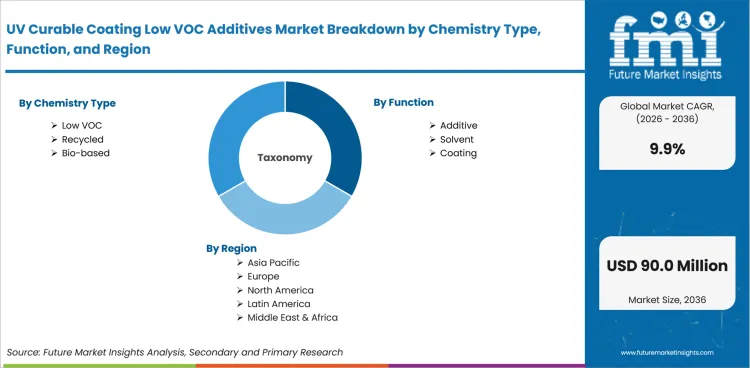
USD 35.0 million in 2026 and USD 90.0 million by 2036 at a 9.9% CAGR.
The UV curable coating low VOC additives industry value is forecast to grow from USD 31.8 million in 2025 to USD 90.0 million by 2036 at 9.9% CAGR as coating formulators reduce solvent contribution without weakening surface flow, adhesion, gloss, or line speed. Additive function is expected to lead with 41.0% share in 2026 because flow control, wetting, defoaming, and scratch resistance decide whether UV coatings pass production trials. Low VOC chemistry is projected to secure 38.0% share in 2026, led by buyers screening formulations for lower emissions and safer plant approval.
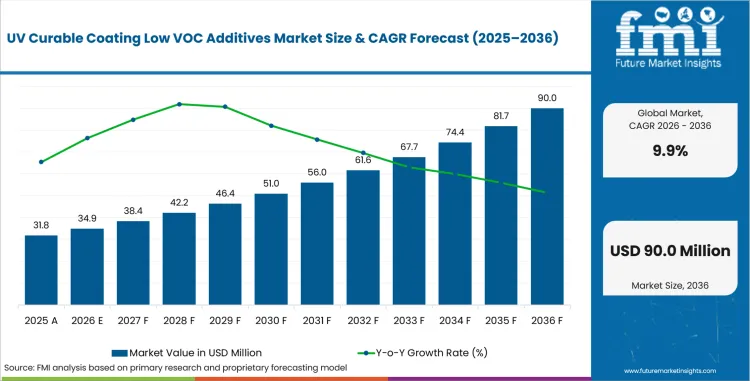
UV Curable Coating Low VOC Additives Market Overview: Size and Forecast
- 2025 (base history): USD 31.8 million
- 2026 (current): USD 35.0 million
- 2036 (forecast): USD 90.0 million
- CAGR (2026–2036): 9.9%
- Leading Function: Additive
- Additive Function Share in 2026: 41.0%
- Leading Chemistry Type: Low VOC
- Low VOC Chemistry Share in 2026: 38.0%
- Fastest-growing Country: India
- India CAGR: 11.2% by 2036
Summary of the UV Curable Coating Low VOC Additives Market
- Demand and Growth Drivers
- Coating formulators are replacing solvent-heavy additives with UV-compatible packages that maintain surface finish and production repeatability.
- Electronics and battery coating users are demanding additives that support low-heat curing and low-residue film formation.
- Packaging converters are testing low-odor varnish and overprint coating systems where migration control and fast cure must work together.
- Product and Segment View
- Additive function is expected to represent 41.0% share in 2026, supported by flow, wetting, defoaming, slip, and scratch control requirements.
- Low VOC chemistry is projected to account for 38.0% share in 2026, led by solvent reduction and buyer audit requirements.
- UV LED systems are forecast to hold 34.0% share in 2026, influenced by low-heat curing requirements across sensitive substrates.
- Geography and Competitive Outlook
- India is projected to record 11.2% CAGR by 2036 as electronics exports and automotive output support coating conversion.
- China is forecast to expand at 10.8% CAGR through 2036 with large automotive, electronics, and packaging production bases.
- BASF, Arkema Sartomer, allnex, BYK Additives, Evonik Coating Additives, IGM Resins, and Covestro define the verified supplier set.
- Suppliers with UV LED data, low-VOC formulation support, and local application labs are better positioned to win repeat approvals.
- Analyst Opinion
- Nikhil Kaitwade, Principal Consultant for Chemicals and Materials at FMI, observes, “UV curable coating low VOC additives are now qualification materials, not only compliance materials. Buyers want proof that wetting agents, dispersants, defoamers, and surface-control additives can reduce solvent pressure without damaging coating yield. Suppliers with UV LED compatibility, low-migration packaging data, and local troubleshooting support should gain stronger customer retention.”
Quality control and emissions documentation are the main forces shaping the market outlook. The European Commission states that IED 2.0, which entered into force on 4 August 2024, covers 37,000 industrial installations and now includes battery gigafactories, which keeps coating emissions and material efficiency under stronger review. Global semiconductor sales reached USD 627.6 billion in 2024, showing the scale of electronics production that requires precision coatings and surface protection. Arkema announced in January 2026 that more than 70% of its coating facilities were ISCC PLUS certified, covering UV/LED/EB technologies and specialty additives with at least 20% lower product carbon footprint than fossil equivalents.
Country-wise CAGR Projections (2026–2036)
India leads growth at 11.2% CAGR through 2036, ahead of China at 10.8%, as electronics export expansion and automotive output drive coating conversion to UV-curable low-VOC formulations.
- India: 11.2% CAGR
- China: 10.8% CAGR
Which factors support expansion in the UV curable coating low VOC additives market?
Finished additive revenue and formulation service are strengthening as coating users move toward application-tested UV systems.
- Market value is supported by low-VOC additive packages used before formulated coating makers pass materials into industrial lines.
- Supplier pricing reflects defect reduction value before raw material cost becomes the final purchase issue.
- Revenue improves as battery and electronics coating users pay for additives that reduce surface flaws during fast cure.
- Buyer trust rises when additives support VOC reduction while preserving gloss, adhesion, odor control, and cure response.
Why is the UV curable coating low VOC additives market growing?
VOC control is moving from plant compliance into customer qualification as OEMs ask for lower-emission coating systems.
Industrial buyers are treating VOC reduction as a line-risk issue, not only a compliance task. The International Energy Agency reported that global electric car sales exceeded 17 million in 2024, while battery demand reached around 1 TWh in the same year. That scale supports coatings for battery packs, coated films, electronics, sensors, and mobility parts where additives must cure quickly without leaving harmful residue. Suppliers with UV LED and low-migration formulation experience are therefore gaining attention from converters and component makers.
How is the UV curable coating low VOC additives market segmented?
The UV curable coating low VOC additives industry is segmented by chemistry type, function, application, end-use industry, and cure system.
- Low VOC chemistry is projected to secure 38.0% share in 2026, led by formulators reducing solvent contribution while preserving film appearance and cure speed.
- Additive function is expected to hold 41.0% share in 2026, supported by the role of wetting, flow, defoaming, slip, and surface correction in production approval.
- Batteries are anticipated to account for 29.0% share in 2026, influenced by coated separators, insulation layers, and protective films needing low-residue cure behavior.
- Electronics is estimated to represent 31.0% share in 2026, reflected by precision coating needs across boards, displays, sensors, and fine films.
- UV LED systems are forecast to capture 34.0% share in 2026, shaped by lower heat exposure and compatibility with sensitive substrates.
Why does low VOC chemistry lead the UV curable coating low VOC additives market?
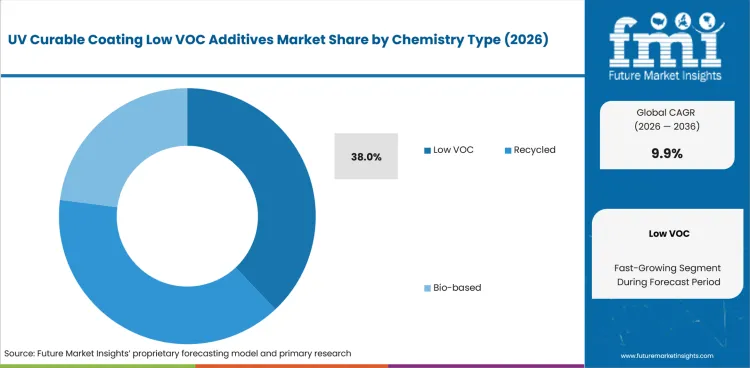
- Low VOC chemistry is projected to account for 38.0% share in 2026, influenced by buyer screening for lower solvent contribution and safer plant approval without losing coating finish.
- Waterborne UV additives gain use where formulators need lower odor and easier cleanup while maintaining wetting, foam control, and cure response.
Which function leads the UV curable coating low VOC additives market?
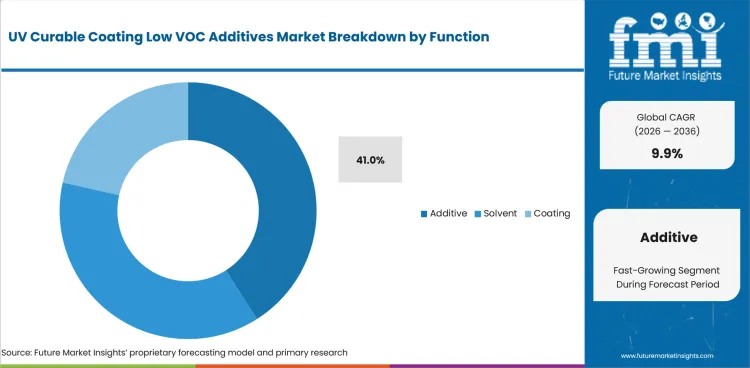
- Additive function is expected to represent 41.0% share in 2026 through its role in flow control, pigment wetting, defoaming, scratch resistance, and surface leveling.
- Binder and process-aid roles remain important where formulators combine low-VOC performance with resin compatibility and repeatable coating behavior.
Which application leads the UV curable coating low VOC additives market?
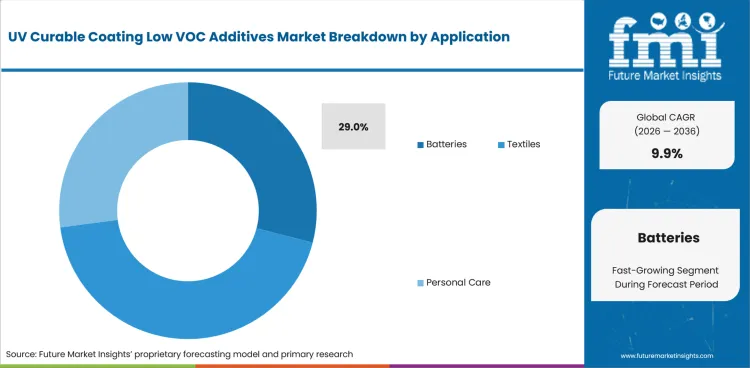
- Batteries are anticipated to hold 29.0% share in 2026, attributable to coated separators, insulation films, and protective layers requiring rapid cure with low residue.
- Construction and textile coatings gain selective demand where low-odor finishing and fast line handling improve coated surface performance.
Which end-use industry leads the UV curable coating low VOC additives market?
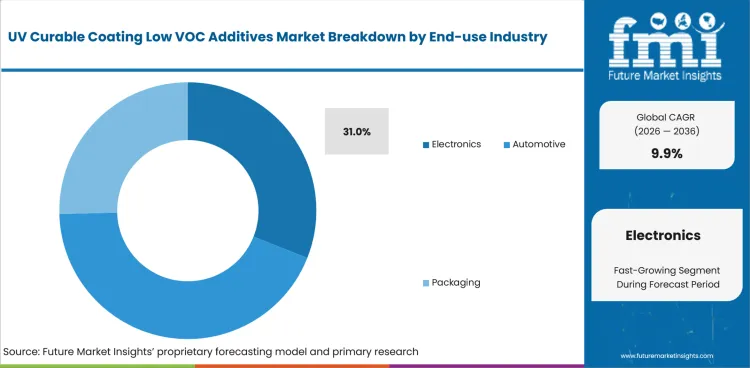
- Electronics is estimated to account for 31.0% share in 2026, led by low-heat curing requirements across boards, sensors, displays, and precision films.
- Automotive users create additional pull where mobility coatings require adhesion control, scratch resistance, and lower emissions during finishing.
Which cure system leads the UV curable coating low VOC additives market?
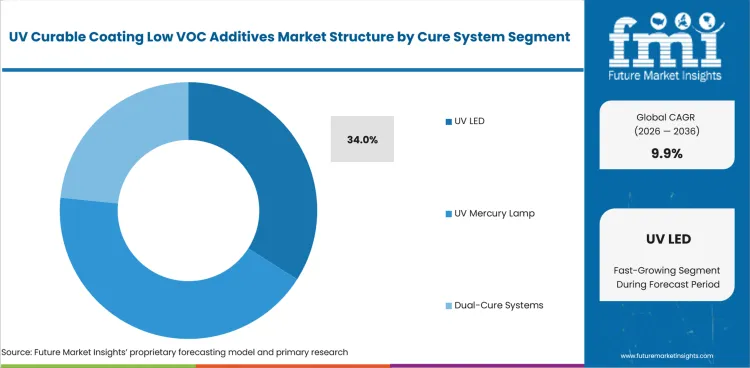
- UV LED systems are forecast to capture 34.0% share in 2026, shaped by low heat exposure and stronger compatibility with sensitive films and electronics.
- Electron beam systems retain a technical role where packaging and industrial users need deeper cure without heavy photoinitiator loading.
What are the drivers, restraints, and opportunities in the UV curable coating low VOC additives market?
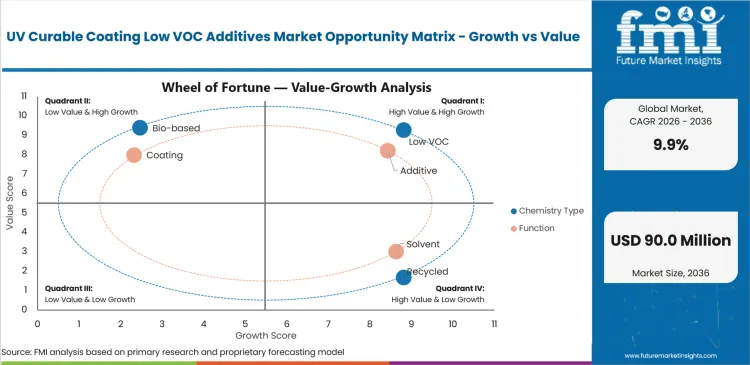
Low-solvent formulation demand supports adoption while qualification cost slows faster switching.
- Driver: Coating users are replacing solvent-heavy additives with UV-compatible packages that protect surface finish and cure speed.
- Restraint: Reformulation remains difficult because one additive change can affect gloss, adhesion, odor, and coating defects.
- Opportunity: Certified bio-attributed and UV LED-compatible additives can gain stronger value in packaging, electronics, and mobility coatings.
Electronics-Grade Low-Residue Coating Demand
Electronics output is creating a strong route for additives that support thin, clean, and low-heat UV coatings. Semiconductor Industry Association data show logic products totaled USD 212.6 billion in 2024, making logic the largest semiconductor product category by sales. This supports demand for coating additives that work at low dosage and protect sensitive electronic substrates during curing.
Reformulation Risk Across Automotive Coatings
Reformulation cost restrains adoption because additive changes must be tested for wetting, slip, adhesion, cure response, and surface defects. ACEA reported that global car production grew by 4.2% to 78.7 million units in 2025, which highlights the broad production base where coating changes require structured qualification before they reach production lines.
Battery and UV LED Coating Opportunity
Battery coatings create a premium opportunity for additives that support low-residue cure and stable surface behavior. The International Energy Agency states that China produced 12.4 million electric cars in 2024, while global electric car production reached 17.3 million units. This supports coating demand across battery packs, insulation layers, electronics modules, and mobility surfaces.
Which countries are growing fastest in the UV curable coating low VOC additives market?
India 11.2% CAGR, China 10.8% CAGR, South Korea 10.0% CAGR, United States 9.6% CAGR, Japan 9.4% CAGR, France 9.1% CAGR, Germany 8.8% CAGR, and United Kingdom 8.7% CAGR through 2036.
.webp "Top Country Growth Comparison Uv Curable Coating Low Voc Additives Market Cagr (2026 2036)")
| Country | CAGR |
|---|---|
| India | 11.2% |
| China | 10.8% |
| South Korea | 10.0% |
| United States | 9.6% |
| Japan | 9.4% |
| France | 9.1% |
| Germany | 8.8% |
| United Kingdom | 8.7% |
Source: Future Market Insights, 2026.
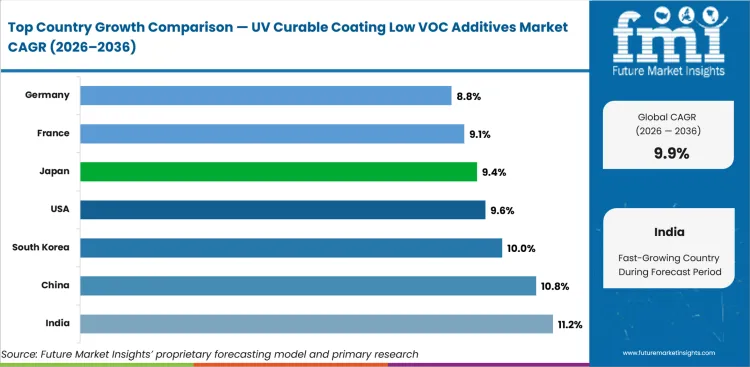
How do country-level CAGRs compare in the UV curable coating low VOC additives market?
India leads country growth while the United Kingdom records the most measured expansion among selected countries.
- India is projected to record 11.2% CAGR by 2036 as electronics exports and automotive manufacturing support additive conversion.
- China is forecast to expand at 10.8% CAGR through 2036 due to automotive, electronics, and packaging coating scale.
- South Korea is expected to rise at 10.0% CAGR by 2036 as semiconductor and battery industries require precision coatings.
- The United States is anticipated to grow at 9.6% CAGR from 2026 to 2036 with VOC scrutiny and high-value coating lines.
- Japan is projected to post 9.4% CAGR through 2036 as UV LED laboratories support precision coating trials.
- France is estimated to advance at 9.1% CAGR by 2036 through certified UV materials and mobility coatings.
- Germany is forecast to grow at 8.8% CAGR through 2036 as automotive and industrial coating qualification remains strict.
- The United Kingdom is expected to expand at 8.7% CAGR through 2036 as packaging and specialty coating users depend on technical distributors.
How fast is India UV curable coating low VOC additives market growing?
An 11.2% CAGR through 2036 reflects electronics manufacturing, auto output, and distributor-led UV additive adoption.
Country Market Snapshot Table
| Parameter | Value |
|---|---|
| Market Size in 2025 (Value) | USD 3.6 million |
| Market Size in 2026 (Value) | USD 4.0 million |
| Market Forecast in 2036 (Value) | USD 11.6 million |
| CAGR (2026 to 2036) | 11.2% |
| Years Considered | 2021 to 2036 |
| Base Year | 2025 |
| Forecast Period | 2026 to 2036 |
| Units Considered | Value (USD million) |
| Leading Sub-Region | Gujarat, Maharashtra, and Tamil Nadu coating clusters |
India UV Curable Coating Low VOC Additives Market Outlook
India demand is shaped by electronics exports, auto manufacturing, packaging conversion, and improving access to energy-curing material distribution. Coating users are becoming more open to low-VOC UV additives when suppliers provide formulation support near production clusters.
Key Growth Drivers
- Electronics coating demand is improving as India’s electronics exports reached USD 22.2 billion in the first half of FY 2025–26, supporting low-residue coating systems for components and assemblies.
- Automotive coating users provide a wider production base as India produced 6,014,691 vehicles in 2024, creating demand for low-emission finishing aids.
- Distributor-led energy-curing material access helps smaller formulators test photoinitiators, additives, and UV-compatible resin packages.
- Packaging and industrial coating users are seeking faster cure windows as they shift toward cleaner finishing systems and shorter line cycles.
Key Restraints
- Electric car adoption is rising from a smaller base even though IEA reported India’s electric car sales grew by more than 30% in 2025, which can limit near-term battery-coating conversion speed.
- Imported specialty additives can raise cost sensitivity during early production trials for regional formulators.
- Technical service gaps outside major coating clusters can slow adoption among smaller industrial users.
What makes India unique
India is unique due to fast-growing electronics exports, expanding automotive output, and improving specialty chemical distribution for energy-curing materials.
Key Companies
- BASF India Limited
- Arkema Chemicals India Private Limited
- allnex India Private Limited
- Evonik India Private Limited
- BYK India Private Limited
- IGM Resins India distribution partners
- Covestro India Private Limited
Sales & Marketing Channels
- Specialty chemical distributors
- Direct sales to coating formulators
- Packaging converter trials
- Electronics supplier qualification
- Automotive coating approval routes
- Application lab support programs
Country Segment Breakdown Table
| Segment | Sub-Segments |
|---|---|
| By Chemistry Type | Bio-based · Recycled · Low VOC · Halogen Free · Waterborne |
| By Function | Solvent · Additive · Binder · Coating · Process Aid |
| By Application | Textiles · Batteries · Construction · Personal Care · Water Treatment |
| By End-use Industry | Automotive · Electronics · Packaging · Agriculture · Industrial Manufacturing |
| By Cure System | UV Mercury Lamp · UV LED · Electron Beam · Dual-Cure Systems · Hybrid UV-Waterborne Systems |
| Key Sub-Regions Covered, Industrial and Coating Clusters | Gujarat · Maharashtra · Tamil Nadu · Karnataka · Telangana · Delhi NCR |
Frequently Asked Questions
How fast is India UV curable coating low VOC additives market growing?
India is projected to expand at 11.2% CAGR from 2026 to 2036 with electronics exports and auto output supporting use.
Who leads India UV curable coating low VOC additives market?
BASF India, Arkema India, allnex India, Evonik India, BYK India, IGM Resins partners, and Covestro India compete through distribution and technical support.
What is driving adoption in India UV curable coating low VOC additives market?
Electronics exports, packaging conversion, and access to energy-curing material suppliers are supporting low-VOC additive trials.
What is the UV curable coating low VOC additives market outlook in China?
A 10.8% CAGR through 2036 is supported by automotive scale, electronics production, and certified UV resin supply.
Country Market Snapshot Table
| Parameter | Value |
|---|---|
| Market Size in 2025 (Value) | USD 9.1 million |
| Market Size in 2026 (Value) | USD 10.1 million |
| Market Forecast in 2036 (Value) | USD 28.2 million |
| CAGR (2026 to 2036) | 10.8% |
| Years Considered | 2021 to 2036 |
| Base Year | 2025 |
| Forecast Period | 2026 to 2036 |
| Units Considered | Value (USD million) |
| Leading Sub-Region | Yangtze River Delta and Greater Bay Area |
China UV Curable Coating Low VOC Additives Market Outlook
China demand is shaped by large coating consumption across automotive, electronics, packaging, and industrial manufacturing. Additive selection often balances cost-in-use with the ability to reduce rejects during high-speed UV coating operations.
Key Growth Drivers
- Automotive coatings provide a large demand base as China produced 31,281,592 vehicles in 2024, supporting high-volume finishing and surface protection needs.
- Electric mobility adds coating demand because China produced 12.4 million electric cars in 2024, representing more than 70% of global electric car production.
- Export-oriented packaging users need lower-odor UV varnishes and inks that can pass customer audits.
- Local certified resin supply helps formulators qualify UV LED and low-VOC additive packages with shorter lead times.
Key Restraints
- Premium additive uptake faces cost pressure as China’s auto output reached 34.531 million units in 2025, increasing price competition across supplier tiers.
- Domestic suppliers can pressure multinational additive firms by offering lower-cost alternatives for less demanding coating lines.
- Export compliance work can increase documentation needs for additives used in packaging and electronics coatings.
What makes China unique
China is unique due to unmatched automotive and electronics scale combined with growing local capability in certified energy-curable materials.
Key Companies
- BASF China
- Arkema China
- allnex China
- BYK Additives China
- Evonik China
- IGM Resins China distribution partners
- Covestro China
Sales & Marketing Channels
- Direct supply to coating formulators
- Local specialty chemical distributors
- Electronics coating trials
- Automotive coating qualification routes
- Packaging converter programs
- Regional technical service laboratories
Country Segment Breakdown Table
| Segment | Sub-Segments |
|---|---|
| By Chemistry Type | Bio-based · Recycled · Low VOC · Halogen Free · Waterborne |
| By Function | Solvent · Additive · Binder · Coating · Process Aid |
| By Application | Textiles · Batteries · Construction · Personal Care · Water Treatment |
| By End-use Industry | Automotive · Electronics · Packaging · Agriculture · Industrial Manufacturing |
| By Cure System | UV Mercury Lamp · UV LED · Electron Beam · Dual-Cure Systems · Hybrid UV-Waterborne Systems |
| Key Sub-Regions Covered, Industrial and Coating Clusters | Shanghai · Jiangsu · Zhejiang · Guangdong · Shenzhen · Chongqing |
Frequently Asked Questions
How fast is China UV curable coating low VOC additives market growing?
China is forecast to grow at 10.8% CAGR from 2026 to 2036 as automotive and electronics coating demand expands.
Who leads China UV curable coating low VOC additives market?
BASF, Arkema, allnex, Evonik, BYK Additives, IGM Resins partners, and Covestro compete through local supply and technical service.
What is driving adoption in China UV curable coating low VOC additives market?
Automotive output, electronics production, and export-facing packaging requirements are supporting low-VOC UV additive use.
What is driving South Korea UV curable coating low VOC additives demand?
A 10.0% CAGR through 2036 reflects semiconductor, battery, and precision coating demand.
Country Market Snapshot Table
| Parameter | Value |
|---|---|
| Market Size in 2025 (Value) | USD 2.6 million |
| Market Size in 2026 (Value) | USD 2.9 million |
| Market Forecast in 2036 (Value) | USD 7.5 million |
| CAGR (2026 to 2036) | 10.0% |
| Years Considered | 2021 to 2036 |
| Base Year | 2025 |
| Forecast Period | 2026 to 2036 |
| Units Considered | Value (USD million) |
| Leading Sub-Region | Gyeonggi-Incheon and Ulsan-Daegu corridors |
South Korea UV Curable Coating Low VOC Additives Market Outlook
South Korea demand is shaped by semiconductor, battery, electronics, and mobility coating requirements. Buyers focus on additives that protect thin films, reduce residue, and maintain repeatability during high-specification production.
Key Growth Drivers
- Semiconductor-linked coating demand is supported by South Korea accounting for approximately 20% of global semiconductor production capacity.
- Semiconductor equipment investment supports precision coating activity as SEMI projected Korea’s equipment investment to rise to USD 23.4 billion in 2025.
- Electronics film and display coatings need additives with low residue and strong surface-flow performance.
- Mobility coating users are testing low-heat UV systems where sensitive parts require controlled cure behavior.
Key Restraints
- Battery material supply risk can affect coating qualification because China provides 96.6% of Korea’s precursor cathode materials.
- High customer specifications can slow new additive approval when repeat production data is limited.
- Smaller coating formulators can face limited bargaining power for imported specialty additives.
What makes South Korea unique
South Korea is unique due to the close link between semiconductor manufacturing, battery production, and precision coating qualification.
Key Companies
- BASF Korea
- Arkema Korea
- allnex Korea
- Evonik Korea
- BYK Korea
- IGM Resins partners
- Covestro Korea
Sales & Marketing Channels
- Electronics OEM qualification
- Battery material supplier trials
- Direct technical sales
- Specialty chemical distribution
- Local application support
- Export customer audit channels
Country Segment Breakdown Table
| Segment | Sub-Segments |
|---|---|
| By Chemistry Type | Bio-based · Recycled · Low VOC · Halogen Free · Waterborne |
| By Function | Solvent · Additive · Binder · Coating · Process Aid |
| By Application | Textiles · Batteries · Construction · Personal Care · Water Treatment |
| By End-use Industry | Automotive · Electronics · Packaging · Agriculture · Industrial Manufacturing |
| By Cure System | UV Mercury Lamp · UV LED · Electron Beam · Dual-Cure Systems · Hybrid UV-Waterborne Systems |
| Key Sub-Regions Covered, Industrial and Coating Clusters | Gyeonggi · Incheon · Seoul · Ulsan · Daegu · Busan |
Frequently Asked Questions
How fast is South Korea UV curable coating low VOC additives market growing?
South Korea is expected to rise at 10.0% CAGR from 2026 to 2036 with semiconductor and battery coating demand.
Who leads South Korea UV curable coating low VOC additives market?
BASF Korea, Arkema Korea, allnex Korea, Evonik Korea, BYK Korea, IGM Resins partners, and Covestro Korea compete through technical supply.
What is driving adoption in South Korea UV curable coating low VOC additives market?
Semiconductor capacity, battery manufacturing, and display coating precision are supporting demand for UV-compatible low-VOC additives.
What is the UV curable coating low VOC additives market outlook in the United States?
A 9.6% CAGR through 2036 is supported by VOC compliance, automotive output, and high-value coating lines.
Country Market Snapshot Table
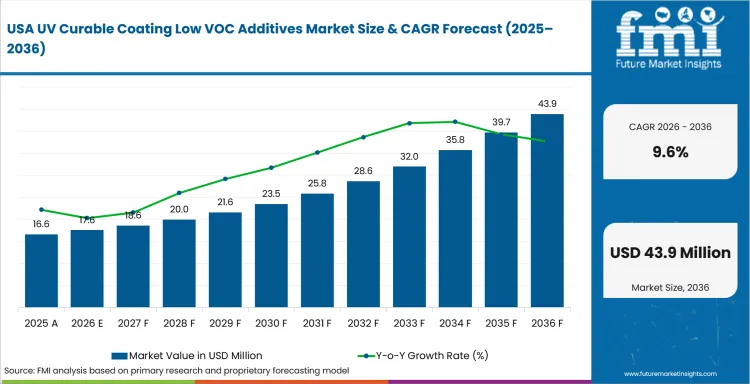
| Parameter | Value |
|---|---|
| Market Size in 2025 (Value) | USD 5.7 million |
| Market Size in 2026 (Value) | USD 6.2 million |
| Market Forecast in 2036 (Value) | USD 15.5 million |
| CAGR (2026 to 2036) | 9.6% |
| Years Considered | 2021 to 2036 |
| Base Year | 2025 |
| Forecast Period | 2026 to 2036 |
| Units Considered | Value (USD million) |
| Leading Sub-Region | Midwest and Southeast manufacturing corridors |
United States UV Curable Coating Low VOC Additives Market Outlook
United States demand is shaped by emissions scrutiny and high-value coating lines in packaging, electronics, automotive, and industrial finishing. Buyers use low-VOC UV additives when they can reduce solvent contribution without weakening appearance or adhesion.
Key Growth Drivers
- Automotive production creates coating demand as the United States produced 10,562,188 vehicles in 2024, supporting refinish, assembly, and component coating requirements.
- Electronics coating users gain support from semiconductor demand as the Americas recorded 44.8% yearly semiconductor sales growth in 2024.
- EPA surface coating guidance keeps VOC control visible across industrial coating categories and plant compliance reviews.
- Packaging converters need low-odor UV varnishes and inks that support faster curing without migration concerns.
Key Restraints
- Aerosol coating reformulation timing can delay wider conversion because EPA extended the amended national aerosol coatings compliance date by 18 months to January 17, 2027.
- State-level VOC expectations can increase testing work for suppliers serving national coating customers.
- Reformulation cost can limit switching when existing coatings already meet OEM or converter specifications.
What makes United States unique
The United States combines VOC compliance pressure with high-value coating lines that require strong application proof before supplier switching.
Key Companies
- BASF Corporation
- Arkema Inc.
- allnex USA Inc.
- BYK USA Inc.
- Evonik Corporation
- IGM Resins USA Inc.
- Covestro LLC
Sales & Marketing Channels
- Direct sales to coating formulators
- Specialty chemical distributors
- Packaging converter trials
- Electronics coating approvals
- Automotive coating qualification routes
- Trade shows and technical seminars
Country Segment Breakdown Table
| Segment | Sub-Segments |
|---|---|
| By Chemistry Type | Bio-based · Recycled · Low VOC · Halogen Free · Waterborne |
| By Function | Solvent · Additive · Binder · Coating · Process Aid |
| By Application | Textiles · Batteries · Construction · Personal Care · Water Treatment |
| By End-use Industry | Automotive · Electronics · Packaging · Agriculture · Industrial Manufacturing |
| By Cure System | UV Mercury Lamp · UV LED · Electron Beam · Dual-Cure Systems · Hybrid UV-Waterborne Systems |
| Key Sub-Regions Covered, Industrial and Coating Clusters | Midwest · Southeast · Texas · California · Northeast · Pacific Northwest |
Frequently Asked Questions
How fast is United States UV curable coating low VOC additives market growing?
The United States is anticipated to grow at 9.6% CAGR from 2026 to 2036 through compliance-led coating reformulation.
Who leads United States UV curable coating low VOC additives market?
BASF, Arkema, allnex, BYK, Evonik, IGM Resins, and Covestro compete through technical service and product breadth.
What is driving adoption in United States UV curable coating low VOC additives market?
VOC rules, high-value coating lines, and electronics-grade surface requirements are moving buyers toward low-VOC UV additives.
How is the UV curable coating low VOC additives market performing in Japan?
A 9.4% CAGR through 2036 reflects precision coating demand and local UV technology support.
Country Market Snapshot Table
| Parameter | Value |
|---|---|
| Market Size in 2025 (Value) | USD 3.3 million |
| Market Size in 2026 (Value) | USD 3.6 million |
| Market Forecast in 2036 (Value) | USD 8.8 million |
| CAGR (2026 to 2036) | 9.4% |
| Years Considered | 2021 to 2036 |
| Base Year | 2025 |
| Forecast Period | 2026 to 2036 |
| Units Considered | Value (USD million) |
| Leading Sub-Region | Kansai and Kanto precision coating clusters |
Japan UV Curable Coating Low VOC Additives Market Outlook
Japan demand is shaped by precision coating users and long validation cycles. Electronics, e-mobility, and specialty films create demand for additives that can deliver consistent cure response and low surface defects.
Key Growth Drivers
- Automotive coating demand remains sizable as Japan produced 8,234,681 vehicles in 2024, maintaining a strong base for finishing and protective coatings.
- Semiconductor equipment activity supports precision coating needs as Japanese semiconductor equipment sales increased by 27% in 2024.
- Local UV/LED/EB technology laboratories help buyers test cure behavior before commercial approval.
- Electronics and mobility coatings require low-heat curing to protect sensitive substrates and fine films.
Key Restraints
- Automotive demand pressure can slow coating conversion as Japan recorded 4,421,494 new passenger vehicle sales in 2024, down 7.5% from the previous year.
- Long buyer validation cycles can delay supplier switching even when additives fit technical requirements.
- High performance expectations reduce the scope for low-cost additives without strong formulation evidence.
What makes Japan unique
Japan is unique due to precision coating expectations and the importance of local validation for UV LED and electronics applications.
Key Companies
- BASF Japan Ltd.
- Arkema K.K.
- allnex Japan
- BYK Japan KK
- Evonik Japan Co. Ltd.
- IGM Resins Japan partners
- Covestro Japan Ltd.
Sales & Marketing Channels
- Local application laboratories
- Electronics OEM qualification
- Direct supplier technical sales
- Specialty chemical distributors
- Mobility component coating trials
- Precision film coating programs
Country Segment Breakdown Table
| Segment | Sub-Segments |
|---|---|
| By Chemistry Type | Bio-based · Recycled · Low VOC · Halogen Free · Waterborne |
| By Function | Solvent · Additive · Binder · Coating · Process Aid |
| By Application | Textiles · Batteries · Construction · Personal Care · Water Treatment |
| By End-use Industry | Automotive · Electronics · Packaging · Agriculture · Industrial Manufacturing |
| By Cure System | UV Mercury Lamp · UV LED · Electron Beam · Dual-Cure Systems · Hybrid UV-Waterborne Systems |
| Key Sub-Regions Covered, Industrial and Coating Clusters | Tokyo · Osaka · Kyoto · Nagoya · Yokohama · Fukuoka |
Frequently Asked Questions
How fast is Japan UV curable coating low VOC additives market growing?
Japan is projected to rise at 9.4% CAGR from 2026 to 2036 as precision coating users adopt low-VOC UV systems.
Who leads Japan UV curable coating low VOC additives market?
BASF Japan, Arkema K.K., allnex Japan, BYK Japan, Evonik Japan, IGM Resins partners, and Covestro Japan compete through local technical service.
What is driving adoption in Japan UV curable coating low VOC additives market?
Electronics, mobility coatings, and local UV/LED/EB lab support are driving additive qualification.
What is the UV curable coating low VOC additives market forecast for France?
A 9.1% CAGR through 2036 reflects certified UV materials, mobility coatings, and electronics-linked demand.
Country Market Snapshot Table
| Parameter | Value |
|---|---|
| Market Size in 2025 (Value) | USD 1.6 million |
| Market Size in 2026 (Value) | USD 1.8 million |
| Market Forecast in 2036 (Value) | USD 4.3 million |
| CAGR (2026 to 2036) | 9.1% |
| Years Considered | 2021 to 2036 |
| Base Year | 2025 |
| Forecast Period | 2026 to 2036 |
| Units Considered | Value (USD million) |
| Leading Sub-Region | Hauts-de-France and Auvergne-Rhône-Alpes |
France UV Curable Coating Low VOC Additives Market Outlook
France demand is supported by certified energy-curable materials and technical coating use in mobility, electronics, and industrial surfaces. The country has a strong supplier-side role through UV resin and additive expertise.
Key Growth Drivers
- Automotive coating demand is supported by French vehicle output of 1,357,701 units in 2024, according to OICA production data.
- Certified UV material supply supports low-emission formulation as Arkema’s certified Sartomer UV/LED/EB offer includes grades with up to 85% biobased content.
- Mobility and electronics coating users need additives that improve surface protection while supporting lower-emission curing.
- French technical suppliers can support customer trials with formulation documentation and certified feedstock claims.
Key Restraints
- Buyer audits can slow new product approval as EU car production reached just under 11.5 million units in 2025, keeping competitive pressure high across coating suppliers.
- Smaller coating users may lack in-house UV formulation teams for fast additive conversion.
- Sustainability claims require documentation, making unsupported bio-based positioning difficult to commercialize.
What makes France unique
France is unique due to its certified UV-LED-EB materials base and strong link between supplier innovation and mobility coating demand.
Key Companies
- Arkema Sartomer
- BASF France
- allnex France
- Evonik France
- BYK France
- IGM Resins distribution partners
- Covestro France
Sales & Marketing Channels
- Direct supplier technical sales
- Certified material documentation routes
- Mobility coating trials
- Electronics supplier qualification
- Specialty chemical distributors
- Industrial coating customer audits
Country Segment Breakdown Table
| Segment | Sub-Segments |
|---|---|
| By Chemistry Type | Bio-based · Recycled · Low VOC · Halogen Free · Waterborne |
| By Function | Solvent · Additive · Binder · Coating · Process Aid |
| By Application | Textiles · Batteries · Construction · Personal Care · Water Treatment |
| By End-use Industry | Automotive · Electronics · Packaging · Agriculture · Industrial Manufacturing |
| By Cure System | UV Mercury Lamp · UV LED · Electron Beam · Dual-Cure Systems · Hybrid UV-Waterborne Systems |
| Key Sub-Regions Covered, Industrial and Coating Clusters | Paris Region · Hauts-de-France · Auvergne-Rhône-Alpes · Normandy · Grand Est · Occitanie |
Frequently Asked Questions
How fast is France UV curable coating low VOC additives market growing?
France is expected to advance at 9.1% CAGR from 2026 to 2036 with certified UV material systems supporting demand.
Who leads France UV curable coating low VOC additives market?
Arkema Sartomer, BASF France, allnex France, Evonik France, BYK France, IGM Resins partners, and Covestro France compete through certified materials and technical service.
What is driving adoption in France UV curable coating low VOC additives market?
Certified energy-curable materials, mobility coatings, and electronics-related surface protection are driving adoption.
What supports Germany UV curable coating low VOC additives demand?
An 8.8% CAGR through 2036 reflects automotive qualification, industrial coating depth, and emissions pressure.
Country Market Snapshot Table
| Parameter | Value |
|---|---|
| Market Size in 2025 (Value) | USD 2.7 million |
| Market Size in 2026 (Value) | USD 2.9 million |
| Market Forecast in 2036 (Value) | USD 6.7 million |
| CAGR (2026 to 2036) | 8.8% |
| Years Considered | 2021 to 2036 |
| Base Year | 2025 |
| Forecast Period | 2026 to 2036 |
| Units Considered | Value (USD million) |
| Leading Sub-Region | North Rhine-Westphalia and Bavaria |
Germany UV Curable Coating Low VOC Additives Market Outlook
Germany demand follows a strict qualification path because automotive and industrial coating users require repeatable performance. Suppliers must prove surface control, cure behavior, and compatibility before additives move into production.
Key Growth Drivers
- Automotive coating demand is supported by German production of 4,069,222 cars in 2024, according to OICA data.
- Industrial emissions pressure remains relevant because IED 2.0 covers 37,000 industrial installations across the EU.
- German formulation labs support structured additive testing for scratch resistance, wetting, and cure response.
- Automotive and industrial customers need low-emission systems that preserve chemical resistance and surface quality.
Key Restraints
- European production pressure can slow premium approvals because EU car production rose only 0.3% in 2025, reaching just under 11.5 million units.
- OEM coating approval cycles increase time-to-sale for new UV additives.
- Premium additives face cost pressure when standard wetting and flow agents meet basic performance needs.
What makes Germany unique
Germany is unique due to strict coating qualification culture and strong local supplier roots in specialty additives.
Key Companies
- BASF SE
- Evonik Coating Additives
- BYK Additives
- allnex Germany
- Arkema Germany
- IGM Resins Germany partners
- Covestro AG
Sales & Marketing Channels
- Direct OEM technical sales
- Application lab trials
- Distributor support for regional formulators
- Automotive coating qualification routes
- European trade fairs
- Plant-level technical audits
Country Segment Breakdown Table
| Segment | Sub-Segments |
|---|---|
| By Chemistry Type | Bio-based · Recycled · Low VOC · Halogen Free · Waterborne |
| By Function | Solvent · Additive · Binder · Coating · Process Aid |
| By Application | Textiles · Batteries · Construction · Personal Care · Water Treatment |
| By End-use Industry | Automotive · Electronics · Packaging · Agriculture · Industrial Manufacturing |
| By Cure System | UV Mercury Lamp · UV LED · Electron Beam · Dual-Cure Systems · Hybrid UV-Waterborne Systems |
| Key Sub-Regions Covered, Industrial and Coating Clusters | North Rhine-Westphalia · Bavaria · Baden-Württemberg · Lower Saxony · Hesse · Hamburg |
Frequently Asked Questions
How fast is Germany UV curable coating low VOC additives market growing?
Germany is forecast to grow at 8.8% CAGR from 2026 to 2036 through automotive and industrial coating qualification.
Who leads Germany UV curable coating low VOC additives market?
BASF, Evonik Coating Additives, BYK Additives, allnex, Arkema, IGM Resins partners, and Covestro compete through technical formulation support.
What is driving adoption in Germany UV curable coating low VOC additives market?
Automotive coating demand, emissions pressure, and local additive expertise are supporting low-VOC UV formulation trials.
What is the UV curable coating low VOC additives market outlook in the United Kingdom?
An 8.7% CAGR through 2036 reflects packaging, specialty coatings, and distributor-led technical support.
Country Market Snapshot Table
| Parameter | Value |
|---|---|
| Market Size in 2025 (Value) | USD 1.3 million |
| Market Size in 2026 (Value) | USD 1.4 million |
| Market Forecast in 2036 (Value) | USD 3.2 million |
| CAGR (2026 to 2036) | 8.7% |
| Years Considered | 2021 to 2036 |
| Base Year | 2025 |
| Forecast Period | 2026 to 2036 |
| Units Considered | Value (USD million) |
| Leading Sub-Region | Midlands and northern packaging corridors |
United Kingdom UV Curable Coating Low VOC Additives Market Outlook
United Kingdom demand is narrower than Germany or France, but it is technically demanding. Packaging, specialty finishes, industrial maintenance, and electronics-related coatings shape demand for low-VOC UV additive packages.
Key Growth Drivers
- British vehicle production reached 905,233 units in 2024, giving coating suppliers an automotive-facing route despite production pressure.
- The UK paint and coatings sector is valued at GBP 3.2 billion and totals 703 million litres, supporting additive demand across specialty coating users.
- Distributor-led selling helps small and mid-sized coating formulators access global additive portfolios.
- Packaging converters need fast-cure varnish systems with lower odor and stable surface slip.
Key Restraints
- UK packaging waste data show 64.1% of packaging waste was recycled in 2024, keeping pressure on converters to document coating choices and recyclability impact.
- Smaller batch economics can slow custom additive qualification for specialty coating producers.
- Import-linked supply chains can expose formulators to lead-time and sample availability risk.
What makes United Kingdom unique
The United Kingdom is unique as a service-led specialty coating market where distributors and documentation often decide additive purchase behavior.
Key Companies
- BASF plc
- Arkema UK
- allnex UK partners
- BYK UK distribution partners
- Evonik UK
- IGM Resins UK partners
- Covestro UK
Sales & Marketing Channels
- Specialty chemical distributors
- Formulator sample programs
- Packaging converter trials
- European supplier sales teams
- Trade association events
- Application troubleshooting support
Country Segment Breakdown Table
| Segment | Sub-Segments |
|---|---|
| By Chemistry Type | Bio-based · Recycled · Low VOC · Halogen Free · Waterborne |
| By Function | Solvent · Additive · Binder · Coating · Process Aid |
| By Application | Textiles · Batteries · Construction · Personal Care · Water Treatment |
| By End-use Industry | Automotive · Electronics · Packaging · Agriculture · Industrial Manufacturing |
| By Cure System | UV Mercury Lamp · UV LED · Electron Beam · Dual-Cure Systems · Hybrid UV-Waterborne Systems |
| Key Sub-Regions Covered, Industrial and Coating Clusters | Midlands · Greater London · North West England · Yorkshire · Scotland · Wales |
Frequently Asked Questions
How fast is United Kingdom UV curable coating low VOC additives market growing?
The United Kingdom is expected to expand at 8.7% CAGR from 2026 to 2036 through packaging and specialty coating demand.
Who leads United Kingdom UV curable coating low VOC additives market?
BASF, Arkema, allnex partners, BYK distributors, Evonik, IGM Resins partners, and Covestro compete through distributor-led access.
What is driving adoption in United Kingdom UV curable coating low VOC additives market?
Packaging converters, specialty coating formulators, and documentation-heavy buyer requirements are supporting low-VOC UV additive use.
Who are the leading companies in the UV curable coating low VOC additives market?
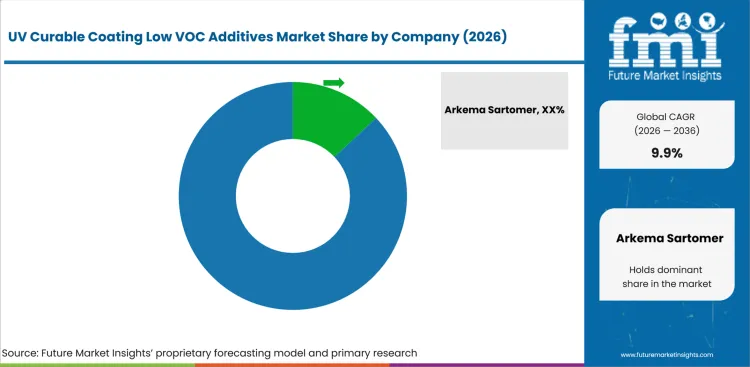
BASF, Arkema Sartomer, allnex, BYK Additives, Evonik Coating Additives, IGM Resins, and Covestro.
- Energy-curing resin and additive specialists hold an advantage through UV LED formulation depth and customer testing support.
- Surface-control suppliers gain value when additives reduce coating defects without adding volatile solvent content.
- Low-VOC formulation enablers compete by supporting waterborne UV, bio-attributed systems, and low-migration packaging needs.
- Regional distributors strengthen supplier access by helping smaller formulators test additives before commercial purchase.
Coating additive companies compete through formulation proof and application service rather than catalog breadth alone. BASF and BYK compete strongly in dispersants, wetting agents, defoamers, and surface-control additives. Arkema Sartomer and allnex compete through energy-curable resin and additive systems. Evonik Coating Additives brings surface-control depth across industrial coatings, while IGM Resins supports UV curing through photoinitiators and specialized energy-curing materials. Covestro remains relevant through low-emission coating raw material expertise.
Supplier scale has become more important as UV curing moves from narrow coating trials into battery, electronics, packaging, and mobility surfaces. Arkema strengthened its certified UV/LED/EB position through ISCC PLUS sites in China and the United States, while BASF added a next-generation dispersing agent for industrial coatings. IGM Resins expanded India access through its January 2026 distribution route, improving customer access to photoinitiators, energy-curing resins, and specialized additives.
Smaller and regional suppliers can win through faster troubleshooting and local distributor relationships. India and China reward suppliers with local inventory and formulation support. Japan and South Korea reward suppliers with local laboratories and long validation support. Germany and the United States reward companies with documentation, VOC evidence, and strong application testing. Suppliers best positioned to win are those that combine UV LED compatibility, low-VOC data, and responsive technical service.
How do top UV curable coating low VOC additives companies compare?
Arkema Sartomer and allnex score strongest on UV/LED cure formulation depth while BASF, BYK, and Evonik remain strong in surface-control additives.
| Company | Relevance to Market Title | UV/LED Cure Formulation Depth | Low-VOC Additive Compliance Support | Application Lab and Channel Reach | Geographic Footprint |
|---|---|---|---|---|---|
| Arkema Sartomer | Very High | Very Strong | Very Strong | Strong | Global |
| allnex | Very High | Very Strong | Strong | Strong | Global |
| BASF | Very High | Strong | Very Strong | Very Strong | Global |
| BYK Additives | High | Strong | Very Strong | Strong | Global |
| Evonik Coating Additives | High | Strong | Strong | Strong | Global |
| IGM Resins | High | Very Strong | Moderate to Strong | Strong | Global |
| Covestro | Moderate to High | Moderate | Strong | Moderate | Global |
Source: Future Market Insights competitive analysis, 2026.
Who are the key players in the UV curable coating low VOC additives market?
Arkema Sartomer, allnex, BASF, BYK Additives, Evonik Coating Additives, IGM Resins, and Covestro are listed among the major suppliers.
Key global companies leading the UV curable coating low VOC additives market include:
- Arkema Sartomer
- allnex
- BASF
- BYK Additives
- Evonik Coating Additives
- IGM Resins
- Covestro
Key Developments in UV Curable Coating Low VOC Additives Market
- In April 2024, BASF launched Efka PX 4360 as a next-generation dispersing agent for industrial coatings at the American Coatings Show, supporting improved pigment compatibility and industrial coating processability.
- In July 2024, Arkema established a UV/LED/EB technologies innovation lab at its Kyoto Technical Center to support specialty coating and adhesive applications for advanced electronics, new energies, building efficiency, and e-mobility markets.
- In December 2025, IGM Resins announced an exclusive India distribution partnership with IDCC Global Chem beginning January 2026, covering photoinitiators, energy-curing resins, and specialized additives.
Key Players in the UV Curable Coating Low VOC Additives Market
Energy-curing resin and additive specialists
- Arkema Sartomer
- allnex
- IGM Resins
Surface-control and dispersion additive suppliers
- BASF
- BYK Additives
- Evonik Coating Additives
Low-VOC formulation enablers
- Covestro
UV Curable Coating Low VOC Additives Market - Report Scope
| Parameter | Details |
|---|---|
| Market size by 2036 | USD 90.0 million |
| Growth rate | 9.9% CAGR from 2026 to 2036 |
| Forecast period | 2026 to 2036 |
| Base year value (2025) | USD 31.8 million |
| By chemistry type | Bio-based, recycled, low VOC, halogen free, waterborne |
| By function | Solvent, additive, binder, coating, process aid |
| By application | Textiles, batteries, construction, personal care, water treatment |
| By end-use industry | Automotive, electronics, packaging, agriculture, industrial manufacturing |
| By cure system | UV mercury lamp, UV LED, electron beam, dual-cure systems, hybrid UV-waterborne systems |
| Regions covered | North America, Latin America, Europe, East Asia, South Asia and Pacific, Middle East and Africa |
| Countries covered | India, China, South Korea, United States, Japan, France, Germany, United Kingdom |
| Key companies profiled | Arkema Sartomer, allnex, BASF, BYK Additives, Evonik Coating Additives, IGM Resins, Covestro |
| Approach | Bottom-up specialty additive approach using eligible additive revenue, UV coating conversion, supplier portfolios, country production signals, and end-use exposure |
Source: Future Market Insights, 2026.
UV Curable Coating Low VOC Additives Market Breakdown by Chemistry Type, Function, Application, End-use Industry, Cure System, and Region
UV Curable Coating Low VOC Additives Market Segmented by Chemistry Type:
- Bio-based
- Recycled
- Low VOC
- Halogen Free
- Waterborne
UV Curable Coating Low VOC Additives Market Segmented by Function:
- Solvent
- Additive
- Binder
- Coating
- Process Aid
UV Curable Coating Low VOC Additives Market Segmented by Application:
- Textiles
- Batteries
- Construction
- Personal Care
- Water Treatment
UV Curable Coating Low VOC Additives Market Segmented by End-use Industry:
- Automotive
- Electronics
- Packaging
- Agriculture
- Industrial Manufacturing
UV Curable Coating Low VOC Additives Market Segmented by Cure System:
- UV Mercury Lamp
- UV LED
- Electron Beam
- Dual-Cure Systems
- Hybrid UV-Waterborne Systems
UV Curable Coating Low VOC Additives Market by Region:
- North America
- Latin America
- Europe
- East Asia
- South Asia and Pacific
- Middle East and Africa
Research Sources and Bibliography
- Arkema. (2024, July 31). Arkema establishes UV/LED/EB technologies innovation lab at its Kyoto Technical Center.
- Arkema. (2024, August 26). Arkema obtains mass balance ISCC PLUS certification for its specialty UV/LED/EB curing resins production facility in China.
- Arkema. (2025, April 22). Arkema obtains mass balance ISCC PLUS certification for UV-LED-EB resin production in Chatham, Virginia and West Chester, Pennsylvania.
- Arkema. (2026, January 14). Arkema announces the ISCC PLUS certification of more than 70% of its coating facilities worldwide.
- BASF. (2024, April 30). BASF introduces Efka PX 4360, a solvent-based dispersing agent for industrial coatings.
- British Coatings Federation. (2025). Industry statistics.
- European Automobile Manufacturers’ Association. (2026, April 2). Economic and market report: Global and EU auto industry, full year 2025.
- European Commission. (2024, August 2). Zero pollution: Modernised rules on industrial and livestock rearing emissions come into effect.
- European Commission. (2025). Industrial and Livestock Rearing Emissions Directive 2.0.
- Federal Register. (2025, July 2). National volatile organic compound emission standards for aerosol coatings: Interim final rule.
- IGM Resins. (2025, December 15). IGM Resins announces strategic distribution partnership with IDCC Global Chem.
- International Energy Agency. (2025, May). Global EV Outlook 2025.
- International Energy Agency. (2026, May). Global EV Outlook 2026.
- International Organization of Motor Vehicle Manufacturers. (2025). World motor vehicle production statistics 2024.
- Invest Korea. (2025, October 2). South Korea’s semiconductor industry and investment status.
- Japan Automobile Manufacturers Association. (2025, September 26). The motor industry of Japan 2025.
- Korea Economic Institute of America. (2025, August 25). South Korea’s battery industry faces challenges.
- Semiconductor Industry Association. (2025, February 7). Global semiconductor sales increase 19.1% in 2024; double-digit growth projected in 2025.
- SEMI. (2025, March 24). SEMICON Korea 2025: Bringing together the global semiconductor ecosystem to drive innovation.
- Society of Motor Manufacturers and Traders. (2025, January 30). Vehicle production dips amid EV transformation and intense market pressure.
- UK Department for Environment, Food and Rural Affairs. (2025, July 23). UK statistics on waste.
- U.S. Environmental Protection Agency. (2026, May 20). Clean Air Act guidelines and standards for solvent use and surface coating industry.
- U.S. International Trade Administration. (2025, November 20). Japan semiconductors.
This bibliography is provided for reader reference and is not exhaustive. The full report contains the complete reference list and detailed citations.
UV Curable Coating Low VOC Additives Market - Scope & Definition
| Attribute | Detail |
|---|---|
| Market Definition | Additives used in ultraviolet, UV LED, electron beam, and energy-curable coating systems that reduce solvent emissions while supporting surface control, dispersion, defoaming, cure response, and process performance. |
| Functions Covered | Wetting, defoaming, dispersion, flow control, slip control, scratch resistance, cure support, surface leveling, and process stabilization. |
| Applications Covered | Textiles, batteries, construction surfaces, personal care packaging, water treatment equipment, electronics coatings, and industrial coating systems. |
| End-Use Industries | Automotive, electronics, packaging, agriculture, and industrial manufacturing. |
| Grades Covered | Bio-based, recycled, low VOC, halogen free, and waterborne additive systems. |
| Inclusions | Specialty additives used in low-VOC UV-curable coating formulations, including surface-control agents, dispersants, defoamers, cure boosters, wetting agents, and process aids. |
| Exclusions | Conventional solventborne coating additives without UV-curable use, thermal-cure additives, powder coating additives, bulk monomers sold without additive function, and unrelated textile or water treatment chemicals. |
UV Curable Coating Low VOC Additives Market - Research Methodology
| Method | Description |
|---|---|
| Primary Research | FMI analyst interviews with coating formulators, UV curing line users, specialty chemical distributors, industrial coating buyers, and application support teams across major production regions. |
| Desk Research | Review of VOC rules, industrial emissions guidance, vehicle production statistics, semiconductor demand signals, EV battery demand, and official company documentation. |
| Market Sizing & Forecasting | Bottom-up specialty additive modeling using additive use rates, UV formulation penetration, regional coating output, and end-use exposure across electronics, automotive, batteries, and packaging. |
| Data Validation | Cross-verification using public emissions rules, verified company developments, chemical output signals, and country-level manufacturing evidence. |
This Report Answers
- Market size estimates for 2026 and forecasts through 2036 for the UV curable coating low VOC additives market.
- Insights across regional and country-level markets covering emissions pressure, coating conversion, and supplier qualification.
- Analysis of demand drivers, formulation trends, UV LED curing adoption, and low-residue coating requirements.
- Evaluation of chemistry types, functions, applications, end-use industries, and cure systems.
- Assessment of VOC regulation, industrial emissions reporting, and plant-level coating approval requirements.
- Identification of opportunities across electronics, batteries, packaging, mobility coatings, and low-migration UV systems.
- Evaluation of supply chain dynamics, application lab support, distributor access, and technical service requirements.
- Country-level growth analysis covering India, China, South Korea, the United States, Japan, France, Germany, and the United Kingdom.
- Assessment of the competitive landscape, including leading UV-curable additive and energy-curing material suppliers.
- Delivery of market data, forecasts, and supporting analysis in PDF and Excel formats.
Frequently Asked Questions
What is the UV curable coating low VOC additives market size in 2026?
The UV curable coating low VOC additives market size is anticipated to reach USD 35.0 million in 2026.
What is the UV curable coating low VOC additives market forecast for 2036?
The UV curable coating low VOC additives industry revenue is predicted to reach USD 90.0 million by 2036 as UV systems move into higher-value coating lines.
What is the UV curable coating low VOC additives market CAGR?
The UV curable coating low VOC additives sector is projected to expand at 9.9% CAGR from 2026 to 2036.
What segment leads the UV curable coating low VOC additives market?
Additive function is likely to capture 41.0% share in 2026 due to wetting, defoaming, flow control, and surface correction needs.
What country grows fastest in the UV curable coating low VOC additives market?
India is set to record 11.2% CAGR by 2036, driven by electronics exports, auto output, and coating conversion capacity.
Preview the report firsthand - request a free sample
Get SampleGet the brochure for pricing and purchase details.
Get PDFTable of Content
- Executive Summary
- Global Market Outlook
- Demand to side Trends
- Supply to side Trends
- Technology Roadmap Analysis
- Analysis and Recommendations
- Market Overview
- Market Coverage / Taxonomy
- Market Definition / Scope / Limitations
- Research Methodology
- Chapter Orientation
- Analytical Lens and Working Hypotheses
- Market Structure, Signals, and Trend Drivers
- Benchmarking and Cross-market Comparability
- Market Sizing, Forecasting, and Opportunity Mapping
- Research Design and Evidence Framework
- Desk Research Programme (Secondary Evidence)
- Company Annual and Sustainability Reports
- Peer-reviewed Journals and Academic Literature
- Corporate Websites, Product Literature, and Technical Notes
- Earnings Decks and Investor Briefings
- Statutory Filings and Regulatory Disclosures
- Technical White Papers and Standards Notes
- Trade Journals, Industry Magazines, and Analyst Briefs
- Conference Proceedings, Webinars, and Seminar Materials
- Government Statistics Portals and Public Data Releases
- Press Releases and Reputable Media Coverage
- Specialist Newsletters and Curated Briefings
- Sector Databases and Reference Repositories
- FMI Internal Proprietary Databases and Historical Market Datasets
- Subscription Datasets and Paid Sources
- Social Channels, Communities, and Digital Listening Inputs
- Additional Desk Sources
- Expert Input and Fieldwork (Primary Evidence)
- Primary Modes
- Qualitative Interviews and Expert Elicitation
- Quantitative Surveys and Structured Data Capture
- Blended Approach
- Why Primary Evidence is Used
- Field Techniques
- Interviews
- Surveys
- Focus Groups
- Observational and In-context Research
- Social and Community Interactions
- Stakeholder Universe Engaged
- C-suite Leaders
- Board Members
- Presidents and Vice Presidents
- R&D and Innovation Heads
- Technical Specialists
- Domain Subject-matter Experts
- Scientists
- Physicians and Other Healthcare Professionals
- Governance, Ethics, and Data Stewardship
- Research Ethics
- Data Integrity and Handling
- Primary Modes
- Tooling, Models, and Reference Databases
- Desk Research Programme (Secondary Evidence)
- Data Engineering and Model Build
- Data Acquisition and Ingestion
- Cleaning, Normalisation, and Verification
- Synthesis, Triangulation, and Analysis
- Quality Assurance and Audit Trail
- Market Background
- Market Dynamics
- Drivers
- Restraints
- Opportunity
- Trends
- Scenario Forecast
- Demand in Optimistic Scenario
- Demand in Likely Scenario
- Demand in Conservative Scenario
- Opportunity Map Analysis
- Product Life Cycle Analysis
- Supply Chain Analysis
- Investment Feasibility Matrix
- Value Chain Analysis
- PESTLE and Porter’s Analysis
- Regulatory Landscape
- Regional Parent Market Outlook
- Production and Consumption Statistics
- Import and Export Statistics
- Market Dynamics
- Global Market Analysis 2021 to 2025 and Forecast, 2026 to 2036
- Historical Market Size Value (USD Million) Analysis, 2021 to 2025
- Current and Future Market Size Value (USD Million) Projections, 2026 to 2036
- Y to o to Y Growth Trend Analysis
- Absolute $ Opportunity Analysis
- Global Market Pricing Analysis 2021 to 2025 and Forecast 2026 to 2036
- Global Market Analysis 2021 to 2025 and Forecast 2026 to 2036, By Chemistry Type
- Introduction / Key Findings
- Historical Market Size Value (USD Million) Analysis By Chemistry Type , 2021 to 2025
- Current and Future Market Size Value (USD Million) Analysis and Forecast By Chemistry Type , 2026 to 2036
- Low VOC
- Recycled
- Bio-based
- Low VOC
- Y to o to Y Growth Trend Analysis By Chemistry Type , 2021 to 2025
- Absolute $ Opportunity Analysis By Chemistry Type , 2026 to 2036
- Global Market Analysis 2021 to 2025 and Forecast 2026 to 2036, By Function
- Introduction / Key Findings
- Historical Market Size Value (USD Million) Analysis By Function, 2021 to 2025
- Current and Future Market Size Value (USD Million) Analysis and Forecast By Function, 2026 to 2036
- Additive
- Solvent
- Coating
- Additive
- Y to o to Y Growth Trend Analysis By Function, 2021 to 2025
- Absolute $ Opportunity Analysis By Function, 2026 to 2036
- Global Market Analysis 2021 to 2025 and Forecast 2026 to 2036, By Application
- Introduction / Key Findings
- Historical Market Size Value (USD Million) Analysis By Application, 2021 to 2025
- Current and Future Market Size Value (USD Million) Analysis and Forecast By Application, 2026 to 2036
- Batteries
- Textiles
- Personal Care
- Batteries
- Y to o to Y Growth Trend Analysis By Application, 2021 to 2025
- Absolute $ Opportunity Analysis By Application, 2026 to 2036
- Global Market Analysis 2021 to 2025 and Forecast 2026 to 2036, By End-use Industry
- Introduction / Key Findings
- Historical Market Size Value (USD Million) Analysis By End-use Industry, 2021 to 2025
- Current and Future Market Size Value (USD Million) Analysis and Forecast By End-use Industry, 2026 to 2036
- Electronics
- Automotive
- Packaging
- Electronics
- Y to o to Y Growth Trend Analysis By End-use Industry, 2021 to 2025
- Absolute $ Opportunity Analysis By End-use Industry, 2026 to 2036
- Global Market Analysis 2021 to 2025 and Forecast 2026 to 2036, By Cure System
- Introduction / Key Findings
- Historical Market Size Value (USD Million) Analysis By Cure System, 2021 to 2025
- Current and Future Market Size Value (USD Million) Analysis and Forecast By Cure System, 2026 to 2036
- UV LED
- UV Mercury Lamp
- Dual-Cure Systems
- UV LED
- Y to o to Y Growth Trend Analysis By Cure System, 2021 to 2025
- Absolute $ Opportunity Analysis By Cure System, 2026 to 2036
- Global Market Analysis 2021 to 2025 and Forecast 2026 to 2036, By Region
- Introduction
- Historical Market Size Value (USD Million) Analysis By Region, 2021 to 2025
- Current Market Size Value (USD Million) Analysis and Forecast By Region, 2026 to 2036
- North America
- Latin America
- Western Europe
- Eastern Europe
- East Asia
- South Asia and Pacific
- Middle East & Africa
- Market Attractiveness Analysis By Region
- North America Market Analysis 2021 to 2025 and Forecast 2026 to 2036, By Country
- Historical Market Size Value (USD Million) Trend Analysis By Market Taxonomy, 2021 to 2025
- Market Size Value (USD Million) Forecast By Market Taxonomy, 2026 to 2036
- By Country
- USA
- Canada
- Mexico
- By Chemistry Type
- By Function
- By Application
- By End-use Industry
- By Cure System
- By Country
- Market Attractiveness Analysis
- By Country
- By Chemistry Type
- By Function
- By Application
- By End-use Industry
- By Cure System
- Key Takeaways
- Latin America Market Analysis 2021 to 2025 and Forecast 2026 to 2036, By Country
- Historical Market Size Value (USD Million) Trend Analysis By Market Taxonomy, 2021 to 2025
- Market Size Value (USD Million) Forecast By Market Taxonomy, 2026 to 2036
- By Country
- Brazil
- Chile
- Rest of Latin America
- By Chemistry Type
- By Function
- By Application
- By End-use Industry
- By Cure System
- By Country
- Market Attractiveness Analysis
- By Country
- By Chemistry Type
- By Function
- By Application
- By End-use Industry
- By Cure System
- Key Takeaways
- Western Europe Market Analysis 2021 to 2025 and Forecast 2026 to 2036, By Country
- Historical Market Size Value (USD Million) Trend Analysis By Market Taxonomy, 2021 to 2025
- Market Size Value (USD Million) Forecast By Market Taxonomy, 2026 to 2036
- By Country
- Germany
- UK
- Italy
- Spain
- France
- Nordic
- BENELUX
- Rest of Western Europe
- By Chemistry Type
- By Function
- By Application
- By End-use Industry
- By Cure System
- By Country
- Market Attractiveness Analysis
- By Country
- By Chemistry Type
- By Function
- By Application
- By End-use Industry
- By Cure System
- Key Takeaways
- Eastern Europe Market Analysis 2021 to 2025 and Forecast 2026 to 2036, By Country
- Historical Market Size Value (USD Million) Trend Analysis By Market Taxonomy, 2021 to 2025
- Market Size Value (USD Million) Forecast By Market Taxonomy, 2026 to 2036
- By Country
- Russia
- Poland
- Hungary
- Balkan & Baltic
- Rest of Eastern Europe
- By Chemistry Type
- By Function
- By Application
- By End-use Industry
- By Cure System
- By Country
- Market Attractiveness Analysis
- By Country
- By Chemistry Type
- By Function
- By Application
- By End-use Industry
- By Cure System
- Key Takeaways
- East Asia Market Analysis 2021 to 2025 and Forecast 2026 to 2036, By Country
- Historical Market Size Value (USD Million) Trend Analysis By Market Taxonomy, 2021 to 2025
- Market Size Value (USD Million) Forecast By Market Taxonomy, 2026 to 2036
- By Country
- China
- Japan
- South Korea
- By Chemistry Type
- By Function
- By Application
- By End-use Industry
- By Cure System
- By Country
- Market Attractiveness Analysis
- By Country
- By Chemistry Type
- By Function
- By Application
- By End-use Industry
- By Cure System
- Key Takeaways
- South Asia and Pacific Market Analysis 2021 to 2025 and Forecast 2026 to 2036, By Country
- Historical Market Size Value (USD Million) Trend Analysis By Market Taxonomy, 2021 to 2025
- Market Size Value (USD Million) Forecast By Market Taxonomy, 2026 to 2036
- By Country
- India
- ASEAN
- Australia & New Zealand
- Rest of South Asia and Pacific
- By Chemistry Type
- By Function
- By Application
- By End-use Industry
- By Cure System
- By Country
- Market Attractiveness Analysis
- By Country
- By Chemistry Type
- By Function
- By Application
- By End-use Industry
- By Cure System
- Key Takeaways
- Middle East & Africa Market Analysis 2021 to 2025 and Forecast 2026 to 2036, By Country
- Historical Market Size Value (USD Million) Trend Analysis By Market Taxonomy, 2021 to 2025
- Market Size Value (USD Million) Forecast By Market Taxonomy, 2026 to 2036
- By Country
- Kingdom of Saudi Arabia
- Other GCC Countries
- Turkiye
- South Africa
- Other African Union
- Rest of Middle East & Africa
- By Chemistry Type
- By Function
- By Application
- By End-use Industry
- By Cure System
- By Country
- Market Attractiveness Analysis
- By Country
- By Chemistry Type
- By Function
- By Application
- By End-use Industry
- By Cure System
- Key Takeaways
- Key Countries Market Analysis
- USA
- Pricing Analysis
- Market Share Analysis, 2025
- By Chemistry Type
- By Function
- By Application
- By End-use Industry
- By Cure System
- Canada
- Pricing Analysis
- Market Share Analysis, 2025
- By Chemistry Type
- By Function
- By Application
- By End-use Industry
- By Cure System
- Mexico
- Pricing Analysis
- Market Share Analysis, 2025
- By Chemistry Type
- By Function
- By Application
- By End-use Industry
- By Cure System
- Brazil
- Pricing Analysis
- Market Share Analysis, 2025
- By Chemistry Type
- By Function
- By Application
- By End-use Industry
- By Cure System
- Chile
- Pricing Analysis
- Market Share Analysis, 2025
- By Chemistry Type
- By Function
- By Application
- By End-use Industry
- By Cure System
- Germany
- Pricing Analysis
- Market Share Analysis, 2025
- By Chemistry Type
- By Function
- By Application
- By End-use Industry
- By Cure System
- UK
- Pricing Analysis
- Market Share Analysis, 2025
- By Chemistry Type
- By Function
- By Application
- By End-use Industry
- By Cure System
- Italy
- Pricing Analysis
- Market Share Analysis, 2025
- By Chemistry Type
- By Function
- By Application
- By End-use Industry
- By Cure System
- Spain
- Pricing Analysis
- Market Share Analysis, 2025
- By Chemistry Type
- By Function
- By Application
- By End-use Industry
- By Cure System
- France
- Pricing Analysis
- Market Share Analysis, 2025
- By Chemistry Type
- By Function
- By Application
- By End-use Industry
- By Cure System
- India
- Pricing Analysis
- Market Share Analysis, 2025
- By Chemistry Type
- By Function
- By Application
- By End-use Industry
- By Cure System
- ASEAN
- Pricing Analysis
- Market Share Analysis, 2025
- By Chemistry Type
- By Function
- By Application
- By End-use Industry
- By Cure System
- Australia & New Zealand
- Pricing Analysis
- Market Share Analysis, 2025
- By Chemistry Type
- By Function
- By Application
- By End-use Industry
- By Cure System
- China
- Pricing Analysis
- Market Share Analysis, 2025
- By Chemistry Type
- By Function
- By Application
- By End-use Industry
- By Cure System
- Japan
- Pricing Analysis
- Market Share Analysis, 2025
- By Chemistry Type
- By Function
- By Application
- By End-use Industry
- By Cure System
- South Korea
- Pricing Analysis
- Market Share Analysis, 2025
- By Chemistry Type
- By Function
- By Application
- By End-use Industry
- By Cure System
- Russia
- Pricing Analysis
- Market Share Analysis, 2025
- By Chemistry Type
- By Function
- By Application
- By End-use Industry
- By Cure System
- Poland
- Pricing Analysis
- Market Share Analysis, 2025
- By Chemistry Type
- By Function
- By Application
- By End-use Industry
- By Cure System
- Hungary
- Pricing Analysis
- Market Share Analysis, 2025
- By Chemistry Type
- By Function
- By Application
- By End-use Industry
- By Cure System
- Kingdom of Saudi Arabia
- Pricing Analysis
- Market Share Analysis, 2025
- By Chemistry Type
- By Function
- By Application
- By End-use Industry
- By Cure System
- Turkiye
- Pricing Analysis
- Market Share Analysis, 2025
- By Chemistry Type
- By Function
- By Application
- By End-use Industry
- By Cure System
- South Africa
- Pricing Analysis
- Market Share Analysis, 2025
- By Chemistry Type
- By Function
- By Application
- By End-use Industry
- By Cure System
- USA
- Market Structure Analysis
- Competition Dashboard
- Competition Benchmarking
- Market Share Analysis of Top Players
- By Regional
- By Chemistry Type
- By Function
- By Application
- By End-use Industry
- By Cure System
- Competition Analysis
- Competition Deep Dive
- Arkema Sartomer
- Overview
- Product Portfolio
- Profitability by Market Segments (Product/Age /Sales Channel/Region)
- Sales Footprint
- Strategy Overview
- Marketing Strategy
- Product Strategy
- Channel Strategy
- allnex
- BASF
- BYK Additives
- vonik Coating Additives
- Arkema Sartomer
- Competition Deep Dive
- Assumptions & Acronyms Used


