

- Industry Size (2026)
- USD 235.4 Mn
- Forecast (2036)
- USD 463.1 Mn
- CAGR (2026 to 2036)
- 7%
Vaginitis Screening Assays Market Forecast and Outlook 2026 to 2036
The vaginitis screening assays market is expected to grow from USD 235.4 million in 2026 to USD 463.1 million by 2036, reflecting a compound annual growth rate (CAGR) of 7%. Vaginitis, an inflammation of the vagina often caused by infections, is a common condition among women, and the need for accurate, fast, and non-invasive diagnostic tools is driving the growth of the screening assays market. These assays are designed to detect various causes of vaginitis, including bacterial vaginosis, yeast infections, and trichomoniasis, allowing healthcare providers to offer more targeted and effective treatments.
The market’s growth is supported by an increasing focus on women's health, improvements in diagnostic technologies, and rising awareness about the importance of early diagnosis and treatment. Additionally, as the healthcare industry continues to prioritize preventive care, the demand for accessible and reliable screening solutions is expected to increase. Advancements in assay technologies, along with the expansion of point-of-care testing, will further fuel market expansion.
Quick Stats for Vaginitis Screening Assays Market
- Vaginitis Screening Assays Market Value (2026): USD 235.4 million
- Vaginitis Screening Assays Market Forecast Value (2036): USD 463.1 million
- Vaginitis Screening Assays Market Global Forecast CAGR (2026-2036): 7%
- Top Type by Share in Vaginitis Screening Assays Market: Molecular PCR Assays (45%)
- Key Growth Regions in Vaginitis Screening Assays Market: India, China, USA, UK, Germany
- Top Players in Vaginitis Screening Assays Market: BD, Hologic, QuidelOrtho, Cepheid, Siemens Healthineers
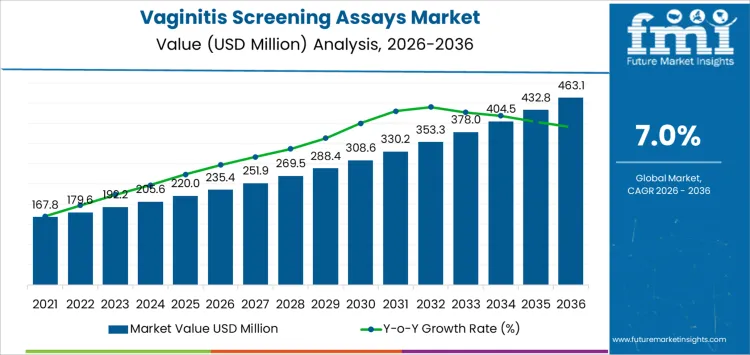
What is the Growth Forecast for the Vaginitis Screening Assays Market through 2036?
The growth momentum analysis for the vaginitis screening assays market indicates steady, predictable growth with periods of acceleration. Starting at USD 235.4 million in 2026, the market grows to USD 251.9 million in 2027 and USD 269.5 million in 2028, reflecting gradual adoption as awareness and demand for early detection of vaginitis increase.
From 2028 to 2030, the market experiences a moderate acceleration, reaching USD 288.4 million in 2029 and USD 308.6 million in 2030. This acceleration is driven by the growing recognition of the importance of timely and accurate diagnosis in managing vaginitis and the continued development of more efficient screening assays. From 2030 to 2035, the market continues to build momentum, reaching USD 330.2 million in 2031, USD 353.3 million in 2032, and USD 378 million in 2033.
By 2035, the market is projected to reach USD 404.5 million, with the final value of USD 463.1 million expected in 2036. The growth momentum analysis reveals that the market will experience consistent and steady growth, with noticeable acceleration in the middle years as the healthcare industry increasingly adopts more accurate and accessible screening solutions for vaginitis. This trajectory suggests a significant rise in demand for these assays as awareness of the condition and the availability of better diagnostic tools expand over time.
Vaginitis Screening Assays Market Key Takeaways
| Metric | Value |
|---|---|
| Industry Sales Value (2026) | USD 235.4 million |
| Industry Forecast Value (2036) | USD 463.1 million |
| Industry Forecast CAGR (2026-2036) | 7% |
What Is Driving the Demand for Vaginitis Screening Assays in the Global Market?
The global demand for vaginitis screening assays is driven by the high prevalence of vulvovaginal infections and the need for accurate, rapid diagnosis to guide appropriate treatment. Vaginitis, which encompasses bacterial vaginosis, vulvovaginal candidiasis, and trichomoniasis, affects women across reproductive and post reproductive ages and is a frequent cause of discomfort, abnormal discharge, and reproductive complications. Traditional diagnosis often relies on clinical assessment and microscopy, which can be subjective and insensitive, leading to misdiagnosis or delayed care. Advances in molecular diagnostics, immunoassays, and point of care platforms have made it possible to detect specific pathogens and biomarkers with greater sensitivity and specificity, reducing uncertainty in clinical decision making. Growing awareness among healthcare providers of the importance of pathogen specific diagnosis to avoid inappropriate antibiotic use also supports uptake of more sophisticated assays. In addition, rising healthcare access in emerging markets and expanded screening practices in prenatal and women’s health programmes contribute to greater utilisation of vaginitis screening tests.
Future demand for vaginitis screening assays is expected to grow as healthcare systems continue prioritising evidence based care and preventive health measures. Continued innovation in assay formats, including rapid point of care tests and multiplex panels that can simultaneously detect multiple pathogens, will expand clinical utility and convenience. Integration of screening assays with electronic health records and telehealth models may further facilitate timely diagnosis and management, especially in settings where traditional laboratory access is limited. Demographic trends, including ageing populations and increased emphasis on women’s health, will sustain demand. Efforts to reduce antimicrobial resistance by promoting targeted therapy could also drive wider adoption of accurate diagnostic assays. Regulatory support for advanced diagnostic tools and reimbursement structures that recognise the value of precise screening will influence how rapidly these technologies are integrated into routine care. As clinical guidelines evolve and awareness of the impact of untreated vaginitis grows, global demand for screening assays that deliver reliable, actionable results is expected to expand steadily.
What Are the Key Segments in Vaginitis Screening Assays Market?
The vaginitis screening assays market is segmented by type and application. Molecular PCR assays lead the type segment with 45% of the market share, offering highly accurate and rapid detection of infections. Bacterial vaginosis dominates the application segment with 40%, driven by its high prevalence and the need for precise diagnostic tools. The market is expanding as both patients and healthcare providers seek effective, non-invasive screening methods to identify and manage various causes of vaginitis.
Which Type Drives Vaginitis Screening Assays Market Demand Globally?

Molecular PCR assays account for 45% of the market share. These assays are valued for their ability to detect pathogens with high sensitivity and specificity, offering reliable results in detecting bacterial, fungal, and parasitic infections associated with vaginitis. The technology amplifies DNA or RNA from vaginal samples, providing rapid and accurate identification of the causative organisms. As the demand for fast, precise diagnostics in clinical and point-of-care settings increases, PCR assays are becoming the go-to solution for vaginitis screening. Their high accuracy and ability to detect infections even in early stages make them highly sought after by healthcare providers. As awareness of vaginitis conditions grows and the need for effective management intensifies, molecular PCR assays are driving the market forward.
Which Application Drives Vaginitis Screening Assays Market Demand Globally?

Bacterial vaginosis leads the application segment with 40% of the market share. This condition is the most common cause of vaginitis, resulting from an imbalance in the vaginal microbiota. The diagnosis of bacterial vaginosis is crucial to prevent complications, such as pelvic inflammatory disease and preterm birth. Due to its high prevalence, bacterial vaginosis remains the primary application for vaginitis screening assays. The growing focus on accurate diagnostics, especially for bacterial vaginosis, has fueled demand for specialized assays designed to detect the condition’s specific bacterial causes. While other applications like yeast infections and Trichomonas & others contribute to the market, bacterial vaginosis remains the dominant segment, driving the need for reliable and rapid testing solutions.
What is the Summary of the Global Vaginitis Screening Assays Market?
The global vaginitis screening assays market is expanding as awareness of women’s reproductive health grows and diagnostic capabilities improve. Screening assays help detect bacterial vaginosis, yeast infections and other vaginal disorders, enabling timely treatment and reducing complications. Growth reflects increased routine gynaecological care, emphasis on preventative diagnostics and rising access to point of care and laboratory technologies in emerging regions. Adoption spans clinics, hospitals and diagnostic labs where effective screening supports patient management. Demand is shaped by investment in healthcare infrastructure and rising public health focus on sexual and reproductive wellbeing worldwide.
What are the Key Drivers for the Global Vaginitis Screening Assays Market?
Rising prevalence of vaginal infections and focus on early detection drive demand for sensitive, specific screening assays that support accurate diagnosis. Healthcare providers seek tools that streamline clinical workflows and reduce misdiagnosis. Expansion of women’s health programmes, educational efforts around reproductive health and higher screening uptake in preventive care settings contribute to market growth. Advances in molecular assay technologies and immunodiagnostics improve detection performance. Growing laboratory infrastructure and adoption of point of care testing increase access. Patient preference for reliable, minimally invasive diagnostic options further motivates integration of screening assays into standard clinical practice.
What are the Restraints for the Global Vaginitis Screening Assays Market?
One restraint is variation in healthcare access and screening uptake across regions, which limits consistent demand. Some areas lack laboratory capacity or trained personnel to perform and interpret advanced assays, leading to reliance on symptom based diagnosis. Costs associated with high performance tests may deter inclusion in routine screening where budgets are constrained. Clinical guidelines and reimbursement policies differ by country, affecting adoption. Perception of vaginal infections as non urgent or stigma around reproductive health may reduce patient engagement with screening services. Variability in pathogen prevalence complicates development of universally applicable assay panels.
What is the Key Trends in the Global Vaginitis Screening Assays Market?
An emerging trend is development of multiplex assays that detect multiple pathogens from a single sample, enhancing efficiency and clinical insight. Integration of molecular techniques such as PCR and next generation platforms improves sensitivity and reduces time to result. Increased focus on point of care and rapid screening solutions supports decentralized testing outside traditional laboratories. Digital connectivity in diagnostic systems enables remote result delivery and integration with electronic health records. Partnerships between assay developers, clinical institutions and public health programmes support wider adoption. Emphasis on women’s health innovation and personalised diagnostics is influencing product design and market strategy globally.
What is the Country-Wise Outlook for the Vaginitis Screening Assays Market?
The Vaginitis Screening Assays market is experiencing steady growth, driven by increasing awareness about women's health and the rising prevalence of vaginal infections. Vaginitis, often caused by bacterial, fungal, or yeast infections, is one of the most common gynecological issues, which has led to a growing demand for diagnostic tools that can provide fast, accurate, and non-invasive results. Countries such as India, China, and the USA are leading the market due to an increasing focus on women’s health, growing healthcare infrastructure, and rising healthcare expenditure. In the UK and Germany, the adoption of screening assays is supported by advancements in medical technology and a strong healthcare system that prioritizes preventative care. As awareness of vaginitis increases and diagnostic tools become more accessible, the market for screening assays is expected to grow significantly in these regions.

| Country | CAGR (2026-2036) |
|---|---|
| India | 9% |
| China | 8.8% |
| USA | 7.8% |
| UK | 6.4% |
| Germany | 6.2% |
What is Driving the Growth of the Vaginitis Screening Assays Market in India?

India’s Vaginitis Screening Assays market is projected to grow at a CAGR of 9%. The increasing prevalence of vaginitis and other gynecological conditions, along with a growing awareness of women’s health issues, is driving the demand for accurate, accessible screening solutions. The expansion of healthcare infrastructure and rising disposable incomes are enabling wider access to diagnostic tests. Additionally, increased focus on preventative healthcare and the growing number of women seeking regular health screenings further contribute to the market’s growth. As more women in India turn to modern diagnostic solutions, the adoption of vaginal infection screening assays is expected to rise, contributing to steady market expansion.
What is Contributing to the Growth of the Vaginitis Screening Assays Market in China?
China’s Vaginitis Screening Assays market is expected to grow at a CAGR of 8.8%. The country’s increasing focus on women’s health, combined with the rising prevalence of vaginal infections, is fueling the demand for reliable diagnostic tests. Screening assays for vaginitis are becoming more widely used, thanks to advances in medical technology, which have made these tools more accessible and affordable. China’s growing healthcare infrastructure, especially in urban areas, is also driving market growth. Furthermore, government efforts to improve healthcare access and expand women’s health services contribute to the increasing adoption of screening assays. As awareness of women’s health continues to rise, China’s market for vaginitis screening is expected to see sustained growth.
What is Driving the Vaginitis Screening Assays Market Growth in the USA?
The USA’s Vaginitis Screening Assays market is projected to grow at a CAGR of 7.8%. Rising awareness about the importance of early detection and treatment of vaginitis is a key factor driving the demand for screening assays. Women in the USA are increasingly seeking non-invasive and convenient methods to diagnose and monitor vaginal infections, and screening assays offer an effective solution. The country’s advanced healthcare infrastructure and increasing access to digital health solutions further support market growth. As women’s health continues to be a priority for healthcare providers, the demand for quick, accurate, and reliable diagnostic tools is expected to rise. Additionally, the growing trend of preventative healthcare is contributing to the broader adoption of these screening assays in the USA.
What is Influencing the Growth of the Vaginitis Screening Assays Market in the UK?
The UK’s Vaginitis Screening Assays market is projected to grow at a CAGR of 6.4%. As part of the National Health Service (NHS) and other private healthcare systems, there is a growing focus on providing women with convenient and accessible health solutions. The increasing prevalence of vaginitis, coupled with a growing awareness of the benefits of early diagnosis, is driving the adoption of screening assays. Advances in diagnostic technology and the expansion of women’s health services have made these assays more available to the general public. Furthermore, increasing governmental support for preventative health measures and the emphasis on improving women's healthcare contribute to the market’s growth. As awareness and accessibility increase, demand for vaginitis screening assays in the UK is expected to continue its steady rise.
What is Contributing to the Growth of the Vaginitis Screening Assays Market in Germany?
Germany’s Vaginitis Screening Assays market is expected to grow at a CAGR of 6.2%. With an advanced healthcare system and an increasing focus on women’s health, Germany is seeing a growing adoption of diagnostic tools for conditions such as vaginitis. The increasing prevalence of vaginal infections, coupled with a demand for early and accurate diagnosis, is driving the market for screening assays. Additionally, Germany’s strong healthcare infrastructure and the growing availability of non-invasive, easy-to-use diagnostic tools contribute to market growth. As the awareness of women’s health issues continues to rise, Germany’s market for vaginitis screening assays is expected to expand steadily, supported by advancements in medical technology and increasing healthcare accessibility.
What is the Competitive Landscape for the Vaginitis Screening Assays Market?

The Vaginitis Screening Assays Market is expanding, driven by the increasing demand for accurate, fast diagnostic tools for vaginal infections. BD leads the market with its comprehensive range of diagnostic assays, offering reliable and efficient testing for vaginitis. Their strong presence in clinical diagnostics allows them to provide wide-reaching screening solutions, helping healthcare professionals deliver precise results. Hologic is another key player, offering molecular diagnostic assays that emphasize speed and accuracy. Their products ensure rapid detection, allowing healthcare providers to quickly diagnose and treat vaginitis, improving patient outcomes. Hologic’s focus on innovation and high-quality products positions it as a strong competitor in the market.
QuidelOrtho, Cepheid, and Siemens Healthineers further intensify the competition with their advanced offerings. QuidelOrtho provides point-of-care diagnostic assays that improve the accessibility and convenience of screening for both clinicians and patients. Their solutions are designed to offer fast results in various healthcare settings. Cepheid, known for its PCR-based diagnostic tools, offers reliable and rapid results for the detection of pathogens responsible for vaginitis, ensuring precise diagnostics. Siemens Healthineers delivers diagnostic assays with a focus on automation, providing integrated solutions that streamline healthcare workflows. These companies compete by leveraging technological innovations, improving diagnostic accuracy, and enhancing ease of use. Their strategies focus on developing products that provide accurate, rapid results to meet the increasing demand for effective vaginitis screening solutions.
Key Players of the Vaginitis Screening Assays Market
- BD
- Hologic
- QuidelOrtho
- Cepheid
- Siemens Healthineers
Scope of the Report
| Items | Values |
|---|---|
| Quantitative Units (2026) | USD Million |
| Type | Molecular PCR assays, POC antigen tests, Lab culture kits, Multiplex panels |
| Application | Bacterial vaginosis, Yeast infections, Trichomonas & others |
| End User | Diagnostic labs, Clinics & OB/GYN, POC retail, Telehealth kits |
| Companies | BD, Hologic, QuidelOrtho, Cepheid, Siemens Healthineers |
| Regions Covered | North America, Latin America, Western Europe, Eastern Europe, South Asia and Pacific, East Asia, Middle East & Africa |
| Countries Covered | United States, Canada, Mexico, Brazil, Argentina, Germany, France, United Kingdom, Italy, Spain, Netherlands, China, India, Japan, South Korea, ANZ, GCC Countries, South Africa |
| Additional Attributes | Dollar by sales by type, application, end-user, and region. Includes market trends in molecular PCR assays, POC antigen tests, lab culture kits, and multiplex panels for vaginitis screening. Focus on bacterial vaginosis, yeast infections, trichomonas, cost-effectiveness, regulatory compliance, market share and competitive positioning of key companies, and the role of telehealth kits and point-of-care (POC) retail options in improving access to screening. |
Vaginitis Screening Assays Market Segmentation
Type
- Molecular PCR assays
- POC antigen tests
- Lab culture kits
- Multiplex panels
Application
- Bacterial vaginosis
- Yeast infections
- Trichomonas & others
End User
- Diagnostic labs
- Clinics & OB/GYN
- POC retail
- Telehealth kits
Region
- Asia Pacific
- China
- Japan
- South Korea
- India
- Australia & New Zealand
- ASEAN
- Rest of Asia Pacific
- Europe
- Germany
- United Kingdom
- France
- Italy
- Spain
- Nordic
- BENELUX
- Rest of Europe
- North America
- United States
- Canada
- Mexico
- Latin America
- Brazil
- Chile
- Rest of Latin America
- Middle East & Africa
- Kingdom of Saudi Arabia
- Other GCC Countries
- Turkey
- South Africa
- Other African Union
- Rest of Middle East & Africa
Frequently Asked Questions
How big is the vaginitis screening assays market in 2026?
The global vaginitis screening assays market is estimated to be valued at USD 235.4 million in 2026.
What will be the size of vaginitis screening assays market in 2036?
The market size for the vaginitis screening assays market is projected to reach USD 463.1 million by 2036.
How much will be the vaginitis screening assays market growth between 2026 and 2036?
The vaginitis screening assays market is expected to grow at a 7.0% CAGR between 2026 and 2036.
What are the key product types in the vaginitis screening assays market?
The key product types in vaginitis screening assays market are molecular pcr assays, poc antigen tests, lab culture kits and multiplex panels.
Which application segment to contribute significant share in the vaginitis screening assays market in 2026?
In terms of application, bacterial vaginosis segment to command 40.0% share in the vaginitis screening assays market in 2026.
Preview the report firsthand - request a free sample
Get SampleGet the brochure for pricing and purchase details.
Get PDFTable of Content
- Executive Summary
- Global Market Outlook
- Demand-side Trends
- Supply-side Trends
- Technology Roadmap Analysis
- Analysis and Recommendations
- Market Overview
- Market Coverage / Taxonomy
- Market Definition / Scope / Limitations
- Market Background
- Market Dynamics
- Drivers
- Restraints
- Opportunity
- Trends
- Scenario Forecast
- Demand in Optimistic Scenario
- Demand in Likely Scenario
- Demand in Conservative Scenario
- Opportunity Map Analysis
- Product Life Cycle Analysis
- Supply Chain Analysis
- Investment Feasibility Matrix
- Value Chain Analysis
- PESTLE and Porter’s Analysis
- Regulatory Landscape
- Regional Parent Market Outlook
- Production and Consumption Statistics
- Import and Export Statistics
- Market Dynamics
- Global Market Analysis 2021 to 2025 and Forecast, 2026 to 2036
- Historical Market Size Value (USD Million) Analysis, 2021 to 2025
- Current and Future Market Size Value (USD Million) Projections, 2026 to 2036
- Y-o-Y Growth Trend Analysis
- Absolute $ Opportunity Analysis
- Global Market Pricing Analysis 2021 to 2025 and Forecast 2026 to 2036
- Global Market Analysis 2021 to 2025 and Forecast 2026 to 2036, By Type
- Introduction / Key Findings
- Historical Market Size Value (USD Million) Analysis By Type , 2021 to 2025
- Current and Future Market Size Value (USD Million) Analysis and Forecast By Type , 2026 to 2036
- Molecular PCR assays
- POC antigen tests
- Lab culture kits
- Multiplex panels
- Y-o-Y Growth Trend Analysis By Type , 2021 to 2025
- Absolute $ Opportunity Analysis By Type , 2026 to 2036
- Global Market Analysis 2021 to 2025 and Forecast 2026 to 2036, By Application
- Introduction / Key Findings
- Historical Market Size Value (USD Million) Analysis By Application, 2021 to 2025
- Current and Future Market Size Value (USD Million) Analysis and Forecast By Application, 2026 to 2036
- Bacterial vaginosis
- Yeast infections
- Trichomonas & others
- Y-o-Y Growth Trend Analysis By Application, 2021 to 2025
- Absolute $ Opportunity Analysis By Application, 2026 to 2036
- Global Market Analysis 2021 to 2025 and Forecast 2026 to 2036, By End User
- Introduction / Key Findings
- Historical Market Size Value (USD Million) Analysis By End User, 2021 to 2025
- Current and Future Market Size Value (USD Million) Analysis and Forecast By End User, 2026 to 2036
- Diagnostic labs
- Clinics & OB/GYN
- POC retail
- Telehealth kits
- Y-o-Y Growth Trend Analysis By End User, 2021 to 2025
- Absolute $ Opportunity Analysis By End User, 2026 to 2036
- Global Market Analysis 2021 to 2025 and Forecast 2026 to 2036, By Region
- Introduction
- Historical Market Size Value (USD Million) Analysis By Region, 2021 to 2025
- Current Market Size Value (USD Million) Analysis and Forecast By Region, 2026 to 2036
- North America
- Latin America
- Western Europe
- Eastern Europe
- East Asia
- South Asia and Pacific
- Middle East & Africa
- Market Attractiveness Analysis By Region
- North America Market Analysis 2021 to 2025 and Forecast 2026 to 2036, By Country
- Historical Market Size Value (USD Million) Trend Analysis By Market Taxonomy, 2021 to 2025
- Market Size Value (USD Million) Forecast By Market Taxonomy, 2026 to 2036
- By Country
- USA
- Canada
- Mexico
- By Type
- By Application
- By End User
- By Country
- Market Attractiveness Analysis
- By Country
- By Type
- By Application
- By End User
- Key Takeaways
- Latin America Market Analysis 2021 to 2025 and Forecast 2026 to 2036, By Country
- Historical Market Size Value (USD Million) Trend Analysis By Market Taxonomy, 2021 to 2025
- Market Size Value (USD Million) Forecast By Market Taxonomy, 2026 to 2036
- By Country
- Brazil
- Chile
- Rest of Latin America
- By Type
- By Application
- By End User
- By Country
- Market Attractiveness Analysis
- By Country
- By Type
- By Application
- By End User
- Key Takeaways
- Western Europe Market Analysis 2021 to 2025 and Forecast 2026 to 2036, By Country
- Historical Market Size Value (USD Million) Trend Analysis By Market Taxonomy, 2021 to 2025
- Market Size Value (USD Million) Forecast By Market Taxonomy, 2026 to 2036
- By Country
- Germany
- UK
- Italy
- Spain
- France
- Nordic
- BENELUX
- Rest of Western Europe
- By Type
- By Application
- By End User
- By Country
- Market Attractiveness Analysis
- By Country
- By Type
- By Application
- By End User
- Key Takeaways
- Eastern Europe Market Analysis 2021 to 2025 and Forecast 2026 to 2036, By Country
- Historical Market Size Value (USD Million) Trend Analysis By Market Taxonomy, 2021 to 2025
- Market Size Value (USD Million) Forecast By Market Taxonomy, 2026 to 2036
- By Country
- Russia
- Poland
- Hungary
- Balkan & Baltic
- Rest of Eastern Europe
- By Type
- By Application
- By End User
- By Country
- Market Attractiveness Analysis
- By Country
- By Type
- By Application
- By End User
- Key Takeaways
- East Asia Market Analysis 2021 to 2025 and Forecast 2026 to 2036, By Country
- Historical Market Size Value (USD Million) Trend Analysis By Market Taxonomy, 2021 to 2025
- Market Size Value (USD Million) Forecast By Market Taxonomy, 2026 to 2036
- By Country
- China
- Japan
- South Korea
- By Type
- By Application
- By End User
- By Country
- Market Attractiveness Analysis
- By Country
- By Type
- By Application
- By End User
- Key Takeaways
- South Asia and Pacific Market Analysis 2021 to 2025 and Forecast 2026 to 2036, By Country
- Historical Market Size Value (USD Million) Trend Analysis By Market Taxonomy, 2021 to 2025
- Market Size Value (USD Million) Forecast By Market Taxonomy, 2026 to 2036
- By Country
- India
- ASEAN
- Australia & New Zealand
- Rest of South Asia and Pacific
- By Type
- By Application
- By End User
- By Country
- Market Attractiveness Analysis
- By Country
- By Type
- By Application
- By End User
- Key Takeaways
- Middle East & Africa Market Analysis 2021 to 2025 and Forecast 2026 to 2036, By Country
- Historical Market Size Value (USD Million) Trend Analysis By Market Taxonomy, 2021 to 2025
- Market Size Value (USD Million) Forecast By Market Taxonomy, 2026 to 2036
- By Country
- Kingdom of Saudi Arabia
- Other GCC Countries
- Turkiye
- South Africa
- Other African Union
- Rest of Middle East & Africa
- By Type
- By Application
- By End User
- By Country
- Market Attractiveness Analysis
- By Country
- By Type
- By Application
- By End User
- Key Takeaways
- Key Countries Market Analysis
- USA
- Pricing Analysis
- Market Share Analysis, 2025
- By Type
- By Application
- By End User
- Canada
- Pricing Analysis
- Market Share Analysis, 2025
- By Type
- By Application
- By End User
- Mexico
- Pricing Analysis
- Market Share Analysis, 2025
- By Type
- By Application
- By End User
- Brazil
- Pricing Analysis
- Market Share Analysis, 2025
- By Type
- By Application
- By End User
- Chile
- Pricing Analysis
- Market Share Analysis, 2025
- By Type
- By Application
- By End User
- Germany
- Pricing Analysis
- Market Share Analysis, 2025
- By Type
- By Application
- By End User
- UK
- Pricing Analysis
- Market Share Analysis, 2025
- By Type
- By Application
- By End User
- Italy
- Pricing Analysis
- Market Share Analysis, 2025
- By Type
- By Application
- By End User
- Spain
- Pricing Analysis
- Market Share Analysis, 2025
- By Type
- By Application
- By End User
- France
- Pricing Analysis
- Market Share Analysis, 2025
- By Type
- By Application
- By End User
- India
- Pricing Analysis
- Market Share Analysis, 2025
- By Type
- By Application
- By End User
- ASEAN
- Pricing Analysis
- Market Share Analysis, 2025
- By Type
- By Application
- By End User
- Australia & New Zealand
- Pricing Analysis
- Market Share Analysis, 2025
- By Type
- By Application
- By End User
- China
- Pricing Analysis
- Market Share Analysis, 2025
- By Type
- By Application
- By End User
- Japan
- Pricing Analysis
- Market Share Analysis, 2025
- By Type
- By Application
- By End User
- South Korea
- Pricing Analysis
- Market Share Analysis, 2025
- By Type
- By Application
- By End User
- Russia
- Pricing Analysis
- Market Share Analysis, 2025
- By Type
- By Application
- By End User
- Poland
- Pricing Analysis
- Market Share Analysis, 2025
- By Type
- By Application
- By End User
- Hungary
- Pricing Analysis
- Market Share Analysis, 2025
- By Type
- By Application
- By End User
- Kingdom of Saudi Arabia
- Pricing Analysis
- Market Share Analysis, 2025
- By Type
- By Application
- By End User
- Turkiye
- Pricing Analysis
- Market Share Analysis, 2025
- By Type
- By Application
- By End User
- South Africa
- Pricing Analysis
- Market Share Analysis, 2025
- By Type
- By Application
- By End User
- USA
- Market Structure Analysis
- Competition Dashboard
- Competition Benchmarking
- Market Share Analysis of Top Players
- By Regional
- By Type
- By Application
- By End User
- Competition Analysis
- Competition Deep Dive
- BD
- Overview
- Product Portfolio
- Profitability by Market Segments (Product/Age /Sales Channel/Region)
- Sales Footprint
- Strategy Overview
- Marketing Strategy
- Product Strategy
- Channel Strategy
- Hologic
- QuidelOrtho
- Cepheid
- Siemens Healthineers
- Others
- BD
- Competition Deep Dive
- Assumptions & Acronyms Used
- Research Methodology


