

- Market Size (2026)
- USD 920.7 Mn
- Forecast (2036)
- USD 1557.8 Mn
- CAGR (2026 to 2036)
- 5.4%
How big is the Valve Test Benches Market in 2026?
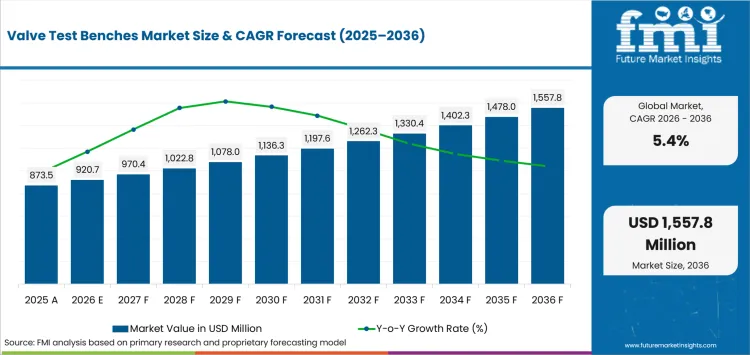
USD 920.7 million in 2026 and USD 1,557.8 million by 2036 at a 5.4% CAGR.
Demand for valve test benches is projected to expand at a 5.4% CAGR between 2026 and 2036, increasing valuation from USD 920.7 million to USD 1,557.8 million. ASME B16.34-2025 and ISO 5208:2015 keep pressure-boundary and closure-tightness testing embedded in industrial valve quality workflows, making test capacity part of production release and maintenance rather than an optional workshop function.
Purchase decisions are shaped by the buyer’s valve diameter and pressure range, test medium, clamping method, safety controls and documentation requirements. Refinery and power-plant turnarounds create concentrated service demand, while valve manufacturers need repeatable in-house testing across production batches. Automation gains value where it shortens pressure cycles, reduces manual intervention and records results without adding a new workflow bottleneck.
Key Takeaways
- Standards-linked pressure and leakage testing, installed-asset maintenance and replacement of manual rigs support recurring equipment demand.
- Horizontal valve test benches are forecast to lead Bench Type with a 24.0% share in 2026 because the layout supports larger valves and practical workshop loading.
- Gate valves are forecast to lead Valve Type with a 24.0% share in 2026, while water is projected to lead Test Medium with a 34.0% share because shell integrity and hydrostatic testing remain central to industrial valve qualification.
- Valve manufacturers and direct OEM supply are projected to hold 29.0% and 41.0% shares in 2026 because testing is embedded in product release and because engineered benches require application engineering, commissioning and operator support.
- Custom fixtures, guarding, media handling and facility integration can slow capital approval, while automated cycles and digital records create a clear modernization opportunity.
- Some of the key players in this market include Ventil Test Equipment, CLIMAX / Calder, EFCO, Hydratron, Resato, Maximator, Curtiss-Wright EST Group, Poppe + Potthoff, Italcontrol, and Yalong Intelligent Equipment.
Analyst Perspective
“The commercial value of a valve test bench is measured in safe, repeatable test throughput. Suppliers that combine flexible clamping, reliable pressure control, digital records and local commissioning support can reduce the friction between valve repair, qualification and return to service.”
- Nikhil Kaitwade, Principal Consultant, Future Market Insights
How is the valve test benches market segmented?
The valve test benches market is segmented by Bench Type, Valve Type, Test Medium, End Use and Sales Channel.
Bench Type defines the physical test layout and degree of automation. Valve Type reflects the sealing mechanism and test sequence. Test Medium separates hydrostatic work from pneumatic or gas-based procedures. End Use distinguishes factory quality control from maintenance and independent verification. Sales Channel captures how standardized and engineered systems reach buyers. These factors connect the bench directly with the testing requirements of industrial valves and the service workflow around them.
Why do horizontal valve test benches lead the Bench Type category?
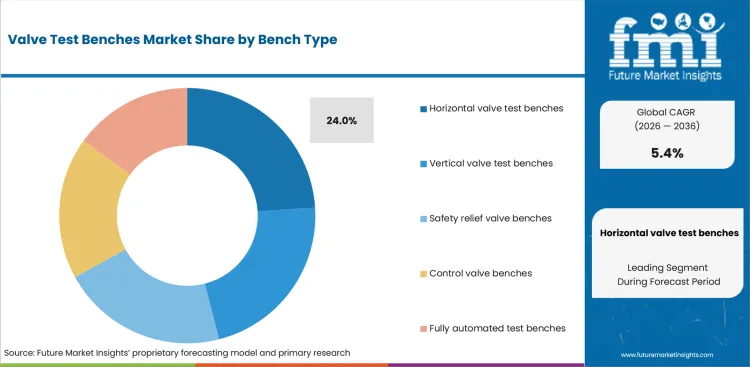
Horizontal systems suit heavier shut-off and control valves that move through repeatable workshop cycles. EFCO describes horizontal clamping as suitable for larger test pieces and easier loading or unloading, with configurations for above-water and underwater testing. The geometry also allows the clamping zone to be separated from the control position, which helps facilities build guarded high-pressure workflows without sacrificing access to the test specimen.
- Horizontal valve test benches are forecast to account for 24.0% of Bench Type demand in 2026 because the layout supports larger valves and practical workshop loading.
- Ventil Valve Academy described horizontal, vertical and tilting configurations in May 2025 and highlighted hydraulic clamping and computer registration as features used across modern test-bench designs.
Why do gate valves lead the Valve Type category?
Gate-valve testing centers on shell integrity and seat tightness across wide diameter and pressure ranges. Multi-purpose fixtures are attractive because the same service center often handles ball, check and control valves, while related valve positioners and actuated assemblies can introduce additional functional checks. The result favors benches that handle routine hydrostatic cycles efficiently while retaining enough fixture flexibility for adjacent shut-off valve work.
- Gate valves are forecast to hold a 24.0% share of Valve Type demand in 2026 because shell and seat-tightness checks remain central to shut-off valve testing.
- ISO 5208:2015 specifies pressure-boundary and closure-tightness tests for industrial metallic valves, reinforcing the need for repeatable shell and seat test procedures across production and repair batches.
Why does water lead the Test Medium category?
Water provides a practical hydrostatic medium for verifying pressure integrity across many shut-off valves. Closed water circuits allow recovery and reuse while hydraulic pressure generation fits a wide range of industrial bench architectures. Gas or nitrogen remains important for leakage sensitivity and specified pneumatic procedures, but it adds stored-energy controls and containment requirements that can raise installation complexity.
- Water is forecast to represent 34.0% of Test Medium demand in 2026 because hydrostatic testing covers a broad range of pressure-integrity work.
- Ventil Valve Academy highlights closed water circuits as a common bench feature. Accurate pressure gauges and calibrated instrumentation remain important because pressure control and recorded test conditions determine whether a hydrostatic cycle is repeatable and auditable.
Why do valve manufacturers lead the End Use category?
Valve manufacturers place test benches directly inside the production quality workflow. The bench must cover the factory’s size range and applicable product standards without delaying movement from assembly to release. Oil and gas service centers and refineries buy for repair and turnaround work, while third-party laboratories place additional emphasis on calibration discipline and independent verification.
- Valve manufacturers are forecast to account for 29.0% of End Use demand in 2026 because testing is embedded in product release and quality assurance.
- ISO 5208:2015 frames examinations and pressure tests as part of establishing pressure-boundary integrity and closure tightness, which supports recurring in-house test loads for manufacturers serving multiple valve classes.
Why does direct OEM supply lead the Sales Channel category?
A valve test bench is usually configured around a defined combination of valve size, pressure range, end connection, test medium, guarding and facility utilities. Those variables make technical clarification part of the purchase process. Direct relationships allow the equipment manufacturer to validate clamping loads and pressure architecture before fabrication, then coordinate commissioning and operator training with the buyer’s procedures.
- Direct OEM supply is forecast to hold a 41.0% share of Sales Channel demand in 2026 because application engineering and commissioning remain closely tied to the purchase.
- Engineered high-pressure systems can incorporate automated ramp, hold and recording sequences, making commissioning and application engineering important parts of the installed solution rather than separate after-sales tasks.
What are the drivers, restraints and opportunities in the Valve Test Benches Market?
Standards-linked testing and installed-asset maintenance support demand, while integration cost can slow purchases and automation creates room for higher throughput with better traceability.
- Driver: Pressure-integrity and leakage-testing requirements create recurring demand across valve manufacturing and maintenance workflows.
- Restraint: Bespoke fixtures, guarding, pressure systems, media handling and facility integration can extend approval and commissioning cycles.
- Opportunity: Automated pressure sequences, digital test records and modular configurations can increase utilization across more valve programs.
The core driver is the requirement to verify valve integrity before shipment or return to service. ASME B16.34-2025 retains testing within the requirements for new industrial valves, while ISO 5208 defines pressure-boundary and closure-tightness tests. Demand rises when a plant expands its valve size or pressure range, internalizes work that had been outsourced, or needs more throughput during turnaround periods.
The main restraint appears at system integration. High-pressure work needs suitable clamping, pressure containment and safe isolation. Pneumatic testing adds stored-energy risk, and buyers may need dedicated water handling, gas storage, calibration procedures and guarded work areas. Smaller service centers can delay investment when utilization is uneven or facility changes materially increase installed cost.
The clearest opportunity is to connect flexible mechanical fixtures with industrial automation and digital registration. Automated ramp-and-hold cycles, stored test histories and remote support can reduce manual steps while improving repeatability. Related industrial actuators also increase the need for functional and torque-aware testing as valve assemblies become more integrated.
Which country CAGRs are profiled in the Valve Test Benches Market?
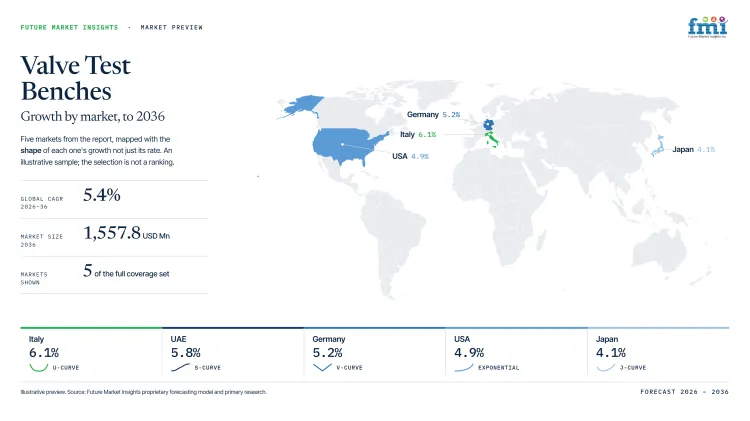
| Country | CAGR |
|---|---|
| Italy | 6.1% |
| UAE | 5.8% |
| Brazil | 5.3% |
| Germany | 5.2% |
| USA | 4.9% |
| Canada | 4.8% |
| Japan | 4.1% |
How do country-level CAGRs compare in the Valve Test Benches Market?
- Italy leads the profiled group with the UAE close behind. Brazil and Germany form the next band. The USA and Canada expand at rates close to 5.0%, while Japan records the slowest approved CAGR as replacement justification and quality-system integration carry greater weight.
- Italy’s concentrated valve manufacturing base supports export-oriented quality requirements.
- The UAE benefits from chemicals and energy project expansion at Ruwais.
- Brazil’s refinery modernization supports recurring valve maintenance and test demand.
- Germany’s mechanical engineering and energy-intensive process industries sustain manufacturing and maintenance demand.
- The USA’s mature refinery base keeps turnaround throughput, portability and service response central.
- Canada’s turnaround cycles and geography increase the value of mobile systems and field support.
- Japan favors documented repeatability, calibration records and integration with established quality procedures.
- Similar CAGRs therefore require different fixture, service and commissioning decisions. The full report provides country-level CAGR analysis across North America, Latin America, Western Europe, Eastern Europe, East Asia, South Asia and Pacific, and Middle East and Africa.
Country-wise Analysis
- Italy combines a concentrated valve manufacturing base with export-oriented quality requirements, making multi-standard test programs and responsive factory support commercially important. AVR / ANIMA Confindustria reported in October 2025 that the Italian valve and tap industry included about 500 industrial companies and 30,000 employees, with exports accounting for 63% of 2024 revenue. Demand for valve test benches in Italy is forecast to expand at 6.1% CAGR from 2026 to 2036 because manufacturers serving international projects need repeatable pressure and tightness testing that can be documented across production batches. Suppliers that support fixture flexibility, multi-standard test sequences and fast commissioning are better positioned to serve export-led valve plants.
- The UAE combines energy and chemicals investment with an expanding installed base of pressure equipment, increasing the need for commissioning, maintenance and periodic valve testing. ADNOC and TAQA announced in January 2026 a 27-year utilities agreement for the TA’ZIZ chemicals zone at Ruwais, where planned production capacity is expected to reach 4.7 million tonnes per year by 2028. Demand for valve test benches in the UAE is forecast to expand at 5.8% CAGR through 2036 because project growth increases the population of valves requiring qualified test workflows. Regional technicians, containerized liquid-and-gas test options and local service coverage can reduce commissioning friction around large industrial projects.
- Brazil’s refinery modernization and downstream investment support recurring valve maintenance and test demand across a dispersed asset base. Petrobras approved its 2026-2030 business plan in November 2025 and allocated USD 15.8 billion to refining and related downstream activity, with refining capacity targeted to rise from 1.8 million to 2.1 million barrels per day by 2030. Demand for valve test benches in Brazil is forecast to rise at 5.3% CAGR from 2026 to 2036 because refinery investment increases the volume of shut-off and control valves requiring hydrostatic and pneumatic verification. Local partners, stocked spares and rugged systems can reduce lifecycle cost and support turnaround schedules.
- Germany’s mechanical engineering and energy-intensive process industries sustain manufacturing and maintenance demand for valve test systems. Destatis reported in August 2026 that output in energy-intensive industrial branches increased 2.2% year over year in June 2026. Demand for valve test benches in Germany is forecast to rise at 5.2% CAGR through 2036 because process-industry activity supports both factory test requirements and installed-asset maintenance. Buyers are likely to scrutinize utilization and total ownership cost, favoring modular pressure systems and automated reporting where they improve existing workflows without requiring extensive facility modification.
- The USA has a mature refinery and process-industry base, keeping turnaround throughput, portability and service response central to purchase decisions. The USA Energy Information Administration reported in June 2026 that operable atmospheric distillation capacity stood at 18.2 million barrels per calendar day at the start of the year. Demand for valve test benches in the USA is forecast to rise at 4.9% CAGR from 2026 to 2036 because the installed asset base creates recurring replacement and service demand. Portable systems, field support and documentation that reduces turnaround downtime are likely to carry more commercial weight than maximum rated pressure alone.
- Canada’s refinery turnaround cycles and long travel distances increase the value of portable equipment, remote diagnostics and dependable field support. The Canada Energy Regulator reported in March 2026 that 16 refineries could process up to 1.9 million barrels per day and that 2025 crude runs averaged 90% of capacity. Demand for valve test benches in Canada is forecast to expand at 4.8% CAGR through 2036 because seasonal maintenance activity and geography favor systems that can move between sites and operate with limited setup time. Mobile benches, service-partner coverage and calibration support can strengthen supplier positioning in a market where response time affects maintenance schedules.
- Japan’s long-lived industrial and energy assets increase the importance of documented repeatability, calibration and dependable local service. Japan’s Agency for Natural Resources and Energy described the Seventh Strategic Energy Plan in May 2025 after Cabinet approval in February 2025. Demand for valve test benches in Japan is forecast to expand at 4.1% CAGR from 2026 to 2036 because replacement justification and integration with established quality procedures carry greater weight than rapid capacity expansion. Suppliers that provide precise instrumentation, stable fixture design and local technical support are better positioned than those relying on equipment price alone.
Who are the notable companies in the Valve Test Benches Market?
Ventil Test Equipment, CLIMAX / Calder, EFCO, Hydratron, Resato, Maximator, Curtiss-Wright EST Group, Poppe + Potthoff, Italcontrol, and Yalong Intelligent Equipment are the notable companies profiled in this market.
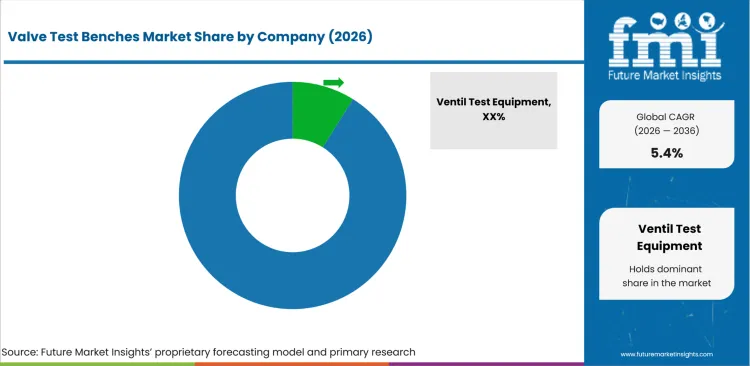
Competition separates into valve-specific test platforms, engineered high-pressure systems and broader test infrastructure. Ventil Test Equipment, CLIMAX / Calder, EFCO and Italcontrol focus closely on valve fixtures and test workflows. Hydratron, Resato, Maximator and Poppe + Potthoff bring pressure-generation and engineered-system capabilities. Curtiss-Wright EST Group and Yalong Intelligent Equipment occupy more specialized or adjacent positions within industrial testing and intelligent equipment.
Ventil Test Equipment, CLIMAX / Calder, EFCO and Italcontrol compete on fixture flexibility, test-method coverage, automation and commissioning support.Hydratron, Resato, Maximator and Poppe + Potthoff are relevant where pressure generation, controls and custom test-cell engineering form a larger share of the project. Curtiss-Wright EST Group and Yalong Intelligent Equipment add pressure-test tooling or broader intelligent-equipment capability to the competitive set.
Competitive Benchmarking: Valve Test Benches Market
| Company | Valve-Specific Test Depth | Pressure / Automation Capability | Commissioning / Service Support | Geographic Reach |
|---|---|---|---|---|
| Ventil Test Equipment | High | High | High | Europe and international refurbishment markets |
| CLIMAX / Calder | High | High | High | North America and international portable/shop markets |
| EFCO | High | High | High | Worldwide supply and service |
| Hydratron | Medium | High | High | UK, Europe and international engineered projects |
| Resato | Medium | High | Medium | Europe and international distributor/project markets |
| Maximator | Medium | High | High | Global engineering and service network |
| Curtiss-Wright EST Group | Medium | Medium | Medium | North America and global industrial service markets |
| Poppe + Potthoff | Medium | High | Medium | Europe and international engineered test-stand markets |
| Italcontrol | High | High | Medium | Europe and international valve-test markets |
| Yalong Intelligent Equipment | Low | Medium | Medium | China-led intelligent-equipment markets |
Scoring basis: High valve-specific test depth requires documented valve test benches across multiple valve classes and test workflows. Medium reflects engineered pressure systems with valve-test relevance, while Low marks broader intelligent-equipment participation. High pressure/automation capability requires automated sequences, engineered high-pressure integration or documented test-control systems. Medium confirms one supported route. High commissioning/service support combines commissioning, refurbishment, training, international service or strong project support. Medium confirms one route and Low a narrower documented offer.
Key Developments in the Valve Test Benches Market
- In June 2026, Ventil Test Equipment presented its Second Life Equipment program for refurbished valve test benches. The program combines condition assessment, refurbishment, warranty and optional safety or productivity upgrades, creating a lower-capital route to modernized test capacity.
- In July 2025, EFCO published a technical update on changes in valve testing practices and the role of new technologies in established procedures. The discussion highlights ongoing movement toward more automated, traceable and configurable test workflows.
- In May 2025, ASME issued B16.34-2025, updating the core standard for flanged, threaded and welding-end valves while retaining testing requirements within new-valve construction. The update reinforces demand for test systems that can reproduce specified pressure and tightness procedures across production workflows.
Key Players in the Valve Test Benches Market
Integrated Valve-Test Platforms
- Ventil Test Equipment
- CLIMAX / Calder
- EFCO
- Italcontrol
High-Pressure Engineered Systems
- Hydratron
- Resato
- Maximator
- Poppe + Potthoff
Specialized Test Infrastructure and Intelligent Equipment
- Curtiss-Wright EST Group
- Yalong Intelligent Equipment
Valve Test Benches Market - Report Scope
| Coverage field | Report scope |
|---|---|
| Market breakdown | By Bench Type, Valve Type, Test Medium, End Use, Sales Channel and region. |
| Quantitative Units | USD million. |
| Market Definition | Revenue includes valve test benches with integrated clamping, pressure generation, controls and test-recording elements included as part of the bench. Downstream valve revenue, general-purpose pressure equipment, in-situ valve testing systems and standalone repair equipment are excluded. |
| Regions Covered | North America, Latin America, Western Europe, Eastern Europe, East Asia, South Asia and Pacific, and Middle East and Africa. |
| Countries Covered | Italy, USA, Japan, Germany, UAE, Brazil and Canada, and 20+ countries included in the full report. |
| Key Companies Profiled | Ventil Test Equipment, CLIMAX / Calder, EFCO, Hydratron, Resato, Maximator, Curtiss-Wright EST Group, Poppe + Potthoff, Italcontrol, and Yalong Intelligent Equipment. |
| Forecast Period | 2026 to 2036. |
| Approach | Primary and secondary research with market triangulation. |
Valve Test Benches Market - Research Methodology
| Method | Approach |
|---|---|
| Primary Research | FMI analysts gathered input from manufacturers, service providers, technology developers, distributors, end users, procurement teams and subject-matter experts. Interviews examined purchasing decisions, product or service evaluation, adoption barriers, approval requirements, pricing considerations and expectations for technical or commercial support. Respondents were also asked what evidence is required before a trial, pilot or initial order develops into regular purchasing. |
| Desk Research | Desk research covered government statistics, regulatory publications, trade data, industry associations, technical literature, standards, company filings, product information and official corporate announcements. Sources were reviewed for relevance, publication date, geographic coverage and consistency with the defined market scope. Claims relating to performance, applications, approvals, capacity, investment and commercial activity were retained only when supported by credible public evidence. |
| Market Sizing and Forecasting | The market model combined the baseline value with historical performance, segment structure, pricing and volume indicators, adoption levels, company participation and country-level demand conditions. Forecast assumptions considered economic activity, investment trends, regulatory developments, technology adoption, purchasing cycles, supply availability and barriers to wider market use. Segment and regional estimates were reconciled before the final market total was calculated. |
| Data Validation | Estimates were checked against multiple independent indicators, including public data, company activity, trade patterns, industry developments and findings from primary interviews. Validation also tested whether products, services, applications and company revenues fell within the defined market boundaries. Adjacent categories, unsupported claims, overlapping revenues and activities without direct market relevance were excluded to reduce double counting and maintain consistency across segments and countries. |
Valve Test Benches Market by Segments
Valve Test Benches Market segmented by Bench Type:
- Horizontal valve test benches
- Vertical valve test benches
- Safety relief valve benches
- Control valve benches
- Fully automated test benches
Valve Test Benches Market segmented by Valve Type:
- Gate valves
- Ball valves
- Check valves
- Safety relief valves
- Control valves
Valve Test Benches Market segmented by Test Medium:
- Water
- Oil
- Gas / nitrogen
- Air
- Mixed media
Valve Test Benches Market segmented by End Use:
- Valve manufacturers
- Oil & gas service centers
- Power plants
- Refineries
- Third-party test labs
Valve Test Benches Market segmented by Sales Channel:
- Direct OEM supply
- Custom engineered systems
- Industrial distributors
- Calibration service partners
Valve Test Benches Market by Region
- North America
- United States
- Canada
- Latin America
- Brazil
- Mexico
- Argentina
- Chile
- Western Europe
- Germany
- France
- United Kingdom
- Italy
- Spain
- Benelux
- Nordics
- Eastern Europe
- Poland
- Czech Republic
- Romania
- Hungary
- East Asia
- China
- Japan
- South Korea
- South Asia and Pacific
- India
- ASEAN
- Australia and New Zealand
- Middle East and Africa
- GCC Countries
- South Africa
- Türkiye
- Israel
Research Sources and Bibliography
- ASME. (2025, May 30). ASME B16.34-2025, Valves-Flanged, Threaded and Welding End.
- International Organization for Standardization. (2015). ISO 5208:2015, Industrial valves - Pressure testing of metallic valves.
- Ventil Test Equipment. (2026, June). Second Life Equipment.
- Ventil Valve Academy. (2025, May 1). What is a Test Bench?
- EFCO Maschinenbau. (2025, July 11). Changes are taking place in valve testing practices: New technologies and established procedures.
- AVR / ANIMA Confindustria. (2025, October 24). AVR Assembly press release on the Italian valve and tap industry.
- USA Energy Information Administration. (2026, June 29). USA refining capacity decreased during 2025.
- Agency for Natural Resources and Energy, Japan. (2025, May 26). A Detailed Outline of the Latest Strategic Energy Plan.
- Federal Statistical Office of Germany (Destatis). (2026, August 7). Production in June 2026: +0.2% on the previous month.
- ADNOC. (2026, January 28). ADNOC and TAQA Announce 27-Year Utilities Agreement with TA’ZIZ.
- Petrobras. (2025, November 28). Petrobras approves Business Plan 2026-2030.
- Canada Energy Regulator. (2026, March 25). Canadian crude refinery runs held steady in 2025.
This bibliography is provided for reader reference and is not exhaustive. The full report contains the complete reference list and detailed citations.
This Report Answers
- What is the valve test benches market size in 2026 and what value is forecast for 2036?
- Which industrial quality and maintenance mechanisms support demand for valve test benches?
- Why do horizontal valve test benches remain important for workshop testing?
- How do gate-valve test requirements influence fixture and pressure-system design?
- Why does water remain central to hydrostatic valve testing?
- How do factory quality control and turnaround maintenance create different buying requirements?
- How do growth conditions differ across Italy, USA, Japan, Germany, UAE, Brazil and Canada?
- Which supplier capabilities matter most across valve-specific platforms and engineered high-pressure systems?
- How do facility integration, guarding and media handling affect capital approval?
- What should quality, maintenance and procurement teams evaluate before selecting a valve test bench?
Frequently Asked Questions
How big is the Valve Test Benches Market in 2026?
The valve test benches market is valued at USD 920.7 million in 2026 and is projected to reach USD 1,557.8 million by 2036. Growth is tied to standards-linked pressure testing, valve manufacturing quality control and installed-asset maintenance.
What is the CAGR of the Valve Test Benches Market from 2026 to 2036?
The valve test benches market is projected to grow at a CAGR of 5.4% between 2026 and 2036. Expansion depends on repeatable pressure testing, replacement of manual rigs and modernization of test documentation.
Which bench type leads the Valve Test Benches Market?
The horizontal valve test benches segment is expected to hold 24.0% of Bench Type demand in 2026, attributable to practical loading, larger valve handling and workshop-friendly clamping layouts.
Which test medium leads the Valve Test Benches Market?
The water segment is expected to represent 34.0% of Test Medium demand in 2026, supported by hydrostatic testing requirements across many industrial valve applications.
Which countries are projected to record the highest growth in the Valve Test Benches Market?
Italy is projected to grow at 6.1% CAGR, followed by the UAE at 5.8% and Brazil at 5.3% through 2036. Their growth routes differ because valve manufacturing, energy-project expansion and refinery modernization affect demand differently.
Which companies are active in the Valve Test Benches Market?
Key companies operating in the market include Ventil Test Equipment, CLIMAX / Calder, EFCO, Hydratron, Resato, Maximator, Curtiss-Wright EST Group, Poppe + Potthoff, Italcontrol, and Yalong Intelligent Equipment. They compete through valve-specific test platforms, engineered high-pressure systems and specialized test infrastructure.
Preview the report firsthand - request a free sample
Get SampleGet the brochure for pricing and purchase details.
Get PDFTable of Content
- Key Takeaways
- Market Size and CAGR
- Top Growth Driver
- Fastest Growing Segment
- Leading Region
- Key Companies
- Emerging Opportunities
- Executive Summary
- Global Market Outlook
- Demand-side Trends
- Supply-side Trends
- Technology Roadmap Analysis
- Analysis and Recommendations
- Analyst Perspective (What is happening? Why now? What should investors know?)
- Key Questions Answered
- How large is the market?
- What is the CAGR?
- What are key trends?
- Which region dominates?
- Who are the leaders?
- Market Overview
- Market Coverage / Taxonomy
- Market Definition / Scope / Limitations
- Research Methodology
- Chapter Orientation
- Analytical Lens and Working Hypotheses
- Market Structure, Signals, and Trend Drivers
- Benchmarking and Cross-market Comparability
- Market Sizing, Forecasting, and Opportunity Mapping
- Research Design and Evidence Framework
- Desk Research Programme (Secondary Evidence)
- Expert Input and Fieldwork (Primary Evidence)
- Tooling, Models, and Reference Databases
- Data Engineering and Model Build
- Quality Assurance and Audit Trail
- Market Background
- Market Dynamics (Drivers, Restraints, Opportunity, Trends)
- Scenario Forecast (Optimistic, Likely, Conservative)
- Impact Analysis
- AI Impact
- Sustainability Impact
- Regulatory Impact
- Technology Impact
- Consumer / Buyer Analysis
- Purchase Drivers
- Adoption Barriers
- Buyer Journey
- Opportunity Map Analysis
- Product Life Cycle Analysis
- Supply Chain Analysis
- Investment Feasibility Matrix
- Value Chain Analysis
- PESTLE and Porter's Analysis
- Regulatory Landscape
- Regional Parent Market Outlook
- Production and Consumption Statistics
- Import and Export Statistics
- Global Market Analysis and Forecast, 2021 to 2036
- Historical Market Size Value (USD Million) Analysis, 2021 to 2025
- Current and Future Market Size Value (USD Million) Projections, 2026 to 2036
- Y-o-Y Growth Trend Analysis
- Absolute $ Opportunity Analysis
- Global Market Pricing Analysis, 2021 to 2036
- Global Market Analysis and Forecast, By Bench Type, 2021 to 2036
- Introduction / Key Findings
- Historical Market Size Value (USD Million) Analysis By Bench Type, 2021 to 2025
- Current and Future Market Size Value (USD Million) Analysis and Forecast By Bench Type, 2026 to 2036
- Horizontal valve test benches
- Vertical valve test benches
- Safety relief valve benches
- Control valve benches
- Fully automated test benches
- Horizontal valve test benches
- Y-o-Y Growth Trend Analysis By Bench Type, 2021 to 2025
- Absolute $ Opportunity Analysis By Bench Type, 2026 to 2036
- Global Market Analysis and Forecast, By Valve Type, 2021 to 2036
- Introduction / Key Findings
- Historical Market Size Value (USD Million) Analysis By Valve Type, 2021 to 2025
- Current and Future Market Size Value (USD Million) Analysis and Forecast By Valve Type, 2026 to 2036
- Gate valves
- Ball valves
- Check valves
- Safety relief valves
- Control valves
- Gate valves
- Y-o-Y Growth Trend Analysis By Valve Type, 2021 to 2025
- Absolute $ Opportunity Analysis By Valve Type, 2026 to 2036
- Global Market Analysis and Forecast, By Test Medium, 2021 to 2036
- Introduction / Key Findings
- Historical Market Size Value (USD Million) Analysis By Test Medium, 2021 to 2025
- Current and Future Market Size Value (USD Million) Analysis and Forecast By Test Medium, 2026 to 2036
- Water
- Oil
- Gas / nitrogen
- Air
- Mixed media
- Water
- Y-o-Y Growth Trend Analysis By Test Medium, 2021 to 2025
- Absolute $ Opportunity Analysis By Test Medium, 2026 to 2036
- Global Market Analysis and Forecast, By End Use, 2021 to 2036
- Introduction / Key Findings
- Historical Market Size Value (USD Million) Analysis By End Use, 2021 to 2025
- Current and Future Market Size Value (USD Million) Analysis and Forecast By End Use, 2026 to 2036
- Valve manufacturers
- Oil & gas service centers
- Power plants
- Refineries
- Third-party test labs
- Valve manufacturers
- Y-o-Y Growth Trend Analysis By End Use, 2021 to 2025
- Absolute $ Opportunity Analysis By End Use, 2026 to 2036
- Global Market Analysis and Forecast, By Sales Channel, 2021 to 2036
- Introduction / Key Findings
- Historical Market Size Value (USD Million) Analysis By Sales Channel, 2021 to 2025
- Current and Future Market Size Value (USD Million) Analysis and Forecast By Sales Channel, 2026 to 2036
- Direct OEM supply
- Custom engineered systems
- Industrial distributors
- Calibration service partners
- Direct OEM supply
- Y-o-Y Growth Trend Analysis By Sales Channel, 2021 to 2025
- Absolute $ Opportunity Analysis By Sales Channel, 2026 to 2036
- Global Market Analysis and Forecast, By Region, 2021 to 2036
- Introduction
- Historical Market Size Value (USD Million) Analysis By Region, 2021 to 2025
- Current Market Size Value (USD Million) Analysis and Forecast By Region, 2026 to 2036
- North America
- Latin America
- Western Europe
- Eastern Europe
- East Asia
- South Asia and Pacific
- Middle East & Africa
- Market Attractiveness Analysis By Region
- North America Market Analysis and Forecast, By Country, 2021 to 2036
- Historical Market Size Value (USD Million) Trend Analysis By Market Taxonomy, 2021 to 2025
- Market Size Value (USD Million) Forecast By Market Taxonomy, 2026 to 2036
- By Country
- USA
- Canada
- By Bench Type
- By Valve Type
- By Test Medium
- By End Use
- By Sales Channel
- By Country
- Market Attractiveness Analysis
- By Country
- By Bench Type
- By Valve Type
- By Test Medium
- By End Use
- By Sales Channel
- Key Takeaways
- Latin America Market Analysis and Forecast, By Country
- Historical Market Size Value (USD Million) Trend Analysis By Market Taxonomy, 2021 to 2025
- Market Size Value (USD Million) Forecast By Market Taxonomy, 2026 to 2036
- By Country
- Brazil
- Mexico
- Chile
- Rest of Latin America
- By Bench Type
- By Valve Type
- By Test Medium
- By End Use
- By Sales Channel
- By Country
- Market Attractiveness Analysis
- By Country
- By Bench Type
- By Valve Type
- By Test Medium
- By End Use
- By Sales Channel
- Key Takeaways
- Western Europe Market Analysis and Forecast, By Country
- Historical Market Size Value (USD Million) Trend Analysis By Market Taxonomy, 2021 to 2025
- Market Size Value (USD Million) Forecast By Market Taxonomy, 2026 to 2036
- By Country
- Germany
- UK
- Italy
- Spain
- France
- Nordic
- BENELUX
- Rest of Western Europe
- By Bench Type
- By Valve Type
- By Test Medium
- By End Use
- By Sales Channel
- By Country
- Market Attractiveness Analysis
- By Country
- By Bench Type
- By Valve Type
- By Test Medium
- By End Use
- By Sales Channel
- Key Takeaways
- Eastern Europe Market Analysis and Forecast, By Country
- Historical Market Size Value (USD Million) Trend Analysis By Market Taxonomy, 2021 to 2025
- Market Size Value (USD Million) Forecast By Market Taxonomy, 2026 to 2036
- By Country
- Russia
- Poland
- Hungary
- Balkan & Baltic
- Rest of Eastern Europe
- By Bench Type
- By Valve Type
- By Test Medium
- By End Use
- By Sales Channel
- By Country
- Market Attractiveness Analysis
- By Country
- By Bench Type
- By Valve Type
- By Test Medium
- By End Use
- By Sales Channel
- Key Takeaways
- East Asia Market Analysis and Forecast, By Country
- Historical Market Size Value (USD Million) Trend Analysis By Market Taxonomy, 2021 to 2025
- Market Size Value (USD Million) Forecast By Market Taxonomy, 2026 to 2036
- By Country
- China
- Japan
- South Korea
- By Bench Type
- By Valve Type
- By Test Medium
- By End Use
- By Sales Channel
- By Country
- Market Attractiveness Analysis
- By Country
- By Bench Type
- By Valve Type
- By Test Medium
- By End Use
- By Sales Channel
- Key Takeaways
- South Asia and Pacific Market Analysis and Forecast, By Country
- Historical Market Size Value (USD Million) Trend Analysis By Market Taxonomy, 2021 to 2025
- Market Size Value (USD Million) Forecast By Market Taxonomy, 2026 to 2036
- By Country
- India
- ASEAN
- Australia & New Zealand
- Rest of South Asia and Pacific
- By Bench Type
- By Valve Type
- By Test Medium
- By End Use
- By Sales Channel
- By Country
- Market Attractiveness Analysis
- By Country
- By Bench Type
- By Valve Type
- By Test Medium
- By End Use
- By Sales Channel
- Key Takeaways
- Middle East & Africa Market Analysis and Forecast, By Country
- Historical Market Size Value (USD Million) Trend Analysis By Market Taxonomy, 2021 to 2025
- Market Size Value (USD Million) Forecast By Market Taxonomy, 2026 to 2036
- By Country
- Kingdom of Saudi Arabia
- Other GCC Countries
- Türkiye
- South Africa
- Other African Union
- Rest of Middle East & Africa
- By Bench Type
- By Valve Type
- By Test Medium
- By End Use
- By Sales Channel
- By Country
- Market Attractiveness Analysis
- By Country
- By Bench Type
- By Valve Type
- By Test Medium
- By End Use
- By Sales Channel
- Key Takeaways
- Key Countries Market Analysis
- USA
- Pricing Analysis
- Market Share Analysis, 2025
- By Bench Type
- By Valve Type
- By Test Medium
- By End Use
- By Sales Channel
- Canada
- Pricing Analysis
- Market Share Analysis, 2025
- By Bench Type
- By Valve Type
- By Test Medium
- By End Use
- By Sales Channel
- Mexico
- Pricing Analysis
- Market Share Analysis, 2025
- By Bench Type
- By Valve Type
- By Test Medium
- By End Use
- By Sales Channel
- Brazil
- Pricing Analysis
- Market Share Analysis, 2025
- By Bench Type
- By Valve Type
- By Test Medium
- By End Use
- By Sales Channel
- Chile
- Pricing Analysis
- Market Share Analysis, 2025
- By Bench Type
- By Valve Type
- By Test Medium
- By End Use
- By Sales Channel
- Germany
- Pricing Analysis
- Market Share Analysis, 2025
- By Bench Type
- By Valve Type
- By Test Medium
- By End Use
- By Sales Channel
- UK
- Pricing Analysis
- Market Share Analysis, 2025
- By Bench Type
- By Valve Type
- By Test Medium
- By End Use
- By Sales Channel
- Italy
- Pricing Analysis
- Market Share Analysis, 2025
- By Bench Type
- By Valve Type
- By Test Medium
- By End Use
- By Sales Channel
- Spain
- Pricing Analysis
- Market Share Analysis, 2025
- By Bench Type
- By Valve Type
- By Test Medium
- By End Use
- By Sales Channel
- France
- Pricing Analysis
- Market Share Analysis, 2025
- By Bench Type
- By Valve Type
- By Test Medium
- By End Use
- By Sales Channel
- India
- Pricing Analysis
- Market Share Analysis, 2025
- By Bench Type
- By Valve Type
- By Test Medium
- By End Use
- By Sales Channel
- ASEAN
- Pricing Analysis
- Market Share Analysis, 2025
- By Bench Type
- By Valve Type
- By Test Medium
- By End Use
- By Sales Channel
- Australia & New Zealand
- Pricing Analysis
- Market Share Analysis, 2025
- By Bench Type
- By Valve Type
- By Test Medium
- By End Use
- By Sales Channel
- China
- Pricing Analysis
- Market Share Analysis, 2025
- By Bench Type
- By Valve Type
- By Test Medium
- By End Use
- By Sales Channel
- Japan
- Pricing Analysis
- Market Share Analysis, 2025
- By Bench Type
- By Valve Type
- By Test Medium
- By End Use
- By Sales Channel
- South Korea
- Pricing Analysis
- Market Share Analysis, 2025
- By Bench Type
- By Valve Type
- By Test Medium
- By End Use
- By Sales Channel
- Russia
- Pricing Analysis
- Market Share Analysis, 2025
- By Bench Type
- By Valve Type
- By Test Medium
- By End Use
- By Sales Channel
- Poland
- Pricing Analysis
- Market Share Analysis, 2025
- By Bench Type
- By Valve Type
- By Test Medium
- By End Use
- By Sales Channel
- Hungary
- Pricing Analysis
- Market Share Analysis, 2025
- By Bench Type
- By Valve Type
- By Test Medium
- By End Use
- By Sales Channel
- Kingdom of Saudi Arabia
- Pricing Analysis
- Market Share Analysis, 2025
- By Bench Type
- By Valve Type
- By Test Medium
- By End Use
- By Sales Channel
- Türkiye
- Pricing Analysis
- Market Share Analysis, 2025
- By Bench Type
- By Valve Type
- By Test Medium
- By End Use
- By Sales Channel
- South Africa
- Pricing Analysis
- Market Share Analysis, 2025
- By Bench Type
- By Valve Type
- By Test Medium
- By End Use
- By Sales Channel
- USA
- Market Structure Analysis
- Competition Dashboard
- Competition Benchmarking
- Market Share Analysis of Top Players
- By Regional
- By Bench Type
- By Valve Type
- By Test Medium
- By End Use
- By Sales Channel
- Emerging Startups
- Innovation Benchmarking
- Competition Analysis
- Competition Deep Dive
- Ventil Test Equipment
- Overview
- Product Portfolio
- Profitability by Market Segments
- Sales Footprint
- Strategy Overview
- Marketing Strategy
- Product Strategy
- Channel Strategy
- CLIMAX / Calder
- EFCO
- Hydratron
- Resato
- Maximator
- Curtiss-Wright EST Group
- Poppe + Potthoff
- Italcontrol
- Yalong Intelligent Equipment
- Ventil Test Equipment
- Case Studies
- Success Stories
- Recent Developments
- Competition Deep Dive
- Assumptions & Acronyms Used


