

- Market Size (2026)
- USD 600 Mn
- Forecast (2036)
- USD 1100 Mn
- CAGR (2026 to 2036)
- 6.4%
How big is the Water-Soluble Films Market in 2026?
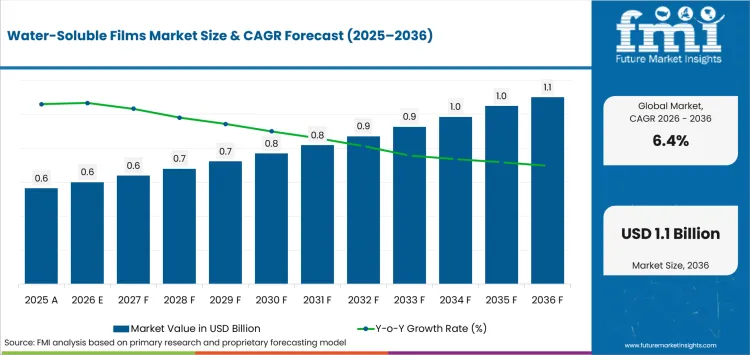
USD 600 million in 2026 and USD 1100 million by 2036 at a 6.4% CAGR.
Demand for water-soluble films is projected to rise from USD 600 million in 2026, expanding at a 6.4% CAGR to reach USD 1100 million by 2036. This growth trajectory reflects a market shifting from niche packaging novelty to embedded infrastructure across unit-dose formats, where the film itself has become inseparable from how the product inside is measured, dosed, and consumed.
The core demand driver is behavioral rather than promotional: households and institutional buyers have restructured routine consumption around pre-measured doses, and each dose consumed is a film unit converted, creating replenishment cycles that track usage frequency rather than seasonal buying patterns. Detergent unit-dose adoption anchors this base, with agrochemical and industrial chemical packaging extending it into settings where operator safety and dosing accuracy justify a cost premium over conventional flexible packaging. Regulatory tightening around single-use plastics and extended producer responsibility frameworks acts as a parallel structural tailwind, pushing brand owners toward water-soluble formats as a compliance-adjacent substitution rather than a purely voluntary sustainability choice.
Restraints center on raw material sensitivity: polyvinyl alcohol pricing volatility and feedstock dependency limit margin flexibility for converters, while performance trade-offs around moisture resistance and shelf stability in humid climates constrain formulation choices. Opportunity pools are emerging in unconventional applications beyond detergents, including embroidery backing, agricultural seed tapes, and pharmaceutical unit-dose packaging, where converters can command differentiated pricing.
At the segment level, resin type, film thickness, and end-use application form the primary structuring axes, with household and institutional cleaning still anchoring overall consumption while industrial and agrochemical uses gain relative share. Regionally, North America and Europe lead on regulatory-driven adoption and established unit-dose penetration, while Asia Pacific is emerging as the faster-growing base on rising detergent formalization and expanding manufacturing capacity.
Key Takeaways of Water-Soluble Films Market
- Measured-dose formats support recurring film demand by delivering fixed quantities without manual measuring or package opening.
- Polyvinyl alcohol is projected at 72.0% in 2026 as established film formation supports adjustable dissolution.
- Cold water-soluble films are estimated at 63.0% in 2026 through dependable release during low-temperature appliance cycles.
- Detergent packaging is forecast at 39.0% in 2026 through recurring laundry and dishwashing unit-dose consumption.
- Moisture exposure and incompatible formulations restrain adoption by weakening seals or changing dissolution during storage.
- Kuraray; SEKISUI; AICELLO; Mitsubishi Chemical; Ecopol; Cortec; Arrow GreenTech; and Aquapak compete through resin chemistry and film conversion.
Analyst Perspective
"Water-soluble film selection starts with the filled formulation, since rapid dissolution cannot offset seals weakened during storage. Detergent programmes should compare leakage, residue and release timing across their shortest qualified wash cycle."
- Nikhil Kaitwade, Principal Consultant, Future Market Insights
How is the Water-Soluble Films Market segmented?
The Water-Soluble Films Market is segmented by material, type, application, end user, dissolution rate and region.
Material covers polyvinyl alcohol, standard PVA films, modified PVA films, starch-based films, starch-polymer blends, bio-based starch films, polyethylene oxide, water-soluble PEO films, industrial PEO films, others, polysaccharide-based films and hybrid water-soluble films; type covers cold water-soluble films, fast-dissolving films, cold-water detergent films, hot water-soluble films, high-temperature dissolving films and industrial hot-water films; application covers detergent packaging, laundry detergent pods, dishwashing detergent pods, agrochemical packaging, pesticide packaging, fertilizer packaging, pharmaceutical and healthcare packaging, drug packaging, medical product packaging, water treatment chemical packaging, water treatment pods and chemical dosing packs; end user covers household cleaning, laundry care, dishwashing products, agriculture, crop protection, agrochemical products, pharmaceuticals and healthcare, pharmaceutical manufacturers, healthcare product manufacturers, textiles, embroidery and textile processing; dissolution rate covers fast soluble films, instant-dissolving films, rapid cold-water films, medium soluble films, controlled dissolution films, standard water-soluble films, difficult soluble films, slow-dissolving films and high-temperature dissolving films; and region.
Why does polyvinyl alcohol hold the largest share within the material category?
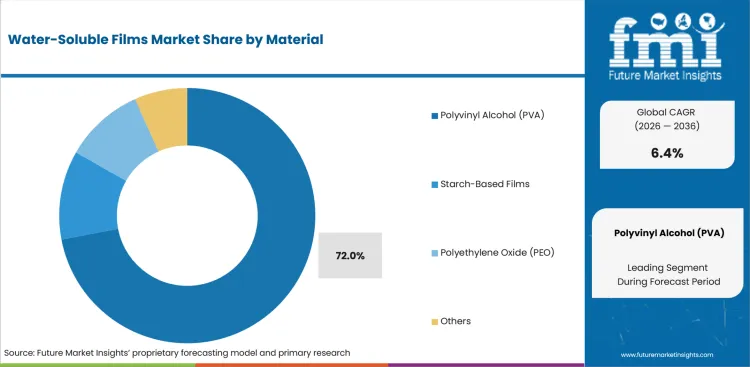
Polyvinyl alcohol forms continuous webs across casting and conversion lines used for soluble unit doses in several industries. Hydrolysis level and molecular weight balance seal strength with release at the intended water temperature. Detergent and agrochemical programmes retain established PVA grades while testing each filled formulation against humidity and line speed throughout commercial production and expected warehouse conditions at scale.
- Based on material, polyvinyl alcohol is projected to account for 72.0% in 2026 due to established film-forming performance across measured-dose packaging. Its broad grade range supports cold-water release and hot-water activation without requiring a different base polymer for every application.
- AICELLO identifies SOLUBLON as a PVA-based film for detergent capsules and agricultural chemical doses, with grades dissolving from above 1°C. The documented range supports material selection across powder and tablet formats and liquid filling routes during complete commercial qualification.
Why do cold water-soluble films retain the largest share within the type category?
Cold water-soluble films release detergent during routine low-temperature laundry and dishwashing programmes across household appliances. The film must remain intact through thermoforming and filling, then open inside the machine at the qualified temperature. Concentrated liquids also require compatibility testing since warehouse humidity and formulation contact can change film strength and release during regional distribution and retail storage across multiple climates.
- Cold water-soluble films are set to lead the type category with 63.0% share in 2026 due to dependable release across common appliance cycles. Their position reflects recurring household detergent use and grades designed for different sealing methods and concentrated contents.
- SEKISUI states that Selvol Ultiloc copolymers dissolve faster and at lower temperatures than standard PVOH grades. Commercial trials must confirm release across the selected film gauge and wash programme, then test compatibility with concentrated formulations throughout transport and warehouse exposure.
How does detergent packaging support demand within the application category?
Detergent packaging encloses a measured liquid or powder dose that enters a laundry or dishwashing cycle without manual opening. Commercial performance depends on uniform seals during filling and complete release during the qualified wash programme. Retail packs protect individual doses from humidity and unintended handling; qualification therefore follows the filled formulation through production, transport and seasonal storage within commercial channels.
- By application, detergent packaging is estimated to hold 39.0% in 2026 owing to repeat orders for laundry and dishwashing unit doses. The format combines dosage control with direct placement in the appliance and supports high-volume conversion on automated thermoforming lines.
- European rules now connect film composition with dosing performance for detergent capsules sold across regional markets. In June 2025, the European Commission prioritized biodegradability criteria for polymeric capsule films; cross-border programmes must document composition alongside sealing and dissolution during placement.
What supports fast soluble film demand within the dissolution rate category?
Fast soluble films support short wash programmes and chemical dosing steps that begin immediately upon immersion. Delayed opening can leave residue or disrupt mixing inside an appliance or spray tank; commercial selection considers particle release and film thickness alongside the activation temperature. Fast grades are expected to expand faster than medium and difficult-soluble films as short-cycle dosing gains wider use.
- The dissolution rate category is forecast to be led by fast soluble films at 48.0% share in 2026 due to commercial short-cycle release requirements. Their position reflects detergent packets and chemical doses that must disperse without leaving particles or residue.
- Format breadth determines whether one film family can serve several rapid-release uses during commercial qualification. Cortec documents EcoSol PVOH bags and sachets for detergent and water-treatment as well as agricultural products, linking rapid release with sufficient filling strength and transport.
What are the drivers, restraints and opportunities in the Water-Soluble Films Market?
Measured doses support recurring film demand, while moisture limits storage and tailored grades extend use across chemical delivery.
- Driver: Measured-dose packets place a fixed quantity into laundry machines or treatment systems without manual measuring. Each consumed dose requires another soluble film unit, supporting recurring orders across household cleaning and agricultural chemical applications throughout treatment schedules and refill cycles.
- Restraint: Water affinity makes soluble films sensitive to warehouse humidity and concentrated formulations that interact with PVA. Weak seals or altered dissolution can emerge unless protective packs limit moisture and filled doses pass storage testing under the intended distribution conditions.
- Opportunity: Application-specific PVA grades can match defined release temperatures and formulation loads across agrochemical, healthcare and water-treatment uses. Commercial value concentrates in films that pass application testing without slowing established filling equipment or increasing production reject rates during routine operations.
Each detergent packet or agrochemical sachet delivers a measured dose directly into the intended treatment system. Frequent washing and scheduled field applications translate into recurring film consumption as every completed dose requires another converted package for the next treatment cycle.
Household storage practices determine whether detergent packets remain safe throughout repeated use within family homes. In June 2025, the American Cleaning Institute reported 35% of surveyed adults kept liquid laundry packets within children's reach or sight; child-resistant packs and clear handling instructions remain necessary.
Specialty applications reward films designed around a defined treatment sequence rather than general water solubility. Agrochemical bags must release before spray nozzles clog, while hospital laundry bags need collection strength followed by reliable hot-water dissolution during every completed washing cycle.
Which country CAGRs are profiled in the Water-Soluble Films Market?
| Country | CAGR |
|---|---|
| South Korea | 7.0% |
| Canada | 6.5% |
| Japan | 6.4% |
| United Kingdom | 6.3% |
| Australia | 6.3% |
| USA | 6.2% |
How do country-level CAGRs compare in the Water-Soluble Films Market?
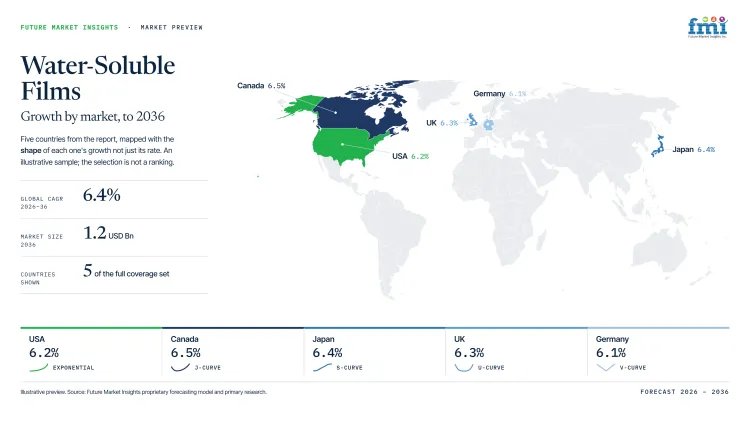
The country comparison spans 0.8 percentage points and reveals three distinct growth groups across the Water-Soluble Films Market. South Korea and Canada form the upper tier with a 0.5-point difference, while Japan, the United Kingdom and Australia create a closely aligned middle group with only 0.1 percentage point separating the latter two markets. The USA remains at the lower end with a 0.1-point gap from Australia.
- South Korea leads the comparison at a 7.0% CAGR through 2036, supported by revised household chemical rules and tighter package documentation requirements for national retail placement.
- Canada follows at a 6.5% CAGR, remaining 0.5 percentage points below South Korea. Measured laundry demand, bilingual labeling requirements and nationwide recall responsibilities shape market conditions for household chemical applications.
- Japan records a 6.4% CAGR, only 0.1 percentage point below Canada. Domestic PVOH expertise supports the market, while automatic liquid dosing remains an established alternative for some applications.
- The United Kingdom grows at a 6.3% CAGR, remaining 0.1 percentage point below Japan. Separate compliance schedules for Great Britain and Northern Ireland influence detergent packaging requirements and adoption conditions.
- Australia also records a 6.3% CAGR, matching the United Kingdom. Soluble agrochemical applications and stronger moisture controls during long inland transport and seasonal storage support demand.
- The USA records a 6.2% CAGR, 0.1 percentage point below Australia. Its position reflects a relatively mature market where established household chemical applications continue to provide a base for water-soluble film demand.
Comparable CAGRs can still produce different market conditions. Differences in regulatory requirements, labeling standards, PVOH capabilities, household chemical demand, agrochemical applications, moisture-control requirements and packaging practices influence market entry and adoption across countries. The full report provides country-level CAGR analysis across North America, Latin America, Europe, East Asia, South Asia and Pacific, and the Middle East and Africa.
Country-Wise Analysis
- In South Korea, water-soluble film demand is predicted to advance at 7.0% CAGR through 2036, supported by measured household chemical formats requiring documented package integrity across national retail channels. Importers must align Korean-language labels and technical files with revised provisions while preserving film performance through humid storage across major cities and regional warehouses. A November 2025 ministry notice confirmed that revised labeling requirements apply to affected products manufactured or imported from July 1, 2026 under the revised national labeling schedule.
- Canada is estimated to post 6.5% CAGR over the forecast period, reinforced by established household channels and continued interest in measured laundry doses across major provinces. Health Canada reported in December 2025 that targeted checks covered 55 household chemical products during the fiscal year; 31 corrective actions followed and seven were recalls. Film-packaged products require complete bilingual documentation and replacement plans spanning provincial retailers, e-commerce channels and distant warehouses during prolonged winter storage and remote regional delivery across remote communities.
- Japan's water-soluble films market outlook is anticipated to advance at 6.4% CAGR over the assessment period, supported by domestic PVOH expertise and established appliance markets. Unit-dose films must compete with familiar liquid dispensing while proving convenience across local wash programmes without increasing residue or cycle failures during repeated household use across national retail channels. The Japan Soap and Detergent Association reported in March 2026 that over 80% of surveyed drum-washer owners with tank auto-dosing used that feature almost every time.
- Adoption of water-soluble films in the United Kingdom is estimated to expand at 6.3% CAGR through 2036, influenced by concentrated detergent formats and established national retail distribution. A March 2026 government memorandum confirmed that Regulation (EU) 2026/405 applies in Northern Ireland under the Windsor Framework for detergent product placement. Cross-territory launches require separate compliance tracking for Great Britain and Northern Ireland while maintaining nationally consistent film specifications, labels and digital product information for national retailers serving both jurisdictions nationwide.
- By 2036, Australia is projected to grow at 6.3% CAGR, driven by soluble agrochemical doses that reduce direct contact during spray preparation across major agricultural states. Registrants must test the actual formulation-to-film ratio and repeated outer-container opening while protecting regional inventory from moisture during long inland transport and seasonal storage across remote farming districts. APVMA guidance updated in September 2025 requires CIPAC MT 176 testing and sets a 30-second dissolution limit for water-soluble bags used in agricultural chemical packaging approval.
Who are the notable companies in the Water-Soluble Films Market?
Notable companies include KURARAY CO., LTD.; SEKISUI CHEMICAL CO., LTD.; AICELLO CORPORATION; Mitsubishi Chemical Group Corporation; Ecopol S.p.A.; Cortec Corporation; Arrow GreenTech Limited; and Aquapak Polymers Ltd.
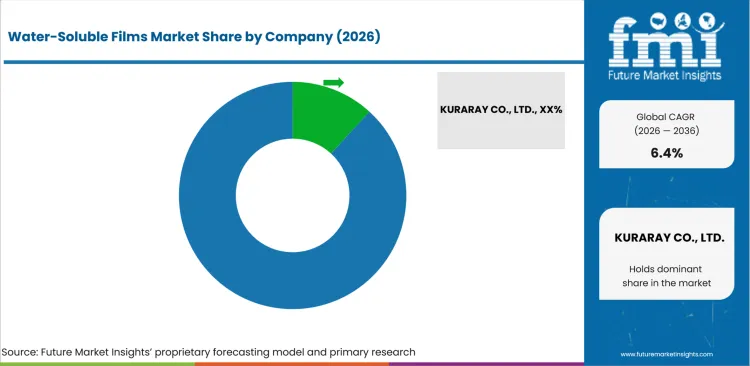
Integrated PVOH groups compete with film specialists and regional manufacturers through distinct qualification routes worldwide. Contracts depend on verified dissolution and seal integrity across production equipment under normal operating conditions.
- Kuraray combines PVOH resin with water-soluble film, while SEKISUI and Mitsubishi Chemical supply formulation-grade PVOH.
- AICELLO and Ecopol manufacture direct soluble film, while Cortec supplies converted PVOH bags for chemical dosing.
- Arrow GreenTech serves regional film uses, while Aquapak provides thermoplastic PVOH grades for laundry bags.
Competitive Benchmarking: Water-Soluble Films Market
| Company | Direct film and PVOH breadth | Temperature and formulation control | Testing and certification support | Geographic Reach |
|---|---|---|---|---|
| KURARAY CO., LTD. | High | High | High | Global |
| SEKISUI CHEMICAL CO., LTD. | Medium | High | High | Global |
| AICELLO CORPORATION | High | High | High | Asia, Europe and North America |
| Mitsubishi Chemical Group Corporation | Medium | High | High | Asia, Europe and North America |
| Ecopol S.p.A. | High | High | High | Europe and North America |
| Cortec Corporation | Medium | Medium | Medium | North America and international distributors |
| Arrow GreenTech Limited | Medium | Medium | Medium | South Asia and Europe |
| Aquapak Polymers Ltd. | Medium | High | High | Europe and international partners |
Scoring basis: High breadth covers three product families; Medium covers one or two; Low lacks direct evidence. High temperature control covers several dissolution conditions; Medium covers one; Low lacks published operating data. High support requires testing or certification; Medium covers one route; Low lacks evidence; geographic reach records active regions.
Key Developments in the Water-Soluble Films Market
- In September 2025, Kuraray announced ISCC PLUS certification for five vinyl-acetate-related products across three Japanese sites. The Okayama scope included PVOH resin used for film conversion under a documented mass-balance accounting route. The certified chain supports domestic qualification records for detergent and agrochemical film programmes seeking traceable Japanese resin across domestic production and distribution systems.
- In April 2025, Mitsubishi Chemical announced ISCC PLUS certification for PVOH products manufactured at its Okayama Plant. The certification covers mass-balance handling of recycled and biomass feedstocks within the named production site. Regional film programmes can document Japanese PVOH provenance during qualification, supporting chain-of-custody records for detergent and chemical packaging distributed through Asian supply networks.
- In February 2025, SEKISUI Specialty Chemicals announced ISCC PLUS certification for a broad suite of Selvol PVOH homopolymers. The certification applies to named grades available globally through a documented mass-balance route for film production. Existing Selvol users can add certified resin options while retaining familiar formulations during trials on established conversion lines and laboratory equipment.
Key Players in the Water-Soluble Films Market
PVOH Resin and Integrated Film Platforms
- KURARAY CO., LTD.
- SEKISUI CHEMICAL CO., LTD.
- Mitsubishi Chemical Group Corporation
Direct Water-Soluble Film Specialists
- AICELLO CORPORATION
- Ecopol S.p.A.
- Cortec Corporation
Regional Film and Alternative Polymer Platforms
- Arrow GreenTech Limited
- Aquapak Polymers Ltd.
Water-Soluble Films Market - Report Scope
| Coverage field | Report scope |
|---|---|
| Market breakdown | By material, type, application, end user, dissolution rate and region. |
| Market Definition | Water-soluble films used for unit-dose packaging, industrial processing and specialty delivery applications. |
| Regions Covered | North America, Latin America, Europe, East Asia, South Asia and Pacific, and Middle East and Africa. |
| Countries Covered | South Korea, Canada, Japan, United Kingdom, Australia and 20+ countries included in the full report. |
| Key Companies Profiled | KURARAY CO., LTD., SEKISUI CHEMICAL CO., LTD., AICELLO CORPORATION, Mitsubishi Chemical Group Corporation, Ecopol S.p.A., Cortec Corporation, Arrow GreenTech Limited and Aquapak Polymers Ltd. |
| Forecast Period | 2026 to 2036. |
| Approach | Primary and secondary research with market triangulation. |
Water-Soluble Films Market - Research Methodology
| Method | Approach |
|---|---|
| Primary Research | FMI analysts gathered input from manufacturers, service providers, technology developers, distributors, end users, procurement teams, and subject-matter experts. Interviews examined purchasing decisions, product or service evaluation, adoption barriers, approval requirements, pricing considerations, and expectations for technical or commercial support. Respondents were also asked what evidence is required before a trial, pilot, or initial order develops into regular purchasing. |
| Desk Research | Desk research covered government statistics, regulatory publications, trade data, industry associations, technical literature, standards, company filings, product information, and official corporate announcements. Sources were reviewed for relevance, publication date, geographic coverage, and consistency with the defined market scope. Claims relating to performance, applications, approvals, capacity, investment, and commercial activity were retained only when supported by credible public evidence. |
| Market Sizing and Forecasting | The market model combined the baseline value with historical performance, segment structure, pricing and volume indicators, adoption levels, company participation, and country-level demand conditions. Forecast assumptions considered economic activity, investment trends, regulatory developments, technology adoption, purchasing cycles, supply availability, and barriers to wider market use. Segment and regional estimates were reconciled before the final market total was calculated. |
| Data Validation | Estimates were checked against multiple independent indicators, including public data, company activity, trade patterns, industry developments, and findings from primary interviews. Validation also tested whether products, services, applications, and company revenues fell within the defined market boundaries. Adjacent categories, unsupported claims, overlapping revenues, and activities without direct market relevance were excluded to reduce double counting and maintain consistency across segments and countries. |
Water-Soluble Films Market by Segments
Water-Soluble Films Market By Material:
- Polyvinyl Alcohol
- Standard PVA Films
- Modified PVA Films
- Starch-Based Films
- Starch-Polymer Blends
- Bio-Based Starch Films
- Polyethylene Oxide
- Water-Soluble PEO Films
- Industrial PEO Films
- Others
- Polysaccharide-Based Films
- Hybrid Water-Soluble Films
Water-Soluble Films Market By Type:
- Cold Water-Soluble Films
- Fast-Dissolving Films
- Cold-Water Detergent Films
- Hot Water-Soluble Films
- High-Temperature Dissolving Films
- Industrial Hot-Water Films
Water-Soluble Films Market By Application:
- Detergent Packaging
- Laundry Detergent Pods
- Dishwashing Detergent Pods
- Agrochemical Packaging
- Pesticide Packaging
- Fertilizer Packaging
- Pharmaceutical and Healthcare Packaging
- Drug Packaging
- Medical Product Packaging
- Water Treatment Chemical Packaging
- Water Treatment Pods
- Chemical Dosing Packs
Water-Soluble Films Market By End User:
- Household Cleaning
- Laundry Care
- Dishwashing Products
- Agriculture
- Crop Protection
- Agrochemical Products
- Pharmaceuticals and Healthcare
- Pharmaceutical Manufacturers
- Healthcare Product Manufacturers
- Textiles
- Embroidery and Textile Processing
Water-Soluble Films Market By Dissolution Rate:
- Fast Soluble Films
- Instant-Dissolving Films
- Rapid Cold-Water Films
- Medium Soluble Films
- Controlled Dissolution Films
- Standard Water-Soluble Films
- Difficult Soluble Films
- Slow-Dissolving Films
- High-Temperature Dissolving Films
Water-Soluble Films Market by Region:
- North America
- United States
- Canada
- Mexico
- Latin America
- Brazil
- Chile
- Rest of Latin America
- Western Europe
- Germany
- United Kingdom
- Italy
- Spain
- France
- Nordics
- Benelux
- Rest of Western Europe
- Eastern Europe
- Russia
- Poland
- Hungary
- Balkan and Baltic States
- Rest of Eastern Europe
- East Asia
- China
- Japan
- South Korea
- South Asia and Pacific
- India
- ASEAN
- Australia and New Zealand
- Rest of South Asia and Pacific
- Middle East and Africa
- Kingdom of Saudi Arabia
- Other GCC Countries
- Türkiye
- South Africa
- Other African Union Countries
- Rest of Middle East and Africa
Research Sources and Bibliography
- American Cleaning Institute. (2026, April 7). National Laundry Day: America's Laundry Habits Revealed.
- AICELLO CORPORATION. (2026). Innovation in water soluble film technology. Retrieved August 4, 2026.
- SEKISUI Specialty Chemicals. (2025, November 20). Selvol™ Ultiloc Product Information.
- European Commission. (2025, June 11). Commission welcomes political agreement on product safety for detergents in the Single Market.
- Cortec Corporation. (2026). EcoSol® Water Soluble Packaging Solution. Retrieved August 4, 2026.
- American Cleaning Institute. (2025, June 17). National Safety Month: ACI Finds More Than One-Third of Adults Store Laundry Packets Unsafely.
- Ministry of Climate, Energy and Environment, Republic of Korea. (2025, November 24).
- Health Canada. (2025, December 23). Compliance Verification Project 2024-2025: Consumer Chemicals and Containers Regulations, 2001.
- Japan Soap and Detergent Association. (2026, March 25).
- Department for Environment, Food & Rural Affairs. (2026, March 2). EM on EU Regulation 2026/405 on Detergents and Surfactants.
- Australian Pesticides and Veterinary Medicines Authority. (2025, September 10). Generation of storage stability data for agricultural chemical products.
- Kuraray Co., Ltd. (2026). Water-soluble PVOH film. Retrieved August 4, 2026.
- SEKISUI Specialty Chemicals. (2026). Films and Packaging Applications. Retrieved August 4, 2026.
- Mitsubishi Chemical Corporation. (2025, April 7). Polyvinyl Alcohol Products from Okayama Plant newly acquired International Sustainability and Carbon Certification “ISCC PLUS Certification”.
- Ecopol S.p.A. (2026). Sustainable and Innovative Delivery Systems. Retrieved August 4, 2026.
- Arrow GreenTech Limited. (2026). WATERSOL™ - Smart, Sustainable, Innovative Solution by Arrow Greentech Ltd. Retrieved August 4, 2026.
- Aquapak Polymers Ltd. (2025). Hydropol™ Product Range. Retrieved August 4, 2026.
- Kuraray America, Inc. (2025, September 24). Kuraray Acquires ISCC PLUS Certification at Three Sites in Japan - Establishment of a Certified Supply Chain for Five Vinyl Acetate-Related Products in Japan
- SEKISUI Specialty Chemicals. (2025, February 26). Sekisui Specialty Chemicals Achieves ISCC PLUS Certification, Advancing Sustainability in Polymer Production.
This bibliography is provided for reader reference and is not exhaustive. The full report contains the complete reference list and detailed citations.
This Report Answers
- How large is the global Water-Soluble Films market by 2036, and what growth trajectory is expected through the forecast period?
- Which product, application, and end-use segments hold the largest market shares in 2026?
- What properties make polyvinyl alcohol (PVA) the preferred material for water-soluble film conversion and manufacturing?
- How do dissolution temperature requirements affect product qualification and application suitability?
- Which storage, packaging, and environmental conditions can disrupt water-soluble film performance and shelf life?
- How do national regulations, sustainability requirements, and certification standards affect market entry across regions?
- Which leading companies operate across both PVA resin production and water-soluble film manufacturing?
- What testing results, performance data, and customer evidence support commercial filling and packaging trials using water-soluble films?
Frequently Asked Questions
How big is the Water-Soluble Films Market in 2026?
The global water-soluble films market is estimated at USD 600 million in 2026. The market is projected to reach USD 1100 million by 2036, driven by growing adoption of unit-dose packaging across industrial and consumer applications.
What is the CAGR of the Water-Soluble Films Market from 2026 to 2036?
The water-soluble films market is projected to grow at a CAGR of 6.4% from 2026 to 2036. Growth is supported by increasing demand for convenient dosing formats and controlled-dissolution packaging solutions.
Which material segment leads the Water-Soluble Films Market?
Polyvinyl Alcohol (PVA) is expected to lead the market, accounting for 72.0% of total revenue in 2026. Its strong water solubility, sealing performance, and compatibility with multiple formulations support widespread adoption.
Which segment is growing fastest in the Water-Soluble Films Market?
Fast-soluble films, with an estimated 48.0% market share in 2026, are expected to be the fastest-growing segment. Demand is increasing as rapid dissolution supports shorter wash cycles and efficient chemical dosing applications.
Who are the leading companies in the Water-Soluble Films Market?
Key players in the water-soluble films market are Kuraray; SEKISUI; AICELLO; Mitsubishi Chemical; Ecopol; Cortec; Arrow GreenTech; and Aquapak. Their capabilities cover PVOH resin and direct film as well as application-specific soluble packaging across household and industrial uses worldwide.
Preview the report firsthand - request a free sample
Get SampleGet the brochure for pricing and purchase details.
Get PDFTable of Content
- Key Takeaways
- Market Size and CAGR
- Top Growth Driver
- Fastest Growing Segment
- Leading Region
- Key Companies
- Emerging Opportunities
- Executive Summary
- Global Market Outlook
- Demand-side Trends
- Supply-side Trends
- Technology Roadmap Analysis
- Analysis and Recommendations
- Analyst Perspective (What is happening? Why now? What should investors know?)
- Key Questions Answered
- How large is the market?
- What is the CAGR?
- What are key trends?
- Which region dominates?
- Who are the leaders?
- Market Overview
- Market Coverage / Taxonomy
- Market Definition / Scope / Limitations
- Research Methodology
- Chapter Orientation
- Analytical Lens and Working Hypotheses
- Market Structure, Signals, and Trend Drivers
- Benchmarking and Cross-market Comparability
- Market Sizing, Forecasting, and Opportunity Mapping
- Research Design and Evidence Framework
- Desk Research Programme (Secondary Evidence)
- Expert Input and Fieldwork (Primary Evidence)
- Tooling, Models, and Reference Databases
- Data Engineering and Model Build
- Quality Assurance and Audit Trail
- Market Background
- Market Dynamics (Drivers, Restraints, Opportunity, Trends)
- Scenario Forecast (Optimistic, Likely, Conservative)
- Impact Analysis
- AI Impact
- Sustainability Impact
- Regulatory Impact
- Technology Impact
- Consumer / Buyer Analysis
- Purchase Drivers
- Adoption Barriers
- Buyer Journey
- Opportunity Map Analysis
- Product Life Cycle Analysis
- Supply Chain Analysis
- Investment Feasibility Matrix
- Value Chain Analysis
- PESTLE and Porter's Analysis
- Regulatory Landscape
- Regional Parent Market Outlook
- Production and Consumption Statistics
- Import and Export Statistics
- Global Market Analysis and Forecast, 2021 to 2036
- Historical Market Size Value (USD Billion) Analysis, 2021 to 2025
- Current and Future Market Size Value (USD Billion) Projections, 2026 to 2036
- Y-o-Y Growth Trend Analysis
- Absolute $ Opportunity Analysis
- Global Market Pricing Analysis, 2021 to 2036
- Global Market Analysis and Forecast, By Material, 2021 to 2036
- Introduction / Key Findings
- Historical Market Size Value (USD Billion) Analysis By Material, 2021 to 2025
- Current and Future Market Size Value (USD Billion) Analysis and Forecast By Material, 2026 to 2036
- Polyvinyl Alcohol (PVA)
- Standard PVA Films
- Modified PVA Films
- Starch-Based Films
- Starch-Polymer Blends
- Bio-Based Starch Films
- Polyethylene Oxide (PEO)
- Water-Soluble PEO Films
- Industrial PEO Films
- Others
- Polysaccharide-Based Films
- Hybrid Water-Soluble Films
- Polyvinyl Alcohol (PVA)
- Y-o-Y Growth Trend Analysis By Material, 2021 to 2025
- Absolute $ Opportunity Analysis By Material, 2026 to 2036
- Global Market Analysis and Forecast, By Type, 2021 to 2036
- Introduction / Key Findings
- Historical Market Size Value (USD Billion) Analysis By Type, 2021 to 2025
- Current and Future Market Size Value (USD Billion) Analysis and Forecast By Type, 2026 to 2036
- Cold Water-Soluble Films
- Fast-Dissolving Films
- Cold-Water Detergent Films
- Hot Water-Soluble Films
- High-Temperature Dissolving Films
- Industrial Hot-Water Films
- Cold Water-Soluble Films
- Y-o-Y Growth Trend Analysis By Type, 2021 to 2025
- Absolute $ Opportunity Analysis By Type, 2026 to 2036
- Global Market Analysis and Forecast, By Application, 2021 to 2036
- Introduction / Key Findings
- Historical Market Size Value (USD Billion) Analysis By Application, 2021 to 2025
- Current and Future Market Size Value (USD Billion) Analysis and Forecast By Application, 2026 to 2036
- Detergent Packaging
- Laundry Detergent Pods
- Dishwashing Detergent Pods
- Agrochemical Packaging
- Pesticide Packaging
- Fertilizer Packaging
- Pharmaceutical & Healthcare Packaging
- Drug Packaging
- Medical Product Packaging
- Water Treatment Chemical Packaging
- Water Treatment Pods
- Chemical Dosing Packs
- Detergent Packaging
- Y-o-Y Growth Trend Analysis By Application, 2021 to 2025
- Absolute $ Opportunity Analysis By Application, 2026 to 2036
- Global Market Analysis and Forecast, By End User, 2021 to 2036
- Introduction / Key Findings
- Historical Market Size Value (USD Billion) Analysis By End User, 2021 to 2025
- Current and Future Market Size Value (USD Billion) Analysis and Forecast By End User, 2026 to 2036
- Household Cleaning
- Laundry Care
- Dishwashing Products
- Agriculture
- Crop Protection
- Agrochemical Products
- Pharmaceuticals & Healthcare
- Pharmaceutical Manufacturers
- Healthcare Product Manufacturers
- Textiles
- Embroidery
- Textile Processing
- Household Cleaning
- Y-o-Y Growth Trend Analysis By End User, 2021 to 2025
- Absolute $ Opportunity Analysis By End User, 2026 to 2036
- Global Market Analysis and Forecast, By Dissolution Rate, 2021 to 2036
- Introduction / Key Findings
- Historical Market Size Value (USD Billion) Analysis By Dissolution Rate, 2021 to 2025
- Current and Future Market Size Value (USD Billion) Analysis and Forecast By Dissolution Rate, 2026 to 2036
- Fast Soluble Films
- Instant-Dissolving Films
- Rapid Cold-Water Films
- Medium Soluble Films
- Controlled Dissolution Films
- Standard Water-Soluble Films
- Difficult Soluble Films
- Slow-Dissolving Films
- High-Temperature Dissolving Films
- Fast Soluble Films
- Y-o-Y Growth Trend Analysis By Dissolution Rate, 2021 to 2025
- Absolute $ Opportunity Analysis By Dissolution Rate, 2026 to 2036
- Global Market Analysis and Forecast, By Region, 2021 to 2036
- Introduction
- Historical Market Size Value (USD Billion) Analysis By Region, 2021 to 2025
- Current Market Size Value (USD Billion) Analysis and Forecast By Region, 2026 to 2036
- North America
- Latin America
- Western Europe
- Eastern Europe
- East Asia
- South Asia and Pacific
- Middle East & Africa
- Market Attractiveness Analysis By Region
- North America Market Analysis and Forecast, By Country, 2021 to 2036
- Historical Market Size Value (USD Billion) Trend Analysis By Market Taxonomy, 2021 to 2025
- Market Size Value (USD Billion) Forecast By Market Taxonomy, 2026 to 2036
- By Country
- USA
- Canada
- By Material
- By Type
- By Application
- By End User
- By Dissolution Rate
- By Country
- Market Attractiveness Analysis
- By Country
- By Material
- By Type
- By Application
- By End User
- By Dissolution Rate
- Key Takeaways
- Latin America Market Analysis and Forecast, By Country
- Historical Market Size Value (USD Billion) Trend Analysis By Market Taxonomy, 2021 to 2025
- Market Size Value (USD Billion) Forecast By Market Taxonomy, 2026 to 2036
- By Country
- Brazil
- Mexico
- Chile
- Rest of Latin America
- By Material
- By Type
- By Application
- By End User
- By Dissolution Rate
- By Country
- Market Attractiveness Analysis
- By Country
- By Material
- By Type
- By Application
- By End User
- By Dissolution Rate
- Key Takeaways
- Western Europe Market Analysis and Forecast, By Country
- Historical Market Size Value (USD Billion) Trend Analysis By Market Taxonomy, 2021 to 2025
- Market Size Value (USD Billion) Forecast By Market Taxonomy, 2026 to 2036
- By Country
- Germany
- UK
- Italy
- Spain
- France
- Nordic
- BENELUX
- Rest of Western Europe
- By Material
- By Type
- By Application
- By End User
- By Dissolution Rate
- By Country
- Market Attractiveness Analysis
- By Country
- By Material
- By Type
- By Application
- By End User
- By Dissolution Rate
- Key Takeaways
- Eastern Europe Market Analysis and Forecast, By Country
- Historical Market Size Value (USD Billion) Trend Analysis By Market Taxonomy, 2021 to 2025
- Market Size Value (USD Billion) Forecast By Market Taxonomy, 2026 to 2036
- By Country
- Russia
- Poland
- Hungary
- Balkan & Baltic
- Rest of Eastern Europe
- By Material
- By Type
- By Application
- By End User
- By Dissolution Rate
- By Country
- Market Attractiveness Analysis
- By Country
- By Material
- By Type
- By Application
- By End User
- By Dissolution Rate
- Key Takeaways
- East Asia Market Analysis and Forecast, By Country
- Historical Market Size Value (USD Billion) Trend Analysis By Market Taxonomy, 2021 to 2025
- Market Size Value (USD Billion) Forecast By Market Taxonomy, 2026 to 2036
- By Country
- China
- Japan
- South Korea
- By Material
- By Type
- By Application
- By End User
- By Dissolution Rate
- By Country
- Market Attractiveness Analysis
- By Country
- By Material
- By Type
- By Application
- By End User
- By Dissolution Rate
- Key Takeaways
- South Asia and Pacific Market Analysis and Forecast, By Country
- Historical Market Size Value (USD Billion) Trend Analysis By Market Taxonomy, 2021 to 2025
- Market Size Value (USD Billion) Forecast By Market Taxonomy, 2026 to 2036
- By Country
- India
- ASEAN
- Australia & New Zealand
- Rest of South Asia and Pacific
- By Material
- By Type
- By Application
- By End User
- By Dissolution Rate
- By Country
- Market Attractiveness Analysis
- By Country
- By Material
- By Type
- By Application
- By End User
- By Dissolution Rate
- Key Takeaways
- Middle East & Africa Market Analysis and Forecast, By Country
- Historical Market Size Value (USD Billion) Trend Analysis By Market Taxonomy, 2021 to 2025
- Market Size Value (USD Billion) Forecast By Market Taxonomy, 2026 to 2036
- By Country
- Kingdom of Saudi Arabia
- Other GCC Countries
- Türkiye
- South Africa
- Other African Union
- Rest of Middle East & Africa
- By Material
- By Type
- By Application
- By End User
- By Dissolution Rate
- By Country
- Market Attractiveness Analysis
- By Country
- By Material
- By Type
- By Application
- By End User
- By Dissolution Rate
- Key Takeaways
- Key Countries Market Analysis
- USA
- Pricing Analysis
- Market Share Analysis, 2025
- By Material
- By Type
- By Application
- By End User
- By Dissolution Rate
- Canada
- Pricing Analysis
- Market Share Analysis, 2025
- By Material
- By Type
- By Application
- By End User
- By Dissolution Rate
- Mexico
- Pricing Analysis
- Market Share Analysis, 2025
- By Material
- By Type
- By Application
- By End User
- By Dissolution Rate
- Brazil
- Pricing Analysis
- Market Share Analysis, 2025
- By Material
- By Type
- By Application
- By End User
- By Dissolution Rate
- Chile
- Pricing Analysis
- Market Share Analysis, 2025
- By Material
- By Type
- By Application
- By End User
- By Dissolution Rate
- Germany
- Pricing Analysis
- Market Share Analysis, 2025
- By Material
- By Type
- By Application
- By End User
- By Dissolution Rate
- UK
- Pricing Analysis
- Market Share Analysis, 2025
- By Material
- By Type
- By Application
- By End User
- By Dissolution Rate
- Italy
- Pricing Analysis
- Market Share Analysis, 2025
- By Material
- By Type
- By Application
- By End User
- By Dissolution Rate
- Spain
- Pricing Analysis
- Market Share Analysis, 2025
- By Material
- By Type
- By Application
- By End User
- By Dissolution Rate
- France
- Pricing Analysis
- Market Share Analysis, 2025
- By Material
- By Type
- By Application
- By End User
- By Dissolution Rate
- India
- Pricing Analysis
- Market Share Analysis, 2025
- By Material
- By Type
- By Application
- By End User
- By Dissolution Rate
- ASEAN
- Pricing Analysis
- Market Share Analysis, 2025
- By Material
- By Type
- By Application
- By End User
- By Dissolution Rate
- Australia & New Zealand
- Pricing Analysis
- Market Share Analysis, 2025
- By Material
- By Type
- By Application
- By End User
- By Dissolution Rate
- China
- Pricing Analysis
- Market Share Analysis, 2025
- By Material
- By Type
- By Application
- By End User
- By Dissolution Rate
- Japan
- Pricing Analysis
- Market Share Analysis, 2025
- By Material
- By Type
- By Application
- By End User
- By Dissolution Rate
- South Korea
- Pricing Analysis
- Market Share Analysis, 2025
- By Material
- By Type
- By Application
- By End User
- By Dissolution Rate
- Russia
- Pricing Analysis
- Market Share Analysis, 2025
- By Material
- By Type
- By Application
- By End User
- By Dissolution Rate
- Poland
- Pricing Analysis
- Market Share Analysis, 2025
- By Material
- By Type
- By Application
- By End User
- By Dissolution Rate
- Hungary
- Pricing Analysis
- Market Share Analysis, 2025
- By Material
- By Type
- By Application
- By End User
- By Dissolution Rate
- Kingdom of Saudi Arabia
- Pricing Analysis
- Market Share Analysis, 2025
- By Material
- By Type
- By Application
- By End User
- By Dissolution Rate
- Türkiye
- Pricing Analysis
- Market Share Analysis, 2025
- By Material
- By Type
- By Application
- By End User
- By Dissolution Rate
- South Africa
- Pricing Analysis
- Market Share Analysis, 2025
- By Material
- By Type
- By Application
- By End User
- By Dissolution Rate
- USA
- Market Structure Analysis
- Competition Dashboard
- Competition Benchmarking
- Market Share Analysis of Top Players
- By Regional
- By Material
- By Type
- By Application
- By End User
- By Dissolution Rate
- Emerging Startups
- Innovation Benchmarking
- Competition Analysis
- Competition Deep Dive
- KURARAY CO., LTD.
- Overview
- Product Portfolio
- Profitability by Market Segments
- Sales Footprint
- Strategy Overview
- Marketing Strategy
- Product Strategy
- Channel Strategy
- SEKISUI CHEMICAL CO., LTD.
- AICELLO CORPORATION
- Mitsubishi Chemical Group Corporation
- Ecopol S.p.A.
- Cortec Corporation
- Arrow GreenTech Limited
- Aquapak Polymers Ltd.
- POLYVA
- AMC (UK) Limited
- Others
- KURARAY CO., LTD.
- Case Studies
- Success Stories
- Recent Developments
- Competition Deep Dive
- Assumptions & Acronyms Used


