

- Market Size (2026)
- USD 740.7 Mn
- Forecast (2036)
- USD 2470.2 Mn
- CAGR (2026 to 2036)
- 12.8%
Weathering Minerals Market Size, Market Forecast and Outlook By FMI
USD 740.7 million in 2026 and USD 2470.2 million by 2036 at a 12.8% CAGR.
The weathering minerals industry value is forecast to advance from USD 656.6489 million in 2025 to USD 2470.2 million by 2036 at 12.8% CAGR as carbon removal buyers fund field-scale mineral pathways and industrial users test CO₂-bound material systems. Direct projects are expected to secure 68.0% share in 2026, driven by traceable quarry-to-field supply and buyer demand for verified delivery. Fine particles are forecast to represent 52.0% share in 2026 due to faster surface reaction sustaining measured carbon removal.
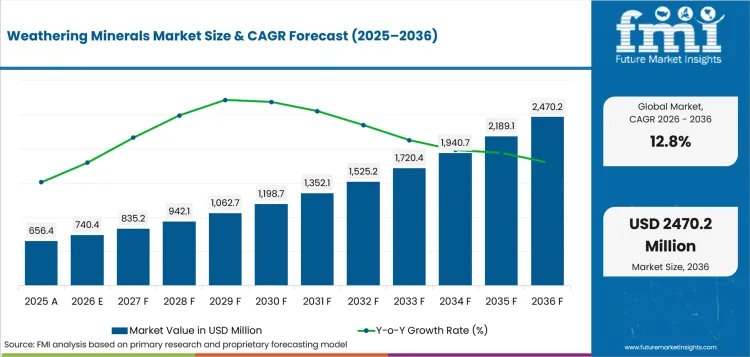
| Metric | Value |
|---|---|
| 2026 Market Size | USD 740.7 million |
| 2036 Market Size | USD 2470.2 million |
| Forecast CAGR | 12.8% from 2026 to 2036 |
| Leading Sales Channel | Direct Projects |
| Direct Projects Share in 2026 | 68.0% |
| Leading Particle Size | Fine |
| Fine Share in 2026 | 52.0% |
| Fastest-growing Country | India |
| India CAGR | 15.4% by 2036 |
Summary of the Weathering Minerals Market
| Market Signal | Commercial Impact |
|---|---|
| Demand and Growth Drivers | Carbon removal projects and industrial mineralization initiatives are increasing demand for weathering minerals.
|
| Product and Segment View | Enhanced rock weathering, fine particles, and direct projects lead their respective segment categories.
|
| Geography and Growth Outlook | India and China are expected to remain key growth markets for weathering minerals.
|
| Competitive Landscape | Competition is increasingly centered on verified weathering projects and durable mineralization pathways.
|
| Analyst Perspective | Weathering minerals are entering a proof-led commercial phase where carbon removal verification and field delivery capabilities determine value.
- Nikhil Kaitwade, Principal Consultant for Bulk Chemicals and Materials at FMI |
Market outlook is shaped by verified carbon removal and mineral supply readiness. International Energy Agency reported global energy-related CO₂ emissions of 37.8 Gt in 2024 and atmospheric CO₂ concentration of 422.5 ppm, raising demand for durable removal options. USA Geological Survey recorded 1.5 billion tons of crushed stone output in 2025 from about 1,400 companies and 3,500 quarries, showing a large mineral handling base for quarry-linked projects. UNDO Carbon announced a Microsoft agreement in October 2025 for 28,900 tonnes of permanent carbon removal, proving commercial appetite for verified enhanced weathering delivery.
Which factors support expansion in the weathering minerals market?
Verified carbon removal contracts and mineralized CO₂ products support market value across project-led and industrial channels.
- Market value is supported by mineral supply contracts linked to monitored carbon removal delivery.
- Supplier pricing reflects rock chemistry and grinding cost before transport distance affects delivered economics.
- Revenue improves as corporate buyers shift from research grants toward contracted removal tonnes.
- Industrial demand strengthens as cement and concrete users test mineralized materials for lower-carbon product claims.
Why is the weathering minerals market growing?
Carbon removal buyers need durable storage claims that can be checked through mineral chemistry and water analysis.
Weathering mineral demand is rising as companies seek removal pathways connecting a physical mineral input with a measurable storage outcome. Department of Energy selected a Midwest enhanced carbonate mineral weathering pilot in June 2026 with DOE funding of USD 3,948,887 and total value of USD 5,141,608. Public funding gives project teams stronger reason to prove field performance rather than sell mineral tonnage alone. Suppliers with mineral screening and laboratory protocols can convert project evidence into offtake-backed revenue.
How is the weathering minerals market segmented?
The weathering minerals industry is segmented by mineral type, application, end use, particle size, and sales channel.
- Basalt fines are projected to secure 41.0% share in 2026, led by quarry availability and lower sourcing complexity for large-area field spreading programs.
- Enhanced rock weathering is anticipated to hold 46.5% share in 2026 since farmland applications help project developers move from laboratory proof toward measured field delivery.
- Carbon removal projects are expected to capture 44.0% share in 2026, supported by corporate offtake contracts and buyer interest in durable removal claims.
- Fine particles are forecast to represent 52.0% share in 2026 as smaller particle size can support faster reaction and stronger project economics.
- Direct projects are projected to account for 68.0% share in 2026, guided by chain-of-custody needs across mineral source and reporting.
Why do basalt fines dominate the weathering minerals market by mineral type?
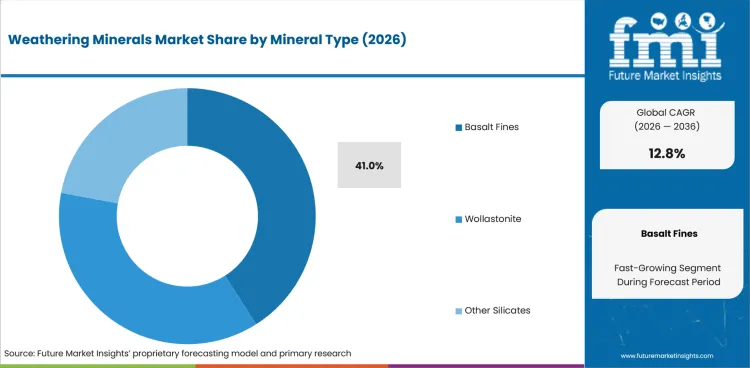
- Basalt fines are projected to account for 41.0% share in 2026, influenced by farm spreading suitability, and lower entry complexity compared with specialty silicates.
- Olivine gains selective demand in projects that prioritize faster reaction. Trace metal checks and sourcing consistency can raise qualification work.
Which application leads the weathering minerals market?
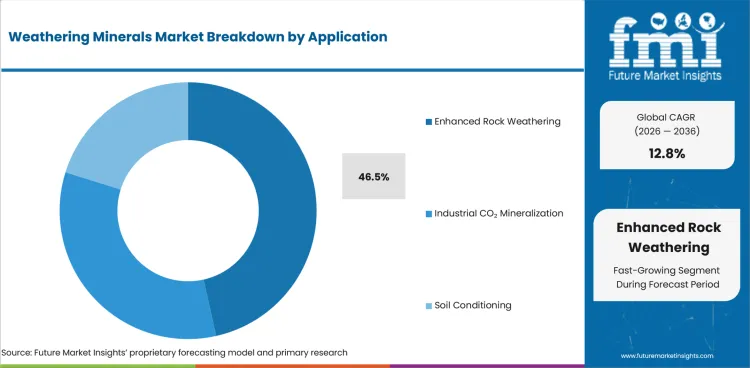
- Enhanced rock weathering is expected to represent 46.5% share in 2026, supported by cropland spreading and corporate interest in field-based carbon removal delivery.
- Industrial CO₂ mineralization gains value as cement and alkaline material users test mineral inputs locking captured CO₂ into usable products.
Which end use leads the weathering minerals market?
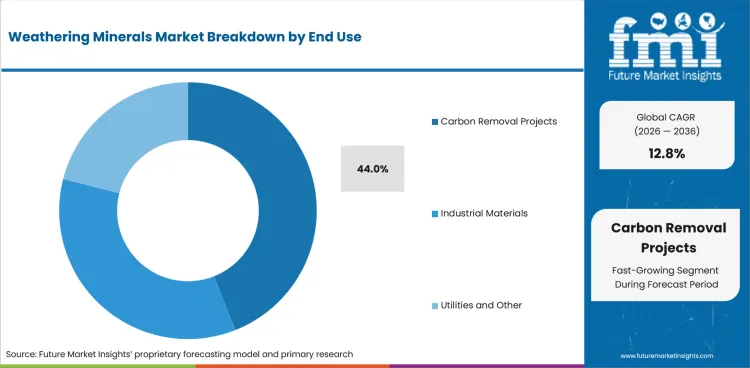
- Carbon removal projects are anticipated to hold 44.0% share in 2026, led by offtake contracts and buyer demand for measured removal outcomes.
- Industrial materials create added demand as mineralized products can support lower-carbon construction and infrastructure applications.
Which particle size leads the weathering minerals market?
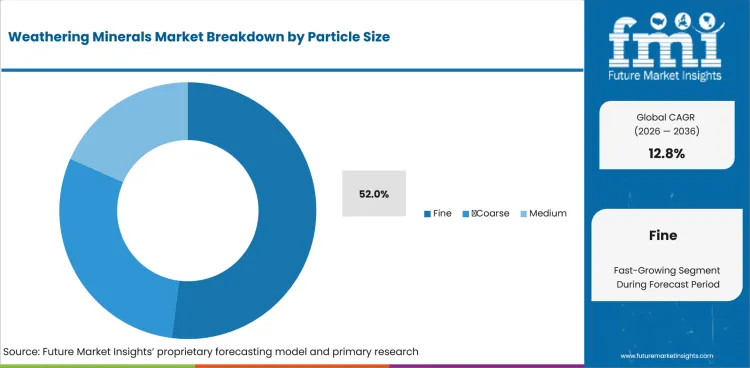
- Fine particles are projected to represent 52.0% share in 2026, shaped by higher surface area and faster weathering response in suitable soil or water conditions.
- Medium particles can suit lower-cost deployments as project teams balance grinding expense with reaction speed and handling performance.
Which sales channel leads the weathering minerals market?
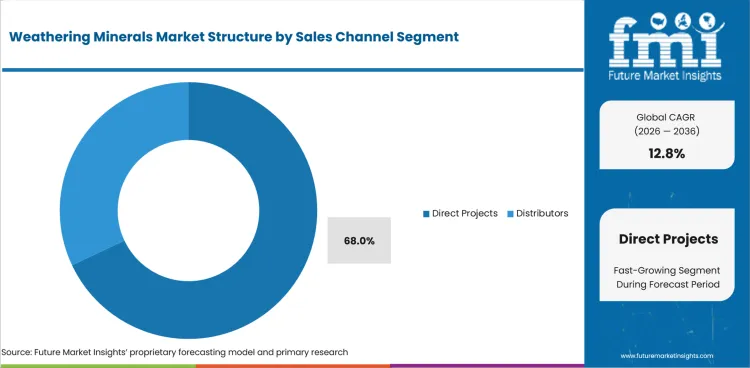
- Direct projects are expected to account for 68.0% share in 2026, shaped by direct buyer contracts and field execution control.
- Distributors gain use in smaller soil conditioning and alkaline material channels as buyers seek flexible mineral supply without full project management.
What are the driver, restraints, and opportunities in the weathering minerals market?
Carbon removal contracts support expansion while transport cost and measurement complexity limit faster rollout.
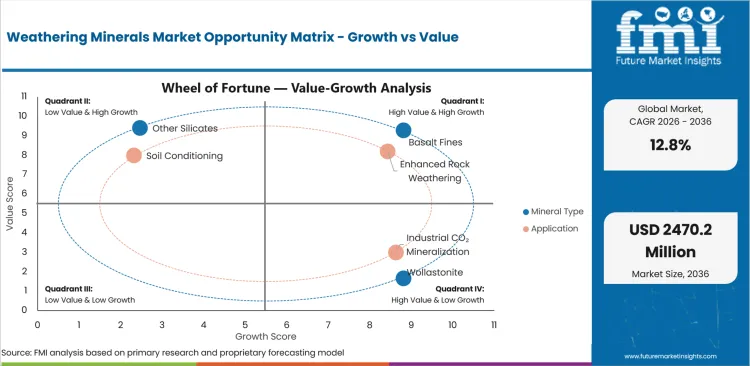
- Driver: Corporate buyers are funding durable removal pathways being able to link rock movement with monitored carbon storage.
- Restraint: Trace metal screening and soil testing can raise delivered project cost.
- Opportunity: Industrial mineralization can create added value as CO₂-bound materials move into cement and alkaline product systems.
Weathering Minerals Market Demand Outlook
Demand outlook is moving toward verified mineral pathways being able to prove project delivery before offtake expansion. International Energy Agency stated that around 45 commercial CCUS facilities are already in operation, with more than 700 projects in various stages across the value chain. Weathering minerals gain from this carbon management momentum as project buyers compare and removal accounting. Suppliers able to connect mineral supply and buyer reporting should hold stronger positions in direct project channels.
Verification and Mineral Screening Pressure
Measurement remains a practical restraint since field weathering needs mineral characterization and independent verification. USA Geological Survey reported USA construction sand and gravel output at 870 million tons in 2025, showing that mineral supply chains can handle large volumes while carbon removal projects need separate chemistry and chain-of-custody proof. Weathering mineral suppliers must avoid treating bulk mineral availability as project readiness. Trace metal screening and net removal accounting can decide whether mineral tonnes convert into saleable removal credits.
Industrial Mineralization and Low-Carbon Materials Opportunity
Industrial mineralization creates added opportunity as captured CO₂ can be reused in building materials and other mineral products. European Commission stated that EU industrial carbon management may need capacity to capture at least 50 Mt of CO₂ per year by 2030, around 280 Mt by 2040, and about 450 Mt by 2050. Mineral suppliers serving cement and alkaline material users can position basalt and other reactive feedstocks as technical inputs rather than ordinary rock powders. Demand should strengthen for suppliers that can provide carbon accounting support and stable mineral specifications.
Which countries are growing fastest in the weathering minerals market?
India 15.4% CAGR, China 14.0% CAGR, United States 13.6% CAGR, United Kingdom 13.4% CAGR, Germany 12.7% CAGR, France 12.5% CAGR, Japan 11.8% CAGR, and South Korea 11.5% CAGR through 2036.
.webp "Top Country Growth Comparison Water Treatment Antiscalant Biopolymers Market Cagr (2026 2036)")
| Country | CAGR |
|---|---|
| India | 15.4% |
| China | 14.0% |
| United States | 13.6% |
| United Kingdom | 13.4% |
| Germany | 12.7% |
| France | 12.5% |
| Japan | 11.8% |
| South Korea | 11.5% |
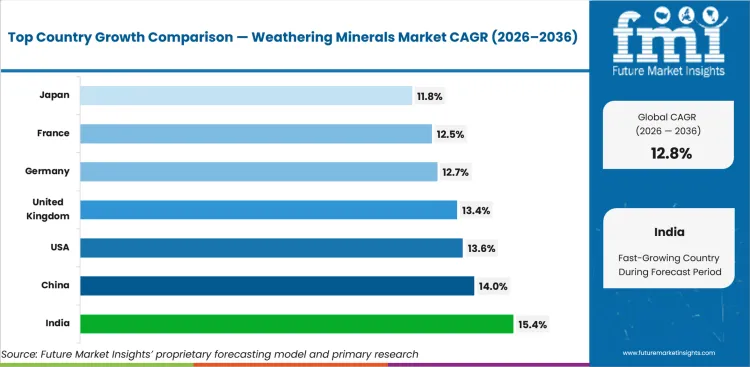
Source: Future Market Insights, 2026.
How do country-level CAGRs compare in the weathering minerals market?
India leads country expansion while South Korea records the most cautious outlook among profiled markets.
- India is forecast to record 15.4% CAGR by 2036 due to basalt access and smallholder project models supporting faster adoption.
- China is expected to expand at 14.0% CAGR from 2026 to 2036 through cement scale and industrial mineralization demand.
- United States is projected to grow at 13.6% CAGR through 2036 on the strength of Midwest agriculture and carbon removal funding.
- United Kingdom is estimated to rise at 13.4% CAGR by 2036 amid policy evidence and farm pilot activity.
- Germany is expected to advance at 12.7% CAGR over the forecast period, reflecting research capacity and industrial decarbonization.
- France is forecast to grow at 12.5% CAGR through 2036 under industrial cluster testing for CO₂ use and storage pathways.
- Japan is projected to post 11.8% CAGR by 2036, led by mineralization links to carbon recycling and construction materials.
- South Korea is expected to rise at 11.5% CAGR through 2036, influenced by qualification-led industrial mineralization pilots.
What is driving weathering minerals growth in India?
A 15.4% CAGR through 2036 is supported by basalt access and enhanced weathering projects.
Country Market Snapshot Table
| Parameter | Value |
|---|---|
| Market Size in 2025 (Value) | USD 78.0 million |
| Market Size in 2026 (Value) | USD 90.0 million |
| Market Forecast in 2036 (Value) | USD 377.0 million |
| CAGR (2026 to 2036) | 15.4% |
| Years Considered | 2021 to 2036 |
| Base Year | 2025 |
| Forecast Period | 2026 to 2036 |
| Units Considered | Value (USD million) |
| Leading Sub-Region | Deccan basalt belt and smallholder farm corridors |
India Weathering Minerals Market Outlook
Industry in India has the strongest country forecast due to basalt access and smallholder carbon removal models. Project operators can pair farmer benefit and carbon removal revenue.
Rural partners and direct carbon offtake are likely to shape demand. Buyers will need proof that removal is measured fairly and farmer outcomes are documented.
Key Growth Drivers
- Deccan basalt access supports weathering mineral supply, demonstrated by the Deccan Traps still covering about 500,000 km² and preserved basalt thickness reaching around 2 km along the Western Ghats escarpment.
- Cropland availability improves farmer-facing field potential, supported by India’s reported 168 million hectares of cropland and its placement among leading countries for enhanced rock weathering.
- Smallholder programs can combine soil improvement and carbon removal revenue in one deployment model.
- Rural implementation partners can help coordinate spreading and sampling across dispersed farms.
Key Restraints
- Industrial mineralization still needs transition finance, reflected in India’s cement emissions projection rising from 246 MtCO₂e in 2023 to 945 MtCO₂e in 2047 and 1,323 MtCO₂e annually by 2070 under business-as-usual conditions.
- Fragmented landholding raises farmer onboarding and data collection cost.
- Rural logistics can make consistent rock powder delivery difficult across dispersed farms.
What makes India unique
India is unique due to smallholder weathering potential and farmer-benefit project models.
Key Companies
- Mati Carbon
- Alt Carbon
- UNDO Carbon
- Lithos Carbon
- Terradot
- InPlanet
- Arca
Sales & Marketing Channels
- Smallholder farmer partnerships
- Rural implementation partners
- Direct carbon removal offtake
- Registry-backed project sales
- Local mineral supply agreements
- Agronomy service networks
Country Segment Breakdown Table
| Segment | Sub-Segments |
|---|---|
| By Mineral Type | Olivine · Basalt Fines · Wollastonite · Other Silicates |
| By Application | Enhanced Rock Weathering · Industrial CO₂ Mineralization · Soil Conditioning · Water Alkalinity |
| By End Use | Agriculture · Carbon Removal Projects · Industrial Materials · Utilities and Other |
| By Particle Size | Coarse · Medium · Fine |
| By Sales Channel | Direct Projects · Distributors |
| Key Sub-Regions Covered, Agriculture and Industrial Corridors | Maharashtra · Karnataka · Telangana · Madhya Pradesh · Gujarat · Eastern India |
Frequently Asked Questions
How fast is India weathering minerals market growing?
India demand is forecast to expand at 15.4% CAGR from 2026 to 2036, supported by basalt access and farmer-centered delivery models.
Who leads India weathering minerals market?
Mati Carbon, Alt Carbon, UNDO Carbon, Lithos Carbon, and Terradot compete due to field implementation and buyer-facing carbon removal delivery.
What is driving adoption in India weathering minerals market?
Deccan basalt availability and carbon removal offtake are supporting early weathering mineral adoption.
How is the weathering minerals market performing in China?
A 14.0% CAGR through 2036 reflects cement scale and domestic mineral supply.
Country Market Snapshot Table
| Parameter | Value |
|---|---|
| Market Size in 2025 (Value) | USD 118.4 million |
| Market Size in 2026 (Value) | USD 135.0 million |
| Market Forecast in 2036 (Value) | USD 500.5 million |
| CAGR (2026 to 2036) | 14.0% |
| Years Considered | 2021 to 2036 |
| Base Year | 2025 |
| Forecast Period | 2026 to 2036 |
| Units Considered | Value (USD million) |
| Leading Sub-Region | Eastern industrial belts and cement-producing provinces |
China Weathering Minerals Market Outlook
Sector in China is driven by industrial material scale more than voluntary carbon removal buying. Cement and construction material systems create strong mineralization potential.
Local partnerships and policy alignment will be essential for suppliers. Industrial buyers are likely to compare process control and carbon accounting before larger deployment.
Key Growth Drivers
- Cement scale supports mineralized material pathways, demonstrated by national statistics reporting cement output of 144.16 million tons in December 2025.
- Asia Pacific CCUS infrastructure supports China’s industrial mineralization route, including planned regional capture capacity of 50 MtCO₂ and storage capacity of 85 MtCO₂ per year by 2030.
- Domestic mineral availability supports bulk testing across basalt and cement-linked mineralization programs.
- Industrial parks can connect CO₂ sources to mineral processing assets under controlled project conditions.
Key Restraints
- Cement-cycle weakness can slow mineral input trials, given China’s 51% share of global cement production and exposure to construction demand shifts.
- Verification systems for durable removal credits are less transparent than mature Western offtake markets.
- Provincial permitting differences can slow project replication across industrial regions.
What makes China unique
China is unique due to large cement and materials volume and industrial park deployment potential.
Key Companies
- Terradot
- UNDO Carbon
- Lithos Carbon
- Arca
- 44.01
Sales & Marketing Channels
- State-linked industrial buyer channels
- Cement producer partnerships
- Industrial park pilots
- Provincial low-carbon project tenders
- Direct mineral supply agreements
- Engineering contractor networks
Country Segment Breakdown Table
| Segment | Sub-Segments |
|---|---|
| By Mineral Type | Olivine · Basalt Fines · Wollastonite · Other Silicates |
| By Application | Enhanced Rock Weathering · Industrial CO₂ Mineralization · Soil Conditioning · Water Alkalinity |
| By End Use | Agriculture · Carbon Removal Projects · Industrial Materials · Utilities and Other |
| By Particle Size | Coarse · Medium · Fine |
| By Sales Channel | Direct Projects · Distributors |
| Key Sub-Regions Covered, Agriculture and Industrial Corridors | East China · North China · Guangdong · Sichuan · Hubei · Inner Mongolia |
Frequently Asked Questions
How fast is China weathering minerals market growing?
China demand is forecast to rise at 14.0% CAGR from 2026 to 2036, supported by cement scale and industrial mineralization demand.
Who leads China weathering minerals market?
, regional mineral processors, Terradot, UNDO Carbon, and Lithos Carbon compete led by industrial projects and mineral sourcing.
What is driving adoption in China weathering minerals market?
Cement production scale and industrial park deployment are supporting China’s weathering mineral adoption.
How fast is the weathering minerals market growing in the United States?
A 13.6% CAGR through 2036 reflects Midwest field trials and corporate carbon removal offtake.
Country Market Snapshot Table
| Parameter | Value |
|---|---|
| Market Size in 2025 (Value) | USD 140.8 million |
| Market Size in 2026 (Value) | USD 160.0 million |
| Market Forecast in 2036 (Value) | USD 572.7 million |
| CAGR (2026 to 2036) | 13.6% |
| Years Considered | 2021 to 2036 |
| Base Year | 2025 |
| Forecast Period | 2026 to 2036 |
| Units Considered | Value (USD million) |
| Leading Sub-Region | Midwest agriculture and quarry corridors |
United States Weathering Minerals Market Outlook
United States weathering mineral demand is driven by carbon removal pilots and corporate offtake interest. Field-based enhanced weathering can use agricultural acreage and mineral handling systems already present in several states.
Suppliers are expected to focus on mineral screening and measured delivery. Buyers are projected to favor projects that combine low haul distance and strong credit documentation.
Key Growth Drivers
- Domestic stone handling supports sourcing flexibility, proven by USA Geological Survey reporting 1.5 billion tons of crushed stone output in 2025.
- Carbon management funding improves buyer confidence, underpinned by USD 1.7 billion for USA carbon capture demonstrations and USD 1.2 billion for direct air capture hubs.
- Agricultural lime channels create a familiar path for farmer education and mineral product handling.
- Corporate removal buyers in California and Washington support direct project contracts under clear credit documentation.
Key Restraints
- Mineral movement can face uneven demand cycles, reflected by first-nine-month crushed stone shipments of 1.10 billion tons in 2025 against 1.11 billion tons in the same period in 2024.
- Quarry-to-field distance can reduce net removal value due to heavy rock powder logistics.
- State soil rules and farmer trust issues can slow acceptance of unfamiliar mineral inputs.
What makes United States unique
United States is unique due to large carbon buyers along with Midwest agricultural access and a large domestic crushed stone supply base.
Key Companies
- Lithos Carbon
- Terradot
- UNDO Carbon
- Eion
- Arca
- Mati Carbon
- InPlanet
Sales & Marketing Channels
- Direct carbon removal offtake
- Quarry-to-field project contracts
- Agricultural service partnerships
- Registry-backed project sales
- Industrial mineralization agreements
- Corporate climate contribution programs
Country Segment Breakdown Table
| Segment | Sub-Segments |
|---|---|
| By Mineral Type | Olivine · Basalt Fines · Wollastonite · Other Silicates |
| By Application | Enhanced Rock Weathering · Industrial CO₂ Mineralization · Soil Conditioning · Water Alkalinity |
| By End Use | Agriculture · Carbon Removal Projects · Industrial Materials · Utilities and Other |
| By Particle Size | Coarse · Medium · Fine |
| By Sales Channel | Direct Projects · Distributors |
| Key Sub-Regions Covered, Agriculture and Industrial Corridors | Midwest · Great Plains · Texas · Appalachia · California · Pacific Northwest |
Frequently Asked Questions
How fast is United States weathering minerals market growing?
United States demand is projected to rise at 13.6% CAGR from 2026 to 2036, guided by field trials and carbon removal offtake.
Who leads United States weathering minerals market?
Lithos Carbon, Terradot, UNDO Carbon, Eion, and Arca compete through mineral access and project delivery.
What is driving adoption in United States weathering minerals market?
Midwest agriculture and corporate removal demand are supporting field-scale weathering mineral deployment.
What is the weathering minerals market outlook in the United Kingdom?
A 13.4% CAGR through 2036 is supported by policy evidence and corporate carbon removal demand.
Country Market Snapshot Table
| Parameter | Value |
|---|---|
| Market Size in 2025 (Value) | USD 66.1 million |
| Market Size in 2026 (Value) | USD 75.0 million |
| Market Forecast in 2036 (Value) | USD 263.7 million |
| CAGR (2026 to 2036) | 13.4% |
| Years Considered | 2021 to 2036 |
| Base Year | 2025 |
| Forecast Period | 2026 to 2036 |
| Units Considered | Value (USD million) |
| Leading Sub-Region | Scotland, Northern England, and agricultural trial corridors |
United Kingdom Weathering Minerals Market Outlook
Sector in the United Kingdom is backed by enhanced rock weathering evidence work and early farm-facing project activity. Project developers can connect basalt spreading and corporate credit delivery in a compact agricultural market.
Retail-style distribution is less important than direct project control. Suppliers carrying farming networks and strong monitoring plans should gain buyer confidence faster.
Key Growth Drivers
- UK emissions pressure supports durable removal demand, evidenced by parliamentary data placing national greenhouse gas emissions at 384 MtCO₂e in 2023, down 5.4% from 2022.
- Enhanced rock weathering has a measurable removal case, including estimated sequestration potential of 12 to 21 MtCO₂ per year under moderate application rates and 19 to 27 MtCO₂ per year under high application rates.
- Farm partnerships can support field application and agronomist-led communication for early direct projects.
- Corporate offtake demand can help fund pilot expansion once project developers convert farm operations into measured removal contracts.
Key Restraints
- Long-term evidence gaps can slow buyer approval, given parliamentary review found limited long-term field trials above 5 to 10 years either globally or in the United Kingdom.
- Quarry-to-farm distance can limit margins in areas lacking nearby suitable basalt or other reactive minerals.
- Buyer caution can persist until protocol acceptance and liability terms become clearer.
What makes United Kingdom unique
United Kingdom is unique due to active farm trials and early corporate carbon removal participation.
Key Companies
- UNDO Carbon
- Future Forest Company
- Lithos Carbon
- Eion
- Terradot
- Arca
- InPlanet
Sales & Marketing Channels
- Direct project contracts
- Farm partnerships
- Carbon credit platforms
- Quarry-to-project agreements
- Corporate sustainability teams
- Research-backed demonstration channels
Country Segment Breakdown Table
| Segment | Sub-Segments |
|---|---|
| By Mineral Type | Olivine · Basalt Fines · Wollastonite · Other Silicates |
| By Application | Enhanced Rock Weathering · Industrial CO₂ Mineralization · Soil Conditioning · Water Alkalinity |
| By End Use | Agriculture · Carbon Removal Projects · Industrial Materials · Utilities and Other |
| By Particle Size | Coarse · Medium · Fine |
| By Sales Channel | Direct Projects · Distributors |
| Key Sub-Regions Covered, Agriculture and Industrial Corridors | Scotland · Yorkshire · Midlands · Wales · Southwest England · Northern Ireland |
Frequently Asked Questions
How fast is United Kingdom weathering minerals market growing?
United Kingdom demand is projected to rise at 13.4% CAGR from 2026 to 2036, supported by enhanced weathering evidence and farm-based pilots.
Who leads United Kingdom weathering minerals market?
UNDO Carbon, Future Forest Company, Lithos Carbon, Eion, and Terradot compete across farm access and field measurement strength.
What is driving adoption in United Kingdom weathering minerals market?
Policy evidence and corporate removal contracts are supporting United Kingdom weathering mineral adoption.
How is the weathering minerals market performing in Germany?
A 12.7% CAGR through 2036 reflects industrial decarbonization pressure and research-backed validation.
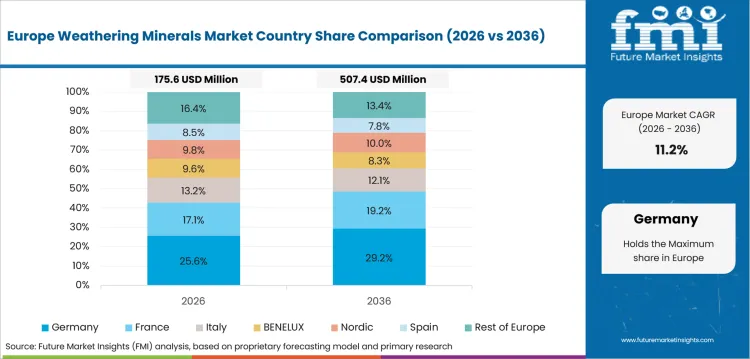
Country Market Snapshot Table
| Parameter | Value |
|---|---|
| Market Size in 2025 (Value) | USD 56.8 million |
| Market Size in 2026 (Value) | USD 64.0 million |
| Market Forecast in 2036 (Value) | USD 211.6 million |
| CAGR (2026 to 2036) | 12.7% |
| Years Considered | 2021 to 2036 |
| Base Year | 2025 |
| Forecast Period | 2026 to 2036 |
| Units Considered | Value (USD million) |
| Leading Sub-Region | North Rhine-Westphalia and industrial mineral corridors |
Germany Weathering Minerals Market Outlook
Germany’s sales are expected to develop through industrial material buyers and research-led carbon removal evaluation. Enhanced weathering projects need strong environmental proof before large contracts.
Cement and research institute partnerships can support early supplier entry. Buyers will prioritize environmental safety and measured performance over quick volume expansion.
Key Growth Drivers
- Carbon management policy supports industrial demand, reflected by Germany being linked to five CCS or CCU projects on track to become operational before 2030 if supportive policy and finance conditions are in place.
- Storage screening strengthens carbon infrastructure planning, backed by geological estimates placing German saline aquifer storage potential at 6.3 to 12.8 GtCO₂ and North Sea storage potential at 150 to 190 GtCO₂.
- Research institute activity can support field data and mineral performance testing before project scale.
- Dense industrial and quarry networks can help connect mineral supply to cement and material users.
Key Restraints
- Germany had no CO₂ storage facility in operation after 2016, which can slow buyer confidence for storage-linked mineralization projects.
- Environmental permitting and soil protection can increase documentation needs for new mineral inputs.
- Conservative industrial buyers may delay adoption until registry rules and product specifications are settled.
What makes Germany unique
Germany is unique due to research-led validation and strong industrial material demand.
Key Companies
- Terradot
- UNDO Carbon
- Lithos Carbon
- Arca
- 44.01
- InPlanet
- Alt Carbon
Sales & Marketing Channels
- Industrial material partnerships
- Research institute collaborations
- Direct enterprise carbon removal sales
- Quarry-to-project supply contracts
- Environmental consulting channels
- Cement and concrete buyer networks
Country Segment Breakdown Table
| Segment | Sub-Segments |
|---|---|
| By Mineral Type | Olivine · Basalt Fines · Wollastonite · Other Silicates |
| By Application | Enhanced Rock Weathering · Industrial CO₂ Mineralization · Soil Conditioning · Water Alkalinity |
| By End Use | Agriculture · Carbon Removal Projects · Industrial Materials · Utilities and Other |
| By Particle Size | Coarse · Medium · Fine |
| By Sales Channel | Direct Projects · Distributors |
| Key Sub-Regions Covered, Agriculture and Industrial Corridors | North Rhine-Westphalia · Bavaria · Baden-Württemberg · Saxony · Hesse · Brandenburg |
Frequently Asked Questions
How fast is Germany weathering minerals market growing?
Germany demand is projected to rise at 12.7% CAGR from 2026 to 2036, led by industrial decarbonization and research-backed validation.
Who leads Germany weathering minerals market?
Terradot, UNDO Carbon, Lithos Carbon, Arca, and 44.01 compete due to industrial mineralization and carbon removal project capability.
What is driving adoption in Germany weathering minerals market?
Research capacity and industrial material demand are supporting Germany’s controlled adoption path.
What is driving weathering minerals growth in France?
A 12.5% CAGR through 2036 is backed by industrial carbon management and material decarbonization pathways.
Country Market Snapshot Table
| Parameter | Value |
|---|---|
| Market Size in 2025 (Value) | USD 51.6 million |
| Market Size in 2026 (Value) | USD 58.0 million |
| Market Forecast in 2036 (Value) | USD 188.3 million |
| CAGR (2026 to 2036) | 12.5% |
| Years Considered | 2021 to 2036 |
| Base Year | 2025 |
| Forecast Period | 2026 to 2036 |
| Units Considered | Value (USD million) |
| Leading Sub-Region | Dunkirk, Rhône-Alpes, and cement-material corridors |
France Weathering Minerals Market Outlook
France demand is more closely linked to industrial mineralization than publicly disclosed cropland weathering at this stage. Cement and industrial clusters can support demand for mineral inputs that bind captured CO₂.
Suppliers should treat France as a specification-led materials market. Early adoption will favor mineral quality data and carbon accounting support.
Key Growth Drivers
- French CCUS planning supports industrial mineralization, shown by capture and storage potential outlined at 4 to 8 Mtpa of CO₂ by 2030, 12 to 20 Mtpa by 2040, and 30 to 50 Mtpa by 2050.
- Industrial carbon management can create a buyer base for mineralized products, supported by CCUS implementation potential equal to a 5% to 10% reduction in industrial CO₂ emissions by 2030.
- Cement and concrete users can create early demand for mineralized products before farm-based weathering advances.
- Engineering firms and industrial clusters can help qualify mineral inputs for CO₂ use and storage projects.
Key Restraints
- Policy timing can slow mineralization projects because France needs CCUS capacity of 4 to 8 Mtpa by 2030, 12 to 20 Mtpa by 2040, and 30 to 50 Mtpa by 2050, while policy and legislative work was put on hold after the 30 June 2024 and 7 July 2024 snap elections.
- Public evidence for French enhanced rock weathering field projects is limited compared to the United States and United Kingdom.
- Industrial buyers may prefer proven carbon capture and storage paths before committing to mineral weathering credits.
What makes France unique
France is unique as an industrial materials market in which mineralization may advance before large farm-based weathering.
Key Companies
- UNDO Carbon
- Terradot
- Lithos Carbon
- Arca
- 44.01
- InPlanet
- Mati Carbon
Sales & Marketing Channels
- Industrial cluster partnerships
- Cement and concrete buyer channels
- Public funding programs
- Engineering firm referrals
- Direct project development agreements
- Carbon removal offtake platforms
Country Segment Breakdown Table
| Segment | Sub-Segments |
|---|---|
| By Mineral Type | Olivine · Basalt Fines · Wollastonite · Other Silicates |
| By Application | Enhanced Rock Weathering · Industrial CO₂ Mineralization · Soil Conditioning · Water Alkalinity |
| By End Use | Agriculture · Carbon Removal Projects · Industrial Materials · Utilities and Other |
| By Particle Size | Coarse · Medium · Fine |
| By Sales Channel | Direct Projects · Distributors |
| Key Sub-Regions Covered, Agriculture and Industrial Corridors | Dunkirk · Île-de-France · Auvergne-Rhône-Alpes · Normandy · Provence-Alpes-Côte d’Azur · Grand Est |
Frequently Asked Questions
How fast is France weathering minerals market growing?
France demand is projected to rise at 12.5% CAGR from 2026 to 2036, supported by industrial carbon management and mineralized materials.
Who leads France weathering minerals market?
UNDO Carbon, Terradot, Lithos Carbon, Arca, and 44.01 compete led by industrial cluster partnerships and carbon removal project support.
What is driving adoption in France weathering minerals market?
Cement-linked mineralization and industrial cluster activity are supporting France’s weathering mineral adoption.
What is the weathering minerals market forecast for Japan?
An 11.8% CAGR through 2036 reflects carbon recycling policy and high-spec industrial mineralization demand.
Country Market Snapshot Table
| Parameter | Value |
|---|---|
| Market Size in 2025 (Value) | USD 44.7 million |
| Market Size in 2026 (Value) | USD 50.0 million |
| Market Forecast in 2036 (Value) | USD 152.5 million |
| CAGR (2026 to 2036) | 11.8% |
| Years Considered | 2021 to 2036 |
| Base Year | 2025 |
| Forecast Period | 2026 to 2036 |
| Units Considered | Value (USD million) |
| Leading Sub-Region | Tokyo, Kansai, and industrial materials corridors |
Japan Weathering Minerals Market Outlook
The market in Japan is anticipated to grow through carbon recycling and controlled mineralization processes. Large open-field spreading is less likely to lead adoption due to land constraints.
High-specification mineral products and carbon accounting support can help suppliers gain trial. Industrial users will need clear performance data before mineralized CO₂ materials enter commercial specifications.
Key Growth Drivers
- Japan’s CCUS pipeline supports mineralization demand, reflected by 7 large-scale projects selected to capture and store around 13 MtCO₂ per year by 2030.
- Japan’s 2025 Strategic Energy Plan identifies mineralization as one carbon recycling route for reusing CO₂ as materials or fuels.
- Concrete and building material applications align with controlled industrial processes and certification-backed material inputs.
- Government-backed technology programs can support CO₂ supply chain work and quality-led adoption.
Key Restraints
- Japan reported FY2024 carbon sink removals of 52.3 MtCO₂e, down 2.9% from FY2023, raising pressure to verify any claimed removal benefit carefully.
- Limited land availability restricts large farm spreading compared to countries having wider cropland corridors.
- High logistics cost can limit bulk imports of reactive minerals needed for lower-value field use.
What makes Japan unique
Japan is unique as a high-spec industrial mineralization market in which controlled product performance can outweigh bulk mineral volume.
Key Companies
- Arca
- 44.01
- Terradot
- UNDO Carbon
- Lithos Carbon
Sales & Marketing Channels
- Direct industrial technology partnerships
- Construction material specification channels
- Government-backed demonstration programs
- Engineering project networks
- Carbon recycling project consortia
- Corporate climate buyer channels
Country Segment Breakdown Table
| Segment | Sub-Segments |
|---|---|
| By Mineral Type | Olivine · Basalt Fines · Wollastonite · Other Silicates |
| By Application | Enhanced Rock Weathering · Industrial CO₂ Mineralization · Soil Conditioning · Water Alkalinity |
| By End Use | Agriculture · Carbon Removal Projects · Industrial Materials · Utilities and Other |
| By Particle Size | Coarse · Medium · Fine |
| By Sales Channel | Direct Projects · Distributors |
| Key Sub-Regions Covered, Agriculture and Industrial Corridors | Tokyo · Osaka · Nagoya · Fukuoka · Yokohama · Hokkaido |
Frequently Asked Questions
How fast is Japan weathering minerals market growing?
Japan demand is projected to rise at 11.8% CAGR from 2026 to 2036, supported by carbon recycling and controlled mineralization projects.
Who leads Japan weathering minerals market?
, , Arca, 44.01, and Terradot compete fueled by industrial material routes.
What is driving adoption in Japan weathering minerals market?
CCUS project selection and construction material testing are supporting Japan’s weathering mineral adoption.
What is the weathering minerals market outlook in South Korea?
An 11.5% CAGR through 2036 reflects qualification-heavy industrial demand and CCUS planning.
Country Market Snapshot Table
| Parameter | Value |
|---|---|
| Market Size in 2025 (Value) | USD 32.3 million |
| Market Size in 2026 (Value) | USD 36.0 million |
| Market Forecast in 2036 (Value) | USD 106.9 million |
| CAGR (2026 to 2036) | 11.5% |
| Years Considered | 2021 to 2036 |
| Base Year | 2025 |
| Forecast Period | 2026 to 2036 |
| Units Considered | Value (USD million) |
| Leading Sub-Region | Ulsan, Pohang, and industrial materials corridors |
South Korea Weathering Minerals Market Outlook
Industry in South Korea is likely to scale through industrial buyers. Steel and chemicals create interest in mineralized outputs, even though qualification cycles can be long.
Pilot work should focus on conglomerates and research bodies. Trust in process reliability and carbon accounting will decide adoption speed.
Key Growth Drivers
- Korea’s official 2035 climate target requires net greenhouse gas emissions to fall by 53% to 61% from a 2018 base of 742.3 MtCO₂eq, supporting industrial carbon management demand.
- Korea’s energy plan targets 70% of electricity generation from zero-carbon sources by 2038, improving the policy case for lower-carbon industrial process pilots.
- Large conglomerate buyers can scale proven solutions quickly after pilot validation.
- Research programs can help validate carbon accounting and process performance.
Key Restraints
- Power-related scrutiny can affect mineral grinding plans, given renewables supplied only 8.6% of electricity generation in 2024 and fossil fuels still provided 78% of total energy supply in 2023.
- Limited domestic mineral access can increase dependence on imports or specialty sourcing.
- Bulk agricultural spreading is constrained by land availability and project coordination needs.
What makes South Korea unique
South Korea is unique as a qualification-heavy market in which industrial buyer trust will decide adoption speed.
Key Companies
- Arca
- 44.01
- Terradot
- UNDO Carbon
- Lithos Carbon
Sales & Marketing Channels
- Industrial pilot partnerships
- Research institute collaborations
- Direct enterprise sales
- Engineering contractor routes
- Imported mineral supply contracts
- Carbon management project consortia
Country Segment Breakdown Table
| Segment | Sub-Segments |
|---|---|
| By Mineral Type | Olivine · Basalt Fines · Wollastonite · Other Silicates |
| By Application | Enhanced Rock Weathering · Industrial CO₂ Mineralization · Soil Conditioning · Water Alkalinity |
| By End Use | Agriculture · Carbon Removal Projects · Industrial Materials · Utilities and Other |
| By Particle Size | Coarse · Medium · Fine |
| By Sales Channel | Direct Projects · Distributors |
| Key Sub-Regions Covered, Agriculture and Industrial Corridors | Ulsan · Pohang · Seoul Capital Area · Busan · Incheon · Daejeon |
Frequently Asked Questions
How fast is South Korea weathering minerals market growing?
South Korea demand is projected to rise at 11.5% CAGR from 2026 to 2036, led by industrial buyer pilots and carbon management planning.
Who leads South Korea weathering minerals market?
, regional cement groups, Arca, 44.01, and Terradot compete depending on mineralization and industrial pilot channels.
What is driving adoption in South Korea weathering minerals market?
Industrial energy intensity and conglomerate-led validation are supporting South Korea’s weathering mineral adoption.
Who are the leading companies in the weathering minerals market?
Terradot, UNDO Carbon, Lithos Carbon, Mati Carbon and InPlanet.
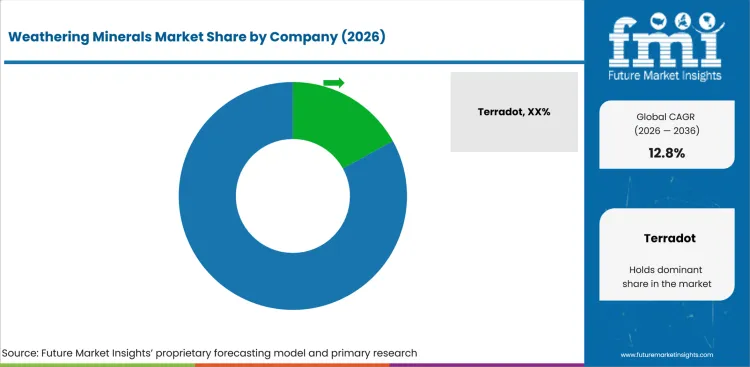
- Project developers hold an advantage through field execution and carbon removal buyer access.
- Mineralization specialists gain acceptance by proving controlled reaction systems and durable storage outcomes.
- Regional operators compete through local geology and stronger farm relationships.
- MRV-ready project documentation supports buyer trust through clear sampling and delivery records.
Weathering minerals suppliers compete by combining mineral sourcing with measured delivery. Mati Carbon’s April 2025 XPRIZE win improved visibility for smallholder enhanced weathering. InPlanet’s December 2025 Microsoft agreement highlighted tropical deployment strength in Brazil.
Project scale has become a competitive separator as carbon removal demand moves beyond small trials. Developers that manage farmers and buyers can control higher-value contracts. Mineral sellers without proof systems risk lower-margin roles. Companies with tested MRV workflows can support larger offtake discussions.
Smaller regional players can win through local mineral access and faster field execution. India and Brazil create stronger weathering conditions for tropical operators. Germany, France, Japan, and South Korea create harder qualification cycles since industrial buyers require high proof before mineralized products enter specifications.
How do top weathering minerals companies compare?
Terradot and UNDO score strongest on MRV depth while Lithos Carbon leads USA field execution strength.
| Company | Relevance to Market Title | Mineral Feedstock Control | MRV and Registry Depth | Field Execution Network | Channel Reach | Geographic Footprint |
|---|---|---|---|---|---|---|
| Terradot | Very High | High | Very Strong | Strong | Strong | United States and Brazil |
| UNDO Carbon | Very High | High | Very Strong | Strong | Strong | United Kingdom and Canada |
| Lithos Carbon | Very High | High | Strong | Very Strong | Strong | United States |
| Mati Carbon | High | Medium | High | Strong | Moderate | India and Global South |
| InPlanet | High | High | High | Strong | Moderate | Brazil |
| Arca | High | High | Strong | Moderate | Moderate | Canada and international |
| 44.01 | High | High | Strong | Moderate | Moderate | Oman and international |
| Alt Carbon | Moderate to High | Medium | Medium | Strong | Moderate | India |
Source: Future Market Insights competitive analysis, 2026.
Who are the key players in the weathering minerals market?
Terradot, UNDO Carbon and Lithos Carbon are listed with Mati Carbon and InPlanet among other suppliers.
Key global companies leading the weathering minerals market include:
- Terradot
- UNDO Carbon
- Lithos Carbon
- Mati Carbon
- InPlanet
- Arca
- 44.01
- Alt Carbon
Key Developments in Weathering Minerals Market
- In February 2026, Terradot confirmed that Eion became part of Terradot, forming a platform with more than 400,000 tons of carbon removal under contract.
- In April 2025, Mati Carbon won the USD 50 million XPRIZE Carbon Removal grand prize for enhanced rock weathering work with farms in India and Africa.
- In December 2025, InPlanet signed an agreement with Microsoft to deliver more than 28,500 tonnes of enhanced rock weathering removals from Brazil during 2026 to 2028.
Key Players in the Weathering Minerals Market
Project Developers
- UNDO Carbon
- Lithos Carbon
- Terradot
- Mati Carbon
- InPlanet
Mineralization Specialists
- Arca
- 44.01
Regional Field Operators
- Alt Carbon
- InPlanet
- Mati Carbon
Weathering Minerals Market - Report Scope
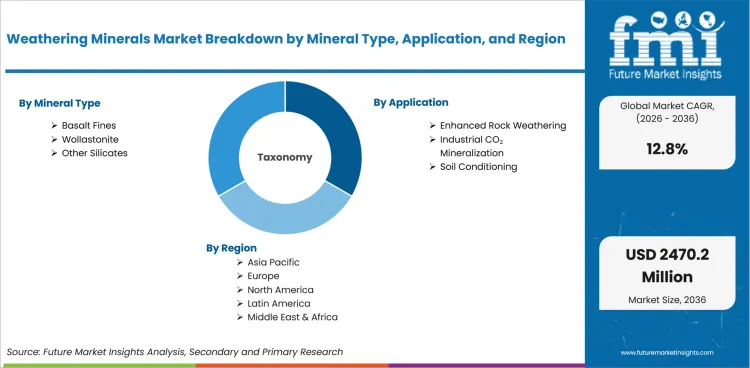
| Parameter | Details |
|---|---|
| Forecast period | 2026 to 2036 |
| Historical period | 2021 to 2025 |
| Quantitative unit | Revenue in USD million |
| By mineral type | Olivine, basalt fines, wollastonite, other silicates |
| By application | Enhanced rock weathering, industrial CO₂ mineralization, soil conditioning, water alkalinity |
| By end use | Agriculture, carbon removal projects, industrial materials, utilities and other |
| By particle size | Coarse, medium, fine |
| By sales channel | Direct projects, distributors |
| Regions covered | North America, Latin America, Europe, East Asia, South Asia and Pacific, Middle East and Africa |
| Countries covered | United States, United Kingdom, Germany, France, Japan, China, South Korea, India |
| Key companies profiled | Terradot, UNDO Carbon, Lithos Carbon, Mati Carbon, InPlanet, Arca, 44.01, Alt Carbon |
Source: Future Market Insights, 2026.
Weathering Minerals Market - Scope & Definition
| Attribute | Detail |
|---|---|
| Market Definition | Commercially supplied silicate and carbonate-bearing minerals used to accelerate carbon dioxide capture through weathering or mineralization, including olivine, basalt fines, wollastonite, and other reactive silicates. |
| Functions Covered | CO₂ removal, mineral carbonation, soil alkalinity support, water alkalinity adjustment, mineralized material formation. |
| Applications Covered | Enhanced rock weathering, industrial CO₂ mineralization, soil conditioning, and water alkalinity applications. |
| End-Use Industries | Agriculture, carbon removal projects, industrial materials, utilities, cement, concrete, and environmental project developers. |
| Grades Covered | Coarse, medium, and fine particle-size mineral inputs. |
| Inclusions | Reactive silicate and carbonate-bearing mineral materials supplied for weathering, mineralization, soil conditioning, and water alkalinity applications across commercial project channels. |
| Exclusions | Decorative stone, standard construction aggregate, cement clinker, lime used only for neutralization, and carbon capture systems without mineral weathering or mineralization material input. |
Weathering Minerals Market - Research Methodology
| Method | Description |
|---|---|
| Primary Research | FMI analyst interviews with carbon removal buyers, mineral suppliers, quarry operators, agronomy service providers, carbon project developers, corporate sustainability teams, and industrial material users. |
| Desk Research | Review of government carbon management sources, technical carbon removal references, official company disclosures, public registry information, and industrial mineral data. |
| Market Sizing & Forecasting | Hybrid bottom-up and top-down methodology using mineral volume, delivered cost, project adoption, application mix, sales channel structure, and country readiness. |
| Data Validation | Cross-verification using project announcements, carbon removal policy signals, mineral supply availability, industrial material demand, and buyer behavior across selected countries. |
Weathering Minerals Market Breakdown by Mineral Type, Application, End Use, Particle Size, Sales Channel, and Region
Weathering Minerals Market Segmented by Mineral Type
- Olivine
- Basalt Fines
- Wollastonite
- Other Silicates
Weathering Minerals Market Segmented by Application
- Enhanced Rock Weathering
- Industrial CO₂ Mineralization
- Soil Conditioning
- Water Alkalinity
Weathering Minerals Market Segmented by End Use
- Agriculture
- Carbon Removal Projects
- Industrial Materials
- Utilities and Other
Weathering Minerals Market Segmented by Particle Size
- Coarse
- Medium
- Fine
Weathering Minerals Market Segmented by Sales Channel
- Direct Projects
- Distributors
Weathering Minerals Market by Region
- North America
- Latin America
- Europe
- East Asia
- South Asia and Pacific
- Middle East and Africa
Research Sources and Bibliography
- Clean Energy Ministerial. (2026, January 8). LETA/CIAB report: China’s impressive strides towards carbon capture, utilisation and storage. Clean Energy Ministerial.
- CO2RE. (2025, December). The UKRI Strategic Priorities Fund Greenhouse Gas Removal Demonstrators programme report. CO2RE.
- Department of Energy. (2026, June 4). Project selections for FOA 3082: Carbon Negative Shot pilots. Department of Energy.
- Environment Agency. (2025, September 19). Enhanced rock weathering: Evidence on potential environmental impacts and social implications. Environment Agency.
- European Commission. (2024, September 16). In focus: Industrial carbon management. European Commission.
- Global CCS Institute. (2025, August). The status of CCUS in France: Present and future opportunities. Global CCS Institute.
- International Energy Agency. (2024, April 25). Carbon capture, utilisation and storage. International Energy Agency.
- International Energy Agency. (2025, March 24). Global Energy Review 2025: CO₂ emissions. International Energy Agency.
- International Energy Agency. (2025). Germany 2025: Energy Policy Review. International Energy Agency.
- International Energy Agency. (2025, November 25). Korea 2025: Energy Policy Review. International Energy Agency.
- Mati Carbon. (2025, April 22). Mati Carbon is the grand prize winner of the XPRIZE Carbon Removal competition. Mati Carbon.
- Mati Carbon. (2025, December 23). 2025: A break-out year for Mati Carbon. Mati Carbon.
- Ministry of Economy, Trade and Industry. (2025). Strategic Energy Plan. Government of Japan.
- Ministry of the Ecological Transition. (2025). The third National Climate Change Adaptation Plan. Government of France.
- Ministry of the Environment. (2026, April 14). Japan’s national greenhouse gas emissions and removals in FY2024. Government of Japan.
- Ministry of Environment. (2025, November 11). Korea sets 2035 target to cut greenhouse gas emissions. Government of the Republic of Korea.
- National Bureau of Statistics of China. (2026, January 20). Industrial production operation in December 2025. National Bureau of Statistics of China.
- NITI Aayog. (2026, January). Roadmap for cement sector decarbonisation. Government of India.
- Parliamentary Office of Science and Technology. (2024, August 15). Enhanced rock weathering: Potential UK greenhouse gas removal. UK Parliament.
- Remineralize The Earth. (2024, June 30). India’s potential for food security and climate stabilization. Remineralize The Earth.
- Terradot. (2026, February 6). Terradot acquires Eion, forming new leading enhanced rock weathering platform. Terradot.
- UNDO Carbon. (2025, October 21). UNDO and Microsoft to remove 28,900 tonnes of carbon, backed by financing from Inlandsis. UNDO Carbon.
- USA Geological Survey. (2026, February). Mineral Commodity Summaries 2026: Construction sand and gravel. USA Geological Survey.
- USA Geological Survey. (2026, February). Mineral Commodity Summaries 2026: Stone, crushed. USA Geological Survey.
- InPlanet. (2025, December 17). InPlanet secures agreement to deliver 28,500 enhanced rock weathering credits to Microsoft. InPlanet.
This bibliography is provided for reader reference and is not exhaustive. The full report contains the complete reference list and detailed citations.
This Report Answer
- Market size estimates for 2026 and forecasts through 2036 for the weathering minerals market.
- Insights across more than 30 regional and country-level markets.
- Analysis of demand drivers, field adoption patterns, industrial mineralization, and buyer behavior.
- Evaluation of key applications and end uses, including enhanced rock weathering and industrial CO₂ mineralization.
- Assessment of measurement, reporting, and verification needs across weathering mineral projects.
- Identification of opportunities across mineral types, particle sizes, applications, end uses, and sales channels.
- Evaluation of mineral supply, grinding, transport, soil testing, and field execution structures.
- Country-level analysis covering the United States, United Kingdom, Germany, France, Japan, China, South Korea, and India.
- Assessment of competition, including project developers, mineralization specialists, and regional field operators.
- Analysis of carbon removal offtake, mineralized material demand, and carbon accounting pressure.
- Regional outlooks across North America, Latin America, Europe, East Asia, South Asia and Pacific, and Middle East and Africa.
- Delivery of market data, forecasts, and supporting analysis in PDF and Excel formats.
Frequently Asked Questions
What is the growth prospect for weathering minerals?
Demand for weathering minerals is expected to rise at a considerable pace as carbon removal buyers and industrial material users seek mineral-based CO₂ storage pathways.
Which companies are expected to shape the weathering minerals market?
Terradot, UNDO Carbon, Lithos Carbon, Mati Carbon, InPlanet, Arca, 44.01, and Alt Carbon are expected to shape competition led by project delivery and MRV capability.
Why are leading carbon removal developers investing in weathering minerals?
Leading developers are investing in weathering minerals to convert reactive rock inputs into verified carbon removal credits and mineralized product value.
Why are direct project channels important in the weathering minerals market?
Direct project channels support traceability from quarry source to field application and buyer-facing delivery.
Which mineral formats are gaining attention in weathering minerals?
Basalt fines and fine-particle mineral inputs are gaining attention as buyers seek lower sourcing difficulty and faster reaction potential.
How do regulations influence weathering mineral projects?
Regulations influence project development through soil safety review and registry acceptance.
Why is MRV important for weathering minerals?
MRV is important since carbon removal buyers need documented evidence showing mineral application and durable storage.
What role does particle size play in weathering mineral adoption?
Fine particles support adoption by improving reaction speed, with grinding cost and dust handling requiring careful project design.
Preview the report firsthand - request a free sample
Get SampleGet the brochure for pricing and purchase details.
Get PDFTable of Content
- Key Takeaways
- Market Size and CAGR
- Top Growth Driver
- Fastest Growing Segment
- Leading Region
- Key Companies
- Emerging Opportunities
- Executive Summary
- Global Market Outlook
- Demand-side Trends
- Supply-side Trends
- Technology Roadmap Analysis
- Analysis and Recommendations
- Analyst Perspective (What is happening? Why now? What should investors know?)
- Key Questions Answered
- How large is the market?
- What is the CAGR?
- What are key trends?
- Which region dominates?
- Who are the leaders?
- Market Overview
- Market Coverage / Taxonomy
- Market Definition / Scope / Limitations
- Research Methodology
- Chapter Orientation
- Analytical Lens and Working Hypotheses
- Market Structure, Signals, and Trend Drivers
- Benchmarking and Cross-market Comparability
- Market Sizing, Forecasting, and Opportunity Mapping
- Research Design and Evidence Framework
- Desk Research Programme (Secondary Evidence)
- Expert Input and Fieldwork (Primary Evidence)
- Tooling, Models, and Reference Databases
- Data Engineering and Model Build
- Quality Assurance and Audit Trail
- Market Background
- Market Dynamics (Drivers, Restraints, Opportunity, Trends)
- Scenario Forecast (Optimistic, Likely, Conservative)
- Impact Analysis
- AI Impact
- Sustainability Impact
- Regulatory Impact
- Technology Impact
- Consumer / Buyer Analysis
- Purchase Drivers
- Adoption Barriers
- Buyer Journey
- Opportunity Map Analysis
- Product Life Cycle Analysis
- Supply Chain Analysis
- Investment Feasibility Matrix
- Value Chain Analysis
- PESTLE and Porter's Analysis
- Regulatory Landscape
- Regional Parent Market Outlook
- Production and Consumption Statistics
- Import and Export Statistics
- Global Market Analysis and Forecast, 2021 to 2036
- Historical Market Size Value (USD Million) Analysis, 2021 to 2025
- Current and Future Market Size Value (USD Million) Projections, 2026 to 2036
- Y-o-Y Growth Trend Analysis
- Absolute $ Opportunity Analysis
- Global Market Pricing Analysis, 2021 to 2036
- Global Market Analysis and Forecast, By Mineral Type, 2021 to 2036
- Introduction / Key Findings
- Historical Market Size Value (USD Million) Analysis By Mineral Type, 2021 to 2025
- Current and Future Market Size Value (USD Million) Analysis and Forecast By Mineral Type, 2026 to 2036
- Basalt Fines
- Wollastonite
- Other Silicates
- Basalt Fines
- Y-o-Y Growth Trend Analysis By Mineral Type, 2021 to 2025
- Absolute $ Opportunity Analysis By Mineral Type, 2026 to 2036
- Global Market Analysis and Forecast, By Application, 2021 to 2036
- Introduction / Key Findings
- Historical Market Size Value (USD Million) Analysis By Application, 2021 to 2025
- Current and Future Market Size Value (USD Million) Analysis and Forecast By Application, 2026 to 2036
- Enhanced Rock Weathering
- Industrial CO₂ Mineralization
- Soil Conditioning
- Enhanced Rock Weathering
- Y-o-Y Growth Trend Analysis By Application, 2021 to 2025
- Absolute $ Opportunity Analysis By Application, 2026 to 2036
- Global Market Analysis and Forecast, By End Use, 2021 to 2036
- Introduction / Key Findings
- Historical Market Size Value (USD Million) Analysis By End Use, 2021 to 2025
- Current and Future Market Size Value (USD Million) Analysis and Forecast By End Use, 2026 to 2036
- Carbon Removal Projects
- Industrial Materials
- Utilities and Other
- Carbon Removal Projects
- Y-o-Y Growth Trend Analysis By End Use, 2021 to 2025
- Absolute $ Opportunity Analysis By End Use, 2026 to 2036
- Global Market Analysis and Forecast, By Particle Size, 2021 to 2036
- Introduction / Key Findings
- Historical Market Size Value (USD Million) Analysis By Particle Size, 2021 to 2025
- Current and Future Market Size Value (USD Million) Analysis and Forecast By Particle Size, 2026 to 2036
- Fine
- Coarse
- Medium
- Fine
- Y-o-Y Growth Trend Analysis By Particle Size, 2021 to 2025
- Absolute $ Opportunity Analysis By Particle Size, 2026 to 2036
- Global Market Analysis and Forecast, By Sales Channel, 2021 to 2036
- Introduction / Key Findings
- Historical Market Size Value (USD Million) Analysis By Sales Channel, 2021 to 2025
- Current and Future Market Size Value (USD Million) Analysis and Forecast By Sales Channel, 2026 to 2036
- Direct Projects
- Distributors
- Direct Projects
- Y-o-Y Growth Trend Analysis By Sales Channel, 2021 to 2025
- Absolute $ Opportunity Analysis By Sales Channel, 2026 to 2036
- Global Market Analysis and Forecast, By Region, 2021 to 2036
- Introduction
- Historical Market Size Value (USD Million) Analysis By Region, 2021 to 2025
- Current Market Size Value (USD Million) Analysis and Forecast By Region, 2026 to 2036
- North America
- Latin America
- Western Europe
- Eastern Europe
- East Asia
- South Asia and Pacific
- Middle East & Africa
- Market Attractiveness Analysis By Region
- North America Market Analysis and Forecast, By Country, 2021 to 2036
- Historical Market Size Value (USD Million) Trend Analysis By Market Taxonomy, 2021 to 2025
- Market Size Value (USD Million) Forecast By Market Taxonomy, 2026 to 2036
- By Country
- USA
- Canada
- Mexico
- By Mineral Type
- By Application
- By End Use
- By Particle Size
- By Sales Channel
- By Country
- Market Attractiveness Analysis
- By Country
- By Mineral Type
- By Application
- By End Use
- By Particle Size
- By Sales Channel
- Key Takeaways
- Latin America Market Analysis and Forecast, By Country
- Historical Market Size Value (USD Million) Trend Analysis By Market Taxonomy, 2021 to 2025
- Market Size Value (USD Million) Forecast By Market Taxonomy, 2026 to 2036
- By Country
- Brazil
- Chile
- Rest of Latin America
- By Mineral Type
- By Application
- By End Use
- By Particle Size
- By Sales Channel
- By Country
- Market Attractiveness Analysis
- By Country
- By Mineral Type
- By Application
- By End Use
- By Particle Size
- By Sales Channel
- Key Takeaways
- Western Europe Market Analysis and Forecast, By Country
- Historical Market Size Value (USD Million) Trend Analysis By Market Taxonomy, 2021 to 2025
- Market Size Value (USD Million) Forecast By Market Taxonomy, 2026 to 2036
- By Country
- Germany
- UK
- Italy
- Spain
- France
- Nordic
- BENELUX
- Rest of Western Europe
- By Mineral Type
- By Application
- By End Use
- By Particle Size
- By Sales Channel
- By Country
- Market Attractiveness Analysis
- By Country
- By Mineral Type
- By Application
- By End Use
- By Particle Size
- By Sales Channel
- Key Takeaways
- Eastern Europe Market Analysis and Forecast, By Country
- Historical Market Size Value (USD Million) Trend Analysis By Market Taxonomy, 2021 to 2025
- Market Size Value (USD Million) Forecast By Market Taxonomy, 2026 to 2036
- By Country
- Russia
- Poland
- Hungary
- Balkan & Baltic
- Rest of Eastern Europe
- By Mineral Type
- By Application
- By End Use
- By Particle Size
- By Sales Channel
- By Country
- Market Attractiveness Analysis
- By Country
- By Mineral Type
- By Application
- By End Use
- By Particle Size
- By Sales Channel
- Key Takeaways
- East Asia Market Analysis and Forecast, By Country
- Historical Market Size Value (USD Million) Trend Analysis By Market Taxonomy, 2021 to 2025
- Market Size Value (USD Million) Forecast By Market Taxonomy, 2026 to 2036
- By Country
- China
- Japan
- South Korea
- By Mineral Type
- By Application
- By End Use
- By Particle Size
- By Sales Channel
- By Country
- Market Attractiveness Analysis
- By Country
- By Mineral Type
- By Application
- By End Use
- By Particle Size
- By Sales Channel
- Key Takeaways
- South Asia and Pacific Market Analysis and Forecast, By Country
- Historical Market Size Value (USD Million) Trend Analysis By Market Taxonomy, 2021 to 2025
- Market Size Value (USD Million) Forecast By Market Taxonomy, 2026 to 2036
- By Country
- India
- ASEAN
- Australia & New Zealand
- Rest of South Asia and Pacific
- By Mineral Type
- By Application
- By End Use
- By Particle Size
- By Sales Channel
- By Country
- Market Attractiveness Analysis
- By Country
- By Mineral Type
- By Application
- By End Use
- By Particle Size
- By Sales Channel
- Key Takeaways
- Middle East & Africa Market Analysis and Forecast, By Country
- Historical Market Size Value (USD Million) Trend Analysis By Market Taxonomy, 2021 to 2025
- Market Size Value (USD Million) Forecast By Market Taxonomy, 2026 to 2036
- By Country
- Kingdom of Saudi Arabia
- Other GCC Countries
- Türkiye
- South Africa
- Other African Union
- Rest of Middle East & Africa
- By Mineral Type
- By Application
- By End Use
- By Particle Size
- By Sales Channel
- By Country
- Market Attractiveness Analysis
- By Country
- By Mineral Type
- By Application
- By End Use
- By Particle Size
- By Sales Channel
- Key Takeaways
- Key Countries Market Analysis
- USA
- Pricing Analysis
- Market Share Analysis, 2025
- By Mineral Type
- By Application
- By End Use
- By Particle Size
- By Sales Channel
- Canada
- Pricing Analysis
- Market Share Analysis, 2025
- By Mineral Type
- By Application
- By End Use
- By Particle Size
- By Sales Channel
- Mexico
- Pricing Analysis
- Market Share Analysis, 2025
- By Mineral Type
- By Application
- By End Use
- By Particle Size
- By Sales Channel
- Brazil
- Pricing Analysis
- Market Share Analysis, 2025
- By Mineral Type
- By Application
- By End Use
- By Particle Size
- By Sales Channel
- Chile
- Pricing Analysis
- Market Share Analysis, 2025
- By Mineral Type
- By Application
- By End Use
- By Particle Size
- By Sales Channel
- Germany
- Pricing Analysis
- Market Share Analysis, 2025
- By Mineral Type
- By Application
- By End Use
- By Particle Size
- By Sales Channel
- UK
- Pricing Analysis
- Market Share Analysis, 2025
- By Mineral Type
- By Application
- By End Use
- By Particle Size
- By Sales Channel
- Italy
- Pricing Analysis
- Market Share Analysis, 2025
- By Mineral Type
- By Application
- By End Use
- By Particle Size
- By Sales Channel
- Spain
- Pricing Analysis
- Market Share Analysis, 2025
- By Mineral Type
- By Application
- By End Use
- By Particle Size
- By Sales Channel
- France
- Pricing Analysis
- Market Share Analysis, 2025
- By Mineral Type
- By Application
- By End Use
- By Particle Size
- By Sales Channel
- India
- Pricing Analysis
- Market Share Analysis, 2025
- By Mineral Type
- By Application
- By End Use
- By Particle Size
- By Sales Channel
- ASEAN
- Pricing Analysis
- Market Share Analysis, 2025
- By Mineral Type
- By Application
- By End Use
- By Particle Size
- By Sales Channel
- Australia & New Zealand
- Pricing Analysis
- Market Share Analysis, 2025
- By Mineral Type
- By Application
- By End Use
- By Particle Size
- By Sales Channel
- China
- Pricing Analysis
- Market Share Analysis, 2025
- By Mineral Type
- By Application
- By End Use
- By Particle Size
- By Sales Channel
- Japan
- Pricing Analysis
- Market Share Analysis, 2025
- By Mineral Type
- By Application
- By End Use
- By Particle Size
- By Sales Channel
- South Korea
- Pricing Analysis
- Market Share Analysis, 2025
- By Mineral Type
- By Application
- By End Use
- By Particle Size
- By Sales Channel
- Russia
- Pricing Analysis
- Market Share Analysis, 2025
- By Mineral Type
- By Application
- By End Use
- By Particle Size
- By Sales Channel
- Poland
- Pricing Analysis
- Market Share Analysis, 2025
- By Mineral Type
- By Application
- By End Use
- By Particle Size
- By Sales Channel
- Hungary
- Pricing Analysis
- Market Share Analysis, 2025
- By Mineral Type
- By Application
- By End Use
- By Particle Size
- By Sales Channel
- Kingdom of Saudi Arabia
- Pricing Analysis
- Market Share Analysis, 2025
- By Mineral Type
- By Application
- By End Use
- By Particle Size
- By Sales Channel
- Türkiye
- Pricing Analysis
- Market Share Analysis, 2025
- By Mineral Type
- By Application
- By End Use
- By Particle Size
- By Sales Channel
- South Africa
- Pricing Analysis
- Market Share Analysis, 2025
- By Mineral Type
- By Application
- By End Use
- By Particle Size
- By Sales Channel
- USA
- Market Structure Analysis
- Competition Dashboard
- Competition Benchmarking
- Market Share Analysis of Top Players
- By Regional
- By Mineral Type
- By Application
- By End Use
- By Particle Size
- By Sales Channel
- Emerging Startups
- Innovation Benchmarking
- Competition Analysis
- Competition Deep Dive
- Terradot
- Overview
- Product Portfolio
- Profitability by Market Segments (Product/Region/Sales Channel)
- Sales Footprint
- Strategy Overview
- Marketing Strategy
- Product Strategy
- Channel Strategy
- UNDO Carbon
- Lithos Carbon
- Mati Carbon
- InPlanet
- Arca
- Terradot
- Case Studies
- Success Stories
- Recent Developments
- Competition Deep Dive
- Assumptions & Acronyms Used


