

- Market Size (2026)
- USD 0.1 Bn
- Forecast (2036)
- USD 2.7 Bn
- CAGR (2026 to 2036)
- 39.0%
How big is Wind Blade Recycling Market in 2026?
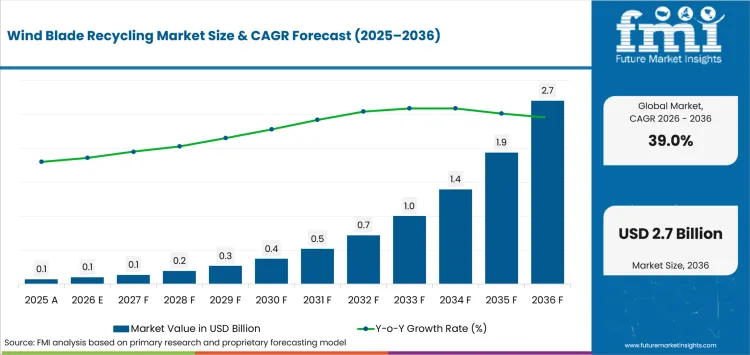
USD 0.1 billion in 2026 and USD 2.7 billion by 2036 at a 39.0% CAGR.
Demand for wind blade recycling is projected to expand at 39.0% CAGR between 2026 and 2036, increasing valuation from USD 0.1 billion in 2026 to USD 2.7 billion by 2036. Repowering programs generate concentrated blade volumes that require planned cutting, transport and verified industrial material outlets.
Established metal systems cannot separate fibers from cured resins, so retired wind turbine blades require a dedicated recovery plan. The U.S. Department of Energy reported in January 2025 that existing infrastructure could process 90% of a retired turbine’s mass. The remaining wind turbine composites require controlled dismantling and verified outlets that accept resin-bound fibers at declared quality levels.
Key Takeaways
- Repowering schedules and landfill restrictions require traceable collection and material recovery from site removal through final industrial use.
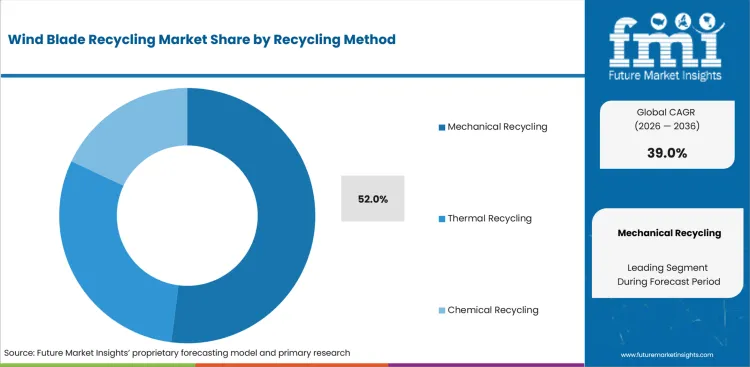
- Mechanical recycling is projected to represent 52.0% share in 2026 because local size reduction reduces transport volume and prepares consistent industrial feedstock.
- Glass fiber is estimated to hold 76.0% share in 2026 owing to its extensive use across installed utility-scale blade structures.
- Construction is forecast to account for 43.0% share in 2026 as cement and concrete applications accept specified composite fractions at industrial volumes.
- Thermoset resin systems limit recovered value because mechanical, thermal and chemical routes alter fiber length and resin chemistry in different ways.
- Vestas Wind Systems A/S, Stena Recycling AB, Siemens Gamesa Renewable Energy S.A.U., RWE Offshore Wind GmbH, ACCIONA S.A., Iberdrola España, S.A.U., FCC Ámbito, S.A.U. and Carbon Rivers, LLC serve the market.
Analyst Perspective
"Retired blade tonnage becomes commercially useful once site handling matches a qualified recovery route and a named industrial outlet. Processors protect margin by agreeing recovered-fiber specifications before contractor crews begin dismantling each project batch."
- Anurag Sharma,, Principal Consultant, Future Market Insights
How is the wind blade recycling market segmented?
The wind blade recycling industry is segmented by recycling method, blade material, end-use industry, blade source, recycling process and region.
The wind blade recycling market is organized by recycling method, blade material, end-use industry, blade source, recycling process and region. Recycling methods include mechanical recycling through shredding and grinding or size reduction and separation, thermal recycling through pyrolysis or thermal decomposition, and chemical recycling through solvolysis or chemical depolymerization. Blade materials include glass fiber reinforced polymer, glass fiber composite, carbon fiber reinforced polymer and carbon fiber composite. End-use industries cover cement, concrete, building materials, automotive components, vehicle structural parts, electronic components, consumer products, furniture, infrastructure, sports and recreation products. Blade sources include decommissioned onshore and offshore blades, blade production waste, composite manufacturing waste, storm-damaged blades and operational replacements. Recycling processes cover blade collection, specialized transportation, pre-processing, cutting and dismantling, shredding and grinding, fiber recovery, resin and composite recovery, composite pellet production and recycled material manufacturing. Regional coverage spans North America, Latin America, Western and Eastern Europe, East Asia, South Asia and Pacific, and the Middle East and Africa.
Why does mechanical recycling hold the largest share within the recycling method category?
Mechanical processing reduces blade volume through controlled cutting and blade shredding routes and prepares fractions for industrial separation or co-processing. ACCIONA reported in May 2025 that material from a Tahivilla blade entered commercial footwear through mechanical reduction, linking site processing with a defined product outlet.
- In 2026, mechanical recycling is expected to lead the recycling method category with 52.0% share because portable cutting and grinding equipment reduces blade volume near retirement sites.
- Commercial uptake depends on a receiving manufacturer that accepts mixed fiberglass and resin powder within declared performance limits, allowing service firms to price handling and processing together.
Why does glass fiber retain the largest share within the blade material category?
Most utility-scale blades use fiberglass materials to balance stiffness and manufacturing cost across long rotor structures. Recycling programs therefore receive larger glass-rich volumes than carbon-fiber streams, although each GFRP composite outlet requires verified fiber length and resin residue.
- By blade material, glass fiber is estimated to hold 76.0% in 2026 owing to its extensive presence across installed onshore and offshore turbine fleets.
- Separable resin chemistry preserves more glass-rich material during recovery and improves qualification for new composite uses. RWE reported in August 2025 that Sofia’s Siemens Gamesa blades use resin designed to separate fiberglass and other components at end of service.
How do decommissioned wind turbine blades support demand within the blade source category?
Planned repowering releases several blades within one project window, allowing crane and cutting costs to be shared across a concentrated batch. ACCIONA reported in October 2025 that shredded end-of-life blade material entered a concrete prototype under the BLADES2BUILD program, confirming a specified construction outlet.
- The blade source category is forecast to be led by decommissioned wind turbine blades at 57.0% share in 2026 due to coordinated retirement volumes from mature wind farms.
- Material records separate scheduled retirements from storm damage and manufacturing scrap, helping processors control contamination during high-performance fiber recovery and agree acceptance limits with construction producers.
What supports collection and transportation demand within the recycling process category?
Blade dimensions make route planning a commercial requirement at the start of every recovery project. Wind farm operators select cutting points and equipment around roads, bridge limits and processor distance to protect route economics.
- Collection and transportation is projected to hold 18.0% share in 2026 owing to specialized handling requirements across distant retirement sites and limited regional processing capacity.
- On-site size reduction improves load density across long routes and limits abnormal-load movements for each project batch. The National Laboratory of the Rockies reported in January 2025 that a mobile shredder could process complete blades and lower transport expense, supporting processors serving distant wind farms.
What are the drivers, restraints and opportunities in the wind blade recycling market?
Driver: Repowering concentrates retired blades into project batches. Restraint: Thermoset separation changes recovered properties. Opportunity: Qualified material specifications support repeat industrial orders.
- Driver: Repowering programs release several blades within fixed schedules that require documented handling from site removal through final industrial use.
- Restraint: Thermoset resins bind reinforcing fibers into durable structures, so each recovery route changes material properties and processing cost.
- Opportunity: Recycling firms can secure repeat orders by qualifying recovered fractions against construction or composite specifications.
Repowering places several blades into one fixed project schedule, so recovery planning belongs inside the decommissioning plan. WindEurope estimated in November 2025 that annual European blade material could reach 55,000 tonnes by 2030. Blade-recovery contractors gain contract visibility once site cutting, transport and outlet capacity are reserved within the same work plan.
Thermoset resins lock glass fibers and carbon-fiber composites into structures designed for decades of service. Grinding shortens fibers, and thermal treatment changes the recovered organic fraction and its accepted industrial use. Pricing a dependable route requires tested material properties plus a named fiber or waste-derived pyrolysis oil outlet that accepts the recovered output.
Regular orders depend on recovered fractions that meet documented performance and contamination limits under industrial contracts. Commission Implementing Regulation (EU) 2026/718, adopted in March 2026, requires at least 70% blade recyclability for covered public contracts and permits assessment of material preservation quality. Documented material grades give cement producers and manufacturers of construction repair composites a basis for recurring contracts.
Which country CAGRs are profiled in the wind blade recycling market?
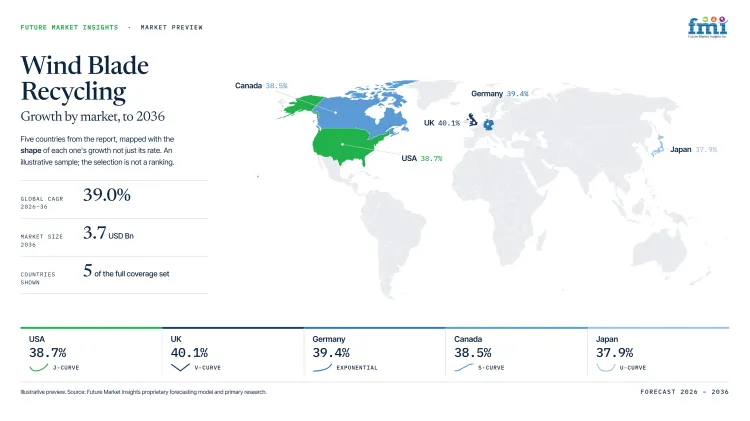
| Country | CAGR |
|---|---|
| United Kingdom | 40.1% |
| Germany | 39.4% |
| Australia | 39.2% |
| United States | 38.7% |
| Canada | 38.5% |
How do country-level CAGRs compare in the wind blade recycling market?
Country CAGRs span 1.6 percentage points across five operating environments and describe forecast pace without measuring present revenue or installed processing capacity.
- The United Kingdom reflects concentrated Scottish repowering, although limited treatment capacity can extend transport and service routes for retired blades.
- Germany shows recurring onshore retirements and established waste controls, with mixed blade materials requiring separate outlet specifications.
- Australia hint toward pilot processing and rising retirement needs, although long distances favor mobile cutting and regional aggregation.
- The United States combines federal technology support with broad geography, so project economics depend on processor access and interstate transport.
- Canada reflects technical development and provincial retirement planning, while sparse facilities require larger batches across long service routes.
Comparable CAGRs can produce different market entry conditions across countries with distinct infrastructure and retirement patterns. The full report provides country-level CAGR analysis across North America, Latin America, Europe, East Asia, South Asia and Pacific, and the Middle East and Africa.
Country-wise Analysis
- Scotland’s early onshore fleet concentrates retirement activity across rural and upland regions, making route surveys and treatment capacity central to each blade-removal schedule within practical contract windows. Wind blade recycling sales in the United Kingdom are forecast to expand at 40.1% CAGR by 2036, reinforced by scheduled repowering across mature sites. The Department for Energy Security and Net Zero reported in July 2025 that annual onshore decommissioning could reach 0.5 to 1 GW during the late 2020s and 2030s. Remote Scottish sites require dependable transport links to processors and qualified material outlets that accept mixed composite fractions for steady industrial use.
- Germany’s mature onshore clusters generate recurring dismantling work through repowering, and national waste controls require documented treatment routes for every removed blade section entering regional waste systems. Bundesnetzagentur reported in January 2026 that almost 0.6 GW of onshore wind capacity was permanently retired during 2025, with affected sites generally repowered using higher-capacity machines. Germany’s wind blade recycling outlook is anticipated to advance at 39.4% CAGR over the assessment period, shaped by recurring retirement volumes and established industrial infrastructure. Mixed glass and carbon fiber structures require separate processing controls and outlet specifications across regional service contracts with verified material acceptance.
- Australia’s dispersed wind farms create long transport routes that favor mobile cutting and regional pre-processing, although smaller retirement projects rarely support dedicated equipment without shared service schedules. In Australia, wind blade recycling demand is predicted to advance at 39.2% CAGR through 2036, influenced by pilot capacity and growing retirement requirements. The Net Zero Economy Authority reported in May 2026 that federal support was advancing a pilot facility designed to process every blade type through controlled domestic trials. Long distances between wind farms and qualified processors remain a material cost barrier for repeatable service routes and consistent economic batch formation.
- Retiring wind assets are distributed across broad inland and coastal regions, so cutting equipment and processor access determine the economic load size available for regular industrial processing. The U.S. Energy Information Administration reported in October 2025 that five wind generators totaling 34.4 MW retired during 2024, establishing a current stream of decommissioned equipment. Adoption of wind blade recycling in the United States is estimated to expand at 38.7% CAGR through 2036, supported by technical development and regional project activity. Processor gaps require coordinated cutting and interstate transport to deliver recovered fractions into qualified industrial outlets with stable acceptance specifications.
- Canadian wind assets cover broad provincial distances that complicate dismantling schedules, and limited nearby facilities require retirement projects to combine blade volumes across several jurisdictions for economical processing batches. A Natural Resources Canada review published in January 2025 documented the infrastructure gap and compared mechanical, thermal and chemical development routes for domestic blade recovery. Canada is estimated to post 38.5% CAGR over the forecast period, aided by technical planning and growing attention to decommissioning requirements. Long haul distances and seasonal access constrain specialized cutting equipment and regional processing at commercial scale across smaller retirement portfolios during routine annual work.
Who are the notable companies in the wind blade recycling market?
Vestas Wind Systems A/S, Stena Recycling AB, Siemens Gamesa Renewable Energy S.A.U., RWE Offshore Wind GmbH, ACCIONA S.A., Iberdrola España, S.A.U., FCC Ámbito, S.A.U. and Carbon Rivers, LLC are the notable companies serving this market.
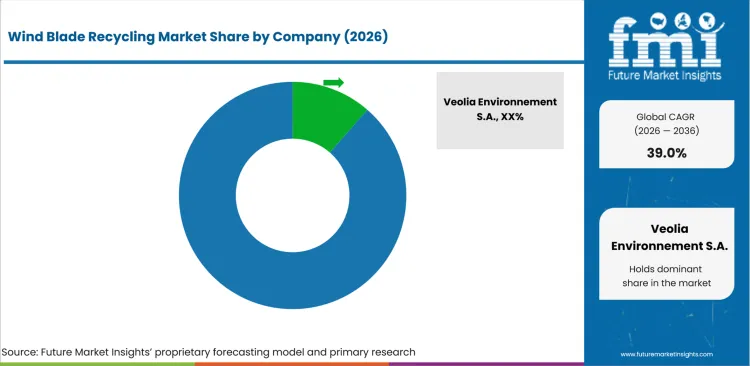
Wind blade recycling remains fragmented across turbine manufacturers and wind farm operators with different control over project assets. Industrial waste groups and composite-recovery specialists control separate route stages through distinct processing equipment and recovered-material outlets. Entry depends on site-access capability plus documented processing evidence that industrial outlets accept for each recovered material stream. Few companies combine every stage, so project teams usually assemble several firms around one repowering portfolio and its E-glass fiber outlets.
- Vestas, Siemens Gamesa and RWE connect recyclable blade design with commercial wind projects, giving future recovery planning a defined material-separation route.
- Stena Recycling, Iberdrola España and FCC Ámbito combine industrial separation, project supply and dedicated plant operations across European blade streams.
- ACCIONA and Carbon Rivers focus on recovered-material qualification through construction applications, thermal processing and clean glass-fiber outputs.
Competitive Benchmarking: Wind Blade Recycling Market
| Company | Blade processing capability | Material recovery depth | Project and logistics integration | Geographic Reach |
|---|---|---|---|---|
| Vestas Wind Systems A/S | Medium | High | Low | Global wind markets |
| Stena Recycling AB | Medium | High | Medium | Northern Europe |
| Siemens Gamesa Renewable Energy S.A.U. | Low | Low | Medium | Global offshore wind markets |
| RWE Offshore Wind GmbH | Low | Low | High | Europe |
| ACCIONA S.A. | Medium | High | Medium | Europe and Australia |
| Iberdrola España, S.A.U. | Medium | High | High | Spain and wider Iberian portfolio |
| FCC Ámbito, S.A.U. | High | High | High | Spain and Portugal |
| Carbon Rivers, LLC | High | High | Medium | North America |
Scoring basis: Blade processing capability is High for an operational commercial route or dedicated plant with verified blade throughput. Medium covers an industrial testbed or documented processing pilot that handles wind blade material under controlled conditions. Low applies to a verified role limited to blade design or project deployment without direct processing responsibility. Material recovery depth is High for documented fiber and organic-fraction recovery that produces a specified reusable output. Medium covers verified material separation or conversion into a specified secondary product with an identified industrial application. Low applies to project participation that does not include verified recovered-material output from the named company.
Key Developments in the Wind Blade Recycling Market
- In May 2026, Stena Recycling and Vestas advanced the Blade Circularity Solution into industrial testbed trials for larger epoxy-blade batches in Halmstad.
- In November 2025, RWE completed installation of 150 Siemens Gamesa recyclable blades across 50 turbines at the Sofia Offshore Wind Farm.
- In June 2025, Iberdrola España and FCC Ámbito opened the EnergyLOOP blade recycling plant in Navarra. The plant combines site conditioning, transport, blade processing and recovered-product marketing within one regional recovery route.
Key Players in the Wind Blade Recycling Market
Recyclable Blade and Wind Project Platforms
- Vestas Wind Systems A/S
- Siemens Gamesa Renewable Energy S.A.U.
- RWE Offshore Wind GmbH
Industrial Recycling and Plant Operators
- Stena Recycling AB
- Iberdrola España, S.A.U.
- FCC Ámbito, S.A.U.
Composite Recovery and Downstream Material Developers
- ACCIONA S.A.
- Carbon Rivers, LLC
Wind Blade Recycling Market - Report Scope
| Coverage field | Report scope |
|---|---|
| Market breakdown | By recycling method, blade material, end-use industry, blade source, recycling process and region. |
| Market Definition | Wind turbine blade recycling services and recovered-material routes across mechanical, thermal and chemical methods, blade sources, process stages and industrial end uses. |
| Regions Covered | North America, Latin America, Europe, East Asia, South Asia and Pacific, and Middle East and Africa. |
| Countries Covered | United Kingdom, Germany, Australia, United States, Canada and 20+ countries included in the full report. |
| Key Companies Profiled | Vestas Wind Systems A/S, Stena Recycling AB, Siemens Gamesa Renewable Energy S.A.U., RWE Offshore Wind GmbH, ACCIONA S.A., Iberdrola España, S.A.U., FCC Ámbito, S.A.U. and Carbon Rivers, LLC |
| Forecast Period | 2026 to 2036. |
| Approach | Primary and secondary research with market triangulation. |
Wind Blade Recycling Market - Research Methodology
| Method | Approach |
|---|---|
| Primary Research | FMI analysts gathered input from manufacturers, service providers, technology developers, distributors, end users, procurement teams, and subject-matter experts. Interviews examined purchasing decisions, product or service evaluation, adoption barriers, approval requirements, pricing considerations, and expectations for technical or commercial support. Respondents were also asked what evidence is required before a trial, pilot, or initial order develops into regular purchasing. |
| Desk Research | Desk research covered government statistics, regulatory publications, trade data, industry associations, technical literature, standards, company filings, product information, and official corporate announcements. Sources were reviewed for relevance, publication date, geographic coverage, and consistency with the defined market scope. Claims relating to performance, applications, approvals, capacity, investment, and commercial activity were retained only when supported by credible public evidence. |
| Market Sizing and Forecasting | The market model combined the baseline value with historical performance, segment structure, pricing and volume indicators, adoption levels, company participation, and country-level demand conditions. Forecast assumptions considered economic activity, investment trends, regulatory developments, technology adoption, purchasing cycles, supply availability, and barriers to wider market use. Segment and regional estimates were reconciled before the final market total was calculated. |
| Data Validation | Estimates were checked against multiple independent indicators, including public data, company activity, trade patterns, industry developments, and findings from primary interviews. Validation also tested whether products, services, applications, and company revenues fell within the defined market boundaries. Adjacent categories, unsupported claims, overlapping revenues, and activities without direct market relevance were excluded to reduce double counting and maintain consistency across segments and countries. |
Wind Blade Recycling Market by Segments
Wind Blade Recycling Market segmented by Recycling Method:
- Mechanical Recycling
- Shredding & Grinding
- Size Reduction & Separation
- Thermal Recycling
- Pyrolysis
- Thermal Decomposition
- Chemical Recycling
- Solvolysis
- Chemical Depolymerization
Wind Blade Recycling Market segmented by Blade Material:
- Glass Fiber
- Glass Fiber Reinforced Polymer
- Glass Fiber Composite
- Carbon Fiber
- Carbon Fiber Reinforced Polymer
- Carbon Fiber Composite
Wind Blade Recycling Market segmented by End-Use Industry:
- Construction
- Cement & Concrete
- Building Materials
- Automotive
- Automotive Components
- Vehicle Structural Parts
- Electronics & Consumer Goods
- Electronic Components
- Consumer Products
- Others
- Furniture & Infrastructure
- Sports & Recreation Products
Wind Blade Recycling Market segmented by Blade Source:
- Decommissioned Wind Turbine Blades
- Onshore Wind Blades
- Offshore Wind Blades
- Manufacturing Scrap
- Blade Production Waste
- Composite Manufacturing Waste
- Damaged & Replaced Blades
- Storm-Damaged Blades
- Operational Replacement Blades
Wind Blade Recycling Market segmented by Recycling Process:
- Collection & Transportation
- Blade Collection
- Specialized Blade Transportation
- Pre-Processing
- Cutting & Dismantling
- Shredding & Grinding
- Material Recovery
- Fiber Recovery
- Resin & Composite Recovery
- Downstream Material Processing
- Composite Pellet Production
- Recycled Material Manufacturing
Wind Blade Recycling Market by Region:
- North America
- United States
- Canada
- Latin America
- Brazil
- Chile
- Mexico
- Rest of Latin America
- Western Europe
- Germany
- United Kingdom
- Italy
- Spain
- France
- Nordics
- Benelux
- Rest of Western Europe
- Eastern Europe
- Russia
- Poland
- Hungary
- Balkan and Baltic States
- Rest of Eastern Europe
- East Asia
- China
- Japan
- South Korea
- South Asia and Pacific
- India
- ASEAN
- Australia and New Zealand
- Rest of South Asia and Pacific
- Middle East and Africa
- Kingdom of Saudi Arabia
- Other GCC Countries
- Türkiye
- South Africa
- Other African Union Countries
- Rest of Middle East and Africa
Research Sources and Bibliography
- USA Department of Energy. (2025, January 6). America Can Recycle 90% of Wind Turbine Mass, According to New DOE Report.
- ACCIONA. (2025, May 8). ACCIONA Energía and El Ganso launch a new line of shoes made with recycled blades from the Tahivilla wind farm.
- RWE Offshore Wind GmbH. (2025, August 21). RWE’s Sofia is the UK’s first offshore wind farm to use recyclable rotor blades.
- ACCIONA. (2025, October 16). ACCIONA and Holcim successfully test a new form of sustainable concrete made with shredded wind turbine blades.
- National Laboratory of the Rockies. (2025, January 16). Winners of Wind Turbine Materials Recycling Prize Enhance Domestic Recycling Industry With Novel Innovations.
- WindEurope. (2025, November 14). Where do wind turbine blades go when they are decommissioned?
- Department for Energy Security and Net Zero. (2025, July 4). Onshore Wind Taskforce strategy (accessible webpage).
- Bundesnetzagentur. (2026, January 8). Growth in renewable energy in 2025.
- Net Zero Economy Authority. (2026, May 14). Can wind turbines be recycled when they reach retirement?
- USA Energy Information Administration. (2025, October 16). Electric Power Annual 2024, Table 4.6: Utility-Scale Capacity Additions, Retirements and Changes by Energy Source, 2024.
- LaFreniere, K. (2025, January 23). Wind turbine blade circularity: an overview of composite recycling methods, global markets and policies, and opportunities for Canadian development.
- Stena Recycling. (2026, May 12). Major advances toward full-scale recycling of wind turbine blades.
- RWE Offshore Wind GmbH. (2025, November 10). RWE completes installation of all recyclable blades at Sofia Offshore Wind Farm, and over half of all turbines.
- FCC Ámbito. (2025, June 17). Iberdrola and FCC cut the ribbon on EnergyLOOP, the first wind turbine blade recycling plant on the Iberian Peninsula.
- Carbon Rivers, LLC. (2024). Renewable Recycling and Composite Manufacturing | Carbon Rivers | Knoxville. Retrieved August 4, 2026.
- European Commission. (2026, March 20). Commission Implementing Regulation (EU) 2026/718 of 20 March 2026 laying down rules for the application of Regulation (EU) 2024/1735 of the European Parliament and of the Council as regards minimum environmental sustainability requirements for public procurement procedures involving certain net-zero technologies.
This bibliography is provided for reader reference and is not exhaustive. The full report contains the complete reference list and detailed citations.
This Report Answers
- How large is the wind blade recycling market in 2026 and 2036?
- Why should wind farm operators plan blade recovery before repowering begins?
- Which recycling method accounts for the largest 2026 share?
- How do glass-fiber and carbon-fiber structures change route selection?
- Which blade sources create concentrated commercial recycling volumes?
- How do the five profiled country outlooks change service-route economics?
- Which companies cover blade design, site conditioning, processing and outlet qualification?
- What contract terms reduce material-quality and logistics risk during blade retirement?
Frequently Asked Questions
How big is the Wind Blade Recycling Market in 2026?
The global wind blade recycling market is estimated at USD 140.0 million in 2026 and is projected to reach USD 3769.4 million by 2036. Growth is driven by increasing blade retirements from repowering projects and the expansion of dedicated recycling infrastructure.
What is the CAGR of the Wind Blade Recycling Market from 2026 to 2036?
The wind blade recycling market is projected to grow at a CAGR of 39.0% between 2026 and 2036. Growth is supported by rising volumes of decommissioned turbine blades and the need for specialized recycling and material recovery solutions.
Which recycling method is projected to account for 52.0% of the Wind Blade Recycling Market?
Mechanical recycling is projected to account for 52.0% of the market in 2026, making it the leading recycling method. Its adoption is driven by its ability to reduce blade waste into reusable materials for construction and composite applications.
How much opportunity will the Wind Blade Recycling Market add between 2026 and 2036?
The wind blade recycling market is expected to create an absolute dollar opportunity of USD 3,629.4 million between 2026 and 2036. This growth reflects increasing investment in recovery, processing, and end-use applications for retired wind turbine blades.
Which companies are active in the wind blade recycling market?
Companies active in the wind blade recycling market are Vestas Wind Systems, Stena Recycling, Siemens Gamesa, RWE Offshore Wind, ACCIONA, Iberdrola España, FCC Ámbito and Carbon Rivers. The wind blade recycling market company set covers recyclable blade design, project coordination, industrial processing and recovered-material qualification across European and North American routes.
Preview the report firsthand - request a free sample
Get SampleGet the brochure for pricing and purchase details.
Get PDFTable of Content
- Key Takeaways
- Market Size and CAGR
- Top Growth Driver
- Fastest Growing Segment
- Leading Region
- Key Companies
- Emerging Opportunities
- Executive Summary
- Global Market Outlook
- Demand-side Trends
- Supply-side Trends
- Technology Roadmap Analysis
- Analysis and Recommendations
- Analyst Perspective (What is happening? Why now? What should investors know?)
- Key Questions Answered
- How large is the market?
- What is the CAGR?
- What are key trends?
- Which region dominates?
- Who are the leaders?
- Market Overview
- Market Coverage / Taxonomy
- Market Definition / Scope / Limitations
- Research Methodology
- Chapter Orientation
- Analytical Lens and Working Hypotheses
- Market Structure, Signals, and Trend Drivers
- Benchmarking and Cross-market Comparability
- Market Sizing, Forecasting, and Opportunity Mapping
- Research Design and Evidence Framework
- Desk Research Programme (Secondary Evidence)
- Expert Input and Fieldwork (Primary Evidence)
- Tooling, Models, and Reference Databases
- Data Engineering and Model Build
- Quality Assurance and Audit Trail
- Market Background
- Market Dynamics (Drivers, Restraints, Opportunity, Trends)
- Scenario Forecast (Optimistic, Likely, Conservative)
- Impact Analysis
- AI Impact
- Sustainability Impact
- Regulatory Impact
- Technology Impact
- Consumer / Buyer Analysis
- Purchase Drivers
- Adoption Barriers
- Buyer Journey
- Opportunity Map Analysis
- Product Life Cycle Analysis
- Supply Chain Analysis
- Investment Feasibility Matrix
- Value Chain Analysis
- PESTLE and Porter's Analysis
- Regulatory Landscape
- Regional Parent Market Outlook
- Production and Consumption Statistics
- Import and Export Statistics
- Global Market Analysis and Forecast, 2021 to 2036
- Historical Market Size Value (USD Billion) Analysis, 2021 to 2025
- Current and Future Market Size Value (USD Billion) Projections, 2026 to 2036
- Y-o-Y Growth Trend Analysis
- Absolute $ Opportunity Analysis
- Global Market Pricing Analysis, 2021 to 2036
- Global Market Analysis and Forecast, By Recycling Method, 2021 to 2036
- Introduction / Key Findings
- Historical Market Size Value (USD Billion) Analysis By Recycling Method, 2021 to 2025
- Current and Future Market Size Value (USD Billion) Analysis and Forecast By Recycling Method, 2026 to 2036
- Mechanical Recycling
- Shredding & Grinding
- Size Reduction & Separation
- Thermal Recycling
- Pyrolysis
- Thermal Decomposition
- Chemical Recycling
- Solvolysis
- Chemical Depolymerization
- Mechanical Recycling
- Y-o-Y Growth Trend Analysis By Recycling Method, 2021 to 2025
- Absolute $ Opportunity Analysis By Recycling Method, 2026 to 2036
- Global Market Analysis and Forecast, By Blade Material, 2021 to 2036
- Introduction / Key Findings
- Historical Market Size Value (USD Billion) Analysis By Blade Material, 2021 to 2025
- Current and Future Market Size Value (USD Billion) Analysis and Forecast By Blade Material, 2026 to 2036
- Glass Fiber
- Glass Fiber Reinforced Polymer
- Glass Fiber Composite
- Carbon Fiber
- Carbon Fiber Reinforced Polymer
- Carbon Fiber Composite
- Glass Fiber
- Y-o-Y Growth Trend Analysis By Blade Material, 2021 to 2025
- Absolute $ Opportunity Analysis By Blade Material, 2026 to 2036
- Global Market Analysis and Forecast, By End-Use Industry, 2021 to 2036
- Introduction / Key Findings
- Historical Market Size Value (USD Billion) Analysis By End-Use Industry, 2021 to 2025
- Current and Future Market Size Value (USD Billion) Analysis and Forecast By End-Use Industry, 2026 to 2036
- Construction
- Cement & Concrete
- Building Materials
- Automotive
- Automotive Components
- Vehicle Structural Parts
- Electronics & Consumer Goods
- Electronic Components
- Consumer Products
- Others
- Furniture & Infrastructure
- Sports & Recreation Products
- Construction
- Y-o-Y Growth Trend Analysis By End-Use Industry, 2021 to 2025
- Absolute $ Opportunity Analysis By End-Use Industry, 2026 to 2036
- Global Market Analysis and Forecast, By Blade Source, 2021 to 2036
- Introduction / Key Findings
- Historical Market Size Value (USD Billion) Analysis By Blade Source, 2021 to 2025
- Current and Future Market Size Value (USD Billion) Analysis and Forecast By Blade Source, 2026 to 2036
- Decommissioned Wind Turbine Blades
- Onshore Wind Blades
- Offshore Wind Blades
- Manufacturing Scrap
- Blade Production Waste
- Composite Manufacturing Waste
- Damaged & Replaced Blades
- Storm-Damaged Blades
- Operational Replacement Blades
- Decommissioned Wind Turbine Blades
- Y-o-Y Growth Trend Analysis By Blade Source, 2021 to 2025
- Absolute $ Opportunity Analysis By Blade Source, 2026 to 2036
- Global Market Analysis and Forecast, By Recycling Process, 2021 to 2036
- Introduction / Key Findings
- Historical Market Size Value (USD Billion) Analysis By Recycling Process, 2021 to 2025
- Current and Future Market Size Value (USD Billion) Analysis and Forecast By Recycling Process, 2026 to 2036
- Collection & Transportation
- Blade Collection
- Specialized Blade Transportation
- Pre-Processing
- Cutting & Dismantling
- Shredding & Grinding
- Material Recovery
- Fiber Recovery
- Resin & Composite Recovery
- Downstream Material Processing
- Composite Pellet Production
- Recycled Material Manufacturing
- Collection & Transportation
- Y-o-Y Growth Trend Analysis By Recycling Process, 2021 to 2025
- Absolute $ Opportunity Analysis By Recycling Process, 2026 to 2036
- Global Market Analysis and Forecast, By Region, 2021 to 2036
- Introduction
- Historical Market Size Value (USD Billion) Analysis By Region, 2021 to 2025
- Current Market Size Value (USD Billion) Analysis and Forecast By Region, 2026 to 2036
- North America
- Latin America
- Western Europe
- Eastern Europe
- East Asia
- South Asia and Pacific
- Middle East & Africa
- Market Attractiveness Analysis By Region
- North America Market Analysis and Forecast, By Country, 2021 to 2036
- Historical Market Size Value (USD Billion) Trend Analysis By Market Taxonomy, 2021 to 2025
- Market Size Value (USD Billion) Forecast By Market Taxonomy, 2026 to 2036
- By Country
- USA
- Canada
- By Recycling Method
- By Blade Material
- By End-Use Industry
- By Blade Source
- By Recycling Process
- By Country
- Market Attractiveness Analysis
- By Country
- By Recycling Method
- By Blade Material
- By End-Use Industry
- By Blade Source
- By Recycling Process
- Key Takeaways
- Latin America Market Analysis and Forecast, By Country
- Historical Market Size Value (USD Billion) Trend Analysis By Market Taxonomy, 2021 to 2025
- Market Size Value (USD Billion) Forecast By Market Taxonomy, 2026 to 2036
- By Country
- Brazil
- Mexico
- Chile
- Rest of Latin America
- By Recycling Method
- By Blade Material
- By End-Use Industry
- By Blade Source
- By Recycling Process
- By Country
- Market Attractiveness Analysis
- By Country
- By Recycling Method
- By Blade Material
- By End-Use Industry
- By Blade Source
- By Recycling Process
- Key Takeaways
- Western Europe Market Analysis and Forecast, By Country
- Historical Market Size Value (USD Billion) Trend Analysis By Market Taxonomy, 2021 to 2025
- Market Size Value (USD Billion) Forecast By Market Taxonomy, 2026 to 2036
- By Country
- Germany
- UK
- Italy
- Spain
- France
- Nordic
- BENELUX
- Rest of Western Europe
- By Recycling Method
- By Blade Material
- By End-Use Industry
- By Blade Source
- By Recycling Process
- By Country
- Market Attractiveness Analysis
- By Country
- By Recycling Method
- By Blade Material
- By End-Use Industry
- By Blade Source
- By Recycling Process
- Key Takeaways
- Eastern Europe Market Analysis and Forecast, By Country
- Historical Market Size Value (USD Billion) Trend Analysis By Market Taxonomy, 2021 to 2025
- Market Size Value (USD Billion) Forecast By Market Taxonomy, 2026 to 2036
- By Country
- Russia
- Poland
- Hungary
- Balkan & Baltic
- Rest of Eastern Europe
- By Recycling Method
- By Blade Material
- By End-Use Industry
- By Blade Source
- By Recycling Process
- By Country
- Market Attractiveness Analysis
- By Country
- By Recycling Method
- By Blade Material
- By End-Use Industry
- By Blade Source
- By Recycling Process
- Key Takeaways
- East Asia Market Analysis and Forecast, By Country
- Historical Market Size Value (USD Billion) Trend Analysis By Market Taxonomy, 2021 to 2025
- Market Size Value (USD Billion) Forecast By Market Taxonomy, 2026 to 2036
- By Country
- China
- Japan
- South Korea
- By Recycling Method
- By Blade Material
- By End-Use Industry
- By Blade Source
- By Recycling Process
- By Country
- Market Attractiveness Analysis
- By Country
- By Recycling Method
- By Blade Material
- By End-Use Industry
- By Blade Source
- By Recycling Process
- Key Takeaways
- South Asia and Pacific Market Analysis and Forecast, By Country
- Historical Market Size Value (USD Billion) Trend Analysis By Market Taxonomy, 2021 to 2025
- Market Size Value (USD Billion) Forecast By Market Taxonomy, 2026 to 2036
- By Country
- India
- ASEAN
- Australia & New Zealand
- Rest of South Asia and Pacific
- By Recycling Method
- By Blade Material
- By End-Use Industry
- By Blade Source
- By Recycling Process
- By Country
- Market Attractiveness Analysis
- By Country
- By Recycling Method
- By Blade Material
- By End-Use Industry
- By Blade Source
- By Recycling Process
- Key Takeaways
- Middle East & Africa Market Analysis and Forecast, By Country
- Historical Market Size Value (USD Billion) Trend Analysis By Market Taxonomy, 2021 to 2025
- Market Size Value (USD Billion) Forecast By Market Taxonomy, 2026 to 2036
- By Country
- Kingdom of Saudi Arabia
- Other GCC Countries
- Türkiye
- South Africa
- Other African Union
- Rest of Middle East & Africa
- By Recycling Method
- By Blade Material
- By End-Use Industry
- By Blade Source
- By Recycling Process
- By Country
- Market Attractiveness Analysis
- By Country
- By Recycling Method
- By Blade Material
- By End-Use Industry
- By Blade Source
- By Recycling Process
- Key Takeaways
- Key Countries Market Analysis
- USA
- Pricing Analysis
- Market Share Analysis, 2025
- By Recycling Method
- By Blade Material
- By End-Use Industry
- By Blade Source
- By Recycling Process
- Canada
- Pricing Analysis
- Market Share Analysis, 2025
- By Recycling Method
- By Blade Material
- By End-Use Industry
- By Blade Source
- By Recycling Process
- Mexico
- Pricing Analysis
- Market Share Analysis, 2025
- By Recycling Method
- By Blade Material
- By End-Use Industry
- By Blade Source
- By Recycling Process
- Brazil
- Pricing Analysis
- Market Share Analysis, 2025
- By Recycling Method
- By Blade Material
- By End-Use Industry
- By Blade Source
- By Recycling Process
- Chile
- Pricing Analysis
- Market Share Analysis, 2025
- By Recycling Method
- By Blade Material
- By End-Use Industry
- By Blade Source
- By Recycling Process
- Germany
- Pricing Analysis
- Market Share Analysis, 2025
- By Recycling Method
- By Blade Material
- By End-Use Industry
- By Blade Source
- By Recycling Process
- UK
- Pricing Analysis
- Market Share Analysis, 2025
- By Recycling Method
- By Blade Material
- By End-Use Industry
- By Blade Source
- By Recycling Process
- Italy
- Pricing Analysis
- Market Share Analysis, 2025
- By Recycling Method
- By Blade Material
- By End-Use Industry
- By Blade Source
- By Recycling Process
- Spain
- Pricing Analysis
- Market Share Analysis, 2025
- By Recycling Method
- By Blade Material
- By End-Use Industry
- By Blade Source
- By Recycling Process
- France
- Pricing Analysis
- Market Share Analysis, 2025
- By Recycling Method
- By Blade Material
- By End-Use Industry
- By Blade Source
- By Recycling Process
- India
- Pricing Analysis
- Market Share Analysis, 2025
- By Recycling Method
- By Blade Material
- By End-Use Industry
- By Blade Source
- By Recycling Process
- ASEAN
- Pricing Analysis
- Market Share Analysis, 2025
- By Recycling Method
- By Blade Material
- By End-Use Industry
- By Blade Source
- By Recycling Process
- Australia & New Zealand
- Pricing Analysis
- Market Share Analysis, 2025
- By Recycling Method
- By Blade Material
- By End-Use Industry
- By Blade Source
- By Recycling Process
- China
- Pricing Analysis
- Market Share Analysis, 2025
- By Recycling Method
- By Blade Material
- By End-Use Industry
- By Blade Source
- By Recycling Process
- Japan
- Pricing Analysis
- Market Share Analysis, 2025
- By Recycling Method
- By Blade Material
- By End-Use Industry
- By Blade Source
- By Recycling Process
- South Korea
- Pricing Analysis
- Market Share Analysis, 2025
- By Recycling Method
- By Blade Material
- By End-Use Industry
- By Blade Source
- By Recycling Process
- Russia
- Pricing Analysis
- Market Share Analysis, 2025
- By Recycling Method
- By Blade Material
- By End-Use Industry
- By Blade Source
- By Recycling Process
- Poland
- Pricing Analysis
- Market Share Analysis, 2025
- By Recycling Method
- By Blade Material
- By End-Use Industry
- By Blade Source
- By Recycling Process
- Hungary
- Pricing Analysis
- Market Share Analysis, 2025
- By Recycling Method
- By Blade Material
- By End-Use Industry
- By Blade Source
- By Recycling Process
- Kingdom of Saudi Arabia
- Pricing Analysis
- Market Share Analysis, 2025
- By Recycling Method
- By Blade Material
- By End-Use Industry
- By Blade Source
- By Recycling Process
- Türkiye
- Pricing Analysis
- Market Share Analysis, 2025
- By Recycling Method
- By Blade Material
- By End-Use Industry
- By Blade Source
- By Recycling Process
- South Africa
- Pricing Analysis
- Market Share Analysis, 2025
- By Recycling Method
- By Blade Material
- By End-Use Industry
- By Blade Source
- By Recycling Process
- USA
- Market Structure Analysis
- Competition Dashboard
- Competition Benchmarking
- Market Share Analysis of Top Players
- By Regional
- By Recycling Method
- By Blade Material
- By End-Use Industry
- By Blade Source
- By Recycling Process
- Emerging Startups
- Innovation Benchmarking
- Competition Analysis
- Competition Deep Dive
- Veolia Environnement S.A.
- Overview
- Product Portfolio
- Profitability by Market Segments
- Sales Footprint
- Strategy Overview
- Marketing Strategy
- Product Strategy
- Channel Strategy
- GE Vernova Inc.
- Vestas Wind Systems A/S
- Siemens Gamesa Renewable Energy
- ACCIONA S.A.
- Global Fiberglass Solutions
- Continuum Composites
- Carbon Rivers
- Neowa GmbH
- ReFiber ApS
- Others
- Veolia Environnement S.A.
- Case Studies
- Success Stories
- Recent Developments
- Competition Deep Dive
- Assumptions & Acronyms Used


