


Flocculant and Coagulant Market : Global Industry Analysis and Opportunity Assessment, 2035
The flocculant and coagulant market is segmented by Application (Municipal Water Treatment; Industrial Water Treatment; Food & Beverages; Pulp and Paper; Textile; Power Industry; Metals and Mining; Others), Product Type (Flocculants; Coagulants), and Region. Forecast for 2025 to 2035.
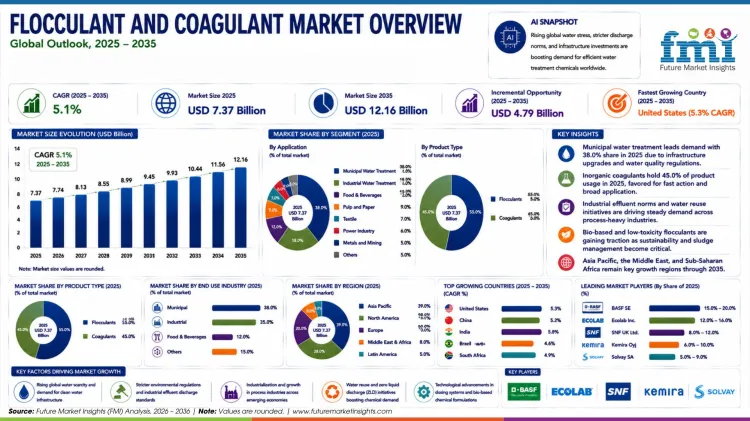
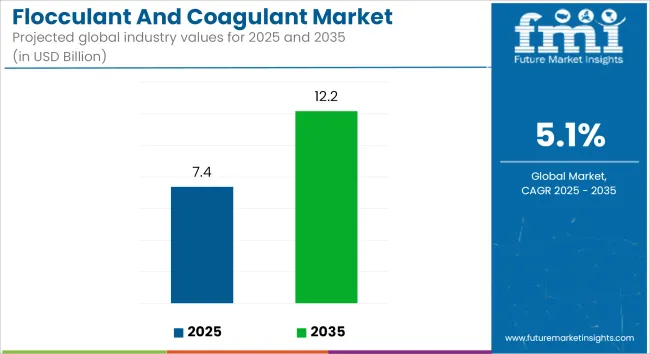
- Industry Size (2025): USD 7.37 Bn
- Forecast (2035): USD 12.16 Bn
- CAGR (2025 to 2035): 5.1%
Flocculant and Coagulant Market Size, Market Forecast and Outlook By FMI
The flocculant and coagulant market is forecast to expand from USD 7.37 billion in 2025 to USD 12.16 billion by 2035. The market is likely to register 5.1% CAGR during the study period. Municipal water treatment is anticipated to lead with 38.0% share, and inorganic coagulants are set to account for 45.0% of product usage in 2025.
Summary of the Flocculant and Coagulant Market
- Demand and Growth Drivers
- Municipal water projects are increasing chemical demand for suspended solid removal.
- Industrial effluent rules are pushing plants toward higher treatment efficiency.
- Water reuse programs are creating steady demand across process-heavy industries.
- Smart dosing systems are improving chemical use in treatment facilities.
- Product and Segment View
- Inorganic coagulants lead because large plants need fast and proven impurity removal.
- Municipal water treatment holds the main share due to public infrastructure spending.
- Bio-based flocculants are gaining interest as sludge disposal costs increase.
- Low-toxicity formulations are likely to gain acceptance in regulated applications.
- Geography and Competitive Outlook
- The United States is expected to grow steadily as EPA-linked discharge rules shape demand.
- The European Union is likely to see stable growth through stricter water quality standards.
- Japan and South Korea are adding demand from semiconductor and electronics water treatment.
- BASF, Ecolab, Kemira, SNF, and Solvay remain active through product breadth and compliance support.
- Analyst Opinion
- Nikhil Kaitwade, Principal Consultant at FMI, suggests, “Flocculant and coagulant suppliers will gain stronger traction when they combine treatment efficiency with lower sludge burden. Municipal bodies and industrial users need chemicals that help meet discharge limits without raising operating complexity.”
- Flocculant and Coagulant Market Value Analysis
- The flocculant and coagulant market is moving from basic chemical treatment into compliance-focused water management.
- Demand is rising as municipalities upgrade drinking water and wastewater treatment systems.
- Industrial users are spending on formulations that improve separation and reduce residue concerns.
- Bio-based and low-toxicity chemistries are likely to gain share where sludge handling costs are high.
- Digital dosing platforms are adding value by reducing chemical wastage across treatment plants.
Analyzing Flocculant and Coagulant Market by Top Investment Segments
Municipal water treatment is projected to lead application demand, driven by increasing global investment in clean water infrastructure and regulatory mandates
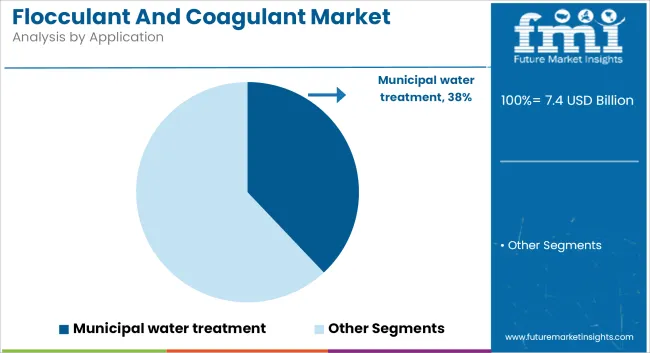
Municipal water treatment is estimated to hold approximately 38% of the global coagulant and flocculant market share in 2025 and is expected to grow at a CAGR of 5.2% through 2035. Coagulants and flocculants are essential for removing suspended solids, organic matter, and pathogens in drinking water and wastewater treatment plants.
As urban populations rise and freshwater resources face contamination, municipal authorities are upgrading treatment systems to comply with stricter environmental and health standards. Governments in regions such as Asia-Pacific, the Middle East, and Sub-Saharan Africa are increasing investments in water quality infrastructure, creating sustained demand for efficient and cost-effective chemical treatment solutions.
Inorganic coagulants are expected to dominate product usage due to their broad applicability, cost-effectiveness, and fast action in destabilizing impurities
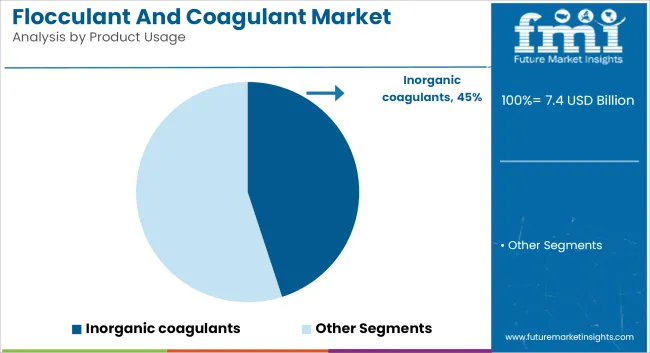
Inorganic coagulants are projected to account for approximately 45% of the global market share in 2025 and are expected to grow at a CAGR of 5.0% through 2035. Common types such as aluminum sulfate, ferric chloride, and polyaluminum chloride (PAC) are widely used across municipal and industrial water treatment facilities for coagulation of fine particles and color removal.
Their effectiveness in a wide pH range and compatibility with high-volume treatment operations make them the preferred choice for large-scale processes.
Despite the growing interest in bio-based and organic alternatives, the established performance of inorganic coagulants ensures their continued dominance in primary treatment stages. Suppliers are focusing on developing low-sludge, high-efficiency formulations to reduce operational costs and environmental impact.
Challenges & Opportunities
Challenges
Environmental Regulations and Concerns Over Chemical-Based Water Treatment
The flocculant and coagulant market faces growing regulatory scrutiny due to the potential environmental impact of synthetic chemical agents. Some coagulants, such as aluminium and metal salts, can result in sludge production, a change in the acidity of the water, and environmental harm.
Governments across the globe are tightening the regulations on the use of hazardous coagulants in their countries, where industries are looking for sustainable alternatives. Tight regulations such as the Safe Drinking Water Act (SDWA) in the USA and EU Water Framework Directive, along with strict industrial wastewater discharge standards, are enforcing limits on toxic chemical effluent, further fuelling demand for biodegradable and non-toxic alternatives.
Moreover, coagulation sludge generates disposal costs for municipal and industrial clients are not finding easy to overcome as treatment plants will add equipment to handle the sludge and dewater it. Focusing towards the heavy metal content in a coagulant raises questions of long-term contamination potential for both aquatic environments and groundwater stores.
This leads to focusing on the research for alternatives in formulations to less sludge generation and more efficient water treatment without harming the environmental safety.
Opportunities
Emergence of Green and Bio-Based Coagulation Technologies
Rise of plant-based polymeric flocculants and natural coagulants to protect the environment globally. Water treatment industries are ever-searching for solutions that are non-toxic, which is eco-friendly alternatives including chitosan-based and starch-derived flocculants are gaining traction. Biodegradable reduces not only chemical waste but also minimizes sludge generation, making it suitable as a green alternative for metal salt-based coagulants.
Moreover, advancements in nanotechnology-based coagulants and bio-engineered polymer flocculants are enhancing product capabilities increasing performance while minimizing chemical consumption. Synthetic biology has been adopted by researchers to modify these natural coagulants, in order to make them more effective, stable, and soluble and work better in various water conditions.
AI-driven dosing systems and real-time monitoring technologies being integrated to optimize bio-based coagulant application, drive down costs, and improve overall water treatment efficiency. Rising in need for circular economy solutions and low-carbon footprint water treatment chemicals drive the major growth of bio-based coagulants and will be the scaling factor for the future market growth.
Country-wise Analysis
United States
The (North) USA flocculant and coagulant market is witnessing an expansion at a steady rate with the growing demand from municipal water treatment plants is contributing to the market growth in the country. End users are thus following suit with high-performance coagulation & flocculation solutions to meet the environmental regulations set out by the Environmental Protection Agency (EPA)regarding the quality of water discharged, as well as effluent discharged from industries.
The increase of oil & gas operations, particularly in the case of hydraulic fracturing (fracking) methods, is contributing to the growth of demand for produced water treatment. The development of advanced flocculant formulations, specifically designed for solid-liquid separation efficiency, is also boosting the food & beverage and pharmaceuticals and chemical manufacturing sector. In this regard, there is a growing trend towards biodegradable and environmentally friendly coagulants.
- Strict EPA Regulations on Wastewater Discharge & Industrial Effluent Treatment: Adoption of high-efficiency coagulants used for wastewater treatment in manufacturing & municipal water plants.
- Growth in Oil & Gas Sector & Fracking Operations: Increasing usage of coagulants for produced water treatment & sediment clearing.
- Expansion of the Food, Beverage, & Pharmaceutical Industries: Higher use of flocculants in process water treatment and filtration.
- Rising Demand for Environmentally Friendly & Bio-Based Coagulants: Rising use of biodegradable and low-toxicity formulations.
- Investment in Smart & Automated Water Treatment Technologies: Rapid growth in the real-time coagulant dosing systems to deliver operational efficiency in water treatment.
| Country | CAGR (2025 to 2035) |
|---|---|
| United States | 5.3% |
United Kingdom
The United Kingdom flocculant and coagulant market is growing at a steady pace, supported by water quality regulations, growing urbanization, and rising demand for sustainable water treatment solutions.
The UK Water Industry Research (UKWIR) and the Environment Agency (EA) have enforced strict discharge limits on industrial effluents and sewage treatment plants, driving the need for effective coagulation and flocculation technologies.
Concern over climate change, and rising water scarcity, is fuelling increased adoption of high-performance water treatment chemicals at desalination and water recycling plants. In addition, the growth of the UK's food & beverage and dairy sectors is creating a demand for coagulants applied for process water purification and wastewater treatment. Increasing use of environmental friendly alternative to aluminum-based coagulants, such as organic polymer-based coagulants, is likely to drive segment growth.
- Strict Environmental Regulations on Industrial & Municipal Water Treatment: Growing need for low-toxicity coagulants for wastewater treatment.
- Growing Investments in Desalination & Water Recycling Infrastructure: Increased utilization of advanced flocculants in brine treatment and water recovery.
- Expansion of the UK’s Food & Beverage Sector: Increase in use of flocculants in dairy and brewery effluent treatment.
- Rising Demand for Eco-Friendly & Aluminum-Free Coagulants: Rise in treatment outcome based on organic polymer.
- Smart Water Treatment Solutions & Digital Monitoring Systems: Growing adoption of real-time monitoring and automated dosing technologies.
| Country | CAGR (2025 to 2035) |
|---|---|
| United Kingdom | 4.9% |
European Union
The European Union flocculant and coagulant market is expanding significantly attributed to stringent water quality standards for various applications, the expansion of the wastewater treatment facilities across various industries, and the investment towards sustainable water management in the EU members.
A European Water Framework Directive (WFD) sets severe discharge limits for pollutants, forcing industries to use high performance coagulants and flocculants to meet demand.
Germany, France, and Italy are among the top countries to adopt bio-based coagulants as EU policies back chemical sustainability and lower environmental impact.
Moreover, the increasing number of urban wastewater treatment projects is driving the demand for flocculants that improve dewatering efficiency of sludge.
Growing demand for flocculants in sectors like mining, paper production, and textile effluent treatment will provide additional impetus to the market growth. In addition, the development of nanotechnology-based coagulants is enhancing contaminant removal efficiency and minimizing the sludge production.
- Strict EU Water Framework Directive & Industrial Effluent Regulations: Growing adoption of eco-friendly and high-efficiency coagulants.
- Expansion of Urban Wastewater & Sludge Dewatering Projects: Increasing use of flocculant in sewage treatment plants
- Growth in Industrial Water Reuse & Circular Economy Initiatives: Rising demand for coagulants in industrial water reuse.
- Advancements in Nanotechnology-Based & Smart Water Treatment Chemicals: Development of precision-dosed flocculants with enhanced separation efficiency.
- Increasing Demand for Non-Toxic & Aluminum-Free Coagulants: Widely use of organic and polymer-based treatment solutions.
| Region | CAGR (2025 to 2035) |
|---|---|
| European Union | 5.1% |
Japan
The Japan flocculant and coagulant market is growing at a steady rate driven by high standards of water treatment, rising industrial wastewater treatment needs, and advancements in chemical formulations. Japan has stringent environmental regulations, which mandate zero liquid discharge (ZLD) in numerous industries, and this trend is driving demand for high-performance coagulants.
Japan’s semiconductor and electronics industry growth has also driven demand for ultra-pure water treatment solutions, which require specific flocculants to remove trace contaminants. Japan’s increasing desalination and water recycling projects are also fuelling acceptance of coagulants in brine treatment and industrial wastewater reuse. Hybrid polymeric flocculants with self-tuning coagulation properties are an emerging technology in smart water treatment applications.
- Strict Industrial Water Treatment & Zero Liquid Discharge (ZLD) Regulations: Coagulants rising demand in high-tech manufacturing.
- Growth in Semiconductor & Electronics Industry Water Treatment Needs: Increased use of ultra-pure flocculants in precision cleaning processes.
- Advancements in Hybrid & Multi-Functional Flocculants: Rise in adoption of intelligent, self-adjusting water treatment solutions.
- Expansion of Water Reuse & Desalination Initiatives: Huge demand for coagulants in brine management.
- Development of Low-Waste & Sludge-Reducing Coagulants: Growth in next-generation polymeric flocculants.
| Country | CAGR (2025 to 2035) |
|---|---|
| Japan | 4.8% |
South Korea
The growth of the South Korea flocculant and coagulant market can also be attributed to increasing industrialization, growing investment in treating municipal wastewater, and stringent government regulations regarding water pollution control. Korean Ministry of Environment (MoE) imposing stricter guidelines on industrial effluent release to wastewater systems, the demand for advanced Flocculant and Coagulant in the manufacturing and chemical sectors has expanded.
The growth of South Korea’s semiconductor and battery manufacturing industries is also increasing demand for ultra-pure water treatment solutions, which need higher-performing coagulants that are low-residue and have high-purity formulations. Market for Polymer & Organics Coagulant are growing with the increasing infrastructure for water recycling or treatment in urban areas. South Korea, as a leader in smart water treatment systems, has developed real-time flocculation monitoring and AI-optimized coagulants dosing technologies.
- Stronger Industrial Effluent Regulations & Water Quality Standards: Rise in demand on specialty coagulants in the high-tech sector.
- Growth in Semiconductor & Battery Manufacturing Sectors: Increasing use of ultra-pure water treatment flocculants.
- Expansion of Smart Water Treatment Infrastructure & AI-Driven Systems: Higher adoption of automated coagulant dosing solutions.
- Investment in Eco-Friendly & Low-Residue Coagulants: Rising focus on sustainable water treatment solutions.
- Rising Urban Wastewater Treatment Needs: Higher emphasis on Sustainable Water Treatment Solutions
| Country | CAGR (2025 to 2035) |
|---|---|
| South Korea | 5.0% |
Competition Outlook
Companies are investing in the development of hybrid organic-inorganic blends, low-sodium variants, and biodegradable flocculants tailored to industry-specific wastewater profiles. BASF and Kemira have focused on scaling bio-based formulations to reduce residual toxicity and sludge volumes. In 2024, SNF expanded production capacity in Asia Pacific to support growing municipal demand. Ecolab is integrating AI-based chemical management platforms into its offering, targeting predictive dosing. Product differentiation in terms of sludge minimization, polymer activity, and compliance with evolving regulatory frameworks is shaping the competitive edge through 2035.
- In May 2025, Gradiant launched its new CURE Chemicals™ platform, offering advanced coagulants and flocculants tailored for water and wastewater treatment in industries such as semiconductors, pharmaceuticals, mining, and food & beverage. The product line was designed to work in synergy with Gradiant’s water treatment technologies, enhancing contaminant removal and operational efficiency. The launch supports the company’s mission to provide integrated, end-to-end water solutions for critical sectors with high sustainability requirements.
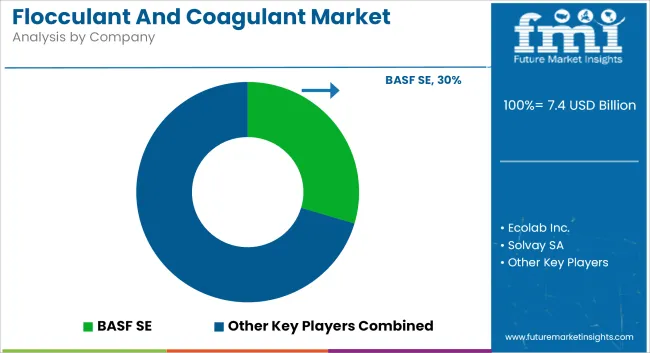
Key Players
- BASF SE
- Ecolab Inc.
- Solvay SA
- SNF (United Kingdom) Ltd
- Solenis
- Akferal
- Kemira Oyj
- Jayem Engineers
- TRIO Chemicals & Allied Products
- Yide Chem
- Tidal Vision
Key Segments
By Application:
- Municipal Water Treatment
- Industrial Water Treatment
- Food & Beverages
- Pulp and Paper
- Textile
- Power Industry
- Metals and Mining
- Others
By Product Type:
- Flocculants
- Anionic
- Cationic
- Amphoteric
- Non Ionic
- Coagulants
- Natural
- Organic
- Inorganic
By Region:
- North America
- Latin America
- Western Europe
- Eastern Europe
- East Asia
- South Asia & Pacific
- Middle East & Africa
Frequently Asked Questions
What is the estimated market size of the global Flocculant and Coagulant market for 2025?
The global Flocculant and Coagulant market is projected to reach USD 7,372.8 million by the end of 2025.
At what rate is the market expected to grow during the forecast period?
The market is anticipated to grow at a CAGR of 5.1% over the forecast period.
What is the projected market worth by 2035?
By 2035, the Flocculant and Coagulant market is expected to reach USD 12,163.3 million.
Which segment is expected to dominate the market?
The municipal water treatment segment leads with 38.0% share in 2025, as industries such as chemical processing, oil & gas, food & beverage, and pharmaceuticals seek efficient wastewater treatment solutions to comply with environmental mandates.
Who are key players in the Flocculant and Coagulant market?
Key players in the Road Marking Paints and Coatings market include Feralco Group, Chemtrade Logistics Inc., IXOM Holdings Pty Ltd., Kurita Water Industries Ltd., Aditya Birla Chemicals, Buckinghams Industries.
Table of Content
- Executive Summary
- Industry Introduction, including Taxonomy and Market Definition
- Market Trends and Success Factors, including Macro-Economic Factors, Market Dynamics, and Recent Industry Developments
- Global Market Demand Analysis 2020 to 2024 and Forecast 2025 to 2035, including Historical Analysis and Future Projections
- Global Market Analysis 2020 to 2024 and Forecast 2025 to 2035
- By Product Type
- By Application
- Global Market Analysis 2020 to 2024 and Forecast 2025 to 2035, By Product Type
- Flocculants
- Anionic
- Cationic
- Amphoteric
- Non-Ionic
- Coagulants
- Natural
- Organic
- Inorganic
- Flocculants
- Global Market Analysis 2020 to 2024 and Forecast 2025 to 2035, By Application
- Municipal Water Treatment
- Industrial Water Treatment
- Food & Beverages
- Pulp and Paper
- Textile, Power Industry
- Metals and Mining
- Others
- Global Market Analysis 2020 to 2024 and Forecast 2025 to 2035, By Region
- North America
- Latin America
- Western Europe
- South Asia
- East Asia
- Eastern Europe
- Middle East & Africa
- North America Sales Analysis 2020 to 2024 and Forecast 2025 to 2035, by Key Segments and Countries
- Latin America Sales Analysis 2020 to 2024 and Forecast 2025 to 2035, by Key Segments and Countries
- Western Europe Sales Analysis 2020 to 2024 and Forecast 2025 to 2035, by Key Segments and Countries
- South Asia Sales Analysis 2020 to 2024 and Forecast 2025 to 2035, by Key Segments and Countries
- East Asia Sales Analysis 2020 to 2024 and Forecast 2025 to 2035, by Key Segments and Countries
- Eastern Europe Sales Analysis 2020 to 2024 and Forecast 2025 to 2035, by Key Segments and Countries
- Middle East & Africa Sales Analysis 2020 to 2024 and Forecast 2025 to 2035, by Key Segments and Countries
- Sales Forecast 2025 to 2035 by Product Type and Application for 30 Countries
- Competition Outlook, including Market Structure Analysis, Company Share Analysis by Key Players, and Competition Dashboard
- Company Profile
- Feralco Group
- Chemtrade Logistics Inc.
- IXOM Holdings Pty Ltd.
- Kurita Water Industries Ltd.
- Aditya Birla Chemicals
- Buckinghams Industries
- Shandong Shuiheng Chemical Co., Ltd.
- Akzo Nobel N.V.
- Aries Chemical, Inc.
- DuPont de Nemours, Inc.


