


- The Hyaluronic Acid Products Market is estimated to grow from USD 9.94 billion in 2026 to USD 16.82 billion by 2036, at a CAGR of 5.4% during the forecast period 2026 to 2036.
- China is expected to be one of the fastest growing markets, expanding its dominance across the global hyaluronic acid value chain, growing at a CAGR of 7.9% until 2036.
- As demand grows in osteoarthritis treatment, ophthalmology, and medical aesthetics, manufacturers are increasingly considering sourcing strategies that weigh production costs against regulatory compliance and quality assurance.
- Price competitiveness no longer drives buying decisions alone; supply continuity, manufacturing standards and the supplier’s long-term reliability are becoming more and more important.
- Increasing market size is driving companies to diversify procurement models, while maintaining consistent pharmaceutical-grade quality.
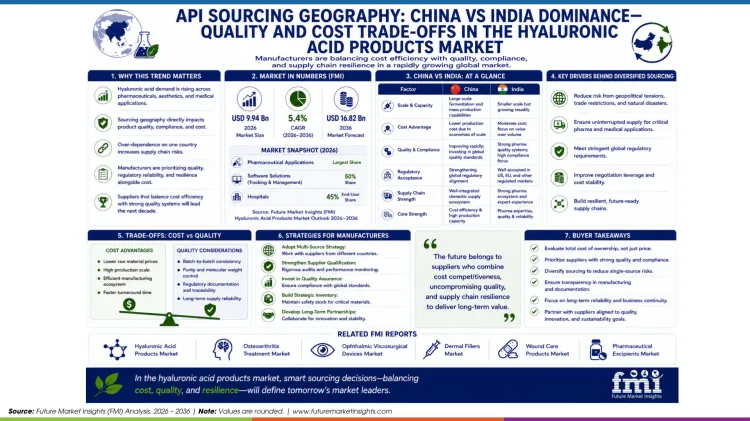
The market for hyaluronic acid products is expanding with physicians and practitioners in the field of aesthetic medicine increasingly using viscosupplementation products, dermal fillers, ophthalmic formulations, and other therapies based on hyaluronic acid. According to Future Market Insights, the market is projected to be valued at USD 9.94 billion in 2026 and is expected to reach USD 16.82 billion by 2036, at a CAGR of 5.4% during the forecast period.
As volumes of production grow, sourcing geography has become an increasingly important strategic consideration. Manufacturers need to evaluate suppliers on more than cost, they need to also consider manufacturing consistency, documentation standards, regulatory compliance and long-term supply reliability.
As a major player in the global hyaluronic acid ecosystem, China is projected to grow at a CAGR of 7.9% through 2036, one of the fastest growing regional markets identified by Future Market Insights. The country’s burgeoning manufacturing capabilities and expanding biotechnology infrastructure make it an important supply contributor in the future.
Similarly, buyers of regulated healthcare applications are focusing more on supplier qualification and quality management systems. For products intended for injectable therapies, ophthalmic applications and other medical uses, strict production controls and consistent product characteristics are required, and supplier evaluation is a multidimensional process, not a simple price comparison.
As a result, procurement organizations are more and more choosing vendors based on manufacturing quality, regulatory readiness, batch-to-batch consistency, documentation support, and business continuity planning, in addition to commercial pricing.
This tendency is also confirmed by the increasing scope of hospital-based treatments. According to FMI, the hospital pharmacies are expected to be the largest distribution channel accounting for 50.3% of distribution in 2026. Institutional healthcare channels tend to have strict purchasing and quality requirements.
Product mix is also a factor in sourcing priorities. The market for single-cycle injection products is projected to reach 54.7% by 2026, highlighting the continuous need for formulations where manufacturing consistency and quality assurance are primary purchasing drivers.
Instead of relying on a single procurement destination, many market participants are likely to improve sourcing resilience by diversifying supplier strategies that foster operational flexibility with a view to regulatory compliance.
The misconception to avoid is the belief that sourcing decisions are driven solely by manufacturing cost. The truth is that long term value is increasingly tied to quality assurance, documentation capability, reliable supply and ability to consistently meet healthcare industry standards.
Bottom Line
Hyaluronic Acid Products Market is projected to grow from USD 9.94 billion in 2026 to USD 16.82 billion by 2036. Sourcing strategy becoming a competitive differentiator. "Companies will be looking for suppliers that can deliver cost efficiency and also reliable quality systems, regulatory compliance and strong long-term supply potential," said the analyst.
Related FMI Reports
- Hyaluronic Acid Products Market
- Dermal Fillers Market
- Osteoarthritis Therapeutics Market
- Ophthalmic Drugs Market
- Regenerative Medicine Market
- Injectable Drug Delivery Market
- Biopharmaceutical Market
- Pharmaceutical Excipients Market
- Medical Aesthetics Market
- Orthobiologics Market

