


Key Takeaways
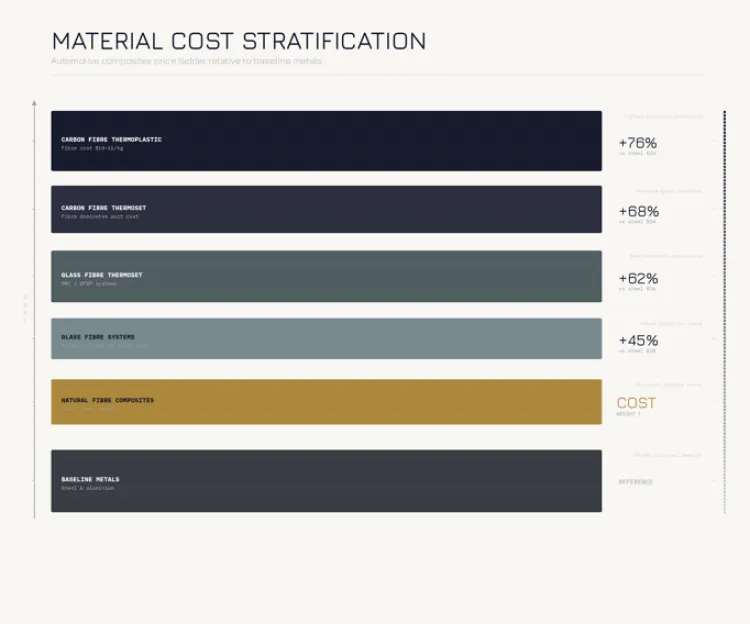
- Techno-economic studies on body-in-white designs show composite structures can cost 60-75% more than steel at 250,000 units a year, with most of the gap explained by material and labour costs.
- For carbon fibre reinforced polymers (CFRP), material alone can account for about 60% of part cost, and recent studies still place industrial carbon fibre production in the roughly 9-11 USD per kg band, so any inefficiency in processing hits the final price hard.
- Glass fibre composites sit on a middle rung of the price ladder, while natural fibre systems (jute, flax, kenaf, bamboo) can undercut both on raw material cost but usually at the expense of higher weight or tighter design margins.
- Process choices matter as much as material. Short cycle compression moulding or high pressure RTM with good parts consolidation spreads capital cost over many parts; hand lay-up, autoclave curing, and high scrap rates keep smaller suppliers stuck at premium prices.
- Regulations on recyclability and lifecycle impact are starting to favour suppliers who can prove credible recycling routes for fibre reinforced polymers or who offer bio-based composite systems. That regulatory "option value" shows up as pricing power in long-term contracts.
How do material choices create the basic price ladder in automotive composites?
Steel and aluminium set the baseline in automotive cost models, so composite prices are usually judged as a premium per kilogram of weight saved relative to those metals. Evidence from ORNL’s body-in-white studies at 250,000 units a year shows large cost gaps, with glass fibre thermoset structures about 62 percent more expensive than steel and carbon fibre thermoplastic structures about 76 percent higher. Inside the composites category the spread is even wider: glass fibre systems such as SMC and GFRP are relatively economical and already used in semi-structural parts, with material representing roughly one-third of total cost, while carbon fibre parts carry far higher input costs, since the fibre alone can cost around 10-11 dollars per kilogram and often accounts for most of the finished part’s cost.
Natural fibre composites such as flax, jute and kenaf sit at the opposite end, offering low raw material cost and favourable embodied-carbon metrics, although they typically produce heavier parts. The National Composites Centre’s SALSA work makes that trade-off explicit by showing that jute panels are cheaper and greener than carbon fibre but heavier. This is why two similar-looking panels from different suppliers can sit on completely different cost curves depending on whether they are glass fibre, carbon fibre or natural fibre, and why pricing rarely converges across manufacturers.
Why do manufacturing processes make the same material cost very different amounts across suppliers?
Cost models for automotive composites make it clear that pricing cannot be separated from process. ORNL’s body-in-white work shows that CFRP monocoques carry a cost split of roughly 60 percent material and 35 percent labour, while glass fibre thermosets sit closer to 29 percent material and 21 percent labour, with the remainder coming from tooling, equipment and overheads. Across manufacturers, the biggest differences come from cycle time, consolidation and yield. High-throughput methods such as compression moulding, high-pressure RTM and injection moulding spread capital cost across many parts, while manual lay-up and long autoclave cures trap smaller suppliers in high labour content and low utilisation.
Designs that consolidate several metal parts into one composite module can reduce assembly steps and deliver lower total system cost, but they demand more complex tooling and strong process control. Scrap and yield amplify the gap further: traditional CFRP routes can generate scrap rates approaching forty percent, which only becomes economical if the supplier has a credible recycling path and tight control over fibre placement and cure quality. This is why two manufacturers using the same carbon fibre can end up with very different price points, with one quoting a lower unit cost or enjoying stronger margins simply because its process delivers shorter cycles, higher yields and more predictable quality.
How do OEM strategies and regulations shape what different suppliers can charge?
Automotive composite pricing is shaped as much by regulatory and risk considerations as by materials or processing. Reviews of natural fibre composites and recycling studies show that strict recyclability targets in Europe and Japan, often above eighty-five to ninety-five percent of vehicle mass, are pushing OEMs toward bio-based and more recyclable composite systems, even though mechanical and thermal recycling routes add cost and only some suppliers can manage them at scale. That capability creates pricing power, because suppliers that can demonstrate lifecycle assessments, recycling pathways and compliance effectively sell regulatory insurance, which OEMs often prioritise over lower upfront part prices.
Premium manufacturers pursuing weight reduction also accept higher cost per kilogram saved and lock in long-term contracts around specific composite architectures, which stabilises pricing for certain Tier 1 suppliers. Emerging carbon fibre routes using coal-derived or lignin-based precursors may offer cost advantages relative to conventional PAN-based fibre, but only suppliers with strong data on durability and long-term availability can capitalise on these savings. This is why the same type of part can attract a low quote from a natural fibre specialist, a mid-range quote from a glass fibre SMC supplier and a high quote from a CFRP integrator offering validated, lightweight structures for high-end models, with the OEM’s own emissions strategy, brand positioning and platform reuse determining which option represents genuine value.
How FMI Can Help
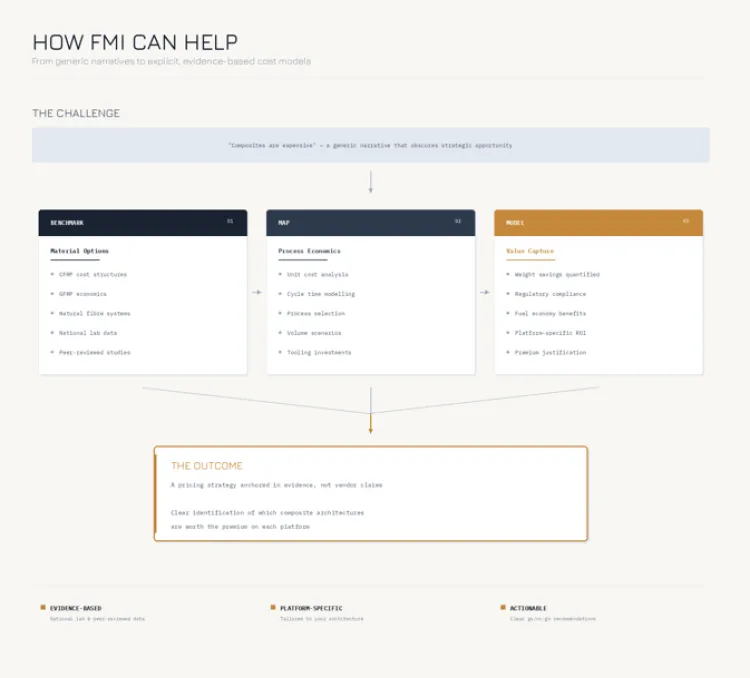
FMI can help OEMs and Tier 1 suppliers move from generic "composites are expensive" narratives to explicit cost models. That includes benchmarking material options across CFRP, GFRP, and natural fibre systems using data from national labs and peer-reviewed studies, mapping process choices to unit cost and cycle times, and building scenario models that connect weight savings to regulatory and fuel economy benefits. The result is a pricing strategy that is anchored in evidence, not in vendor claims, and that makes clear which composite architectures are worth paying a premium for on each platform.
Sources
- Das, S. et al., "Cost of Automotive Polymer Composites," Oak Ridge National Laboratory, cost structure and material share analysis for composite BIW designs.
- Chen, H. et al., "A critical review and meta-analysis of energy demand, carbon footprint, and other environmental impacts from carbon fiber manufacturing," with discussion of carbon fibre manufacturing cost trends and precursor cost shares.
- Engineered Science, "A Review on Natural Fiber Composite Material in Automotive Applications," summary of cost and performance of natural fibre composites in vehicles.
- National Composites Centre, "Project SALSA: Cost and performance vs environmental impact using natural fibres in composite car panels," comparison of jute and carbon fibre panels on cost and environmental metrics.
- Shehab, E. et al., "Cost Modelling for Recycling Fiber-Reinforced Composites," analysis of recycling routes and their cost implications for fibre reinforced polymers.

